
Introduction
This almanac page for Thursday, September 9, 1971, pulls together various records created by the federal government and links to additional resources which can provide context about the events of the day.
Previous Date: Wednesday, September 8, 1971
Next Date: Friday, September 10, 1971
Schedule and Public Documents
The Daily Diary files represent a consolidated record of the President's activities. Visit the finding aid to learn more.
The President's day began at The White House - Washington, D. C.
The Weekly Compilation of Presidential Documents made available transcripts of the President's news conferences; messages to Congress; public speeches, remarks, and statements; and other Presidential materials released by the White House.
Digitized versions can be found at HathiTrust.
Each Public Papers of the Presidents volume contains the papers and speeches of the President of the United States that were issued by the White House Office of the Press Secretary during the time period specified by the volume. The material is presented in chronological order, and the dates shown in the headings are the dates of the documents or events. In instances when the release date differs from the date of the document itself, that fact is shown in the text note.
To ensure accuracy, remarks have been checked against audio recordings (when available) and signed documents have been checked against the original, unless otherwise noted. Editors have provided text notes and cross references for purposes of identification or clarity.
The Federal Register is the official daily publication for rules, proposed rules, and notices of federal agencies and organizations, as well as executive orders and other Presidential documents.
The Congressional Record is the official daily record of the debates and proceedings of the U.S. Congress.
Archival Holdings
Any selection of archival documents will necessarily be partial. You should use the documents and folders identified below as a starting place, but consult the linked collection finding aids and folder title lists and the collections themselves for context. Many documents to be found this way do not lend themselves to association with specific dates, but are essential to a complete understanding of the material.
Selective document listing
President's Office Files
The President's Office Files consists of materials drawn together by the Special Files Unit from several administrative subdivisions within the White House Office. It is the handwriting and sensitive papers sent to the Staff Secretary that now comprise much of the President's Office Files. Visit the finding aid to learn more.
- News Summaries, Unmarked News Summaries, Box 46, News Summaries - September 1971 [3 of 9] [Note: Due to the way News Summary products were compiled, you should also consult nearby days for potentially relevant materials.]
- Digest of Recent News Comment, September 9, 1971
- News Summary, September 9, 1971, (Wed. Newscasts, Wires, Magazines)
- President's Daily Schedule, Box 102, [President's Daily Schedule, Sept.-Dec. 1971] [1 of 3]
- The President's Schedule, Thursday - September 9, 1971
President's Personal File
The President's Personal File is essentially a President's secretary's file, kept by Rose Mary Woods, personal secretary to the President, for two purposes: (1) preserving for posterity a collection of documents particularly close to the President, whether because he dictated or annotated them, or because of the importance of the correspondent or the event concerned and (2) giving appropriate attention–letters of gratitude, invitations to White House social events, and the like–to members and important friends and supporters of the Nixon administration. This generalization does not describe all the varied materials of a file group which is essentially a miscellany, but it does identify the reason for the existence of the file group's core. Visit the finding aid to learn more.
- President's Speech File
The H. R. Haldeman Diaries consists of seven handwritten diaries, 36 dictated diaries recorded as sound recordings, and two handwritten audio cassette tape subject logs. The diaries and logs reflect H. R. Haldeman’s candid personal record and reflections on events, issues, and people encountered during his service in the Nixon White House. As administrative assistant to the President and Chief of Staff, Haldeman attended and participated in public events and private meetings covering the entire scope of issues in which the Nixon White House engaged in during the years 1969-1973. Visit the finding aid to learn more.
- Transcript of diary entry (PDF)
Thursday, September 9.
The President was fascinated this morning to get a report on the Kennedy Center opening of the Mass last night. I described the program, and Bernstein's performance and everything to him, and after asking a few questions and making a few comments, he paused a minute--this was over the phone--and then said, "I just want to ask you one favor. If I'm assassinated, I want you to have them play Dante's Inferno and have Lawrence Welk produce it," which was really pretty funny.
He's talking about ideas for getting things going on the college campuses and had me over at the EOB at 11:00, just before he was going to leave for the speech to Congress, to review some ideas. He wants to get Rogers out talking about peace, and Pete Peterson out giving his foreign trade pitch. Feels we should pick key states and move in on them.
He also raised the point that he was concerned about Ogilvie and Illinois. He thinks that our people are relying too much on the Illinois political leaders, and he's afraid Ogilvie is a terrible drag on us, and that we don't have anyone else to rely on. He wants to be sure we avoid the Party hacks, and that we don't tie totally on the Governor there.
He did a superb job on the speech to Congress, and all the reactions were very good, especially on his presentation and delivery. He called right afterwards on the phone and said "Well, it was a damn dull subject, but that's as good as it could be said," and then he fe-- comment that he feels we need a speech doctor to go through and write in cheer lines, like FDR had, after the speech is written, which is what the President now has to do. Later this afternoon, he got back into the subject of how much time we want on TV, and that sort of thing. He's trying to weigh the question of visibility, whether we should have been on television for the Congress thing today. Maybe the country's in a shape where they want more appearances from the President, and so on.
We had a little flap after his meeting with Connally, in that Connally was concerned about a memo he received, signed by the President, telling him he couldn't go over 20 percent in the Japanese negotiations on the yen. The President felt we should never do a thing like this without checking with Connally first, and he was upset with Alex and me, and so on, for putting this on. We tracked it down, discovered it was a Kissinger proposal. So he called Henry in. Henry pointed out that the directive said that it was just the opposite of what Connally implied. In the first place, the President hadn't signed it, Henry had; secondly, it had been designed for the purpose of putting the responsibility into Connally's area and keeping the other people out of it. Kissinger had read it to Volcker in a meeting--and then sent it over to Connally's office--asking if there was any problem before he sent the memo. So we're back to the problem of internal dissension in Treasury, which I think is fairly substantial. I think Volcker and Walker are both working to try and split Connally from the White House and build their own status with him.
Tonight was the symphony concert opening at Kennedy Center. The President went, handled it very well, called me after the concert at home. Said he would have chosen a different program, thought the orchestra was very good, but that Dorati was trying to show off by doing the Stravinsky thing, that Stern was wasted on a Mozart chamber music piece, and the great chorus was wasted with that odd Schumann composition; so the only quote he put out was that the orchestra found a beautiful home, and the acoustics were great. He again expressed his pleasure at not having had to go to the Mass the night before, which certainly was the right way to handle that.
End of September 9. - Original audio recording (MP3)
The National Archives Catalog is the online portal to the records held at the National Archives, and information about those records. It is the main way of describing our holdings and also provides access to electronic records and digitized versions of our holdings.
The Catalog searches across multiple National Archives resources at once, including archival descriptions, digitized and electronic records, authority records, and web pages from Archives.gov and the Presidential Libraries. The Catalog also allows users to contribute to digitized historical records through tagging and transcription.
Nixon Library Holdings
All National Archives Units
National Security Documents
The President's Daily Brief is the primary vehicle for summarizing the day-to-day sensitive intelligence and analysis, as well as late-breaking reports, for the White House on current and future national security issues. Read "The President's Daily Brief: Delivering Intelligence to Nixon and Ford" to learn more.
The Foreign Relations of the United States series presents the official documentary historical record of major U.S. foreign policy decisions and significant diplomatic activity. Visit the State Department website for more information.
Vol. V, United Nations, 1969-1972
Secretary-General Succession
222. Memorandum From Marshall Wright of the National Security Council Staff to the President’s Assistant for National Security Affairs (Kissinger), Washington, September 9, 1971
Source: National Archives, Nixon Presidential Materials, NSC Files, Box 301, Agency Files, USUN, Vol. VII. Confidential. Sent for information. Kissinger’s handwritten note in the margin reads: “Marshall—Let’s do what is possible to get rid of Thant. HK”
Vol. XIX, Part 2, Japan, 1969-1972
April-October 1971: Change and Reassessment
95. Memorandum From the President’s Assistant for National Security Affairs (Kissinger) to President Nixon, Washington, September 9, 1971
Source: National Archives, Nixon Presidential Materials, NSC Files, Box 536, Country Files, Far East, Japan, Vol. V, 1 Jul–Sep 71. Secret. Sent for information. A notation on the memorandum indicates Nixon saw it. Kissinger forwarded this memorandum to the President as Hormats and Froebe recommended in their September 3 memorandum. (Ibid.) Kissinger edited the Hormats/Froebe draft by eliminating a paragraph that read: “In retrospect, the effect of our China and economic initiatives was probably to accelerate Prime Minister Sato’s departure from the Japanese political scene—his opponents added their heavy criticism of his handling of U.S.-Japan relations and China policy to their earlier mounting criticism of him on several other scores. On China policy, they claimed that Japan had to develop an independent policy to keep the U.S. from getting out in front in normalizing relations with Peking.” (Ibid.)
Vol. XXI, Chile, 1969-1973
Cool and Correct: The U.S. Response to the Allende Administration, November 5, 1970-December 31, 1972
257. Minutes of a Meeting of the Senior Review Group, Washington, September 9, 1971, 3:01-3:45 p.m.
Source: National Archives, Nixon Presidential Materials, NSC Files, NSC Institutional Files (H-Files), Box H–112, SRG Minutes, 1971. Secret; Nodis. The meeting took place in the White House Situation Room. Kissinger initialed and wrote “OK” on a September 13 covering memorandum from Davis transmitting the minutes. (Ibid.) A copy was sent to Kennedy and Nachmanoff. All brackets are in the original.
258. Memorandum for the Record, Washington, September 9, 1971
Source: National Security Council, Nixon Intelligence Files, Subject Files, Chile, Minutes of 40 Committee. Secret; Eyes Only. Drafted by Jessup on September 16. A copy was sent to Mitchell, Packard, Johnson, Admiral Moorer, and Helms.
Vol. E-4, Documents on Iran and Iraq, 1969-1972
Iran 1971
143. Action Memorandum from the Assistant Secretary for Near Eastern and South Asian Affairs (Sisco) to Secretary of State Rogers, Washington, September 9, 1971
Sisco advised Rogers on the status of British-Iranian negotiations over the Gulf islands, in which the United Kingdom and Iran had reached agreement in principle but had yet to obtain the consent of the sheikhs.
Source: National Archives, RG 59, Central Files 1970–73, POL 33–3 PERSIAN GULF. Secret. Drafted by Joseph W. Twinam (NEA/ARP); cleared by Davies (NEA), Burns (EUR/BMI), Dowell (NEA/IRN), and Murphy (NEA/ARP). The proposed letter, Tab A, is published as Document 144. Tabs B and C are not published. The substance of this message was included in the material submitted to Kissinger on September 8 for the President’s Thursday Briefing. (Ibid., Nixon Presidential Materials, NSC Files, Box 1268, Saunders Files, Middle East Negotiations, 6/1/71–12/31/71.)
The Kissinger telephone conversation transcripts consist of approximately 20,000 pages of transcripts of Kissinger’s telephone conversations during his tenure as Assistant to the President for National Security Affairs (1969-1974) and Secretary of State (1973-1974) during the administration of President Richard Nixon. Visit the finding aid for more information.
Digitized versions can be found in the National Archives Catalog.
Audiovisual Holdings
The White House Tapes are sound recordings of President Richard Nixon's telephone conversations and of meetings held in the Oval Office and the Cabinet Room in the White House, the President's office in the Old Executive Office Building (OEOB), the Lincoln Sitting Room in the residence section of the White House, and several locations at the Presidential retreat at Camp David, Maryland. These recordings document many of the major events and decisions of the Nixon Administration from February 16, 1971 to July 18, 1973. Visit the White House Tapes finding aid to learn about the taping system's operation and archival processing.
Old Executive Office Building
- 278-1; Unknown between 1:20 p.m. & 1:33 p.m.; Nixon, Richard M. (President); Haldeman, H. R. ("Bob")
- 278-2; Unknown between 1:20 p.m. & 1:33 p.m.; Nixon, Richard M. (President); White House operator
- 278-3; Unknown between 1:20 p.m. & 1:33 p.m.; Nixon, Richard M. (President); Sanchez, Manolo
- 278-4; Unknown between 1:20 p.m. & 1:33 p.m.; Nixon, Richard M. (President); Haldeman, H. R. ("Bob")
- 278-5; 1:33 p.m. - 1:33 p.m.; Nixon, Richard M. (President); Sanchez, Manolo
- 278-6; 1:33 p.m. - 1:39 p.m.; Nixon, Richard M. (President); Colson, Charles W.
- 278-7; Unknown between 1:39 p.m. & 1:48 p.m.; Nixon, Richard M. (President); Sanchez, Manolo
- 278-8; Unknown between 1:39 p.m. & 1:48 p.m.; Nixon, Richard M. (President); White House operator
- 278-9; 1:48 p.m. - 1:52 p.m.; Nixon, Richard M. (President); Finch, Robert H.
- 278-10; Unknown between 1:52 p.m. & 1:58 p.m.; Nixon, Richard M. (President); Haldeman, H. R. ("Bob")
- 278-11; Unknown between 1:58 p.m. & 2:03 p.m.; Nixon, Richard M. (President); Colson, Charles W.
- 278-12; Unknown between 2:03 p.m. & 2:05 p.m.; Nixon, Richard M. (President); White House operator
- 278-13; 2:05 p.m. - 2:08 p.m.; Nixon, Richard M. (President); MacGregor, Clark
- 278-14; Unknown between 2:08 p.m. & 2:11 p.m.; Nixon, Richard M. (President); White House operator
- 278-15; Unknown between 2:08 p.m. & 2:11 p.m.; Nixon, Richard M. (President); White House operator
- 278-16; 2:11 p.m. - 2:12 p.m.; Nixon, Richard M. (President); Buchanan, Patrick J.
- 278-17; 2:13 p.m. - 2:14 p.m.; Nixon, Richard M. (President); Price, Raymond K., Jr.
- 278-18; 2:19 p.m. - 2:28 p.m.; Nixon, Richard M. (President); Haldeman, H. R. ("Bob")
- 278-19; Unknown between 2:28 p.m. & 2:57 p.m.; Nixon, Richard M. (President); Sanchez, Manolo
- 278-20; Unknown between 2:28 p.m., 9/9 & 3:44 p.m., 8/3; Nixon, Richard M. (President); [Unknown person(s)]
Oval Office
- 568-1; Unknown between 1:18 p.m. & 1:22 p.m.; United States Secret Service agents
- 568-2; Unknown between 2:57 p.m. & 3:03 p.m.; Nixon, Richard M. (President); Bull, Stephen B.
- 568-3; Unknown between 2:57 p.m. & 3:03 p.m.; Nixon, Richard M. (President); Krogh, Egil ("Bud"), Jr.
- 568-4; 3:03 p.m. - 3:34 p.m.; Nixon, Richard M. (President); Shafer, Raymond P.; Jaffe, Jerome H. (Dr.); Krogh, Egil ("Bud"), Jr.; White House photographer; Sanchez, Manolo
- 568-5; Unknown between 3:34 p.m. & 3:38 p.m.; Nixon, Richard M. (President); Bull, Stephen B.
- 568-6; Unknown between 3:34 p.m. & 3:56 p.m.; Bull, Stephen B.; Solomon, Ezra; Solomon, Janet Lorraine; Solomon, Catherine; Solomon, Janet; Stein, Herbert; Solomon, Lorna; Richey, Judge Charles R.; Shultz, George P.; White House photographer; [Unknown person(s)]; Carlucci, Frank C., III; Carlucci, Jean Phyliss (Anthony); Carlucci, Karen; Carlucci, Frank C., IV; Carlucci, Frank C., II; Rumsfeld, Donald H.; White House photographer
- 568-7; 3:56 p.m. - 3:56 p.m.; Nixon, Richard M. (President); Bull, Stephen B.
- 568-8; 3:56 p.m. - 3:57 p.m.; Haldeman, H. R. ("Bob"); Butterfield, Alexander P.
- 568-9; Unknown between 3:58 p.m. & 5:06 p.m.; Nixon, Richard M. (President); Haldeman, H. R. ("Bob"); Bull, Stephen B.
- 568-10; Unknown between 4:05 p.m. & 5:06 p.m.; Nixon, Richard M. (President); Sanchez, Manolo
- 568-11; Unknown between 4:05 p.m. & 5:06 p.m.; Nixon, Richard M. (President); White House operator
- 568-12; Unknown between 4:05 p.m. & 6:00 p.m.; Nixon, Richard M. (President); Butterfield, Alexander P.; Haldeman, H. R. ("Bob"); Woods, Rose Mary; Nixon, Thelma C. ("Pat") (Ryan); Kissinger, Henry A.; White House operator; Shultz, George P.
- 568-13; Unknown between 6:00 p.m. & 8:26 p.m.; United States Secret Service agents
White House Telephone
- 8-60; Unknown between 9:04 a.m. & 10:11 a.m.; Nixon, Richard M. (President); White House operator
- 8-61; 10:11 a.m. - 10:20 a.m.; Nixon, Richard M. (President); Butterfield, Alexander P.
- 8-62; Unknown between 10:20 a.m. & 11:01 a.m.; Nixon, Richard M. (President); White House operator
- 8-63; 11:01 a.m. - 11:13 a.m.; Nixon, Richard M. (President); Haldeman, H. R. ("Bob")
- 8-64; Unknown between 11:13 a.m. & 11:18 a.m.; Nixon, Richard M. (President); White House operator
- 8-65; 11:18 a.m. - 11:23 a.m.; Nixon, Richard M. (President); Colson, Charles W.
- 8-66; Unknown between 1:20 p.m. & 1:33 p.m.; Nixon, Richard M. (President); White House operator
- 8-67; 1:33 p.m. - 1:39 p.m.; Nixon, Richard M. (President); Colson, Charles W.; Sanchez, Manolo
- 8-68; Unknown between 1:39 p.m. & 1:48 p.m.; Nixon, Richard M. (President); White House operator
- 8-69; 1:48 p.m. - 1:52 p.m.; Nixon, Richard M. (President); Finch, Robert H.
- 8-70; 1:58 p.m. - 2:03 p.m.; Nixon, Richard M. (President); Colson, Charles W.
- 8-71; Unknown between 2:03 p.m. & 2:05 p.m.; Nixon, Richard M. (President); White House operator
- 8-72; 2:05 p.m. - 2:08 p.m.; Nixon, Richard M. (President); MacGregor, Clark
- 8-73; Unknown between 2:08 p.m. & 2:11 p.m.; Nixon, Richard M. (President); White House operator
- 8-74; Unknown between 2:08 p.m. & 2:11 p.m.; Nixon, Richard M. (President); White House operator
- 8-75; 2:11 p.m. - 2:12 p.m.; Nixon, Richard M. (President); Buchanan, Patrick J.
- 8-76; 2:13 p.m. - 2:14 p.m.; Nixon, Richard M. (President); Price, Raymond K., Jr.
- 8-77; 2:19 p.m. - 2:28 p.m.; Nixon, Richard M. (President); Haldeman, H. R. ("Bob")
- 8-78; Unknown between 2:28 p.m. & 5:06 p.m.; Nixon, Richard M. (President); White House operator
- 8-79; 5:06 p.m. - 5:08 p.m.; Nixon, Richard M. (President); Woods, Rose Mary; [Unknown person(s)]
- 8-80; Unknown between 5:08 p.m. & 5:11 p.m.; Nixon, Richard M. (President); White House operator
- 8-81; 5:11 p.m. - 5:12 p.m.; Nixon, Richard M. (President); Nixon, Thelma C. ("Pat") (Ryan)
- 8-82; Unknown between 5:12 p.m. & 6:01 p.m.; Haldeman, H. R. ("Bob"); White House operator
The White House Photo Office collection consists of photographic coverage of President Richard Nixon meeting with prominent social, political, and cultural personalities; speaking engagements and news conferences of the President and various high-ranking members of the White House staff and Cabinet; Presidential domestic and foreign travel, including Presidential vacations; social events and entertainment involving the First Family, including entertainers present; official portraits of the President, First Family, and high-ranking members of the Nixon administration; the 1969 and 1973 Inaugurals; the President’s 1972 Presidential election campaign appearances (including speeches) and other official activities of the White House staff and the President’s Cabinet from January 20, 1969 until August 9, 1974 at the White House and the Old Executive Office Building; other locations in Washington, DC, such as The Mall; and the Presidential retreats in Camp David, Maryland, Key Biscayne, Florida, and San Clemente, California. Visit the finding aid to learn more.
Roll WHPO-7208 Photographer: Schumaker, Byron | Color or B&W: B&W
- Frame(s): WHPO-7208-02-12, President Nixon addressing a joint session of Congress on his new economic policy. 9/9/1971, Washington, D.C. U. S. Capitol, House Chamber. President Nixon, members of Congress.
- Frame(s): WHPO-7208-06, President Nixon addressing a joint session of Congress on his new economic policy. View shows most of the room with 2nd floor gallery. 9/9/1971, Washington, D.C. U. S. Capitol, House Chamber. President Nixon, Vice President Agnew, Carl Albert, members of Congress.
- Frame(s): WHPO-7208-12, President Nixon receiving a standing ovation while at the podium to address a joint session of Congress on his new economic policy. 9/9/1971, Washington, D.C. U. S. Capitol, House Chamber. President Nixon, Vice President Agnew, Carl Albert, members of Congress.
Roll WHPO-7209 Photographer: Schumaker, Byron | Color or B&W: B&W
- Frame(s): WHPO-7209-02, President Nixon entering the House Chamber to address members of Congress about his new economic policy. 9/9/1971, Washington, D.C. U. S. Capitol, House Chamber. President Nixon, members of Congress, Nixon family members, staff, officials, guests.
- Frame(s): WHPO-7209-03-19, President Nixon addressing members of Congress about his new economic policy. 9/9/1971, Washington, D.C. U. S. Capitol, House Chamber. President Nixon, members of Congress, Nixon family members, staff, officials, guests.
- Frame(s): WHPO-7209-20-22, President Nixon leaving the Capitol building. 9/9/1971, Washington, D.C. U. S. Capitol, House Chamber. President Nixon, members of Congress, Nixon family members, staff, officials, guests.
Roll WHPO-7210 Photographer: Atkins, Oliver | Color or B&W: B&W
- Frame(s): WHPO-7210-04-14, President Nixon addressing a joint session of Congress about his economic policy. 9/9/1971, Washington, D.C. U. S. Capitol, House Chamber. President Nixon, Carl Albert, Spiro Agnew, Floyd Riddick, Hale Boggs, Jacob Javits, Robert Byrd, Allen Ellender, John Tower, Gerald Ford, members of Congress.
- Frame(s): WHPO-7210-15-27A, President Nixon at the podium, talking with Congressmen after his address. 9/9/1971, Washington, D.C. U. S. Capitol, House Chamber. President Nixon, Carl Albert, Spiro Agnew, Floyd Riddick, Hale Boggs, Jacob Javits, Robert Byrd, Allen Ellender, John Tower, Gerald Ford, members of Congress.
Roll WHPO-7211 Photographer: Atkins, Oliver | Color or B&W: Color
- Frame(s): WHPO-7211-02A-11A, President Nixon's family members and others in the gallery. 9/9/1971, Washington, D.C. U. S. Capitol, House Chamber. President Nixon, Carl Albert, Spiro Agnew, Floyd Riddick, Nixon family members, staff, officials, guests, members of Congress.
- Frame(s): WHPO-7211-12A-33A, President Nixon addressing Congress about his new economic policy. 9/9/1971, Washington, D.C. U. S. Capitol, House Chamber. President Nixon, Carl Albert, Spiro Agnew, Floyd Riddick, Nixon family members, staff, officials, guests, members of Congress.
- Frame(s): WHPO-7211-22A, President Nixon addressing Congress about his new economic policy. 9/9/1971, Washington, D.C. U. S. Capitol, House Chamber. President Nixon, Carl Albert, Spiro Agnew, Floyd Riddick, Nixon family members, staff, officials, guests, members of Congress.
- Frame(s): WHPO-7211-24A, President Nixon addressing Congress about his new economic policy. 9/9/1971, Washington, D.C. U. S. Capitol, House Chamber. President Nixon, Carl Albert, Spiro Agnew, Floyd Riddick, Nixon family members, staff, officials, guests, members of Congress.
- Frame(s): WHPO-7211-28A, President Nixon addressing Congress about his new economic policy. 9/9/1971, Washington, D.C. U. S. Capitol, House Chamber. President Nixon, Carl Albert, Spiro Agnew, Floyd Riddick, Nixon family members, staff, officials, guests, members of Congress.
Roll WHPO-7212 Photographer: Schumaker, Byron | Color or B&W: B&W
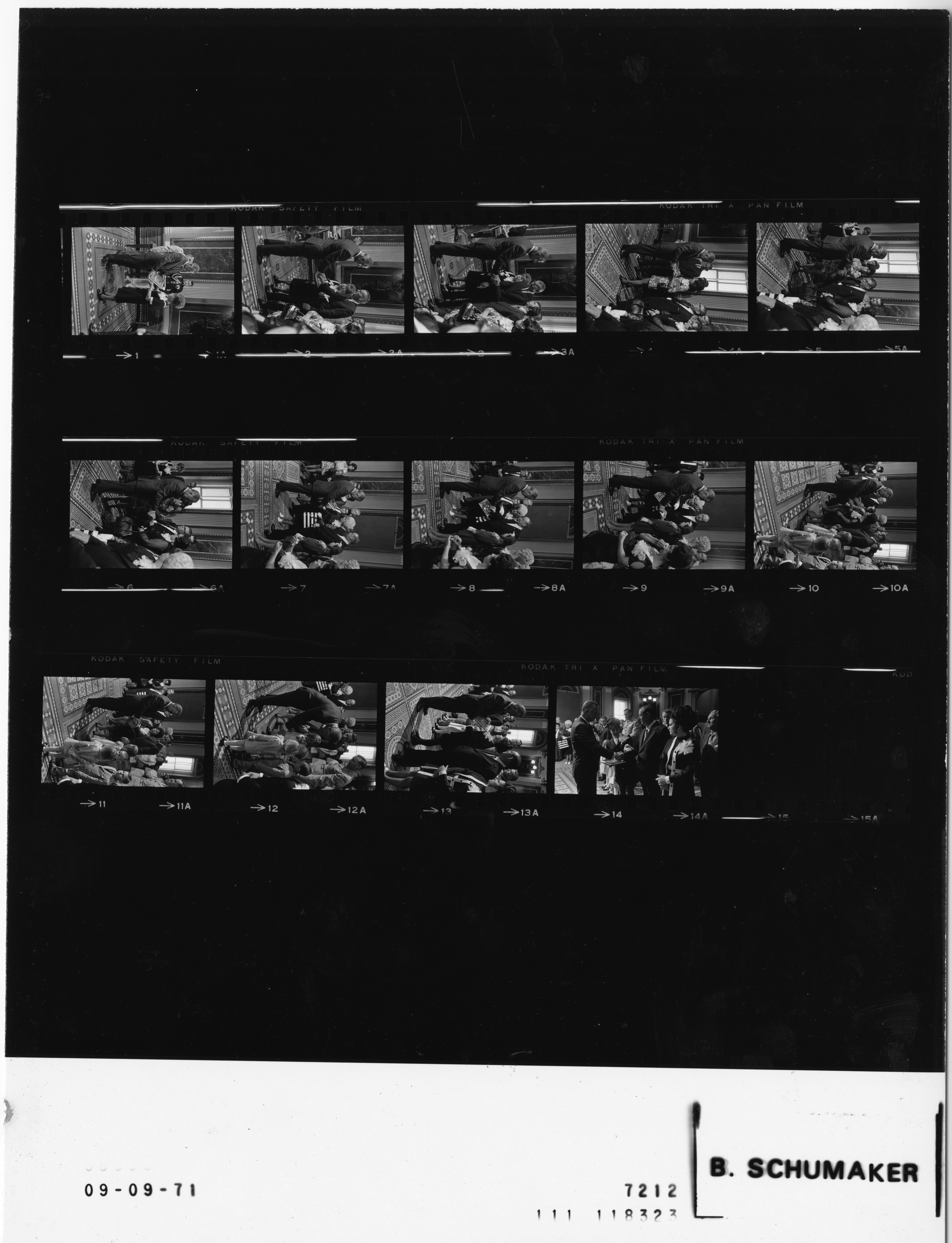
- Frame(s): WHPO-7212-01-14, Vice President Agnew awarding Medals of Honor posthumously to the families of the honored servicemen. 9/9/1971, Washington, D.C. unknown. Spiro Agnew, unidentified families, aides.
Roll WHPO-7213 Photographer: Knudsen, Robert L. | Color or B&W: Color
- Frame(s): WHPO-7213-02-34, The Change of Command ceremony of the Naval Administrative Unit, Washington, D.C., with LCDR Robert Johnson leaving the post and LCDR George Phillips assuming it. 9/9/1971, Washington, D.C. Washington Navy Yard. Robert Johnson, George Phillips, officials, guests.
Roll WHPO-7214 Photographer: Knudsen, Robert L. | Color or B&W: Color
- Frame(s): WHPO-7214-02-15, The Change of Command ceremony of the Naval Administrative Unit, Washington, D.C., as LCDR Robert Johnson leaving the post and LCDR George Phillips assuming it. 9/9/1971, Washington, D.C. Washington Navy Yard. Robert Johnson, George Phillips, officials, guests.
Roll WHPO-7215 Photographer: Atkins, Oliver | Color or B&W: B&W
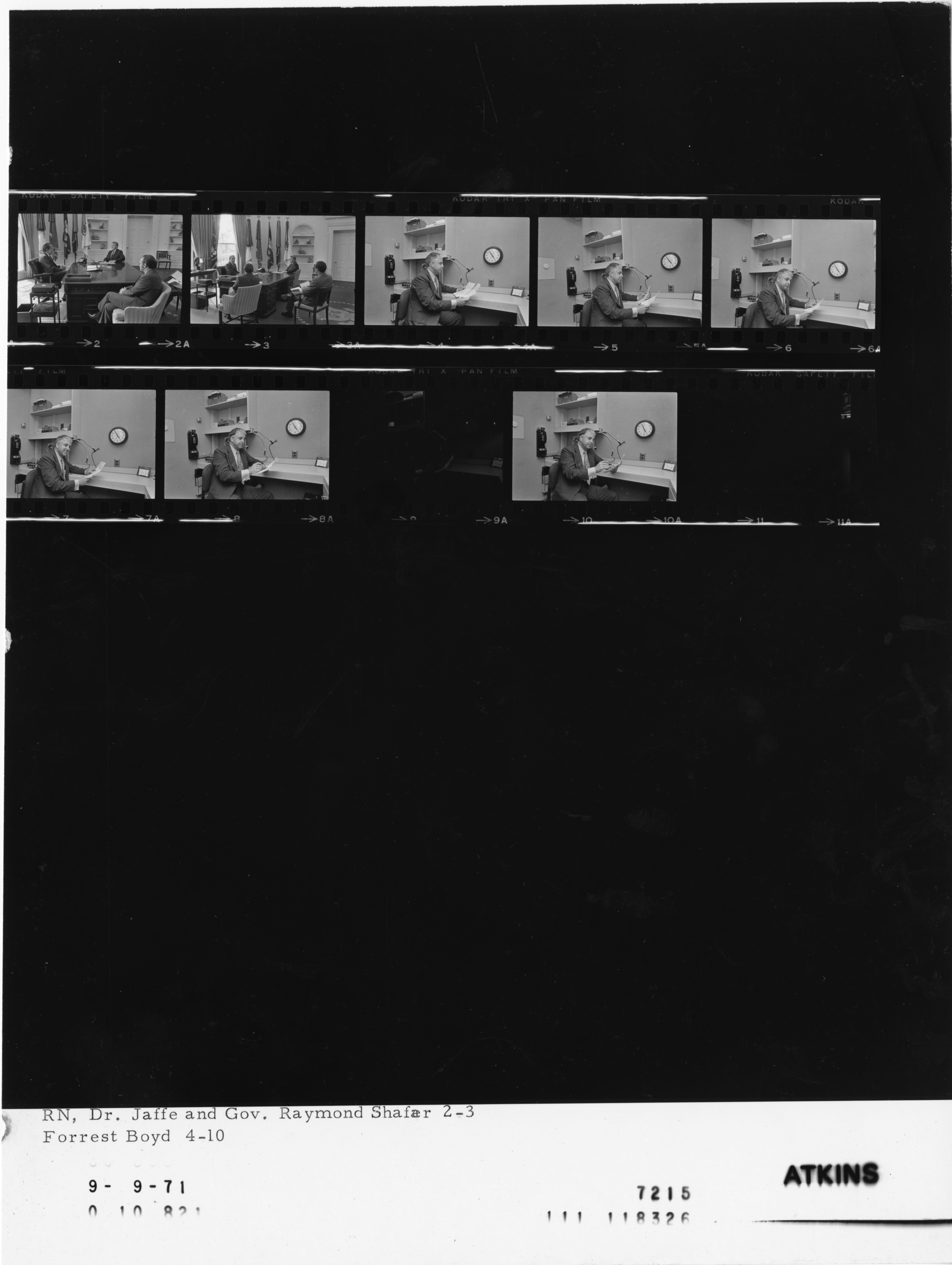
- Frame(s): WHPO-7215-02-03, President Nixon seated at his desk during a meeting with Raymond Shafer, Chairman of the Marijuana Commission, and Jerome Jaffe. 9/9/1971, Washington, D.C. White House, Oval Office. President Nixon, Raymond Shafer, Jerome Jaffe, Egil Krogh.
- Frame(s): WHPO-7215-04-10, Forrest Boyd sitting in a broadcasting booth. 9/9/1971, Washington, D.C. White House, Mutual Broadcasting booth. Forrest Boyd.
Roll WHPO-7216 Photographer: Kightlinger, Jack | Color or B&W: B&W
- Frame(s): WHPO-7216-03A-08A, President Nixon, Pat Nixon, family members, and guests in the Kennedy Center Presidential Box. 9/9/1971, Washington, D.C. Kennedy Center, Presidential Box and anteroom. President Nixon, Pat Nixon, Tricia Nixon Cox, Ed Cox, Mamie Eisenhower, guests, Antal Dorati, Isaac Stern, Mrs. Stern, Jouett Shouse, Gregory Peck, Helen Hayes, unidentified persons.
- Frame(s): WHPO-7216-09A-19A, President Nixon and Pat Nixon with Mamie Eisenhower, greeting conductor Antal Dorati, violinist Isaac Stern and Mrs. Stern, Jouett Shouse, actor Gregory Peck, and actress Helen Hayes in the box's anteroom. 9/9/1971, Washington, D.C. Kennedy Center, Presidential Box and anteroom. President Nixon, Pat Nixon, Tricia Nixon Cox, Ed Cox, Mamie Eisenhower, guests, Antal Dorati, Isaac Stern, Mrs. Stern, Jouett Shouse, Gregory Peck, Helen Hayes, unidentified persons.
- Frame(s): WHPO-7216-10A, President Nixon and Pat Nixon with former First Lady Mamie Eisenhower, greeting conductor Antal Dorati. 9/9/1971, Washington, D.C. Kennedy Center, Presidential Box and anteroom. President Nixon, Pat Nixon, Mamie Eisenhower, Antal Dorati, unidentified persons.
- Frame(s): WHPO-7216-16A, President Nixon and Pat Nixon with former First Lady Mamie Eisenhower, standing and applauding in the Kennedy Center Presidential Box. 9/9/1971, Washington, D.C. Kennedy Center, Presidential Box and anteroom. President Nixon, Pat Nixon, Mamie Eisenhower, Ed Cox.
- Frame(s): WHPO-7216-18A, President Nixon and Pat Nixon with former First Lady Mamie Eisenhower, greeting actress Helen Hayes in the Presidential Box's anteroom. 9/9/1971, Washington, D.C. Kennedy Center, Presidential Box and anteroom. President Nixon, Pat Nixon, Mamie Eisenhower, Helen Hayes, Antal Dorati.
Roll WHPO-7217 Photographer: Kightlinger, Jack | Color or B&W: B&W
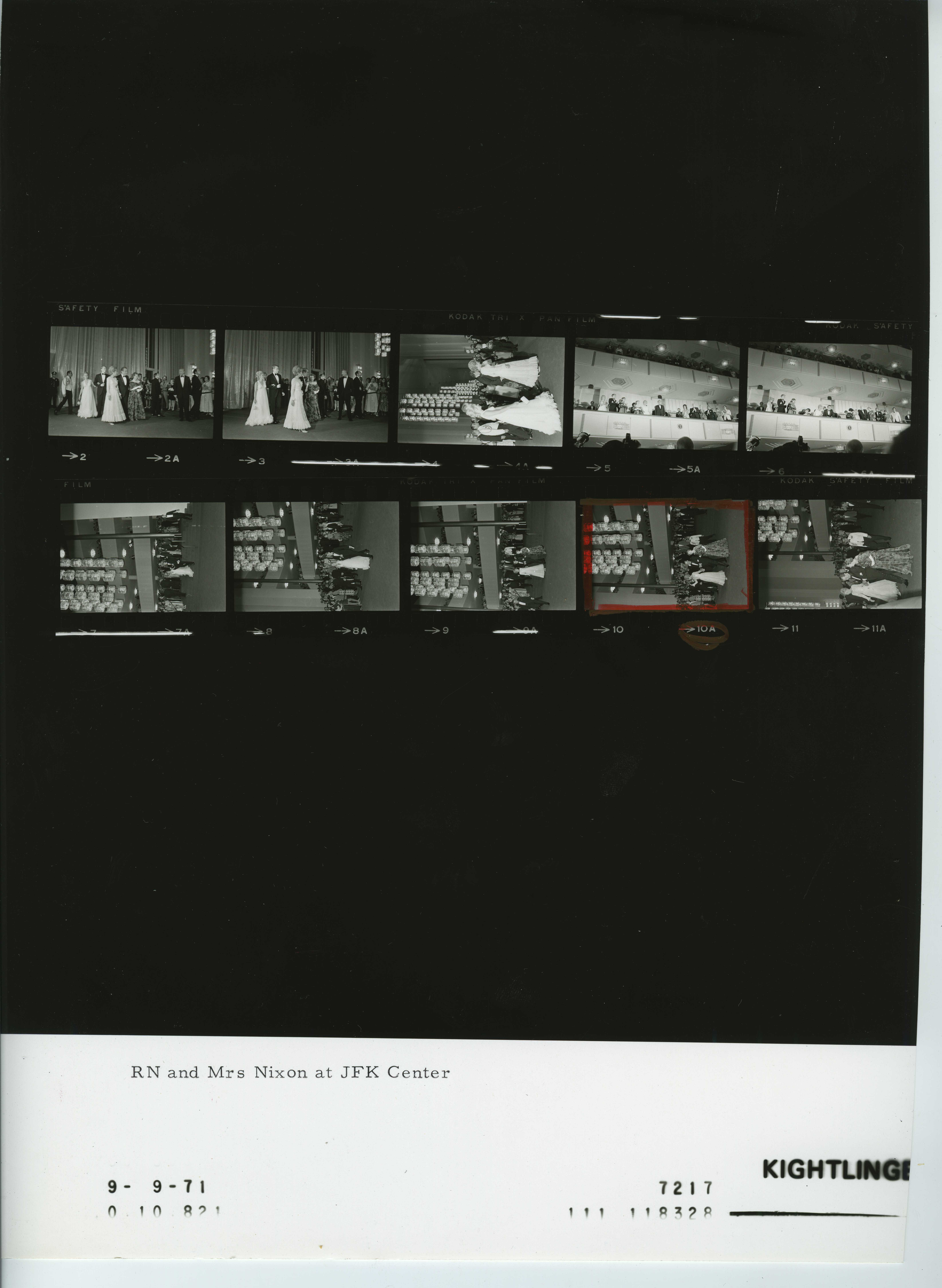
- Frame(s): WHPO-7217-02-04, President Nixon and family members in the Kennedy Center hallway before the concert. 9/9/1971, Washington, D.C. Kennedy Center, hallway. President Nixon, Pat Nixon, Mamie Eisenhower, Tricia Nixon Cox, Ed Cox, guests, audience.
- Frame(s): WHPO-7217-05-06, President Nixon and Pat Nixon acknowledging the audience at the Kennedy Center. 9/9/1971, Washington, D.C. Kennedy Center, Presidential Box. President Nixon, Pat Nixon, Mamie Eisenhower, Tricia Nixon Cox, Ed Cox, guests, audience.
- Frame(s): WHPO-7217-07-11, President Nixon escorting former First Lady Mamie Eisenhower and Pat Nixon through the Kennedy Center lobby after the concert. 9/9/1971, Washington, D.C. Kennedy Center, hallway. President Nixon, Pat Nixon, Mamie Eisenhower, Tricia Nixon Cox, Ed Cox, guests, audience.
- Frame(s): WHPO-7217-10A, President Nixon escorting former First Lady Mamie Eisenhower and Pat Nixon through the Kennedy Center lobby after the concert. 9/9/1971, Washington, D.C. Kennedy Center, hallway. President Nixon, Pat Nixon, Mamie Eisenhower, guests, audience.
Roll WHPO-7218 Photographer: Kightlinger, Jack | Color or B&W: Color
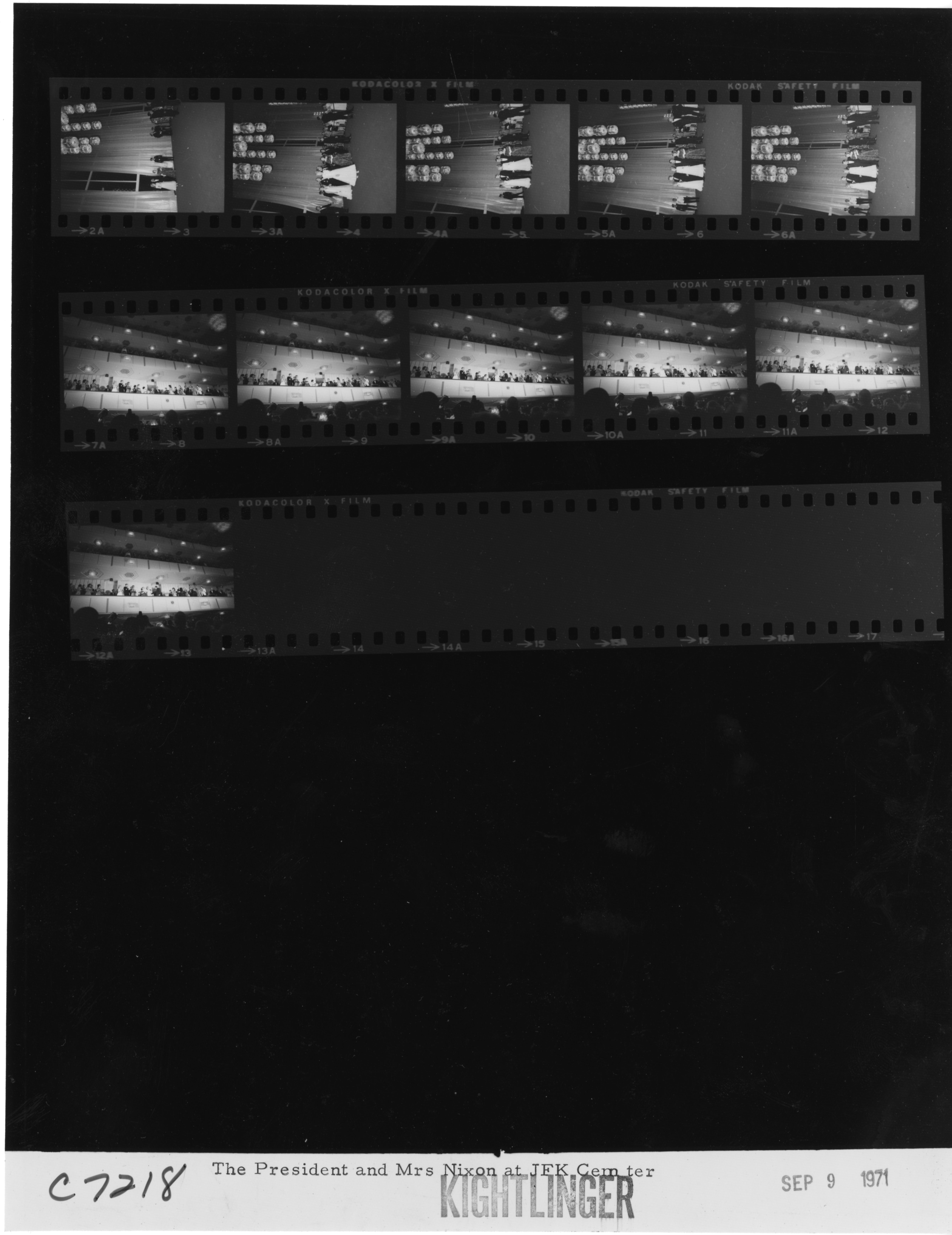
- Frame(s): WHPO-7218-02A-06A, President Nixon and family members in the Kennedy Center hallway. 9/9/1971, Washington, D.C. Kennedy Center, Hallway. President Nixon, Pat Nixon, Nixon family members, guests, audience.
- Frame(s): WHPO-7218-04, President Nixon, Pat Nixon, former First Lady Mamie Eisenhower, Tricia Nixon Cox, and Ed Cox in the Kennedy Center hallway. 9/9/1971, Washington, D.C. Kennedy Center, Hallway. President Nixon, Pat Nixon, Tricia Nixon Cox, Ed Cox, Mamie Eisenhower, guests, audience.
- Frame(s): WHPO-7218-07A-12A, President Nixon and Pat Nixon entering the Kennedy Center Presidential Box and acknowledge the audience. 9/9/1971, Washington, D.C. Kennedy Center, Presidential Box. President Nixon, Pat Nixon, Nixon family members, guests, audience.
Roll WHPO-7219 Photographer: Schumaker, Byron | Color or B&W: B&W
- Frame(s): WHPO-7219-01-10, President Nixon at the swearing-in ceremony administered by Judge Charles Richey for Ezra Solomon as a Member of the Council of Economic Advlsors (CEA). 9/9/1971, Washington, D.C. White House, Oval Office. President Nixon, Judge Charles Richey, Ezra Solomon, Janet (Cameron) Solomon, Solomon children, Frank C. Carlucci III, Mrs. Carlucci, Carlucci children, Mr. & Mrs. Frank Carlucci II.
- Frame(s): WHPO-7219-03, President Nixon at the swearing-in ceremony administered by Judge Charles Richey for Ezra Solomon as a Member of the Council of Economic Advlsors (CEA). 9/9/1971, Washington, D.C. White House, Oval Office. President Nixon, Judge Charles Richey, Ezra Solomon, Janet (Cameron) Solomon.
- Frame(s): WHPO-7219-13-23, President Nixon and Donald Rumsfeld at the swearing-in ceremony administered by Judge Charles Richey for Frank Carlucci III. 9/9/1971, Washington, D.C. White House, Oval Office. President Nixon, Judge Charles Richey, Frank C. Carlucci III, Mrs. Carlucci, Carlucci children, Mr. & Mrs. Frank Carlucci II, Donald Rumsfeld.
- Frame(s): WHPO-7219-16, President Nixon and Donald Rumsfeld at the swearing-in ceremony administered by Judge Charles Richey for Frank Carlucci III. 9/9/1971, Washington, D.C. White House, Oval Office. President Nixon, Judge Charles Richey, Frank C. Carlucci III, Mrs. Carlucci, Donald Rumsfeld.
The White House Communications Agency Sound Recordings Collection contains public statements that took place between 1969 and 1974. Visit the finding aid to learn more.
B - Vice-Presidential (Agnew and Ford)
- WHCA-SR-B-190
Posthumous Medal of Honor presentation ceremony with remarks by Vice President Agnew. (9/9/1971, Indian Treaty Room, the White House)
Runtime: 0:06:50
Production credits: Audio feed supplied by WHCA; Recorded by RAS (initials of WHCA engineer)
Original Format: 1/4-inch reel-to-reel audiotape. Original source type: Original. Technical notes: 20 seconds of silence at beginning and 1 minute and 14 seconds of silence at end of recording removed from access copies.
P - Formal Presidential Remarks
- WHCA-SR-P-710904
Remarks by President Nixon to Joint Session of Congress on New Economic Policy with Carl Albert. (9/9/1971)
Runtime: 27:45:00
Original Format: 1/4-inch reel-to-reel audiotape. Original source type: Original.
The White House Communications Agency Videotape Collection contains “off-the-air” recordings of televised programs produced between 1968 and 1974. Visit the finding aid to learn more.
- WHCA-4636
Nixon before the Joint Session of Congress…The Economy (with commentary).
ALL NETWORKS
Runtime: 01:05:25 - WHCA-4637
"Nixon Before Joint Session of Congress".
ALL NETWORKS
Runtime: 0:30 - WHCA-4638
"The President at [birthplace] Loma Linda". FTN: Secretary of Commerce Maurice Stans; "MTP": UAW President Leonard Woodcock; "I&A": Secretary of Labor James C. Hodgson.
CBS, NBC, ABC
Runtime: 01:06:12 - WHCA-4639
Weekly News Summary, Tape I. Excerpts of evening network news broadcasts from the week of 9/3/71 to 9/9/71 Eric Sevareid.
CBS
Runtime: 1:30 - WHCA-4640
Weekly News Summary, Tape II. Excerpts of evening network news broadcasts from the week of 9/3/71 to 9/9/71 Julie Nixon Eisenhower, Tricia Nixon, Luci Baines Johnson Nugent, Lynda Johnson Robb.
CBS
Runtime: 1:30 - WHCA-4641
Weekly News Summary, Tape III. Excerpts of evening network news broadcasts from the week of 9/3/71 to 9/9/71 Walter Rostow.
Southern Educational Communications Association
Runtime: 1:00
Context (External Sources)
The Vanderbilt Television News Archive is the world's most extensive and complete archive of television news. They have been recording, preserving and providing access to television news broadcasts of the national networks since August 5, 1968.
Wikipedia is a free encyclopedia that anyone can edit.