
Introduction
This almanac page for Wednesday, October 27, 1971, pulls together various records created by the federal government and links to additional resources which can provide context about the events of the day.
Previous Date: Tuesday, October 26, 1971
Next Date: Thursday, October 28, 1971
Schedule and Public Documents
The Daily Diary files represent a consolidated record of the President's activities. Visit the finding aid to learn more.
The President's day began at The White House - Washington, D. C.
The Weekly Compilation of Presidential Documents made available transcripts of the President's news conferences; messages to Congress; public speeches, remarks, and statements; and other Presidential materials released by the White House.
Digitized versions can be found at HathiTrust.
The Federal Register is the official daily publication for rules, proposed rules, and notices of federal agencies and organizations, as well as executive orders and other Presidential documents.
The Congressional Record is the official daily record of the debates and proceedings of the U.S. Congress.
Archival Holdings
Any selection of archival documents will necessarily be partial. You should use the documents and folders identified below as a starting place, but consult the linked collection finding aids and folder title lists and the collections themselves for context. Many documents to be found this way do not lend themselves to association with specific dates, but are essential to a complete understanding of the material.
Selective document listing
President's Office Files
The President's Office Files consists of materials drawn together by the Special Files Unit from several administrative subdivisions within the White House Office. It is the handwriting and sensitive papers sent to the Staff Secretary that now comprise much of the President's Office Files. Visit the finding aid to learn more.
- Annotated and Unmarked News Summaries [Note: Although there was no News Summary on this date, due to the way News Summary products were compiled, you should also consult nearby days for potentially relevant materials.]
- President's Daily Schedule, Box 102, [President's Daily Schedule, Sept.-Dec. 1971] [2 of 3]
- The President's Schedule, Wednesday - October 27, 1971
The H. R. Haldeman Diaries consists of seven handwritten diaries, 36 dictated diaries recorded as sound recordings, and two handwritten audio cassette tape subject logs. The diaries and logs reflect H. R. Haldeman’s candid personal record and reflections on events, issues, and people encountered during his service in the Nixon White House. As administrative assistant to the President and Chief of Staff, Haldeman attended and participated in public events and private meetings covering the entire scope of issues in which the Nixon White House engaged in during the years 1969-1973. Visit the finding aid to learn more.
- Transcript of diary entry (PDF)
Wednesday, October 27th. The President had his breakfast with Rogers and Kissinger this morning to let Henry fill Rogers in on the China trip. I was originally supposed to attend, but the President called me just before breakfast, wanted Colson, Ziegler, and me to get together and work out the plan of whether Kissinger has a backgrounder or not today. The President's concerned about escalating Kissinger's trip, doesn't see what questions he needs to answer at this point and thinks it would be better to lay low in view of the China vote last night, or Monday night I mean. But after the breakfast, the President agreed with our recommendation that Kissinger go ahead and do it on the record, just covering logistics and details, no color and background, and to make it brief, on the record, with no film and no mics.
The President said he had worked out a good understanding with Stans and Connally yesterday on the international economic situation and that he was now going to work with the two of them, keeping Peterson out of it. He feels that Peterson's not the one to handle it, and they're just going to have to work it that way. He feels that the problem with Peterson is he's a square peg in a round hole, and he wants to move him out of that slot, and put Flanigan in it. He did agree to let Peterson sit in the Quadriad meeting tomorrow afternoon, and will let that take the place of meeting with him.
Kissinger came in later after the breakfast, and the President and Henry discussed at considerable length the whole reaction of the breakfast. Apparently, Rogers is unbelievable in that he spent the whole time nit-picking and sort of downgrading everything Henry had done, didn't seem to allow that anything positive had been accomplished at all. Henry is convinced that Rogers pushed the UN vote for Monday night, so as to downgrade Henry's trip and give Henry's trip the blame for the Taiwan loss. The President's point is the problem is not Taiwan, it's the UN, and he's concerned that the Democrats are going to seize upon this as the reason to blame us for the defeat. That we put on too much pressure and because of the China trip. Apparently, Kissinger, Rogers accused Kissinger of being too soft on his dealings with the Chinese. He hit all the China stuff. We had quite a discussion about the State Department problem, and the President made the point strongly to Henry that the press is obviously trying to work State off against us, and that we've got to avoid letting them do it. He also made the point again, with Henry, of the concern on Henry's backgrounding because of the timing off of the Taiwan vote, and it's bad to have a big story now on our moves with Red China. Henry's argument is we're going to have the story anyway, and it's better to have our story by Henry reviewing it. So, they reviewed how to handle the Q and A, and all, and the President agreed to do it.
The President said he definitely decided he would travel in a Chinese plane in China, so we could work out the trip to Hangzhou with Chou En-lai accompanying us. Chou will not travel in an American plane.
-------------------------------------------------------------------------------------------------------------------
DECLASSIFIED - E.O. 13526, Sect. 3.4: by MS, NARA, June 12, 2013
Audio Cassette 15, Side A, Withdrawn Item Number 17 [AC-15(A) Sel 11]
Duration: 20 seconds
The President hit very hard on wanting to get Otto Passman via Harlow to understand that we want him to chop the bejesus out of all of our support for multinational organization, although the President has to stay a mile away from it.
------------------------------------------------------------------------------------------------------------------
The President also told Henry to call Ronald Reagan today and try to get him straightened out. He then had Ziegler in, and we talked about UN funding. He told Ziegler to back Rogers's statement. He should refer to the glee displayed at the UN. That it would have a detrimental effect on the US people and the Congress. Said the President does want to get into the position on this, saying the conduct was a disgusting spectacle. The delegates of many countries the US supports were gleeful, and all; that the UN was very seriously impaired in terms of support from among American people and the American Congress. Ron picked up that line and used it today, and it had quite a big play.
He, the President, did as I mentioned earlier, agree to meet with the Quadriad tomorrow, but he will not grant Burns the private meeting that he wants. He wants Flanigan to tell Burns that his candidate for the Fed will not necessarily be given the post, although he will be given consideration. Arthur's in a sticky wicket because he's probably promised the job to the guy, but will now have to back off of it. There was a budget meeting this afternoon where Ehrlichman made a presentation on, again on domestic issues and their proposal for a value-added tax. The President made the point afterwards, that regarding the value-added tax and all the other things of that sort, we've got to be clear that all we're after here is the issue. That none of these initiatives are going to pass Congress in the coming year, and that welfare, government reform, revenue sharing, and so on, will have no chance of passing nor will tax reform. But if we package it in a simple way, we can use it as a good issue. He thinks the parochial school aid is a potential winner, if we can blunt the sword the other way, and that we need things that directly appeal to the individual, instead of things like reorganization and welfare reform.
He wants to try and find something that we now don't have in any of our programs, which is the what's in it for me idea: the gifts to some key constituency that makes a difference to us. He makes the point that billboards that win in elections are the ones that say lower taxes, which relate to the individual rather than to the more complex issue type things. But we go on and say be responsible, which does us no good. He says that as people become more and more educated, they become less and less dedicated to old values. But there is still a majority that are not that well-educated, that haven't been spoiled and ruined, that still have feelings for what we stand for. And the problem is that in our domestic program we've done very little for those people. They’re only for us now because of our foreign policy and a certain basic faith in Nixon personally.
The President asked Connally about the idea of the tax, and he, Connally says that first we must have a balanced budget, that that's the most important thing, and that if we need to raise taxes to get one, we should do it. He's not concerned about raising taxes in an election year. He thinks that the value-added will be considered a sales tax, and people don't mind that. He said we should fashion it as a political weapon. A sales tax is better than a tax on your home; therefore, it's a good political issue. It's okay to tie it to education as Ehrlichman recommended, but we should call it Property Tax Relief Act. We should eliminate the optional question and force aid to parochial schools in it. We should remove commercial property from the tax relief. Just do residential, so we have a home owners' tax relief act. We bite the bullet on parochial schools and help Catholic education, and we use the added revenue to balance the budget. Connally feels you have to show fiscal responsibility next year at any cost.
End of October 27th. - Original audio recording (MP3)
The National Archives Catalog is the online portal to the records held at the National Archives, and information about those records. It is the main way of describing our holdings and also provides access to electronic records and digitized versions of our holdings.
The Catalog searches across multiple National Archives resources at once, including archival descriptions, digitized and electronic records, authority records, and web pages from Archives.gov and the Presidential Libraries. The Catalog also allows users to contribute to digitized historical records through tagging and transcription.
Nixon Library Holdings
All National Archives Units
National Security Documents
The President's Daily Brief is the primary vehicle for summarizing the day-to-day sensitive intelligence and analysis, as well as late-breaking reports, for the White House on current and future national security issues. Read "The President's Daily Brief: Delivering Intelligence to Nixon and Ford" to learn more.
The Foreign Relations of the United States series presents the official documentary historical record of major U.S. foreign policy decisions and significant diplomatic activity. Visit the State Department website for more information.
Vol. V, United Nations, 1969-1972
Chinese Representation in the United Nations
432. Memorandum From Marshall Wright of the National Security Council Staff to the President’s Deputy Assistant for National Security Affairs (Haig), Washington, October 27, 1971
Source: National Archives, Nixon Presidential Materials, NSC Files, Box 302, Agency Files, USUN, Vol. VIII. Confidential. Sent for information. The memorandum bears a handwritten note by Kissinger reading: “Key para on 2nd page. HK.” The last paragraph of the memorandum is marked.
Vol. XI, South Asia Crisis, 1971
South Asia Crisis, 1971
172. Briefing Prepared for President Nixon, Washington, October 27, 1971
Source: National Archives, Nixon Presidential Materials, NSC Files, Box 575, Indo-Pak War, South Asian Relief, 8/1/71–11/23/71. Confidential. Prepared by Hoskinson and Saunders for an October 28 briefing of the President. The memorandum does not indicate who was scheduled to do the briefing, but it was customarily done by Kissinger.
Vol. XXXIV, National Security Policy, 1969-1972
The Defense Budget and U.S. National Security Policy
199. Conversation With President Nixon, Washington, October 27, 1971
Source: National Archives, Nixon Presidential Materials, White House Tapes, Record of Conversation among Nixon, Connally, Kissinger, Ehrlichman, Shultz, Weinberger, and Haig, Oval Office, Conversation No. 604–6. No classification marking. The editor transcribed the portion of the tape recording printed here specifically for this volume. This conversation was part of a longer one that took place from 3:07 to 3:40 p.m. (Ibid., White House Central Files, President’s Daily Diary)
Vol. E-10, Documents on American Republics, 1969-1972
Guatemala
359. Memorandum of Conversation, Washington, October 27, 1971., Washington, October 27, 1971
Country Director for the Office of Central American Affairs Breen met with Pat Holt of the Senate Foreign Relations Committee Staff and the Church Subcommittee to discuss U.S. military and security assistance to Guatemala. Holt argued that the United States should reduce its security assistance profile in order to disassociate itself from Guatemala’s ongoing political violence.
Source: National Archives, RG 59, Central Files 1970–73, POL 23–8 GUAT. Confidential. Drafted by Breen. Copies sent to Meyer, Hurwitch, Kleine, Samuels, Engle, Amembassy Guatemala, USAID Guatemala, Wiggins, Lockard, and Lewis. In telegram 0297 from Guatemala City, January 19, 1972, the Embassy took exception with many of Holt’s statements. (Ibid., POL GUAT–US)
The Kissinger telephone conversation transcripts consist of approximately 20,000 pages of transcripts of Kissinger’s telephone conversations during his tenure as Assistant to the President for National Security Affairs (1969-1974) and Secretary of State (1973-1974) during the administration of President Richard Nixon. Visit the finding aid for more information.
Digitized versions can be found in the National Archives Catalog.
Audiovisual Holdings
The White House Tapes are sound recordings of President Richard Nixon's telephone conversations and of meetings held in the Oval Office and the Cabinet Room in the White House, the President's office in the Old Executive Office Building (OEOB), the Lincoln Sitting Room in the residence section of the White House, and several locations at the Presidential retreat at Camp David, Maryland. These recordings document many of the major events and decisions of the Nixon Administration from February 16, 1971 to July 18, 1973. Visit the White House Tapes finding aid to learn about the taping system's operation and archival processing.
Cabinet Room
Oval Office
- 603-1; 9:40 a.m. - 12:22 p.m.; Nixon, Richard M. (President); Butterfield, Alexander P.; Haldeman, H. R. ("Bob"); Bull, Stephen B.; Kissinger, Henry A.; Ziegler, Ronald L.
- 603-2; Unknown between 12:22 p.m. & 12:23 p.m.; Nixon, Richard M. (President); White House operator
- 603-3; 12:23 p.m. - 12:52 p.m.; Nixon, Richard M. (President); Woods, Rose Mary; Cox, Tricia Nixon; Woods, Rose Mary; [Unknown person(s)]
- 603-4; 12:53 p.m. - 1:10 p.m.; Nixon, Richard M. (President); Ziegler, Ronald L.
- 603-5; Unknown between 1:10 p.m. & 1:13 p.m.; Nixon, Richard M. (President); Bull, Stephen B.
- 603-6; Unknown between 1:10 p.m. & 1:13 p.m.; Nixon, Richard M. (President); Sanchez, Manolo
- 603-7; 1:13 p.m. - 1:32 p.m.; Nixon, Richard M. (President); Colson, Charles W.; [Unknown person(s)]; Ziegler, Ronald L.
- 604-1; Unknown between 1:32 p.m. & 2:53 p.m.; Nixon, Richard M. (President); Sanchez, Manolo
- 604-2; Unknown between 1:32 p.m. & 2:53 p.m.; Nixon, Richard M. (President); Bull, Stephen B.
- 604-3; Unknown between 1:32 p.m. & 2:53 p.m.; Nixon, Richard M. (President); Bull, Stephen B.
- 604-4; Unknown between 1:32 p.m. & 2:53 p.m.; Nixon, Richard M. (President); Bull, Stephen B.
- 604-5; Unknown between 1:32 p.m. & 2:53 p.m.; Nixon, Richard M. (President); Sanchez, Manolo
- 604-6; Unknown between 1:32 p.m. & 3:45 p.m.; Nixon, Richard M. (President); Haldeman, H. R. ("Bob"); Kissinger, Henry A.; Bull, Stephen B.; Butterfield, Alexander P.; Connally, John B.; Ehrlichman, John D.; Haig, Alexander M., Jr.; Shultz, George P.; Weinberger, Caspar W. ("Cap")
- 604-7; Unknown between 3:45 p.m. & 3:48 p.m.; [Unknown person(s)]
- 604-8; 5:27 p.m. - 5:29 p.m.; Nixon, Richard M. (President); Shultz, George P.
- 604-9; 5:29 p.m. - 6:14 p.m.; Nixon, Richard M. (President); Colson, Charles W.; Haldeman, H. R. ("Bob"); [Unknown person(s)]; Bull, Stephen B.; Woods, Rose Mary
- 604-10; Unknown between 6:14 p.m. & 11:59 p.m.; Sanchez, Manolo; [Unknown person(s)]
White House Telephone
- 13-19; Unknown between 9:40 a.m. & 12:23 p.m.; Nixon, Richard M. (President); White House operator
- 13-20; 12:23 p.m. - 12:26 p.m.; Nixon, Richard M. (President); Cox, Tricia Nixon
- 13-21; Unknown between 12:36 p.m. & 12:52 p.m.; Woods, Rose Mary; White House operator; [Unknown person(s)]
- 13-22; Unknown between 5:27 p.m. & 5:29 p.m.; Nixon, Richard M. (President); Shultz, George P.
The White House Photo Office collection consists of photographic coverage of President Richard Nixon meeting with prominent social, political, and cultural personalities; speaking engagements and news conferences of the President and various high-ranking members of the White House staff and Cabinet; Presidential domestic and foreign travel, including Presidential vacations; social events and entertainment involving the First Family, including entertainers present; official portraits of the President, First Family, and high-ranking members of the Nixon administration; the 1969 and 1973 Inaugurals; the President’s 1972 Presidential election campaign appearances (including speeches) and other official activities of the White House staff and the President’s Cabinet from January 20, 1969 until August 9, 1974 at the White House and the Old Executive Office Building; other locations in Washington, DC, such as The Mall; and the Presidential retreats in Camp David, Maryland, Key Biscayne, Florida, and San Clemente, California. Visit the finding aid to learn more.
Roll WHPO-7640 Photographer: Atkins, Oliver | Color or B&W: Color
- Frame(s): WHPO-7640-04-05, President Nixon at a breakfast meeting with Kissinger and William Rogers. 10/27/1971, Washington, D.C. White House, Family Dining Room. President Nixon, Henry Kissinger, William Rogers.
Roll WHPO-7641 Photographer: undetermined | Color or B&W: B&W
- Frame(s): WHPO-7641-, Copies of photograph showing Henry Kissinger seated in front of a mountain mural painting at a dinner table with Chou En-Lai and Dwight Chapin. 10/27/1971, China dining room, unknown location. Henry Kissinger, Chou En-Lai, Dwight Chapin.
- Frame(s): WHPO-7641-[none], Copy of a photograph showing Henry Kissinger seated in front of a mountain mural painting at a dinner table with Chou En-Lai and Dwight Chapin. 10/27/1971, China dining room, unknown location. Henry Kissinger, Chou En-Lai, Dwight Chapin.
Roll WHPO-7642 Photographer: undetermined | Color or B&W: B&W
- Frame(s): WHPO-7642-, Copies of a group portrait photo of Henry Kissinger, Dwight Chapin, General Hughes, members of his China Advance team with Chinese officials and interpreters on the Great Wall during their tour. 10/27/1971, China Great Wall of China. Henry Kissinger, Dwight Chapin, General Hughes, China Advance Team members, officials, interpreters, unidentified secret service agent.
- Frame(s): WHPO-7642-[none], A copy of a group portrait photo of Henry Kissinger, Dwight Chapin, General Hughes, members of his China Advance team with Chinese officials and interpreters on the Great Wall during their tour. 10/27/1971, China Great Wall of China. Henry Kissinger, Dwight Chapin, General Hughes, China Advance Team members, officials, interpreters, unidentified secret service agent.
Roll WHPO-7643 Photographer: Schumacher, Karl | Color or B&W: B&W
- Frame(s): WHPO-7643-06A-14A, Pay Board Commission members after their swearing-in ceremony. 10/27/1971, Washington, D.C. unknown. Donald Rumsfeld, Pay Board Commission members.
- Frame(s): WHPO-7643-15A-22A, Pay Board Commission members meeting after their swearing-in ceremony. 10/27/1971, Washington, D.C. unknown. Donald Rumsfeld, Pay Board Commission members.
Roll WHPO-7645 Photographer: Kightlinger, Jack | Color or B&W: Color
- Frame(s): WHPO-7645-02-35, Unidentified persons looking at the carved pumpkin entries in White House Pumpkin Contest. 10/27/1971, Washington, D.C. White House, Grand Hall. unidentified persons.
Roll WHPO-7646 Photographer: Schumaker, Byron | Color or B&W: Color
- Frame(s): WHPO-7646-02A-06A, Yugoslavian President Josip Broz Tito and Mrs. Josip Broz Tito arriving at Camp David. 10/27/1971, Camp David, Maryland helipad. Josip Broz Tito, Mrs. Josip Broz Tito, military personnel, aides.
- Frame(s): WHPO-7646-07A-36A, Yugoslavian President Josip Broz Tito and Mrs. Josip Broz Tito touring Camp David, including walking paths and looking through telescopes. 10/27/1971, Camp David, Maryland grounds. Josip Broz Tito, Mrs. Josip Broz Tito, military personnel, aides.
Roll WHPO-7647 Photographer: Schumaker, Byron | Color or B&W: Color
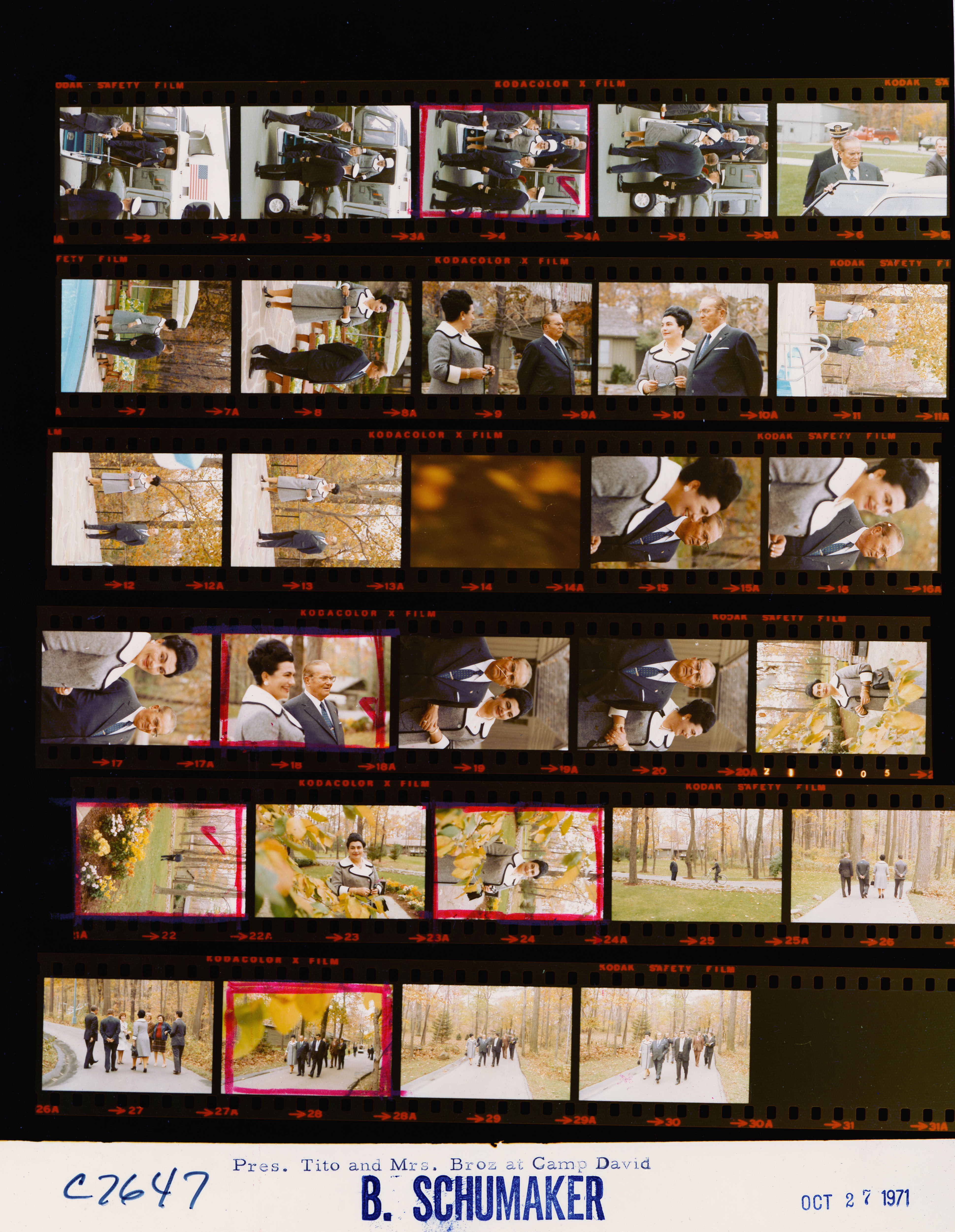
- Frame(s): WHPO-7647-02-05, Yugoslavian President Josip Broz Tito and Mrs. Josip Broz Tito arriving at Camp David in a helicopter. 10/27/1971, Camp David, Maryland helipad. Josip Broz Tito, Mrs. Josip Broz Tito, military personnel, aides.
- Frame(s): WHPO-7647-06-30, Yugoslavian President Josip Broz Tito and Mrs. Josip Broz Tito touring Camp David. 10/27/1971, Camp David, Maryland grounds. Josip Broz Tito, Mrs. Josip Broz Tito, military personnel, aides.
Roll WHPO-7648 Photographer: Schumaker, Byron | Color or B&W: B&W
- Frame(s): WHPO-7648-02A-13A, New building construction in Camp David. 10/27/1971, Camp David, Maryland grounds.
Roll WHPO-7668 Photographer: Atkins, Oliver | Color or B&W: B&W
- Frame(s): WHPO-7668-01, Ollie Atkins, White House Photo Office manager and Nixon's official Presidential photographer. 10/27/1971, Washington, D.C. unknown. Oliver Atkins.
- Frame(s): WHPO-7668-03, President Nixon walking, viewed through a window. 10/27/1971, Washington, D.C. White House, West Wing Colonnade. President Nixon.
- Frame(s): WHPO-7668-04-19, Henry Kissinger briefing press at a new conference. Ron Ziegler stands nearby. 10/27/1971, Washington, D.C. unknown. Henry Kissinger, Ronald Ziegler, press corps members.
The White House Communications Agency Sound Recordings Collection contains public statements that took place between 1969 and 1974. Visit the finding aid to learn more.
H - White House Staff Member Recordings
- WHCA-SR-H-450
Press briefing by Henry Kissinger and Ronald Ziegler. (10/27/1971, Press Center, White House)
Runtime: 36:50:00
Keywords: Press conferences, news conferences, interviews, media, press secretary
Production credits: Audio feed supplied by WHCA; Recorded by RSM (initials of WHCA engineer)
Original Format: 1/4-inch reel-to-reel audiotape. Original source type: Original.
The White House Communications Agency Videotape Collection contains “off-the-air” recordings of televised programs produced between 1968 and 1974. Visit the finding aid to learn more.
- WHCA-4756
PBS Special, with Secretary George Romney address.
ABC
Runtime: 1:00 - WHCA-4758
Weekly News Summary, Tape II.
ALL NETWORKS
Runtime: 1:30:00
16. Smith/Jarriel: Kissinger tells of arrangements for Presidential trip to China. Time Code Start: 46:59. Keywords: Presidents, travel, trips, People's Republic of China, cabinet, advisors, interviews. Network: ABC.
17. Smith/Clark: White House comment of vote; Senators debate cutting United Nations (U.N.) financing and foreign aid measures (Senator Scott, Secretary of State Rogers). Time Code Start: 49:06. Keywords: organization of nations, intergovernmental alliance, financial aid, voting. Network: ABC.
18. Reasoner/Snell: The making of the Chinese flag. Time Code Start: 51:58. Keywords: People's Republic of China, flags. Network: ABC.
19. Reasoner/Donaldson: Phase II of President Nixon's economic plan. Time Code Start: 53:50. Keywords: wage and price controls, freezes, prices, costs, increases, decreases, economy, economics, budgets, finances, recession, inflation, money. Network: ABC.
20. Reasoner/Downs: President Nixon gives go-ahead on Amchitka Island, Alaska atomic test. Time Code Start: 56:55. Keywords: Cannikin, Spartan anti-ballistic missile (ABM) interceptor, underground tests, nuclear weapons, atomic bombs, explosions, Aleutian Islands, atomic energy, nuclear safety, ecosystem ecology, radiation protection. Network: ABC.
21. Smith: Commentary on the United Nations (U.N.). Time Code Start: 59:04. Keywords: organization of nations, intergovernmental alliance. Network: ABC.
22. Chancellor: President Nixon/Vice President Agnew comment on the United Nations (U.N.).; Senator Scott, Secretary of State Rogers comment; President Nixon to go to China after 1 Jan 1972. Time Code Start: 60:54. Keywords: Vice Presidents, cabinet, advisors, organization of nations, intergovernmental alliance, People's Republic of China, admissions. Network: NBC.
23. Chancellor/Goralski: President Nixon okays Amchitka Island, Alaska atomic test. Time Code Start: 64:36. Keywords: Cannikin, Spartan anti-ballistic missile (ABM) interceptor, underground tests, nuclear weapons, atomic bombs, explosions, Aleutian Islands, atomic energy, nuclear safety, ecosystem ecology, radiation protection. Network: NBC.
24. Chancellor: Mayor Hatcher (Gary, Indiana) asks for 20% black representation at Democratic Convention. Time Code Start: 66:45. Keywords: Mayors, African Americans, racial quotas, affirmative action, political parties, Democrats, Democratic Party, Presidential elections, campaigns, campaigning, conventions, delegates. Network: NBC.
25. Chancellor/Thomas: Yugoslavian President Tito visits the U.S.. Time Code Start: 69:12. Keywords: Presidents, travel, trips, meetings. Network: NBC.
26. Cronkite/Rather: President Nixon to visit China after 1 Jan 1972; President Nixon and Vice President Agnew comment on United Nations (U.N.) vote. Time Code Start: 70:35. Keywords: organization of nations, intergovernmental alliance, voting, Presidents, travel, trips, Nixon trips, international, People's Republic of China. Network: CBS.
27. Kalb: Secretary of State Rogers and Senator Scott comment on United Nations (U.N.) vote. Time Code Start: 73:08. Keywords: cabinet, advisors, organization of nations, voting, intergovernmental alliance. Network: CBS.
28. Cronkite/Herman: President Nixon okays Amchitka Island, Alaska atomic test. Time Code Start: 75:48. Keywords: Cannikin, Spartan anti-ballistic missile (ABM) interceptor, underground tests, nuclear weapons, atomic bombs, explosions, Aleutian Islands, atomic energy, nuclear safety, ecosystem ecology, radiation protection. Network: CBS.
29. Cronkite: Cronkite interviews West German Chancellor Willy Brandt. Time Code Start: 77:54. Keywords: West Germany, Chancellors, leaders, meetings. Network: CBS.
30. Sevareid: Commentary on business and politics. Time Code Start: 85:16. Keywords: businesses, trade, imports, exports, diplomacy, political activities. Network: CBS.
Context (External Sources)
The Vanderbilt Television News Archive is the world's most extensive and complete archive of television news. They have been recording, preserving and providing access to television news broadcasts of the national networks since August 5, 1968.
Wikipedia is a free encyclopedia that anyone can edit.