
Introduction
This almanac page for Tuesday, October 26, 1971, pulls together various records created by the federal government and links to additional resources which can provide context about the events of the day.
Previous Date: Monday, October 25, 1971
Next Date: Wednesday, October 27, 1971
Schedule and Public Documents
The Daily Diary files represent a consolidated record of the President's activities. Visit the finding aid to learn more.
The President's day began at The White House - Washington, D. C.
The Weekly Compilation of Presidential Documents made available transcripts of the President's news conferences; messages to Congress; public speeches, remarks, and statements; and other Presidential materials released by the White House.
Digitized versions can be found at HathiTrust.
Each Public Papers of the Presidents volume contains the papers and speeches of the President of the United States that were issued by the White House Office of the Press Secretary during the time period specified by the volume. The material is presented in chronological order, and the dates shown in the headings are the dates of the documents or events. In instances when the release date differs from the date of the document itself, that fact is shown in the text note.
To ensure accuracy, remarks have been checked against audio recordings (when available) and signed documents have been checked against the original, unless otherwise noted. Editors have provided text notes and cross references for purposes of identification or clarity.
The Federal Register is the official daily publication for rules, proposed rules, and notices of federal agencies and organizations, as well as executive orders and other Presidential documents.
No Federal Register published on this date
The Congressional Record is the official daily record of the debates and proceedings of the U.S. Congress.
Decided
Archival Holdings
Any selection of archival documents will necessarily be partial. You should use the documents and folders identified below as a starting place, but consult the linked collection finding aids and folder title lists and the collections themselves for context. Many documents to be found this way do not lend themselves to association with specific dates, but are essential to a complete understanding of the material.
Selective document listing
President's Office Files
The President's Office Files consists of materials drawn together by the Special Files Unit from several administrative subdivisions within the White House Office. It is the handwriting and sensitive papers sent to the Staff Secretary that now comprise much of the President's Office Files. Visit the finding aid to learn more.
- News Summaries, Annotated News Summaries, Box 31, News Summaries - October 21-30, 1971 [3 of 5] [Note: Due to the way News Summary products were compiled, you should also consult nearby days for potentially relevant materials.]
- October 26, 1971
- News Summary, October 26, 1971, (Monday newscasts, wires, mags)
- News Summaries, Annotated News Summaries, Box 31, News Summaries - October 21-30, 1971 [4 of 5] [Note: Due to the way News Summary products were compiled, you should also consult nearby days for potentially relevant materials.]
- News Summary, October 26, 1971, (Tuesday Newscasts, Wires, Columns)
- President's Daily Schedule, Box 102, [President's Daily Schedule, Sept.-Dec. 1971] [2 of 3]
- The President's Schedule, Tuesday - October 26, 1971
President's Personal File
The President's Personal File is essentially a President's secretary's file, kept by Rose Mary Woods, personal secretary to the President, for two purposes: (1) preserving for posterity a collection of documents particularly close to the President, whether because he dictated or annotated them, or because of the importance of the correspondent or the event concerned and (2) giving appropriate attention–letters of gratitude, invitations to White House social events, and the like–to members and important friends and supporters of the Nixon administration. This generalization does not describe all the varied materials of a file group which is essentially a miscellany, but it does identify the reason for the existence of the file group's core. Visit the finding aid to learn more.
- President's Speech File
The H. R. Haldeman Diaries consists of seven handwritten diaries, 36 dictated diaries recorded as sound recordings, and two handwritten audio cassette tape subject logs. The diaries and logs reflect H. R. Haldeman’s candid personal record and reflections on events, issues, and people encountered during his service in the Nixon White House. As administrative assistant to the President and Chief of Staff, Haldeman attended and participated in public events and private meetings covering the entire scope of issues in which the Nixon White House engaged in during the years 1969-1973. Visit the finding aid to learn more.
- Transcript of diary entry (PDF)
Tuesday, October 26th. The main action today was on the UN vote. The President had me in this morning and called Rogers to discuss that and the European Security Conference...
-------------------------------------------------------------------------------------------------------------------
DECLASSIFIED - E.O. 13526, Sect. 3.4: by MS, NARA, June 12, 2013
Audio Cassette 15, Side A, Withdrawn Item Number 9 [AC-15(A) Sel 3]
Duration: 11 seconds
...trial balloons that have been floated by Brezhnev and Pompidou. The President told Rogers to keep it cool on that, that we should not let the press push us in to it, that it would be a mess right now.
-------------------------------------------------------------------------------------------------------------------
He also assured Rogers that he'd wait until tomorrow to get a report from Henry on the China advance, since Henry gets back this evening, or late this afternoon. He did some schedule shifting for the week, so that he could spend a good deal of time with Connally this afternoon and tomorrow afternoon, since he leaves on Thursday. The UN vote has, of course, stirred up the Conservatives substantially, and the Attorney General called with considerable concern. Reagan had been very upset last night and tried to reach the President after midnight, and the President returned the call this morning. Reagan feels that the President should go on television and make a big thing that we won't abide by any UN votes in the future, etcetera. The President explained to him why we couldn’t do that…
-------------------------------------------------------------------------------------------------------------------
DECLASSIFIED - E.O. 13526, Sect. 3.4: by MS, NARA, June 12, 2013
Audio Cassette 15, Side A, Withdrawn Item Number 10 [AC-15(B) Sel 4]
Duration: 8 seconds
...because we're relying on the UN groups to try to resolve the India-Pakistan situation...
-------------------------------------------------------------------------------------------------------------------
...and that apparently didn't calm him down much. Rogers called Reagan later and thought he had made some headway, saying we're going to sleep on the whole thing and see how it works out. But then Reagan saw Rogers on television later, saying that we weren't going to suspend funding of the UN because of the vote, and that got Reagan all upset again. He thinks that, he talked to the Attorney General after that and said that he thinks we've at least got to call Bush down for a consultation. That this should be a strong Presidential statement we'll no longer abide by UN votes, and at the very least, he should take a strong stand on cutting funds before Congress does it beneath him. Mitchell tends to agree feeling that if we don't do that and take the line we're taking now, which is leaving it up to Rogers as the spokesman, it leaves the President behind the parade. Later, Mitchell talked to Bill and Jim Buckley at my suggestion, and also Goldwater. He determined that the Reagan line and suggestions had come from Bill Buckley and that Jim Buckley feels basically the same as Bill Buckley does. Goldwater was in Tucson last night and said there was quite an uprising over the news, and also a problem at the Republican luncheon today. That he thinks that now that we're pulling on our horns on foreign aid and the currency reform, and all that sort of thing, that the little nations are now flaunting their independence. Mitchell feels there's some very negative political factors and that the President's going to get the blame for it all because of Peking. He doesn't think we need to do anything in a hurry, but he feels the President should do something personally to get the initiative on this.
-------------------------------------------------------------------------------------------------------------------
DECLASSIFIED - E.O. 13526, Sect. 3.4: by MS, NARA, June 12, 2013
Audio Cassette 15, Side A, Withdrawn Item Numbers 12, 13 [AC-15(A) Sel 6, 7]
Duration: 33 seconds
The President's urging that we get Sam Devine and some of the other Congressmen to move out on cutting UN funds and that sort of thing. And also wants Kissinger to call Reagan and try and get it squared away with him. Later in the day, he got to thinking we would call Bush down, which we've now done, and that we might remove him from the UN and reassign him to NATO or something like that. And just leave the UN sitting there or downgrade it with a lesser appointment.
--------------------------------------------------------------------------------------------------------------------
The President called me at home later this evening and said that he had his talk with Henry, who was back from China, and that Henry had called Reagan as I asked him to do, and will also call Buckley. The President makes the point that we need to keep the right wing on track. Their plan is to keep Bush down here two or three days, which will shake them up a little at the UN, and in some way, we'll say we're disgusted by their performance. He feels that beyond that, there's nothing we can do about it. We just have to ride it through. We have to see if Kissinger can keep Reagan in line and try to do so with Buckley also, and that we've just got to keep Reagan from jumping off the reservation. He does want to make it clear to the conservatives that the President fought the China battle as hard as he could, and the right wing should understand that. And that the point here is that we mustn't be defensive with them. They’ve got to face up to the fact that we have common enemies, and that the people they should be after are the UN, not the President.
We had a fairly long discussion at, this morning also on China guidance, before Henry got back. The President's now concluded that Pat Nixon’s got to go on the trip because of the way Henry's set things up, but that if she goes, none of her staff are to go, but she has to have an advance man to handle her activities. She should be separately scheduled, take no women's press along with her, should not ride with the President. Also, Rose should be lectured cold turkey that she is going along, but she's to work for everybody. We should go with a very thin staff. Rogers can take a secretary, but not his wife. And he, the President wants to review personally the specific man-by-man lists of people to go along on the trip.
He says he will approve Teddy White going, on the basis that we need an historian and somebody who understands the China situation, but we should get some mileage out of it with Teddy though, that we're, the President's made this decision over other people's advice, etcetera, and is going to let him go.
He made the point that we've got to move now to get Kissinger under control on backgrounders. He doesn't want to give so, have him give so many, because he feels they build up the man who's doing the backgrounding, rather than the President. He's talked to Ehrlichman about this too, apparently.
End of October 26th.
Going back over the weekend for a minute: the phone sheet showed that, as a result of the meeting the President had with Rogers and Bush on Friday to discuss UN-China strategy...
-------------------------------------------------------------------------------------------------------------------
DECLASSIFIED - E.O. 13526, Sect. 3.4: by MS, NARA, June 12, 2013
Audio Cassette 15, Side A, Withdrawn Item Number 14 [AC-15(A) Sel 8]
Duration: 50 seconds
...the President made some phone calls to put pressure on some of the nations to vote: he called Colombo of Italy, King Hassan of Morocco, Echeverria of Mexico, and I believe, a couple of others, which would show in the log. A point he made afterwards was that he had gone way beyond what one would expect the President to do, and that we must not put the word out of the calls that he made, because of course, we failed in the vote. Some of the calls did manage to save a vote, or at least, move it to the abstentions column. But it wasn't enough to keep Taiwan in.
------------------------------------------------------------------------------------------------------------------ - Original audio recording (MP3)
The National Archives Catalog is the online portal to the records held at the National Archives, and information about those records. It is the main way of describing our holdings and also provides access to electronic records and digitized versions of our holdings.
The Catalog searches across multiple National Archives resources at once, including archival descriptions, digitized and electronic records, authority records, and web pages from Archives.gov and the Presidential Libraries. The Catalog also allows users to contribute to digitized historical records through tagging and transcription.
Nixon Library Holdings
All National Archives Units
National Security Documents
The President's Daily Brief is the primary vehicle for summarizing the day-to-day sensitive intelligence and analysis, as well as late-breaking reports, for the White House on current and future national security issues. Read "The President's Daily Brief: Delivering Intelligence to Nixon and Ford" to learn more.
The Foreign Relations of the United States series presents the official documentary historical record of major U.S. foreign policy decisions and significant diplomatic activity. Visit the State Department website for more information.
Vol. III, Foreign Economic Policy; International Monetary Policy, 1969-1972
International Monetary Policy, 1969-1972
185. Memorandum From the President’s Assistant for International Economic Affairs (Peterson) to Secretary of the Treasury Connally, Washington, October 26, 1971
Source: Washington National Records Center, Department of the Treasury, Records of Secretary Shultz: FRC 56 80 1, CIEP—Peterson. Confidential; Eyes Only.
Vol. V, United Nations, 1969-1972
Chinese Representation in the United Nations
429. Telegram From the Mission to the United Nations to the Department of State, New York, October 26, 1971, 0639Z
Source: National Archives, RG 59, Central Files 1970–73, UN 6 CHICOM. Confidential.
430. Telegram From the Mission to the United Nations to the Department of State, New York, October 26, 1971, 0800Z
Source: National Archives, RG 59, Central Files 1970–73, UN 6 CHICOM. Unclassified; Priority.
431. Telegram From the Mission to the United Nations to the Department of State, New York, October 26, 1971, 2358Z
Source: National Archives, Nixon Presidential Materials, NSC Files, Box 302, Agency Files, USUN, Vol. VIII. Secret; Exdis.
Vol. E-1, Documents on Global Issues, 1969-1972
Oceans Policy
415. Telegram 3859 From the Mission to the United Nations to the Department of State, New York, October 26, 1971, 2230Z
U.S. Ambassador to the United Nations Bush reported continued Spanish opposition to the U.S. position on international straits.
Source: National Archives, RG 59, Central Files 1970-73, POL 33-8. Limited Official Use. Repeated to Madrid and Defense. Sent with a request to pass to the Office of Ocean Affairs in the Department of Defense.
Vol. E-13, Documents on China, 1969-1972
55. Memorandum of Conversation, Beijing, October 26, 1971, 5:30-8:10 p.m., Beijing, October 26, 1971, 5:30-8:10 p.m.
During the final meeting between Chinese and American officials, President’s Assistant for National Security Affairs Kissinger cautioned that he was out in front of official U.S. policy on Taiwan and could not guarantee that President Nixon would agree to the entire formulation. He agreed that the U.S. would not challenge the reality of one China and that Taiwan was a province of China. Chinese Premier Chou En-lai maintained that where there were fundamental differences, especially in the interpretation of words such as “peaceful competition” and “individual freedom,” the differences should remain in the communiqué.
Source: National Archives, Nixon Presidential Materials, NSC Files, Box 1035, Files for the President-China Material, HAK visit to PRC, October 1971, Memcons-originals. Top Secret; Sensitive; Exclusively Eyes Only. No drafting information appears on the memorandum. The meeting was held at the Government Guest House, Attached at Tab A is the third Chinese draft of the communiqué. See Document 56 for text of the draft. At Tab B is the final agreed tentative draft, which is printed in Foreign Relations, 1969-1972, volume XVII, China, 1969-1972, as an attachment to Document 165. The final version of the draft is in ibid., Document 203.56. American and Chinese Drafts of the Joint Communiqué, Beijing, October 22-26, 1971, Beijing, October 26, 1971
Each nation submitted three drafts of the joint communiqué for President Nixon’s visit to China.
Source: National Archives, Nixon Presidential Materials, NSC Files, Box 1035, Files for the President-China Material, China-HAK October 1971 Visit. No classification marking. All brackets in the source text. See Documents 165 and 203, Foreign Relations, 1969-1976, volume XVII, China, 1969-1972, for the final agreed tentative draft and final version of the communiqué
The Kissinger telephone conversation transcripts consist of approximately 20,000 pages of transcripts of Kissinger’s telephone conversations during his tenure as Assistant to the President for National Security Affairs (1969-1974) and Secretary of State (1973-1974) during the administration of President Richard Nixon. Visit the finding aid for more information.
Digitized versions can be found in the National Archives Catalog.
Audiovisual Holdings
The White House Tapes are sound recordings of President Richard Nixon's telephone conversations and of meetings held in the Oval Office and the Cabinet Room in the White House, the President's office in the Old Executive Office Building (OEOB), the Lincoln Sitting Room in the residence section of the White House, and several locations at the Presidential retreat at Camp David, Maryland. These recordings document many of the major events and decisions of the Nixon Administration from February 16, 1971 to July 18, 1973. Visit the White House Tapes finding aid to learn about the taping system's operation and archival processing.
Old Executive Office Building
- 303-1; Unknown between 1:40 p.m. & 1:41 p.m.; Nixon, Richard M. (President); White House operator
- 303-2; 1:41 p.m. - 1:47 p.m.; Nixon, Richard M. (President); Rogers, William P.
- 303-3; Unknown between 1:47 p.m. & 1:50 p.m.; Nixon, Richard M. (President); [Unknown person(s)]
- 303-4; Unknown between 1:47 p.m. & 1:50 p.m.; Nixon, Richard M. (President); White House operator
- 303-5; Unknown between 1:47 p.m. & 1:50 p.m.; Nixon, Richard M. (President); Sanchez, Manolo
- 303-6; 1:50 p.m. - 1:51 p.m.; Nixon, Richard M. (President); Rogers, William P.
- 303-7; Unknown between 1:51 p.m. & 2:49 p.m.; Nixon, Richard M. (President); [Unknown person(s)]
- 303-8; Unknown between 1:51 p.m. & 2:49 p.m.; Nixon, Richard M. (President); [Unknown person(s)]
- 303-9; 2:49 p.m. - 5:55 p.m.; Nixon, Richard M. (President); Connally, John B.; Sanchez, Manolo; Haldeman, H. R. ("Bob"); Shultz, George P.
- 303-10; Unknown between 5:55 p.m. & 6:10 p.m.; Nixon, Richard M. (President); Sanchez, Manolo
- 303-11; Unknown between 5:55 p.m. & 6:10 p.m.; Nixon, Richard M. (President); Haldeman, H. R. ("Bob")
- 303-12; Unknown between 6:10 p.m. & 11:59 p.m.; [Unknown person(s)]
Oval Office
- 601-35; Unknown between 8:35 a.m. & 8:49 a.m.; Nixon, Richard M. (President); White House operator
- 601-36; Unknown between 8:35 a.m. & 10:00 a.m.; Nixon, Richard M. (President); Haldeman, H. R. ("Bob"); Rogers, William P.; White House operator
- 602-1; Unknown between 9:01 a.m. & 11:09 a.m.; Nixon, Richard M. (President); Haldeman, H. R. ("Bob"); [Unknown person(s)]; Haig, Alexander M., Jr.; Butterfield, Alexander P.; Agnew, Spiro T. (Vice President); Sanchez, Manolo; White House operator; Flanigan, Peter M.; Bull, Stephen B.
- 602-2; Unknown between 11:09 a.m. & 11:13 a.m.; Nixon, Richard M. (President); White House operator
- 602-3; Unknown between 11:09 a.m. & 11:13 a.m.; Nixon, Richard M. (President); Sanchez, Manolo
- 602-4; 11:13 a.m. - 11:25 a.m.; Nixon, Richard M. (President); Reagan, Ronald W.
- 602-5; 11:24 a.m. - 11:29 a.m.; Nixon, Richard M. (President); Ziegler, Ronald L.; Haig, Alexander M., Jr.
- 602-6; 11:35 a.m. - 12:18 p.m.; Butterfield, Alexander P.; Bennett, Wallace F.; Shultz, George P.; MacGregor, Clark; Ehrlichman, John D.; Nixon, Richard M. (President); White House operator; [Unknown person(s)]; Acker, Marjorie P.
- 602-7; 12:18 p.m. - 12:19 p.m.; Nixon, Richard M. (President); Acker, Marjorie P.
- 602-8; Unknown between 12:19 p.m. & 12:20 p.m.; Nixon, Richard M. (President); Butterfield, Alexander P.
- 602-9; 12:20 p.m. - 12:40 p.m.; Nixon, Richard M. (President); Maupin, Armistad J., Jr.; Collins, Charles P., III; Abad, Francis L., Jr.; Leadbeter, Karel J.; Myerovitz, Jack R.; Reese, Carrollton E., Jr.; Butler, John F.; Nielsen, Thomas M.; Lane, Zeph; Lane, Zeph (Mrs.); Will, Rick; Will, Pat; Colson, Charles W.; Butterfield, Alexander P.; White House photographer
- 602-10; 12:45 p.m. - 1:39 p.m.; Nixon, Richard M. (President); Haldeman, H. R. ("Bob"); Sanchez, Manolo; Butterfield, Alexander P.; Colson, Charles W.
- 602-11; Unknown between 1:39 p.m. & 11:59 p.m.; [Unknown person(s)]
White House Telephone
- 12-129; Unknown between 8:35 a.m. & 8:49 a.m.; Nixon, Richard M. (President); White House operator
- 12-130; 8:49 a.m. - 8:55 a.m.; Nixon, Richard M. (President); Rogers, William P.
- 12-131; Unknown between 8:55 p.m. & 8:59 p.m.; Nixon, Richard M. (President); White House operator; Haldeman, H. R. ("Bob"); Rogers, William P.
- 13-1; Unknown between 8:35 a.m. & 10:15 a.m.;
- 13-2; Unknown between 8:35 a.m. & 10:15 a.m.;
- 13-3; 10:15 a.m. - 10:16 a.m.; Nixon, Richard M. (President); Haig, Alexander M., Jr.
- 13-4; Unknown between 10:16 a.m. & 10:17 a.m.; Nixon, Richard M. (President); White House operator
- 13-5; 10:17 a.m. - 10:18 a.m.; Nixon, Richard M. (President); Flanigan, Peter M.
- 13-6; Unknown between 10:18 a.m. & 11:13 a.m.; Nixon, Richard M. (President); Haig, Alexander M., Jr.
- 13-7; Unknown between 10:18 a.m. & 11:13 a.m.; Nixon, Richard M. (President); White House operator
- 13-8; 11:13 a.m. - 11:25 a.m.; Nixon, Richard M. (President); Reagan, Ronald W.
- 13-9; Unknown between 11:25 a.m. & 11:37 a.m.; Nixon, Richard M. (President); White House operator
- 13-10; 11:37 a.m. - 11:42 a.m.; Nixon, Richard M. (President); Rogers, William P.
- 13-11; Unknown between 11:42 a.m. & 1:41 p.m.; Nixon, Richard M. (President); White House operator
- 13-12; 1:41 p.m. - 1:47 p.m.; Nixon, Richard M. (President); Rogers, William P.
- 13-13; Unknown between 1:47 p.m. & 1:50 p.m.; Nixon, Richard M. (President); White House operator
- 13-14; 1:50 p.m. - 1:51 p.m.; Nixon, Richard M. (President); Rogers, William P.
- 13-15; Unknown between 6:36 p.m. & 7:50 p.m.; Nixon, Richard M. (President); White House operator
- 13-16; 7:50 p.m. - 7:52 p.m.; Nixon, Richard M. (President); Woods, Rose Mary
- 13-17; Unknown between 7:52 p.m. & 8:01 p.m.; Nixon, Richard M. (President); White House operator
- 13-18; 8:01 p.m. - 8:07 p.m.; Nixon, Richard M. (President); Haldeman, H. R. ("Bob")
The White House Photo Office collection consists of photographic coverage of President Richard Nixon meeting with prominent social, political, and cultural personalities; speaking engagements and news conferences of the President and various high-ranking members of the White House staff and Cabinet; Presidential domestic and foreign travel, including Presidential vacations; social events and entertainment involving the First Family, including entertainers present; official portraits of the President, First Family, and high-ranking members of the Nixon administration; the 1969 and 1973 Inaugurals; the President’s 1972 Presidential election campaign appearances (including speeches) and other official activities of the White House staff and the President’s Cabinet from January 20, 1969 until August 9, 1974 at the White House and the Old Executive Office Building; other locations in Washington, DC, such as The Mall; and the Presidential retreats in Camp David, Maryland, Key Biscayne, Florida, and San Clemente, California. Visit the finding aid to learn more.
Roll WHPO-7615 Photographer: Schumacher, Karl | Color or B&W: B&W
- Frame(s): WHPO-7615-05, Vice President Agnew briefing President Nixon during a meeting in the Oval Office, about his recent trip to Turkey, Iran, and Greece. 10/26/1971, Washington, D.C. White House, Oval Office. President Nixon, Spiro Agnew.
- Frame(s): WHPO-7615-05-09, Vice President Agnew briefing President Nixon during a meeting in the Oval Office, about his recent trip to Turkey, Iran, and Greece. 10/26/1971, Washington, D.C. White House, Oval Office. President Nixon, Spiro Agnew.
Roll WHPO-7616 Photographer: Schumacher, Karl | Color or B&W: B&W
- Frame(s): WHPO-7616-02A-13A, Vice President Agnew briefing President Nixon during a meeting in the Oval Office, about his recent trip to Turkey, Iran, and Greece. 10/26/1971, Washington, D.C. White House, Oval Office. President Nixon, Spiro T. Agnew.
- Frame(s): WHPO-7616-14, Vice President Agnew briefing President Nixon during a meeting in the Oval Office, about his recent trip to Turkey, Iran, and Greece. 10/26/1971, Washington, D.C. White House, Oval Office. President Nixon, Spiro Agnew.
Roll WHPO-7617 Photographer: Schumacher, Karl | Color or B&W: B&W
- Frame(s): WHPO-7617-03-35, Close-up portrait study of Dana Mead. 10/26/1971, Washington, D.C. unknown. Dana Mead.
Roll WHPO-7618 Photographer: Schumaker, Byron | Color or B&W: B&W
- Frame(s): WHPO-7618-02A-13A, Price Commission members participating in a swearing-in ceremony. 10/26/1971, Washington, D.C. unknown. Donald Rumsfeld, Price Commission members, unidentified persons.
- Frame(s): WHPO-7618-14A-20A, Meeting of the Price Commission following their swearing-in ceremony. 10/26/1971, Washington, D.C. unknown. Donald Rumsfeld, Price Commission members, unidentified persons.
Roll WHPO-7619 Photographer: Atkins, Oliver | Color or B&W: B&W
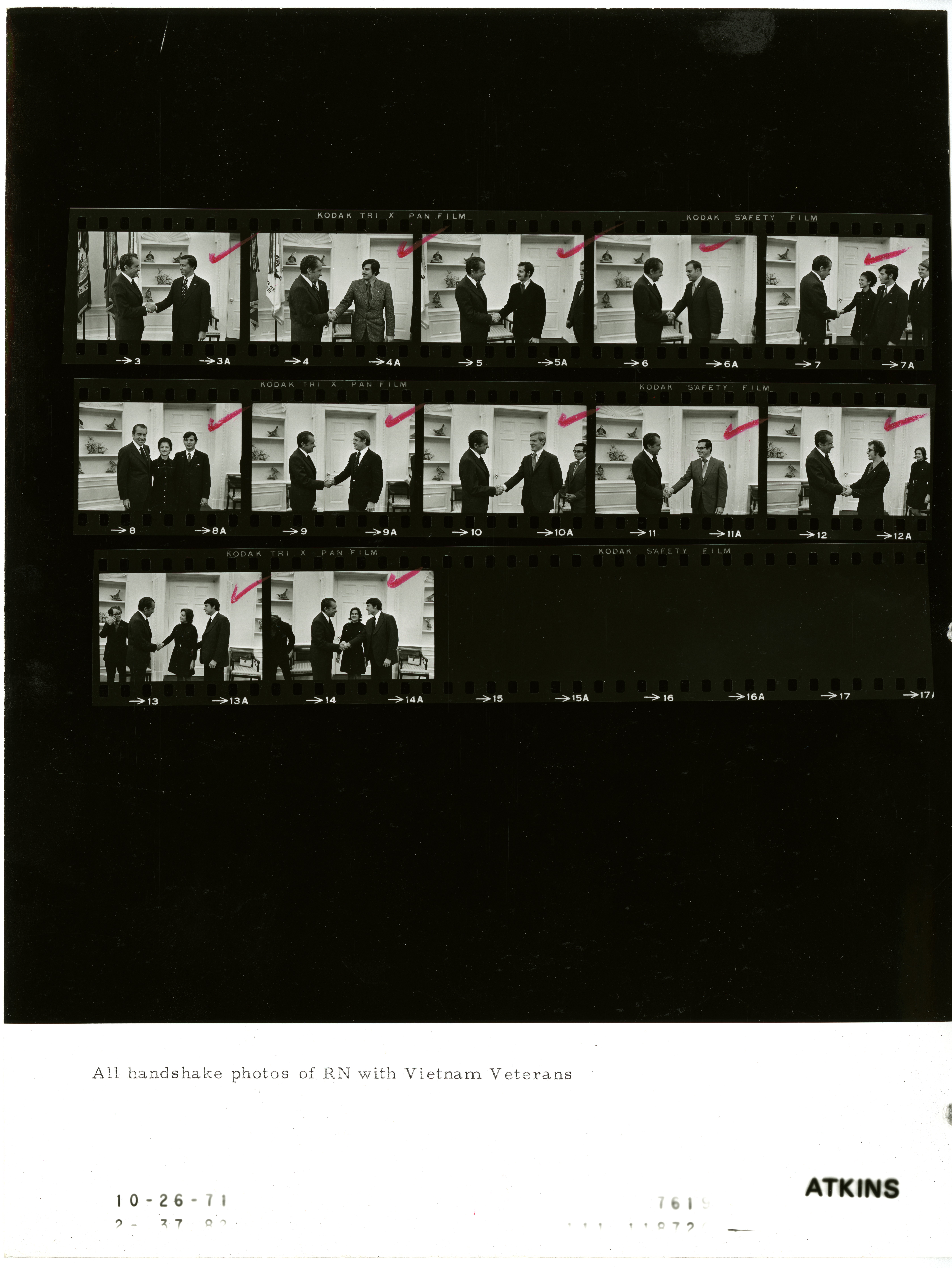
- Frame(s): WHPO-7619-03-14, President Nixon shaking hands individually with Vietnam veterans who returned to Vietnam to work as civilians on a housing project for disabled Vietnamese soldiers. 10/26/1971, Washington, D.C. White House, Oval Office. President Nixon, Armistad Maupin, Jr., Charles Collins III, Francis Abad, Jr., Karel Leadbeter, Jack Myerovitz, Carrollton Reese, Jr., John Butler, Thomas Nielsen, Zeph Lane, Mrs. Zeph Lane, Rick Will, Mrs. Rick Will.
Roll WHPO-7620 Photographer: Atkins, Oliver | Color or B&W: B&W
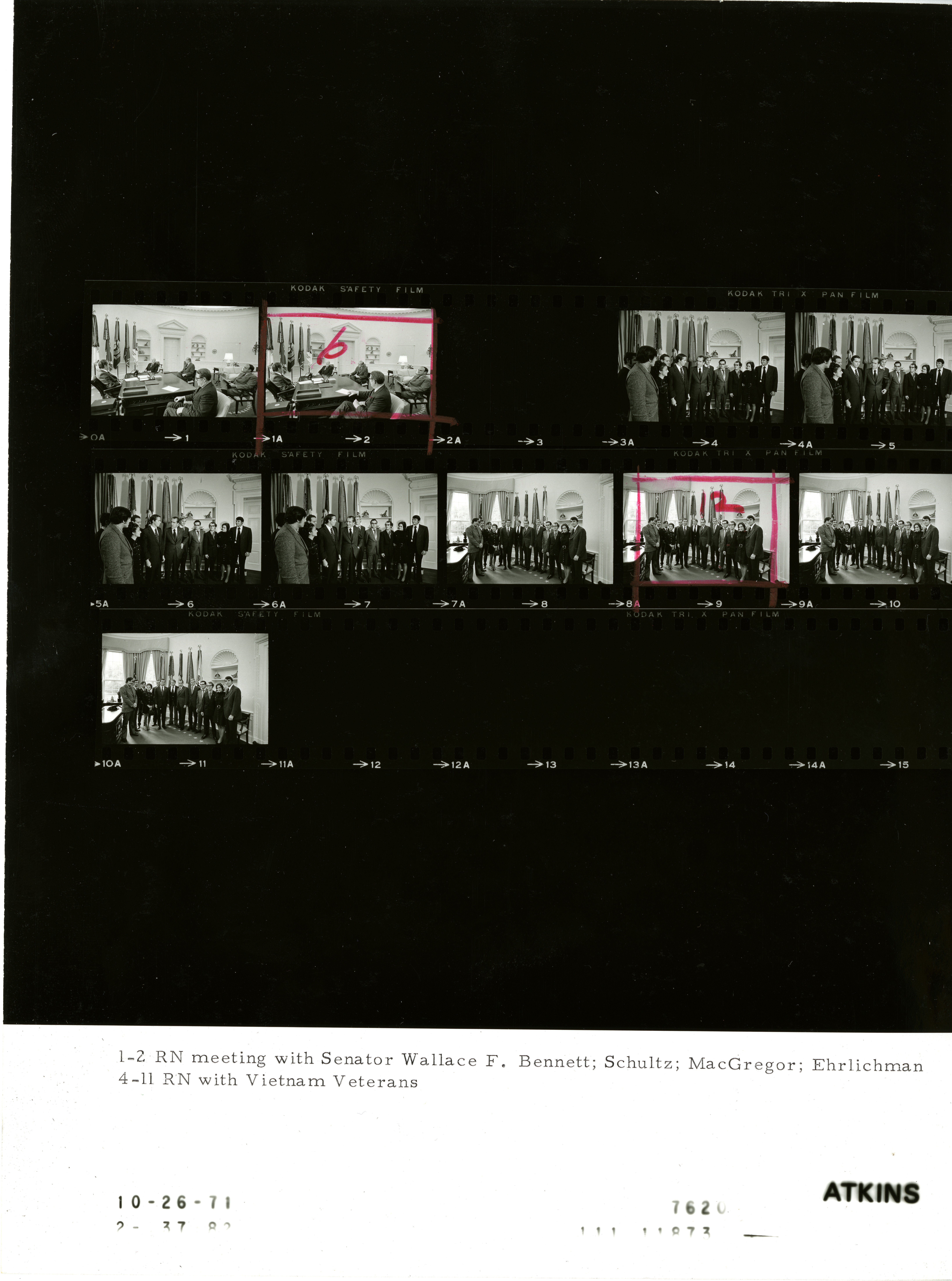
- Frame(s): WHPO-7620-01-02, President Nixon meeting at his desk with Senator Wallace Bennett, George Shultz, Clark MacGregor, and John Ehrlichman to discuss finance legislation. 10/26/1971, Washington, D.C. White House, Oval Office. President Nixon, Wallace F. Bennett, George P. Shultz, Clark MacGregor, John D. Ehrlichman.
- Frame(s): WHPO-7620-04-11, President Nixon with Vietnam veterans who returned to Vietnam to work as civilians on a housing project for disabled Vietnamese soldiers. 10/26/1971, Washington, D.C. White House, Oval Office. President Nixon, Armistad Maupin, Jr., Charles Collins III, Francis Abad, Jr., Karel Leadbeter, Jack Myerovitz, Carrollton Reese, Jr., John Butler, Thomas Nielsen, Zeph Lane, Mrs. Zeph Lane, Rick Will, Mrs. Rick Will.
Roll WHPO-7622 Photographer: Kightlinger, Jack | Color or B&W: B&W
- Frame(s): WHPO-7622-01A-05A, Portrait of Mrs. John Ehrlichman and an unidentified man. 10/26/1971, Washington, D.C. White House grounds. Mrs. John Ehrlichman, unidentified man.
Roll WHPO-7623 Photographer: Elbourne, Tim | Color or B&W: B&W
- Frame(s): WHPO-7623-01-23, An operation in a hospital. 10/26/1971, China operating room, unknown hospital. Unidentified doctors, patients.
- Frame(s): WHPO-7623-22A, Seen from above, an operation in progress in a hospital in China. 10/26/1971, China operating room, unknown hospital. Unidentified doctors and patient.
- Frame(s): WHPO-7623-24-29, Henry Kissinger meeting with unidentified persons. 10/26/1971, China unknown. Henry Kissinger, unidentified persons.
Roll WHPO-7624 Photographer: Elbourne, Tim | Color or B&W: B&W
- Frame(s): WHPO-7624-01A-34A, Henry Kissinger and unidentified persons on a plane. 10/26/1971, air plane, interior. Henry Kissinger, unidentified persons.
- Frame(s): WHPO-7624-32, Henry Kissinger seated with paperwork on a plane. 10/26/1971, air plane, interior. Henry Kissinger.
Roll WHPO-7625 Photographer: Elbourne, Tim | Color or B&W: B&W
- Frame(s): WHPO-7625-00A-16A, Henry Kissinger and unidentified persons on a plane. 10/26/1971, unknown air. Henry Kissinger, unidentified persons.
- Frame(s): WHPO-7625-17A-33A, Henry Kissinger and unidentified persons on land. 10/26/1971, unknown unknown. Henry Kissinger, unidentified persons.
Roll WHPO-7626 Photographer: Elbourne, Tim | Color or B&W: Color
- Frame(s): WHPO-7626-01A-36A, Henry Kissinger and staff in various locations. 10/26/1971, China unknown site. Henry Kissinger, unidentified staff and Chinese officials.
- Frame(s): WHPO-7626-05A, Henry Kissinger and officials are seen through a doorway while visiting an unidentified site in China. 10/26/1971, China unknown site. Henry Kissinger, unidentified staff and Chinese officials.
- Frame(s): WHPO-7626-21, Officials visiting an unidentified site in China (possibly a power or electrical plant). One man is seen holding a camera. 10/26/1971, China unknown site. unidentified Chinese officials, unidentified persons.
Roll WHPO-7627 Photographer: Elbourne, Tim | Color or B&W: Color
- Frame(s): WHPO-7627-01A-14A, Henry Kissinger and staff at the Great Wall during his Advance Trip. 10/26/1971, China Great Wall. Henry Kissinger, staff, Chinese officials.
- Frame(s): WHPO-7627-15A-36A, Henry Kissinger and staff touring China next to a statue of an elephant. 10/26/1971, China unknown. Henry Kissinger, staff, Chinese officials.
Roll WHPO-7628 Photographer: Elbourne, Tim | Color or B&W: Color
- Frame(s): WHPO-7628-03-20, Henry Kissinger and staff in an airplane. 10/26/1971, China unknown. Henry Kissinger, staff, Chinese officials.
- Frame(s): WHPO-7628-21-37, Henry Kissinger and staff touring China. 10/26/1971, China unknown. Henry Kissinger, staff, Chinese officials.
Roll WHPO-7629 Photographer: Elbourne, Tim | Color or B&W: Color
- Frame(s): WHPO-7629-02-14, Henry Kissinger being driven on country roads. 10/26/1971, China streets. Henry Kissinger, staff, Chinese officials.
- Frame(s): WHPO-7629-13A, Henry Kissinger walking on the Great Wall of China with Chinese officials during his Advance Trip. 10/26/1971, China Great Wall of China. Henry Kissinger, staff, Chinese officials.
- Frame(s): WHPO-7629-15-34, Henry Kissinger on the Great Wall, during his Advance Trip. 10/26/1971, China Great Wall of China. Henry Kissinger, staff, Chinese officials.
Roll WHPO-7630 Photographer: Elbourne, Tim | Color or B&W: Color
- Frame(s): WHPO-7630-01A-30A, Henry Kissinger touring China with his staff. 10/26/1971, China unknown. Henry Kissinger, Dwight Chapin, staff, Chinese officials.
- Frame(s): WHPO-7630-23, Henry Kissinger and the his China Advance team staff members pose for a group portrait in front of historic buildings during a tour in China. 10/26/1971, China unknown historic site. Henry Kissinger, Dwight Chapin, staff, Chinese officials.
Roll WHPO-7631 Photographer: Elbourne, Tim | Color or B&W: Color
- Frame(s): WHPO-7631-02-05, Henry Kissinger and staff touring China. 10/26/1971, China unknown. Henry Kissinger, staff.
- Frame(s): WHPO-7631-06-29, Henry Kissinger and staff on a plane. 10/26/1971, China unknown. Henry Kissinger, staff.
Roll WHPO-7632 Photographer: Elbourne, Tim | Color or B&W: Color
- Frame(s): WHPO-7632-02-35, Henry Kissinger and staff touring China. 10/26/1971, China unknown. Henry Kissinger, staff, Chinese officials.
Roll WHPO-7633 Photographer: Chapin | Color or B&W: B&W
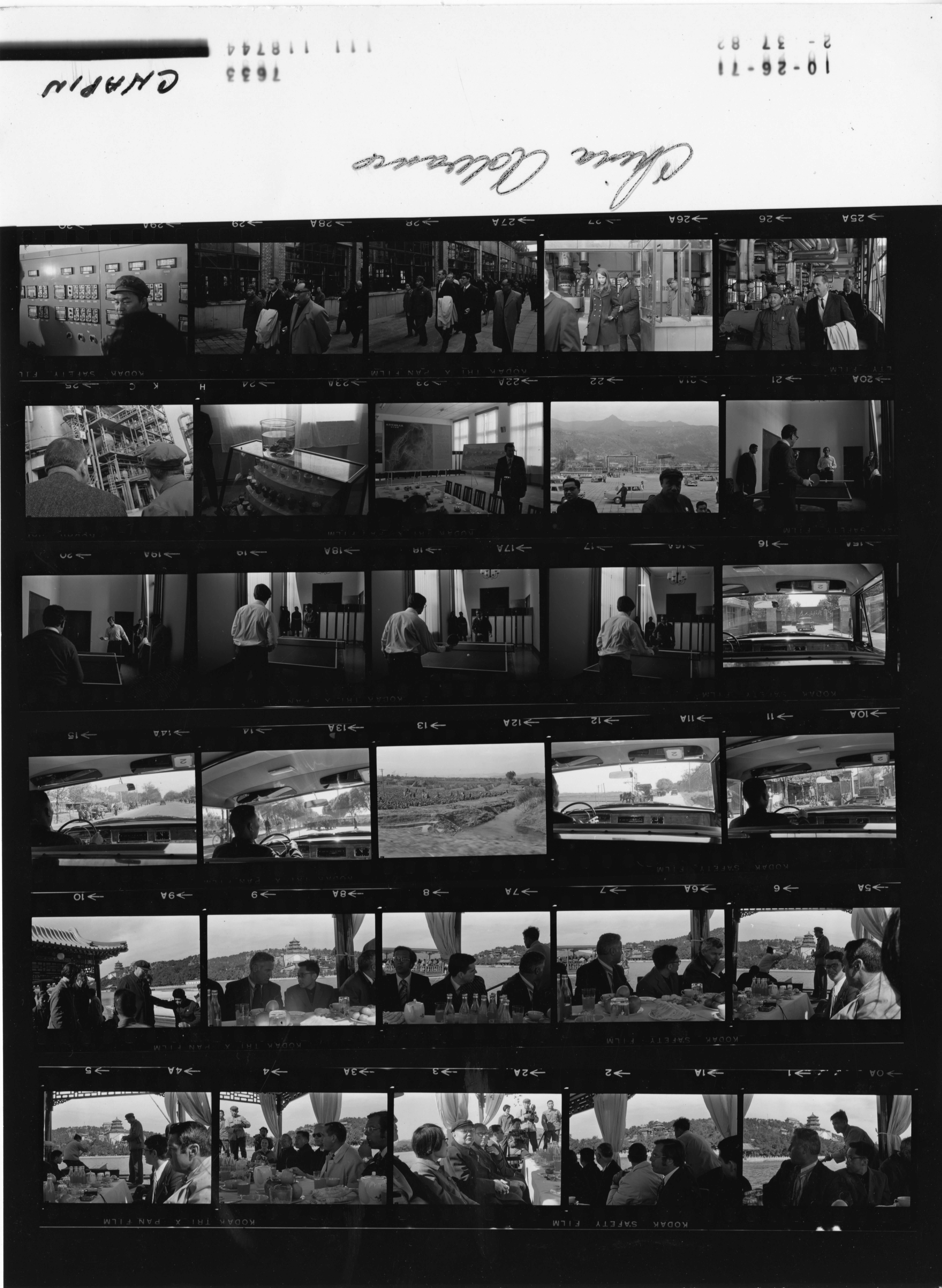
- Frame(s): WHPO-7633-00A-15A, 21A-29A, Henry Kissinger of the National Security Council NSC and staff members touring China. 10/26/1971, China unknown. Henry Kissinger, Winston Lord, staff, Chinese officials.
- Frame(s): WHPO-7633-16A-20A, Henry Kissinger playing ping pong "table tennis" with Winston Lord, his National Security Council NSC Special assistant. 10/26/1971, China unknown. Henry Kissinger, Winston Lord, unidentified staff members, Chinese officials.
Roll WHPO-7634 Photographer: Chapin | Color or B&W: B&W
- Frame(s): WHPO-7634-00A-34A, Henry Kissinger and staff touring China. 10/26/1971, China unknown. Henry Kissinger, staff, Chinese officials.
Roll WHPO-7635 Photographer: Chapin | Color or B&W: Color
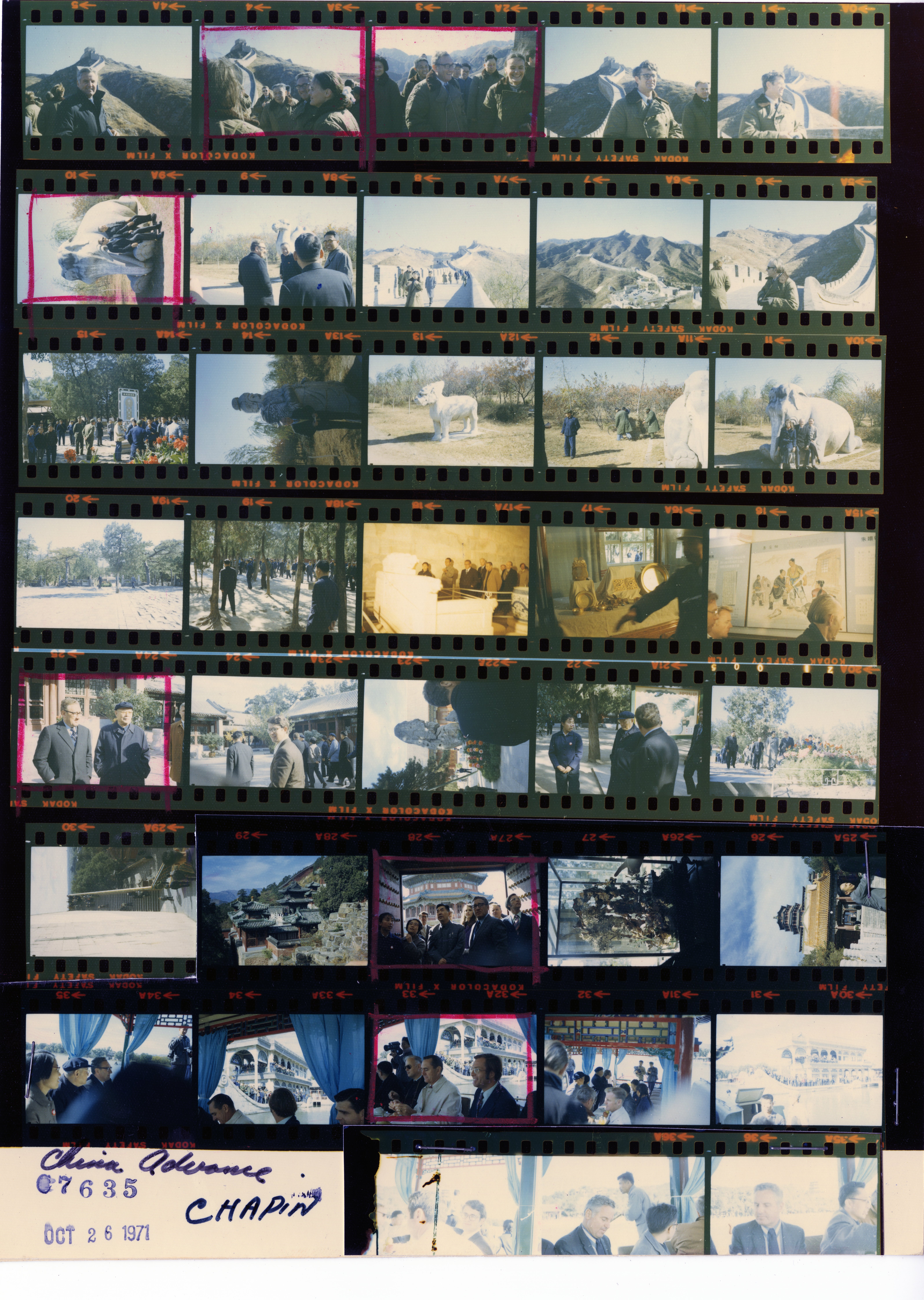
- Frame(s): WHPO-7635-00A-08A, Henry Kissinger and staff touring the Great Wall of China during his Advance Trip. 10/26/1971, China Great Wall. Henry Kissinger, staff, Ralph albertazzi, General Hughes, Tim Elbourne, Chinese officials and interpreters.
- Frame(s): WHPO-7635-09A-36A, Henry Kissinger and staff touring China. 10/26/1971, China unknown. Henry Kissinger, staff, Ralph albertazzi, General Hughes, Tim Elbourne, Chinese officials and interpreters.
- Frame(s): WHPO-7635-25, Henry Kissinger and unidentified man in front of a historical Chinese building during Kissinger's Advance Trip. 10/26/1971, China unknown historic site. Henry Kissinger, unidentified man.
- Frame(s): WHPO-7635-28, Henry Kissinger and officials touring inside of a historical Chinese building during Kissinger's Advance Trip. 10/26/1971, China unknown historic site. Henry Kissinger, staff, Ralph albertazzi, General Hughes, Tim Elbourne, Chinese officials and interpreters.
Roll WHPO-7636 Photographer: Chapin | Color or B&W: Color
- Frame(s): WHPO-7636-00-09, Henry Kissinger and staff on a beach. 10/26/1971, Guam unknown beach. Kissinger, staff.
- Frame(s): WHPO-7636-10-20, Henry Kissinger and staff at Andersen Air Force Base, and on Air Force One. 10/26/1971, China, Guam Andersen AFB. Henry Kissinger, staff.
- Frame(s): WHPO-7636-21-22, Henry Kissinger and staff in China. 10/26/1971, China, Guam Andersen AFB. Henry Kissinger, staff, Chinese officials.
Roll WHPO-7637 Photographer: Chapin | Color or B&W: Color
- Frame(s): WHPO-7637-00A-37A, Henry Kissinger at various unknown locations, including a beach, an airport, at dinner, and a nightime outdoor location. 10/26/1971, unknown unknown. Henry Kissinger, Tim Elbourne, Dwight Chapin, children, officials, unidentified staff members.
Roll WHPO-7638 Photographer: Chapin | Color or B&W: Color
- Frame(s): WHPO-7638-00A-22A, Henry Kissinger and staff touring China. Group inside the Peking Musem, good portrait of the Imperial jade burial suit on display. 10/26/1971, China unknown. Henry Kissinger, Tim Elbourne, staff, Chinese officials, staff photographers.
- Frame(s): WHPO-7638-23A-30A, Henry Kissinger and staff touring the Great Wall of China during his Advance Trip. 10/26/1971, China unknown. Henry Kissinger, Tim Elbourne, staff, Chinese officials, staff photographers.
- Frame(s): WHPO-7638-30A, Henry Kissinger and staff touring the Great Wallof China during his Advance Trip. 10/26/1971, China The Great Wall of China. Henry Kissinger, Tim Elbourne, General Hughes, secret service agent.
Roll WHPO-7639 Photographer: Chapin | Color or B&W: Color
- Frame(s): WHPO-7639-00A-06A, Henry Kissinger at an unidentified airport. 10/26/1971, air, China airport. Henry Kissinger, staff, Chinese officials.
- Frame(s): WHPO-7639-07A-12A, Henry Kissinger on a plane. 10/26/1971, air, China airplane. Henry Kissinger, staff, Chinese officials.
- Frame(s): WHPO-7639-12, Henry Kissinger holds a meeting with staff on AF1. 10/26/1971, air, China airplane. Henry Kissinger, staff.
The White House Communications Agency Sound Recordings Collection contains public statements that took place between 1969 and 1974. Visit the finding aid to learn more.
F - Secretary of State Briefings
- WHCA-SR-F-021
Remarks by Secretary William Rogers to the press regarding the expulsion of the Republic of China from the United Nations. (10/26/1971, State Department)
Runtime: 0:31:26
Keywords: People's Republic of China
Production credits: Audio feed supplied by State Department; Recorded by BAC (initials of WHCA engineer)
Original Format: 1/4-inch reel-to-reel audiotape. Original source type: Original.
P - Formal Presidential Remarks
- WHCA-SR-P-711018
Private taping for Nat'l Assn. of Manufacturers. (10/26/1971)
Runtime: 2:12
Original Format: 1/4-inch reel-to-reel audiotape. Original source type: Original.
The White House Communications Agency Videotape Collection contains “off-the-air” recordings of televised programs produced between 1968 and 1974. Visit the finding aid to learn more.
- WHCA-4753
"The Funny Side". with comments about Ralph Nader Secretary of Labor James D. Hodgson.
NBC
Runtime: 01:00:08 - WHCA-4754
Special with Cronkite interviewing President Tito of Yugoslavia. former Secretary of Interior Walter J. Hickel.
Metromedia
Runtime: 01:31:50 - WHCA-4755
"The Tonight Show". drug abuse expert, John Knowles.
Group W Productions, Inc.
Runtime: 01:25:37 - WHCA-4758
Weekly News Summary, Tape II.
ALL NETWORKS
Runtime: 1:30:00
1. Reasoner/Koppel: Taiwan voted out of the United Nations (U.N.), Red China seated. Time Code Start: 00:00. Keywords: organization of nations, intergovernmental alliance, People's Republic of China, voting, admissions. Network: ABC.
2. Smith/Gill: Secretary of State Rogers comments on United Nations (U.N.) vote, U.S. financial support of United Nations (U.N.). Time Code Start: 05:28. Keywords: cabinet, advisors, organization of nations, intergovernmental alliance, financial aid, voting. Network: ABC.
3. Smith/Clark: Senate reactions to United Nations (U.N.) decision; comments by Senator Goldwater and three other senators. Time Code Start: 07:50. Keywords: organization of nations, intergovernmental alliance. Network: ABC.
4. Reasoner/Tuckner: Reactions of Taiwanese to United Nations (U.N.) vote. Time Code Start: 10:11. Keywords: organization of nations, intergovernmental alliance, voting, public opinions. Network: ABC.
5. Smith/Jarriel: Kissinger returns from People's Republic of China. Time Code Start: 13:00. Keywords: cabinet, advisors, travel, trips, People's Republic of China. Network: ABC.
6. Reasoner: Commentary on the United Nations (U.N.) China decision. Time Code Start: 14:44. Keywords: organization of nations, intergovernmental alliance, People's Republic of China, admissions. Network: ABC.
7. Chancellor/Valeriani: Taiwan voted out of United Nations (U.N.), Red China seated; Secretary of State Rogers comments. Time Code Start: 16:14. Keywords: organization of nations, intergovernmental alliance, People's Republic of China, voting, admissions, cabinet, advisors, speeches. Network: NBC.
8. Chancellor/Frederick: More on United Nations (U.N.) vote on China. Time Code Start: 21:51. Keywords: organization of nations, intergovernmental alliance, People's Republic of China, voting, admissions. Network: NBC.
9. Chancellor: Kissinger returns from China (no footage). Time Code Start: 26:26. Keywords: cabinet, advisors, travel, trips, People's Republic of China. Network: NBC.
10. Chancellor/Delaney: Busing in Pontiac, Michigan. Time Code Start: 26:56. Keywords: bills, laws, legislation, desegregation, racism, racial discrimination, African Americans, schools, students, transportation, reports. Network: NBC.
11. Chancellor/Mackin: Anti-war marchers at the White House. Time Code Start: 29:12. Keywords: demonstrations, rally, protests, protesters, demonstraters, demonstrators, Vietnam War, anti-war. Network: NBC.
12. Rather/Hottelet: Taiwan voted out of United Nations (U.N.), Red China seated; White House reactions. Time Code Start: 30:12. Keywords: organization of nations, intergovernmental alliance, People's Republic of China, voting, admissions. Network: CBS.
13. Kalb: Secretary of State William Rogers comments on United Nations (U.N.) vote; Senator Goldwater and other senators comment; Henry Kissinger returns from China. Time Code Start: 34:17. Keywords: corganization of nations, intergovernmental alliance, People's Republic of China, voting, admissions, cabinet, advisors, speeches. Network: CBS.
14. Cronkite: Interview with Yugoslavian President Tito. Time Code Start: 38:33. Keywords: Presidents, media, press conferences, news conferences, interviews. Network: CBS.
15. Sevareid: Commentary on the United Nations (U.N.) China decision. Time Code Start: 44:22. Keywords: organization of nations, intergovernmental alliance, People's Republic of China, admissions. Network: CBS.
Context (External Sources)
The Vanderbilt Television News Archive is the world's most extensive and complete archive of television news. They have been recording, preserving and providing access to television news broadcasts of the national networks since August 5, 1968.
Wikipedia is a free encyclopedia that anyone can edit.