

Introduction
This almanac page for Tuesday, October 24, 1972, pulls together various records created by the federal government and links to additional resources which can provide context about the events of the day.
Previous Date: Monday, October 23, 1972
Next Date: Wednesday, October 25, 1972
Schedule and Public Documents
The Daily Diary files represent a consolidated record of the President's activities. Visit the finding aid to learn more.
The President's day began at The White House - Washington, D. C.
The Weekly Compilation of Presidential Documents made available transcripts of the President's news conferences; messages to Congress; public speeches, remarks, and statements; and other Presidential materials released by the White House.
Digitized versions can be found at HathiTrust.
Each Public Papers of the Presidents volume contains the papers and speeches of the President of the United States that were issued by the White House Office of the Press Secretary during the time period specified by the volume. The material is presented in chronological order, and the dates shown in the headings are the dates of the documents or events. In instances when the release date differs from the date of the document itself, that fact is shown in the text note.
To ensure accuracy, remarks have been checked against audio recordings (when available) and signed documents have been checked against the original, unless otherwise noted. Editors have provided text notes and cross references for purposes of identification or clarity.
The Federal Register is the official daily publication for rules, proposed rules, and notices of federal agencies and organizations, as well as executive orders and other Presidential documents.
No Federal Register published on this date
Archival Holdings
Any selection of archival documents will necessarily be partial. You should use the documents and folders identified below as a starting place, but consult the linked collection finding aids and folder title lists and the collections themselves for context. Many documents to be found this way do not lend themselves to association with specific dates, but are essential to a complete understanding of the material.
Selective document listing
President's Office Files
The President's Office Files consists of materials drawn together by the Special Files Unit from several administrative subdivisions within the White House Office. It is the handwriting and sensitive papers sent to the Staff Secretary that now comprise much of the President's Office Files. Visit the finding aid to learn more.
- News Summaries, Annotated News Summaries, Box 40, Oct. 23-31, 1972 [1 of 7] [Note: Due to the way News Summary products were compiled, you should also consult nearby days for potentially relevant materials.]
- Political Media Analysis, October 24, 1972
- News Summaries, Annotated News Summaries, Box 40, Oct. 23-31, 1972 [2 of 7]
- News Summary, October 24, 1972, (Mon. nets, wires, columns, mags)
- President's Daily Schedule, Box 102, [President's Daily Schedule, Oct.-Dec. 1972] [1 of 2]
- The President's Schedule, Tuesday - October 24, 1972
President's Personal File
The President's Personal File is essentially a President's secretary's file, kept by Rose Mary Woods, personal secretary to the President, for two purposes: (1) preserving for posterity a collection of documents particularly close to the President, whether because he dictated or annotated them, or because of the importance of the correspondent or the event concerned and (2) giving appropriate attention–letters of gratitude, invitations to White House social events, and the like–to members and important friends and supporters of the Nixon administration. This generalization does not describe all the varied materials of a file group which is essentially a miscellany, but it does identify the reason for the existence of the file group's core. Visit the finding aid to learn more.
- President's Speech File
The H. R. Haldeman Diaries consists of seven handwritten diaries, 36 dictated diaries recorded as sound recordings, and two handwritten audio cassette tape subject logs. The diaries and logs reflect H. R. Haldeman’s candid personal record and reflections on events, issues, and people encountered during his service in the Nixon White House. As administrative assistant to the President and Chief of Staff, Haldeman attended and participated in public events and private meetings covering the entire scope of issues in which the Nixon White House engaged in during the years 1969-1973. Visit the finding aid to learn more.
- Transcript of diary entry (PDF)
Tuesday, October 24.
The more I get to thinking about it, the more the President was concerned about motorcade security. I told him about the report of someone picked up with a shotgun. And he made the point that we should be concerned somewhat with the danger -- that McGovern haters are dangerous type people, especially as they get backed into a corner in desperation, and this raises a question of whether it's wise to do any more motorcading. On Chicago, he wants to make a very short run. And then we got into quite a discussion of the cancellation of Ohio. He was looking for reasons--the war, security, health, weather, so on, but, the more we talked about it, the more it became obvious that we would have to go ahead with it. Although he did have me meet with Connally separately before the political meeting this afternoon, to get his view on it. He, too, feels that there is a certain risk, and that we shouldn't do anymore than we have to. He agrees with the idea of cancelling the California motorcade and the Denver event altogether, so we're going to do just an airport arrival in California, and bring the Mountain people into the Chicago regional meeting, so we don't have to make the stop in Denver.
This is the first time that I've seen the President concerned about security, but I think that he's now feeling that since we've got the win pretty well locked up anyway, there's no point in running an unnecessary and undue risk. He raised the question again of why we don't have somebody file a lawsuit to knock down the Watergate story, without getting into specific denials, but just a general suit by one of the injured parties.
We had our regular political strategy meeting this afternoon for a couple of hours, with Connally, Ehrlichman, MacGregor, Colson, and Mitchell. Connally opened, making the point about the peace negotiations, hoping that there wouldn't be anything before the election. It would hurt us because it would look expedient. The President explained the problem, said that negotiations are in a delicate stage, and we have to deal with them as they come. Connally then said that it's important that it appears that the President is in charge, that it's not Kissinger who is running this.
Also, the President made the point that our role now is to play it loose regarding the election, to keep McGovern off balance and mainly try to keep the whole thing confused. The President told MacGregor that he should not go on the Today Show versus Warnke. But then as they got over talking about what he ought to say-- any idea of avoiding anything current-- the President told him to go ahead, but to attack, not defend. MacGregor said that Kissinger and Haig both felt that we needed him to go on to provide an answer, and that what he should do is make the point that McGovern and the peace by surrender group have seriously delayed the possibility of a settlement. The point was raised for a need for an economic attack on MacGregor, with Stein, Rumsfeld and Walker being our best spokesmen, also Renfrey ought to be turned loose and that we hit that his program would mean higher taxes, higher prices, higher unemployment and a recession. The President wanted to get a 60 second radio spot going on this now also.
Some discussion on the advertising and it was agreed that we should go heavier on the attack ads -- two-thirds on the attack, one-third positive, and, some copy changes were worked on the "fipflop" tape, to bring it up to some more current issues. We agreed to the President going on television next Thursday for a half hour, a high level type speech.
End of October 24. - Original audio recording (MP3)
The National Archives Catalog is the online portal to the records held at the National Archives, and information about those records. It is the main way of describing our holdings and also provides access to electronic records and digitized versions of our holdings.
The Catalog searches across multiple National Archives resources at once, including archival descriptions, digitized and electronic records, authority records, and web pages from Archives.gov and the Presidential Libraries. The Catalog also allows users to contribute to digitized historical records through tagging and transcription.
Nixon Library Holdings
All National Archives Units
National Security Documents
The President's Daily Brief is the primary vehicle for summarizing the day-to-day sensitive intelligence and analysis, as well as late-breaking reports, for the White House on current and future national security issues. Read "The President's Daily Brief: Delivering Intelligence to Nixon and Ford" to learn more.
The Foreign Relations of the United States series presents the official documentary historical record of major U.S. foreign policy decisions and significant diplomatic activity. Visit the State Department website for more information.
Vol. V, United Nations, 1969-1972
Special Meetings of the Security Council
140. Telegram From the Mission to the United Nations to the Department of State, New York, October 24, 1972, 1559Z
Source: National Archives, RG 59, Central Files 1970–73, UN 3 SC. Confidential; Limdis. Repeated to Panama City.
Vol. IX, Vietnam, October 1972-January 1973
Paris Negotiations Collapse, October 24-December 13, 1972
64. Memorandum From the President’s Assistant for National Security Affairs (Kissinger) to President Nixon, Washington, October 24, 1972
Source: National Archives, Nixon Presidential Materials, NSC Files, Box 116, Vietnam Subject Files, Vietnam Psychological Warfare Against NVN. Secret; Sensitive; Eyes Only. Sent for information. A stamped notation on the first page reads: “The President has seen,” and Nixon wrote the following comment: “Good—Keep it up until we settle.”
65. Memorandum From John D. Negroponte of the National Security Council Staff to the President’s Assistant for National Security Affairs (Kissinger), Washington, October 24, 1972
Source: National Archives, Nixon Presidential Materials, NSC Files, Box 1135, Jon Howe Trip Files, Negroponte Negotiations File. Top Secret; Eyes Only. Urgent; Sent for information. Kissinger and Haig initialed this memorandum.
66. Diary Entry by the Chairman of the Joint Chiefs of Staff (Moorer), Washington, October 24, 1972
Source: National Archives, RG 218, Records of the Chairman, Moorer Diary, July 1970–July 1974. Top Secret. This diary entry summarizes a telephone conversation between Moorer and Vogt at 8:11 a.m. Admiral Moorer was in Washington; General Vogt was in Saigon.
67. Transcript of a Telephone Conversation Between the President’s Assistant for National Security Affairs (Kissinger) and the Ambassador to Vietnam (Bunker), October 24, 1972, 8:53 a.m.
Source: National Archives, Nixon Presidential Materials, Kissinger Telephone Conversations, Box 16, Chronological File. No classification marking. Kissinger was in Washington; Bunker was in Saigon.
68. Backchannel Message From the President’s Assistant for National Security Affairs (Kissinger) to the Ambassador to Vietnam (Bunker), Washington, October 24, 1972, 2010Z
Source: National Archives, Nixon Presidential Materials, NSC Files, Box 857, For the President’s Files (Winston Lord)—China Trip/Vietnam, Sensitive Camp David, Vol. XXI (1). Top Secret; Sensitive; Exclusively Eyes Only.
Vol. XVII, China, 1969-1972
China, March-December 1972
257. Memorandum Prepared for the 40 Committee, Washington, October 24, 1972
Source: National Security Council, Nixon Intelligence Files, 303/40 Committee Files, China. Secret; Eyes Only. Although no drafting information appears on the memorandum. Holdridge initialed his concurrence.
258. Memorandum of Conversation, New York, October 24, 1972, 6:55-7:45 p.m.
Source: National Archives, Nixon Presidential Materials, NSC Files, Box 850, President’s File—China Trip, China Exchanges. Top Secret; Sensitive; Exclusively Eyes Only. Attached but not printed were Kissinger’s talking points.
Vol. E-1, Documents on Global Issues, 1969-1972
Oceans Policy
440. Memorandum From the President’s Assistant for National Security Affairs (Kissinger) to President Nixon, Washington, October 24, 1972
Kissinger informed Nixon of a proposed scenario for resolving the fisheries dispute with Ecuador. Nixon approved lifting the suspension on Foreign Military Sales and a flat fee payment in exchange for informal assurances that the Ecuadorian Government would refrain from seizing U.S. fishing vessels within 200 miles of the Ecuadorian coast.
Source: National Archives, Nixon Presidential Materials, NSC Files, NSC Institutional Files (H-Files), Box H-237, NSDM Files, NSDM 194 [2 of 2]. Confidential. Sent for action. A notation on the memorandum indicates that Nixon saw it. Nixon initialed approval of both recommendations. Tab A is published as Document 436. Tab B is published as Document 437. At Tab C was a September 22 memorandum from Office of Management and Budget Director Caspar W. Weinberger to Nixon. At Tab I was Presidential Determination 73-4, issued on October 27, which directed Rogers to inform Congress of the waiver but retained its classified status for national security reasons. (Ibid.) Tab II is published as Document 442.
Vol. E-2, Documents on Arms Control and Nonproliferation, 1969-1972
Conferences on Nuclear and World Disarmament and Soviet UN Initiative on Non-Use of Force
347. Memorandum From Helmut Sonnenfeldt of the National Security Council Staff to the President’s Assistant for National Security Affairs (Kissinger), Washington, October 24, 1972
The memorandum discussed the study prepared in response to NSSM 162 and briefed Kissinger in preparation for the upcoming Senior Review Group on the Soviet proposed UN resolution to prohibit the use of nuclear weapons.
Source: National Archives, Nixon Presidential Materials, NSC Files, NSC Institutional Files (H-Files), Box H–65, SRG Meeting, NSSM 162, 10/27/72. Secret. Sent for action. None of the options on page 6 is marked. At Tab A was Document 345.
Vol. E-4, Documents on Iran and Iraq, 1969-1972
Iran 1972
227. Telegram 6346 From the Embassy in Iran to the Department of State, Tehran, October 24, 1972, 0553Z
The Shah set out his demands for the replacement of his aircraft, including accelerated delivery of equipment orders previously placed in the US.
Source: National Archives, RG 59, Central Files 1970–73, DEF 19–8 US-IRAN. Top Secret; Nodis; Cherokee. Passed to Saigon.
Vol. E-10, Documents on American Republics, 1969-1972
Ecuador
318. Memorandum From the President’s Assistant for National Security Affairs (Kissinger) to President Nixon, Washington, October 24, 1972., Washington, October 24, 1972
President’s Assistant for National Security Affairs Kissinger recommended a scenario for reaching an agreement with Ecuador regarding the seizures of U.S. fishing boats.
Source: National Archives, Nixon Presidential Materials, NSC Institutional Files (H-Files), Box H–237, NSDM files, NSDM 194. Confidential. Sent for action. A stamped notation on the memorandum indicates that the President saw it. Nixon approved both recommendations. Attached but not published is Tab I, dated October 27. Tab II, which authorized the resumption of military sales to Ecuador and approved bilateral negotiations is Document 319. Attached but not published are Tabs A, B, and C. Tab A is an August 29 memorandum from Irwin to Nixon; Tab B is a September 15 memorandum from Laird to Nixon; and Tab C is a September 22 memorandum from OMB to the President.
The Kissinger telephone conversation transcripts consist of approximately 20,000 pages of transcripts of Kissinger’s telephone conversations during his tenure as Assistant to the President for National Security Affairs (1969-1974) and Secretary of State (1973-1974) during the administration of President Richard Nixon. Visit the finding aid for more information.
Digitized versions can be found in the National Archives Catalog.
Audiovisual Holdings
Visit the White House Tapes finding aid to learn about the taping system's operation and archival processing.
Old Executive Office Building
- 373-1; 12:57 p.m. - 1:24 p.m.; Nixon, Richard M. (President); Colson, Charles W.; Sanchez, Manolo; [Unknown person(s)]
- 373-2; 1:34 p.m. - 1:34 p.m.; Nixon, Richard M. (President); White House operator
- 373-3; Unknown between 1:34 p.m. & 1:58 p.m.; Nixon, Richard M. (President); Haldeman, H. R. ("Bob")
- 373-4; Unknown between 1:34 p.m. & 1:58 p.m.; Nixon, Richard M. (President); Haldeman, H. R. ("Bob")
- 373-5; Unknown between 1:34 p.m. & 1:58 p.m.; Nixon, Richard M. (President); Sanchez, Manolo
- 373-6; 1:58 p.m. - 1:58 p.m.; Nixon, Richard M. (President); White House operator
- 373-7; Unknown between 1:58 p.m. & 3:50 p.m.; Nixon, Richard M. (President); Sanchez, Manolo
- 373-8; Unknown between 1:58 p.m. & 3:50 p.m.; Nixon, Richard M. (President); Sanchez, Manolo
- 373-9; Unknown between 1:58 p.m. & 3:50 p.m.; Nixon, Richard M. (President); [Unknown person(s)]
- 373-10; Unknown between 1:58 p.m. & 3:50 p.m.; Nixon, Richard M. (President); White House operator
- 373-11; Unknown between 1:58 p.m. & 3:50 p.m.; Nixon, Richard M. (President); [Unknown person(s)]
- 373-12; Unknown between 1:58 p.m. & 3:50 p.m.; Nixon, Richard M. (President); [Unknown person(s)]
- 373-13; Unknown between 1:58 p.m. & 3:50 p.m.; Nixon, Richard M. (President); White House operator
- 373-14; 3:50 p.m. - 3:54 p.m.; Nixon, Richard M. (President); Butterfield, Alexander P.
- 373-15; 3:52 p.m. - 3:54 p.m.; Nixon, Richard M. (President); Margiotta, Joseph M.
- 373-16; Unknown between 3:54 p.m. & 4:00 p.m.; Nixon, Richard M. (President); White House operator
- 373-17; 4:00 p.m. - 4:02 p.m.; Nixon, Richard M. (President); Michaelian, Edwin G.
- 373-18; Unknown between 4:02 p.m. & 4:04 p.m.; Nixon, Richard M. (President); White House operator
- 373-19; Unknown between 4:04 p.m. & 4:16 p.m.; Nixon, Richard M. (President); Sanchez, Manolo
- 373-20; Unknown between 4:04 p.m. & 4:16 p.m.; Nixon, Richard M. (President); White House operator
- 373-21; Unknown between 4:04 p.m. & 4:16 p.m.; Nixon, Richard M. (President); [Unknown person(s)]
- 373-22; Unknown between 4:04 p.m. & 4:16 p.m.; Nixon, Richard M. (President); [Unknown person(s)]
- 373-23; Unknown between 4:04 p.m. & 4:16 p.m.; Nixon, Richard M. (President); Bull, Stephen B.
- 373-24; Unknown between 4:04 p.m. & 4:16 p.m.; Nixon, Richard M. (President); Bull, Stephen B.
- 373-25; 4:16 p.m. - 6:30 p.m.; Nixon, Richard M. (President); Connally, John B.; Mitchell, John N.; MacGregor, Clark; Ehrlichman, John D.; Colson, Charles W.; Sanchez, Manolo
- 375-1; Unknown between 6:05 p.m. & 6:30 p.m.; Nixon, Richard M. (President); Haldeman, H. R. ("Bob"); Connally, John B.
- 375-2; Unknown between 6:34 p.m. & 6:40 p.m.; Nixon, Richard M. (President); Sanchez, Manolo
Oval Office
- 806-3; Unknown between 8:45 a.m. & 8:49 a.m.; Nixon, Richard M. (President); Sanchez, Manolo
- 806-4; Unknown between 8:49 a.m. & 8:58 a.m.; Nixon, Richard M. (President); Bull, Stephen B.
- 806-5; 8:58 a.m. - 8:59 a.m.; Nixon, Richard M. (President); Chapin, Dwight L.
- 806-6; Unknown between 8:59 a.m. & 10:04 a.m.; Nixon, Richard M. (President); Butterfield, Alexander P.; Haldeman, H. R. ("Bob"); Bull, Stephen B.; White House operator; Andrews, John K., Jr.; Ziegler, Ronald L.
- 806-7; Unknown between 10:04 a.m. & 11:15 a.m.; Nixon, Richard M. (President); Ziegler, Ronald L.; Kissinger, Henry A.; Rogers, William P.; White House photographer; Bull, Stephen B.
- 806-8; Unknown between 11:04 a.m. & 11:15 a.m.; Nixon, Richard M. (President); Bull, Stephen B.
- 806-9; 11:15 a.m. - 11:45 a.m.; Nixon, Richard M. (President); Kissinger, Henry A.; Kraemer, Fritz G. A.; White House photographer
- 806-10; 11:45 a.m. - 11:46 a.m.; Nixon, Richard M. (President); Ziegler, Ronald L.
- 806-11; Unknown between 11:46 a.m. & 11:47 a.m.; Nixon, Richard M. (President); Bull, Stephen B.
- 806-12; 11:47 a.m. - 11:56 a.m.; Nixon, Richard M. (President); Miller, Jake; Fisher, Ray; Hust, Lawrence; Iannuccilli, Philip; Lewis, Jack L.; Jenkins, Robert H., Jr.; Johnston, Susan; Loman, Alan J.; Murkerson, Robert E.; Scott, Patrick L.; Coster, Clarence; Krogh, Egil ("Bud"), Jr.; Nidecker, John E.; Shepard, Geoffrey C.; White House photographer
- 806-13; 11:58 a.m. - 12:32 p.m.; Nixon, Richard M. (President); Butterfield, Alexander P.; Haldeman, H. R. ("Bob"); Sanchez, Manolo
- 806-15; 12:49 p.m. - 12:50 p.m.; Nixon, Richard M. (President); Haldeman, H. R. ("Bob"); Sanchez, Manolo
- 806-16; Unknown between 12:50 p.m. & 12:57 p.m.; United States Secret Service agents; [Unknown person(s)]
White House Telephone
- 32-10; Unknown between 12:05 a.m. & 12:10 a.m.; Nixon, Richard M. (President); White House operator
- 32-11; 12:10 a.m. - 12:17 a.m.; Nixon, Richard M. (President); Rogers, William P.
- 32-12; Unknown between 12:17 a.m. & 12:18 a.m.; Nixon, Richard M. (President); White House operator
- 32-13; 12:17 a.m. - 12:29 a.m.; Nixon, Richard M. (President); Colson, Charles W.
- 32-14; Unknown between 9:05 a.m. & 9:15 a.m.; Nixon, Richard M. (President); White House operator
- 32-15; 9:15 a.m. - 9:17 a.m.; Nixon, Richard M. (President); Andrews, John K., Jr.
- 32-16; 1:34 p.m. - 1:34 p.m.; Nixon, Richard M. (President); White House operator
- 32-17; Unknown between 1:34 p.m. & 1:58 p.m.; Nixon, Richard M. (President); White House operator
- 32-18; Unknown between 1:58 p.m. & 3:50 p.m.; Nixon, Richard M. (President); White House operator
- 32-19; Unknown between 1:58 p.m. & 3:50 p.m.; Nixon, Richard M. (President); White House operator
- 32-20; Unknown between 1:58 p.m. & 3:50 p.m.; Nixon, Richard M. (President); White House operator
- 32-21; 3:52 p.m. - 3:54 p.m.; Nixon, Richard M. (President); Margiotta, Joseph M.
- 32-22; Unknown between 3:54 p.m. & 4:00 p.m.; Nixon, Richard M. (President); White House operator
- 32-23; 4:00 p.m. - 4:02 p.m.; Nixon, Richard M. (President); Michaelian, Edwin G.
- 32-24; Unknown between 4:02 p.m. & 4:04 p.m.; Nixon, Richard M. (President); White House operator
- 32-25; Unknown between 4:04 p.m. & 4:16 p.m.; Nixon, Richard M. (President); White House operator
- 32-26; Unknown between 7:04 p.m. & 7:31 p.m.; Nixon, Richard M. (President); White House operator
- 32-27; 7:31 p.m. - 7:33 p.m.; Nixon, Richard M. (President); Haig, Alexander M., Jr.
The White House Photo Office collection consists of photographic coverage of President Richard Nixon meeting with prominent social, political, and cultural personalities; speaking engagements and news conferences of the President and various high-ranking members of the White House staff and Cabinet; Presidential domestic and foreign travel, including Presidential vacations; social events and entertainment involving the First Family, including entertainers present; official portraits of the President, First Family, and high-ranking members of the Nixon administration; the 1969 and 1973 Inaugurals; the President’s 1972 Presidential election campaign appearances (including speeches) and other official activities of the White House staff and the President’s Cabinet from January 20, 1969 until August 9, 1974 at the White House and the Old Executive Office Building; other locations in Washington, DC, such as The Mall; and the Presidential retreats in Camp David, Maryland, Key Biscayne, Florida, and San Clemente, California. Visit the finding aid to learn more.
Roll WHPO-D0787 Photographer: Atkins, Oliver | Color or B&W: Color
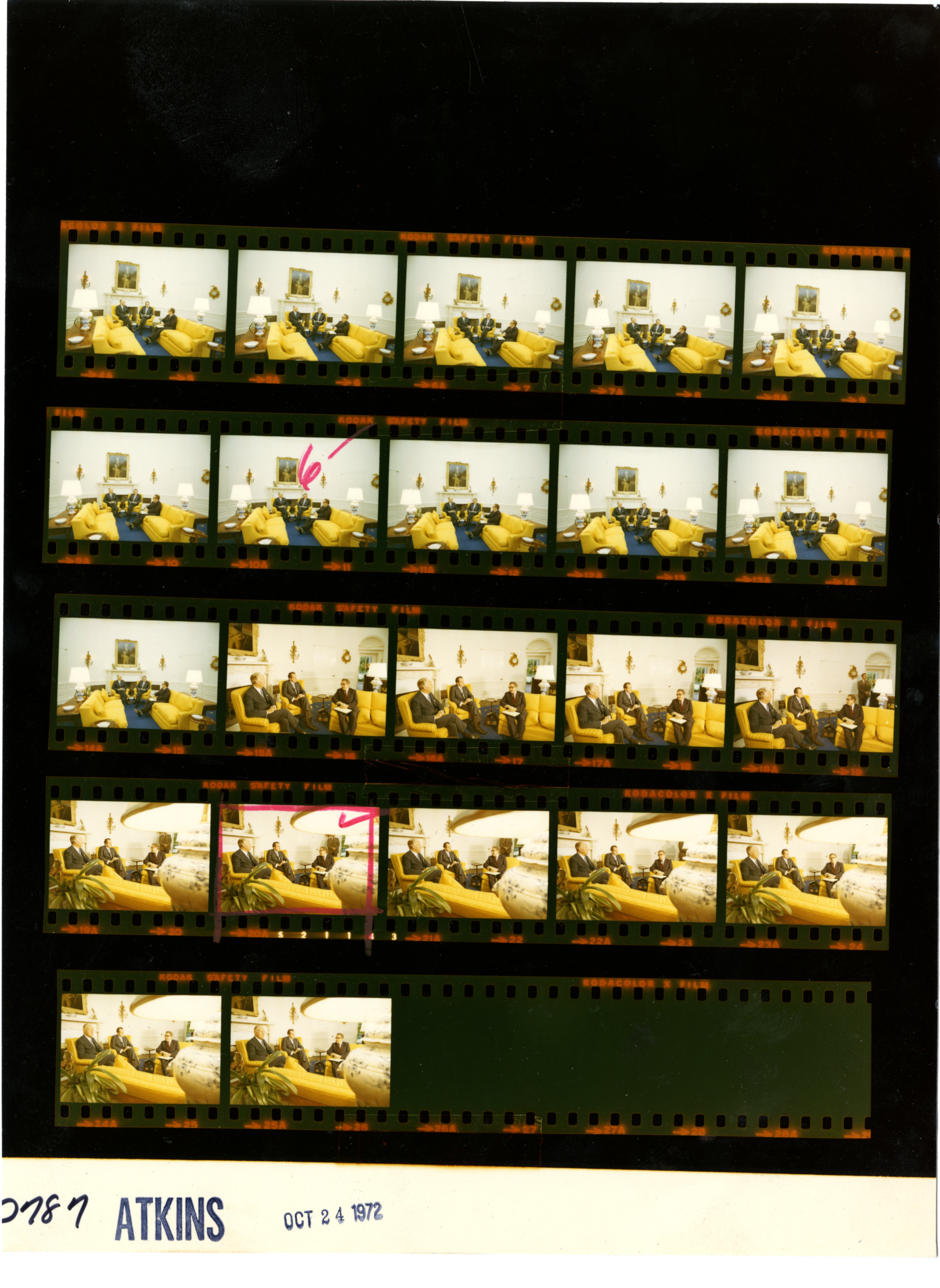
- Frame(s): WHPO-D0787-05A-25A, President Nixon seated in the Oval office during a meeting with Henry Kissinger and William Rogers. 10/24/1972, Washington, D.C. White House, Oval Office. Pesident Nixon, Henry Kissinger, William Rogers.
Roll WHPO-D0788 Photographer: Royer | Color or B&W: B&W
- Frame(s): WHPO-D0788-, Deputy Special Assistant John E. Nidecker receiving a replica of a stagecoach from the Thomas family. 10/24/1972, Washington, D.C. unknown. Nidecker, Mr. & Mrs. Thomas and son.
Roll WHPO-D0790 Photographer: Knudsen, Robert L. | Color or B&W: Color
- Frame(s): WHPO-D0790-00, President Nixon shaking hands with Patrolman Jake Miller, Policeman of the Year. 10/24/1972, Washington, D.C. White House, Oval Office. President Nixon, Jake Miller, Jack Lewis, Ray Fisher, Susan Johnston, Lawrence Hust, Philip Iannuccilli, Robert Murkerson, Robert Jenkins, Jr., Patrick Scott, Alan Loman.
- Frame(s): WHPO-D0790-01-12, President Nixon in group photos with Patrolman Miller and Honorable Mention award winners. 10/24/1972, Washington, D.C. White House, Oval Office. President Nixon, Jake Miller, Jack Lewis, Ray Fisher, Susan Johnston, Lawrence Hust, Philip Iannuccilli, Robert Murkerson, Robert Jenkins, Jr., Patrick Scott, Alan Loman.
Roll WHPO-D0792 Photographer: Atkins, Oliver | Color or B&W: B&W
- Frame(s): WHPO-D0792-, President Nixon shaking hands with the Policeman of the Year, Patrolman Jake Miller, and in group shots with him and the Honorable Mention award winners. 10/24/1972, Washington, D.C. White House, Oval Office. President Nixon, Jake Miller, Egil Krogh, Honorable Mention award winners, press corps members.
- Frame(s): WHPO-D0792-11A, The press gathered in the White House taking pictures of Nixon with the Policeman of the Year, Patrolman Jake Miller (not shown, the press is only shown). 10/24/1972, Washington, D.C. White House, Oval Office.
Roll WHPO-D0793 Photographer: Atkins, Oliver | Color or B&W: B&W
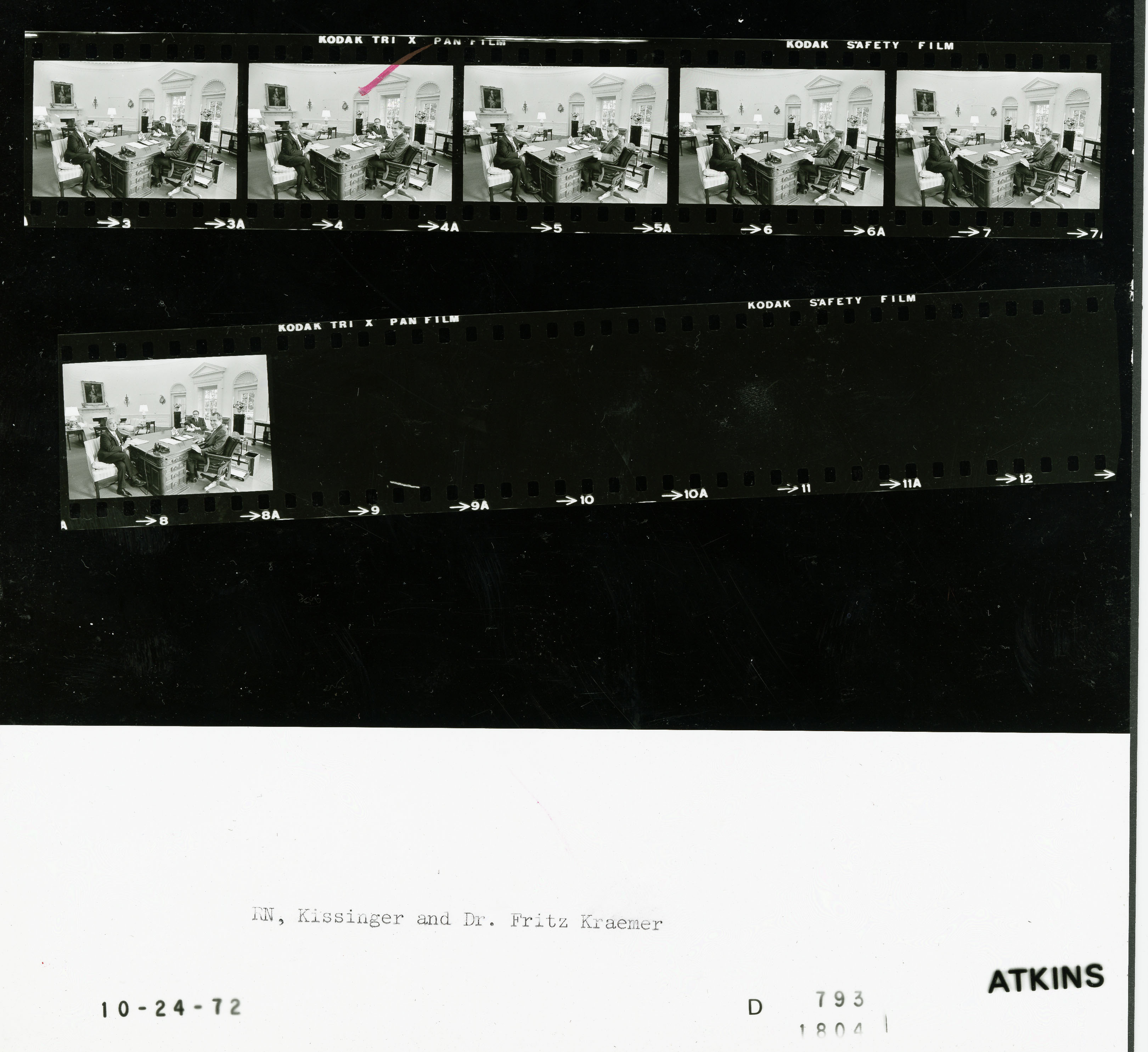
- Frame(s): WHPO-D0793-03-08, President Nixon seated at his Oval Office desk during a meeting with Henry Kissinger and Fritz Kraemer, Senior Civilian Advisor to the U.S. Army Chief of Staff at the Pentagon. 10/24/1972, Washington, D.C. White House, Oval Office. President Nixon, Henry Kissinger, Fritz Kraemer.
Roll WHPO-D0794 Photographer: Knudsen, Robert L. | Color or B&W: Color
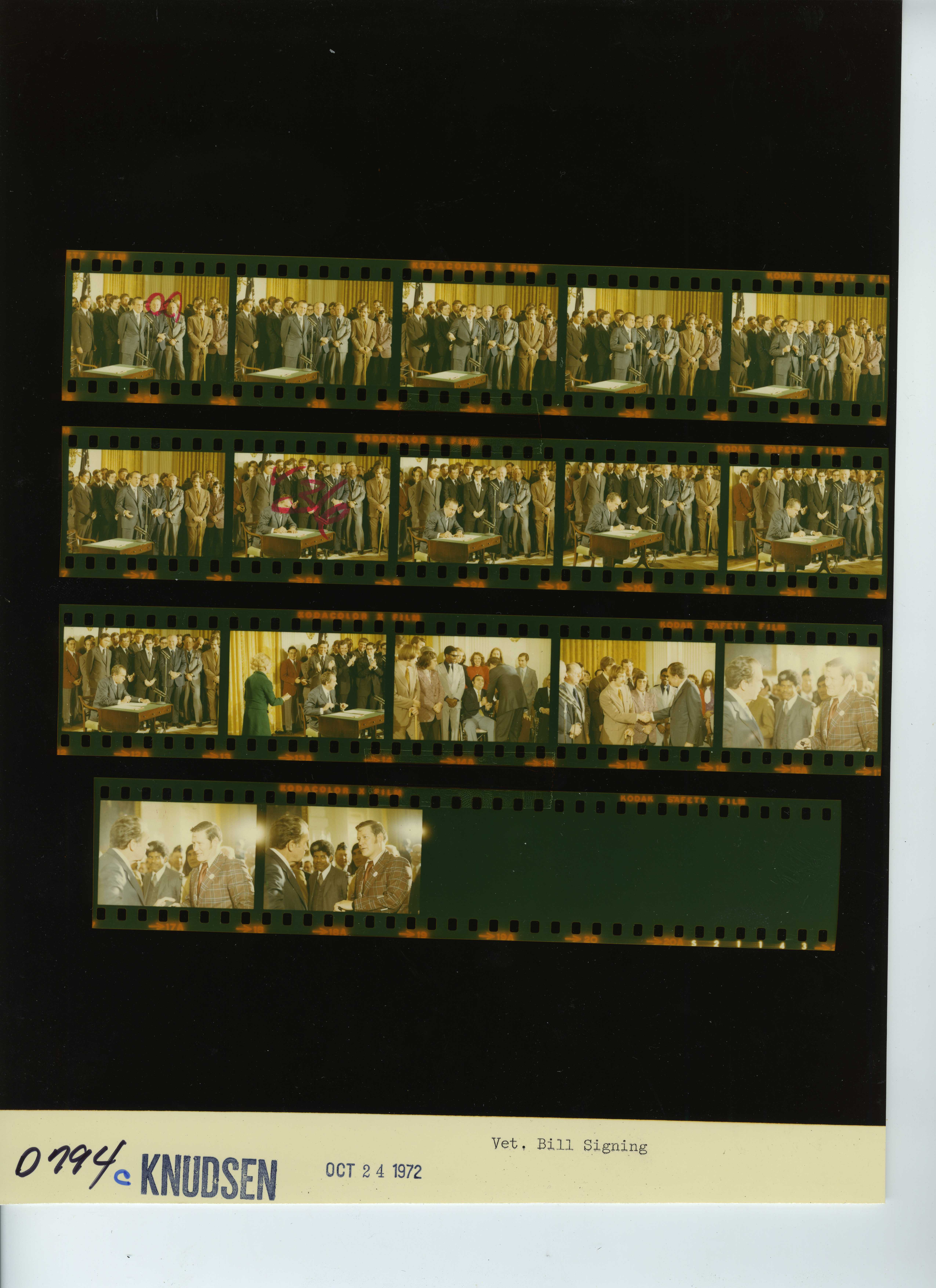
- Frame(s): WHPO-D0794-, President Nixon before, during, and after the signing of two veterans-related bills. 10/24/1972, Washington, D.C. White House, State Dining Room. President Nixon, Larry Kirk, veterans, officials.
- Frame(s): WHPO-D0794-08A, President Nixon signing two veterans-related bills. 10/24/1972, Washington, D.C. White House, State Dining Room. President Nixon, Larry Kirk, veterans, officials.
Roll WHPO-D0795 Photographer: Atkins, Oliver | Color or B&W: Color
- Frame(s): WHPO-D0795-, President Nixon signing two veterans-related bills. 10/24/1972, Washington, D.C. White House, State Dining Room. President Nixon, veterans, officials, guests.
Roll WHPO-D0796 Photographer: Royer | Color or B&W: B&W
- Frame(s): WHPO-D0796-, President Nixon signing two veterans-related bills. 10/24/1972, Washington, D.C. White House, State Dining Room. President Nixon, veterans, officials, guests.
Roll WHPO-D0797 Photographer: Royer | Color or B&W: B&W
- Frame(s): WHPO-D0797-, President Nixon before, during, and after the signing of two veterans-related bills. 10/24/1972, Washington, D.C. White House, State Dining Room. President Nixon, veterans, officials, guests.
Roll WHPO-D0798 Photographer: Schumacher, Karl | Color or B&W: B&W
- Frame(s): WHPO-D0798-04-07, Vice President Agnew speaking to a large audience. 10/24/1972, Salt Lake City, Utah; unknown unknown. Spiro Agnew, officials, audience.
- Frame(s): WHPO-D0798-08-15, Vice President Agnew arriving at and leaving from an unknown city. 10/24/1972, Salt Lake City, Utah; unknown unknown. Spiro Agnew, officials, audience.
- Frame(s): WHPO-D0798-16-26, Vice President Agnew talking with Governor Rockefeller and giving a speech. 10/24/1972, Syracuse, New York unknown. Spiro Agnew, Nelson Rockefeller, officials.
Roll WHPO-D0799 Photographer: Schumacher, Karl | Color or B&W: B&W
- Frame(s): WHPO-D0799-, Agnew giving a campaign speech. 10/24/1972, Salt Lake City, Utah unknown. Agnew, unidentified persons, audience.
Roll WHPO-D0801 Photographer: Schumacher, Karl | Color or B&W: B&W
- Frame(s): WHPO-D0801-, Vice President Agnew speaking to an audience and shaking hands with individuals, including Gov. Rockefeller. 10/24/1972, Syracuse, New York unknown. Agnew, Nelson Rockefeller, individuals, audience.
Roll WHPO-D0802 Photographer: Kightlinger, Jack | Color or B&W: Color
- Frame(s): WHPO-D0802-, Pat Nixon presenting the "Blind Worker of the Year Award" to Mrs. Mazelle Sullivan. 10/24/1972, Washington, D.C. White House, East Room. Pat Nixon, Mazelle Sullivan, aide.
Roll WHPO-D0929 Photographer: Schumacher, Karl | Color or B&W: B&W
- Frame(s): WHPO-D0929-02-06, Vice President Agnew giving a campaign speech. 10/24/1972, Syracuse, N.Y.; air unknown; plane. Spiro Agnew, Judy Agnew, officials, unidentified persons.
- Frame(s): WHPO-D0929-07-12, Vice President Agnew seated on his plane. Judy Agnew with unidentified young women. 10/24/1972, Syracuse, N.Y.; air unknown; plane. Spiro Agnew, Judy Agnew, officials, unidentified persons.
Roll WHPO-D1021 Photographer: Knudsen, Robert L. | Color or B&W: Color

- Frame(s): WHPO-D1021-, President Nixon, Pat Nixon and family arriving near the Winter Garden Theatre on Broadway in New York City. President Nixon, Pat Nixon and family window shopping. President Nixon, Pat Nixon and family leaving the theater, and greeting people in the crowd waiting outside the theater. 10/24/1972, New York City, New York outside, Winter Garden Theatre, Broadway. President Nixon, Pat Nixon, Julie Eisenhower, aides, crowd.
Roll WHPO-D1022 Photographer: Knudsen, Robert L. | Color or B&W: B&W
- Frame(s): WHPO-D1022-, President Nixon greeting the crowd outside the offices of the law firm of Judge, Rose, Guthrie and Alexander. 10/24/1972, New York City, New York 20 Broad Street. President Nixon, crowd.
The White House Communications Agency Sound Recordings Collection contains public statements that took place between 1969 and 1974. Visit the finding aid to learn more.
C - First Lady
- WHCA-SR-C-137
Remarks by Pat Nixon at reception for National Industries for the Blind. (10/24/1972, East Room, The White House)
Runtime: none listed
Production credits: Audio feed supplied by WHCA; Recorded by GET (initials of WHCA engineer)
Original Format: 1/4-inch reel-to-reel audiotape. Original source type: Original.
L - White House Press Office Briefings
- WHCA-SR-L-044
Press briefing by Ronald Ziegler. (10/24/1972, White House Press Lobby)
Runtime: 0:36:29
Keywords: press conferences, news conferences, interviews, media, press secretary, briefings, public statements to the press, Vietnam War, Indochina War, signing ceremony, bills, laws, signings, Presidential elections, Presidential campaigns, 1972 Presidential camp
Production credits: Audio feed supplied by WHCA; Recorded by JP (initials of WHCA engineer)
Original Format: 1/4-inch reel-to-reel audiotape. Original source type: Original. Technical notes: 1 hour 29 seconds of silence at end of recording removed from access copies.
P - Formal Presidential Remarks
- WHCA-SR-P-721019
Remarks by President Nixon signing veterans legislation: HR 10880, HR 12828, HJ Res. 748. (10/24/1972)
Runtime: 8:40
Original Format: 1/4-inch reel-to-reel audiotape. Original source type: Original.
The White House Communications Agency Videotape Collection contains “off-the-air” recordings of televised programs produced between 1968 and 1974. Visit the finding aid to learn more.
- WHCA-5850
Weekly News Summary, Tape II.
ALL NETWORKS
Runtime: 01:35:45
8. Reasoner/Koppel: South Vietnam's President Thieu makes stiff demands for Vietnam ceasefire. Time Code Start: 23:23. Keywords: South Vietnam, Presidents, speeches, statements, Vietnam War, ceasefires. Network: ABC.
9. Smith/Jarriel: Kissinger back in Washington, D.C., President Nixon signs new G.I. bill. Time Code Start: 25:20. Keywords: bills, laws, signings, military, troops, veterans, benefits, education, financial aid, Presidents, cabinet, advisors. Network: ABC.
10. Reasoner/Kaplow: McGovern campaigning in Dayton, Ohio. Time Code Start: 28:20. Keywords: Presidential elections, campaigns, campaigning, candidates. Network: ABC.
11. Smith/Donaldson: Frank Mankiewicz wants some other cases besides Watergate investigated by FBI. Democrats step up demands for investigation of political sabotage by Republicans. Democrats charge Justice Department whitewashed Watergate affair; demand othe. Time Code Start: 30:30. Keywords: Watergate, Senate committee hearings, investigations, testimony, testify, cover-ups, break-in, burglary, theft, plumbers, scandals. Network: ABC.
12. Reasoner/Sherwood: Harris poll on the issues, (John Kerry) running for congress in Massachusetts (Paul Cronin, Senator Ted Kennedy). Time Code Start: 32:41. Keywords: public opinions, polls, approval ratings, Gallup poll, Harris poll, Presidential elections, campaigns, primaries, candidates, voting. Network: ABC.
13. Reasoner: Commentary on Jackie Robinson, 1917-1972. Time Code Start: 35:58. Keywords: sports, baseball, hall of fame, celebrities, death, heart attacks, tributes, documentary, African Americans, leaders, civil rights, activists. Network: ABC.
14. Chancellor/Streithorst: South Vietnam's President Thieu against compromise suggested by the U.S.. Time Code Start: 37:55. Keywords: South Vietnam, Presidents, speeches, statements, Vietnam War. Network: NBC.
15. Chancellor/Valeriani: Kissinger back in Washington, D.C. to meet with President Nixon. Time Code Start: 40:33. Keywords: Presidents, meetings. Network: NBC.
16. Chancellor: Vietnam. Time Code Start: 42:03. Keywords: Vietnam War. Network: NBC.
17. Brinkley's Journal: Prospects for peace. Time Code Start: 42:56. Keywords: Vietnam War, truces, treaty, treaties. Network: NBC.
18. Chancellor/Dancy: Vice President Agnew in Utah. Time Code Start: 44:43. Keywords: Vice Presidents, travel, trips, Presidential elections, campaigns, campaigning, candidates. Network: NBC.
19. Chancellor/Nessen: Shriver in Chicago, Illinois. Time Code Start: 46:35. Keywords: Presidential elections, campaigns, campaigning, primaries, candidates, speeches. Network: NBC.
20. Chancellor/Davis: Secretary of Transportation Volpe and Tricia Nixon dedication of PRT Personal Rapid Transit System. Time Code Start: 48:32. Keywords: opening, PRT system, Personal Rapid Transit, public transportation, commuting, podcar, automated guideway transit (AGT). Network: NBC.
21. Chancellor/Stern: Republican sabotage squad? Justice Department said investigating reports of Republican sabotage squad, designed to disrupt Democrat political activities. Investigation found not to be underway. Those reported involved with operation have. Time Code Start: 51:04. Keywords: political parties, Republicans, GOP, spying, espionage, sabotage, crimes. Network: NBC.
22. Cronkite/Rather/Kalb: Piece in Vietnam; South Vietnam's President Thieu resistance; report from state department. Time Code Start: 53:33. Keywords: South Vietnam, Presidents, speeches, statements, Vietnam War. Network: CBS.
23. Cronkite/Morton: McGovern in Dayton, Ohio. Time Code Start: 56:18. Keywords: Presidential elections, campaigns, campaigning, candidates. Network: CBS.
24. Cronkite/Serafin: Vice President Agnew in Utah and Idaho. Time Code Start: 58:38. Keywords: Vice Presidents, travel, trips, Presidential elections, campaigns, campaigning, candidates. Network: CBS.
25. Cronkite/Broun/Sevareid: Tribute to Jackie Robinson, , 1917-1972. Time Code Start: 61:30. Keywords: sports, baseball, hall of fame, celebrities, death, heart attacks, tributes, documentary, African Americans, leaders, civil rights, activists. Network: CBS.
26. Cronkite/Walker: Tricia Nixon Cox dedicates PRT Personal Rapid Transit System. Time Code Start: 65:47. Keywords: Presidents Nixon, families, women, celebrations, dedications, PRT system, Personal Rapid Transit, public transportation, commuting, commuting, podcar, automated guideway transit (AGT). Network: CBS.
27. Cronkite/Culhane/Williams/Dick/Threlkeld: Campus campaign special. Time Code Start: 68:28. Keywords: Presidential elections, campaigns, campaigning, candidates. Network: CBS.
Context (External Sources)
The Vanderbilt Television News Archive is the world's most extensive and complete archive of television news. They have been recording, preserving and providing access to television news broadcasts of the national networks since August 5, 1968.
Wikipedia is a free encyclopedia that anyone can edit.