
Introduction
This almanac page for Wednesday, October 25, 1972, pulls together various records created by the federal government and links to additional resources which can provide context about the events of the day.
Previous Date: Tuesday, October 24, 1972
Next Date: Thursday, October 26, 1972
Schedule and Public Documents
The Daily Diary files represent a consolidated record of the President's activities. Visit the finding aid to learn more.
The President's day began at The White House - Washington, D. C.
The Weekly Compilation of Presidential Documents made available transcripts of the President's news conferences; messages to Congress; public speeches, remarks, and statements; and other Presidential materials released by the White House.
Digitized versions can be found at HathiTrust.
Each Public Papers of the Presidents volume contains the papers and speeches of the President of the United States that were issued by the White House Office of the Press Secretary during the time period specified by the volume. The material is presented in chronological order, and the dates shown in the headings are the dates of the documents or events. In instances when the release date differs from the date of the document itself, that fact is shown in the text note.
To ensure accuracy, remarks have been checked against audio recordings (when available) and signed documents have been checked against the original, unless otherwise noted. Editors have provided text notes and cross references for purposes of identification or clarity.
The Federal Register is the official daily publication for rules, proposed rules, and notices of federal agencies and organizations, as well as executive orders and other Presidential documents.
Archival Holdings
Any selection of archival documents will necessarily be partial. You should use the documents and folders identified below as a starting place, but consult the linked collection finding aids and folder title lists and the collections themselves for context. Many documents to be found this way do not lend themselves to association with specific dates, but are essential to a complete understanding of the material.
Selective document listing
President's Office Files
The President's Office Files consists of materials drawn together by the Special Files Unit from several administrative subdivisions within the White House Office. It is the handwriting and sensitive papers sent to the Staff Secretary that now comprise much of the President's Office Files. Visit the finding aid to learn more.
- News Summaries, Annotated News Summaries, Box 40, Oct. 23-31, 1972 [3 of 7] [Note: Due to the way News Summary products were compiled, you should also consult nearby days for potentially relevant materials.]
- Political Media Analysis, October 25, 1972, 13 Days To Go
- News Summary, October 25, 1972, (nets, wires, columns)
- President's Daily Schedule, Box 102, [President's Daily Schedule, Oct.-Dec. 1972] [1 of 2]
- The President's Schedule, Wednesday - October 25, 1972
President's Personal File
The President's Personal File is essentially a President's secretary's file, kept by Rose Mary Woods, personal secretary to the President, for two purposes: (1) preserving for posterity a collection of documents particularly close to the President, whether because he dictated or annotated them, or because of the importance of the correspondent or the event concerned and (2) giving appropriate attention–letters of gratitude, invitations to White House social events, and the like–to members and important friends and supporters of the Nixon administration. This generalization does not describe all the varied materials of a file group which is essentially a miscellany, but it does identify the reason for the existence of the file group's core. Visit the finding aid to learn more.
- President's Speech File
The H. R. Haldeman Diaries consists of seven handwritten diaries, 36 dictated diaries recorded as sound recordings, and two handwritten audio cassette tape subject logs. The diaries and logs reflect H. R. Haldeman’s candid personal record and reflections on events, issues, and people encountered during his service in the Nixon White House. As administrative assistant to the President and Chief of Staff, Haldeman attended and participated in public events and private meetings covering the entire scope of issues in which the Nixon White House engaged in during the years 1969-1973. Visit the finding aid to learn more.
- Transcript of diary entry (PDF)
Wednesday, October 25.
The Post story on me broke this morning and was the major stir for today. We had gotten into it yesterday evening, since they had inquired about it, and we knew that the story would probably break, and it did. Today's the day McGovern does his big speech on corruption, so they obviously used that as the buildup. There was a lot of discussion during the day about the effect and what should be done.
Ziegler did a strong counterattack on the Post at his briefing this morning, and that will ride as the main answer, with a good strong denial. Also Hugh Sloan and others have handled the denials. The President didn't seem overly worried about it, although he did raise it some. And let's see what develops from there.
The President got into some questions on speech schedules, he wants to get going on the foreign policy speech now and also the defense policy one, using the material from his San Francisco speech, but building up the point of massive retaliation being outdated in discussing the fate of small nations. He went over the timing of the various radio speeches -- he also wants a radio spot on amnesty. He feels that we're not getting enough on that. Felt that Ziegler, or someone, should hit the Post on yellow journalism. That we should keep a hard attack going on McGovern on Vietnam, and then in the middle of all that raised the point that he wants a little press facility built up at Camp David for use as a briefing room, and small press lounge set up.
End of October 25. - Original audio recording (MP3)
The National Archives Catalog is the online portal to the records held at the National Archives, and information about those records. It is the main way of describing our holdings and also provides access to electronic records and digitized versions of our holdings.
The Catalog searches across multiple National Archives resources at once, including archival descriptions, digitized and electronic records, authority records, and web pages from Archives.gov and the Presidential Libraries. The Catalog also allows users to contribute to digitized historical records through tagging and transcription.
Nixon Library Holdings
All National Archives Units
National Security Documents
The President's Daily Brief is the primary vehicle for summarizing the day-to-day sensitive intelligence and analysis, as well as late-breaking reports, for the White House on current and future national security issues. Read "The President's Daily Brief: Delivering Intelligence to Nixon and Ford" to learn more.
The Foreign Relations of the United States series presents the official documentary historical record of major U.S. foreign policy decisions and significant diplomatic activity. Visit the State Department website for more information.
Vol. IX, Vietnam, October 1972-January 1973
Paris Negotiations Collapse, October 24-December 13, 1972
69. Transcript of a Telephone Conversation Between the President’s Assistant for National Security Affairs (Kissinger) and the Deputy Assistant Secretary of State for East Asian and Pacific Affairs (Sullivan), Washington, October 25, 1972, 5 p.m.
Source: National Archives, Nixon Presidential Materials, Kissinger Telephone Conversations, Box 16, Chronological File. No classification marking.
70. Backchannel Message From the President’s Assistant for National Security Affairs (Kissinger) to the Ambassador to Vietnam (Bunker), Washington, October 25, 1972, 2115Z
Source: National Archives, Nixon Presidential Materials, NSC Files, Box 857, For the President’s Files (Winston Lord)—China Trip/Vietnam, Sensitive Camp David, Vol. XXI (1). Top Secret; Sensitive; Exclusively Eyes Only.
71. Memorandum From Secretary of Defense Laird to the Assistant Secretary of Defense for Installations and Logistics (Shillitoe), Washington, October 25, 1972
Source: National Archives, RG 218, Records of the Chairman, Records of Thomas Moorer, Box 29, Vietnam, October 1972. Top Secret; Sensitive. Copies were sent to the Service Secretaries and the Chairman of the Joint Chiefs of Staff.
Vol. XVII, China, 1969-1972
China, March-December 1972
259. Message From the Government of the People’s Republic of China to the Government of the United States, New York, October 25, 1972
Source: National Archives, Nixon Presidential Materials, NSC Files, Box 850, President’s File—China Trip, China Exchanges. No classification marking. A typewritten notation on the first page reads: “Handed to J. Fazio by Mrs. Shih, October 25, 1972, New York.” At this meeting, Fazio handed over a copy of a 3-page note entitled “Message to the Government of the DRV on Behalf of the President of the United States,” which was a response to a DRV message of October 24. Fazio also extended an invitation from Kissinger to Ch’iao Kuan-hua and Huang Hua for dinner in New York on November 1. Fazio’s memorandum for the record of the October 25 meeting and the U.S. message are ibid. See Foreign Relations, 1969–1976, vol. E–13, Document 165.
Vol. XIX, Part 1, Korea, 1969-1972
Republic of Korea Troops in Vietnam and Force Modernization, April 1971-December 1972
164. Memorandum From John H. Holdridge of the National Security Council Staff to the President’s Assistant for National Security Affairs (Kissinger), Washington, October 25, 1972
Source: National Archives, Nixon Presidential Materials, NSC Files, Box 543, Country Files, Far East, Korea, Vol. V, 1 Jan–31 Dec 1972, Part 2. Secret; Sensitive. Sent for information. Also initialed by Froebe. A notation on the memorandum indicates Haig saw it.
Vol. XXXVI, Energy Crisis, 1969-1974
March 16, 1972-March 6, 1973
144. Telegram From the Deputy Secretary of State (Irwin) to the Department of State, Paris, October 25, 1972, 0954Z
Source: National Archives, RG 59, Central Files 1970–73, PET 3 OECD. Confidential.
Vol. XXXIX, European Security
Prelude to Negotiations, June 1972-November 1972
116. Memorandum From the Executive Secretary of the Department of State (Eliot) to the President’s Assistant for National Security Affairs (Kissinger), Washington, October 25, 1972
Source: National Archives, Nixon Presidential Materials, NSC Files, Box 247, Agency Files, MBFR and CSCE, 1972. Secret. On October 26, Sonnenfeldt forwarded Eliot’s memorandum to Kissinger. In the covering memorandum, Sonnenfeldt wrote: “Having at long last solved the flank participation issue, we plan to answer the Soviet note given to you in Moscow.” Sonnenfeldt predicted: “Delivery of our note and its content will undoubtedly leak. Since virtually the entire scenario will then have appeared in the press, a joint Soviet-American announcement strikes me as an anti-climax.” Sonnenfeldt recommended that Kissinger concur in the Department of State scenario and “approve a unilateral U.S. announcement” that it was “accepting the Finnish invitation for November 22” and was planning “to attend the first MBFR talks in January.” Kissinger initialed his approval of both recommendations.
Vol. E-1, Documents on Global Issues, 1969-1972
U.S. Policy Towards Terrorism, Hijacking of Aircraft, and Attacks on Civil Aviation: The Olympic Attack and the Anti-Terrorism Initiatives, September−December 1972
113. Memorandum From Fernando Rondon and Richard Kennedy of the National Security Council Staff to the President’s Assistant for National Security Affairs (Kissinger), Washington, October 25, 1972
NSC staffers updated Kissinger on the status of the Terrorism Convention and the Convention on the Protection of Diplomats at the United Nations.
Source: National Archives, Nixon Presidential Materials, NSC Files, Subject Files, Box 310, Cabinet Committee on Terrorism. Confidential. Sent for information. Copies were sent to Saunders and Young. Tab A is published as Document 112.
Vol. E-10, Documents on American Republics, 1969-1972
Nicaragua
516. Memorandum of Conversation, Managua, October 25, 1972., Managua, October 25, 1972
Political Officer Cheek met with Archbishop Obando y Bravo to discuss the political role of the Church and increased confrontation with the state. Obando y Bravo indicated that the Church had an obligation to fight injustice and other evils, and criticized the Government of Nicaragua for acts of violence against the population.
Source: National Archives, RG 59, Central Files 1970–73, POL 15–7 NIC. Confidential. It was repeated to Guatemala, San Salvador, San José, Tegucigalpa, and USCINCSO for POLAD. It was transmitted to the Department as an Enclosure to Airgram A–104 from Managua, November 3, which is published as Document 517.
Vol. E-13, Documents on China, 1969-1972
163. Memorandum for the Record, New York, October 25, 1972, 4:30-4:55 p.m., New York, October 25, 1972, 4:30-4:55 p.m.
Deputy Director of the White House Situation Room Fazio and Shih Yen-hua of the Chinese Mission to the UN exchanged notes concerning the war in Vietnam and a dinner engagement between U.S. and Chinese officials.
Source: National Archives, Nixon Presidential Materials, NSC Files, Box 850, President’s File-China Trip, China Exchanges, Oct 24, 1972-Dec 31, 1972. Top Secret; Sensitive. Drafted by Fazio on October 26. For the text of the note Shih Yen-hua handed to Fazio, see Document 259, Foreign Relations, 1969-1976, volume XVII. Attached are three U.S. messages, two of which bear the handwritten notation: “Handed to Mrs. Shih by J. Fazio, 10/25/72, NYC.” The last message bears the handwritten notation: “Read to Mrs. Shih by J. Fazio, 10/25/72, NYC.”
The Kissinger telephone conversation transcripts consist of approximately 20,000 pages of transcripts of Kissinger’s telephone conversations during his tenure as Assistant to the President for National Security Affairs (1969-1974) and Secretary of State (1973-1974) during the administration of President Richard Nixon. Visit the finding aid for more information.
Digitized versions can be found in the National Archives Catalog.
Audiovisual Holdings
Visit the White House Tapes finding aid to learn about the taping system's operation and archival processing.
Old Executive Office Building
- 372-1; Unknown between 7:42 a.m. & 8:20 a.m.; Nixon, Richard M. (President); White House operator
- 372-2; 8:20 a.m. - 8:22 a.m.; Nixon, Richard M. (President); Ziegler, Ronald L.
- 372-3; Unknown between 8:20 a.m. & 9:05 a.m.; Nixon, Richard M. (President); Bull, Stephen B.
- 372-4; Unknown between 8:20 a.m. & 9:05 a.m.; Nixon, Richard M. (President); White House operator
- 372-5; Unknown between 8:20 a.m. & 9:05 a.m.; Nixon, Richard M. (President)
- 372-6; 9:05 a.m. - 9:05 a.m.; Nixon, Richard M. (President); White House operator
- 372-7; Unknown between 9:05 a.m. & 9:18 a.m.; Nixon, Richard M. (President)
- 372-8; 9:18 a.m. - 9:19 a.m.; Nixon, Richard M. (President); Schwenk, Edwin M.
- 372-9; Unknown between 9:19 a.m. & 9:25 a.m.; Nixon, Richard M. (President)
- 372-10; 9:25 a.m. - 9:36 a.m.; Nixon, Richard M. (President); Ehrlichman, John D.
- 372-11; 9:40 a.m. - 10:08 a.m.; Nixon, Richard M. (President); Kissinger, Henry A.
- 372-12; Unknown between 10:08 a.m. & 10:09 a.m.; Nixon, Richard M. (President); White House operator
- 372-13; 10:09 a.m. - 10:10 a.m.; Nixon, Richard M. (President); Bull, Stephen B.
- 372-14; Unknown between 10:10 a.m. & 10:11 a.m.; Nixon, Richard M. (President); White House operator
- 372-15; 10:11 a.m. - 10:14 a.m.; Nixon, Richard M. (President); Ziegler, Ronald L.
- 372-16; Unknown between 10:14 a.m. & 11:18 a.m.; Nixon, Richard M. (President); Kissinger, Henry A.
- 372-17; Unknown between 10:14 a.m. & 11:18 a.m.; Nixon, Richard M. (President)
- 372-18; Unknown between 10:14 a.m. & 11:18 a.m.; Nixon, Richard M. (President); Sanchez, Manolo
- 372-19; Unknown between 10:14 a.m. & 11:18 a.m.; Nixon, Richard M. (President); Sanchez, Manolo
- 372-20; Unknown between 10:14 a.m. & 11:18 a.m.; Nixon, Richard M. (President)
- 372-21; Unknown between 11:04 a.m. & 11:18 a.m.; Nixon, Richard M. (President); Butterfield, Alexander P.
- 372-22; Unknown between 11:04 a.m. & 11:18 a.m.; Nixon, Richard M. (President)
- 372-23; Unknown between 11:04 a.m. & 11:18 a.m.; Nixon, Richard M. (President); Sanchez, Manolo
- 372-24; 11:18 a.m. - 12:00 p.m.; Nixon, Richard M. (President); Haldeman, H. R. ("Bob"); Ziegler, Ronald L.; Kissinger, Henry A.
- 372-25; Unknown between 12:25 p.m. & 12:29 p.m.; Nixon, Richard M. (President); Sanchez, Manolo
- 372-26; 12:29 p.m. - 1:10 p.m.; Nixon, Richard M. (President); Colson, Charles W.; Bull, Stephen B.
- 372-27; Unknown between 1:10 p.m. & 2:30 p.m.; Nixon, Richard M. (President); [Unknown person(s)]
- 372-28; Unknown between 1:10 p.m. & 2:30 p.m.; Nixon, Richard M. (President); Sanchez, Manolo
- 372-29; Unknown between 1:10 p.m. & 2:30 p.m.; Nixon, Richard M. (President); White House operator
- 372-30; 2:30 p.m. - 2:32 p.m.; Nixon, Richard M. (President); Butterfield, Alexander P.
- 372-31; 2:50 p.m. - 2:53 p.m.; Nixon, Richard M. (President); Butterfield, Alexander P.
- 372-32; Unknown between 2:53 p.m. & 3:03 p.m.; Nixon, Richard M. (President); [Unknown person(s)]
- 372-33; Unknown between 2:53 p.m. & 3:03 p.m.; Nixon, Richard M. (President); White House operator
- 372-34; 3:03 p.m. - 3:04 p.m.; Nixon, Richard M. (President); Bull, Stephen B.
- 372-35; Unknown between 3:04 p.m. & 3:05 p.m.; Nixon, Richard M. (President); White House operator
- 372-36; 3:05 p.m. - 3:06 p.m.; Nixon, Richard M. (President); Andrews, John K., Jr.
- 372-37; Unknown between 3:06 a.m. & 3:25 a.m.; Nixon, Richard M. (President)
- 372-38; 3:25 p.m. - 4:20 p.m.; Nixon, Richard M. (President); Haldeman, H. R. ("Bob"); [Unknown person(s)]; Bull, Stephen B.
- 372-39; Unknown between 4:20 p.m. & 4:40 p.m.; Nixon, Richard M. (President); Bull, Stephen B.
- 374-1; Unknown between 4:20 p.m. & 4:40 p.m.; Nixon, Richard M. (President); Sanchez, Manolo
- 374-2; Unknown between 4:20 p.m. & 4:40 p.m.; Nixon, Richard M. (President)
- 374-3; 4:40 p.m. - 5:40 p.m.; Nixon, Richard M. (President); Colson, Charles W.; Sanchez, Manolo; White House operator; [Unknown person(s)]; Kissinger, Henry A.
White House Telephone
- 32-28; Unknown between 7:47 a.m. & 8:20 a.m.; Nixon, Richard M. (President); White House operator
- 32-29; 8:20 a.m. - 8:22 a.m.; Nixon, Richard M. (President); Ziegler, Ronald L.
- 32-30; Unknown between 8:22 a.m. & 9:05 a.m.; Nixon, Richard M. (President); White House operator
- 32-31; 9:05 a.m. - 9:05 a.m.; Nixon, Richard M. (President); White House operator
- 32-32; 9:18 a.m. - 9:19 a.m.; Nixon, Richard M. (President); Schwenk, Edwin M.
- 32-33; Unknown between 9:19 a.m. & 10:09 a.m.; Nixon, Richard M. (President); White House operator
- 32-34; 10:09 a.m. - 10:10 a.m.; Nixon, Richard M. (President); Bull, Stephen B.
- 32-35; Unknown between 10:10 a.m. & 10:11 a.m.; Nixon, Richard M. (President); White House operator
- 32-36; 10:11 a.m. - 10:14 a.m.; Nixon, Richard M. (President); Ziegler, Ronald L.
- 32-37; Unknown between 1:10 p.m. & 2:30 p.m.; Nixon, Richard M. (President); White House operator
- 32-38; 2:30 p.m. - 2:32 p.m.; Nixon, Richard M. (President); Butterfield, Alexander P.; [Unknown person(s)]
- 32-39; Unknown between 2:53 p.m. & 3:03 p.m.; Nixon, Richard M. (President); White House operator
- 32-40; 3:03 p.m. - 3:04 p.m.; Nixon, Richard M. (President); Bull, Stephen B.
- 32-41; Unknown between 3:04 p.m. & 3:05 p.m.; Nixon, Richard M. (President); White House operator
- 32-42; 3:05 p.m. - 3:06 p.m.; Nixon, Richard M. (President); Andrews, John K., Jr.
- 32-43; Unknown between 4:40 p.m. & 5:25 p.m.; Colson, Charles W.; White House operator; [Unknown person(s)]
- 32-171; 6:25 p.m. - 6:26 p.m.; Nixon, Richard M. (President); Cox, Tricia Nixon
The White House Photo Office collection consists of photographic coverage of President Richard Nixon meeting with prominent social, political, and cultural personalities; speaking engagements and news conferences of the President and various high-ranking members of the White House staff and Cabinet; Presidential domestic and foreign travel, including Presidential vacations; social events and entertainment involving the First Family, including entertainers present; official portraits of the President, First Family, and high-ranking members of the Nixon administration; the 1969 and 1973 Inaugurals; the President’s 1972 Presidential election campaign appearances (including speeches) and other official activities of the White House staff and the President’s Cabinet from January 20, 1969 until August 9, 1974 at the White House and the Old Executive Office Building; other locations in Washington, DC, such as The Mall; and the Presidential retreats in Camp David, Maryland, Key Biscayne, Florida, and San Clemente, California. Visit the finding aid to learn more.
Roll WHPO-D0804 Photographer: Royer | Color or B&W: B&W
- Frame(s): WHPO-D0804-, Young children, including Ron Ziegler's daughter, and adults gathered around the Cabinet table. 10/25/1972, Washington, D.C. White House, Cabinet Room. Ziegler, Miss Ziegler, children, adults.
Roll WHPO-D0805 Photographer: Royer | Color or B&W: B&W
- Frame(s): WHPO-D0805-, Young children, including Ron Ziegler's daughter, and adults gathered around the Cabinet table. 10/25/1972, Washington, D.C. White House, Cabinet Room. Ziegler, Miss Ziegler, children, adults.
Roll WHPO-D0806 Photographer: Atkins, Oliver | Color or B&W: B&W
- Frame(s): WHPO-D0806-, Shots of radio technicians and others in a room. 10/25/1972, Washington, D.C. unknown. unidentified men.
Roll WHPO-D0807 Photographer: Schumacher, Karl | Color or B&W: B&W
- Frame(s): WHPO-D0807-, Vice President Agnew and Judy Agnew at various unidentified sites. 10/25/1972, Augusta, Georgia; unidentified sites unidentified sites. Agnew, Judy Agnew, officials, crowds.
Roll WHPO-D0808 Photographer: Schumacher, Karl | Color or B&W: Color
- Frame(s): WHPO-D0808-, Vice President Agnew and Judy Agnew at various unidentified sites. 10/25/1972, North Carolina unidentified sites. Agnew, Judy Agnew, officials, crowds.
Roll WHPO-D1024 Photographer: Knudsen, Robert L. | Color or B&W: Color
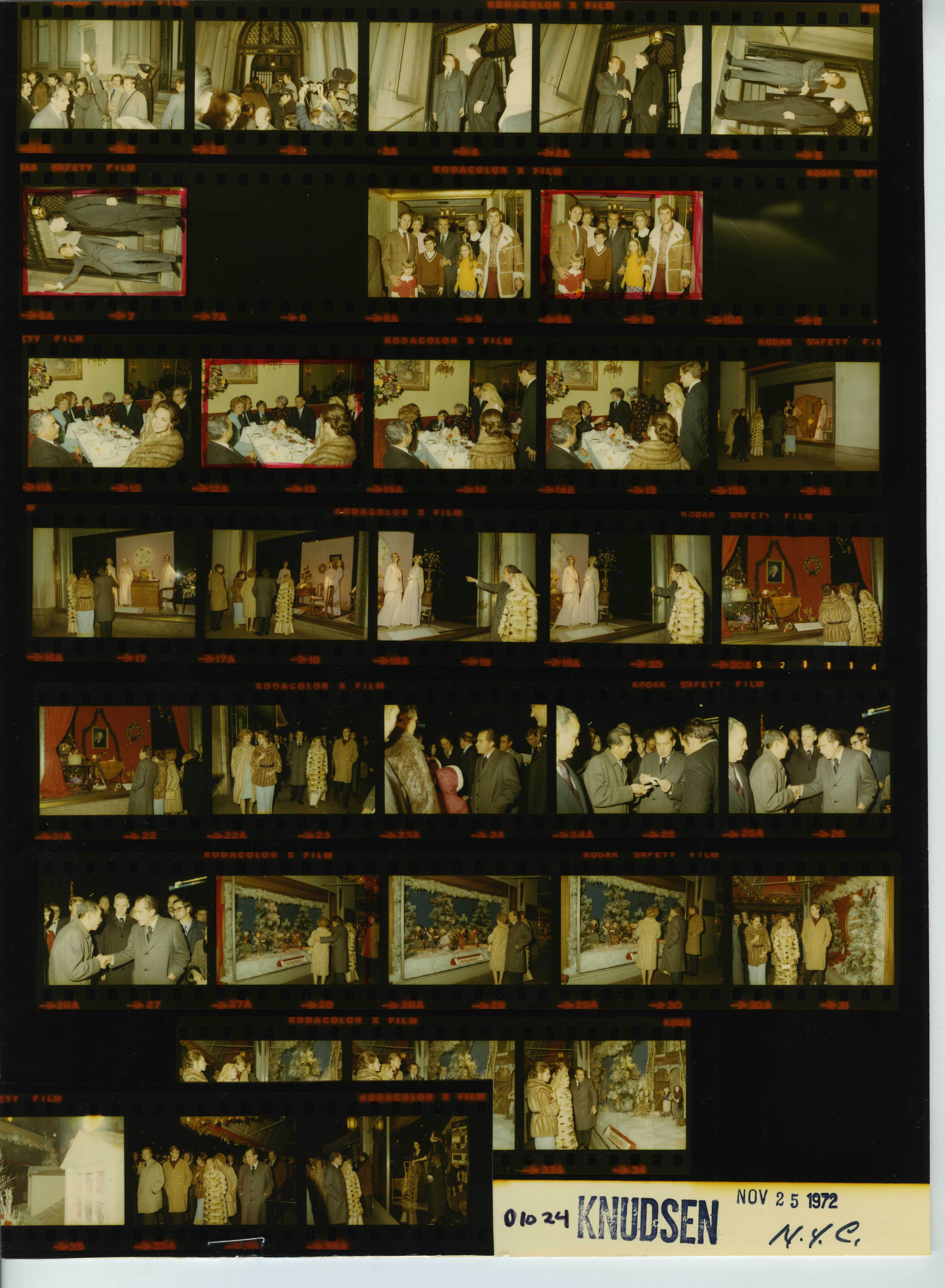
- Frame(s): WHPO-D1024-02-07, President Nixon visiting with Terrence Cardinal Cooke at Cooke's New York residence. 10/25/1972, New York City, New York residence of Cardinal Cooke; La Grenouille Restaurant; streets. President Nixon, Pat Nixon, Terrence Cardinal Cooke, Tricia Nixon Cox, Ed Cox, Julie Eisenhower, Charles Bebe Rebozo, crowd.
- Frame(s): WHPO-D1024-09-15, President Nixon standing with an unidentified family prior to dinner and eating with his family and guests. 10/25/1972, New York City, New York residence of Cardinal Cooke; La Grenouille Restaurant; streets. President Nixon, Pat Nixon, Terrence Cardinal Cooke, Tricia Nixon Cox, Ed Cox, Julie Eisenhower, Rebozo, crowd.
- Frame(s): WHPO-D1024-16-36, The Nixons window shopping and greeting the crowd. 10/25/1972, New York City, New York La Grenouille Restaurant; streets. President Nixon, Pat Nixon, Tricia Nixon Cox, Ed Cox, Julie Eisenhower, BB Charles Rebozo, crowd.
Roll WHPO-D1025 Photographer: Knudsen, Robert L. | Color or B&W: Color
- Frame(s): WHPO-D1025-, President Nixon greeting the crowd outside. President Nixon standing with Ismail el Shamawany and Moshe Harel. 10/25/1972, New York City, New York Rockefeller Center. President Nixon, Ismail el Shamawany, Moshe Harel, crowd.
The White House Communications Agency Sound Recordings Collection contains public statements that took place between 1969 and 1974. Visit the finding aid to learn more.
E - Secretary of Defense Briefings
- WHCA-SR-E-029
Press conference by Secretary of Defense Melvin Laird at Andrews Air Force Base, Maryland. (10/25/1972, Andrews Air Force Base, Maryland)
Production credits: Audio feed supplied by OPI; Recorded by JMM (initials of WHCA engineer)
Original Format: 1/4-inch reel-to-reel audiotape. Original source type: Original.
L - White House Press Office Briefings
- WHCA-SR-L-045
Press briefing by Ronald Ziegler. (10/25/1972, White House Press Lobby)
Runtime: 0:54:24
Keywords: press conferences, news conferences, interviews, media, press secretary, briefings, public statements to the press, bills, laws, media, newspapers, magazines, the press, publications, Vietnam War, Indochina War, athlete, athletes, sports, celebrities, Pre
Production credits: Audio feed supplied by WHCA; Recorded by JMM (initials of WHCA engineer)
Original Format: 1/4-inch reel-to-reel audiotape. Original source type: Original. Technical notes: 17 minutes and 18 seconds of silence at end of recording removed from access copies.
P - Formal Presidential Remarks
- WHCA-SR-P-721020
Live radio speech on federal responsibility to education. (10/25/1972, Lincoln Library)
Runtime: 0:15:08
Production credits: Audio "mult" feed supplied by CBS (probably pool feed); No WHCA engineer initials listed
Original Format: 1/4-inch reel-to-reel audiotape. Original source type: Original. - WHCA-SR-P-721021
Remarks by President Nixon on behalf of Republican candidates. (10/25/1972)
Runtime: 3:15
Original Format: 1/4-inch reel-to-reel audiotape. Original source type: Original.
The White House Communications Agency Videotape Collection contains “off-the-air” recordings of televised programs produced between 1968 and 1974. Visit the finding aid to learn more.
- WHCA-5841
"ABC Evening News"; McGovern Political Announcement AND "A Public Affair: Election '72".
ALL NETWORKS
Runtime: 1:30 - WHCA-5842
Nixon-Khrushchev Kitchen Debate, 7/24/1959. Stanley Scott.
Metromedia
Runtime: 00:16:15 - WHCA-5842A
Nixon-Khrushchev Kitchen Debate.
Post-Newsweek Stations, Inc.
Runtime: 00:33:42 - WHCA-5850
Weekly News Summary, Tape II.
ALL NETWORKS
Runtime: 01:35:45
28. Smith/Burke: Vietnam, air strikes slowdown. Time Code Start: 73:36. Keywords: Vietnam War, aircraft, bombings. Network: ABC.
29. Smith/Giggans: South Vietnam's President Thieu speech reaction. Time Code Start: 76:21. Keywords: South Vietnam, Presidents, speeches, statements, Vietnam War. Network: ABC.
30. Smith/Koppel: More on Peace moves (MacGregor). Time Code Start: 78:50. Keywords: Vietnam War, treaty, treaties, negotiations. Network: ABC.
31. Smith/Donaldson: Washington Post charges MacGregor. Time Code Start: 81:15. Keywords: newspapers, editorials, stories, accusations, reports, Watergate, burglary, investigations, White House, administration, officials, staff. Network: ABC.
32. Smith/Reynolds: (McGovern) in Ohio. Time Code Start: 83:55. Keywords: Presidential elections, campaigns, campaigning, candidates. Network: ABC.
33. Smith/Murphy: Texas politics (Senator John Tower). Time Code Start: 86:08. Keywords: Sentaors, political activities. Network: ABC.
34. Smith: Commentary on Watergate. Time Code Start: 90:00. Keywords: Watergate, Senate committee hearings, investigations, testimony, testify, cover-ups, break-in, burglary, theft, plumbers, scandals. Network: ABC. - WHCA-5851
Weekly News Summary, Tape III.
ALL NETWORKS
Runtime: 1:30
1. Chancellor/Valeriani: Washington Post charges; (McGovern) comments on charges; Ziegler denies charges; MacGregor denies charges. Time Code Start: 00:00. Keywords: newspapers, editorials, stories, accusations, reports, Watergate, burglary, investigations, White House, administration, officials, staff. Network: NBC.
2. Chancellor/Streithorst: South Vietnam's President Thieu resists coalition government in Vietnam. Time Code Start: 05:57. Keywords: South Vietnam, Presidents, speeches, statements, Vietnam War. Network: NBC.
3. Brinkley's Journal: South Vietnam's President Thieu. Time Code Start: 09:02. Keywords: South Vietnam, Presidents, speeches, statements, Vietnam War. Network: NBC.
4. Chancellor/Lord: Vietnam, bombing halt. Time Code Start: 10:52. Keywords: Vietnam War, bombs, bombings. Network: NBC.
5. Cronkite/Jones: Peace settlement; Vietnam. Time Code Start: 13:58. Keywords: Paris Peace Talks, Vietnam War, treaty, treaties, negotiations, settlements. Network: CBS.
6. Cronkite/Schorr/Schieffer: Washington Post charges; Ziegler denies charges; McGovern comments on charges. Time Code Start: 17:30. Keywords: newspapers, editorials, stories, accusations, reports, Watergate, burglary, investigations, White House, administration, officials, staff. Network: CBS.
7. Sevareid: Commentary on Washington Post charges. Time Code Start: 21:53. Keywords: newspapers, editorials, stories, accusations, reports, Watergate, burglary, investigations, White House, administration, officials, staff. Network: CBS.
8. Cronkite/Dean: West Virginia's governor's race, Illinois governor's race. Time Code Start: 25:17. Keywords: Governors, Gubernatorial, elections, campaigns, campaigning, candidates, voting, results. Network: CBS.
Context (External Sources)
The Vanderbilt Television News Archive is the world's most extensive and complete archive of television news. They have been recording, preserving and providing access to television news broadcasts of the national networks since August 5, 1968.
Wikipedia is a free encyclopedia that anyone can edit.