
Introduction
This almanac page for Wednesday, November 15, 1972, pulls together various records created by the federal government and links to additional resources which can provide context about the events of the day.
Previous Date: Tuesday, November 14, 1972
Next Date: Thursday, November 16, 1972
Schedule and Public Documents
The Daily Diary files represent a consolidated record of the President's activities. Visit the finding aid to learn more.
The President's day began at Camp David, Maryland
The Weekly Compilation of Presidential Documents made available transcripts of the President's news conferences; messages to Congress; public speeches, remarks, and statements; and other Presidential materials released by the White House.
Digitized versions can be found at HathiTrust.
Each Public Papers of the Presidents volume contains the papers and speeches of the President of the United States that were issued by the White House Office of the Press Secretary during the time period specified by the volume. The material is presented in chronological order, and the dates shown in the headings are the dates of the documents or events. In instances when the release date differs from the date of the document itself, that fact is shown in the text note.
To ensure accuracy, remarks have been checked against audio recordings (when available) and signed documents have been checked against the original, unless otherwise noted. Editors have provided text notes and cross references for purposes of identification or clarity.
The Federal Register is the official daily publication for rules, proposed rules, and notices of federal agencies and organizations, as well as executive orders and other Presidential documents.
Archival Holdings
Any selection of archival documents will necessarily be partial. You should use the documents and folders identified below as a starting place, but consult the linked collection finding aids and folder title lists and the collections themselves for context. Many documents to be found this way do not lend themselves to association with specific dates, but are essential to a complete understanding of the material.
Selective document listing
President's Office Files
The President's Office Files consists of materials drawn together by the Special Files Unit from several administrative subdivisions within the White House Office. It is the handwriting and sensitive papers sent to the Staff Secretary that now comprise much of the President's Office Files. Visit the finding aid to learn more.
- News Summaries, Unmarked News Summaries, Box 52, News Summaries - November 1972 [2 of 11] [Note: Due to the way News Summary products were compiled, you should also consult nearby days for potentially relevant materials.]
- News Summary, November 15, 1972, (Tuesday nets, wires)
The H. R. Haldeman Diaries consists of seven handwritten diaries, 36 dictated diaries recorded as sound recordings, and two handwritten audio cassette tape subject logs. The diaries and logs reflect H. R. Haldeman’s candid personal record and reflections on events, issues, and people encountered during his service in the Nixon White House. As administrative assistant to the President and Chief of Staff, Haldeman attended and participated in public events and private meetings covering the entire scope of issues in which the Nixon White House engaged in during the years 1969-1973. Visit the finding aid to learn more.
- Transcript of diary entry (PDF)
Wednesday, November 15.
The President had me over first thing this morning, for mainly a discussion of Cabinet personnel. As of now, he feels we have to move Richardson out of HEW and Weinberger in. Also for the busing reason the question on that is what Weinberger's view on busing is, that we've got to give signals in the right direction. We've got to get the South into the Cabinet, that is a Southerner Secretary of Defense if we can get one. We should get John Collins from Boston as Secretary of Commerce, as a Catholic Democrat. The question of whether Clements could do the top job at Defense. Today the President talked to Rinfret and said that he wants to see him. Thinks Fred Dean is our best appointment from the South to Commerce, John Rawlings should be National Finance Chairman. Wants to consider Bush for National Chairman, Dent thinks he's the best. The President met with Dent this morning after his Vice President meeting. Wants to be sure Timmons has a Southern Democrat on his Congressional staff, to deal with the Southerners, such as Dick Russell’s man. Wants to bring Dick Brannon of HEW over, who's a good Southerner, and would be good on the White House staff. We've got to have some Southerner in the White House.
Meeting with the Vice President this morning. We started out by reviewing the campaign, and discussing vote results, and some analysis of how things happen. And then got into the Vietnam situation summary. And he explained to the Vice President what our status was there on the negotiations that he thinks Henry is going to be able to wrap it up on this last trip, and he went into some discussion of the letter he wrote to Thieu, and the position he's taking on a very hard line basis, that Thieu has got to go along with us now. That if he doesn't, we won't have Congressional support to back him up later. They discussed the need to tie Teddy to McGovern, and not let him get off the hook. Then the Vice President started talking about the problems that he has in his role, particularly in intergovernmental relations on domestic policy. That they're not in the flow of policy formulation. The President interrupted and said, well, under our reorganization plans, this whole intergovernmental relations thing should be in OMB or HUD, and our reorganization gets into this, which I'm going to have Ehrlichman and Haldeman go over with you after our meeting. He said the Vice President should be dealing with important things instead, that he and the President should not have to take the heat on these intergovernmental matters. That they should stay out of solving their troubles, and he should stay on the highest level. We should set up effective machinery to handle these matters, keep the President and Vice President out of the crossfire and stay out of the nuts and bolts. He said what he should do, (the VP) is to continue his participation in the foreign field. Shuck off a lot of the clerical stuff, get into the new things, not just the President's errand boy to the mayors and Governors. The best big new thing would be the Bicentennial, a major public event of the Administration, involving all fifty states and all foreign countries. Jimmy Roosevelt’s going to be our Ambassador abroad on this, and the Vice President could pick that up. This he should take on as a major responsibility, get it on the track. It's an opportunity to get high-powered people, rather than just a mediocre staff. And we talked about enlisting our New American Majority as the focal point for the Bicentennial. He said that first, the Vice President should spend more time cultivating the new Senators and Congressmen. The Vice President said he will be spending more time there, and that he's going to beef up his staff on this, that he had already started working on it. Also, he should work on not letting the Wednesday group take over.
Second, he should work the Southern Democratic Senators and Congressmen, and also some of the Northern Democrats like Delaney. Third, he should keep the Governors and so forth, maintain that contact -- but only at the highest level, social and speeches -- but stay out of it at the staff level. Fourth, the Bicentennial, he should not move fast, he should get a really high power group of PR people, writers, organization people-- not partisan, bring in the Democrats who have supported us. The Vice President on the political side should be in the battle, but above it. He should skip all the crappy jobs. Fifth, he should do a lot of the Party chores, but don't let them burden him down, he should stay above the Party, and do the New Majority. The Vice President raised the question of Indian Affairs, said he's very interested in that. The President said that he thinks it's a loser and the Vice President should not be tied to a loser. The President then reiterated his assignments to the Vice President. First, and foremost, Senate and House relations. Second, governors, etcetera, at a high level. Third, the New Majority, ethnics, Catholics in the South, and some political, but not too much. Fourth -- in the government -- preside at the Senate enough for credit, hit the NSC and that sort of meeting, shuck away all the trivia that are nothing. Fifth, take on a big project, the Bicentennial, this is the way to get an adequate staff. Sixth, foreign things at selected times.
The Vice President then said that he had reservations about the Bicentennial, and that he wants a chance to do selected tasks in the foreign field-- Kissinger type missions in the foreign area. The President agreed that he should not just do goodwill trips and funerals, but that he shouldn't worry about this, we'll handle it, setting him up for some single shot negotiations and foreign economic things. The President makes the point that what makes the Vice President important is what he does on the big plays, not the number of jobs he has. He pushed him hard on the Hill work and going at the social level.
The Vice President then got into some staff changes that he wanted to make, and the President told him to talk to John and me later. John and I then met with him over at Laurel, and went through the reorganization plan, which he was in basic agreement with, but, he got again into the staff and made the point that he was scared of the Bicentennial, because he thinks that it could be disastrous. You can't satisfy people, and it would lead only to trouble.
Later in the day the President got into the Colson problem again. Says that he really should leave now for our interests, and it doesn't really fit now under the reorganization to keep him in the White House, and, therefore, we should go another round with him. We really need him out now and not later. The question was whether to have him as RNC counsel-- instead we should have a member of his firm, and not him. We should consider Dent as counsel to the RNC, if he stays up here. Or, something else if he wants to stay. He said I should talk to Colson, say I'm talking without the President's knowledge regarding Dean, Ehrlichman and so forth-- the inevitable problems with the Hunt trial. The President can't let you go under fire; we can't be sure what will come out. On the positive side, you're needed outside now. Finch, Klein, etcetera, are leaving and pulling out completely, you're going for a specific purpose, and you will have a continuing relation-- the Clark Clifford role. The problem is that your position inside will erode; you have no great goal to pursue, like the election. The President needs you on the outside, where you are free to set up a campaign firm, as well as a law firm and do the poll brokering. Now is the time to pick up the clients -- law and PR -- and we just don't have the job inside. Think in terms of Lord Walton in rebuilding the Party. The President is determined to get politics out of the White House, so you become the man to see. You've got to go into the President and say that you’ve thought it through, this is what you should do, you reached the conclusion, be a big man. Both Klein and Finch want to stay, and the President said no, you shouldn't put him in a position of difficulty with you.
Met this afternoon with Pat Buchanan, basically to review his role. It was a long meeting; we got into quite a long discussion on philosophy and so forth with Pat. Told him that he wanted him first to supervise the news summary, and to do a weekly political evaluation on a free-wheeling basis. Second, to do the news conference preparation. Third, to handle the counterattack material, get it to the RNC and so on, more on programs then people. And fourth, to make substantive policy contributions. He covered the need to build up the mythology of the election-- the need to get all of this out of the White House now. And we had quite a little discussion on how to structure the counterattack. He then also got into thank you letters and called me on the phone tonight, I had gone home for the evening. He's concerned about letters to the labor leaders and so on, that someone has to supervise it. And that he's concerned whether we have any one in the political organization that's handling the first naming and all that. We need an extra paragraph to personalize the key letters, for instance the surrogates. The President has done all the basic forms, now they have to be worked in. Price has the responsibility to see that all the forms are put together; Colson should do the Democrats and laborers; Dent should work on it. We should get them out fast, they should work around-the-clock on this.
I had a talk with Kissinger this evening. He's concerned about some of the appointments and all, wanted to be sure that we wouldn't put Connally into Defense or State without letting him know ahead of time. Said he has some concerns about who Richardson might bring with him to State. And says the bureaucracy is really churning about what's happening, that it's good for now, but the problem is that if it goes too long -- that is beyond Thanksgiving -- it will turn on us. He also says Connally has put out the story that he's been offered State, and Henry is concerned about how to handle that if it's done.
End of November 15. - Original audio recording (MP3)
The National Archives Catalog is the online portal to the records held at the National Archives, and information about those records. It is the main way of describing our holdings and also provides access to electronic records and digitized versions of our holdings.
The Catalog searches across multiple National Archives resources at once, including archival descriptions, digitized and electronic records, authority records, and web pages from Archives.gov and the Presidential Libraries. The Catalog also allows users to contribute to digitized historical records through tagging and transcription.
Nixon Library Holdings
All National Archives Units
National Security Documents
The President's Daily Brief is the primary vehicle for summarizing the day-to-day sensitive intelligence and analysis, as well as late-breaking reports, for the White House on current and future national security issues. Read "The President's Daily Brief: Delivering Intelligence to Nixon and Ford" to learn more.
The Foreign Relations of the United States series presents the official documentary historical record of major U.S. foreign policy decisions and significant diplomatic activity. Visit the State Department website for more information.
Vol. II, Organization and Management of U.S. Foreign Policy, 1969-1972
The Intelligence Community and the White House
285. Memorandum for the Record, Washington, November 15, 1972
Source: Department of State, INR/IL Historical Files, State/CIA Relations, 1970–1972. Secret. Drafted by William McAfee, Deputy Director, Directorate for Coordination, Bureau of Intelligence and Research.
286. Action Memorandum From the Director of the Bureau of Intelligence and Research (Cline) to the Deputy Secretary of State (Irwin), Washington, November 15, 1972
Source: Department of State, INR/IL Historical Files: NSCIC–NSCIC Working Group, 1971–1974. Secret. Drafted by Berry and concurred in by Kux and Laingen.
Vol. IX, Vietnam, October 1972-January 1973
Paris Negotiations Collapse, October 24-December 13, 1972
108. Transcript of a Telephone Conversation Between President Nixon and the President’s Assistant for National Security Affairs (Kissinger), November 15, 1972, 9:06 a.m.
Source: National Archives, Nixon Presidential Materials, Kissinger Telephone Conversations, Box 17, Chronological File. No classification marking. Nixon was at Camp David; Kissinger was in Washington. (Ibid., White House Central Files, President’s Daily Diary)
109. Minutes of a Washington Special Actions Group Meeting, Washington, November 15, 1972, 10:04-11:26 a.m.
Source: National Archives, Nixon Presidential Materials, NSC Files, NSC Institutional Files (H-Files), Box H–117, Washington Special Actions Group, WSAG Minutes (Originals) 7–27–72 to 9–20–73. Top Secret; Codeword; Sensitive. The meeting took place in the White House Situation Room. All brackets, except those indicating omitted material, are in the original. The original is incorrectly dated November 14; according to Kissinger’s Record of Schedule, the meeting took place on November 15 from 10:05 until 11:28 a.m. (Library of Congress, Manuscript Division, Kissinger Papers, Box 438, Miscellany, 1968–76)
Vol. XXI, Chile, 1969-1973
Cool and Correct: The U.S. Response to the Allende Administration, November 5, 1970-December 31, 1972
314. Memorandum From Secretary of State Rogers to President Nixon, Washington, November 15, 1972
Source: National Archives, RG 59, Central Files 1970–73, POL 7 CHILE. Secret. A typed notation on the top of the page reads, “Per call [illegible] Amb. Bush is to call on Allende while in N.Y.; courtesy call only. 11/25/72.”
Vol. XLI, Western Europe; NATO, 1969-1972
Canada
115. Memorandum of Conversation, Washington, November 15, 1972
Source: National Archives, RG 59, Central Files 1970–73, POL CAN–US. Confidential. Drafted by Johnson and cleared in U on January 5, 1973.
Vol. E-2, Documents on Arms Control and Nonproliferation, 1969-1972
Conferences on Nuclear and World Disarmament and Soviet UN Initiative on Non-Use of Force
351. Telegram 207841 From the Department of State to the Mission to the United Nations, Washington, November 15, 1972, 1742Z
The telegram instructed the U.S. delegation how to vote on draft resolutions on the non-use of force and what explanations to provide if questioned on the U.S. position.
Source: National Archives, RG 59, Central Files 1970–1973, DEF 18–6. Confidential. Priority. It was repeated to Moscow. Drafted by Semler (ACDA/IR) and McIntyre (IO/UNP); cleared in DOD/ISA, PM/DCA, ACDA/IR, the White House, IO/UNP, EUR/SOV, and IO; and approved by De Palma (IO).
Vol. E-7, Documents on South Asia, 1969-1972
U.S. Relations with India and Pakistan, 1972
313. Telegram 207769 From the Department of State to the Embassy in India, Washington, November 15, 1972, 1609Z
Deputy Secretary Irwin and Indian Foreign Secretary-designate Kewal Singh discussed prospects for improved relations between the U.S. and India.
Source: National Archives, RG 59, Central Files 1970–73, POL INDIA–US. Confidential. Drafted by Kux on November 13, cleared by Sisco, and approved by Irwin. Repeated to Islamabad, Dacca, USUN, Bonn, Kathmandu, and Colombo.
The Kissinger telephone conversation transcripts consist of approximately 20,000 pages of transcripts of Kissinger’s telephone conversations during his tenure as Assistant to the President for National Security Affairs (1969-1974) and Secretary of State (1973-1974) during the administration of President Richard Nixon. Visit the finding aid for more information.
Digitized versions can be found in the National Archives Catalog.
Audiovisual Holdings
Visit the White House Tapes finding aid to learn about the taping system's operation and archival processing.
Camp David Hard Wire
- 225-7; Unknown between 9:00 a.m. & 9:08 a.m.; Nixon, Richard M. (President); Camp David Operator
- 225-8; Unknown between 9:00 a.m. & 9:08 a.m.; Nixon, Richard M. (President); Sanchez, Manolo
- 225-9; 9:08 a.m. - 9:14 a.m.; Nixon, Richard M. (President); Kissinger, Henry A.
- 225-10; Unknown between 9:14 a.m. & 9:50 a.m.; Nixon, Richard M. (President)
- 225-11; Unknown between 9:14 a.m. & 9:50 a.m.; Nixon, Richard M. (President); Brennan, John V.
- 225-12; Unknown between 9:14 a.m. & 9:50 a.m.; Nixon, Richard M. (President)
- 225-13; Unknown between 9:14 a.m. & 9:50 a.m.; Nixon, Richard M. (President); [Unknown person(s)]
- 225-14; Unknown between 9:14 a.m. & 9:50 a.m.; Nixon, Richard M. (President); Sanchez, Manolo
- 225-15; Unknown between 9:14 a.m. & 9:50 a.m.; Nixon, Richard M. (President)
- 225-16; Unknown between 9:50 a.m. & 10:05 a.m.; Nixon, Richard M. (President); Haldeman, H. R. ("Bob")
- 225-17; Unknown between 9:50 a.m., 11/15 & 8:43 a.m., 9/23; Nixon, Richard M. (President); Brennan, Peter J.
- 225-18; Unknown between 9:50 a.m., 11/15 & 8:43 a.m., 9/23; Nixon, Richard M. (President)
- 225-19; Unknown between 9:50 a.m., 11/15 & 8:43 a.m., 9/23; Nixon, Richard M. (President); Sanchez, Manolo
- 225-20; Unknown between 9:50 a.m., 11/15 & 8:43 a.m., 9/23; Nixon, Richard M. (President)
- 225-21; Unknown between 9:50 a.m., 11/15 & 8:43 a.m., 9/23; Nixon, Richard M. (President)
- 225-22; Unknown between 9:50 a.m., 11/15 & 8:43 a.m., 9/23; Nixon, Richard M. (President); Sanchez, Manolo
- 225-23; Unknown between 9:50 a.m., 11/15 & 8:43 a.m., 9/23; Nixon, Richard M. (President)
Camp David Study Table
The White House Photo Office collection consists of photographic coverage of President Richard Nixon meeting with prominent social, political, and cultural personalities; speaking engagements and news conferences of the President and various high-ranking members of the White House staff and Cabinet; Presidential domestic and foreign travel, including Presidential vacations; social events and entertainment involving the First Family, including entertainers present; official portraits of the President, First Family, and high-ranking members of the Nixon administration; the 1969 and 1973 Inaugurals; the President’s 1972 Presidential election campaign appearances (including speeches) and other official activities of the White House staff and the President’s Cabinet from January 20, 1969 until August 9, 1974 at the White House and the Old Executive Office Building; other locations in Washington, DC, such as The Mall; and the Presidential retreats in Camp David, Maryland, Key Biscayne, Florida, and San Clemente, California. Visit the finding aid to learn more.
Roll WHPO-D0985 Photographer: Atkins, Oliver | Color or B&W: B&W
- Frame(s): WHPO-D0985-, Interior and exterior shots of the presidential trailer. 11/15/1972, Camp David, Maryland grounds.
Roll WHPO-D0986 Photographer: Atkins, Oliver | Color or B&W: B&W
- Frame(s): WHPO-D0986-, President Nixon and Vice President Agnew walking to the Aspen Lodge at Camp David. 11/15/1972, Camp David, Maryland Aspen Lodge. President Nixon, Spiro Agnew.
- Frame(s): WHPO-D0986-04A-27A, President Nixon and Vice President Agnew seated informally indoors, shaking hands outdoors, and walking to the lodge and again shaking hands. 11/15/1972, Camp David, Maryland Aspen Lodge. President Nixon, Spiro Agnew.
- Frame(s): WHPO-D0986-07A, President Nixon and Vice President Agnew seated informally during a meeting at Camp David. 11/15/1972, Camp David, Maryland Aspen Lodge. President Nixon, Spiro Agnew.
- Frame(s): WHPO-D0986-13A, President Nixon and Vice President Agnew shaking hands while standing outside of Camp David Aspen Lodge. 11/15/1972, Camp David, Maryland Aspen Lodge. President Nixon, Spiro Agnew.
- Frame(s): WHPO-D0986-25A, President Nixon and Vice President Agnew shaking hands while standing outside of Camp David Aspen Lodge. Aspen sign visible above the doorway. 11/15/1972, Camp David, Maryland Aspen Lodge. President Nixon, Spiro Agnew.
Roll WHPO-D0987 Photographer: Kightlinger, Jack | Color or B&W: B&W
- Frame(s): WHPO-D0987-, Henry Kissinger seated informally with Unidentified members of a Japanese delegation. 11/15/1972, Washington, D.C. unknown. Henry Kissinger, Japanese delegation members.
Roll WHPO-D0988 Photographer: Kightlinger, Jack | Color or B&W: B&W
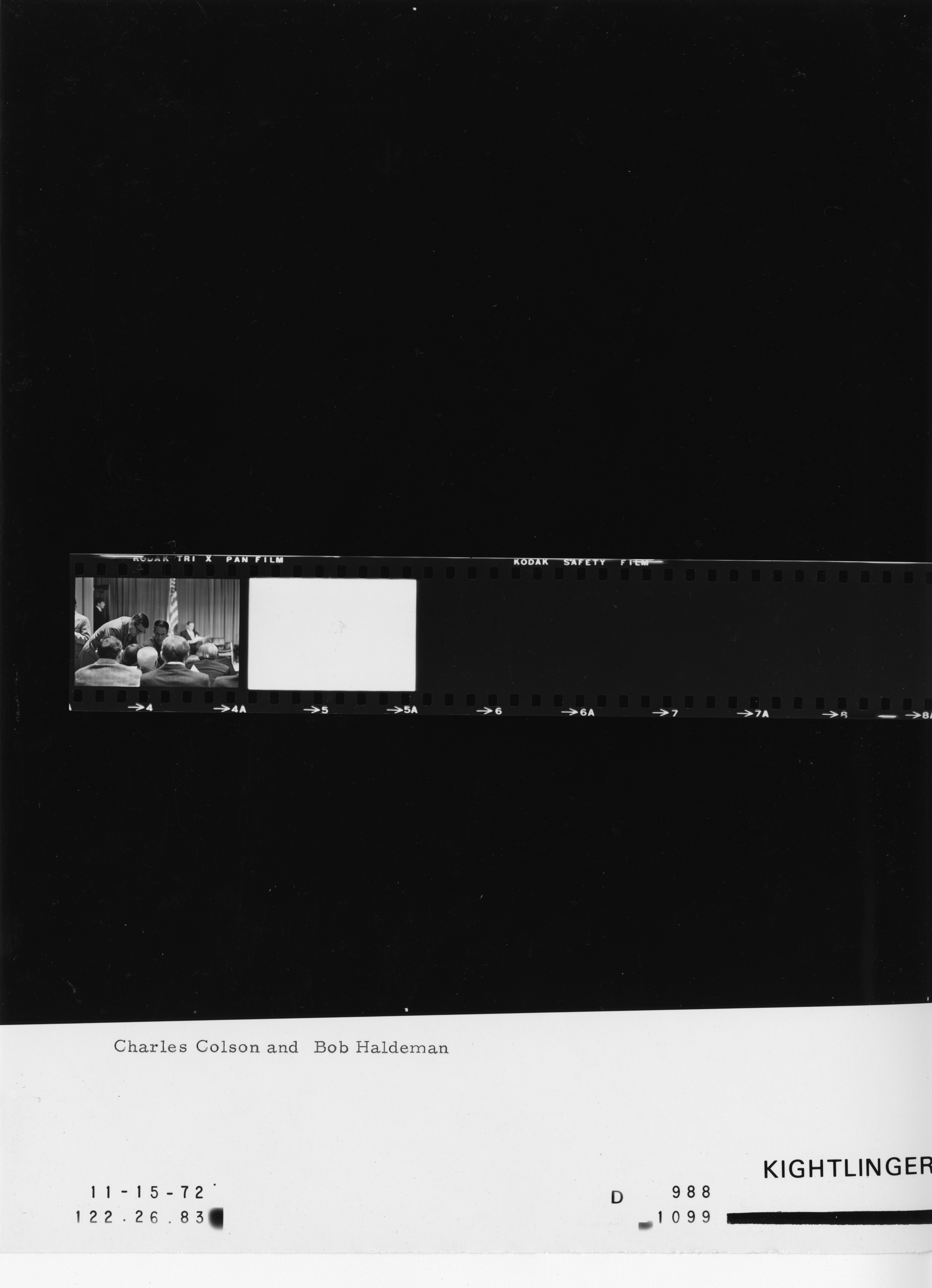
- Frame(s): WHPO-D0988-, Chuck Colson speaking with H.R. Haldeman near men seated in an audience an an undisclosed event. (possibly a press conference). 11/15/1972, Washington, D.C. unknown. H.R. Haldeman, Charles W. Colson, audience members.
Roll WHPO-D0989 Photographer: Kightlinger, Jack | Color or B&W: Color
- Frame(s): WHPO-D0989-, Pat Nixon with Mamie Eisenhower and other family members at the Kennedy Center. 11/15/1972, Washington, D.C. Kennedy Center. Pat Nixon, Mamie Eisenhower, Julie Eisenhower, unidentified family members.
- Frame(s): WHPO-D0989-04, Pat Nixon with former First Lady Mamie Eisenhower and other family members at the Kennedy Center. 11/15/1972, Washington, D.C. Kennedy Center. Pat Nixon, Mamie Eisenhower, unidentified family member.
- Frame(s): WHPO-D0989-12, Pat Nixon with former First Lady Mamie Eisenhower, Julie Eisenhower, and other family members at the Kennedy Center. 11/15/1972, Washington, D.C. Kennedy Center. Pat Nixon, Mamie Eisenhower, Julie Eisenhower.
Roll WHPO-D0990 Photographer: Kightlinger, Jack | Color or B&W: Color
- Frame(s): WHPO-D0990-03-06, Pat Nixon receiving a present and standing with the Ambassador from Iran and an unidentified official, in the White House Library. 11/15/1972, Washington, D.C. White House, Library. Pat Nixon, Iranian ambassador, unidentified man, unidentified persons.
- Frame(s): WHPO-D0990-07-17, Pat Nixon receiving the first sheet of the new Christmas Seals from unidentified persons. 11/15/1972, Washington, D.C. White House, Map Room. Pat Nixon, Iranian ambassador, unidentified man, unidentified persons.
Roll WHPO-D0991 Photographer: Kightlinger, Jack | Color or B&W: B&W

- Frame(s): WHPO-D0991-, Nell Yates picking flowers. 11/15/1972, unknown unknown. Nell Yates.
The White House Communications Agency Sound Recordings Collection contains public statements that took place between 1969 and 1974. Visit the finding aid to learn more.
L - White House Press Office Briefings
- WHCA-SR-L-059
Press briefing by Ronald Ziegler. (11/15/1972, White House Press Lobby)
Runtime: 16:00
Keywords: Press conferences, news conferences, interviews, media, press secretary
Original Format: 1/4-inch reel-to-reel audiotape. Original source type: Original.
The White House Communications Agency Videotape Collection contains “off-the-air” recordings of televised programs produced between 1968 and 1974. Visit the finding aid to learn more.
- WHCA-5925
"A Public Affair: Election '72".
NBC
Runtime: 00:32:48 - WHCA-5926
"Firing Line".
CBS
Runtime: 00:59:24 - WHCA-5928
Weekly News Summary, Tape II.
ALL NETWORKS
Runtime: 01:39:00
7. Smith/Reasoner/Luce: ceasefire talks; Vietnam war; POWs. Time Code Start: 12:42. Keywords: Vietnam War, Vietnam Prisoner of War, ceasefires. Network: ABC.
8. Smith: Commentary on McGovern and the Democrats. Time Code Start: 17:02. Keywords: political parties, Democrats, Democratic Party. Network: ABC.
9. Chancellor/Hackes/Valeriani: Hijacking; Cuba relations. Time Code Start: 18:48. Keywords: hijackings, skyjackings, kidnappings, terrorism, aircraft, airlines. Network: NBC.
10. Chancellor/Briggs: Senator Eagleton talks about his health. Time Code Start: 23:17. Keywords: Presidents, Presidential elections, campaigns, candidates, health, illness, medical care, diagnosis, fitness, medical examinations. Network: NBC.
11. Schorr: Dr. Grayson on price controls. Time Code Start: 25:22. Keywords: wage and price controls, freezes, prices, costs, increases, decreases, economy, economics, budgets, finances, recession, inflation, money. Network: CBS.
12. Sevareid: Analysis of President Nixon comments on nature of man. Time Code Start: 27:15. Keywords: Presidents, speeches, philosophy. Network: CBS.
Context (External Sources)
The Vanderbilt Television News Archive is the world's most extensive and complete archive of television news. They have been recording, preserving and providing access to television news broadcasts of the national networks since August 5, 1968.
Wikipedia is a free encyclopedia that anyone can edit.