
Introduction
This almanac page for Tuesday, March 9, 1971, pulls together various records created by the federal government and links to additional resources which can provide context about the events of the day.
Previous Date: Monday, March 8, 1971
Next Date: Wednesday, March 10, 1971
Schedule and Public Documents
The Daily Diary files represent a consolidated record of the President's activities. Visit the finding aid to learn more.
The President's day began at The White House - Washington, D. C.
The Weekly Compilation of Presidential Documents made available transcripts of the President's news conferences; messages to Congress; public speeches, remarks, and statements; and other Presidential materials released by the White House.
Digitized versions can be found at HathiTrust.
The Federal Register is the official daily publication for rules, proposed rules, and notices of federal agencies and organizations, as well as executive orders and other Presidential documents.
The Congressional Record is the official daily record of the debates and proceedings of the U.S. Congress.
Archival Holdings
Any selection of archival documents will necessarily be partial. You should use the documents and folders identified below as a starting place, but consult the linked collection finding aids and folder title lists and the collections themselves for context. Many documents to be found this way do not lend themselves to association with specific dates, but are essential to a complete understanding of the material.
Selective document listing
President's Office Files
The President's Office Files consists of materials drawn together by the Special Files Unit from several administrative subdivisions within the White House Office. It is the handwriting and sensitive papers sent to the Staff Secretary that now comprise much of the President's Office Files. Visit the finding aid to learn more.
- Annotated News Summaries, Box 30, News Summaries - March 1971 [1 of 2] [During this period, the Staff Secretary only removed pages from the News Summaries which contained President Nixon's handwriting, often leaving the document with no date. In addition to the individual document(s) listed below, you should also consult the full folder for the month.]
- [3/9/71]
- Annotated News Summaries, Box 30, News Summaries - March 1971 [2 of 2]
- President's Daily Schedule, Box 101, [President's Daily Schedule, Mar.-May 1971] [1 of 3]
- The President's Schedule, Tuesday - March 9, 1971
The H. R. Haldeman Diaries consists of seven handwritten diaries, 36 dictated diaries recorded as sound recordings, and two handwritten audio cassette tape subject logs. The diaries and logs reflect H. R. Haldeman’s candid personal record and reflections on events, issues, and people encountered during his service in the Nixon White House. As administrative assistant to the President and Chief of Staff, Haldeman attended and participated in public events and private meetings covering the entire scope of issues in which the Nixon White House engaged in during the years 1969-1973. Visit the finding aid to learn more.
- Transcript of diary entry (PDF)
Tuesday, March 9.
The first problem of the day arose when the President started to sign some material in his action file and discovered a memorandum from Pete Peterson, saying that he had run into a problem with both Connally and Hardin, regarding the recommendation he had put through the other day on how to deal with the wheat import problem with the United Kingdom. It turns out that both the Secretaries violently disagreed with Peterson's recommendation and felt that their input had not been adequately presented. Peterson's recommended solution was that the President call Hardin and get him swung over, and send a memo to Connally, in effect confirming the decision. The President, of course, refused to do so and instructed me to meet with Peterson and explain to him that that isn't the way to handle this. That it's up to Peterson to have a meeting with the Cabinet officers concerned and get the thing straightened out, and if he's unable to do so, then he was to set up a meeting with the Secretaries and the President. He made the point that I've got to convince Peterson that he can't have Cabinet officers saying that their views are not adequately presented, and that this will start him off on the wrong foot, which, of course, it would.
We got into quite a discussion during the day on polls, particularly the items on credibility, and the President was interested in reviewing the drop in credibility over a period of time and the question of whether that's related to the war, and so on. We pulled out a bunch of the back ones and really don't have enough to, to check it out. He feels that we haven't done an adequate job of knocking down the press credibility and that we've got to do that in our own defense, which we are moving to do.
Another flap continues today as a result of Wilbur Mills' unilateral negotiations with Japan on a textile agreement. This causes the President to be concerned that Flanigan has lost sight of the textile problem because he's dealing with too many other things, and that we've let it drop. I don't think that's the case. And we covered it thoroughly in staff meeting, and it would appear that this is something that there was no way we could have done anything about. It does pose a problem for us, but also a great opportunity in a chance to really whack Mills. In any event, the President wanted me to talk with Bryce Harlow about how to handle Wilbur Mills. And also, it raises the question whether Flanigan's up to handling the textile negotiations that this is a highly sophisticated deal and we really need to look at it carefully without any sentimentality and determine whether he can handle it.
The big thing of the day was Kissinger's decision to finally confront the President with his plan for resignation, which he actually did. The President told him, according to Henry, that he would not discuss the matter at all with him at this time, there were too many important things involved and we just couldn't even consider it, that we have to get to it later on. He told Henry that he would discuss it with me and possibly with George Shultz, and with no one else, and that we would work something out. In the late the afternoon, President had Ehrlichman stay in after a meeting with Shultz and then called me in. After some hemming and hawing about other things, told us about Henry's situation, and we had quite a long talk, making all of us late to dinner. The upshot of which is that we didn't really come to a conclusion on how to handle it, but all of us feel that Henry's taking this action may purge him of his internal problems and make it easier to deal with him and the whole thing. The general feeling is that Ehrlichman should try to handle Henry by getting tough with him because he's been soft, and that I should move in and handle Rogers, making it clear to him that he is going to have to start working within the system. Actually, the meeting Rogers scheduled for today, which Henry was going to refuse to attend, worked out rather well because Rogers called Henry and apologized for setting it up, said he would never do it again, that it was a one of a kind situation and asked Henry please to reconsider and come to the meeting, which Henry then agreed to do. The whole thing becomes kind of ludicrous.
End of March 9. - Original audio recording (MP3)
The National Archives Catalog is the online portal to the records held at the National Archives, and information about those records. It is the main way of describing our holdings and also provides access to electronic records and digitized versions of our holdings.
The Catalog searches across multiple National Archives resources at once, including archival descriptions, digitized and electronic records, authority records, and web pages from Archives.gov and the Presidential Libraries. The Catalog also allows users to contribute to digitized historical records through tagging and transcription.
Nixon Library Holdings
All National Archives Units
National Security Documents
The President's Daily Brief is the primary vehicle for summarizing the day-to-day sensitive intelligence and analysis, as well as late-breaking reports, for the White House on current and future national security issues. Read "The President's Daily Brief: Delivering Intelligence to Nixon and Ford" to learn more.
The Foreign Relations of the United States series presents the official documentary historical record of major U.S. foreign policy decisions and significant diplomatic activity. Visit the State Department website for more information.
Vol. IV, Foreign Assistance, International Development, Trade Policies, 1969-1972
Foreign Assistance Policy, 1969-1972
53. Memorandum From the Director of the Office of Management and Budget (Shultz) to President Nixon, Washington, March 9, 1971
Source: National Archives, Nixon Presidential Materials, NSC Files, Agency Files, Box 195, AID 1/1/71-12/31/71. No classification marking.
Vol. V, United Nations, 1969-1972
Chinese Representation in the United Nations
335. Minutes of the Senior Review Group Meeting, Washington, March 9, 1971, 3:48-4:51 p.m.
Source: National Archives, Nixon Presidential Materials, NSC Files, NSC Institutional Files (H–Files), Box H–112, SRG Minutes, Originals. Secret; Nodis. The meeting was held in the White House Situation Room. Jeanne Davis of the NSC staff forwarded the minutes to Kissinger under cover of a March 11 memorandum. (Ibid.) Green summarized these minutes in a memorandum to Rogers, March 11. (Ibid., RG 59, S/S Files: Lot 80 D 212, National Security Files, NSSM 107) Another record of the meeting, prepared by Armacost is ibid. A note on the minutes indicates that Farley and Petty were not present at the beginning of the meeting.
Vol. VII, Vietnam, July 1970-January 1972
Operational Lam Son 719, February 8-April 7, 1971
147. Backchannel Message From the President’s Assistant for National Security Affairs (Kissinger) to the Ambassador to Vietnam (Bunker), Washington, March 9, 1971
Source: National Archives, Nixon Presidential Materials, NSC Files, Box 84, Vietnam Subject Files, Special Operations File, Vol. VI. Top Secret; Sensitive; Eyes Only. The original is the message as approved by Haig for transmission. Transmitted as message WHS1013.
Vol. XXIII, Arab-Israeli Dispute, 1969-1972
216. Memorandum From the President’s Assistant for National Security Affairs (Kissinger) to President Nixon, Washington, March 9, 1971
Source: National Archives, Nixon Presidential Materials, NSC Files, Kissinger Office Files, Box 129, Country Files, Middle East. Secret; Nodis; Cedar. Sent for information. A stamped notation on the memorandum indicates the President saw it.
Vol. XXVIII, Southern Africa
Regional Issues
46. Intelligence Note Prepared in the Bureau of Intelligence and Research, Washington, March 9, 1971
Source: National Archives, RG 59, Central Files 1970–73, POL 19 SW AFR. Confidential; No Foreign Dissem; Controlled Dissem. Drafted by Hugh Campbell, cleared by Lloyd Rives, and released by David Mark (INR/Africa).
Vol. XXXVI, Energy Crisis, 1969-1974
March 10, 1970-April 2, 1971
86. Memorandum From C. Fred Bergsten of the National Security Council Staff to the President’s Assistant for National Security Affairs (Kissinger), Washington, March 9, 1971
Source: National Archives, Nixon Presidential Materials, NSC Files, Box 367, Subject Files, Oil 1971. Secret. Sent for information.
The Kissinger telephone conversation transcripts consist of approximately 20,000 pages of transcripts of Kissinger’s telephone conversations during his tenure as Assistant to the President for National Security Affairs (1969-1974) and Secretary of State (1973-1974) during the administration of President Richard Nixon. Visit the finding aid for more information.
Digitized versions can be found in the National Archives Catalog.
Audiovisual Holdings
The White House Tapes are sound recordings of President Richard Nixon's telephone conversations and of meetings held in the Oval Office and the Cabinet Room in the White House, the President's office in the Old Executive Office Building (OEOB), the Lincoln Sitting Room in the residence section of the White House, and several locations at the Presidential retreat at Camp David, Maryland. These recordings document many of the major events and decisions of the Nixon Administration from February 16, 1971 to July 18, 1973. Visit the White House Tapes finding aid to learn about the taping system's operation and archival processing.
Cabinet Room
- 50-1; 8:05 a.m. - 9:43 a.m.; Nixon, Richard M. (President); Hardin, Clifford M.; Moorer, Thomas H. (Adm.); Scott, Hugh; Griffin, Robert P.; Smith, Margaret Chase; Cotton, Norris; Allott, Gordon L.; Dominick, Peter H.; Ford, Gerald R.; Arends, Leslie C.; Anderson, John B.; Stafford, Robert T.; Poff, Richard H.; Rhodes, John J.; Conable, Barber B., Jr.; Wilson, Robert C. ("Bob"); Smith, H. Allen; Dole, Robert J.; Shultz, George P.; Ehrlichman, John D.; MacGregor, Clark; Timmons, William E.; Klein, Herbert G.; BeLieu, Kenneth E.; Buchanan, Patrick J.; Dent, Harry S.; Ziegler, Ronald L.; Harlow, Bryce N.; Price, John R., Jr.; Harper, Edwin L.
- 50-2; Unknown between 9:43 a.m. & 3:06 p.m.; [Unknown person(s)]
- 50-4; Unknown between 9:43 a.m. & 3:06 p.m.; White House tour group
- 50-5; Unknown between 9:43 a.m. & 3:06 p.m.; [Unknown person(s)]
- 50-6; Unknown between 9:43 a.m. & 3:06 p.m.; White House tour group
Oval Office
- 464-2; 7:58 a.m. - 7:59 a.m.; Nixon, Richard M. (President); Butterfield, Alexander P.
- 464-3; 7:59 a.m. - 8:00 a.m.; Nixon, Richard M. (President); Kuykendall, Daniel H.
- 464-4; 8:00 a.m. - 8:05 a.m.; Nixon, Richard M. (President); Haldeman, H. R. ("Bob"); Bull, Stephen B.
- 464-5; 9:58 a.m. - 10:36 a.m.; Nixon, Richard M. (President); Haldeman, H. R. ("Bob"); Bull, Stephen B.
- 464-6; Unknown between 10:36 a.m. & 10:40 a.m.; Nixon, Richard M. (President); Bull, Stephen B.
- 464-7; 10:40 a.m. - 11:28 a.m.; Nixon, Richard M. (President); Swigert, John L. ("Jack"), Jr.; Pogue, William R.; Lousma, Jack R.; Anders, William A.; Rumsfeld, Donald H.; Magruder, Jeb Stuart; White House photographer
- 464-8; 11:30 a.m. - 11:39 a.m.; Nixon, Richard M. (President); Haldeman, H. R. ("Bob"); Butterfield, Alexander P.
- 464-9; 11:39 a.m. - 12:03 p.m.; Nixon, Richard M. (President); Shultz, George P.; Kissinger, Henry A.; Flanigan, Peter M.; Peterson, Peter G.; White House operator
- 464-10; 12:03 p.m. - 12:23 p.m.; Nixon, Richard M. (President); Fassen, Fred; Pratt, Foster J.; Schuettner, Arthur; Ast, Raymond; Barhydt, Emily T.; Blueth, Louis; Fichtner, Charles C.; Gilbert, George E.; Gillingham, Robert C.; Hendler, H. Benjamin; Krieger, Florence; Long, Leslie O.; Mathias, A. O.; Powell, William J.; Ray, Willie C.; Spain, Jayne B.; Sandberg, J. Cecil; Tiller, H. A.; Tilly, Lola; Wilmot, Jennie S.; Woodward, Emma; Nash, Bernard E.; Crippen, Dorothy; Brickfield, Cyril; Wright, Lloyd; Thomas, Charles; Rensselaer, Bernard S. Van; Martin, John B.; Bell, George T.; Finch, Robert H.; White House photographer
- 464-11; Unknown between 12:23 p.m. & 12:26 p.m.; Nixon, Richard M. (President); Bull, Stephen B.
- 464-12; 12:26 p.m. - 1:30 p.m.; Nixon, Richard M. (President); Haldeman, H. R. ("Bob"); Bull, Stephen B.; Woods, Rose Mary; Ziegler, Ronald L.; [Unknown person(s)]; White House operator; Kendall, William T.
- 464-13; Unknown between 1:30 p.m. & 2:34 p.m.; Nixon, Richard M. (President); Bull, Stephen B.
- 464-14; Unknown between 1:30 p.m. & 2:34 p.m.; Nixon, Richard M. (President); Bull, Stephen B.
- 464-15; 2:34 p.m. - 2:58 p.m.; Nixon, Richard M. (President); Dent, Harry S.; Flanigan, Peter M.
- 464-16; Unknown between 2:58 p.m. & 3:01 p.m.; Nixon, Richard M. (President); Bull, Stephen B.
- 464-17; 3:01 p.m. - 3:42 p.m.; Nixon, Richard M. (President); Kissinger, Henry A.; Bull, Stephen B.
- 464-18; Unknown between 3:42 p.m. & 3:45 p.m.; Nixon, Richard M. (President); Bull, Stephen B.
- 464-19; 3:45 p.m. - 3:48 p.m.; Nixon, Richard M. (President); Taft, Robert A., Jr.; Dusterberg, Richard; Dusterberg, Richard (Mrs.); Nidecker, John E.; White House photographer
- 464-20; 3:48 p.m. - 3:55 p.m.; Nixon, Richard M. (President); Conte, Silvio O.; Farrick, Edward; Farrick, Edward (Mrs.); LaSalle, John H.; Rodriguez, Robert; Bardwell, Fred H.; Nidecker, John E.; White House photographer
- 464-21; 3:55 p.m. - 3:55 p.m.; Nixon, Richard M. (President); Bull, Stephen B.
- 464-22; 3:55 p.m. - 4:00 p.m.; Nixon, Richard M. (President); Lujan, Manuel, Jr.; Nidecker, John E.; White House photographer
- 464-23; Unknown between 4:00 p.m. & 4:05 p.m.; Nixon, Richard M. (President); Bull, Stephen B.
- 464-24; 4:05 p.m. - 5:34 p.m.; Nixon, Richard M. (President); Paley, William S.; Stanton, Frank; Schneider, John A.; Jencks, Richard W.; Wood, Robert D.; Salant, Richard S.; Klein, Herbert G.; Colson, Charles W.; Ziegler, Ronald L.; White House photographer; Bull, Stephen B.
- 464-25; Unknown between 5:36 p.m. & 7:10 p.m.; Nixon, Richard M. (President); Shultz, George P.; Ehrlichman, John D.; Haldeman, H. R. ("Bob"); White House operator; Murray, Hyde; Harlow, Bryce N.
The White House Photo Office collection consists of photographic coverage of President Richard Nixon meeting with prominent social, political, and cultural personalities; speaking engagements and news conferences of the President and various high-ranking members of the White House staff and Cabinet; Presidential domestic and foreign travel, including Presidential vacations; social events and entertainment involving the First Family, including entertainers present; official portraits of the President, First Family, and high-ranking members of the Nixon administration; the 1969 and 1973 Inaugurals; the President’s 1972 Presidential election campaign appearances (including speeches) and other official activities of the White House staff and the President’s Cabinet from January 20, 1969 until August 9, 1974 at the White House and the Old Executive Office Building; other locations in Washington, DC, such as The Mall; and the Presidential retreats in Camp David, Maryland, Key Biscayne, Florida, and San Clemente, California. Visit the finding aid to learn more.
Roll WHPO-5829 Photographer: Atkins, Oliver | Color or B&W: B&W
- Frame(s): WHPO-5829-03, Unidentified staff members. 3/9/1971, Washington, D.C. unknown. unidentified men.
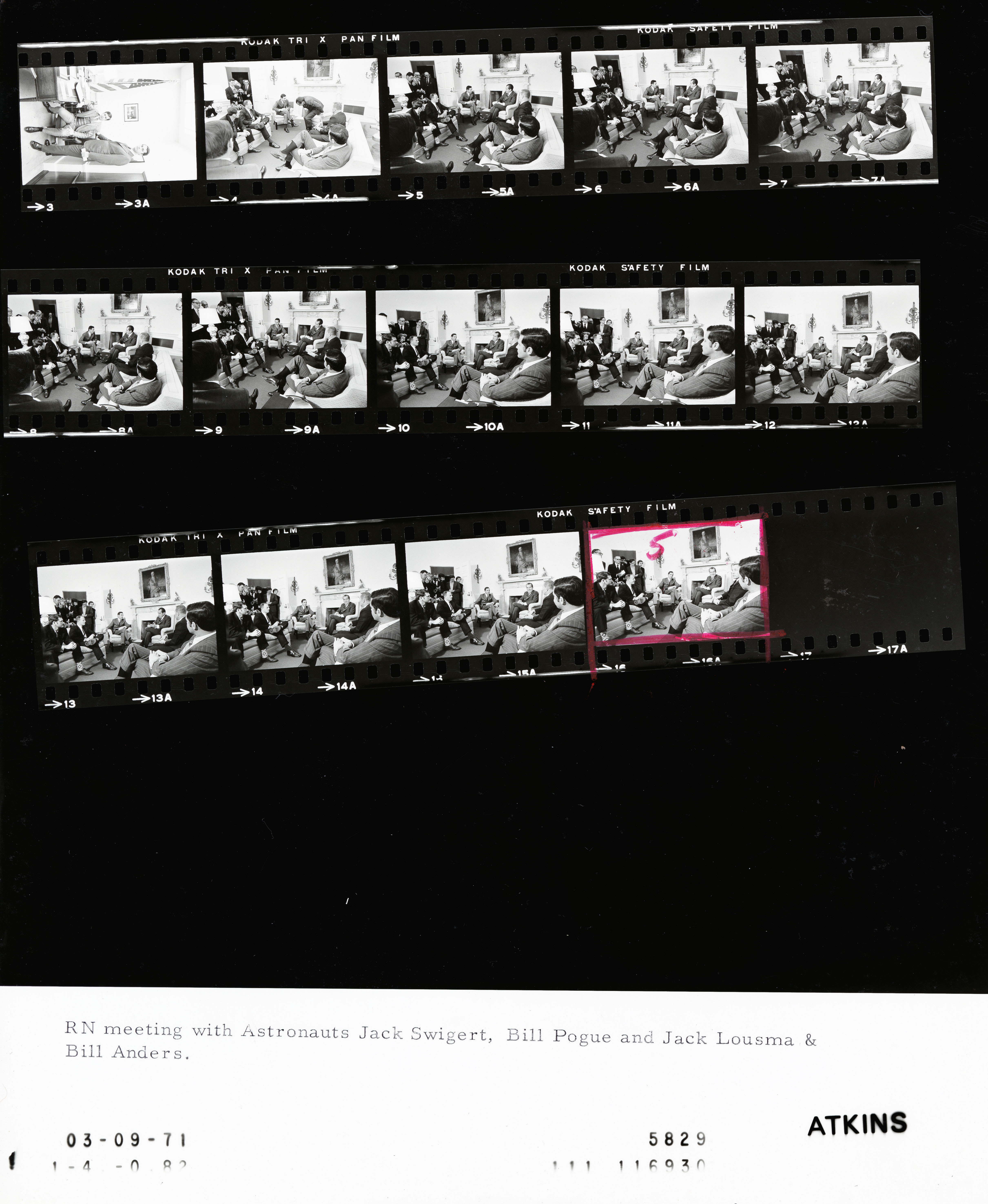
- Frame(s): WHPO-5829-04-16, President Nixon seated informally with astronauts Col. William Pogue, Maj. Jack Lousma, William Anders, John Swigert, Jr., Jeb Magruder, Donald Rumsfeld and other aides. 3/9/1971, Washington, D.C. White House, Oval Office. President Nixon, Col. William Pogue, Maj. Jack Lousma, William Anders, John Swigert,Jr., Magruder, Rumsfeld.
Roll WHPO-5830 Photographer: Atkins, Oliver | Color or B&W: B&W
- Frame(s): WHPO-5830-, President Nixon shaking hands with members of the Legislative Council of the American Association of Retired Persons. 3/9/1971, Washington, D.C. White House, Oval Office. President Nixon, AARP members.
Roll WHPO-5831 Photographer: Knudsen, Robert L. | Color or B&W: B&W
- Frame(s): WHPO-5831-, Rep. Manuel Lujan presenting President NIxon with baseball gift Ticket #1 for the World Series of the Babe Ruth League. 3/9/1971, Washington, D.C. White House, Oval Office. President Nixon, Manuel Lujan (baseball).
Roll WHPO-5832 Photographer: Schumacher, Karl | Color or B&W: B&W
- Frame(s): WHPO-5832-, Posed head and shoulders photos of Pat Nixon. 3/9/1971, Washington, D.C. unknown. Pat Nixon.
- Frame(s): WHPO-5832-24, Posed head and shoulders portrait of Pat Nixon. 3/9/1971, Washington, D.C. unknown. Pat Nixon.
Roll WHPO-5833 Photographer: Atkins, Oliver | Color or B&W: Color
- Frame(s): WHPO-5833-, Posed head and shoulders photos of Pat Nixon. 3/9/1971, Washington, D.C. unknown. Pat Nixon.
- Frame(s): WHPO-5833-08, Posed head and shoulders portrait of Pat Nixon. 3/9/1971, Washington, D.C. unknown. Pat Nixon.
- Frame(s): WHPO-5833-14, Posed head and shoulders portrait of Pat Nixon. 3/9/1971, Washington, D.C. unknown. Pat Nixon.
Roll WHPO-5834 Photographer: Atkins, Oliver | Color or B&W: Color
- Frame(s): WHPO-5834-, Posed head and shoulders photos of Pat Nixon. 3/9/1971, Washington, D.C. unknown. Pat Nixon.
Roll WHPO-5835 Photographer: Knudsen, Robert L. | Color or B&W: B&W
- Frame(s): WHPO-5835-03A-06A, President Nixon receiving a copy of "The Official Inaugural Medals" from author, Richard Dusterberg, as Mrs. Dusterberg and Sen. Robert Taft, Jr. stand nearby. 3/9/1971, Washington, D.C. White House, Oval Office. President Nixon, Robert Taft, Jr., Mr. & Mrs. Richard Dusterberg.
- Frame(s): WHPO-5835-09A-18A, President Nixon receiving a commemorative coin gift honoring Whately, Massachusetts' s 200th anniversary from Town representatives and Representative Silvio Conte. 3/9/1971, Washington, D.C. White House, Oval Office. President Nixon, Silvio Conte, Mr. & Mrs. Edward Farrick, James LaSalle, Jr., Robert Rodriquez, Fred Bardwell.
Roll WHPO-5836 Photographer: Atkins, Oliver | Color or B&W: B&W
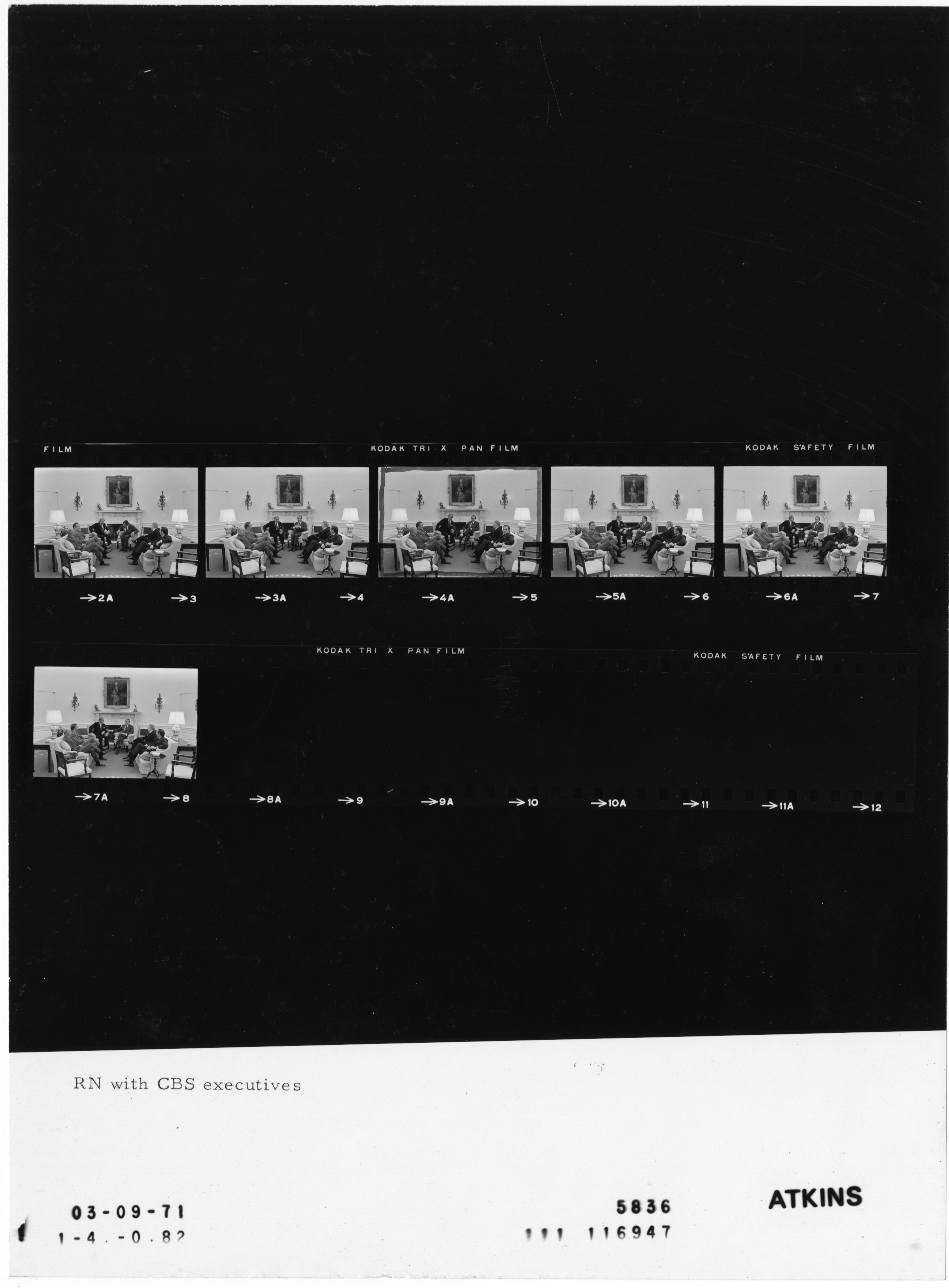
- Frame(s): WHPO-5836-, President Nixon seated informally with CBS Television broadcasting executives. L-R: Robert Wood, Dick Jencks, William Paley, President Nixon, Frank Stanton, and Jack Schneider. 3/9/1971, Washington, D.C. White House, Oval Office. Robert Wood, Dick Jencks, William Paley, President Nixon, Frank Stanton, Jack Schneider, CBS, Executives.
Roll WHPO-5837 Photographer: Kightlinger, Jack | Color or B&W: B&W
- Frame(s): WHPO-5837-, President Nixon and Pat Nixon hosting a small dinner party for Vice President Agnew, Mrs. Agnew and several Cabinet members with their wives. 3/9/1971, Washington, D.C. First floor Family Dining Room, White House. President Nixon, Pat Nixon, Spiro Agnew, Mrs. Judy Agnew, Attorney General John Mitchell, Mrs. Martha Mitchell, Secretary of Agriculture Hardin and Mrs. Clifford M. Hardin, Postmaster General Blount and Mrs. Winton M. Blount, Secretary of Transportation Volpe and Mrs. John A. Volpe.
- Frame(s): WHPO-5837-04, President Nixon and Pat Nixon hosting a small dinner party for Vice President Agnew, Mrs. Agnew and several Cabinet members with their wives. 3/9/1971, Washington, D.C. President's Dining Room, White House. President Nixon, Pat Nixon, Spiro Agnew, Mrs. Judy Agnew, Attorney General John Mitchell, Mrs. Martha Mitchell, Secretary of Agriculture Hardin and Mrs. Clifford M. Hardin, Postmaster General Blount and Mrs. Winton M. Blount, Secretary of Transportation Volpe and Mrs. John A. Volpe.
- Frame(s): WHPO-5837-07, President Nixon and Pat Nixon hosting a small dinner party for Vice President Agnew, Mrs. Agnew and several Cabinet members with their wives. 3/9/1971, Washington, D.C. President's Dining Room, White House. President Nixon, Pat Nixon, Spiro Agnew, Mrs. Judy Agnew, Attorney General John Mitchell, Mrs. Martha Mitchell, Secretary of Agriculture Hardin and Mrs. Clifford M. Hardin, Postmaster General Blount and Mrs. Winton M. Blount, Secretary of Transportation Volpe and Mrs. John A. Volpe.
Roll WHPO-5838 Photographer: Knudsen, Robert L. | Color or B&W: B&W
- Frame(s): WHPO-5838-, Men at a reception for Joe Bartlett. 3/9/1971, Washington, D.C. unknown. Joe Bartlett, unidentified men.
The White House Communications Agency Sound Recordings Collection contains public statements that took place between 1969 and 1974. Visit the finding aid to learn more.
H - White House Staff Member Recordings
- WHCA-SR-H-352
Press briefing by George Lincoln, William Hiatt, and General Clark. (3/9/1971, Press Center, White House)
Runtime: 22:00
Keywords: Press conferences, news conferences, interviews, media
Production credits: Audio feed supplied by WHCA; Recorded by KAP (initials of WHCA engineer)
Original Format: 1/4-inch reel-to-reel audiotape. Original source type: Original. - WHCA-SR-H-353
Press briefing by Apollo 14 astronauts. (3/9/1971, Press Center, White House)
Runtime: 18:00
Keywords: NASA, National Aeronautics and Space Administration, space program, astronauts
Production credits: Audio feed supplied by WHCA; Recorded by KAP (initials of WHCA engineer)
Original Format: 1/4-inch reel-to-reel audiotape. Original source type: Original.
I - Various Administration Events
- WHCA-SR-I-059
Microphone test in press lobby at a Bruce Whelihan Briefing [not received by NARA]. (3/9/1971)
Runtime: 5:00
Keywords: Press conferences, news conferences, interviews, media
Original Format: 1/4-inch reel-to-reel audiotape. Original source type: Original.
The White House Communications Agency Videotape Collection contains “off-the-air” recordings of televised programs produced between 1968 and 1974. Visit the finding aid to learn more.
- WHCA-4214
"Thirty Minutes". consumer activist Ralph Nader, singer Carmen McRae.
Daphne Productions and Roland & Jaffee Productions
Runtime: - WHCA-4215
"New Voices In The South". Former Attorney-General Ramsay Clark.
Undetermined
Runtime: - WHCA-4217
Weekly News Summary, Tape I.
ALL NETWORKS
Runtime: 1:30
25. Smith/Donaldson: Secretary of Defense Laird's message to Congress. Time Code Start: 38:51. Keywords: military, House of Representatives, messages, cabinet, advisors, media. Network: ABC.
26. Smith/Murphy: Laos. Time Code Start: 41:30. Keywords: Laos, Vietnam War. Network: ABC.
27. Smith/Hhukyser: Security Exchange Commission (SEC). Time Code Start: 44:54. Keywords: U.S. Securities and Exchange Commission, stock market regulation,stock exchanage, financial markets, credit. Network: ABC.
28. Brinkley: U.S. military strength; USSR and Red China have made long range missile advances; anti-ballistic missile (ABM) system should be built, Defense Secretary Laird and Pentagon requests money. Time Code Start: 46:58. Keywords: Armed Forces, military, weapons, comparisons, budgets, statistics, proposals. Network: NBC.
29. McGee: Indochina. Time Code Start: 48:15. Keywords: Laos, Cambodia, Vietnam War. Network: NBC.
30. McGee: Senator McGovern and the FBI. Time Code Start: 49:06. Keywords: Senate, Senators, Federal Bureau of Investigations, government, organizations, crime, espionage, spying, investigations. Network: NBC.
31. Cronkite/Schorr: Anti-Ballistic Missiles (ABMs). Time Code Start: 49:49. Keywords: war, military, missiles, aircraft, artillery, weapons. Network: CBS.
32. Sevaride: Commentary on education. Time Code Start: 51:38. Keywords: schools, colleges, universities. Network: CBS.
Context (External Sources)
The Vanderbilt Television News Archive is the world's most extensive and complete archive of television news. They have been recording, preserving and providing access to television news broadcasts of the national networks since August 5, 1968.
Wikipedia is a free encyclopedia that anyone can edit.