

Introduction
This almanac page for Wednesday, March 29, 1972, pulls together various records created by the federal government and links to additional resources which can provide context about the events of the day.
Previous Date: Tuesday, March 28, 1972
Next Date: Thursday, March 30, 1972
Schedule and Public Documents
The Daily Diary files represent a consolidated record of the President's activities. Visit the finding aid to learn more.
The President's day began at The White House - Washington, D. C.
The Weekly Compilation of Presidential Documents made available transcripts of the President's news conferences; messages to Congress; public speeches, remarks, and statements; and other Presidential materials released by the White House.
Digitized versions can be found at HathiTrust.
Each Public Papers of the Presidents volume contains the papers and speeches of the President of the United States that were issued by the White House Office of the Press Secretary during the time period specified by the volume. The material is presented in chronological order, and the dates shown in the headings are the dates of the documents or events. In instances when the release date differs from the date of the document itself, that fact is shown in the text note.
To ensure accuracy, remarks have been checked against audio recordings (when available) and signed documents have been checked against the original, unless otherwise noted. Editors have provided text notes and cross references for purposes of identification or clarity.
The Federal Register is the official daily publication for rules, proposed rules, and notices of federal agencies and organizations, as well as executive orders and other Presidential documents.
The Congressional Record is the official daily record of the debates and proceedings of the U.S. Congress.
Archival Holdings
Any selection of archival documents will necessarily be partial. You should use the documents and folders identified below as a starting place, but consult the linked collection finding aids and folder title lists and the collections themselves for context. Many documents to be found this way do not lend themselves to association with specific dates, but are essential to a complete understanding of the material.
Selective document listing
President's Office Files
The President's Office Files consists of materials drawn together by the Special Files Unit from several administrative subdivisions within the White House Office. It is the handwriting and sensitive papers sent to the Staff Secretary that now comprise much of the President's Office Files. Visit the finding aid to learn more.
- News Summaries, Unmarked News Summaries, Box 48, News Summaries - Mar. 1972 [3 of 4] [Note: Due to the way News Summary products were compiled, you should also consult nearby days for potentially relevant materials.]
- News Summary, March 29, 1972, (Tuesday nets, wires, mags)
- President's Daily Schedule, Box 102, [President's Daily Schedule, Jan.-Mar. 1972] [2 of 3]
- The President's Schedule, Wednesday - March 29, 1972
The H. R. Haldeman Diaries consists of seven handwritten diaries, 36 dictated diaries recorded as sound recordings, and two handwritten audio cassette tape subject logs. The diaries and logs reflect H. R. Haldeman’s candid personal record and reflections on events, issues, and people encountered during his service in the Nixon White House. As administrative assistant to the President and Chief of Staff, Haldeman attended and participated in public events and private meetings covering the entire scope of issues in which the Nixon White House engaged in during the years 1969-1973. Visit the finding aid to learn more.
- Transcript of diary entry (PDF)
Wednesday, March 29th. Shultz reported to me this morning that the reason I'd been having a problem in setting up the Laird meeting on government purchases that the President told me to do, is that Laird is determined not to come to it. He told Ken Rush that he would refuse to go. That Rush can go if he wants to, but that Laird won't be bound by anything that's said here.
So I started calling Laird, took most of the day back and forth before I got through to him and I really jumped on him on the basis that the President had ordered the meeting and I couldn't understand on what basis he was refusing to attend. He backed off then, said he'd be glad to come to the meeting we've set up for tomorrow afternoon.
Dick Walters met yesterday with Perot, at our request, to avoid Perot meeting with the President. Apparently, he's got a deal where the North Vietnamese will release 30 sick and wounded prisoners in return for a million dollars from us. Henry's concerned that we work out some way of handling the ransom so that we get credit for it rather than Perot. And we’ve apparently had feelers on the same thing from other sources also.
The President raised the question of getting Connally out, as was sort of discussed yesterday in the meeting with him, to really hit the Democrats. Connally obviously would like to do this and wants to take them on by name and attack them on their tax reforms and all. The President thinks this is a good tactic to divide them, and I think he's basically right.
Kissinger was in talking about the Russian trip and the problems of whether we stay at the Kremlin or not, how many days we stay in Russia, and all that sort of thing.
-------------------------------------------------------------------------------------------------------------------
DECLASSIFIED - E.O. 13526, Sect. 3.4: by MS, NARA, June 12, 2013
Audio Cassette 20, Side A, Withdrawn Item Number 5 [AC-20(A) Sel 5]
Duration: 17 seconds
He's still arguing against going to Poland. The President told him that he definitely wants to and he wants Henry to find a way to work it out. And he'll stay another day in Russia if that'll buy them off on it.
-------------------------------------------------------------------------------------------------------------------
The President also raised the thought of whether he ought to speak to the Russian people on television as Eisenhower did, or was going to do, and as Nixon actually did. Also he wants to see if we can get a Walters type translator with some enthusiasm instead of Akolevsky who is pretty low key.
The big thing today again is ITT. Colson and MacGregor and I had a meeting. They feel that we've got some problems in that Mitchell undercut us yesterday and got East--, Eastland to renege on his promise to bring the hearings to a close on a vote today, because Mitchell wants to keep them open to get a couple of other witnesses on. However, he saw the light this morning when Wally Johnson told him that one of the witnesses he wants on is going to testify that has Mitchell perjured himself when he said that he had not met with Reinecke in the springtime. Then Mitchell ordered Mardian to go up and get Eastland and turn him off, but Eastland wouldn't do it, but apparently he did agree not to call the other witnesses, and then agreed to turn the hearings off next Thursday when the Senators come back. He'll hear no more witnesses after Geneen, who's on today.
The Republicans are starting to fold a little bit, at least Scott and Mathias. Scott was pushing to sever the issue of Kleindienst versus the hearings. Guerney was very upset with that as was MacGregor and they think they have it turned off. Some of them want to get the Life charges back on the record and answered. And MacGregor concludes that the Republican Senators are looking for a way to get off the hook, although they deny this. And, he thinks this is our problem. Colson thinks that Kleindienst can't withdraw now but that maybe we could force a floor vote or something like that to develop a provocation, and he can resign on the basis of that. He argues still that he throw a gauntlet down either with or without the ultimatum in order to get some positive action on our side instead of just equivocating.
I reported that to the President this afternoon. He--, his view is that this is a political investigation and therefore it's better for Mitchell to handle the calls, and so on, rather than the White House, MacGregor, and Colson. He feels that Eastland wouldn't break his word to Mitchell as he did to MacGregor yesterday. He feels that we've got to keep Scott off the severing idea and that we've got to get the hearings closed somehow. Then he raises the question: isn't Kleindienst a tarnished symbol? And the problem is, on the political side. The Democrats are going to run against the fact that we have an Attorney General who can't even be confirmed by the Senate and they'll keep the issue alive all through the campaign. In other words, Kleindienst can't stay as acting Attorney General forever, which is what MacGregor and Colson think Mitchell's present ploy is. We have to get him out of the campaign today. He’s too heavy a load to carry, and we can't use the ultimatum device because that's too phony as Connally said yesterday.
We talked about this for about an hour and then the President had me call Kleindienst over and we met over at the library, had the waiter light a fire and brought some coffee down. Kleindienst came, scared to death, made the point that there will be an executive session next Thursday, and they'll close the hearings, and he's convinced that Eastland is able to do that. Has only three votes against him in the committee on it, whereas MacGregor and Colson seem to think he'll have a problem on a close vote in the committee to close the hearings. He says then it'll go to a filibuster on the Senate floor after a delay for filing minority reports, etcetera, and that the filibuster will die after a while, and that we have ample votes to confirm Kleindienst. He says Eastland has a commitment from Mansfield to put a vote on the calendar. That we don't have the votes for cloture, so we can't kill the filibuster, but it'll ride through to the end of May or early June, and then they'll vote and it'll pass. We went round and round on that, Kleindienst made the point that he doesn't want MacGregor dealing with Eastland, and we agreed to leave Eastland to Kleindienst to handle. We agreed that Kleindienst also would have Fannin handle the Ervin issue, which our guys say is gonna be impossible to deal with.
The President called me later at home, and before I got home, when I returned the call, he asked me to wait just a minute, that he had just gotten out of the shower, and went out to get a bathrobe. Then he felt the Kleindienst meeting had gone well and been productive. He has changed his view that we should dump Kleindienst, thinks that we should ride him out as he recommends. Said we've got to remember that we shouldn't get so close to these things that we panic, which I must say, he was closer to doing than most of the rest of us. Kleindienst sees no chance of losing the vote in the committee, where our people thought it was going to be a close vote. The President would say based on this, that we should have Kleindienst nail Eastland on the vote tomorrow. Then, go to the next point, we'll have to ride through the period of three weeks, but sometime Mansfield has to bring it up. The President feels he did get across to Kleindienst the problem that if they don't confirm, we can't get ahead past the convention with him as acting AG, so the deadline now is about June 1st.
He was impressed by Kleindienst's feeling that we should get the White House out of the San Diego Convention riot planning and all. He told me to get that done. He wants to look into the possibility of moving the convention, maybe to Miami, but he thinks it's probably too far along to do that. He wants to get the details on ITT contributions to the Democrats. He feels Kleindienst is correct about dealing with Eastland that MacGregor should stay out of it. He thinks Mitchell's got to get directly into the play, and not work at odds with other people. He wants me to stay close to Kleindienst, minimal contact with him. He feels the Democrats may now have a problem if we can keep up a drumbeat for a vote, with a group on the floor every day, that they'll have trouble defending it after a while.
End of March 29th. - Original audio recording (MP3)
The National Archives Catalog is the online portal to the records held at the National Archives, and information about those records. It is the main way of describing our holdings and also provides access to electronic records and digitized versions of our holdings.
The Catalog searches across multiple National Archives resources at once, including archival descriptions, digitized and electronic records, authority records, and web pages from Archives.gov and the Presidential Libraries. The Catalog also allows users to contribute to digitized historical records through tagging and transcription.
Nixon Library Holdings
All National Archives Units
National Security Documents
The President's Daily Brief is the primary vehicle for summarizing the day-to-day sensitive intelligence and analysis, as well as late-breaking reports, for the White House on current and future national security issues. Read "The President's Daily Brief: Delivering Intelligence to Nixon and Ford" to learn more.
The Foreign Relations of the United States series presents the official documentary historical record of major U.S. foreign policy decisions and significant diplomatic activity. Visit the State Department website for more information.
Vol. IV, Foreign Assistance, International Development, Trade Policies, 1969-1972
Coordinating Committee on Export Controls, 1969-1972
380. National Security Decision Memorandum 159, Washington, March 29, 1972
Source: National Archives, RG 59, S/S Files: Lot 83 D 305, NSDM 159. Secret. A copy was sent to the Director of Central Intelligence.
381. Letter From the President’s Assistant for National Security Affairs (Kissinger) to Foreign Minister Schumann, Washington, March 29, 1972
Source: National Archives, Nixon Presidential Materials, NSC Files, Country Files-Europe, Box 678, France, Volume IX 1/72-7/72. No classification marking.
Vol. VIII, Vietnam, January-October 1972
Before the Easter Offensive, January 20-March 29, 1972
46. Backchannel Message From the Head of the Delegation to the Paris Peace Talks (Porter) to the President’s Assistant for National Security Affairs (Kissinger), Paris, March 29, 1972, 1244Z
Source: National Archives, Nixon Presidential Materials, NSC Files, Box 419, Backchannel, Backchannel Messages 1972, Paris, Watson and Porter. Secret; Eyes Only.
Vol. XVII, China, 1969-1972
China, March-December 1972
216. Memorandum From Phil Odeen of the National Security Council Staff to the President’s Assistant for National Security Affairs (Kissinger), Washington, March 29, 1972
Source: National Archives, Nixon Presidential Materials, NSC Files, Box 523, Country Files, Far East, China, Vol. X. Secret. Sent for action. Concurred in by Holdridge and Kennedy. Attached was a March 31 covering note from Kennedy to Kissinger, which reads in its entirety: “Henry: This all adds up to a suggestion that we need to cool off all comment on Taiwan force levels and stop further pronouncements. It would be best handled by a call from you to Secretaries Laird and Rogers or a call from Haig to Eliot and Pursley, if you agreed that this is the course to be followed.” Kissinger’s handwritten comment on this note read: “I want no reductions made on Taiwan until end of VN war under any pretext.”
Vol. XXXIX, European Security
Moscow Summit, December 1971-May 1972
87. Minutes of a Senior Review Group Committee Meeting, Washington, March 29, 1972, 3:06-4:02 p.m.
Source: National Archives, Nixon Presidential Materials, NSC Institutional Files (H–Files), Box H–113, SRG Meetings Minutes, Originals, 1972–1973. Top Secret. The meeting took place in the White House Situation Room.
Vol. XLI, Western Europe; NATO, 1969-1972
Canada
111. Letter From Secretary of the Treasury Connally to Secretary of Defense Laird, Washington, March 29, 1972
Source: National Archives, Nixon Presidential Materials, NSC Files, Box 472, President’s Trip Files, Canada. Confidential. The original is a copy that Connally sent to the White House on April 7. In a covering note to Haldeman, he wrote: “I think the President ought to see this before he goes to Canada.” An April 11 memorandum from Lawrence Higby of the White House Staff to Haldeman, also attached, reads: “This should go to Kissinger first. 9:00 A.M.—4/11/72.” Haldeman annotated: “Right—but it must go to P.[resident] by tomorrow.” Additional annotation on Higby’s memorandum reads: “Sonnenfeldt/Hormats have action (HAK has c[op]y).” Higby’s memorandum was initialed by Haig. A memorandum from Connally to the President, suggesting strategy for his meeting with Trudeau, is ibid.
Vol. E-2, Documents on Arms Control and Nonproliferation, 1969-1972
Nuclear Test Ban Issues; Peaceful Nuclear Explosions
311. Memorandum From the Director of the Program Analysis Staff, National Security Council (Odeen) to the President’s Assistant for National Security Affairs (Kissinger), Washington, March 29, 1972
Under the cover of this memorandum, Odeen transmitted the March 14 JCS memorandum expressing its “highly-charged” opposition to a comprehensive nuclear test ban and recommended Kissinger forward it to the President.
Source: National Archives, Nixon Presidential Materials, NSC Files, Box 245, Agency Files, JCS volume II. Top Secret; Restricted Data. Sent for action. Kennedy and Sonnenfeldt concurred in the memorandum. A handwritten notation at the top indicated that Kissinger saw it, but he did not sign or forward the memorandum attached at Tab A to the President (Tab A is not published). In a March 31 memorandum to Kissinger, Kennedy said he doubted Kissinger would want to send the JCS memorandum to the President since the Verification Panel was studying the issue and an upcoming meeting would provide an opportunity to explore all views, including those of the JCS, before putting them before the President. He concluded the memorandum was “too cryptic” to give the President a full exposition of the arguments both pro and con. Kissinger wrote on Kennedy’s note, “It is a brief not an analysis.”(Ibid.)
Vol. E-4, Documents on Iran and Iraq, 1969-1972
Iraq 1972
302. Memorandum From the Director of Central Intelligence (Helms) to the President’s Assistant for National Security Affairs (Kissinger), Secretary of State Rogers, and Secretary of Defense Laird, Washington, March 29, 1972
Helms described the Kurdish effort, against a background of closer Soviet-Iraqi ties, to elicit international support for their resistance movement.
Source: National Archives, Nixon Presidential Materials, NSC Files, Box 603, Country Files, Middle East, Iraq, Vol. I. Secret; No Foreign Dissem; Controlled Dissem; No Dissem Abroad.
Vol. E-7, Documents on South Asia, 1969-1972
U.S. Relations with India and Pakistan, 1972
242. Transcript of Telephone Conversation Between Secretary of State Rogers and the President’s Assistant for National Security Affairs (Kissinger), Washington, March 29, 1972, 11:30 a.m.
Rogers told Kissinger that when he met with Secretary General Ahmed, Ahmed would press for a decision to renew the supply of military equipment to Pakistan. Kissinger responded: “That’s not on.”
Source: Library of Congress, Manuscript Division, Kissinger Papers, Box 371, Telephone Conversations, Chronological File. No classification marking.243. Memorandum of Conversation, Washington, March 29, 1972, 12:15 p.m.
Secretary General Ahmed discussed Pakistan’s security concerns with President Nixon and the President’s Assistant for National Security Affairs Kissinger. He urged the U.S. to maintain a strong presence in South Asia. Nixon responded that his administration would provide all the help that it could to Pakistan, but most of it would be economic assistance. He said it would be difficult to consider military assistance until after the election in November. He added that he intended to recognize Bangladesh within the week. Nixon and Kissinger assured Ahmed of U.S. support for Pakistan in the event of an attack by India.
Source: National Archives, Nixon Presidential Materials, White House Special Files, President’s Office Files, Box 88, Memoranda for the President, Beginning March 26, 1972. Secret; Nodis. The meeting was held in Kissinger’s office in the White House. A handwritten notation on the memorandum indicates that Saunders prepared it for the President’s file.
The Kissinger telephone conversation transcripts consist of approximately 20,000 pages of transcripts of Kissinger’s telephone conversations during his tenure as Assistant to the President for National Security Affairs (1969-1974) and Secretary of State (1973-1974) during the administration of President Richard Nixon. Visit the finding aid for more information.
Digitized versions can be found in the National Archives Catalog.
Audiovisual Holdings
Visit the White House Tapes finding aid to learn about the taping system's operation and archival processing.
Old Executive Office Building
- 328-12; Unknown between 12:57 p.m. & 3:07 p.m.; Nixon, Richard M. (President); Butterfield, Alexander P.
- 328-13; Unknown between 12:57 p.m. & 3:07 p.m.; Nixon, Richard M. (President); Alvarez, Luis Echeverria; Westmoreland, William (Gen.)
- 328-14; Unknown between 12:57 p.m. & 3:07 p.m.; Nixon, Richard M. (President); Sanchez, Manolo; Alvarez, Luis Echeverria; Westmoreland, William (Gen.); Peale, Norman Vincent; Kissinger, Henry A.
- 328-15; Unknown between 12:57 p.m. & 3:07 p.m.; Nixon, Richard M. (President); [Unknown person(s)]
- 328-16; Unknown between 12:57 p.m. & 3:07 p.m.; Nixon, Richard M. (President); Sanchez, Manolo
- 328-17; Unknown between 12:57 p.m. & 3:07 p.m.; Nixon, Richard M. (President); White House operator
- 328-18; Unknown between 12:57 p.m. & 3:07 p.m.; Nixon, Richard M. (President); Sanchez, Manolo
- 328-19; 3:07 p.m. - 3:15 p.m.; Nixon, Richard M. (President); MacGregor, Clark; Sanchez, Manolo
- 328-20; Unknown between 3:15 p.m. & 3:50 p.m.; Nixon, Richard M. (President); Haldeman, H. R. ("Bob")
- 328-21; Unknown between 3:15 p.m. & 3:50 p.m.; Nixon, Richard M. (President); [Unknown person(s)]
- 328-22; 3:50 p.m. - 3:51 p.m.; Nixon, Richard M. (President); Eisenhower, Julie Nixon
- 328-23; 4:00 p.m. - 4:48 p.m.; Nixon, Richard M. (President); Haldeman, H. R. ("Bob"); White House operator; Kleindienst, Richard G.
Oval Office
- 696-1; 9:20 a.m. - 12:29 p.m.; Nixon, Richard M. (President); Butterfield, Alexander P.; Haldeman, H. R. ("Bob"); Kissinger, Henry A.; White House operator; Eisenhower, Julie Nixon; [Unknown person(s)]
- 696-2; Unknown between 12:57 p.m. & 4:48 p.m.; United States Secret Service agents; [Unknown person(s)]
White House Telephone
- 22-40; Unknown between 9:19 a.m. & 11:27 a.m.; Nixon, Richard M. (President); White House operator
- 22-41; 11:27 a.m. - 11:27 a.m.; Nixon, Richard M. (President); White House operator
- 22-42; 12:17 p.m. - 12:18 p.m.; Nixon, Richard M. (President); Eisenhower, Julie Nixon
- 22-43; Unknown between 12:18 p.m. & 3:07 p.m.; Nixon, Richard M. (President); White House operator
- 22-44; 3:07 p.m. - 3:15 p.m.; Nixon, Richard M. (President); MacGregor, Clark; Haldeman, H. R. ("Bob")
- 22-45; 3:50 p.m. - 3:51 p.m.; Nixon, Richard M. (President); Eisenhower, Julie Nixon
- 22-46; Unknown between 4:00 p.m. & 4:48 p.m.; Haldeman, H. R. ("Bob"); White House operator; Nixon, Richard M. (President); Kleindienst, Richard G.
The White House Photo Office collection consists of photographic coverage of President Richard Nixon meeting with prominent social, political, and cultural personalities; speaking engagements and news conferences of the President and various high-ranking members of the White House staff and Cabinet; Presidential domestic and foreign travel, including Presidential vacations; social events and entertainment involving the First Family, including entertainers present; official portraits of the President, First Family, and high-ranking members of the Nixon administration; the 1969 and 1973 Inaugurals; the President’s 1972 Presidential election campaign appearances (including speeches) and other official activities of the White House staff and the President’s Cabinet from January 20, 1969 until August 9, 1974 at the White House and the Old Executive Office Building; other locations in Washington, DC, such as The Mall; and the Presidential retreats in Camp David, Maryland, Key Biscayne, Florida, and San Clemente, California. Visit the finding aid to learn more.
Roll WHPO-8790 Photographer: Knudsen, Robert L. | Color or B&W: B&W
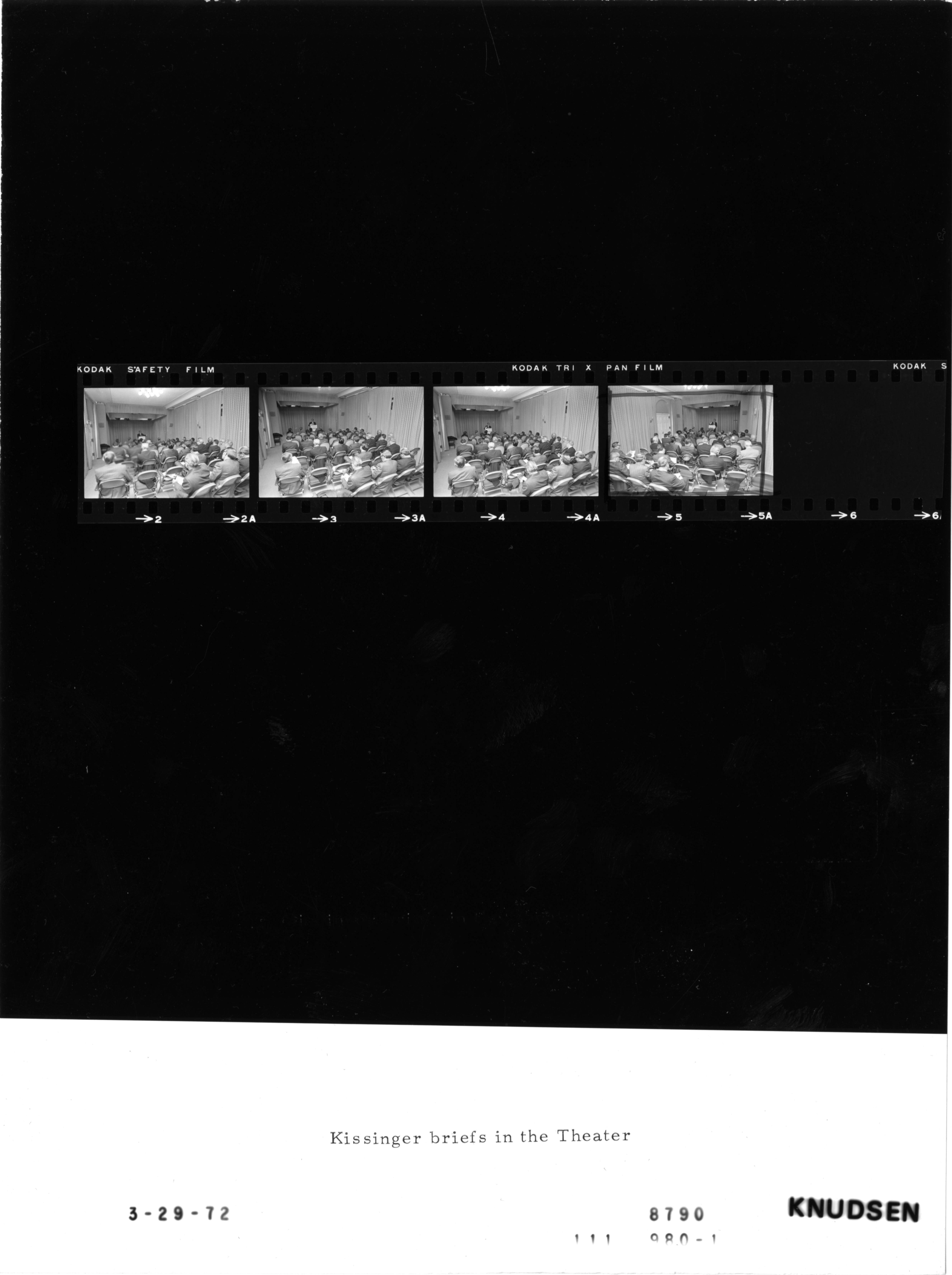
- Frame(s): WHPO-8790-, Henry Kissinger conducting a press briefing. 3/29/1972, Washington, D.C. theater, White House. Henry Kissinger, unidentified persons.
Roll WHPO-8791 Photographer: Knudsen, Robert L. | Color or B&W: B&W
- Frame(s): WHPO-8791-, Portrait of unidentified family standing. 3/29/1972, Washington, D.C. Red Room, White House. unidentified family.
Roll WHPO-8792 Photographer: Kightlinger, Jack | Color or B&W:
- Frame(s): WHPO-8792-, Julie Eisenhower visits with female students and their chaperones from the School for the Deaf Mutual Improvement Society of Jacksonville, Illinois. 3/29/1972, Washington, D.C. White House, Library. Julie Eisenhower, young girls, adults or chaperones.
The White House Communications Agency Sound Recordings Collection contains public statements that took place between 1969 and 1974. Visit the finding aid to learn more.
D - First Family
- WHCA-SR-D-027
Julie Nixon Eisenhower interview with "Seventeen" magazine. (3/29/1972, Map Room, The White House)
Runtime: 0:50:58
Production credits: Audio feed supplied by WHCA; Recorded by LDH (initials of WHCA engineer)
Original Format: 1/4-inch reel-to-reel audiotape. Original source type: Original.
H - White House Staff Member Recordings
- WHCA-SR-H-544
Briefing by Henry Kissinger and Billy Graham. (3/29/1972, Family Theater, White House)
Runtime: 1:05:00
Keywords: Briefings, public briefings, statements to the press (see also Press conferences, news conferences, interviews, media)
Production credits: Audio feed supplied by WHCA; Recorded by REE (initials of WHCA engineer)
Original Format: 1/4-inch reel-to-reel audiotape. Original source type: Original. - WHCA-SR-H-545
Press briefing by Ronald Ziegler, Frank Carlucci, and George Shultz. (3/29/1972, Press Center, White House)
Runtime: 37:00:00
Keywords: Press conferences, news conferences, interviews, media, press secretary
Production credits: Audio feed supplied by WHCA; Recorded by DAS (initials of WHCA engineer)
Original Format: 1/4-inch reel-to-reel audiotape. Original source type: Original.
The White House Communications Agency Videotape Collection contains “off-the-air” recordings of televised programs produced between 1968 and 1974. Visit the finding aid to learn more.
- WHCA-5240
"Great Decisions 1972"; "A Public Affair: Election '72";"This Week". FTN: Judge McLaren; "Moment": General William Westmoreland; "MTP": Alabama Governor George Wallace.
CBS, NBC
Runtime: 1:30 - WHCA-5241
"Metro-View: Black National Convention" AND "Martin Agronsky: Evening Edition".
WRC
Runtime: 1:30 - WHCA-5246
Weekly News Summary, Tape II.
ALL NETWORKS
Runtime: 01:35:37
17. Smith/Zimmerman: Connally tells grocers to lower meat prices. Time Code Start: 37:00. Keywords: food, meats, animal products, markets, retail stores, prices, costs, increases, shortages, cabinet, advisors. Network: ABC.
18. Smith/Hill: Middle-man in food chain defends self, blames chain groceries. Time Code Start: 38:50. Keywords: businesses, food, retail, grocery stores, markets. Network: ABC.
19. Smith: Commentary on Ireland/Israel. Time Code Start: 40:47. Keywords: Europe, United Kingdom, Ireland, Middle East, Mideast, Israeli, war. Network: ABC.
20. Chancellor/Levine: Phase II; rising food prices (Connally). Time Code Start: 42:25. Keywords: food, wage and price controls, freezes, prices, costs, increases, decreases, economy, economics, budgets, finances, recession, inflation, money. Network: NBC.
21. Chancellor/Perkins: Reason for rising food prices. Time Code Start: 44:50. Keywords: food, meat, agriculture, animal products, dairy products, prices, costs, increases, shortages. Network: NBC.
22. Chancellor/Duke: Senator Hruska & Senator Tunney on International Telephone & Telegraph (ITT Corporation); the size of International Telephone & Telegraph (ITT Corporation). Time Code Start: 47:27. Keywords: International Telephone & Telegraph, communications, world, corporations, conglomerates, campaign funding, investigations, hearings, Senators, statements. Network: NBC.
23. Chancellor/Utley: The Wisconsin '72 issures: Lindsay, McGovern, Muskie, Governor George Wallace. Time Code Start: 52:12. Keywords: Senators, Governors, Presidential elections, campaigns, primaries, candidates. Network: NBC.
24. Chancellor/Goralski: Tribute to POWs & MIA's held in Washington D.C.. Time Code Start: 55:50. Keywords: Vietnam War, Vietnam Prisoner of War/Missing in Action, commemorations. Network: NBC.
25. Cronkite/Herman: Phase II, prices up; Connally, Mitchell comment. Time Code Start: 57:08. Keywords: wage and price controls, freezes, prices, costs, increases, decreases, economy, economics, budgets, finances, recession, inflation, money, cabinet, advisors, speeches. Network: CBS.
26. Cronkite: Civil Rights commission critical of President Nixon. Time Code Start: 60:30. Keywords: African Americans, desegregation, racism, racial discrimination. Network: CBS.
27. Cronkite/Schaffin: Senators Hruska, Senator Ted Kennedy, and Geenen on International Telephone & Telegraph (ITT Corporation) techniques. Time Code Start: 61:14. Keywords: International Telephone & Telegraph, communications, world, corporations, conglomerates, campaign funding, investigations, hearings, Senators, statements. Network: CBS.
28. Sevareid: Commentary on inflation controls. Time Code Start: 64:05. Keywords: economy, economics, budgets, finances, recession, inflation, money, wages, costs, unemployment, prices, reports. Network: CBS.
Context (External Sources)
The Vanderbilt Television News Archive is the world's most extensive and complete archive of television news. They have been recording, preserving and providing access to television news broadcasts of the national networks since August 5, 1968.
Wikipedia is a free encyclopedia that anyone can edit.