
Introduction
This almanac page for Thursday, March 30, 1972, pulls together various records created by the federal government and links to additional resources which can provide context about the events of the day.
Previous Date: Wednesday, March 29, 1972
Next Date: Friday, March 31, 1972
Schedule and Public Documents
The Daily Diary files represent a consolidated record of the President's activities. Visit the finding aid to learn more.
The President's day began at The White House - Washington, D. C.
The Weekly Compilation of Presidential Documents made available transcripts of the President's news conferences; messages to Congress; public speeches, remarks, and statements; and other Presidential materials released by the White House.
Digitized versions can be found at HathiTrust.
The Federal Register is the official daily publication for rules, proposed rules, and notices of federal agencies and organizations, as well as executive orders and other Presidential documents.
The Congressional Record is the official daily record of the debates and proceedings of the U.S. Congress.
Archival Holdings
Any selection of archival documents will necessarily be partial. You should use the documents and folders identified below as a starting place, but consult the linked collection finding aids and folder title lists and the collections themselves for context. Many documents to be found this way do not lend themselves to association with specific dates, but are essential to a complete understanding of the material.
Selective document listing
President's Office Files
The President's Office Files consists of materials drawn together by the Special Files Unit from several administrative subdivisions within the White House Office. It is the handwriting and sensitive papers sent to the Staff Secretary that now comprise much of the President's Office Files. Visit the finding aid to learn more.
- News Summaries, Unmarked News Summaries, Box 48, News Summaries - Mar. 1972 [4 of 4] [Note: Due to the way News Summary products were compiled, you should also consult nearby days for potentially relevant materials.]
- News Summary, March 30, 1972, (Wed. nets, wires)
- President's Daily Schedule, Box 102, [President's Daily Schedule, Jan.-Mar. 1972] [2 of 3]
- The President's Schedule, Thursday - March 30, 1972
President's Personal File
The President's Personal File is essentially a President's secretary's file, kept by Rose Mary Woods, personal secretary to the President, for two purposes: (1) preserving for posterity a collection of documents particularly close to the President, whether because he dictated or annotated them, or because of the importance of the correspondent or the event concerned and (2) giving appropriate attention–letters of gratitude, invitations to White House social events, and the like–to members and important friends and supporters of the Nixon administration. This generalization does not describe all the varied materials of a file group which is essentially a miscellany, but it does identify the reason for the existence of the file group's core. Visit the finding aid to learn more.
- President's Speech File
The H. R. Haldeman Diaries consists of seven handwritten diaries, 36 dictated diaries recorded as sound recordings, and two handwritten audio cassette tape subject logs. The diaries and logs reflect H. R. Haldeman’s candid personal record and reflections on events, issues, and people encountered during his service in the Nixon White House. As administrative assistant to the President and Chief of Staff, Haldeman attended and participated in public events and private meetings covering the entire scope of issues in which the Nixon White House engaged in during the years 1969-1973. Visit the finding aid to learn more.
- Transcript of diary entry (PDF)
Thursday, March 30.
ITT started out the day again with my meeting with Colson and MacGregor right after the staff meeting to explain the President's action with Kleindienst last night. They feel that Eastland's real plan is to go for acting Attorney General and say that he asked MacGregor for assurance that the President would keep Kleindienst as acting AG. They think we're now turning this over to Mitchell, Kleindienst, and Mardian, but their track record doesn't justify this, their decisions and judgments don't warrant this kind of confidence. Mardian apparently said to Eastland in MacGregor's presence there was-- even though there is a serious philosophical difference between MacGregor and Kleindienst that MacGregor's motives are clear. Also Mardian said to somebody that MacGregor wants the AG job. Problem now is whether they'll equivocate on additional witnesses. Eastland committed to MacGregor on the Thursday thing that he keeps asking MacGregor what the Republican vote count is and all. Clark's principal concern though is that he was being pulled off of what he considers to be his responsibility, and I think I set him to rest on that. Then the President called me in, wanted to review the whole thing, mainly to be sure that Kleindienst checks today with Eastland to be sure that the commitment is a clean vote to terminate.
President feels that he's got to get away from the ITT matter now, and that so should Colson and MacGregor and that I should play the inner relation role with Kleindienst, let him handle some of this. He told me to tell Kleindienst that he made a mistake in what he said to MacGregor last night, because MacGregor has the responsibility to get the votes. That regarding Eastland, he's to deal directly with him, not have Mardian do it. On the hearings, there must be a clean termination, not any compromise and he's got to understand that MacGregor has to have some contact with Eastland on Republican votes and that sort of thing. We have to have everyone working together, we can't let the Republicans go off on this. Or-- Nor can we have Eastland go off talking about the acting Attorney General because we can't wield that politically. If the hearings are not terminated next week, we of course, have a totally different ball game, which the President recognizes and agrees.
President then again got back to the point-- called Colson in, got back to the point that he has to step back from the ITT thing, that he now has it setup to get done what needs to be done. I later talked to Kleindienst and everything seemed to be working out all right with him, and I think we've got that issue pretty well buttoned up now.
During the morning while we were talking and Kissinger was in, he was handed a note indicating that the North Vietnamese have attacked in South Vietnam. The attack that we've been concerned about and waiting for.
The other item of discussion today was the question whether the President gives a speech to the National Catholic Educators Association, the decision hinging on the question of whether we're going to go with the move for aid for parochial schools. President finally decided he'd do it regardless of what the Domestic Council wanted, and he wants Buchanan to do up the speech, and he also wants to kick the Population Commission, making the anti-abortion point again. So, we busted through the red tape and got that underway. He made the point, however, that he wanted to do it on Tuesday rather than on Monday because Monday would be the day before the New Hampshire pri-- the Wisconsin primary and that would create a problem.
End of March 30. - Original audio recording (MP3)
The National Archives Catalog is the online portal to the records held at the National Archives, and information about those records. It is the main way of describing our holdings and also provides access to electronic records and digitized versions of our holdings.
The Catalog searches across multiple National Archives resources at once, including archival descriptions, digitized and electronic records, authority records, and web pages from Archives.gov and the Presidential Libraries. The Catalog also allows users to contribute to digitized historical records through tagging and transcription.
Nixon Library Holdings
All National Archives Units
National Security Documents
The President's Daily Brief is the primary vehicle for summarizing the day-to-day sensitive intelligence and analysis, as well as late-breaking reports, for the White House on current and future national security issues. Read "The President's Daily Brief: Delivering Intelligence to Nixon and Ford" to learn more.
The Foreign Relations of the United States series presents the official documentary historical record of major U.S. foreign policy decisions and significant diplomatic activity. Visit the State Department website for more information.
Vol. IV, Foreign Assistance, International Development, Trade Policies, 1969-1972
Foreign Assistance Policy, 1969-1972
91. Information Memorandum From the President’s Assistant for National Security Affairs (Kissinger) to President Nixon, Washington, March 30, 1972
Source: National Archives, Nixon Presidential Materials, NSC Files, Subject Files, Box 324, Foreign Aid, Volume II 1972. Secret. The notation “The President has seen” is stamped on the memorandum.
Vol. XIV, Soviet Union, October 1971-May 1972
U.S.-Soviet Relations and the Spring Offensive in Vietnam, March 30-April 18, 1972
74. Memorandum From Helmut Sonnenfeldt of the National Security Council Staff to the President’s Assistant for National Security Affairs (Kissinger), Washington, March 30, 1972
Source: National Archives, Nixon Presidential Materials, NSC Files, Kissinger Office Files, Box 67, Country Files, Europe, USSR, Sonnenfeldt Papers [2 of 2]. Secret; Outside System. Sent for information.
75. Memorandum From Helmut Sonnenfeldt of the National Security Council Staff to the President’s Assistant for National Security Affairs (Kissinger), Washington, March 30, 1972
Source: National Archives, Nixon Presidential Materials, NSC Files, Kissinger Office Files, Box 67, Country Files, Europe, USSR, Sonnenfeldt Papers [2 of 2]. Secret; Sensitive; Exclusively Eyes Only. Sent for information.
76. Memorandum of Conversation, Washington, March 30, 1972, 1:15-3 p.m.
Source: National Archives, Nixon Presidential Materials, NSC Files, Box 493, President’s Trip Files, Dobrynin/Kissinger, 1972, Vol. 10. Top Secret; Sensitive; Exclusively Eyes Only. The meeting was held at the Soviet Embassy. No drafting information appears on the memorandum. Kissinger forwarded it and summarized its contents in an April 5 memorandum to the President. A notation on the April 5 memorandum indicates the President saw it. (Ibid.)
77. Conversation Between President Nixon and his Assistant for National Security Affairs (Kissinger), Washington, March 30, 1972
Source: National Archives, Nixon Presidential Materials, White House Tapes, Oval Office, Conversation No. 698–2. No classification marking. According to his Daily Diary, Nixon met with Kissinger in the Oval Office from 3:17 to 3:27 p.m. (Ibid., White House Central Files) The editors transcribed the portion of the conversation printed here specifically for this volume.
78. Conversation Between President Nixon and his Assistant for National Security Affairs (Kissinger), Washington, March 30, 1972
Source: National Archives, Nixon Presidential Materials, White House Tapes, Oval Office, Conversation Nos. 698–7 and 698–8. No classification marking. According to his Daily Diary, Nixon met with Kissinger in the Oval Office from 5:07 to 5:30 p.m. (Ibid., White House Central Files) The editors transcribed the portion of the conversation printed here specifically for this volume.
Vol. XIX, Part 1, Korea, 1969-1972
Republic of Korea Troops in Vietnam and Force Modernization, April 1971-December 1972
130. Memorandum From John H. Holdridge of the National Security Council Staff to the President’s Assistant for National Security Affairs (Kissinger), Washington, March 30, 1972
Source: National Archives, Nixon Presidential Materials, NSC Files, Box 543, Country Files, Far East, Korea, Vol. V, Korea, 1972, Part 2. Secret; Sensitive. Sent for information. The memorandum bears Kissinger’s and Haig’s initials.
Vol. XXXII, SALT I, 1969-1972
Narrowing the Issues, October 19, 1971-April 18, 1972
246. Backchannel Message From the Chief of the Delegation to the Strategic Arms Limitation Talks (Smith) to the President’s Assistant for National Security Affairs (Kissinger), Helsinki, March 30, 1972, 1645Z
Source: National Archives, Nixon Presidential Materials, NSC Files, Box 427, Backchannel Files, Backchannel Messages, 1972 SALT. Top Secret; Sensitive.
The Kissinger telephone conversation transcripts consist of approximately 20,000 pages of transcripts of Kissinger’s telephone conversations during his tenure as Assistant to the President for National Security Affairs (1969-1974) and Secretary of State (1973-1974) during the administration of President Richard Nixon. Visit the finding aid for more information.
Digitized versions can be found in the National Archives Catalog.
Audiovisual Holdings
Visit the White House Tapes finding aid to learn about the taping system's operation and archival processing.
Oval Office
- 697-1; Unknown between 9:32 a.m. & 9:38 a.m.; Nixon, Richard M. (President); [Unknown person(s)]
- 697-2; 9:38 a.m. - 11:10 a.m.; Nixon, Richard M. (President); Haldeman, H. R. ("Bob"); Kissinger, Henry A.; White House operator; Stennis, John C.
- 697-3; Unknown between 11:10 a.m. & 11:12 a.m.; Nixon, Richard M. (President); [Unknown person(s)]; Haldeman, H. R. ("Bob")
- 697-4; 11:12 a.m. - 11:28 a.m.; Nixon, Richard M. (President); Woods, Rose Mary
- 697-5; Unknown between 11:28 a.m. & 11:30 a.m.; Nixon, Richard M. (President); [Unknown person(s)]
- 697-6; 11:30 a.m. - 11:32 a.m.; Nixon, Richard M. (President); Ziegler, Ronald L.; Woods, Rose Mary
- 697-7; Unknown between 11:32 a.m. & 11:34 a.m.; Nixon, Richard M. (President); Woods, Rose Mary
- 697-8; 11:34 a.m. - 11:39 a.m.; Nixon, Richard M. (President); Rudd, Oliver W., Jr.; Rudd, Oliver W., Jr. (Mrs.); Rudd, Alice D.; Rudd, Caroline M.; Woods, Rose Mary; White House photographer
- 697-9; 11:39 a.m. - 11:39 a.m.; Nixon, Richard M. (President); Bull, Stephen B.
- 697-10; 11:39 a.m. - 11:39 a.m.; Nixon, Richard M. (President); White House operator
- 697-11; 11:39 a.m. - 11:42 a.m.; Nixon, Richard M. (President); Eisenhower, Julie Nixon
- 697-12; Unknown between 11:42 a.m. & 11:48 a.m.; Nixon, Richard M. (President); [Unknown person(s)]
- 697-13; Unknown between 11:42 a.m. & 11:48 a.m.; Nixon, Richard M. (President); [Unknown person(s)]
- 697-14; Unknown between 11:42 a.m. & 11:48 a.m.; Nixon, Richard M. (President); [Unknown person(s)]
- 697-15; 11:50 a.m. - 12:15 p.m.; Nixon, Richard M. (President); Haldeman, H. R. ("Bob")
- 697-16; 12:15 p.m. - 12:15 p.m.; Nixon, Richard M. (President); Bull, Stephen B.
- 697-17; 12:15 p.m. - 12:20 p.m.; Nixon, Richard M. (President); Stewart, James E.; MacGregor, Clark; White House photographer
- 697-18; 12:20 p.m. - 12:21 p.m.; Nixon, Richard M. (President); Bull, Stephen B.
- 697-19; 12:21 p.m. - 12:25 p.m.; Nixon, Richard M. (President); Jackson, Donald L.; Flanigan, Peter M.; Bull, Stephen B.; White House photographer
- 697-20; 12:25 p.m. - 12:26 p.m.; Nixon, Richard M. (President); Bull, Stephen B.
- 697-21; 12:26 p.m. - 12:30 p.m.; Nixon, Richard M. (President); Tiller, Carl W.; Shultz, George P.; White House photographer
- 697-22; 12:30 p.m. - 12:31 p.m.; Nixon, Richard M. (President); Bull, Stephen B.
- 697-23; 12:31 p.m. - 12:39 p.m.; Nixon, Richard M. (President); Finamore, Mike; Landers, Ann; Letton, A. Hamblin; Letton, A. Hamblin (Mrs.); Ebersol, Charles R.; Ebersol, Charles R. (Mrs.); Adams, Lane W.; Adams, Lane W. (Mrs.); Rimer, Irving I.; Davis, Alan; Finamore, John; Finamore, John (Mrs.); Finamore, Deborah; Letton, Alice; Cole, Kenneth R., Jr.; Cavanaugh, James H.; White House photographer
- 697-24; Unknown between 12:39 p.m. & 12:45 p.m.; Nixon, Richard M. (President); White House operator
- 697-25; Unknown between 12:39 p.m. & 12:45 p.m.; Nixon, Richard M. (President); White House operator
- 697-26; Unknown between 12:39 p.m. & 12:45 p.m.; Nixon, Richard M. (President); Haldeman, H. R. ("Bob")
- 697-27; Unknown between 12:39 p.m. & 12:45 p.m.; Nixon, Richard M. (President); Haldeman, H. R. ("Bob")
- 697-28; 12:45 p.m. - 12:47 p.m.; Nixon, Richard M. (President); Kissinger, Henry A.
- 697-29; 12:47 p.m. - 2:32 p.m.; Nixon, Richard M. (President); Haldeman, H. R. ("Bob"); Colson, Charles W.; Sanchez, Manolo
- 697-30; Unknown between 2:32 p.m. & 2:36 p.m.; Nixon, Richard M. (President); Butterfield, Alexander P.
- 698-1; Unknown between 2:32 p.m. & 3:13 p.m.; Nixon, Richard M. (President); Bull, Stephen B.
- 698-2; 3:13 p.m. - 4:40 p.m.; Nixon, Richard M. (President); Ziegler, Ronald L.; Bull, Stephen B.; Kissinger, Henry A.; Fitzsimmons, Frank E.; Colson, Charles W.; Shultz, George P.; Kissinger, Henry A.; Atkins, Oliver F. ("Ollie"); [Unknown person(s)]
- 698-3; 4:40 p.m. - 4:41 p.m.; Nixon, Richard M. (President); Bull, Stephen B.
- 698-4; 4:42 p.m. - 5:03 p.m.; Nixon, Richard M. (President); Sanchez, Phillip V.; Shultz, George P.; Butterfield, Alexander P.; White House photographer; Woods, Rose Mary; Bull, Stephen B.; Sanchez, Manolo
- 698-5; Unknown between 5:03 p.m. & 5:07 p.m.; Nixon, Richard M. (President); Kissinger, Henry A.
- 698-6; Unknown between 5:03 p.m. & 5:07 p.m.; Nixon, Richard M. (President); Butterfield, Alexander P.
- 698-7; 5:07 p.m. - 5:11 p.m.; Nixon, Richard M. (President); Kissinger, Henry A.
- 698-8; 5:18 p.m. - 5:30 p.m.; Nixon, Richard M. (President); Kissinger, Henry A.; [Unknown person(s)]; Sanchez, Manolo
- 698-9; 5:32 p.m. - 6:11 p.m.; Nixon, Richard M. (President); Haldeman, H. R. ("Bob"); [Unknown person(s)]; Bull, Stephen B.; Colson, Charles W.; Woods, Rose Mary; Sanchez, Manolo
- 698-10; Unknown between 6:11 p.m. & 6:13 p.m.; Bull, Stephen B.; Butterfield, Alexander P.; [Unknown person(s)]
White House Telephone
- 22-47; Unknown between 9:38 a.m. & 10:10 a.m.; Nixon, Richard M. (President); White House operator; Kissinger, Henry A.
- 22-48; 10:10 a.m. - 10:12 a.m.; Nixon, Richard M. (President); Stennis, John C.
- 22-49; 11:28 a.m. - 11:28 a.m.; Nixon, Richard M. (President); White House operator
- 22-50; Unknown between 11:28 a.m. & 11:39 a.m.; Nixon, Richard M. (President); White House operator
- 22-51; 11:39 a.m. - 11:42 a.m.; Nixon, Richard M. (President); Eisenhower, Julie Nixon
- 22-52; Unknown between 11:42 a.m. & 12:45 p.m.; Nixon, Richard M. (President); White House operator
- 22-53; 12:45 p.m. - 12:47 p.m.; Nixon, Richard M. (President); Kissinger, Henry A.
- 22-54; Unknown between 6:13 p.m. & 7:16 p.m.; Nixon, Richard M. (President); White House operator
- 22-55; 7:16 p.m. - 7:20 p.m.; Nixon, Richard M. (President); Eisenhower, Julie Nixon
- 22-56; Unknown between 7:20 p.m. & 7:22 p.m.; Nixon, Richard M. (President); White House operator
- 22-57; 7:22 p.m. - 7:26 p.m.; Nixon, Richard M. (President); Cox, Tricia Nixon
- 22-58; Unknown between 7:26 p.m. & 7:33 p.m.; Nixon, Richard M. (President); White House operator
- 22-59; Unknown between 7:26 p.m. & 7:33 p.m.; xon, Richard M. (President); White House operator
- 22-60; 7:33 p.m. - 7:45 p.m.; Nixon, Richard M. (President); Colson, Charles W.
- 22-61; Unknown between 7:45 p.m. & 8:02 p.m.; Nixon, Richard M. (President); White House operator
- 22-62; 8:02 p.m. - 8:07 p.m.; Nixon, Richard M. (President); Kissinger, Henry A.
The White House Photo Office collection consists of photographic coverage of President Richard Nixon meeting with prominent social, political, and cultural personalities; speaking engagements and news conferences of the President and various high-ranking members of the White House staff and Cabinet; Presidential domestic and foreign travel, including Presidential vacations; social events and entertainment involving the First Family, including entertainers present; official portraits of the President, First Family, and high-ranking members of the Nixon administration; the 1969 and 1973 Inaugurals; the President’s 1972 Presidential election campaign appearances (including speeches) and other official activities of the White House staff and the President’s Cabinet from January 20, 1969 until August 9, 1974 at the White House and the Old Executive Office Building; other locations in Washington, DC, such as The Mall; and the Presidential retreats in Camp David, Maryland, Key Biscayne, Florida, and San Clemente, California. Visit the finding aid to learn more.
Roll WHPO-8793 Photographer: Atkins, Oliver | Color or B&W: B&W
- Frame(s): WHPO-8793-02-03, Unidentified press photographers seen through a doorway. 3/30/1972, Washington, D.C. unknown. unidentified photographers.
- Frame(s): WHPO-8793-05-24, President Nixon standing with news Columnist Ann Landers, American Cancer Society Courage Award recipient Mike Finamore, Finamore family members, and others. 3/30/1972, Washington, D.C. White House, Oval Office. President Nixon, Ann Landers, Mike Finamore, Finamore family members, Cancer Society officials, guests.
Roll WHPO-8794 Photographer: Atkins, Oliver | Color or B&W: B&W
- Frame(s): WHPO-8794-, President Nixon standing with actress Julia Meade (Mrs. Oliver W. Rudd, Jr.) and her family. 3/30/1972, Washington, D.C. White House, Oval Office. President Nixon, Julia Meade, Oliver W. Rudd, Jr., Caroline Rudd, Alice Rudd.
Roll WHPO-8795 Photographer: Atkins, Oliver | Color or B&W: B&W
- Frame(s): WHPO-8795-01A-08A, President Nixon standing and shaking hands with Stewart Lumber Co. President James Stewart. 3/30/1972, Washington, D.C. White House, Oval Office. President Nixon, James Stewart, Donald Jackson, Shultz, Carl Tiller.
- Frame(s): WHPO-8795-11A, President Nixon standing at his desk, as reflected in a mirror. 3/30/1972, Washington, D.C. White House, Oval Office. President Nixon, James Stewart, Donald Jackson, Shultz, Carl Tiller.
- Frame(s): WHPO-8795-12A-20A, President Nixon standing and shaking hands with Donald Jackson. 3/30/1972, Washington, D.C. White House, Oval Office. President Nixon, James Stewart, Donald Jackson, Shultz, Carl Tiller.
- Frame(s): WHPO-8795-21A-28A, President Nixon standing and shaking hands with George Shultz and Carl Tiller. 3/30/1972, Washington, D.C. White House, Oval Office. President Nixon, James Stewart, Donald Jackson, George Shultz, Carl Tiller.
Roll WHPO-8796 Photographer: Schumaker, Byron | Color or B&W: Color
- Frame(s): WHPO-8796-, The Easter Bunny character and his Easter Egg Roll cart at the 1972 White House annual Easter Egg Rol. 3/30/1972, Washington, D.C. White House, South Lawn. Easter Bunny, children.
Roll WHPO-8797 Photographer: Schumaker, Byron | Color or B&W: Color
- Frame(s): WHPO-8797-, Julie Eisenhower seated with samples of crewel embroidery on a bench with King Timahoe the Irish Setter dog sitting at her side. 3/30/1972, Washington, D.C. White House grounds. Julie Eisenhower, King Timahoe, Olive M. Brewster.
Roll WHPO-8798 Photographer: Atkins, Oliver | Color or B&W: B&W
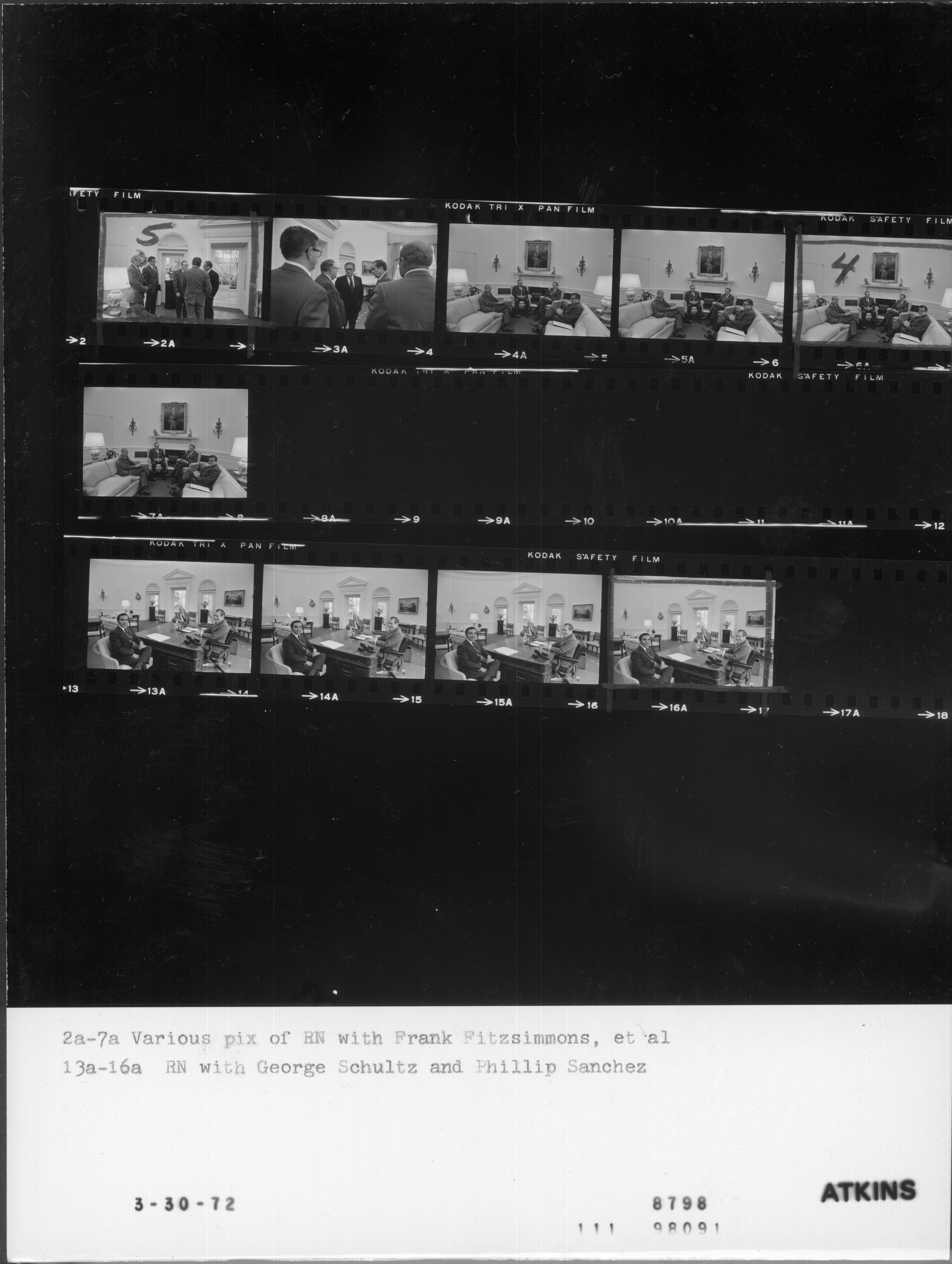
- Frame(s): WHPO-8798-02A-07A, President Nixon standing and informally seated with George Shultz, Charles Colson, Henry Kissinger, and Frank Fitzsimmons. 3/30/1972, Washington, D.C. White House, Oval Office. President Nixon, Shultz, Charles W. Colson, Frank Fitzsimmons, Henry Kissinger, Phillip Sanchez.
- Frame(s): WHPO-8798-13A-16A, President Nixon seated at his desk during a meeting with George Shultz and Phillip Sanchez. 3/30/1972, Washington, D.C. White House, Oval Office. President Nixon, Shultz, Phillip Sanchez.
Roll WHPO-8799 Photographer: Atkins, Oliver | Color or B&W: B&W
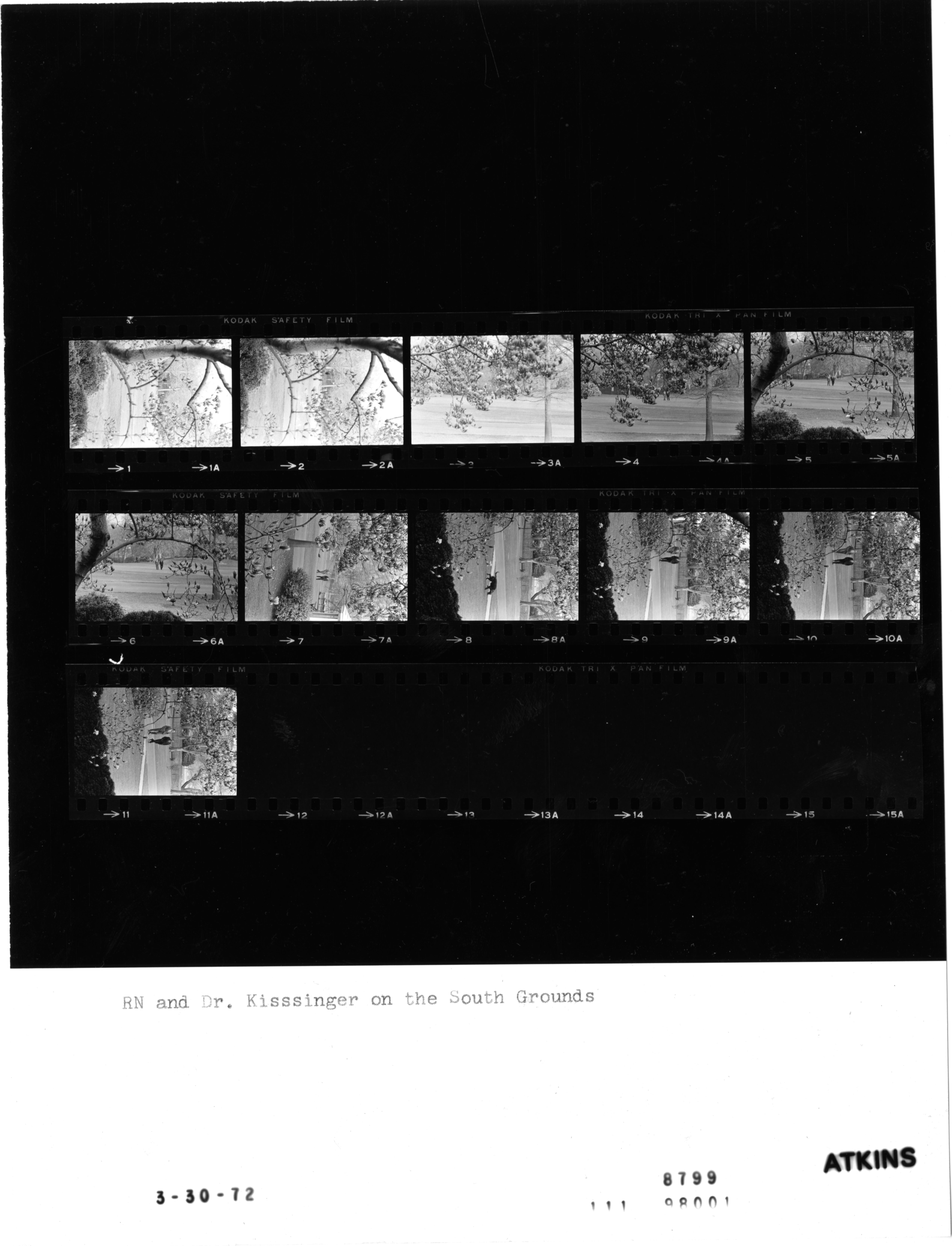
- Frame(s): WHPO-8799-, President Nixon and Henry Kissinger walking on the South Grounds. 3/30/1972, Washington, D.C. White House, South Grounds. President Nixon, Kissinger.
- Frame(s): WHPO-8799-09, President Nixon and Henry Kissinger walking on the South Grounds. A flowering tree is seen in the foreground. 3/30/1972, Washington, D.C. White House, South Grounds. President Nixon, Kissinger.
The White House Communications Agency Sound Recordings Collection contains public statements that took place between 1969 and 1974. Visit the finding aid to learn more.
P - Formal Presidential Remarks
- WHCA-SR-P-720315
Remarks by President Nixon in tribute to Mark Spitz, Sullivan Award winner. (3/30/1972)
Runtime: 0:32
Original Format: 1/4-inch reel-to-reel audiotape. Original source type: Original.
The White House Communications Agency Videotape Collection contains “off-the-air” recordings of televised programs produced between 1968 and 1974. Visit the finding aid to learn more.
- WHCA-5242
"Panorama". Injured Vietnam War veteran amputees.
CBS
Runtime: 01:30:45 - WHCA-5243
"Dinah's Place". Robert Young.
Eastern Educational Network
Runtime: 00:32:16 - WHCA-5244
"Thirty Minutes".
WCET, Los Angeles
Runtime: 00:30:10 - WHCA-5246
Weekly News Summary, Tape II.
ALL NETWORKS
Runtime: 01:35:37
29. Smith/Geer: Berrigan trial judge criticized (Harrisburg 7). Time Code Start: 67:02. Keywords: Protests, militants, bombings, violence, sabotage, shootings, kidnappings, courts, trials, investigations, prosecutions. Network: ABC.
30. Smith/Reasoner: Vietnam; South Viets can handle suspected enemy offensive. Time Code Start: 69:26. Keywords: Vietnam War. Network: ABC.
31. Smith/Gill: Ambassador Watson criticized for personal conduct. Time Code Start: 72:05. Keywords: diplomats, Ambassadors, scandals, criticisms, lifestyles. Network: ABC.
32. Smith/Matney/Sherwood: Wisconsin '72, McGovern & McCarthy. Time Code Start: 74:59. Keywords: Presidential elections, campaigns, campaigning, candidates. Network: ABC.
33. Smith/Tucker: Federal House Administration (FHA) scandal. Time Code Start: 79:15. Keywords: organizations, scandals, investigations. Network: ABC.
34. Smith: Commentary on Doom & Gloom. Time Code Start: 83:44. Keywords: war, death, failure, predictions, projections, psychology. Network: ABC.
35. Chancellor/Levine: Phase II, meat prices. Time Code Start: 85:34. Keywords: food, meats, animal products, wage and price controls, freezes, prices, costs, increases, decreases, economy, economics, budgets, finances, recession, inflation, money. Network: NBC.
36. Chancellor/Goralski: North Vietnam increases air strength. Time Code Start: 87:51. Keywords: Vietnam War, aircraft. Network: NBC.
37. Chancellor/Ellis: Laos refugees. Time Code Start: 89:25. Keywords: Laos, Vietnam War. Network: NBC.
38. Chancellor: Harris polls… President Nixon leads. Time Code Start: 91:40. Keywords: public opinions, polls, approval ratings, Gallup poll, Harris poll, Presidential elections, campaigns, primaries, candidates, voting. Network: NBC.
39. Chancellor/Nessen: Busing & education conference. Time Code Start: 92:05. Keywords: bills, laws, legislation, desegregation, racism, racial discrimination, African Americans, schools, students, transportation, reports, education, conferences. Network: NBC. - WHCA-5247
Weekly News Summary, Tape III.
ALL NETWORKS
Runtime: 0:30
1. Cronkite/Shepard: Food prices/meat prices… who's to blame?. Time Code Start: 00:00. Keywords: food, meats, animal products, markets, retail stores, prices, costs, increases, shortages. Network: CBS.
2. Cronkite: U.S. crime rate down; crime & Rockford, Illinois. Time Code Start: 05:00. Keywords: bills, laws, House of Representatives, anti-crime, offences, infractions, criminals, criminality, law breaking. Network: CBS.
3. Cronkite/Shoumacher: Wisconsin primary & Senator Hubert Humphrey. Time Code Start: 08:03. Keywords: Presidential elections, campaigns, primaries, voting. Network: CBS.
4. Cronkite/Sevareid: Commentary on Wisconsin primary. Time Code Start: 10:12. Keywords: Presidential elections, campaigns, primaries, voting. Network: CBS.
Context (External Sources)
The Vanderbilt Television News Archive is the world's most extensive and complete archive of television news. They have been recording, preserving and providing access to television news broadcasts of the national networks since August 5, 1968.
Wikipedia is a free encyclopedia that anyone can edit.