
Introduction
This almanac page for Friday, March 16, 1973, pulls together various records created by the federal government and links to additional resources which can provide context about the events of the day.
Previous Date: Thursday, March 15, 1973
Next Date: Saturday, March 17, 1973
Schedule and Public Documents
The Daily Diary files represent a consolidated record of the President's activities. Visit the finding aid to learn more.
The President's day began at The White House - Washington, D. C.
The Weekly Compilation of Presidential Documents made available transcripts of the President's news conferences; messages to Congress; public speeches, remarks, and statements; and other Presidential materials released by the White House.
Digitized versions can be found at HathiTrust.
Each Public Papers of the Presidents volume contains the papers and speeches of the President of the United States that were issued by the White House Office of the Press Secretary during the time period specified by the volume. The material is presented in chronological order, and the dates shown in the headings are the dates of the documents or events. In instances when the release date differs from the date of the document itself, that fact is shown in the text note.
To ensure accuracy, remarks have been checked against audio recordings (when available) and signed documents have been checked against the original, unless otherwise noted. Editors have provided text notes and cross references for purposes of identification or clarity.
The Federal Register is the official daily publication for rules, proposed rules, and notices of federal agencies and organizations, as well as executive orders and other Presidential documents.
Archival Holdings
Any selection of archival documents will necessarily be partial. You should use the documents and folders identified below as a starting place, but consult the linked collection finding aids and folder title lists and the collections themselves for context. Many documents to be found this way do not lend themselves to association with specific dates, but are essential to a complete understanding of the material.
Selective document listing
President's Office Files
The President's Office Files consists of materials drawn together by the Special Files Unit from several administrative subdivisions within the White House Office. It is the handwriting and sensitive papers sent to the Staff Secretary that now comprise much of the President's Office Files. Visit the finding aid to learn more.
- News Summaries, Annotated News Summaries, Box 44, [Mar. 14-19, 1973] [3 of 4] [Note: Due to the way News Summary products were compiled, you should also consult nearby days for potentially relevant materials.]
- News Summary, March 16, 1973, (Thursday nets, wires)
- Digest of Recent News Comment, March 16, 1973
The H. R. Haldeman Diaries consists of seven handwritten diaries, 36 dictated diaries recorded as sound recordings, and two handwritten audio cassette tape subject logs. The diaries and logs reflect H. R. Haldeman’s candid personal record and reflections on events, issues, and people encountered during his service in the Nixon White House. As administrative assistant to the President and Chief of Staff, Haldeman attended and participated in public events and private meetings covering the entire scope of issues in which the Nixon White House engaged in during the years 1969-1973. Visit the finding aid to learn more.
- Transcript of diary entry (PDF)
Friday, March 16.
The President got into the POW question this morning. He wants to meet with Flynn, the Senior Officer of the POW's, who's now back. He wants to see him as soon as possible and right after that announce the May 24 dinner. Got into some discussion of POW gifts, decided he wants to give each of them cuff links, each of the wives pins, each of the kids, a bow pin for the girls and tie clips for the boys, plus an ashtray or something like that for their homes, plus a Unit Citation type of thing and a framed copy for each POW. He wants a full plan worked out on that, he wants to go ahead with May 24. I talked to Bob Hope and the date's okay with him, he's supposed to call me back on whether Les Brown will be available and then we'll go ahead. Hope's idea is to put together a show with all the stars that have been over there, like Raquel Welch and Ann Margaret, etcetera.
He got into some PR questions, wants to set up a new plan for circulation of favorable editorials from the outside so that there are no more mailings from the White House and he's trying to figure out how to do that.
Feels that the burden of support on aid to North Vietnam is on Rogers and Richardson and also that they've got to carry the defense budget. We've got to work out the question of how we fight about the Congressional isolationists and they are the key to it.
He got into quite a thing on Watergate again, on the strategies. Still concerned about the appearance of the President covering up and feels that we've got to try to work out of that position by releasing the Segretti data or something.
He also got into staff assignments, feels that Shultz is spread way too thin. He's the senior man on labor, Russian trade, economic policy, Treasury items, monetary policy, energy and so forth. He thinks we've got to get Ash more active on the management side. That Ehrlichman's role has got to be more as an advocate, leaving the substance to Cole, and we need to parcel these assignments out better. Let Flanigan go back to being the businessmen's guy, so Ehrlichman doesn't have to do that. Find a way to point Ehrlichman and Shultz better. We do need to handle the Congressional side, and he's interested in the possibilities of getting a present member of Congress to come over to replace Timmons. Feels we've got to man-to-man each of the Cabinet members on key Congressmen, especially Lynn and Weinberger. And wanted to explore bringing MacGregor back as a Congressional member, because he's got some enthusiasm.
End of March 16. - Original audio recording (MP3)
The National Archives Catalog is the online portal to the records held at the National Archives, and information about those records. It is the main way of describing our holdings and also provides access to electronic records and digitized versions of our holdings.
The Catalog searches across multiple National Archives resources at once, including archival descriptions, digitized and electronic records, authority records, and web pages from Archives.gov and the Presidential Libraries. The Catalog also allows users to contribute to digitized historical records through tagging and transcription.
Nixon Library Holdings
All National Archives Units
National Security Documents
The President's Daily Brief is the primary vehicle for summarizing the day-to-day sensitive intelligence and analysis, as well as late-breaking reports, for the White House on current and future national security issues. Read "The President's Daily Brief: Delivering Intelligence to Nixon and Ford" to learn more.
The Foreign Relations of the United States series presents the official documentary historical record of major U.S. foreign policy decisions and significant diplomatic activity. Visit the State Department website for more information.
Vol. XV, Soviet Union, June 1972-August 1974
Summit Preparations; Jackson-Vanik Amendment; Non-Use of Nuclear Weapons, December 1972-April 1973
85. Conversation Between President Nixon and his Assistant for National Security Affairs (Kissinger), Washington, March 16, 1973, 10:18-10:33 a.m.
Source: National Archives, Nixon Presidential Materials, White House Tapes, Oval Office, Conversation No. 881–2. No classification marking. The editor transcribed the portion of the conversation printed here specifically for this volume.
Vol. XVIII, China, 1973-1976
Kissinger's Visits to Beijing and the Establishment of the Liaison Offices, January 1973-May 1973
21. Letter From President Nixon to Chinese Chairman Mao Zedong, Washington, March 16, 1973
Source: National Archives, Nixon Presidential Materials, NSC Files, Kissinger Office Files, Box 94, Country Files, Far East, China Exchanges, January 1–April 14, 1973. No classification marking. The President received this letter for his approval and signature under a March 8 covering memorandum from Kissinger. (Ibid.) Lord gave it to Chuang Yen, Deputy PRC Representative to the United Nations, on March 17, during a meeting at the PRC Mission to the United Nations. (Ibid.)
22. Letter From President Nixon to Chinese Premier Zhou Enlai, Washington, March 16, 1973
Source: National Archives, Nixon Presidential Materials, NSC Files, Kissinger Office Files, Box 94, Country Files, Far East, China Exchanges, January 1–April 14, 1973. No classification marking. The President received this letter for his approval and signature under a March 8 covering letter from Kissinger. (Ibid.) Lord gave it to Chuang Yen, Deputy PRC Representative to the United Nations during a March 17 meeting at the PRC Mission to the United Nations. (Ibid.)
23. Memorandum From the President’s Assistant for National Security Affairs (Kissinger) to President Nixon, Washington, March 16, 1973
Source: National Archives, Nixon Presidential Materials, NSC Files, Box 526, Country Files, Far East, People’s Republic of China, Vol. 6, Jan–Apr 1973. Secret; Noforn Attachment. Sent for information. Holdridge sent this memorandum to Kissinger on January 29; Kissinger initialed it and passed it on to Nixon. (Ibid.) According to the attached correspondence profile, Nixon saw it on March 29.
Vol. XXI, Chile, 1969-1973
"That Chilean Guy May Have Some Problems": The Downfall of Salvador Allende, January-September 1973
322. Memorandum From the Executive Secretary of the Department of State (Eliot) to the President’s Assistant for National Security Affairs (Kissinger), Washington, March 16, 1973
Source: National Archives, Nixon Presidential Materials, NSC Files, Box 777, Country Files, Latin America, Chile, Vol. VIII. Secret; Exdis.
Vol. XXXI, Foreign Economic Policy, 1973-1976
The End of Fixed Exchange Rates, January-March 1973
34. Backchannel Message From Helmut Sonnenfeldt of the National Security Council Staff to the President’s Assistant for National Security Affairs (Kissinger), Paris, March 16, 1973, 1026Z
Source: National Archives, Nixon Presidential Materials, NSC Files, Box 424, Backchannel Files, Backchannel Messages—Europe—1973. Secret; Immediate; Exclusively Eyes Only.
Vol. XXXV, National Security Policy, 1973-1976
National Security Policy
10. Memorandum From the Deputy Director of the Office of Management and Budget (Malek) to President Nixon, Washington, March 16, 1973
Source: National Archives, Nixon Presidential Materials, White House Special Files, President’s Office Files, Box 21, President’s Handwriting Files, March 11–31, 1973. No classification marking. Sent for action. A note on the memorandum reads, “The President has seen.” Nixon decided during a March 9 meeting, held in the Oval Office to discuss the previous day’s announcement of an increase in the WPI and mounting criticism of the administration’s economic policies, that “stockpile sales should be vigorously pushed” and that Malek be “placed in charge of doing it.” His decision was prompted by Stein, Simon, and Ehrlichman’s shared view that there had been a “failure as yet to implement a policy of more rapid sales of stockpiled industrial materials, which seemed especially important in view of the big increase of industrial prices just reported.” The record of the meeting is ibid., Box 91, Memoranda for the President—Beginning March 4 [1973].
11. National Security Decision Memorandum 208, Washington, March 16, 1973
Source: National Archives, Nixon Presidential Materials, NSC Files, Box 364, Subject Files, NSDMs 145–264. Confidential.
12. National Security Study Memorandum 177, Washington, March 16, 1973
Source: National Archives, Nixon Presidential Materials, NSC Files, Box 365, Subject Files, NSSMs Nos. 104–206. Secret. A copy was sent to Moorer.
Vol. E-8, Documents on South Asia, 1973-1976
India-Pakistan 1
117. Telegram 48647 From the Department of State to the Embassy in India, Washington, March 16, 1973, 0032Z
Assistant Secretary of State of Near Eastern and South Asian Affairs Sisco reported on a meeting with Indian Ambassador L. K. Jha to discuss tensions in Indo-U.S. relations, especially regarding the U.S. decision to resume arms sales to Pakistan.
Source: National Archives, RG 59, Central Files 1970–73, POL INDIA-US. Secret; Immediate. It was drafted on March 15 by Hawes; cleared by NEA/INS; and approved by Sisco.
Vol. E-12, Documents on East and Southeast Asia, 1973-1976
Australia, New Zealand, ANZUS, Papua New Guinea
29. Memorandum From Secretary of State Rogers to President Nixon, Washington, March 16, 1973., Washington, March 16, 1973
Rogers reported on his conversation with Plimsoll.
Source: National Archives, Nixon Presidential Materials, NSC Files, Box 504, Country Files, Far East, Australia, January 1972–December 31, 1973. Secret.
Philippines
317. Memorandum From the President’s Assistant for National Security Affairs (Kissinger) to President Nixon, Washington, March 16, 1973., Washington, March 16, 1973
Kissinger described for Nixon the consensus that resulted from an SRG meeting regarding the Philippines and urged him to approve a NSDM to be released at a later date.
Source: National Archives, Nixon Presidential Materials, NSC Institutional Files (H-Files), Box H–192, NSSM 155 [2 of 2]. Secret. Sent for action. Tab A, an undated proposed NSDM on U.S. policy toward the Philippines, is attached but not published. The President initialed his approval of the draft NSDM, which was subsequently released. See Document 318. The Laurel-Langley Agreement, which governed U.S. tariffs on Philippine exports and the privileges of U.S. investors, expired on July 4, 1974.
The Kissinger telephone conversation transcripts consist of approximately 20,000 pages of transcripts of Kissinger’s telephone conversations during his tenure as Assistant to the President for National Security Affairs (1969-1974) and Secretary of State (1973-1974) during the administration of President Richard Nixon. Visit the finding aid for more information.
Digitized versions can be found in the National Archives Catalog.
Audiovisual Holdings
Visit the White House Tapes finding aid to learn about the taping system's operation and archival processing.
Old Executive Office Building
- 420-1; Unknown between 1:38 p.m. & 2:45 p.m.; Nixon, Richard M. (President); [Unknown person(s)]
- 420-2; Unknown between 1:38 p.m. & 2:45 p.m.; Nixon, Richard M. (President); Sanchez, Manolo
- 420-3; Unknown between 1:38 p.m. & 2:45 p.m.; Nixon, Richard M. (President); Sanchez, Manolo
- 420-4; Unknown between 1:38 p.m. & 2:45 p.m.; Nixon, Richard M. (President); White House operator
- 420-5; Unknown between 1:38 p.m. & 2:45 p.m.; Nixon, Richard M. (President)
- 420-6; 2:45 p.m. - 2:48 p.m.; Nixon, Richard M. (President); Eisenhower, Julie Nixon
- 420-7; 2:48 p.m. - 2:51 p.m.; Nixon, Richard M. (President); Bull, Stephen B.
- 420-8; Unknown between 2:51 p.m. & 3:00 p.m.; Nixon, Richard M. (President); [Unknown person(s)]
- 420-9; Unknown between 2:51 p.m. & 3:00 p.m.; Nixon, Richard M. (President)
- 420-10; Unknown between 2:51 p.m. & 3:00 p.m.; Nixon, Richard M. (President)
- 420-11; 3:00 p.m. - 4:47 p.m.; Nixon, Richard M. (President); Ehrlichman, John D.
Oval Office
- 881-1; Unknown between 10:14 a.m. & 10:18 a.m.; Nixon, Richard M. (President); [Unknown person(s)]
- 881-2; 10:18 a.m. - 10:33 a.m.; Nixon, Richard M. (President); Kissinger, Henry A.
- 881-3; 10:34 a.m. - 11:10 a.m.; Nixon, Richard M. (President); Dean, John W., III; [Unknown person(s)]; Ziegler, Ronald L.
- 881-4; 11:10 a.m. - 12:06 p.m.; Nixon, Richard M. (President); Bull, Stephen B.
- 881-5; 12:06 p.m. - 12:19 p.m.; Nixon, Richard M. (President); Johnson, Wallace H.; Bull, Stephen B.; Atkins, Oliver F. ("Ollie"); Domenici, Peter V.; Domenici, Nancy [Burk]; Domenici, Lisa; Domenici, Peter, Jr.; Domenici, Nella; Domenici, Claire; Domenici, David; Domenici, Nanette; Domenici, Paula; Domenici, Helen
- 881-6; 12:20 p.m. - 12:31 p.m.; Nixon, Richard M. (President); Farrell, Michael J.; Dahl, Arlene; Schaum, Rounseville ("Skip"); Shaum, Lorenzo; Schaum, Carole
- 881-7; 12:31 p.m. - 1:36 p.m.; Nixon, Richard M. (President); Haldeman, H. R. ("Bob")
- 881-8; 4:51 p.m. - 4:52 p.m.; Nixon, Richard M. (President); Ehrlichman, John D.
- 881-9; Unknown between 4:52 p.m. & 5:02 p.m.; Nixon, Richard M. (President); Woods, Rose Mary
- 881-10; Unknown between 4:52 p.m. & 5:02 p.m.; Nixon, Richard M. (President); Woods, Rose Mary
- 881-11; Unknown between 5:06 p.m. & 5:10 p.m.; Nixon, Richard M. (President); [Unknown person(s)]
- 881-12; 5:10 p.m. - 6:43 p.m.; Nixon, Richard M. (President); Ziegler, Ronald L.; Ehrlichman, John D.; [Unknown person(s)]; Kissinger, Henry A.; Kahn, Herman
- 881-13; 6:43 p.m. - 6:43 p.m.; Nixon, Richard M. (President); [Unknown person(s)]
White House Telephone
- 37-127; Unknown between 1:38 p.m. & 2:45 p.m.; Nixon, Richard M. (President); White House operator
- 37-128; 2:45 p.m. - 2:48 p.m.; Nixon, Richard M. (President); Eisenhower, Julie Nixon
- 37-129; Unknown between 7:05 p.m. & 7:41 p.m.; Nixon, Richard M. (President); White House operator
- 37-130; 7:41 p.m. - 7:50 p.m.; Nixon, Richard M. (President); Kissinger, Henry A.
- 37-131; Unknown between 7:50 p.m. & 7:53 p.m.; Nixon, Richard M. (President); White House operator
- 37-132; 7:53 p.m. - 8:12 p.m.; Nixon, Richard M. (President); Colson, Charles W.
- 37-133; Unknown between 8:12 p.m. & 8:14 p.m.; Nixon, Richard M. (President); White House operator
- 37-134; 8:14 p.m. - 8:23 p.m.; Nixon, Richard M. (President); Dean, John W., III
- 37-135; Unknown between 8:23 p.m. & 8:34 p.m.; Nixon, Richard M. (President); White House operator
- 37-136; 8:34 p.m. - 8:34 p.m.; Nixon, Richard M. (President); White House operator
The White House Photo Office collection consists of photographic coverage of President Richard Nixon meeting with prominent social, political, and cultural personalities; speaking engagements and news conferences of the President and various high-ranking members of the White House staff and Cabinet; Presidential domestic and foreign travel, including Presidential vacations; social events and entertainment involving the First Family, including entertainers present; official portraits of the President, First Family, and high-ranking members of the Nixon administration; the 1969 and 1973 Inaugurals; the President’s 1972 Presidential election campaign appearances (including speeches) and other official activities of the White House staff and the President’s Cabinet from January 20, 1969 until August 9, 1974 at the White House and the Old Executive Office Building; other locations in Washington, DC, such as The Mall; and the Presidential retreats in Camp David, Maryland, Key Biscayne, Florida, and San Clemente, California. Visit the finding aid to learn more.
Roll WHPO-E0457 Photographer: Parish, William | Color or B&W: Color
- Frame(s): WHPO-E0457-, Pat Nixon's birthday bouquet. 3/16/1973, Washington, D.C. unknown. Three unidentified men.
Roll WHPO-E0458 Photographer: Schumacher, Karl | Color or B&W: Color
- Frame(s): WHPO-E0458-, Anne Armstrong portraits. 3/16/1973, Washington, D.C. unknown. Anne Armstrong.
- Frame(s): WHPO-E0458-18A, Portrait study of Anne Armstrong. 3/16/1973, Washington, D.C. unknown. Anne Armstrong.
Roll WHPO-E0459 Photographer: Schumacher, Karl | Color or B&W: B&W
- Frame(s): WHPO-E0459-, Anne Armstrong portraits. 3/16/1973, Washington, D.C. unknown. Anne Armstrong.
- Frame(s): WHPO-E0459-10A, Head and shoulders portrait of Anne Armstrong. 3/16/1973, Washington, D.C. unknown. Anne Armstrong.
Roll WHPO-E0460 Photographer: Schumacher, Karl | Color or B&W: B&W
- Frame(s): WHPO-E0460-, Kathleen Balsdon portraits. 3/16/1973, Washington, D.C. unknown. Kathleen Balsdon.
Roll WHPO-E0461 Photographer: Atkins, Oliver | Color or B&W: Color
- Frame(s): WHPO-E0461-03-04, President Nixon and Pat Nixon seated at the table while hosting a breakfast meeting to discuss economic policies with members of the Council of Economic Advisers (CEA) and their wives. 3/16/1973, Washington, D.C. White House, Family Dining Room. President Nixon, Pat Nixon, Chairman Herbert Stein, Mrs. Stein, Departing member Ezra Solomon, Mrs. Solomon, Robert F. Whitman, professor and Chairman of the Department of English at the University of Pittsburgh, Marina von Neumann Whitman.
- Frame(s): WHPO-E0461-03A, President Nixon and Pat Nixon seated at the table while hosting a breakfast meeting to discuss economic policies with members of the Council of Economic Advisers (CEA) and their wives. 3/16/1973, Washington, D.C. White House, Family Dining Room. President Nixon, Pat Nixon, Chairman Herbert Stein, Mrs. Stein, Departing member Ezra Solomon, Mrs. Solomon, Robert F. Whitman, professor and Chairman of the Department of English at the University of Pittsburgh, Marina von Neumann Whitman.
- Frame(s): WHPO-E0461-05-08, President Nixon meeting New Mexico Senator Pete V. Domenici and his family. 3/16/1973, Washington, D.C. White House, Oval Office. President Nixon, Senator Pete V. Domenici, Mrs. Domenici, Lisa Domenici, Pete Domenici, Jr., Nella Domenici, Clare Domenici, David Domenici, Nanette Domenici, Paula Domenici, Helen Domenici.
- Frame(s): WHPO-E0461-09-16, President Nixon meeting actress Arlene Dahl (Mrs. Rounsevelle Schaum) and her family. 3/16/1973, Washington, D.C. White House, Oval Office. President Nixon, Mrs. Rounsevelle Schaum (Arlene Dahl), Mr. Rounsevelle Schaum, Dahl's son Lorenzo Lamas, Dahl's daugher Christina Holmes.
Roll WHPO-E0462 Photographer: Knudsen, Robert L. | Color or B&W: Color
- Frame(s): WHPO-E0462-, Pat Nixon, National Wildlife Federation (NWF President N. Bill Winter, Executive Vice President Thomas L. Kimball, and guests attending the dedication of the National Wildlife Federation (NWF-LREC) Laurel Ridge Educational Center. 3/16/1973, Vienna, Virginia Laurel Ridge Educational Center. Pat Nixon, N. Bill Winter, Executive Vice President Thomas L. Kimball, unidentified VIPs and guests.
Roll WHPO-E0463 Photographer: Knudsen, Robert L. | Color or B&W: Color
- Frame(s): WHPO-E0463-, Pat Nixon, National Wildlife Federation (NWF President N. Bill Winter, Executive Vice President Thomas L. Kimball, and guests attending the dedication of the National Wildlife Federation (NWF-LREC) Laurel Ridge Educational Center. 3/16/1973, Vienna, Virginia Laurel Ridge Educational Center. Pat Nixon, N. Bill Winter, Executive Vice President Thomas L. Kimball, unidentified VIPs and guests.
Roll WHPO-E0464 Photographer: Knudsen, Robert L. | Color or B&W: Color
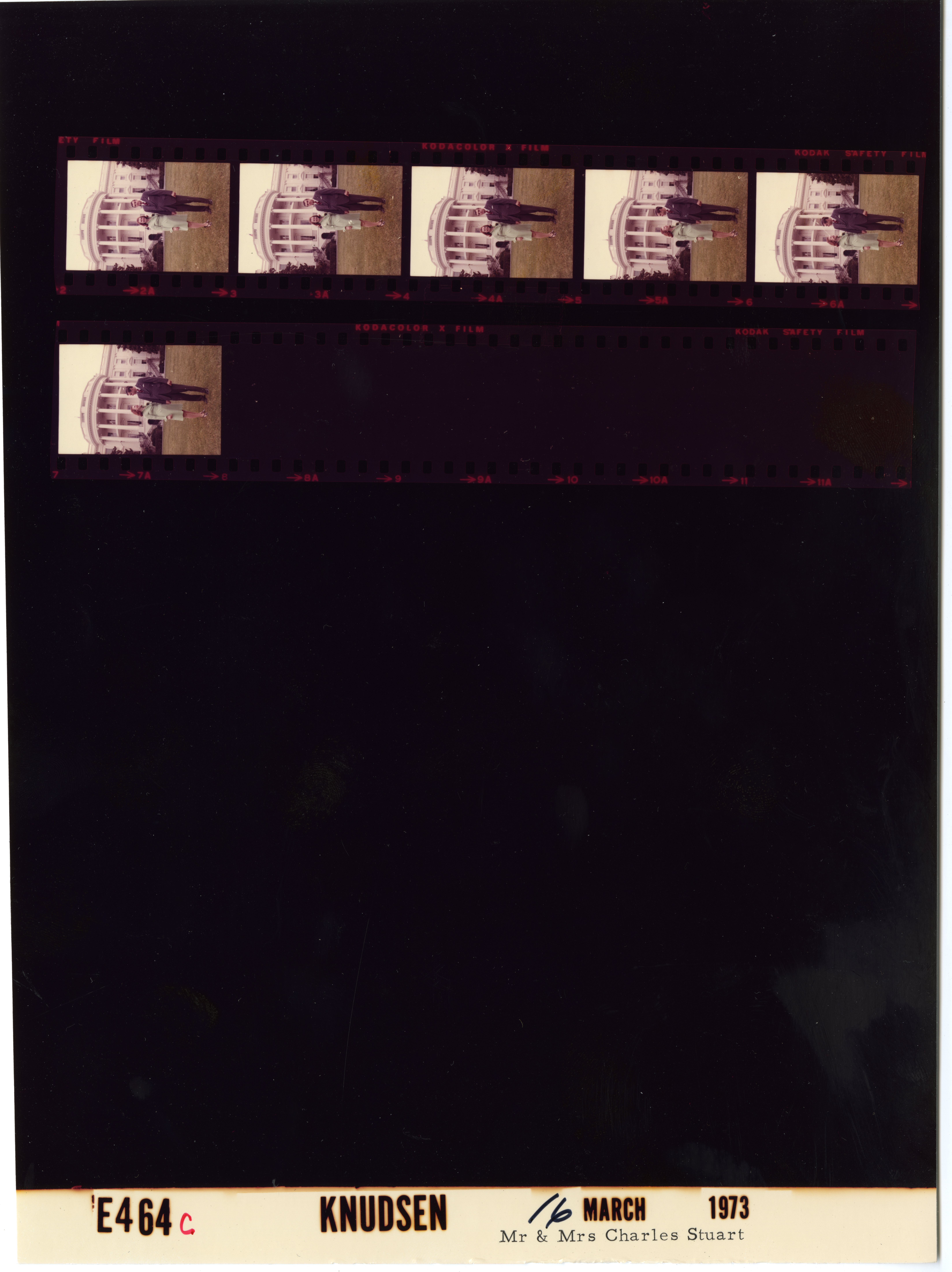
- Frame(s): WHPO-E0464-, Mr. and Mrs. Charles Stuart portraits. 3/16/1973, Washington, D.C. White House, South Lawn. Charles Stuart, Constance Cornell Stuart (Connie Stuart).
Roll WHPO-E0465 Photographer: Schumacher, Karl | Color or B&W: Color
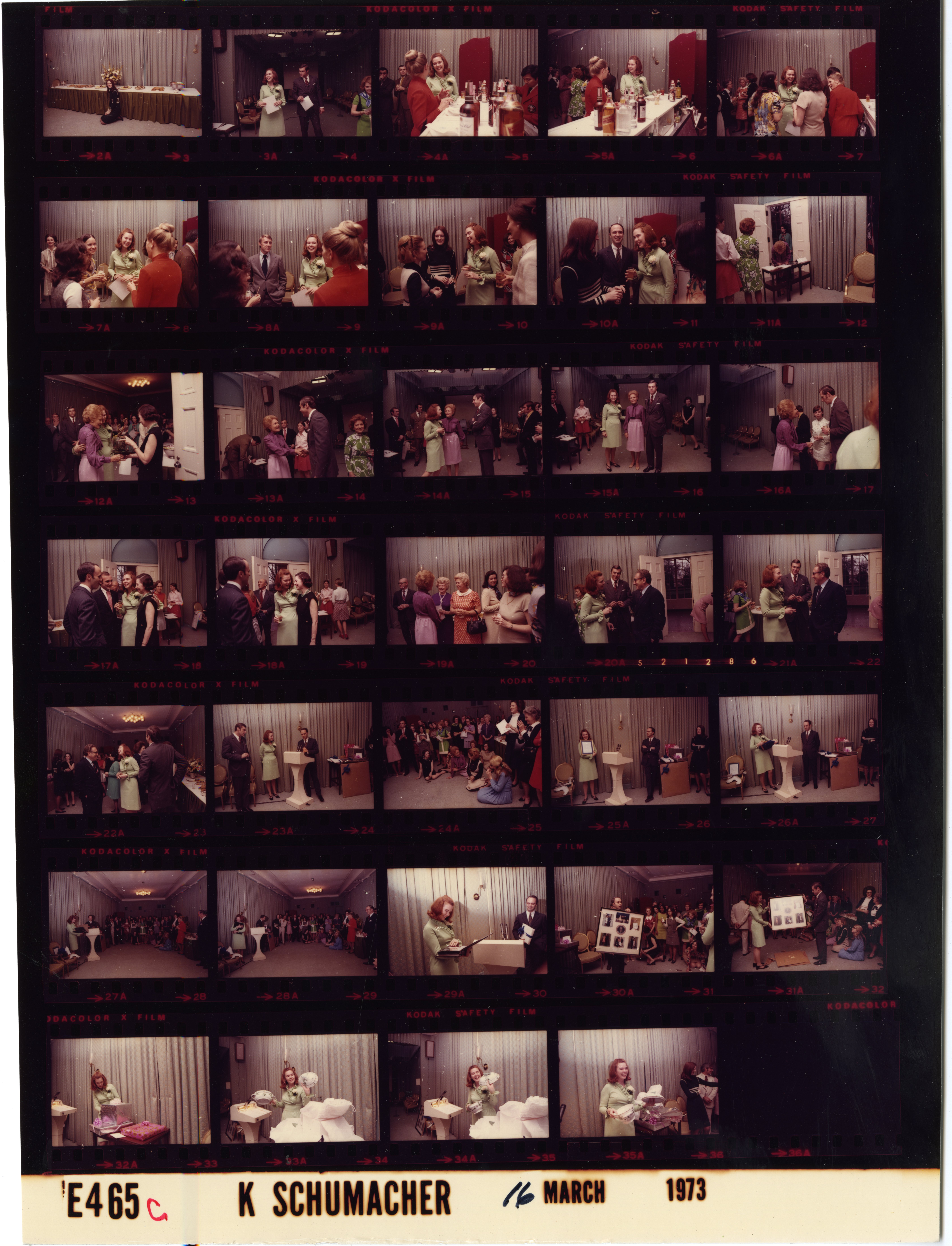
- Frame(s): WHPO-E0465-, Party for departing staff member Constance Stuart (Connie Stuart). 3/16/1973, Washington, D.C. White House interior. Constance Cornell Stuart, Charles Stuart, Pat Nixon, unidentified White House staff.
Roll WHPO-E0466 Photographer: Schumacher, Karl | Color or B&W: Color
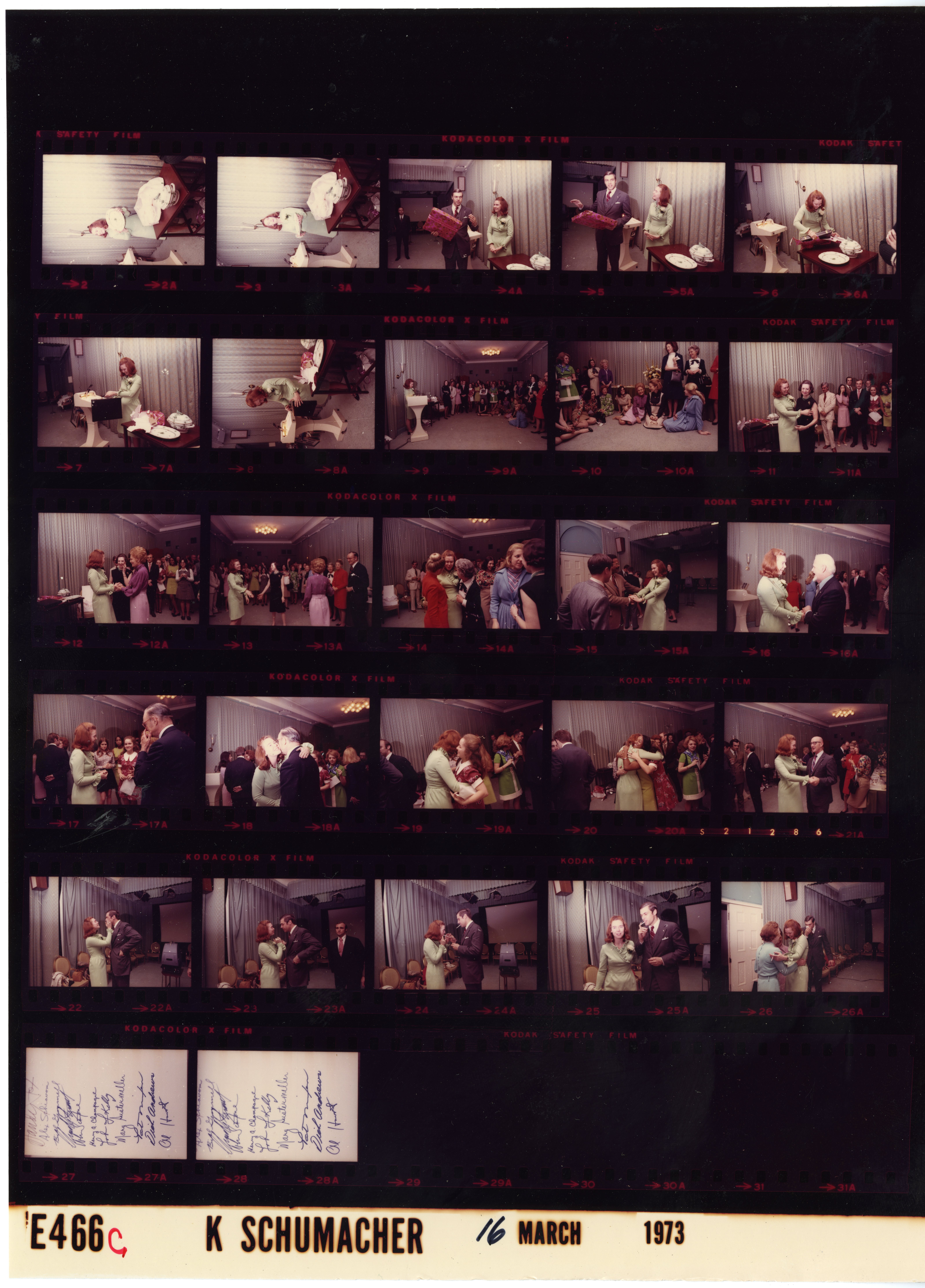
- Frame(s): WHPO-E0466-, Party for departing staff member Constance Stuart. (Connie Stuart). 3/16/1973, Washington, D.C. White House interior. Constance Cornell Stuart, Charles Stuart, Pat Nixon, unidentified White House staff.
Roll WHPO-E0467 Photographer: Knudsen, Robert L. | Color or B&W: B&W
- Frame(s): WHPO-E0467-, President Nixon meeting Dr. Herman Kahn. 3/16/1973, Washington, D.C. White House, Oval Office. President Nixon, Director of the Hudson Institute Dr. Herman Kahn.
The White House Communications Agency Sound Recordings Collection contains public statements that took place between 1969 and 1974. Visit the finding aid to learn more.
C - First Lady
- WHCA-SR-C-143
Remarks by Pat Nixon dedicating a National Wildlife Federation building in Vienna, Virginia. (3/16/1973, Vienna, Virginia)
Runtime: 2:45
Production credits: Audio feed supplied by WHCA; Recorded by GET (initials of WHCA engineer)
Original Format: 1/4-inch reel-to-reel audiotape. Original source type: Original.
I - Various Administration Events
- WHCA-SR-I-131
Farewell party for Connie Stuart, with Mike Farrell. (3/16/1973, Family Theater, White House)
Runtime: 0:35:56
Production credits: Audio feed supplied by WHCA; Recorded by JMC (initials of WHCA engineer)
Original Format: 1/4-inch reel-to-reel audiotape. Original source type: Original.
P - Formal Presidential Remarks
- WHCA-SR-P-730320
Taping on 1st Federal Design Assembly and the Am. Battlefield Monument. (3/16/1973)
Runtime: 1:45
Original Format: 1/4-inch reel-to-reel audiotape. Original source type: Original.
S - White House Press Office Briefings (continuation of the L-series)
- WHCA-SR-S-023
Press briefing by Ronald Ziegler. (3/16/1973, White House Press Lobby)
Runtime: 41:50:00
Keywords: Press conferences, news conferences, interviews, media, press secretary
Production credits: Audio feed supplied by WHCA; Recorded by CRB (initials of WHCA engineer)
Original Format: 1/4-inch reel-to-reel audiotape. Original source type: Original. - WHCA-SR-S-024
Private taping by John D. Ehrlichman. (3/16/1973, Private Office)
Runtime: 6:34
Production credits: Audio feed supplied by WHCA; Recorded by SB (initials of WHCA engineer)
Original Format: 1/4-inch reel-to-reel audiotape. Original source type: Original. - WHCA-SR-S-025
Virginia Knauer: A Battle Plan for Saving. (3/16/1973, EOB Conference Room (450))
Runtime: 40:00:00
Production credits: Audio feed supplied by WHCA; Recorded by E. Doss (initials of WHCA engineer)
Original Format: 1/4-inch reel-to-reel audiotape. Original source type: Original.
The White House Communications Agency Videotape Collection contains “off-the-air” recordings of televised programs produced between 1968 and 1974. Visit the finding aid to learn more.
- WHCA-6182
"Martin Agronsky: Evening Edition". Herbert Klein.
Metromedia
Runtime: 00:29:26 - WHCA-6193
Weekly News Summary, 16-22 Mar 73, Tape I.
ALL NETWORKS
Runtime: 01:27:00
1. Reasoner: POW release. Time Code Start: 00:00. Keywords: Vietnam War, Vietnam Prisoner of War, releases. Network: ABC.
2. Reasoner/Koppel: State Department reaction to POW anti-war statements. Time Code Start: 02:52. Keywords: Vietnam War, Vietnam Prisoner of War, statements. Network: ABC.
3. Reasoner/Gill: Money crisis (dollar crisis)and meat prices; boycott. Time Code Start: 06:21. Keywords: food, meats, animal products, prices, shortages, protests, boycotts, economy, economics, budgets, finances, recession, inflation, money, currency, monetary values, exchange rates, decreases, wages, costs, increases. Network: ABC.
4. Reasoner/Zimmerman: Panama vs. U.S. with Scali. Time Code Start: 10:28. Keywords: Central American, agreements, negotations, contracts, treaties, treaty. Network: ABC.
5. Reasoner: Commentary on highway money. Time Code Start: 12:55. Keywords: credit, loans, cash, currency, funding, financial aid, building, construction, roads. Network: ABC.
6. Chancellor/Levine: Meat prices with Viriginia Knauer. Time Code Start: 14:42. Keywords: food, meats, animal products, markets, retail stores, prices, costs, increases, shortages, Consumer Affairs, Assistant to the President, advocats, women. Network: NBC.
7. Chancellor/Jones: POWs arrive at Clark Air Force Base. Time Code Start: 20:55. Keywords: Vietnam War, Vietnam Prisoner of War, releases, arrivals, Armed Forces, military, air bases, airfields, airports, hospitals. Network: NBC.
8. Chancellor/Cochran: Secretary of Defense Richardson on POWs; troop withdrawls stop. Time Code Start: 23:37. Keywords: cabinet, advisors, Vietnam War, Vietnam Prisoner of War, Vietnam War, Armed Forces, mlitary, troops, decreases, withdrawals. Network: NBC.
9. Chancellor/Brinkley: Tax systems. Time Code Start: 25:23. Keywords: taxes, taxation, revenue. Network: NBC.
10. Chancellor: Separations of power. Time Code Start: 27:10. Keywords: judiciary, legislative, executive, branches of government, administrative. Network: NBC.
11. Chancellor: L. Patrick Gray and Watergate. Time Code Start: 27:22. Keywords: Federal Bureau of Investigations, leaders, nominees, testimony, testify, Watergate, Senate committee hearings, investigations, cover-ups, break-in, burglary, theft, plumbers, scandals. Network: NBC.
12. Cronkite/Webster: POWs at Clark Air Force Base. Time Code Start: 27:55. Keywords: Vietnam War, Vietnam Prisoner of War, releases, arrivals, Armed Forces, military, air bases, airfields, airports, hospitals. Network: CBS.
13. Cronkite/Dail: Tapes of POW anti-war statements; Secretary of Defense Richardson. Time Code Start: 31:18. Keywords: Vietnam War, Vietnam Prisoner of War, recordings, anti-war, protests, cabinet, advisors. Network: CBS.
14. Cronkite: U.S. and Vietnam trade, warning on escalation. Time Code Start: 33:47. Keywords: Vietnam War. Network: CBS.
15. Cronkite: Watergate and L. Patrick Gray. Time Code Start: 37:25. Keywords: Federal Bureau of Investigations, leaders, nominees, testimony, testify, Watergate, Senate committee hearings, investigations, cover-ups, break-in, burglary, theft, plumbers, scandals. Network: CBS.
16. Cronkite/Drinkwater: POW talks about prison life. Time Code Start: 37:50. Keywords: Vietnam War, Vietnam Prisoner of War. Network: CBS.
Context (External Sources)
The Vanderbilt Television News Archive is the world's most extensive and complete archive of television news. They have been recording, preserving and providing access to television news broadcasts of the national networks since August 5, 1968.
Wikipedia is a free encyclopedia that anyone can edit.