
Introduction
This almanac page for Thursday, March 15, 1973, pulls together various records created by the federal government and links to additional resources which can provide context about the events of the day.
Previous Date: Wednesday, March 14, 1973
Next Date: Friday, March 16, 1973
Schedule and Public Documents
The Daily Diary files represent a consolidated record of the President's activities. Visit the finding aid to learn more.
The President's day began at The White House - Washington, D. C.
The Weekly Compilation of Presidential Documents made available transcripts of the President's news conferences; messages to Congress; public speeches, remarks, and statements; and other Presidential materials released by the White House.
Digitized versions can be found at HathiTrust.
Each Public Papers of the Presidents volume contains the papers and speeches of the President of the United States that were issued by the White House Office of the Press Secretary during the time period specified by the volume. The material is presented in chronological order, and the dates shown in the headings are the dates of the documents or events. In instances when the release date differs from the date of the document itself, that fact is shown in the text note.
To ensure accuracy, remarks have been checked against audio recordings (when available) and signed documents have been checked against the original, unless otherwise noted. Editors have provided text notes and cross references for purposes of identification or clarity.
The Federal Register is the official daily publication for rules, proposed rules, and notices of federal agencies and organizations, as well as executive orders and other Presidential documents.
The Congressional Record is the official daily record of the debates and proceedings of the U.S. Congress.
Archival Holdings
Any selection of archival documents will necessarily be partial. You should use the documents and folders identified below as a starting place, but consult the linked collection finding aids and folder title lists and the collections themselves for context. Many documents to be found this way do not lend themselves to association with specific dates, but are essential to a complete understanding of the material.
Selective document listing
President's Office Files
The President's Office Files consists of materials drawn together by the Special Files Unit from several administrative subdivisions within the White House Office. It is the handwriting and sensitive papers sent to the Staff Secretary that now comprise much of the President's Office Files. Visit the finding aid to learn more.
- News Summaries, Annotated News Summaries, Box 44, [Mar. 14-19, 1973] [2 of 4] [Note: Due to the way News Summary products were compiled, you should also consult nearby days for potentially relevant materials.]
- News Summary, March 15, 1973, (Wednesday nets, wires)
President's Personal File
The President's Personal File is essentially a President's secretary's file, kept by Rose Mary Woods, personal secretary to the President, for two purposes: (1) preserving for posterity a collection of documents particularly close to the President, whether because he dictated or annotated them, or because of the importance of the correspondent or the event concerned and (2) giving appropriate attention–letters of gratitude, invitations to White House social events, and the like–to members and important friends and supporters of the Nixon administration. This generalization does not describe all the varied materials of a file group which is essentially a miscellany, but it does identify the reason for the existence of the file group's core. Visit the finding aid to learn more.
- President's Speech File
The H. R. Haldeman Diaries consists of seven handwritten diaries, 36 dictated diaries recorded as sound recordings, and two handwritten audio cassette tape subject logs. The diaries and logs reflect H. R. Haldeman’s candid personal record and reflections on events, issues, and people encountered during his service in the Nixon White House. As administrative assistant to the President and Chief of Staff, Haldeman attended and participated in public events and private meetings covering the entire scope of issues in which the Nixon White House engaged in during the years 1969-1973. Visit the finding aid to learn more.
- Transcript of diary entry (PDF)
Thursday, March 15.
Discussion at the staff meeting this morning about the Hill's counterstrategy on our budget plan. They now plan to agree to a budget ceiling, or to the idea that 268 but not only as a ceiling, also as a floor, on the theory that we’ve gone to that as a full employment budget on the basis that the economy needs government spending at that level in order to maintain the economic growth level. Therefore, they will cut defense and then take the money that's left and spend it on social programs, which we've got to figure out a counterstrategy for.
The President had his press conference this morning, and over half of it was devoted to Watergate questions. He got into quite a discussion with me this afternoon about that, and his concern, which he's expressed continually, although tries to stay away from it with me, that we're in a bad position on Watergate. He keeps working with Dean every day on trying to develop ways of finding some statement that we can put out that shows that we're not just covering it up.
He went over the questions that they didn't ask at the press conference on all the major issues, including no questions on the announcement of Bruce to China, which he made at the beginning of the press conference. And he raises a question maybe whether he should do these press conference more often, even weekly, which Ziegler strongly disagrees with.
End of March 15. - Original audio recording (MP3)
The National Archives Catalog is the online portal to the records held at the National Archives, and information about those records. It is the main way of describing our holdings and also provides access to electronic records and digitized versions of our holdings.
The Catalog searches across multiple National Archives resources at once, including archival descriptions, digitized and electronic records, authority records, and web pages from Archives.gov and the Presidential Libraries. The Catalog also allows users to contribute to digitized historical records through tagging and transcription.
Nixon Library Holdings
All National Archives Units
National Security Documents
The President's Daily Brief is the primary vehicle for summarizing the day-to-day sensitive intelligence and analysis, as well as late-breaking reports, for the White House on current and future national security issues. Read "The President's Daily Brief: Delivering Intelligence to Nixon and Ford" to learn more.
The Foreign Relations of the United States series presents the official documentary historical record of major U.S. foreign policy decisions and significant diplomatic activity. Visit the State Department website for more information.
Vol. X, Vietnam, January 1973-July 1975
Neither War nor Peace, January 27-June 15, 1973
30. Backchannel Message From the President’s Assistant for National Security Affairs (Kissinger) to the Ambassador to Laos (Godley), Washington, March 15, 1973, 0019Z
Source: National Archives, Nixon Presidential Materials, NSC Files, Box 411, Backchannel Messages, Southeast Asia, 1973. Secret.
31. Transcript of Telephone Conversation Between the President’s Assistant for National Security Affairs (Kissinger) and the White House Chief of Staff (Haig), Washington, March 15, 1973, 9:33 a.m.
Source: National Archives, Nixon Presidential Materials, Henry A. Kissinger Telephone Conversation Transcripts, Box 19, Chronological File. No classification marking.
32. Memorandum From William Stearman of the National Security Council Staff to the President’s Assistant for National Security Affairs (Kissinger), Washington, March 15, 1973
Source: National Archives, Nixon Presidential Materials, NSC Files, Box 163, Vietnam Country Files, Vietnam, January 1973–April 1973. Secret. Sent for information. Kissinger’s initials appear at the top of the page.
Vol. E-6, Documents on Africa, 1973-1976
Africa Region
3. Memorandum of Conversation, London, March 15, 1973
Assistant Secretary of State for African Affairs David Newsom summarized U.S. views on Africa at the beginning of the second Nixon Administration for his counterparts from the British Foreign and Commonwealth Office.
Source: National Archives, RG 59, Central Files 1970–73, POL AFR. Confidential. Drafted by Michael L. Milligan (AF) on May 4.
Vol. E-11, Part 1, Documents on Mexico; Central America; and the Caribbean, 1973-1976
Costa Rica
109. Telegram 47730 From the Department of State to the Embassy in Costa Rica, Washington, March 15, 1973, 1354Z
Summary: The Department reported that the Securities and Exchange Commission planned to present evidence in court of financial links between financier Robert Vesco and Costa Rican President José Figueres.
Source: National Archives, RG 59, Central Foreign Policy File, [no film number]. Confidential; Limdis. Drafted and approved by Lazar. Vesco sought residency in Costa Rica after becoming the subject of an SEC investigation for fraud in connection with his management of the Investors Overseas Services mutual fund firm and his implication as the source of an illegal contribution to President Nixon’s 1972 reelection campaign. In telegram 939 from San José, March 17, the Embassy reported that Figueres told Vaky that he could account for the transactions involving Vesco and offered to facilitate an out-of-court settlement between Vesco and the SEC. (Ibid., Nixon Presidential Materials, NSC Files, Country Files, Box 779, Latin America, Costa Rica) Telegram 983 from San José, March 22, transmitted a letter in which Figueres elaborated on his offer to mediate. (Ibid.)
Vol. E-12, Documents on East and Southeast Asia, 1973-1976
Korean Peninsula
234. Memorandum From John Holdridge of the National Security Council Staff to the President’s Assistant for National Security Affairs (Kissinger), Washington, March 15, 1973., Washington, March 15, 1973
Holdridge recommended that Kissinger approve a backchannel message to Habib concerning UNCURK.
Source: National Archives, Nixon Presidential Materials, NSC Files, Country Files, Far East, Box 544, Korea, Volume 6, January 1973–October 1973. Secret; Sensitive; Exclusively Eyes Only; Entirely Outside System. In the top right hand corner Kissinger wrote, “Where is the extra paper by Rush?” A response in an unknown hand wrote “Tab C,” referring to the March 8 Department of State paper. At the top of the first page, an unknown hand indicated that the situation room received the telegram for dispatch on the morning of March 19, 1973. Attached but not published is Tab A, the draft backchannel telegram from Kissinger to Habib, which was sent as backchannel telegram 30768 to Habib, March 19. (ibid., Box 411, Backchannel Messages, Southeast Asia, Volume II, 1973, Part 1) Tab B, a February 24 memorandum of conversation, is Document 232. Tab C, a paper prepared in the Department of State, March 8, is attached but not published.
Philippines
316. Memorandum From the Acting Assistant Secretary of Defense for International Security Affairs (Eagleburger) to Secretary of Defense Richardson, Washington, March 15, 1973., Washington, March 15, 1973
Eagleburger described the Muslim insurgency in the Philippines.
Source: Washington National Records Center, OSD Files: FRC 330–78–0001, Philippines, 091.3, 15 March 1973. Confidential; Noforn. The bottom of the memorandum is stamped, “Sec has seen. 17 Mar 1973.”
Vol. E-15, Part 2, Documents on Western Europe, 1973-1976, Second, Revised Edition
Federal Republic of Germany, 1973-1976
263. Memorandum From the President’s Assistant for National Security Affairs (Kissinger) to President Nixon, Washington, March 15, 1973
Summary: Kissinger forwarded a letter he had received from the novelist Hans Habe.
Source: National Archives, Nixon Presidential Materials, NSC Files, Kissinger Office Files, Box 61, Country Files, Europe, General, Hans Habe. Confidential. Sent for information. A stamped notation on the memorandum indicates the President saw it. Nixon wrote on the bottom of the memorandum, “K—a very perceptive and very disturbing analysis—I think he is too close to the truth.” Nixon underlined the portion of the seventh paragraph of the letter that begins “in the current of time” until the end of the sentence and wrote in the adjacent margin, “K—very perceptive.” In the ninth paragraph, Nixon underlined the third sentence; in the tenth paragraph, he underlined the fourth sentence. In the thirteenth paragraph, Nixon underlined the sixth sentence, as well as the final sentence, and wrote a check mark in the margin. In the sixteenth paragraph, Nixon underlined the first sentence, writing in the adjacent margin, “K—one of our greatest mistakes. We must do everything possible to rectify it.” Nixon also underlined substantial portions of the fourth and fifth sentences in the sixteenth paragraph.
The Kissinger telephone conversation transcripts consist of approximately 20,000 pages of transcripts of Kissinger’s telephone conversations during his tenure as Assistant to the President for National Security Affairs (1969-1974) and Secretary of State (1973-1974) during the administration of President Richard Nixon. Visit the finding aid for more information.
Digitized versions can be found in the National Archives Catalog.
Audiovisual Holdings
Visit the White House Tapes finding aid to learn about the taping system's operation and archival processing.
Old Executive Office Building
- 410-15; Unknown between 2:58 p.m. & 3:02 p.m.; Nixon, Richard M. (President); Bull, Stephen B.
- 410-16; Unknown between 2:58 p.m. & 3:02 p.m.; Nixon, Richard M. (President); Sanchez, Manolo
- 410-17; Unknown between 2:58 p.m. & 3:02 p.m.; Nixon, Richard M. (President); [Unknown person(s)]
- 410-18; Unknown between 2:58 p.m. & 3:02 p.m.; Nixon, Richard M. (President); White House operator
- 410-19; 3:02 p.m. - 3:04 p.m.; Nixon, Richard M. (President); Rebozo, Charles G. ("Bebe")
- 410-20; 3:04 p.m. - 4:24 p.m.; Nixon, Richard M. (President); Haldeman, H. R. ("Bob")
- 410-21; Unknown between 4:24 p.m. & 4:26 p.m.; Nixon, Richard M. (President); White House operator
- 410-22; 4:26 p.m. - 4:29 p.m.; Nixon, Richard M. (President); Moorer, Thomas H. (Adm.)
- 410-23; Unknown between 4:29 p.m. & 4:34 p.m.; Nixon, Richard M. (President); [Unknown person(s)]
- 410-24; Unknown between 4:29 p.m. & 4:34 p.m.; Nixon, Richard M. (President); White House operator
- 410-25; 4:34 p.m. - 4:35 p.m.; Nixon, Richard M. (President); Haldeman, H. R. ("Bob")
- 410-26; Unknown between 4:35 p.m. & 4:42 p.m.; Nixon, Richard M. (President); Eisenhower, Julie Nixon
- 410-27; 4:42 p.m. - 4:44 p.m.; Nixon, Richard M. (President); Timmons, William E.
- 410-28; 4:45 p.m. - 4:45 p.m.; Nixon, Richard M. (President); [Unknown person(s)]
- 410-29; 4:45 p.m. - 4:47 p.m.; Nixon, Richard M. (President); Bull, Stephen B.
- 410-30; Unknown between 4:47 p.m. & 4:50 p.m.; Nixon, Richard M. (President); Ehrlichman, John D.
- 410-31; Unknown between 4:47 p.m. & 4:50 p.m.; Nixon, Richard M. (President); White House operator
- 410-32; 4:50 p.m. - 4:52 p.m.; Nixon, Richard M. (President); Scowcroft, Brent G. (Gen.)
- 410-33; 4:52 p.m. - 5:43 p.m.; Nixon, Richard M. (President); Ehrlichman, John D.; Nixon, Thelma C. ("Pat") (Ryan); Bull, Stephen B.; Sanchez, Manolo
- 410-34; Unknown between 5:43 p.m. & 6:20 p.m.; Nixon, Richard M. (President); White House operator
- 410-35; 6:20 p.m. - 6:21 p.m.; Nixon, Richard M. (President); Nixon, Thelma C. ("Pat") (Ryan)
- 410-36; Unknown between 6:21 p.m. & 6:24 p.m.; Nixon, Richard M. (President); Sanchez, Manolo
- 410-37; 6:24 p.m. - 6:24 p.m.; Nixon, Richard M. (President); White House operator
- 410-38; Unknown between 6:24 p.m. & 6:28 p.m.; Nixon, Richard M. (President); White House operator
- 410-39; Unknown between 6:24 p.m. & 6:28 p.m.; Nixon, Richard M. (President); Sanchez, Manolo
- 410-40; Unknown between 6:24 p.m. & 6:28 p.m.; Nixon, Richard M. (President); White House operator
- 410-41; 6:28 p.m. - 6:29 p.m.; Nixon, Richard M. (President); Bull, Stephen B.
- 410-42; 6:33 p.m. - 6:34 p.m.; Nixon, Richard M. (President); Bull, Stephen B.
- 410-43; 6:34 p.m. - 6:45 p.m.; Nixon, Richard M. (President); Hope, Lelsie T. ("Bob")
- 410-44; 6:47 p.m. - 6:47 p.m.; Nixon, Richard M. (President); White House operator
- 410-45; Unknown between 6:47 p.m. & 7:01 p.m.; Nixon, Richard M. (President); Sanchez, Manolo
- 410-46; Unknown between 6:47 p.m. & 7:01 p.m.; Nixon, Richard M. (President); White House operator
- 410-47; 7:01 p.m. - 7:01 p.m.; Nixon, Richard M. (President); White House operator
- 410-48; 7:01 p.m. - 7:02 p.m.; Nixon, Richard M. (President); Sanchez, Manolo
- 410-49; 7:02 p.m. - 7:04 p.m.; Nixon, Richard M. (President); Palmer, Arnold
- 410-50; 7:14 p.m. - 7:18 p.m.; Nixon, Richard M. (President); Rebozo, Charles G. ("Bebe")
- 410-51; Unknown between 7:18 p.m. & 7:30 p.m.; Nixon, Richard M. (President); Sanchez, Manolo
- 416-33; 9:20 a.m. - 9:20 a.m.; Nixon, Richard M. (President); White House operator
- 416-34; 9:22 a.m. - 10:05 a.m.; Nixon, Richard M. (President); Ziegler, Ronald L.
- 416-35; 10:39 a.m. - 10:55 a.m.; Nixon, Richard M. (President); Kissinger, Henry A.
- 416-36; Unknown between 1:18 p.m. & 2:48 p.m.; Nixon, Richard M. (President); Sanchez, Manolo
- 416-37; Unknown between 1:18 p.m. & 2:48 p.m.; Nixon, Richard M. (President); [Unknown person(s)]
- 416-38; Unknown between 1:18 p.m. & 2:48 p.m.; Nixon, Richard M. (President)
- 416-39; Unknown between 1:18 p.m. & 2:48 p.m.; Nixon, Richard M. (President); White House operator
- 416-40; Unknown between 1:18 p.m. & 2:48 p.m.; Nixon, Richard M. (President); Sanchez, Manolo; [Unknown person(s)]
- 416-41; 2:48 p.m. - 2:49 p.m.; Nixon, Richard M. (President); Bull, Stephen B.
Oval Office
- 880-1; 11:16 a.m. - 11:19 a.m.; Nixon, Richard M. (President); Ziegler, Ronald L.
- 880-2; Unknown between 11:19 a.m. & 11:22 a.m.; Nixon, Richard M. (President); Ziegler, Ronald L.
- 880-3; 11:58 a.m. - 12:05 p.m.; Nixon, Richard M. (President); Ziegler, Ronald L.
- 880-4; Unknown between 12:05 p.m. & 12:11 p.m.; Nixon, Richard M. (President); White House operator
- 880-5; Unknown between 12:05 p.m. & 12:11 p.m.; Nixon, Richard M. (President); Bull, Stephen B.
- 880-6; 12:11 p.m. - 12:25 p.m.; Nixon, Richard M. (President); Kissinger, Henry A.; Cake, Ralph H.; Ziegler, Ronald L.; [Unknown person(s)]
- 880-7; Unknown between 12:25 p.m. & 12:26 p.m.; Nixon, Richard M. (President); Sanchez, Manolo
- 880-8; 12:26 p.m. - 12:35 p.m.; Nixon, Richard M. (President); Friedersdorf, Max L.; Ploch, Debbie; Collins, James M.
- 880-9; 12:35 p.m. - 1:02 p.m.; Nixon, Richard M. (President); Bull, Stephen B.; Kissinger, Henry A.
- 880-10; Unknown between 1:02 p.m. & 1:04 p.m.; Nixon, Richard M. (President); Bull, Stephen B.
- 880-11; Unknown between 1:04 p.m. & 1:16 p.m.; Nixon, Richard M. (President); Ziegler, Ronald L.
- 880-12; Unknown between 2:53 p.m. & 2:55 p.m.; Nixon, Richard M. (President); [Unknown person(s)]
- 880-13; Unknown between 2:55 p.m. & 2:59 p.m.; Nixon, Richard M. (President); Woods, Rose Mary
- 880-14; Unknown between 2:55 p.m. & 3:55 p.m.; Nixon, Richard M. (President); Ferguson, Lucy; Ferguson, John; Williams, Donald; Williams, Donald (Mrs.); Williams, Jeanette; Williams, Mark; Williams, Jonathan; Jordan, Diane; Jordan, Shelby; Jordan, Kim; Garment, Leonard; Fisher, Max M.; [Unknown person(s)]
- 880-15; 3:56 p.m. - 4:17 p.m.; Nixon, Richard M. (President); Sanchez, Manolo; Young, Donald E.; Cook, Richard K.; Coghill, Jack
- 880-16; Unknown between 4:17 p.m. & 4:18 p.m.; Nixon, Richard M. (President); Sanchez, Manolo
- 880-17; Unknown between 4:17 p.m. & 4:18 p.m.; Nixon, Richard M. (President); [Unknown person(s)]
- 880-18; 4:18 p.m. - 5:30 p.m.; Nixon, Richard M. (President); Haldeman, H. R. ("Bob"); Ziegler, Ronald L.; Kissinger, Henry A.; Sanchez, Manolo
- 880-19; Unknown between 5:30 p.m. & 5:31 p.m.; Nixon, Richard M. (President); Bull, Stephen B.
- 880-20; Unknown between 5:30 p.m. & 5:31 p.m.; Nixon, Richard M. (President); Bull, Stephen B.
- 880-21; Unknown between 5:30 p.m. & 5:31 p.m.; Nixon, Richard M. (President); White House operator
- 880-22; 5:31 p.m. - 5:33 p.m.; Nixon, Richard M. (President); Woods, Rose Mary
- 880-23; 5:33 p.m. - 5:34 p.m.; Nixon, Richard M. (President); White House operator
- 880-24; 5:36 p.m. - 6:24 p.m.; Nixon, Richard M. (President); Dean, John W., III; Moore, Richard A.; [Unknown person(s)]; Bull, Stephen B.
- 880-25; Unknown between 11:22 a.m. & 11:58 a.m.; [Unknown person(s)]
- 880-26; Unknown between 6:24 p.m., 3/15 & 10:14 a.m., 3/1; [Unknown person(s)]
White House Telephone
- 37-115; 9:20 a.m. - 9:20 a.m.; Nixon, Richard M. (President); White House operator
- 37-116; Unknown between 9:20 a.m. & 10:05 a.m.; Nixon, Richard M. (President); Ziegler, Ronald L.; Dean, John W., III
- 37-117; Unknown between 12:05 p.m. & 12:11 p.m.; Nixon, Richard M. (President); White House operator
- 37-118; 12:11 p.m. - 12:12 p.m.; Nixon, Richard M. (President); Cake, Ralph H.
- 37-119; Unknown between 1:18 p.m. & 2:48 p.m.; Nixon, Richard M. (President); White House operator
- 37-120; 2:48 p.m. - 2:49 p.m.; Nixon, Richard M. (President); Bull, Stephen B.
- 37-121; Unknown between 5:30 p.m. & 5:31 p.m.; Nixon, Richard M. (President); White House operator
- 37-122; 5:31 p.m. - 5:33 p.m.; Nixon, Richard M. (President); Woods, Rose Mary
- 37-123; Unknown between 5:33 p.m. & 5:34 p.m.; Nixon, Richard M. (President); White House operator
- 37-124; 5:34 p.m. - 5:35 p.m.; Nixon, Richard M. (President); Acker, Marjorie P.
- 37-125; Unknown between 7:10 p.m. & 7:43 p.m.; Nixon, Richard M. (President); White House operator
- 37-126; 7:43 p.m. - 7:44 p.m.; Nixon, Richard M. (President); Cox, Tricia Nixon
The White House Photo Office collection consists of photographic coverage of President Richard Nixon meeting with prominent social, political, and cultural personalities; speaking engagements and news conferences of the President and various high-ranking members of the White House staff and Cabinet; Presidential domestic and foreign travel, including Presidential vacations; social events and entertainment involving the First Family, including entertainers present; official portraits of the President, First Family, and high-ranking members of the Nixon administration; the 1969 and 1973 Inaugurals; the President’s 1972 Presidential election campaign appearances (including speeches) and other official activities of the White House staff and the President’s Cabinet from January 20, 1969 until August 9, 1974 at the White House and the Old Executive Office Building; other locations in Washington, DC, such as The Mall; and the Presidential retreats in Camp David, Maryland, Key Biscayne, Florida, and San Clemente, California. Visit the finding aid to learn more.
Roll WHPO-E0451 Photographer: Knudsen, Robert L. | Color or B&W: B&W
- Frame(s): WHPO-E0451-, Maid of Cotton. 3/15/1973, Washington, D.C. White House, Oval Office. Maid of Cotton.
Roll WHPO-E0452 Photographer: Parish, William | Color or B&W: B&W
- Frame(s): WHPO-E0452-, POW (Vietnam Prisoner of War) parents. 3/15/1973, Washington, D.C. White House exterior. unidentified POW (Vietnam Prisoner of War) parents.
Roll WHPO-E0453 Photographer: Atkins, Oliver | Color or B&W: Color
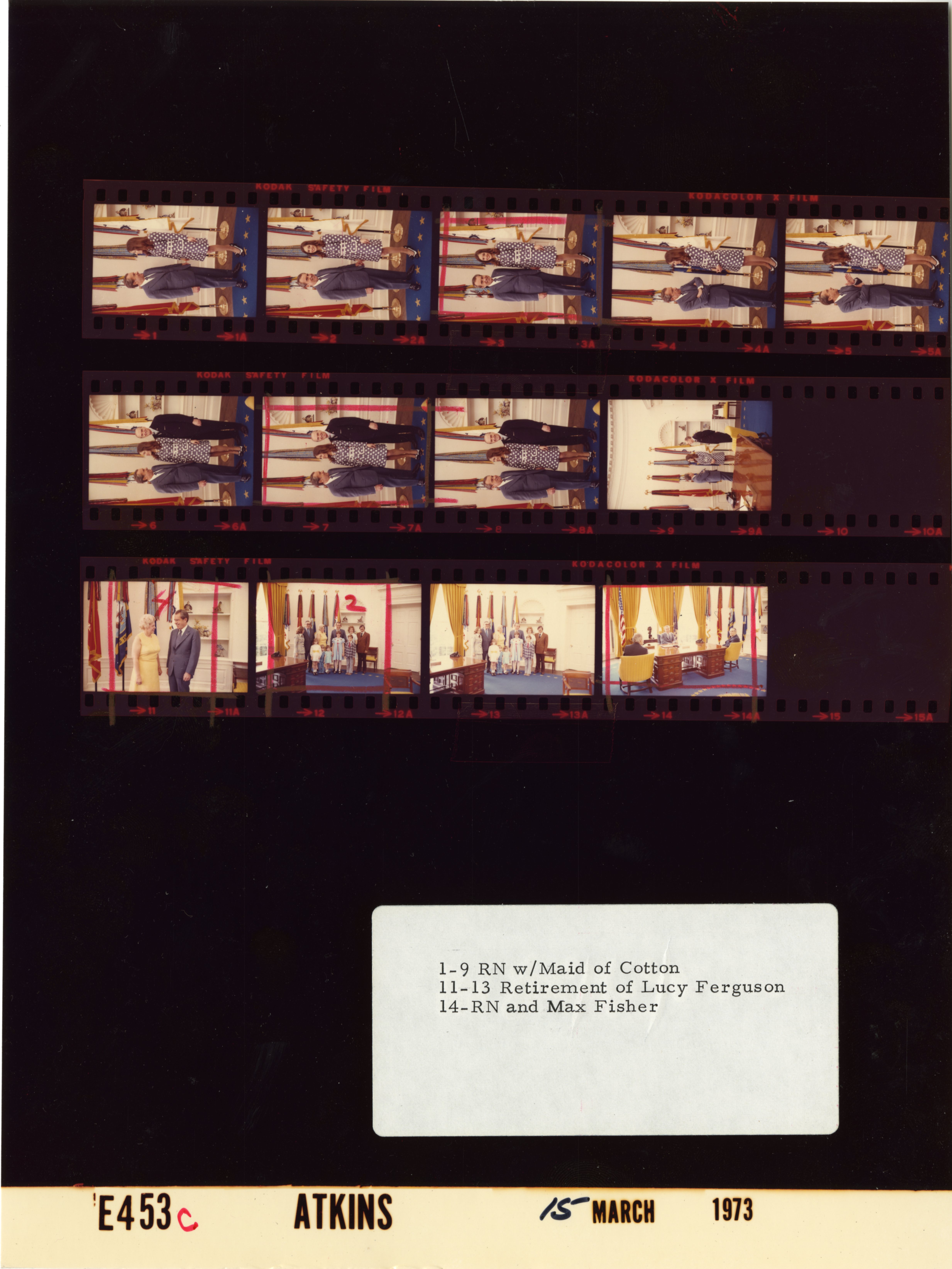
- Frame(s): WHPO-E0453-01-09, President Nixon meets 1973 Maid of Cotton. 3/15/1973, Washington, D.C. White House, Oval Office. President Nixon, 1973 Maid of Cotton Debbie Ploch, unidentified male.
- Frame(s): WHPO-E0453-11-13, President Nixon meeting in the Oval office with retiring Lucy Ferguson. 3/15/1973, Washington, D.C. White House, Oval Office. President Nixon, Lucy Ferguson, unidentified Ferguson family members.
- Frame(s): WHPO-E0453-14, President Nixon meeting Max Fisher. 3/15/1973, Washington, D.C. White House, Oval Office. President Nixon, President of the Council of Jewish Federations and Welfare Funds Max Fisher.
Roll WHPO-E0454 Photographer: Knudsen, Robert L. | Color or B&W: B&W
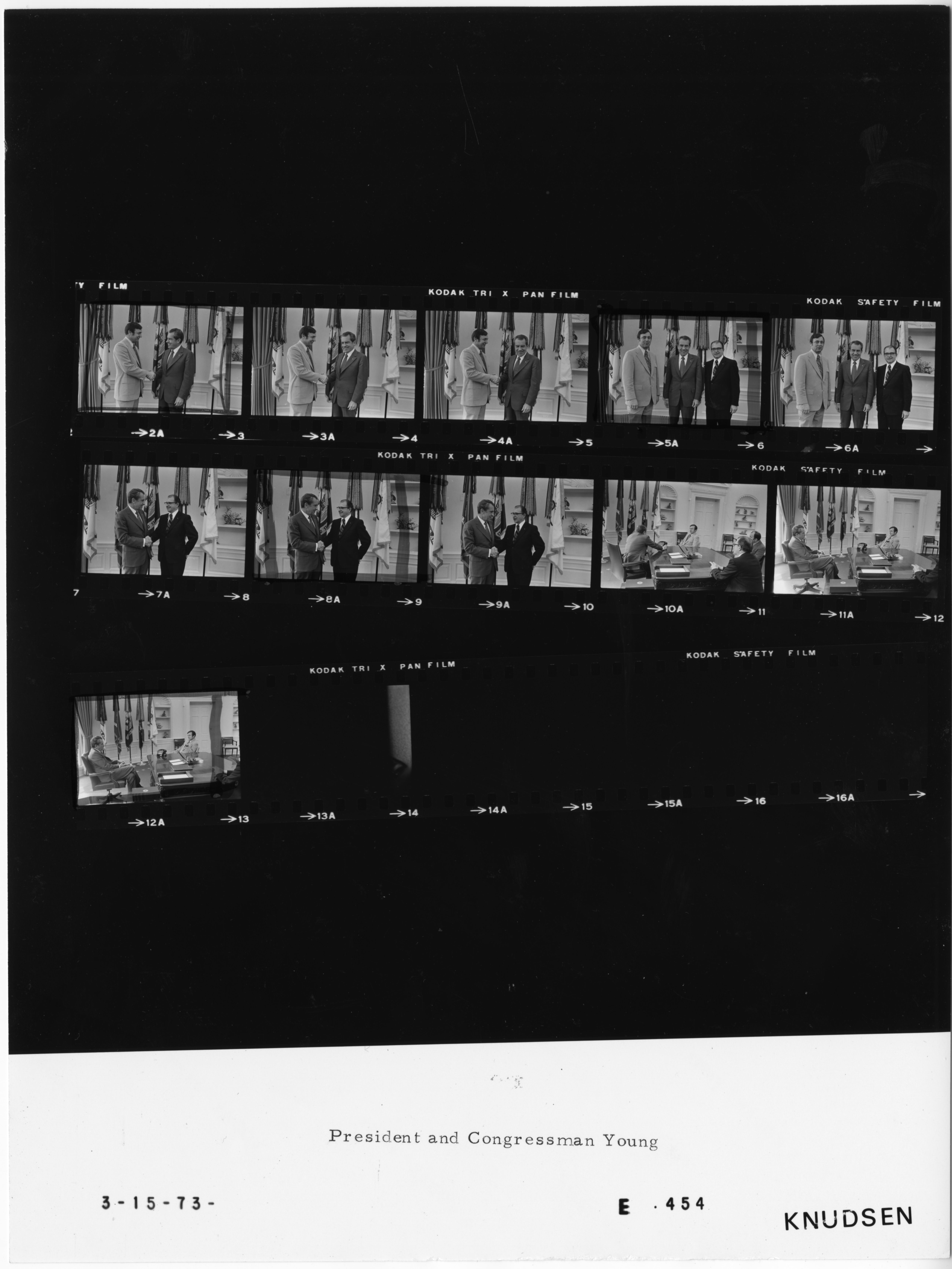
- Frame(s): WHPO-E0454-, President Nixon meeting Alaskan Congressman Don Young. 3/15/1973, Washington, D.C. White House, Oval Office. President Nixon, Congressman Don Young, Alaska Republican State Chairman Jack Coghill, Deputy Assistant Richard K. Cook.
Roll WHPO-E0455 Photographer: Kightlinger, Jack | Color or B&W: Color
- Frame(s): WHPO-E0455-, Pat Nixon attending the Second National and International Cystic Fibrosis Conference banquet. 3/15/1973, Washington, D.C. Presidential Ballroom, Statler Hilton Hotel. Pat Nixon, President National Cystic Fibrosis Research Foundation Robert D. McCreery, Vice President Grover L. Angel, 1973 National Poster Child Tracey Forehand, Dr. Giulio Barbero, Mrs. Robert TulcinCharles L. McCullers, Rabbi Tzvi H. Porath.
- Frame(s): WHPO-E0455-07A, Pat Nixon with her arm around Cystic Fibrosis poster child Tracey Lynne Forehand while attending the Second National and International Cystic Fibrosis Conference banquet. See the Washington Post Article dated 3/16/73, Page B3 "First Lady and a Little Girl" - see Parallel Box, for more information. 3/15/1973, Washington, D.C. Presidential Ballroom, Statler Hilton Hotel. Pat Nixon, Tracey Lynne Forehand.
- Frame(s): WHPO-E0455-18A, Pat Nixon carrying Cystic Fibrosis poster child Tracey Lynne Forehand while standing with officials during the Second National and International Cystic Fibrosis Conference banquet. 3/15/1973, Washington, D.C. Presidential Ballroom, Statler Hilton Hotel. Pat Nixon, Tracey Lynne Forehand, unidentified persons.
Roll WHPO-E0456 Photographer: Kightlinger, Jack | Color or B&W: Color
- Frame(s): WHPO-E0456-, Pat Nixon attending retirement party for Lucy Ferguson. 3/15/1973, Washington, D.C. unknown. Pat Nixon, Lucy Ferguson, John Ferguson, Donald Williams, Jeannette Williams, Mark Williams, Jonathan Williams, Diane Jordan, Shelby Jordan, Kim Jordan.
The White House Communications Agency Sound Recordings Collection contains public statements that took place between 1969 and 1974. Visit the finding aid to learn more.
P - Formal Presidential Remarks
- WHCA-SR-P-730319
Remarks by President Nixon in a press conference. (3/15/1973, White House Press Lobby)
Runtime: 0:36:31
Keywords: Presidential press conferences, presidential news conferences, interviews, media, People's republic of China, United States Liaison Office in Peking, Watergate, John Dean testimony before Congressional Committee, Vietnam War, cease-fire violations, FBI in
Production credits: Audio feed supplied by WHCA; Recorded by LSB (initials of WHCA engineer)
Original Format: 1/4-inch reel-to-reel audiotape. Original source type: Original.
The White House Communications Agency Videotape Collection contains “off-the-air” recordings of televised programs produced between 1968 and 1974. Visit the finding aid to learn more.
- WHCA-6175
"CBS Morning News".
ABC
Runtime: 00:59:56 - WHCA-6176
"Today" Show, Hour 1. Coverage of the returning Vietnam Prisoners of War Sisco.
CBS
Runtime: 00:59:24 - WHCA-6177
"Today" Show II. MTP: Caspar Weinberger, director of Office of Management and Budget.
NBC, ABC
Runtime: 01:00:23 - WHCA-6180
Weekly News Summary, Tape III.
ALL NETWORKS
Runtime: 00:53:00
1. Reasoner/Jarriel/Mariano: President Nixon on inflation; troops leave Saigon, Vietnam. Time Code Start: 00:00. Keywords: Presidents, speeches, economy, economics, budgets, finances, recession, inflation, unemployment, Vietnam War, military, withdrawals. Network: ABC.
2. Reasoner/Bell: POWs released in China. Time Code Start: 04:16. Keywords: Vietnam War, Vietnam Prisoner of War, releases, People's Republic of China. Network: ABC.
3. Reasoner/Clark: President Nixon talks on L. Patrick Gray hearings. Time Code Start: 06:50. Keywords: Presidents, appointments, Federal Bureau of Investigations, leaders, nominees, Senate committee hearings, testimony, testify. Network: ABC.
4. Reasoner: President Nixon on food prices. Time Code Start: 09:41. Keywords: food, meat, agriculture, animal products, dairy products, prices, costs, increases, shortages. Network: ABC.
5. Reasoner/MacVaine/Murphy: Panama negotiations. Time Code Start: 10:36. Keywords: Central American, agreements, negotations, contracts, treaties, treaty. Network: ABC.
6. Reasoner: Commentary on unbuilding. Time Code Start: 16:23. Keywords: buildings, housing, construction, development, increases, decreases. Network: ABC.
7. Chancellor/Valeriani: President Nixon press conference. Time Code Start: 18:18. Keywords: Presidents, speeches, statements, media, press conferences, news conferences, interviews. Network: NBC.
8. Chancellor/Brady: Ambassador David Bruce chosen as envoy to China, China releases more POWs, POWs report. Time Code Start: 21:40. Keywords: Ambassadors, diplomats, negotiations, People's Republic of China, Indochina War, Vietnam War, Vietnam Prisoner of War, releases. Network: NBC.
9. Chancellor: Separations of powers with President Nixon, Watergate. Time Code Start: 24:58. Keywords: Watergate, Senate committee hearings, investigations, testimony, testify, cover-ups, break-in, burglary, theft, plumbers, scandals. Network: NBC.
10. Chancellor/Brinkley: Commentary on separations of powers. Time Code Start: 29:19. Keywords: judiciary, legislative, executive, branches of government, administrative. Network: NBC.
11. Chancellor/Graham: Attorney General Kleindienst comments on Wounded Knee (American Indians). Time Code Start: 31:08. Keywords: American Indians, Native Americans, tribes, American Indian Movement, occupations. Network: NBC.
12. Cronkite/Pierpoint: President Nixon press conference. Time Code Start: 32:20. Keywords: Presidents, speeches, statements, media, press conferences, news conferences, interviews. Network: CBS.
13. Cronkite/Webster: POWs released by China. Time Code Start: 37:07. Keywords: Vietnam War, Vietnam Prisoner of War, releases, People's Republic of China. Network: CBS.
14. Cronkite/Threlkeld: Office of Economic Opportunity (OEO) dissolves, effects on working women. Time Code Start: 40:00. Keywords: Office of Economic Opportunity, closings, war on poverty, VISTA, Job Corps, Community Action Program, Head Start , welfare, benefits, ending, Feminism, Feminist movement, women's rights, Womens Liberation, equality, equal rights, gender, civil rights, act. Network: CBS.
15. Cronkite/Myer: Ambassador David Bruce interview. Time Code Start: 42:14. Keywords: Ambassadors, diplomats, negotiations, People's Republic of China, media, press conferences, news conferences, interviews. Network: CBS.
16. Cronkite/Sevareid: Commentary on Ambassador David Bruce. Time Code Start: 43:50. Keywords: Ambassadors, diplomats, negotiations, People's Republic of China,. Network: CBS. - WHCA-6181
"Thirty Minutes". Richard Nixon, school officials.
Undetermined
Runtime: 00:30:12
Context (External Sources)
The Vanderbilt Television News Archive is the world's most extensive and complete archive of television news. They have been recording, preserving and providing access to television news broadcasts of the national networks since August 5, 1968.
Wikipedia is a free encyclopedia that anyone can edit.