
Introduction
This almanac page for Saturday, March 17, 1973, pulls together various records created by the federal government and links to additional resources which can provide context about the events of the day.
Previous Date: Friday, March 16, 1973
Next Date: Sunday, March 18, 1973
Schedule and Public Documents
The Daily Diary files represent a consolidated record of the President's activities. Visit the finding aid to learn more.
The President's day began at The White House - Washington, D. C.
The Weekly Compilation of Presidential Documents made available transcripts of the President's news conferences; messages to Congress; public speeches, remarks, and statements; and other Presidential materials released by the White House.
Digitized versions can be found at HathiTrust.
The Federal Register is the official daily publication for rules, proposed rules, and notices of federal agencies and organizations, as well as executive orders and other Presidential documents.
No Federal Register published on this date
Archival Holdings
Any selection of archival documents will necessarily be partial. You should use the documents and folders identified below as a starting place, but consult the linked collection finding aids and folder title lists and the collections themselves for context. Many documents to be found this way do not lend themselves to association with specific dates, but are essential to a complete understanding of the material.
Selective document listing
President's Office Files
The President's Office Files consists of materials drawn together by the Special Files Unit from several administrative subdivisions within the White House Office. It is the handwriting and sensitive papers sent to the Staff Secretary that now comprise much of the President's Office Files. Visit the finding aid to learn more.
- News Summaries, Unmarked News Summaries, Box 54, News Summaries - Feb. & March 1973 [2 of 9] [Note: Due to the way News Summary products were compiled, you should also consult nearby days for potentially relevant materials.]
- News Summary, March 17, 1973, (Friday nets, wires)
President's Personal File
The President's Personal File is essentially a President's secretary's file, kept by Rose Mary Woods, personal secretary to the President, for two purposes: (1) preserving for posterity a collection of documents particularly close to the President, whether because he dictated or annotated them, or because of the importance of the correspondent or the event concerned and (2) giving appropriate attention–letters of gratitude, invitations to White House social events, and the like–to members and important friends and supporters of the Nixon administration. This generalization does not describe all the varied materials of a file group which is essentially a miscellany, but it does identify the reason for the existence of the file group's core. Visit the finding aid to learn more.
- President's Speech File
The H. R. Haldeman Diaries consists of seven handwritten diaries, 36 dictated diaries recorded as sound recordings, and two handwritten audio cassette tape subject logs. The diaries and logs reflect H. R. Haldeman’s candid personal record and reflections on events, issues, and people encountered during his service in the Nixon White House. As administrative assistant to the President and Chief of Staff, Haldeman attended and participated in public events and private meetings covering the entire scope of issues in which the Nixon White House engaged in during the years 1969-1973. Visit the finding aid to learn more.
- Transcript of diary entry (PDF)
Saturday, March 17.
Got into some schedule discussion this morning, a normal Saturday of time killing. He's now decided he wants to meet with the Congressional leaders, the full GOP leadership group every two weeks, and then on the alternate weeks have bipartisan, or special type meetings if we need to. Same program with the Cabinet, meet with the full Cabinet regularly every two weeks, basically as a Domestic Council meeting, then in between do Cost of Living Council, CEA, NSC and so on.
[End of tape reel AC-31(B)]
[Begin tape reel AC-32(A)]
Saturday March 17. The President was covering Congressional things. Wants to concentrate now on: first, time to think; second, hitting our targets, which at the moment are Congressmen; and third, good photo opportunities such as the Soviet gymnast this coming week. He wants to consider an African trip in May, since he can't do South America because Bill Rogers is going. Wants to try to develop some trips into the United States in the April and May period. Chicago and some cities that we haven't done. A little bouncing around to show the flag.
He had a long talk with Haig and said that he had confirmed that Kissinger had accused Haig of disloyalty to him in December and had really blown at him, which disturbed Al considerably. And the President sort of reviewed the Kissinger problems. Re-raised the point that he had even hit me on parking his airplane in the wrong place, which he did the day he came back from one of the peace talks or his Hanoi trip or something, when he arrived just after the President and was furious because he didn't get any press coverage on his return arrival. Blaming me for parking his plane in such a way that the press couldn't cover him.
On the schedule thing, I reviewed with him my analysis of polls versus television appearances and the conclusions which are very nebulous from that. He comes out deciding that the knickknacks don't do much for us which, of course, they don't, but the press conference holds our present position but doesn't advance us. Speeches, if they involve significant action, move us ahead a little and action itself is the only thing that really moves us ahead. The concern is that we don't have any big action steps like the China trip and so on coming up in the next four years, so we're going to have to get our move on other bases and have to develop the ways to do that. At Timmons and Flanigans urging, we called Wilbur Mills today to try to get him to hold off his tax hearings and take up trade. Mills made a deal with him. Agreed to do it if Shultz would testify on tax first on April 30, and then he'll cut off and shift to the trade stuff. I don't know whether that's a good or bad deal for us.
Tonight was the Merle Haggard "Evening at the White House". The President came out looking a trifle ridiculous, wearing a huge green bow tie which he had borrowed from Freddy, the elevator operator, and was obviously in good spirits. The "Evening" was pretty much a flop, because the audience obviously had no appreciation for country-western music and there wasn't much rapport, except when Haggard did his Okie from Muskogee and Fightin’ Side of Me numbers, which everybody responded to very favorably, of course.
End of March 17. - Original audio recording (MP3)
The National Archives Catalog is the online portal to the records held at the National Archives, and information about those records. It is the main way of describing our holdings and also provides access to electronic records and digitized versions of our holdings.
The Catalog searches across multiple National Archives resources at once, including archival descriptions, digitized and electronic records, authority records, and web pages from Archives.gov and the Presidential Libraries. The Catalog also allows users to contribute to digitized historical records through tagging and transcription.
Nixon Library Holdings
All National Archives Units
National Security Documents
The President's Daily Brief is the primary vehicle for summarizing the day-to-day sensitive intelligence and analysis, as well as late-breaking reports, for the White House on current and future national security issues. Read "The President's Daily Brief: Delivering Intelligence to Nixon and Ford" to learn more.
The Foreign Relations of the United States series presents the official documentary historical record of major U.S. foreign policy decisions and significant diplomatic activity. Visit the State Department website for more information.
Vol. XXXI, Foreign Economic Policy, 1973-1976
The End of Fixed Exchange Rates, January-March 1973
36. Backchannel Message From Helmut Sonnenfeldt of the National Security Council Staff to the President’s Deputy Assistant for National Security Affairs (Scowcroft), London, March 17, 1973, 2100Z
Source: National Archives, Nixon Presidential Materials, NSC Files, Box 424, Backchannel Files, Backchannel Messages—Europe—1973. Secret; Immediate.
Vol. E-8, Documents on South Asia, 1973-1976
India-Pakistan 1
118. Telegram 49943 From the Department of State to the Embassies in Pakistan, Afghanistan, Bangladesh, and Iran, Washington, March 17, 1973, 2044Z
The Department relayed a summary of Ambassador Moynihan’s first official meeting with Prime Minister Indira Gandhi, covering various topics, such as U.S. arms sales to Pakistan, PL–480 food aid, and the Simla negotiations between India and Pakistan.
Source: National Archives, RG 59, Central Foreign Policy Files. Secret; Exdis. It was drafted by Holmes; cleared by NEA/IRN and NEA; and approved by Laingen.
Vol. E-11, Part 1, Documents on Mexico; Central America; and the Caribbean, 1973-1976
Nicaragua
238. Telegram 1648 From the Embassy in Nicaragua to the Department of State, Managua, March 17, 1973, 1430Z
Summary: Somoza told the visiting Commander of the U.S. Southern Command that he believed the December 1972 earthquake would lead to significant social and economic changes and that he was prepared to lead Nicaragua through those changes.
Source: National Archives, RG 59, Central Foreign Policy File, [no film number]. Confidential. Repeated to Guatemala City, San Salvador, San José, Tegucigalpa, and USCINCSO for POLAD. In a March 15 letter to Country Officer Stuart Lippe, Deputy Chief of Mission Warner wrote from Managua that he and Political Officer James Cheek disagreed over the extent to which the earthquake and its aftermath had affected Nicaraguans’ political attitudes, with Cheek believing that “people are more willing to criticize the government openly and to confront it and do battle for their ideas,” while Warner was inclined to believe that “if the reconstruction and the economy go well during the next few months, the present muttering and grumbling will mostly fade away.” (Ibid., ARA/CEN/N Files, Lot 76D179, POL 15 Government, N–1973)
The Kissinger telephone conversation transcripts consist of approximately 20,000 pages of transcripts of Kissinger’s telephone conversations during his tenure as Assistant to the President for National Security Affairs (1969-1974) and Secretary of State (1973-1974) during the administration of President Richard Nixon. Visit the finding aid for more information.
Digitized versions can be found in the National Archives Catalog.
Audiovisual Holdings
Visit the White House Tapes finding aid to learn about the taping system's operation and archival processing.
Old Executive Office Building
- 416-42; Unknown between 11:15 a.m. & 11:25 a.m.; Nixon, Richard M. (President); [Unknown person(s)]
- 416-43; 11:25 a.m. - 12:33 p.m.; Nixon, Richard M. (President); Haig, Alexander M., Jr.; Sanchez, Manolo; Woods, Rose Mary
- 416-44; Unknown between 2:10 p.m. & 3:05 p.m.; Nixon, Richard M. (President); Sanchez, Manolo
- 416-45; Unknown between 2:10 p.m. & 3:05 p.m.; Nixon, Richard M. (President); Sanchez, Manolo
- 416-46; Unknown between 3:05 p.m. & 3:40 p.m.; Nixon, Richard M. (President); Sanchez, Manolo
- 416-47; Unknown between 3:05 p.m. & 3:40 p.m.; Nixon, Richard M. (President)
- 416-48; Unknown between 3:05 p.m. & 3:40 p.m.; Nixon, Richard M. (President); Sanchez, Manolo
- 416-49; Unknown between 3:05 p.m. & 3:40 p.m.; Nixon, Richard M. (President); White House operator
- 416-50; 3:40 p.m. - 6:00 p.m.; Nixon, Richard M. (President); White, Theodore H.; Ziegler, Ronald L.; White House operator; [Unknown person(s)]; Sanchez, Manolo
Oval Office
- 882-1; Unknown between 9:54 a.m. & 10:14 a.m.; Nixon, Richard M. (President); [Unknown person(s)]
- 882-2; Unknown between 9:54 a.m. & 10:14 a.m.; Nixon, Richard M. (President); [Unknown person(s)]
- 882-3; Unknown between 9:54 a.m. & 10:14 a.m.; Nixon, Richard M. (President); Bull, Stephen B.
- 882-4; Unknown between 9:54 a.m. & 10:14 a.m.; Nixon, Richard M. (President); [Unknown person(s)]
- 882-5; Unknown between 9:54 a.m. & 10:14 a.m.; Nixon, Richard M. (President); White House operator
- 882-6; 10:14 a.m. - 10:15 a.m.; Nixon, Richard M. (President); Haig, Alexander M., Jr.
- 882-7; Unknown between 10:15 a.m. & 10:20 a.m.; Nixon, Richard M. (President); Haldeman, H. R. ("Bob")
- 882-8; Unknown between 10:20 a.m. & 11:15 a.m.; Nixon, Richard M. (President); Haldeman, H. R. ("Bob")
- 882-9; 12:27 p.m. - 12:28 p.m.; Nixon, Richard M. (President); Woods, Rose Mary
- 882-10; 12:28 p.m. - 12:47 p.m.; Nixon, Richard M. (President); Nixon, Thelma C. ("Pat") (Ryan); Woods, Rose Mary; [Unknown person(s)]; Scowcroft, Brent G. (Gen.); Warnack, William; Ziegler, Ronald L.
- 882-11; 12:47 p.m. - 12:47 p.m.; Nixon, Richard M. (President); [Unknown person(s)]
- 882-12; 12:47 p.m. - 2:10 p.m.; Nixon, Richard M. (President); Haldeman, H. R. ("Bob"); [Unknown person(s)]; Dean, John W., III; White House operator; Mills, Wilbur D.
- 882-13; Unknown between 2:10 p.m. & 3:37 p.m.; [Unknown person(s)]; United States Secret Service agents
- 882-14; Unknown between 11:15 a.m. & 12:27 p.m.; [Unknown person(s)]
White House Telephone
- 37-137; Unknown between 10:11 a.m. & 10:14 a.m.; Nixon, Richard M. (President); White House operator
- 37-138; 10:14 a.m. - 10:15 a.m.; Nixon, Richard M. (President); Haig, Alexander M., Jr.
- 37-139; Unknown between 1:25 p.m. & 1:42 p.m.; Nixon, Richard M. (President); White House operator
- 37-140; 1:42 p.m. - 1:52 p.m.; Nixon, Richard M. (President); Mills, Wilbur D.
- 37-141; Unknown between 3:05 p.m. & 3:40 p.m.; Nixon, Richard M. (President); White House operator
- 37-142; 3:47 p.m. - 3:47 p.m.; Nixon, Richard M. (President); White House operator
The White House Photo Office collection consists of photographic coverage of President Richard Nixon meeting with prominent social, political, and cultural personalities; speaking engagements and news conferences of the President and various high-ranking members of the White House staff and Cabinet; Presidential domestic and foreign travel, including Presidential vacations; social events and entertainment involving the First Family, including entertainers present; official portraits of the President, First Family, and high-ranking members of the Nixon administration; the 1969 and 1973 Inaugurals; the President’s 1972 Presidential election campaign appearances (including speeches) and other official activities of the White House staff and the President’s Cabinet from January 20, 1969 until August 9, 1974 at the White House and the Old Executive Office Building; other locations in Washington, DC, such as The Mall; and the Presidential retreats in Camp David, Maryland, Key Biscayne, Florida, and San Clemente, California. Visit the finding aid to learn more.
Roll WHPO-E0468 Photographer: Knudsen, Robert L. | Color or B&W: B&W
- Frame(s): WHPO-E0468-, Former Vietnam War Vietnam Prisoner of War (POW) and family group portrait. 3/17/1973, Washington, D.C. White House, South Lawn. Unidentified former POW (Vietnam Prisoner of War) and family.
Roll WHPO-E0469 Photographer: Knudsen, Robert L. | Color or B&W: B&W
- Frame(s): WHPO-E0469-, President Nixon presented with annual gift of Irish shamrocks in honor of St. Patrick's Day by Ambassador and Mrs. William Warnock. 3/17/1973, Washington, D.C. White House, Oval Office. President Nixon, Pat Nixon, Ambassador from the Republic of Ireland William Warnock, Mrs. Warnock.
Roll WHPO-E0470 Photographer: Kightlinger, Jack | Color or B&W: Color
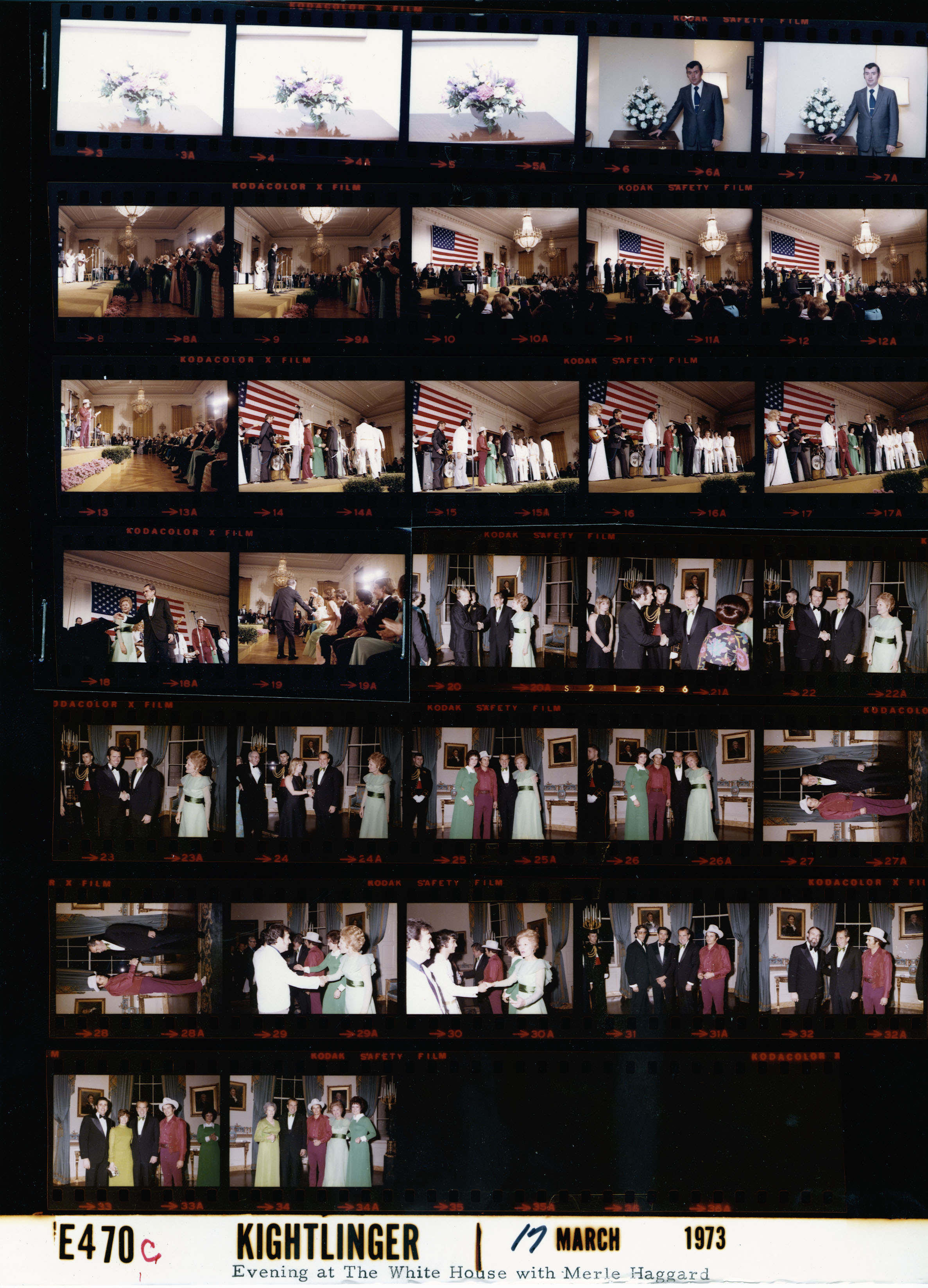
- Frame(s): WHPO-E0470-, President Nixon and Pat NIxon greeting guests attending the Evening at White House performance of Merle Haggard and the Osborne Brothers band. 3/17/1973, Washington, D.C. Blue Room, White House. President Nixon, Pat Nixon, Merle Haggard, The Strangers Band, Osborne Brothers singers, guests.
- Frame(s): WHPO-E0470-03-07, A White House floral arrangement. 3/17/1973, Washington, D.C. unknown. Unidentified male.
- Frame(s): WHPO-E0470-08-19, Merle Haggard and the Osborne Brothers singers and The Strangers band stand nearby during their Evening at the White House East Room performance on St. Patrick's Day. 3/17/1973, Washington, D.C. White House, East Room. President Nixon, Pat Nixon, Merle Haggard, The Strangers Band, the Osborne Brothers singers, guests.
- Frame(s): WHPO-E0470-16A, President Nixon speaking at the microphone on stage while Merle Haggard and the Osborne Brothers singers and The Strangers band stand nearby during their Evening at the White House East Room performance on St. Patrick's Day. 3/17/1973, Washington, D.C. White House, East Room. President Nixon, Merle Haggard, The Strangers Band, the Osborne Brothers singers, guests.
- Frame(s): WHPO-E0470-27, President Nixon posing for a portrait with country western singer Merle Haggard during a reception in the Blue Room on St. Patrick's Day. 3/17/1973, Washington, D.C. White House, Blue Room. President Nixon, Merle Haggard.
- Frame(s): WHPO-E0470-28, President Nixon posing for a portrait shaking hands with country western singer Merle Haggard during a reception in the Blue Room on St. Patrick's Day. 3/17/1973, Washington, D.C. White House, Blue Room. President Nixon, Merle Haggard.
Roll WHPO-E0471 Photographer: Kightlinger, Jack | Color or B&W: Color
- Frame(s): WHPO-E0471-, Merle Haggard and the Osborne Brothers singers and The Strangers band stand nearby during their Evening at White House East Room performance on St. Patrick's Day. 3/17/1973, Washington, D.C. White House, East Room. President Nixon, Pat Nixon, Merle Haggard and The Strangers Band, the Osborne Brothers singers, unidentified guests, Julie Eisenhower, David Eisenhower.
- Frame(s): WHPO-E0471-08A, President Nixon, Pat Nixon, Davis Eisenhower, Julie Eisenhower, Secretary of State William Rogers, Mrs. Adele Rogers, Clifford Hardin, Gerald Ford, and Anne Armstrong, along with, possibly not in frame, Ed Cox and Tricia Cox, sit in the front row watching country western singer Merle Haggard and the Osborne Brothers singers and The Strangers band stand nearby during their Evening at White House East Room performance on St. Patrick's Day. 3/17/1973, Washington, D.C. White House, East Room. President Nixon, Pat Nixon, Davis Eisenhower, Julie Eisenhower, Secretary of State William Rogers, Mrs. Adele Rogers, Clifford Hardin, Gerald Ford, Anne Armstrong, possibly Ed Cox and Tricia Cox.
- Frame(s): WHPO-E0471-16A, President Nixon shaking hands with country western singer Merle Haggard, and sharing a laugh onstage with the Osborne Brothers singers and The Strangers band after their Evening at White House East Room performance on St. Patrick's Day. 3/17/1973, Washington, D.C. White House, East Room. President Nixon, Pat Nixon, Merle Haggard, The Strangers Band, the Osborne Brothers singers, unidentified guests, Julie Eisenhower, David Eisenhower.
Roll WHPO-E0472 Photographer: Atkins, Oliver | Color or B&W: Color
- Frame(s): WHPO-E0472-03A-06A, President Nixon presented with annual gift of Irish shamrocks in honor of St. Patrick's Day by Ambassador and Mrs. William Warnock. 3/17/1973, Washington, D.C. White House, Oval Office. President Nixon, Pat Nixon, Ambassador from the Republic of Ireland William Warnock, Mrs. Warnock.
- Frame(s): WHPO-E0472-08A-14A, Spring scenic shots captured through White House window. 3/17/1973, Washington, D.C. White House interior. none.
Roll WHPO-E0473 Photographer: Schumacher, Karl | Color or B&W: Color
- Frame(s): WHPO-E0473-, Spring scenic shots captured through White House window. 3/17/1973, Washington, D.C. White House interior. none.
- Frame(s): WHPO-E0473-09, Spring scenic shots captured through White House window. 3/17/1973, Washington, D.C. White House interior.
The White House Communications Agency Sound Recordings Collection contains public statements that took place between 1969 and 1974. Visit the finding aid to learn more.
K - Informal Presidential Remarks
- WHCA-SR-K-047
Photo opportunity/Mrs. Nixon, Prime Min. of Ireland and wife-Oval Office. (3/17/1973)
Original Format: 1/4-inch reel-to-reel audiotape. Original source type: Original.
The White House Communications Agency Videotape Collection contains “off-the-air” recordings of televised programs produced between 1968 and 1974. Visit the finding aid to learn more.
- WHCA-6183
"Agronsky & Company".
ALL NETWORKS
Runtime: 00:30:53 - WHCA-6193
Weekly News Summary, 16-22 Mar 73, Tape I.
ALL NETWORKS
Runtime: 01:27:00
17. Utley/McCarthy: First Lady Pat Nixon's birthday party; the public is buying less meat. Time Code Start: 44:16. Keywords: Presidents, families, wife, celebrations, food, meats, animal products, purchases, sales, decreases. Network: NBC.
18. Levine: Secretary of Agriculture Butz comments on cutting food costs. Time Code Start: 48:05. Keywords: food, markets, retail stores, prices, costs, increases, shortages, media, press conferences, news conferences, interviews, cabinet, advisors. Network: NBC.
19. Utley: Senator Hughes reply to President Nixon's speech. Time Code Start: 49:00. Keywords: Presidents, speeches, Senators, rebuttals. Network: NBC.
20. Trotta: General Tran of Viet Cong holds news conference. Time Code Start: 50:48. Keywords: Vietnam War, People's Liberation Armed Forces (PLAF), National Liberation Front (NLF), VC, military, leaders, officials, press conferences, news conferences, interviews, media. Network: NBC.
21. Cochran: Mine removal in North Vietnamese harbors. Time Code Start: 52:18. Keywords: Vietnam War, Navy, Naval mines, oceans, weapons, mine fields, bombs, explosives, minesweeping. Network: NBC.
22. Utley/Neal: Prisoners of War arrived in California: 19 military officers and one civilian (Bobby Joe Casey); speech by Col. George E. Day (Air Force). Time Code Start: 51:30. Keywords: . Network: NBC.
23. Utley/Bell: Meat price increase and in protest Sheri Weiler sent 400 peanut butter sandwiches to the White House; Dale James invited Weiler to his farm in Michigan to learn about farming; Nixons receive peanut butter sandwiches (President Nixon, First Lad. Time Code Start: 54:10. Keywords: Presidents, families, wife, food, dining. Network: NBC.
24. Mudd/Dunning: POWs arrive at U.S. Footage of John McCain at around 58:00. Civilian Bobby Joe Casey arrives home.. Time Code Start: 57:00. Keywords: Vietnam War, Vietnam Prisoner of War, releases, military air bases, airports. Network: CBS.
25. Mudd: President Nixon crime bill attacked by Senator Hughes. Time Code Start: 60:00. Keywords: bills, laws, House of Representatives, anti-crime, offences, infractions, criminals, criminality, law breaking. Network: CBS.
26. Mudd/Snyder: Meat prices; boycott; Meat price increase and in protest Sheri Weiler sent 400 peanut butter sandwiches to the White House (inverview with Weiler); local reports from Drumand Island Michigan meat boycot. Time Code Start: 61:30. Keywords: food, meats, animal products, markets, retail stores, prices, costs, increases, shortages, protests, boycotts. Network: CBS.
27. Mudd: President Nixon accepts an Irish silver bowl. Time Code Start: 68:00. Keywords: Presidents, gifts, presentations. Network: CBS.
Context (External Sources)
The Vanderbilt Television News Archive is the world's most extensive and complete archive of television news. They have been recording, preserving and providing access to television news broadcasts of the national networks since August 5, 1968.
Wikipedia is a free encyclopedia that anyone can edit.