

Introduction
This almanac page for Monday, March 12, 1973, pulls together various records created by the federal government and links to additional resources which can provide context about the events of the day.
Previous Date: Sunday, March 11, 1973
Next Date: Tuesday, March 13, 1973
Schedule and Public Documents
The Daily Diary files represent a consolidated record of the President's activities. Visit the finding aid to learn more.
The President's day began at The White House - Washington, D. C.
The Weekly Compilation of Presidential Documents made available transcripts of the President's news conferences; messages to Congress; public speeches, remarks, and statements; and other Presidential materials released by the White House.
Digitized versions can be found at HathiTrust.
Each Public Papers of the Presidents volume contains the papers and speeches of the President of the United States that were issued by the White House Office of the Press Secretary during the time period specified by the volume. The material is presented in chronological order, and the dates shown in the headings are the dates of the documents or events. In instances when the release date differs from the date of the document itself, that fact is shown in the text note.
To ensure accuracy, remarks have been checked against audio recordings (when available) and signed documents have been checked against the original, unless otherwise noted. Editors have provided text notes and cross references for purposes of identification or clarity.
The Federal Register is the official daily publication for rules, proposed rules, and notices of federal agencies and organizations, as well as executive orders and other Presidential documents.
The Congressional Record is the official daily record of the debates and proceedings of the U.S. Congress.
Archival Holdings
Any selection of archival documents will necessarily be partial. You should use the documents and folders identified below as a starting place, but consult the linked collection finding aids and folder title lists and the collections themselves for context. Many documents to be found this way do not lend themselves to association with specific dates, but are essential to a complete understanding of the material.
Selective document listing
President's Office Files
The President's Office Files consists of materials drawn together by the Special Files Unit from several administrative subdivisions within the White House Office. It is the handwriting and sensitive papers sent to the Staff Secretary that now comprise much of the President's Office Files. Visit the finding aid to learn more.
- News Summaries, Annotated News Summaries, Box 44, March 8-13, 1973 [3 of 4] [Note: Due to the way News Summary products were compiled, you should also consult nearby days for potentially relevant materials.]
- Digest of Weekend News Comment, March 12, 1973
The H. R. Haldeman Diaries consists of seven handwritten diaries, 36 dictated diaries recorded as sound recordings, and two handwritten audio cassette tape subject logs. The diaries and logs reflect H. R. Haldeman’s candid personal record and reflections on events, issues, and people encountered during his service in the Nixon White House. As administrative assistant to the President and Chief of Staff, Haldeman attended and participated in public events and private meetings covering the entire scope of issues in which the Nixon White House engaged in during the years 1969-1973. Visit the finding aid to learn more.
- Transcript of diary entry (PDF)
Monday, March 12th. The President had Henry and me in this morning to talk about ambassadors. He decided he wants a non-career man to Taiwan, Hill, Bob Hill to Pakistan, Farlan to Mexico, send Reynolds to Columbia or Venezuela. Raised the question of Brazil and Argentina; said to do Keating to Israel and Vail to Germany; told Henry to call him rather than my doing it. He said that Pappas didn't insist on Tosca going to Greece and so wanted me to call Mitchell and tell him we want Tosca here as Assistant Secretary for Africa, and said that we ought to work it out to let them keep Newsom in the Africa desk, and send Sisco to Russia as another alternative. He wanted to know the Jimmy Roosevelt status on his roving Ambassador assignment. Also got into the State Visit business, he wanted to try to move the Shah and Willy Brandt up to May visits, and then the African in the fall, or as a reserve, if either the Shah or Brandt can't come in May. Also, a Latin American, in the late spring or in the fall. Then he wants to plan a Latin American trip with three countries this fall, Brazil, and then something on the way back, probably also Venezuela.
-------------------------------------------------------------------------------------------------------------------
DECLASSIFIED - E.O. 13526, Sect. 3.4: by MS, NARA, June 12, 2013
Audio Cassette 31, Side B, Withdrawn Item Number 11 [AC-31(B) Sel 8]
Duration: 9 seconds
The question of whether they would have an uprising; you have to check Caracas out carefully.
-------------------------------------------------------------------------------------------------------------------
He also wants a ten day trip to Africa; three countries, Nigeria, Congo and Ethiopia. Henry recommended considering adding the Sudan also; probably will hold that until spring of next year, although he might want to do it earlier.
Later in the day he said to consider the possibility of doing Latin America this spring, right after Easter, a one week total trip with one day stops, no return dinners, just lunches. He still wants to do Europe in the fall, early fall, as a state visit, grand tour type of approach. He got into the news analysis sheet that Buchanan and Mort Allen had whipped up, and was concerned, because it's practically all bad news, except for the POW's which we had no control over, that was the one good thing. He thinks that they should point out the positives, too. That this is dwelling too much on problems instead of opportunities, and ruins the team spirit setup, and he questions whether Ehrlichman's value isn't greater at thinking and creating rather than doing, and whether we don't need him working in this area. Also he felt Ehrlichman should be editing the President's speeches, such as the one on the cities. He should have, should not have said the crisis was over. It was a bad way to put it, and John should have caught that. Price should edit the President's speeches after the original drafts are done.
He raised the point that he wanted me to have Dent get a candidate fielded and going against Sam Ervin, to give him some trouble in his district, to slow him down a little on his Watergate activities.
End of March 12th. - Original audio recording (MP3)
The National Archives Catalog is the online portal to the records held at the National Archives, and information about those records. It is the main way of describing our holdings and also provides access to electronic records and digitized versions of our holdings.
The Catalog searches across multiple National Archives resources at once, including archival descriptions, digitized and electronic records, authority records, and web pages from Archives.gov and the Presidential Libraries. The Catalog also allows users to contribute to digitized historical records through tagging and transcription.
Nixon Library Holdings
All National Archives Units
National Security Documents
The President's Daily Brief is the primary vehicle for summarizing the day-to-day sensitive intelligence and analysis, as well as late-breaking reports, for the White House on current and future national security issues. Read "The President's Daily Brief: Delivering Intelligence to Nixon and Ford" to learn more.
The Foreign Relations of the United States series presents the official documentary historical record of major U.S. foreign policy decisions and significant diplomatic activity. Visit the State Department website for more information.
Vol. XVIII, China, 1973-1976
Kissinger's Visits to Beijing and the Establishment of the Liaison Offices, January 1973-May 1973
20. Conversation Between President Nixon and his Assistant for National Security Affairs (Kissinger), Washington, March 12, 1973
Source: National Archives, Nixon Presidential Materials, White House Tapes, Conversation No. 876–4. No classification marking. The editor transcribed the portions of the conversation printed here specifically for this volume. According to the President’s Daily Diary, Nixon met with Kissinger in the Oval Office between 9:30 and 10:29 a.m. (Ibid., White House Central Files)
Vol. XXII, Panama, 1973-1976
Panama, 1973-1976
5. Letter From the Special Representative for Interoceanic Canal Negotiations (Anderson) to President Nixon, New York, March 12, 1973
Source: National Archives, RG 59, Ambassador Bunker’s Correspondence, Lot 78D300, Box 1, Nixon-Anderson Correspondence. Confidential.
Vol. XXV, Arab-Israeli Crisis and War, 1973
Arab-Israeli Crisis and War, 1973
40. Memorandum From the President’s Assistant for National Security Affairs (Kissinger) to President Nixon, Washington, March 12, 1973
Source: National Archives, Nixon Presidential Materials, NSC Files, Kissinger Office Files, Box 131, Country Files, Middle East, Egypt/Ismail, Vol. IV, February 24–May 19, 1973. Secret; Sensitive; Eyes Only. A stamped notation on the first page reads: “The President has seen.”
The Kissinger telephone conversation transcripts consist of approximately 20,000 pages of transcripts of Kissinger’s telephone conversations during his tenure as Assistant to the President for National Security Affairs (1969-1974) and Secretary of State (1973-1974) during the administration of President Richard Nixon. Visit the finding aid for more information.
Digitized versions can be found in the National Archives Catalog.
Audiovisual Holdings
Visit the White House Tapes finding aid to learn about the taping system's operation and archival processing.
Old Executive Office Building
- 419-1; Unknown between 12:46 p.m. & 1:16 p.m.; Nixon, Richard M. (President); Sanchez, Manolo
- 419-2; Unknown between 12:46 p.m. & 1:16 p.m.; Nixon, Richard M. (President); Sanchez, Manolo
- 419-3; Unknown between 12:46 p.m. & 1:16 p.m.; Nixon, Richard M. (President)
- 419-4; Unknown between 12:46 p.m. & 1:16 p.m.; Nixon, Richard M. (President); White House operator
- 419-5; Unknown between 12:46 p.m. & 1:16 p.m.; Nixon, Richard M. (President)
- 419-6; 1:16 p.m. - 1:18 p.m.; Nixon, Richard M. (President); Rogers, Adele (Langston)
- 419-7; Unknown between 1:18 p.m. & 2:33 p.m.; Nixon, Richard M. (President); Haldeman, H. R. ("Bob")
- 419-8; 2:33 p.m. - 3:02 p.m.; Nixon, Richard M. (President); Haldeman, H. R. ("Bob"); Ehrlichman, John D.
- 877-2; Unknown between 6:36 p.m., 3/12 & 8:14 a.m., 2/27; Sanchez, Manolo; [Unknown person(s)]
Oval Office
- 876-1; Unknown between 8:29 a.m. & 9:30 a.m.; Nixon, Richard M. (President)
- 876-2; Unknown between 8:29 a.m. & 9:30 a.m.; Nixon, Richard M. (President); [Unknown person(s)]
- 876-3; Unknown between 8:29 a.m. & 9:30 a.m.; Nixon, Richard M. (President); [Unknown person(s)]
- 876-4; 9:30 a.m. - 10:29 a.m.; Nixon, Richard M. (President); Kissinger, Henry A.
- 876-5; Unknown between 10:30 a.m. & 12:20 p.m.; Nixon, Richard M. (President); Haldeman, H. R. ("Bob"); Kissinger, Henry A.; [Unknown person(s)]
- 876-6; Unknown between 12:20 p.m. & 12:21 p.m.; Nixon, Richard M. (President); [Unknown person(s)]
- 876-7; Unknown between 12:20 p.m. & 12:21 p.m.; Nixon, Richard M. (President); [Unknown person(s)]
- 876-8; Unknown between 12:21 p.m. & 12:46 p.m.; Nixon, Richard M. (President); Kleindienst, Richard G.; Shepard, Geoffrey C.; Ingersoll, John E. ("Jack"); Devine, Thomas; Devine, Thomas (Mrs.); Devine, Thomas, Jr.; Devine, Michael; Devine, Mary Rita; Devine, Lawrence M.; Devine, W. Robert; Tummillo, Samuel; Tumillo, Clara; Tummillo, Mary Ann; Fletcher, Connie; Statita, Carla
- 876-9; Unknown between 12:34 p.m. & 12:46 p.m.; Nixon, Richard M. (President); Bull, Stephen B.
- 876-10; Unknown between 3:06 p.m. & 3:08 p.m.; Nixon, Richard M. (President); Bull, Stephen B.
- 876-11; 3:08 p.m. - 4:34 p.m.; Nixon, Richard M. (President); Bull, Stephen B.; Risner, Robinson (Col.); Sanchez, Manolo
- 876-12; Unknown between 4:24 p.m. & 6:34 p.m.; Nixon, Richard M. (President); Bull, Stephen B.
- 876-13; Unknown between 4:24 p.m. & 6:34 p.m.; Nixon, Richard M. (President); Bull, Stephen B.; Denton, Jeremiah A., Jr.
- 876-14; Unknown between 12:34 p.m. & 3:06 p.m.; [Unknown person(s)]
- 877-1; 4:40 p.m. - 6:34 p.m.; Nixon, Richard M. (President); Denton, Jeremiah A., Jr.; Sanchez, Manolo; [Unknown person(s)]
White House Telephone
The White House Photo Office collection consists of photographic coverage of President Richard Nixon meeting with prominent social, political, and cultural personalities; speaking engagements and news conferences of the President and various high-ranking members of the White House staff and Cabinet; Presidential domestic and foreign travel, including Presidential vacations; social events and entertainment involving the First Family, including entertainers present; official portraits of the President, First Family, and high-ranking members of the Nixon administration; the 1969 and 1973 Inaugurals; the President’s 1972 Presidential election campaign appearances (including speeches) and other official activities of the White House staff and the President’s Cabinet from January 20, 1969 until August 9, 1974 at the White House and the Old Executive Office Building; other locations in Washington, DC, such as The Mall; and the Presidential retreats in Camp David, Maryland, Key Biscayne, Florida, and San Clemente, California. Visit the finding aid to learn more.
Roll WHPO-E0427 Photographer: Atkins, Oliver | Color or B&W: B&W
- Frame(s): WHPO-E0427-01A-06A, Panoramic shots of the Bureau of Narcotics and Dangerous Drugs agent award ceremony. 3/12/1973, Washington, D.C. White House, Oval Office. President Nixon, Bureau of Narcotics and Dangerous Drugs agent award winners, unidentified guests and family.
- Frame(s): WHPO-E0427-08-13, Panoramic test shots of White House Photo Office. 3/12/1973, Washington, D.C. Photo Office, White House. unidentified Photo Office staff.
Roll WHPO-E0428 Photographer: Atkins, Oliver | Color or B&W: B&W
- Frame(s): WHPO-E0428-, President Nixon meeting in the Oval office with Bureau of Narcotics and Dangerous Drugs award winners. 3/12/1973, Washington, D.C. White House, Oval Office. President Nixon, Bureau of Narcotics and Dangerous Drugs agent award winners, unidentified guests and family.
Roll WHPO-E0429 Photographer: Knudsen, Robert L. | Color or B&W: B&W
- Frame(s): WHPO-E0429-, President Nixon meeting in the Oval office with Bureau of Narcotics and Dangerous Drugs award winners. 3/12/1973, Washington, D.C. White House, Oval Office. President Nixon, Bureau of Narcotics and Dangerous Drugs agent award winners, unidentified guests and family.
Roll WHPO-E0430 Photographer: Knudsen, Robert L. | Color or B&W: B&W
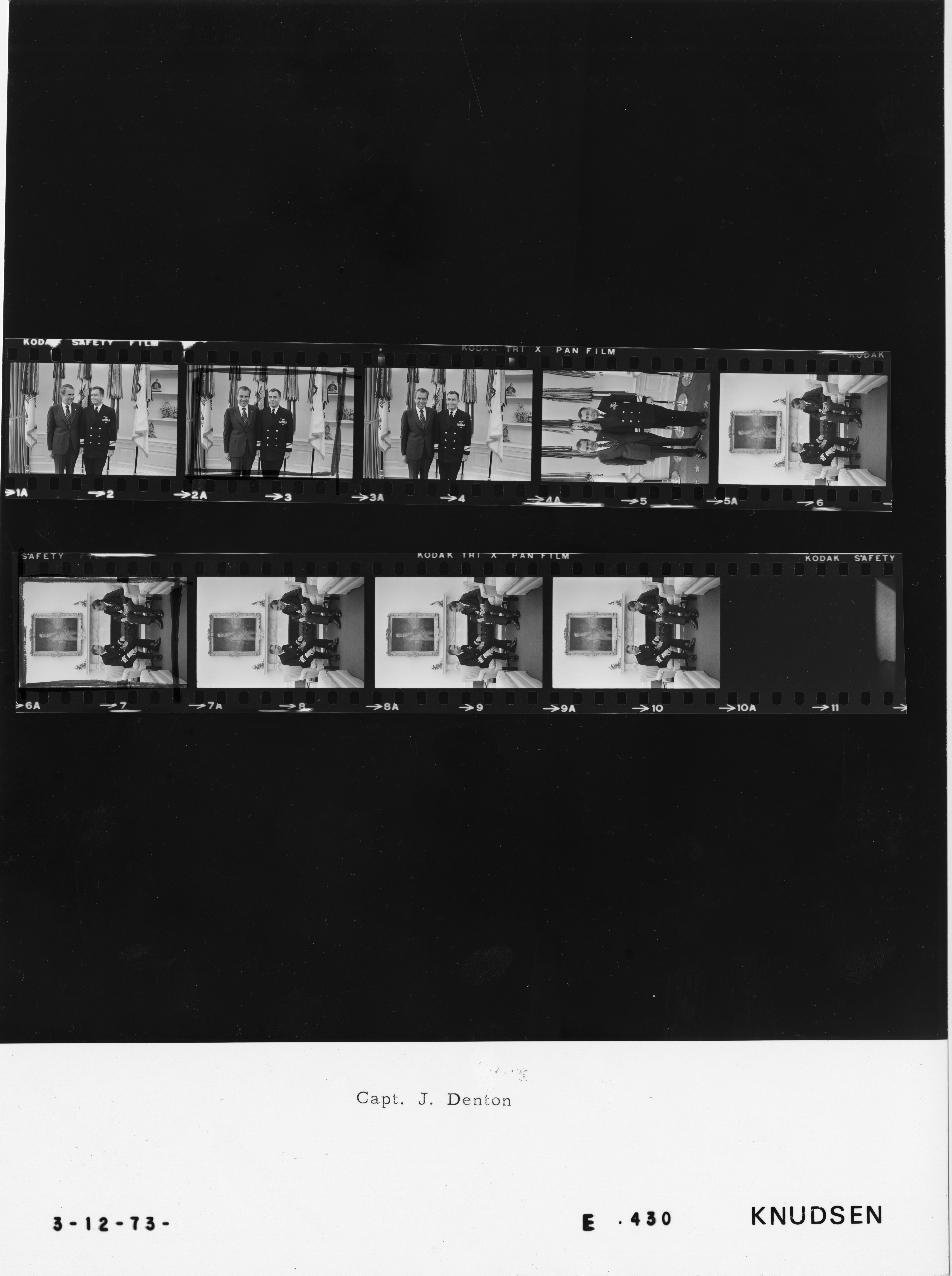
- Frame(s): WHPO-E0430-, President Nixon seated informally in the Oval Office during a meeting with former POW (Vietnam Prisoner of War) Captain Jeremiah (Jerry) Denton. 3/12/1973, Washington, D.C. White House, Oval Office. President Nixon, Former POW (Vietnam Prisoner of War) U.S. Navy Captain Jeremiah Andrew Denton.
- Frame(s): WHPO-E0430-07, President Nixon seated informally in the Oval Office during a meeting with former POW (Vietnam Prisoner of War) Captain Jeremiah (Jerry) Denton. 3/12/1973, Washington, D.C. White House, Oval Office. President Nixon, Former POW (Vietnam Prisoner of War) U.S. Navy Captain Jeremiah Andrew Denton.
Roll WHPO-E0431 Photographer: Schumacher, Karl | Color or B&W: B&W
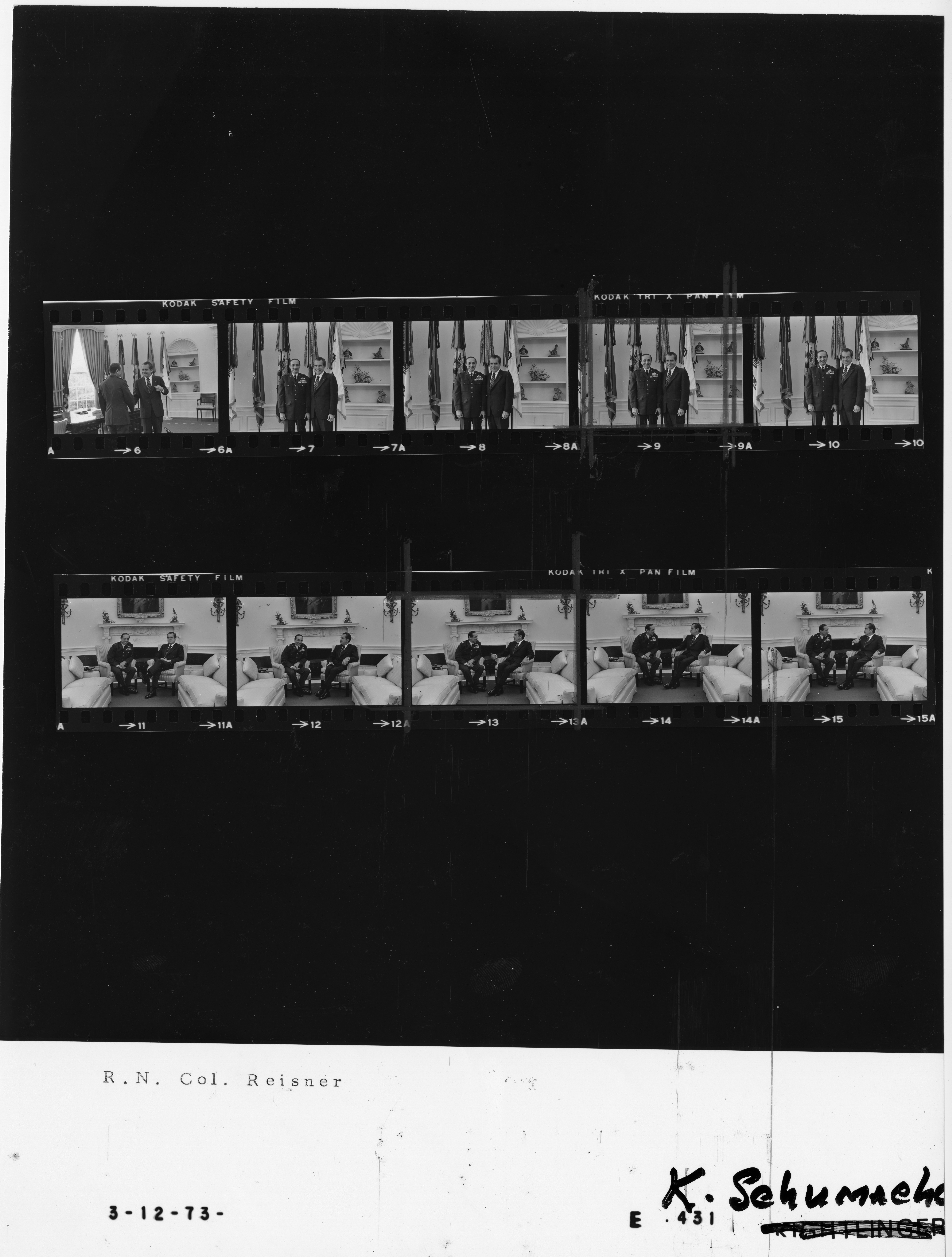
- Frame(s): WHPO-E0431-, President Nixon with former POW (Vietnam Prisoner of War) Colonel Robinson (Robby) Reisner. 3/12/1973, Washington, D.C. White House, Oval Office. President Nixon, Former POW (Vietnam Prisoner of War) U.S. Air Force Lieutenant Colonel James Robinson Reisner.
- Frame(s): WHPO-E0431-13, President Nixon seated informally in the Oval office during a meeting with former POW (Vietnam Prisoner of War) Colonel Robinson (Robby) Reisner. 3/12/1973, Washington, D.C. White House, Oval Office. President Nixon, Former POW (Vietnam Prisoner of War) U.S. Air Force Lieutenant Colonel James Robinson Reisner.
The White House Communications Agency Sound Recordings Collection contains public statements that took place between 1969 and 1974. Visit the finding aid to learn more.
S - White House Press Office Briefings (continuation of the L-series)
- WHCA-SR-S-018
Press briefing by Ronald Ziegler. (3/12/1973, White House Press Lobby)
Runtime: 34:59:00
Keywords: Press conferences, news conferences, interviews, media, press secretary
Production credits: Audio feed supplied by WHCA; Recorded by GET (initials of WHCA engineer)
Original Format: 1/4-inch reel-to-reel audiotape. Original source type: Original.
The White House Communications Agency Videotape Collection contains “off-the-air” recordings of televised programs produced between 1968 and 1974. Visit the finding aid to learn more.
- WHCA-6178
Weekly News Summary, Tape I.
ALL NETWORKS
Runtime: 01:31:56
17. Reasoner/Bell/Collins: Newest POW list; John Downey comes home. Time Code Start: 41:49. Keywords: Vietnam War, Vietnam Prisoner of War, releases. Network: ABC.
18. Reasoner/Mariano: Violations of Vietnam peace; South Vietnam POW release; infiltrations. Time Code Start: 45:35. Keywords: Paris Peace Talks, Vietnam War, treaty, treaties, negotiations, ceasefires, Vietnam War, Vietnam Prisoner of War, lists, releases. Network: ABC.
19. Chancellor/Brady: U.S. receives new list of POWs to be released; John Downey is released from China. Time Code Start: 48:55. Keywords: Vietnam War, Vietnam Prisoner of War, releases, People's Republic of China. Network: NBC.
20. Chancellor/Kiker: John Dean and the L. Patrick Gray hearings; commentary on Washington Post with Ziegler. Time Code Start: 51:52. Keywords: Senate, hearings, Federal Bureau of Investigations, advisors, Watergate, burglary, investigations, White House, administration, officials, staff, newspapers, editorials, stories, accusations, reports. Network: NBC.
21. Cronkite/Webster: POW release Wednesday; Downey released. Time Code Start: 56:45. Keywords: Vietnam War, Vietnam Prisoner of War, releases. Network: CBS.
22. Cronkite/Davis: Commentary on Vietnamese POWs. Time Code Start: 59:15. Keywords: Vietnam War, Vietnam Prisoner of War, releases. Network: CBS.
23. Cronkite/Schorr: Federal court-ordered hearings on automakers and anti-smog devices. Time Code Start: 61:39. Keywords: laws, rulings, automobiles, cars, trucks, vehicles, emissions, pollutants, air pollution, smog, smoke. Network: CBS.
24. Cronkite/Rather: President Nixon will not allow any past or present staff members to be questioned by Congress on Watergate. Time Code Start: 63:52. Keywords: Watergate, Senate committee hearings, investigations, testimony, testify, cover-ups, break-in, burglary, theft, plumbers, scandals. Network: CBS.
25. Sevareid: Commentary on the American Indians at Wounded Knee. Time Code Start: 66:20. Keywords: American Indians, Native Americans, tribes, American Indian Movement, occupations. Network: CBS.
Context (External Sources)
The Vanderbilt Television News Archive is the world's most extensive and complete archive of television news. They have been recording, preserving and providing access to television news broadcasts of the national networks since August 5, 1968.
Wikipedia is a free encyclopedia that anyone can edit.