

Introduction
This almanac page for Thursday, June 17, 1971, pulls together various records created by the federal government and links to additional resources which can provide context about the events of the day.
Previous Date: Wednesday, June 16, 1971
Next Date: Friday, June 18, 1971
Schedule and Public Documents
The Daily Diary files represent a consolidated record of the President's activities. Visit the finding aid to learn more.
The President's day began at The White House - Washington, D. C.
The Weekly Compilation of Presidential Documents made available transcripts of the President's news conferences; messages to Congress; public speeches, remarks, and statements; and other Presidential materials released by the White House.
Digitized versions can be found at HathiTrust.
Each Public Papers of the Presidents volume contains the papers and speeches of the President of the United States that were issued by the White House Office of the Press Secretary during the time period specified by the volume. The material is presented in chronological order, and the dates shown in the headings are the dates of the documents or events. In instances when the release date differs from the date of the document itself, that fact is shown in the text note.
To ensure accuracy, remarks have been checked against audio recordings (when available) and signed documents have been checked against the original, unless otherwise noted. Editors have provided text notes and cross references for purposes of identification or clarity.
- Statement on Occasion of Signing of Agreement Between the United States and Japan About the Reversion of Okinawa to Japan
- Remarks About an Intensified Program for Drug Abuse Prevention and Control.
- Special Message to the Congress on Drug Abuse Prevention and Control.
- Executive Order 11599—Establishing a Special Action Office for Drug Abuse Prevention
- Proclamation 4060—World Law Day, 1971
The Federal Register is the official daily publication for rules, proposed rules, and notices of federal agencies and organizations, as well as executive orders and other Presidential documents.
The Congressional Record is the official daily record of the debates and proceedings of the U.S. Congress.
Archival Holdings
Any selection of archival documents will necessarily be partial. You should use the documents and folders identified below as a starting place, but consult the linked collection finding aids and folder title lists and the collections themselves for context. Many documents to be found this way do not lend themselves to association with specific dates, but are essential to a complete understanding of the material.
Selective document listing
President's Office Files
The President's Office Files consists of materials drawn together by the Special Files Unit from several administrative subdivisions within the White House Office. It is the handwriting and sensitive papers sent to the Staff Secretary that now comprise much of the President's Office Files. Visit the finding aid to learn more.
- Annotated News Summaries, Box 30, News Summaries - June 1971 [1 of 2]
- Annotated News Summaries, Box 30, News Summaries - June 1971 [2 of 2] [During this period, the Staff Secretary only removed pages from the News Summaries which contained President Nixon's handwriting, often leaving the document with no date. Although there are no specific documents with this date, you should also consult the full folder for the month.]
- President's Daily Schedule, Box 101, [President's Daily Schedule, June-Aug. 1971] [1 of 3]
- The President's Schedule, Thursday - June 17, 1971
President's Personal File
The President's Personal File is essentially a President's secretary's file, kept by Rose Mary Woods, personal secretary to the President, for two purposes: (1) preserving for posterity a collection of documents particularly close to the President, whether because he dictated or annotated them, or because of the importance of the correspondent or the event concerned and (2) giving appropriate attention–letters of gratitude, invitations to White House social events, and the like–to members and important friends and supporters of the Nixon administration. This generalization does not describe all the varied materials of a file group which is essentially a miscellany, but it does identify the reason for the existence of the file group's core. Visit the finding aid to learn more.
- President's Speech File
The H. R. Haldeman Diaries consists of seven handwritten diaries, 36 dictated diaries recorded as sound recordings, and two handwritten audio cassette tape subject logs. The diaries and logs reflect H. R. Haldeman’s candid personal record and reflections on events, issues, and people encountered during his service in the Nixon White House. As administrative assistant to the President and Chief of Staff, Haldeman attended and participated in public events and private meetings covering the entire scope of issues in which the Nixon White House engaged in during the years 1969-1973. Visit the finding aid to learn more.
- Transcript of diary entry (PDF)
Thursday, June 17.
New York Times is still the major item of the day. President spent considerable time at a number of sessions with Colson, Ziegler, Ehrlichman, Kissinger and various combinations of them, going over points to be made. Particularly anxious to get across that this is no skin off of our hide, this involves the Kennedy-Johnson Administrations. There are no documents from this Administration. He feels Ziegler is saying this, but saying it too subtly and not making it clear. He keeps going back on the point of how many Korean documents there are, and how many World War II documents. He wants to get that established to show the problem of the relations with foreign governments, etcetera. He wants to be sure all our speakers hit the line that this does not involve us. He feels there's a lack of focus on our position, that we're making too many points, that all we should be saying is that one, it's not us; and two, it involves papers and documents of previous Democratic Presidents.
He wants to be sure that we do everything that we can to destroy The Times, but make the point that this doesn't involve this Administration. It does involve the country, the Presidency, our foreign relations and our ability to conduct the government. He wants to get a Rogers statement out today. He asked me to tell Ehrlichman that he wasn't sure Mitchell should delay the grand jury. He thinks that we have to play boldly and not be afraid of the risks. Mitchell delayed it anyway; in fact, he already had when the President was talking to me. He made the point that things were the same way in the Hiss case, that everybody will get a little jittery and want to start pulling back, but we want to fight it. This involves security. It relates to the leak of the Algerian material and '72 war plans that were in The Times yesterday. He doesn't want to fight it defensively; he wants to take the offense. He thinks that we should go ahead on the Rogers statement and keep pounding the public points. He wants to be sure Klein gets going on the editorial people. He feels we can beat them if we work it right, and that it's a real opportunity. He comes back several times to the need for the research on Korea and World War II, and that we should hang FDR and Truman on the same wicket.
He points out that The New York Times has focused on their two key points, censorship and the Vietnam War; where we're not focused, this Administration is covering up nothing. This involves two previous Administrations, not ours. On the other hand, he doesn't want to jump on them on the line that they got us into the war; that's not our line. We stand for the integrity of the Presidency.
We had a good long staff session with the crew that Ehrlichman will be using to fight this, which is the two of us, plus Kissinger, Ziegler, Colson, Scali, and Moore, John Dean and Clark MacGregor. We've agreed to meet every day at 5:30 on the subject. One late in the day effort was to get LBJ to have a press conference tomorrow or Saturday and take it on. Our feeling was that, if he would do this, it would clearly put the thing in his lap, where it belongs. Obviously, he recognizes the same thing and is not very anxious to do it.
He worked on the ideas of what he ought to say at Rochester tomorrow. His point is to speak to the policy of this Administration regarding security. We've got to enforce a law that is passed by Congress. He then mentioned to Ehlichman, Kissinger and me that he's thinking in very big terms on this and that he may argue the case before the Supreme Court himself to indicate the importance of it. He wants to use the line that The Times now says that stolen goods are fit to print. He wants to work on the Cabinet officers to cut out The New York Times, particularly Connally, Stans, Mitchell and Dole. Also, he ordered Henry to get the Lodge files on the murder of Diem, part of which is covered in the files The Times has, but part of it isn't, and he thinks we should get a set of those in our possession. Apparently, Lodge has the only files at this point. He gave Colson two or three lines to use, on the theory that we don't have any: one, is that they are knowingly publishing stolen goods; another, they're giving aid and comfort to the enemy; another, that no cause justifies breaking the law and giving comfort to the enemy. He repeated the rule that anybody on the White House staff talking to The Times is to be fired instantly.
The other item that came up today was the speech writing problem, and it arose in the context of the drug statement that was to be made today. They came up first with an eight minute speech that was not usable and then, because it wasn't, were told to cut it down to 150 words, which came out even worse. So the President wrote the thing himself. He makes the point that we have the problem because we always talk around things, like the drug business, rather than taking them on directly. We need someone to take these and get some sex appeal into them. We need focus and bite. He feels that what they prepare has no lead and nothing to grab onto. We miss the point of a lead for tomorrow's paper, a cheer line that's got to ring true. He thinks we probably need a different kind of writer, because ours may be too smart and write on the basis of their own intelligence, rather than doing it for the President.
On the drug thing, he really wants to put the emphasis on the importance of the program, making the idea that this is the battle that cannot be lost. That the financial, educational and leadership resources all will be committed to this battle, using whatever is necessary to win. Another facet of the drug thing was a point raised by Senator Ellender in the bipartisan leaders' meeting this morning, when he pointed out that we have nine departments involved in drugs now; we are now adding a new one in the White House, and he wonders how many people we' re getting rid of in the process. The President got quite cranked up about this and wants Shultz and Weber to get going on the removal of people from HEW, OEO, and so on, who are spinning their wheels and who have done a lousy job up to now. He doesn't want to keep those who have failed, and he told me to have Shultz prepare a report by tomorrow morning on what we're doing, so that we aren't just going on with business as usual.
The President called me at home at 9:30, wondering how the TV news had gone. Obviously, he's uptight on this whole thing. I didn't have a news report. Then he got into the point of how he would handle Rochester tomorrow, and he says he won't read the statement, which is what we were going to recommend; he'll just issue a statement and talk there about domestic things and not say anything about The Times deal. He thinks that we're falling too often into reading things; that doesn't get it across, and he's afraid that what they're preparing is probably too legalistic anyway, and that's not the point for him to make. So he concludes that he'll either issue it as a statement or he'll ad-lib a brief thing; he will not stand and read to the editors. He does not want to get into the legalisms.
End of June 17. - Original audio recording (MP3)
The National Archives Catalog is the online portal to the records held at the National Archives, and information about those records. It is the main way of describing our holdings and also provides access to electronic records and digitized versions of our holdings.
The Catalog searches across multiple National Archives resources at once, including archival descriptions, digitized and electronic records, authority records, and web pages from Archives.gov and the Presidential Libraries. The Catalog also allows users to contribute to digitized historical records through tagging and transcription.
Nixon Library Holdings
All National Archives Units
National Security Documents
The President's Daily Brief is the primary vehicle for summarizing the day-to-day sensitive intelligence and analysis, as well as late-breaking reports, for the White House on current and future national security issues. Read "The President's Daily Brief: Delivering Intelligence to Nixon and Ford" to learn more.
The Foreign Relations of the United States series presents the official documentary historical record of major U.S. foreign policy decisions and significant diplomatic activity. Visit the State Department website for more information.
Vol. XI, South Asia Crisis, 1971
South Asia Crisis, 1971
74. Telegram From the Department of State to the Embassy in India, Washington, June 17, 1971, 0029Z
Source: National Archives, RG 59, Central Files 1970–73, REF PAK. Secret; Priority; Exdis. Drafted by Schneider on June 16, cleared by Deputy Executive Secretary Robert C. Brewster, and approved by Van Hollen. Repeated to Islamabad, USUN, Dacca, Calcutta, Kathmandu, Colombo, US Mission Geneva for Kellogg, London, and Paris OECD for MacDonald.
75. Telegram From the Department of State to the Embassy in India, Washington, June 17, 1971, 2303Z
Source: National Archives, RG 59, Central Files 1970–73, REF PAK. Secret; Exdis. Drafted by Schneider on June 16; cleared by Saunders at the White House, and in draft by Farrar (AID/NESA), and Louis A. Wiesner (S/R); and approved by Van Hollen. Also sent to Paris OECD for MacDonald.
Vol. XXIX, Eastern Europe, 1969-1972
Radio Free Europe and Radio Liberty
56. Memorandum of Conversation, Washington, June 17, 1971, 2:30 p.m.
Source: National Archives, RG 59, Central Files 1970–73, POL GER W–US. Secret; Exdis. Drafted by Sutterlin on June 18. The meeting took place in Kissingerʼs office.
Vol. XXXIX, European Security
MBFR and the Conference on European Security, December 1970-December 1971
61. Telegram From the Department of State to the Embassy in the Soviet Union, Washington, June 17, 1971, 1647Z
Source: National Archives, Nixon Presidential Materials, NSC Institutional Files (H-Files), Box H–224, National Security Decision Memorada, NSDM 116. Secret; Exdis. Drafted by Matlock and approved by Davies. Repeated to the U.S. Mission to NATO, Ottawa, Athens, Ankara, and all European diplomatic posts. Sonnenfeldt forwarded a copy to Kissinger on June 18 with an attached summary. (Ibid.)
62. Memorandum of Conversation, Washington, June 17, 1971, 2:30 p.m.
Source: National Archives, RG 59, Central Files 1970–73, POL GER W–US. Secret; Exdis. Drafted by Sutterlin. Part I of III. The conversation took place in Kissinger’s office. For Part II of the conversation on Berlin negotiations, see Foreign Relations, 1969–1976, volume XL, Germany and Berlin, 1969–1972, Document 257. For Part III of the conversation on Radio Free Europe and Radio Liberty, see Foreign Relations, 1969–1976, Eastern Europe; Eastern Mediterranean, 1969–1972, volume XXIX, Document 56.
63. Notes of a National Security Council Meeting, Washington, June 17, 1971, 3:37-5:12 p.m.
Source: National Archives, Nixon Presidential Materials, NSC Institutional Files (H-Files), Box H–110, NSC Meeting Minutes, Originals, 1971 through 6/20/74. No classification marking. The notes were handwritten by Wayne Smith. According to the President’s Daily Diary, the following attended the meeting: the President, Rogers, Laird, Connally, Lincoln, Mitchell, Packard, Helms, Moorer, Gerard Smith, Farley, Irwin, Hillenbrand, Kissinger, Wayne Smith, and Sonnenfeldt. The time of the meeting is also from the President’s Daily Diary. (Ibid., White House Central Files, President’s Daily Diary)
Vol. XL, Germany and Berlin, 1969-1972
Germany and Berlin, 1969-1972
257. Memorandum of Conversation, Washington, June 17, 1971, 2:30 p.m.
Source: National Archives, Nixon Presidential Materials, NSC Files, Box 685, Country Files, Europe, Germany (Bonn), Vol. IX. Secret. Drafted by Sutterlin on June 18. The meeting was held in Kissinger’s office. The memorandum is part II of III; parts I (MBFR) and III (RFE and RL) are ibid. Sonnenfeldt forwarded the memorandum to Kissinger on June 21 for approval. (Ibid.) An attached note from David Halperin to Jeanne Davis indicates that Kissinger reviewed but did not specifically approve the memoranda of conversation with Bahr. For a German record of the conversation on Berlin, see Akten zur Auswärtigen Politik der Bundesrepublik Deutschland, 1971, Vol. 2, pp. 995–996. Kissinger told Nixon after the meeting with Brandt on June 15: “I’m having three different meetings with Bahr.” “One I have to do for the record, so that the State Department gets a record; then I’m seeing him with Rush tomorrow, for 2 hours tomorrow afternoon.” (National Archives, Nixon Presidential Materials, White House Tapes, Recording of Conversation Between Nixon and Kissinger, June 15, 1971, 5:13–6:03 p.m., Oval Office, Conversation 521–13) The editor transcribed the portion of the conversation printed here specifically for this volume. According to his Record of Schedule, Kissinger also met Rush and Bahr on June 16 from 5:32 to 6:35 p.m., and Bahr privately for breakfast on June 17 from 8 to 9:10 a.m. (Library of Congress, Manuscript Division, Kissinger Papers, Box 438, Miscellany, 1968–76) No substantive record of either meeting has been found.
Vol. E-1, Documents on Global Issues, 1969-1972
U.S. Policy Towards International Production and Trafficking in Illegal Drugs
194. Telegram 108468 From the Department of State to All Diplomatic Posts, Washington, June 17, 1971, 2213Z
Secretary of State Rogers alerted all posts to President Nixon’s comprehensive Congressional message on the drug problem, and to results of the June 14 meeting with the President.
Source: National Archives, RG 59, Central Files 1970-73, SOC 11-5. Unclassified. Repeated to Rome for FODAG and Paris for NESCO. Drafted by Betty C. Gough (IO/HDC), cleared by Herz, Wellman, and Eliot, and approved by Rogers.
Vol. E-4, Documents on Iran and Iraq, 1969-1972
Iran 1971
132. Telegram 3242 From the Embassy in Iran to the Assistant Secretary of State for Near Eastern and South Asian Affairs (Sisco), Tehran, June 17, 1971, 1230Z
Ambassador MacArthur questioned Minister of Court ALAM as to whether underlying Iranian grievances against the United States had motivated the Daryani affair.
Source: National Archives, RG 59, Central Files 1970–73, POL 13–2 IRAN. Secret; Nodis.
Vol. E-10, Documents on American Republics, 1969-1972
Bolivia
102. Memorandum From Arnold Nachmanoff of the National Security Council Staff to the President’s Assistant for National Security Affairs (Kissinger), Washington, June 17, 1971., Washington, June 17, 1971
National Security Council staff member Nachmanoff outlined options for military and economic assistance to Bolivia.
Source: National Archives, Nixon Presidential Materials, NSC Files, NSC Institutional Files (H-Files), Box H–55, SRG Meeting Bolivia 6/17/71. Secret. Sent for action. In a covering memorandum, Kissinger approved a telephone poll on the policy if an SRG meeting was not possible. No record of an SRG meeting on Bolivia on or after June 17 has been found. Kissinger wrote on the covering memorandum, “I favor option D on mil[itary] and Option B on economic.” A note in another hand reads; “Phoned to Arnie [Nachmanoff] DH.” There were five attachments. Tab A, Talking Points, has not been found. Tabs B through E are attached but not published. Tab B is the June 14 IG/ARA Options Paper; Tab C is Telegram 3022 from La Paz, June 7; Tab D is the June 11 CIA Chronology of Soviet Moves; and Tab E is June 16 CIA Intelligence Memorandum 1707/71, “Bolivia Under Torres.”
Mexico
463. Telegram 3330 From the Embassy in Mexico to the Department of State, June 17, 1971, 0115Z., June 17, 1971, 0115Z
The Embassy expressed its concern “over possibility USG may be linked by hostile elements to recent student disturbances, especially the violent June 10 riots, through our training program for up to 20 Mexican police officials.”
Source: National Archives, Nixon Presidential Materials, NSC Files, Box 787, Country Files, Latin America, Mexico, Vol. II, January 1, 1970–December 31, 1972. Secret; Exdis; Immediate. A stamped notation on the telegram indicates that Part 2 was received in the White House Situation Room at 8:36 a.m. and Part 1 was received at 8:37 a.m. on June 17.
The Kissinger telephone conversation transcripts consist of approximately 20,000 pages of transcripts of Kissinger’s telephone conversations during his tenure as Assistant to the President for National Security Affairs (1969-1974) and Secretary of State (1973-1974) during the administration of President Richard Nixon. Visit the finding aid for more information.
Digitized versions can be found in the National Archives Catalog.
Audiovisual Holdings
The White House Tapes are sound recordings of President Richard Nixon's telephone conversations and of meetings held in the Oval Office and the Cabinet Room in the White House, the President's office in the Old Executive Office Building (OEOB), the Lincoln Sitting Room in the residence section of the White House, and several locations at the Presidential retreat at Camp David, Maryland. These recordings document many of the major events and decisions of the Nixon Administration from February 16, 1971 to July 18, 1973. Visit the White House Tapes finding aid to learn about the taping system's operation and archival processing.
Cabinet Room
- 62-1; Unknown between 7:55 a.m. & 3:37 p.m.; Nixon, Richard M. (President); Williams, Harrison A., Jr.; Hruska, Roman L.; Aiken, George D.; Ellender, Allen J.; Young, Milton R.; Thurmond, Strom; Magnuson, Warren G. ("Maggie"); Albert, Carl B.; Boggs, [Thomas] Hale; Ford, Gerald R.; Quie, Albert H.; Celler, Emanuel; Poff, Richard H.; Arends, Leslie C.; Hébert, F. Edward; Mahon, George H.; Teague, Olin E.; Rogers, Paul G.; Springer, William L.; Krogh, Egil ("Bud"), Jr.; Timmons, William E.; Ehrlichman, John D.; Donfeld, Jeffrey; Ziegler, Ronald L.; Klein, Herbert G.; Jaffe, Jerome H. (Dr.)
- 62-2; Unknown between 9:48 a.m. & 11:59 p.m.; Nixon, Richard M. (President); National Security Council; Agnew, Spiro T. (Vice President); Rogers, William P.; Laird, Melvin R.; Connally, John B.; Lincoln, George A. (Gen.); Mitchell, John N.; Packard, David; Helms, Richard M.; Moorer, Thomas H. (Adm.); Smith, Gerard C.; Farley, Philip J.; Irwin, John N., II; Hillenbrand, Martin J.; Kissinger, Henry A.; Smith, K. Wayne (Dr.); Sonnenfeldt, Helmut ("Hal"); Newton, William
- 63-1; Unknown between 5:12 p.m., 6/17 & 10:05 a.m., 2/5; [Unknown person(s)]
Old Executive Office Building
- 258-31; Unknown between 6:55 p.m. & 9:29 p.m.; Nixon, Richard M. (President); [Unknown person(s)]
- 258-32; 9:29 p.m. - 9:35 p.m.; Nixon, Richard M. (President); Haldeman, H. R. ("Bob")
- 258-33; Unknown between 9:35 p.m. & 9:39 p.m.; Nixon, Richard M. (President); Sanchez, Manolo
- 258-34; Unknown between 9:35 p.m. & 9:39 p.m.; Nixon, Richard M. (President); [Unknown person(s)]
- 258-35; Unknown between 9:35 p.m. & 9:39 p.m.; Nixon, Richard M. (President); [Unknown person(s)]
- 261-12; Unknown between 1:09 p.m. & 1:16 p.m.; Nixon, Richard M. (President); Sanchez, Manolo; Woods, Rose Mary
- 261-13; Unknown between 1:16 p.m. & 2:22 p.m.; Nixon, Richard M. (President); White House operator
- 261-14; 2:22 p.m. - 2:37 p.m.; Nixon, Richard M. (President); Colson, Charles W.
- 261-15; Unknown between 6:13 p.m. & 6:17 p.m.; Nixon, Richard M. (President); Sanchez, Manolo
- 261-16; 6:17 p.m. - 6:46 p.m.; Nixon, Richard M. (President); Woods, Rose Mary; Ziegler, Ronald L.; Colson, Charles W.
- 261-17; Unknown between 6:46 p.m. & 6:55 p.m.; Nixon, Richard M. (President); Sanchez, Manolo
- 261-18; 6:55 p.m. - 6:56 p.m.; Nixon, Richard M. (President); Colson, Charles W.
- 261-19; Unknown between 6:56 p.m. & 7:39 p.m.; Nixon, Richard M. (President); Sanchez, Manolo
- 261-20; Unknown between 7:39 p.m., 6/17 & 11:27 a.m., 5/26; Nixon, Richard M. (President); Butterfield, Alexander P.
- 261-21; Unknown between 7:39 p.m., 6/17 & 11:27 a.m., 5/26; Nixon, Richard M. (President); Sanchez, Manolo
- 261-22; Unknown between 7:39 p.m., 6/17 & 11:27 a.m., 5/26; Nixon, Richard M. (President); Sanchez, Manolo
- 261-23; Unknown between 7:39 p.m., 6/17 & 11:27 a.m., 5/26; Nixon, Richard M. (President); Sanchez, Manolo
- 261-24; Unknown between 7:39 p.m., 6/17 & 11:27 a.m., 5/26; Nixon, Richard M. (President); Sanchez, Manolo
Oval Office
- 524-1; 7:55 a.m. - 8:06 a.m.; Nixon, Richard M. (President); Haldeman, H. R. ("Bob"); Bull, Stephen B.
- 524-2; Unknown between 8:06 a.m. & 9:48 a.m.; Butterfield, Alexander P.; Sanchez, Manolo
- 524-3; Unknown between 8:06 a.m. & 9:48 a.m.; Butterfield, Alexander P.; [Unknown person(s)]
- 524-4; Unknown between 9:48 a.m. & 9:51 a.m.; Nixon, Richard M. (President); Butterfield, Alexander P.
- 524-5; Unknown between 9:51 a.m. & 9:52 a.m.; Nixon, Richard M. (President); [Unknown person(s)]
- 524-6; 9:52 a.m. - 9:55 a.m.; Nixon, Richard M. (President); Chapin, Dwight L.
- 524-7; Unknown between 9:55 a.m. & 9:58 a.m.; Nixon, Richard M. (President); Sanchez, Manolo
- 524-8; 9:58 a.m. - 10:34 a.m.; Nixon, Richard M. (President); Haldeman, H. R. ("Bob"); [Unknown person(s)]; Bull, Stephen B.
- 524-9; Unknown between 10:34 a.m. & 10:39 a.m.; Nixon, Richard M. (President); Bull, Stephen B.; Sanchez, Manolo
- 524-10; Unknown between 3:37 p.m. & 5:15 p.m.; Bull, Stephen B.; Butterfield, Alexander P.
- 524-11; 10:39 a.m. - 10:47 a.m.; Nixon, Richard M. (President); Winchester, Lucy A.; Bull, Stephen B.
- 524-12; Unknown between 10:47 a.m. & 10:58 a.m.; Nixon, Richard M. (President); [Unknown person(s)]
- 524-13; 10:58 a.m. - 11:00 a.m.; Nixon, Richard M. (President); Ziegler, Ronald L.
- 524-14; Unknown between 11:06 a.m. & 11:15 a.m.; Nixon, Richard M. (President); Ziegler, Ronald L.
- 524-15; 11:15 a.m. - 12:03 p.m.; Nixon, Richard M. (President); Haldeman, H. R. ("Bob"); Ziegler, Ronald L.; Bull, Stephen B.; Kendall, Donald McI.; Kissinger, Henry A.
- 524-16; Unknown between 12:03 p.m. & 12:06 p.m.; Nixon, Richard M. (President); Bull, Stephen B.
- 524-17; 12:06 p.m. - 12:11 p.m.; Nixon, Richard M. (President); Butterfield, Alexander P.; DeGuigne, Christian, III; de Guigne, Christian, IV; White House photographer
- 524-18; 12:12 p.m. - 12:12 p.m.; Nixon, Richard M. (President); Bull, Stephen B.
- 524-19; 12:12 p.m. - 12:17 p.m.; Nixon, Richard M. (President); McClellan, John L.; MacGregor, Clark; Bull, Stephen B.; White House photographer
- 524-20; 12:18 p.m. - 12:18 p.m.; Nixon, Richard M. (President); Bull, Stephen B.
- 524-21; 12:18 p.m. - 12:22 p.m.; Nixon, Richard M. (President); Wyatt, Wendell; MacGregor, Clark; Bull, Stephen B.; White House photographer
- 524-22; 12:22 p.m. - 12:46 p.m.; Nixon, Richard M. (President); Bull, Stephen B.; White House operator; Shultz, George P.
- 524-23; Unknown between 12:46 p.m. & 2:41 p.m.; Nixon, Richard M. (President); White House operator
- 524-26; 2:41 p.m. - 2:41 p.m.; Nixon, Richard M. (President); Bull, Stephen B.
- 524-27; 2:42 p.m. - 3:33 p.m.; Nixon, Richard M. (President); Haldeman, H. R. ("Bob"); Ziegler, Ronald L.; Colson, Charles W.; MacGregor, Clark; Goldwater, Barry M.; White House photographer; Kissinger, Henry A.; Sanchez, Manolo; Bull, Stephen B.
- 524-28; Unknown between 3:33 p.m. & 3:37 p.m.; Nixon, Richard M. (President); Kissinger, Henry A.; Sanchez, Manolo
- 524-29; Unknown between 8:06 a.m. & 9:48 a.m.; Sanchez, Manolo; Butterfield, Alexander P.; [Unknown person(s)]
- 524-30; Unknown between 12:46 p.m. & 2:41 p.m.; [Unknown person(s)]
- 525-1; 5:15 p.m. - 6:10 p.m.; Nixon, Richard M. (President); Woods, Rose Mary; Ehrlichman, John D.; Haldeman, H. R. ("Bob"); Ziegler, Ronald L.; Kissinger, Henry A.; Butterfield, Alexander P.; Acker, Marjorie P.
- 525-2; Unknown between 6:13 p.m., 6/17 & 8:40 a.m., 6/2; United States Secret Service agents
White House Telephone
- 5-106; Unknown between 1:10 p.m. & 1:13 p.m.; Nixon, Richard M. (President); White House operator
- 5-107; Unknown between 1:13 p.m. & 1:16 p.m.; Nixon, Richard M. (President); Woods, Rose Mary
- 5-108; Unknown between 1:16 p.m. & 2:22 p.m.; Nixon, Richard M. (President); White House operator
- 5-109; 2:22 p.m. - 2:37 p.m.; Nixon, Richard M. (President); Colson, Charles W.
- 5-110; 2:41 p.m. - 2:41 p.m.; Nixon, Richard M. (President); White House operator
- 5-111; 5:46 p.m. - 5:46 p.m.; Haldeman, H. R. ("Bob"); Nixon, Richard M. (President); White House operator
- 5-112; Unknown between 5:46 p.m. & 6:38 p.m.; Nixon, Richard M. (President); White House operator
- 5-113; 6:38 p.m. - 6:45 p.m.; Nixon, Richard M. (President); Colson, Charles W.
- 5-114; Unknown between 6:45 p.m. & 6:55 p.m.; Nixon, Richard M. (President); White House operator
- 5-115; 6:55 p.m. - 6:56 p.m.; Nixon, Richard M. (President); Colson, Charles W.
- 5-116; Unknown between 6:56 p.m. & 7:39 p.m.; Nixon, Richard M. (President); White House operator
- 5-117; 7:39 p.m. - 7:45 p.m.; Nixon, Richard M. (President); Kissinger, Henry A.
- 5-118; 8:00 p.m. - 8:00 p.m.; Nixon, Richard M. (President); White House operator
- 5-119; Unknown between 8:00 p.m. & 8:10 p.m.; Nixon, Richard M. (President); White House operator
- 5-120; 8:10 p.m. - 8:11 p.m.; Nixon, Richard M. (President); Colson, Charles W.
- 5-121; 8:21 p.m. - 8:24 p.m.; Nixon, Richard M. (President); Ford, Gerald R.
- 5-122; 8:24 p.m. - 8:24 p.m.; Nixon, Richard M. (President); White House operator
- 5-123; 8:25 p.m. - 8:28 p.m.; Nixon, Richard M. (President); Hébert, F. Edward
- 5-124; 8:46 p.m. - 8:48 p.m.; Nixon, Richard M. (President); Kissinger, Henry A.
- 5-125; Unknown between 8:48 p.m. & 9:28 p.m.; Nixon, Richard M. (President); White House operator
- 5-126; 9:28 p.m. - 9:28 p.m.; Nixon, Richard M. (President); White House operator
- 5-127; 9:29 p.m. - 9:35 p.m.; Nixon, Richard M. (President); Haldeman, H. R. ("Bob")
The White House Photo Office collection consists of photographic coverage of President Richard Nixon meeting with prominent social, political, and cultural personalities; speaking engagements and news conferences of the President and various high-ranking members of the White House staff and Cabinet; Presidential domestic and foreign travel, including Presidential vacations; social events and entertainment involving the First Family, including entertainers present; official portraits of the President, First Family, and high-ranking members of the Nixon administration; the 1969 and 1973 Inaugurals; the President’s 1972 Presidential election campaign appearances (including speeches) and other official activities of the White House staff and the President’s Cabinet from January 20, 1969 until August 9, 1974 at the White House and the Old Executive Office Building; other locations in Washington, DC, such as The Mall; and the Presidential retreats in Camp David, Maryland, Key Biscayne, Florida, and San Clemente, California. Visit the finding aid to learn more.
Roll WHPO-6646 Photographer: Atkins, Oliver | Color or B&W: B&W
- Frame(s): WHPO-6646-02-07, President Nixon talking to bi-partisan Congressional leaders during a meeting about drug abuse. 6/17/1971, Washington, D.C. White House, Cabinet Room. President Nixon, Carl Albert, Allen Ellender, Clark MacGregor, aides.
- Frame(s): WHPO-6646-04A, President Nixon speaks to Speaker of the House Carl Albert seated next to him during a bi-partisan Congressional leadership meeting about drug abuse. Representative Clark MacGregor can be seen behind the two men. 6/17/1971, Washington, D.C. White House, Cabinet Room. President Nixon, Carl Albert, Clark MacGregor.
- Frame(s): WHPO-6646-07A, President Nixon seated next to Senator Barry Goldwater during a bi-partisan Congressional leadership meeting about drug abuse. Speaker of the House Carl Albert and U.S Representative Clark MacGregor are seated nearby. 6/17/1971, Washington, D.C. White House, Cabinet Room. President Nixon, Clark MacGregor, Carl Albert, Barry Goldwater.
Roll WHPO-6647 Photographer: Atkins, Oliver | Color or B&W: B&W
- Frame(s): WHPO-6647-04-05, President Nixon sitting with John O'Neill, member of "Vietnam Veterans for a Just Peace," Melville Stephens, White House Consultant on Vietnam Veterans' Affairs, and Chuck Colson. 6/17/1971, Washington, D.C. White House, Oval Office. President Nixon, John O'Neill, Melville Stephens, Charles W. Colson.
- Frame(s): WHPO-6647-04-05, President Nixon sitting with John O'Neill, member of "Vietnam Veterans for a Just Peace," Melville Stephens, White House Consultant on Vietnam Veterans' Affairs, and Chuck Colson. 6/17/1971, Washington, D.C. White House, Oval Office. President Nixon, John O'Neill, Melville Stephens, Charles W. Colson.
- Frame(s): WHPO-6647-06-07, President Nixon attending a bi-partisan Congressional leadership meeting about drug abuse. 6/17/1971, Washington, D.C. White House, Cabinet Room. President Nixon, Congressional leaders, Presidential aides.
- Frame(s): WHPO-6647-06-07, President Nixon attending a bi-partisan Congressional leadership meeting about drug abuse. 6/17/1971, Washington, D.C. White House, Cabinet Room. President Nixon, Congressional leaders, Presidential aides.
Roll WHPO-6648 Photographer: Schumaker, Byron | Color or B&W: B&W
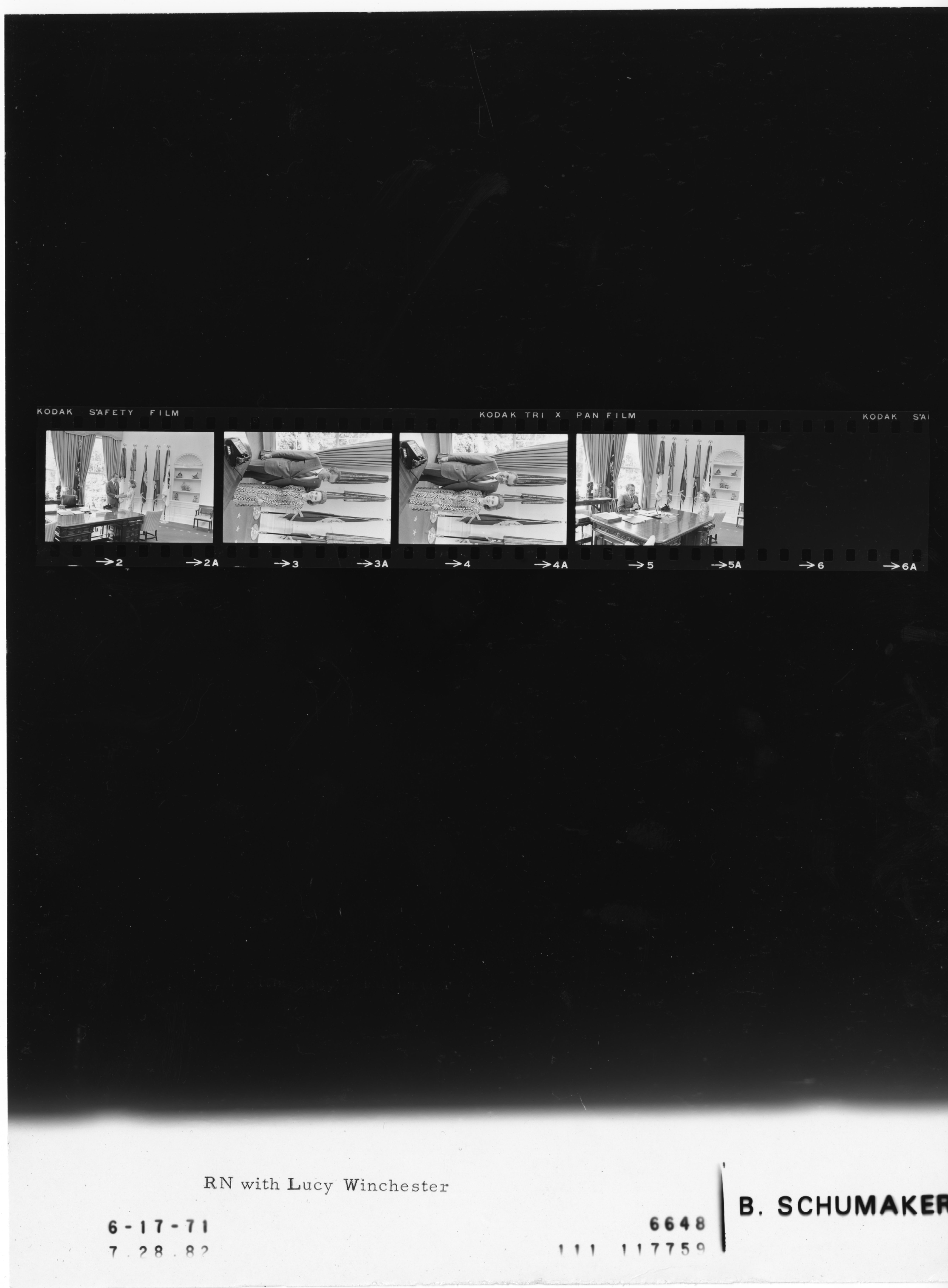
- Frame(s): WHPO-6648-02-05, President Nixon meeting with Lucy Winchester in the Oval Office. 6/17/1971, Washington, D.C. White House, Oval Office. President Nixon, Lucy Winchester.
Roll WHPO-6649 Photographer: Schumaker, Byron | Color or B&W: B&W
- Frame(s): WHPO-6649-03-15, Robert Brown meeting with an unidentified man. 6/17/1971, Washington, D.C. Robert Brown's office. Robert Brown, unidentified man and woman.
Roll WHPO-6650 Photographer: Atkins, Oliver | Color or B&W: B&W
- Frame(s): WHPO-6650-03-06, President Nixon with Christian deGuigne III, Chairman of the Stauffer Chemical Company, and his son Christian deGuigne IV. 6/17/1971, Washington, D.C. White House, Oval Office. President Nixon, Christian de Guigne III, Christian de Guigne IV.
- Frame(s): WHPO-6650-10-17, President Nixon with Senator McClelland and a gift knife. 6/17/1971, Washington, D.C. White House, Oval Office. President Nixon, John McClelland.
- Frame(s): WHPO-6650-21-24, President Nixon with Wendell Wyatt. 6/17/1971, Washington, D.C. White House, Oval Office. President Nixon, Wendell Wyatt.
Roll WHPO-6651 Photographer: Atkins, Oliver | Color or B&W: B&W
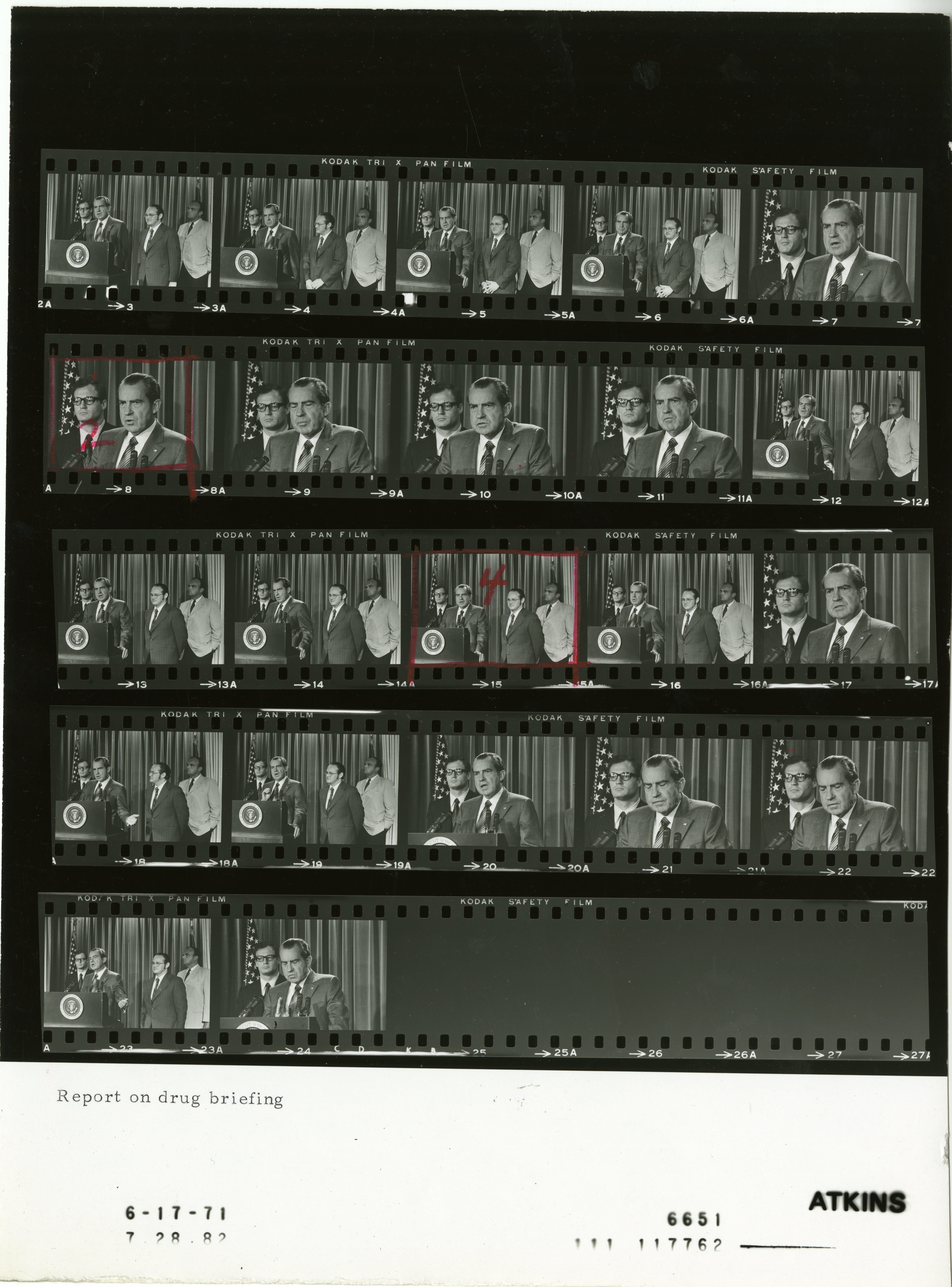
- Frame(s): WHPO-6651-03-24, President Nixon at a podium giving a press briefing on the bi-partisan Congressional leadership meeting on drug abuse. 6/17/1971, Washington, D.C. White House, Press Room. President Nixon, Jerome H. Jaffe, John Ehrlichman, Egil Krogh.
- Frame(s): WHPO-6651-08, President Nixon gives a press briefing at a bi-partisan congressional leadership meeting on drug abuse. Egil Krogh stands behind him. 6/17/1971, Washington, D.C. White House, Press Room. President Nixon, Egil Krogh.
Roll WHPO-6652 Photographer: Knudsen, Robert L. | Color or B&W: B&W
- Frame(s): WHPO-6652-03A-06A, President Nixon seated at his Oval Office desk during a meeting with Senator Barry Goldwater and Clark MacGregor. 6/17/1971, Washington, D.C. White House, Oval Office. President Nixon, Barry Goldwater, Clark MacGregor.
- Frame(s): WHPO-6652-06A, President Nixon seated at his Oval Office desk during a meeting with Senator Barry Goldwater and Clark MacGregor. 6/17/1971, Washington, D.C. White House, Oval Office. President Nixon, Barry Goldwater, Clark MacGregor.
The White House Communications Agency Sound Recordings Collection contains public statements that took place between 1969 and 1974. Visit the finding aid to learn more.
G - Cabinet Officer Briefings
- WHCA-SR-G-052
Briefing on economic policy by Secretary of Labor George Shultz and Secretary of Commerce Maurice Stans. (6/17/1970, Press Center)
Runtime: 45:00:00
Production credits: Audio feed supplied by WHCA; Recorded by JLS (initials of WHCA engineer)
Original Format: 1/4-inch reel-to-reel audiotape. Original source type: Original.
H - White House Staff Member Recordings
- WHCA-SR-H-196
Remarks to REA group by Mike Farrell, astronaut William Anders, Arthur Mitchell, and Janet Rorzov. (6/17/1970, South Lawn, White House)
Runtime: 10:00
Keywords: NASA, National Aeronautics and Space Administration, space program, astronauts
Production credits: Audio feed supplied by WHCA; Recorded by KLM (initials of WHCA engineer)
Original Format: 1/4-inch reel-to-reel audiotape. Original source type: Original. - WHCA-SR-H-197
Press briefing by George Lincoln. (6/17/1970, Press Lobby, White House)
Runtime: 25:00:00
Keywords: Press conferences, news conferences, interviews, media
Production credits: Audio feed supplied by WHCA; Recorded by GLG (initials of WHCA engineer)
Original Format: 1/4-inch reel-to-reel audiotape. Original source type: Original.
P - Formal Presidential Remarks
- WHCA-SR-P-700612
Remarks by President Nixon for a televised address on the economy. (6/17/1970, Oval Office, The White House)
Runtime: 0:26:19
Production credits: Audio feed supplied by WHCA; NBC provided the pool ("mult") feed; No WHCA engineer initials listed
Original Format: 1/4-inch reel-to-reel audiotape. Original source type: Original.
The White House Communications Agency Videotape Collection contains “off-the-air” recordings of televised programs produced between 1968 and 1974. Visit the finding aid to learn more.
- WHCA-4457
"Washington Week in Review". Dr. Gerald Solomon.
Daphne Productions and Roland & Jaffee Productions
Runtime: 00:32:18 - WHCA-4458
Weekly News Summary, Tape I. Excerpts of evening network news broadcasts from the week of 6/11/71 to 6/17/71
ALL NETWORKS
Runtime: 01:35:58 - WHCA-4459
Weekly News Summary, Tape II. Excerpts of evening network news broadcasts from the week of 6/11/71 to 6/17/71
ALL NETWORKS
Runtime: 01:33:20 - WHCA-4460
Weekly News Summary, Tape III. Excerpts of evening network news broadcasts from the week of 6/11/71 to 6/17/71 Daniel "Chappie" James, Jr. (U.S. Air Force fighter pilot, and Deputy Assistant Secretary of Defense (Public Affairs) - Note: in 1975 he became the first black American to achieve rank of four-star general - PE).
Undetermined
Runtime: 00:29:27
Context (External Sources)
The Vanderbilt Television News Archive is the world's most extensive and complete archive of television news. They have been recording, preserving and providing access to television news broadcasts of the national networks since August 5, 1968.
Wikipedia is a free encyclopedia that anyone can edit.