
Introduction
This almanac page for Wednesday, June 16, 1971, pulls together various records created by the federal government and links to additional resources which can provide context about the events of the day.
Previous Date: Tuesday, June 15, 1971
Next Date: Thursday, June 17, 1971
Schedule and Public Documents
The Daily Diary files represent a consolidated record of the President's activities. Visit the finding aid to learn more.
The President's day began at The White House - Washington, D. C.
The Weekly Compilation of Presidential Documents made available transcripts of the President's news conferences; messages to Congress; public speeches, remarks, and statements; and other Presidential materials released by the White House.
Digitized versions can be found at HathiTrust.
Each Public Papers of the Presidents volume contains the papers and speeches of the President of the United States that were issued by the White House Office of the Press Secretary during the time period specified by the volume. The material is presented in chronological order, and the dates shown in the headings are the dates of the documents or events. In instances when the release date differs from the date of the document itself, that fact is shown in the text note.
To ensure accuracy, remarks have been checked against audio recordings (when available) and signed documents have been checked against the original, unless otherwise noted. Editors have provided text notes and cross references for purposes of identification or clarity.
The Federal Register is the official daily publication for rules, proposed rules, and notices of federal agencies and organizations, as well as executive orders and other Presidential documents.
The Congressional Record is the official daily record of the debates and proceedings of the U.S. Congress.
Archival Holdings
Any selection of archival documents will necessarily be partial. You should use the documents and folders identified below as a starting place, but consult the linked collection finding aids and folder title lists and the collections themselves for context. Many documents to be found this way do not lend themselves to association with specific dates, but are essential to a complete understanding of the material.
Selective document listing
President's Office Files
The President's Office Files consists of materials drawn together by the Special Files Unit from several administrative subdivisions within the White House Office. It is the handwriting and sensitive papers sent to the Staff Secretary that now comprise much of the President's Office Files. Visit the finding aid to learn more.
- Annotated News Summaries, Box 30, News Summaries - June 1971 [1 of 2]
- Annotated News Summaries, Box 30, News Summaries - June 1971 [2 of 2] [During this period, the Staff Secretary only removed pages from the News Summaries which contained President Nixon's handwriting, often leaving the document with no date. Although there are no specific documents with this date, you should also consult the full folder for the month.]
- President's Daily Schedule, Box 101, [President's Daily Schedule, June-Aug. 1971] [1 of 3]
- The President's Schedule, Wednesday - June 16, 1971
President's Personal File
The President's Personal File is essentially a President's secretary's file, kept by Rose Mary Woods, personal secretary to the President, for two purposes: (1) preserving for posterity a collection of documents particularly close to the President, whether because he dictated or annotated them, or because of the importance of the correspondent or the event concerned and (2) giving appropriate attention–letters of gratitude, invitations to White House social events, and the like–to members and important friends and supporters of the Nixon administration. This generalization does not describe all the varied materials of a file group which is essentially a miscellany, but it does identify the reason for the existence of the file group's core. Visit the finding aid to learn more.
- President's Speech File
The H. R. Haldeman Diaries consists of seven handwritten diaries, 36 dictated diaries recorded as sound recordings, and two handwritten audio cassette tape subject logs. The diaries and logs reflect H. R. Haldeman’s candid personal record and reflections on events, issues, and people encountered during his service in the Nixon White House. As administrative assistant to the President and Chief of Staff, Haldeman attended and participated in public events and private meetings covering the entire scope of issues in which the Nixon White House engaged in during the years 1969-1973. Visit the finding aid to learn more.
- Transcript of diary entry (PDF)
[June 16, 1971]
New York Times reaction again dominated the day today, starting with the staff meeting, where we got into a discussion in the 8:00 meeting, with Shultz making the point that there are three main issues: the question of whether this should have been classified or declassified to begin with; the point that top secret material is published every day, and the question of why this is any different from others; and the concern about how devious Defense and Foreign Affairs intelligence are. They're always playing a cat and mouse game, never a straight statement. Then we got into the general staff meeting and pointed out the problem is that the President now is being positioned as opposed to the public's right to know, and MacGregor, among others, raised the question of why don't we condemn the massive deception of the previous Administration. There'll be a thrust in Congress now to limit the war powers and especially to demand knowledge of what the President's doing. Two separate issues are being mixed: first, The Times is violating the law; second, the content of the documents. An idea that was raised was to give the documents to Congress, leaving them classified, but letting them have them, which would prove that we're not trying to cover anything up, but would still preserve the aspect of secret classification.
There's a real problem here of Johnson's pure deceit, for instance at his press conference where he said he was not doing exactly what he was doing. Another idea was that we should declassify all of the material that can be declassified and announce now that we're going to do so. Do enough of a release so that we can't be accused of suppression. That, though, creates the problem of declassifying other documents or releasing them to the Senate on the basis of their being leaked or on any other basis.
The President got into this on and off all during the day, wanted to be sure that we're making an all out effort on editorials. Felt that we should have someone analyze the Kennedy stuff and then get it leaked out somehow. Decided we probably should give Ehrlichman the responsibility as the one man on top of the whole thing, since there is nobody running it now and it's an ideal thing for Ehrlichman. His view is that we're trying to protect the integrity of government and the ability to conduct government, and that does require some classification of materials. For instance, many of the discussions going on now on SALT, Berlin, et cetera, have to be classified. He comes back again and again with the view that nothing else that we do in the rest of this Administration will give him more pleasure than to carry out the directive now with regard to The New York Times: they're never to be in the office, never on the pool, never on the plane, et cetera, and no one is to raise this with the President.
He feels we do have to make the issue that the press is massively endangering our security, paint them as lawbreakers, disloyal, et cetera. That there's no question of right to know or how we got into Vietnam, but we must maintain the integrity of government.
As we were talking at midday today, he heard some kids shouting out on the South Lawn and realized that the 1,000 Rural Electrification Administration youth group were gathering to be addressed by Cliff Hardin and then take a White House tour. After pondering the whole thing on and off for a while, he decided that he should go out and greet them, which he then did on a completely spontaneous and unannounced basis, and it was a big success. Now he feels he wants to do more of that kind of thing, which indeed he should.
He came up with some schedule changes, regarding California particularly, because he's not going to Midway now, and -- some ideas on shifting the press conference plans around, etcetera. We were supposed to be making a big drug speech, possibly on preemptive network TV tomorrow, and were waiting for it to come in. When it finally did, it was completely the wrong thing, and that wasn't until late this afternoon; so we're getting a kind of stir on that, because our whole speech preparation deal is pretty screwed up, and this was a good example of it. Instead of doing a speech now, he's going to do a one or one and a half minute opening to the briefing and let the briefers carry the story, rather than the President trying to do it.
End of June 16th. - Original audio recording (MP3)
The National Archives Catalog is the online portal to the records held at the National Archives, and information about those records. It is the main way of describing our holdings and also provides access to electronic records and digitized versions of our holdings.
The Catalog searches across multiple National Archives resources at once, including archival descriptions, digitized and electronic records, authority records, and web pages from Archives.gov and the Presidential Libraries. The Catalog also allows users to contribute to digitized historical records through tagging and transcription.
Nixon Library Holdings
All National Archives Units
National Security Documents
The President's Daily Brief is the primary vehicle for summarizing the day-to-day sensitive intelligence and analysis, as well as late-breaking reports, for the White House on current and future national security issues. Read "The President's Daily Brief: Delivering Intelligence to Nixon and Ford" to learn more.
The Foreign Relations of the United States series presents the official documentary historical record of major U.S. foreign policy decisions and significant diplomatic activity. Visit the State Department website for more information.
Vol. V, United Nations, 1969-1972
Secretary-General Succession
218. Telegram From the Department of State to the Mission to the United Nations, Washington, June 16, 1971, 2105Z
Source: National Archives, RG 59, Central Files 1970–73, UN 8–3. Confidential. Repeated to Vienna. Drafted by Herz and Counselor Richard F. Pedersen and approved by Herz.
Vol. VII, Vietnam, July 1970-January 1972
The Consequences of Operation Lan Som 719 and the Search for a Settlement, April 8-October 6, 1971
220. Conversation Among President Nixon, the Ambassador to Vietnam (Bunker), and the President’s Assistant for National Security Affairs (Kissinger), Washington, June 16, 1971
Source: National Archives, Nixon Presidential Materials, White House Tapes, Oval Office, Conversation 522–2. No classification marking. The editors transcribed the portions of the tape recording printed here specifically for this volume. The exchange is part of a larger conversation, 10:39 a.m.–12:07 p.m. According to the Nixon tapes log, Kissinger entered at 11:21 a.m. and Bunker at 11:32 a.m.
Vol. XIX, Part 1, Korea, 1969-1972
Republic of Korea Troops in Vietnam and Force Modernization, April 1971-December 1972
94. Memorandum From Ernest Johnston of the National Security Council Staff to the President’s Assistant for National Security Affairs (Kissinger), Washington, June 16, 1971
Source: National Archives, Nixon Presidential Materials, NSC Files, Box 542, Country Files, Far East, Korea, Vol. IV, 1 Jan–31 Dec 1971. No classification marking. According to a note on the first page, this memorandum was “OBE.”
Vol. XXIX, Eastern Europe, 1969-1972
Radio Free Europe and Radio Liberty
55. Letter From Director of Central Intelligence Helms to the Director of the Office of Management and Budget (Shultz), Washington, June 16, 1971
Source: National Archives, Nixon Presidential Materials, NSC Files, Box 379, Subject Files, Radio Free Europe & Radio Liberty, Vol. I. Secret; Sensitive. A copy was sent to Kissinger.
Vol. XXXIX, European Security
MBFR and the Conference on European Security, December 1970-December 1971
60. Memorandum From the President’s Assistant for National Security Affairs (Kissinger) to President Nixon, Washington, June 16, 1971
Source: National Archives, Nixon Presidential Materials, NSC Institutional Files (H-Files), Box H–031, NSC Meeting Folders, NSC Meeting on MBFR, 6/17/71. Top Secret. The memorandum was drafted by K. Wayne Smith of the NSC staff and forwarded to Kissinger on June 15.
Vol. XL, Germany and Berlin, 1969-1972
Germany and Berlin, 1969-1972
256. Memorandum From Helmut Sonnenfeldt of the National Security Council Staff to the President’s Assistant for National Security Affairs (Kissinger), Washington, June 16, 1971
Source: National Archives, Nixon Presidential Materials, NSC Files, Box 692, Country Files, Europe, Germany (Berlin), Vol. IV. Secret. Sent for action. According to another copy, Downey drafted the memorandum. (Library of Congress, Manuscript Division, Kissinger Papers, Box CL 14, Chronological File, 1969–75, 20 May–10 July, 1971)
Vol. E-2, Documents on Arms Control and Nonproliferation, 1969-1972
Conferences on Nuclear and World Disarmament and Soviet UN Initiative on Non-Use of Force
323. Transcript of Telephone Conversation Between the President’s Assistant for National Security Affairs (Kissinger) and the Director of the Arms Control and Disarmament Agency (Smith), Washington, June 16, 1971, 10:35 a.m.
Kissinger and Smith briefly discussed Ambassador Dobrynin’s visit to the President the day before and the Soviet proposal for five-power conference on nuclear disarmament.
Source: Library of Congress, Manuscript Division, Kissinger Papers, Box 368, Telephone Conversations, Chronological File, 14–18 June 1971. No classification marking.
Vol. E-5, Part 2, Documents on North Africa, 1969-1972
Algeria
25. Airgram A–11 From the Department of State to the Interests Section in Algeria, Washington, June 16, 1971, 11:23 a.m.
This Airgram transmitted a Policy Planning Paper for Algeria. The paper highlighted the geographic, economic, and political importance of Algeria and outlined U.S. interests and objectives in the African nation over the course of the next five years, Algeria’s objectives with respect to the United States, and concluded with a 6 part recommended course of action. The Paper was approved by the NSC Interdepartmental Group for Africa.
Source: National Archives, RG 59, Central Files 1970–73, POL 1 ALG-US. Secret; Noforn. Telegram drafted by Edward Holmes (AF/NSC-IG) and approved by Carter. Attached but not printed at Annex A is documentation on U.S. agency expenditures in Algeria; at Annex B is background information; and at Annex C is a list of approved policy guidance papers.
Libya
78. Airgram A–6 From the Department of State to the Embassy in Libya, Washington, June 16, 1971
The Department forwarded a Policy Planning Paper for Libya as approved by the NSC Interdepartmental Group for Africa.
Source: National Archives, RG 59, Central Files 1970–73, POL 1 LIBYA–US. Secret;Noforn. Covering airgram was drafted by Edward W. Holmes (AF/NSC) and approved by Carter. The annexes are not printed.
Morocco
115. Airgram A–43 From the Department of State to the Embassy in Morocco, Washington, June 16, 1971
The Department forwarded an official statement of U.S. policy toward Morocco, approved by the National Security Council Interdepartmental Group for Africa, that outlines U.S. interests and objectives in Morocco over the next five years, as well as Morocco’s objectives vis-à-vis the United States. It then goes on to outline a 20 part recommended course of action that the U.S. Government should take over the course of the next 5 years.
Source: National Archives, RG 59, Central Files 1970–73, POL 1 MOR-US. Secret; Noforn. Drafted on June 8 by Holmes and approved by Carter.
Vol. E-7, Documents on South Asia, 1969-1972
India and Pakistan: Crisis and War, March-December 1971
138. Conversation Among President Nixon, the President’s Assistant for National Security Affairs (Kissinger), the Indian Foreign Minister (Singh), and the Assistant Secretary of State for Near Eastern and South Asian Affairs (Sisco), Washington, June 16, 1971, 2:58-3:41 p.m.
In a discussion of mounting tensions on the subcontinent, Singh sought to emphasize the “tremendous problem” created for India by the influx of refugees from East Pakistan. Nixon counseled patience while the U.S. provided additional funds to deal with the refugees and used quiet diplomacy to try to mediate a settlement in Pakistan.
Source: National Archives, Nixon Presidential Materials, White House Tapes, Recording of Conversation among Nixon, Singh, Kissinger, and Sisco, Oval Office, Conversation No. 523–2. No classification marking. Ambassadors Keating and Jha were also present.
Vol. E-10, Documents on American Republics, 1969-1972
Dominican Republic
290. Conversation Among President Nixon, Gulf-Western Chairman Charles Bluhdorn, the President’s Assistant for Domestic Affairs (Ehrlichman), and Secretary of Commerce Peterson, Washington, June 16, 1971, 3:40–4:30 p.m., Washington, June 16, 1971, 3:40-4:30 p.m.
Gulf-Western Chairman Bluhdorn lobbied President Nixon for an increase in the Dominican Republic’s sugar quota.
Source: National Archives, Nixon Presidential Materials, White House Tapes, Conversation No. 523–4, Oval Office. No classification marking. The editors transcribed the portions of the tape recording published here specifically for this volume.
Vol. E-16, Documents on Chile, 1969-1973
Cool and Correct: The U.S. Response to the Allende Administration, November 5, 1970-December 31, 1972
76. Memorandum From Arnold Nachmanoff of the National Security Council Staff to the President’s Assistant for National Security Affairs (Kissinger), Washington, June 16, 1971
Summary: This memorandum forwarded for Kissinger’s signature a memorandum to the Senior Review Group and Secretary of the Treasury Connally informing them of the President’s decision to approve the FMS ceiling for Chile (see Foreign Relations, 1969–1976, vol. XXI, Chile, 1969–1973, Document 235) and to defer a decision on the Export-Import Bank loan for Boeing aircraft. Nachmanoff commented that postponing the Boeing decision would damage U.S.-Chilean relations and noted that the copper companies would, most likely, not approve of it either.
Source: National Archives, Nixon Presidential Materials, NSC Files, NSC Institutional Files (H-Files), Box H–56, SRG Meeting, Chile 6/3/71. Secret; Nodis. Sent for action. Tabs I and II are attached but not published.
The Kissinger telephone conversation transcripts consist of approximately 20,000 pages of transcripts of Kissinger’s telephone conversations during his tenure as Assistant to the President for National Security Affairs (1969-1974) and Secretary of State (1973-1974) during the administration of President Richard Nixon. Visit the finding aid for more information.
Digitized versions can be found in the National Archives Catalog.
Audiovisual Holdings
The White House Tapes are sound recordings of President Richard Nixon's telephone conversations and of meetings held in the Oval Office and the Cabinet Room in the White House, the President's office in the Old Executive Office Building (OEOB), the Lincoln Sitting Room in the residence section of the White House, and several locations at the Presidential retreat at Camp David, Maryland. These recordings document many of the major events and decisions of the Nixon Administration from February 16, 1971 to July 18, 1973. Visit the White House Tapes finding aid to learn about the taping system's operation and archival processing.
Old Executive Office Building
- 258-19; Unknown between 8:07 p.m. & 8:22 p.m.; Nixon, Richard M. (President); Sanchez, Manolo
- 258-20; Unknown between 8:07 p.m. & 8:22 p.m.; Nixon, Richard M. (President); Sanchez, Manolo
- 258-21; Unknown between 8:07 p.m. & 8:22 p.m.; Nixon, Richard M. (President); Sanchez, Manolo
- 258-22; Unknown between 8:07 p.m. & 8:22 p.m.; Nixon, Richard M. (President)
- 258-23; Unknown between 8:07 p.m. & 8:22 p.m.; Nixon, Richard M. (President); Sanchez, Manolo
- 258-24; Unknown between 8:07 p.m. & 8:22 p.m.; Nixon, Richard M. (President); Sanchez, Manolo
- 258-25; Unknown between 8:07 p.m. & 8:22 p.m.; Nixon, Richard M. (President); White House operator
- 258-26; 8:22 p.m. - 8:25 p.m.; Nixon, Richard M. (President); Ehrlichman, John D.
- 258-28; 8:31 p.m. - 8:36 p.m.; Nixon, Richard M. (President); Woods, Rose Mary
- 258-29; Unknown between 8:36 p.m. & 8:55 p.m.; Nixon, Richard M. (President); White House operator
- 258-30; 8:55 p.m. - 8:55 p.m.; Nixon, Richard M. (President); White House operator
Oval Office
- 522-1; 9:05 a.m. - 10:38 a.m.; Nixon, Richard M. (President); Butterfield, Alexander P.; Haldeman, H. R. ("Bob"); Bull, Stephen B.; [Unknown person(s)]; Sanchez, Manolo; Ehrlichman, John D.
- 522-2; 10:39 a.m. - 12:07 p.m.; Nixon, Richard M. (President); Haldeman, H. R. ("Bob"); Ziegler, Ronald L.; Bull, Stephen B.; Kissinger, Henry A.; White House operator; Bahr, Egon; Bunker, Ellsworth F.; [Unknown person(s)]; Butterfield, Alexander P.
- 522-3; Unknown between 12:07 p.m. & 12:26 p.m.; Nixon, Richard M. (President); Butterfield, Alexander P.
- 522-4; 12:26 p.m. - 12:37 p.m.; Nixon, Richard M. (President); Adair, E. Ross (Ambassador); Adair, E. Ross (Mrs.); Wright, W. Marshall
- 522-5; 12:38 p.m. - 12:46 p.m.; Nixon, Richard M. (President); Klein, Herbert G.; Scott, Stanley S.; Atkins, Oliver F. ("Ollie"); Ziegler, Ronald L.
- 522-6; 12:46 p.m. - 12:59 p.m.; Nixon, Richard M. (President); [Unknown person(s)]; Klein, Herbert G.; Ziegler, Ronald L.; Tames, George; Noel, Arnold C.; Driscoll, Norman; Rollins, Byron; Johnson, Maurice; Shutt, Charles; Stroup, Barry; Gaylin, George; Beall, William; Kramer, Carl; Raney, James; Woolsey, Charles; McGee, John; Arrowsmith, John; Galbraith, William; Peterson, Lynne; Smith, Allan; Chung, Constance ("Connie"); Sisco, Paul; Cancellare, Frank E.; Griffin, Henry; Craven, Thomas ("Tom"), Sr.; Johnson, Hugo; Denton, Robert D.; Baltzell, J. Thomas; Dorsey, George; Roberts, Joe; May, Andrew J.
- 522-7; 12:59 p.m. - 1:04 p.m.; Nixon, Richard M. (President); Ziegler, Ronald L.
- 522-8; Unknown between 1:04 p.m. & 1:15 p.m.; Nixon, Richard M. (President); Haldeman, H. R. ("Bob"); Butterfield, Alexander P.
- 522-9; Unknown between 1:09 p.m. & 1:15 p.m.; Nixon, Richard M. (President); Haldeman, H. R. ("Bob"); Bull, Stephen B.
- 522-10; Unknown between 1:15 p.m. & 1:27 p.m.; [Unknown person(s)]
- 522-11; 1:27 p.m. - 2:15 p.m.; Nixon, Richard M. (President); Haldeman, H. R. ("Bob")
- 523-1; Unknown between 2:15 p.m. & 2:58 p.m.; Nixon, Richard M. (President); [Unknown person(s)]
- 523-2; 2:58 p.m. - 3:41 p.m.; Nixon, Richard M. (President); Ziegler, Ronald L.; Woods, Rose Mary; Kissinger, Henry A.; Bull, Stephen B.; Singh, Swaran; Jha, Lakshmi Kant; Keating, Kenneth B.; Sisco, Joseph J.; White House photographer; Sanchez, Manolo
- 523-3; Unknown between 3:41 p.m. & 3:43 p.m.; Nixon, Richard M. (President); Bull, Stephen B.
- 523-4; Unknown between 3:41 p.m. & 4:30 p.m.; Nixon, Richard M. (President); Bull, Stephen B.; Kissinger, Henry A.; Bluhdorn, Charles; Ehrlichman, John D.; Peterson, Peter G.
- 523-5; 4:30 p.m. - 5:15 p.m.; Nixon, Richard M. (President); Butterfield, Alexander P.; O'Neill, John M.; Stephens, Melvin; Colson, Charles W.; Bull, Stephen B.; Sanchez, Manolo; Kissinger, Henry A.; White House operator; [Unknown person(s)]; Woods, Rose Mary
- 523-6; 5:16 p.m. - 6:05 p.m.; Nixon, Richard M. (President); Haldeman, H. R. ("Bob"); [Unknown person(s)]; Ziegler, Ronald L.; Kissinger, Henry A.; Higby, Lawrence M.; Woods, Rose Mary
- 523-7; Unknown between 6:05 p.m., 6/16 & 7:55 a.m., 5/28; [Unknown person(s)]
- 523-8; 4:29 p.m. - 4:30 p.m.; Nixon, Richard M. (President); Bull, Stephen B.; Butterfield, Alexander P.
White House Telephone
- 5-91; Unknown between 9:02 a.m. & 5:10 p.m.; Kissinger, Henry A.; White House operator
- 5-92; Unknown between 9:02 a.m. & 5:10 p.m.; Kissinger, Henry A.; Bahr, Egon
- 5-93; Unknown between 9:02 a.m. & 5:10 p.m.; Nixon, Richard M. (President); White House operator
- 5-94; 5:10 p.m. - 5:11 p.m.; Nixon, Richard M. (President); Woods, Rose Mary
- 5-95; 7:46 p.m. - 7:46 p.m.; Nixon, Richard M. (President); White House operator
- 5-96; 7:47 p.m. - 7:47 p.m.; Nixon, Richard M. (President); White House operator
- 5-97; 7:48 p.m. - 7:56 p.m.; Nixon, Richard M. (President); Ziegler, Ronald L.
- 5-98; 7:56 p.m. - 7:56 p.m.; Nixon, Richard M. (President); White House operator
- 5-99; 7:57 p.m. - 7:57 p.m.; Nixon, Richard M. (President); Nixon, Thelma C. ("Pat") (Ryan)
- 5-100; 7:58 p.m. - 8:22 p.m.; Nixon, Richard M. (President); White House operator
- 5-101; 8:22 p.m. - 8:25 p.m.; Nixon, Richard M. (President); Ehrlichman, John D.
- 5-102; Unknown between 8:25 p.m. & 8:31 p.m.; Nixon, Richard M. (President); White House operator
- 5-103; 8:31 p.m. - 8:36 p.m.; Nixon, Richard M. (President); Woods, Rose Mary
- 5-104; Unknown between 8:36 p.m. & 8:55 p.m.; Nixon, Richard M. (President); White House operator
- 5-105; 8:55 p.m. - 8:55 p.m.; Nixon, Richard M. (President); White House operator
The White House Photo Office collection consists of photographic coverage of President Richard Nixon meeting with prominent social, political, and cultural personalities; speaking engagements and news conferences of the President and various high-ranking members of the White House staff and Cabinet; Presidential domestic and foreign travel, including Presidential vacations; social events and entertainment involving the First Family, including entertainers present; official portraits of the President, First Family, and high-ranking members of the Nixon administration; the 1969 and 1973 Inaugurals; the President’s 1972 Presidential election campaign appearances (including speeches) and other official activities of the White House staff and the President’s Cabinet from January 20, 1969 until August 9, 1974 at the White House and the Old Executive Office Building; other locations in Washington, DC, such as The Mall; and the Presidential retreats in Camp David, Maryland, Key Biscayne, Florida, and San Clemente, California. Visit the finding aid to learn more.
Roll WHPO-6513 Photographer: Atkins, Oliver | Color or B&W: B&W
- Frame(s): WHPO-6513-01-02, President Nixon taking pictures of the founders of White House News Photographers Association. 6/16/1971, Washington, D.C. White House, Oval Office. President Nixon, photographers.
Roll WHPO-6631 Photographer: Schumacher, Karl | Color or B&W: B&W
- Frame(s): WHPO-6631-03A-07A, Pat Nixon receiving a "Saturday Evening Post" presentation from Mr. and Mrs. Des Vaas. 6/16/1971, Washington, D.C. White House, Map Room. Pat Nixon, Mr. Des Vaas, Mrs. Des Vaas.
Roll WHPO-6632 Photographer: Schumacher, Karl | Color or B&W: Color
- Frame(s): WHPO-6632-03A-10A, Pat Nixon receiving a "Saturday Evening Post" presentation from Mr. & Mrs. Des Vaas. 6/16/1971, Washington, D.C. White House, Map Room. Pat Nixon, Mr. Des Vaas, Mrs. Des Vaas, unidentified persons.
Roll WHPO-6633 Photographer: Atkins, Oliver | Color or B&W: B&W
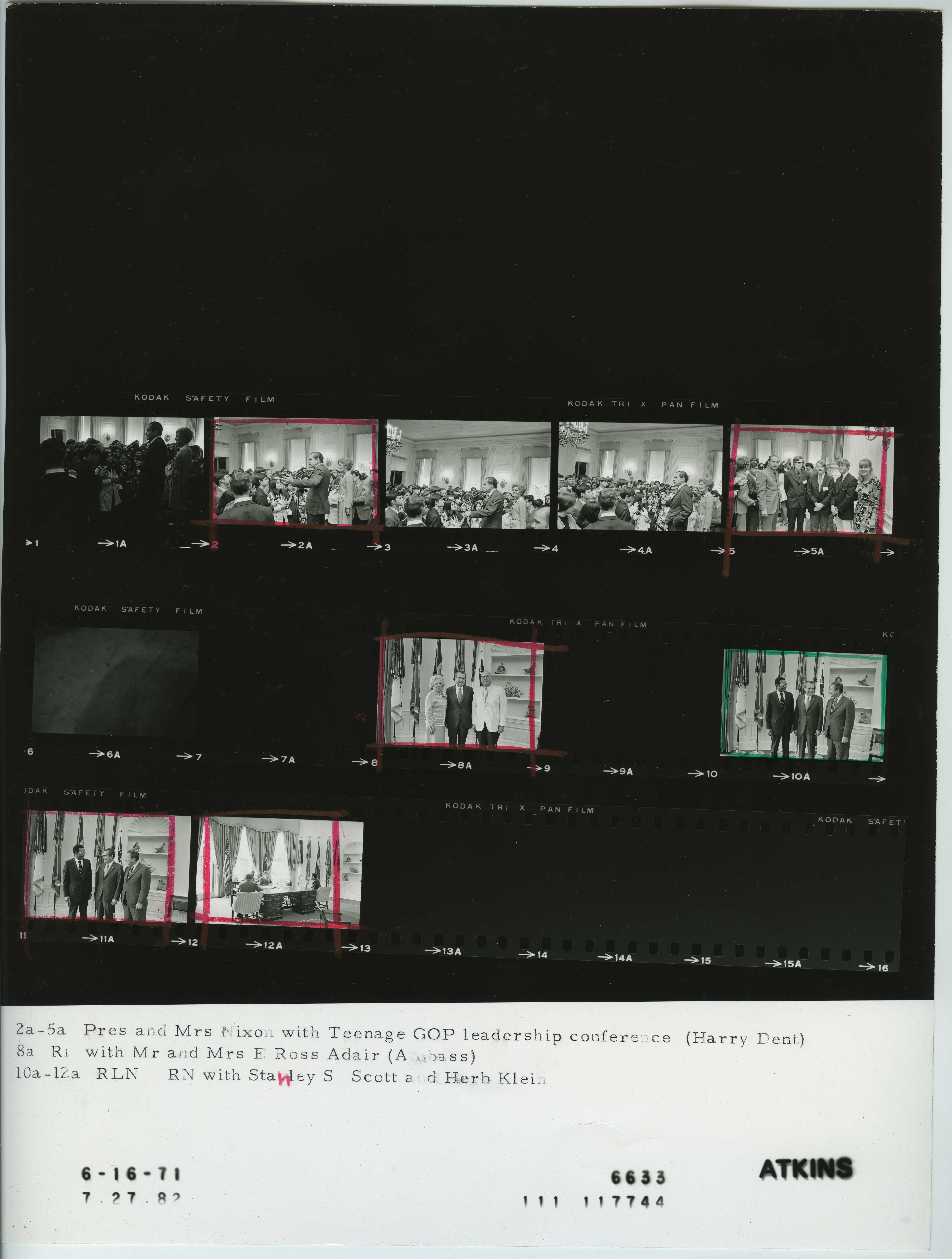
- Frame(s): WHPO-6633-01A-05A, President Nixon with Pat Nixon at his side, speaking to members of the Teenage Republican Leadership Conference. 6/16/1971, Washington, D.C. White House, State Dining Room. President Nixon, Pat Nixon, unidentified teenagers, Republican teenage student leadership.
- Frame(s): WHPO-6633-08A, President Nixon with Ambassador E. Ross Adair and Mrs. Adair. 6/16/1971, Washington, D.C. White House, Oval Office. President Nixon, E. Ross Adair, Mrs. E. Ross Adair, Stanley Scott, Herb Klein.
- Frame(s): WHPO-6633-10A-12A, President Nixon meeting with Stanley Scott and Herbert Klein. 6/16/1971, Washington, D.C. White House, Oval Office. President Nixon, Stanley Scott, Herbert Klein.
- Frame(s): WHPO-6633-11A, President Nixon meeting with Stanley Scott and Herbert Klein. 6/16/1971, Washington, D.C. White House, Oval Office. President Nixon, Stanley Scott, Hebert Klein.
Roll WHPO-6634 Photographer: Knudsen, Robert L. | Color or B&W: B&W
- Frame(s): WHPO-6634-03-13, President Nixon sitting at his Oval Office desk during a meeting with U.S. Ambassador to the Republic of Vietnam Ellsworth Bunker and National Security Advisor Henry Kissinger. 6/16/1971, Washington, D.C. White House, Oval Office. President Nixon, Henry Kissinger, Ellsworth Bunker.
- Frame(s): WHPO-6634-10A, President Nixon sitting at his Oval Office desk during a meeting with U.S. Ambassador to the Republic of Vietnam Ellsworth Bunker and National Security Advisor Henry Kissinger. 6/16/1971, Washington, D.C. White House, Oval Office. President Nixon, Henry Kissinger, Ellsworth Bunker.
Roll WHPO-6635 Photographer: Knudsen, Robert L. | Color or B&W: B&W
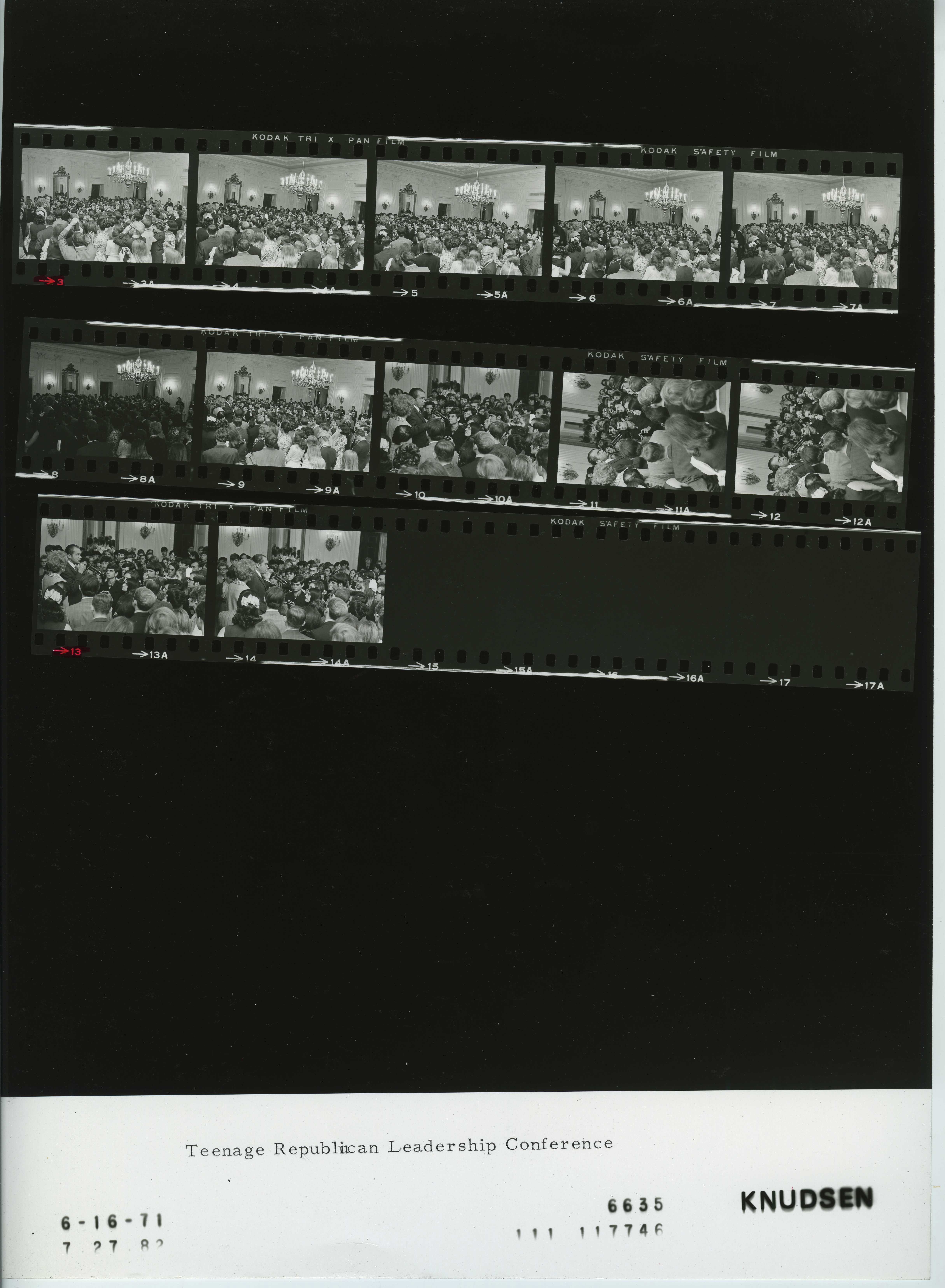
- Frame(s): WHPO-6635-03, President Nixon addressing members of the Teenage Republican Leadership Conference. Pat Nixon stands nearby. 6/16/1971, Washington, D.C. White House, State Dining Room. President Nixon, Pat Nixon, teenage Republican leaders, unidentified persons.
- Frame(s): WHPO-6635-03-14, President Nixon addressing members of the Teenage Republican Leadership Conference. Pat Nixon stands nearby. 6/16/1971, Washington, D.C. White House, State Dining Room. President Nixon, Pat Nixon, teenage Republican leaders, unidentified persons.
Roll WHPO-6636 Photographer: Knudsen, Robert L. | Color or B&W: B&W
- Frame(s): WHPO-6636-02-12, President Nixon shaking hands with officers of White House News Photographers Association. 6/16/1971, Washington, D.C. White House, Oval Office. President Nixon, George Tames, White House photographers.
- Frame(s): WHPO-6636-13-20, President Nixon receiving a memento of the 50th anniversary of the White House News Photographers Association from its president, George Tames, photographer for the New York Times. 6/16/1971, Washington, D.C. White House, Oval Office. President Nixon, George Tames, White House photographers.
- Frame(s): WHPO-6636-21-27, President Nixon with officers of White House News Photographers Association. 6/16/1971, Washington, D.C. White House, Oval Office. President Nixon, George Tames, White House photographers.
Roll WHPO-6637 Photographer: Knudsen, Robert L. | Color or B&W: B&W
- Frame(s): WHPO-6637-02-06, President Nixon shaking hands with White House News Photographers Association photographers. 6/16/1971, Washington, D.C. White House, Oval Office. President Nixon, White House photographers.
- Frame(s): WHPO-6637-07-10, President Nixon talking with White House News Photographers Association photographers. 6/16/1971, Washington, D.C. White House, Oval Office. President Nixon, White House photographers.
- Frame(s): WHPO-6637-11-34, President Nixon holding a camera. 6/16/1971, Washington, D.C. White House, Oval Office. President Nixon, White House photographers.
- Frame(s): WHPO-6637-28, President Nixon looking out a camera. 6/16/1971, Washington, D.C. White House, Oval Office. President Nixon.
- Frame(s): WHPO-6637-29, President Nixon holding a camera. 6/16/1971, Washington, D.C. White House, Oval Office. President Nixon.
Roll WHPO-6638 Photographer: Atkins, Oliver | Color or B&W: B&W
- Frame(s): WHPO-6638-04A-14A, President Nixon receiving a memento of the 50th anniversary of the White House News Photographers Association from its president, George Tames, photographer for the New York Times. 6/16/1971, Washington, D.C. White House, Oval Office. President Nixon, George Tames, White House photographers.
- Frame(s): WHPO-6638-15A-27A, President Nixon trying out a camera. 6/16/1971, Washington, D.C. White House, Oval Office. President Nixon, George Tames, White House photographers.
Roll WHPO-6639 Photographer: Atkins, Oliver | Color or B&W: B&W
- Frame(s): WHPO-6639-01-08A, President Nixon receiving a memento of the 50th anniversary of the White House News Photographers Association from its president, George Tames, photographer for the New York Times. 6/16/1971, Washington, D.C. White House, Oval Office. President Nixon, George Tames, White House photographers.
- Frame(s): WHPO-6639-08A-16A, President Nixon with members of the White House News Photographers Association. 6/16/1971, Washington, D.C. White House, Oval Office. President Nixon, George Tames, White House photographers.
Roll WHPO-6640 Photographer: Atkins, Oliver | Color or B&W: B&W
- Frame(s): WHPO-6640-05A-09A, President Nixon sitting at his desk with Charles Bluhdorn, Chairman of the Board of Gulf and Western Industries. 6/16/1971, Washington, D.C. White House, Oval Office. President Nixon, Charles Bluhdorn.
Roll WHPO-6641 Photographer: Schumacher, Karl | Color or B&W: B&W
- Frame(s): WHPO-6641-01-07, Agriculture Secretary Clifford Hardin speaking to a Rural Electric Youth group. 6/16/1971, Washington, D.C. White House, South Grounds. Clifford Hardin, youth group.
Roll WHPO-6642 Photographer: Atkins, Oliver | Color or B&W: B&W
- Frame(s): WHPO-6642-01A-15A, President Nixon visiting the Rural Electric Youth group who were listening to a speech by Secretary of Agriculture Clifford M. Hardin. 6/16/1971, Washington, D.C. White House, South Grounds. President Nixon, youth group.
- Frame(s): WHPO-6642-16A-19A, President Nixon and H.R. Haldeman walking along the colonnade. 6/16/1971, Washington, D.C. White House, West Colonnade. President Nixon, Harry Robbins Haldeman, youth group.
Roll WHPO-6643 Photographer: Knudsen, Robert L. | Color or B&W: B&W
- Frame(s): WHPO-6643-04A-08A, Ronald Ziegler with two unidentified men. 6/16/1971, Washington, D.C. White House, South Grounds. Ronald Ziegler, unidentified men.
Roll WHPO-6644 Photographer: Knudsen, Robert L. | Color or B&W: B&W
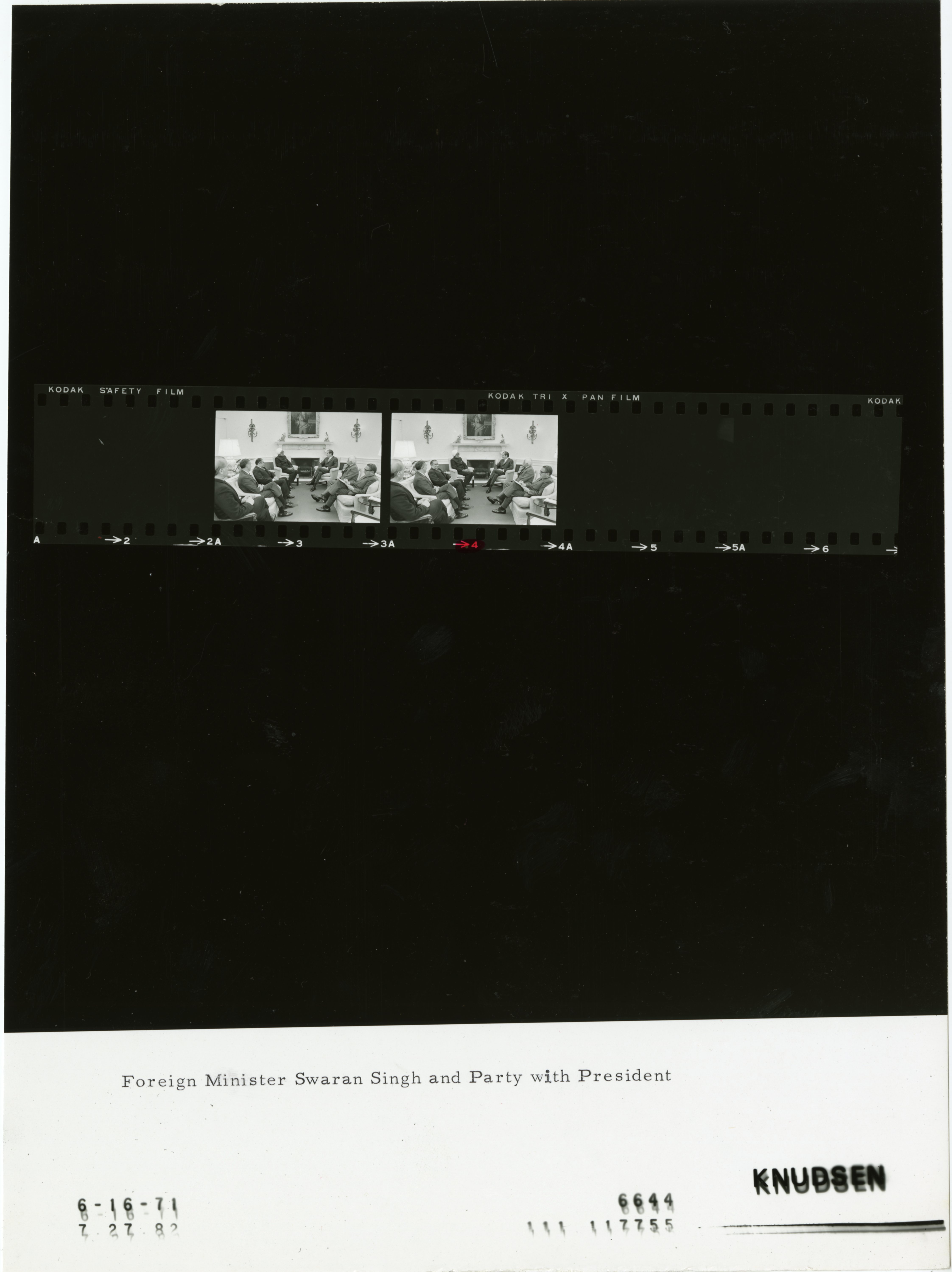
- Frame(s): WHPO-6644-03-04, President Nixon sitting with East Indian Foreign Minister Swaran Singh, Ambassador From India Lakshmi Kant Jha, Ambassador from US to India, Kenneth B. Keating,and others. 6/16/1971, Washington, D.C. White House, Oval Office. President Nixon, Henry Kissinger, Kenneth Keating, Swaran Singh, Lakshmi Kant Jha, Joseph Sisco, unidentified man.
Roll WHPO-6645 Photographer: Schumacher, Karl | Color or B&W: Color
- Frame(s): WHPO-6645-02-15, Pat Nixon receiving a presentation from members of Sigma. 6/16/1971, Washington, D.C. White House, East Room. Pat Nixon, unidentified women.
Roll WHPO-E0594 Photographer: President Nixon/6513 IS A COPY OF THIS MEG | Color or B&W: B&W
- Frame(s): WHPO-E0594-, White House Photo Office photographer Buck May (2nd from right) with 4 unidentified men. 6/16/1971, Washington, D.C. White House, Oval Office. Buck May, unidentified men.
- Frame(s): WHPO-E0594-02, White House Photo Office photographer Buck May (2nd from right) with 4 unidentified men. 6/16/1971, Washington, D.C. White House, Oval Office. Buck May, unidentified men.
The White House Communications Agency Videotape Collection contains “off-the-air” recordings of televised programs produced between 1968 and 1974. Visit the finding aid to learn more.
- WHCA-4454
"The New Zoo Review".
Undetermined
Runtime: 00:22:20 - WHCA-4455
Mayor's Conference. U.S. Senator Edward Kennedy (D-MA).
WETA
Runtime: 00:16:13 - WHCA-4456
"The David Frost Show" w Major James Rose, Howard Cosell, actor Chuck McCann, and Irish singer Val Doonican.
WCET, Los Angeles
Runtime: 1:30
Context (External Sources)
The Vanderbilt Television News Archive is the world's most extensive and complete archive of television news. They have been recording, preserving and providing access to television news broadcasts of the national networks since August 5, 1968.
Wikipedia is a free encyclopedia that anyone can edit.