
Introduction
This almanac page for Friday, July 30, 1971, pulls together various records created by the federal government and links to additional resources which can provide context about the events of the day.
Previous Date: Thursday, July 29, 1971
Next Date: Saturday, July 31, 1971
Schedule and Public Documents
The Daily Diary files represent a consolidated record of the President's activities. Visit the finding aid to learn more.
The President's day began at The White House - Washington, D. C.
The Weekly Compilation of Presidential Documents made available transcripts of the President's news conferences; messages to Congress; public speeches, remarks, and statements; and other Presidential materials released by the White House.
Digitized versions can be found at HathiTrust.
Each Public Papers of the Presidents volume contains the papers and speeches of the President of the United States that were issued by the White House Office of the Press Secretary during the time period specified by the volume. The material is presented in chronological order, and the dates shown in the headings are the dates of the documents or events. In instances when the release date differs from the date of the document itself, that fact is shown in the text note.
To ensure accuracy, remarks have been checked against audio recordings (when available) and signed documents have been checked against the original, unless otherwise noted. Editors have provided text notes and cross references for purposes of identification or clarity.
The Federal Register is the official daily publication for rules, proposed rules, and notices of federal agencies and organizations, as well as executive orders and other Presidential documents.
The Congressional Record is the official daily record of the debates and proceedings of the U.S. Congress.
Archival Holdings
Any selection of archival documents will necessarily be partial. You should use the documents and folders identified below as a starting place, but consult the linked collection finding aids and folder title lists and the collections themselves for context. Many documents to be found this way do not lend themselves to association with specific dates, but are essential to a complete understanding of the material.
Selective document listing
President's Office Files
The President's Office Files consists of materials drawn together by the Special Files Unit from several administrative subdivisions within the White House Office. It is the handwriting and sensitive papers sent to the Staff Secretary that now comprise much of the President's Office Files. Visit the finding aid to learn more.
- Annotated News Summaries, Box 30, News Summaries - July 1971 [1 of 2] [During this period, the Staff Secretary only removed pages from the News Summaries which contained President Nixon's handwriting, often leaving the document with no date. In addition to the individual document(s) listed below, you should also consult the full folder for the month.]
- [7/30/71]
- Annotated News Summaries, Box 30, News Summaries - July 1971 [2 of 2] [During this period, the Staff Secretary only removed pages from the News Summaries which contained President Nixon's handwriting, often leaving the document with no date. In addition to the individual document(s) listed below, you should also consult the full folder for the month.]
- [7/30/71]
- [7/30/71]
- President's Daily Schedule, Box 101, [President's Daily Schedule, June-Aug. 1971] [3 of 3]
- The President's Schedule, Friday - July 30, 1971
President's Personal File
The President's Personal File is essentially a President's secretary's file, kept by Rose Mary Woods, personal secretary to the President, for two purposes: (1) preserving for posterity a collection of documents particularly close to the President, whether because he dictated or annotated them, or because of the importance of the correspondent or the event concerned and (2) giving appropriate attention–letters of gratitude, invitations to White House social events, and the like–to members and important friends and supporters of the Nixon administration. This generalization does not describe all the varied materials of a file group which is essentially a miscellany, but it does identify the reason for the existence of the file group's core. Visit the finding aid to learn more.
- President's Speech File
The H. R. Haldeman Diaries consists of seven handwritten diaries, 36 dictated diaries recorded as sound recordings, and two handwritten audio cassette tape subject logs. The diaries and logs reflect H. R. Haldeman’s candid personal record and reflections on events, issues, and people encountered during his service in the Nixon White House. As administrative assistant to the President and Chief of Staff, Haldeman attended and participated in public events and private meetings covering the entire scope of issues in which the Nixon White House engaged in during the years 1969-1973. Visit the finding aid to learn more.
- Transcript of diary entry (PDF)
Friday, July 30.
After some discussion this morning and review of the situation, we decided to cancel the trip to the Bohemian Grove, mainly because it was clear that we weren't going to be able to keep the press from bootlegging information on the President’s talk and thus breaking the off-the-record regulation at the Grove. President was not totally unhappy to have an excuse to get out of it anyway, so it all worked out reasonably well. We are planning a meeting with Emperor Hirohito on September 27, in Anchorage, Alaska, while he's on his way to Europe. We'll go to California, then shoot up there. We had some political discussions today, particularly on the problem of dealing with the conservatives, now that they've announced their statement of suspension of support. President keeps coming back to this, making the point that we've got to handle them, and that Mitchell's got to follow up on it so as not to let it build up politically, especially.
The VP problem dragged me in today, as the President asked me to go over and see him to explore the conspiracy of the White House staff that he feels is up-- out to get him. I went over and had the meeting, and the Vice President gave me a document from Vic Gold, which purported to conclude that John Scali was the one who was leading a high-level White House effort to try to make the case that the Vice President didn't know about China, and that his attitude on China and the China question was going to result in his being dropped from the ticket. I tried to smooth the thing over a little and didn't succeed very well, and so left it that I would look into it and see what we could develop on the actual facts. I talked to the President about it later, and he got all cranked up, especially on the Newsweek story, which is really basically pretty false; but we'll wait and see what happens on a possible Newsweek retraction before I lay down the law on no contact, as the President wants.
He got to talking about domestic policy and made the point that he feels deeply troubled that he's being sucked in too much on welfare and environment and consumerism. This all was a result of my reading to him a speech by Tom Shepherd of Look, who hits pretty hard on the environment and the consumer issue particularly. President feels that we've got to shift to a domestic approach on the things where the President feels deeply, that we have to get some sharp edges in domestic policy, and the only way to do it, the way he does in foreign policy and on crime, is to have conviction. So we have to have the position of-- have the President in a position where he doesn't feel uncomfortable. He now does feel uncomfortable. He feels we need to get into his speeches more of a sense of conviction, not just mouthing the stuff that we are now. That's why he hopes that we've gotten Marty Anderson on the staff. And he's had me send Shepherd's speech to Price and Ehrlichman, with the point that this is reflect-- this reflects, basically, what the President believes. Also he wants to get Shepherd in to talk to him, and consider maybe using him to edit material for the President, to get off the mushy liberalism and get someone who writes like the President thinks.
Then we took off for Canton, Ohio, where the President did the Football Hall of Fame tour and then spoke at the Hall of Fame Dinner. He did a superb job, as we would have expected he would, because of his unbelievable knowledge of football. He really dazzled them at the Hall of Fame and did a darn good job in his remarks at the dinner, tying football and Chief Newman into the point that America needs to be number one, and that the way to be a good loser is to hate to lose and to come back again to win. We had big crowd at the airport and unbelievable crowds along the streets all the way into Canton, and even all the way out and off to the motel in Akron, at 11:30 at night. There is obviously a strong ground swell of support there, because this was not a generated crowd by any means; it was people who were out to see the President on their own initiative. President was very pleased with it and feels we've really got something going in the heartland as a result of this.
As we pulled up to the hotel, there was a Viet Cong flag in the crowd across the street. And the President said to get it down. Denny Shaw and a couple of the other Secret Service guys went over and got it, and then came back to the hotel, came in and chatted with the President for a minute, told them how they'd done it, etcetera.
End of July 30. - Original audio recording (MP3)
The National Archives Catalog is the online portal to the records held at the National Archives, and information about those records. It is the main way of describing our holdings and also provides access to electronic records and digitized versions of our holdings.
The Catalog searches across multiple National Archives resources at once, including archival descriptions, digitized and electronic records, authority records, and web pages from Archives.gov and the Presidential Libraries. The Catalog also allows users to contribute to digitized historical records through tagging and transcription.
Nixon Library Holdings
All National Archives Units
National Security Documents
The President's Daily Brief is the primary vehicle for summarizing the day-to-day sensitive intelligence and analysis, as well as late-breaking reports, for the White House on current and future national security issues. Read "The President's Daily Brief: Delivering Intelligence to Nixon and Ford" to learn more.
The Foreign Relations of the United States series presents the official documentary historical record of major U.S. foreign policy decisions and significant diplomatic activity. Visit the State Department website for more information.
Vol. II, Organization and Management of U.S. Foreign Policy, 1969-1972
The Intelligence Community and the White House
234. Draft Memorandum From Wayne Smith and Andrew Marshall of the National Security Council Staff to the President’s Assistant for National Security Affairs (Kissinger), Washington, July 30, 1971
Source: National Archives, Nixon Presidential Materials, NSC Files, Subject Files, Box 332, Intelligence Reorganization, Vol. I. Top Secret; Byeman. Kissinger initiated the memorandum.
Vol. XI, South Asia Crisis, 1971
South Asia Crisis, 1971
111. Minutes of Senior Review Group Meeting, Washington, July 30, 1971, 3:20-4:35 p.m.
Source: National Archives, Nixon Presidential Materials, NSC Files, NSC Institutional Files (H-Files), Box H–112, SRG Minutes, Originals, 1971. Secret; Nodis. No drafting information appears on the minutes. The meeting was held in the White House Situation Room. Another record of the meeting was prepared on August 9 in OASD/ISA by Brigadier General Brett. (Washington National Records Center, OSD Files, FRC 330 76 0197, Box 74, Pakistan 092 (Aug–Dec) 1971) A brief record of the meeting was prepared in the CIA on August 2 by John H. Waller, Chief of the Near East and South Asia Division, Directorate for Plans. (Central Intelligence Agency, O/DDO Files, Job 79–01229A, Box 7, Folder 8, NSC 1971)
112. Memorandum of Conversation, Washington, July 30, 1971, 6 p.m.
Source: Library of Congress, Manuscript Division, Kissinger Papers, Box CL 210, Geopolitical File, South Asia, Chronological File, Nov 69–July 1971. Secret; Nodis. Drafted by Saunders on July 31. The meeting was held in Kissingerʼs office at the White House.
Vol. XIII, Soviet Union, October 1970-October 1971
Between Beijing and Moscow: Summit Announcement, July 19-October 12, 1971
305. Transcript of a Telephone Conversation Between the President’s Assistant for National Security Affairs (Kissinger) and the Soviet Ambassador (Dobrynin), Washington, July 30, 1971, 6:35 p.m.
Source: National Archives, Nixon Presidential Materials, Henry Kissinger Telephone Conversation Transcripts, Box 27, Dobrynin File. No classification marking. All brackets are in the original.
Vol. XL, Germany and Berlin, 1969-1972
Germany and Berlin, 1969-1972
275. Message From the German State Secretary for Foreign, Defense, and German Policy (Bahr) to the President’s Assistant for National Security Affairs (Kissinger), Bonn, July 30, 1971
Source: National Archives, Nixon Presidential Materials, NSC Files, Kissinger Office Files, Country Files, Europe, Box 60, Egon Bahr, Berlin File [1 of 3]. Top Secret. The message, translated here from the original German by the editor, was sent through the special Navy channel in Frankfurt. No time of transmission or receipt appears on the message. For the German text, see also Akten zur Auswärtigen Politik der Bundesrepublik Deutschland, 1971, Vol. 2, pp. 1198–99.
Vol. XLI, Western Europe; NATO, 1969-1972
Canada
105. Telegram From the Department of State to the Embassy in Canada, Washington, July 30, 1971, 1535Z
Source: National Archives, Nixon Presidential Materials, NSC Files, Box 670, Country Files—Europe, Canada, Vol. II. Secret; Priority; Nodis. Drafted by A.L. Jenkins (EA/ACA); cleared in EUR/CAN (in draft), EA, IO, and S; and approved by Rogers. Also sent to USUN.
Vol. E-2, Documents on Arms Control and Nonproliferation, 1969-1972
Conferences on Nuclear and World Disarmament and Soviet UN Initiative on Non-Use of Force
331. Memorandum From Helmut Sonnenfeldt of the National Security Council Staff to the President’s Assistant for National Security Affairs (Kissinger), Washington, July 30, 1971
Sonnenfeldt briefed Kissinger for an upcoming Verification Panel meeting on the Soviet proposal for a five-power nuclear conference. The NSSM study is Document 329.
Source: National Archives, Nixon Presidential Materials, NSC Files, NSC Institutional Files (H-Files), Box H–11, Verification Panel Meeting 7/30/72, Soviet Proposal for a 5-Power Nuclear Conference. Secret.332. Minutes of Verification Panel Meeting, Washington, July 30, 1971, 3:05-3:15 p.m.
The meeting decided it was premature to discuss an agenda for the proposed five-power nuclear conference and agreed, if the allies responded favorably to U.S. soundings, to make a verbal reply indicating consideration of the Soviet proposal.
Source: National Archives, Nixon Presidential Materials, NSC Files, NSC Institutional Files (H-Files), Box H–107, Meeting Minutes, Verification Panel Minutes, 1969 to 3–8–72. Secret. The meeting was held in the White House Situation Room. Later that afternoon Kissinger told the President: “We’ve decided not to answer that [the Soviet proposal]…just let it drop.” (National Archives, Nixon Presidential Materials, White House Tapes, Conversation No. 267–22)
The Kissinger telephone conversation transcripts consist of approximately 20,000 pages of transcripts of Kissinger’s telephone conversations during his tenure as Assistant to the President for National Security Affairs (1969-1974) and Secretary of State (1973-1974) during the administration of President Richard Nixon. Visit the finding aid for more information.
Digitized versions can be found in the National Archives Catalog.
Audiovisual Holdings
The White House Tapes are sound recordings of President Richard Nixon's telephone conversations and of meetings held in the Oval Office and the Cabinet Room in the White House, the President's office in the Old Executive Office Building (OEOB), the Lincoln Sitting Room in the residence section of the White House, and several locations at the Presidential retreat at Camp David, Maryland. These recordings document many of the major events and decisions of the Nixon Administration from February 16, 1971 to July 18, 1973. Visit the White House Tapes finding aid to learn about the taping system's operation and archival processing.
Cabinet Room
- 67-1; Unknown between 9:37 a.m. & 10:23 a.m.; Nixon, Richard M. (President); United Transportation Union; Ailes, Stephen; Hiltz, John P ("Jack"), Jr.; Luna, Charles; Shultz, George P.; Hodgson, James D.; Volpe, John A.; Lincoln, George A. (Gen.); Usery, Willie J., Jr.; Weber, Arnold R.; McCracken, Paul W.; Ziegler, Ronald L.
- 67-2; Unknown between 9:54 a.m. & 10:10 a.m.; White House tour group
- 67-3; Unknown between 9:54 a.m. & 10:10 a.m.; White House tour group
- 67-4; Unknown between 9:54 a.m. & 10:10 a.m.; White House tour group
- 67-5; Unknown between 9:54 a.m. & 10:10 a.m.; [Unknown person(s)]
- 67-6; Unknown between 9:54 a.m. & 10:10 a.m.; [Unknown person(s)]
- 67-7; Unknown between 9:54 a.m. & 10:10 a.m.; White House tour group
- 67-9; Unknown between 9:54 a.m. & 10:10 a.m.; [Unknown person(s)]
- 67-10; Unknown between 9:54 a.m. & 10:10 a.m.; [Unknown person(s)]
Old Executive Office Building
- 267-2; 9:08 a.m. - 9:10 a.m.; Nixon, Richard M. (President); Butterfield, Alexander P.
- 267-3; Unknown between 9:10 a.m. & 9:13 a.m.; Nixon, Richard M. (President); [Unknown person(s)]
- 267-4; 9:13 a.m. - 9:15 a.m.; Nixon, Richard M. (President); Shultz, George P.
- 267-5; Unknown between 9:15 a.m. & 9:35 a.m.; Nixon, Richard M. (President); [Unknown person(s)]
- 267-6; Unknown between 1:24 p.m. & 3:04 p.m.; Nixon, Richard M. (President); Haldeman, H. R. ("Bob")
- 267-7; Unknown between 1:24 p.m. & 3:04 p.m.; Nixon, Richard M. (President); Woods, Rose Mary
- 267-8; Unknown between 1:24 p.m. & 3:04 p.m.; Nixon, Richard M. (President); [Unknown person(s)]
- 267-9; Unknown between 1:24 p.m. & 3:04 p.m.; Nixon, Richard M. (President); [Unknown person(s)]
- 267-10; 3:04 p.m. - 4:00 p.m.; Nixon, Richard M. (President); Haldeman, H. R. ("Bob")
- 267-11; Unknown between 4:00 p.m. & 4:17 p.m.; Nixon, Richard M. (President); White House operator
- 267-12; Unknown between 4:00 p.m. & 4:17 p.m.; Nixon, Richard M. (President); Nixon, Thelma C. ("Pat") (Ryan)
- 267-13; Unknown between 4:00 p.m. & 4:17 p.m.; Nixon, Richard M. (President); Haldeman, H. R. ("Bob")
- 267-14; 4:17 p.m. - 4:19 p.m.; Nixon, Richard M. (President); Acker, Marjorie P.
- 267-15; Unknown between 4:19 p.m. & 4:35 p.m.; Nixon, Richard M. (President); [Unknown person(s)]
- 267-16; 4:35 p.m. - 4:35 p.m.; Nixon, Richard M. (President); White House operator
- 267-17; 4:35 p.m. - 4:35 p.m.; Nixon, Richard M. (President); White House operator
- 267-18; 4:37 p.m. - 4:37 p.m.; Nixon, Richard M. (President); White House operator
- 267-19; 4:37 p.m. - 4:45 p.m.; Nixon, Richard M. (President); Hodgson, James D.
- 267-20; 4:45 p.m. - 4:45 p.m.; Nixon, Richard M. (President); White House operator
- 267-21; 4:46 p.m. - 4:46 p.m.; Nixon, Richard M. (President); Haldeman, H. R. ("Bob")
- 267-22; 4:46 p.m. - 5:43 p.m.; Nixon, Richard M. (President); Colson, Charles W.; Haldeman, H. R. ("Bob"); White House operator; Kissinger, Henry A.; Starr, Bart
Oval Office
- 552-1; Unknown between 9:54 a.m. & 10:23 a.m.; Nixon, Richard M. (President); Sanchez, Manolo
- 552-2; Unknown between 9:54 a.m. & 10:23 a.m.; Nixon, Richard M. (President); White House operator
- 552-3; 10:23 a.m. - 12:30 p.m.; Nixon, Richard M. (President); Haldeman, H. R. ("Bob"); Kissinger, Henry A.; [Unknown person(s)]; Harris, Louis; Ziegler, Ronald L.; White House operator; Nixon, Thelma C. ("Pat") (Ryan)
- 552-4; 12:31 p.m. - 1:04 p.m.; Nixon, Richard M. (President); Woods, Rose Mary; Sanchez, Manolo
- 552-5; 1:10 p.m. - 1:20 p.m.; Nixon, Richard M. (President); Haldeman, H. R. ("Bob")
- 552-6; Unknown between 1:20 p.m. & 11:59 p.m.; United States Secret Service agents
White House Telephone
- 7-36; 9:13 a.m. - 9:15 a.m.; Nixon, Richard M. (President); Shultz, George P.
- 7-37; Unknown between 9:15 a.m. & 10:27 a.m.; Nixon, Richard M. (President); White House operator
- 7-38; 10:27 a.m. - 10:34 a.m.; Nixon, Richard M. (President); Harris, Louis
- 7-39; Unknown between 10:34 a.m. & 12:09 p.m.; Nixon, Richard M. (President); White House operator
- 7-40; 12:09 p.m. - 12:10 p.m.; Nixon, Richard M. (President); Nixon, Thelma C. ("Pat") (Ryan)
The White House Photo Office collection consists of photographic coverage of President Richard Nixon meeting with prominent social, political, and cultural personalities; speaking engagements and news conferences of the President and various high-ranking members of the White House staff and Cabinet; Presidential domestic and foreign travel, including Presidential vacations; social events and entertainment involving the First Family, including entertainers present; official portraits of the President, First Family, and high-ranking members of the Nixon administration; the 1969 and 1973 Inaugurals; the President’s 1972 Presidential election campaign appearances (including speeches) and other official activities of the White House staff and the President’s Cabinet from January 20, 1969 until August 9, 1974 at the White House and the Old Executive Office Building; other locations in Washington, DC, such as The Mall; and the Presidential retreats in Camp David, Maryland, Key Biscayne, Florida, and San Clemente, California. Visit the finding aid to learn more.
Roll WHPO-6897 Photographer: Schumaker, Byron | Color or B&W: B&W
- Frame(s): WHPO-6897-02-03, President Nixon meeting with representatives of the United Transportation Union and Railroad Management. 7/30/1971, Washington, D.C. White House, Cabinet Room. President Nixon, Clark McCracken, Arnold Weber, Shultz, Volpe, George Lincoln, Hodgson, William Usery, Stephen Ailes, Charles Luna, Jack Hiltz.
Roll WHPO-6898 Photographer: Schumaker, Byron | Color or B&W: B&W
- Frame(s): WHPO-6898-02-31, 33-35, President Nixon attending the Pro Football Hall of Fame Awards Dinner. 7/30/1971, Canton, Ohio Cultural Center for the Arts. President Nixon, football players, officials, guests.
- Frame(s): WHPO-6898-32, President Nixon speaking at the podium in front of a Vince Lomabardi photo banner while attending the Pro Football Hall of Fame Awards Dinner. 7/30/1971, Canton, Ohio Cultural Center for the Arts. President Nixon, football players, officials, guests.
Roll WHPO-6899 Photographer: Schumaker, Byron | Color or B&W: B&W
- Frame(s): WHPO-6899-02-08, President Nixon arriving at the airport and addressing the crowd, with officials on the podium with him. 7/30/1971, Canton, Ohio airport. President Nixon, Gov. John Gilligan, Mayor John Ballard, Sen. William Saxbe.
Roll WHPO-6900 Photographer: Schumaker, Byron | Color or B&W: B&W
- Frame(s): WHPO-6900-03-08, President Nixon arriving by plane. 7/30/1971, Canton, Ohio Akron-Canton Municipal Airport, tarmac. President Nixon, John Gilligan, John Ballard, William Saxbe, Stanley Cmich, Frank Bow, officials, crowd.
- Frame(s): WHPO-6900-09-20, President Nixon being greeted by officials upon arrival. 7/30/1971, Canton, Ohio Akron-Canton Municipal Airport, tarmac. President Nixon, John Gilligan, John Ballard, William Saxbe, Stanley Cmich, Frank Bow, officials, crowd.
- Frame(s): WHPO-6900-21-30, President Nixon greeting the crowd. 7/30/1971, Canton, Ohio Akron-Canton Municipal Airport, tarmac. President Nixon, John Gilligan, John Ballard, William Saxbe, Stanley Cmich, Frank Bow, officials, crowd.
- Frame(s): WHPO-6900-31-35, President Nixon addressing crowd at the airport. 7/30/1971, Canton, Ohio Akron-Canton Municipal Airport, tarmac. President Nixon, John Gilligan, John Ballard, William Saxbe, Stanley Cmich, Frank Bow, officials, crowd.
Roll WHPO-6901 Photographer: Schumaker, Byron | Color or B&W: B&W
- Frame(s): WHPO-6901-02A-13A, President Nixon at the airport. 7/30/1971, Canton, Ohio airport, tarmac. President Nixon, officials, football players, crowd, guests.
- Frame(s): WHPO-6901-14A-16A, Cultural Center for the Arts, exterior. 7/30/1971, Canton, Ohio Cultural Center for the Arts. President Nixon, officials, football players, crowd, guests.
- Frame(s): WHPO-6901-18A-33A, President Nixon addressing crowd at the Pro Football Hall of Fame Awards Dinner, under a Vince Lombardi poster. 7/30/1971, Canton, Ohio Cultural Center for the Arts. President Nixon, football players, officials, guests.
- Frame(s): WHPO-6901-24, President Nixon addressing crowd at the Pro Football Hall of Fame Awards Dinner, under a Vince Lombardi poster and lettering: "Football's Greatest Weekend.". 7/30/1971, Canton, Ohio Cultural Center for the Arts. President Nixon, football players, officials, guests.
Roll WHPO-6903 Photographer: Atkins, Oliver | Color or B&W: B&W
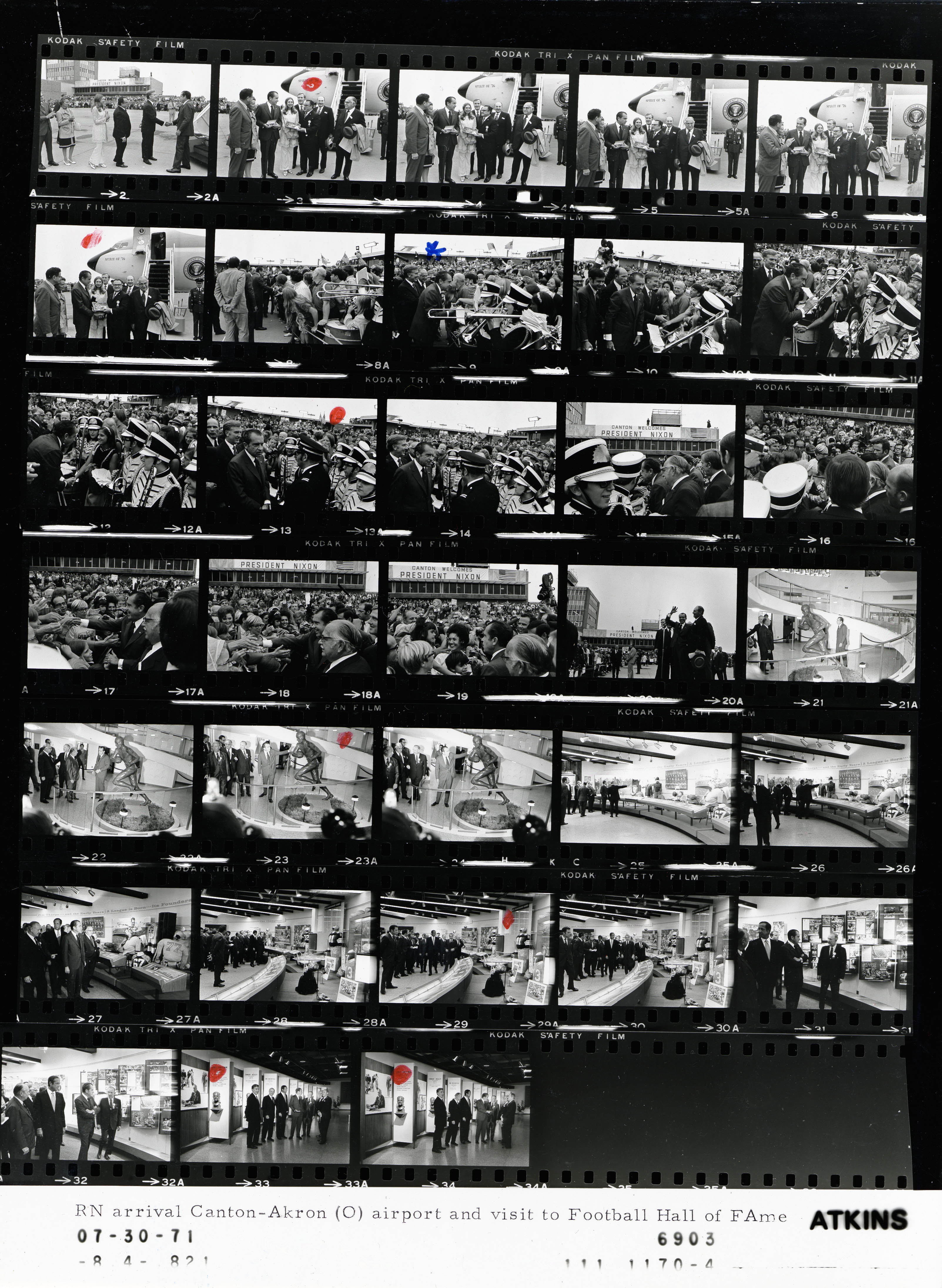
- Frame(s): WHPO-6903-02-07, President Nixon being greeted upon arrival. 7/30/1971, Canton, Ohio Akron-Canton Airport, tarmac. President Nixon, John Ballard, Mrs. John Ballard, Stanley Cmich, Mrs. Cmich, John Gilligan, William Saxbe, Frank Bow, band members, unidentified persons.
- Frame(s): WHPO-6903-08-19, President Nixon talking with band members. 7/30/1971, Canton, Ohio Akron-Canton Airport, tarmac. President Nixon, John Ballard, Mrs. John Ballard, Stanley Cmich, Mrs. Cmich, John Gilligan, William Saxbe, Frank Bow, band members, unidentified persons.
- Frame(s): WHPO-6903-20, President Nixon addressing crowd at a podium. 7/30/1971, Canton, Ohio Akron-Canton Airport, tarmac. President Nixon, John Ballard, Mrs. John Ballard, Stanley Cmich, Mrs. Cmich, John Gilligan, William Saxbe, Frank Bow, band members, unidentified persons.
- Frame(s): WHPO-6903-21-34, President Nixon touring exhibits at the Football Hall of Fame. 7/30/1971, Canton, Ohio Football Hall of Fame. President Nixon, John Ballard, Mrs. John Ballard, Stanley Cmich, Mrs. Cmich, John Gilligan, William Saxbe, Frank Bow, band members, unidentified persons.
Roll WHPO-6904 Photographer: Atkins, Oliver | Color or B&W: B&W
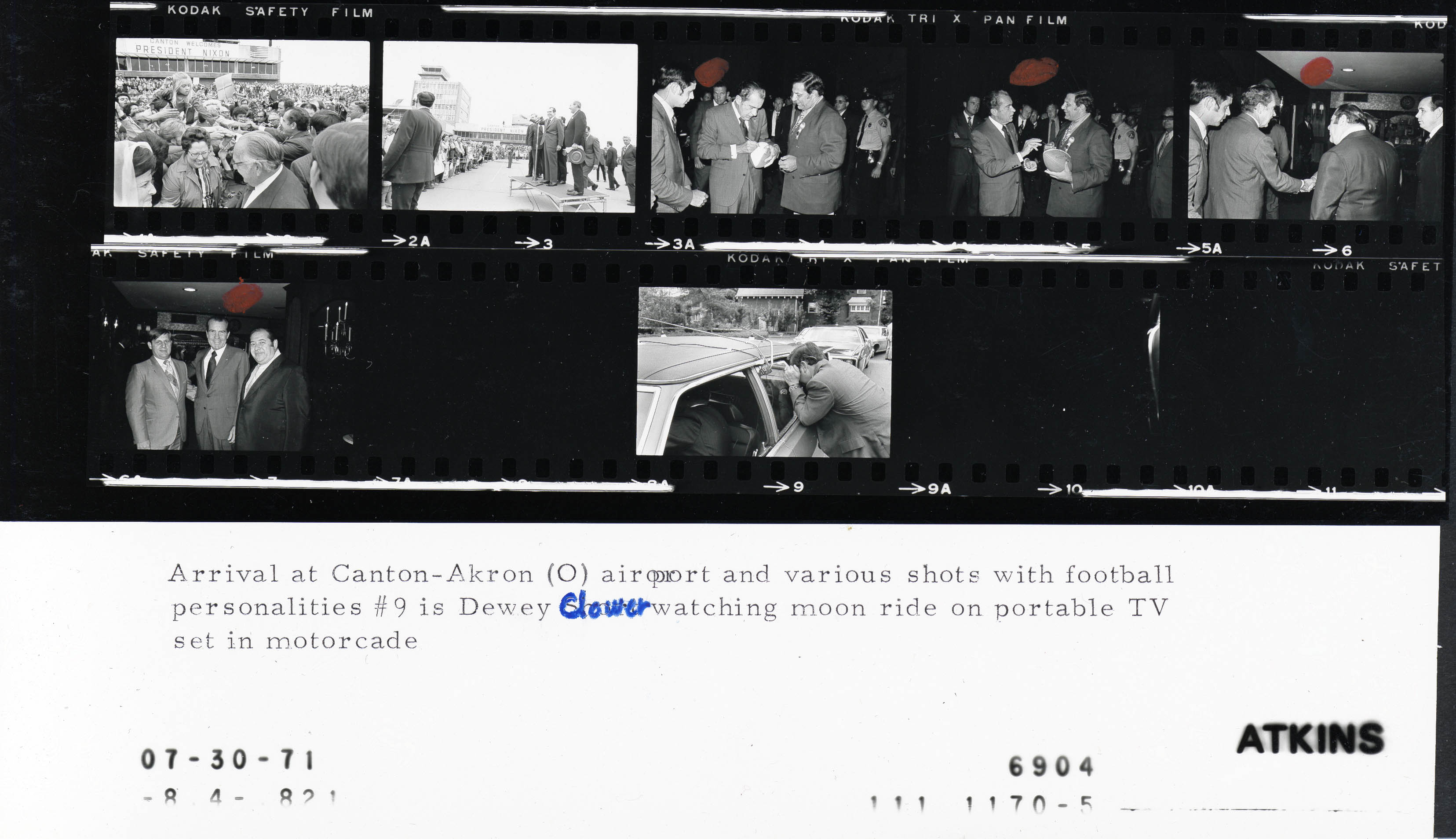
- Frame(s): WHPO-6904-01A-02A, President Nixon addressing a crowd upon arrival at the airport. 7/30/1971, Canton, Ohio Akron-Canton Airport, tarmac. President Nixon, unidentified persons.
- Frame(s): WHPO-6904-03A-6A, President Nixon with unidentified men at the exhibit area of the Football Hall of Fame. 7/30/1971, Canton, Ohio Football Hall of Fame. President Nixon, unidentified persons.
- Frame(s): WHPO-6904-08A, W. Dewey Clower, member of Ron Walker's Advance Team peering closely into a limo window, watching the Apollo 15 moon ride on the TV set inside a motorcade car. 7/30/1971, Canton, Ohio street. W. Dewey Clower, seen from left side, with hands covering face.
Roll WHPO-6908 Photographer: Atkins, Oliver | Color or B&W: B&W
- Frame(s): WHPO-6908-01-18, President Nixon greeting guests at the head table during the Pro Football Hall of Fame Awards Dinner. 7/30/1971, Canton, Ohio Football Hall of Fame. President Nixon, unidentified family, football players, officials, guests.
Roll WHPO-6915 Photographer: Atkins, Oliver | Color or B&W: B&W
- Frame(s): WHPO-6915-06A, President Nixon addressing crowd at the Pro Football Hall of Fame Awards Dinner, under a Vince Lombardi poster and lettering: "Football's Greatest Weekend.". 7/30/1971, Canton, Ohio Cultural Center for the Arts. President Nixon, football players, officials, guests.
Roll WHPO-6916 Photographer: Schumaker, Byron | Color or B&W: Color
- Frame(s): WHPO-6916-01-09, President Nixon addressing the guests at the Pro Football Hall of Fame Awards Dinner in front of a Vince Lomabardi photo banner. 7/30/1971, Canton, Ohio Cultural Center for the Arts. President Nixon, Tittle, Hewitt, Rozelle, unidentified football players, officials, guests.
- Frame(s): WHPO-6916-06A, President Nixon addressing the guests at the Pro Football Hall of Fame Awards Dinner in front of a Vince Lomabardi photo banner. 7/30/1971, Canton, Ohio Cultural Center for the Arts. President Nixon, Tittle, Hewitt, Rozelle, unidentified football players, officials, guests.
The White House Communications Agency Sound Recordings Collection contains public statements that took place between 1969 and 1974. Visit the finding aid to learn more.
G - Cabinet Officer Briefings
- WHCA-SR-G-129
Press briefing by Secretary of Labor James D. Hodgson, with Ronald Ziegler. (7/30/1971, Press Center)
Runtime: 23:00
Production credits: Audio feed supplied by WHCA; Recorded by JMC (initials of WHCA engineer)
Original Format: 1/4-inch reel-to-reel audiotape. Original source type: Original.
P - Formal Presidential Remarks
- WHCA-SR-P-710710
Remarks by President Nixon at Canton-Akron Airport. (7/30/1971)
Runtime: 4:34
Original Format: 1/4-inch reel-to-reel audiotape. Original source type: Original. - WHCA-SR-P-710711
Remarks by President Nixon at Pro Football Hall of Fame in Canton, OH. with Pete Rozelle. (7/30/1971)
Runtime: 17:06
Keywords: Sports, football
Original Format: 1/4-inch reel-to-reel audiotape. Original source type: Original. - WHCA-SR-P-710712
Interview with Frank Gifford for CBS in Canton. (7/30/1971)
Runtime: 4:11
Original Format: 1/4-inch reel-to-reel audiotape. Original source type: Original.
The White House Communications Agency Videotape Collection contains “off-the-air” recordings of televised programs produced between 1968 and 1974. Visit the finding aid to learn more.
- WHCA-4555
"The Tricycle". A Public Service Announcement from the Office of Emergency Preparedness
ABC, NBC
Runtime: 00:02:11
Context (External Sources)
The Vanderbilt Television News Archive is the world's most extensive and complete archive of television news. They have been recording, preserving and providing access to television news broadcasts of the national networks since August 5, 1968.
Wikipedia is a free encyclopedia that anyone can edit.