
Introduction
This almanac page for Thursday, July 22, 1971, pulls together various records created by the federal government and links to additional resources which can provide context about the events of the day.
Previous Date: Wednesday, July 21, 1971
Next Date: Friday, July 23, 1971
Schedule and Public Documents
The Daily Diary files represent a consolidated record of the President's activities. Visit the finding aid to learn more.
The President's day began at The White House - Washington, D. C.
The Weekly Compilation of Presidential Documents made available transcripts of the President's news conferences; messages to Congress; public speeches, remarks, and statements; and other Presidential materials released by the White House.
Digitized versions can be found at HathiTrust.
Each Public Papers of the Presidents volume contains the papers and speeches of the President of the United States that were issued by the White House Office of the Press Secretary during the time period specified by the volume. The material is presented in chronological order, and the dates shown in the headings are the dates of the documents or events. In instances when the release date differs from the date of the document itself, that fact is shown in the text note.
To ensure accuracy, remarks have been checked against audio recordings (when available) and signed documents have been checked against the original, unless otherwise noted. Editors have provided text notes and cross references for purposes of identification or clarity.
- Executive Order 11609—Delegating Certain Functions Vested in the President to Other Officers of the Government
- Executive Order 11610—Further Amending Executive Order 10789 Authorizing Agencies of the Government to Exercise Certain Contracting Authority in Connection with National Defense Functions and Prescribing Regulations Governing the Exercise of Such Authority
The Federal Register is the official daily publication for rules, proposed rules, and notices of federal agencies and organizations, as well as executive orders and other Presidential documents.
The Congressional Record is the official daily record of the debates and proceedings of the U.S. Congress.
Archival Holdings
Any selection of archival documents will necessarily be partial. You should use the documents and folders identified below as a starting place, but consult the linked collection finding aids and folder title lists and the collections themselves for context. Many documents to be found this way do not lend themselves to association with specific dates, but are essential to a complete understanding of the material.
Selective document listing
President's Office Files
The President's Office Files consists of materials drawn together by the Special Files Unit from several administrative subdivisions within the White House Office. It is the handwriting and sensitive papers sent to the Staff Secretary that now comprise much of the President's Office Files. Visit the finding aid to learn more.
- Annotated News Summaries, Box 30, News Summaries - July 1971 [1 of 2]
- Annotated News Summaries, Box 30, News Summaries - July 1971 [2 of 2] [During this period, the Staff Secretary only removed pages from the News Summaries which contained President Nixon's handwriting, often leaving the document with no date. Although there are no specific documents with this date, you should also consult the full folder for the month.]
- President's Daily Schedule, Box 101, [President's Daily Schedule, June-Aug. 1971] [2 of 3]
- The President's Schedule, Thursday - July 22, 1971
The H. R. Haldeman Diaries consists of seven handwritten diaries, 36 dictated diaries recorded as sound recordings, and two handwritten audio cassette tape subject logs. The diaries and logs reflect H. R. Haldeman’s candid personal record and reflections on events, issues, and people encountered during his service in the Nixon White House. As administrative assistant to the President and Chief of Staff, Haldeman attended and participated in public events and private meetings covering the entire scope of issues in which the Nixon White House engaged in during the years 1969-1973. Visit the finding aid to learn more.
- Transcript of diary entry (PDF)
Thursday, July 22.
First thing this morning, we were back on the China follow-up question again. He feels we have several problems. First, how it's handled, that is, what happens, what comes out of the China visit. The other, the second, is the other people going to China, which is going to dilute the effect of our trip; we need to consider that as we do our planning. He feels that someone should take the China project on and build it as our thing in leadership, relate it back to the past things the President has done and get the leadership credit for it. He feels that it's very important for us to keep hitting China because of the strong favorable reaction on it. It's obviously something that we can continue to get mileage on.
He was concerned about the youth conversation we had yesterday with Colson, because it convinced him that he was right in thinking no one was in charge. And as I explored, I find that actually is the case, so we've got to get that problem remedied.
Kissinger got into the problem of Ehrlichman doing the advance again and finally confronted President with it late today, and got the President to agree not to use Ehrlichman to handle the advancing after all. So although I haven't talked to the President about it yet, I warned Ehrlichman that that was the case, and I'm going to have to confirm it to him after I do talk to the President. Henry doesn't want to handle it with John. But it's basically right for him not to do it. The objections Kissinger has are valid, in that we shouldn't sent a substantive person over there, and we shouldn't send a high-level person to do the advancing. Also, he feels that John will approach the thing on the wrong basis, and it will look too much like a political effort. On the other side, it just doesn't make sense for John to do it, and it basically undercuts him in his domestic posture.
The President met with Finch and Rumsfeld this morning to try to get their situations untangled. Finch got into the California situation apparently, and the President told him to talk to the Attorney General about it, which was perfect because that's what I've been telling him to do. The President offered him the Ambassadorship to Mexico. Bob said he would think about it, but it isn't likely that he'll do it. He also suggested OEP as a possibility, and Bob seemed to be more interested in that. The fact that Kevin is in his senior year next year makes it very difficult for Bob to consider moving at this time. The general conclusion, then, is that maybe OEP is the best, as long as we get a Deputy that's a real manager who can run it. The other side though is that Bob's not sure he should get out at all; he thinks maybe he can help most by staying in the White House, making his speeches and working with the youth and liberals and so on. He had made the point that we can't leave California to Tuttle and Salvatori and that crowd and that we've got to get somebody to run the state, which I think is probably right.
On Rumsfeld, the President said he was very upbeat, especially on China and the Kansas City speech. The President discussed NATO with him after he said he didn't want the OEP job. He's apparently going to consider that. He also raised the question of an Under Secretary of State post, to clean out the State Department, which he thinks he'd like to do. His third point was to stay at the White House with special assignments in foreign areas, especially Latin America. So other than exploring a little new ground, nothing much was accomplished with the two of them.
I reviewed the phone poll we just took with the President and also the new Gallup poll. Both of them show no increase in his approval rating, even after the China thing, which is very hard to figure. Our poll does show, however, very strongly favorable reaction to the whole China thing and a high level of awareness, but for some reason that hasn't, at least for now, translated into Presidential approval.
End of July 22. - Original audio recording (MP3)
The National Archives Catalog is the online portal to the records held at the National Archives, and information about those records. It is the main way of describing our holdings and also provides access to electronic records and digitized versions of our holdings.
The Catalog searches across multiple National Archives resources at once, including archival descriptions, digitized and electronic records, authority records, and web pages from Archives.gov and the Presidential Libraries. The Catalog also allows users to contribute to digitized historical records through tagging and transcription.
Nixon Library Holdings
All National Archives Units
National Security Documents
The President's Daily Brief is the primary vehicle for summarizing the day-to-day sensitive intelligence and analysis, as well as late-breaking reports, for the White House on current and future national security issues. Read "The President's Daily Brief: Delivering Intelligence to Nixon and Ford" to learn more.
The Foreign Relations of the United States series presents the official documentary historical record of major U.S. foreign policy decisions and significant diplomatic activity. Visit the State Department website for more information.
Vol. V, United Nations, 1969-1972
Chinese Representation in the United Nations
378. Telegram From the Mission to the United Nations to the Department of State, New York, July 22, 1971, 2345Z
Source: National Archives, Nixon Presidential Materials, NSC Files, Box 301, Agency Files, USUN, Vol. VII. Secret; Nodis.
Vol. VII, Vietnam, July 1970-January 1972
The Consequences of Operation Lan Som 719 and the Search for a Settlement, April 8-October 6, 1971
235. Summary of Conclusions of a Meeting of the Senior Review Group, Washington, July 22, 1971, 2:35-3:40 p.m.
Source: National Archives, Nixon Presidential Materials, NSC Files, NSC Institutional Files (H-Files), Box H–112, SRG Minutes, Originals, 1971. Top Secret; Sensitive. The meeting took place in the Situation Room of the White House.
Vol. XIII, Soviet Union, October 1970-October 1971
Between Beijing and Moscow: Summit Announcement, July 19-October 12, 1971
294. Memorandum From the President’s Assistant for National Security Affairs (Kissinger) to President Nixon, Washington, July 22, 1971
Source: National Archives, Nixon Presidential Materials, NSC Files, Box 499, President’s Trip Files, Reaction to China Initiative Memos, Letters, etc., July 1971. Secret. A notation and attached correspondence profile indicate that the President saw and noted the memorandum on July 29. On July 26, however, he discussed the attached paper with Kissinger; see Document 295.
Vol. XIX, Part 1, Korea, 1969-1972
Republic of Korea Troops in Vietnam and Force Modernization, April 1971-December 1972
102. Conversation Among President Nixon, Secretary of Defense Laird, and the President’s Assistant for National Security Affairs (Kissinger), Washington, July 22, 1971
Source: National Archives, Nixon Presidential Materials, White House Tapes, Oval Office, Conversation 543–6. No classification marking. According to the Nixon Tape Log, Haldeman was also present. (Ibid.) The transcript is part of a larger conversation, 5:35–6:20 p.m. The editors transcribed the portions of the conversation printed here specifically for this volume.
Vol. XIX, Part 2, Japan, 1969-1972
April-October 1971: Change and Reassessment
82. Memorandum From Secretary of State Rogers to President Nixon, Washington, July 22, 1971
Source: National Archives, Nixon Presidential Materials, NSC Files, Box 757, Presidential Correspondence File, 1969–1974, Japan (Sato Corr) 1969–8 July 1972. Secret; Nodis. An August 2 note indicates that Rogers’ memorandum was incorporated into the President’s brief. (Ibid.)
Vol. XXI, Chile, 1969-1973
Cool and Correct: The U.S. Response to the Allende Administration, November 5, 1970-December 31, 1972
238. Memorandum From Arnold Nachmanoff of the National Security Council Staff to the President’s Assistant for National Security Affairs (Kissinger), Washington, July 22, 1971
Source: National Archives, Nixon Presidential Materials, NSC Files, Box 775, Country Files, Latin America, Chile, Vol. V. Secret. Sent for information. Kissinger initialed the memorandum.
Vol. E-1, Documents on Global Issues, 1969-1972
U.S.-Cuba Hijacking Agreement, 1969-February 1973
134. Memorandum from the Assistant Legal Adviser for Inter-American Affairs (Feldman) to the Assistant Legal Adviser of Administrative and Consular Affairs (Malmborg), Washington, July 22, 1971
This memorandum records details of Assistant Secretary of State for Inter-American Affairs Meyer’s testimony before an Executive Session of the Senate Foreign Relations Committee and reports the committee’s primary concern was why the United States could not accept a anti-hijacking agreement based on the entirety of Cuban Law 1226. Concerns of Senator Fulbright were also detailed.
Source: National Archives, RG 59, Central Files 1970-73, AV 12 US. Confidential. Drafted by Feldman. Copies were sent to Hurwitch, Salans, Funseth, and Leahy.
Oceans Policy
404. Memorandum From the President’s Assistant for National Security Affairs (Kissinger) to President Nixon, Washington, July 22, 1971
Kissinger reviewed the positions that might be adopted by the U.S. delegation to the Law of the Sea Preparatory Committee (the Seabed Committee). He recommended accommodating the fisheries interests of other states, a more flexible approach to defining seabed boundaries, and emphasizing the importance of U.S. security interests with other delegations.
Source: National Archives, Nixon Presidential Materials, NSC Files, NSC Institutional Files (H-Files), Box H-226, NSDM Files, NSDM 122. Top Secret. Sent for action. For Tab A as approved, see Document 405. Nixon did not initial the recommendation, but the attached slip indicates that he approved the recommendation on July 22.405. National Security Decision Memorandum 122, Washington, July 22, 1971
The President provided guidance for the U.S. delegation to the Law of the Sea Preparatory Committee and issued instructions concerning other aspects of U.S. oceans policy.
Source: National Archives, RG 59, S/S-I Files: Lot 83 D 305, Box 4, NSDM 122-7/22/71-US Oceans Policy. Top Secret. A copy was sent to the Chairman of the Joint Chiefs of Staff. The document, as published, incorporates an amended second page that was circulated to all addressees on July 27. Haig initialed the document, indicating that he had seen it.
Vol. E-4, Documents on Iran and Iraq, 1969-1972
Iran 1971
137. Telegram 4015 From the Embassy in Iran to the Department of State, Tehran, July 22, 1971, 1340Z
Ambassador MacArthur reported to the Department on the terms of the consortium’s agreement with Iran for additional revenue outside the terms of the five-year settlement.
Source: National Archives, RG 59, Central Files 1970–73, POL 33 PERSIAN GULF. Secret. Repeated to London, Vienna, Jidda, Kuwait, and Dhahran
Vol. E-5, Part 1, Documents on Sub-Saharan Africa, 1969-1972
The Horn
322. Memorandum From the Deputy Secretary of Defense (Packard) to the Chairman, Joint Chiefs of Staff (Moorer), Washington, July 22, 1971
Packard suggested continuing to seek ways to phase-down Kagnew facilities whenever feasible.
Source: Washington National Records Center, OSD Files: FRC 330–76–197, Ethiopia, 1971, Box 63. Secret.
Vol. E-10, Documents on American Republics, 1969-1972
Jamaica
424. Telegram 1782 From the Embassy in Jamaica to the Department of State, July 22, 1971, 2122Z., July 22, 1971, 2122Z
The Embassy reported that in a speech before the Jamaican Parliament, Prime Minister Shearer stated that the Jamaican Government planned to maintain good relations with foreign investors, and discouraged harassment of foreign bauxite companies. The Embassy concluded that Shearer had no plans to nationalize the bauxite industry.
Source: National Archives, RG 59, Central Files 1970–73, POL JAM. Confidential. In telegram 134034 to Kingston, the Department replied, “We are heartened by the general views expressed by Shearer regarding the United States, and by his constructive stand on the question of foreign investment. It is particularly encouraging that he does not regard Guyana as an inevitable model for Jamaica.” (Ibid.)
Mexico
468. Letter From Secretary of State Rogers to Secretary of Foreign Relations Rabasa, Washington, July 22, 1971., Washington, July 22, 1971
Secretary of State Rogers informed Foreign Secretary Rabasa that the U.S. Government could not accommodate Mexico’s proposed 6-year agreement for dealing with the Colorado River salinity issue, but offered a counter-proposal.
Source: National Archives, RG 59, Central Files 1970–73, POL 33–1 MEX–US. No classification marking. In telegram 4238 from Mexico City, July 27, the Embassy reported that it had delivered the new proposal to Echeverría and Rabasa, both of whom agreed to carefully study it, but made no commitments. (Ibid.) Rabasa’s proposal is published as Document 467.
Vol. E-13, Documents on China, 1969-1972
11. Letter From the Military Attaché at the Embassy in France (Walters) to the President’s Deputy Assistant for National Security Affairs (Haig), Paris, July 22, 1971, Paris, July 22, 1971
Walters described his late afternoon meeting with Chinese Ambassador to France Huang Chen on July 21.
Source: National Archives, Nixon Presidential Materials, NSC Files, Box 849, President’s File-China Trip, China Exchanges, July 1971-Oct 20, 1971. Top Secret; Sensitive; Exclusively Eyes Only. The meeting was held at Chen’s residence in Neuilly. Kirschman is in reference to Kissinger.
The Kissinger telephone conversation transcripts consist of approximately 20,000 pages of transcripts of Kissinger’s telephone conversations during his tenure as Assistant to the President for National Security Affairs (1969-1974) and Secretary of State (1973-1974) during the administration of President Richard Nixon. Visit the finding aid for more information.
Digitized versions can be found in the National Archives Catalog.
Audiovisual Holdings
The White House Tapes are sound recordings of President Richard Nixon's telephone conversations and of meetings held in the Oval Office and the Cabinet Room in the White House, the President's office in the Old Executive Office Building (OEOB), the Lincoln Sitting Room in the residence section of the White House, and several locations at the Presidential retreat at Camp David, Maryland. These recordings document many of the major events and decisions of the Nixon Administration from February 16, 1971 to July 18, 1973. Visit the White House Tapes finding aid to learn about the taping system's operation and archival processing.
Cabinet Room
Old Executive Office Building
- 266-1; Unknown between 1:06 p.m. & 1:44 p.m.; Nixon, Richard M. (President); Haldeman, H. R. ("Bob"); [Unknown person(s)]
- 266-2; 1:44 p.m. - 2:47 p.m.; Nixon, Richard M. (President); Sanchez, Manolo
- 266-3; 1:44 p.m. - 2:47 p.m.; Nixon, Richard M. (President); White House operator
- 266-4; 2:47 p.m. - 3:02 p.m.; Nixon, Richard M. (President); Colson, Charles W.
- 266-5; 3:02 p.m. - 3:03 p.m.; Nixon, Richard M. (President); Sanchez, Manolo
- 266-6; Unknown between 3:02 p.m., 7/22 & 2:45 p.m., 6/9; Nixon, Richard M. (President); [Unknown person(s)]
Oval Office
- 542-1; 9:35 a.m. - 10:01 a.m.; Nixon, Richard M. (President); Haldeman, H. R. ("Bob"); Bull, Stephen B.
- 542-2; 10:01 p.m. - 10:01 p.m.; Nixon, Richard M. (President); Sanchez, Manolo
- 542-3; 10:01 a.m. - 10:51 a.m.; Nixon, Richard M. (President); Finch, Robert H.
- 542-4; 10:51 a.m. - 11:36 a.m.; Nixon, Richard M. (President); McCracken, Paul W.; Sanchez, Manolo; White House operator; Connally, John B.; Rumsfeld, Donald H.
- 542-5; 11:36 a.m. - 12:28 p.m.; Nixon, Richard M. (President); Rumsfeld, Donald H.; Sanchez, Manolo; [Unknown person(s)]; Bull, Stephen B.
- 542-6; Unknown between 12:28 p.m. & 12:31 p.m.; Nixon, Richard M. (President); Bull, Stephen B.
- 542-7; 12:31 p.m. - 12:35 p.m.; Nixon, Richard M. (President); Bear, Stanley H.; Bear, Stanley H. (Mrs.); Bear, Susan; Bear, Vickie; Bear, Nancy; Bear, David; Hughes, James D. ("Don")
- 542-8; 12:36 p.m. - 12:36 p.m.; Nixon, Richard M. (President); Bull, Stephen B.
- 542-9; 12:36 p.m. - 12:40 p.m.; Nixon, Richard M. (President); Jamison, Robert J.; Jamison, Robert J. (Mrs.); Woods, Rose Mary
- 542-10; 12:41 p.m. - 12:45 p.m.; Nixon, Richard M. (President); Tankoos, Dianne C.; Woods, Rose Mary
- 542-11; Unknown between 12:45 p.m. & 12:49 p.m.; Nixon, Richard M. (President); Bull, Stephen B.
- 542-12; 12:49 p.m. - 12:57 p.m.; Nixon, Richard M. (President); Haldeman, H. R. ("Bob"); Bull, Stephen B.
- 542-13; Unknown between 12:57 p.m. & 11:59 p.m.; United States Secret Service agents
- 543-1; Unknown between 3:49 p.m. & 5:05 p.m.; Nixon, Richard M. (President); Rogers, William P.; Kissinger, Henry A.
- 543-2; Unknown between 5:05 p.m. & 5:16 p.m.; Nixon, Richard M. (President); Bull, Stephen B.
- 543-3; 5:16 p.m. - 5:16 p.m.; Nixon, Richard M. (President); White House operator
- 543-4; 5:16 p.m. - 5:16 p.m.; Nixon, Richard M. (President); Bull, Stephen B.
- 543-5; Unknown between 5:17 p.m. & 5:35 p.m.; United States Secret Service agents
- 543-6; Unknown between 5:35 p.m. & 6:20 p.m.; Nixon, Richard M. (President); [Unknown person(s)]; Laird, Melvin R.; Kissinger, Henry A.; Haldeman, H. R. ("Bob"); White House operator; Sanchez, Manolo
- 543-7; Unknown between 6:20 p.m. & 6:25 p.m.; Nixon, Richard M. (President); Butterfield, Alexander P.
- 543-8; 6:25 p.m. - 6:46 p.m.; Nixon, Richard M. (President); Haldeman, H. R. ("Bob"); Kissinger, Henry A.; [Unknown person(s)]
- 543-9; 6:46 p.m. - 6:46 p.m.; United States Secret Service agents
White House Telephone
- 6-182; Unknown between 9:22 a.m. & 11:32 a.m.; Nixon, Richard M. (President); White House operator
- 6-183; 11:32 a.m. - 11:35 a.m.; Nixon, Richard M. (President); Connally, John B.; Haldeman, H. R. ("Bob")
- 6-184; Unknown between 11:35 a.m. & 2:47 p.m.; Nixon, Richard M. (President); White House operator
- 6-185; Unknown between 2:47 p.m. & 3:02 p.m.; Nixon, Richard M. (President); Colson, Charles W.
- 6-186; 5:16 p.m. - 5:16 p.m.; Nixon, Richard M. (President); White House operator
- 6-187; 5:38 p.m. - 5:38 p.m.; Nixon, Richard M. (President); White House operator
- 6-188; Unknown between 6:46 p.m. & 7:00 p.m.; Nixon, Richard M. (President); White House operator
- 6-189; 7:41 p.m. - 7:45 p.m.; Nixon, Richard M. (President); Dole, Robert J.
- 6-190; Unknown between 7:45 p.m. & 7:52 p.m.; Nixon, Richard M. (President); White House operator
- 6-191; Unknown between 7:45 p.m. & 7:52 p.m.; Nixon, Richard M. (President); White House operator
- 6-192; 7:52 p.m. - 7:53 p.m.; Nixon, Richard M. (President); Rebozo, Charles G. ("Bebe")
- 6-193; Unknown between 7:55 p.m. & 8:07 p.m.; Nixon, Richard M. (President); Colson, Charles W.
The White House Photo Office collection consists of photographic coverage of President Richard Nixon meeting with prominent social, political, and cultural personalities; speaking engagements and news conferences of the President and various high-ranking members of the White House staff and Cabinet; Presidential domestic and foreign travel, including Presidential vacations; social events and entertainment involving the First Family, including entertainers present; official portraits of the President, First Family, and high-ranking members of the Nixon administration; the 1969 and 1973 Inaugurals; the President’s 1972 Presidential election campaign appearances (including speeches) and other official activities of the White House staff and the President’s Cabinet from January 20, 1969 until August 9, 1974 at the White House and the Old Executive Office Building; other locations in Washington, DC, such as The Mall; and the Presidential retreats in Camp David, Maryland, Key Biscayne, Florida, and San Clemente, California. Visit the finding aid to learn more.
Roll WHPO-6845 Photographer: Schumaker, Byron | Color or B&W: B&W
- Frame(s): WHPO-6845-01A-10A, Brigadier General James Donald Hughes awarding a medal to Col. Stanley Bear. 7/22/1971, Washington, D.C. unknown. Brigadier General James Donald Hughes, Stanley Bear, Mrs. Bear, unidentified man.
Roll WHPO-6846 Photographer: Atkins, Oliver | Color or B&W: B&W
- Frame(s): WHPO-6846-02-03, President Nixon meeting with and greeting state presidents of the Future Farmers of America. 7/22/1971, Washington, D.C. White House, Cabinet Room,. President Nixon, Future Farmers of America members, Rep. Paul Finley.
- Frame(s): WHPO-6846-04-10, The Future Farmers of America's Presidents standing in a group photo. 7/22/1971, Washington, D.C. White House, South Portico Stairs. President Nixon, Future Farmers of America members, Rep. Paul Finley.
Roll WHPO-6847 Photographer: Atkins, Oliver | Color or B&W: B&W
- Frame(s): WHPO-6847-03A-08A, President Nixon with Col. Stanley Bear and his family. 7/22/1971, Washington, D.C. White House, Oval Office. President Nixon, Stanley Bear, Mrs. Bear, Susan Bear, Vicki Bear, Nancy Bear, David Bear, unidentified man and woman, Robert Jamison, Mrs. Jamison, Dianne Tankoos.
- Frame(s): WHPO-6847-09A-12A, President Nixon with Robert Jamison and his wife. 7/22/1971, Washington, D.C. White House, Oval Office. President Nixon, Stanley Bear, Mrs. Bear, Susan Bear, Vicki Bear, Nancy Bear, David Bear, unidentified man and woman, Robert Jamison, Mrs. Jamison, Dianne Tankoos.
- Frame(s): WHPO-6847-14A-17, President Nixon with Dianne Tankoos. 7/22/1971, Washington, D.C. White House, Oval Office. President Nixon, Dianne Tankoos.
Roll WHPO-6848 Photographer: Kightlinger, Jack | Color or B&W: B&W
- Frame(s): WHPO-6848-02-06, President Nixon sitting at his desk with Melvin Laird and Henry Kissinger. 7/22/1971, Washington, D.C. White House, Oval Office. President Nixon, Melvin Laird, Henry Kissinger.
Roll WHPO-6849 Photographer: Schumaker, Byron | Color or B&W: B&W
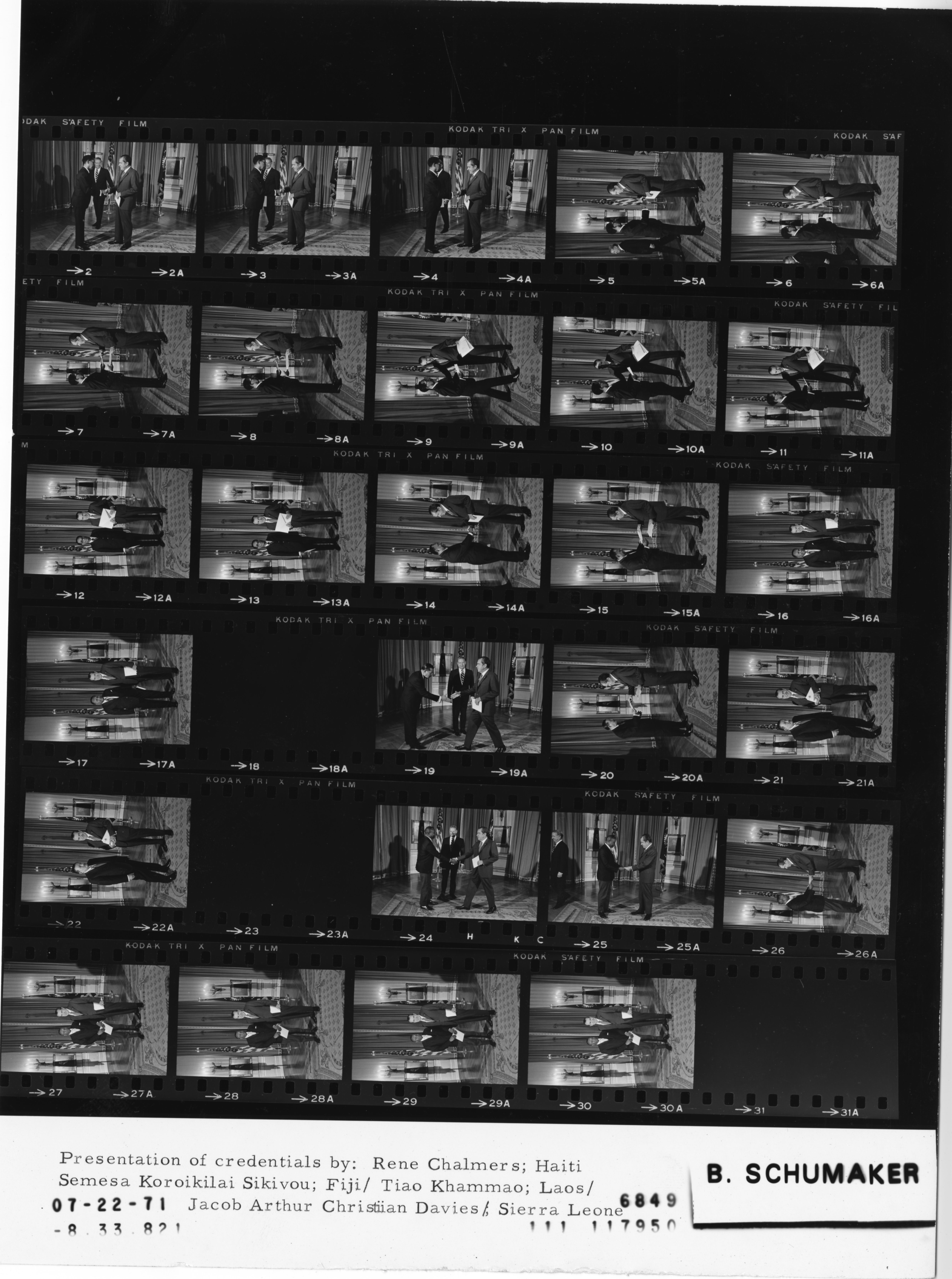
- Frame(s): WHPO-6849-02-13, President Nixon receiving diplomatic credentials from Haitian Ambassador Rene Chalmers. 7/22/1971, Washington, D.C. White House, Blue Room. President Nixon, Rene Chalmers.
- Frame(s): WHPO-6849-14-17, President Nixon receiving diplomatic credentials from Ambassador Semesa K. Sikivou of Fiji. 7/22/1971, Washington, D.C. White House, Blue Room. President Nixon, Semesa K. Sikivou.
- Frame(s): WHPO-6849-19-22, President Nixon receiving diplomatic credentials from Laotian Ambassador HRH Tiao Khammao. 7/22/1971, Washington, D.C. White House, Blue Room. President Nixon, Tiao Khammao.
- Frame(s): WHPO-6849-24-30, President Nixon receiving diplomatic credentials from Ambassador Jacob Arthur C. Davies of Sierra Leone. 7/22/1971, Washington, D.C. White House, Blue Room. President Nixon, Jacob Arthur C. Davies.
Roll WHPO-6886 Photographer: Schumacher, Karl | Color or B&W: B&W
- Frame(s): WHPO-6886-03A-11A, Vice President Agnew preparing to leave Spain. 7/22/1971, Madrid, Spain airport. Spiro Agnew, Spanish officials, Congolese officials, unidentified persons.
- Frame(s): WHPO-6886-12A-22A, Vice President Agnew arriving in Kinshasa. 7/22/1971, Kinshasa, Congo airports. Spiro Agnew, Spanish officials, Congolese officials, unidentified persons.
Roll WHPO-6887 Photographer: Schumacher, Karl | Color or B&W: B&W
- Frame(s): WHPO-6887-02A-17A, Vice President Agnew touring Congo. 7/22/1971, Kinshasa, Congo unknown. Spiro Agnew, Congolese officials, unidentified persons.
Roll WHPO-6888 Photographer: Schumacher, Karl | Color or B&W: Color
- Frame(s): WHPO-6888-04A-10A, Vice President Agnew and others walking in a game preserve. 7/22/1971, Congo unknown. Spiro Agnew, unidentified persons.
Roll WHPO-6889 Photographer: Schumacher, Karl | Color or B&W: Color
- Frame(s): WHPO-6889-04-09, Vice President Agnew and others walking in a game preserve. 7/22/1971, Congo unknown. Spiro Agnew, unidentified persons.
- Frame(s): WHPO-6889-10-16, Vice President Agnew preparing to leave the Congo. 7/22/1971, Congo airport. Spiro Agnew, unidentified persons.
Roll WHPO-6890 Photographer: Schumacher, Karl | Color or B&W: Color
- Frame(s): WHPO-6890-03A-06A, Unidentified persons standing outside a building in the game perserve. 7/22/1971, Congo unknown. unidentified persons.
- Frame(s): WHPO-6890-07A-08A, A lion lying in the grass. 7/22/1971, Congo unknown.
- Frame(s): WHPO-6890-09A, Vice President Agnew meeting with officials. 7/22/1971, Congo unknown. Spiro Agnew, officials.
- Frame(s): WHPO-6890-12A-13A, 16A, Vice President Agnew sitting with officials. 7/22/1971, Congo unknown. Spiro Agnew, officials.
- Frame(s): WHPO-6890-14A-15A, Vice President Agnew walking with officials. 7/22/1971, Congo unknown. Spiro Agnew, officials.
The White House Communications Agency Videotape Collection contains “off-the-air” recordings of televised programs produced between 1968 and 1974. Visit the finding aid to learn more.
- WHCA-4540
"Newsmakers". FTN: U.S. Representatives Dingle and Eckhardt; "I&A": Walt Rostow, former National Security Advisor to President Johnson.
CBS, ABC
Runtime: 00:31:02 - WHCA-4541
"Washington Week in Review". George Meany, President of the AFL-CIO.
NBC
Runtime: 00:29:41 - WHCA-4542
"Strangers in Their Own Land", Part I of a Three Part Series on Minorities in America". Robert J. Brown, Special Assistant to the President.
ABC
Runtime: 00:30:32 - WHCA-4543
"The Dick Cavett Show":Big Mama Thornton, Roger Moore, Saul Alinsky, C. McCann. Big Mama Thornton, Roger Moore, Saul Alinsky, Chuck McCann discuss music, blues, Janis Joplin, Elvis Presley, celebrities, radicals, community organizing U.S. Senator from Arizona, and former Presidential candidate Barry S. Goldwater, Sr..
Daphne Productions and Roland & Jaffee Productions
Runtime: 01:31:00 - WHCA-4545
Weekly News Summary, Tape II.
ALL NETWORKS
Runtime: 01:25:29
29. Brinkley/Saarinen: Draft law expiration and military troops shortages; Paris Peace Talks changed relations with China;' United States shake Hanoi. Time Code Start: 70:04. Keywords: military, conscription, selective service, lottery, laws, Paris Peace Talks, Vietnam War, Indochina War, treaty, treaties, negotiations, foreign relations, draft reform, draft evasion. Network: NBC.
30. Brinkley/Duke: College students getting food stamps may be reason families in poverty can't get welfare aid they need; distribution of Federal tax dollars from city to city. Time Code Start: 72:43. Keywords: food, financial aid, universities, families, unemployment, welfare, Aid to Families with Dependent Children, taxes, benefits, cities, statistics. Network: NBC.
31. Cronkite/Schakne: Federal Grand Jury hearings appeals on Kent State killings over a year old. Time Code Start: 74:57. Keywords: National Guard, shootings, students, deaths, colleges, universities, investigations, demonstrations, rally, protests, protesters, demonstraters, demonstrators, Vietnam War, anti-war, lawsuits, hearings, trials. Network: CBS.
32. Cronkite: Combat death toll in Vietnam War in the recent week; North Vietnam still demands for unconditional American widthdrawal from Vietnam in Paris Peace Talks; John Kerry accused of using views on the Vietnam War for political ambitions. Time Code Start: 78:24. Keywords: Vietnam War, military, Killed in Action, KIA, death tolls, fatalities, casualties. Network: CBS.
33. Cronkite: Food Stamps program to exclude college student recipients and will rechannel aid benefits to poverty stricken. Time Code Start: 80:07. Keywords: food, financial aid, families, unemployment, welfare, Aid to Families with Dependent Children. Network: CBS.
34. Cronkite/Mudd: Senator Ted Kennedy accuses American Medical Association (AMA) has monopoly on administration health programs. Time Code Start: 80:42. Keywords: Senators, criticisms, health care, health insurance, health organizations, insurance, benefits, medicine, medical care, hospitals, costs, financial aid. Network: CBS.
35. Cronkite/Sevareid: government documents published from World War II show Mao Tse-Tung and Chou En Lai's request meeting with President Roosevelt about McCarthy Anti Communism trials; President Nixon's planned visit to China. Time Code Start: 82:05. Keywords: Presidents, travel, trips, People's Republic of China, leaders, requests, WWII, letters, writings, trials, Communists. Network: CBS.
Context (External Sources)
The Vanderbilt Television News Archive is the world's most extensive and complete archive of television news. They have been recording, preserving and providing access to television news broadcasts of the national networks since August 5, 1968.
Wikipedia is a free encyclopedia that anyone can edit.