
Introduction
This almanac page for Wednesday, July 21, 1971, pulls together various records created by the federal government and links to additional resources which can provide context about the events of the day.
Previous Date: Tuesday, July 20, 1971
Next Date: Thursday, July 22, 1971
Schedule and Public Documents
The Daily Diary files represent a consolidated record of the President's activities. Visit the finding aid to learn more.
The President's day began at The White House - Washington, D. C.
The Weekly Compilation of Presidential Documents made available transcripts of the President's news conferences; messages to Congress; public speeches, remarks, and statements; and other Presidential materials released by the White House.
Digitized versions can be found at HathiTrust.
Each Public Papers of the Presidents volume contains the papers and speeches of the President of the United States that were issued by the White House Office of the Press Secretary during the time period specified by the volume. The material is presented in chronological order, and the dates shown in the headings are the dates of the documents or events. In instances when the release date differs from the date of the document itself, that fact is shown in the text note.
To ensure accuracy, remarks have been checked against audio recordings (when available) and signed documents have been checked against the original, unless otherwise noted. Editors have provided text notes and cross references for purposes of identification or clarity.
The Federal Register is the official daily publication for rules, proposed rules, and notices of federal agencies and organizations, as well as executive orders and other Presidential documents.
The Congressional Record is the official daily record of the debates and proceedings of the U.S. Congress.
Archival Holdings
Any selection of archival documents will necessarily be partial. You should use the documents and folders identified below as a starting place, but consult the linked collection finding aids and folder title lists and the collections themselves for context. Many documents to be found this way do not lend themselves to association with specific dates, but are essential to a complete understanding of the material.
Selective document listing
President's Office Files
The President's Office Files consists of materials drawn together by the Special Files Unit from several administrative subdivisions within the White House Office. It is the handwriting and sensitive papers sent to the Staff Secretary that now comprise much of the President's Office Files. Visit the finding aid to learn more.
- Annotated News Summaries, Box 30, News Summaries - July 1971 [1 of 2]
- Annotated News Summaries, Box 30, News Summaries - July 1971 [2 of 2] [During this period, the Staff Secretary only removed pages from the News Summaries which contained President Nixon's handwriting, often leaving the document with no date. Although there are no specific documents with this date, you should also consult the full folder for the month.]
- President's Daily Schedule, Box 101, [President's Daily Schedule, June-Aug. 1971] [2 of 3]
- The President's Schedule, Wednesday - July 21, 1971
The H. R. Haldeman Diaries consists of seven handwritten diaries, 36 dictated diaries recorded as sound recordings, and two handwritten audio cassette tape subject logs. The diaries and logs reflect H. R. Haldeman’s candid personal record and reflections on events, issues, and people encountered during his service in the Nixon White House. As administrative assistant to the President and Chief of Staff, Haldeman attended and participated in public events and private meetings covering the entire scope of issues in which the Nixon White House engaged in during the years 1969-1973. Visit the finding aid to learn more.
- Transcript of diary entry (PDF)
Wednesday, July 21.
President had the day clear except for a scheduled meeting at 3:00 with Connally and a group of us on labor. He came in late and went right over to the EOB, had a long session with Henry and then called me over. I used the opportunity to go through the whole scheduling folder and get all of the backlog of schedule stuff cleaned up. He agreed to do a quick trip to Iowa and Ohio on Saturday a week, to do a dam dedication and the Football Hall of Fame. Then the following week, he wants to go to Maine and New Hampshire. He's still planning on doing the California vacation.
We also got into some discussion of the China trip. Henry had hit him on the idea of having Ehrlichman doing the advance, and had refused to allow Ehrlichman to go with him and is very much upset about Ehrlichman going at all. Henry and I discussed this a couple of times later in the day, and he's going to try and get it shifted. The President's concern, of course, is to keep Kissinger out of logistics, but I think we can work that out by having Chapin, or somebody, go with Henry. President also thought we ought to take a really hard look on what we want to do regarding press on the trip. We'll obviously have to take all the networks and the wire services and wire photos, but then the question is how much we take in the way of newspaper, magazine and radio people. We talked about using San Francisco as the point of departure, stopping in Wake on the way over, and then stopping in Alaska on the way back and going on to Washington. President said he's going to take charge of the advance himself, especially the Secret Service and staff thing, keeping it to an absolute minimum, cutting down on the numbers, that there's no reason to mar this with a lot of extra people.
He talked about Kennedy, Dave Kennedy, as Ambassador to Japan. President wanted me to discuss this with Connally. He has no confidence in State's choice. Wants a senior businessman, thinks Kennedy would be ideal; so if Connally has no objection, President will try to name him. Got into discussion on the youth program. President questioned what was being done and feels that we can use China as a takeoff point for youth, especially this fall, that we could really whip up enthusiasm. He got Colson in to make the point that we needed to do that, plus more general hailing of the President to really build up the fact of the initiative. Also that we should exploit the leadership thing in every possible way.
Regarding the YAF, he said we shouldn't worry about their criticism. We've got to realize how low their influence is, that they are unreasonable, and we probably just have to let them go. That the price that we have to pay for them is too great. The question is, where were they before China, on Laos, Cambodia, and etcetera? They weren't speaking up for us then, so why should we worry about them speaking against us now?
The President was horrified by a proposal Kissinger made to go on a secret trip to Hanoi after he leaves Peking on the next trip. President's point being that Henry is now getting carried away with his secret diplomacy and going too far. We discussed the Finch situation, and he's concerned about Bob, thinks he may be going through the Stassen syndrome of wanting a job, such as a Senatorship, so much that he's lost all his judgment and perspective. I think that may very well be true. Kissinger raised the problem of Stans requesting a visit to Russia, and we agreed that that would be turned down. Stans had his administrative assistant approach Dobrynin directly on it, which didn't make Henry very happy. Henry also thinks that Grunwald of Time magazine is capable of switching, that if he is convinced that we are the gurus and the leaders, that we could switch him over, and that it's worth our making the effort to try to do so.
At 3:00, we had a two hour meeting with Shultz, Connally, Ehrlichman, and Colson. President first raised the point of whether we couldn't develop a program of issuing bonds, government bonds for special purpose projects, as a way to get big things done, such as general research, cure for cancer, environmental questions, and so on. He says we have to find a way to do big things, but without raising taxes, and this might be the way to do it. Also it would establish a sort of market value on some of these things, in that if people won't buy the bonds to support them, then we can make the claim that there isn't sufficient public support to carry out the project. He then raised the point that Connally has a theory that it's good to have an enemy, and that one of the best we could have now is John Kenneth Galbraith, who has come out yesterday in favor of permanent government controls on the economy. The President feels that we should have a concerted effort to blast him, as the economic spokesman for the liberal wing of the Democratic Party, their chief guru. Now he's finally said what he really meant. He wants then that, by hitting this, we can turn the control argument our way. In other words, he feels we can win this debate, if we scare them enough on it.
He then got into the basic subject of the meeting, which was the whole labor/management problem. The question of whether we should write off the unions or try to work with them. The key, he pointed out, is how to do the best we can with the rank and file, recognizing that the leadership ranges from strongly anti to, at best, neutral. The specific question was the planned meeting in September of labor and management, regarding the big picture, which we were going to try to do to get bipartisan appeal, but it means asking Meany to play a major part, and the question is whether we want to do that. Connally said he felt there was no justification for an all-out war on labor, that the September meeting could be a good sounding board, but we shouldn't expect labor to bore-in on productivity and do anything about it. He says labor is not irretrievably lost to Nixon. We can get to the rank and file, especially on the issue of jobs, and that particularly, in the American position in the world economy––our trade relations. On that issue, labor will be our strongest ally. Also in the field of ecology, because they're sick and tired of it; they're not interested in losing jobs in order to clean up the environment.
The President added that, although it’s sort of a long philosophical thing then, making the point that the ordinary working guy is made up of the two-thirds of the people in this country who never went to college. And that in this period of our history, the leaders and the educated class are decadent. Whenever you ask for patriotic support, they all run away: the college types, the professors, the elite, etcetera. So he concludes the more a person is educated, he becomes brighter in the head and weaker in the spine. When you have to call on the nation to be strong––on such things as drugs, crime, defense, and our basic national position—the educated people and the leader class no longer has any character, and you can't count on them. We can only turn for support to the non-educated people. He says look at Meany, Fitzsimmons, and Brennan. They're shortsighted, partisan, hate Nixon politically, but they represent the constituency of uneducated people, which plus the farm heartland, are all that's left of the character of this nation. He's concerned whether the country really has the character to do what must be done. And he cited his meetings with college-- the group of college presidents, the new managerial business class, the science advisory group, who have absolutely no character or guts. Also the ministers, except for the Billy Graham-type know nothings, so-called. They're all permissive, with no character. And the nation's editors and reporters have no spine or guts left. So where do you go? If you don't communicate with the labor leaders, they can go to the masses, the rank and file of labor, and say we don't care. So we've got to communicate with them. Plus they are men, not softies. So we have to find a way, intelligently, to fight them where they're wrong, plus to go over their heads, when it's necessary, to their troops. He feels the country is in a great moral crisis, a crisis of character, and we won't get leadership from our class. When we need support on tough problems, the uneducated are the ones that are with us. So it was generally agreed that we must maintain an open public communication, regardless of how the labor leaders kick the Administration. There are many ways to get the working people with us. Jobs is the main one, but the racial issue and a lot of others can also be used. The key is really the jobs issue and job security, and we’ve got to avoid appearing to be anti-union. We have to get that cast right, and Connally feels that the way to approach it is the international picture. The President emphasized we need to dramatize it by a number, such as a hundred million jobs by '76, or something. Also we need to keep Meany willing to look the other way, if the locals take a walk on the Democratic candidates. President feels the Democrats will now have to nominate an ultra-liberal, that there's no way they can avoid it, and that they then will have trouble pulling labor in behind them, and that's our chance. Paragraph.
He then ended the meeting—all of that took about two hours—asked Connally and me to stay behind. He raised directly the Vice Presidential question, asked me to report to Connally on my talk with Harlow about the Vice President's three out of four chance evaluation that he will not run for reelection. We all agreed, as the President and I had yesterday, that if he's not going to go for reelection, he's got to resign now and let the President appoint somebody. President then made the major pitch again for the fact that "somebody" has to be Connally; that he's the only man who can be President, and that the appointments got to be made on the consideration of the man may very well become President. Connally emphasized, as he said he had with the President the day—two days ago—that he had no ambition for the job, and he then went on to say that, as a matter of fact, he wasn't at all sure he could stand being President, that it seemed like a ver-- I mean Vice President, that it seemed like a very useless job, and that he was much better off as a Cabinet officer. The President jumped on that, emphasized that that depended totally on who the Vice President was and how he worked with the President, that with the two of them and the relationship that they have, the Vice President could be an extremely meaningful job. Much more so than it's ever been in history, that he would use him as an alternate President, and I'm convinced he really means that.
He didn't try to push Connally to any kind of decision, in fact very carefully avoided pushing him at all, but obviously is giving him a pretty good shove in the right direction. It was, in its way, quite an historic meeting, and it will be fascinating to see what comes of it. It's clear that Connally feels strongly that Agnew does have to go, and he doesn't have any suggestion as to who would be a replacement for him, other than himself. So it's my opinion that he's basically decided that he’d take it, but he's obviously not going to ask for it, because he doesn't want to be in that position. He'll have a pretty strong hand to deal from now, and it may be very difficult to work with him, but it will be interesting to see.
End of July 21. - Original audio recording (MP3)
The National Archives Catalog is the online portal to the records held at the National Archives, and information about those records. It is the main way of describing our holdings and also provides access to electronic records and digitized versions of our holdings.
The Catalog searches across multiple National Archives resources at once, including archival descriptions, digitized and electronic records, authority records, and web pages from Archives.gov and the Presidential Libraries. The Catalog also allows users to contribute to digitized historical records through tagging and transcription.
Nixon Library Holdings
All National Archives Units
National Security Documents
The President's Daily Brief is the primary vehicle for summarizing the day-to-day sensitive intelligence and analysis, as well as late-breaking reports, for the White House on current and future national security issues. Read "The President's Daily Brief: Delivering Intelligence to Nixon and Ford" to learn more.
The Foreign Relations of the United States series presents the official documentary historical record of major U.S. foreign policy decisions and significant diplomatic activity. Visit the State Department website for more information.
Vol. V, United Nations, 1969-1972
Chinese Representation in the United Nations
376. Circular Telegram From the Department of State to Certain Posts, Washington, July 21, 1971, 2243Z
Source: National Archives, RG 59, Central Files 1970–73, UN 6 CHINAT. Secret; Nodis. Drafted by William A. Brown; cleared by Armitage, Arva C. Floyd, Russell Fessenden, and Robert H. Miller; and approved by Assistant Secretary Green. Sent to Helsinki, Copenhagen, Stockholm, Oslo, Brussels, Vienna, Bern, Dublin, Madrid, Lisbon, The Hague, USNATO, USUN, and Luxembourg.
Vol. XIII, Soviet Union, October 1970-October 1971
Between Beijing and Moscow: Summit Announcement, July 19-October 12, 1971
291. Memorandum From Secretary of State Rogers to President Nixon, Washington, July 21, 1971
Source: National Archives, Nixon Presidential Materials, NSC Files, Box 716, Country Files, Europe, USSR, Vol. XV. Secret; Nodis. According to a notation and attached correspondence profile, the President saw the memorandum on August 6. According to another copy, Rogers drafted the memorandum himself and sent a copy to Kissinger. (Ibid., RG 59, Rogers’ Office Files: Lot 73 D 443, Box 3, Chronological File, 1969–1973)
292. Memorandum From the President’s Deputy Assistant for National Security Affairs (Haig) to the President’s Assistant for National Security Affairs (Kissinger), Washington, July 21, 1971
Source: National Archives, Nixon Presidential Materials, NSC Files, Box 522, Country Files, Far East, China, Vol. VIII. Secret; Sensitive.
293. Transcript of a Telephone Conversation Between the President’s Assistant for National Security Affairs (Kissinger) and Congressman Gerald R. Ford, Washington, July 21, 1971, 1:10 p.m.
Source: National Archives, Nixon Presidential Materials, Henry Kissinger Telephone Conversation Transcripts, Box 10, Chronological File. No classification marking.
Vol. XXIII, Arab-Israeli Dispute, 1969-1972
244. Telegram From the Department of State to the Embassy in Israel, Washington, July 21, 1971, 0105Z
Source: National Archives, Nixon Presidential Materials, NSC Files, Box 1164, Saunders Files, Middle East Negotiations Files, Middle East—Jarring Talks, July 16–August 1, 1971. Secret; Nodis; Cedar Plus. Drafted and approved by Sisco. Repeated to Cairo.
Vol. XXIV, Middle East Region and Arabian Peninsula, 1969-1972; Jordan, September 1970
Persian Gulf States
104. Telegram From the Department of State to the Embassies in Saudi Arabia and Iran, Washington, July 21, 1971, 0041Z
Source: National Archives, RG 59, Central Files 1970–73, POL 16 UAE. Secret; Priority; Exdis. Drafted by Twinam and Murphy; cleared in NEA/IRN, NEA, and S/S–O; and approved by Sisco. It was repeated to Kuwait, London, and Dhahran.
Vol. XXIX, Eastern Europe, 1969-1972
Hungary
121. Telegram From the Embassy in Hungary to the Department of State, Budapest, July 21, 1971, 1405Z
Source: National Archives, RG 59, Central Files 1970–73, POL HUNG–US. Confidential. Puhan reported on other portions of his meeting with Peter in telegrams 1309, 1310, and 1314 from Budapest, July 21. (Ibid. and ibid., SOC 12–1 HUNG)
The Kissinger telephone conversation transcripts consist of approximately 20,000 pages of transcripts of Kissinger’s telephone conversations during his tenure as Assistant to the President for National Security Affairs (1969-1974) and Secretary of State (1973-1974) during the administration of President Richard Nixon. Visit the finding aid for more information.
Digitized versions can be found in the National Archives Catalog.
Audiovisual Holdings
The White House Tapes are sound recordings of President Richard Nixon's telephone conversations and of meetings held in the Oval Office and the Cabinet Room in the White House, the President's office in the Old Executive Office Building (OEOB), the Lincoln Sitting Room in the residence section of the White House, and several locations at the Presidential retreat at Camp David, Maryland. These recordings document many of the major events and decisions of the Nixon Administration from February 16, 1971 to July 18, 1973. Visit the White House Tapes finding aid to learn about the taping system's operation and archival processing.
Old Executive Office Building
- 264-1; Unknown between 10:05 a.m. & 10:21 a.m.; Nixon, Richard M. (President); [Unknown person(s)]
- 264-2; Unknown between 10:05 a.m. & 10:21 a.m.; Nixon, Richard M. (President); Sanchez, Manolo
- 264-3; 10:21 a.m. - 11:01 a.m.; Nixon, Richard M. (President); Kissinger, Henry A.
- 264-4; Unknown between 11:01 a.m. & 11:05 a.m.; Nixon, Richard M. (President); Haldeman, H. R. ("Bob")
- 264-5; Unknown between 11:05 a.m. & 1:14 p.m.; Nixon, Richard M. (President); Haldeman, H. R. ("Bob"); Kissinger, Henry A.
- 264-6; Unknown between 1:14 p.m. & 2:39 p.m.; Nixon, Richard M. (President); [Unknown person(s)]
- 264-7; Unknown between 1:14 p.m. & 2:39 p.m.; Nixon, Richard M. (President); Sanchez, Manolo
- 264-8; Unknown between 1:14 p.m. & 2:39 p.m.; Nixon, Richard M. (President); Sanchez, Manolo
- 264-9; Unknown between 1:14 p.m. & 2:39 p.m.; Nixon, Richard M. (President); White House operator
- 264-10; Unknown between 1:14 p.m. & 2:39 p.m.; Nixon, Richard M. (President); Sanchez, Manolo
- 264-11; 2:39 p.m. - 2:42 p.m.; Nixon, Richard M. (President); Connally, John B.
- 264-12; 2:43 p.m. - 2:47 p.m.; Nixon, Richard M. (President); Romnes, Haakon I.
- 264-13; Unknown between 2:47 p.m. & 2:51 p.m.; Nixon, Richard M. (President); White House operator
- 264-14; Unknown between 2:47 p.m. & 2:51 p.m.; Nixon, Richard M. (President); Sanchez, Manolo
Oval Office
- 541-1; 2:53 p.m. - 2:54 p.m.; Nixon, Richard M. (President); Lund, [First name unknown] (Miss)
- 541-2; Unknown between 2:52 p.m. & 5:04 p.m.; Nixon, Richard M. (President); Haldeman, H. R. ("Bob"); Usery, Willie J., Jr.; Bull, Stephen B.; Bull, Stephen B.; Connally, John B.; Shultz, George P.; Ehrlichman, John D.; Colson, Charles W.; Mahon, George H.; White House operator; [Unknown person(s)]
- 541-3; Unknown between 5:04 p.m. & 5:07 p.m.; Nixon, Richard M. (President); [Unknown person(s)]
- 541-4; Unknown between 5:04 p.m. & 5:07 p.m.; Nixon, Richard M. (President); White House operator
- 541-5; 5:07 p.m. - 5:15 p.m.; Nixon, Richard M. (President); Woods, Rose Mary; Bull, Stephen B.
- 541-6; 5:15 p.m. - 5:15 p.m.; Nixon, Richard M. (President); Kissinger, Henry A.; Bull, Stephen B.
- 541-7; Unknown between 5:15 p.m. & 5:21 p.m.; Nixon, Richard M. (President); Sanchez, Manolo
- 541-8; Unknown between 5:15 p.m. & 6:19 p.m.; Nixon, Richard M. (President); Haldeman, H. R. ("Bob"); Butterfield, Alexander P.; [Unknown person(s)]; Bull, Stephen B.; Colson, Charles W.; Kissinger, Henry A.
- 541-9; Unknown between 6:19 p.m. & 6:23 p.m.; [Unknown person(s)]
White House Telephone
- 6-171; Unknown between 10:05 a.m. & 2:39 p.m.; Nixon, Richard M. (President); White House operator
- 6-172; 2:39 p.m. - 2:42 p.m.; Nixon, Richard M. (President); Connally, John B.
- 6-173; 2:43 p.m. - 2:47 p.m.; Nixon, Richard M. (President); Romnes, Haakon I.
- 6-174; Unknown between 2:47 p.m. & 2:53 p.m.; Nixon, Richard M. (President); White House operator
- 6-175; 2:55 p.m. - 2:56 p.m.; Nixon, Richard M. (President); Usery, Willie J., Jr.
- 6-176; Unknown between 2:56 p.m. & 4:40 p.m.; Nixon, Richard M. (President); White House operator; Haldeman, H. R. ("Bob")
- 6-177; 4:40 p.m. - 4:46 p.m.; Nixon, Richard M. (President); Mahon, George H.
- 6-178; Unknown between 4:46 p.m. & 5:14 p.m.; Nixon, Richard M. (President); White House operator
- 6-179; Unknown between 4:46 p.m. & 5:14 p.m.; Nixon, Richard M. (President); White House operator
- 6-180; 5:14 p.m. - 5:14 p.m.; Nixon, Richard M. (President); White House operator
- 6-181; 8:26 p.m. - 8:30 p.m.; Nixon, Richard M. (President); Rollins, John W.
The White House Photo Office collection consists of photographic coverage of President Richard Nixon meeting with prominent social, political, and cultural personalities; speaking engagements and news conferences of the President and various high-ranking members of the White House staff and Cabinet; Presidential domestic and foreign travel, including Presidential vacations; social events and entertainment involving the First Family, including entertainers present; official portraits of the President, First Family, and high-ranking members of the Nixon administration; the 1969 and 1973 Inaugurals; the President’s 1972 Presidential election campaign appearances (including speeches) and other official activities of the White House staff and the President’s Cabinet from January 20, 1969 until August 9, 1974 at the White House and the Old Executive Office Building; other locations in Washington, DC, such as The Mall; and the Presidential retreats in Camp David, Maryland, Key Biscayne, Florida, and San Clemente, California. Visit the finding aid to learn more.
Roll WHPO-6844 Photographer: Atkins, Oliver | Color or B&W: B&W
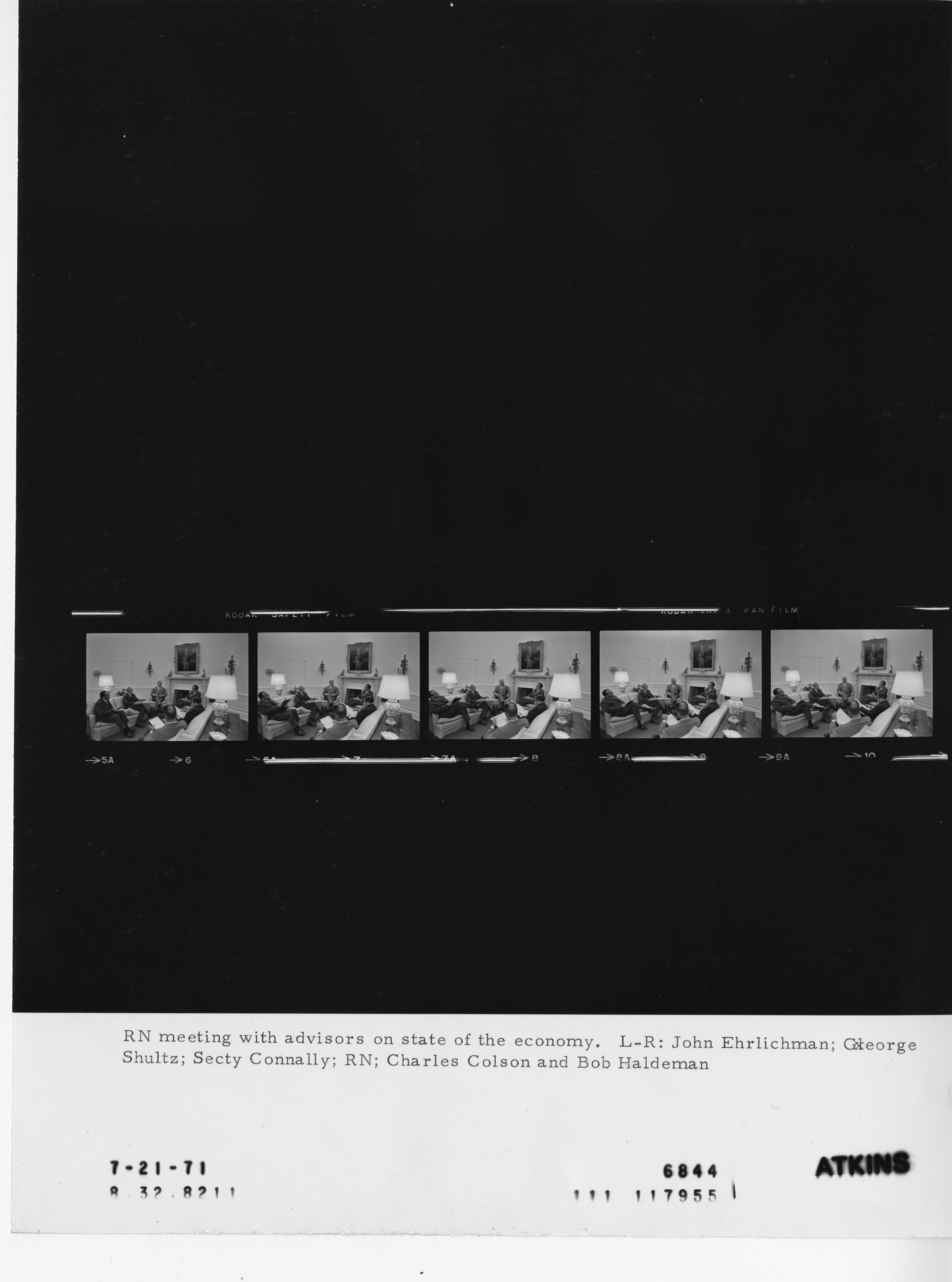
- Frame(s): WHPO-6844-05A-09A, President Nixon sitting with advisors John Ehrlichman, George Shultz, Connally, Charles Colson, Harry Robbins H.R. Haldeman, in the Oval Office. 7/21/1971, Washington, D.C. White House, Oval Office. President Nixon, John Ehrlichman, George Shultz, Connally, Charles W. Colson, Harry Robbins H.R. Haldeman.
Roll WHPO-7323 Photographer: Knudsen, Robert L. | Color or B&W: B&W
- Frame(s): WHPO-7323-05, Henry Kissinger in a room. 7/21/1971, Washington, D.C. unknown. Henry Kissinger.
- Frame(s): WHPO-7323-06-10, Unidentified men. 7/21/1971, Washington, D.C. unknown. unidentified men.
The White House Communications Agency Videotape Collection contains “off-the-air” recordings of televised programs produced between 1968 and 1974. Visit the finding aid to learn more.
- WHCA-4538
"The Dick Cavett Show".
ALL NETWORKS
Runtime: 01:29:56 - WHCA-4539
"The Tonight Show".
WETA Public Affairs
Runtime: 01:29:30 - WHCA-4545
Weekly News Summary, Tape II.
ALL NETWORKS
Runtime: 01:25:29
22. Chancellor/Valeriani: Chinese leader Chou En Lai speaks on importance of American military removal from Indochina to improve relations with China. Time Code Start: 53:34. Keywords: People's Republic of China, leaders, speeches, Vietnam War, Indochina War, military, troops, withdrawals. Network: NBC.
23. Chancellor: Senate voting on $2 billion in loans to aid struggling businesses; non-prescription sleeping pills monopolize market. Time Code Start: 55:22. Keywords: Senators, voting, budgets, financial aid, funding, bankruptcies. Network: NBC.
24. Cronkite/Schorr: The wave of drug abuse and addiction in American society. Time Code Start: 58:04. Keywords: pharmaceuticals, medicines, drugs, drug abuse, narcotics, heroin, marijuana, alcohol, alcoholism, addicts, addiction, prevention, programs. Network: CBS.
25. Cronkite: First major Soviet comment released on President Nixon's planned trip to China; Japanese Premier Soto criticizes secrecy of President Nixon's China trip. Time Code Start: 61:20. Keywords: Russia, USSR, Soviet Union, criticisms, Presidents, travel, trips, Nixon trips, international, People's Republic of China. Network: CBS.
26. Cronkite/Strawser: China lobby members working for Friends of FBI organization, Lee Edwards heading drive for contributions funding FBI record study countering Princeton study on FBI political intimidation. Time Code Start: 62:27. Keywords: Federal Bureau of Investigations, corruption, coercion, threats, persuasion, studies, funding, fundraising. Network: CBS.
27. Smith/Geer: Vietnam War; Cambodia bombings intensify; Paris Peace Talks at stand still; John Kerry speech as spokesman for Veterans Against the War; First Soviet remarks on President Nixon's China visit. Time Code Start: 64:28. Keywords: Vietnam War, bombings, protests, military, organizations, leaders, anti-war, speeches, Russia, USSR, Soviet Union, criticisms, Presidents, travel, trips, People's Republic of China. Network: ABC.
28. Smith: Congress hopes to bailout badly managed businesses vital to economy and national security. Time Code Start: 68:07. Keywords: House of Representatives, debates, business, bankruptcies, funding, financial aid, civil defense, counterintelligence services, secret police, anti-terrorism. Network: ABC.
Context (External Sources)
The Vanderbilt Television News Archive is the world's most extensive and complete archive of television news. They have been recording, preserving and providing access to television news broadcasts of the national networks since August 5, 1968.
Wikipedia is a free encyclopedia that anyone can edit.