
Introduction
This almanac page for Tuesday, July 20, 1971, pulls together various records created by the federal government and links to additional resources which can provide context about the events of the day.
Previous Date: Monday, July 19, 1971
Next Date: Wednesday, July 21, 1971
Schedule and Public Documents
The Daily Diary files represent a consolidated record of the President's activities. Visit the finding aid to learn more.
The President's day began at The White House - Washington, D. C.
The Weekly Compilation of Presidential Documents made available transcripts of the President's news conferences; messages to Congress; public speeches, remarks, and statements; and other Presidential materials released by the White House.
Digitized versions can be found at HathiTrust.
Each Public Papers of the Presidents volume contains the papers and speeches of the President of the United States that were issued by the White House Office of the Press Secretary during the time period specified by the volume. The material is presented in chronological order, and the dates shown in the headings are the dates of the documents or events. In instances when the release date differs from the date of the document itself, that fact is shown in the text note.
To ensure accuracy, remarks have been checked against audio recordings (when available) and signed documents have been checked against the original, unless otherwise noted. Editors have provided text notes and cross references for purposes of identification or clarity.
The Federal Register is the official daily publication for rules, proposed rules, and notices of federal agencies and organizations, as well as executive orders and other Presidential documents.
The Congressional Record is the official daily record of the debates and proceedings of the U.S. Congress.
Archival Holdings
Any selection of archival documents will necessarily be partial. You should use the documents and folders identified below as a starting place, but consult the linked collection finding aids and folder title lists and the collections themselves for context. Many documents to be found this way do not lend themselves to association with specific dates, but are essential to a complete understanding of the material.
Selective document listing
President's Office Files
The President's Office Files consists of materials drawn together by the Special Files Unit from several administrative subdivisions within the White House Office. It is the handwriting and sensitive papers sent to the Staff Secretary that now comprise much of the President's Office Files. Visit the finding aid to learn more.
- Annotated News Summaries, Box 30, News Summaries - July 1971 [1 of 2]
- Annotated News Summaries, Box 30, News Summaries - July 1971 [2 of 2] [During this period, the Staff Secretary only removed pages from the News Summaries which contained President Nixon's handwriting, often leaving the document with no date. Although there are no specific documents with this date, you should also consult the full folder for the month.]
- President's Daily Schedule, Box 101, [President's Daily Schedule, June-Aug. 1971] [2 of 3]
- The President's Schedule, Tuesday - July 20, 1971
The H. R. Haldeman Diaries consists of seven handwritten diaries, 36 dictated diaries recorded as sound recordings, and two handwritten audio cassette tape subject logs. The diaries and logs reflect H. R. Haldeman’s candid personal record and reflections on events, issues, and people encountered during his service in the Nixon White House. As administrative assistant to the President and Chief of Staff, Haldeman attended and participated in public events and private meetings covering the entire scope of issues in which the Nixon White House engaged in during the years 1969-1973. Visit the finding aid to learn more.
- Transcript of diary entry (PDF)
Tuesday, July 20.
President had a Republican leaders' meeting this morning. Briefed them on the China thing and then had Shultz cover the economy. Apparently it didn't go too well, especially the economy part. The President was really fed up with the attitude of the leaders. He told me to tell MacGregor that he's got to avoid these leadership meetings becoming a crying towel. He's got to brief someone to step-up and cheer a little bit. He made the point that if that had been a Democratic meeting, they would have cheered the President’s initiative and been babbling all over about it. And he sighed and said it's such hard work for the President to have to buck them up all the time, which I can certainly understand his concern about.
Then he had Dole and Timmons in, Dole going through the motions of informing him of-- or getting his views on the Convention site. The President immediately opened the meeting by saying, any of the three sites you have in mind is acceptable to me, and the line you should use in going out to the press is to say we discussed this, and the press-- the President left it up to the committee to decide. And he really does feel it's up to the committee. On that basis, Dole says the decision will be San Diego, although he thinks the committee really would prefer Miami. But he thinks they can handle San Diego all right, that they'll be able to avoid the California political factions, etcetera, and that they can probably cut the Convention to three days, but not to the two that the President had originally requested. Dole then pointed out that it’s nec-- there's a real problem on the economy, as was evidenced in the leadership meeting, and that Shultz needs to meet with the nineteen Senators that are up for election and also the Congressmen. Dole also asked whether he should go to Taiwan or not on his trip to Vietnam; he obviously wants to do that.
This afternoon, after a session with Kissinger, the President had Ehrlichman and me over for a talk and made the point that he had decided to have Ehrlichman go with Kissinger and Bruce on the September trip to China to handle the advancing. I didn't say anything at the time, but when Henry came in and joined the meeting later, the President raised the same point again. Henry was clearly shook by it. I too think it's a very bad idea, but Ehrlichman is dying to go to China, and this is the one way he can get in on the act, and he maneuvered it with the President this morning. Later this evening, Haig raised the question with Larry and said Kissinger was absolutely furious about the idea, that we can't have a substantive person going over to meet with them, and I think Henry will probably scuttle it, which is just as well.
The other problem on the China trip is that we're probably going to have to take some Democratic visits to China before the President gets there. The Chinese notified Henry today that it was very difficult for them to withhold permission to visit, to other political people, as they have been doing, now that our visit is arranged. I argued strongly that we should still try to talk them out of it, on the grounds that they could welcome those people after the President’s visit, and so on. President, I think, is resigned to the fact that we're going to have to let them do it, but he's pushing hard to at least hold Mao in reserve and not have them meet with them. President makes the point that the Chinese have to have this trip––they initiated it––but we don't want to pant after them. We need to maintain our bargaining position, and we don't want to do anything that cuts that down.
He talked to Henry on the phone, while Henry was meeting with Hugh Sidey, and told him to make the point that the difference between this-- of the difference between this trip and other Summit meetings, that the President is not just going over there to tour or to socialize and charm these people; he's going over for real, gut-level discussions. He got talking with John and me about his concern that, although he's ordered no speculation regarding the effect this will have on other countries, etcetera, we should be doing some speculating on the fact that this is a discussion between the US and China, and we should speculate to the hilt about the President’s leadership and how he brought this about. He wants Scali to run heavily with this story, making the point that the one thing you can talk about is that, thank God, we have a President who knows how to handle this kind of thing. Also bring up his forbearance during the Laos deal, that he had all the cards, but he never played them; he kept his eye on the main chance. We can say that we can't talk about the substance, but look back at this whole thing, the President didn't even tell his own staff, etcetera. Made the point that we should change the name of Air Force One, immediately, to Spirit of '76, so that’s done before the trip.
Then Kissinger came in, and the President raised with him the point of whether we ought to consider doing the Russian Summit first, and Henry definitely says no. Instead, we should plan on Russia in the spring, but announce it before we go to Peking. This is the way he's put it to the Russians, and he wants to hang tight on that. The President told Henry he should move the preliminary trip up to September 15. He needs to get over there earlier, especially if he's going to let other political people go in ahead of us; he needs to dull the impact, especially if Kennedy turns out to be one of them. Kissinger reported on his interview with Sidey and said Sidey was very much with us all the way, but made the point that his editors are absolutely beside themselves, that it's driving them wild to think that Nixon is the one to do this, and that they just think it's terrible, which is an interesting insight into Time/Life.
Before--then Kissinger left before he had come in, and again after he left, we had quite a discussion on the Vice Presidential thing, the President seeking John's and my views on what the situation is and how to deal with it. His feeling is that the Democrats need an issue, now that we've taken foreign policy away from them, and so they'll zero in on the economy as the substantive issue, and the VP as the way of cutting us. Also he got into quite a long talk about the question of succession, making the point that he may not live through even this term, let alone a second term, because of the possibility of accident or ill health. And that raises the question of whether Agnew is somebody that we're willing to see become President. He enumerated some of his problems: that he's dogmatic, his hidebound prejudices, he’s totally inflexible and that he sees things in minuscule terms. We then talked about what to do to get him out, and concluded that it's impossible for him to announce––such as in January, as he apparently is willing to do according to Harlow––that he will not run, because that would open a horrible battle for the nomination. Also, Agnew himself would be immediately dead once he does that.
President then got around to raising the Connally question with Ehrlichman and made the point that the only one we could put on the ticket is Connally. We couldn't afford a battle, because out of that, Reagan would clearly come up with the nomination, which would be disastrous. The conclusion then is, if Agnew is not going to be on the ticket, he must get off by resignation. Given that, the sooner he resigns, the better. Then the President told Ehrlichman and me that we were to talk to Connally on the Vice President problem. That he-- the President wants to stay one step away from it, but I should call Connally, ask him for a couple hours of free time for John and me, and then we should just sit down and talk the problem through, see if he's got any ideas on how to approach it, so on.
End of July 20. - Original audio recording (MP3)
The National Archives Catalog is the online portal to the records held at the National Archives, and information about those records. It is the main way of describing our holdings and also provides access to electronic records and digitized versions of our holdings.
The Catalog searches across multiple National Archives resources at once, including archival descriptions, digitized and electronic records, authority records, and web pages from Archives.gov and the Presidential Libraries. The Catalog also allows users to contribute to digitized historical records through tagging and transcription.
Nixon Library Holdings
All National Archives Units
National Security Documents
The President's Daily Brief is the primary vehicle for summarizing the day-to-day sensitive intelligence and analysis, as well as late-breaking reports, for the White House on current and future national security issues. Read "The President's Daily Brief: Delivering Intelligence to Nixon and Ford" to learn more.
The Foreign Relations of the United States series presents the official documentary historical record of major U.S. foreign policy decisions and significant diplomatic activity. Visit the State Department website for more information.
Vol. II, Organization and Management of U.S. Foreign Policy, 1969-1972
The NSC System
158. Memorandum by the President’s Assistant for National Security Affairs (Kissinger), Washington, July 20, 1971
Source: National Security Council, Secretariat, Directives, 1971, Directive #89. Confidential. A copy was sent to Moorer.
Vol. III, Foreign Economic Policy; International Monetary Policy, 1969-1972
International Monetary Policy, 1969-1972
161. Memorandum From the Assistant Director of the Office of Management and Budget (Schlesinger) to the President’s Assistant for International Economic Affairs (Peterson), Washington, July 20, 1971
Source: Washington National Records Center, Department of the Treasury, Files of Under Secretary Volcker: FRC 56 79 15, CIEP. No classification marking.
Vol. XIII, Soviet Union, October 1970-October 1971
Between Beijing and Moscow: Summit Announcement, July 19-October 12, 1971
290. Memorandum From Helmut Sonnenfeldt of the National Security Council Staff to the President’s Assistant for National Security Affairs (Kissinger), Washington, July 20, 1971
Source: National Archives, Nixon Presidential Materials, NSC Files, Box 715, Country Files, Europe, USSR, Vol. XIV. Secret; Sensitive. Sent for information. Haig forwarded the memorandum to Kissinger on July 21 with his own assessment of the China initiative (Document 292). Kissinger wrote in the margin: “Hal—outstanding. HK.” Haig also initialed the memorandum.
Vol. XVII, China, 1969-1972
China,January-September 1971
150. Message From the United States Government to the Premier of the People’s Republic of China Chou En-lai, Washington, July 20, 1971
Source: National Archives, Nixon Presidential Materials, NSC Files, Box 849, President’s File—China Trip, China Exchanges. Haig forwarded the message under a separate covering letter to Walters on July 20. (Ibid.) Walters delivered this message to the PRC Ambassador to France on July 21. (Walters’ letter to Haig, July 22; ibid.) See Foreign Relations, 1969–1976, vol. E–13, Documents 10 and 11. In many of his reports. Walters uses the name “Kirschman” to refer to Kissinger.
Vol. XIX, Part 2, Japan, 1969-1972
April-October 1971: Change and Reassessment
81. Memorandum for the Record, Washington, July 20, 1971
Source: National Archives, Nixon Presidential Materials, NSC Files, Box 536, Country Files, Far East, Japan, Vol. V, 1 Jul–Sep 71. Secret; Limdis. Drafted July 20 by U. Alexis Johnson who sent it under cover of a letter to Kissinger on that date. In his letter, Johnson noted that his memorandum did not mention “the fact that Ushiba showed me a long letter that Prime Minister McMahon of Australia had sent to Prime Minister Sato about the necessity of Japan and Australia concerting with each other on the U.N. problem, in the light of the U.S. move to Peking that had caught them both off guard.” Holdridge forwarded Johnson’s letter to Kissinger under a July 22 memorandum, in which he observed: “The main thrust of Ushiba’s comments on the China announcement was that, since by giving only short notice to Tokyo we had pulled the rug out from under the traditional Japanese policy of close collaboration with the U.S. in foreign policy, it is now of the greatest importance that we consult closely on Chirep.” Kissinger initialed Holdridge’s memorandum. (Ibid.)
Vol. XX, Southeast Asia, 1969-1972
Thailand
130. Backchannel Message From the President’s Assistant for National Security Affairs (Kissinger) to the Ambassador to Thailand (Unger), Washington, July 20, 1971, 10:03 p.m.
Source: National Archives, Nixon Presidential Materials, NSC Files, Box 410, Backchannel Files, Backchannel Messages 1971, Southeast Asia. Top Secret.
Vol. XXIV, Middle East Region and Arabian Peninsula, 1969-1972; Jordan, September 1970
Persian Gulf States
103. Memorandum of Conversation, London, July 20, 1971
Source: National Archives, RG 59, Central Files 1970–73, POL UK–US. Confidential; Limdis. Drafted by B. Scott Custer and approved on July 30 in U. This is Part 8 of an 8-part memorandum of conversation that recorded discussions on the Middle East, Southeast Asia, and Europe. Parts 1–7 are not printed.
Vol. XXXII, SALT I, 1969-1972
From SALT Announcement to Summit Announcement, May 27-October 12, 1971
180. National Security Decision Memorandum 120, Washington, July 20, 1971
Source: National Archives, Nixon Presidential Materials, NSC Files, NSC Institutional Files (H–Files), Box H–208, National Security Decision Memoranda, NSDMs 101–150. Top Secret; Nodis; SALT. Copies were sent to the Chairman of the Joint Chiefs of Staff and to the senior members of the U.S. SALT Delegation.
181. Memorandum From Secretary of Defense Laird to the President’s Assistant for National Security Affairs (Kissinger), Washington, July 20, 1971
Source: National Archives, Nixon Presidential Materials, NSC Files, Box 881, SALT, SALT talks (Helsinki), Vol. XV, May 1–July 1971. Top Secret; Sensitive. Kissinger initialed the memorandum indicating that he saw it.
182. Memorandum From the Chairman of the Joint Chiefs of Staff (Moorer) to the Chairman of the Verification Panel (Kissinger), Washington, July 20, 1971
Source: National Archives, Nixon Presidential Materials, NSC Files, Box 881, SALT, SALT talks (Helsinki), Vol. XV, 1 May–July 1971. Top Secret. Copies were sent to the members of the Verification Panel: Packard, Irwin, Helms, Farley, and Mitchell.
Vol. XL, Germany and Berlin, 1969-1972
Germany and Berlin, 1969-1972
269. Memorandum From Helmut Sonnenfeldt of the National Security Council Staff to the President’s Assistant for National Security Affairs (Kissinger), Washington, July 20, 1971
Source: National Archives, Nixon Presidential Materials, NSC Files, Box 715, Country Files, Europe, USSR, Vol. XIV. Secret. Urgent; sent for information. Kissinger wrote “Good job” on the memorandum, which, according to an attached form, was “noted by HAK” on August 3. Haig also initialed the memorandum, indicating that he had seen it.
Vol. E-10, Documents on American Republics, 1969-1972
Dominican Republic
291. Memorandum From the Executive Secretary (Eliot) to the President’s Assistant for National Security Affairs (Kissinger), Washington, July 20, 1971., Washington, July 20, 1971
The Department of State called President’s Assistant for National Security Affairs Kissinger’s attention to the fact that the Senate Finance Committee proposed to eliminate the President’s discretionary authority for special allocations under the pending Sugar Act. The Senate’s decision came after President Nixon had already signed an undelivered letter indicating approval of a special sugar allocation for the Dominican Republic. The Department of State recommended that a new letter be drafted to include the caveat that any special sugar allocation would be contingent on Congress.
Source: National Archives, Nixon Presidential Materials, NSC Files, Box 783, Country Files, Latin America, Dominican Republic, Vol. I. Confidential. Ted C. signed for Eliot above Eliot’s typeset signature. Attached is a draft of a suggested revised letter. On July 22, President Nixon signed the revised letter. (Ibid.)
Haiti
402. Telegram 745 From the Embassy in Haiti to the Department of State, July 20, 1971, 2000Z., July 20, 1971, 2000Z
In an evaluation of President Jean-Claude Duvalier’s first 90 days in office, the Embassy concluded that the new government had made an effort to maintain “an open, progressive image” and intended to cooperate with the United States. The Embassy recommended considering modest requests for bilateral assistance and the abandonment of the “cool and correct” policy toward Haiti.
Source: National Archives, RG 59, Central Files 1970–73, POL 15–1 HAI. Confidential; Limdis. In a September 9 information memorandum, the ARA/NSC/IG advised its members that they would meet at the Department on September 15 to consider modification of U.S. policy toward Haiti and modest requests for bilateral assistance. (Ibid., Department of State, NSC–IG/ARA Information Memos, 1971, Lot 76 D 325) For a summary of the group’s report, see Document 404.
Vol. E-13, Documents on China, 1969-1972
10. Letter From the President’s Deputy Assistant for National Security Affairs (Haig) to the Military Attaché at the Embassy in France (Walters), Washington, July 20, 1971, Washington, July 20, 1971
Haig informed Walters that President’s Assistant for National Security Affairs Kissinger would be visiting Paris on July 25 and 26 and would like to meet with the Chinese Ambassador at his residence on July 25.
Source: National Archives, Nixon Presidential Materials, NSC Files, Box 849, President’s File-China Trip, China Exchanges, July 1971-Oct 20, 1971. Top Secret; Sensitive; Exclusively Eyes Only. Attached but not published are the two messages, which were to be handed to the Chinese ambassador for transmission to Chou En-lai.
The Kissinger telephone conversation transcripts consist of approximately 20,000 pages of transcripts of Kissinger’s telephone conversations during his tenure as Assistant to the President for National Security Affairs (1969-1974) and Secretary of State (1973-1974) during the administration of President Richard Nixon. Visit the finding aid for more information.
Digitized versions can be found in the National Archives Catalog.
Audiovisual Holdings
The White House Tapes are sound recordings of President Richard Nixon's telephone conversations and of meetings held in the Oval Office and the Cabinet Room in the White House, the President's office in the Old Executive Office Building (OEOB), the Lincoln Sitting Room in the residence section of the White House, and several locations at the Presidential retreat at Camp David, Maryland. These recordings document many of the major events and decisions of the Nixon Administration from February 16, 1971 to July 18, 1973. Visit the White House Tapes finding aid to learn about the taping system's operation and archival processing.
Cabinet Room
- 65-1; Unknown between 7:35 a.m. & 8:05 a.m.; [Unknown person(s)]
- 65-2; Unknown between 7:35 a.m. & 10:23 a.m.; Nixon, Richard M. (President); Rogers, William P.; Scott, Hugh; Stennis, John C.; Griffin, Robert P.; Smith, Margaret Chase; Allott, Gordon L.; Norris, Glenn; Dominick, Peter H.; Ford, Gerald R.; Arends, Leslie C.; Anderson, John B.; Poff, Richard H.; Conable, Barber B., Jr.; Rhodes, John J.; Wilson, Robert C. ("Bob"); Stafford, Robert T.; Smith, H. Allen; Dole, Robert J.; Kissinger, Henry A.; MacGregor, Clark; Ehrlichman, John D.; Shultz, George P.; Timmons, William E.; BeLieu, Kenneth E.; Cook, Richard K.; Dent, Harry S.; Klein, Herbert G.; Buchanan, Patrick J.; Harlow, Bryce N.; Ziegler, Ronald L.
Old Executive Office Building
- 263-1; Unknown between 1:31 p.m. & 1:58 p.m.; Nixon, Richard M. (President); Haldeman, H. R. ("Bob")
- 263-2; Unknown between 1:58 p.m. & 3:10 p.m.; Nixon, Richard M. (President); Kissinger, Henry A.
- 263-3; Unknown between 1:58 p.m. & 3:10 p.m.; Nixon, Richard M. (President); Sanchez, Manolo
- 263-4; Unknown between 1:58 p.m. & 3:10 p.m.; Nixon, Richard M. (President); Sanchez, Manolo
- 263-5; 3:10 p.m. - 3:35 p.m.; Nixon, Richard M. (President); Kissinger, Henry A.
- 263-6; Unknown between 3:35 p.m. & 3:41 p.m.; Nixon, Richard M. (President); Haldeman, H. R. ("Bob")
- 263-7; Unknown between 3:35 p.m. & 3:41 p.m.; Nixon, Richard M. (President); Sanchez, Manolo
- 263-8; Unknown between 3:35 p.m. & 3:41 p.m.; Nixon, Richard M. (President); Sanchez, Manolo
- 263-9; Unknown between 3:41 p.m. & 6:09 p.m.; Nixon, Richard M. (President); Ehrlichman, John D.; Haldeman, H. R. ("Bob"); Kissinger, Henry A.; Sanchez, Manolo
- 263-10; 6:16 p.m. - 6:17 p.m.; Nixon, Richard M. (President); Nixon, Thelma C. ("Pat") (Ryan)
- 263-11; 6:19 p.m. - 6:19 p.m.; Nixon, Richard M. (President); White House operator
- 263-12; 6:19 p.m. - 6:19 p.m.; Nixon, Richard M. (President); White House operator
- 263-13; 6:19 p.m. - 6:41 p.m.; Nixon, Richard M. (President); Colson, Charles W.
- 263-14; Unknown between 6:43 p.m. & 6:46 p.m.; [Unknown person(s)]
Oval Office
- 540-1; Unknown between 7:35 a.m. & 7:53 a.m.; Nixon, Richard M. (President); Rogers, William P.; Kissinger, Henry A.
- 540-2; Unknown between 7:35 a.m. & 7:53 a.m.; United States Secret Service agents
- 540-3; Unknown between 7:35 a.m. & 7:53 a.m.; Nixon, Richard M. (President); Kissinger, Henry A.
- 540-4; 7:53 a.m. - 8:05 a.m.; Nixon, Richard M. (President); Kissinger, Henry A.; [Unknown person(s)]
- 540-5; Unknown between 8:05 a.m. & 10:23 a.m.; United States Secret Service agents
- 540-6; Unknown between 10:29 a.m. & 11:07 a.m.; Nixon, Richard M. (President); Bull, Stephen B.; Butterfield, Alexander P.
- 540-7; 10:29 a.m. - 11:07 a.m.; Nixon, Richard M. (President); Haldeman, H. R. ("Bob"); Dole, Robert J.; Timmons, William E.; Bull, Stephen B.
- 540-8; Unknown between 11:07 a.m. & 11:09 a.m.; Nixon, Richard M. (President); Bull, Stephen B.
- 540-9; Unknown between 11:09 a.m. & 1:21 p.m.; Nixon, Richard M. (President); Baker, Steven; Ehrlichman, John D.; Shultz, George P.
- 540-10; Unknown between 1:21 p.m. & 1:25 p.m.; Nixon, Richard M. (President); Butterfield, Alexander P.
- 540-11; 1:26 p.m. - 1:29 p.m.; Nixon, Richard M. (President); Haldeman, H. R. ("Bob")
- 540-12; Unknown between 1:29 p.m. & 1:31 p.m.; United States Secret Service agents
- 540-13; Unknown between 8:05 a.m. & 10:23 a.m.; [Unknown person(s)]
- 540-14; Unknown between 8:05 a.m. & 10:23 a.m.; United States Secret Service agents
White House Telephone
- 6-159; 6:16 p.m. - 6:16 p.m.; Nixon, Richard M. (President); White House operator
- 6-160; 6:16 p.m. - 6:17 p.m.; Nixon, Richard M. (President); Nixon, Thelma C. ("Pat") (Ryan)
- 6-161; 6:18 p.m. - 6:18 p.m.; Nixon, Richard M. (President); White House operator
- 6-162; 6:19 p.m. - 6:19 p.m.; Nixon, Richard M. (President); White House operator
- 6-163; Unknown between 6:19 p.m. & 6:41 p.m.; Nixon, Richard M. (President); Colson, Charles W.
- 6-164; 6:41 p.m. - 6:41 p.m.; Nixon, Richard M. (President); Sanchez, Manolo; Rebozo, Charles G. ("Bebe")
- 6-165; 7:53 p.m. - 7:57 p.m.; Nixon, Richard M. (President); Rebozo, Charles G. ("Bebe")
- 6-166; Unknown between 7:57 p.m. & 8:07 p.m.; Nixon, Richard M. (President); White House operator
- 6-167; 8:07 p.m. - 8:08 p.m.; Nixon, Richard M. (President); Cox, Tricia Nixon
- 6-168; 8:09 p.m. - 8:09 p.m.; Nixon, Richard M. (President); White House operator
- 6-169; 8:10 p.m. - 8:10 p.m.; Nixon, Richard M. (President); White House operator
- 6-170; 8:11 p.m. - 8:12 p.m.; Nixon, Richard M. (President); White House operator; Stout, Stewart
The White House Photo Office collection consists of photographic coverage of President Richard Nixon meeting with prominent social, political, and cultural personalities; speaking engagements and news conferences of the President and various high-ranking members of the White House staff and Cabinet; Presidential domestic and foreign travel, including Presidential vacations; social events and entertainment involving the First Family, including entertainers present; official portraits of the President, First Family, and high-ranking members of the Nixon administration; the 1969 and 1973 Inaugurals; the President’s 1972 Presidential election campaign appearances (including speeches) and other official activities of the White House staff and the President’s Cabinet from January 20, 1969 until August 9, 1974 at the White House and the Old Executive Office Building; other locations in Washington, DC, such as The Mall; and the Presidential retreats in Camp David, Maryland, Key Biscayne, Florida, and San Clemente, California. Visit the finding aid to learn more.
Roll WHPO-6835 Photographer: Kightlinger, Jack | Color or B&W: Color
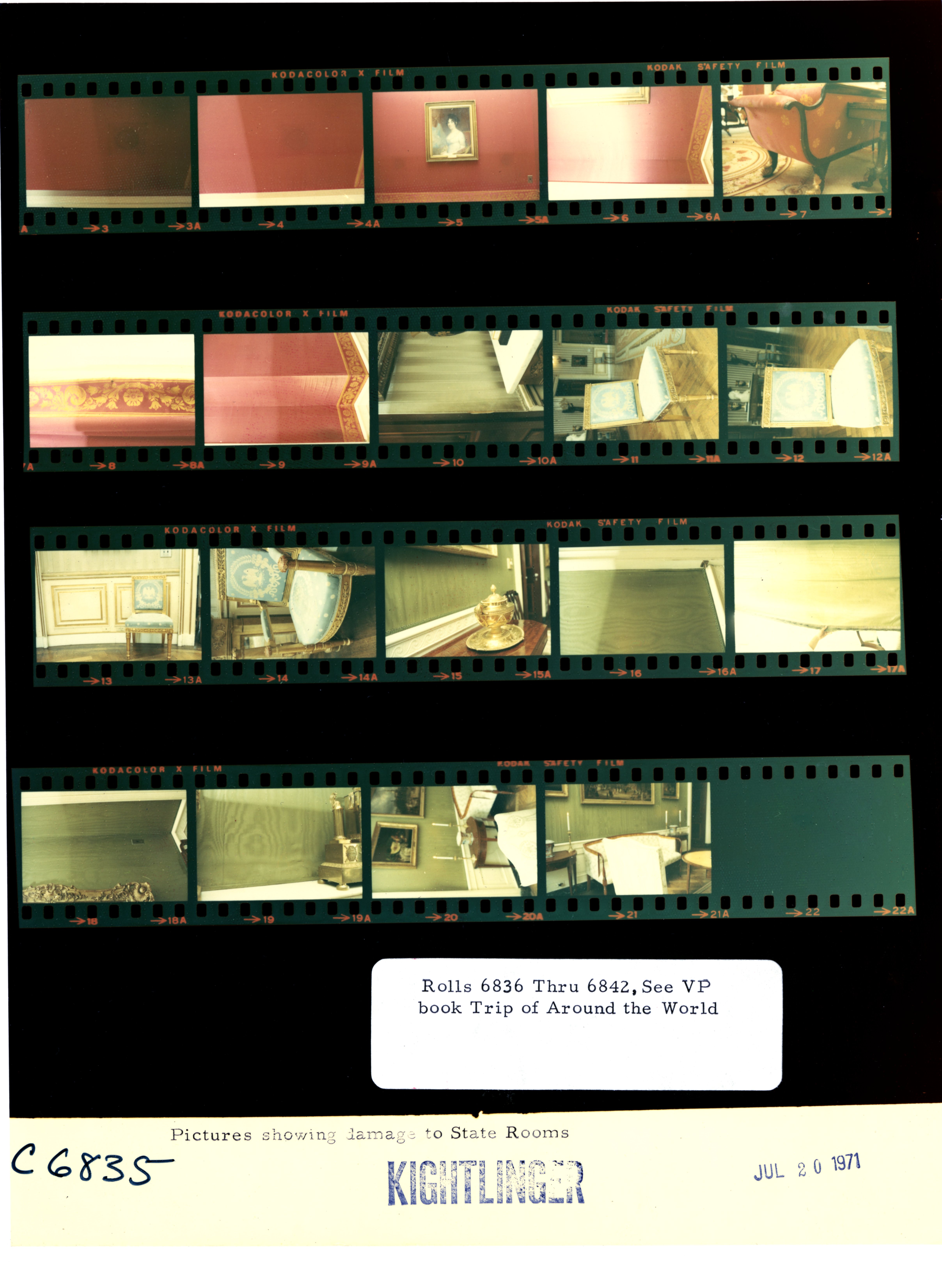
- Frame(s): WHPO-6835-03-09, Damages in the White House State Rooms. 7/20/1971, Washington, D.C. White House, Red Room.
- Frame(s): WHPO-6835-10, 15-21, Damages in the White House State Rooms. 7/20/1971, Washington, D.C. White House, Green Room.
- Frame(s): WHPO-6835-11-14, Damages in the White House State Rooms. 7/20/1971, Washington, D.C. White House, Blue Room.
Roll WHPO-6843 Photographer: Kightlinger, Jack | Color or B&W: B&W
- Frame(s): WHPO-6843-02A-31A, Group shots of Pan-African teams. 7/20/1971, Washington, D.C. White House, North Portico steps. Pan-African team members, unidentified woman.
The White House Communications Agency Sound Recordings Collection contains public statements that took place between 1969 and 1974. Visit the finding aid to learn more.
H - White House Staff Member Recordings
- WHCA-SR-H-416
Press briefing by Ronald Ziegler and Peter Peterson. (7/20/1971, Press Center, White House)
Runtime: 39:20:00
Keywords: Press conferences, news conferences, interviews, media, press secretary
Production credits: Audio feed supplied by WHCA; Recorded by RSM (initials of WHCA engineer)
Original Format: 1/4-inch reel-to-reel audiotape. Original source type: Original. - WHCA-SR-H-417
Fred Malek, Speical Assistant o the President (Personnel Matters) speaks to summer interns. (7/20/1971, Room 444, Executive Office Building)
Runtime: 1:10:00
Keywords: Briefings, private briefings
Production credits: Audio feed supplied by WHCA; Recorded by RWF (initials of WHCA engineer)
Original Format: 1/4-inch reel-to-reel audiotape. Original source type: Original.
The White House Communications Agency Videotape Collection contains “off-the-air” recordings of televised programs produced between 1968 and 1974. Visit the finding aid to learn more.
- WHCA-4535
"Thirty Minutes". Police Chiefs Murphy (N.Y.C.) and Wilson (Washington, D.C.), John Kerry, Jim Brown, writer John Kobler.
Daphne Productions and Roland & Jaffee Productions
Runtime: 00:29:27 - WHCA-4536
"The David Frost Show" with journalist Sander Vanocur, author Sam Levinson. Dr. Jean Spencer.
Undetermined
Runtime: 00:27:06 - WHCA-4537
"[Supreme Court] Justice Black and The Constitution".
ALL NETWORKS
Runtime: 00:58:02 - WHCA-4545
Weekly News Summary, Tape II.
ALL NETWORKS
Runtime: 01:25:29
13. Chancellor: President Nixon's planned China trip criticized; President planning Soviet Union visit. Time Code Start: 34:31. Keywords: Presidents, travel, trips, Nixon trips, international, People's Republic of China, Russia, USSR. Network: NBC.
14. McGee: Selective Service lottery continues despite the draft law expiration. Time Code Start: 36:11. Keywords: military, conscription, selective service, lottery, laws, Vietnam War, ending, extensions, expirations, draft reform, draft evasion. Network: NBC.
15. Chancellor/Goralski: Secretary of Treasury Connally speaks on the government bailout plan for failing businesses vital to economic progress and national security. Time Code Start: 38:01. Keywords: cabinet, advisors, funding, financing, financial aid, backing, bankruptcy, civil defense, counterintelligence services, secret police, anti-terrorism. Network: NBC.
16. Cronkite/Walker: Implications of the Chinese visit to relations with Taiwan and Chinese Nationalist leader Chiang Kai-shek. Time Code Start: 40:36. Keywords: People's Republic of China, leaders, travel, trips. Network: CBS.
17. Cronkite/Plant: Mayors meet in Millwakee, Wisconsin to discuss solving urban problems, Chicago, Illinois Mayor Daley endorses Milwakee Mayor Myer for Democratic Vice Presidential nomination. Time Code Start: 43:57. Keywords: Presidential elections, campaigns, campaigning, candidates, mayors, endorsements, public housing projects, construction, redevelopment, buildings. Network: CBS.
18. Sevareid: Economic issues that bring domestic problems to an internationally minded President Nixon. Time Code Start: 46:29. Keywords: Presidents, diplomacy, economy, economics, budgets, finances, recession, inflation, money, wages, costs, unemployment, prices. Network: CBS.
19. Smith/Geer: Japan's Prime Minister Sato criticizes President Nixon's China trip as "unsatisfactory," protests in front of the White House against the president's Chinese visit. Time Code Start: 48:52. Keywords: Presidents, travel, trips, Nixon trips, international, People's Republic of China, opinions, reactions, Japanese. Network: ABC.
20. Smith: National Review's publisher William F. Buckley admits their published collection of Highly Classified Documents or Secret Papers a hoax. Time Code Start: 50:48. Keywords: media, newspapers, magazines, the press, publications, journalism, classified documents, top secret, hoaxes, frauds, tricks. Network: ABC.
21. Reasoner: Similarites of President Nixon's Chinese visit to the Potsdam and Yalta Conferences. Time Code Start: 51:32. Keywords: Presidents, travel, trips, Nixon trips, international, People's Republic of China, meetings, conferences, summits, leaders, comparisons. Network: ABC.
Context (External Sources)
The Vanderbilt Television News Archive is the world's most extensive and complete archive of television news. They have been recording, preserving and providing access to television news broadcasts of the national networks since August 5, 1968.
Wikipedia is a free encyclopedia that anyone can edit.