

Introduction
This almanac page for Monday, July 19, 1971, pulls together various records created by the federal government and links to additional resources which can provide context about the events of the day.
Previous Date: Sunday, July 18, 1971
Next Date: Tuesday, July 20, 1971
Schedule and Public Documents
The Daily Diary files represent a consolidated record of the President's activities. Visit the finding aid to learn more.
The President's day began at The White House - Washington, D. C.
The Weekly Compilation of Presidential Documents made available transcripts of the President's news conferences; messages to Congress; public speeches, remarks, and statements; and other Presidential materials released by the White House.
Digitized versions can be found at HathiTrust.
Each Public Papers of the Presidents volume contains the papers and speeches of the President of the United States that were issued by the White House Office of the Press Secretary during the time period specified by the volume. The material is presented in chronological order, and the dates shown in the headings are the dates of the documents or events. In instances when the release date differs from the date of the document itself, that fact is shown in the text note.
To ensure accuracy, remarks have been checked against audio recordings (when available) and signed documents have been checked against the original, unless otherwise noted. Editors have provided text notes and cross references for purposes of identification or clarity.
The Federal Register is the official daily publication for rules, proposed rules, and notices of federal agencies and organizations, as well as executive orders and other Presidential documents.
No Federal Register published on this date
The Congressional Record is the official daily record of the debates and proceedings of the U.S. Congress.
Archival Holdings
Any selection of archival documents will necessarily be partial. You should use the documents and folders identified below as a starting place, but consult the linked collection finding aids and folder title lists and the collections themselves for context. Many documents to be found this way do not lend themselves to association with specific dates, but are essential to a complete understanding of the material.
Selective document listing
President's Office Files
The President's Office Files consists of materials drawn together by the Special Files Unit from several administrative subdivisions within the White House Office. It is the handwriting and sensitive papers sent to the Staff Secretary that now comprise much of the President's Office Files. Visit the finding aid to learn more.
- Annotated News Summaries, Box 30, News Summaries - July 1971 [1 of 2] [During this period, the Staff Secretary only removed pages from the News Summaries which contained President Nixon's handwriting, often leaving the document with no date. In addition to the individual document(s) listed below, you should also consult the full folder for the month.]
- Weekend News Review, July 19, 1971
- Annotated News Summaries, Box 30, News Summaries - July 1971 [2 of 2]
- President's Daily Schedule, Box 101, [President's Daily Schedule, June-Aug. 1971] [2 of 3]
- The President's Schedule, Monday - July 19, 1971
President's Personal File
The President's Personal File is essentially a President's secretary's file, kept by Rose Mary Woods, personal secretary to the President, for two purposes: (1) preserving for posterity a collection of documents particularly close to the President, whether because he dictated or annotated them, or because of the importance of the correspondent or the event concerned and (2) giving appropriate attention–letters of gratitude, invitations to White House social events, and the like–to members and important friends and supporters of the Nixon administration. This generalization does not describe all the varied materials of a file group which is essentially a miscellany, but it does identify the reason for the existence of the file group's core. Visit the finding aid to learn more.
- President's Speech File
The H. R. Haldeman Diaries consists of seven handwritten diaries, 36 dictated diaries recorded as sound recordings, and two handwritten audio cassette tape subject logs. The diaries and logs reflect H. R. Haldeman’s candid personal record and reflections on events, issues, and people encountered during his service in the Nixon White House. As administrative assistant to the President and Chief of Staff, Haldeman attended and participated in public events and private meetings covering the entire scope of issues in which the Nixon White House engaged in during the years 1969-1973. Visit the finding aid to learn more.
- Transcript of diary entry (PDF)
Monday, July 19th. Today was the day of the meetings, starting with the breakfast with Mansfield. I haven't had any report on how that went. Then the bipartisan leadership meeting. The President made the point there that we need time for setting up the China meeting, because it's regarding substance; it's going to take a lot of planning, which is completely different than a goodwill trip. He says, we can't tell you about the whole thing, and we'll not put it all out for you today. Without secrecy, there would have been no agreement for a meeting; and without secrecy, there will be no success at the meeting. And he made the point that in negotiations, even between friends, there must be trust, and you can't do that by negotiating in the newspapers. When you're negotiating with someone you don't know, the element of trust is lacking, so you have to establish secrecy. The process won't work unless there's a considerable amount of secrecy, and we're working only for success.
He then had Henry give a review of the process, which took ten minutes. He reviewed the history leading up to the meeting, described the secrecy and the sequence of meetings in Peking. Made the point that only the President, Bill and I knew the whole picture. He said this is the beginning of a relationship between people who have had no contact with each other, so there's an enormous amount of underbrush to clear away. There was no pre-established agenda, and no protocol set up. They were very concerned regarding too much public speculation, and we have to stress that we're just at the beginning of a relationship. The greatest amount of self-discipline on our part is essential. It's essential to create an atmosphere for the trip, and for everyone to recognize that the objective is world peace.
Then Rogers took over and went for about fifteen minutes, again emphasizing the concern re--, for self-discipline, saying we can't operate in a public way, with the Congress or with other governments, and speculation of any kind will put the visit in jeopardy, therefore, nothing should come out of this meeting that could damage SALT and the Mideast, as well as the China trip. He urged them all to be very cautious regarding what they say. We need to convince other governments that we don't have a secret agreement with the Chinese, and there's a problem of getting the views of the members of Congress, but if they're publicly expressed, they'll jeopardize the thing. The President interjected to say that we'll set up a procedure for Congressmen to come in on a private basis, not a TV extravaganza. We do want your views, but they must be conveyed privately. The President has to say very little; anything prior to the meeting will break the understanding. Therefore, he'll have no press conference for a while and no public speech on this.
Rogers then reviewed the reactions of other nations, especially the strong support of the Asian nations and NATO. He touched on the problem of Taiwan, said we have to handle this in a very diplomatic way. The treaty will continue, and we will have to discuss the UN representation question with them, but we will vote against a resolution to expel them. The President said that Bill Rogers would inform Congress on the UN question. That it's very important that Rogers have the opportunity to check other governments to see what position is viable, and we've got to give Rogers time to continue his talks. Rogers made the point very strongly that in spite of Kissinger's trip, the UN position was doomed to fail; that is, are you in a position of keeping free China in. We would have lost the vote this fall; the People's Republic would have been admitted, and the Republic of China expelled. We were faced, therefore, with this reality, and we have to decide with the Republic of China what position to take.
Rogers again emphasized that nothing should be said regarding this meeting, especially the UN question. Carl Albert said we will, he will say that he will let the Administration speak for itself. Ellender said the purpose of the Kissinger meeting was to lay the groundwork. Fulbright raised the problem of, regarding the hearings he's holding regarding China at the Foreign Relations Committee. He said, I completely agree with what you're doing; I don't want to do anything to handicap you, but it's impossible to stifle the committee on an inquiry or expressing their views. The President urged Fulbright to keep in touch with Rogers. The President said we've got to cover this very cold turkey. If any of you say publicly what the President should do, you can see what the effect will be, that is, a resolution by Congress or a committee regarding what the relation should be. Instead, let us know your views privately. We must not let the Chinese feel we're using them for the purpose of frying some other fish. We've got to look for the fundamental point of why do this at all.
--------------------------------------------------------------------------------------------------------------------
DECLASSIFIED - E.O. 13526, Sect. 3.4: by MS, NARA, June 12, 2013
Audio Cassette 11, Side A, Withdrawn Item Number 11 [AC-11(A) Sel 5]
Duration: 23 seconds
There was validity ten years ago to playing the free nations of Asia against China, now the situation has changed. That is, the Japanese, who are unarmed, the Koreans, the Indonesians have no capability of self-defense. And while the Asian world will continue in a flux, we can play a more effective re--, role by working with the Chinese than without them.
--------------------------------------------------------------------------------------------------------------------
Kissinger made the point that any speculation regarding Vietnam in any way would be totally counterproductive and would defeat any by-products of the meetings. Rogers said if we talk in public now, the trip may not come off. Albert said the problem is a lot of people want out of Vietnam now, and any move that doesn't do that raises hell. So the first question we'll all get will be, does this contribute to Vietnam? The President said to say the purpose is a journey for peace, and you think it will contribute to peace. Fulbright said the current hearings he's conducting are historical in nature, they won't hurt the trip, they should help, and others agreed. Kissinger said it's important to express personal views, not to say what the President said. Stennis said, you've made a good move; I'll say it's up to you to carry it out, and I back you. We need self-discipline around this table. The responsibility is on the right man.
The President said there is a chance for peace, but speculation could harm it. He views this without euphoria. He has the least euphoria of anybody who's ever sat in that chair, but by necessity we have to find a way to talk. We need to look down the road at the historic perspective in terms of peace in the world. It's difficult with any great power with a different interest. It's impossible with a great power outside of communication. Mansfield said, you're walking on eggshells on both sides. The attitude of this group is one of understanding. The best answer to any question we get is, no comment. If we have to say anything, we should say that it's our own opinion. There's still a lot of groundwork to be accomplished, because of the delicacy and the promise of this situation; we've got to be careful. We're moving out of an old era, into a new one. It contains promise, but it takes understanding and negotiations. The President said again that we'll welcome comments privately, you should decline to speculate on the effect with other countries, any such would not be in the interest of success. That the purpose of these meetings is between the US and the People's Republic of China, not for third powers.
Bipartisan meeting was immediately followed by the Cabinet meeting, and there the President emphasized the necessity for total discipline on what we say, that without secrecy, the meetings will not succeed. That we have long and torturous discussions that we've already been in, that we'll continue to be in now, and will be in after the meetings. There must be discipline through all the Departments. It's essential that we don't speculate. The theme to be used is that this is for world peace, and anything for world peace is good for all nations of the world. Rogers made the point of the serious problem of self-discipline, especially important that no one from the Administration say anything to jeopardize this. There's a lot of things you would normally say that, in this case, could have serious damage. The President said, especially any reference to any favorable political effect.
Rogers said anyone who causes this to fail will be in deep trouble. We've got to work in three areas: Congressional, our own family, and other nations. The President made, said that the points to underline are the questions on: how it affects the Russians, this is not directed against any country, how it affects Vietnam—we won't speculate. The purpose is US and China. How it affects Japan, India, etcetera, again, no speculation, this is between China and the US Any new relationship can contribute to the peace of the world. In the meantime, everybody's to shut his yap—accept what the President says. This is not a goodwill trip, it's not cosmetics, it's not to see China, but to see the man or the men. That you have to consider the alternatives. If we were to work with the Soviet and Chinese neighbors, with little détentes here and there, such as arms control with the Soviets, it is worthless if China is outside the communications orbit. In 25 years, you can't have a fourth, a quarter of the people of the world isolated and have any chance of peace. The answer regarding becoming soft is that no one is less euphoric than the President, especially on the US versus the Communists. No one can be more pragmatic in this matter, but the US can't just stand by without trying to affect the world.
No one knew about this, because it was not possible to bring it off if they did know. Even then, we were worried because we might talk in our sleep. You must exert tremendous discipline over your people. They'll be sucking around everybody in the government. Any little blip can be disastrous. We have not established trust and confidence yet. The Chinese must feel that they can talk in secrecy. Our preparation must be thorough but roundabout. We'll have hard, tough discussions, and we'll go as soon as we're ready. Nothing as momentous as this has ever been discussed in this Cabinet room, in terms of its effect on the world. The irony is that the US is the chosen instrument of China for ending their period of isolation. We can't blow it by yakking. Laird said we've got to maintain the other pillars of the Nixon Doctrine. He's concerned that some will read in this the wrong points regarding the need for preparedness and a strong national security position. We must not have negotiation as the only pillar. The President said this is the beginning of a dialogue, and it does not change the power position in the world; we must maintain our defense posture.
Rogers said the problem is everyone's going to want to say something. We've got to quit making statements. If we do, let the President authorize them first, and do it only in a planned way. The President says this is the same problem in the domestic field: we blow our opportunities by yakking around. We're going to stop briefing Congressmen and Senators.
The President then said to Laird that the line is terribly important, the tone and the mood. These talks will take place, but nothing's changed regarding the need for defense. We will change only when the situation changes, but the Chinese are very sensitive to tone, nuance, and timing. We have to avoid building up great hopes. We have to be very careful not to go beyond what the President said. Don't interpret it. It's time for the Administration and our Republican friends in Congress not to assume the President is so dumb. Assume we're doing something, not just with China; and people coming in saying we ought to do this so-and-so just makes it impossible for us to do it. He's not suggesting that anything's going on regarding Vietnam, but just don't assume that we're dumb. Anything that anyone says will not help with the Chinese; they only want to hear the President. Anything we don't say could help with others, because they'll think more is going on than really is. The problem is the compulsion to talk and appear smart; that makes it hard for a free government to operate.
Rog Morton made the point that we ought to be prepared for a political onslaught on domestic issues to counteract this from the opposition; so, we'll have plenty to talk about. We'll have to be more unified on the domestic issues. The domestic attack will escalate. We have to be together and attack and join the battle.
The President also came into the staff meeting and practically drove Henry nuts, because he said he was only going to stay in for a minute and a half, and he stayed for twenty minutes, giving his opening remarks. During the process of which, Henry got more and more nervous, and finally broke his pencil, he was so distressed. The President's key point was that this whole thing is in our vital interest and in China's, and those vital interests may in some areas coincide, but we are both consulting our own vital interests. Henry then gave his same pitch. There was nothing new raised in the staff meeting of any importance.
The Connally flap, I guess, was settled today. The President had a two-hour talk with him over at the EOB. He called me afterwards and said he had a good talk, that he took him on the mountaintop, by which he meant he talked to him about the vice presidency. It turns out that another incident was rubbing Connally, which was one on the hiring of a secretary. Connally told the President he had total confidence in Ehrlichman and total confidence in me, and that he thinks that Peterson is okay. He said this thing just kind of built up; that he had no complaint at all regarding me. They did get into the Vice President thing. The President said there's nothing I should do to follow up now, but sometime I should give him a call, tell him the President filled me in on their meeting, and if there are any more picayunish things, he should call me. It was emphasized that any problems he has substantively on domestic policy, he should talk to Ehrlichman; any other problems, he should at all times talk to me.
End of July 19th. - Original audio recording (MP3)
The National Archives Catalog is the online portal to the records held at the National Archives, and information about those records. It is the main way of describing our holdings and also provides access to electronic records and digitized versions of our holdings.
The Catalog searches across multiple National Archives resources at once, including archival descriptions, digitized and electronic records, authority records, and web pages from Archives.gov and the Presidential Libraries. The Catalog also allows users to contribute to digitized historical records through tagging and transcription.
Nixon Library Holdings
All National Archives Units
National Security Documents
The President's Daily Brief is the primary vehicle for summarizing the day-to-day sensitive intelligence and analysis, as well as late-breaking reports, for the White House on current and future national security issues. Read "The President's Daily Brief: Delivering Intelligence to Nixon and Ford" to learn more.
The Foreign Relations of the United States series presents the official documentary historical record of major U.S. foreign policy decisions and significant diplomatic activity. Visit the State Department website for more information.
Vol. IV, Foreign Assistance, International Development, Trade Policies, 1969-1972
International Development Policy, 1969-1972
142. Memorandum From Robert Hormats of the National Security Council Staff to the President’s Assistant for National Security Affairs (Kissinger), Washington, July 19, 1971
Source: National Archives, Nixon Presidential Materials, NSC Files, Agency Files, Box 195, AID 1/1/71-12/31/71. Confidential; Sensitive.
East-West Trade, 1969-1972
341. Memorandum From the President’s Assistant for International Economic Affairs (Peterson) to the President’s Assistant for National Security Affairs (Kissinger), Washington, July 19, 1971
Source: National Archives, Nixon Presidential Materials, NSC Files, President’s Trip Files, Box 492, Dobrynin/HAK 1971, Volume 7, Part 2. Top Secret.
Vol. XIII, Soviet Union, October 1970-October 1971
Between Beijing and Moscow: Summit Announcement, July 19-October 12, 1971
287. Memorandum From the President’s Assistant for International Economic Affairs (Peterson) to the President’s Assistant for National Security Affairs (Kissinger), Washington, July 19, 1971
Source: National Archives, Nixon Presidential Materials, NSC Files, Kissinger Office Files, Box 66, Country Files, Europe, USSR, Dobrynin Backup (Talkers) [2 of 3]. Top Secret.
288. Memorandum of Conversation, Washington, July 19, 1971, 1 p.m.
Source: National Archives, Nixon Presidential Materials, NSC Files, Box 492, President’s Trip Files, Dobrynin/Kissinger, 1971, Vol. 7 [part 2]. Top Secret; Sensitive; Eyes Only. Lord and Rodman forwarded this memorandum and another summarizing its “highlights” for the President to Kissinger on July 24. Kissinger approved both, which were then submitted to Nixon on July 27; a note on the “highlights” memorandum indicates that the President saw it. The meeting was held in the Map Room at the White House. According to Kissinger’s Record of Schedule, the meeting lasted until 2:55. (Library of Congress, Manuscript Division, Kissinger Papers, Box 438, Miscellany, 1968–76) For their memoir accounts of the meeting, see Kissinger, White House Years, pp. 766–767, 835–836, and Dobrynin, In Confidence, pp. 227–228.
289. Conversation Between President Nixon and the President’s Assistant for National Security Affairs (Kissinger), Washington, July 19, 1971
Source: National Archives, Nixon Presidential Materials, White House Tapes, Conversation 262–9. No classification marking. The editors transcribed the portions of the tape recording printed here specifically for this volume. According to the President’s Daily Diary, Nixon met Kissinger in the Executive Office Building from 5:10 to 5:35 p.m. on July 19. (Ibid., White House Central Files)
Vol. XVII, China, 1969-1972
China, January-September 1971
147. Memorandum From President Nixon to his Assistant for National Security Affairs (Kissinger), Washington, July 19, 1971
Source: National Archives, Nixon Presidential Materials, NSC Files, Subject Files, Box 341, President/Kissinger Memos, HAK/President Memoranda, 1971. Confidential. Printed from an unsigned copy. A covering note, attached but not printed, from Haldeman to Kissinger reads: “P. suggests you cover these points with Scali also—but do not show him the memo.” Haldeman reiterated many of these points in a similar memorandum to Kissinger, March 14, 1972. (Ibid., Box 817, Name Files, Haldeman, H.R.)
148. Minutes of the Secretary of Defense Staff Meeting, Washington, July 19, 1971, 8:47-9:52 a.m.
Source: Washington National Records Center, RG 330, OSD Office Files: FRC 330 76 0028, Chron, 16 June 1971. Top Secret. Prepared by Colonel James G. Boatner, USA. Laird also held his regular meeting with the Joint Chiefs of Staff on July 19 at 2:30 p.m. Although the minutes of this meeting have not been found, the talking paper prepared for Laird cover many of the same points as the staff meeting minutes. The talking paper states that “The price which Peking may demand for normalizing U.S.–PRC relations is a return by the U.S. to essentially a pre-World War II posture in Asia, with minimum presence and influence.” (Ibid., OSD Files: FRC 330 76 0197, 337 Staff Mtgs (JCS), 1971)
149. Memorandum From the Defense Attaché in France (Walters) to the President’s Assistant for National Security Affairs (Kissinger), Paris, July 19, 1971
Source: National Archives, Nixon Presidential Materials, NSC Files, Box 849, President’s File—China Trip, China Exchanges. Top Secret; Sensitive; Eyes Only.
Vol. XIX, Part 1, Korea, 1969-1972
Republic of Korea Troops in Vietnam and Force Modernization, April 1971-December 1972
101. Memorandum From Secretary of Defense Laird to President Nixon, Washington, July 19, 1971
Source: National Archives, Nixon Presidential Materials, NSC Files, Box 227, Agency Files, Dept of Defense, 16 May–31 Jul 71, Vol. XII. Top Secret; Sensitive; Eyes Only. Kissinger forwarded Laird’s memorandum to Nixon under a July 22 memorandum. A notation on Kissinger’s memorandum indicates the President saw it. Kissinger summarized Laird’s conclusions and recommendations as follows: “The ROK is a staunch and dedicated ally, and we should continue to cultivate that relationship with it in the spirit of harmony and candor. The present composite ROK/US military capability constitutes an adequate deterrent.” He continued: “Starting in FY 73, we should plan to reduce U.S. ground force strength in Korea by at least 14,000 additional men. We should maintain a tactical air presence in Korea for the indefinite future.”
Vol. XIX, Part 2, Japan, 1969-1972
April-October 1971: Change and Reassessment
80. Memorandum From Secretary of Defense Laird to President Nixon, Washington, July 19, 1971
Source: Washington National Records Center, RG 330, OSD Files: FRC 330–76–197, Box 67, Japan, 333 Laird. Top Secret; Sensitive; Eyes Only.
Vol. XX, Southeast Asia, 1969-1972
Philippines
237. Memorandum From the President’s Assistant for National Security Affairs (Kissinger) to President Nixon, Washington, July 19, 1971
Source: National Archives, Nixon Presidential Materials, NSC Files, Box 557, Country Files, Far East, Philippines, Vol. III. Limited official use. Sent for action. Haig signed for Kissinger.
The Kissinger telephone conversation transcripts consist of approximately 20,000 pages of transcripts of Kissinger’s telephone conversations during his tenure as Assistant to the President for National Security Affairs (1969-1974) and Secretary of State (1973-1974) during the administration of President Richard Nixon. Visit the finding aid for more information.
Digitized versions can be found in the National Archives Catalog.
Audiovisual Holdings
The White House Tapes are sound recordings of President Richard Nixon's telephone conversations and of meetings held in the Oval Office and the Cabinet Room in the White House, the President's office in the Old Executive Office Building (OEOB), the Lincoln Sitting Room in the residence section of the White House, and several locations at the Presidential retreat at Camp David, Maryland. These recordings document many of the major events and decisions of the Nixon Administration from February 16, 1971 to July 18, 1973. Visit the White House Tapes finding aid to learn about the taping system's operation and archival processing.
Cabinet Room
- 64-5; Unknown between 8:36 a.m. & 10:11 a.m.; Nixon, Richard M. (President); Rogers, William P.; Mansfield, Michael J. ("Mike"); Scott, Hugh; Stennis, John C.; Smith, Margaret Chase; Fulbright, J. William; Aiken, George D.; Ellender, Allen J.; Young, Milton R.; Albert, Carl B.; Boggs, [Thomas] Hale; Ford, Gerald R.; Hébert, F. Edward; Arends, Leslie C.; Morgan, Thomas E. ("Doc") (Dr.); Mailliard, William S.; Mahon, George H.; Bow, Frank T.; Kissinger, Henry A.; MacGregor, Clark; Timmons, William E.; BeLieu, Kenneth E.; Ziegler, Ronald L.; Scali, John A.
- 64-6; Unknown between 10:00 a.m. & 11:12 a.m.; Nixon, Richard M. (President); Cabinet officers; Rogers, William P.; Cabinet officers; Agnew, Spiro T. (Vice President); Laird, Melvin R.; Kleindienst, Richard G.; Morton, Rogers C. B.; Hardin, Clifford M.; Stans, Maurice H.; Silberman, Laurence H.; Veneman, John G.; Van Dusen, Richard C.; Beggs, James M.; Kennedy, David M.; Shultz, George P.; Rumsfeld, Donald H.; Bush, George H. W.; Klein, Herbert G.; Price, Raymond K., Jr.; Butterfield, Alexander P.; Ziegler, Ronald L.; Haldeman, H. R. ("Bob"); Dole, Robert J.
Old Executive Office Building
- 262-1; Unknown between 1:26 p.m. & 3:00 p.m.; Nixon, Richard M. (President); Sanchez, Manolo
- 262-2; Unknown between 1:26 p.m. & 3:00 p.m.; Nixon, Richard M. (President); Sanchez, Manolo
- 262-3; Unknown between 1:26 p.m. & 3:00 p.m.; Nixon, Richard M. (President); [Unknown person(s)]
- 262-4; Unknown between 1:26 p.m. & 3:00 p.m.; Nixon, Richard M. (President); [Unknown person(s)]
- 262-5; 3:00 p.m. - 5:05 p.m.; Nixon, Richard M. (President); Connally, John B.; [Unknown person(s)]; Kissinger, Henry A.
- 262-6; Unknown between 5:05 p.m. & 5:10 p.m.; Nixon, Richard M. (President); Kissinger, Henry A.
- 262-7; Unknown between 5:05 p.m. & 5:10 p.m.; Nixon, Richard M. (President); Ehrlichman, John D.
- 262-8; Unknown between 5:05 p.m. & 5:10 p.m.; Nixon, Richard M. (President); Haldeman, H. R. ("Bob")
- 262-9; 5:10 p.m. - 5:35 p.m.; Nixon, Richard M. (President); Kissinger, Henry A.
Oval Office
- 539-1; 10:00 a.m. - 10:11 a.m.; Nixon, Richard M. (President); Stennis, John C.; Hébert, F. Edward; Rogers, William P.; Timmons, William E.; MacGregor, Clark; BeLieu, Kenneth E.; Kissinger, Henry A.
- 539-2; Unknown between 10:11 a.m. & 10:13 a.m.; Nixon, Richard M. (President); Haldeman, H. R. ("Bob"); Butterfield, Alexander P.
- 539-3; Unknown between 10:14 a.m. & 11:12 a.m.; United States Secret Service agents; [Unknown person(s)]
- 539-4; Unknown between 11:12 a.m. & 11:18 a.m.; Nixon, Richard M. (President); [Unknown person(s)]
- 539-5; Unknown between 11:12 a.m. & 11:18 a.m.; Nixon, Richard M. (President); [Unknown person(s)]
- 539-6; 11:18 a.m. - 11:37 a.m.; Nixon, Richard M. (President); Haldeman, H. R. ("Bob"); Kissinger, Henry A.; Butterfield, Alexander P.; [Unknown person(s)]
- 539-7; 11:58 a.m. - 12:08 p.m.; Nixon, Richard M. (President); Ziegler, Ronald L.
- 539-8; Unknown between 12:08 p.m. & 12:48 p.m.; Nixon, Richard M. (President); Bull, Stephen B.
- 539-9; Unknown between 12:08 p.m. & 12:48 p.m.; Nixon, Richard M. (President); Bull, Stephen B.
- 539-10; Unknown between 12:08 p.m. & 12:48 p.m.; Nixon, Richard M. (President); Bull, Stephen B.
- 539-11; Unknown between 12:08 p.m. & 12:48 p.m.; Nixon, Richard M. (President); Bull, Stephen B.
- 539-12; Unknown between 12:08 p.m. & 1:08 p.m.; Nixon, Richard M. (President); Kissinger, Henry A.
- 539-13; Unknown between 12:55 p.m. & 1:08 p.m.; Nixon, Richard M. (President)
- 539-14; 1:08 p.m. - 1:21 p.m.; Nixon, Richard M. (President); Haldeman, H. R. ("Bob")
- 539-15; 1:21 p.m. - 1:22 p.m.; United States Secret Service agents
White House Telephone
The White House Photo Office collection consists of photographic coverage of President Richard Nixon meeting with prominent social, political, and cultural personalities; speaking engagements and news conferences of the President and various high-ranking members of the White House staff and Cabinet; Presidential domestic and foreign travel, including Presidential vacations; social events and entertainment involving the First Family, including entertainers present; official portraits of the President, First Family, and high-ranking members of the Nixon administration; the 1969 and 1973 Inaugurals; the President’s 1972 Presidential election campaign appearances (including speeches) and other official activities of the White House staff and the President’s Cabinet from January 20, 1969 until August 9, 1974 at the White House and the Old Executive Office Building; other locations in Washington, DC, such as The Mall; and the Presidential retreats in Camp David, Maryland, Key Biscayne, Florida, and San Clemente, California. Visit the finding aid to learn more.
Roll WHPO-6825 Photographer: unknown (Chinese photographer) | Color or B&W: B&W
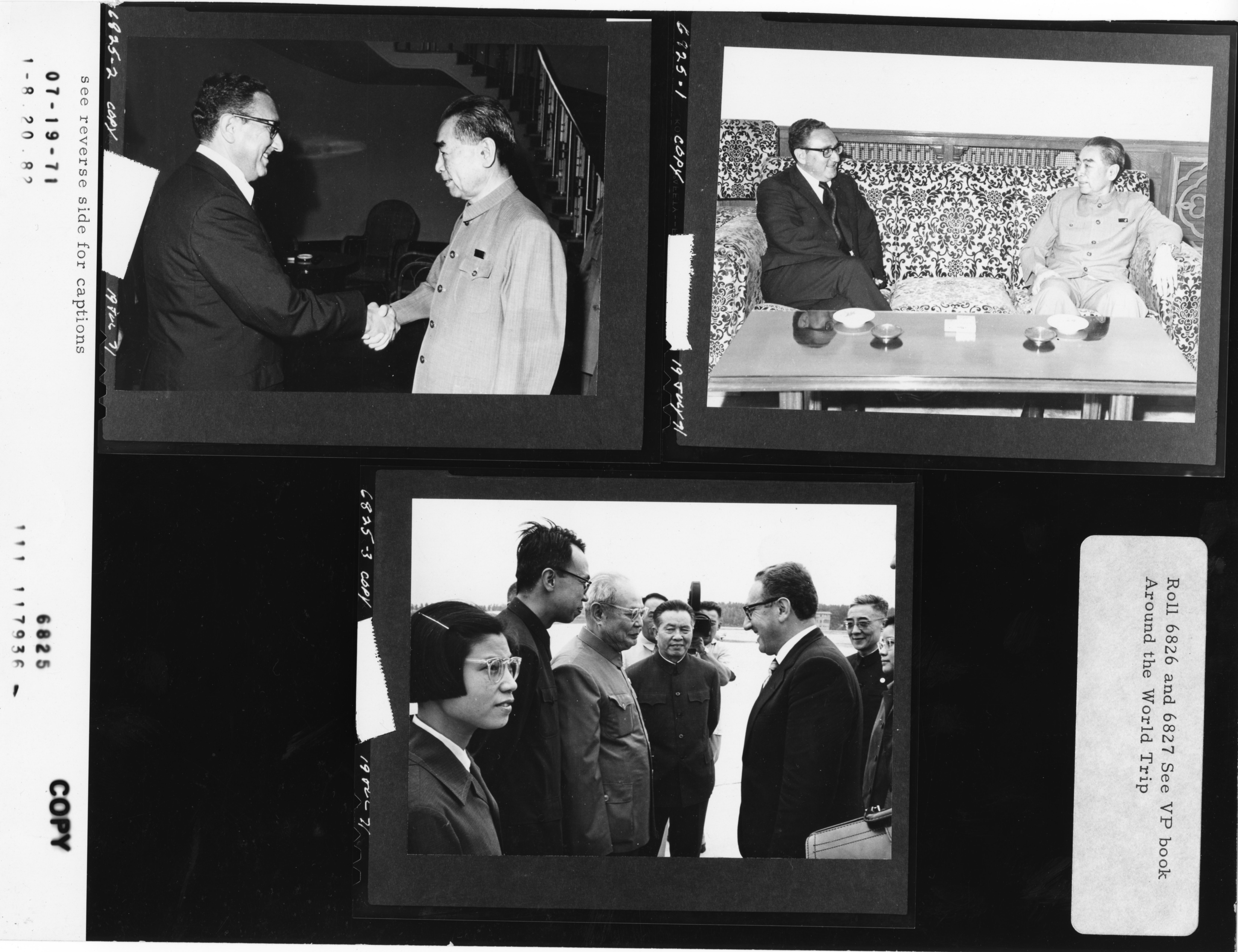
- Frame(s): WHPO-6825-01, Henry Kissinger sitting with Chinese Premier Chou En-Lai during a meeting during a meeting at Government House in China. 7/19/1971, Peking, China Government House. Henry Kissinger, Chou En-Lai.
- Frame(s): WHPO-6825-01, Henry Kissinger sitting with Chinese Premier Chou En-Lai during a meeting during a meeting at Government House in China. 7/19/1971, Peking, China Government House. Henry Kissinger, Chou En-Lai.
- Frame(s): WHPO-6825-01, Henry Kissinger sitting with Chinese Premier Chou En-Lai during a meeting during a meeting at Government House in China. 7/19/1971, Peking, China Government House. Henry Kissinger, Chou En-Lai.
- Frame(s): WHPO-6825-02, Henry Kissinger shaking hands with Chinese Premier Chou En-Lai during a meeting at Government House in China. 7/19/1971, Peking, China Government House. Henry Kissinger, Chou En-Lai.
- Frame(s): WHPO-6825-02, Henry Kissinger shaking hands with Chinese Premier Chou En-Lai during a meeting at Government House in China. 7/19/1971, Peking, China Government House. Henry Kissinger, Chou En-Lai.
- Frame(s): WHPO-6825-02, Henry Kissinger shaking hands with Chinese Premier Chou En-Lai during a meeting at Government House in China. 7/19/1971, Peking, China Government House. Henry Kissinger, Chou En-Lai.
- Frame(s): WHPO-6825-03, Henry Kissinger at the airport in China with Chinese officials. 7/19/1971, Peking, China airport tarmac. Henry Kissinger, Chou En-Lai, Yeh Chien-ying, Huang Hua, Chang Wen-chin, interpreters,unidentified woman and man.
- Frame(s): WHPO-6825-03, Henry Kissinger at the airport in China with Chinese officials. 7/19/1971, Peking, China airport tarmac. Henry Kissinger, Chou En-Lai, Yeh Chien-ying, Huang Hua, Chang Wen-chin, interpreters,unidentified woman and man.
- Frame(s): WHPO-6825-03, Henry Kissinger at the airport in China with Chinese officials. 7/19/1971, Peking, China airport tarmac. Henry Kissinger, Chou En-Lai, Yeh Chien-ying, Huang Hua, Chang Wen-chin, interpreters,unidentified woman and man.
Roll WHPO-6831 Photographer: Atkins, Oliver | Color or B&W: B&W
- Frame(s): WHPO-6831-01A-04A, President Nixon briefing Congressional leaders on his plans to visit China. 7/19/1971, Washington, D.C. White House, Cabinet Room. President Nixon, Gerald Ford, Carl Albert, Hugh Scott, Margaret Chase Smith, MacGregor, senators, representatives, aides.
Roll WHPO-6832 Photographer: Kightlinger, Jack | Color or B&W: B&W
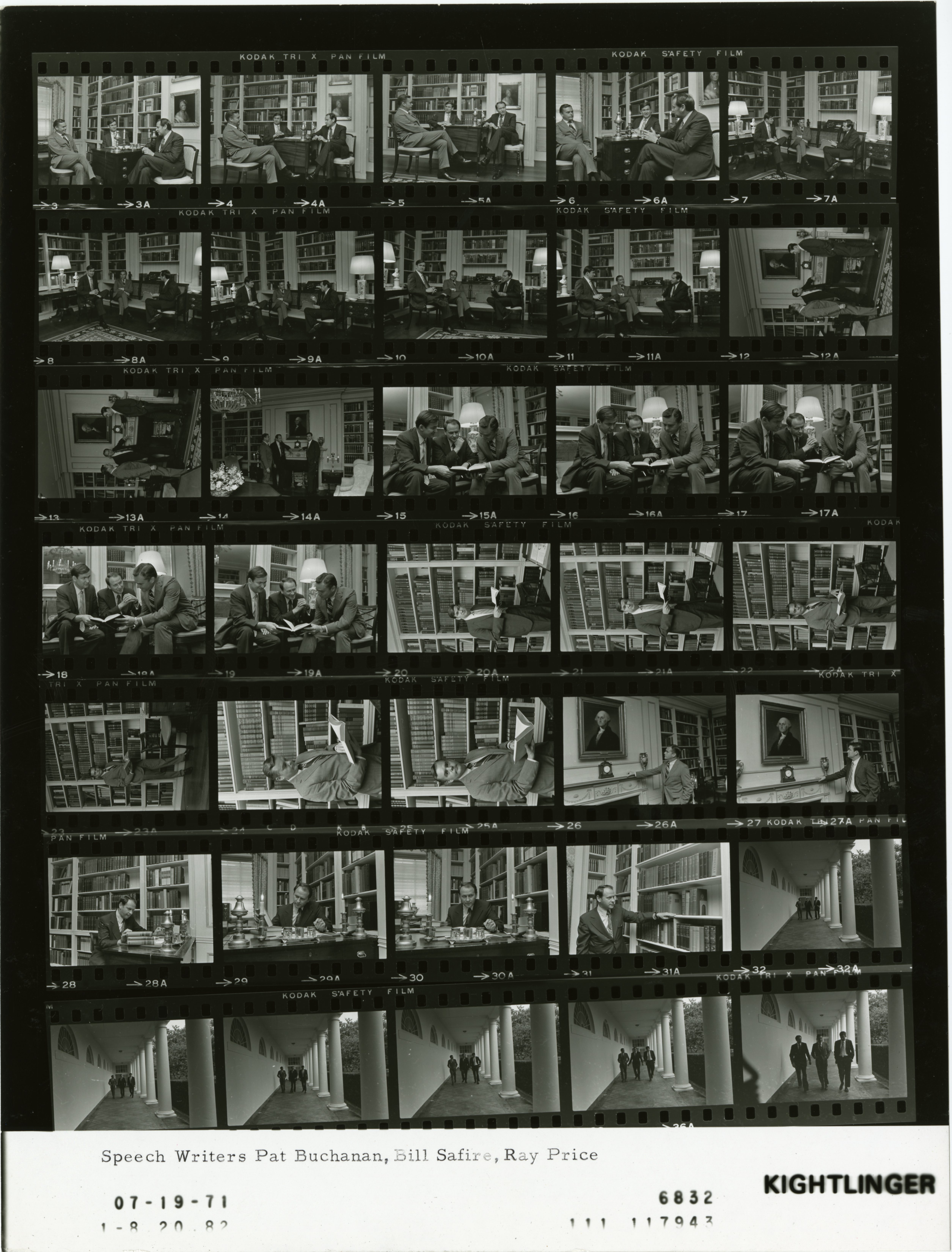
- Frame(s): WHPO-6832-03-31, Portrait of Presidential speech writers. 7/19/1971, Washington, D.C. White House, unidentified room. Pat Buchanan, Bill Safire, Ray Price.
- Frame(s): WHPO-6832-21A, Portrait of Pat Buchanan holding a book in front of the bookcase. 7/19/1971, Washington, D.C. White House, unidentified room. Pat Buchanan.
- Frame(s): WHPO-6832-24A, Portrait of Ray Price holding a book in front of the bookcase. 7/19/1971, Washington, D.C. White House, unidentified room. Ray Price.
- Frame(s): WHPO-6832-29A, Portrait of Bill Safire seated at his desk. 7/19/1971, Washington, D.C. White House, unidentified room. Bill Safire.
- Frame(s): WHPO-6832-32-37, Portrait of Presidential speech writers. 7/19/1971, Washington, D.C. White House, unidentified room. Pat Buchanan, Bill Safire, Ray Price.
The White House Communications Agency Videotape Collection contains “off-the-air” recordings of televised programs produced between 1968 and 1974. Visit the finding aid to learn more.
- WHCA-4545
Weekly News Summary, Tape II.
ALL NETWORKS
Runtime: 01:25:29
1. Chancellor: President Nixon informs Congress of plans to visit China. Time Code Start: 00:00. Keywords: Presidents, travel, trips, Nixon trips, international, People's Republic of China, announcements, speeches. Network: NBC.
2. McGee/Lewis: U.S. troops tested for Heroin use and addiction before leaving Vietnam, Heroin addiction program report. Time Code Start: 02:41. Keywords: Vietnam war, Armed Forces, military, troops, drugs, drug abuse, narcotics, morphine, heroin, addicts, addiction, prevention, programs, tests, testing. Network: NBC.
3. Chancellor/Neal: Democratic National Convention to be held in Miami, Florida, Republican National Convention to be held in San Diego, California. Time Code Start: 06:06. Keywords: Presidential elections, conventions, locations. Network: NBC.
4. Chancellor/Mackin: Washington's Senator Jackson seeks 1972 Democratic Presidential nomination. Time Code Start: 07:51. Keywords: Presidential elections, campaigns, campaigning, candidates, Senators. Network: NBC.
5. Cronkite/Rather: President Nixon warns Congress against speculating his China visit will speed an end to the Vietnam War. Time Code Start: 12:58. Keywords: Presidents, travel, trips, Nixon trips, international, People's Republic of China, House of Representatives, Vietnam War. Network: CBS.
6. Cronkite: Vice President Agnew not informed on details of President Nixon's China trip; Senator Ted Kennedy praises Nixon's China trip; report on the life of Chinese peasants under Communism. Time Code Start: 15:30. Keywords: Presidents, travel, trips, Nixon trips, international, People's Republic of China, Vice Presidents, Senate, Chinese, citizens, lifestyles, health, Communists. Network: CBS.
7. Cronkite/Schoumacher: Senate votes to keep Subversive Activities Control Board (SACB) operating despite inactivity; Senator Proxmire against decision. Time Code Start: 19:21. Keywords: Senators, agencies, militants, investigations, organizations, voting. Network: CBS.
8. Smith/Geer: South Vietnamese President Thieu says China plans to invade, criticizes President Nixon's planned China visit; Senate reaction to Nixon's China trip. Time Code Start: 22:02. Keywords: Presidents, travel, trips, Nixon trips, international, People's Republic of China, Vietnam War, criticisms. Network: ABC.
9. Reasoner/Chapman: The military refutes reports that 1,100 troops tested positive for drug use; cheating difficult with current drug testing process. Time Code Start: 25:10. Keywords: Vietnam war, Armed Forces, military, troops, drugs, drug abuse, marijuana, alcoholism, narcotics, morphine, heroin, addicts, addiction, prevention, programs, tests, testing. Network: ABC.
10. Smith/ Zimmerman: Taxes a major topic of 1972 Presidential campaign with Alabama Governor George George Wallace. Time Code Start: 27:18. Keywords: Presidential elections, campaigns, campaigning, candidates, Governors, speeches, taxes, taxation. Network: ABC.
11. Reasoner/Hill: Mayors conference meeting in Milwaukee, Wisconsin to discuss economy; Chicago Mayor Daley endorses Milwaukee Mayor Myer for Vice Presidential nomination. Time Code Start: 29:18. Keywords: Mayors, conferences, conventions, meetings, Presidential elections, campaigns, campaigning, candidates, Vice Presidents, nominations, endorsements. Network: ABC.
12. Smith: President Nixon tells Senate stop speculating on China visit implications; Kissinger's advance trip to China preparing for Nixon's arrival in 1972. Time Code Start: 31:19. Keywords: Presidents, travel, trips, Nixon trips, international, Senators, speeches, cabinet, advisors, People's Republic of China. Network: ABC.
Context (External Sources)
The Vanderbilt Television News Archive is the world's most extensive and complete archive of television news. They have been recording, preserving and providing access to television news broadcasts of the national networks since August 5, 1968.
Wikipedia is a free encyclopedia that anyone can edit.