

Introduction
This almanac page for Monday, January 31, 1972, pulls together various records created by the federal government and links to additional resources which can provide context about the events of the day.
Previous Date: Sunday, January 30, 1972
Next Date: Tuesday, February 1, 1972
Schedule and Public Documents
The Daily Diary files represent a consolidated record of the President's activities. Visit the finding aid to learn more.
The President's day began at The White House - Washington, D. C.
The Weekly Compilation of Presidential Documents made available transcripts of the President's news conferences; messages to Congress; public speeches, remarks, and statements; and other Presidential materials released by the White House.
Digitized versions can be found at HathiTrust.
Each Public Papers of the Presidents volume contains the papers and speeches of the President of the United States that were issued by the White House Office of the Press Secretary during the time period specified by the volume. The material is presented in chronological order, and the dates shown in the headings are the dates of the documents or events. In instances when the release date differs from the date of the document itself, that fact is shown in the text note.
To ensure accuracy, remarks have been checked against audio recordings (when available) and signed documents have been checked against the original, unless otherwise noted. Editors have provided text notes and cross references for purposes of identification or clarity.
The Federal Register is the official daily publication for rules, proposed rules, and notices of federal agencies and organizations, as well as executive orders and other Presidential documents.
No Federal Register published on this date
The Congressional Record is the official daily record of the debates and proceedings of the U.S. Congress.
Archival Holdings
Any selection of archival documents will necessarily be partial. You should use the documents and folders identified below as a starting place, but consult the linked collection finding aids and folder title lists and the collections themselves for context. Many documents to be found this way do not lend themselves to association with specific dates, but are essential to a complete understanding of the material.
Selective document listing
President's Office Files
The President's Office Files consists of materials drawn together by the Special Files Unit from several administrative subdivisions within the White House Office. It is the handwriting and sensitive papers sent to the Staff Secretary that now comprise much of the President's Office Files. Visit the finding aid to learn more.
- News Summaries, Annotated News Summaries, Box 33, [Jan. 25-31, 1972] [2 of 2] [Note: Due to the way News Summary products were compiled, you should also consult nearby days for potentially relevant materials.]
- January 31, 1972
- Weekend News Review, January 31, 1972
- President's Daily Schedule, Box 102, [President's Daily Schedule, Jan.-Mar. 1972] [3 of 3]
- The President's Schedule, Monday - January 31, 1972
The H. R. Haldeman Diaries consists of seven handwritten diaries, 36 dictated diaries recorded as sound recordings, and two handwritten audio cassette tape subject logs. The diaries and logs reflect H. R. Haldeman’s candid personal record and reflections on events, issues, and people encountered during his service in the Nixon White House. As administrative assistant to the President and Chief of Staff, Haldeman attended and participated in public events and private meetings covering the entire scope of issues in which the Nixon White House engaged in during the years 1969-1973. Visit the finding aid to learn more.
- Transcript of diary entry (PDF)
Monday, January 31.
Rogers called this morning, on the China trip planning, said that Henry was having the State people over for planning meetings and that Bill would like to be included in these and feels that the President should get himself involved. He feels the President should meet with the group of Rogers, Green, Jenkins, Platt, and Henry's people, so that it's clear to all of them that they're all working for the President. Kissinger's apparently asked for a meeting tomorrow, and Rogers would like to be in that meeting and have the President show it's a combined effort. I raised this in a meeting later in the day with the President while Rogers was-- while Kissinger was there, and Henry was horrified and furious at the thought. But President said to call Rogers back and tell him that he knows how the President abhors bull sessions and that he learns much better from the written word, so he would like them to get their papers in first, let the President have time to study them, then he'll meet with the group, and ask his questions and so forth, but he'd like their papers in before this weekend. Henry was delighted with that solution.
In the same session, we-- President got into a philosophical discussion with Henry out of which came the idea of having Andre Malraux come over for an appointment with the President before he goes to China, then Henry raised the idea of the President meeting with Yetvushenko, the Soviet poet, which the President agreed to do.
Attorney General called today regarding the Howard Hughes problem. He's gotten a report from the U.S. Attorney in New York, that, who has a draft of the Noah Dietrich book, that indicates that Hughes apparently contributed or made a gift of $195,000 to Nixon, after the '60 election, and said it could be considered a belated campaign contribution, and Mitchell's concerned that we get the background on that. Wants me to talk to Rose or someone and see what we can find out, which I will do. He also said that Reagan wants to talk with the President tomorrow, before his meeting on the dock strikes, about the problem of the conservatives in the Republican Party, so we're setting up some time for that.
President got into the whole Connally problem this morning, he wanted me to call Nellie and see if Connally would like to go to Florida and stay at the President's house for a while to recover from his cold and all. Also, he wants me to sit down and talk to Connally and say that the President says, because he's carrying such a burden and the President considers him the indispensable man that I'm to see that his path is as easy as possible within the White House staff, with Flanigan, Ehrlichman, Kissinger, and so on. That I'll take the responsibility to see that it's carried out, but I-- checking on this I found that our staff say that they can't reach him, and I wonder if there's anyone on his staff that they can deal with to save him from overloading. He won't tolerate even a hint of non-cooperation with you. You have to be the one voice, but somehow people have got to be able to get at you to get decisions and so on.
President also got into campaign PR and so on. He wants to get Billy Graham in tomorrow to talk about politics, and, based on a letter he had from Lou Giley, he feels we need one man who's really bright on the campaign PR side to contribute on thinking, who has some real brains, but that our people can't get jealous about. He thinks that we don't have adequate talent in this area, which is actually correct.
He also talked a little about the idea of having Connally head up the Democrats for Nixon, and using that as a campaign role for him. He's concerned about whether we're working the Southern Democrats in Congress, especially Harry Byrd. Wants to be sure our people all keep quiet about campaign strategy.
Ziegler was in several times today trying to get a final decision on the China press corps, the big debate being whether to take Joe Kraft or not. First problem being the President's ruling out of The Washington Post, but Ziegler talked him into leaving them on the list. Then Henry's pushing for Joe Kraft, so they were looking for a conservative columnist to balance him, and finally agreed that it should be Kilpatrick, then Ziegler came back in, said Kilpatrick had said he couldn't go, so we agreed it should be William S. White. Ziegler came back a few minutes later and said White can't go, either. So then the debate was between Holmes Alexander, Dick Wilson, or Bill Buckley. We're all afraid of Buckley, but obviously he'd be the best signal, and I think that's where we ended up.
The Don Nixon problem arose again as Ehrlichman reported to the President on the Anderson thing, and we had some discussion about how to handle Don, and agreed that it's got to be done through Kalmbach.
Also, Ehrlichman had raised the welfare problem on the basis of Ribicoff's abandonment of Family Assistance, as a result of which the President called Ribicoff to suggest a meeting with him and Long and Bennett. Ribicoff used the opportunity to fill the President full of his line on the subject. President made the point that a bitter confrontation in the committee would be bad at this time, and we should try to work something out. He asked Ribicoff to talk to John Ehrlichman, go over this whole thing with him, and then before they make a final decision on what way to go, the President would like to have a talk with Ribicoff. This approach apparently solved the problem, at least for the time being.
End of January 31. - Original audio recording (MP3)
The National Archives Catalog is the online portal to the records held at the National Archives, and information about those records. It is the main way of describing our holdings and also provides access to electronic records and digitized versions of our holdings.
The Catalog searches across multiple National Archives resources at once, including archival descriptions, digitized and electronic records, authority records, and web pages from Archives.gov and the Presidential Libraries. The Catalog also allows users to contribute to digitized historical records through tagging and transcription.
Nixon Library Holdings
All National Archives Units
National Security Documents
The President's Daily Brief is the primary vehicle for summarizing the day-to-day sensitive intelligence and analysis, as well as late-breaking reports, for the White House on current and future national security issues. Read "The President's Daily Brief: Delivering Intelligence to Nixon and Ford" to learn more.
The Foreign Relations of the United States series presents the official documentary historical record of major U.S. foreign policy decisions and significant diplomatic activity. Visit the State Department website for more information.
Vol. XVII, China, 1969-1972
China, October 1971-February 1972
188. Memorandum From the President’s Deputy Assistant for National Security Affairs (Haig) to the Defense Attaché in France (Walters), Washington, January 31, 1972
Source: National Archives, Nixon Presidential Materials, NSC Files, Box 849, President’s File—China Trip, China Exchanges. Top Secret; Sensitive; Exclusively Eyes Only. By wire. A handwritten notation on the document reads: “WH 20114 [less than 1 line of source text not declassified]
Vol. XXXII, SALT I, 1969-1972
Narrowing the Issues, October 19, 1971-April 18, 1972
231. Backchannel Message From the Chief of the Delegation to the Strategic Arms Limitation Talks (Smith) to the President’s Assistant for National Security Affairs (Kissinger), Vienna, January 31, 1972, 1714Z
Source: Washington National Records Center, RG 383, ACDA Files: FRC 383–97–0010, Box 1, Director’s Files, Smith Files, Smith/White House Correspondence, January–May 1972. Top Secret; Sensitive; Exclusive Eyes Only. The message number, “Vienna 144” is handwritten at the top of the first page. The text printed here is the copy Smith approved.
Vol. XXXVI, Energy Crisis, 1969-1974
April 15, 1971-March 11, 1972
109. Memorandum of Conversation, Washington, January 31, 1972
Source: National Archives, RG 59, Central Files 1970–73, FSE 1 US. Secret. Drafted by Akins. This memorandum of conversation is Part III of a series of memoranda covering six meetings Irwin and Akins held with other heads of agencies. They met with Lincoln and Schlesinger on January 21 (Parts I and II), Morton on February 1 (Part IV), Nassikas on February 2 (Part V), and Stein on February 8 (Part VI). (Ibid., FSE 15 US) They also met with Connally on March 8. (Ibid., FSE 1 US) The reception of the Department’s presentations, which were based on Document 106, was both positive and supportive.
The Kissinger telephone conversation transcripts consist of approximately 20,000 pages of transcripts of Kissinger’s telephone conversations during his tenure as Assistant to the President for National Security Affairs (1969-1974) and Secretary of State (1973-1974) during the administration of President Richard Nixon. Visit the finding aid for more information.
Digitized versions can be found in the National Archives Catalog.
Audiovisual Holdings
Visit the White House Tapes finding aid to learn about the taping system's operation and archival processing.
Oval Office
- 660-15; Unknown between 9:04 a.m. & 9:23 a.m.; Nixon, Richard M. (President); [Unknown person(s)]
- 660-16; 9:23 a.m. - 10:34 a.m.; Nixon, Richard M. (President); Haldeman, H. R. ("Bob"); Butterfield, Alexander P.; Ziegler, Ronald L.; Bull, Stephen B.
- 660-17; 10:34 a.m. - 10:59 a.m.; Nixon, Richard M. (President); Schmidt, Benno C.; Clark, R. Lee; Good, Robert A.; Richardson, Elliot L.; Cavanaugh, James H.; Cole, Kenneth R., Jr.; White House photographer
- 660-18; Unknown between 10:59 a.m. & 11:03 a.m.; Nixon, Richard M. (President); Sanchez, Manolo
- 660-19; Unknown between 10:59 a.m. & 11:03 a.m.; Nixon, Richard M. (President); Bull, Stephen B.
- 660-20; Unknown between 10:59 a.m. & 11:03 a.m.; Nixon, Richard M. (President); White House operator
- 660-21; 11:03 a.m. - 11:54 a.m.; Nixon, Richard M. (President); Kissinger, Henry A.; Bull, Stephen B.; Luns, Joseph M. A.; White House photographer
- 661-1; 1:28 p.m. - 3:12 p.m.; Nixon, Richard M. (President); Ehrlichman, John D.; Haldeman, H. R. ("Bob"); [Unknown person(s)]; Ziegler, Ronald L.; White House operator; Ribicoff, Abraham A.; Bull, Stephen B.
- 661-2; 3:13 p.m. - 3:51 p.m.; Nixon, Richard M. (President); Schlesinger, James R. (Dr.); Haig, Alexander M., Jr.; Butterfield, Alexander P.
- 661-3; Unknown between 3:51 p.m. & 4:00 p.m.; Nixon, Richard M. (President); Butterfield, Alexander P.; Ziegler, Ronald L.; White House operator; McClory, Robert
- 661-4; Unknown between 4:00 p.m. & 4:01 p.m.; Nixon, Richard M. (President); White House operator
- 661-5; Unknown between 4:00 p.m. & 4:01 p.m.; Nixon, Richard M. (President); Bull, Stephen B.
- 661-6; 4:01 p.m. - 4:03 p.m.; Nixon, Richard M. (President); Arsht, Leslye A.
- 661-7; Unknown between 4:03 p.m. & 4:04 p.m.; Nixon, Richard M. (President); White House operator
- 661-8; Unknown between 4:03 p.m. & 4:04 p.m.; Nixon, Richard M. (President); Bull, Stephen B.
- 661-9; 4:04 p.m. - 5:05 p.m.; Nixon, Richard M. (President); McKinney, Stewart B.; Ehrlichman, John D.; Ziegler, Ronald L.
- 661-10; Unknown between 5:05 p.m. & 5:13 p.m.; Nixon, Richard M. (President); Bull, Stephen B.
- 661-11; Unknown between 5:05 p.m. & 5:49 p.m.; Nixon, Richard M. (President); Haldeman, H. R. ("Bob"); Kissinger, Henry A.
- 661-12; 5:49 p.m. - 6:00 p.m.; Nixon, Richard M. (President); Woods, Rose Mary; Butterfield, Alexander P.; Haldeman, H. R. ("Bob"); [Unknown person(s)]
- 661-13; Unknown between 6:00 p.m. & 6:06 p.m.; Nixon, Richard M. (President); Butterfield, Alexander P.; Bull, Stephen B.
- 661-14; Unknown between 6:00 p.m. & 6:06 p.m.; Nixon, Richard M. (President); Kissinger, Henry A.; Woods, Rose Mary
- 661-15; Unknown between 6:00 p.m. & 11:59 p.m.; Butterfield, Alexander P.; United States Secret Service agents
White House Telephone
- 20-1; Unknown between 12:01 a.m. & 1:06 p.m.;
- 20-2; Unknown between 2:22 p.m. & 2:34 p.m.; Nixon, Richard M. (President); White House operator
- 20-3; 2:34 p.m. - 2:42 p.m.; Nixon, Richard M. (President); Ribicoff, Abraham A.
- 20-4; Unknown between 3:55 p.m. & 3:57 p.m.; Nixon, Richard M. (President); White House operator
- 20-5; 3:57 p.m. - 3:58 p.m.; Nixon, Richard M. (President); McClory, Robert
- 20-6; Unknown between 4:00 p.m. & 4:01 p.m.; Nixon, Richard M. (President); White House operator
- 20-7; 4:01 p.m. - 4:03 p.m.; Nixon, Richard M. (President); Arsht, Leslye A.
- 20-8; Unknown between 4:03 p.m. & 4:04 p.m.; Nixon, Richard M. (President); White House operator
- 20-9; 4:04 p.m. - 4:06 p.m.; Nixon, Richard M. (President); McKinney, Stewart B.
- 20-10; Unknown between 6:06 p.m. & 7:26 p.m.; Nixon, Richard M. (President); White House operator
- 20-11; 7:26 p.m. - 7:27 p.m.; Nixon, Richard M. (President); Haldeman, H. R. ("Bob")
- 20-12; 7:44 p.m. - 7:44 p.m.; Nixon, Richard M. (President); White House operator
- 20-13; 8:00 p.m. - 8:04 p.m.; Nixon, Richard M. (President); White House operator; Woods, Rose Mary
- 20-14; Unknown between 9:21 p.m. & 9:49 p.m.; Nixon, Richard M. (President); White House operator
The White House Photo Office collection consists of photographic coverage of President Richard Nixon meeting with prominent social, political, and cultural personalities; speaking engagements and news conferences of the President and various high-ranking members of the White House staff and Cabinet; Presidential domestic and foreign travel, including Presidential vacations; social events and entertainment involving the First Family, including entertainers present; official portraits of the President, First Family, and high-ranking members of the Nixon administration; the 1969 and 1973 Inaugurals; the President’s 1972 Presidential election campaign appearances (including speeches) and other official activities of the White House staff and the President’s Cabinet from January 20, 1969 until August 9, 1974 at the White House and the Old Executive Office Building; other locations in Washington, DC, such as The Mall; and the Presidential retreats in Camp David, Maryland, Key Biscayne, Florida, and San Clemente, California. Visit the finding aid to learn more.
Roll WHPO-8351 Photographer: Schumacher, Karl | Color or B&W: Color
- Frame(s): WHPO-8351-03-04, Unidentified celebrity signing baseballs. 1/31/1972, New York City, New York unknown. Julie Eisenhower, David Eisenhower, unidentified persons.
- Frame(s): WHPO-8351-05-30, Julie and David Eisenhower before, during, and after a Puerto Rican Sports Award reception. 1/31/1972, New York City, New York unknown. Julie Eisenhower, David Eisenhower, unidentified persons.
Roll WHPO-8352 Photographer: Schumacher, Karl | Color or B&W: B&W
- Frame(s): WHPO-8352-10, Julie Nixon Eisenhower and David Eisenhower walking outside either before or after a Puerto Rican Sports Award reception. 1/31/1972, New York City, New York unknown. Julie Eisenhower, David Eisenhower, unidentified persons.
Roll WHPO-8353 Photographer: Atkins, Oliver | Color or B&W: B&W
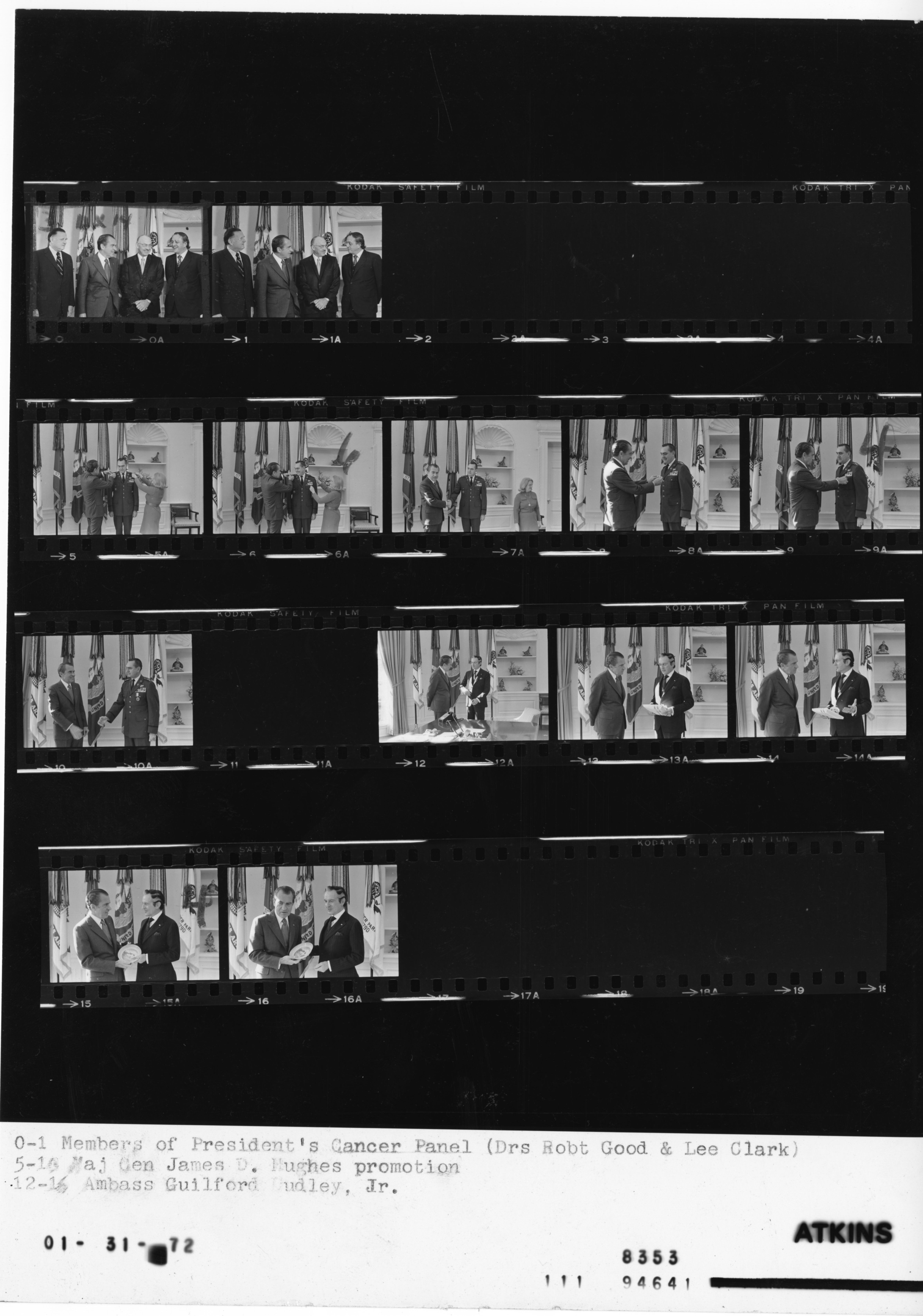
- Frame(s): WHPO-8353-00-01, President Nixon standing with members of his Cancer Panel. 1/31/1972, Washington, D.C. White House, Oval Office. President Nixon, Benno Schmidt, R. Lee Clark, Robert Good, James Hughes, Mrs. James Hughes, Guilford Dudley, Jr.
- Frame(s): WHPO-8353-05-10, President Nixon promoting Brigadier General Hughes to Major General James Donald Hughes, as his wife looks on. 1/31/1972, Washington, D.C. White House, Oval Office. President Nixon, Benno Schmidt, R. Lee Clark, Robert Good, James Hughes, Mrs. James Hughes, Guilford Dudley, Jr.
- Frame(s): WHPO-8353-12-16, President Nixon receiving a gift from former U.S. ambassador to the Netherlands Guilford Dudley, Jr. 1/31/1972, Washington, D.C. White House, Oval Office. President Nixon, Benno Schmidt, R. Lee Clark, Robert Good, James Hughes, Mrs. James Hughes, Guilford Dudley, Jr.
Roll WHPO-8354 Photographer: Atkins, Oliver | Color or B&W: B&W
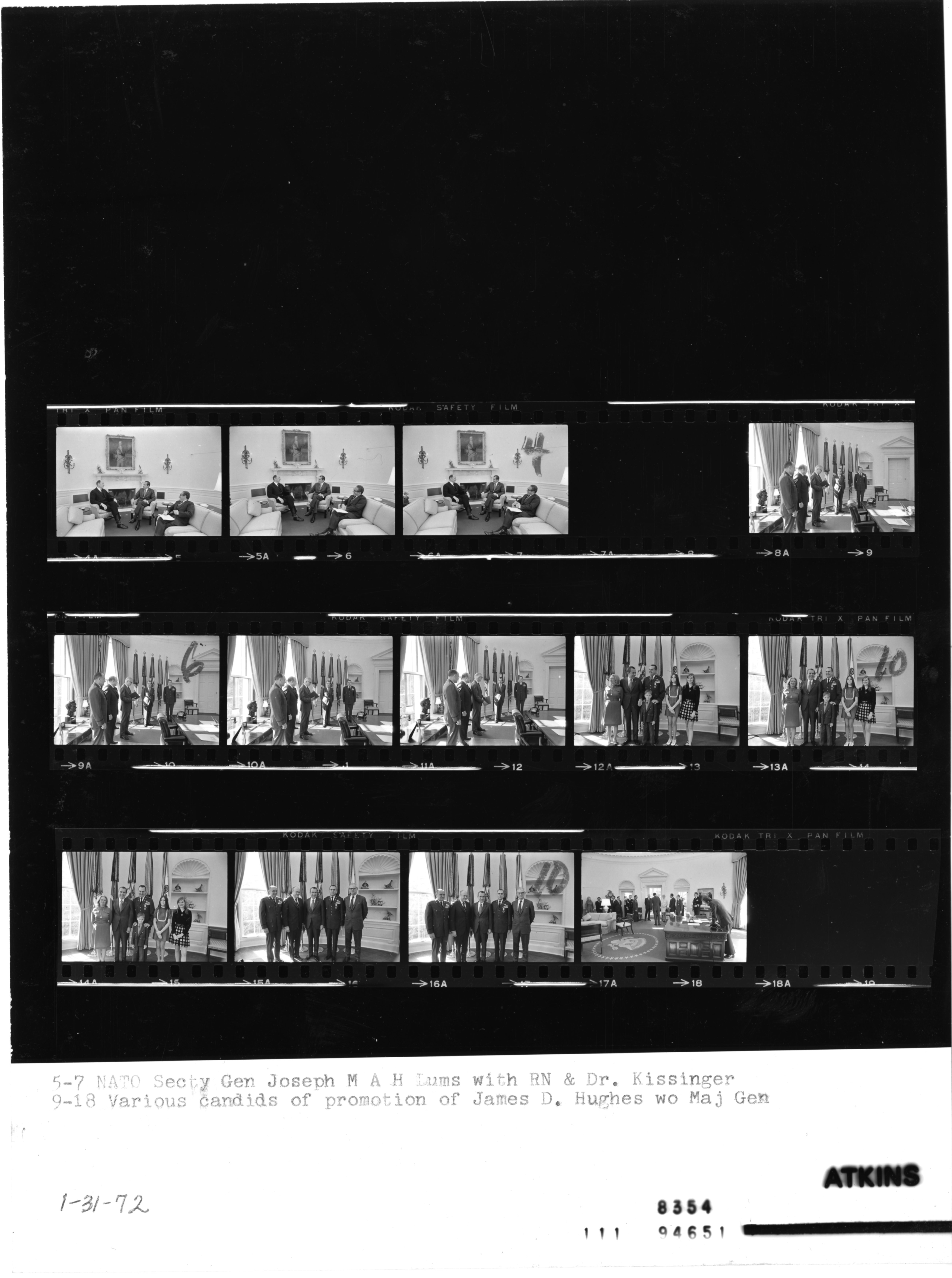
- Frame(s): WHPO-8354-05-07, President Nixon seated informally with Henry Kissinger and Secretary General of NATO Joseph Luns. 1/31/1972, Washington, D.C. White House, Oval Office. President Nixon, Henry Kissinger, Joseph Luns, James Hughes, Hughes family members, Laird, Robert Seamans, John Ryan.
- Frame(s): WHPO-8354-09-18, President Nixon promoting Brigadier General Hughes to Major General James Donald Hughes. 1/31/1972, Washington, D.C. White House, Oval Office. President Nixon, Henry Kissinger, Joseph Luns, James Hughes, Hughes family members, Laird, Robert Seamans, John Ryan.
Roll WHPO-8355 Photographer: Atkins, Oliver | Color or B&W: B&W
- Frame(s): WHPO-8355-, President Nixon seated at his desk during a meeting with Alexander Haig and James Schlesinger. 1/31/1972, Washington, D.C. White House, Oval Office. President Nixon, Haig, James Schlesinger.
Roll WHPO-8356 Photographer: Kightlinger, Jack | Color or B&W: B&W
- Frame(s): WHPO-8356-, Unidentified persons at a meeting concerning a dock strike. 1/31/1972, Washington, D.C. unknown. unidentified persons.
The White House Communications Agency Sound Recordings Collection contains public statements that took place between 1969 and 1974. Visit the finding aid to learn more.
H - White House Staff Member Recordings
- WHCA-SR-H-505
Press briefing by Gerald Warren, Dr. Smidt, and Dr. Good. (1/31/1972, Press Center, White House)
Runtime: 34:00:00
Keywords: Press conferences, news conferences, interviews, media
Production credits: Audio feed supplied by WHCA; Recorded by LRR (initials of WHCA engineer)
Original Format: 1/4-inch reel-to-reel audiotape. Original source type: Original.
The White House Communications Agency Videotape Collection contains “off-the-air” recordings of televised programs produced between 1968 and 1974. Visit the finding aid to learn more.
- WHCA-5017
"The Loyal Opposition".
Undetermined
Runtime: 01:00:15 - WHCA-5018
"Two Interviews," with Julie Eisenhower. News commentators.
NBC, ABC, CBS
Runtime: 01:05:24 - WHCA-5019
"Surveillance: Who's Watching?".
Runtime: 01:29:05 - WHCA-5020
"Bangladesh".
Undetermined
Runtime: 00:29:05 - WHCA-5029
Weekly News Summary, Tape I.
ALL NETWORKS
Runtime: 01:35:56
36. Report on no new taxes by President Nixon's administration/ film of the House Ways and Means Committee/ on camera comments by Representative Al Ullman and Senator Connolly. Time Code Start: 67:37. Keywords: Presidents, taxes, taxation, revenue. Network: ABC.
37. Film report of Mayor John Lindsay campaigning in Wisconsin. Time Code Start: 69:29. Keywords: Mayors, Presidential elections, campaigns, campaigning, candidates. Network: ABC.
38. Film report of Senator Jackson campaigning in Florida and Georgia. Time Code Start: 71:51. Keywords: elections, campaigns, campaigning, primaries, candidates, voting, speeches. Network: ABC.
39. Report on U.S.-Israel talks to re-open Suez Canal/ film of cabinet meeting with Assistant Secretary of State Joseph Sisco. Time Code Start: 73:54. Keywords: Middle East, Mideast, Egyptian, Jordanian, Mediterranean, Red Sea, Suez canal zone, canals, waterways, shipping routes, cabinet, advisors. Network: ABC.
40. Harry Reasoner commentary on President Nixon's Peace Plan and the possibility of its success and its desirability versus its possibility. Time Code Start: 77:17. Keywords: Presidents, Paris Peace Talks, Vietnam War, treaty, treaties, negotiations. Network: ABC.
41. Report on the break in talks of North Vietnam's Nine Point Peace Plan/ on camera comments by Nguyen Thanh Le in Paris. Time Code Start: 79:28. Keywords: Paris Peace Talks, Vietnam War, treaty, treaties, negotiations, government, officials. Network: NBC.
42. Film report of Cambodian attempt to obtain a cease-fire. Time Code Start: 81:22. Keywords: Cambodia, Vietnam War, truces, treaty, treaties, peace, ceasefires. Network: NBC.
43. Report on fighting in Laos. Time Code Start: 84:41. Keywords: Laos, Vietnam War. Network: NBC.
44. Report on no new taxes by President Nixon's administration/ film of the House Ways and Means Committee/ on camera comments by Representative Al Ullman and Senator Connolly. Time Code Start: 85:10. Keywords: Presidents, taxes, taxation, revenue. Network: NBC.
45. Film report of massacre by British soldiers in Londonberry, Northern Ireland and protests in Dublin. Time Code Start: 87:19. Keywords: United Kingdom, Irish Republican Army, terrorism, explosions, riots, violence, military, assaults,. Network: CBS.
46. Report on Bernadette Devlin (Member of Parliament from Northern Ireland) and her attack on a British minister/ interview with Devlin. Time Code Start: 90:02. Keywords: United Kingdom, Irish Republican Army, MPs, attacks, criticisms. Network: CBS.
47. Report on expected communist TET offensive/ North Vietnam Nine Point Peace Proposal. Time Code Start: 91:57. Keywords: Paris Peace Talks, Vietnam War, treaty, treaties, negotiations. Network: CBS.
48. Sevareid: commentary on the new rules of the Democrat delegate system. Time Code Start: 92:56. Keywords: political parties, Democrats, Democratic Party, Presidential elections, campaigns, campaigning, candidates, primaries, voting, conventions, delegations, delegates. Network: CBS.
Context (External Sources)
The Vanderbilt Television News Archive is the world's most extensive and complete archive of television news. They have been recording, preserving and providing access to television news broadcasts of the national networks since August 5, 1968.
Wikipedia is a free encyclopedia that anyone can edit.