
Introduction
This almanac page for Thursday, January 30, 1969, pulls together various records created by the federal government and links to additional resources which can provide context about the events of the day.
Previous Date: Wednesday, January 29, 1969
Next Date: Friday, January 31, 1969
Schedule and Public Documents
The Daily Diary files represent a consolidated record of the President's activities. Visit the finding aid to learn more.
The President's day began at The White House - Washington, D. C.
The Weekly Compilation of Presidential Documents made available transcripts of the President's news conferences; messages to Congress; public speeches, remarks, and statements; and other Presidential materials released by the White House.
Addresses and Remarks
- Presidential Prayer Breakfast (5 Weekly Comp. Pres. Doc. 188, January 30, 1969)
The President's Remarks at the 17th Annual Presidential Prayer Breakfast. - Astronaut Borman's Goodwill Tour (5 Weekly Comp. Pres. Doc. 189, January 30, 1969)
Remarks of the President and Col. Frank Borman Announcing the Colonel's Forthcoming Visit to Western Europe. - Department of Justice (5 Weekly Comp. Pres. Doc. 191, January 30, 1969)
The President's Remarks to Department Employees.
Appointments and Nominations
- Post Office Department (5 Weekly Comp. Pres. Doc. 193, January 30, 1969)
Announcement of Nominations for Appointment to the Department.
Congress, Communications to
- Reorganization of the Executive Branch (5 Weekly Comp. Pres. Doc. 190, January 30, 1969)
The President's Message to the Congress Urging Extension of the President's Authority To Transmit Reorganization Plans.
Memorandums to Federal Agencies
- Implementation of Task Force Recommendations (5 Weekly Comp. Pres. Doc. 192, January 30, 1969)
Announcement of Directives to Heads of Departments and Agencies.
Statements by the President
- Allen Dulles (5 Weekly Comp. Pres. Doc. 194, January 30, 1969)
Statement by the President.
Checklist of White House Press Releases
The releases listed below, made public by the Office of the White House Press Secretary during the period covered by this issue, are not included in the issue.
- Biographical data on Elmer Theodore Klassen.
- Biographical data on James W. Hargrove.
- Biographical data on Kenneth A. Housman.
- Biographical data on John L. O'Marra.
- Biographical data on David A. Nelson.
- Biographical data on Elizabeth Duncan Koontz.
Each Public Papers of the Presidents volume contains the papers and speeches of the President of the United States that were issued by the White House Office of the Press Secretary during the time period specified by the volume. The material is presented in chronological order, and the dates shown in the headings are the dates of the documents or events. In instances when the release date differs from the date of the document itself, that fact is shown in the text note.
To ensure accuracy, remarks have been checked against audio recordings (when available) and signed documents have been checked against the original, unless otherwise noted. Editors have provided text notes and cross references for purposes of identification or clarity.
- Remarks at the 17th Annual Presidential Prayer Breakfast.
- Remarks Announcing a Goodwill Tour to Western Europe by Col. Frank Borman, USAF.
- Special Message to the Congress Requesting New Authority To Reorganize the Executive Branch
- Remarks to Employees at the Department of Justice.
- Statement on the Death of Allen Dulles.
The Federal Register is the official daily publication for rules, proposed rules, and notices of federal agencies and organizations, as well as executive orders and other Presidential documents.
The Congressional Record is the official daily record of the debates and proceedings of the U.S. Congress.
Archival Holdings
Any selection of archival documents will necessarily be partial. You should use the documents and folders identified below as a starting place, but consult the linked collection finding aids and folder title lists and the collections themselves for context. Many documents to be found this way do not lend themselves to association with specific dates, but are essential to a complete understanding of the material.
Selective document listing
President's Office Files
The President's Office Files consists of materials drawn together by the Special Files Unit from several administrative subdivisions within the White House Office. It is the handwriting and sensitive papers sent to the Staff Secretary that now comprise much of the President's Office Files. Visit the finding aid to learn more.
- President's Handwriting, Box 1, President's Handwriting, January 1969 [2 of 2]
- Note; Haldeman notes on meeting with the President. January 30, 1969. 1 pg.
- President's Handwriting, Box 1, President's Handwriting, February 1969 [1 of 3]
- Memo; Daniel P. Moynihan to The President re: Administrator of the Federal Highway Administration. January 30, 1969. 2 pgs.
- Annotated News Summaries, Box 28, News Summaries - January 1969 [During this period, the Staff Secretary only removed pages from the News Summaries which contained President Nixon's handwriting, often leaving the document with no date. In addition to the individual document listed below, you should also consult the full folder for the month.]
- Evening News Play, January 30, 1969
- Washington Evening Star, "Son Is Seeking Nixon Pardon for Imprisoned Doctor", January 30, 1969
- News Analyses, January 30, 1969
- President's Meetings File, Box 73, Memoranda for the President--Beginning January 26, 1969
- H. R. Haldeman to The President's File, Meeting with Max Fisher (also present: Henry Kissinger). 1/30/1969, 2:16 p.m. [per President's Daily Diary]. 1 pg.
- H. R. Haldeman to The President's File, Meeting with Fred LaRue (also present: John Sears). 1/30/1969, 2:45 p.m. [per President's Daily Diary]. 1 pg.
- H. R. Haldeman to The President's File, Meeting with Dr. DuBridge. 1/30/1969, 3:23 p.m. [per President's Daily Diary]. 1 pg.
President's Personal File
The President's Personal File is essentially a President's secretary's file, kept by Rose Mary Woods, personal secretary to the President, for two purposes: (1) preserving for posterity a collection of documents particularly close to the President, whether because he dictated or annotated them, or because of the importance of the correspondent or the event concerned and (2) giving appropriate attention–letters of gratitude, invitations to White House social events, and the like–to members and important friends and supporters of the Nixon administration. This generalization does not describe all the varied materials of a file group which is essentially a miscellany, but it does identify the reason for the existence of the file group's core. Visit the finding aid to learn more.
- President's Speech File
Selective document listing
The White House Press Office during the Presidency of Richard Nixon was responsible for daily communication with the White House press corps. Ronald L. Ziegler was the Press Secretary to the President for Nixon's entire term in office from January 1969 to August 1974 and Gerald Warren served as the Deputy Press Secretary. The office held daily briefings for the press and produced the White House’s press releases. Visit the finding aid to learn more.
- White House Press Releases, Box 1
- FOR IMMEDIATE RELEASE JANUARY 30, 1969
Office of the White House Press Secretary
THE WHITE HOUSE
BIOGRAPHICAL INFORMATION ON ELIZABETH DUNCAN KOONTZ
Present Position: Director, Women's Bureau, United States Department of Labor
Born: June 3, 1919, Salisbury, North Carolina
Marital Status: Married to Harry L. Koontz
Education: Livingstone College, Salisbury, North Carolina 1938, A. B.
Atlanta University, Atlanta, Georgia 1940-41 M.A.
Experience:
Non Government
1938-40 Teacher, Dunn, North Carolina
1941-42 Teacher, Landis, North Carolina
1942-45 Teacher, Winston-Salem, North Carolina
1945-69 Special Education Teacher (slow-learners, disadvantaged children), Price Junior-Senior High School, Salisbury, North Carolina (on leave school year 1968-69)
July/1968-69 President, National Education Association
1969 - present Director, Women's Bureau, United States Department of Labor
Memberships:
President of the North Carolina Teachers Association and presently a member of the Executive Board.
Member, North Carolina Governor Sanford's Commission on the Status of Women in 1962.
Member: American Delegation to 4th Dartmouth Conference, Soviet Union (1964); President Johnson's Advisory Council on Education of Disadvantaged Children (1965-68); Education Committee, National Urban League ( 1965-present); Editorial Board of Education USA (1965-present); Editorial Board of Education Digest (1967 - present); North Carolina Council on Human Relations; Family Service Council of North Carolina; National Education Association (life member); National Association for Retarded Children; North Carolina Association for Retarded Children.
# # # - FOR RELEASE AT 12:00 NOON EST January 30, 1969
NOTICE: There should be no premature release of this message nor should its contents be paraphrased, alluded to or hinted at in earlier stories. There is a total embargo on this message until it has been delivered to the United States Senate or the House of Representatives, which includes any and all references to any material in this message.
Ronald Ziegler
THE WHITE HOUSE
TO THE CONGRESS OF THE UNITED STATES:
New times call for new ideas and fresh approaches. To meet the needs of today and tomorrow, and to achieve a new level of efficiency, the Executive Branch requires flexibility in its organization.
Government organization is created to serve, not to exist; as functions change, the organization must be ready to adapt itself to those changes.
Ever since the Economy Act of 1932, the Congress has recognized the need of the President to modernize the Federal Government continually. During most of that time, the Congress has provided the President the authority to reorganize the Executive Branch. The current reorganization statute -- Chapter 9 of Title 5 of the United States Code -- is derived from the Reorganization Act of 1949. That law places upon the President a permanent responsibility "from time to time to examine the organization of all agencies" and "to determine what changes therein are necessary" to accomplish the purposes of the statute. Those purposes include promoting the better execution of the laws, cutting expenditures, increasing efficiency in Government operations, abolishing unnecessary agencies and eliminating duplication of effort. The law also authorizes the President to transmit reorganization plans to the Congress to make the changes he considers necessary.
Unfortunately, the authority to transmit such plans expired on December 31, 1968. The President cannot, therefore, now fulfill his reorganization responsibilities. He is severely limited in his ability to organize and manage the Executive Branch in a manner responsive to new needs.
I, therefore, urge that the Congress promptly enact legislation to extend for at least two years the President's authority to transmit reorganization plans.
This time-tested reorganization procedure is not only a means for curtailing ineffective and uneconomical Government operations, but it also provides a climate that enables good managers to manage well.
Under the procedure, reorganization plans are sent to the Congress by the President and generally take effect after 60 days unless either House passes a resolution of disapproval during that time. In this way the President may initiate improvements, and the Congress retains the power of review.
This cooperative executive-legislative approach to reorganization has shown itself to be sensible and effective for more than three decades, regardless of party alignments. It is more efficient than the alternative of passing specific legislation to achieve each organizational change.. The cooperative approach is tested; it is responsive; it works.
Reorganization authority is the tool a President needs to shape his Administration to meet the new needs of the times, and I urgently request its extension.
RICHARD NIXON
THE WHITE HOUSE,
January 30, 1969.
# # # # - FOR IMMEDIATE RELEASE JANUARY 30, 1969
OFFICE OF THE WHITE HOUSE PRESS SECRETARY
THE WHITE HOUSE
REMARKS OF THE PRESIDENT AND COLONEL FRANK BORMAN AFTER A MEETING WITH THE APOLLO 8 ASTRONAUTS
THE FISH ROOM
AT 11:00 A.M. EST
THE PRESIDENT: Ladies and gentlemen, these three men who stand with me need no introduction. I think, if anything, they are probably better known than the President of the United States as a result of television and their recent very great exposure for the whole world.
It is my very great privilege today to welcome them again to this House and this office, and to announce that Colonel Borman, his wife and two sons are going to make a goodwill trip to Western Europe. The number of countries to be visited at present is eight. The number may be extended. We think this is a very appropriate trip for him to make for several reasons.
First, a personal note with regard to the Inaugural ceremonies to indicate the sense of continuity of the space program. Naturally, when the Inauguration invitations went out I suggested that we invite the three Astronauts who are with me today to come to the Inauguration. The NASA Director very appropriately pointed out that the invitation should be extended to a larger group, because these three men, as Colonel Borman and his colleagues have taken every opportunity to point out, could not have done what they have done without building on what has gone on before them. So, consequently, a group of nine came to the Inauguration.
As Colonel Borman goes to Europe, he pointed out to me, his two colleagues have a mission here at home that they need to undertake and consequently will not be going with him. But Colonel Borman will not only represent these three, but the men who have gone before.
I should also point out that as he goes to Europe he emphasizes a fact we of ten forget -- that the knowledge which made possible these great discoveries is not limited to this Nation; that it comes from the whole history of scientific discovery and there is certainly no national monopoly on that kind of knowledge.
It is significant to note that when we look at the national backgrounds of these men here we find represented the Canadians, the British, the Germans, and the Czechoslovakians here in this group.
So I think it is very appropriate for Colonel Borman to go to Western Europe and to bring to them not only the greetings of the people of the United States, but to point out what is the fact: that we in America do not consider that this is a monopoly, these great new discoveries that we are making; that we recognize the great contributions that others have made and will make in the future; and that we do want to work together with all peoples on this earth in the high adventure of exploring the new areas of space.
So, consequently, Colonel, I think they would like to hear from you, as they have heard so often. I told the Colonel and his colleagues before that they have been appearing so often and so well in various parts of the country that those exposures to the national press corps causes them much less concern than it does me when I come before you.
COLONEL BORMAN: Thank you, sir.
I think the President has outlined very completely what we will be doing.
I would like to say that I am very sorry that Jim and Bill cannot accompany me, but they will be the backup group for Apollo 11 so they will be heavily engaged in learning how to fly the LEM which we did not have on board.
I think it is also appropriate to point out that the President has been kind enough to invite us to dinner this evening to view some films of the flight and to help answer any questions the members of the Administration might have about the space program.
I am particularly gratified to be able to go to Western Europe because I think in so many ways, as I have pointed out many times, the space program may be a positive force for creating cooperation among peoples through the world.
Since we have flown we have gotten congratulatory letters from people throughout the world and I hope the space program will help the cause we are interested in --in maintaining a peace and a lasting peace.
END AT 11:05 A.M. - FOR IMMEDIATE RELEASE JANUARY 30, 1969
OFFICE OF THE WHITE HOUSE PRESS SECRETARY
REMARKS OF THE PRESIDENT AT THE 17TH ANNUAL PRESIDENTIAL PRAYER BREAKFAST
SHERATON PARK HOTEL
AT 10:15 A.M.
Mr. Vice President and Mrs. Agnew , Senator Carlson, all ,the distinguished Members of congress, representatives of the Administration, and particularly to your distinguished guests from other countries. and those listening on radio and those who may see bits and pieces on television:
I am honored to be here on one of the first public appearances since the Inauguration; and particularly so because I have had the opportunity to share with you in these very eloquent moments in which we have heard from people in both Parties, in which we have also heard from a representative of another nation. There is, however, a common theme that runs through it all. That theme is religious faith which, despite the differences we, may have, brings us together -- brings us together in this Nation and, we trust, may help bring us together in the world.
As I was preparing my Inaugural Address, I did what I am sure every President who has had that responsibility did -- I read all the ones that had previously been made. They were very different. Some were much longer than others. One was an hour and: forty minutes. Another, the shortest, was ten minutes. Some spoke of all the great issues, as the State of the Union Message does, and others were rather brief, speaking only of the principles which were to be held to by the next President of the United States.
But there was one theme that was common to every one of them. That was that each President, as he was being inaugurated, in his own way, recognized the spiritual heritage of this Nation and asked for the blessing of God on this country in not only its affairs at home , but its affairs abroad.
In talking to Billy Graham, who has spoken to us so eloquently today, he told me he had made a study of the Presidents of the United States. He had reached an interesting conclusion. Some of them came to the Presidency with a much deeper and more basic religious faith than others, but however they may have come to that awesome responsibility, all had left the Presidency with a very deep religious faith.
Yesterday, Speaker McCormack gave me a striking example of this. One of the early great Presidents, Andrew Jackson, came to the Presidency from the battlefields. Perhaps those who had read history were not aware of the deep religious faith which he perhaps had then but had not expressed, but which in his later years -- and particularly after he left the Presidency -- he often attested to.
The Speaker referred to an occasion when President Jackson was asked to participate in a dedication ceremony marking the Battle of New Orleans. He refused because the ceremony was set for Sunday.
Those who were inviting him said, "But, Mr. President, you fought in the Battle of New Orleans on Sunday." Jackson answered, "Well, that was a matter of necessity. I am speaking now from choice."
During these past few days, as is the case with any newly inaugurated President, I have found very little time to do what t would like to do; to meet people, to read the thousands of lefters that come in from all over the country. But each evening at the end of the day I try to read a few, to get a feeling of the country, so as not to get out of touch -- in that Oval Room -- with all of the deep feelings that people around this country have about the Presidency and our Nation.
I found one common theme that ran through a majority ·of those letters. I was somewhat surprised that it did so. In these days in which religion is not supposed to be fashionable in many quarters, in these days when skepticism and even agnosticism seems to be on the upturn, over half of all the letters that have come into our office have indicated that people of all faiths and of all nations in a very simple way are saying: we are praying for you, Mr. President. We are praying for this country. We are praying for the leadership that this Nation may be able to provide for this world.
As I read those letters I realize how great was my responsibility and how great was your responsibility, those who share with me these days in Government.
I realize that people who we will never meet have t his deep religious faith which has run through the destiny of this land from the beginning.
I realize that we carry on our shoulders their hopes, but more important, we are sustained by their prayers.
I say to all of you joining us here today in this Presidential Prayer Breakfast, that in the many events that I will participate in, none will mean more to me, personally, none, I think, will mean more to the Members of the Cabinet and to Congress than this occasion.
You have inspired us. You have given us a sense of the continuity of history which brings us together from the beginning to now. You have told us in a very simple and eloquent way that, great as the problems which now confront us, with faith, faith in Our Lord, faith in the ideals of our country, and also with a deep dedication to what our role is in this nation and the world, we are going to be able to make these next years great years for this nation and great years for the world.
I believe that and it is to that end that we dedicate ourselves today. That objective transcends all partisan considerations. I am proud to stand here today in the presence of those who, by your being here, indicate that you have not lost faith in this nation. You have not lost faith in the religious background that has sustained us.
As a matter of fact, we are entering a period when, sustained by that faith, we will be able to meet the challenge which is ours -- a challenge which comes to very few people in the history of man. It is America's now. Whether we succeed or we fail will depend or determine whether peace and freedom survive on this world.
We will meet the challenge. We will meet it because we are going to devote every hour of the day to seeing that we meet it properly. But we will meet it also because we will be sustained and inspired by the prayers of millions of people across this world. Those prayers do mean something. Through the medium of these words I want to thank the people of this nation, the people of this world who are praying for us. we trust that we can be worthy of your prayers and worthy of your faith.
END (10:23 P.M. EST) - FOR IMMEDIATE RELEASE JANUARY 30, 1969
Office of the White House Press Secretary
THE WHITE HOUSE
STATEMENT BY THE PRESIDENT ON THE DEATH OF ALLEN DULLES
At eleven o'clock last night, America lost a most valued public servant and the world lost a dedicated and courageous defender of freedom.|
The death of Allen Dulles came at a time when his qualities of deliberation, integrity and intelligence are more than ever those on which free men must rely. He served his country in the great tradition of his family and with unstinting devotion to duty.
During the years he served as Director of the Central Intelligence Agency, I had the opportunity to meet with him on many occasions. My impression of him then is my impression now: he was a man who brought civility, intelligence and great dedication to everything he did. In the nature of his task, his achievements were known to only a few. But -- because of him -- the world is a safer place today.
I know that all Americans join with Director Helms, Mrs. Nixon and with me in extending our deepest sympathy to his family.
# # # - FOR IMMEDIATE RELEASE JANUARY 30, 1969
Office of the White House Press Secretary
THE WHITE HOUSE
The President yesterday issued the first group in a series of directives to Cabinet officers and agency heads calling for actions some of which grew out of recommendations by task forces working with those departments.
Dr. Arthur Burns, Counselor to the President, characterized the directives as "turning the ignition key of governmental action"; he emphasized, however, that the directives did not necessarily mean that draft legislation or executive orders would be prepared on the subject areas in the immediate future.
In some cases, the directives indicated the President's intentions; in others, further study was called for with a report by a specified date.
Fourteen directives were sent to seven departments and the Budget Bureau; more will go out this week and next.
The President directed the Department of Justice to advise him promptly on recommendations that have been made for Electoral College reform; also to review the recommendations made on organized crime.
The Department of State was directed to advise on recommendations made to upgrade the Arms Control and Disarmament Agency; also to report on issues relating to telecommunication.
The Department of the Treasury was directed to review interest rate ceilings on Treasury Issues, and on bank deposits, and to submit recommendations for action; to consider the establishment of an office within Treasury to coordinate new debt issues of Federal credit agencies with direct U.S. Treasury financing; also to report on plans to achieve the objective of moving away from the present system of controls over foreign lending and investing.
The President directed the Department of Transportation to establish a committee to investigate all aspects of the supersonic transport program; also to inquire into some urgent problems surrounding Airport Development Air Traffic Control, and FAA regulations.
The Postmaster General was requested to inform the President promptly on the changes needed to improve the postal service.
The Secretary of Defense was advised of the President's conviction that an all-volunteer armed force be established after the expenditures for Vietnam are substantially reduced, and was requested to plan a special Commission to develop a detailed plan of action for ending the draft.
The Department of Commerce and the Department of Housing and Urban Development were advised that the President places high priority on the development of voluntary programs that will involve businessmen more actively in our social and economic problems, and were asked for recommendations on a White House conference in this area.
The Bureau of the Budget was informed that the President was disturbed by reports that the Federal government is not living up to its obligations to colleges and universities whose grants have been abrogated by the National Science Foundation because of the expenditure ceiling in fiscal 1969. A check on the facts was called for, and an estimate requested of the cost required to eliminate the inequities.
Also, the Bureau of the Budget was directed to advise the President concerning the need for a contingency reserve for fiscal 1969 and the desirability of a thorough revision of the Budget for fiscal 1970.
# # # - FOR IMMEDIATE RELEASE JANUARY 30, 1969
OFFICE OF THE WHITE HOUSE PRESS SECRETARY
THE WHITE HOUSE
REMARKS OF THE PRESIDENT TO EMPLOYEES OF THE DEPARTMENT OF JUSTICE
GREAT HALL, DEPARTMENT OF JUSTICE
AT 4:03 P.M. EST
Mr. Attorney General, ladies and gentlemen.
I think of all the Departments of Government that I have visited, and will be visiting in these next two to three weeks, I will feel more at home here.
I don't mean because the Bureau or Narcotics is here or the Bureau of Prisons or anything of that sort. But when I look over this room and I see the senior people in the Department of Justice, when I know your backgrounds, when I realize that we come basically from the same backgrounds, I realize that but for the accident of politics I might be here and you might be where I am.
I, too, want you to know that in saying that I speak with very great appreciation of the activities of your new Attorney General. I was trying to check on his political credentials before I came over here today and I think you might be interested in some of his background.
I find that there is a story to the effect, which he has not denied, that he was one of the commanding officers for John F. Kennedy in the Pacific. Before he became my campaign manager or director during the campaign of 1968, he was Counsel to Governor Nelson Rockefeller of New York. I say Counsel to Governor Rockefeller. He was Counsel to the State of New York in its activities in the field of bonds.
I remember in that respect a conversation I had with the Governor, at which your new Attorney General was present, shortly after I had won the nomination of the Republican Party in Miami Beach and the Governor came in to congratulate me. Mr. Mitchell was there. I started to introduce the two and Governor Rockefeller very graciously said, "I know John Mitchell. You know, he is my lawyer. Or, I should say, he was my lawyer."
But in any event, with that common background, I do want you to know that I am aware of the tremendous responsibility the men and women in this room have. All of you know that for these past few years, there has been an increasing interest in the United States in the activities in which you have primary responsibility.
I want to make it very clear when we talk about the fields in which you are engaged -- the fields of law enforcement, anti-trust, civil rights, all of these areas - that we are not talking in any partisan sense. The interest of all Americans is involved here.
There has never been a time in this Nation's history when more Americans were more concerned about the enforcement of law and re-establishing not only respect for laws but laws that deserve respect, and that means how the laws are enforced will bring that respect.
So great deal rides on the competence of the men and women in this room -- the Ieadership that you provide.
I simply want you to know that I have great confidence in you. I realize that only a few of you -- those who sit in these front rows -- are here because of the appointments that I have made; appointments that I have made after consultation with the Attorney General and with his, of course, strong approval.
I know that most of you in this room are people who have dedicated your adult lives to the service of Government. I want all of you to know who are not political appointees, those of you who are in the career service, that I have great respect for those who have been in the career service. I know what a tremendous contribution you have made and what a tremendous contribution you are going to make.
No one .can be a successful Attorney General, no one can be a successful Assistant Attorney General or Deputy Attorney General unless he has the backing and the enthusiastic support of those in his Department.
We need your support. We want it and we hope to be worthy of it.
I can simply say, as I look back over the years that I was in the Congress -- going back 22 years ago, four years in the House, two years in the Senate, and eight years as Vice President -- I have had many opportunities to know the men and women in the Department of Justice. I always had
the very highest. respect for their caliber. And I learned then that when you look over the entire Government, you would not be able to name any Department where, in terms of dedication, in terms of sacrifice for the public interest, there was a higher standard than here. Let me be quite precise in that respect.
I am sure all of you are aware of the fact that there was considerable publicity at the time the Attorney General took this assignment that he had to come down in pay as a result.
I know, too, that there is a reverse side of that coin. I know that in this room are many people who, when they had the choice of whether to go into private practice -- with all of the opportunities to go up financially --you chose Government service. You chose it not because the financial remuneration was low. But you chose it because the opportunity for service was high. I therefore respect you for what you have done.
I know that over the years you sometimes may have had doubts as to whether that decision was the right one, particularly when those years came when you were old enough -- as some of you are -- to have to meet the responsibilities of sending children to college and all the other activities in maintaining a balanced family budget.
But I can assure you that speaking as one who has been at the highest level -- and I can say the highest level in the company of my former law partner -- at the highest level of remuneration in the private practice of the law, and one who has also served in the Congress of the United States, in the Senate of the United States, as Vice President and, years ago, -- I should also point this out -- started out as a P-3 -- I think that was the classification -- in the old Office of Price Administration before World War II -- I can tell you that if I had the choice to make today, the choice between going into Government service and doing what you are doing in this Department and going into one of the great law firms with a much higher remuneration, I would do what you are doing here.
You are going to look back on your lives, I think, later on, and you can be proud that when you had that choice to make you chose to make this contribution to public service.
Now, understand, I am not running down those who are in the private sector. After all, without them we would not have the tax monies with which to make that pay increase which we all want. But what I am suggesting here is this: That we in this country sometimes are not too much aware, enough aware, of how much of a financial sacrifice people may make to go into Government service. We are not, therefore, appreciative enough of how much they have contributed.
It has become rather fashionable to run down the career servant and sometimes, I must say, the career servant, like the political appointee, needs a little jacking up. And there will be some of that in this next administration -- I can assure you. With all that, I simply want to conclude with this final thought:
As the new President of the United States, working with the new Attorney General, I want you to know that we both understand your problems. We both recognize that there will be virtually no index of the success of this administration that will be more closely watched than what happens in the conduct of the enforcement of the law by the Department of Justice.
In this room is the brain power. In this room is the dedication. In this room is the ability that will determine whether we succeed or fail in that great venture. We will provide the leadership. I am confident as I stand here that you will provide, also, that strong support that we need so that we can look back on these years and be proud of what we have accomplished -- not only for our profession of the law, but be proud of what we have accomplished for this Nation.
END (AT 4: 13 P. M.) - FOR IMMEDIATE RELEASE JANUARY 30, 1969
Office of the White House Press Secretary
THE WHITE HOUSE
Postmaster General Winton M. Blount announced today on, behalf of President Nixon five nominations for the Post Office Department.
The names announced were:
Elmer T. Klassen of New York and Conway, Mass., former president of the American Can Co., as deputy postmaster general.
James W. Hargrove of Houston, senior vice president of Texas Eastern Transmission Corp., as assistant postmaster general for the Bureau of Finance and Administration.
Kenneth A. Housman of New Canaan, Conn., formerly manager of public affairs for Union. Carbide Corp., as assistant postmaster general for personnel.
John L. O'Marra, a former executive of Western Electric Co., as assistant postmaster general for the Bureau of Facilities. He also held this post in the Johnson Administration.
David A. Nelson of Lakewood, Ohio, a Cleveland attorney, as general counsel.
Klassen is a native of Kansas and worked his way to the presidency of American Can Co. from office boy. He joined the firm in 1925 and was elected president and chief operating officer in 1965.
He is board chairman of the Institute for Collective Bargaining and Group Relations, a trustee of the Postgraduate Institute of Osteopathic Medicine and Surgery, and a member of the advisory council of the Business College of Pennsylvania State University.
Hargrove has been associated with Texas Eastern Transmission Corp. since 1947. Starting as office manager, he successively held a series of management positions starting with assistant secretary and assistant treasurer and was elected senior vice president in 1967.
He served as secretary and treasurer of Caddo Abstract Co. 1946-47.
He is a governor of Rice University, a trustee of George Peabody College for Teachers and Austin Presbyterian Theological Seminar.
Housman, who was graduated from Harvard in 1947 with honors, has been associated with Union Carbide throughout his working career. Most recently, he has been manager of public affairs .at the firm's New York City offices. Most of his career with Union Carbide has been in personnel and industrial relations work.
In 1967 Housman was one of 200 men loaned by industry to the governor of California to help make an efficiency study of the executive branch in that state.
O'Marra was sworn into office by former Postmaster General Lawrence F. O'Brien on Aug. 4, 1967. As head of the Bureau of Facilities he has been responsible for supervising the acquisition and maintenance of the postal services' buildings, vehicles, and equipment. He was director of engineering and manufacturing for Western Electric' s 5,000 employe Oklahoma City plant. Previously, he had been chief of personnel research and supply services at the firm's New York City headquarters.
A native of New Jersey, O'Marra received a bachelor's degree in education from Fordham University and holds a master's degree in business administration from New York University. From 1956-66 he was an industry member of the national advisory board to HEW Secretary John Gardner on establishment of the National Institute for the Deaf.
Nelson has been associated with the Cleveland law firm of Squire, Sanders & Dempsey since 1958. From 1959-62 he was an attorney in the office of the General Counsel of the Air Force in Washington, D. C.
He was graduated Phi Beta Kappa from Hamilton College in 1954, studied at Cambridge University in England under a Fulbright Scholarship and is a cum laude graduate of Harvard Law School.
# # # - FOR IMMEDIATE RELEASE January 30, 1969
Office of the White House Press Secretary
THE WHITE HOUSE
BIOGRAPHICAL DATA ON ELMER THEODORE KLASSEN
Elmer Theodore Klassen of New York was president, chief operating officer and a director of the American Can Co.
Klassen, who joined American Can Co. in San Francisco in 1925, began as an office boy, worked his way up through the ranks and was elected president of the giant corporation in 1965.
He is board chairman of the Institute for Collective Bargaining and Group Relations, New York City; a member of the board of trustees, Post Graduate Institute of Osteopathic Medicine and Surgery, New York City; and belongs to the advisory council of the Busines s College of Pennsylvania State University.
Klassen was born on Nov. 6, 1908, in Hillsboro, Kan. and went to California, where he received his education. He has taken advanced management training at the Harvard Business School.
Klassen and his wife, the former Marie Callahan of New Jersey, reside in Conway, Mass. They are presently staying at the Watergate Hotel, Washington, D. C.
# # # - FOR IMMEDIATE RELEASE JANUARY 30, 1969
Office of the White House Press Secretary
THE WHITE HOUSE
BIOGRAPHICAL DATA ON JAMES W. HARGROVE
James W. Hargrove of Houston, senior vice president of Texas Eastern Transmission Corp., has more than 20 years of corporate financial and business management experience.
He was graduated from Sewanee Military Academy in 1939 and received a B.A. from Rice Institute in 1943. Hargrove is a member of Phi Beta Kappa. In 1946-47 Hargrove was secretary-treasurer of Caddo Abstract Co. and joined Eastern Transmission as office manager in 1947.
Hargrove was elected senior vice president in 1967, after successively serving at Eastern Transmission as assistant secretary, assistant treasurer, secretary and treasurer. He was vice president and secretary 1954-58 and vice president finance 1958-67.
He is a governor of Rice University, a trustee of George Peabody College for Teachers and Austin Presbyterian Theological Seminary. Hargrove also is a member of the American Gas Association and the Independent Natural Gas Association.
Born in Shreveport, La. Oct. 31, 1922, Hargrove is the son of Reginald H. and Hallie (Ward) Hargrove. He is married to the former Marion Elizabeth Smith. They have four children, James W., Florence, Thomas M. and William H. Hargrove.
# # # - FOR IMMEDIATE RELEASE January 30, 1969
Office of the White House Press Secretary
THE WHITE HOUSE
BIOGRAPHICAL DATA ON KENNETH A. HOUSMAN
Kenneth Alfred Housman of New Canaan, Conn., was born and raised in New York. He was graduated from Harvard University in 1947 with honors in labor economics. Immediately after graduation Housman joined Union Carbide Corp. as an industrial relations trainee.
Most of Housman's career with Union Carbide has been in personnel and industrial relations work, although for five years he was involved with production line responsibility as a plant manager and as a vice president of operations for a subsidiary.
In 1967 Housman was one of 200 men loaned by industry to the governor of California to help make an efficiency study of the executive branch of government of the State of California.
He has been manager of public affairs of the Union Carbide Corp. in New York City. During the course of his career he has lived in Oregon, Illinois, Georgia and New York.
# # # - FOR IMMEDIATE RELEASE January 30, 1969
Office of the White House Press Secretary
THE WHITE HOUSE
BIOGRAPHICAL DATA ON JOHN L. O'MARRA
John L. O'Marra was nominated July 13, 1967 by President Johnson as assistant postmaster general for the Bureau of Facilities and sworn into office by Postmaster General Lawrence F. O'Brien on Aug. 4, 1967. O'Marra has an extensive background in manufacturing, distribution and personnel work.
As head of the Post Office Department's Bureau of Facilities, he will supervise the acquisition and maintenance of the postal service's buildings, vehicles and equipment. Involved are some 30,000 buildings, nearly 60,000 vehicles and almost $200 million a year in purchases.
A native of New Jersey, O'Marra served as director of engineering and manufacture for the 5,000 employe Oklahoma City plant of Western Electric Co. He joined Western Electric, manufacturing and supply unit of the Bell System in 1942.
O'Marra attended grade and high school in Jersey City, where he was born on July 7, 1920. After high school, he went to work for Butler Brothers, a wholesale merchandising firm, as a stockman.
O'Marra attended night school at Fordham University in New York City, and in 1941 received a bachelor's degree in education. Thirteen years later, he obtained a master's degree in business administration from New York University.
He began his career with Western Electric in February, 1942, in the manufacturing division of its Kearny, N. J. works. O'Marra enlisted in the Army on his 22nd birthday. After graduating from Officer's Candidate School and being commissioned a lieutenant. he served in Europe as battalion personnel officer and intelligence officer and received the Bronze Star, five battle stars and the Belgian Fourragere. Following his discharge on Feb. 10, 1946 O'Marra went into the active reserve
from which he retired in 1967 as a lieutenant colonel.
Returning to the Kearny plant of Western Electric after the war, O'Marra worked in personnel and industrial relations. In 1955, he moved to the firm's headquarters in New York City as chief of the personnel research department and later as head of the supply services division. He became director of public affairs and programs for the firm and director of merchandise and service in its manufacturing division before being named to the post at Oklahoma City in Feb. 1966.
O'Marra was awarded in 1962 a public affairs fellowship by The Brookings Institution, Washington, D. C. He participated in a five-month program in Washington to familiarize industry and labor representatives with government management problems by serving in the Office of the Secretary of the Department of Health, Education and Welfare.
He also served in 1965 and 1966 as an industry member of the national advisory board to the HEW Secretary on establishment of the National Technical Institute for the Deaf.
O'Marra has also been active in church and community affairs, most recently holding such positions as chairman of the Will Rogers District of the Boy Scouts of America in Oklahoma and Oklahoma County chairman of the United States Savings Bond program.
While living in New Jersey, he served for several years as an instructor in management at Rutgers University.
In 1948, O'Marra married Marie Raineri of Brooklyn, N. Y. They have three sons.
# # # - FOR IMMEDIATE RELEASE JANUARY 30, 1969
Office of the White House Press Secretary
THE WHITE HOUSE
BIOGRAPHICAL DATA ON DAVID A. NELSON
David Aldrich Nelson was born in Watertown, N. Y. Aug. 14, 1932, the son of Mr. and Mrs. Carlton Low Nelson.
He was educated in the public schools at East Aurora, N. Y. and was graduated from East Aurora High School in 1950.
Nelson was graduated from Hamilton College in Clinton, N. Y. in 1954. He was a member of Phi Beta Kappa and was class valedictorian.
Following graduation, Nelson studied at Cambridge University in England under a Fulbright Scholarship. He received first class honors on Law Qualifying Examination II at Cambridge and was awarded an honorary scholarship by St. Peter's College, Cambridge.
After returning to this country in 1955, Nelson entered the Harvard Law School, where he served for two years on the Legal Aid Bureau. Harvard awarded him the L.L.B. degree, cum laude, in 1958.
Nelson became associated with the law firm of Squire, Sanders & Dempsey in Cleveland upon graduation from law school. In 1959 he was commissioned as a second lieutenant in the Air Force and served for three years as an attorney in the Office of the General Counsel of the Air Force in
Washington, D. C. Nelson is currently a captain in the Air Force Ready Reserve.
In 1962 Nelson returned to the private practice of law in Cleveland as an associate with Squire, Sanders & Dempsey. He became a general partner of that firm in 1967.
Nelson is a member of the bars of the Supreme Court of Ohio, the United States District Court for the Northern District of Ohio, the United States Court of Appeals for the Sixth Circuit and the United States Supreme Court. He is a member of the Cleveland Bar Association, the Cuyahoga County Bar Association, the Ohio State Bar Association and the American Bar Association.
He is a member of the Lakewood, Ohio Congregational Church.
Nelson is married to the former Mary E. Dickson of Minneapolis. They have three children, Frederick, Claudia and Caleb. The family lives in Lakewood, Ohio.
# # #
- FOR IMMEDIATE RELEASE JANUARY 30, 1969
- White House Press Conferences, Box 55
- News Conference #23 at the White House with Ron Ziegler, Press Secretary to the President, January 30, 1969, 11:05 A.M. EST. 8 pgs.
NEWS CONFERENCE #23
AT THE WHITE HOUSE
WITH RON ZIEGLER, PRESS SECRETARY TO THE PRESIDENT
11:05 A.M. EST
JANUARY 30, 1969
THURSDAY
MR. ZIEGLER: Colonel Borman and his wife, Susan, and their two sons, Frederick, 17, and Edwin, 15, will begin their eight-nation Presidential goodwill tour this Sunday. They are scheduled to return to this country on approximately February 20th.
The eight nations which appear on the schedule are: England, France, Belgium, The Netherlands, West Germany, Italy, Spain and Portugal.
Q Is that the order in which they will be going, Ron?
MR. ZIEGLER: We will have for you, before they leave on Sunday, their full schedule. Also, NASA will release that. Of course, you know the ranks; Navy Captain James Lovell, Air Force Lt. Colonel Anders and Air Force Colonel Frank Borman.
Q Former President Johnson sent one or more Astronauts to Western Europe on something similar to this. Do you recall the events, when and where?
MR. ZIEGLER: Tim Elbourne has that information.
MR. ELBOURNE: Astronauts McDivitt and White attended the Paris Air Show three years ago last September, September 1965. John Glenn toured Europe since that time, but it was not a Presidential trip. Astronauts Schirra and Borman toured the Far East two years ago. NASA is going to phone over right now all the details of these trips so we will post them for you.
Q Were any of them Presidential trips?
MR. ELBOURNE: The McDivitt and White trip to the Paris Air Show was.
Q Was there any consideration of sending Colonel Borman to the Soviet Union?
MR. ZIEGLER: The schedule is as I listed it. I know of no other considerations other than the countries that are listed.
Q It was stated by the President that they might go elsewhere later. Is there any consideration about going behind the Curtain into the satellite areas?
MR. ZIEGLER: I don't have any information on that for you. If they do go elsewhere you will be informed.
Q Are these the nations that invited Borman? Is it their invitations?
MR. ZIEGLER: When the President asks somebody to go on a goodwill trip there are others involved and invitations are submitted.
Q You don't know whether it has been ruled in or out other countries?
MR. ZIEGLER: I only know about the countries on the schedule.
Q The initiative came from Washington?
MR. ZIEGLER: That is correct.
To continue with the schedule, you are aware of the Prayer Breakfast this morning. There is a pool report on that. The President will go to the Justice Department this afternoon. He will leave the White House at 3: 50 , to arrive at the Justice Department at 4 o'clock. At the Justice Department he will address 200 of the top Departmental employees in the Great Hall of the Justice Department. The President will, of course, be greeted when he arrives there by Attorney General Mitchell and the Deputy Attorney General, Dick Kleindienst and the top Assistant Attorneys General.
Because of the size of the Great Hall, this will be covered by pool. Those on the pool will be: the wire services and the wire photos, UPI news film, Newsweek Photos, Time Magazine correspondent, CBS, Newhouse News, UPI Audio for radio.
We are due to return here to the White House at about 5 o'clock. I will brief here shortly after we return which will be about 5:30.
The President also has on the schedule for this evening the dinner for the Astronauts and their wives. Also attending will be Mr. Bud Wilkinson, Secretary Laird and his wife. Following the dinner about 60 guests have been invited to see the film of the Apollo 8 mission. The guests will include Congressional leaders and members of the appropriate science committees. Gerry Van der Heuvel will have a list of guests for release later.
Q Will there be coverage tonight?
MR. ZIEGLER: No.
Q Will there be administration officials there?
MR. ZIEGLER: Yes.
Q Will it be shown in the theatre?
MR. ZIEGLER: Yes.
Q Where Will the dinner be held?
MR. ZIEGLER: In the Family Dining Room.
Q Is that on the second floor?
MR. ZIEGLER: Yes.
On Friday's schedule;
At 10 a.m. -- The President will visit the Defense Department. We will have details for you on that at 5:30.
At 3 p.m. -- The President will receive the diplomatic credentials of His Excellency Ernest Steven Montiero of the Republic of Singapore. This will take place in the Fish Room under these same coverage conditions. Also to be received is His Excellency, Dr. Rolf Friedemann Pauls of the Federal Republic of Germany. And finally, His Excellency, Dr. Hector Luisi of the Oriental Republic of Uruguay.
Last night the President had dinner in the Family Dining Room with Alice Roosevelt Longworth, whom I am sure you are all familiar with, the daughter of President Theodore Roosevelt. As you know, she has been the social guest of virtually every President in the past 60 years. Mrs. Longworth is in her 80's.
The President told me this morning that the dinner was held in the Family Dining Room which Mrs. Longworth told him was her bedroom when she lived here in the White House. At that time she was known as "Princess Alice".
Also attending the dinner was Mrs. Robert Low Bacon, J. Edgar Hoover, Secretary Rogers and his wife and Dr. Henry Kissinger.
Q Was that a social dinner?
MR. ZIEGLER: Yes, it was. Following the dinner the President showed his guests through the second floor. He told me this morning that he pointed out to them the study that he has selected on the second floor which is a small room in the Southeast corner of the second floor next to the Lincoln Bedroom.
Q Is that the Lincoln Sitting Room?
MR. ZIEGLER: I believe it is called the Lincoln Sitting Room.
Q Ron, is that the room that he is going to use as a workroom instead of the one across the street?
MR. ZIEGLER: No. That is the one he is going to use as a workroom in the mansion.
Q How is the search for a room at the EOB coming?
MR. ZIEGLER: It is moving right along.
The President is sending to Congress today a message requesting extension of the Reorganization Authority. The message calls for the conventional extension of two years. The President feels that Congress should have an opportunity to see how it is used and then resubmit it if necessary. The release time for this message is 12 Noon. It is available now in this room.
Q Is that the President's first message to the Congress?
MR. ZIEGLER: Yes, it is.
Q Reorganization of what?
MR. ZIEGLER: Governmental reorganization authority to the President. If you have any questions on this I have some expert support here.
Q While you are on the subject of messages, is there anything new on the State of the Union Message or any other messages?
MR. ZIEGLER: No, there is not. There has been no decision on the State of the Union Message.
Q Is there any plan for submitting reorganization proposals or is this just to be ready in case one comes up later?
MR. ZIEGLER: I have nothing to announce on that today.
Q Has the President been apprised of the possibility that the House and Senate leaders will go ahead with the Postal Reorganization Plan on their own without necessarily waiting for any special messages?
MR. ZIEGLER~ I am not aware that he is apprised of this. But I believe he probably would have been.
Q How long did he meet with the Astronauts this morning?
MR. ZIEGLER: About 15 minutes.
Q Did they get into any matters of substance?
MR. ZIEGLER: No. It was a courtesy call. He is, of course, going to see them for dinner.
Q Will the families be here for dinner, too?
MR. ZIEGLER : Yes.
Q Will this Justice Department be on the same order as the State Department visit?
MR. ZIEGLER: The President will spend some time with the Attorney General prior to going into the Great Hall.
Q Will the Astronauts leave from here, from Washington? I mean the Astronaut; Colonel Borman.
MR. ZIEGLER: I don't have their full schedule as to where they will depart from, but as I indicated earlier in the briefing, we will have that for you. We will have the schedule the full trip.
Q Do you know what is happening on this trip? Will he see the Queen?
MR. ZIEGLER: Again, we will have full details on that.
Q Have they been given any instructions, such as talking about cooperation in space projects?
MR. ZIEGLER: I am sure that Colonel Borman will talk about that tonight at dinner, no doubt, and over at NASA as to what the content of their messages will be to the countries they will visit.
Q Since that is being covered only by a pool at the Justice Department, can we get a transcript of the President's remarks?
MR. ZIEGLER: Yes, we will have that for you.
I have one more announcement.
The President has appointed Elizabeth Duncan Koontz -- for those of you who were at the Pierre Hotel in New York, I believe you have met Mrs. Koontz -- of Salisbury, North Carolina.to be the representative of the United States on the Commission on the Status of Women on the Economic and Social Council of the United Nations.
Mrs. Koontz has been nominated to be the Director of the Women's Bureau in the Department of Labor. That announcement was made in New York City, as you know.
Q That UN position goes with the head of the Women's Bureau?
MR. ZIEGLER: That is right. The biography on Mrs. Koontz is available in the bin.
That is all I have to give you.
To give you a feel of tomorrow; I have given you basically the schedule, the diplomatic credentials. Also tomorrow night there will be a diplomatic reception. Gerry Van der Heuvel will release details on that. That will be at 9:00.
On Saturday, as you know, the National Security Council will meet at 9:30 here in the White House. We will brief at our regular briefing hours tomorrow and brief only at noon on Saturday.
Q The President said the other day that he would announce the end of this week the anti-crime program for the District of Columbia. Do you expect that tomorrow or Saturday?
MR. ZIEGLER : It will be announced one of those two days.
Q Will that be from the White House or the Justice Department?
MR. ZIEGLER: That will be from the White House.
Q Ron, our Saigon bureau reports there has been a proposal there for starting a domestic peace corps involving South Vietnamese young people. They want to know if that proposal originated here in Washington?
MR. ZIEGLER: That is the first I heard of the proposal. I don't have an answer for you on that.
Q Several days ago we had asked and you said you would look into it to get us information on the status of considerable valuable equipment installed at the LBJ Ranch and what the prospects would be of the Government recovering it.
MR. ZIEGLER: I remember that question. I don't have a status report on it today.
Q Is it still on the works? May we get something later on it?
MR. ZIEGLER: I don't have anything for you today.
Q Do you expect the President to be in the White House over the weekend?
MR. ZIEGLER: Yes. If he was not, we would have let you know by now.
Q Can you tell me if Governor Scranton will attend the National Security Council meeting?
MR. ZIEGLER: He was not on the list of those I saw who were going to attend.
Q Who is going to attend?
MR. ZIEGLER: We will talk about the National Security Council meeting in a limited way on Saturday.
Q Has Governor Scranton been doing anything else for the President since he returned from that trip?
MR. ZIEGLER: No.
Q Is there any possibility of having the dinner with the Astronauts filmed?
MR. ZIEGLER: No, there is not.
Let me just add on your question in relation to the equipment on the former-President Johnson's Ranch. I don't want to leave this hanging. The Air Force tells me that they can find no record or recollection of any such conversation that took place as was reported between the former White House and the Air Force. There is, of course, various military equipment on the ranch that was used by President Johnson. They also indicate that there will be no problem in determining what is not needed there.
President Nixon, I think, has indicated on several occasions -- I believe to most of you; if not, he has indicated to me -- that he plans to be in touch with President Johnson and President Eisenhower on various matters as the days and months go on.
Q That indicates, then, that all this material would just remain there. Is that the sense of what I get from what you said?
MR. ZIEGLER: That is why I answered you the way I did in response to your first question. The point is, there is equipment there and there is no problem in determining what will no longer be needed. I don't have that information.
Q Has the President been in touch with Governor Rockefeller about a further trip to Latin America?
MR. ZIEGLER: No, he has not talked to him any more than I told you about the other day.
Q Anything on the Middle East?
MR. ZIEGLER: No, I don't have anything on the Middle East.
Q Going back to the equipment, you said he will be seeing both Presidents Johnson and Eisenhower?
MR. ZIEGLER; I said he will be in touch.
Q What does that have to do with the equipment?
MR. ZIEGLER: I am not going to expand on anything more than I have said.
Q As a matter of guidance, could you tell us whether there is any likelihood on a decision on the Nuclear Treaty this week?
MR. ZIEGLER: As a matter of guidance , I don't have anything on the Non-Proliferation Treaty.
END AT 11:30 A.M. - News Conference #24 at the White House with Winton M. Blount, Postmaster General; and Ron Ziegler, Press Secretary, January 30, 1969, 5:20 P.M. EST. 3 pgs.
NEWS CONFERENCE #24
AT THE WHITE HOUSE
WITH WINTON M. BLOUNT, POSTMASTER GENERAL; AND RON ZIEGLER, PRESS SECRETARY
5:20 P.M. EST
JANUARY 30, 1969
THURSDAY
MR. ZIEGLER: Postmaster General Blount has some announcements to make.
POSTMASTER GENERAL BLOUNT: Ladies and gentlemen, I have a number of announcements to make of the Presidential appointments at the Post Office Department.
As the Deputy Postmaster General the President will send up the nomination of Elmer T. Klassen, who is president and chief director of American Can Company. American Can Company is a company of about $1.5 billion in sales and about 60,000 or 70,000 employees. Mr. Klassen, like many who are coming, is coming at a great financial sacrifice.
He worked all of his life with the American Can Company. He started as an office boy and worked his way up to president. He has had a number of dealings in industry relations throughout his career and is an extremely capable executive. And I am delighted to have him aboard.
MR. ZIEGLER: Biographies will be in the bin.
Q How many employees did you say?
POSTM.ASTER GENERAL BLOUNT; 60,000 or 70,000.
As Assistant Postmaster General for Finance, we have James W. Hargrove, who is senior vice president of the Texas Eastern Transmission Corporation, from Houston, Texas. He has been with Texas Eastern most of his life, corning up as financial vice president and subsequently as senior vice president. He will be Assistant Postmaster General for the Bureau of Finance and Administration.
Q Is that oil transmission?
MR. HARGROVE: Mostly natural gas.
POSTMASTER GENERAL BLOUNT: For Assistant Postmaster General for Personnel, we have Kenneth A. Housman, who has been with the Union Carbide Corporation all of his life since graduating from Harvard in labor economics in 1947. He is principally in the labor relations area, manages some of their divisions.
I believe in 1967, when Governor Reagan called for a task force to study the government in California after being elected, he was part of that task force. Since then he has been manager of the public affairs program for Union Carbide.
His responsibilities will be Assistant Postmaster General for Personnel.
Jack O'Marra has been for the past year and a half the Assistant Postmaster General for Facilities, since 1967. Prior to that he was with Western Electric Corporation. He moved around Western Electric in a number of responsibilities. I believe he was the director of engineering and manufacturing in the Oklahoma City plant prior to his appointment in August of 1967.
As our General Counsel we have Dave Nelson, who is a general partner of the firm of Squire, Sanders & Dempsey. First he went to Cambridge University in England on a Fulbright Scholarship, then graduated from Harvard in 1958, cum laude, and is now a full partner in Squire, Sanders & Dempsey.
If you have any questions, I will be delighted to throw some to them.
Q Does this finish up the top?
POSTMASTER GENERAL BLOUNT: No, this is not. These are the first announcements we are making.
Q How many assistant postmasters are there?
POSTMASTER GENERAL BLOUNT: Six assistant postmaster generals, one deputy and one general counsel, all for Senate confirmation.
Q Do you think this know-how in industry and talent will be able to get our mail to us better?
POSTMASTER GENERAL BLOUNT: I am glad you recognized it and I think they will help us with that purpose.
Q Have you had any chance to study and reach any conclusions on the Capital Commission recommendations?
POSTMASTER GENERAL BLOUNT: I sent a letter to the House and Senate Members today telling them we are undertaking a study not only of the Capital Commission report, but a number of bills have been sent to Congress dealing with reorganization of the Post Office Department in various degrees, asking Congress to give us time to study this problem and not make any irrevocable decisions before we have a chance to come to Congress with our ducks in a row.
Q Do you have a position on President Johnson's budget proposal for a one-cent increase for a blending of First Class and Air Mail?
POSTMASTER GENERAL BLOUNT: No, We are looking at that now. We are turning our attention to the matter of what we can do about cutting our costs as well as consider whether or not we can raise the rates. These are things we have in the mill to study.
Q General, I thought it was reported that you were in agreement with the overall recommendation of the Capital Report, is that so?
POSTMASTER GENERAL BLOUNT: I have not made any commitment, Mr. Kaplow, as to the Capital Commission Report. I have said on numerous occasions that it is a very fine study of the Post Office Department. I believe everybody I have talked to about the Capital Commission Report agrees with the specific recommendations. There is some disagreement about whether to incorporate these recommendations in a separate government-type, TVA-type corporation or in the framework that presently exists.
But as to recommendations, I think I am in favor almost 100 percent of the recommendations.
Q But you have not taken a position on which part?
POSTMASTER GENERAL BLOUNT: No. We are going to study that as well as these other bills.
Q What is the salary level of the appointees today?
POSTMASTER GENERAL BLOUNT: I really don't know. I think it is in the $23,000 to $30,000 level at the present.
Q There has been some report from the southland that you are the richest man in the Cabinet. Is that true?
POSTMASTER GENERAL BLOUNT: I doubt it.
Q What would you say your worth is before you got in Government business?
POSTMASTER GENERAL BLOUNT: I would not have any comment.
Q But before you divest yourself of everything the people would like to know.
POSTMASTER GENERAL BLOUNT: Before I divest myself of everything I might tell them.
Q When do you expect to complete your evaluation of the Capita l Commission report?
POSTMASTER GENERAL BLOUNT: We don't want to put ourselves on a timetable. I might suppose it could be several months.
Q What is your objective on the proposed one-cent stamp increase? Are you going to try to do without it?
POSTMASTER GENERAL BLOUNT: We are going to turn our attention to cost, yes, sir, to see if we can do without it.
MR. ZIEGLER: Thank you, gentlemen.
END AT 5:27 P.M. EST - News Conference #25 at the White House with Ron Ziegler, Press Secretary to the President, January 30, 1969, 5:28 P.M. EST. 8 pgs.
NEWS CONFERENCE #25
AT THE WHITE HOUSE
WITH RON ZIEGLER, PRESS SECRETARY TO THE PRESIDENT
5:28 P.M. EST
JANUARY 30, 1969
THURSDAY
MR. ZIEGLER: The President yesterday issued the first group of a series of directives to Cabinet Officers and agency heads calling for actions, some of which grew out of recommendations by task forces working with the Departments and so forth.
A release on these directives, paraphrasing the content of the directives, will be available to you in the bins. Some of you have asked us about these directives and we are making available to you some of the content of the things that the President has requested of Departments and agency heads to provide to the White House offices for final decision purposes for the President.
Q Is he telling them to do things or is he telling them to present alternatives to him?
MR. ZIEGLER: Some of the directives call for information and others call for action on recommendations that he has for them. When these are provided to the President he will then make the decisions. The areas suggested call for a study of the volunteer draft, the Department of Transportation, for example, was asked for an investigation on aspects of the supersonic transport program and these other areas.
Q Would it be possible to get those as we come in so we could ask questions about them at the briefing?
MR. ZIEGLER: I don't see any problem with that. Are you talking about in the future?
Q Can we have them right now?
MR. ZIEGLER: There will not be anything that I can respond to other than what is in it, but we will certainly pass them out to you.
Q Why can't we get the full texts of the directives?
MR. ZIEGLER: I don't know of a precedent of this being done before, communications by the President to his agency and Department heads. The information contained in the release pretty well paraphrases what the directives state.
Q Does it leave out any proposals?
MR. ZIEGLER: It generally paraphrases what the requests for information say. We are not going to provide to you the exact letter.
Q Are you saying that the handout provides all the things he asks them to do or all the actions he asked them to take?
MR. ZIEGLER: That is right. The President will be issuing further directives in the coming days and we will provide you with that information, also.
While we are waiting for those releases, I might tell you, there is also a statement that will be in the bins by the President on the death of Allen Dulles.
I discussed the Astronaut movies with the President. He does not mind if we do have a pool there to watch the movies. The pool will be: Associated Press, United Press International, The Washington Star, The Washington Post, Washington News the Dallas News and Reuters. These organizations can provide any representative that they want to observe the movies.
Q What time?
MR. ZIEGLER: The pool should be in the West Wing at 9:30.
Q When you said you did not know of any precedent on the full text, did you mean a precedent for making available the full text or this information you are giving us this afternoon?
MR. ZIEGLER: For making available the information we are giving you this afternoon or the full text. I am not aware that this has been done.
Q You have us the full text of a memorandum you sent out the other day about the budget to Department heads and agency chiefs. Frequently in past administrations we have had full texts.
MR. ZIEGLER: Then I was wrong.
Q I noticed they are going to study the possibility of upgrading the Arms Control and Disarmament Agency which we were told yesterday was already upgraded.
MR. ZIEGLER: Than that question has already been answered.
I am sure they were referring to further ways to use the ACDA than it currently has responsibility for.
Q Is it correct to conclude that what the President is asking for here is recommendations, including in some cases alternative recommendations on matters that he may wish to include in his legislative program and in matters for Congress?
MR. ZIEGLER: Matters on decisions which the President will be making which will include some executive actions and some legislative actions.
Q Do you know when these reports are supposed to be in?
MR. ZIEGLER: I don't have a date to give you for when the reports are supposed to be in.
Q He is thinking of this year's submissions, though, isn't he?
MR. ZIEGLER: This is not long range.
Q Did the President express a preference in any way like "I am thinking of doing this. Would you give me your recommendations on these things?"
MR. ZIEGLER: I think what it states in the release that you have pretty well paraphrases the content of what the directives say.
Q In none of these does he seem to express a preference for any course of action?
MR. ZIEGLER: That is correct. I think if he would express a preference in the directive or request that it would tend to maybe guide the Departments who are responding to the directive.
Q The President directed the Department of Transportation to investigate all aspects of the SST. Does that include consideration to withdrawing the Government's subsidiary?
MR. ZIEGLER: Ted, I would not get into what the considerations might be. I think it has been clearly stated that the purpose for this request for information is to obtain from the Departments and from the agencies their thinking and their recommendations on the subjects listed here.
As these come in and when the President reaches the decision point and we are moving to a course of action, then these actions will be announced and made available.
We talked today about the program for the District of Columbia. The announcement of a statement by the President on that will be released tomorrow, hopefully before 2 o'clock.
I will have an exact time for that statement which will be provided to you at the briefing when we return from the Department of Defense.
Q This will be specific recommendations or proposals for the District of Columbia?
MR. ZIEGLER: Yes, that is correct.
Q Is that only crime or is it something else?
MR. ZIEGLER: It covers a wide range of matters relating to the District of Columbia.
Q So it is not only crime in the District?
MR. ZIEGLER: Primarily it involves law enforcement.
Q There will be a background briefing on it?
M.R. ZIEGLER: Yes. When we make this announcement we will have here John Ehrlichman and Dr. Moynihan and some other to give you background information.
Q Can you give us hour's notice on that tomorrow?
MR. ZIEGLER: Yes. I will have a time for you when we return from the DOD.
Q It will not be at your morning briefing?
MR. ZIEGLER: No. It will be sometime after the briefing so you will have some time to have your specialists here.
Q Is it a message to Congress?
MR. ZIEGLER: No, it is not. It is a statement by the President.
Q What kind of a statement?
MR. ZIEGLER: It is a statement by the President calling for action by the District of Columbia and others who would be involved in a program.
Q The Appropriations Committees of the Congress?
MR. ZIEGLER: It would, of course, include some Congressional action, but it is not a message to the Congress.
For your background information, also, on this matter, the Mayor of Washington, D. C. and Secretary Romney will be at 809 and 810 7th Street, between Sand T Streets tomorrow morning at approximately 9:00 or 9:15. I would suggest that as part of your background on the story that you may want to have a representative at this location.
Q Is that a Model Cities area?
MR. ZIEGLER: Mayor Washington and Secretary Romney are going to be looking at a particular area which would be involved in the recommendation for the District of Columbia.
Q A recommendation for what?
MR. ZIEGLER: There is an area there which involves some clearance of buildings and they are going to be there inspecting that.
Q That street address doesn't make sense.
MR. ZIEGLER: What I have is Lot 809 and 810, which is on 7th Street between S and T.
Q They are just going to be looking at it?
MR. ZIEGLER: Mayor Washington and Secretary Romney will be looking at the site.
Q We are going to have a kind of peculiar problem putting this on the ticker.
MR. ZIEGLER: If I was writing it, what I would say is Mayor Washington and Secretary Romney will be at 7th Street between Sand T to inspect an area which would be involved in the project for the District which the President will announce tomorrow.
Q This begins to sound like something a good deal more than a law enforcement statement.
Q Is this the crime statement that he talked about at the press conference?
MR. ZIEGLER: It is not a statement to Congress. It is a statement calling for actions that should be taken to improve the conditions here in the District of Columbia. This involves some aspects of law enforcement and other matters that relate to the social problems that exist within the District.
Q If someone goes to see Mayor Washington and Governor Romney there at 9:00 will they tell them what it is?
MR. ZIEGLER: We do have a little problem in timing here. I understand your questions.
Q Wouldn't it simplify having the Presidential statement at 9 o'clock?
MR. ZIEGLER: There is no way to do that.
Q How about having them go to S and T Streets after you put out the statement?
Q Are you saying it is just a photo opportunity?
MR. ZIEGLER: Yes.
Q Are they going to talk to other people there -- like us?
MR. ZIEGLER: It is my judgment that it may be worthwhile for you to be there. You may be let down, but I don't think so.
Q Are there any new appointments involved in this statement tomorrow?
MR. ZIEGLER: No, there are not.
Q Tomorrow night at midnight the three appointments on the District City Council expire. Will they be filled before the expiration?
MR. ZIEGLER: I don't have that information for you today. I will tomorrow.
Q Anything on Small Business Administration?
MR. ZIEGLER: No.
Q Anything on the Latin American post at the State Department?
MR. ZIEGLER: No.
Q Anything on the Pentagon visit tomorrow, other than that it is at 10 o'clock?
MR. ZIEGLER: Yes. That is the last subject on my agenda.
Let me announce the pool for the visit to the Defense Department: The wires, Time Magazine photo, US News and World Report, NBC, Mutual, the Evening Star, Cleve Ryan and Ollie
Atkins.
The pool should be here in the morning at 8:45.
Q Can anyone go? If you are not on the pool can you still go?
MR. ZIEGLER: Yes.
Q There will be remarks over there?
MR. ZIEGLER: It will be similar to the previous two visits. The President is scheduled to arrive there at approximately 10:00 a.m. He will first of all attend a briefing by the Joint Chiefs of Staff in the Secretary's dining room.
Following that the President will go to the Fifth Floor Theater, room 5A1070. Members of the press should be there and situated by 11:15 a.m., those of you who are not going in the pool. The coverage opportunities will be a review of the troops and presentation of the Flags. All Services will present the Flags when the President arrives.
The President will have the briefing in the Secretary's dining room and that, of course, is closed. Then the President will talk to employees of the Department of Defense in the Fifth Floor Theater. Then we will return to the White House.
The schedule for tomorrow, as I indicated: In this room the President will receive diplomatic credentials and tomorrow night there will be a diplomatic reception at 9 o'clock.
Q What is your schedule tomorrow?
MR. ZIEGLER: We will brief tomorrow when we return from the Department of Defense and at that time we will indicate to you when we will have the briefing on the District of Columbia.
Q The Pentagon is open for sound film coverage?
MR. ZIEGLER: Yes.
Tomorrow night there will be photo coverage of the diplomatic reception. We will give you information on that tomorrow. The pool should be here at 9:30 for the Astronaut movies. There will be no photo opportunity tonight.
Q At what entrance will they arrive at the Pentagon?
MR. ZIEGLER: River Entrance.
Q There is nothing before that tomorrow?
MR. ZIEGLER: Nothing firm on the schedule at this time.
Q Will these briefings be a continuation of the President's last Pentagon visit? He is seeing the Joint Chiefs again.
MR. ZIEGLER: It would be a continuation of the conversations and the briefings.
Q Is he going to every Department?
MR. ZIEGLER: I think over the coming weeks he may get to all the Departments.
Q What time do you expect to brief after the Pentagon visit?
MR. ZIEGLER: I don't know. I will let you know when we return from the Pentagon what time we will have the statement on the District.
Q When do you think the President might visit the Key West Naval Facilities?
MR. ZIEGLER: I don't know, but I am hoping that it will be soon.
Q Ron, in these directives, this one about an all-volunteer Armed Forces certainly indicates that the President is moving ahead on that plan. That is obvious.
MR. ZIEGLER: Sure. He is moving ahead on developing these thoughts and getting further recommendations on it.
Q Is there any chance of a reconsideration in view of the latest Gallup Poll which shows that the American public are opposed to a volunteer Army two to one?
MR. ZIEGLER: I don't have a comment on that today.
Q Could it be that he doesn't believe the Gallup Poll?
Q Do you know whether he took note of that poll?
MR. ZIEGLER: He is aware of what is occurring.
Q Was it included in his summary of news, Ron?
MR. ZIEGLER: He probably saw that in the paper. I am sure he read it in the newspaper.
Q A request that you might not be able to fill for some guidance: In a statement like the Department of the Treasury was asked to review the interest on Treasury issues and bank deposits, could this be read as a suggestion by the President that the Treasury reverse the stand? It is a complicated question, but are these suggestions for re-evaluation of past policy or just a neutral request for information?
MR. ZIEGLER: I would caution you not to read anything into this information. It is a directive from the President asking these people to provide him with thoughts and views that they have on these matters.
Q But apparently in some cases he does indicate his intentions. As you say in the third paragraph, for example, where he asks the Department of Transportation to investigate all aspects of the SST. In that directive did he say, "I think it ought to be kept" or "It ought to be scrapped"?
MR. ZIEGLER: No, he did not make a statement of any kind that you refer to there in any of the directive. He is seeking the thoughts of the agencies.
Q In the third paragraph it says here that some of the directives contained the President' s intentions.
Q It says the President's conviction, but you said in no cases did he.
MR. ZIEGLER: I understand your question. In one of them does he in a lengthy way articulate what he plans to do. This is a seeking of information.
Q Is there any feeling that since in many of these instances the officials involved are holdovers from the Johnson Administration, that the advice and recommendations that he is getting are not necessarily going to be fresh or new views?
MR. ZIEGLER: I think he can evaluate those when he receives the reports.
THE PRESS: Thank you.
END AT 5:50 P.M. EST
- News Conference #23 at the White House with Ron Ziegler, Press Secretary to the President, January 30, 1969, 11:05 A.M. EST. 8 pgs.
The H. R. Haldeman Diaries consists of seven handwritten diaries, 36 dictated diaries recorded as sound recordings, and two handwritten audio cassette tape subject logs. The diaries and logs reflect H. R. Haldeman’s candid personal record and reflections on events, issues, and people encountered during his service in the Nixon White House. As administrative assistant to the President and Chief of Staff, Haldeman attended and participated in public events and private meetings covering the entire scope of issues in which the Nixon White House engaged in during the years 1969-1973. Visit the finding aid to learn more.
- Transcript of diary entry (PDF)
Thursday, January 30.
Busy day, the two prayer breakfasts first. (Finch said President was best he had ever seen him. I told the President later - and he laughed it off - said he had just given them some church stuff). Then the astronauts for a picture and announcement of Frank Borman's good will tour. Then a CIA-State meeting. Then appointments - Kissinger, Max Fisher (wants to be head Jew and handle that whole area), LaRue and Sears (below); DuBridge with heads of National Science Foundation (first time they'd ever had an appointment with the President. They were ecstatic afterward and especially impressed with President's understanding and genuine interest); visit to Justice Department. Long meeting with me. Then dinner with the astronauts and saw their movie.
Finally got Alex in for several sessions. President pretty awkward with stranger there, but tried to cover it up. He's not very good at that.
Meeting with LaRue and Sears got President back to thinking about politics - and reopened the Bliss problem - which has to be solved. President very impressed with LaRue's ideas about maintaining and building political base.
President really handles new people well, i.e. the NSF group. Knows just how to lead them on and establish rapport. Build their interest.
Round and round on the Folger problem - dumped on me to resolve. President too kind-hearted and loyal to let it drop. Have to give Cliff something.
Discussed Europe trip plans - decided I should go on advance (later changed). Feels he must have someone in complete control. Can't let State make the decisions. - Handwritten diary entry (JPG)
The National Archives Catalog is the online portal to the records held at the National Archives, and information about those records. It is the main way of describing our holdings and also provides access to electronic records and digitized versions of our holdings.
The Catalog searches across multiple National Archives resources at once, including archival descriptions, digitized and electronic records, authority records, and web pages from Archives.gov and the Presidential Libraries. The Catalog also allows users to contribute to digitized historical records through tagging and transcription.
Nixon Library Holdings
All National Archives Units
National Security Documents
The President's Daily Brief is the primary vehicle for summarizing the day-to-day sensitive intelligence and analysis, as well as late-breaking reports, for the White House on current and future national security issues. Read "The President's Daily Brief: Delivering Intelligence to Nixon and Ford" to learn more.
- President's Daily Brief of 30 January 1969 [consult link for visuals and extent of redactions]
The President's Daily Brief
30 January 1969
19
LATE NEWS FOR THE PRESIDENT'S DAILY BRIEF OF 30 JANUARY 1969
[REDACTED]
31 January 1969
LATE NOTES FOR THE PRESIDENT'S DAILY BRIEF OF 30 JANUARY 1969
I. MAJOR PROBLEMS
MIDDLE EAST
[REDACTED]
* * *
Ambassador Jarring told the British on 29 January that he is willing to wait in New York as long as necessary to get a clarification of the attitudes of the great powers. After that, Jarring may set up shop in Geneva, with the idea of getting answers from the Middle Eastern states to specific questions which ultimately must be part of a settlement. [REDACTED]
* * *
The Iraqi information minister announced this morning that a new mass spy trial is being prepared.
(FBIS 37, 31 Jan 69)
EUROPE
The first British national opinion poll of 1969, published yesterday in the Daily Mail, reveals a sharp swing back to the Labor Government, after a low point in December. Prime Minister Wilson's personal stock also went up, albeit not as much as his government's. "Peace and quiet" for the past month or two seems to have been responsible. [REDACTED]
SOVIET AFFAIRS
At the same time they are negotiating in Peru, the Soviets and Hungarians also are dickering with Venezuela about establishing diplomatic relations. A Venezuelan Foreign Ministry official told a US Embassy officer yesterday that agreement might be reached prior to the inauguration of President-elect Caldera in March. No action is likely, however, until after the new government is sworn in. [REDACTED]
VIETNAM
An authoritative commentary on the President's news conference was published today in the North Vietnamese party daily, Nhan Dan, according to Hanoi Radio. It avoided responding to the questions of restoration of the Demilitarized Zone or a return to the Geneva agreements, calling such points "deceptive talk." The commentary apparently was timed to reinforce the rejection in Paris yesterday of Ambassador Lodge's proposals. (FBIS 28, 31 Jan 69)
II. OTHER IMPORTANT DEVELOPMENTS
There is nothing of significance to report.
I. MAJOR PROBLEMS
MIDDLE EAST
[REDACTED]
* * *
[REDACTED]
* *
The evidence at hand is still inconclusive as to whether there was an Israeli air attack this morning against Iraqi troops in Jordan.
EUROPE
[REDACTED]
SOVIET AFFAIRS
Soviet authorities today moved to dispel rumors about Kosygin's prolonged absence. A Foreign Ministry spokesman said that Kosygin is nursing a cold which he picked up when he returned to Moscow about a week ago from a vacation-cure, but that he expects to return to work late next week. The spokesman said that the Premier had spent a month in the Caucasus undergoing treatment for a mild liver ailment.
* * *
The Soviet Union and its allies have reacted quickly in response to Peru's overtures for closer contacts. Diplomatic relations will be established between Moscow and Lima in the next day or two. Since the military took over in Peru last October, they have established diplomatic ties with Rumania, Yugoslavia, and Czechoslovakia. Hungary is now pressing to join the list. [REDACTED]
VIETNAM
Numerous indicators point to a Communist intent to launch a series of attacks, perhaps countrywide, between now and Tet, which falls on 17 February this year. It is questionable whether the enemy will do much more than direct harassing fire against allied outposts and some urban centers. Terrorist and sapper action in the cities could accompany the shellings.
Recently captured prisoners report that a fairly substantial effort has been under way for some weeks to infiltrate specially trained terrorists and, sappers into Saigon. They further state that some of these groups have already succeeded in entering the city; recently there have been several incidents and attempted incidents within the capital.
According to the prisoners, terrorist attacks in Saigon are to be coordinated with main force action in the provinces around the capital. Signal intelligence shows that for the last two months the enemy has been trying to move a number of infantry regiments from four nearby divisions into the provinces around Saigon. Allied pre-emptive actions have delayed these deployments, but the sighting of Communist troops in recent days by villagers in those provinces suggests that some enemy units are managing to get into positions from which they could launch attacks. Intercepted messages from I, II, and IV Corps also tell a story of Communist intentions to step up action prior to Tet.
* * *
Preliminary press accounts of today's session in Paris indicate the Communists took the line forecast in earlier statements. Hanoi may eventually be willing to discuss our proposals on troop withdrawals and restoring the Demilitarized Zone, but the Communists are unlikely to go very far toward resolving these matters before they have a fairly clear idea of how political issues are to be settled. Xuan Thuy's statement that "only on a political basis can we settle military questions" was as straightforward as anything the Communists have said publicly on this subject.
* * *
[REDACTED]
II. OTHER IMPORTANT DEVELOPMENTS
PAKISTAN
President Ayub has gained a breathing spell by sending the army in to restore order in four of the country's main cities. Tension remains high, however.
The Ayub government now faces the dilemma which confronts all authoritarian regimes beginning to lose their grip. As the embassy in Karachi puts it, repression intensifies resistance but concessions suggest an inability to govern. We may get a better line on what Ayub plans after his regular first of the month speech Saturday. The government press is hinting that it will contain some important announcements.
BRAZIL
At annex is a review of major problems affecting US-Brazil relations.
OKINAWA
Okinawan and Japanese leaders have thus far been unsuccessful in persuading leftist labor organizers to call off a general strike and rally against the presence of B-52s scheduled for 4 February. These officials fear that any violent incidents would jeopardize their priority goal of achieving an early return of Okinawa to Japanese administration. A large demonstration is to be held in the vicinity of the US airbase at Kadena, and extremists may attempt to penetrate the base in an effort to provoke a violent response from the police or US security guards. The police, who must also be at other potential trouble spots, will be spread thin.
Violence during the demonstrations in Okinawa could trigger a sympathetic reaction from leftist elements in Japan, particularly on the part of militant-students who recently were responsible for the turmoil on university campuses in Tokyo.
BRAZIL
SIGNIFICANCE: Brazil, traditionally among the strongest and closest US allies in Latin America, has become a virtual military dictatorship sapped by vacillating leadership and internal rivalries. A climax came in December 1968 when the Brazilian military forced President Costa e Silva to decree an Institutional Act that bypassed the Constitution and gave the executive broad dictatorial powers. The US expressed "dismay" at this action and assumed a policy of watchful waiting.
The massive US aid program to Brazil--which runs about $350 million annually and is the largest program in Latin America and the third largest in the world--was taken "under review" and a $50 million program loan tranche was delayed. Brazilian officials have not yet expressed impatience with these delays potentially damaging to Brazilian business confidence, but they are very sensitive to even implied criticism of their internal political affairs. Our aid postponements could be so interpreted and could quickly generate open antagonism among top Brazilian leaders, provoking retaliation against US business interests, and putting a severe strain on US-Brazil relations.
Internal Political Background
Most Brazilians regard their country as ready for "Great Power" status--primarily by virtue of its vast size, burgeoning population (about 90 million) and tremendous natural resources. Few of them, however, would deny that only rarely has any Brazilian government used these advantages to exert significant international or even domestic leadership.
In March 1964 the Brazilian military, joined by leading state governors, revolted against the corruption, fiscal and economic irresponsibility; and the excessive toleration of the extreme left by the administration of President Joao Goulart. General Castello Branco was elected by a purged Congress in April 1964 to serve out President Goulart's term which was then extended until March 1967. Brazil was outwardly tranquil during the Castello Branco administration, but tensions within the military have existed since the 1964 coup. Hard-line military officers provided the impetus for many of Castello Branco's decrees. The military seemed united in their choice of Costa e Silva when he was elected in 1966 by Congress to replace Castello Branco, but his weak leadership, his failure to crack down on corruption and subversion, and his inability to halt growing political turbulence combined to erode this vital backing. [REDACTED] Incident after incident--criticism of the regime by church and press, a judicial decision to free arrested student demonstrators--added to military disillusionment. In· December the final straw came. Congress refused to lift the immunity of an opposition deputy who had in September made a speech in Congress criticizing the military establishment. Enraged and essentially unprepared for this defiance, in which even representatives of the majority pro-government Arena Party participated, the military concluded that this rebuff was intolerable.
They forced the President to issue an Institutional Act on 13 December that gave him clearly dictatorial powers and stripped away any facade of constitutional government. Under authority of the act, Congress has been shut down indefinitely, as have the state legislatures. Habeas corpus has been revoked, a large number of Brazilians have been jailed, and dozens of congressmen, including several from the president's own party, have lost their political rights. The purge has included several members of the supreme court and is likely to be extended to include state and local officials. The press has been censored. There is little prospect for a return to former constitutional trappings in the foreseeable future.
Most civilian politicians are intimidated and demoralized by the military take-over. Although a majority of Brazilian and foreign businessmen support the new decrees, most other Brazilians still appear apathetic--the long-range implications of these events have yet to sink in. University students return to classes in March after a long, vacation. They are a potentially strong focus of opposition, but most will probably be cowed by the government's expected show of force and by the military's new power to deny habeas corpus. Organized labor, with a host of legitimate grievances, is crippled by poor leadership and a tradition of dependence on government. [REDACTED]
Although Costa e Silva has so far survived as President, his leadership is ineffective, and in fact it is not clear who, or even what group, actually controls the levers of power. He is attempting to shore up his position, but he may not be sufficiently forceful or capable to exert his will. He could not keep his job in the face of united opposition from military officers. [REDACTED]
This inherently unstable situation may continue for some time. If the President is removed, a military man or junta would be the likely successor--perhaps a hardline figure such as former Interior Minister General Albuquerque-Lima or leaders of the powerful group of non-cabinet officers referred to as "the generals."
Foreign Policy Trends
Brazilian-US relations, which were extremely close under Castello Branco, began to become more difficult after he left office. The trend in foreign policy since March 1967 has been toward expressing deep-seated nationalistic aspirations that reflect Brazilians' belief that their country is destined to become a "Great Power." This view is particularly prevalent among military officers, especially those identified with the hard line."
Under Costa e Silva, Brazilian foreign policy has more frequently diverged from that of the US. For example, Brazil has steadfastly resisted all appeals that it endorse the Nuclear Nonproliferation Treaty because government leaders say the treaty would forever condemn Brazil to the ranks of "second rate" nations by hampering its nuclear development program. Moreover, Brazil withdrew its early support for the US-backed permanent Inter-American Peace Force. The Brazilian Government no longer gives public backing to US policies on Vietnam.
Demonstrations of anti-Americanism in Brazil have not been fostered by the government, but they have rarely been discouraged. For example, there was a major hue and cry over Brazilian fears that the US had evil designs on the Amazon basin. This was carried to such an extreme that missionaries who had provided birth control devices to Indian women were accused of attempting to "sterilize Brazilian womanhood" so that the US could occupy the Amazon.
Foreign Minister Magalhaes Pinto, who has long aspired to the presidency, exploited these nationalistic feelings not only out of personal conviction but because he believed they would increase his support among the military. He has had little success [REDACTED] If he is replaced, however, his successor will probably be just as nationalistic.
Consequences
The US will be criticized in Brazil and elsewhere in Latin America, no matter what policies it adopts. Continuation of large-scale aid would be called a prop for an unpopular and inept dictatorship. Despite successes in curbing skyrocketing/inflation, Brazil's current leaders do not seem to understand the complexity of the country's social and economic needs, much less to be able to develop effective programs to meet these needs.
On the other hand, reduction or elimination of US aid would adversely affect--and perhaps completely frustrate--the Brazilian effort to curb inflation and promote economic growth. Such economic effects would in short order aggravate the government's political problems. One result might well be to strengthen the hand of those influential hard liners in the military who are urging an "independent" stance for Brazil and a more neutral position in world affairs.
[REDACTED] Although the moderate view may prevail in time, the locus of power now resides in the hands of the "generals."
The Foreign Relations of the United States series presents the official documentary historical record of major U.S. foreign policy decisions and significant diplomatic activity. Visit the State Department website for more information.
Vol. VI, Vietnam, January 1969-July 1970
Vietnam, January 1969-July 1970
12. Memorandum of Meeting Between the President’s Assistant for National Security Affairs (Kissinger), Secretary of Defense Laird, and the Chairman of the Joint Chiefs of Staff (Wheeler) , Washington, January 30, 1969, 3 p.m.
Source: National Archives, Nixon Presidential Materials, NSC Files, Box 955, Haig Chronological Files, February 1–15, 1969. Top Secret; Sensitive. Haig also attended this meeting, which was held in the Secretary of Defense’s conference room at the Pentagon. Haig sent a copy of this memorandum to Kissinger on February 6, and to a February 6 covering memorandum, Haig attached a list of the specific actions agreed to at the meeting and a letter from Kissinger to Laird. This letter enclosed a copy of the above list for Laird’s use in preparation for a meeting with Nixon on February 11. (Ibid.)
Vol. XIX, Part 1, Korea, 1969-1972
North Korean Shootdown of a U.S. Reconnaissance Flight and Contingency Planning, January-November 1969
1. Special National Intelligence Estimate , Washington, January 30, 1969
Source: Department of State, INR/EAP Files: Lot 90 D 110. Secret. Submitted by Rufus Taylor, Deputy Director of Central Intelligence. In an attached January 27 memorandum to Thomas L. Hughes, Director of the Bureau of Intelligence and Research, John H. Holdridge stated that the SNIE was on the agenda of the January 30 USIB meeting, that its forerunner was dated May 1968, and that the “estimate reaffirms the conclusions of earlier SNIE’s that Pyongyang does not want a war.” The forerunner is SNIE 14.2–68; see Foreign Relations, 1964–1968, volume XXIX, part 1, Korea, Document 200.
Vol. XXIV, Middle East Region and Arabian Peninsula, 1969-1972; Jordan, September 1970
Middle East Region
2. Paper Prepared by the Interdepartmental Group for Near East and South Asia , Washington, January 30, 1969
Source: National Archives, Nixon Presidential Materials, NSC Files, NSC Institutional Files (H-Files), Box H–020, NSC Meetings, Briefing by Joint Staff: SOIP, 2/4/69. Secret. This paper was prepared in response to NSSM 2, Document 1. A January 24 version of this paper is in the National Archives, Nixon Presidential Materials, NSC Files, NSC Institutional Files (H-Files), Box H–020, NSC Meetings, Middle East, 2/1/69. Saunders’s comments on the paper, sent in a January 23 memorandum to the chairman of the IG, are ibid., NSC Files, Box 1233, Saunders Files, Basic Policy, Middle East, 1/20/69– 12/31/69.
Vol. E-4, Documents on Iran and Iraq, 1969-1972
Iran 1969
2. Memorandum From the Executive Secretary of the Department of State (Read) to the President’s Assistant for National Security Affairs (Kissinger) , Washington, January 30, 1969
Read briefed Kissinger for his upcoming meeting with Iranian Ambassador Hushang Ansary, and attached a summary of U.S. relations with Iran.
Source: National Archives, RG 59, Central Files 1967–69, POL 17–5 IRAN-US. Confidential with Secret attachment. Drafted by Theodore L. Eliot Jr. (NEA/IRN) on January 29; cleared by Stuart W. Rockwell (NEA). No record of the conversation was found. The first enclosure to the memorandum, “Biography of the Ambassador of Iran,” is not published. The January 22 letter from the Shah is ibid., Nixon Presidential Materials, NSC Files, Box 920, VIP Visits, Shah of Iran, Washington DC, October 21–23, 1969.
The Kissinger telephone conversation transcripts consist of approximately 20,000 pages of transcripts of Kissinger’s telephone conversations during his tenure as Assistant to the President for National Security Affairs (1969-1974) and Secretary of State (1973-1974) during the administration of President Richard Nixon. Visit the finding aid for more information.
Chronological File, Box 1, Folder January 21-31, 1969 [2 of 2]
- 9:15 AM, Prime Minister Gorton - Australia; Mr. Kissinger
Prime Minister Gorton - Australia
Mr. Kissinger
1-30-69 9:15 AM
HAK explained that President was out of building and wondered if he could help. PM said he wanted to offer congratulations, etc., to the President and he would do that when he spoke to him. PM said President and he did have exchange of telegrams previously - if at all possible it would be very helpful if he could come to Washington sometime between March 30 and April 12. HAK said he would certainly put it up to the President - one problem he knows of is NATO meeting which is coming up on April 10 in Washington. HAK said he knows the President is very anxious to have an opportunity to talk with the PM and the only problem is one of dates. HAK asked whether early May would be a good time for the PM and he said no but almost any time in March or early April would be convenient. HAK said he knows the President is extremely concerned about establishing closest relationship with PM's country and that he will look sympathetically at this request.
PM said they sent note to the US Government asking whether US would agree to feasibility study in connection with harbor in northwest ports of Australia. Seaborg had press conference at which he announced US had agreed to do this study, but PM said he has no official confirmation that the President has in fact authorized such a feasibility study and he has had many questions from the press. HAK said he could tell him that it will be approved, that he will get official notification to the PM today or tomorrow and apologized for manner in which PM had learned of this.
jm - 9:50 AM, Congressman Paul Findley; Mr. Kissinger
Congressman Paul Findley
Mr. Kissinger
1/30/69 9 50 a
HAK explained that the President's schedule was so completely taken up that he wouldn't be able to see Findley before Findley leaves for Munich on Friday. Findley agreed to come to see HAK this evening around 8 :00 pm (flexible, since he has a speaking engagement. )
z - 10:05 AM, Kurt Birrenbach
Kurt Birrenbach
Thursday, 1/30/69, 10:05 a. m.
HAK told Birrenbach that he and some of his colleagues needed some unofficial German advice, and could Birrenbach find some reason for coming to Washington--such as a business trip. HAK would prefer it if only the Chancellor knew about his coming, and that there be no publicity whatsoever.
Birrenbach will leave Dusseldorf on Wednesday and fly thru to Washington, being available to HAK on Thursday morning, Feb. 6.
Birrenbach said he would send HAK a cable, after he talks to the Chancellor, confirming his arrival. Bi.rrenbach asked if he could inform the German Ambassador in Washington, and HAK said he would leave that up to him and the Chancellor, but he stressed that this visit should be treated very privately.
HAK asked B to give the Chancellor his warmest personal regards--and that both the Pres and he have the greatest interest in establishing a relationship of cordial confidence.
z - 10:45 AM, Haldeman; Kissinger
1/30/69 10 45 a
Telcon
Haldeman-Kissinger
HAK will see Max Fisher at 2:00 or a little before--he will talk to him for about 15 minutes--then take him up to see the Pres (Pres wants no more than 15 minutes with him) -- HAK will be present during P's apptmt w/Fisher.
Dwight will refer Fisher to us.
HAK asked that Richardson apptmt be changed to 12 :45
z - 5:15 PM, Secretary Rogers; Mr. Kissinger
Secretary Rogers
Mr. Kissinger
1-30-69 5:15 PM
R asked K if he was going to touch base with the German Government. K said no he had talked with Richardson at lunch today and suggested to him that R talk to the Arnb on Monday. K said he has telephoned a friend of Kiesinger's (also a friend of K's) and asked if he wanted to come over for a chat. K said if R could see him when he comes and give him general idea of his attitude about Germany, it would be helpful. R said o. k.
R brought up telegram on President's trip. K said after meeting this morning, Pres called K and Haldeman in. Wants Haldeman working on this too as he knows his habits, etc. R said he would LDX a telegram over which he wants to get out tonight. After he gets it, K agreed to call Pedersen. K suggested that R, Haldeman and himself meet on this and act as steering group for the trip.
K assured R that the NSDM will be worked out to R's satisfaction. - 5:15 PM, Haldeman; Kissinger
Haldeman
Kissinger
1-30-69 5:15 PM
H said Rogers was trying to reach K re tel on Pre sident's trip. K said he insists that we have to see the messages over here. They agreed to meet later tonight on the subject. (Presumably after Findley's appt with K)
jm - 5:30 PM, The Vice President; Mr. Kissinger
The Vice President
Mr. Kissinger
1-30-69 5:30 PM
The VP expressed his concern over handling of eyes only documents, which he understands cannot be kept in a safe his staff has access to. K offered to keep them down here for the VP, but it was finally agreed that the VP would keep them at home in a safe with an electronic jacket.
They agreed to meet at 2:30 tomorrow
jm - 5:35 PM, Secretary Finch; Mr. Kissinger
Secretary Finch
Mr. Kissinger
1-30-69 5:35 PM
Finch said he had seen Zhukov at the request of Franklin Murphy. Z told Finch he was seeing K. F said he had a list of questions, mostly foreign policy, and F told Z he knew nothing about foreign policy and never discusses it with the President. K said that was exactly the way to handle it. Thought it was good that Finch had seen him, however.
F and K agreed to lunch together and K said his secretary would call F's and try to arrange something for next week.
jm - 7:30 PM, General Lincoln; Mr. Kissinger
General Lincoln
Mr. Kissinger
1-30-69 7:30 PM
Lincoln said Cleveland and Stanley have been in touch with him about a meeting in Brussels the middle of February - Symposium on Civil Emergency Planning . They have asked Lincoln if he could head
the delegation. L said he could not do it all but could leave after NSC meeting on Wednesday night and show the flag. If HAK thinks it is a good idea L will check it out with Rogers. HAK said he thought L should go. L discussed personnel situation at OEP. They are trying to get Werner Brandt from the Secretariat at State, but they are reluctant to release him (especially since HAK has Houdek). L does not know Brandt but he has been recommended to him. HAK said he would take a reading on him.
jm
Audiovisual Holdings
The White House Photo Office collection consists of photographic coverage of President Richard Nixon meeting with prominent social, political, and cultural personalities; speaking engagements and news conferences of the President and various high-ranking members of the White House staff and Cabinet; Presidential domestic and foreign travel, including Presidential vacations; social events and entertainment involving the First Family, including entertainers present; official portraits of the President, First Family, and high-ranking members of the Nixon administration; the 1969 and 1973 Inaugurals; the President’s 1972 Presidential election campaign appearances (including speeches) and other official activities of the White House staff and the President’s Cabinet from January 20, 1969 until August 9, 1974 at the White House and the Old Executive Office Building; other locations in Washington, DC, such as The Mall; and the Presidential retreats in Camp David, Maryland, Key Biscayne, Florida, and San Clemente, California. Visit the finding aid to learn more.
Roll WHPO-0138 Photographer: Atkins, Oliver | Color or B&W: B&W
- Frame(s): WHPO-0138-01, 03, President Nixon, Vice President Agnew and unidentified officials standing together in a small room, before the Presidential Prayer Breakfast with the Rev. Billy Graham. 1/30/1969, Washington, D.C. Sheraton Park Hotel, banquet room. President Nixon, Spiro Agnew.
- Frame(s): WHPO-0138-04-13, Presidential Prayer Breakfast with the Rev. Billy Graham, head table attendees standing with President Nixon and Pat Nixon. 1/30/1969, Washington, D.C. Sheraton Park Hotel, banquet room. Reverend Billy Graham, Lieutenant Colonel Vernon Coffey, Pat Nixon, President Nixon.
- Frame(s): WHPO-0138-08, President Nixon, Pat Nixon and Rev. Billy Graham stand at the head table during a Presidential Prayer Breakfast. 1/30/1969, Washington, D.C. Sheraton Park Hotel, banquet room. Reverend Billy Graham, Pat Nixon, President Nixon.
Roll WHPO-0139 Photographer: Atkins, Oliver | Color or B&W: B&W
- Frame(s): WHPO-0139-01-19, Presidential Prayer Breakfast at the Sheraton Park Hotel, with the Rev. Billy Graham, head table attendees standing with President Nixon and Pat Nixon. 1/30/1969, Washington, D.C. Sheraton Park Hotel, banquet room. Frame 3, L-R: Rev. Billy Graham, Lt. Col. Vernon Coffey, Mrs. Nixon, President Nixon, former Senator Frank Carlson, Spiro Agnew.
- Frame(s): WHPO-0139-20-25, President Nixon says farewell to Rev. Billy Graham, and others, after Presidential Prayer Breakfast, before entering his limousine. 1/30/1969, Washington, D.C. Sheraton Park Hotel, parking garage. President Nixon, Rev. Billy Graham, unidentified officials.
Roll WHPO-0140 Photographer: Knudsen, Robert L. | Color or B&W: B&W
- Frame(s): WHPO-0140-02-06, President Nixon seated during a meeting with the Apollo VIII (Apollo 8) astronauts Col. Frank Borman, Capt. James A. Lovell, Jr., and Lt. Col. William A. Anders. 1/30/1969, Washington, D.C. White House, Oval Office. Capt. James A. Lovell, Jr., Col. Frank Borman, President Nixon, Lt. Col. William A. Anders.
- Frame(s): WHPO-0140-03, President Nixon seated informally in the Oval Office during a meeting with Apollo VIII (Apollo 8) astronauts Col. Frank Borman, Capt. James A. Lovell, Jr., and Lt. Col. William A. Anders. 1/30/1969, Washington, D.C. White House, Oval Office. Col. Frank Borman, President Nixon, Capt. James A. Lovell, Jr., Lt. Col. William A. Anders.
- Frame(s): WHPO-0140-07-13, President Nixon in a press conference standing with the Apollo VIII (Apollo 8) astronauts Col. Frank Borman, Capt. James A. Lovell, Jr., Lt. Col. William A. Anders. 1/30/1969, Washington, D.C. White House, Fish Room. Frame 10, L-R: Col. Frank Borman, President Nixon, Capt. James A. Lovell, Jr., Lt. Col. William A. Anders; on the side: Ron Ziegler, Tim Elbourne, Gerald Warren.
Roll WHPO-0141 Photographer: Knudsen, Robert L. | Color or B&W: B&W
- Frame(s): WHPO-0141-03A-08A, President Nixon seated and visiting with the Apollo VIII (Apollo 8) astronauts Col. Frank Borman, Capt. James A. Lovell, Jr., and Lt. Col. William A. Anders, in the Oval Office. 1/30/1969, Washington, D.C. White House, Oval Office. Capt. James A. Lovell, Jr., Col. Frank Borman, President Nixon, Lt. Col. William A. Anders.
- Frame(s): WHPO-0141-09A-20A, President Nixon speaking at the podium, during a press conference, the Apollo VIII (Apollo 8) astronauts, Capt. James A. Lovell, Jr., Lt. Col. William A. Anders, all standing nearby. 1/30/1969, Washington, D.C. White House, Fish Room. L-R: Col. Frank Borman, President Nixon, Capt. James A. Lovell, Jr., Lt. Col. William A. Anders.
- Frame(s): WHPO-0141-21A-23A, Col. Frank Borman speaking at the podium, during a press conference with President Nixon and the Apollo VIII (Apollo 8) astronauts. (Col. Frank Borman, Capt. James A. Lovell, Jr., Lt. Col. William A. Anders). 1/30/1969, Washington, D.C. White House, Fish Room. L-R: President Nixon, Col. Frank Borman, Capt. James A. Lovell, Jr., Lt. Col. William A. Anders, Ron Ziegler.
- Frame(s): WHPO-0141-24A-25A, President Nixon speaking at the podium, during a press conference with the Apollo VIII (Apollo 8) I astronauts, Col. Frank Borman, Capt. James A. Lovell, Jr., and Lt. Col. William A. Anders. Ron Ziegler standing nearby. 1/30/1969, Washington, D.C. White House, Fish Room. Frame 24A, L-R: President Nixon, Col. Frank Borman, Capt. James A. Lovell, Jr., Lt. Col. William A. Anders, Ron Ziegler.
Roll WHPO-0142 Photographer: Kightlinger, Jack | Color or B&W: B&W
- Frame(s): WHPO-0142-02A-29A, Formal seated portrait of Robert Brown, Special Assistant to the President. 1/30/1969, Washington, D.C. White House. Robert J. Brown.
- Frame(s): WHPO-0142-14A, Formal seated portrait of Robert Brown, Special Assistant to the President. 1/30/1969, Washington, D.C. White House. Robert J. Brown.
Roll WHPO-0143 Photographer: Kightlinger, Jack | Color or B&W: B&W
- Frame(s): WHPO-0143-03-04, 07-08, President Nixon speaking at the podium during a press conference with Apollo VIII (Apollo 8) astronaut Col. Frank Borman, standing nearby. 1/30/1969, Washington, D.C. White House, Fish Room. Col. Frank Borman, President Nixon.
- Frame(s): WHPO-0143-05-06, Apollo VIII (Apollo 8) astronaut Col. Frank Borman speaking at the podium, during a press conference with President Nixon. 1/30/1969, Washington, D.C. White House, Fish Room. President Nixon, Col. Frank Borman.
- Frame(s): WHPO-0143-07, President Nixon speaking at the podium during a press conference with Apollo VIII (Apollo 8) astronauts Col. Frank Borman, Capt. James A. Lovell, Jr., and Lt. Col. William A. Anders, standing nearby. 1/30/1969, Washington, D.C. White House, Fish Room. President Nixon, Col. Frank Borman, Capt. James A. Lovell, Jr., and Lt. Col. William A. Anders.
- Frame(s): WHPO-0143-09-35, Casual portraits of William L. Safire. 1/30/1969, Washington, D.C. White House. William L. Safire.
- Frame(s): WHPO-0143-10, Casual portrait of William L. Safire reviewing paperwork. 1/30/1969, Washington, D.C. White House. William L. Safire.
- Frame(s): WHPO-0143-22, Casual portrait of William L. Safire on the telephone. 1/30/1969, Washington, D.C. White House. William L. Safire.
Roll WHPO-0144 Photographer: Kightlinger, Jack | Color or B&W: B&W
- Frame(s): WHPO-0144-03-21, Seated portrait of Patrick Buchanan at his desk reviewing paperwork. 1/30/1969, Washington, D.C. White House. Patrick J. Buchanan.
- Frame(s): WHPO-0144-06, Seated portrait of Patrick Buchanan at his desk reviewing paperwork and pointing. 1/30/1969, Washington, D.C. White House. Patrick J. Buchanan.
- Frame(s): WHPO-0144-13, Seated portrait of Patrick Buchanan at his desk with hands crossed. 1/30/1969, Washington, D.C. White House. Patrick J. Buchanan.
Roll WHPO-0145 Photographer: Knudsen, Robert L. | Color or B&W: B&W
- Frame(s): WHPO-0145-01A-19A, President Nixon addressing members of the Department of Justice, Attorney General John Mitchell sits on stage nearby. 1/30/1969, Washington, D.C. Department of Justice, Great Hall. President Nixon, John Mitchell.
- Frame(s): WHPO-0145-20A-27A, President Nixon shaking hands with people in a crowd while leaving the Department of Justice. 1/30/1969, Washington, D.C. Department of Justice. President Nixon. Unidentified military and civilian well-wishers.
Roll WHPO-0146 Photographer: Knudsen, Robert L. | Color or B&W: B&W
- Frame(s): WHPO-0146-02-14, President Nixon addressing members of the Department of Justice, Attorney General John Mitchell sitting on stage nearby. 1/30/1969, Washington, D.C. Department of Justice, Great Hall. L-R: John Mitchell, President Nixon.
Roll WHPO-0147 Photographer: Knudsen, Robert L. | Color or B&W: B&W
- Frame(s): WHPO-0147-02A-05A, Attorney General John Mitchell addressing members of the Department of Justice, President Nixon sitting nearby. 1/30/1969, Washington, D.C. Department of Justice, Great Hall. President Nixon, John Mitchell.
- Frame(s): WHPO-0147-06A-19A, President Nixon addressing members of the Department of Justice. 1/30/1969, Washington, D.C. Department of Justice, Great Hall. President Nixon, John Mitchell.
- Frame(s): WHPO-0147-13A, President Nixon addressing members of the Department of Justice. John Mitchell sits on the stage near the Spirit of Justice and Majesty of Justice statues that flank the stage. 1/30/1969, Washington, D.C. Department of Justice, Great Hall. President Nixon, John Mitchell.
- Frame(s): WHPO-0147-21A-24A, President Nixon and John Mitchell examining the bust of Robert F. Kennedy on display in the Department of Justice courtyard. 1/30/1969, Washington, D.C. Department of Justice, Courtyard. President Nixon, John Mitchell.
Roll WHPO-0149 Photographer: Bachrach, Bradford | Color or B&W: Color
- Frame(s): WHPO-0149-01, Formal standing portrait of the Nixon family including: President Nixon, Pat Nixon, Julie Nixon and Tricia Nixon. and family portrait. Signature of Bradford Bachrach next to a copyright icon on lower right. 1/30/1969, Washington, D.C. L-R: Tricia Nixon, Julie Nixon Eisenhower, President Nixon, Pat Nixon.
Roll WHPO-0150 Photographer: Kightlinger, Jack | Color or B&W: B&W
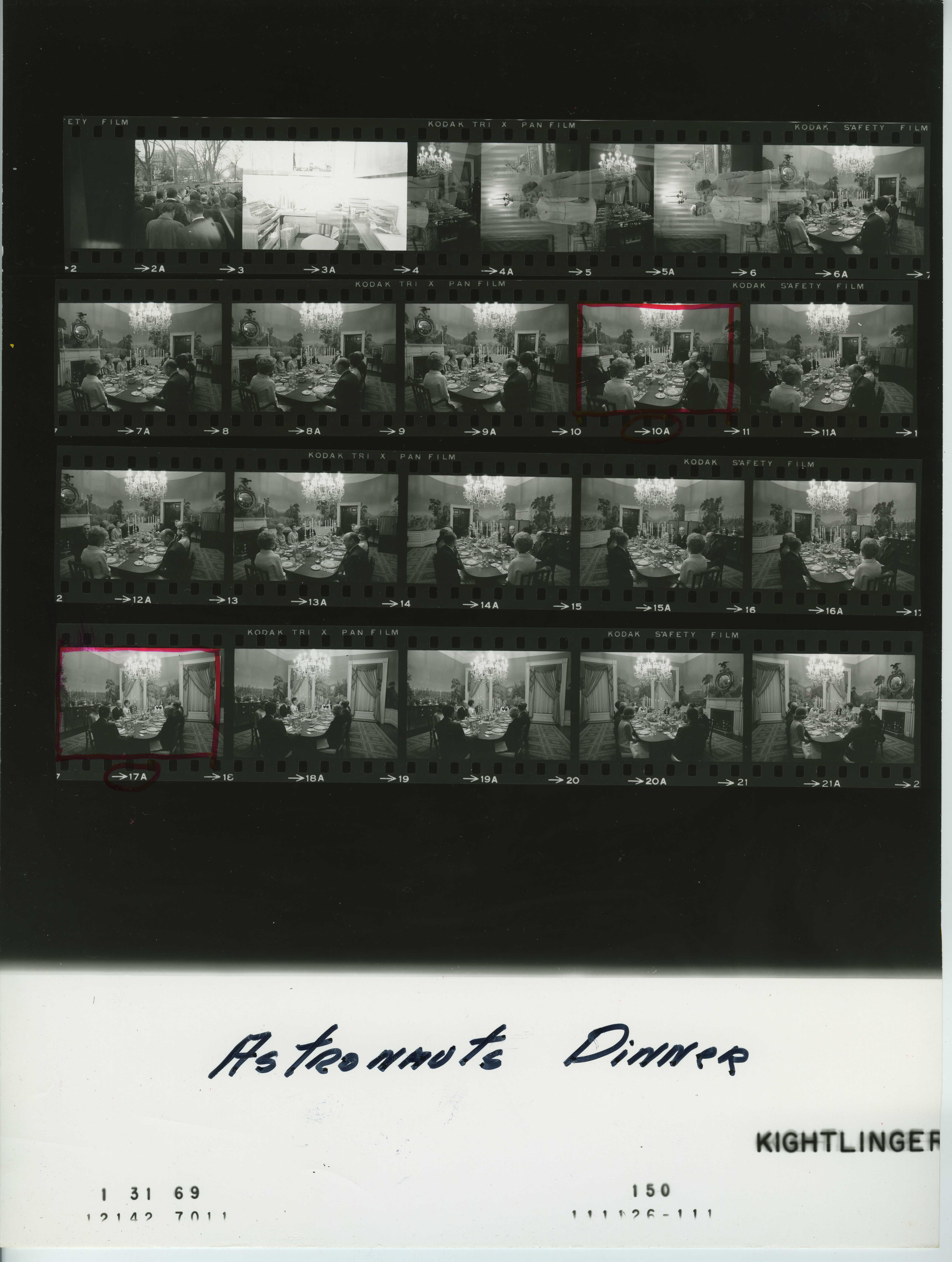
- Frame(s): WHPO-0150-03A, Empty office chair near typewriter. 1/30/1969, Washington, D.C. White House, unknown office.
- Frame(s): WHPO-0150-05-06, Double exposure of Pat Nixon standing with Carol Glessford. 1/30/1969, Washington, D.C. White House, Second Floor Private Dining Room. Pat Nixon, Carol Glessford.
- Frame(s): WHPO-0150-06A-021A, President Nixon, Pat Nixon seated at dinner with the Apollo VIII (Apollo 8) astronauts Col. Frank Borman, Capt. James A. Lovell, Jr., Lt. Col. William A. Anders, and their wives. 1/30/1969, Washington, D.C. White House, Second Floor Private Dining Room. Frame 10A, CW: President Nixon, Pat Nixon, Mrs. Borman, Lt. Col. William A. Anders, Bud Wilkinson, Mrs. Lovell, Melvin Laird, Pat Nixon, Col. Frank Borman, Mrs. Wilkinson, Mrs. Anders, Capt. James A. Lovell, Mrs. Laird.
The White House Communications Agency Sound Recordings Collection contains public statements that took place between 1969 and 1974. Visit the finding aid to learn more.
E - Secretary of Defense Briefings
- WHCA-SR-E-001
Press conference by Sec. Def. Melvin Laird at the Pentagon. (1/30/1969, Pentagon)
Runtime: 46:00:00
Production credits: Audio feed supplied by OPI; Recorded by GLT (initials of WHCA engineer)
Original Format: 1/4-inch reel-to-reel audiotape. Original source type: Original.
P - Formal Presidential Remarks
- WHCA-SR-P-690116
Remarks by President Nixon at 17th Annual Congressional prayer breakfast at Sheriton Park Hotel, Washington DC;. (1/30/1969, Sheriton Park Hotel, Washington DC)
Runtime: 0:46:09
Keywords: Church service, worship service, prayer service, religion
Original Format: 1/4-inch reel-to-reel audiotape. Original source type: Original. - WHCA-SR-P-690117
Remarks by President Nixon at 17th Annual Congressional prayer breakfast. (1/30/1969, Sheriton Park Hotel)
Runtime: 1:07:11
Keywords: Church service, worship service, prayer service, religion
Production credits: Audio feed supplied by CBS
Original Format: 1/4-inch reel-to-reel audiotape. Original source type: Original. - WHCA-SR-P-690118
Remarks by President Nixon announcing Colonel Frank Borman's goodwill tour of Europe, with additional remarks by Borman. (1/30/1969, Fish Room, White House)
Runtime: 0:06:28
Production credits: Audio feed supplied by CBS
Original Format: 1/4-inch reel-to-reel audiotape. Original source type: Original. - WHCA-SR-P-690119
Remarks by President Nixon at Justice Department,. (1/30/1969)
Runtime: 9:11
Original Format: 1/4-inch reel-to-reel audiotape. Original source type: Original. - WHCA-SR-P-690120
Remarks by President Nixon at a showing of Apollo 8 flight films and slides. (1/30/1969)
Runtime: 0:53:42
Keywords: NASA, National Aeronautics and Space Administration, space program, astronauts
Production credits: Recorded by WHCA
Original Format: 1/4-inch reel-to-reel audiotape. Original source type: Original.
Context (External Sources)
The Vanderbilt Television News Archive is the world's most extensive and complete archive of television news. They have been recording, preserving and providing access to television news broadcasts of the national networks since August 5, 1968.
Wikipedia is a free encyclopedia that anyone can edit.