
Introduction
This almanac page for Friday, January 31, 1969, pulls together various records created by the federal government and links to additional resources which can provide context about the events of the day.
Previous Date: Thursday, January 30, 1969
Next Date: Saturday, February 1, 1969
Schedule and Public Documents
The Daily Diary files represent a consolidated record of the President's activities. Visit the finding aid to learn more.
The President's day began at The White House - Washington, D. C.
The Weekly Compilation of Presidential Documents made available transcripts of the President's news conferences; messages to Congress; public speeches, remarks, and statements; and other Presidential materials released by the White House.
Addresses and Remarks
- Department of Defense (5 Weekly Comp. Pres. Doc. 194, January 31, 1969)
Remarks of the President and Secretary of Defense Melvin Laird to Employees at the Pentagon.
Appointments and Nominations
- Federal Mediation and Conciliation Service (5 Weekly Comp. Pres. Doc. 196, January 31, 1969)
Announcement of Nomination of J. Curtis Counts as Director.
Statements by the President
- District of Columbia (5 Weekly Comp. Pres. Doc. 197, January 31, 1969)
Statement by the President on Actions and Recommendations for the Federal City.
Checklist of White House Press Releases
The releases listed below, made public by the Office of the White House Press Secretary during the period covered by this issue, are not included in the issue.
- Press conference of Secretary of Commerce George P. Shultz and J. Curtis Counts announcing Mr. Counts' nomination as Director, Federal Mediation and Conciliation Service.
- Biographical data on Donald Eugene Santarelli.
Digest of Other White House Announcements
Following is a listing of items of general interest which were announced in the press but not made public as formal White House press releases during the period covered by this issue. Appointments requiring Senate approval are not included since they appear in the list of nominations submitted to the Senate, below.
- Ambassadors Ernest Steven Monteiro of the Republic of Singapore, Rolf Friedemann Pauls of the Federal Republic of Germany, and Hector Luisi of the Oriential Republic of Uruguay presented their credentials to the President at the White House.
Nominations Submitted to the Senate
Does not include promotions of members of the Uniformed Services, nominations to the Service Academies, or nominations of Foreign Service Officers.
- JOHN W. WARNER, of Virginia, to be Under Secretary of the Navy.
- FRANK SANDERS, of Maryland, to be an Assistant Secretary of the Navy.
- ALBERT W. SHERER, JR., of Illinois, a Foreign Service Officer of Class one, now Ambassador Extraordinary and Plenipotentiary of the United States of America to the Republic of Togo, to serve concurrently and without additional compensation as Ambassador Extraordinary and Plenipotentiary of the United States of America to the Republic of Equatorial Guinea, to which office he was appointed during the last recess of the Senate.
- ELMER T. KLASSEN, of Massachusetts, to be Deputy Postmaster General.
- JAMES W. HARGROVE, of Texas, to be an Assistant Postmaster General.
- KENNETH A. HOUSMAN, of Connecticut, to be an Assistant Postmaster General.
- DAVID A. NELSON, of Ohio, to be General Counsel of the Post Office Department.
- GERARD C. SMITH, Of the District of Columbia, to be Director of the United States Arms Control and Disarmament Agency.
- RICHARD A. DIER, of Nebraska, to be United States Attorney for the District of Nebraska for the term of 4 years, vice Theodore L. Richling, resigned.
- ALLEN L. DONIELSON, Of Iowa, to be United States Attorney for the Southern District of Iowa for the term of 4 years, vice James P. Rielly, resigned.
Each Public Papers of the Presidents volume contains the papers and speeches of the President of the United States that were issued by the White House Office of the Press Secretary during the time period specified by the volume. The material is presented in chronological order, and the dates shown in the headings are the dates of the documents or events. In instances when the release date differs from the date of the document itself, that fact is shown in the text note.
To ensure accuracy, remarks have been checked against audio recordings (when available) and signed documents have been checked against the original, unless otherwise noted. Editors have provided text notes and cross references for purposes of identification or clarity.
The Federal Register is the official daily publication for rules, proposed rules, and notices of federal agencies and organizations, as well as executive orders and other Presidential documents.
The Congressional Record is the official daily record of the debates and proceedings of the U.S. Congress.
Archival Holdings
Any selection of archival documents will necessarily be partial. You should use the documents and folders identified below as a starting place, but consult the linked collection finding aids and folder title lists and the collections themselves for context. Many documents to be found this way do not lend themselves to association with specific dates, but are essential to a complete understanding of the material.
Selective document listing
President's Office Files
The President's Office Files consists of materials drawn together by the Special Files Unit from several administrative subdivisions within the White House Office. It is the handwriting and sensitive papers sent to the Staff Secretary that now comprise much of the President's Office Files. Visit the finding aid to learn more.
- President's Handwriting, Box 1, President's Handwriting, January 1969 [2 of 2]
- Memo; Harry Flemming to H. R. Haldeman re: James Johnson, U.S. Civil Service Commission. January 31, 1969. 2 pgs.
- Memo; Daniel P. Moynihan to The President re: Enclosed review from the Wall Street Journal. January 31, 1969. 2 pgs.
- Letter; J. Edgar Hoover to The President re: FBI National Crime Information center, incl. attachment. January 31, 1969. 6 pgs.
- Notes; Haldeman notes on meeting with the President. January 31, 1969. 4 pages.
- Annotated News Summaries, Box 28, News Summaries - January 1969 [During this period, the Staff Secretary only removed pages from the News Summaries which contained President Nixon's handwriting, often leaving the document with no date. In addition to the individual document listed below, you should also consult the full folder for the month.]
- News Play, January 31
- President's Meetings File, Box 73, Memoranda for the President--Beginning January 26, 1969
Selective document listing
The White House Press Office during the Presidency of Richard Nixon was responsible for daily communication with the White House press corps. Ronald L. Ziegler was the Press Secretary to the President for Nixon's entire term in office from January 1969 to August 1974 and Gerald Warren served as the Deputy Press Secretary. The office held daily briefings for the press and produced the White House’s press releases. Visit the finding aid to learn more.
- White House Press Releases, Box 1
- FOR IMMEDIATE RELEASE JANUARY 31, 1969
Office of the White House Press Secretary
THE WHITE HOUSE
BIOGRAPHICAL DATA ON DONALD EUGENE SANTARELLI
NAME: Donald Eugene Sartarelli
TITLE: Associate Deputy Attorney General for Criminal Justice
BORN: Hershey, Pa., July 22, 1937, son of Mr. and Mrs. Ambrose Santarelli of Hershey.
EDUCATION: Hershey Parochial Schools, St. Mary's (High School) School, Lebanon, Pa. Mount St. Mary's College, Emmitsburg, Md. (1959). The University of Virginia Law School, LL. B (1962). Graduate study at the University of Virginia Graduate School of Arts and Sciences, Charlottesville, Va. (1964).
EXPERIENCE: Law Clerk to United States District Court Judge Thomas J. Michie, Western District of Virginia, 1964-65.
Assistant Corporation Counsel for the District of Columbia, 1965-66. -- litigation in civil and criminal cases and in appellate courts.
Assistant U.S. Attorney for the District of Columbia, 1966-67, as a criminal prosecutor.
Minority Counsel to the U. S. House of Representatives Committee on the Judiciary, 1967-69, specializing in criminal law and judicial administration, legislation, including the 1968 Omnibus Crime Bill.
Special Counsel to the U. S. Senate Judiciary Subcommittee on Constitutional Rights for the Bail Reform Act hearings, January 1969.
MARITAL STATUS: Married to the former Miss Anne Constance Dunlap of Lancaster, Pa.
###### - FOR IMMEDIATE RELEASE JANUARY 31, 1969
OFFICE OF THE WHITE HOUSE PRESS SECRETARY
THE WHITE HOUSE
REMARKS OF THE PRESIDENT AND SECRETARY OF DEFENSE MELVIN LAIRD
AUDITORIUM, THE PENTAGON
11:37 A.M. EST
SECRETARY LAIRD: It is indeed a privilege for me, as Secretary of Defense, to present at this time the President of the United States, our Commander-in-Chief, Richard Nixon.
THE PRESIDEN: Mr. Secretary and Gentlemen: It is a very great honor to be here in the Defense Department arid to have received today the colors of the various forces of our Defense Establishment, to have had another briefing from the Defense Department a few moments ago, and now to address the key men who are responsible for the defense of the United States and who also play the major role in the defense of peace and freedom in the world.
As I stand here today, I would perhaps have to admit that this is one department where I feel particularly humble. Like so many Americans, I, of course, have served in the Armed Forces and I always feel just a little bit embarrassed when an Admiral comes up to me and says "sir". think it should be the other way around. I am sure the Secretary has the same problem.
All I can say is that I hope that in these years ahead that, as the President of this Nation, and as the Commander-in-Chief of the Armed Forces, I can be worthy of the men and women who serve in the Defense Department.
In speaking to that point, I was asking the Secretary as we moved through the halls and saw all of the civilian personnel and some of the military personnel standing in the corridors to welcome us, about the numbers that were involved. We know that this department is the biggest in our Government. Approximately 60 percent of our personnel and budget comes from this department. We know, too, that as far as the numbers of people who are involved, I understand there are approximately 4 million in the Defense Department, both civilian and military personnel.
In reflecting on that number, I want to particularly emphasize to the men here how important it is to see that all of those 4 million, to the extent that it is possible, realize that they play, collectively and individually, a vital role in the defense of this country and in developing the strength that is essential if we are going to be able to provide peace with freedom in the world.
Last night we had a very fascinating briefing by the Astronauts, with some of the slides they had taken, as well as some of the motion pictures they had taken on their trip around the moon. Col. Borman made a very significant point as the briefing was concluded.
He said that he was speaking not just for himself, and not just for the three who had made this trip, but for 400,000 men and women in the Nation who at one time or another had played a part in making this great, spectacular feat possible.
Here in this room are the top people. I suppose we would refer to most of you people as the "top brass." You are the people who will have direct contact with the Secretary and with the President. You will be briefing him and me and the other top officials of this Government.
But I think it is vitally important for all of us to recognize that all over this Nation, and all over the world, are men and women who will never have that opportunity, men and women who do jobs, sometimes very routine jobs, that can become very, very boring and that they constantly need reassurance that what they do matters.
I was glad to see Col. Borman bring it home that way. 400,000 made it possible for this magnificent achievement to occur. I trust that all of you can convey that kind of spirit to those who work in the Defense Department, in all their capacities that they may be filling here and around the world.
In that respect, too, I would like to pay a tribute which I think should be paid to those who are in the career forces. I am referring now to the Army, the Navy, the Air Force, the Marine Corps, the Coast Guard, to the American military man.
It is rather fashionable these days to speak of the military man as a class apart. He knows about the hardware. He knows about military strategy. He knows how to conduct. a war. Sometimes it goes so far that well-intentioned individuals say, "Well, we have a Department of War and we need a Department of Peace."
I have never thought of it that way. This is the Defense Department. Without what this Department, through its efficiency and through the dedication of its personnel, creates we would not be able to have the negotiations which can bring peace. This is an integral part of our peace forces in the world.
The other point that I wish to make is that individually I have been privileged to know the top military commanders of this Nation, going back over 20 years. I know that the military man in the United States today is a broad-gauged man. His knowledge is not limited simply, and his interests are not limited simply to the military responsibilities that are his.
He knows the world in which we live. He can give valuable advice on the great diplomatic and political considerations that have to be considered when these decisions are made. He is a specialist, true, and I can assure you of one thing: I do not presume to be a specialist in this field and I am going to rely, when it comes to purely military matters, on what my military advisers tell me should be done.
But I do know this: I do know that due to the magnificent education that is provided for those who finally achieve the top ranks in our military services, they are men who are not just specialists; they are generalists in the best sense of the word. They can make a contribution, a contribution
to the overall policy of this Nation.
I want you to know that I want to hear what they have to say. I will take that into consideration in developing our policies, because I know that your interests are the same as ours.
I know often the tendency is to take the Department of Defense and the Department of State and constantly to assume that they will be at odds: they will be working against each other; and that is the job of the President of the United States, or his National Security Advisers, to try to negotiate
the differences and then present some kind of, shall we say, negotiated peace treaty between the two before we can get a policy.
I don't consider it that way at all. We will have our differences. There are differences within the State Department as to what our policy should be. There are differences within the Defense Department, although it is very hard to get General Wheeler to tell me what they are.
But on the other hand, while those differences do exist, I believe that we are all working together toward the same end. I want to hear those differences expressed. I will then have to make the decision, a decision that only the President of the United States can make in determining what our
policy will be.
But only if I hear from the Defense Department and from within the Department the differences that may be there, and from the State Department and from the other interested departments of Government what their views are on the great problems that confront this Nation and abroad -- only if I hear that can I make the kind of decision that is going to be the best decision.
So I want to say, Mr. Secretary, that I am going to depend upon you and General Wheeler to bring to me and the National Security Council the viewpoints of the Defense Department and even those minority viewpoints that only exist here which may not agree with that which you, have eventually considered should prevail.
By seeing that those viewpoints are brought to the attention of the National Security Council, and through that Council to the President .of the United States, you will assure that our policy will be a better policy than it would otherwise be.
Finally today, I would like to say one thing about a subject that is often mentioned in Government and which is the reason for the visit that I am making to this Department and all the 12 major departments in Government in the first three weeks that I am in office: It is that question of morale.
I know we hear all sorts of stories about morale in one department is low, and morale in another department is going down and the rest. I know perhaps less than particularly our military commanders know what really brings morale.
What brings morale is not what happens down in the ranks, but the leadership and the example that is set at the top.
I have one favorite story that I would like to impose upon you, a story that I think indicates my philosophy with regard to morale, and one that I hope you will take to heart and try to apply it in these days and months and years ahead.
In reading General Pershing's memoirs of World War I, he told of the very difficult time that he had immediately after assuming command of the American Expeditionary Force of having to remove some of his closest friends who were commanders of divisions, and when he had to make those very difficult decisions, of course, this tore him apart, but he did it.
Because he was decisive and did move effectively, that force became a very powerful force before the end of World War I. He told of one particular case which illustrates the point that I wanted to make.
An attack had been ordered in a certain area and he, on a certain day, was visiting one of the divisions. The commander of that division, an old friend of the General's, said to him, "General, we cannot make this attack, " he said. "My men are tired, my men are disheartened, their morale is low. We simply aren't going to be able to launch another attack, go over the top tomorrow."
General Pershing answered him in this way: He said, "General, your men are not tired. Your men are not disheartened. Their morale is not low. You are tired. Your morale is low. I am going to relieve you."
So he relieved the General and he put another man in charge, another General. He said that in a matter of two to three weeks, as a result of the change in command, and the new spirit that came to that division, it was one of the best fighting units on the whole Western front, after a record previous to that time which had been one of the worst.
I want all of you to know that I trust that in my position I can provide the kind of leadership that will keep up your morale, but by the same token, we count on you to let every one of the four million people in the Armed Services of this country know that what each one of them does really counts. It really matters. Failing to do even the smallest job may affect the efficiency and the effectiveness of our overall defense policy.
This sounds like a little sermon to a group of very sophisticated and top leaders in our military and business community, but I say it to you today because I do know this: You can have the most efficient organization possible, you can have all the money that you need, and you can still not have that spirit, that high, extra quotient that can only come from leadership which brings the highest morale and which gets it right down through the ranks, through all the civilians who dedicate their lives to public service, through all the military men who do that.
I know most of you personally. I have appointed some of you who are on the civilian side, and I understand, too, that I make some of the appointments on the military side. I sign lots of sheets which indicate what you are going to do.
I can only say in conclusion that we are counting on you. I will respect your advice and I know that you will see to it that this whole great Defense Establishment has a of purpose, a new sense of that great dedication made us always proud of the defense forces of this country.
SECRETARY LAIRD: Thank you very much, Mr. President. We will use your sound advice and counsel as our guidepost in this new Administration.
We appreciate your coming here today to pay this visit. This is the second visit you have made this week, including the one for the briefing on Monday. We hope that you can make these visits often, but General Wheeler and I will be carrying the messages to the White House on a regular basis and I can assure you that the views of the military and the civilian personnel of this great Defense Establishment will be communicated to you in a very efficient and a very effective way.
END (AT 11:53 A.M. EST) - FOR IMMEDIATE RELEASE JANUARY 31, 1969
Office of the White House Press Secretary
THE WHITE HOUSE
Secretary of Labor George P. Shultz announced today on behalf of President Nixon the nomination of J. Curtis Counts, 53, as director of the Federal Mediation and Conciliation Service. He resides in Cheviot Hills, a suburb of Los Angeles, Calif.
Counts has been vice president of employe relations for Douglas Aircraft Co. since 1964 and has extensive industrial relations experience in private and public service.
As the nation's top mediator Counts will direct the independent agency charged with promoting and maintaining labor-management peace through mediation and conciliation efforts.
From 1962-68 Counts served as a member of the National Labor-Management Panel, set up under the Taft-Hartley Act to advise the Service's director on industrial relations matters affecting the general welfare.
He joined the aircraft firm in Santa Monica in 1941 and was in charge of the Douglas Overseas Projects through 1944 when he was named assistant to the company's director of personnel.
Named staff assistant to the director of industrial relations in 1946, Counts served from 1948 to 1960 as employe relations manager.
In 1960 he became assistant director of industrial relations and two years later was appointed as the company's director of employe relations, a post he held until becoming vice president.
Counts has served the federal government as a member of the Western States Regional Manpower Advisory Committee and the Citizens' Advisory Council on the Status of Women.
In 1965 he was chairman of the Aerospace-Industries Association West Coast industrial relations committee and its national industrial relations committee.
In addition, Counts has been a member of the Electronic Industries Association's industrial relations department and board member of the Management Council of Greater Los Angeles and the Neighborhood Youth Association in the Los Angeles area.
A former president of the Westwood Chamber of Commerce, Counts in 1951 was selected as one of California's five outstanding young men by the California Junior Chamber of Commerce.
Counts is married to the former Virginia Shugart.
# # # - FOR IMMEDIATE RELEASE JANUARY 31, 1969
Office of the White House Press Secretary
THE WHITE HOUSE
ACTIONS AND RECOMMENDATIONS OF THE PRESIDENT FOR THE DISTRICT OF COLUMBIA
Responsibility begins at home.
The District of Columbia is the Federal city, and the Federal Government cannot evade its share of responsibility for the conditions of life in the District.
For many who live here, those conditions have become intolerable. Violent crimes in the District have increased by almost three times in the last eight years; only two days ago, the local newspapers carried a report that armed robberies had more than doubled in the past year alone.
This violence -- raw, vicious violence, hurting most of all those who are poor and work hard -- is the surface manifestation of far deeper troubles.
These troubles have been long building. In part, Washington today is reaping a whirlwind sown long since by rural poverty in the South, by failures in education, by racial prejudice, and by the sometimes explosive strains of rapid social readjustrnents.
Because its roots are deep and closely woven, crime in the District cannot be brought under control overnight. Neither can poverty be ended or hatred eliminated or despair overcome in a year. But we can begin.
In the 11 days since the new Administration took office, I have asked the departments and agencies concerned to make an intensive study -- as a matter of first priority -- of actions that could be taken now toward curbing crime and improving the conditions of life in the city of Washington.
I wish I could report that we had produced a magic formula that would end crime and sweep away despair overnight. We have not. I have determined on a number of actions and recommendations which will provide a start.
These include:
# A swift start on restoring those areas devastated nearly ten months ago.
# A package of proposals that can at least help toward restoring the safety of life and property.
# A commitment to give the people of the District of Columbia the voice they legitimately should have in the public policies that affect their lives.
Before detailing these measures I would like to make two points, both of which may help set the measures themselves in perspective.
I am pleased to report, first, that Mayor Washington and I, together with key members of our respective Administrations, have established the basis for what I confidently expect will be the most effective cooperation yet achieved in the relations between the Federal and City governments.
The basic framework within which we both intend to operate is one of local initiative and responsibility; and the fullest possible Federal support -- not only in terms of the necessary money, but also by involving the vast array of technical assistance available from within the Federal departments and agencies headquartered here.
Second, the great majority of these actions and recommendations are in the fields of crime control and the administration of justice. I recognize full well that crime and violence are only part of the complex interweave of problems the District faces, and that in the long run crime itself also requires much more far-reaching and subtle approaches. But the rapidly mounting urgency of the crime crisis in the District marks immediate, direct anti-crime measures as the first-priority task.
There is another reason for this early and urgent emphasis. Crime in America today is both a primary local responsibility and a primary national concern. Here in the District, the Federal Government bears a special responsibility and has a unique opportunity. By searching for new ways of applying the resources of the Federal Government in the war against crime here, we may discover new ways of advancing the war against crime elsewhere.
These measures are by no means a comprehensive list. They represent things that are clearly needed and can be done now. Other crime-control measures will follow, and also additional measures to meet the vast array of the District's other needs.
RESTORING THE DEV ASTATED AREAS
Scarcely any of the shops and homes destroyed during the riots of last April have been rebuilt, and very few of those damaged have been made habitable or usable again. These rotting, boarded-up structures are a rebuke to us all, and an oppressive, demoralizing environment for those who live in their shadow. They remind us again of the basic fact that the principal victims
of violence are those in whose neighborhoods it occurs.
It is not enough merely to patch up what now exists: we must truly rebuild.
The people of the District -- especially, of course, the people who live in these areas, and those who own the land - - must decide the purposes for which these blocks will be used. The Federal Government can, however, pledge its full support for those Federal programs which can enable such redevelopment to proceed, and can further pledge the utmost Executive energy in responding to formal applications from the District.
We have already begun.
Specifically, Secretary Romney informed me today that the Department of Housing and Urban Development has approved a 29.7 million dollar neighborhood development plan for the Shaw area, including the major portion of the 7th Street neighborhood damaged during last April's riots. This plan, the result of several years of preparation, is an accomplishment of which this city
can be proud.
It took Secretary Romney's Department less than 24 hours to approve this plan for the Shaw area, once it was approved by the City Council last Tuesday and submitted for Federal approval Wednesday evening. This unprecedented process illustrates the commitment of this Administration to the meeting of the urgent needs of the Capital city.
Mayor Washington has indicated that he intends to seek similar assistance under the Housing and Urban Development Act of 1968 for rehabilitation of the two major areas of riot damage not covered in the Shaw plan -- the areas along 14th Street and H Street. I can assure him that this Administration will respond with the same sense of urgency to his requests for help in these areas.
He has promised me a tight but serious timetable under which the first construction in these areas would begin next fall.
While the city prepares for this construction -- and decides what to do with the 14th and H Street areas -- the Department of Housing and Urban Development will make available $1 million in special interim assistance for improvements in some of the blighted areas. This morning, I watched the first c:ranes at work clearing rubble to make way for a temporary playground. The District has plans for swings, slides and swimming pools where now there is charred rubble. Street lighting will be improved, roads and sidewalks repaired.
Under Section 514 of the 1968 Housing and Urban Development Act, Mayor Washington has undertaken to provide 1/3 matching funds for this $1 million, and the District Government will take the initiative in deciding how this money will be spent. The limited assistance to be provided by the federal government under this interim program cannot by itself remake these areas. But it is a first step toward making them more livable, an earnest demonstration of our concern, and a first sign of hope.
In this connection, I can announce that the 1969 Inaugural Committee, through its chairman, Mr. J. Willard Marriott, has agreed to devote the net proceeds of the Inaugural to the cost of providing playground equipment and other improvements for these parks and playground areas.
CRIME AND ADMINISTRATION OF JUSTICE
A meaningful assault on crime requires action on a broad array of fronts. But in the midst of a crime crisis, immediate steps are needed to increase the effectiveness of the police and to make justice swifter and more certain. Toward these ends and as a beginning, I have taken or will propose action in twelve major areas.
1. THE COURTS OF THE DISTRICT OF COLUMBIA
I am asking Congress to provide 10 more judges for the courts of the District of Columbia. I will ask later for more additional judges as they become necessary upon the reorganization of the District of Columbia court system.
As an interim measure, I would hope that the existing visiting judges program would be expanded in the District. The Chief Judge of the District of Columbia circuit here has diligently sought the services of visiting judges. I will encourage and aid him in his effort to obtain the services of more judges.
To improve the administration of justice in the District, I have directed the Attorney General to consult with the bench, the bar and the various interested groups, to assist in the drafting of appropriate legislation providing for a reorganization and restructuring of our present court system toward the eventual goal of creating one local court of general, civil, criminal and juvenile jurisdiction for the District of Columbia. It is consistent with my support for home rule to urge the creation of a local court system similar to that of the States and other large municipalities.
To perform with full effectiveness, a modern court needs modern computer and management techniques. I have asked the Attorney General to offer his department's assistance to the study groups in the District that are presently seeking to apply such techniques in the court system.
I have asked the Attorney General to submit specific recommendations for such additional court house personnel, including United States Marshals, court clerks, probation officers, law clerks and bailiffs, as are necessary to support not only the present judges but the additional judges that will be requested.
2. UNITED STATES ATTORNEY'S OFFICE
The chronic under staffing of the prosecutor's office has long hampered the efficient administration of justice in the District. It is widely recognized that a ratio of at least two prosecutors for each judge is needed. To achieve that goal, 20 new Assistant U. S. Attorneys are required immediately. With the creation of 10 additional judgeships and the contemplated court reorganization, another 20 prosecutors will be required. Consequently I am recommending the authorization of 40 more Assistant U. S. Attorneys.
A comprehensive reorganization of the Office of the U. S. Attorney is imperative. This should include a restructuring of the office to provide for two-man prosecutor teams in important cases; the development of specialized functions for technical cases such as frauds and other economic crimes; and the creation of a special "violent crimes unit" to handle such crimes as armed bank robberies on a priority basis, as is presently being tried experimentally. In addition, greater emphasis is needed on developing policy guidelines and training programs. On January 14, $120,000 was awarded by the National Institute of Law Enforcement and Criminal Justice for a special study committee. Included in its study is an examination of the prosecutor's office, with a view toward recommending improvements in its operation. I strongly support this study and have instructed the Attorney General to make available the resources of the Department of Justice to assist the committee and to facilitate reorganization found desirable.
In addition, I will seek authorization for the hiring of law clerks and sufficient other personnel for the proper staffing of the U. S. Attorney's office -- and for the hiring and use of trained investigators, who are necessary to the effective functioning of the prosecutor's office.
3. COURTHOUSE FACILITIES
The local courts already are overflowing the existing Court of General Sessions buildings. Judges are sitting in three different buildings, and some in temporary courtrooms. With the creation of additional judges and the eventual transfer of greatly expanded jurisdiction to the local courts, a new courthouse complex becomes a pressing necessity. $100,000 has already been utilized for planning for a new courthouse and $3. 5 million has been appropriated for site selection. But we must have these facilities now. Consequently, I am vigorously endorsing the requests presently pending before the Congress for $1,240,000 to be used to complete acquisition and for additional planning. The Administration will fully support the Mayor in such additional requests as are needed to speed the building program. Meanwhile, I have instructed the General Services Administration to assist in providing temporary facilities.
4. BAIL REFORM AND THE BAlL AGENCY
Problems arising out of the operation of the Bail Reform Act of 1966 are now being- considered by the Congress. But, substantial changes in this area are needed quickly. Increasing numbers of crimes are being committed by persons already indicted for earlier crimes, but free on pre-trial
release. Many are now being arrested two, three, even seven times for new offenses while awaiting trials. This requires that a new provision be made in the law, whereby dangerous hard core recidivists could be held in temporary pre-trial detention when they have been charged with crimes and when their continued pre-trial release presents a clear danger to the community.
Additionally, crimes committed by persons on pre-trial release should be made subject to increased penalties.
Insufficient staffing of the Bail Agency is one of the contributors to crime by those on pre-trial release. I support immediate lifting of the ceiling that now constricts the Agency' s funding. I will seek appropriations for an initial expansion of the agency from 13 to 35 permanent positions. If the pre-trial release system is to protect the rights of the community, the agency must have .the capacity for adequate investigation and supervision.
5. THE DISTRICT OF COLUMBIA DEPARTMENT OF CORRECTIONS
As the local government is painfully aware, the existing facilities and programs of the Department of Corrections are woefully inadequate. On January 16, 1969, the Director of the Bureau of Prisons submitted a comprehensive report to Mayor Washington identifying the deficiencies and making a number of recommendations. I join with the Mayor in urging immediate implementation of those recommendations, and I will offer whatever Federal assistance is possible in doing so.
All who have studied the problem agree that far-reaching changes are needed in. the penal facilities and programs serving the District. I will press vigorously for accomplishment of the needed reforms.
6. OFFICE OF PUBLIC DEFENDER
The recent bail reform hearings before the Senate Judiciary Subcommittee on Constitutional Rights have emphasized the important contributions skilled defense counsel can make toward expediting: criminal trials.
Too often, inexperienced lawyers who are appointed to represent indigent defendants complicate and delay the trial process by their unfamiliarity with the law and criminal practice. Experience has shown that professional public defenders, on the other hand, not only better safeguard the rights of defendants, but also speed the process of justice. The Legal Aid Agency in the District is a pilot project which has given every indication of great success if properly supported. I believe the time has come to convert this project into a full-fledged Public Defender program. To make this project possible, I will support the Legal Aid Agency's 1970 budget request for $700,000 to allow an increase in its staff from 22 to 34 attorneys and to assume responsibility for a successful project in offender rehabilitation. This would allow it to become a full-fledged Public Defenders Office with the capacity to represent almost half of the indigent adult and juvenile defendants in the District.
7. THE METROPOLITAN POLICE DEPARTMENT
There is no deterrent to crime quite so effective as the public presence of policemen. Several immediate steps are needed to bolster and improve the local police force in the District of Columbia.
The first step is more effective recruitment. Despite diligent recruitment efforts, the police force has hundreds of unfilled vacancies. I have pledged to the Mayor the assistance and full support of this Administration to improve the recruitment process. I will sponsor the establishment of a procedure by which the District can draw upon the experience of other cities. Imaginative and innovative approaches may be necessary.
But even bringing the department up to its presently authorized strength will not secure adequate public protection in these troubled times. Consequently, I am recommending to the Mayor that he request authorization of an additional 1000 police officers for the District, and I will support such a request.
I endorse the Mayor' s efforts and those of the police department to reorganize the structure of the department, so as to consolidate functions, reduce duplication and free additional police officers for patrol and enforcement duties, I offer the assistance of the Federal Government in this effort.
I urge our local police officials to give a high priority to planning and development, making use of the increased Federal funds now available for the introduction of new law enforcement techniques.
The police department also needs the increased assistance of competent legal advisers in this era of evermore complicated criminal law and procedures. I laud the Mayor for his recent appointment to the police department of a legal adviser. However, with the increased burdens on the department it seems advisable to increase the staff and capability of such an office. Not only do the police need to be properly advised as to the performance of their duties, but it is also necessary for the police department to be assured of the Government's support of an interest in the officer's performance of his individual duties.
8. DIRECTOR OF PUBLIC SAFETY
The potential of this office is great. It is presently vacant. The Mayor informs me that he is diligently searching for the right man to fill the job. I have offered the Mayor this Administration's r sources to assist him in selecting the best possible Director.
9. CITIZEN PARTICIPATION
Increased citizen involvement is essential to any program of crime control and prevention; it is also in keeping with the American tradition. I strongly support the Mayor in his plan to appoint a Criminal Justice Coordinating Committee patterned after similar successful programs in other large cities. It is important that the Council be properly staffed. This could be done with help from the recently created Criminal Justice Planning Office and funded under the Law Enforcement Assistance Act, which provides financial support of up to 90% for such planning activity involving citizen participation. Policy making and planning must have citizen participation and coordination if they are to produce programs that are widely acceptable to the community. I pledge the Mayor the support and assistance of the Federal Government in this area.
10. NARCOTICS
Although the narcotics traffic in the District of Columbia is apparently not dominated by organized crime it has become an acute and growing problem. It is a direct cause of much of the District's crime, by driving the narcotic user to commit crime to support his "habit". Many armed robberies, assaults and bank holdups are directly related to narcotics use.
Consequently, I have instructed the U.S. Bureau of Narcotics and Dangerous Drugs to increase significantly its role in the District of Columbia in enforcing the narcotic and dangerous drug laws. The Bureau has assured me that they will also increase their cooperation with the Metropolitan Police Department in enforcement, training and in making available additional laboratory facilities and expert and technical assistance.
I have also directed the Bureau and the Department of Justice to seek more effective application of the civil commitment provisions of the Narcotics Rehabilitation Act of 1966 which has not yet been widely used.
11. JUVENILE CRIME
In recent years the median age of those charged with crime has been ominously dropping. The National Commission on Violence warned this month: "The key to much of the violence in our society seems to lie with the young. Our youth account for an ever-increasing percentage of crime, greater than their increasing percentage of the population .... It may be here, with tomorrow's generation, that much of the emphasis of our studies and the national response should lie."
I strongly support the city government's efforts to draft a new Juvenile Code, and I am making available technical assistance by Federal authorities. The Department of Justice is already cooperating with the Corporation Counsel and other local officials on the project.
Under the proposed court reorganization, the now isolated and undernourished Juvenile Court would be brought into the new District of Columbia court of general jurisdiction. Thus juveniles would have the advantage of the comprehensive facilities of the new court, including family services and probation assistance.
The pilot Group Home Rehabilitation Project, in which juveniles enjoy retention of community ties, close adult supervision and peer-group controls, gives every appearance of success. Expansion of the project as a substitute for institutionalization and as a possible supplement to probation is desirable. I support the Mayor in his request for increased funding and authorization for such facilities.
The lack of sufficient psychiatric services for the youthful disturbed is a serious obstacle to crime prevention. Young minds gone astray must be helped while still malleable. I will assist the Mayor in his forthcoming request for a well-staffed psychiatric care residential facility for adolescent delinquents.
I also urge that the local government, together with local school officials, prepare a plan to provide for the education of those school children whose disciplinary and truant absence from schools for long periods now causes them to reach adulthood educationally stunted. A substitute educational program must be devised for them, lest they become a burden to themselves and the community.
12. NEW ATTENTION TO THE DISTRICT
The Attorney General has created a new post within the Justice Department, that of Associate Deputy Attorney General for the Administration of Criminal Justice, with one of the new official's special and continuing responsibilities that of helping improve the administration of justice in the District of Columbia. He has named to the post Mr. Donald Santarelli, a widely experienced expert. on the special problems of crime control in the District. One of Mr. Santarelli' s functions will be to evaluate and help implement new ideas for more effective anti-crime measures in the District.
HOME RULE AND DISTRICT REPRESENTATION
For more than 20 years I have supported home rule for the District of Columbia. I continue to support home rule, but I consider the timing of that effort the key, as is proven by its past history of failure. For the present, I will seek within the present system to strengthen the role of the local government in the solution of local problems.
Beyond this, I will press for Congressional representation for the District. In accordance both with my own conviction and with the platform pledge of my party, I will support a constitutional amendment to give the 850,000 people of the District at last a voting representative in Congress.
Adding an amendment to our Constitution, however, is a long and difficult process. As an interim measure, I will press this year for legislation that would give the District a non-voting delegate. The District is a Federal city, but it should not be a Federal colony. Nearly 200 years ago, the people of America confronted the question of taxation without representation. It was not acceptable then; it hardly is justifiable today.
I cannot overemphasize the fact that these reforms are not a panacea. They are a beginning. Some will show modest results quickly; others may show greater results over a longer period of time. More must be done. But as the city moves to modernize its own government, as improved Federal cooperation provides the support so desperately needed, as the citizens of Washington develop a greater awareness of ways in which citizen action can make their city safer and more livable, as progress is made in tackling the stubborn social problems that have sapped the spirit of so many of the District's people, I am confident that together we can. make measurable progress toward reviving the spirit and restoring the safety of the nation's capitol, and making it once again what it ought to be: a proud, glorious city, cherished by every American as part of his heritage and cherished by those who live here as a place of beauty; neighborliness and decency.
# # # - FOR IMMEDIATE RELEASE JANUARY 31, 1969
OFFICE OF THE WHITE HOUSE PRESS SECRETARY
THE WHITE HOUSE
PRESS CONFERENCE OF HON. GEORGE P. SHULTZ
SECRETARY OF LABOR
WEST PORTICO
2:45 P.M. EST
SECRETARY SHULTZ: Really, the man of the hour here is Mr. J. Curtis Counts, who is right here. I believe there is a release that is available.
Mr. Counts, I am very pleased and proud to announce on behalf of the President, is being nominated for Director of the Federal Mediation and Conciliation Service.
Mr. Counts now is Vice President of Douglas-McDonnell Aircraft. He has been very active in California and in the Nation in collective bargaining and manpower problems. He has worked in his industry in a private capacity. He has also been a member of the National Labor-Management Advisory Panel of the Federal Mediation Service from 1962 to 1968, so he has been one of those people from industry who the service has called in over the years to help out with their problems.
I am particularly pleased to have the opportunity to introduce him to. you because, as you know, the Mediation Service is an independent agency. It is not part of the Department of Labor. At the same time, it is quite obvious that the interests and concerns of the service and the Department
are closely aligned.
I think the symbolism of my having the opportunity to make the announcement is that we intend to work closely and cooperatively together, each in our spheres of work, but to work together and to help each other and have a close partnership in this effort.
With that, I think I would like to introduce Curt Counts. It may be that you have some questions to ask him.
MR. COUNTS: I am very pleased to have the opportunity to become a part of the Administration. I worked with Bill Simkin for a considerable time. He has done a tremendous job, in my opinion, of advancing the importance of the Service and has raised it professionally. I hope that we can continue that.
We certainly expect to work very cooperatively with the Secretary of Labor and all the other agencies to have the best operation that we possibly can.
Q Mr. Counts, have you been given your first job yet?
MR. COUNTS: No, sir.
Q What do you think it will be?
MR. COUNTS: Well, I suspect, with many of the things that are in the hopper, such as the Longshoremen's dispute and other things, that there will be lots to do. But we will wait until I get confirmed and into it before we predict what we are going to get into first.
Q Are you a Republican or a Democrat?
MR. COUNTS: I am a Republican.
Q What about the strike at the McDonnell plant in St. Louis? Isn't that your company?
MR. COUNTS: Very happily, I can say that I am part of the Douglas complex. I have not been involved in that, so I really have nothing to say.
Q Do you think that the Federal Government is going to have to step into the dock strike?
MR. COUNTS: Well, I feel that I should be better informed before I make any predictions. I hope you fellows will understand until I am confirmed and am fully informed, I would prefer not to comment.
Q Maybe we can ask Mr. Shultz that.
MR. COUNTS: You can ask Mr. Shultz that; yes.
Q Mr. Secretary, do you want to step up and answer that question?
SECRETARY SHULTZ: I think the first point is that the Mediation Service has been involved in the Longshoremen's negotiations since the beginning. They have worked themselves. They have worked with David Cole, who has been a Special Mediator there. They are very active in all the ports right now.
I have been following it closely, of course. There are negotiations in all the key spots going on. We hope that we may see a break in it. But I think anyone who has been familiar with longshore negotiations over the years is reluctant to make any predictions, but we are working very hard on it and we hope that through the processes of negotiations, and without any new measures, we may get a settlement.
Q Mr. Secretary, I understand the Director of the Mediation Service is a Presidential appointee, is he not?
SECRETARY SHULTZ: That is correct.
Q How will he maintain his identity as a separate Service, quite apart from the Labor Department? That seems to have been a problem throughout the years. Do you have any plans for buttressing against your own jurisdiction?
MR. SHULTZ: No. I think the way to approach that is not to worry about it too much and to say that we have a job to do and we are both very much interested in it.
There is a tremendous amount that the Mediation Service does and can contribute. We will want to help them in every way we can. I think there is a lot of background and work that the Department can do. I am sure they will be keeping us informed and working together on it.
I might say also there is the National Mediation Board, which has an interest in mediation in the transportation industry, and there are other labor aspects in the Government. These things need to be coordinated and worked together. That is what we intend to do.
Q What is the coordination you are talking about? Would that be an ad hoc thing; or would you recommend legislation?
SECRETARY SHULTZ: No, I think we will work along on an ad hoc basis and see what we can accomplish.
Q Mr. Secretary, how critical is the longshore dispute? There was a Taft-Hartley injunction which would seem to indicate it was pretty critical. Now the strike has been on since the termination of that injunction for some· time and nothing seems to have happened. Is it critical or isn't it?
SECRETARY SHULTZ: Of course it is a very important thing. It must be of concern to the Government when you have a shutdown of the whole East and Gulf Coasts. It is for that reason that we are working on it and watching it so intensely.
The business of assessing the impact of a strike, as you know, is very difficult and tricky business. The people are directly concerned, obviously. The workers are not getting wages, ships are not turning around, and the pressures on the parties immediately are there. If one tries to assess the impact more broadly on the economy, let's say, then part of the question has to do with short-term, immediate impacts and part of the question has to do with longer term ones.
In assessing short-term impacts, I think you have to look at it in terms of what happened before the strike started. If you check the figures there, you will see that exports went up very dramatically in the three or four months before the strike that the injunction was going along, and I would expect after the strike there would be a big surge, too.
So you have to net these things out. I think this is a subject that deserves careful study by us, and I think also by the press, to develop better ways than we now have to assess the impact of the strike.
It is a serious problem, and at the same time it is possible to exaggerate these things. But we are working on it closely, trying to assess the effects. I am told that something like 400 ships are lying idle, waiting to be unloaded or loaded. That is quite a few.
I hope that is responsive.
Q Mr. Secretary, will the embargo on inbound and outbound shipments by Pan American and its cargo have any effect in your efforts on the dock strike?
SECRETARY SHULTZ: I don't want to comment on that.
Q Mr. Secretary, are we anywhere near the point where the national welfare is seriously endangered by the strike?
SECRETARY SHULTZ: Well, "anywhere near" is a loose term. I guess I would like to stand on the statement that it is a serious situation. We are studying it very carefully. Progress is being made in negotiations, and we are doing everything we can to help in that process. We hope that we will get a settlement sometime soon.
Q You don't see any need for legislation at the moment?
SECRETARY SHULTZ: Not at the moment, no.
Q Can you tell us some of the more serious - labor disputes you have helped to settle, Mr. Counts?
MR. COUNTS: As a member of the National Labor-Management Panel, we have had a slight involvement in the work of the agency, and in bringing to the agency ideas and ways and means of approaching and developing answers to these problems.
I am very happy to say that in my many years of experience as a negotiator, we have only had one strike situation, and I can't say that actually we have settled a lot of disputes in that way. But certainly in my participation with the Mediation Service we have had an involvement.
Q How long were you Vice President of Douglas?
MR. COUNTS: I was Vice President of Douglas since 1964, and prior to that I headed their Labor and Employee Relations Department for about 20 years.
Q Mr. Secretary, were you one who picked Mr. Counts?
SECRETARY SHULTZ: Yes, I searched far and wide and made my recommendations, along with others. I am very pleased to have him here. I am all for it.
Q Mr. Secretary, in the past several years, the big labor disputes have seemed to wind up at the Labor Department, in the Secretary's office, and the Mediation Service has been very little heard of. Is it your joint plan to reverse that and put more focus on the Mediation Service?
SECRETARY SHULTZ: Well, we want to put as much emphasis as possible on the work of the Mediation Service in working with these disputes. It may be that there will come times when the Secretary's office will have to be involved. I hope those will be at an absolute minimum. I suppose one way of helping to do that is to be sure that we are being as helpful as we can be to the Mediation Service as it does its work.
I think this is the sort of thing, on an ad hoc basis as you put it, John, that we would hope to be doing; to build up the importance of the Service and get as much mileage as possible from it.
THE PRESS: Thank you very much, gentlemen.
END (AT 2:57 p.m. EST) - Department of Justice
FOR RELEASE TO MORNING PAPERS
FRIDAY, JANUARY 31, 1969
Attorney General John Mitchell announced today that four teenagers will be presented Young American Medals this year.
Two brothers, Ronald C. and Randy D. Lee of Stanley, Wisconsin, were chosen to receive Young American Medals for Bravery for their rescue of their family from their burning home in sub-zero weather.
Gail Ann Budlow of West Allis, Wisconsin, and Janette Ann Litten of Alhambra, California, will receive Young American Medals for Service.
The Attorney General said the winners were chosen from 53 nominations from 18 states, Guam and the District of Columbia.
Nominations were judged by the Young American Medals Committee. Members are FBI Director J. Edgar Hoover, chairman, Solicitor General Erwin N. Griswold, and Cliff Sessions, former Director of Public Information for the Department of Justice.
The medals will be presented to the four winners by President Nixon in a White House ceremony later this year.
The awards, for 1967, will make a total of 31 for bravery and 16 for service since Congress established the program in 1950 to recognize outstanding acts of courage and service by youth. Selections were made in calendar year 1968.
Summaries of winners' accomplishments:
RONALD CLARK LEE and RANDY DEAN LEE, sons of Edwin Clark Lee and the late Doris Faye Hatfield Lee, 320 East 4th Avenue, Stanley, Wisconsin.
Ronald, born in Stanley, Wisc., November 5, 1950, and Randy, born in Stanley, November 9, 1951, were awakened by their mother's screams on February 12, 1967, and discovered their old log house ablaze. Unable to move through the house because of smoke and fire, they broke out a window and climbed out into thigh-deep snow and 30 below zero temperature.
Wearing only their underwear, they broke open their mother's bedroom window and dragged the hysterical woman through to safety. Ronald burned on his face and neck, then climbed through the window and pulled a younger brother, Tom, from under the bed and carried him to safety. Randy crawled into the room to rescue another younger brother, Edwin, who was whimpering in a corner.
The skin of Ronald's left hand was burned off when he touched the bedpost in rescuing Tom. He also suffered severe burns on his face, neck and hand; part of his underwear burned away; and he had frostbite and second degree freezing injuries to his feet.
Randy, who ran to the barn to let the animals out after rescuing Edwin, who was crippled, suffered several burns, deep lacerations on his thigh, and frostbite and second degree freezing injuries to his feet.
The mother died of a heart attack stemming from shock, caused by first degree burns over most of her body, lacerations and smoke inhalation. The boy's father, who was at work 40 miles away at the time of the fire, moved his family from their rural farm to Stanley after Mrs. Lee's death.
GAIL ANN BUDLOW, born March 16, 1953, in Milwaukee, daughter of Mr. and Mrs. Gilbert C. Budlow of 1501 South 58th Street, West Allis, Wisconsin.
Gail worked 28 hours a week at the Lutheran Horne for the Aged in Wauwatosa, Wisconsin, helping with nursing, occupational therapy and clerical work.
She worked three days a week in the beauty shop, visiting bed-ridden patients, passing out juice and magazines, reading to the lonely, and helping with occupational therapy. She also helped with a Christmas concert, given by area children for the aged residents of the home.
On two other days per week, Gail worked at the Red Cross summer camp for retarded children.
JANETTE ANN LITTEN, born June 25, 1950 in Portsmouth, Virginia, daughter of Mr. and Mrs. Charles T. Litten of 1518 Fourth Street, Alhambra, California.
Janette directed more than 2,000 students in the Alhambra City High School's Christmas drive for the Navajo Indian Gospel Mission in Oraibi, Arizona. Two large truckloads of canned goods, warm clothing and toys were collected for the mission school. She also directed a collection among students and faculty for money to ,provide a film projector, several desks and 300 bags of candy for the Indian students; and another drive to support an orphan girl in Ecuador and a boy in Hong Kong.
In addition, Janette was a member of the Pequinitas Service Club which contributed items such as slippers and place mats to the General Hospital in Los Angeles. She also devoted many hours of service to the Ingleside Sanitarium in Rosemead, California, providing companionship to the elderly.
- FOR IMMEDIATE RELEASE JANUARY 31, 1969
- White House Press Conferences, Box 55
- News Conference #26 at the White House with Ron Ziegler, January 31, 1969, 3:10 P.M. EST. 1 pg.
NEWS CONFERENCE #26
AT THE WHITE HOUSE
WITH RON ZIEGLER
3:10 P.M. EST
JANUARY 31, 1969
FRIDAY
MR. ZIEGLER: Ladies and gentlemen, let me tell you where we are.
We have the crime statement ready to give you now. I say "crime statement." I am in error. It is a statement by the President on Washington, D. C. We will give that out now.
At 3:30 the President will receive the credentials from the diplomats, which we indicated to you yesterday. That will basically be a photo opportunity.
Following that, at 4:00 o'clock, back in the office here, John Ehrlichman and several other gentlemen from HUD and the Department of Justice will be available to further background those of you who feel you would like to be further backgrounded on the President's statement.
At that time we will also respond, or try to respond, to any additional queries you may have of the White House today.
We will pass out this statement now and reassemble in here at approximately 4:00 o'clock.
O Do you anticipate anything after that 4:00 o'clock briefing?
MR. ZIEGLER: No.
Q Do you expect any announcements at 4:00 o'clock other than just the questions, Ron?
MR. ZIEGLER: No.
Q Ron, will there be any coverage on the diplomatic reception tonight?
MR. ZIEGLER: No, sir. Only the presentation of credentials that I announced yesterday.
THE PRESS: Thank you.
END (AT 3:13 P.M. EST) - News Conference #27 at the White House with Ron Ziegler, January 31, 1969, 4:47 P.M. EST. 4 pgs.
NEWS CONFERENCE #27
AT THE WHITE HOUSE
WITH RON ZIEGLER
4:47 P.M. EST
JANUARY 31, 1969
FRIDAY
MR. ZIEGLER: I have a few quick announcements.
With regard to the Pentagon visit this morning, there is a pool report.
As you know, prior to going to the auditorium, the President did meet with Secretary Laird and Deputy Secretary Packard, the Joint Chiefs of Staff, Service Secretaries and a small number of military and special assistants.
The President, among other things, was briefed on NATO and the R&D aspects, research and development aspects, of the military.
At 4 :15 p.m., the President met with Senator Jacob Javits. That meeting is still going on at this time.
At 9:00 p.m. tonight, as you know, there is a diplomatic reception.
The reception begins at 9:00 p .m. The reception is for ambassadors and their wives. Chiefs of missions and their wives and Cabinet Members and their wives are among those invited. Approximately 130 countries will be represented.
The pool representatives have been invited by Mrs. Gerry Van der Heuvel. The pool should be in the East Lobby at 9:00 p.m. Those wishing pool reports should be in the East Lobby at 9:45 p.m. These reports will be given in the library downstairs.
At Sunday's church service the Minister will be Rev. Dr. Richard C. Halverson, Pastor of the Fourth Presbyterian Church in Bethesda. Services will again be in the East Room at 11:00 a.m. Among those invited are ranking Congressmen, Under Secretaries of the Cabinet, and White House personnel, also, some of the White House drivers will be invited.
We will have a pool list on that posted tomorrow.
There will be a National Security Council meeting tomorrow morning at 9:30.
We will brief tomorrow at 12:30 p.m. here at the White House. That will be the only briefing of the day.
The Sunday schedule is, as it stands now, only the church service.
Q Will there be anything at 12:30 other than the status announcement on the NSC?
MR. ZIEGLER: We have no major announcements for tomorrow at this time.
Q Will the NSC meeting still be on the Middle East?
MR. ZIEGLER: Yes. The President indicated earlier that this would be the topic. I will have no announcements or information for you on the NSC meeting tomorrow.
Q Do you know what Senator Javits is meeting with the President about?
MR. ZIEGLER: Senator Javits requested the meeting with the President.
Q Do you know if it is on the Mideast?
MR. ZIEGLER: I don't know what the subject of the conversation is.
Q One of the wire services is carrying the story that the White House staff has begun making preparations -- Have you been asked about this, generally?
MR. ZIEGLER: Several times the other day.
Q UPI now is carrying a story that the White House staff has begun making specific preparations for a trip to Europe by the President in May. It speaks of a meeting with President deGaulle, a meeting with Prime Minister Wilson and a NATO summit, I believe. Can you confirm, deny or otherwise comment on that story,
MR. ZIEGLER: No. What I can tell you is what I said the other day. At this time we have no firm plans for foreign travel. As I think I indicated the other day also, there have been discussions in the White House and within other parts of the Government on the possibility of a Presidential trip.
However, at this time there are no firm plans. When and if there are firm plans, those plans will be announced from the White House.
Q Ron, there is one little intriguing note in the statement of the District I didn't get a chance to ask a question on. Do you know yet what the net proceeds from the inaugural are that will be given to the playgrounds?
MR. ZIEGLER: I don't know what the total is, but what it is referring to is that the inaugural has agreed at the President's request , to use the profits from the inaugural for the purchasing of equipment for the playgrounds that will be constructed in the area along 7th St. N.W. and 14th St.
N.W.
Q What would it be used for otherwise?
MR. ZIEGLER: There was no determination as to what it was going to be used for, but there is now.
Q There was a question left open in the briefing that I am also interested in. Mr. Ehrlichman said he did not know whether the President felt that the part about preventive detention was constitutional. I wonder if we can get a determination today whether the President does feel that portion is constitutional.
MR. ZIEGLER: I think the gentlemen were here and available for the briefing.
Q Well, that is an unanswered question. I certainly agree with the questioner that this is a matter
of very considerable interest.
MR. ZIEGLER: If you have a question and want to give Mr. Ehrlichman a call, you can ask him.
Q What I understand this man is asking you to do is to check with the President and see if the President thinks it is constitutional.
Q Are you willing to say it is a safe assumption that the President would not recommend anything that he felt was unconstitutional?
MR. ZIEGLER: I think you would be on safe ground in making that assumption.
Q I have a couple of questions. Is the President going to the Dulles funeral tomorrow?
MR. ZIEGLER: He has no plans at this time to do so.
Q Is the President going to Laredo, Texas, on February 22, with President Johnson, to celebrate George Washington's birthday?
MR. ZIEGLER: Again, he does not have that on the schedule.
Q Is there anything new on the Rockefeller mission?
MR . ZIEGLER: No, I don't have anything new for you on that today.
Q Ron, on the inaugural proceeds, is there a chance of getting some kind of figure?
MR. ZIEGLER: I will have that for you tomorrow.
Q Is there any reason why we shouldn't go home?
MR. ZIEGLER: No, The lid is on.
THE PRESS: Thank you.
END (AT 4:55 PM EST)
- News Conference #26 at the White House with Ron Ziegler, January 31, 1969, 3:10 P.M. EST. 1 pg.
The H. R. Haldeman Diaries consists of seven handwritten diaries, 36 dictated diaries recorded as sound recordings, and two handwritten audio cassette tape subject logs. The diaries and logs reflect H. R. Haldeman’s candid personal record and reflections on events, issues, and people encountered during his service in the Nixon White House. As administrative assistant to the President and Chief of Staff, Haldeman attended and participated in public events and private meetings covering the entire scope of issues in which the Nixon White House engaged in during the years 1969-1973. Visit the finding aid to learn more.
- Transcript of diary entry (PDF)
Friday, January 31.
Staff meeting - Ehrlichman and Alex - Harlow not there. President called me in regarding the day's schedule. Upset about visit to reconstruction site - and even more about meeting with Senator Javits - but agreed to go ahead.
President did reconstruction site visit (great press) and trip to Pentagon, returning at noon. Had long session regarding schedule and called Kissinger and me in to meeting with General Goodpaster regarding Kissinger's problems with State. President refused to tackle it head-on. Started by shifting schedule and personnel responsibilities regarding State from Kissinger to me - to get Kissinger out of trivia. Especially emphasized this regarding trip. Agreed to change plan and send Ehrlichman as head of advance team because I should be where President is. Put me in overall charge of the trip - work out way to hold control over State.
Lots of problems today: above plus Hardin's stubborn insistence on appointing an Assistant Secretary that can't be confirmed, feed grain price level, etc. President takes them on one by one - no sweat.
Great show as three Ambassadors arrive to present credentials - troops along South Drive, trumpeters fanfare from balcony. President went out on porch to watch departure. Had Tim in the office - can't get him to come over by President's desk - he's trying dog biscuits, no use.
Long session with Harlow - schedule meetings with Congressmen and Senators. President still groping to find orderly schedule plan that he likes. Also covered some appointment problems - reviewed mail signing procedure - he goes back and forth on how much mail he wants to do. Problems with Rose - not in on things - and the Pat Nixon staff bitching. Long run on Ray Bliss problem. President refusing to recognize that he did not set Bliss's departure as a firm thing. Finally settled on a procedure, either Ambassador now, or out in June, with Chotiner coming in now as number two man. Harlow to handle it. Covered a few other sticky ones - President avoids any involvement but is obviously concerned about getting them solved.
Can't seem to get the schedule briefing material done right. It really frustrates President. Dinner with Kissinger about trip plan. Real bag of worms to put together - in order to get it done Nixon's way, not State's. Kissinger is great, but very concerned about State problem. He kept Zhukov (Russian) waiting for appointment while we ate.
Diplomatic reception in the Mansion at 9:00, white tie. President's entrance spectacular. All guests in East Room. Color guard goes up to second floor, precedes President and Mrs. Nixon downstairs and into cross hall with band playing processional. President like a little kid or a wooden soldier - arms stiff, trying not to look as tickled as he obviously was. Stands behind colors in cross hall, is announced, Hail to the Chief, follows colors into and through East Room to Green Room where he receives. VP in Blue Room, Secretary of State in Red Room. President really ate it up, as at all ceremonies. He loves being President! - Handwritten diary entry (JPG)
The National Archives Catalog is the online portal to the records held at the National Archives, and information about those records. It is the main way of describing our holdings and also provides access to electronic records and digitized versions of our holdings.
The Catalog searches across multiple National Archives resources at once, including archival descriptions, digitized and electronic records, authority records, and web pages from Archives.gov and the Presidential Libraries. The Catalog also allows users to contribute to digitized historical records through tagging and transcription.
Nixon Library Holdings
All National Archives Units
National Security Documents
The President's Daily Brief is the primary vehicle for summarizing the day-to-day sensitive intelligence and analysis, as well as late-breaking reports, for the White House on current and future national security issues. Read "The President's Daily Brief: Delivering Intelligence to Nixon and Ford" to learn more.
- President's Daily Brief of 31 January 1969 [consult link for visuals and extent of redactions]
The President's Daily Brief
31 January 1969
19
LATE NOTES FOR THE PRESIDENT'S DAILY BRIEF OF 31 JANUARY 1969
[REDACTED]
1 February 1969
LATE NOTES FOR THE PRESIDENT'S DAILY BRIEF OF 31 JANUARY 1969
I. MAJOR PROBLEMS
MIDDLE EAST
Cairo's semi-official newspaper Al Ahram, in a commentary yesterday, criticized the Iraqi Government for the sensational manner in which it handled the recent hanging of the 14 alleged spies and for inappropriate timing. The commentary, in answer to Iraqi complaints that Arab nations were not giving adequate support, stated that Iraq had "a completely sound case"; however, the matter was not one "for which festivals are staged," and it occurred at a time of "important international initiatives." (FBIS 11, 31 Jan 1969)
EUROPE
There is nothing of significance to report.
SOVIET AFFAIRS
There is nothing of significance to report.
VIETNAM
General Nguyen Van Kiem, chief of President Thieu's military cabinet, was severely wounded in an assassination attempt last night. Terrorists tossed explosives into his car and two escorting vehicles as he was driving through central Saigon. (Various press, 1 Feb 1969)
II. OTHER IMPORTANT DEVELOPMENTS
OKINAWA
Labor organizers are said to have agreed to call off the general strike planned for 4 February against the presence of B-52s. The labor leaders are to meet today with their rank-and-file membership to seek approval. The police expect, however, that a small demonstration by extremists will take place at the US airbase at Kadena even if the strike is averted. [REDACTED]
1. MAJOR PROBLEMS
MIDDLE EAST
Soviet Politburo member Aleksandr Shelepin announced in Cairo on 29 January that a Russian airlift of relief supplies for Palestinian refugees in Syria and Jordan would begin early in February. According to a Moscow broadcast, the food and clothing will be channeled through the central trade unions' organization. At present, the refugees are cared for by the UN. This splashy propaganda operation will doubtless be popular in the Middle East, although perhaps not with the government of Jordan. Many Arab terrorists reside in the refugee camps, and the guerrillas probably will exploit such indirect Soviet aid in their recruiting drives. Until now, Moscow had avoided becoming embroiled with the refugees, contending that the "imperialists" had caused their problem and it was up to "them" to solve it.
EUROPE
There is nothing of significance to report.
SOVIET AFFAIRS
[REDACTED]
VIETNAM
[REDACTED]
* * *
Several recently captured enemy documents provide further evidence of Communist plans to launch attacks soon in and around Saigon. One document contains a list of targets, including Tan Son Nhut Air Base, the Pho Tho race track in Saigon, and references to the first through the seventh precincts of the capital city. Another document shows that reconnaissance elements of the Communist 9th Division were ordered to move into districts northwest and west of Saigon in order to prepare "the springboard area." These preparations were to have been completed by 25 January.
Just to the north of Saigon, a Communist who rallied to the government yesterday reports that the Communist 5th Division intends to mount major attacks against the key Bien Hoa - Long Binh complex shortly after the Tet holiday.
In addition to the 9th and 5th Divisions, the 1st and 7th Divisions, as well as several independent units of regimental and battalion size, are currently deployed in III Corps north and west of Saigon.
II. OTHER IMPORTANT DEVELOPMENTS
KOREA
In a recent domestic radiobroadcast, North Korea strongly reaffirmed its policy of pressure and subversion against the South, despite the failure thus far of its efforts to promote insurgency. The broadcast reasserted the correctness of Kim Il-song's strategy for stimulating "revolution" in the South and cautioned against reckless adventurism and defeatism, either of which would retard the growth of the revolutionary movement. In tone and content, the broadcast was virtually identical to Kim's speech of October 1966 which established current policy toward South Korea.
A sharp drop in North Korean harassment along the DMZ since early November and the absence of agent landings along the coast since late December may be due in part to severe winter weather. There were similar sharp declines in North Korean operations during the past two winters.
INDIA
Today's Annex deals with India's agricultural and population problems.
PERU
[REDACTED]
INDIA'S STRUGGLE FOR SURVIVAL
SIGNIFICANCE: Population control and agricultural development are two of the most important challenges facing the Indian Government. Unless substantial progress can be made in these two interrelated fields, India's economic and political future will be in serious jeopardy.
* * *
The grave threat of immediate widespread famine that haunted India in the mid-1960s has receded for now, although the food supply problem is far from being solved. After two years of drought in which foodgrain production slumped from 89 million tons in the 1964-65 crop year to 72 million tons in 1965-66 and 75 million tons in 1966-67, production reached a new record in the crop year that ended last June with an estimated 100 million tons. This substantial increase mainly was due to an exceptionally good monsoon, although improved agricultural technology was also instrumental.
The monsoon is still the key factor in agricultural production in India. This year's monsoon has only been average and the new technology--including hybrid seeds and more use of fertilizers and pesticides--can only partially fill the gap. Foodgrain production for the crop year that ends next June will probably slip to around 97 million tons. This should be adequate, along with private and government stocks, to prevent famine, although much of the population will remain poorly fed by Western standards. Under the current PL-480 agreement for 2.3 million tons signed late last year, about 1.6 million tons remain to be shipped to India; delivery should be completed by midyear. This should help build up emergency buffer stocks as a hedge against the vagaries of the next monsoon.
India's expanding population places considerable pressure on the already tight food supply. Some 2.5 to 3 million tons of additional grain is needed each year just to keep pace with an annual population growth of at least 13 million. Moreover, the annual population growth rate, now about 2.5%, could increase in the next few years. If left unchecked, the Indian population--now about 530 million people--would probably double within 30 years.
The Indian government has long been concerned about the population problem. It was among the first to endorse birth control as a national goal, beginning as early as 1951 in the First Five Year Plan. Over the last several years, the program has gained more momentum as more emphasis has been placed on getting out to the rural areas. A new nationwide administrative machinery, directed by competent officials, has also been set up. This administrative effort is being backed up by greatly increased funds to make a "cafeteria" of methods readily available to the population. In the Fourth Five Year Plan, to begin in April 1969, about $306 million is expected to be budgeted for birth control, a tenfold increase over the third plan allocation.
The long range goal of this effort is to stabilize the population at about 670 million in 1985. This may be unrealistic. In any event, substantial results cannot be expected in the near future. Improved public health programs will probably continue to cause the death rate to decline and thus, at least for a while, largely offset any decline in the birth rate.
To check the population explosion and increase agricultural production enough to make India self-sufficient will require more administrative drive and initiative than the Indians have thus far demonstrated in any field. With so many competing development needs, there is always the chance of a letdown in the intensive and sustained effort that is necessary. Failure can only mean impossible demands on the US and other countries for food, a declining standard of living, and the continued descent of the Indian democratic experiment into political chaos.
The Foreign Relations of the United States series presents the official documentary historical record of major U.S. foreign policy decisions and significant diplomatic activity. Visit the State Department website for more information.
Vol. III, Foreign Economic Policy; International Monetary Policy, 1969-1972
International Monetary Policy, 1969-1972
112. Telegram From the Department of State to Selected Posts , Washington, January 31, 1969, 0115Z
Source: National Archives, RG 59, Central Files 1967-69, FN 10 IMF. Limited Official Use. Drafted by Thomas O. Enders (E/IMA) and L.P. Pascoe (Treasury), cleared at Treasury by Volcker and Willis and at the IMF by Dale, and approved by Enders. Sent to all posts except Bathurst, Bujumbura, Gaborone, Kigali, Maseru, Mbabane, and Port Louis.
Vol. IV, Foreign Assistance, International Development, Trade Policies, 1969-1972
Trade and Commerce, 1969-1972
181. Report of the Task Force on Foreign Trade Policy , Washington, January 31, 1969
Source: National Archives, Nixon Presidential Materials, NSC Files, Subject Files, Box 401, Trade General Volume I. No classification marking. Attached to a February 7 memorandum from Arthur F. Burns to Kissinger informing him that the report of the Task Force, chaired by Alan Greenspan, should be treated on a confidential basis. The Task Force has not been further identified, but it was presumably part of the Nixon transition team; see footnote 2, Document 185.
Vol. VI, Vietnam, January 1969-July 1970
Vietnam, January 1969-July 1970
13. Memorandum From the Former Head of the Delegation to the Paris Peace Talks on Vietnam (Harriman) to Secretary of State Rogers, Washington, January 31, 1969
Source: National Archives, RG 59, Files of Richard Pedersen: Lot 75 D 229, Miscellaneous & Hold File–RFP. Personal and Secret. Harriman sent a copy of this memorandum to Kissinger under cover of a January 31 note. (Ibid., Nixon Presidential Materials, NSC Files, Box 74, Vietnam Subject Files, Vietnam (General Files), January–August 1969)
14. Memorandum From the President’s Assistant for National Security Affairs (Kissinger) to Secretary of State Rogers, Washington, January 31, 1969
Source: National Archives, Nixon Presidential Materials, NSC Files, Box 861, For the President’s File, Vietnam Negotiations, Camp David Memoranda, 1969–1970. Secret; Nodis; Eyes Only. The memorandum is an uninitialed copy.
Vol. XL, Germany and Berlin, 1969-1972
Germany and Berlin, 1969-1972
5. Memorandum of Conversation , Washington, January 31, 1969, 4 p.m.
Source: National Archives, Nixon Presidential Materials, NSC Files, Box 681, Country Files, Europe, Germany, Vol. I. Confidential. Drafted by Puhan. The meeting was held at the White House. The State Department Executive Secretariat sent the memorandum to Kissinger on February 1 for approval. Upon receiving the memorandum, Sonnenfeldt noted: “As far as I know this has long since been distributed. But, in any case I have no objection to contents (since I wasn’t there trust Puhan) or distribution.” (Ibid.) According to a handwritten notation, the White House informed the Secretariat on March 10 that the memorandum had been cleared. (Ibid.) For Pauls’ report on the meeting, see Akten zur Auswärtigen Politik der Bundesrepublik Deutschland, 1969, Vol. 1, pp. 138–139.
Vol. E-2, Documents on Arms Control and Nonproliferation, 1969-1972
Nuclear Non-Proliferation Treaty; Implementation of Safeguard System
6. Memorandum From the President’s Assistant for National Security Affairs (Kissinger) to President Nixon, Washington, January 31, 1969
Kissinger forwarded a list of actions resulting from the January 29 NSC meeting. He specifically requested that the President respond with his comments on U.S. security capabilities and potential strategies for dealing with non-nuclear countries.
Source: National Archives, Nixon Presidential Materials, NSC Files, NSC Institutional Files (H-Files), Box H–19, NSC Meeting, 1/29/69 Meeting. Top Secret; Sensitive.
Vol. E-4, Documents on Iran and Iraq, 1969-1972
Iraq 1969-1971
247. Memorandum From the Under Secretary of State (Richardson) to President Nixon, Washington, January 31, 1969
In the Evening Report, Richardson notified the President of attempts through third parties to achieve the release of Americans imprisoned in Iraq.
Source: National Archives, Nixon Presidential Materials, NSC Files, President’s Daily Briefing, Box 1, February 1–8, 1969. Secret. This memorandum was for the President’s Evening Reading.
Vol. E-10, Documents on American Republics, 1969-1972
Cuba
195. Memorandum From the President’s Assistant for National Security Affairs (Kissinger) to President Nixon, Washington, January 31, 1969. , Washington, January 31, 1969
President’s Assistant for National Security Affairs Kissinger advised President Nixon that the new administration could expect correspondence from Cuban exiles. Noting the potential for embarrassment, Kissinger recommended that such correspondence be referred to the Department of State.
Source: National Archives, Nixon Presidential Materials, NSC Files, Box 780, Country Files, Latin America, Cuba, Vol. 1. Confidential. Written in an unknown hand in the upper right hand corner reads, “Shown to A. Nachmanoff 2/3/69.” Under the recommendation is a note in President Nixon’s handwriting which reads, “I disagree. State has handled this with disgusting incompetence. The careerists are Pro Castro for the most part. Possibly Allen could handle these on a controlled discreet basis–showing at least some sympathy for their plight.”
The Kissinger telephone conversation transcripts consist of approximately 20,000 pages of transcripts of Kissinger’s telephone conversations during his tenure as Assistant to the President for National Security Affairs (1969-1974) and Secretary of State (1973-1974) during the administration of President Richard Nixon. Visit the finding aid for more information.
Chronological File, Box 1, Folder January 21-31, 1969 [2 of 2]
- 9:30, HAK; Henry Brandon
HAK - Henry Brandon
9:30 Jan. 31 [69]
Wanted guidance on the Wilson problem. K didn't seem to think there was a problem.
Wilson is terribly eager to come to the U. S. but thinks that the President is trying to avoid him Brandon says.
K said the decision hasn't been made whether to go to Europe or have heads of governments come here.
Brandon thinks the President is trying harder to build relationship with de Gaulle and is hurting Wilson's feelings by doing so.
Wilson prides himself on his relationship with the U.S. said Brandon.
K again said that there was no attempt to avoid him. On the contrary. - 11:30, Roger Fisher (collect call)
Roger Fisher ( collect call)
1/31/69
11:30
Fisher suggested that K appoint John Mayer (supposedly runnerup for Science Advisor) as consultant and to take charge of Biafra relief measures. Some urgency here since Mayer will be leaving the States very soon.
Fisher is sending package by plane tomorrow and K said he would have the papers picked up.
K said he would check in to Mayer since he didn't know anything about him. - 6:00 PM, Dwight Chapin; Mr. Kissinger
Dwight Chapin
Mr. Kissinger
1/31/69 6:00 pm
Re Trip: HAK asked Dwight Chapin if there was something in the week of the 23rd that would prevent the Pres. from doing it then.
Chapin said the week of the 23rd there are two dinners scheduled and two Congressional things--but we wouldn't break too much china if we went. It can be done.
HAK said the trouble with March 1st is there is a political activity in Berlin which should be avoided, so how about the week after?
Chapin said the week of the 10th there's no problem.
HAK said "let's see about it, then."
### - PM, U. Alexis Johnson; Mr. Kissinger
U. Alexis Johnson
Mr. Kissinger
1-31-69 PM
K said at Javits meeting with the President, Javits about getting Iraqi Jews out and President told K to take it up with State. K asked for paper if a study has been made on this. J said he would get something over tomorrow on this. K. said this might very well come up at NSC meeting tomorrow. J said he would tell the Secretary about it.
K said he saw German Ambassador briefly today after his presentation of credentials. The Amb said he was seeing the Secretary on Monday and would raise with him Article 53 and 107 in connection with the NPT. K said he was sending over a memo of conversation.
jm - PM, Secy Laird; Mr. Kissinger
Secy Laird
Mr. Kissinger
1- 31-69 PM
Laird asked if K would kind of ride herd on this to let him know when he thought the President would be back if he goes to Europe. Laird and Wheeler are going to lay on a trip to Vietnam, but L did not think they should be out of country when the President is. K agreed. K said roughly the trip would be from the 2nd to the 9th or 10th of March, but this may slip depending on when foreign leaders are available. L said he has to go up to the Hill on March 15 and was hoping to get to Vietnam before that - perhaps he should postpone both of them. He asked K if he thought they should not go to Vietnam before the President goes to Europe. K said that would be his initial reaction, but he would think it over and let Laird know at the meeting tomorrow.
Audiovisual Holdings
The White House Photo Office collection consists of photographic coverage of President Richard Nixon meeting with prominent social, political, and cultural personalities; speaking engagements and news conferences of the President and various high-ranking members of the White House staff and Cabinet; Presidential domestic and foreign travel, including Presidential vacations; social events and entertainment involving the First Family, including entertainers present; official portraits of the President, First Family, and high-ranking members of the Nixon administration; the 1969 and 1973 Inaugurals; the President’s 1972 Presidential election campaign appearances (including speeches) and other official activities of the White House staff and the President’s Cabinet from January 20, 1969 until August 9, 1974 at the White House and the Old Executive Office Building; other locations in Washington, DC, such as The Mall; and the Presidential retreats in Camp David, Maryland, Key Biscayne, Florida, and San Clemente, California. Visit the finding aid to learn more.
Roll WHPO-0151 Photographer: Kightlinger, Jack | Color or B&W: B&W
- Frame(s): WHPO-0151-03A, Shot from inside the car looking out window at two story residence row houses near Arlington, Virginia. 1/31/1969, Arlington, Virginia Pentagon.
- Frame(s): WHPO-0151-04A-10A, President Nixon participates in the Presentation of Flags to Military Secretaries Ceremony while standing alongside Gen. Westmoreland, Admiral Moorer, John Cafee, Stanley Resor, Henry Kissinger, David Packard, Melvin Laird and Earle Wheeler. 1/31/1969, Arlington, Virginia Pentagon. Frame 8A, L-R: John Chafee (Secretary of the Navy), Admiral Thomas Moorer (Chief of Naval Operations), General William Westmoreland (Army Chief of Staff), Stanley Resor (Secretary of the Army), Henry Kissinger, David Packard (Deputy Defense Secretary), President Nixon, Melvin Laird, Earle G. Wheeler.
- Frame(s): WHPO-0151-11A-16A, President Nixon walking away from the open field, back to the Pentagon building, accompanied by Melvin Laird, Gen. Earle Wheeler, John Chafee (Secretary of the Navy), Admiral Thomas Moorer (Chief of Naval Operations), General William Westmoreland (Army Chief of Staff), Stanley Resor (Secretary of the Army), Henry Kissinger, David Packard (Deputy Defense Secretary). 1/31/1969, Arlington, Virginia Pentagon. President Nixon, John Chafee (Secretary of the Navy), Admiral Thomas Moorer (Chief of Naval Operations), General William Westmoreland (Army Chief of Staff), Stanley Resor (Secretary of the Army), Henry Kissinger, David Packard (Deputy Defense Secretary), Melvin Laird, Earle G. Wheeler.
- Frame(s): WHPO-0151-15A, President Nixon walking away from the open field, back to the Pentagon building, accompanied by Melvin Laird and, possibly, Gen. Earle Wheeler, John Chafee (Secretary of the Navy), Admiral Thomas Moorer (Chief of Naval Operations), General William Westmoreland (Army Chief of Staff), Stanley Resor (Secretary of the Army), Henry Kissinger, David Packard (Deputy Defense Secretary). 1/31/1969, Arlington, Virginia Pentagon. President Nixon, Melvin Laird; possibly John Chafee (Secretary of the Navy), Admiral Thomas Moorer (Chief of Naval Operations), General William Westmoreland (Army Chief of Staff), Stanley Resor (Secretary of the Army), Henry Kissinger, David Packard (Deputy Defense Secretary), Earle G. Wheeler.
- Frame(s): WHPO-0151-17A-28A, President Nixon speaking to an audience at the Pentagon, in an auditorium. 1/31/1969, Arlington, Virginia Pentagon, auditorium. John Chafee (Secretary of the Navy), Admiral Thomas Moorer (Chief of Naval Operations), General William Westmoreland (Army Chief of Staff), Stanley Resor (Secretary of the Army), Henry Kissinger, David Packard (Deputy Defense Secretary), President Nixon, Melvin Laird, General Earle G. Wheeler.
- Frame(s): WHPO-0151-29A, President Nixon waving to a crowd at the Pentagon hallway. 1/31/1969, Arlington, Virginia Pentagon.
- Frame(s): WHPO-0151-30A-34A, President Nixon, Melvin Laird and General General Earle G. Wheeler standing together, in the Pentagon Hall of Heroes display area. 1/31/1969, Arlington, Virginia Pentagon. President Nixon, Melvin Laird, Gen. Earle G. Wheeler.
Roll WHPO-0152 Photographer: Kightlinger, Jack | Color or B&W: B&W
- Frame(s): WHPO-0152-03A-04A, President Nixon visiting the site of a future public park development project at 7th & T-Street. 1/31/1969, Washington, D.C. 7th Street and T Street. President Nixon, crowd.
- Frame(s): WHPO-0152-05A, President Nixon visiting a site for a future park at 7th & T-Street, with George Romney and an unidentified official. 1/31/1969, Washington, D.C. 7th Street and T Street. President Nixon, HUD Secretary George W. Romney, Walter E. Washington, Mayor-Commissioner of Washington, DC, unidentified official, unidentified persons.
- Frame(s): WHPO-0152-05A-06A, President Nixon, George Romney and Walter Washington, Mayor of Washington, DC., visiting a site for a future park at 7th & T-Street. 1/31/1969, Washington, D.C. 7th Street and T Street. Frame 05A, L-R: President Nixon, HUD Secretary George W. Romney; Also present, Walter E. Washington, Mayor of Washington, DC. Unidentified official.
- Frame(s): WHPO-0152-13A-23A, President Nixon participates in the Presentation of Flags to Military Secretaries Ceremony, with Gen. Westmoreland, Admiral Moorer, John Cafee, Stanley Resor, Henry Kissinger, David Packard, Melvin Laird and Gen. Earle Wheeler. 1/31/1969, Arlington, Virginia Pentagon. Frame 19A, L-R: Leonard Chapman, Jr. (Commandant of the Marine Corps), John Chafee (Secretary of the Navy), Admiral Thomas Moorer (Chief of Naval Operations), General William Westmoreland (Army Chief of Staff), Stanley Resor (Secretary of the Army), Henry Kissinger, David Packard (Deputy Defense Secretary), President Nixon, Melvin Laird, Gen. Earle G. Wheeler; Back to the camera, L-R: John P. McConnell (Chief of Staff, Air Force), Robert Seamans (Secretary of the Air Force).
- Frame(s): WHPO-0152-16A, President Nixon, holding a flag, Melvin laird, and Gen. Earle G. Wheeler stand on a podium as they participate in the Presentation of Flags to Military Secretaries Ceremony for John P. McConnell and Robert Seamans, with whom Admiral Moorer stands. Gen. Westmoreland, Stanley Resor, Henry Kissinger, David Packard stand nearby. 1/31/1969, Arlington, Virginia Pentagon. General William Westmoreland (Army Chief of Staff), Stanley Resor (Secretary of the Army), Henry Kissinger, David Packard (Deputy Defense Secretary); at the podium, L to R: President Nixon, Melvin Laird, Gen. Earle G. Wheeler; Back to the camera, L-R: John P. McConnell (Chief of Staff, Air Force), Robert Seamans (Secretary of the Air Force), Admiral Thomas Moorer (Chief of Naval Operations).
- Frame(s): WHPO-0152-24A, President Nixon walking away from the open field, back to the Pentagon building, accompanied by Melvin Laird, Gen. Earle Wheeler, John Chafee (Secretary of the Navy), Admiral Thomas Moorer (Chief of Naval Operations), General William Westmoreland (Army Chief of Staff), Stanley Resor (Secretary of the Army), Henry Kissinger, David Packard (Deputy Defense Secretary). 1/31/1969, Arlington, Virginia Pentagon. President Nixon, John Chafee (Secretary of the Navy), Admiral Thomas Moorer (Chief of Naval Operations), General William Westmoreland (Army Chief of Staff), Stanley Resor (Secretary of the Army), Henry Kissinger, David Packard (Deputy Defense Secretary), Melvin Laird, Earle G. Wheeler.
Roll WHPO-0153 Photographer: Kightlinger, Jack | Color or B&W: B&W
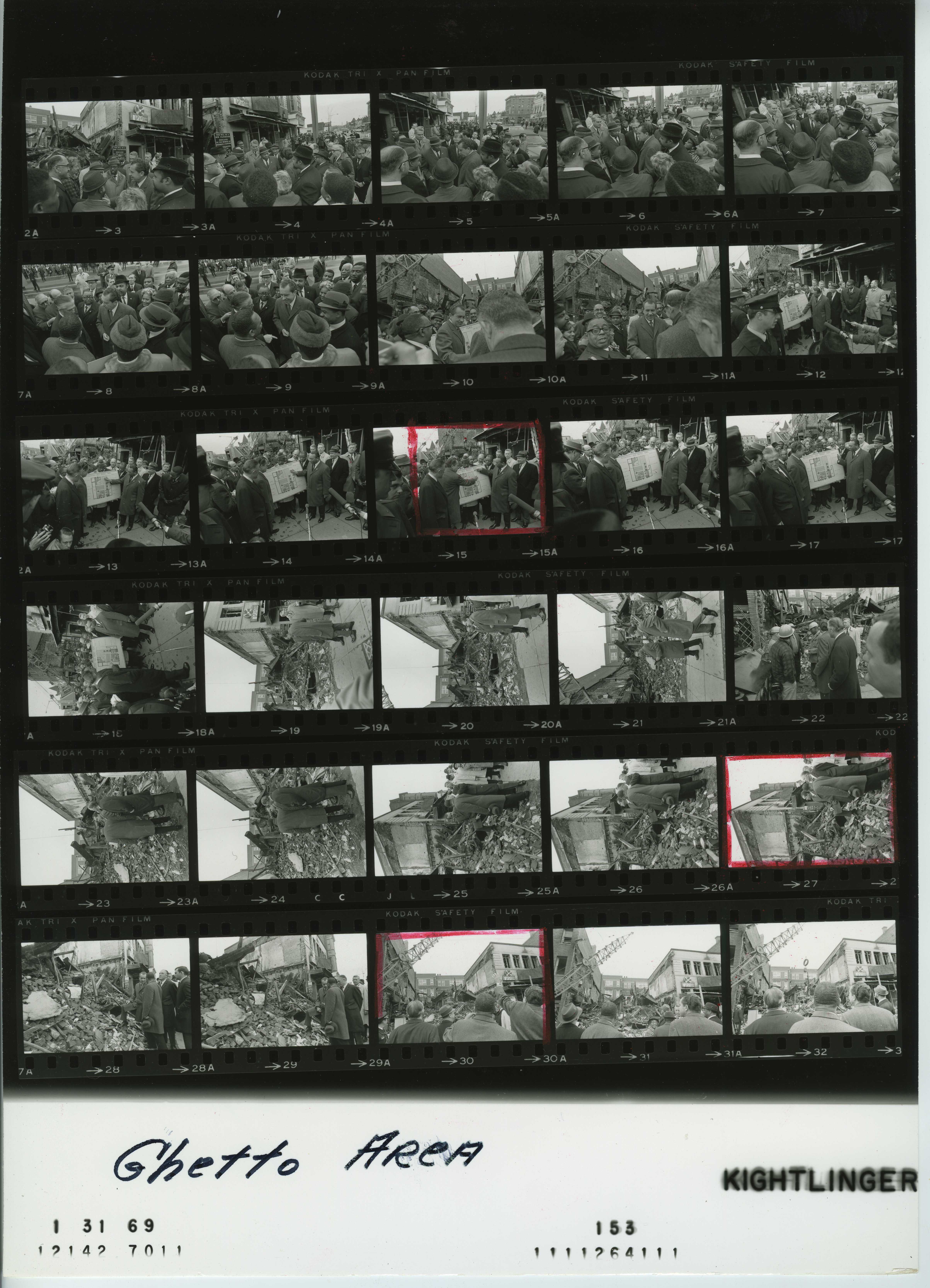
- Frame(s): WHPO-0153-03-32, President Nixon visits the impoverished ghetto or slum site of a future park redevelopment area at 7th and T-Street. In group are HUD Secretary George Romney, and Washington, D.C. Mayor Walter Washington. 1/31/1969, Washington, D.C. 7th and T Streets. Frame 15, L-R: HUD Sec. George Romney, President Nixon, Walter E. Washington, Mayor of Washington; Frame 11: DC City Council Vice Chairman Walter E. Fauntroy (standing behind President Nixon).
- Frame(s): WHPO-0153-15, President Nixon and Mayor-Commissioner of Washington D.C. Walter Washington talk and touch a large posterboard of a schematic design for a future park in front of press microphones, during a visit to the impoverished ghetto or slum site of a future park redevelopment area at 7th and T-Street. HUD Secretary George Romney and other unidentified officials and persons stand to the side. 1/31/1969, Washington, D.C. 7th and T Streets. President Nixon, HUD Sec. George Romney, Walter E. Washington, Mayor-Commissioner of Washington, D.C., unidentified persons.
- Frame(s): WHPO-0153-27, President Nixon, Secretary George Romney, and Washington, D.C. Mayor-Commissioner Walter Washington look at a demolished building, during a visit to the impoverished ghetto or slum site of a future park redevelopment area at 7th and T-Street. President Nixon puts his leg up on the rubble. 1/31/1969, Washington, D.C. 7th and T Streets. President Nixon, HUD Sec. George Romney, Walter E. Washington, Mayor-Commissioner of Washington, unidentified persons.
Roll WHPO-0154 Photographer: Kightlinger, Jack | Color or B&W: B&W
- Frame(s): WHPO-0154-03-10, President Nixon speaking to Pentagon employees in an auditorium. 1/31/1969, Arlington, Virginia Pentagon, auditorium. L-R: President Nixon, Melvin Laird.
- Frame(s): WHPO-0154-11-13, President Nixon viewing the Hall of Heroes display with Melvin Laird, and Gen. Earle Wheeler. 1/31/1969, Arlington, Virginia Pentagon. L-R: Earle Wheeler, Melvin Laird, President Nixon.
- Frame(s): WHPO-0154-14-17, President Nixon standing with with Melvin Laird and Gen. Earle Wheeler outside the Pentagon. 1/31/1969, Arlington, Virginia Pentagon. L-R: Earle Wheeler, President Nixon, Melvin Laird.
- Frame(s): WHPO-0154-18-20, President Nixon and staff members walking back to the White House, near the loggia porch area. 1/31/1969, Washington, D.C. White House. President Nixon, unidentified staff members.
Roll WHPO-0155 Photographer: Kightlinger, Jack | Color or B&W: B&W
- Frame(s): WHPO-0155-03A-10A, President Nixon participates in the Presentation of Flags to Military Secretaries Ceremony, with Gen. Westmoreland, Admiral Moorer, John Chafee, Stanley Resor, Henry Kissinger, David Packard, Melvin Laird and Gen. Earle Wheeler. 1/31/1969, Arlington, VA Pentagon. Frame 10A, L-R: Henry Kissinger, David Packard (Deputy Defense Secretary), President Nixon, Melvin Laird, Gen. Earle G. Wheeler; Back to the camera, L-R: John Chafee (Secretary of the Navy), Leonard Chapman, Jr. (Commandant of the Marine Corps), Admiral Thomas Moorer (Chief of Naval Operations).
- Frame(s): WHPO-0155-11A-12A, 14A-29A, President Nixon speaking to Pentagon employees in an auditorium. 1/31/1969, Arlington, Virginia Pentagon, auditorium. L-R: President Nixon, Melvin Laird.
- Frame(s): WHPO-0155-13A, Melvin Laird speaking to Pentagon employees in an auditorium, President Nixon sitting nearby. 1/31/1969, Arlington, Virginia Pentagon, auditorium. L-R: President Nixon, Melvin Laird.
Roll WHPO-0156 Photographer: Atkins, Oliver | Color or B&W: B&W
- Frame(s): WHPO-0156-00A, 02A-12A, Guests enjoying a diplomatic reception and dance in the East Room, hosted by President Nixon and Pat Nixon. 1/31/1969, Washington, D.C. White House, East Room. President Nixon, Pat Nixon, Spiro Agnew, Judy Agnew, Emil Mosbacher, Jr., Mrs. Mosbacher, Everett Dirksen, unidentified persons.
- Frame(s): WHPO-0156-01A, Everett Dirksen and Mrs. Dirksen speaking with guest at a diplomatic reception and dance in the East Room, hosted by President Nixon and Pat Nixon. 1/31/1969, Washington, D.C. White House, East Room. Everett Dirksen, Mrs. Dirksen, unidentified diplomats and guests.
- Frame(s): WHPO-0156-13A-20A, Vice President Agnew and Judy Agnew dancing at a diplomatic reception and dance in the East Room, hosted by President Nixon and Pat Nixon. 1/31/1969, Washington, D.C. White House, East Room. Spiro Agnew, Judy Agnew, unidentified guests.
Roll WHPO-0157 Photographer: Kightlinger, Jack | Color or B&W: B&W
- Frame(s): WHPO-0157-02A-11A, General Albright conducts a military medal award bestowal ceremony for Gary L. Voight. 1/31/1969, Washington, D.C. L-R: Gary L. Voight, General Albright.
- Frame(s): WHPO-0157-12A-13A, Closeup of military eagle motif medal awarded to Gary L. Voight. 1/31/1969, Washington, D.C. Gary L. Voight.
Roll WHPO-0158 Photographer: Kightlinger, Jack | Color or B&W: B&W
- Frame(s): WHPO-0158-03-05, General Albright conducts a military medal award bestowal ceremony for Gary L. Voight, an unidentified official reading the commendation. 1/31/1969, Washington, D.C. L-R: Gary L. Voight, General Albright, unidentified official.
Roll WHPO-0159 Photographer: Atkins, Oliver | Color or B&W: B&W
- Frame(s): WHPO-0159-01-07, President Nixon and Pat Nixon walk toward the Green Room behind a formal honor color guard, before receiving the Ambassadors and guests at a Diplomatic Reception. 1/31/1969, Washington, D.C. White House, Green Room. President Nixon, Pat Nixon, military honor color guard.
- Frame(s): WHPO-0159-08-16, President Nixon and Pat Nixon stand with Chief of Protocol Emil Mosbacher, Jr. in front of the military honor color guard greeting Ambassadors and guests at a formal Diplomatic Reception's official reception line. 1/31/1969, Washington, D.C. White House, Green Room. President Nixon, Pat Nixon, Emil Mosbacher, Jr., military honor color guard, unidentified diplomats.
Roll WHPO-0160 Photographer: Knudsen, Robert L. | Color or B&W: B&W
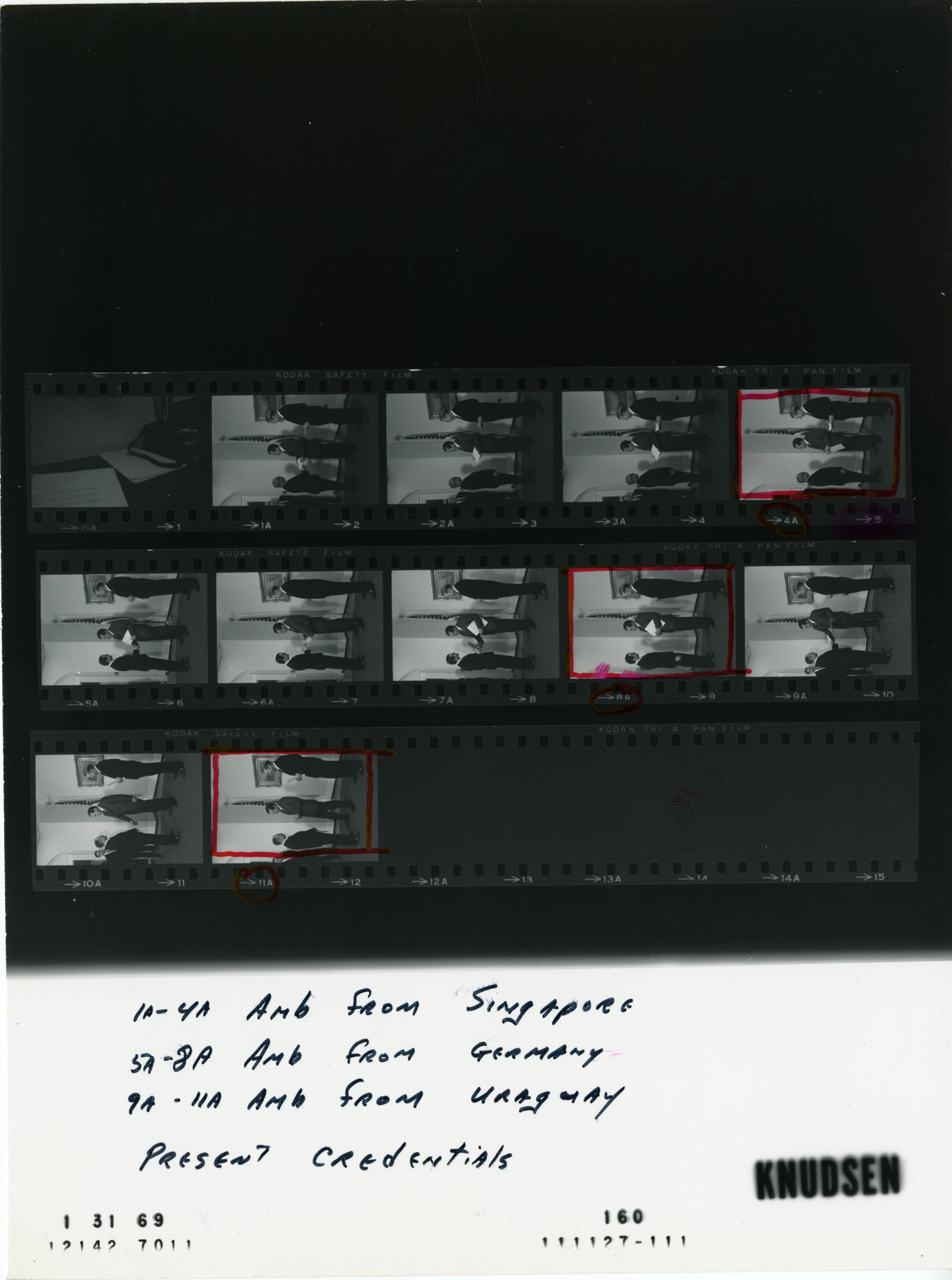
- Frame(s): WHPO-0160-01A-04A, President Nixon accepts diplomatic credentials of Ernest Steven Monteiro, Ambassador from the Republic of Singapore, while standing near Emil Mosbacher, Jr., Chief of Protocol. 1/31/1969, Washington, D.C. White House, Fish Room. L-R: Ernest Steven Monteiro, President Nixon, Emil Mosbacher, Jr.
- Frame(s): WHPO-0160-05A-08A, President Nixon accepts diplomatic credentials of Rolf Friedmann Pauls, Ambassador from Germany, while standing near Emil Mosbacher, Jr., Chief of Protocol. 1/31/1969, Washington, D.C. White House, Fish Room. L-R: Rolf Friedmann Pauls, President Nixon, Emil Mosbacher, Jr.
- Frame(s): WHPO-0160-09A-11A, President Nixon accepts diplomatic credentials of Hector Luisi, Ambassador from the Oriental Republic Uruguay, while standing near Emil Mosbacher, Jr., Chief of Protocol. 1/31/1969, Washington, D.C. White House, Fish Room. L-R: Hector Luisi, President Nixon, Emil Mosbacher, Jr.
Roll WHPO-0161 Photographer: Knudsen, Robert L. | Color or B&W: B&W
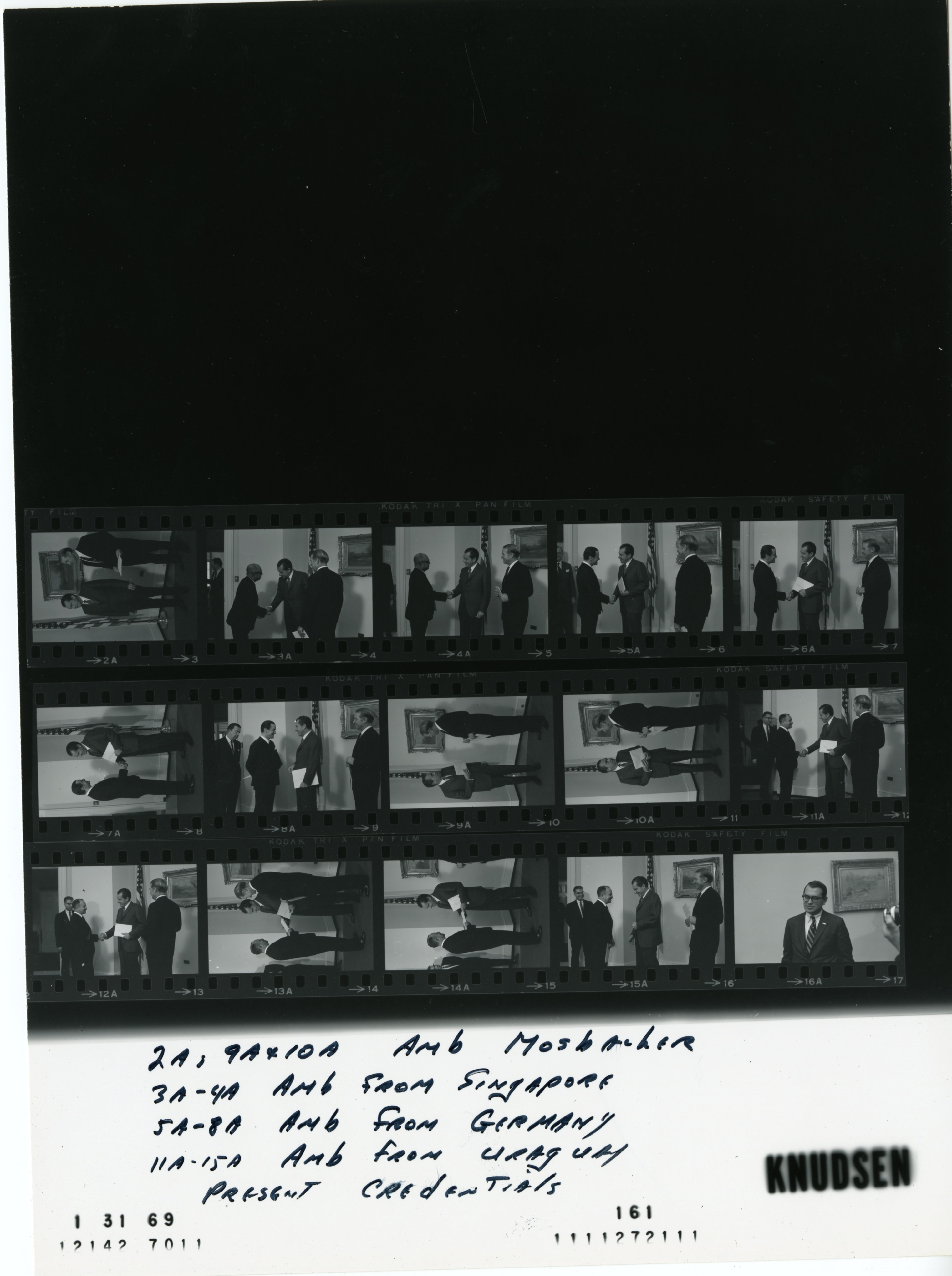
- Frame(s): WHPO-0161-02A, President Nixon and Emil Mosbacher, Chief of Protocol, wait to meet Ambassadors who will be presenting their credentials at their official Diplomatic Reception. Ceremony. 1/31/1969, Washington, D.C. White House, Fish Room. L-R: President Nixon, Emil Mosbacher, Jr.
- Frame(s): WHPO-0161-03A-04A, President Nixon accepts diplomatic credentials of Ernest Steven Monteiro, Ambassador from Singapore, while standing near Emil Mosbacher, Jr., Chief of Protocol. 1/31/1969, Washington, D.C. White House, Fish Room. L-R: Ernest Steven Monteiro, President Nixon, Emil Mosbacher, Jr.
- Frame(s): WHPO-0161-05A-08A, President Nixon accepts diplomatic credentials of Rolf Friedmann Pauls, Ambassador from Germany, while standing near Emil Mosbacher, Jr., Chief of Protocol. 1/31/1969, Washington, D.C. White House, Fish Room. L-R: Rolf Friedmann Pauls, President Nixon, Emil Mosbacher, Jr.
- Frame(s): WHPO-0161-09A-10A, President Nixon and Emil Mosbacher, Chief of Protocol, wait to meet Ambassadors who will be presenting their credentials at their official Diplomatic Reception. 1/31/1969, Washington, D.C. White House, Fish Room. L-R: President Nixon, Emil Mosbacher, Jr.
- Frame(s): WHPO-0161-11A-15A, Credentialing Ceremony of Hector Luisi (Ambassador from Uraguay). 1/31/1969, Washington, D.C. White House, Fish Room. L-R: Hector Luisi, President Nixon, Emil Mosbacher, Jr.
Roll WHPO-0162 Photographer: Atkins, Oliver | Color or B&W: B&W
- Frame(s): WHPO-0162-00-19, Herb Klein, Director of Communications, at his desk, going over papers in his office, with receptionist Mary Ann Snow. 1/31/1969, Washington, D.C. Executive Office Building. Herb Klein, Mary Ann Snow.
Roll WHPO-0163 Photographer: Atkins, Oliver | Color or B&W: B&W
- Frame(s): WHPO-0163-01-09, President Nixon visits with Newspaper and Television Media editors from the Washington Daily News, Washington Post, Washington Star, NBC, CBS, ABC, HUD, MetroMedia, officials from the Justice Department, State Dept. Deputy Mayor of Washington and the Counsel to the President. 1/31/1969, Washington, D.C. White House, Oval Office. President Nixon, Herbert G. Klein, Ronald L. Ziegler, Richard Van Deusen, John Ehrlichman, Don Santorelli, Richard Hollender, Nicholas Blatchford, Ben Bradlee, Philip Geyelin, John Anderson, Newbold Noyes, John H. Cline, Frank Jordan, Mike Buchanan, Bill Small, John Lynch, Tom Fletcher, Richard Pedersen.
Roll WHPO-0167 Photographer: Knudsen, Robert L. | Color or B&W: Color
- Frame(s): WHPO-0167-02-37, President Nixon and Pat Nixon stand near Chief of Protocol Emil Mosbacher, Jr., in a reception line to greet Ambassadors and their wives at a diplomatic reception. 1/31/1969, Washington, D.C. White House, Green Room. President Nixon, Pat Nixon, Emil Mosbacher, Jr., unidentified Ambassadors, diplomats, their wives and guests.
Roll WHPO-0168 Photographer: Knudsen, Robert L. | Color or B&W: Color
- Frame(s): WHPO-0168-01A-35A, President Nixon and Pat Nixon stand near Chief of Protocol Emil Mosbacher, Jr., in a reception line to greet Ambassadors and their wives at a diplomatic reception. 1/31/1969, Washington, D.C. White House, Green Room. President Nixon, Pat Nixon, Emil Mosbacher, Jr., unidentified Ambassadors, diplomats, their wives and guests.
Roll WHPO-0169 Photographer: Knudsen, Robert L. | Color or B&W: Color
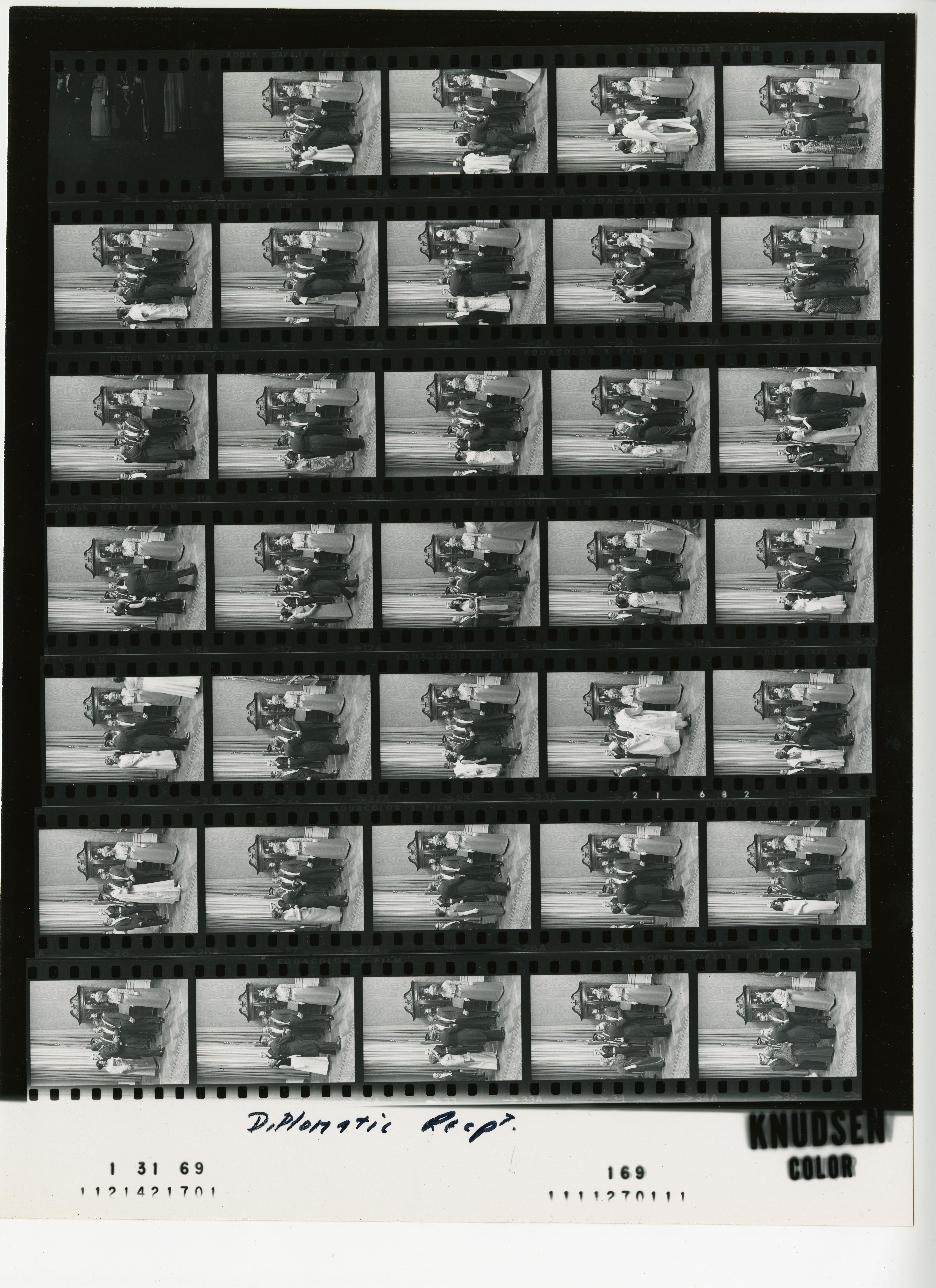
- Frame(s): WHPO-0169-01A-35A, President Nixon and Pat Nixon stand near Chief of Protocol Emil Mosbacher, Jr., in a reception line to greet Ambassadors and their wives at a diplomatic reception. 1/31/1969, Washington, D.C. White House, Green Room. President Nixon, Pat Nixon, Emil Mosbacher, Jr., unidentified Ambassadors, diplomats, their wives and guests.
Roll WHPO-0170 Photographer: Knudsen, Robert L. | Color or B&W: Color
- Frame(s): WHPO-0170-01A-35A, President Nixon and Pat Nixon stand near Chief of Protocol Emil Mosbacher, Jr., in a reception line greeting Ambassadors and their wives, at their first diplomatic reception. 1/31/1969, Washington, D.C. White House, Green Room. President Nixon, Pat Nixon, Emil Mosbacher, Jr., unidentified Ambassadors, diplomats, their wives and guests.
Roll WHPO-0171 Photographer: Knudsen, Robert L. | Color or B&W: Color
- Frame(s): WHPO-0171-02A-07A, A standing portrait of an unidentified woman alone, dressed in a fur trimmed full length formal gown at the first Nixon Presidential administration's diplomatic reception. 1/31/1969, Washington, D.C. White House, Green Room. Unidentified guest.
- Frame(s): WHPO-0171-09A-10A, Standing portraits of three unidentified diplomat officials, or Ambassadors, at the first Nixon Presidential administration's diplomatic reception. 1/31/1969, Washington, D.C. White House, Green Room. unidentified Ambassadors or diplomats.
- Frame(s): WHPO-0171-11A-35A, President Nixon and Pat Nixon stand near Chief of Protocol Emil Mosbacher, Jr., in a reception line greeting Ambassadors and their wives, at their first diplomatic reception. 1/31/1969, Washington, D.C. White House, Green Room. President Nixon, Pat Nixon, Emil Mosbacher, Jr., unidentified Ambassadors, diplomats, their wives and guests.
The White House Communications Agency Sound Recordings Collection contains public statements that took place between 1969 and 1974. Visit the finding aid to learn more.
G - Cabinet Officer Briefings
- WHCA-SR-G-003
Remarks by Secretary of Labor George Shultz announcing appointment of Curtis Counts to Federal Mediation Service, with additional remarks by Curtis Counts. (1/31/1969, Press Lobby, The White House)
Runtime: 0:14:10
Production credits: Audio feed supplied by ABC; No WHCA engineer initials listed
Original Format: 1/4-inch reel-to-reel audiotape. Original source type: Original. Technical notes: 39 minutes and 2 seconds of silence at end of recording removed from access copies.
P - Formal Presidential Remarks
- WHCA-SR-P-690121
Remarks by President Nixon to key personnel at the Defense Department. (1/31/1969, Pentagon Auditorium)
Runtime: 0:15:55
Production credits: Audio feed supplied by NBC
Original Format: 1/4-inch reel-to-reel audiotape. Original source type: Original. - WHCA-SR-P-690122
Remarks by President Nixon at reception, diplomatic corps. (1/31/1969)
Runtime: 4:34
Original Format: 1/4-inch reel-to-reel audiotape. Original source type: Original.
Context (External Sources)
The Vanderbilt Television News Archive is the world's most extensive and complete archive of television news. They have been recording, preserving and providing access to television news broadcasts of the national networks since August 5, 1968.
Wikipedia is a free encyclopedia that anyone can edit.