
Introduction
This almanac page for Wednesday, January 29, 1969, pulls together various records created by the federal government and links to additional resources which can provide context about the events of the day.
Previous Date: Tuesday, January 28, 1969
Next Date: Thursday, January 30, 1969
Schedule and Public Documents
The Daily Diary files represent a consolidated record of the President's activities. Visit the finding aid to learn more.
The President's day began at The White House - Washington, D. C.
The Weekly Compilation of Presidential Documents made available transcripts of the President's news conferences; messages to Congress; public speeches, remarks, and statements; and other Presidential materials released by the White House.
Addresses and Remarks
- Department of State (5 Weekly Comp. Pres. Doc. 185, January 29, 1969)
The President's Remarks to Key Personnel at the Department of State.
Checklist of White House Press Releases
The releases listed below, made public by the Office of the White House Press Secretary during the period covered by this issue, are not included in the issue.
- Announcement of nomination of Allen L. Donielson and Richard A. Dier as U.S. attorneys.
- Announcement of nomination of Rear Adm. Jackson D. Arnold for appointment to the grade of vice admiral.
- Announcement of approval of selection board recommendations on promotion of U.S. Marine Corps Reserve officers as follows: To major general: Charles T. Hagan, Jr., Arthur B. Hanson; To brigadier general: Richard Mulberry, Jr.
- Biographical data on Gerard Smith.
Digest of Other White House Announcements
Following is a listing of items of general interest which were announced in the press but not made public as formal White House press releases during the period covered by this issue. Appointments requiring Senate approval are not included since they appear in the list of nominations submitted to the Senate, below.
- The President visited the Senate floor and lunched with the Senate leadership in the minority leader's office.
- The President has commissioned Director of Protocol Emil (Bus) Mosbacher, Jr., Chief of Protocol for the White House, with the personal rank of Ambassador.
- The President has appointed Mrs. Elizabeth Duncan Koontz of Salisbury, N.C., to be the representative of the United States on the Commission on the Status of Women of the Economic and Social Council of the United Nations.
Nominations Submitted to the Senate
Does not include promotions of members of the Uniformed Services, nominations to the Service Academies, or nominations of Foreign Service Officers.
- RUSSELL E. TRAIN, of the District of Columbia, to be Under Secretary of the Interior.
- FRED J. RUSSELL, of California, to be Deputy Director of the Office of Emergency Preparedness.
Each Public Papers of the Presidents volume contains the papers and speeches of the President of the United States that were issued by the White House Office of the Press Secretary during the time period specified by the volume. The material is presented in chronological order, and the dates shown in the headings are the dates of the documents or events. In instances when the release date differs from the date of the document itself, that fact is shown in the text note.
To ensure accuracy, remarks have been checked against audio recordings (when available) and signed documents have been checked against the original, unless otherwise noted. Editors have provided text notes and cross references for purposes of identification or clarity.
The Federal Register is the official daily publication for rules, proposed rules, and notices of federal agencies and organizations, as well as executive orders and other Presidential documents.
The Congressional Record is the official daily record of the debates and proceedings of the U.S. Congress.
Archival Holdings
Any selection of archival documents will necessarily be partial. You should use the documents and folders identified below as a starting place, but consult the linked collection finding aids and folder title lists and the collections themselves for context. Many documents to be found this way do not lend themselves to association with specific dates, but are essential to a complete understanding of the material.
Selective document listing
President's Office Files
The President's Office Files consists of materials drawn together by the Special Files Unit from several administrative subdivisions within the White House Office. It is the handwriting and sensitive papers sent to the Staff Secretary that now comprise much of the President's Office Files. Visit the finding aid to learn more.
- President's Handwriting, Box 1, President's Handwriting, January 1969 [2 of 2]
- Memo; Lee A. DuBridge to The President re: Agenda for Meeting with the President 3:00 PM January 30. January 29, 1969. 2 pgs.
- Annotated News Summaries, Box 28, News Summaries - January 1969 [During this period, the Staff Secretary only removed pages from the News Summaries which contained President Nixon's handwriting, often leaving the document with no date. Although there are no specific documents with this date, you should also consult the full folder for the month.]
- President's Meetings File, Box 73, Memoranda for the President--Beginning January 26, 1969
President's Personal File
The President's Personal File is essentially a President's secretary's file, kept by Rose Mary Woods, personal secretary to the President, for two purposes: (1) preserving for posterity a collection of documents particularly close to the President, whether because he dictated or annotated them, or because of the importance of the correspondent or the event concerned and (2) giving appropriate attention–letters of gratitude, invitations to White House social events, and the like–to members and important friends and supporters of the Nixon administration. This generalization does not describe all the varied materials of a file group which is essentially a miscellany, but it does identify the reason for the existence of the file group's core. Visit the finding aid to learn more.
- President's Speech File
Selective document listing
The White House Press Office during the Presidency of Richard Nixon was responsible for daily communication with the White House press corps. Ronald L. Ziegler was the Press Secretary to the President for Nixon's entire term in office from January 1969 to August 1974 and Gerald Warren served as the Deputy Press Secretary. The office held daily briefings for the press and produced the White House’s press releases. Visit the finding aid to learn more.
- White House Press Releases, Box 1
- FOR IMMEDIATE RELEASE JANUARY 29, 1969
Office of the White House Press Secretary
THE WHITE HOUSE
The President today announced that he has nominated Rear Admiral Jackson D. Arnold, U.S. Navy, for appointment to the grade of vice admiral.
Rear Admiral Arnold was born in Greenville, Florida, on November 3, 1912. He is serving as Vice Chief of Naval Material and will continue in his present assignment in the grade of vice admiral.
Rear Admiral Arnold was graduated from the Naval Academy in 1934, and completed flight training at Pensacola. His decorations include the Navy Cross, Silver Star medal, Distinguished Flying Cross with one Gold Star in lieu of a second award, the Air Medal with four Gold Stars and the Presidential Unit Citation for service aboard the USS Hornet.
# # # - FOR IMMEDIATE RELEASE JANUARY 29, 1969
Office of the White House Press Secretary
THE WHITE HOUSE
The President today approved the reports of selection boards convened on 7 January 1969 to select officers of the U.S. Marine Corps Reserve for promotion to the grades of major general and brigadier general. The following named officers were selected for promotion to the grades indicated:
Major General:
Charles T. Hagan, Jr.
Arthur B. Hanson
Brigadier General:
Richard Mulberry, Jr.
General Hagan was born 20 April 1913 in Greensboro, North Carolina. He was commissioned a second lieutenant in the U.S. Marine Corps Reserve in October 1935 and served on active duty during World War II from February 1941 until March 1946. General Hagan is currently a partner in the law firm of Adams, Kleemeier, Hagan and Hannah of Greensboro, North Carolina and resides at 401 Sunset Drive, Greensboro, North Carolina.
General Hanson was born 8 December 1916 in Washington, D. C. He was commissioned a second lieutenant in the Marine Corps Reserve in May 1941 and served on active duty during World War II from May 1941 until March 1946. General Hanson is currently the managing partner in the law firm of Hanson, Cobb, O'Brien and Tucker of Washington, D. C, and Rockville, Maryland and resides at 10 Stanmone Court, Potomac, Maryland.
Colonel Mulberry was born in 14 March 1920 in Scott County, Kentucky. He was commissioned a second lieutenant in the U.S. Marine Corps Reserve in July of 1942 and served on active duty during World War II from August 1942 until June 1946. He served on active duty during the Korean Conflict from March 1951 until January 1953. He is a certified public accountant and partner and member in the firm of Elmer, Fox and Company and resides at 4559 Hallmark, Dallas, Texas.
The President will submit the names of these officers to the United States Senate for confirmation.
# # # - FOR IMMEDIATE RELEASE JANUARY 29, 1969
Office of the White House Press Secretary
THE WHITE HOUSE
President Nixon has nominated the following men to be U.S. attorneys:
Allen L. Donielson, of Des Moines, Iowa, to be United States Attorney for the Southern District of Iowa (Court sits at Des Moines, Council Bluffs and Davenport) for the term of four years, vice James P. Rielly, resigned.
Richard A. Dier, of Kearney, Nebraska, to be United States Attorney for the District of Nebraska (Court sits at Lincoln, North Platte, and Omaha,) for a term of four years, vice Theodore L. Richling, resigned.
# # # - FOR IMMEDIATE RELEASE JANUARY 29, 1969
Office of the White House Press Secretary
THE WHITE HOUSE
BIOGRAPHICAL DATA ON GERARD SMITH
After graduating from Canterbury School, New Milford, Connecticut, in 1931, Yale College in 1935, and Yale Law School in 1938, Mr. Smith was with the Legal Department of General Motors Corporation from 1939 to 1941.
From 1941 to 1945 he served in the U.S. N, R. (Lieutenant) and received the Secretary of Navy Commendation.
From 1945 to 1950 he practiced law in New York City.
From 1950 to 1954 he was with the Atomic Energy Commission as Special Assistant to Commissioner Thomas E. Murray.
From 1954 to 1957 Mr. Smith was Special Assistant to Secretary of State for Atomic Affairs, including responsibility in the Department of State for disarmament matters. In this capacity he was responsible for preparation of U.S. disarmament proposals of 1957 and assisted the Secretary of State at the London Disarmament Negotiations. During 1957 Mr. Smith was in charge of liaison with Congress on disarmament developments. In 1955 and 1956 he was Deputy U. S. representative, International Atomic Energy Agency Treaty negotiations, and was Chief Political Advisor, Atoms for Peace Conference, Geneva, 1955.
He was also principal Political Advisor at the technical talks (Rabi-Skobeltsyn) with U.S. S. R., Geneva, 1955, on methods of controlling against diversion of fissionable material from power reactors into weapons.
In 1957 Mr. Smith became Assistant Secretary of State for Policy Planning and served until 1961.
In 1962 and in 1964 he was Special Advisor to the Secretary of State for Multilateral Force Negotiations.
Since 1961 he has been a member of the Board of Consultants, Policy Planning Council, Department of State.
Mr. Smith originated the concept of nuclear test restraint agreed upon at the Bermuda Heads of Governments meeting (Eisenhower-Macmillan) in 1957.
In 1963 President Kennedy credited Mr. Smith for originating in December, 1959, the proposal for the Washington-Moscow "Hot Line."
Since 1967 Mr. Smith has been the publisher of INTERPLAY (the magazine of international affairs) and a Research Associate at the Foreign Policy Center, School for Advanced International Studies, Johns Hopkins University, and a member of the SAIS Advisory Council.
From '67 to date Smith has served as Director of the Atlantic Council of the U.S. He is also a member of the Council on Foreign Relations, New York, a director of American Security and Trust Company, a trustee of Sheridan School and Canterbury School, and a member of the Law Committee of Yale University Council and Executive Committee of Yale Law School Association.
He is married to Bernice Latrobe Maguire of St. Louis, Missouri. They have four children: John Thomas Smith, Second Lieutenant U.S. Air Force; Gerard L. Smith, an enlisted man in the U.S. Army at Fort Gordon, Georgia; Hugh M. Smith, a student at Canterbury School; and a married daughter, Mrs. Richard B. Griffin, Jr. 1 of Washington D. C.
# # # - FOR IMMEDIATE RELEASE JANUARY 29, 1969
OFFICE OF THE WHITE HOUSE PRESS SECRETARY
THE WHITE HOUSE
REMARKS OF THE PRESIDENT AT THE STATE DEPARTMENT
Mr. Secretary, ladies and gentlemen:
I am very honored and privileged to be here in this auditorium on my first official visit with the key personnel of one of the Departments.
I recall, incidentally, that on Inauguration Day the first building I visited was this one. We had then
prayer breakfast, not a breakfast -- we had prayer without breakfast.
Now that we had the prayers, we are back here to get the advice so that I can go back to the Senate and get the consent for everything that we have to do from now on.
I do want you to know, too, that in appearing here with the Secretary of State, I think his relationship with the President is of great interest of those in this Department.
I have been reading some dope stories lately about the rivalries that may develop between the various Departments in Government and particularly the traditional struggles for power that sometimes take place when the State Department is concerned and the White House staff is concerned when it delves into foreign policy. I have often answered those who had concern in this point by saying that what really counts is not the table of organization, but what really counts is
the relationship between the two men -- the President and his Secretary of State.
I am sure that all of you know that my relationship with Secretary Rogers goes back many, many years. We came into Government virtually together, as a matter of fact, we came into the service together -- the Navy when we were at Quonset Point in 1942. Since that time I have learned to respect his judgment, his courage, his basic intelligence, as I know and I am sure that you in this Department who have the opportunity to know him will learn to respect it.
I also am aware of the fact that in the presence of a Secretary of State I may be in the presence of someone who may turn out to be my successor in this office.
I did a little historical research before coming over here, just as I did historical research before I went to the House yesterday and to the Senate today at noon. So, in each place I pay proper tribute to the members of the body concerned.
In the House of Representatives, for example, I was able to point out that in a period between 1840 and 1880, ten out of the twelve Presidents of the United States in that period had served in the House of Representatives. Then for a considerable period of time, up until the time of the election in 1960, the nation moved to other areas for their Presidents, except for the election of Harry Truman in 1948.
I pointed out when I was at the Senate today that Andrew Johnson, in the 19th Century, was the last President before John F. Kennedy who had served in both the House and the Senate. Then John F. Kennedy, Lyndon Johnson, and now the present occupant of the Presidency, has served in both the House and the Senate.
Now, as far as the State Department was concerned, my history had to go back a little further.
I found, for example, that in days long gone -- not gone, but long past -- that in the past the Secretary of State was the office that was the logical one for anyone to seek in the event he wanted to be President.
You will all remember that Jefferson was Washington's Secretary of State. Madison was Jefferson's Secretary of State. Monroe was Madison's Secretary of State. John Quincy Ada was Monroe's Secretary of State. And Martin Van Buren was Jackson's first Secretary of State.
In fact, the tradition continued, and I found ended in the passing of the office from President Polk to President Buchanan. President Buchanan was the last who had been Secretary of State who became President of the United States. Now, whether that tells us something or not as to why it has not happened since, I do not know.
President Buchanan, as some of you may recall -- if you were following me on Inaugural night -- was one, who came to the Presidency at a time that he thought was much too late for that honor to be accorded him. As he was riding down from the White House to the Capitol he turned to a friend and said that he didn't feel particularly happy about becoming President at this late stage in his political career because he found that all of his friends that he wanted to reward had now died. And he said all of his, enemies that he hated and wanted to punish were now his friends.
Now, of course, we have Secretary Rogers.
I should point out that there is another way that he can go up if he would like. He has been the Attorney General of the United States and subsequently could qualify for the Chief Justiceship. I am not suggesting that, incidentally, he will be Earl Warren's successor -- not right now.
But you will recall that the first Chief Justice of the United States, John Jay, started as Secretary to the Confederation before the United States became the Government that was under the Constitution. And John Marshall had served as Secretary of State to Charles Evans Hughes. That is a great tradition.
All that I am suggesting to you by these opening remarks is that those of you who may plan to be Secretary of State can look forward possibly to being either President of the United States or Chief Justice.
I will only add one further thought, however; that in each body, any House Member, naturally, who heard what I said could see himself becoming President some day, any Member of the Senate could see that if things worked out he might become President, and, of course, any person in this audience with your foreign policy background and your futures could see yourself becoming President.
Which is the best way? I think perhaps the best answer I have for that is in a favorite anecdote. An Episcopal Priest was asked by a young parishioner who was very troubled about all of the theology he had heard about, asked that question that I am sure all leaders in religious thought are often asked.
The young parishioner said, "Father, is the Episcopal Church the only true path to salvation?" The Priest smiled and answered. He said, "No, son, there are other ways, but no gentleman would choose them."
I am sure the Secretary would say that there may be other ways to the Presidency than the Secretary of State, but no gentleman would choose them.
Now, may I speak to you quite directly about the work that you do and my association with it, and what I hope would be our association in the future?
As I look to this front row here, I see men whom I met 20 years ago when I first went to Europe with the Herter Committee. I can see in rows way back there people who have briefed me on my trips abroad during the period I was a Congressman, a Senator, the eight years I was Vice President, and then in the period of seven or eight years when I was out of Government.
During that time, I have visited over 60 countries. I always prided myself in trying to be well briefed before I made those visits, and subsequently I became well acquainted with the career men and women in the State Department.
Not just because I stand before you today, but because I believe this -- and I have often said it publicly and privately -- I do think that we have the best career service in the world. I think that was the case based on what I have seen, what I have heard, and on the advice that I have received.
I think it is vitally important to the future of this country that the morale of that career service be kept at its highest level possible and that those who make the foreign policy of this country have the best possible advice that we can get from those who serve in the career service.
That is one of the reasons why, when Secretary Rogers assumed his position and when the Under Secretaries as well as the Assistant Secretaries talked to me, I set forth a policy, a policy that I want followed throughout this administration, somewhat different from some of the policies of the past.
Each President must work differently, of course, in developing his foreign policy decisions. That policy is this: I consider the Secretary of State to be my chief foreign policy adviser and when we have a difficult decision and I ask him what should we do, I do not want him to come in and say, "You could do this or you could do that." I want him to say "You could do this or you could do that," but I want him to give me his advice on what we should do.
I have always told him, and as I understand it, he has informed you, that where there is a strong minority view or where there may be two other viewpoints or more held by responsible people, that I want to see that view, too. The reason I want to see the minority views as well as the majority views as well as his advice, which may be either one or the other, because he may not agree with the majority view, even in the Department, is that I have the conviction that a policy is improved by having a decision maker consider the options and consider the alternatives, even if he decides to reject one point of view that is strongly urged, he may develop from considering that point of view a more effective and stronger position in the position which he eventually considers to be the preferable one.
I say that because as I have traveled throughout the world I have sometimes been concerned that people in the career service in various posts develop a sense of frustration that they have ideas with regard to the conduct of foreign policy that are quite relevant that ought to be considered, but there is some way they will never get to the top in the bureaucracy.
Now, I recognize in the huge responsibilities we have around the world and all the cables that come pouring in here, that every idea that anybody has in the world cannot always come to the President of the United States or even to the Under Secretaries or the Assistant Secretaries. But I do want to urge everyone here who has a responsibility for preparing any materials that come to my office, that I am interested in, and want to see, points of view that may differ from those that eventually become the policy of this country.
I think the more that we have, that kind of dialogue, that kind of sometimes debate, of consideration, which is not simply papering over differences, negotiating them out -- and I know you are very skilled in that, too, you have to be -- but think when we have that kind of a dialogue we can improve our policies.
It will certainly be of very good assistance to me. I say that, too, because I realize that in this Department are so many who have varied backgrounds, who have done a great deal of thinking, a great deal more than I will ever have the opportunity to do, on special problems and special areas.
I will, therefore, appreciate the best that you can present and I can assure you that to the extent my time permits, those viewpoints will be considered.
Finally, as you may have noted if you read, or heard my first press conference on Monday, I was glad the Secretary had read it, incidentally, you will note that I pointed out when one of the questioners said "What is the most important decision that you have to make? What is the greatest problem that you have to confront?" I pointed out what is the fact, and that is that it is difficult to try to select priorities among the many problems that confront this nation at home and abroad, but I do know that there are certain decisions in foreign policy that only the President of the United States can make. It is here that he must devote that extra effort if there is any extra effort he can devote to it because if he makes a mistake in this area it is a mistake that no one else is going to be able to correct.
For that reason, I asked that the Secretary arrange this meeting, that I come here to say to those who have worked in the field -- many of you I have met around the world, many of you I hope to meet during the course of my service in the present office that I hold --to say to you that I appreciate what you have done. I respect the members of this Department, the career service, for the contribution you have made and are making to the foreign policy of this country.
I hope that when this administration completes its service in Washington we will have made real progress toward settling differences between nations, toward bringing the peace that we all want in the world.
I know that if that comes it will come only because of the quality of our State Department personnel. I know that I have to count on you. I can only say that as I stand here today, as I see you, I believe that I, as the chief executive officer of this nation, have the best advice of any chief executive officer of any nation in the world.
Thank you.
Before Mr. Rogers responds, I should say that in giving that little history I can also tell you about the last Attorney General who became Secretary of State. I am sure some of the veterans may remember, it was President Taft's Secretary of State, Philander Knox. He was famous for a reason that I hope Mr. Rogers does not become famous for. He was a man who loved the good life. He used to arrive in the office about 10 o'clock to look over the cables. At 11:30 he would leave and go to the best club in town for a leisurely two-martini lunch. Then in the afternoon, if it was a good day, he would go out to Chevy Chase and play golf and that evening attend a diplomatic reception.
I understand that things have changed, but that was one of your predecessors.
END (3:22 P.M. EST)
- FOR IMMEDIATE RELEASE JANUARY 29, 1969
- White House Press Conferences, Box 55
- News Conference #21 at the White House with Ron Ziegler, Press Secretary, January 29, 1969, 11:17 A.M. EST. 9 pgs.
NEWS CONFERENCE #21
AT THE WHITE HOUSE
WITH RON ZIEGLER, PRESS SECRETARY
11:17 A.M. EST
JANUARY 29, 1969
WEDNESDAY
MR. ZIEGLER: The President arrived in the West Wing about 7:45 this morning. The National Security Council Meeting began at 10:00 a.m., as was previously announced. The subject of the meeting this morning is the Nonproliferation Treaty.
Those in attendance at the meeting are: the Vice President, Secretary of Defense Laird, Secretary of State Rogers, Director of the OEP, General Lincoln, General Wheeler, Joint Chiefs of Staff; Director Helms, CIA; Elliot Richardson, Under Secretary of State. Of course, Henry Kissinger is there, Dr. DuBridqe, the President's Science Adviser; Acting Director of the Arms Control and Disarmament Agency, Adrian Fisher. Bryce Harlow is sitting in the NSC meeting this morning, as is General Goodpaster.
The schedule for the remainder of the day remains as indicated yesterday.
The President will leave the White House for the Senate at 12:20. The President will visit the Floor of the Senate and then he will have lunch. The lunch will be held in the Senate Minority Leader's chambers. The guests will be Senator Hugh Scott of Pennsylvania, Senator Tower of Texas, Senator Gordon Allott of Colorado, Senator Margaret Chase Smith of Maine, Senator Milton Young of North Dakota.
The other guests at the lunch will be Senator Mike Mansfield of Montana, Senator Edward Kennedy of Massachusetts, Senator Richard Russell of Georgia, Senator Ellender of Louisiana, Senator Robert Byrd of West Virginia, Senator Ed Muskie of Maine. Also attending will be the Vice President, Mr. Bryce Harlow and Ken BeLieu of Mr. Harlow's staff.
The President has asked me to announce the fact that he has commissioned the Director of Protocol Emil (Bus) Mosbacher, Jr., of New York, Chief of Protocol for the White House, with the personal rank of Ambassador.
Also, and these will be available to you in the bins, the President has nominated the following men to be u. S. Attorneys: Allen L. Donielson, of Des Moines, Iowa, to be United States Attorney for the Southern District of Iowa.
We have biographies available on these men.
Q Do you have information there as to what is the immediate past job of that man?
MR. ZIEGLER: No. We will give you the biographies.
Richard A. Dier, of Kearney, Nebraska, to be United States Attorney for the District of Nebraska.
Information on where the Court sits and so forth will be in the bins.
The President today also announced that he has nominated Rear Admiral Jackson D. Arnold, U.S. Navy, for appointment to the grade of Vice Admiral. The information on the Admiral's background is on the sheet.
Q Do you have his new job?
MR. ZIEGLER: It doesn't have his new job. I don't know that he has been assigned to that yet. His current job and background is available.
Also, the President today approved the reports of selection boards convened on 7 January to select officers of the U. S. Marine Corps Reserve for promotion to the grades of major general and brigadier general.
The names of the gentlemen promoted and their background are on the sheet which will be available in the bins.
One final announcement: Mrs. Nixon will meet with the Family Circle Homemaker of the Year at 2:30 in the Green Room of the White House. This will be a photo session only. The photographers will be picked up by someone in Gerry Van der Heuvel's office in the West Wing about 2:20.
Q Do you have the name of the lady?
MR. ZIEGLER: Mrs. Richard Gessford of Coos Bay, Oregon. Her husband, Henry, is a magazine representative. Gerry Van der Heuvel asked me to make that announcement.
Q Ron, on the National Security Council Meeting, you told us, as you did earlier, that the Nonproliferation Treaty was the scheduled topic. Was the Mid-East discussed at all?
MR. ZIEGLER: The Non-Proliferation Treaty has been discussed as being on the agenda. I could not go beyond that in telling you what the agenda is except that the majority of the meeting has been confined to that.
Q Do you expect to make an announcement about the President's feeling on the Treaty today?
MR. ZIEGLER: No.
Q Does the President have a reaction to the trials taking place and the execution in Baghdad?
MR. ZIEGLER: I would have to refer you to the statement the Secretary of State made on that yesterday, and also to Bob McCloskey's statement yesterday.
Q Is the meeting still going on?
MR. ZIEGLER: Yes.
Q Is the Non-Proliferation Treaty the only thing they discussed?
MR. ZIEGLER: That has consumed the discussion this morning. The meeting started at 10:00 and the conversation has been on the Non-Proliferation Treaty.
Q Totally?
MR. ZIEGLER: Up to this point.
Q What is Richardson doing in on the meeting?
MR. ZIEGLER: As you know, he is Under Secretary of State.
Q There seems to be in some quarters some feeling of urgency about the Middle East. If the National Security Council meeting is at least so far all on the Treaty ---
MR. ZIEGLER: I have said this earlier. This is a practice that we are going to follow on the National Security Council meetings, with some exceptions, that we will not announce the full agenda of the National Security Council meetings.
Q What you are saying is that you are not ruling out other subjects, such as the Middle East, at today's meeting?
MR. ZIEGLER: That is correct.
Q Do you think the NSC will come to a decision today on the timing of the President's asking the Senate for ratification of the NPT, or do you think there will have to be further meetings on that subject?
MR. ZIEGLER: You are asking me for my judgment on that and I would not want to give you that. I don't think that is what you want to know.
Q Didn't the President say, at his press conference, that he was going to consult with Senate leaders sometime in the next few days?
MR. ZIEGLER: That is correct.
Q Has he done that yet?
MR. ZIEGLER: Up to this point, he has not.
Q Will that be done today?
MR. ZIEGLER: That is not the purpose for the visit to the Senate, and there is no agenda for the luncheon at the Senate. I don't know if the matter will come up or not. This is not a working session.
Q What is actually being taken up on the Treaty today, the timing?
MR. ZIEGLER: Again, following the procedure on the National Security Council, I am not in a position to say what the full content of the conversation is.
Q Can we assume that since the only thing to do with the Treaty is to ratify it, that ratification is part of the assumptions?
MR. ZIEGLER: I would not want to guide you on any assumptions.
Q The President said the other day, he referred to the Treaty and said the only question was when to call for ratification. So aren't we safe in assuming that is the only question left for decision at this point?
MR. ZIEGLER: Let me put it this way: There are other matters to discuss on the Non-Proliferation Treaty other than the matters you mentioned, Chuck.
Q Like what?
Q Do you mean other international political problems?
MR. ZIEGLER: Going beyond those points that he made.
Q You mean regarding the Treaty?
Q Reservations or something like that?
MR. ZIEGLER: No, I don't want to indicate that.
Q Such as relations with allies and their attitudes?
MR. ZIEGLER: I think those matters everyone is generally aware of.
Q What is the status of the President's request for urgent comprehensive review of the starving peoples of the Nigerian war?
MR. ZIEGLER: I don't have a status report on that, but if you would check the Department of State they may have something on that.
Q What did the President do from 7:45 to 10:00 this morning?
MR. ZIEGLER: He worked in his office in the West Wing with the staff.
Q He will return here before going to the State Department, won't he?
MR. ZIEGLER: No. Let me continue with the schedule.
Following the visit to the Senate Floor and the lunch, the President will go to the State Department. At the State Department he will go to the auditorium, the large auditorium, where approximately 700 people will gather of the State Department -- a representative of AID, the Peace Corps , and other agencies that fall under the State Department and employees of the State Department and those agencies.
The President will be greeted by the Secretary of State and will greet the people assembled.
Following that the President will go to the 8th Floor of the State Department to meet with the Secretary of State and his top policy advisers.
The President will then return to the White House.
Q That is a 3 o'clock speech?
MR. ZIEGLER: Yes, but as I indicated yesterday, it is not a speech. He will make remarks but it is not a major address.
Q How long do you expect him to stay?
MR. ZIEGLER: We are due to return to the White House at 5 o'clock.
Q Do you know how long the remarks or greeting will be?
MR. ZIEGLER: I don't know.
Q Is it off the cuff?
MR. ZIEGLER: It is not a major address. It will be informal remarks.
Q What is the nature of the meeting on the 8th Floor?
MR. ZIEGLER: It will give the President an opportunity to meet and discuss with Secretary of State Rogers and top policymaking advisors matters at hand.
Q Will the Assistant Secretaries be there, the geographic Assistant Secretaries?
MR. ZIEGLER: Yes, I believe they will.
The pool for the trip to the Senate and Department of State: AP, UP, Reuters, AP Photos, UPI Photos, U.S. News and World Report, Metromedia, UPI News Film, NBC, Baltimore Sun and the magazine photo is U. S. News. Cleve Ryan will also go along.
Q Will you have a 4 o'clock briefing?
MR. ZIEGLER: We will be back at 5 and I will brief shortly after we get back.
Q Will there be press facilities at the State Department?
MR. ZIEGLER: Yes. Tim Elbourne is working with Bob McCloske on setting them up.
Q Going back to the NSC meeting, I noticed you did not have Alexis Johnson among the attendees.
MR. ZIEGLER: He was not there.
Q Did you say whether the President was there?
MR. ZIEGLER: I did not say, but he, of course, was there.
Q Was anybody from the Atomic Energy Commission there?
MR. ZIEGLER: No, they were not on the list.
Q Is there anything else being discussed other than the timing of the ratification? You said there were other matters discussed relating to the treaty, other than the timing of the ratification. Can you give us some idea of what they are?
MR. ZIEGLER: No, I cannot. My reference there is that the whole range of the matter of the Non-Proliferation Treaty is being discussed.
Q To make that clear, you are not suggesting that the President's position as to whether or not he favors the treaty is any different than it was Monday?
MR. ZIEGLER: Not at all.
Q Did the President have any guests for dinner last night at the White House?
MR. ZIEGLER: No, I don't believe he did.
Q Can you tell us later in the day whether the Mid East did come up at the NSC meeting and whether NPT does come up at the Senate luncheon?
MR. ZIEGLER: It is doubtful I will.
Q Can you tell us now that the Middle East has not been discussed at the National Security Council meeting?
MR. ZIEGLER: I think what I have said is pretty clear on this. I have indicated, and this is the last time I will do it, and that is a fact, that as previously announced, the Non-Proliferation Treaty is on the agenda for the NSC meeting.
Q How could you characterize the President's attitude toward the latest developments in the Middle East?
MR. ZIEGLER: I would not want to characterize it.
Q Can you tell us, Ron, whether Secretary Rogers' statement from the State Department yesterday was issued under the President's instructions?
MR. ZIEGLER: The President of the United States is, of course, aware of the statement that was issued by the Secretary and also of Bob McCloskey's briefing over there which I would refer you to.
Q Do you want to give us anything on guidance or background just to clarify some of this? It is not clear. You know that.
MR. ZIEGLER: Give me an indication as to precisely where you would like guidance.
Q On the Nuclear Non-Proliferation Treaty.
Q Is he concerned about what is happening in the Middle East? Is it a back burner item, a front burner item or is it burning at all?
MR. ZIEGLER: It is not any burner item. It is a matter that the President is aware of and is keeping in touch with, of course. I would refer you to the State Department on statements made by this Government in relation to the Middle East which the President is, of course, aware of.
Q Would it be reasonable to say he has it under continuing study?
MR. ZIEGLER: I think it would be proper to say he is totally aware of the situation.
Q Has the President been in touch with the Secretary General of the United Nations, either directly or through the Ambassador?
MR. ZIEGLER: I know he has not been in touch with him directly.
Q You keep saying that he is aware of Secretary Rogers' statement. Presumably, he also endorses Secretary Rogers' statements, doesn't he?
MR. ZIEGLER: Of course.
Q Is this keeping in touch being furthered by the 8th Floor meeting this afternoon at the State Department with the Secretary of State and his top policy advisers?
MR. ZIEGLER: I would characterize that as keeping in touch.
Q Could you tell us whether this Non-Proliferation Treaty was discussed in the context of broader disarmament agreements?
MR. ZIEGLER: No. I just have nothing to give you on the discussion of the Non-Proliferation Treaty.
Q Ron, were you present at all at the NSC meeting?
MR. ZIEGLER: No, I was not. I don't intend to be present at all the NSC meetings.
Q So you cannot say whether the NoniProliferation Treaty was discussed.
MR. ZIEGLER: I think I can.
Q So far you said the whole meeting was around the NPT. Then you seemed to back away from this.
MR. ZIEGLER: I think when you read the transcript you will see I did not back away from it.
Q I got the impression that when these NSC meetings were first announced it was said that when one particular subject was taken up it would be taken up more or less as an in-depth briefing session to talk over and familiarize the whole NSC with the entire context and background of that particular subject. Is this a correct impression?
In other words, when you talk about the NPT, am I correct in drawing inference from what was said earlier that it would not just be two hours or how much ever to talk about "Should we
ratify it?" or "Should we not ratify it?" now, but going back and tracing the entire history of the NPT, the negotiations of it, et cetera? I didn't mean to cross that line, but I guess I have.
MR. ZIEGLER: You developed some broad assumptions. I don't know where you developed them but I don't have anything to say on it.
Q According to that State Department comment yesterday on the Middle East, the United States asked Israel to avoid reprisals. Has the President indicated he would like some restraints urged upon other States involved in the dispute?
MR. ZIEGLER: No. What I would say on that is that this Government is on record many times in deploring the cycle of incidents and retaliations which seriously upset the precarious situation in the Middle East. Then I would refer you to the statements in the State Department.
Q Ron, it has been reported that the U. S. Government, apparently the State Department, was in touch with the Indian Embassy, which represents Iraq's interests here since the break in diplomatic relations, in an effort to stop the execution of those who were executed. I want to ask you three questions: Is that correct? Who was in touch with the Indian Embassy? Since the first group of executions, has there been any subsequent contact with the Indian Embassy in an effort to prevent further trials that are now talked about?
MR. ZIEGLER: Again, on that matter I would have to refer you to the State Department.
Q Are you saying it was the State Department only that was in contact with the Indians?
MR. ZIEGLER: I am saying I would have to refer you to the State Department.
Q As the White House Press Secretary, I will ask you: Did the President direct any State Department members to be in touch with members of the Indian Embassy to contact the Iraq Embassy to forestall executions? Did the President direct this?
MR. ZIEGLER: I have no information on that.
Q Has the President had any communications from the Pope on these incidents?
MR. ZIEGLER: No. To my knowledge, he has not.
THE PRESS: Thank you.
END (AT 11:40 A.M. EST) - News Conference #22 at the White House with Ron Ziegler, Press Secretary, January 29, 1969, 5:42 P.M. EST. 8 pgs.
NEWS CONFERENCE #22
AT THE WHITE HOUSE
WITH RON ZIEGLER, PRESS SECRETARY
5:42 P.M. EST
JANUARY 29, 1969
WEDNESDAY
MR. ZIEGLER: Let me give you the details first on the Prayer Breakfast tomorrow.
The President will attend the Presidential Prayer Breakfast at the Sheraton Park Hotel. The Prayer Breakfast is sponsored by the United States Senate and House of Representatives Prayer Breakfast Committee.
The pool will be: Associated Press, United Press, Reuters, AP photos, UPI photos, Newsweek photo, UPI news film, Newsweek, ABC, RKO General, Chicago Tribune and Cleve Ryan. The pool should be in the press lobby at 7:30 a.m.
There are two breakfasts. The first will be at 8 : 00 a.m. That will not be open to full coverage, but the pool will be in the breakfast to observe the Prayer Breakfast. There will be no pictures.
The second breakfast is at 9:00 a.m., with Congressmen, Mayors from throughout the country, Governors, religious leaders and Federal officials. About 2,000 people will be there. It will be open to full coverage. That does not mean live TV, but film, pictures and full reporting coverage.
The two breakfasts are scheduled to conclude at about 10:15 a.m. The President will return to the White House.
Q Is he attending both?
MR. ZIEGLER: Yes.
Q Does he speak?
Q Who is going to be at the first one besides him?
MR. ZIEGLER: The Joint Chiefs of Staff, Cabinet members, members of Congress and the Supreme Court.
Q At the second one?
MR. ZIEGLER; I gave you the list for the second one.
Q The first group doesn't go on to the second one?
MR. ZIEGLER: No, it is my understanding that there are two separate breakfasts.
Q Who are the members of Congress?
MR. ZIEGLER: Congressional leadership.
Q Should we go around to see the first breakfast also?
MR. ZIEGLER: I would refer you on that one to the United States Senate and House of Representatives Prayer Breakfast Committee.
Q Which rooms?
MR. ZIEGLER: Sheraton Hall.
Q 8 or 9?
MR. ZIEGLER: 9:00 a.m.
Q Photo pool on the first, but no photos allowed?
MR. ZIEGLER: That is correct.
Let me continue with the schedule.
Tomorrow morning when the President returns to the White House he will meet with Astronauts Borman, Lovell, and Anders. That will take place at about 10:30 a.m.
Tomorrow night the Astronauts and their wives will have dinner with the President and Mrs. Nixon. After the dinner the President and his dinner guests will view films of the Apollo 8 flight and discuss the Astronauts flight and the films.
Q Who else is going to be there?
MR. ZIEGLER; The Astronauts and their wives and Mr. and Mrs. Nixon.
Q Is that open coverage at 10:30?
MR. ZIEGLER: No. But they will be available after the meeting for announcements.
Q Will there be photo coverage of the dinner?
MR. ZIEGLER: No, but there will be of the Astronauts meeting with the President.
Tim, will you give a fill-in on the Prayer Breakfast?
MR. ELBOURNE: The first breakfast is in the room immediately behind the Grand Ballroom. You know, they partition the Grand Ballroom off in the Sheraton Park. It is the Park Ballroom.
MR. ZIEGLER: And the second is the Sheraton Hall?
MR. ELBOURNE: Yes.
MR. ZIEGLER: It is my understanding there is no photo coverage.
MR. ELBOURNE: There is no coverage at all of the first breakfast. However, the pool will be permitted to observe.
Q What does that mean?
MR . ZIEGLER: That means you can observe and report.
MR. ELBOURNE: Yes, but it will be a total White House situation rather than full coverage. In the second case it is open coverage for reels, stills, and photos. There is a press area in the second balcony.
MR. ZIEGLER: That is the desire of the Senate and House Committee?
MR. ELBOURNE: Yes.
Q The President will speak at both breakfasts, won't he?
MR. ZIEGLER: He is not scheduled for remarks. He may make brief remarks.
Continuing with the announcements:
The President, on the recommendation of the Secretary of State, today has nominated Gerard Smith as Director of the Arms Control and Disarmament Agency.
I will read the statement. We did not have time to put it out, so I will read it slowly.
"Gerard Smith has the experience, the knowledge and the dedication for this job. He was engaged in developing proposals for a test ban as early as a decade ago. President Kennedy credited him with the original proposal for the Washington-Moscow 'Hot Line.'
"The tasks of the Arms Control and Disarmament Agency belong to the most important of my Administration. I know that Mr. Smith will address them with all the urgency and emphasis that they deserve. To this end I am directing that the role and status of the ACDA within the US Government be upgraded. Mr. Smith will have direct and ready access to the Secretary of State and to the President and will participate in all meetings of the National Security Council at which matters within the scope of his mission are considered."
Q Do you have a biog of what he is doing now?
MR. ZIEGLER: They are being run off now and they will be in the bin by the time you are out of here.
Q Ron, why is this different than before, Mr. Smith's role? Wasn't this more or less the way it was before or was it not?
MR. ZIEGLER: Well, the President, in his statement, indicates that it will be upgraded. I don't know if ---
Q Did Mr. Foster not have access to the Secretary of State and the President, and did he not also sit in at NSC meetings?
MR, ZIEGLER: That was the previous administration and I am not aware of that.
Q What is he upgrading it from?
MR. ZIEGLER: Again, I am not aware.
Q It is a simple question of information. In what ways is this being upgraded?
Q Could you check as to whether the NSC meetings have included the same man?
Q Did he sit in today?
MR. ZIEGLER ; No, Adrian Fisher, Acting Director, did.
Q What is he being promoted from?
MR. ZIEGLER: The biog is available on Mr. Smith. He has served as Director of the Atlantic Council of the United States. He is a member of the Council on Foreign Relations and a Director of the American Security and Trust Company here in Washington. All of this information is in the biography.
He has also been Assistant Secretary of State for Policy Planning. All of this is in the bins.
Q Senator Dirksen made a statement to reporters today that he had received information indicating that the Soviet Union might be planning a military move against Romania. He said he had not discussed this with the President, but he thought the President knew about it. "It" being the report. Do you have anything on that?
MR. ZIEGLER: I am aware of that report, the Dirksen statement, but I am not aware of the basis of the concern over Romania.
Q In connection with that, Senator Dirksen said that he thinks that the Senate now should ratify the Non-Proliferation Treaty, whether or not the Senate hears from the President. I think he said that maybe it was the Romanian report that was delaying it.
Q Was this one of the matters you indirectly referred to this morning?
MR. ZIEGLER: No. As I said, I have no information or announcement on the Non-Proliferation Treaty for you today.
Q Has he talked about this matter with Senator Dirksen?
MR. ZIEGLER: The matter being the Non-Proliferation Treaty?
Q Yes.
MR. ZIEGLER: I think Senator Dirksen indicated in his press briefing yesterday that the matter was discussed in the meeting.
Q He said it was not.
Q Do you know if it was discussed since then?
MR. ZIEGLER: No, to my knowledge it has not been. Today was a social meeting.
Q So as far as you know, he has not discussed it with the President?
MR. ZIEGLER: That is correct. The reference was made in the meeting yesterday , but not a full discussion.
Q Do you know if an effort has been made to contact Senator Dirksen to find out the basis for his report and concern?
MR. ZIEGLER: No. We just returned from the State Department.
Q As we know it, Senator Dirksen is recommending ratification without direction or consultation from the President?
MR. ZIEGLER: I would not draw that assumption, no.
Q Would you say when you say he has not discussed this matter with Dirksen, are you ruling out telephone conversations that were pretty frequent with President Johnson and Dirksen?
MR. ZIEGLER: Regarding the Non-·Proliferation Treaty, that is a matter that was considered today, as previously announced in the National Security Council meeting. In relation to conversations with Senator Dirksen, I don't have any information on that.
Q First you said as far as you know they had not discussed it. It sounds to me like you are backing down a little bit.
MR. ZIEGLER: No, I am not. As far as I know, they have not discussed it.
Q Did today's NSC meeting make any advance toward the approval of the Treaty?
MR. ZIEGLER: As I indicated this morning, I am not in a position to discuss the matters discussed in the National Security Council meeting and have nothing for you on the Non-Proliferation Treaty tonight.
Q Did the President discuss Romania with the State Department's officials that he met with after that meeting?
MR. ZIEGLER: Gentlemen, we are getting into an area that I have nothing to give you on. So I think we can just eliminate questions on that.
Q Is it possible that there may be something further on this NPT this week?
MR. ZIEGLER: There is always the possibility of that.
Q How long did the NSC meeting last?
MR. ZIEGLER: I think it was two hours and ten minutes.
Q Can you tell us what they discussed, if anything, other than the Non-Proliferation Treaty?
MR. ZIEGLER: No. And I will make this statement one final time and this will be the final time. I think maybe the point will be made this final time.
We are not going to discuss the subjects discussed at the National Security Council meetings. When we have announcements on matters that are discussed at the National Security Council, gentlemen , I will make them available to you.
We can delay the briefings and go on and on with questions on it, but I will have no statement to make.
Q Would you clear up one thing? You said you have nothing on the Romanian report of Senator Dirksen. Someone asked the question, was the Romanian thing one of the other things you answered with respect to discussions on the Treaty. What was your answer?
MR. ZIEGLER: I will refer you to the transcript. We are in an area that I have nothing to give you on or nothing to discuss.
Q I asked you that question because you said quite clearly this morning that the possible timing for ratification requests was not the only matter discussed in relation to the Treaty. That is why I brought it up.
MR. ZIEGLER: I understand.
Q You are not saying that the President is unaware of the report that the Russians are ready to invade Romania?
MR. ZIEGLER: I am saying we have nothing on that for you.
Q There are other reports today that the President plans for rather extensive travel beginning in the early Spring. That was on background and I don't want to quote the source.
MR. ZIEGLER: I am aware of the source. As I indicated to you yesterday, there are discussions in relation to travel, but there are no plans set and there are no firm decisions for travel at this point.
Q I don't think you did indicate yesterday that there were discussions.
MR. ZIEGLER: Maybe not in the briefing, but I indicated that there are discussions about foreign travel.
Q With a country?
MR. ZIEGLER: No, not at all. There are discussions about foreign travel, but there are no plans for dates or any trips at this point.
Q When you say that you have nothing for us on the question of Romania, are you in effect saying that you have no comment on it?
MR. ZIEGLER: On that I am indicating to you that upon returning from the State Department at this time I am not aware of any basis of concern about Romania.
Q Does the White House feel that, like Senator Dirksen apparently feels, now is an appropriate time to bring up the NPT?
MR. ZIEGLER: I have nothing on the NPT for you this evening.
Q Does the filling of this vacancy, Mr. Smith's appointment, remove one of the reasons for delay on the treaty?
MR. ZIEGLER: I would not relate the appointment of Gerard Smith today to the consideration of the Non-Proliferation Treaty.
Q Herb Klein said that he would expect that Nixon would go abroad within the next few months. Is that right or wrong?
Q He said he anticipated it.
MR. ZIEGLER: I think in a backgrounder Herb was on a background basis indicating that there was an anticipation. What I am saying is that there are no plans to make a trip abroad.
Q When you spoke to Herb he did say that, though, that he had anticipated this?
MR. ZIEGLER: Gentlemen, let me make it clear: we have no plans at the White House at this point to make any trip abroad. We have no plans set. There has been no discussion in terms of the period in which it would occur.
Q The "few months" thing is simply Herb's surmise and it is not the White House view?
MR. ZIEGLER: That is t he way I understand it.
Q He was not speaking for the administration?
MR. ZIEGLER: I think he was giving a backgrounder in relation to things he feels may occur.
Q Strictly Herb Klein's thinking?
MR. ZIEGLER: I will not go into it. I have made a statement.
Q When you say "discussion", have things reached the point where various appropriate staff members have blocked out different alternatives in memoranda form with their possibilities for the President' s considerations?
MR. ZIEGLER: No, discussions have not reached that formal a stage.
Q Are the discussions about visiting Europe, for example? Have they reached a place?
MR. ZIEGLER: There are discussions on foreign travel. There are no plans.
Q Is it discussions with respect to meeting Western allied leaders?
MR. ZIEGLER: Gentlemen, I understand your interest and your questions on this and I have no basis on which to discuss it. I think I have given you the full information.
Q Would you agree with everything that Herb Klein is quoted as saying?
MR. ZIEGLER: I have not read the full text of what Mr. Klein said, nor was I present at the backgrounder. What I am giving you is in response to a question at a White House briefing and that is that there are no plans for travel at this point.
Q Is there any discussion of possibilities of making the NATO foreign ministers' meeting scheduled here for April a NATO summit meeting in effect?
MR. ZIEGLER: At this stage it is at a ministerial level and the meeting is April 15. There is nothing at this stage that would indicate that it would be anything other than it is planned to be.
Q Ron, there is a report that British Prime Minister Wilson would like to meet Mr. Nixon.
MR. ZIEGLER: I will refer you to yesterday's transcript on that, Herb.
Q Is there anything else on the schedule for tomorrow?
MR. ZIEGLER: Not at this time. We will give you any further schedule information at the 11 a.m. briefing tomorrow.
THE PRESS: Thank you.
END (AT 6:05 P.M. EST)
- News Conference #21 at the White House with Ron Ziegler, Press Secretary, January 29, 1969, 11:17 A.M. EST. 9 pgs.
The H. R. Haldeman Diaries consists of seven handwritten diaries, 36 dictated diaries recorded as sound recordings, and two handwritten audio cassette tape subject logs. The diaries and logs reflect H. R. Haldeman’s candid personal record and reflections on events, issues, and people encountered during his service in the Nixon White House. As administrative assistant to the President and Chief of Staff, Haldeman attended and participated in public events and private meetings covering the entire scope of issues in which the Nixon White House engaged in during the years 1969-1973. Visit the finding aid to learn more.
- Transcript of diary entry (PDF)
Wednesday, January 29.
Staff meeting, mainly concerned with getting out reaction to Inaugural. And wants public relations staff to read incoming mail and get a feel of what the people think and what they react to. Is afraid they are too much influenced by the columnists, should read and react to people, not columns. Don't get out of touch. White House provides almost total isolation from the real world. Need to know what moves and concerns the average guy. Must not be overbalanced by Washington reaction.
Furious when he discovered there are two prayer breakfasts tomorrow. Long tirade about self-promoters, etc.
Had Tim in the office. Both of them pretty nervous.
Disaster of the day was a Klein leak regarding the European trip - made the headlines in the Star tonight. Came out of a backgrounder breakfast. Herb, of course, denies the quote. Strangely, President not too upset even though he's been very concerned about keeping the trip a secret. Visited the Senate - and the State Department. Both great successes according to all reports. - Handwritten diary entry (JPG)
The National Archives Catalog is the online portal to the records held at the National Archives, and information about those records. It is the main way of describing our holdings and also provides access to electronic records and digitized versions of our holdings.
The Catalog searches across multiple National Archives resources at once, including archival descriptions, digitized and electronic records, authority records, and web pages from Archives.gov and the Presidential Libraries. The Catalog also allows users to contribute to digitized historical records through tagging and transcription.
Nixon Library Holdings
All National Archives Units
National Security Documents
The President's Daily Brief is the primary vehicle for summarizing the day-to-day sensitive intelligence and analysis, as well as late-breaking reports, for the White House on current and future national security issues. Read "The President's Daily Brief: Delivering Intelligence to Nixon and Ford" to learn more.
- President's Daily Brief of 29 January 1969 [consult link for visuals and extent of redactions]
The President's Daily Brief
29 January 1969
19
29 January 1969
LATE NOTES FOR THE PRESIDENT'S DAILY BRIEF OF 28 JANUARY 1969
I. MAJOR PROBLEMS
MIDDLE EAST
The press reports that another mass spy trial has begun in Baghdad. We assume the Israelis are casting about for ways to retaliate, but the governing consideration for them probably is still the vulnerability of the Iraqi Jewish community. (AP 247, 28 January 1969)
EUROPE
Knowledgeable sources of the US Embassy in Paris report that the Concorde supersonic transport is scheduled to make its maiden flight between 11 and 15 February. [REDACTED]
SOVIET AFFAIRS
A Tass report of a "luncheon" for the president of South Yemen was broadcast at 0524 EST this morning. Kosygin was listed among the participants. An hour later the report was transmitted again, but this time the event was referred to as a "dinner" and Kosygin's name was missing from the list of participants.
The Soviet premier has been out of sight for a month, [REDACTED] (FBIS 13 and 15, 29 January 1969)
VIETNAM
The Liberation Front has announce that it will observe a week-long truce during the Tet holiday. The truce will extend from 15 to 22 February. (UPI 320 A, 28 January 1969)
II. OTHER IMPORTANT DEVELOPMENTS
PERU
The Peruvians took over the International Petroleum Company's offices in Lima yesterday afternoon. Company officials say that although the company retains ownership of its distributive outlets, this move effectively puts it out of business in Peru.
Paradoxically, the Peruvians yesterday also extended until 4 February the deadline for payment of the $15 million bill they have levied on the company. [REDACTED]
I. MAJOR PROBLEMS
MIDDLE EAST
There is nothing of significance to report.
EUROPE
Horst Osterheld, a foreign affairs aide in Kiesinger's office, has told the embassy in Bonn that he thinks the idea of transforming the April meeting of NATO into a summit is a good one. If this is not possible, he wonders whether it would be a good idea for Kiesinger to visit Washington in early March before his meeting on 13 and 14 March with De Gaulle. Osterheld made it plain that the Chancellor and the President must meet first; only thereafter could such lesser figures as Schroeder and Brandt see President Nixon.
* * *
[REDACTED]
SOVIET AFFAIRS
The Soviets are working to keep a toehold on the Arabian Peninsula. They have supported the rulers of Yemen--regardless of ideology--since 1962, and have been undeterred by consistent Saudi Arabian hostility in their attempts to establish contacts there.
During the past week, Moscow has airlifted to south Yemen--until last year the British Aden colony--some of the military equipment it had promised last November. This shipment includes MIG-17 fighters, which will be assembled by some 52 Soviet technicians. There are no South Yemenis qualified to fly the MIG-17, so additional Russian, advisers can be expected. South Yemen is torn by civil war and its future is so uncertain that up to now the Soviets were reluctant to do more than send token military assistance. The MIGs--the first jet warplanes in the country--were probably sent as a gesture, arriving as they did just before the trip to Moscow yesterday of South Yemen's president. He is looking for additional military and economic aid and will probably receive both--in amounts far below his requests.
* * *
Our Annex today deals with Soviet military pressures on Rumania and Yugoslavia.
VIETNAM
Vice President Ky's conversation with Ambassador Lodge on 27 January provides a good summary sketch of the way he would like to see the talks unfold and the kind of political settlement his government thinks it could live with.
Ky made it clear that the GVN wants the military issues kept as separate as possible from the political issues, the latter to be considered only after there is substantial movement on the former. He apparently hopes that our side can bargain for the withdrawal of North Vietnamese forces by offering only military concessions in return. Presumably the withdrawal of US forces from Vietnam would be the quid pro quo for North Vietnamese withdrawal. Despite this statement, Ky went on to say he expects Hanoi to insist that the settlement "take care" of the National Liberation Front.
Ky's view of how to satisfy this Communist demand is for the government to allow Front personnel to run for elective office, specifically including seats in the houses of the National Assembly. He made it clear, however, that the GVN would not entertain the notion that Communists be allowed to have any ministries in the government. In this conversation, he estimated that the Communists might get around 15 or 20 percent of the vote. He clearly implied that he does not believe the Communists have enough political punch to threaten, or even seriously embarrass, the Saigon government. On the contrary, Ky suggested that the GVN would be able to "overwhelm" the Communists once North Vietnamese military personnel had withdrawn.
Ky's optimistic view of how easily the Communists' political challenge can be met may actually reflect current GVN thinking or it may be only his own view. [REDACTED] Ky, Thieu and company have not yet really come to grips with this problem in any detail.
There have been no new clues to Communist intentions in Paris. More propaganda broadsides are likely in tomorrow's meeting, especially in reaction to South Vietnam's initial presentation last Saturday. Although Hanoi undoubtedly wants to explore the US position on substantive matters, the North Vietnamese will do everything possible to avoid moves which suggest they are in a hurry. As they have in the past, they probably will wait to take their cue from the US, and they probably expect the US to take the lead in proposing new private discussions. Le Due Tho agreed to Ambassador Harriman's suggestion on 14 January that the private US-DRV dialogue should continue with the new American team in Paris. The Communists almost certainly believe that only in private talks will they be able to sound out the policies of the new US administration, their priority objective at present.
* * *
Military action remained at a normal level yesterday. There are signs, however, that the enemy intends to launch a series of attacks in I Corps over the next few days. The enemy is in a position to hit many allied posts and urban centers with rocket and mortar attacks, sapper and terrorist raids, and even with some small scale ground attacks.
II. OTHER IMPORTANT DEVELOPMENTS
BERLIN
Vice President Ky was scheduled to arrive in West Berlin at 3:35 EST this afternoon. At last report, neither the press nor the student militants had gotten wind of the fact. The students, however, are already mobilized on other issues and could zero in on Ky with little or no advance warning.
COMMUNIST CHINA
TASS reporting from Peking shows that there has been a recent increase in the wall slogan and poster campaign there. One slogan is quoted as calling for the "overthrow of all who are opposing Chairman Mao." This adds to signs that the political struggle in the Peking leadership may be intensifying.
There is also some indication that the military establishment is becoming-more deeply embroiled in the political struggle, but in a way that is not yet clear. [REDACTED]
SOVIET MILITARY PRESSURES ON RUMANIA AND YUGOSLAVIA
SIGNIFICANCE: Uncertainty about Soviet military intentions is likely to rise again in Eastern Europe in 1969 when the military forces of the Warsaw Pact conduct a combined exercise in Rumania, something Bucharest had been able to fend off since 1962. The Soviets are using the Wars1aw Pact as a lever to exact greater cooperation from the Rumanians and, indirectly, from non-Pact member Yugoslavia. The Rumanians and the Yugoslavs no longer fear, however, that the Soviets are prepared to go as far as outright military intervention. They are probably right. Even so, the anxieties aroused in Eastern Europe will be felt in Western Europe, and there will be renewed concern in NATO about the security of its southern flank.
* * *
Soviet Military Pressures
In the wake of its decision to stamp out reformism in Czechoslovakia, Moscow has set out to force the Rumanians to reduce their awkward defiance of Soviet authority. The Soviets also hope to insulate Eastern Europe from the insidious influence of Yugoslav "revisionism."
As a member of the Warsaw Pact, Rumania is more susceptible to Soviet pressures applied through that organization than is Yugoslavia. Nevertheless, in the aftermath of Czechoslovakia, with its demonstration of Soviet readiness to use military force for political purposes in Eastern Europe, and Moscow's declaration concerning the limitations on the sovereignty of members of the "socialist commonwealth," Soviet pressures on Rumania will be felt keenly in Yugoslavia.
Rumanian Participation in the Warsaw Pact
In recent years Rumania has reduced its participation in Pact affairs, coming last spring very nearly to the point of having a "vacant chair" at Pact gatherings.
Since the invasion of Czechoslovakia, their own discretion and, no doubt, a good measure of "comradely persuasion" from Moscow have recommended a more accommodating policy to the Rumanians. Top-ranking Rumanian and Soviet military officers have exchanged visits, among these a visit to Bucharest by the Soviet commander-in-chief of the Warsaw Pact forces. It was not by chance that Bucharest was the site of the annual meeting of the chiefs-of-staff of the Pact countries convened late last year. Last month Bucharest in a very limited way rejoined the Warsaw Pact communications intelligence intercept network from which it had withdrawn in December 1966.
In the offing early this year is a meeting of the Pact's Political Consultative Committee, which will be, in effect, a summit meeting of the party, government and military chiefs of the seven member states. It can be expected that pressure will mount at that time on Rumania to make concessions--potentially damaging to Rumania's claims to national sovereignty--in the name of strengthening the Warsaw Pact vis-a-vis NATO. The Soviets might revert, for example, to earlier demands that Rumania expand its own armed forces or agree to increased standardization of military equipment within the Pact. The Rumanians are particularly apprehensive about a possible attempt to give the Pact command tighter control over national forces.
The Rumanian Response
The Rumanian position is delicate. Bucharest will have to give some ground--as it already has in agreeing to combined exercises--but will struggle hard against being drawn more tightly into the Warsaw Pact net. In negotiating with the Russians on the timing and scope of the exercises, the Rumanians will seek to obtain hard-and-fast assurances that foreign forces will withdraw at a specific time. If [REDACTED] the Soviets seek to hold the exercises in the region bordering Yugoslavia, Rumania will surely argue for a less provocative locale. [REDACTED]
Soviet Intentions
There is no reason to think that Moscow considers either Rumania or Yugoslavia a real and present danger to its security position. The chances of extreme military action against either are not great. But even while applying lesser pressures, Moscow will arouse sharp new anxieties in Bucharest and Belgrade. If the Pact forces are slow to withdraw from Rumanian soil, as they may be, the atmosphere of tension that prevailed last summer will begin to settle again over Eastern Europe. If the Russians were to go a step further and leave their forces in Rumania for a protracted period, there would be real concern within NATO that the Soviets had set out to fasten their hold on all of Eastern Europe including Yugoslavia. A Yugoslav request for economic and military assistance from NATO countries would be sure to follow. The US would be pressed, on the one hand, to issue warnings to Moscow and, on the other, to avoid taking a stance which might seem to challenge the USSR.
The Foreign Relations of the United States series presents the official documentary historical record of major U.S. foreign policy decisions and significant diplomatic activity. Visit the State Department website for more information.
Vol. II, Organization and Management of U.S. Foreign Policy, 1969-1972
The NSC System
19. Memorandum From the Assistant Secretary of State for East Asian and Pacific Affairs (Bundy) to Secretary of State Rogers, Washington, January 29, 1969
Source: National Archives, RG 59, Office Files of William P. Rogers: Lot 73 D 443, Box 1, Miscellaneous Hold. Confidential; Literally Personal and Eyes Only.
Vol. VI, Vietnam, January 1969-July 1970
Vietnam, January 1969-July 1970
11. Memorandum From the President’s Assistant for National Security Affairs (Kissinger) to President Nixon, Washington, January 29, 1969, 09:35 a.m.
Source: National Archives, Nixon Presidential Materials, NSC Files, NSC Institutional Files (H-Files), Box H–109, NSC Minutes, Originals, 1969. Secret.
Vol. XII, Soviet Union, January 1969-October 1970
Initial Contacts, January-April 22, 1969
8. Notes From Lunch Between the Assistant to the President (Ellsworth) and the Soviet Chargé (Tcherniakov) , Washington, January 29, 1969, 1-2:40 p.m.
Source: National Archives, Nixon Presidential Materials, NSC Files, Box 709, Country Files, Europe, USSR, Vol. I. No classification marking. In a January 29 covering memorandum to Kissinger, Ellsworth stated that he was “addressing it to you rather than the President because I do not want to introduce this material into the regular mechanism.”
Vol. E-2, Documents on Arms Control and Nonproliferation, 1969-1972
Nuclear Non-Proliferation Treaty; Implementation of Safeguard System
5. Minutes of National Security Council Meeting , Washington, January 29, 1969
The meeting was devoted to a detailed discussion of the NPT. Over the course of the two hour meeting, the participants examined the articles, debated various problems associated with the ways in which the treaty would affect U.S. interests, and discussed strategies for presenting the treaty to the U.S. Senate to ensure its ratification.
Source: Library of Congress, Manuscript Division, Kissinger Papers, Box TS 82, National Security Council, Meetings, NSC, January–March 1969. Top Secret
Vol. E-4, Documents on Iran and Iraq, 1969-1972
Iraq 1969-1971
246. Telegram 14051 From the Department of State to the Mission to the United Nations, Washington, January 29, 1969, 1633Z
The Department submitted a copy of Rogers’ statement against the execution of the 14 Iraqi Jews to the Security Council of the United Nations.
Source: National Archives, RG 59, Central Files 1967–69, POL 29 IRAQ. Unclassified. Repeated to Tel Aviv, Beirut, Brussels, Amman, London, and Jerusalem. Drafted by Betty Jane Jones (IO/UNP). Cleared by Davies, Atherton, C. Morgan Holmes (EUR/FBS); Robert G. Neumann, L/NEA, Seelye, George T. Walsh (S/S); and approved by Sisco.
Vol. E-5, Part 1, Documents on Sub-Saharan Africa, 1969-1972
Nigerian Civil War
27. Intelligence Memorandum , Washington, January 29, 1969
The memorandum analyzed the Biafran relief problem, which was likely to worsen in the next few months. Nigerian authorities were expected to become increasingly suspicious of foreign involvement.
Source: National Archives, Nixon Presidential Materials, NSC Files, Box 741, Country Files, Africa, 3/54. Secret; No Foreign Dissem. Prepared in the Office of Current Intelligence, Central Intelligence Agency.
Vol. E-7, Documents on South Asia, 1969-1972
India and Pakistan: Pre-Crisis, January 1969-February 1971
2. Telegram 944 From the Embassy in Pakistan to the Department of State, Rawalpindi, January 29, 1969, 0824Z
The Embassy commented on the possibility that Pakistani President Ayub Khan might not stand for reelection.
Source: National Archives, RG 59, Central Files 1967–69, POL 15–1 PAK. Secret; Priority; Exdis.
The Kissinger telephone conversation transcripts consist of approximately 20,000 pages of transcripts of Kissinger’s telephone conversations during his tenure as Assistant to the President for National Security Affairs (1969-1974) and Secretary of State (1973-1974) during the administration of President Richard Nixon. Visit the finding aid for more information.
Chronological File, Box 1, Folder January 21-31, 1969 [2 of 2]
- 11:55 AM, Secretary Rogers; Mr. Kissinger
Secretary Rogers
Mr. Kissinger
1-29-69 11:55 AM
K said President had asked him a few days ago to arrange briefing for him on covert operation. It is taking place tomorrow in the President's office at 11: 00 AM. K suggested that Rogers would like to attend and he agreed to be present.
Rogers said he had not seen memo Richardson gave to K and told K to call him if he had any questions.
K said he would be coming to State this afternoon with the President if that was o. k. Rogers said fine.
jm - 12:15 PM, General Wheeler; Mr. Kissinger
General Wheeler
Mr. Kissinger
January 29, 1969 12:15 PM
Discussed the NSC meeting and both agreed that ACDA had gotten into some bad habits. W said he had gotten a call on the secure phone from NATO - Cleveland has gotten himself worked up and wants to send strong message that next SACEUR should be an American. He had recalled that K had written an article on the subject and wanted to nail down conversation he had with Brosio that any other solution would not be workable. K said Cleveland should be told his apprehensions are unfounded; it is not necessary for him to send any such message in (wrong approach and could be counter-productive); and that the matter is being handled in a way that will lead to the same result. K said we have the letter in draft now and Andy is going over it.
K said he had talked to the President about Wyant/Ginsberg matter and the Pres had decided to go with Wyant because over longer period he would stand up better. K said hopes W will give him his backing through his channels.
jm - 12:30 PM, Robert B. Anderson; Mr. Kissinger
Robert B. Anderson
Mr. Kissinger
1-29-69 12:30 PM
Anderson said Dean Rusk had called him and asked him to get word to his friend out there that they would welcome it(?). Anderson said when Rusk called he asked him by whose authority and Rusk said Rogers. A said he then received a call from a desk officer at State telling him not to do this so he has called it off.
A then brought up Malta and Medport project and said he would send K a letter on this. A said it is written in such a way that no foreigners should see it. K said he could be sure none would.
A said he had note from the President in which he thanked him and suggested he come to Washington as soon as possible and have a talk with Rogers. A said he had called Rogers about this and Rogers said he would do it in the next few weeks.
A said he would like to see HAK - HAK said to let him know a day or two in advance and he would clear his calendar.
jm - 12:40 PM, Secy Rogers; Mr. Kissinger
Secy Rogers
Mr. Kissinger
1-29-69 12:40 PM
Re NATO meeting
Discussed fact that President might want to have heads of government here but does not want to commit himself one way or other. On Monday President said the matter of heads of government should be reserved for discussion with R and K after he has been to Europe - may want to invite them while there - no discussion before he has been there.
HAK brought up message sent over by State about POW telegrams which he thought was a little cool, HAK said he has slightly warmer draft and should he send it over, Rogers said that was not necessary, just to send him a copy of whatever HAK sent out. - 6:15 PM, Ben Read; Mr. Kissinger
Ben Read
Mr. Kissinger
1-29-69 6:15
BR asked whether K could enlighten him re Ken Cole who has been communicating in a demeaning way with Secretary of State by sending over action chits signed by himself. K said he would check into the matter and Read was not it& to do anything with the requests until he heard further from K.
jm - 6:45 PM, Secretary Rogers; Mr. Kissinger
Secretary Rogers
Mr. Kissinger
1-29-69 6:45 PM
Re Paris - Rogers asked if K had any thoughts. K said Klein had mentioned this - doesn't know how it could have happened, he was not supposed to. R said it is probably appropriate to have missions start process of invitations - usual working out of President's schedule and subjects, at least in Paris
should be done through emissary.
Discussed President's visit to State - both agreed Nixon had been tremendous. R said everyone at State is most enthusiastic.
jm - Governor Scranton; Joan
THE WHITE HOUSE
WASHINGTON
Jan 29
HAK:
Governor Scranton called to say if you have not found an Assistant Secretary of State for Latin America, he has following name to suggest.
Walter Samuel Carpenter, 3rd, of Wilmington, Delaware. Carpenter's father was President of DuPont and Walter Carpenter is presently a member of the Board of Directors of DuPont. He is 53 years old, a graduate of Princeton. Last year he resigned as Manager of International Department of DuPont (a position he held for nine years) because he did not think they were doing the kind of international job they should.
He is thoroughly familiar with LA, speaks both Spanish and Portuguese extremely well - fluent in Spanish. Strong Republican and major contributor - member of Executive Committee of Adela (international Banking association.
Scranton knows Carpenter and knows him well, but he is not aware of Scranton's call to you. Gov Scranton asked me to tell you he wishes you the best in the world and if there is anything he can do to be helpful on the Middle East situation, he's at your disposal.
Joan - PM, Secretary Romney; Mr. Kissinger
Secretary Romney
Mr. Kissinger
1-29-69 PM
K apologized for not returning call sooner. K and R agreed to have dinner together on Monday, Feb 3. R will come by office to pick up K.
jm
Audiovisual Holdings
The White House Photo Office collection consists of photographic coverage of President Richard Nixon meeting with prominent social, political, and cultural personalities; speaking engagements and news conferences of the President and various high-ranking members of the White House staff and Cabinet; Presidential domestic and foreign travel, including Presidential vacations; social events and entertainment involving the First Family, including entertainers present; official portraits of the President, First Family, and high-ranking members of the Nixon administration; the 1969 and 1973 Inaugurals; the President’s 1972 Presidential election campaign appearances (including speeches) and other official activities of the White House staff and the President’s Cabinet from January 20, 1969 until August 9, 1974 at the White House and the Old Executive Office Building; other locations in Washington, DC, such as The Mall; and the Presidential retreats in Camp David, Maryland, Key Biscayne, Florida, and San Clemente, California. Visit the finding aid to learn more.
Roll WHPO-0127 Photographer: Overbey | Color or B&W: B&W
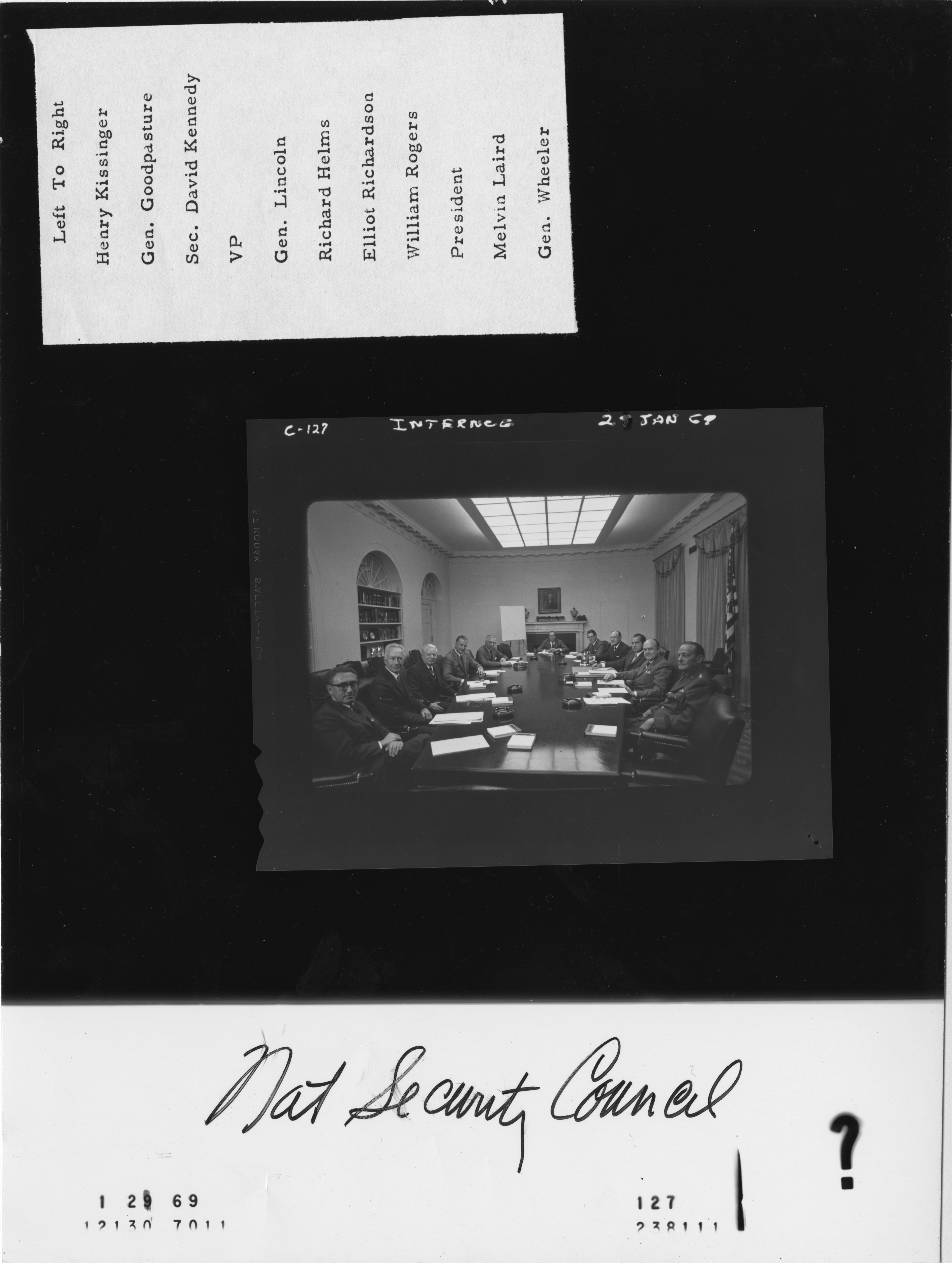
- Frame(s): WHPO-0127-01, National Security Council (NSC) meeting with President Nixon and other attendees. 1/29/1969, Washington, D.C. White House, Cabinet Room. Clockwise from the President: President Nixon, Melvin Laird, General Earle Wheeler, Henry Kissinger, General Andrew Goodpaster, David Kennedy, Spiro Agnew, General George Lincoln, Richard Helms, Elliot Richardson, William Rogers.
Roll WHPO-0128 Photographer: Overbey | Color or B&W: Color
- Frame(s): WHPO-0128-01, An unidentified decorated yacht moored at a dock at night. Unidentified people seen aboard. 1/29/1969, Key Biscayne, Florida Key Biscayne, FL.
Roll WHPO-0129 Photographer: Overbey | Color or B&W: Color
- Frame(s): WHPO-0129-01, An unidentified laughing woman standing on a yacht gangplank, holding with a cigarette in a cigarette holder. 1/29/1969, Key Biscayne, FL Key Biscayne, FL.
Roll WHPO-0130 Photographer: Overbey | Color or B&W: Color
- Frame(s): WHPO-0130-01, Secret Service peronnel overlooking the crowd at a parade. 1/29/1969, Unknown Unknown.
Roll WHPO-0131 Photographer: Atkins, Oliver | Color or B&W: B&W
- Frame(s): WHPO-0131-01A-08A, Candid portrait of Daniel Patrick Moynihan at his office desk. 1/29/1969, Washington, D.C. Office,. Daniel Patrick Moynihan.
- Frame(s): WHPO-0131-03A, Candid portrait of Daniel Patrick Moynihan at his office desk. 1/29/1969, Washington, D.C. Office,. Daniel Patrick Moynihan.
- Frame(s): WHPO-0131-09A-28A, Daniel Patrick Moynihan speaking on the telephone at his office desk. 1/29/1969, Washington, D.C. Office,. Daniel Patrick Moynihan.
- Frame(s): WHPO-0131-15A, Candid portrait of Daniel Patrick Moynihan speaking on the telephone at his office desk. 1/29/1969, Washington, D.C. Office,. Daniel Patrick Moynihan.
- Frame(s): WHPO-0131-29A-34A, Closeup candid portraits of Daniel Patrick Moynihan, while sitting at his office desk. 1/29/1969, Washington, D.C. Office,. Daniel Patrick Moynihan.
Roll WHPO-0132 Photographer: Atkins, Oliver | Color or B&W: B&W
- Frame(s): WHPO-0132-00A-06A, President Nixon visits the State Department to attend luncheon with Senate Leaders. 1/29/1969, Washington, D.C. Capitol Hill. President Nixon, Everett Dirksen, Mike Mansfield, Hugh Scott, Ted Kennedy, Gordon Allott, Robert. C. Byrd, Margaret Chase Smith, Richard Russell, John Tower, Allen Ellender, John McClellan, Milton Young, Bryce N. Harlow, Kenneth BeLieu.
- Frame(s): WHPO-0132-05A, President Nixon standing with Margaret Chase Smith and other Senators at a dining table in the State Department before sitting down to luncheon with Senate Leaders. 1/29/1969, Washington, D.C. Capitol Hill, State Dept Dining room. L to R: Margaret Chase Smith, President Nixon, Richard Russell, Gordon Allott, Hugh Scott.
- Frame(s): WHPO-0132-08A, President Nixon shaking hands with unidentified staff members in the hallway at the State Department. 1/29/1969, Washington, D.C. State Department. President Nixon, William Rogers, unidentified Sate Dept. staff members.
- Frame(s): WHPO-0132-09A-19A, President Nixon and Secretary of State William Rogers on stage during a speech in an auditorium, to members of the Senate. 1/29/1969, Washington, D.C. State Department. President Nixon, William Rogers.
- Frame(s): WHPO-0132-20A-23A, President Nixon and Secretary of State William Rogers visiting with Senate leaders at a the State Department reception room. 1/29/1969, Washington, D.C. State Department. President Nixon, William Rogers, unidentified Senators.
Roll WHPO-0133 Photographer: Atkins, Oliver | Color or B&W: B&W
- Frame(s): WHPO-0133-01-17, President Nixon and Secretary of State William Rogers on stage during a speaking engagement at the State Dept. auditorium to members of the Senate. 1/29/1969, Washington, D.C. State Department, auditorium. President Nixon, William Rogers, unidentified Senators.
Roll WHPO-0134 Photographer: Atkins, Oliver | Color or B&W: B&W
- Frame(s): WHPO-0134-00A-10A, President Nixon, Vice President Agnew, and Senator Everett Dirksen stand together at the entrance to the State Department. 1/29/1969, Washington, D.C. Capitol Hill. L-R: Spiro Agnew, Everett Dirksen, President Nixon.
- Frame(s): WHPO-0134-08A, President Nixon, Vice President Agnew, and Senator Everett Dirksen stand together at the entrance to the State Department on the occassion of a luncheon with Senate members. 1/29/1969, Washington, D.C. Capitol Hill. L-R: Spiro Agnew, Everett Dirksen, President Nixon.
- Frame(s): WHPO-0134-11A-19A, President Nixon seated at a dining table during a luncheon with Senate Leaders at a State Department dining room. 1/29/1969, Washington, D.C. Capitol Hill, Senator Dirksen's Office. Clockwise: Robert. C. Byrd, Edmund Muskie, Allen Ellender, Spiro Agnew, Mike Mansfield, Margaret Chase Smith, Everett Dirksen, President Nixon, Richard Russell, Gordon Allott, Hugh Scott, Edward Kennedy, Milton Young, John Tower, Kenneth BeLieu.
- Frame(s): WHPO-0134-18A, President Nixon seated at a dining table during a luncheon with Senate Leaders at a State Department dining room. 1/29/1969, Washington, D.C. Capitol Hill, Senator Dirksen's Office. Clockwise: Robert. C. Byrd, Edmund Muskie, Allen Ellender, Spiro Agnew, Mike Mansfield, Margaret Chase Smith, Everett Dirksen, President Nixon, Richard Russell, Gordon Allott, Hugh Scott, Edward Kennedy, Milton Young, John Tower, Kenneth BeLieu.
- Frame(s): WHPO-0134-20A-29A, President Nixon walking in the State Department hallway with Senate leaders after attending luncheon with them. 1/29/1969, Washington, D.C. Capitol Hill, State Department Hallway. Frame 24A: Richard Russell, Everett Dirksen, President Nixon, Mike Mansfield.
Roll WHPO-0135 Photographer: Kightlinger, Jack | Color or B&W: B&W
- Frame(s): WHPO-0135-03A-16A, Pat Nixon and Carol Gessford. 1/29/1969, Washington, D.C. White House. L-R: Carol Gessford, Pat Nixon.
- Frame(s): WHPO-0135-17A-23A, Pat Nixon with Carol Gessford and Richard L. (no last name given). 1/29/1969, Washington, D.C. White House. L-R: Richard L., Carol Gessford, Pat Nixon.
Roll WHPO-0136 Photographer: Kightlinger, Jack | Color or B&W: B&W
- Frame(s): WHPO-0136-04-06, Pat Nixon standing with Carol Gessford. 1/29/1969, Washington, D.C. White House. L-R: Carol Gessford, Pat Nixon.
- Frame(s): WHPO-0136-08-26, Candid seated portraits of Dr. Arthur Burns, the Federal Reserve Board Chairman, holding his pipe. 1/29/1969, Washington, D.C. unspecified office. Dr. Arthur F. Burns.
- Frame(s): WHPO-0136-14, Candid seated portrait of Dr. Arthur Burns, the Federal Reserve Board Chairman, smoking his pipe. 1/29/1969, Washington, D.C. unspecified office. Dr. Arthur F. Burns.
- Frame(s): WHPO-0136-27-36, Candid seated portraits of Dr. Arthur Burns, the Federal Reserve Board Chairman, without his pipe. 1/29/1969, Washington, D.C. unspecified office. Dr. Arthur F. Burns.
- Frame(s): WHPO-0136-31, Candid seated portrait of Dr. Arthur Burns, the Federal Reserve Board Chairman. 1/29/1969, Washington, D.C. unspecified office. Dr. Arthur F. Burns.
Roll WHPO-0137 Photographer: Kightlinger, Jack | Color or B&W: B&W
- Frame(s): WHPO-0137-02-23, Seated portrait of Dr. Martin Anderson, special assistant to President Nixon. 1/29/1969, Washington, D.C. White House. Martin Anderson.
- Frame(s): WHPO-0137-07, Seated portrait of Dr. Martin Anderson, special assistant to President Nixon. 1/29/1969, Washington, D.C. White House. Martin Anderson.
The White House Communications Agency Sound Recordings Collection contains public statements that took place between 1969 and 1974. Visit the finding aid to learn more.
P - Formal Presidential Remarks
- WHCA-SR-P-690115
Remarks by President Nixon in a visit to the State Department. (1/29/1969, State Department Auditorium)
Runtime: 0:18:47
Production credits: Audio feed supplied by NBC
Original Format: 1/4-inch reel-to-reel audiotape. Original source type: Original.
Context (External Sources)
The Vanderbilt Television News Archive is the world's most extensive and complete archive of television news. They have been recording, preserving and providing access to television news broadcasts of the national networks since August 5, 1968.
Wikipedia is a free encyclopedia that anyone can edit.