
Introduction
This almanac page for Tuesday, January 28, 1969, pulls together various records created by the federal government and links to additional resources which can provide context about the events of the day.
Previous Date: Monday, January 27, 1969
Next Date: Wednesday, January 29, 1969
Schedule and Public Documents
The Daily Diary files represent a consolidated record of the President's activities. Visit the finding aid to learn more.
The President's day began at The White House - Washington, D. C.
The Weekly Compilation of Presidential Documents made available transcripts of the President's news conferences; messages to Congress; public speeches, remarks, and statements; and other Presidential materials released by the White House.
Appointments and Nominations
- Department of Agriculture (5 Weekly Comp. Pres. Doc. 185, January 28, 1969)
Announcement of Appointment of George B. Hansen as Deputy Under Secretary for Congressional Relations. - Office of Emergency Preparedness (5 Weekly Comp. Pres. Doc. 185, January 28, 1969)
Announcement of Nomination of Fred J. Russell as Deputy Director. - Department of the Interior (5 Weekly Comp. Pres. Doc. 185, January 28, 1969)
Announcement of Appointment of Russell E. Train as Under Secretary.
News Conferences
- Meeting With the Minority Leadership (5 Weekly Comp. Pres. Doc. 181, January 28, 1969)
Press Briefing by Senator Everett M. Dirksen and Representative Gerald R. Ford Following the President's Meeting With Republican Congressional Leaders.
Checklist of White House Press Releases
The releases listed below, made public by the Office of the White House Press Secretary during the period covered by this issue, are not included in the issue.
- Biographical data on Fred J. Russell.
- Biographical data on Russell E. Train.
- Background information on King Timahoe, an Irish setter given to the President by members of his staff.
Digest of Other White House Announcements
Following is a listing of items of general interest which were announced in the press but not made public as formal White House press releases during the period covered by this issue. Appointments requiring Senate approval are not included since they appear in the list of nominations submitted to the Senate, below.
- The President's staff presented him with a 6-month-old Irish setter, which he named King Timahoe at the suggestion of his cousin, author Jessamyn West. Timahoe is a city in the county of Kildare, Ireland, where the President's forebears lived.
- President Nixon went to the House of Representatives for a visit to the House floor and luncheon with the leadership, members of the House Committee on Rules, and chairmen of various other committees.
- At the request of the President, Dr. Glenn T. Seaborg will continue as Chairman of the Atomic Energy Commission.
The Federal Register is the official daily publication for rules, proposed rules, and notices of federal agencies and organizations, as well as executive orders and other Presidential documents.
The Congressional Record is the official daily record of the debates and proceedings of the U.S. Congress.
Archival Holdings
Any selection of archival documents will necessarily be partial. You should use the documents and folders identified below as a starting place, but consult the linked collection finding aids and folder title lists and the collections themselves for context. Many documents to be found this way do not lend themselves to association with specific dates, but are essential to a complete understanding of the material.
Selective document listing
President's Office Files
The President's Office Files consists of materials drawn together by the Special Files Unit from several administrative subdivisions within the White House Office. It is the handwriting and sensitive papers sent to the Staff Secretary that now comprise much of the President's Office Files. Visit the finding aid to learn more.
- President's Handwriting, Box 1, President's Handwriting, February 1969 [1 of 3]
- Memo; H. R. Haldeman to Mr. Harlow re: Appointments. January 28, 1969. 1 pg.
- Annotated News Summaries, Box 28, News Summaries - January 1969 [During this period, the Staff Secretary only removed pages from the News Summaries which contained President Nixon's handwriting, often leaving the document with no date. Although there are no specific documents with this date, you should also consult the full folder for the month.]
- President's Meetings File, Box 73, Memoranda for the President--Beginning January 26, 1969
- H. R. Haldeman to The President's File, Meeting with Mr. Pat Haggerty, candidate for Administrator of NASA. 1/28/1969, [not listed] [per President's Daily Diary]. 2 pgs.
- Bryce Harlow to Staff Secretary, Re: Congressional leaders and the House Committee on Rules. 1/28/1969, 11:39 a.m. [per President's Daily Diary]. 1 pg.
- Pat Buchanan to The President, Re: One observer's view of the first meeting between the President and his Minority Leadership on Capitol Hill. 1/28/1969, 11:39 a.m. [per President's Daily Diary]. 14 pgs.
- H. R. Haldeman to The President's File, Meeting with Dr. Glenn Seaborg, Chairman of the Atomic Energy Commission, January 28, 1969. 1/28/1969, 3:45 p.m. [per President's Daily Diary]. 2 pgs.
Selective document listing
The White House Press Office during the Presidency of Richard Nixon was responsible for daily communication with the White House press corps. Ronald L. Ziegler was the Press Secretary to the President for Nixon's entire term in office from January 1969 to August 1974 and Gerald Warren served as the Deputy Press Secretary. The office held daily briefings for the press and produced the White House’s press releases. Visit the finding aid to learn more.
- White House Press Releases, Box 1
- FOR IMMEDIATE RELEASE JANUARY 28, 1969
Office of the White House Press Secretary
THE WHITE HOUSE
BACKGROUND ON KING TIMAHOE
King Timahoe is a six-month-old male Irish Setter from the Tirvelda Kennels, the Plains, Virginia. The dog was bred by Mr. E. I. Eldredge, owner of the kennels: Mr. Eldredge has been breeding Irish Setters for 34 years and has finished more than 80 champions. Mr. Eldredge has judged dogs in the United States and in Europe. He also is a prominent dairy farmer.
King Timahoe's father is Tirvelda Rustic Duke, a champion who is the full brother of the leading producer in the history of Irish Setters. The mother, Tirvelda Maidavale, is not a champion but has been shown four times and has won all four shows.
King Timahoe is a gift of the staff.
The name Timahoe was suggested to President Nixon by his cousin, author Jessamyn West. Timahoe is a city in the county of Kildare, Ireland, where President Nixon's forebears lived .
# # # - FOR IMMEDIATE RELEASE JANUARY 28, 1969
Office of the White House Press Secretary
THE WHITE HOUSE
AMERICAN HEART MONTH, 1969
BY THE PRESIDENT OF THE UNITED STATES OF AMERICA
A PROCLAMATION
Brilliant advances have been scored in cardiovascular research in recent years. But heart disease remains a formidable threat to our national well-being. It clouds the future of thousands of children. It cuts down men and women in their most productive years.
Nearly every 30 seconds, someone in the United States dies of some form of heart disease. Last year, it took the lives of approximately one million people -- over half of all deaths in the Nation. It incapacitates or hampers millions of others, in varying degrees, from living a full and active life.
Heart disease is costly not only to the afflicted but also to the Nation. The cost of medical care for heart and circulatory disease victims exceeds $2. 5 billion annually. Lost wages and productivity due to illness and disability are estimated at about $3.5 billion. The loss of future earnings of those who die from heart and blood vessel disease each year is estimated to be in excess of $19 billion.
Despite the magnitude of the heart disease problem, the progress that has been made is encouraging. Today, some heart disease can be prevented. Greatly improved methods of diagnosis and treatment are more readily availab1e to those who are stricken. The death rate is declining in all but one of the main categories of cardiovascular disease.
This progress has resulted in large part from a collaborative undertaking, led by the National Heart Institute as the principal Federal partner and the American Heart Association as the major voluntary ally. Public, professional, and private interests have been mobilized in a truly national endeavor against heart disease. Through this effort, buttressed by a determination to employ every necessary resource, we can continue to move ahead. With the firm support of all our people, the conquest of heart disease can be achieved.
For such reasons, the Congress, by a joint resolution approved December 30, 1963 (77 Stat. 843 ), requested the President to issue annually a proclamation designating February as American Heart Month.
NOW, THEREFORE, I, RICHARD NIXON, President of the United States of America, do hereby proclaim the month of February 1969 as American Heart Month, and I invite the Governors of the States, the Commonwealth of Puerto Rico, and officials of other areas subject to the jurisdiction of the United States to issue similar proclamations.
I urge the people of the United States to give heed to the nationwide problem of heart disease, and to support programs essential to bring about its solution.
IN WITNESS WHEREOF, I have hereunto set my hand this twenty-seventh day of January, in the year of our Lord nineteen hundred 2nd sixty-nine, and of the Independence of the United States of America the one hundred and ninety-third.
RICHARD NIXON
# # # - FOR IMMEDIATE RELEASE JANUARY 28, 1969
Office of the White House Press Secretary
THE WHITE HOUSE
President Nixon today nominated Fred J. Russell of California as deputy director of the Office of Emergency Preparedness in the Executive Office of the President.
Mr. Russell, president and general manager of the Weiser Lock Co. until 1967, has built and is operating apartment houses, and an industrial park. He owns a shopping center in California and rebuilt homes in Kansas. He was president of the Wherry Housing Association in Washington, D. C.
in 1956 and 1957.
He will be a principal assistant to George A. Lincoln, nominated as director of OEP.
# # # - FOR IMMEDIATE RELEASE JANUARY 28, 1969
Office of the White House Press Secretary
THE WHITE HOUSE
BIOGRAPHICAL INFORMATION ON FRED J. RUSSELL
Fred J. Russell was born June 9, 1916, in Edmonton, Alberta, Canada, of parents who were U.S. citizens. He joined the Weiser Company in 1946, when it had eight employees. When he sold it 21 years later, 1,600 employees were producing and selling more than 30 percent of all residential locks in the U.S., over 5o percent of those in Canada, and making substantial sales in many foreign countries.
He purchased the Gabriel Steel Company of Detroit in 1956, reorganized, re-equipped and retooled it and, in 1958, sold the company to the Inland Steel Company.
His current holdings are principally in real estate. He is a resident of Beverly Hills, California, and a veteran of four years in the U.S. Marine Corps.
PERSONAL STATISTICS:
Height 6' 1"
Weight 195 pounds
Health Excellent
Birth Date June 9, 1916 (Present Age - 52)
Birthplace Admonton, Alberta, Canada
Citizenship United States citizen - born of U.S. citizen parents
Marital Status Married: February 10, 1940 Divorced: January 24, 1966
Formal Education: Graduated from. high school (with recommended college grades) at 16 1/2 years of age (January 26, 1933).
Completed one semester, one summer session of Grade 13 of college at age 17 years.
Military Training: Private in U. S, Marine Corps Reserve, 13th Battalion, FMCR from November 4, 1935 to expiration of enlistment and honorable discharge on October 22, 1939.
Employments:
1935 Apprentice for Southern Pacific Railroad (shop and yards)
1936-1943 Many positions in Douglas Aircraft Company, Inc.
1943-1945 Assistant Works Manager, and later a Plant Manager at Timm Aircraft Corporation.
1946-1967 President and General Manager of Weiser Company (and its several subsidiaries)
When he started, this company had 8 employees and 10,000 square feet of factory, and he was to receive a salary and one-third of the profits.
In 1954, with financial help from his other Investment Auxiliary Employment combinations, he purchased this company. He developed and led this operation into lock manufacturing, with factories in the United States and Canada, with 1,600 employees and 1,000,000 square feet of factory. By 1967, this company was producing and selling more than 30 percent of all the residential locks in the United States, more than 50 percent of all the residential locks in Canada, and making substantial sales in many foreign countries.
Over these years, he personally has played a major role in the writing of Federal specifications for hardward, both in the United States and in Canada, working closely with General Services Administration, Army, Navy, Air Force, Department of Housing and Urban Development, and other government agencies in Washington, D. C., and in Ottawa.
He sold this company in May 1967 for over $13 million cash.
Investment - Auxiliary Employment Combinations:
1949 to present He built 121 apartments and has operated them successfully ever since. He still owns them. The current gross rents are approximately $160,000 per year.
1949 to 1952 He built and sold over 1, 000 individual houses and a public utility water company.
1950 to present He formed and operated a sales company to handle various building construction items. After several years of successful operation, he led it into the owning and leasing of industrial property and industrial machinery. It now owns and successfully operates a 44 unit apartment project, the current gross rents of which are approximately $40,000 per year.
1952 to 1958 He built and operated a 571 unit Wherry Act military housing project at El. Toro Marine Base, Santa Ana, California, selling it to the Navy in early 1958. During 1956 and 1957, he was president of the Wherry Housing Association, with office in Washington, D. C., representing the owners of 60,000 of the 82,000 Wherry housing units throughout the country. As president of the Association, he personally worked with Army, Navy, Air Force, Department of Defense, Congressional committees, and their staffs and individual members of both House and Senate. He testified before the appropriate Congressional committees on several occasions.
1956 to 1958 He bought Gabriel Steel Company in Detroit, Michigan. This company originated in 1912 and was engaged in manufacture of industrial tote boxes and large metal racks, in standard and large span steel joists, and in basen1.ent construction products. The company had reached
the operating loss point. He reorganized, re-equipped, and retooled it. He developed its sales organization. At the end of three years, he sold it to Inland Steel Co. for integration into its Milwaukee plant. His profit was approximately $1 million.
1960 to present He bought the 36 acre, 500,000 square foot, 12-year-old Lincoln-Mercury plant from Ford Motor Company. He added 100,000 square feet of buildings. He leases to industrial and commercial tenants. He still owns this property. The current gross rents are approximately $500,000 per year.
1962 to 1968 He purchased 800 acres for $1 million and developed it into a profitable farm operation and a public utility water company. In 1968, he sold all but the water company portion of this operation for over $4 million cash, thus realizing a $3 million cash profit. He still owns and operates the public utility water company and the irrigation water operation.
1964 to present He bought 860 individual, defaulted, 12-year-old houses in Wichita, Kansas from the Federal Housing Administration. He since has completely rebuilt them, has bought and expanded the shopping center and rubbish and garbage pick-up operations. He still owns and operates this complex as landlord. The current gross rents and receipts are approximately $900,000 per year.
1966 to present He purchased the largest shopping center in Fresno, California (50 tenants) and is spending more than half a million dollars to improve it. He still owns and services it as landlord. The current gross rents are approximately $750,000 per year.
1964 to present He purchased the deluxe 120 unit 4-year-old apartment project in Riverside, California from the Federal Housing Administration. He still owns this property and services it as landlord. The current gross rents are approximately $250,000 per year.
Patents
To date, approximately 130 United States mechanical patents and approximately 100 Canadian mechanical patents have been issued in his name. As of this date, there are approximately 100 additional mechanical patent applications pending in his name both in the United States and in Canada.
Summary of Qualifications
His schooling, education, employments, investment -- auxiliary employment combinations, and associations make him uniquely qualified in the following fields:
- Aerodynamics
- Commercial building operations
- Industrial building operations
- Industrial engineering
- Farming
- Manufacturing operations of almost every kind
- Mechanical engineering
- Property management
- Public utility operations
- Residential building operations
He has had many dealings with Army, Navy, Air Force, Department of Defense Department of Commerce, Department of Housing and Urban Development, and committees of Congress. In connection with military housing matters alone, he was in Washington, D. C. more than 80 times during two years.
He has had considerable business dealings in some foreign countries.
He has had unusual experience and success in developing business plans, executing each plan with the help of people who he inspires by understanding, by leadership, and by personal follow-through to a successful conclusion.
He is especially adept at communicating with people and getting people to want to do what should be done. He understands people, particularly rank and file people.
He has been extremely successful in his every undertaking.
He is independently wealthy and thus can afford to be of personal service to his country.
He is not at this time involved with any interest or ownership which would conflict with his being personally engaged in personal service to his country.
In summary, he is a very successful businessman, a highly qualified and able person, with considerable experience in Washington.
# # # - FOR IMMEDIATE RELEASE JANUARY 28, 1969
Office of the White House Press Secretary
THE WHITE HOUSE
Secretary of Agriculture Clifford M. Hardin announced today on behalf of President Nixon the nomination of former U.S. Representative George B. Hansen (R-Idaho) as deputy under secretary for congressional relations.
Hansen served two terms in the House 1965-68. He was the Republican candidate for the U.S. Senate last November and also was a Senate candidate in 1962.
Born in Tetonia, Idaho September 14, 1930, Hansen was graduated from Ricks College in 1956 with honors in history and Russian, did graduate work at Idaho State University and graduated in accounting from Grimms Business College.
He was mayor of Alameda, Idaho 1961-62, city commissioner of Pocatello 1962-65 and a director of the Idaho Municipal League 1961-63. Active in the Idaho Republican Party, Hansen is a former vice chairman of Bannock County Republican Central Committee and a former president of Bannock County Young Republican Club.
He is a veteran, having served 3-1/2 years in the Air Force and is an officer in the Naval Reserve.
Hansen is married to the former Connie Camp of Malden, Mo. They have five children, Steven, George, James Vernon, Patricia Sue, William Dean and Joanne. The Hansens make their home in Pocatello.
# # # # - FOR IMMEDIATE RELEASE JANUARY 28, 1969
Office of the White House Press Secretary
THE WHITE HOUSE
Secretary Walter J. Hickel today announced on behalf of the President the appointment of Russell E. Train as under secretary of the Interior.
Train, 48, is one of America's foremost conservationists. Since 1965 he has been president of the Conservation Foundation, which has been de scribed by the Ford Foundation as "the only national organization dedicated to the whole range of conservation concerns."
He resigned as Judge of the U.S. Tax Court to take on direction of the 20-year-old non-profit research, education and information organization.
A lifelong resident of the District of Columbia, Train is a graduate of Princeton University and the Columbia University Law School. He has been a member of the District of Columbia Bar since 1949.
As a specialist in tax law, he served as an attorney for the Congressional Joint Committee on Internal Revenue Taxation and later as clerk and then minority advisor to the House Ways and Means Committee. From 1956 to 1957, when he was appointed to the Tax Court by President Eisenhower, Train was head of the Treasury Department's legal advisory staff.
Train's activities in the field of conservation have been international in scope. He has served as an executive board member of the International Union for the Conservation of Nature and Natural Resources, as a trustee and vice president of the World Wildlife Fund, and as a trustee of the American Conservation Association.
In 1968 President Johnson appointed Train to the National Water Commission, a seven-man body created by Congress to review the nation's long-term water resource requirements and make recommendations to the President and the Congress. He serves as Vice Chairman of the Commission.
# # # - FOR IMMEDIATE RELEASE JANUARY 28, 1969
Office of the White House Press Secretary
THE WHITE HOUSE
BIOGRAPHICAL DATA ON RUSSELL E. TRAIN
Russell E. Train has been President of The Conservation Foundation since 1965, when he resigned as a Judge of the U. S. Tax Court to take on direction of the 20-year old non-profit research, education and information organization.
The Conservation Foundation's purpose is "to encourage human conduct to sustain and enrich life on earth." It has been described by the Ford Foundation as occupying "a lonely eminance as the only national organization dedicated to the whole range of conservation concerns. "
During the last three years the foundation has strengthened its public policy development work in a broad range of environmental problems. During this period, also, its information and education work has been redirected to stimulate citizen involvement. The foundation's offices have been moved from New York to Washington, its staff expanded, and its financing diversified.
Train defines conservation as the rational use of the earth's resources to achieve the highest quality of living for mankind. He has said that "Conservation has two lines of attack. First, making sure that critical irreplaceable and unique resources are preserved. And second, seeing to it that development processes respect natural resource systems, avoid negative impacts like air and water pollution, and produce amenable, liveable environments."
Under his direction the foundation has taken increased interest in development processes and environmental problems of urban areas. Its current programs include, for example, a series of on-the-ground projects designed to demonstrate the use of ecologically-based planning in integrating natural values in attractive and profitable urban development. At the first of these demonstration projects, at Rookery Bay, near Naples, Florida, the foundation in 1968 recommended ways in which profit-oriented residential shoreline development can be compatible with protection of the bay's natural functions as a nursery and feeding area for marine life and as a fishing area. The recommendations are being tested.
Other recent foundation projects include conferences and books on developmental problems in metropolitan areas, "the future environments of North America," environmental consequences of U.S.-financed international development programs, effects on human behavior of human crowding, and preparation of the basic work document for UNESCO' s 1968 conference on The Scientific Bases for Rational Use of the Biosphere.
Born in 1920, Train is a lifelong resident of the District of Columbia. He graduated from Princeton University in 1941; served in the Army from 1941 to 1946, rising to the rank of major; earned an L.L.B. degree from Columbia University in 1948 and was admitted to the District of Columbia
bar in 1949.
He then specialized in tax law and served as an attorney for the Congressional Joint Committee on Internal Revenue Taxation and later (1953-54) as Clerk and then Minority Advisor to the House Ways and Means Committee. He was head of the Treasury Department's legal advisory staff (1956-57).
He was appointed to the Tax Court of the United States by President Eisenhower in 195 7 and reappointed to a full 12-year term in 1959, resigning in 1965.
In 1961 Train founded the African Wildlife Leader ship Foundation, which started the first wildlife management school in Africa, gives scholarships to Africans at U. S. universities, conducts research and education programs in African schools, and is now the major source of U. S. support for wildlife conservation in Africa.
His interests also led him into participation in other conservation organizations in the United States and abroad. In addition to serving as president and a trustee of The Conservation Foundation and African Wildlife Leadership Foundation, Train serves various U. S. and international conservation organizations, including the International Union for the Conservation of Nature and Natural Resources (executive board member); World Wildlife Fund (trustee and vice president); Tanzania, Kenya and Uganda National Parks (honorary trustee), and American Conservation Association (trustee}.
Train has served on a number of committees advising government, including a National Academy of Sciences committee on SST-Sonic Boom, a Department of the Interior committee on the International Water for Peace Conference and other international and resources activities.
In 1968 President Johnson appointed Train to the National Water Commission, a seven-man body created by Congress that year. The Commission is to review the nation's long-term water resource requirements and make its final recommendations to the President and the Congress by 1973. Train serves as Vice-Chairman of the Commission, which is headed by Charles F. Luce, Board Chairman of Consolidated Edison Company of New York.
Train is Senior Warden of St. John's Church (Lafayette Square), a trustee of the Washington Cathedral and member of its executive committee; a trustee of Recordings for the Blind, and is active in other civic organizations.
Train is the son of the late Rear Admiral and Mrs. Charles R. Train, U.S. N. He is married to the former Aileen Bowdoin; they have four children.
# # # #
- FOR IMMEDIATE RELEASE JANUARY 28, 1969
- White House Press Conferences, Box 55
- News Conference #18 at the White House with Walter J. Hickel, Secretary of the Interior; Russell E. Train, Under Secretary of the Interior; and Ron Ziegler, Press Secretary, January 28, 1969, 4:10 P.M. EST. 5 pgs.
NEWS CONFERENCE #18
AT THE WHITE HOUSE
WITH WALTER J. HICKEL, SECRETARY OF THE INTERIOR; RUSSELL E. TRAIN, UNDER SECRETARY OF THE INTERIOR; AND RON ZIEGLER; PRESS SECRETARY
4:10 P.M. EST
JANUARY 28, 1969
TUESDAY
MR. ZIEGLER: Secretary Hickel has a surprise announcement for you this afternoon.
SECRETARY HICKEL: Thank you.
I do have the pleasure this afternoon of announcing for President Nixon my Under Secretary of Interior -- and I might say that I first met Mr. Train early. His name is Russell E. Train. There will be a bio on the table for you. He was one of the first men I talked to in regard to the problems in the Interior. As I recall it was January 3rd, and by January 6th I had made up my mind. I think that indicates the kind of a person I think he is and why he will be a good, compatible person for me in the Department.
One of the things that, as I recall, helped me make up my mind was not only his ease of conversation, but his depth of problems. He has a good background. As you know , he was born and raised in this area. He is a graduate of Princeton and has a law degree from Columbia. He was admitted to the Bar here in 1959. President Eisenhower put him in the Tax Court in 1957 and reappointed him for a period of twelve years.
It was what happened after that that really struck my imagination. It was in 1961 when he took an earnest interest in conservation , wildlife and general resources in general. In 1965 when he finally resigned from the Tax Court to become president of the Conservation Society -- I think that not only his interest in what was happening in America but his general interest in what was happening to the resources around the world, especially the conservation and wildlife. And when I saw a man who had that much interest go to some private organization, do the job that had to be done -- and I might say few private organizations outside a public body had that interest -- I knew that I had that kind of a man.
I just want to say that Russ Train, in my opinion, will do an excellent job as Under Secretary of the Interior.
Russ, congratulations.
MR. TRAIN: I am obviously highly honored by the confidence reposed in me by the President and Secretary Hickel in giving me this appointment. I will do my best to justify that confidence.
I look forward to going to work in Interior. It is a great Department that touches the lives of the American people in a great many ways and I think in many more ways in the years to come.
Q Mr. Train, Mr. Secretary, there has been a lot of discussion recently about Federal land being kept out for conservation purposes. What are your views on that?
SECRETARY HICKEL: I would say this: that basically the Public Land Law Review Committee that will bring the report in for 1970 will have specific recommendations of what we should do with our public lands. Although we will not wait for action that might necessarily have to be taken in specific cases, in general we will wait for that Public Land Review Commission report.
Q Mr. Secretary, will there be any specific duties given to the Under Secretary? Are you giving him
any special duties?
SECRETARY HICKEL: He will have the broad duties, as my Under Secretary, all the duties that I will have as Secretary of the Interior, besides those specifically set down by statute.
Q Mr. Train, could you tell us how you feel about conservation for conservation's sake?
MR. TRAIN: I believe in conservation. I don't know about labels of that sort. I believe in conservation and I know what you are saying. I believe that Secretary Hickel believes in conservation. We are agreed on that.
Q Do you have to be confirmed?
MR. TRAIN: Yes. I understand that the Senate Interior Committee, at least at the present, intends a
confirmation hearing on Tuesday of next week.
Q Mr. Train, did you find the process in the past weeks in which Mr. Hickel came under a lot of criticism, was that educational, helpful, or did you find it was not so?
MR. TRAIN: Do you mean for me? I found it a very tense period, if you really want to know. I have been waiting for the other shoe to drop now for some days.
SECRETARY HICKEL: I might add, I don't think the hearings will go as long as they did for me for Mr. Train.
Q When did you finally decide on Mr. Train as your Under Secretary?
SECRETARY HICKEL: I will let him answer that.
MR. TRAIN: As I recall, the Secretary asked me on the 3rd of January and I told him I would give him my answer on the 6th, which I did. The answer at that time was yes.
Q Mr. Secretary, who was Mr. Train's chief sponsor?
SECRETARY HICKEL: You know, I can't answer that specifically. I knew about him.
Q Just tell us several of them, then.
SECRETARY HICKEL: Okay. Many members of the Senate Interior and Insular Affairs Committee, both House and Senate. That is just about it.
Q Mr. Secretary, if the decision was made on January 6th, why was Mr. Train's appointment not announced until today?
SECRETARY HICKEL: Because I was not Secretary of the Interior yet.
Q Yet in other Departments we did have announcements before people were confirmed.
SECRETARY HICKEL: There wasn't any real specific reason. I might add that I think it was quite well known that I was kind of busy and so I really didn't get around to it. There is no specific reason.
Q Mr. Train, did you head a task force for the President on resources in the campaign?
MR. TRAIN: On resources and environment, yes, I did.
Q Mr. Train, do you have any kind of conflict of interest problems involved in your appointment?
MR. TRAIN: I think I ought to discuss that with the Senate Interior Committee. I don't really think this would be the place to discuss it. I have tried to resolve any of those that I see, a couple of oil stocks.
Q With what company; sir?
MR. TRAIN: Are you looking for a tip?
Q I am interested to know what companies you had ownership in?
MR. TRAIN: I think Gulf Oil and Diamond Shamrock.
Q You will divest on those, is that correct?
MR. TRAIN: I have sold them.
Q Mr. Train, could you tell us briefly how you got to be an outstanding conservationist from when we first knew you as an expert on the House Ways and Means Committee years ago?
MR. TRAIN: I don't think we have enough time. I don't know that I could really answer the question. I think, very briefly, it is the kind of thing that happens to many of us. You become more and more interested in something and spend more and more time at it.
In the beginning it is a spare-time thing and very soon it is taking a little time away from your job and pretty soon you have to make a decision as to what you are going to do with your life, which I did.
Q Mr. Hickel, there have been recurring reports that you plan to appoint Mr. Kelly from your Commission of Resources in Alaska, that you plan to appoint him as a director is that correct?
SECRETARY HICKEL: I have no such plans.
Q Do you intend to bring him into the Department?
SECRETARY HICKE: I have not discussed it with him and have no plans.
Q Is Mr. Watt working?
SECRETARY HICKEL: He has not been assigned to duty as of this moment.
Q Will he be?
SECRETARY HICKEL: On my staff, not as an assistant secretary.
Q Mr. Secretary, are you taking a trip to the Caribbean next week?
SECRETARY HICKEL: No. I have no plans to. I am making a trip to Kansas next week.
Q Do you have any plans to keep Mr. Paiewonsky in the Governorship of the Virgin Islands?
SECRETARY HICKEL: I have given it no thought.
Q Do you think that the allowance the Administration was considering last week will strain the
Antiquities Act?
SECRETARY HICKEL: I think that is something the President has to make a decision on. I have not really gotten into it or given it much thought.
Q There are plans to restrict the authority to withdraw?
SECRETARY HICKEL You mean legislation plans? I think if the legislature has reason to do that, fine.
Q Mr. Train, did you work on any projects with Mrs. Johnson, and if for what?
MR. TRAIN: Yes, the National Youth Conference on Natural Beauty and Conservation in 1966.
Q Mr. Secretary, could you give us your views , if you have them yet, on the reported dispute between Mr. Udall and President Johnson on the amount of land that might be turned over to conservation purposes?
SECRETARY HICKEL: I don't know if they had a dispute. I don't know that for sure, no more than I read in the paper. I know nothing officially. We have not gotten in to our briefings in that Department yet. Until I do get in there and can take a look at what should happen, I can't know more than that.
Q Do you think your Department will be involved in the dispute between the Sierra Club and Disneyland?
SECRETARY HICKEL: I heard about that in a minute way. I heard that the Sierra Club is protesting what Mr. Disney is planning to do. I don't know enough specifically about it at this time to comment whether or not I would or would not get involved. If I thought, after studying it, that we should, I would make a decision then.
Q Would your problems on the conservation issue have anything to do with Mr. Train being selected?
SECRETARY HICKEL: I selected Mr. Train roughly on the 3rd of January. The hearings had no bearing whatsoever.
Q Didn't your problems start before January 3, I mean the news conference?
SECRETARY HICKEL: I don't think that news conference was so bad. I will stand on that news conference.
Q That was in December, was it not?
SECRETARY HICKEL: Yes, it was.
Q Mr. Secretary, did President Nixon tell you that he expected oil policy to be made in the Interior Department or has he discussed that with you?
SECRETARY HICKE: He has not discussed that with me.
Q I would like to ask you, as Secretary, how much authority do you expect to delegate to Mr. Train ; a great deal?
SECRETARY HICKEL: I think in this regard, when I am gone, on the road or out of the office, he will have the authority of the Secretary. I expect him to be my right-hand man. He will have a deputy and we will go on down the line and that is the way the organization will be.
MR. ZIEGLER ~ Thank you, gentlemen.
END (AT 4:25 P.M. EST) - News Conference #19 at the White House with Glenn T. Seaborg, Chairman, Atomic Energy Commission; and Ron Ziegler, Press Secretary, January 28, 1969, 4:25 P.M. EST. 5 pgs.
NEWS CONFERENCE #19
AT THE WHITE HOUSE
WITH GLENN T. SEABORG, CHAIRMAN, ATOMIC ENERGY COMMISSION; AND RON ZIEGLER, PRESS SECRETARY
4:25 P.M. EST
JANUARY 28, 1969
TUESDAY
MR. ZIEGLER: We have another guest for the 4 o'clock briefing today.
Dr. Seaborg, Chairman of the Atomic Energy Commission has just completed a meeting with the President. He has a few statements to make.
Ladies and gentlemen, Dr. Seaborg.
DR. SEABORG: I just met with the President and he asked me to come by and talk to you. We discussed the problems of the Atomic Energy Commission in general, including national security areas and especially the area of the peaceful uses of atomic energy.
The President expressed a great interest -- and he asked me particularly to tell you this -- in the peaceful uses of atomic energy. He particularly identified Plowshare, the area of the peaceful uses of nuclear explosives, as an area in which he had a special interest. He also mentioned such areas as the development of breeder reactors and the civilian nuclear power program.
I think that is the gist of my conversation with the President.
Q Did you talk to him at all about the possible use of nuclear energy in the building of the new canal?
DR. SEABORG: Yes. He inquired especially about that and the Australian project that has been brought forth in the last few days. He expressed an interest in those projects and asked that I do everything that I could to accelerate those projects and to bring them along at the fastest possible rate.
Q What is the Australian project?
DR. SEABORG: The Australian project is a project to build a harbor in northwest Australia at Keraudren Bay. This would use a roll of five nuclear explosives to build a narrow harbor there in order to give access to the interior where there are certain minerals that need to be brought out.
Q Are you satisfied now that the studies show that use of nuclear explosives would be economically feasible?
DR. SEABORG: Yes, I think so. But we have more tests to make in order to make this definite. This cooperative experiment with Australia would be one test on the way towards demonstrating the feasibility of building a sea level canal across the isthmus.
Q Have we agreed to do the Australian project?
DR. SEABORG: We have agreed to do a study regarding its feasibility. The Australian project has a certain degree of urgency about it because they need to have the access to this ore by 1970, so if we go ahead we will have to go very fast.
Q Can these projects move without violating the Nuclear Test Treaty?
DR. SEABORG: Yes, I think so.
Q Was there any discussion with Mr. Nixon about the canal across South America?
DR. SEABORG: Yes , the President expressed great interest and hoped we would be able to make all the tests necessary to make this feasible. As you know, there is an Inter-Oceanic Canal Commission, under the chairmanship of Robert Anderson that includes among its members Milton Eisenhower and Kenneth Field, that is studying the whole question of the feasibility and the relative merits of conventional methods against nuclear methods.
In order for us to give them the data they need in order to make this evaluation, the Atomic Energy Commission has a program of excavation shots. One of them would be such a shots, the detonation of a roll of such nuclear explosives of the type that is required to build this harbor in Australia. So that would be part of the preparation for the building of the isthmian canal.
Q Can you tell us more about the national security aspects of your discussions?
DR. SEABORG: I cannot. I am sorry.
Q Did you discuss the control of nuclear weapons or methods of detecting nuclear blasts, et cetera?
DR. SEABORG: No, not as such.
Q When will the Australian feasibility study begin and how long will it take?
DR. SEABORG: I think the Australian feasibility study is beginning, essentially , immediately. You might say it is underway right now. I don't know how long it will take. I hope it will be possible to finish it in a couple of months.
Q Did the President ask you to remain on, and, if so, are you staying on?
DR . SEABORG: The President has asked me to stay on and I am staying on.
Q When does your term expire?
DR. SEABORG: My term expires June 30, 1970. I asked for the short term, you will recall, when I was reconfirmed last June.
Q And he asked you today to stay on?
DR. SEABORG: Yes.
Q Beyond this date?
DR. SEABORG: No. He just asked me to stay on. No dates were discussed.
Q Dr. Seaborg, would you please give us specifically some of the other projects and peaceful uses that you and Mr. Nixon discussed?
DR. SEABORG: In the time that I was with the President, besides speaking generally on the whole field of peaceful uses of nuclear energy and identifying it in that matter, he specifically identified Plowshare and nuclear reactors, particularly the nuclear breeder reactor.
Q Can you be more specific?
DR. SEABORG: Just what I said.
Q Did you discuss the Nuclear Nonproliferation Treaty?
DR. SEABORG: No.
Q There was talk last year that AEC might get rid of its gaseous diffusion plants. Did you talk about that?
DR. SEABORG: No.
Q When would you expect the first detonation in this Australian project?
DR. SEABORG: It would all be done at the same time. I hope if we go forward it would be before the end of 1970. That is the time scale which the Australians feel they must move in.
Q What is the United States' role in this?
DR. SEABORG: We would furnish the explosives and probably help in the funding to an extent that it would be equivalent to conducting a test of this sort for our own purposes, namely, to determine the feasibility of the isthmian canal for ourselves.
Q Therefore, if we do not go forward with this for Australia, what will they do?
DR. SEABORG: They will be forced to use more expensive conventional excavation methods.
Q Explosives?
DR . SEABORG: They would use explosives to some extent, and dredging and so forth.
Q How much would that cost?
DR. SEABORG: I don't know, off-hand; in the order of $10 million or something like that.
Q Has the President yet been briefed by the Atomic Energy Commission about our military nuclear capabilities?
DR. SEABORG: I should have mentioned that earlier. The President said he plans to visit us at our headquarters in Germantown in order to be briefed on all aspects; the military capabilities, the peaceful uses and the entire range of our program. He would like to do this when he can get
around to it, possibly as early as February, although he did not want to set a date at this time.
Q Would the Australian project be the first-time use of nuclear explosives for this purpose?
DR . SEABORG: It would be the first practical experiment. It would be a combined experiment and at the same time usefully excavate a harbor in Australia. It would be the first useful excavation experiment. We have done underground nuclear engineering that was, for example, the gas buggy shot a year ago when we detonated in New Mexico an explosive to see whether we could fracture the tight gas-bearing formations underground in order to increase the flow rate so that otherwise deposits of gas could be economically mined.
Q That is the date your term as Chairman on the Commission expires or is it the same thing?
DR. SEABORG: It is the same thing, I suppose. It is my term as a Commissioner. By law you are designated as a member of the Atomic Energy Commission. The President designates you as Chairman.
Q Has the Soviet Union conducted successfully excavation experiments in that area?
DR. SEABORG: We don't know. We are not exchanging information in that area.
Q What kind of minerals are involved in the Australian harbor, and is there an American company involved?
DR. SEABORG: Yes , the Sentinnel Mining Company.
Q Underground minerals?
DR. SEABORG: In the underground nuclear engineering experiments in the Plowshare program, a number of companies are involved. We are doing all of that in collaboration with industry.
Q I mean the harbor, would that be underground detonations?
DR. SEABORG: It would break the surface of the earth. The explosive would be buried a couple of hundred feet below the bottom of the ocean, the shoreline at that point. Then five of them in a row would be detonated to give a narrow harbor.
Q Would it be necessary to touch base with the other signers of the Test Ban Treaty? Would you have to negotiate at all on this?
DR. SEABORG: I don't think we have reached any conclusion on that as yet.
Q How long did the Chairman spend with the President?
MR. ZIEGLER: About 35 minutes.
THE PRESS: Thank you.
END AT 4:40 P.M. EST - News Conference #20 at the White House with Ron Ziegler, January 28, 1969, 4:40 P.M. EST. 4 pgs.
NEWS CONFERENCE #20
AT THE WHITE HOUSE
WITH RON ZIEGLER, PRESS SECRETARY TO THE PRESIDENT
4:40 P.M. EST
JANUARY 28, 1969
TUESDAY
MR. ZIEGLER: The President asked me to announce today the nomination of Fred J. Russell of California as Deputy Director of the Office of Emergency Preparedness in the Executive Office of the President. That is the O.E.P, formerly known as the Office of Emergency Planning. There will be a bio in the bins.
For your information, Mr. Russell will be attending Wednesday afternoon a flood damage hearing in Fresno, California. He will be the administration's observer at that hearing.
Also, in the event you did not know, General Lincoln was confirmed in the Senate today by the Armed Forces Committee.
The other announcement that will be in the bins is the fact that the President today signed papers declaring February as American Heart Month for 1969.
The President wishes to announce the fact that George B. Hansen of Idaho has been nominated to be Deputy Under Secretary for Congressional Relations in the Department of Agriculture. This announcement will also be in the bins.
Q Is he the Congressman who was defeated last year?
MR. ZIEGLER: That is right.
To continue, the schedule for the remainder of the day, Secretary Rogers will meet with the President this afternoon at about 4:30. There are no other scheduled appointments for the remainder of the day.
As previously announced, the National Security Council will meet here in the White House tomorrow at 10 p.m. The President will depart for the Senate at 12:20. He will visit the Senate Floor and have lunch with the Senate leadership in the Minority leader's office.
Then the President will return to the White House prior to going to the State Department to visit that department and the employees of the State Department.
Q About what time will that be, Ron?
MR. ZIEGLER: About 3 o'clock.
Q Will the President make a speech there?
MR. ZIEGLER: Yes. The President will meet in the large auditorium at the State Department with about 400 to 500 employees of the State Department, deputy assistant secretaries, desk secretaries and so on.
Q Will that be open to coverage?
MR. ZIEGLER: Yes. Bob McCloskey and Tim Elbourne are working on the details of that and we will have that for you at the 11 a.m. briefing tomorrow.
Q Is that a weekly meeting of the NSC?
MR. ZIEGLER: The NSC is meeting twice a week now. Last week I announced that they will meet on Thursday and Saturday and possibly move the Thursday meeting to Wednesday.
Q Will the meeting on the Hill be similar to the one today?
MR. ZIEGLER: Yes.
Q Do you have anything out of Senator Jackson's meeting with the President?
MR. ZIEGLER: Just the fact that he confirmed that the meeting took place.
Q Will the State Department speech be a pep talk or a policy speech?
MR. ZIEGLER: No. Don't even term it as a speech. The President will appear there with Secretary Rogers to greet the employees of the State Department.
Q What are the subjects for discussion at the National Security Council meeting?
MR. ZIEGLER: The only thing I can give you on that is what has been previously announced and, as the President indicated, the Non-Proliferation Treaty will be discussed.
Q There are reports out of London that the Prime Minister would like to visit the President. Do you have any guidance? He said at one point he would have a great many foreign leaders here.
MR. ZIEGLER: I am aware of that report. The only thing I can give you on that is that there have been no decisions made in terms of meeting with foreign leaders or making any foreign trips.
Q Can you say whether they have been in contact directly or through other channels?
MR. ZIEGLER: They have not, but as the report indicated, Secretary Rogers did have a conversation with Sir Patrick Dean.
Q There is a piece on the wire which quotes diplomatic sources as saying the President has asked Governor Rockefeller to make a special trip to re-evaluate the Alliance for Progress.
MR. ZIEGLER: The only guidance I can give you on that is the fact that there have been conversations with Governor Rockefeller and the President and also the Secretary of State. However, there has been no final decision made on any role that the Governor of New York would play in terms of Latin America, but they have had conversations on this matter.
Q Is he willing to accept the role, Ron?
MR. ZIEGLER: I can't go beyond what I have said except telling you that there has been no final decision.
Q Did they meet last night?
MR. ZIEGLER: No, nor did they talk on the phone.
Q Can you confirm that the President is going to send a mission to Latin America?
MR. ZIEGLER: Nor I cannot say that. The only thing I can confirm is that the President has had discussions with Governor Rockefeller and the Secretary of State, but there have been no final decisions on this matter.
Q When and where were the conversations?
MR. ZIEGLER: I can't give you the precise hour, but the President has talked to the Governor, l would say, in the last few immediate days.
Q Is that so, Ron, that it is to re-evaluate the Alliance for Progress?
MR. ZIEGLER: I can't get into any purpose because it really has not been firmed up.
Q Did the President talk with the Governor following the conversation with Savilla-Sacasa?
MR. ZIEGLER: Yes.
Q Was it suggested by Savilla-Sacasa?
MR. ZIEGLER: I don't know if it was suggested at that time or not.
Q Can you tell us if one factor in the fact that there has been no decision made was that it is a problem of whether or not Governor Rockefeller is going to accept that job?
MR. ZIEGLER: I don't know whether there is any problem connected with that at all. As you know, Governor Rockefeller, being Governor of New York, has many things on his mind at the State level. I don't know that there is any problem at all. I am only saying there have been conversations on this matter.
Q How long a type of thing is envisioned here in the mission to Latin America, if there were to be one?
MR. ZIEGLER: I don't have any details to give to you today on this matter.
Q Is this supposed to be a permanent thing for him or would he stay on as Governor?
MR. ZIEGLER: I don't have any details on it.
Q Is the President considering a mission to Latin America for a re-evaluation -- aside from the Governor?
MR. ZIEGLER: I think the fact that I have confirmed that the President and the Secretary of State have had conversations with Governor Rockefeller on this matter would indicate that there is conversation relating to this, but I want to make it firm and clear that there has been no final decision on that and that is the point I am trying to make.
Q Decision on what?
MR. ZIEGLER: Decision to send a mission or for Governor Rockefeller to head a mission. There has been conversation on it.
Q Can you tell us what sort of evaluation the President has been getting as to the impact of the dock strike on our export-import trade and our balance of payments?
MR. ZIEGLER: All I can tell you is that he is keeping fully informed of the progress of the dock strike. I have not discussed that with the President.
Q What could the President do about the dock strike at this point under existing statutes?
MR. ZIEGLER: The Taft-Hartley law has been used to the fullest extent.
Q It is a matter of personal influence if he choses to exert it?
MR. ZIEGLER: Yes, I would imagine so. He and the Secretary of Labor have expressed their hope that they hope the dock strike will be settled through normal negotiations.
Q This morning Senator Dirksen said that in order to have a budget surplus you would have to continue the surtax through fiscal 1970. Is this strictly the Senator's opinion or the administration's position?
MR. ZIEGLER: I would not make a statement on the administration's position on the surtax.
Q There is a story out that Britain is looking for a big-four meeting on the Middle East. What is the President's position on it?
MR. ZIEGLER: That was asked at the press conference yesterday and his position is the same as he stated yesterday.
Q Then Senator Dirksen was only speaking for himself today, right?
MR. ZIEGLER: I think Senator Dirksen made it clear that he was only making an announcement of what he drew from the conversation.
THE PRESS: Thank you.
END AT 4:50 P.M. EST
- News Conference #18 at the White House with Walter J. Hickel, Secretary of the Interior; Russell E. Train, Under Secretary of the Interior; and Ron Ziegler, Press Secretary, January 28, 1969, 4:10 P.M. EST. 5 pgs.
The H. R. Haldeman Diaries consists of seven handwritten diaries, 36 dictated diaries recorded as sound recordings, and two handwritten audio cassette tape subject logs. The diaries and logs reflect H. R. Haldeman’s candid personal record and reflections on events, issues, and people encountered during his service in the Nixon White House. As administrative assistant to the President and Chief of Staff, Haldeman attended and participated in public events and private meetings covering the entire scope of issues in which the Nixon White House engaged in during the years 1969-1973. Visit the finding aid to learn more.
- Transcript of diary entry (PDF)
Tuesday, January 28.
First Congressional GOP leaders meeting. Breakfast first with VP, Dirksen, Ford and Harlow. Meeting ran way late - President called Mitchell in regarding DC problems and plans, which John was scheduled to present in next meeting. Part of President's determination to get things moving.
Formally presented the new dog, King Timahoe, in Rose Garden after leaders meetings - they all watched. Rose and I brought Tim up to President, press all there. Lots of gags regarding picking him up by the ears - house-broken, etc. President explained Irish origin of name.
Visit to the House. First, small group in Speaker's office - then on to the floor - long ovation, then members lined up to shake hands.
Meeting with Burns regarding his directives. President approved first batch, wants them out fast, with press release.
Meeting with Glenn Seaborg. Very concerned about report regarding new discovery that nuclear bomb can be made much more easily than had been believed. No one knows this yet - Seaborg has only told members of the AEC. Could have enormous effect on world power balance if smaller nations find out, because would give them potential for nuclear capability without need for stockpile of uranium, etc., as previously believed. Also long discussion about Plowshare and peaceful use of atom. President very interested in this - asked lot of questions. Wants to go forward fast on peaceful uses. Wants to visit AEC HQ for briefing.
And a fascinating meeting with Pat Haggerty, head of Texas Instruments and candidate for NASA. President very impressed with his obvious brain power - and with his concept of institutionalizing innovation. This is main thrust of his work at TI, and President told him maybe this was more important contribution to the nation than actual Federal service. - Handwritten diary entry (JPG)
The National Archives Catalog is the online portal to the records held at the National Archives, and information about those records. It is the main way of describing our holdings and also provides access to electronic records and digitized versions of our holdings.
The Catalog searches across multiple National Archives resources at once, including archival descriptions, digitized and electronic records, authority records, and web pages from Archives.gov and the Presidential Libraries. The Catalog also allows users to contribute to digitized historical records through tagging and transcription.
Nixon Library Holdings
All National Archives Units
National Security Documents
The President's Daily Brief is the primary vehicle for summarizing the day-to-day sensitive intelligence and analysis, as well as late-breaking reports, for the White House on current and future national security issues. Read "The President's Daily Brief: Delivering Intelligence to Nixon and Ford" to learn more.
- President's Daily Brief of 28 January 1969 [consult link for visuals and extent of redactions]
The President's Daily Brief
28 January 1969
19
I. MAJOR PROBLEMS
MIDDLE EAST
[REDACTED]
* * *
The Annex today sets forth some of the problems Jordan's King Husayn faces.
* * *
[REDACTED]
EUROPE
Nothing of significance to report.
SOVIET AFFAIRS
All the Eastern European countries have announced increased military budgets for 1969, most of them for the fourth consecutive year. The increases, however, are generally larger than in the past few years, ranging from a low of nine percent for East Germany to more than 20 percent for Rumania and Hungary, and almost 40 percent for Albania. The military budgets in all countries account for an equal or larger percentage of their total budgets than in 1968.
There is no evidence that the increases in military spending are because of large-scale military buildups. It is probable that the Warsaw Pact members are responding to Soviet pressures to bring their military capabilities up to previously planned levels. With the introduction of economic reform and more realistic budget planning, the understatement of military expenses may be coming to an end. Other factors also may include higher real costs from the use of more sophisticated equipment, the effects of inflation, and the budgetary and price reforms.
VIETNAM
A recent article by one of Hanoi's leading generals, Chu Van Tan, is another in a series of recent attempts to make party cadres understand that much hard fighting lies ahead. Tan emphasized that North Vietnam's number one priority is concentrating its energies and resources, including manpower, in support of the struggle in South Vietnam. In criticizing local party leaders in the North, he
strongly suggested that many of them are not always putting first things first.
Tan argued that only a persistent offensive strategy will bring success. He strongly criticized both the performance of Communist forces in the South and their overreliance on support from the North. In one particularly pointed passage, he observed that "to be worthy of the rear base's [the North's] confidence, the front line [the South] must ensure continuous, resounding victories, use the aid of the rear base most rationally and economically, and strive to help the rear base lessen its burden by caring for, preserving, and developing its own forces."
* * *
[REDACTED]
* * *
We continue to receive information from prisoners that the Communists intend to step up the level of their military activity in early February, particularly in the provinces around Saigon.
US Marine positions just below the Demilitarized Zone were hit by Communist mortar rounds fired from within the southern portion of the DMZ~ This is the first reported instance of Communist firing from positions within the DMZ since 21 December.
II. OTHER IMPORTANT DEVELOPMENTS
PERU
The US-owned International Petroleum Company has been told by the Peruvians that its remaining assets will be seized unless it pays the $15 million debt it allegedly owes by the end of this month. [REDACTED]
The highly nationalistic Velasco regime expropriated the Talara refinery and took over a company-run
oilfield last October. It if does not take appropriate steps to offer fair compensation by 9 April, US law calls for the suspension of Peru's sugar quota and a cutoff of aid.
COMMUNIST CHINA
[REDACTED]
* * *
Communist China, which had moderately successful crops in 1968, now has ordered 3.7 million tons of Australian and Canadian wheat to meet expected food deficits in its urban areas. This about matches its grain imports for last year, but falls considerably below the 5-million-ton average which prevailed during the early 1960s. These lower imports reflect in part Peking's "back to the farm" program which has resulted in tens of millions of city dwellers being sent to the countryside where they must scrabble along with the peasants for sustenance from local food production.
THE FUTURE OF JORDAN
SIGNIFICANCE: Jordan, almost alone among the Arab states involved in the present Arab-Israeli conflict, has manifested a steadfast desire to maintain friendly relations with the United States. [REDACTED] The king's efforts to combine. loyal Arabism, preservation of Jordan's national integrity, and maintenance of Western ties have made his personal position increasingly precarious, but his political agility has kept him alive and in touch with the friends and foes who have suffered Jordan to exist--so far. His departure could lead to the partition of Jordan and the dissolution of practically the only pro-American oasis in the Arab World.
* * *
The King is well aware of the possibility of assassination. His grandfather, King Abdullah, was murdered in a Jerusalem mosque in 1950, and Husayn is acutely conscious that he walks in his grandfather's footsteps. His current conflicts with the Palestinian terrorists have increased the possibility that some rabid Arab may put a bullet into Husayn.
Husayn has been in a dilemma over how tb deal with the terrorists, for whom Jordan is a major base of operations. Sympathy for the terrorists among the populace and within the army has made it impossible for him fully to put down terrorist activity despite the clear fact that terrorist action out of Jordan only brings quick and harsh retaliation from the Israelis. Husayn has now come to a fragile truce with the major terrorist organizations. [REDACTED]
Husayn still has a number of assets working for him. He retains the loyalty of the Bedouin core of the army, has demonstrated his skill in dealing with the terrorists, and faces no-well-organized political opposition in the country. [REDACTED]
The King has been a long-time friend of the United States. Jordan was one of the few Arab states that did not break relations with Washington after the June 1967 war, and Husayn has consistently opposed pressures from his army and within his government to tighten the country's relations with Moscow. Nevertheless, should it appear to the Jordanians that the US is dragging its feet in regard to our promised delivery of aircraft to the Jordanians, this could be the final straw that would turn Husayn toward Moscow.
[REDACTED] Husayn's legal successor is his youngest brother, Crown Prince Hasan, an intelligent and perceptive Oxford graduate of 21. Hasan takes his official position and possible future thoughtfully, but has failed to demonstrate the charismatic qualities which have helped Husayn hold his throne this long.
[REDACTED]
The Foreign Relations of the United States series presents the official documentary historical record of major U.S. foreign policy decisions and significant diplomatic activity. Visit the State Department website for more information.
Vol. III, Foreign Economic Policy; International Monetary Policy, 1969-1972
Foreign Economic Policy
3. Action Memorandum From Richard Cooper and C. Fred Bergsten of the National Security Council Staff to the President’s Assistant for National Security Affairs (Kissinger) , Washington, January 28, 1969
Source: National Archives, Nixon Presidential Materials, NSC Files, Subject Files, Box 309, Balance of Payments. Confidential; Urgent.
4. Memorandum From the President’s Assistant for National Security Affairs (Kissinger) to President Nixon, Washington, January 28, 1969
Source: National Archives, Nixon Presidential Materials, NSC Files, Subject Files, Box 309, BOP. Confidential. A handwritten note on the memorandum reads: “Copy given to Bergsten on 2/4/69.” Presumably this memorandum was attached to Document 3.
5. Memorandum From the Assistant Secretary of the Treasury for International Affairs (Petty) to Secretary of the Treasury Kennedy, Washington, January 28, 1969
Source: Washington National Records Center, Department of the Treasury, Office of the Assistant Secretary for International Affairs: FRC 56 76 108, Studies and Reports, Volume 7, 2/68-11/69. Confidential; Limdis. Drafted by Petty on January 28. Copies were sent to Under Secretaries Walker and Volcker. A handwritten notation reads: “(Note: very limited distribution) per [T. Page] Nelson (Jan 31).”
Vol. XII, Soviet Union, January 1969-October 1970
Initial Contacts, January-April 22, 1969
7. Memorandum From Helmut Sonnenfeldt of the National Security Council Staff to the President’s Assistant for National Security Affairs (Kissinger) , Washington, January 28, 1969
Source: National Archives, Nixon Presidential Materials, NSC Files, Box 709, Country Files, Europe, USSR, Vol. I. Confidential. Sent for information. Drafted by Donald R. Lesh, NSC staff officer responsible for Europe and sent through Eagleburger. On January 29, Lesh wrote a related memorandum to Kissinger on “Further Reports of Serious Kosygin Illness,” in which he explained that Premier Kosygin was seriously ill with a liver ailment. (Ibid.)
Vol. XXI, Chile, 1969-1973
A "Noisy Democracy": The Decline of Eduardo Frei, January-December 1969
1. National Intelligence Estimate , Washington, January 28, 1969
Source: Central Intelligence Agency, National Intelligence Council, Job 79R01012A, NIE 94–69. Secret; Controlled Dissem. According to the covering sheet, the CIA and the intelligence organizations of the Departments of State and Defense, and the National Security Agency participated in the preparation of the estimate. All members of the U.S. Intelligence Board concurred in the estimate except the Atomic Energy Commission and the FBI, on the grounds that the subject was outside their jurisdiction. For the full text of the NIE, see Foreign Relations, 1969–1976, vol. E–16,Documents on Chile, 1969–1973, Document 1.
Vol. XLI, Western Europe; NATO, 1969-1972
Western Europe Region and NATO
5. Memorandum From the Assistant Secretary of Defense for International Security Affairs (Warnke) to Secretary of Defense Laird, Washington, January 28, 1969
Source: Ford Library, Laird Papers, Accession 2001–NLF–020, Box 1, NATO, Vol. 1. Secret. The memorandum is stamped “Sec Def has seen” with the stamped date of January 30, 1969. All brackets are in the original.
Italy
178. Telegram From the Embassy in Italy to the Department of State , Rome, January 28, 1969, 2040Z
Source: National Archives, Nixon Presidential Materials, NSC Files, Box 694, Country Files—Europe, Italy, Vol. I. Secret; Exdis.
Vol. E-2, Documents on Arms Control and Nonproliferation, 1969-1972
Nuclear Non-Proliferation Treaty; Implementation of Safeguard System
4. Memorandum From the President’s Assistant for National Security Affairs (Kissinger) to Vice President Agnew, Washington, January 28, 1969
In this memorandum, Kissinger briefed recipients on the NSC meeting scheduled for the following day and attached a ten-page issues paper on the NPT.
Source: National Archives, Nixon Presidential Materials, NSC Files, NSC Institutional Files (H-Files), Box H–19, NSC Meeting, 1/29/69 Meeting. Secret. It was also sent to Rogers, Laird, and Lincoln. A copy was sent to the Wheeler, Helms, and Richardson.
Nuclear Test Ban Issues; Peaceful Nuclear Explosions
278. Memorandum From the President’s Assistant for National Security Affairs (Kissinger) to President Nixon, Washington, January 28, 1969
Kissinger briefed Nixon on the Non-Proliferation Treaty, control of nuclear weapons, deployment of ABMs, underground testing of large yield nuclear weapons, and nuclear excavation for his meeting that afternoon with Atomic Energy Commission Chairman Glenn Seaborg.
Source: National Archives, Nixon Presidential Materials, NSC Files, Box 202, Agency Files, Atomic Energy Commission-1969, General, volume I. Secret.279. Journal Entry by the Chairman of the Atomic Energy Commission (Seaborg) , Washington, January 28, 1969
Seaborg summarized the substance of his January 28 meeting with Nixon. He focused specifically on his discussion with the President about the peaceful nuclear explosive projects (Plowshare).
Source: Journal of Glenn T. Seaborg, volume 18, pp. 35–39. No classification marking.
Vol. E-4, Documents on Iran and Iraq, 1969-1972
Iraq 1969-1971
245. Telegram 333 From the Embassy in Israel to the Department of State, Tel Aviv, January 28, 1969, 1300Z
The Embassy expressed hope that Secretary Rogers’ statement of condemnation would mollify somewhat Israeli indignation over the Iraqi hangings.
Source: National Archives, RG 59, Central Files 1967–69, POL 29 IRAQ. Secret; Priority. Repeated to Amman, Jerusalem, London, Rome, and USUN.
Vol. E-5, Part 1, Documents on Sub-Saharan Africa, 1969-1972
Nigerian Civil War
25. Memorandum From the Presidentʼs Assistant for National Security Affairs (Kissinger) to President Nixon, Washington, January 28, 1969
Kissingerʼs memorandum, drafted by Roger Morris, sketched the background of the Biafra relief problem, the current situation, the interplay of relief and diplomacy, and where other nations stood, and recommended that the President sign a NSSM that would get the bureaucracy moving toward consideration of alternate Biafra relief programs. Tab C is Document 26.
Source: National Archives, Nixon Presidential Materials, NSC Files, Box 741, Country Files, Africa, Nigeria, Vol. I. Secret. Nixon checked and initialed “Authorize NSSM.” An adjacent note reads: “NSSM 11 issued 1/28/69, distributed 1/29/69.”26. National Security Study Memorandum 11 , Washington, January 28, 1969
NSSM 11 directed the preparation of papers on 1) alternative approaches and programs for expanding relief and 2) alternate views of the U.S. interest in Nigeria and Biafra.
Source: National Archives, Nixon Presidential Materials, NSC Files, NSC Institutional Files (H-Files), Box H–133, NSSM Files, NSSM 11. Secret. A copy was sent to the Chairman of the Joint Chiefs of Staff, General Earle G. Wheeler.
Vol. E-10, Documents on American Republics, 1969-1972
Peru
576. Briefing Memorandum Prepared in the Department of State for the President’s Assistant for National Security Affairs (Kissinger), Washington, January 28, 1969. , Washington, January 28, 1969
Peru’s expropriation of a portion of the International Petroleum Company (IPC) would require the President to suspend assistance and the sugar quota, unless Peru adequately compensated the company. The Department of State predicted and that these sanctions would precipitate widespread criticism of the United States throughout Latin America.
Source: National Archives, Nixon Presidential Materials, NSC Files, Box 794, Country Files, Latin America, Peru, 21 January–31 March 1969, Vol. I, IPC Hickenlooper Amendment. Confidential. The note at the end of the memorandum, added by the NSC staff, was based on a January 28 memorandum from Rogers to the President; National Archives, RG 59, S/S Presidential Evening Reading, 1964–7/73: Lot 74 D 164, Box 410. Kissinger informed the President in a January 29 covering memorandum that NSC IG for Inter-American Affairs was working up plans if U.S.-Peruvian relations deteriorated.
Vol. E-16, Documents on Chile, 1969-1973
A "Noisy Democracy": The Decline of Eduardo Frei, January-December 1969
1. National Intelligence Estimate , Washington, January 28, 1969
Summary: This estimate provided a comprehensive assessment of Chilean President Eduardo Frei’s administration and a prediction for the future economic and political scene in Chile in light of the 1969 and 1970 elections. It also included a discussion of the ramifications of a possible victory by the leftist coalition in the 1970 election.
Source: Central Intelligence Agency, National Intelligence Council, Job 79R01012A: Intelligence Publications Files (1950–1975), Box 374, Folder 2: (NIE 94–69) Prospects for Chile. Secret; Controlled Dissem. According to a note on the cover sheet, this estimate was prepared in the Central Intelligence Agency with the participation of the intelligence organizations of the Departments of State and Defense, and the National Security Agency. The United States Intelligence Board concurred in this estimate on January 28, with the exception of the Atomic Energy Commission and the Federal Bureau of Investigation, both of which abstained on the grounds that the subject was outside their jurisdiction.
The Kissinger telephone conversation transcripts consist of approximately 20,000 pages of transcripts of Kissinger’s telephone conversations during his tenure as Assistant to the President for National Security Affairs (1969-1974) and Secretary of State (1973-1974) during the administration of President Richard Nixon. Visit the finding aid for more information.
Chronological File, Box 1, Folder January 21-31, 1969 [2 of 2]
- 9:00 AM, Secy Laird; Mr. Kissinger
Secy Laird
Mr. Kissinger
1-28-69 9:00 AM
L said he wanted to check on the President's visit to Defense. L said Pres has indicated he would like some briefings and asked if K had same impression. K said yes he wanted some idea of general thing on doctrine (tactical nuclear weapons - role of NATO). L said he would limit that to smaller group then the Pres would be taken to the auditorium at 11:15 where he would make brief statement to about 100 of the top people at Defense.
K and L discussed NSSM's - no problem on number 7 - completely in-house. The other will not be in-house - K said he and Lynn would talk with Packard about that.
Discussed NSC meeting Feb 12 on Strategic Forces. K said he has memo which has just been finished on this subject and told L he would get it over to him today. L asked whether HAK would contact State to get the person designated and K said he would. L said they would finance.
jm - 9:35 AM, Secretary Rogers; Mr. Kissinger
Secretary Rogers
Mr. Kissinger
1/28/69 9 35 a
Rogers referred to an NSC document where there was an omission (NSDM 3 ?) HAK said the only way to do it is to put out another NSDM with the revision in it, HAK said he would feel happier if Rogers would put it into his own language. I assume Mr. Rogers will be sending over the language today.
HAK also told Secy Rogers the President has pretty much decided to go to Europe early in March. HAK would like to shoot for March 1st. HAK said he had asked for an apptmt for Rogers later this afternoon to get the trip organized. - 10:50 AM, Adrian Fisher; Mr. Kissinger
Adrian Fisher
Mr. Kissinger
1/28/69 10:50 a
HAK asked Fisher to give a preliminary briefing on just what the issues are, before the meeting on the NPT tomorrow*. Fisher will be in the Cabinet Room at 10:00 for the briefing (when briefing is over, the
discussion will be confined to statutory members).
(HAK said he hadn't cleared the briefing with the Pres, but he is sure he will agree.)
HAK asked Fisher to do a paper for him, of 2 or 3 pages, which HAK could take up with the President.
*Jan. 29
z - 12:35 PM, Secy Packard; Mr. Kissinger
Secy Packard
Mr. Kissinger
1-28-69 12:35 PM
K said he wanted to talk about review of strategic posture. Asked if P would be willing to talk to Lynn and Goodpaster - thought staff problem about which Laird wrote could be worked out. P said he would be glad to.
K said Pres does not want Departments to follow procedures followed during Kennedy and Johnson Administrations - it is to be done on inter-departmental basis in so far as policy and doctrinal considerations. P said there are some policy considerations to be settled first.
P said he thought Lynn should serve on the Committee and K agreed. P said they have man from Systems Analysis Group and thought they should get someone from State, Asked HAK for any ideas. HAK said Farley might be the right man but said he would be seeing Rogers today and ask him who he wants. He said he would let P know tomorrow morning.
K said when in Florida he and Laird had discussed this subject and K has paper drafted which might be used for the discussion next week - depending on P's judgment.
jm - 2:50 PM, General Wheeler; Mr. Kissinger
General Wheeler
Mr. Kissinger
1/28/69 2:50 p
Wheeler talked to Lodge along the lines "of our conversation yesterday" and this preference he indicated is his personal preference. Wiant would do a good job. There's no question that right now Ginsburgh is the better in terms of his competence, but in terms of his standing he thinks it would be tougher for the delegation to ignore Wiant. This General Loe who is coming over apparently to headt he South Vietnamese military delegation is a Lt Gen, so this is another argument that supports Cabot.
HAK said he'll recommend to the President that we agree with Lodge.
It's agreeable to Wheeler -- the other chiefs will not raise a fuss about it. - ?, Boris Sedov (232-3426); Mr. Kissinger
Boris Sedov (232-3426)
Mr. Kissinger
[? 29 Jan 69]
Sedov said Mr. Arbatov would be here for several days. Sedov will come with Arbatov to see HAK on Thursday, 30 Jan. 2:30 p.m. (Sedov was hoping for as much as an hour.)
(p. s. Sedov will let us know his (Arbatov's)first name--for clearance purposes) - AM, Gen. Goodpaster; Mr. Kissinger
Gen. Goodpaster
Mr. Kia singer
1/28/69 a
HAK told Goodpaster that "we had another recalcitrant department--Lynn had told him that Systems Analysis and ISA people are trying to take over the study and squeezing it into the DPM's." Goodpaster said that's just what we don't want.
Goodpaster agreed to accompany Lynn to talk with Packard and explain the system to him -- apart from any specific paper.
HAK has a call into Vance Packard -- he will talk to him and see what his frame of mind is.
z
Audiovisual Holdings
The White House Photo Office collection consists of photographic coverage of President Richard Nixon meeting with prominent social, political, and cultural personalities; speaking engagements and news conferences of the President and various high-ranking members of the White House staff and Cabinet; Presidential domestic and foreign travel, including Presidential vacations; social events and entertainment involving the First Family, including entertainers present; official portraits of the President, First Family, and high-ranking members of the Nixon administration; the 1969 and 1973 Inaugurals; the President’s 1972 Presidential election campaign appearances (including speeches) and other official activities of the White House staff and the President’s Cabinet from January 20, 1969 until August 9, 1974 at the White House and the Old Executive Office Building; other locations in Washington, DC, such as The Mall; and the Presidential retreats in Camp David, Maryland, Key Biscayne, Florida, and San Clemente, California. Visit the finding aid to learn more.
Roll WHPO-0104 Photographer: Atkins, Oliver | Color or B&W: B&W
- Frame(s): WHPO-0104-00-09, President Nixon seated at the dinner table during a breakfast meeting with Republican leaders; Gerald Ford, Bryce Harlow, Vice President Agnew and Everett Dirksen. 1/28/1969, Washington, D.C. White House, first floor family dining room. Frame 8A Clockwise: President Nixon, Gerald Ford, Bryce Harlow, Spiro Agnew, Everett Dirksen.
- Frame(s): WHPO-0104-03, President Nixon seated at the dinner table during a breakfast meeting with Republican leaders; Gerald Ford, Bryce Harlow, Vice President Agnew and Everett Dirksen. 1/28/1969, Washington, D.C. White House, first floor family dining room. Clockwise: President Nixon, Gerald Ford, Bryce Harlow, Spiro Agnew, Everett Dirksen.
Roll WHPO-0114 Photographer: Knudsen, Robert L. | Color or B&W: B&W
- Frame(s): WHPO-0114-01A-20A, Senator Everett Dirksen and Representative Gerald Ford during a press briefing. A stenographer recording the meeting nearby. 1/28/1969, Washington, D.C. White House room. Frame 2, Center, L-R: Everett Dirksen, Gerald Ford. Unidentified Press reporters and staff officials.
Roll WHPO-0115 Photographer: Knudsen, Robert L. | Color or B&W: B&W
- Frame(s): WHPO-0115-02A-29A, Senator Everett Dirksen and Representative Gerald Ford giving a press briefing. 1/28/1969, Washington, D.C. Frame 2A, L-R: Everett Dirksen, Gerald Ford.
Roll WHPO-0116 Photographer: Atkins, Oliver | Color or B&W: B&W
- Frame(s): WHPO-0116-01-04, John Mitchell seen with his pipe, while standing in the doorway of the cabinet meeting room, speaking with unidentified staff member. 1/28/1969, Washington, D.C. White House, Cabinet Room. John Mitchell, unidentified staff member.
- Frame(s): WHPO-0116-05-14, Daniel Patrick Moynihan, John Ehrlichman and John Mitchell discussing paperwork on the District of Columbia, seen through the doorway of the cabinet meeting room. 1/28/1969, Washington, D.C. White House, Cabinet Room. Frame 11, L-R: Daniel Patrick Moynihan, John Ehrlichman, John Mitchell.
- Frame(s): WHPO-0116-15-16, President Nixon seen through the doorway of the cabinet meeting room, receiving a briefing on the District of Columbia. 1/28/1969, Washington, D.C. White House, Cabinet Room. President Nixon.
- Frame(s): WHPO-0116-17, H.R. Haldeman, Dwight Chapin and unidentified staff member walking out of a doorway. 1/28/1969, Washington, D.C. White House, Cabinet Room. H.R. Haldeman, Dwight Chapin and unidentified staff member.
Roll WHPO-0117 Photographer: Atkins, Oliver | Color or B&W: B&W
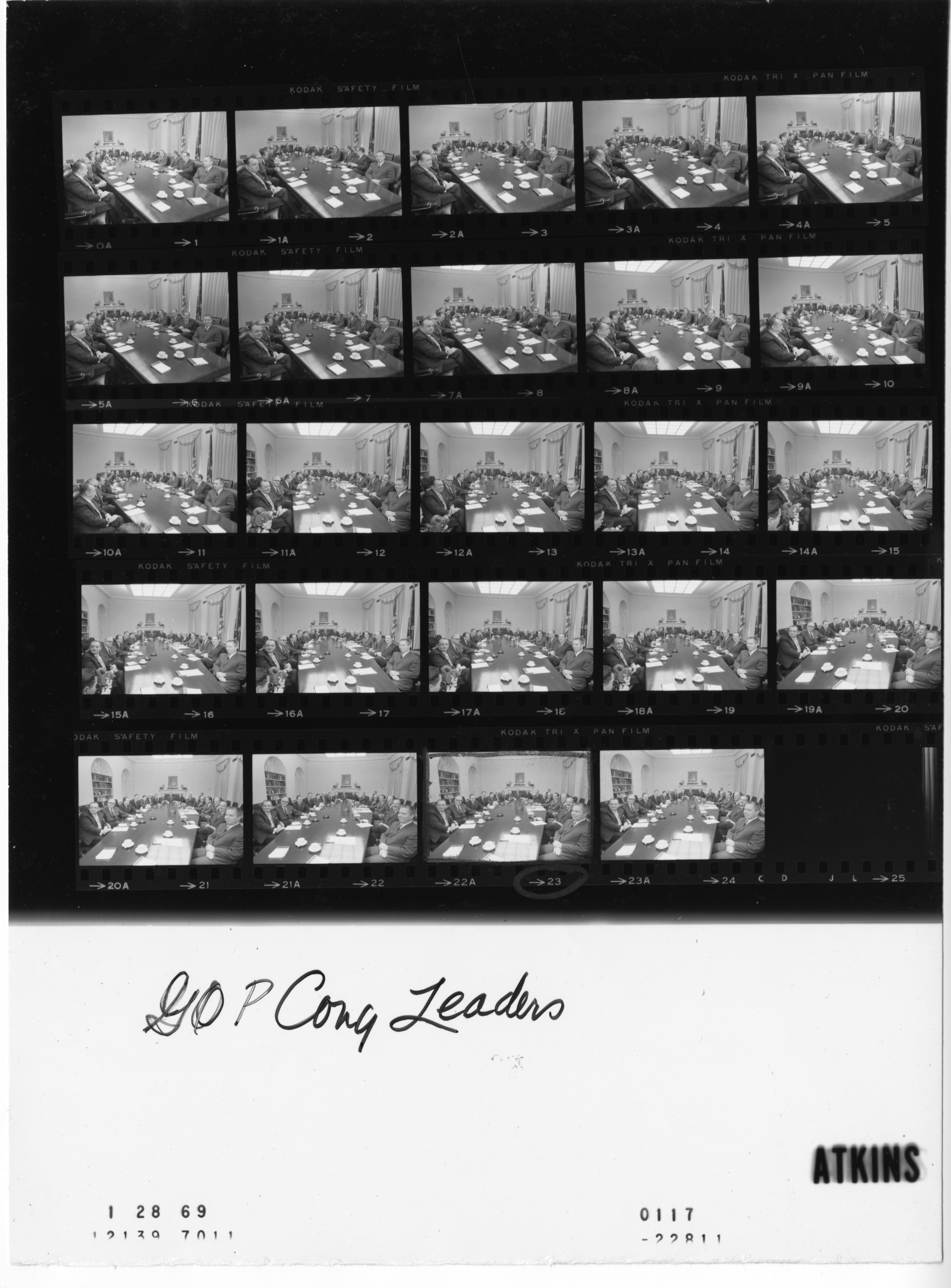
- Frame(s): WHPO-0117-01-24, President Nixon and Vice President Agnew attending a Congressional Leadership meeting. 1/28/1969, Washington, D.C. White House, Cabinet Room. Clockwise: Bob Wilson, Gordon Allott, William Cramer, Spiro Agnew, John Tower, Leslie Arends, H. Allen Smith, Richard Poff, Robert Taft, John Anderson, Milton Young, Magaret Chase Smith, Everett Dirksen, President Nixon, Gerald Ford, Hugh Scott, John Rhodes, Patrick J. Buchanan.
- Frame(s): WHPO-0117-23, President Nixon and Vice President Agnew attending a Congressional Leadership meeting. 1/28/1969, Washington, D.C. White House, Cabinet Room. Clockwise: Bob Wilson, Gordon Allott, William Cramer, Spiro Agnew, John Tower, Leslie Arends, H. Allen Smith, Richard Poff, Robert Taft, John Anderson, Milton Young, Magaret Chase Smith, Everett Dirksen, President Nixon, Gerald Ford, Hugh Scott, John Rhodes; Behind: Kenneth E. Belieu.
Roll WHPO-0118 Photographer: Atkins, Oliver | Color or B&W: B&W
- Frame(s): WHPO-0118-05A-27A, Birthday gift presentation of an Irish Setter dog named King Timahoe to President Nixon from White House Staff members. 1/28/1969, Washington, D.C. White House, Rose Garden. Frame 8A: L-R: Ron Ziegler, H.R. Haldeman, Rose Mary Woods (In other frames: Bob Wilson, Gordon Allott, William Cramer, Spiro Agnew, John Tower, Leslie Arends, H. Allen Smith, Richard Poff, Robert Taft, John Anderson, Milton Young, Magaret Chase Smith, Everett Dirksen, Gerald Ford, Hugh Scott, John Rhodes, Shelley Scarney, Patrick Buchanan, Alexander Butterfield, Hebert Klein, Marjorie Acker, Gerald Warren, Manolo Sanchez, John Ehrlichman.
- Frame(s): WHPO-0118-08A, Ron Ziegler, H.R. Haldeman and Rose Mary Woods watch President Nixon hold the leash of his new Irish Setter King Timahoe, after the dog was given as a birthday gift from White House Staff members. 1/28/1969, Washington, D.C. White House, Rose Garden. Ron Ziegler, H.R. Haldeman, Rose Mary Woods, President Nixon, Irish Setter King Timahoe.
Roll WHPO-0119 Photographer: Kightlinger, Jack | Color or B&W: B&W
- Frame(s): WHPO-0119-03-30, Closeup portrait of John R. Price. (Head and shoulders). 1/28/1969, Washington, D.C. unknown. John R. Price.
- Frame(s): WHPO-0119-14A, Closeup portrait of John R. Price.(Head and shoulders). 1/28/1969, Washington, D.C. unknown. John R. Price.
Roll WHPO-0120 Photographer: Kightlinger, Jack | Color or B&W: B&W
- Frame(s): WHPO-0120-03-19, Closeup portrait of Attorney Leonard S. Zartman, one of six assistants to Daniel Patrick Moynihan, the executive secretary of President Nixon's Urban Affairs Council. (Head and shoulders). 1/28/1969, Washington, D.C. unknown studio. Leonard S. Zartman.
- Frame(s): WHPO-0120-20-37, Closeup portrait of Christopher C. DeMuth, one of six assistants to Daniel Patrick Moynihan, the executive secretary of President Nixon's Urban Affairs Council. (Head and shoulders). 1/28/1969, Washington, D.C. unknown studio. Christopher C. DeMuth.
Roll WHPO-0121 Photographer: Kightlinger, Jack | Color or B&W: B&W
- Frame(s): WHPO-0121-02A-20A, Closeup portrait of Michael C. Monroe, one of six assistants to Daniel Patrick Moynihan, the executive secretary of President Nixon's Urban Affairs Council. (Head and shoulders). 1/28/1969, Washington, D.C. Michael C. Monroe.
- Frame(s): WHPO-0121-21A-25A, Closeup portrait of Attorney Leonard S. Zartman, one of six assistants to Daniel Patrick Moynihan, the executive secretary of President Nixon's Urban Affairs Council. . (Head and shoulders). 1/28/1969, Washington, D.C. Leonard S. Zartman.
Roll WHPO-0122 Photographer: Atkins, Oliver | Color or B&W: B&W
- Frame(s): WHPO-0122-01-16, President Nixon meeting with Glenn Seaborg (Chairman of the Atomic Energy Commission (AEC)), Robert Ellsworth (U.S. NATO Ambassador), Lee A. DuBridge (Science Advisor), and Patrick E. Haggerty (Chairman of Texas Instruments). 1/28/1969, Washington, D.C. White House, Oval Office. Frame 12, L-R: Henry Kissinger, Robert Ellsworth, Patrick Haggerty, President Nixon, Glenn T. Seaborg, Lee A. Dubridge (Unseen: H.R. Haldeman, Chapin).
- Frame(s): WHPO-0122-12, President Nixon meeting with Glenn Seaborg (Chairman of the Atomic Energy Commission(AEC)), Robert Ellsworth (U.S. NATO Ambassador), Lee A. DuBridge (Science Advisor), and Patrick E. Haggerty (Chairman of Texas Instruments). 1/28/1969, Washington, D.C. White House, Oval Office. Frame 12, L-R: Henry Kissinger, Robert Ellsworth, Patrick Haggerty, President Nixon, Glenn T. Seaborg, Lee A. Dubridge (Unseen: H.R. Haldeman, Chapin).
Roll WHPO-0123 Photographer: Atkins, Oliver | Color or B&W: B&W
- Frame(s): WHPO-0123-01-20, President Nixon meeting with Secretary of State William Rogers in the Oval Office. 1/28/1969, Washington, D.C. White House, Oval Office. President Nixon, William P. Rogers.
- Frame(s): WHPO-0123-03, President Nixon meeting with Secretary of State William Rogers in the Oval Office. 1/28/1969, Washington, D.C. White House, Oval Office. President Nixon, William P. Rogers.
Roll WHPO-0124 Photographer: Atkins, Oliver | Color or B&W: B&W
- Frame(s): WHPO-0124-01A-06A, President Nixon meeting in the Oval office with Senator Henry Jackson and Supreme Allied Commander Andrew Goodpaster. 1/28/1969, Washington, D.C. White House, Oval Office. Clockwise: General Andrew J. Goodpaster, Henry Jackson, Bryce N. Harlow, President Nixon, Henry Kissinger.
- Frame(s): WHPO-0124-02A, President Nixon meeting in the Oval office with Senator Henry Jackson and Supreme Allied Commander Andrew Goodpaster. 1/28/1969, Washington, D.C. White House, Oval Office. Clockwise: General Andrew J. Goodpaster, Henry Jackson, Bryce N. Harlow, President Nixon, Henry Kissinger.
- Frame(s): WHPO-0124-08A-09A, Two unidentified men (staff members) seen through a doorway, in a two desk office. 1/28/1969, Washington, D.C. White House, unidentified office. Dwight Chapin (possibly).
Roll WHPO-0125 Photographer: Atkins, Oliver | Color or B&W: B&W
- Frame(s): WHPO-0125-03A-14A, President Nixon eating lunch with House of Representatives Leaders. 1/28/1969, Washington, D.C. Capitol Hill, Speaker's Dining Room. President Nixon, Howard W. Smith, John McCormack, William Colmer, Carl Albert, Gerald Ford.
Roll WHPO-0126 Photographer: Atkins, Oliver | Color or B&W: B&W
- Frame(s): WHPO-0126-01-02, President Nixon greeting Congressman John McCormack prior to the House Leadership Group Lunch. 1/28/1969, Washington, D.C. Capitol Hill, Speaker's Dining Room. L-R: President Nixon, John McCormack.
- Frame(s): WHPO-0126-01A, President Nixon greeting Congressman John McCormack prior to the House Leadership Group Lunch. 1/28/1969, Washington, D.C. Capitol Hill, Speaker's Dining Room. L-R: President Nixon, John McCormack.
- Frame(s): WHPO-0126-03, Congressmen and President Nixon walking to the House of Representatives Leaders Lunch. 1/28/1969, Washington, D.C. Capitol Hill, Speaker's Dining Room. L-R: William Miller, Kenneth Harding; Background L-R: John McCormack, President Nixon.
- Frame(s): WHPO-0126-04, President Nixon walking alongside Congressman McCormack en route to the House Leadership Group Lunch. 1/28/1969, Washington, D.C. Capitol Hill, Speaker's Dining Room. President Nixon, John McCormack.
- Frame(s): WHPO-0126-05-06, President Nixon eating lunch with House of Representatives Leaders. 1/28/1969, Washington, D.C. Capitol Hill, Speaker's Dining Room. Frame 05-06 L-R: Howard W. Smith, John McCormack, President Nixon, William Colmer, Carl Albert.
- Frame(s): WHPO-0126-07-08, President Nixon at the House Leadership Group Lunch. 1/28/1969, Washington, D.C. Capitol Hill, Speaker's Dining Room. L-R: William Miller, President Nixon, Leslie Arends, John W. McCormack.
- Frame(s): WHPO-0126-09, Exterior view of entry into White House building loggia. 1/28/1969, Washington, D.C. White House.
Roll WHPO-0148 Photographer: unknown | Color or B&W: Color
- Frame(s): WHPO-0148-01, President Nixon in a meeting with Congressional Leaders. 1/28/1969, Washington, D.C. White House, Cabinet Room. CW: Bob Wilson, Gordon Allott, William Cramer, Spiro Agnew, John Tower, Leslie Arends, H. Allen Smith, Richard Poff, Robert. A. Taft, Jr., John Anderson, Milton Young, Margaret Chase Smith, Everett Dirksen, Nixon, Gerald Ford, Hugh Scott, John Rhodes.
Roll WHPO-0174 Photographer: Knudsen, Robert L. | Color or B&W: Color
- Frame(s): WHPO-0174-, President Nixon recieves an Irish Setter dog, King Timahoe, as his birthday present from White House Staff. 1/28/1969, Washington, D.C. White House, Rose Garden. L-R: Everett M. Dirksen, President Nixon, Gerald R. Ford, Milton R. Young, Gordon L. Allott, John B. Anderson, John G. Tower, William C. Cramer, Bob Wilson, Robert A. Taft, Jr.; Background, L-R: Herbert G. Klein, Gerald L. Warren, John D. Ehrlichman.
Roll WHPO-1267 Photographer: unknown | Color or B&W: B&W
- Frame(s): WHPO-1267-, Gerald Ford and Everett Dirksen holding a press conference. 1/28/1969, Washington, D.C. unknown. Gerald Ford, Dirksen.
The White House Communications Agency Sound Recordings Collection contains public statements that took place between 1969 and 1974. Visit the finding aid to learn more.
G - Cabinet Officer Briefings
- WHCA-SR-G-002
Remarks by Secretary of the Interior Walter Hickel announcing appointment of Undersecretary Russell Train. (1/28/1969, Roosevelt Room, The White House)
Runtime: 3:32
Production credits: Audio feed supplied by ABC; No WHCA engineer initials listed
Original Format: 1/4-inch reel-to-reel audiotape. Original source type: Original.
Context (External Sources)
The Vanderbilt Television News Archive is the world's most extensive and complete archive of television news. They have been recording, preserving and providing access to television news broadcasts of the national networks since August 5, 1968.
Wikipedia is a free encyclopedia that anyone can edit.