
Introduction
This almanac page for Monday, January 27, 1969, pulls together various records created by the federal government and links to additional resources which can provide context about the events of the day.
Previous Date: Sunday, January 26, 1969
Next Date: Tuesday, January 28, 1969
Schedule and Public Documents
The Daily Diary files represent a consolidated record of the President's activities. Visit the finding aid to learn more.
The President's day began at The White House - Washington, D. C.
The Weekly Compilation of Presidential Documents made available transcripts of the President's news conferences; messages to Congress; public speeches, remarks, and statements; and other Presidential materials released by the White House.
Memorandums to Federal Agencies
- Review of the Budget (5 Weekly Comp. Pres. Doc. 180, January 27, 1969)
The President's Memorandum to the Heads of Executive Departments and Agencies.
News Conferences
- The President's News Conference of January 27, 1969 (5 Weekly Comp. Pres. Doc. 175, January 27, 1969)
No. 1.
Proclamations
- American Heart Month, 1969 (5 Weekly Comp. Pres. Doc. 181, January 27, 1969)
Proclamation 3892. Dated January 27, 1969. Released January 28, 1969.
Digest of Other White House Announcements
Following is a listing of items of general interest which were announced in the press but not made public as formal White House press releases during the period covered by this issue. Appointments requiring Senate approval are not included since they appear in the list of nominations submitted to the Senate, below.
- The President went to the Pentagon for a briefing on the military situation by the Joint Chiefs of Staff.
- Ambassador Guillermo Sevilla-Sacasa of Nicaragua, dean of the diplomatic corps, paid a courtesy call on the President at the White House.
Nominations Submitted to the Senate
Does not include promotions of members of the Uniformed Services, nominations to the Service Academies, or nominations of Foreign Service Officers.
- RICHARD C. VAN DUSEN, of Michigan, to be Under Secretary of Housing and Urban Development.
- FLOYD H. HYDE, of California, to be an Assistant Secretary of Housing and Urban Development.
- SAMUEL C. JACKSON, of the District of Columbia, to be an Assistant Secretary of Housing and Urban Development.
- SAMUEL J. SIMMONS, of Michigan, to be an Assistant Secretary of Housing and Urban Development.
- SHERMAN UNGER, of Ohio, to be General Counsel of the Department of Housing and Urban Development.
- DAVID A. HAMIL, of Colorado, to be Administrator of the Rural Electrification Administration for a term of 10 years.
Each Public Papers of the Presidents volume contains the papers and speeches of the President of the United States that were issued by the White House Office of the Press Secretary during the time period specified by the volume. The material is presented in chronological order, and the dates shown in the headings are the dates of the documents or events. In instances when the release date differs from the date of the document itself, that fact is shown in the text note.
To ensure accuracy, remarks have been checked against audio recordings (when available) and signed documents have been checked against the original, unless otherwise noted. Editors have provided text notes and cross references for purposes of identification or clarity.
The Federal Register is the official daily publication for rules, proposed rules, and notices of federal agencies and organizations, as well as executive orders and other Presidential documents.
No Federal Register published on this date
The Congressional Record is the official daily record of the debates and proceedings of the U.S. Congress.
Archival Holdings
Any selection of archival documents will necessarily be partial. You should use the documents and folders identified below as a starting place, but consult the linked collection finding aids and folder title lists and the collections themselves for context. Many documents to be found this way do not lend themselves to association with specific dates, but are essential to a complete understanding of the material.
Selective document listing
President's Office Files
The President's Office Files consists of materials drawn together by the Special Files Unit from several administrative subdivisions within the White House Office. It is the handwriting and sensitive papers sent to the Staff Secretary that now comprise much of the President's Office Files. Visit the finding aid to learn more.
- President's Handwriting, Box 1, President's Handwriting, January 1969 [2 of 2]
- Letter; [Richard Nixon] to Charles C. Tillinghast, Jr. re: 1968 TWA Citizenship Program. January 27, 1969. 1 pg.
- Letter; Dick Nixon to J. Irving Whalley re: Copy of the Congressional election results. January 27, 1969. 1 pg.
- Note; Hewson A. Ryan to The President re: Attachment. January 27, 1969. 2 pgs.
- Annotated News Summaries, Box 28, News Summaries - January 1969 [During this period, the Staff Secretary only removed pages from the News Summaries which contained President Nixon's handwriting, often leaving the document with no date. Although there are no specific documents with this date, you should also consult the full folder for the month.]
President's Personal File
The President's Personal File is essentially a President's secretary's file, kept by Rose Mary Woods, personal secretary to the President, for two purposes: (1) preserving for posterity a collection of documents particularly close to the President, whether because he dictated or annotated them, or because of the importance of the correspondent or the event concerned and (2) giving appropriate attention–letters of gratitude, invitations to White House social events, and the like–to members and important friends and supporters of the Nixon administration. This generalization does not describe all the varied materials of a file group which is essentially a miscellany, but it does identify the reason for the existence of the file group's core. Visit the finding aid to learn more.
- President's Speech File
Selective document listing
The White House Press Office during the Presidency of Richard Nixon was responsible for daily communication with the White House press corps. Ronald L. Ziegler was the Press Secretary to the President for Nixon's entire term in office from January 1969 to August 1974 and Gerald Warren served as the Deputy Press Secretary. The office held daily briefings for the press and produced the White House’s press releases. Visit the finding aid to learn more.
- White House Press Releases, Box 1
- FOR IMMEDIATE RELEASE JANUARY 27, 1969
Office of the White House Press Secretary
THE WHITE HOUSE
MEMORANDUM FROM THE PRESIDENT TO THE HEADS OF EXECUTIVE DEPARTMENTS AND AGENCIES
As we set the course of the new Administration, a careful and thorough review of the budget must be the first order of business. The American people have a right to expect that their tax dollars will be properly and prudently used. They also have a right to expect that fiscal policy will help to restrain the present excessive rate of price inflation in our economy.
At my request, the Budget Director has asked you to begin promptly a review of the budget requests sent to the Congress by the outgoing administration. This task must receive your personal attention. As you evaluate the programs of your agency in that review, I want each of you particularly to:
- identify activities of low priority which can be reduced or phased down and perhaps, over time, eliminated completely;
- start now to redirect ongoing Federal programs toward this Administration1s goals and objectives.
We must act promptly along these lines in order to make room for new programs that seem urgent.
For the fiscal year ending June 30, 1969, we must operate under the spending ceilings set in the Revenue and Expenditure Control Act of 1968. Fiscal year 1969 is more than half over and our flexibility for making changes is limited.
However, we need to begin now to lay the foundation for our future actions. I want you, therefore, to examine in detail the spending plans of your agency through this June and to achieve all the savings that you can - - not by deferrals or stretchouts which will have to be made up later, but by actions that will provide a sound base for future programs we will want to undertake. The Director of the Budget should be informed of your plans within the next 30 days. Our examination of the Government's programs and budget levels in the coming weeks is of central importance to the success of the new Administration in achieving a more efficient and responsive Government. I ask each of you to cooperate fully in this endeavor.
# # #
- FOR IMMEDIATE RELEASE JANUARY 27, 1969
- White House Press Conferences, Box 55
- News Conference #17 at the White House with Ron Ziegler, January 27, 1969, 5:20 P.M. EST. 8 pgs.
NEWS CONFERENCE #17
AT THE WHITE HOUSE
WITH RON ZIEGLER
5:20 P.M. EST
JANUARY 27, 1969
MONDAY
MR. ZIEGLER: I will give you a rundown on the President's visit to the Defense Department. I think the pool reporters have already indicated that the President had lunch in the Secretary's Dining Room with Dr. Kissinger and Secretary Laird and General Wheeler. The lunch lasted about an hour.
They then went to the National Military Command Center where the President was briefed on the military situation by General Wheeler and the Joint Chiefs of Staff. The President was briefed on the various command decisions over which the President has responsibility. This meeting, as I think the President indicated when he left the Pentagon, was with the senior commanders. He will return to the Pentagon on Friday as a part of his general program to further acquaint himself with the agencies and departments of Government.
The President also, incidentally, will visit the State Department on Wednesday, in the afternoon. We will have further details for you on that tomorrow.
Today's briefing of the President at the Defense Department was held in the conference room of the Military Command Center. Following the briefing, the President took a tour of the Command Center. He was shown the Hot Line. He was taken on a tour by General Wheeler.
The President has just concluded a meeting with Ambassador Sevilla-Sacasa, the Dean of the Diplomatic Corps. That is a courtesy call.
Tomorrow's schedule:
The President will have breakfast with Senator Dirksen and Congressman Ford.
8:30 - The President will meet with the Republican Leadership.
Shortly after that meeting, he will receive his new White House pet that was given to him by his staff, an Irish Setter.
I understand Senator Dirksen and Representative Ford will be available to the members of the White House Press Corps. That will be approximately 10 a.m.
Q What time is the breakfast?
MR. ZIEGLER: About 7:30.
Q What is the name of the Irish Setter?
MR. ZIEGLER: We will have that for you tomorrow. I will have all the details on the dog tomorrow. We will have a coverage opportunity on that.
Let me continue now with the activities for tomorrow and we will go to questions, if there are any.
Tomorrow, also, the President will visit the House of Representatives. He will visit the Floor of the House. He will have lunch there in the Speaker's Dining Room of the Capitol.
Q What time?
MR. ZIEGLER: The President will depart here at approximately 11:15 a.m.
Q Will there be a pool?
MR. ZIEGLER: Yes, we will take a pool and that will be announced tomorrow.
Q He will not be on the Floor during the session, will he?
MR. ZIEGLER: He will visit the Floor before lunch, before noon.
Q He will be getting there about the time they convene.
MR. ZIEGLER: These times are not precise. We are working the timing out now, but he will visit the House of Representatives, go on the Floor, and after that have lunch. The lunch will be hosted by Congressman William M. Colmer, a Democrat from Mississippi, who is Chairman of the House
Committee on Rules.
Congressman Ford was originally going to host a luncheon for the President, but the Rules Committee already had a luncheon planned at this time, so it was the decision to join the two luncheons. Therefore, Congressman Colmer will be the host of the luncheon.
Those present at the luncheon will be members of the House Committee on Rules, plus the Majority and Minority Leaders, and chairmen of various other committees. There will be approximately 40 present at the lunch.
Q When you say "the leaders", do you mean the single leaders, McCormack and Ford, or the Leadership?
MR. ZIEGLER: The Leadership.
Q McCormack will be there?
MR. ZIEGLER: It is my understanding he will be, yes.
Q Did you say "and chairmen of various committees"?
MR. ZIEGLER: Yes. There will be about 40 there, Leadership and some chairmen.
Q And ranking Republican members?
MR. ZIEGLER: I am sure that is the way they are breaking it down. We will have a list of that for you tomorrow.
There is available in the bins a number of nominations to be sent to the Senate which have already been announced.
Also in the bins is the memorandum from the President to the heads of Executive departments and agencies which I believe the President referred to in his press conference this morning, following up Budget Director Mayo's letter to the various departments and agencies.
Q On the Pentagon visit, General Wheeler said he would not brief the President, but that staff members of the JCS would. What was it? Did he do the briefing or did the staff members of the JCS do it?
MR. ZIEGLER: General Wheeler was the ranking member there, but he did not conduct the entire briefing.
Q He played a part in it?
MR. ZIEGLER: Yes he played a part in the discussion.
Q Were the other members of the JCS there?
MR. ZIEGLER: Yes. General Palmer represented General Westmoreland.
Q Where is General Westmoreland?
MR. ZIEGLER: I am not sure where General Westmoreland is.
O Isn't the President going to go to the Senate for a similar luncheon Wednesday?
MR. ZIEGLER: Yes, it is scheduled for Wednesday. I will have details for you on that.
Q Will it be sort of a repetition of the House visit?
MR. ZIEGLER: That is correct. The Senate visit will be similar to the House visit.
Q Who will be the host?
MR. ZIEGLER: I don't have the full details on the Senate luncheon. I will have that for you tomorrow.
Q Is the President sending any delegation to Africa next week?
MR. ZIEGLER: I am not aware of that.
Q What is the purpose of visiting the floor? No one is going to be there, are they? Is he just looking around?
MR. ZIEGLER: I am sure the Members of the Congress will be aware that the President is coming.
Q He is not going to address them, is he?
MR. ZIEGLER: He is going to visit the Floor.
Q Do you know where Dr. Kissinger used the phrase "nuclear sufficiency"?
MR. ZIEGLER: On that particular term, I would have to refer you to Ed Morgan. I think what Mr. Morgan was referring to, he was reading an article that Dr. Kissinger wrote, "Agenda For a Nation." But the term "sufficiency" was not included in that. I think Ed Morgan used that term out of reading "Agenda For a Nation."
Q And the President accepted the term?
MR. ZIEGLER: In reference to Ed Morgan's question he repeated the term that Ed used, as I recall the transcript.
Q Would you look into that African thing, please?
MR. ZIEGLER: Yes. I am not aware of it.
Q Do you know if the briefing at the Pentagon had an effect on the President's views that there is a security gap?
MR. ZIEGLER: The President had, I think, a very full briefing there and was very pleased with it.
Q Will the lights be on tonight?
MR . ZIEGLER : Yes, they sure will be.
Q Have they been on before?
MR. ZIEGLER: They have been on since last Monday night.
Q In the Mansion or outside?
MR. ZIEGLER : Outside.
Q There have been reports out of Egypt that the United States is going in for one of these four-power meetings on the Middle East crisis. Is that report right?
MR. ZIEGLER: I would not want to make a comment on that beyond what the President said this morning.
Q Can you tell us something more about the White House purse snatching?
MR. ZIEGLER: It is on the wire.
Q Does the White House have anything further to say on the President's statement at his press conference this morning that the term "sufficiency", he thought, was more acceptable than "parity" or "superiority"?
There has been some reporting that this is a new element that Kissinger has forwarded instead of "parity" or "superiority''.
MR. ZIEGLER: I would not want to go further than the President did this morning. I would simply refer you to "Agenda For a Nation."
Q But is the idea used, without using the actual word?
MR. ZIEGLER: I suggest you read it. Let me be very clear on that term. This was a term that was used in a question to the President. The President then, responding to that question, used the term again.
Q Mr. Morgan has since indicated he does not remember where he read it or what it means.
MR. ZIEGLER: Let's conclude this by my suggestion that you read "Agenda For a Nation." I think you will enjoy it.
Q Does the President endorse and accept Dr. Kissinger's views as expressed in that article?
MR. ZIEGLER: I would not go beyond what the President covered this morning in his press conference.
Q If the President does say that he thinks "sufficiency" is a better than than "superiority" or "parity", what is our status now? Are we sufficient or insufficient? Is there a security gap?
MR. ZIEGLER: I would refer you to the transcript of the press conference of the President this morning, in which I think he said some very meaningful things about the use of terms and that sort of thing.
Q But he prefers the term "sufficiency" to "complete superiority"?
MR. ZIEGLER: I would not comment beyond the press conference.
Q What subject will the President be taking up with bipartisan leaders of Congress during these two trips to the Hill?
HR. ZIEGLER: Those that are on the top of everyone's mind, I am sure.
Q Will these luncheons be closed or open to pool coverage?
MR. ZIEGLER: They will be closed.
Q Ron, these series of trips to the Hill, do they have anything to do with Dr. Burns' recommendations which he delivered the 21st in his tentative report earlier on appropriate legislative moves, the Burns report? Is that part of it?
MR. ZIEGLER: The President is going to the Capitol to visit the Floor of the House and to have lunch.
Q Was this idea pressed by people on the Hill?
MR. ZIEGLER: No. It is the President's idea to do that.
Q Would you call it a social call?
MR. ZIEGLER: Yes.
Q Is the President going to the Senate and the State Department both on Wednesday?
MR. ZIEGLER: That is correct.
Q Is it their invitation to him for the Hill visit?
MR. ZIEGLER: Yes. However, the President did express the desire to go to the Hill to visit both the House and Senate. I believe he said before that he is proud of the fact that he came from the House and the Senate.
Q Is he going to visit any other Government installations in the next few days or weeks?
MR. ZIEGLER: I think you could look for him to visit the other agencies and departments in the coming weeks, yes.
Q Does the President have any intention to visit Cape Kennedy soon?
MR. ZIEGLER: No.
Q What is the purpose of returning to the Pentagon so soon? Didn't they complete their work?
MR. ZIEGLER: Today's briefing was from the senior officers, Joint Chiefs of Staff. The President will go back on Friday as part of his visitation to the various agencies and departments to meet with other levels of the Pentagon.
Q Do you mean that he will make a practice of going to most of the agencies?
MR. ZIEGLER: Yes.
Q How far down on the levels is he going in these meetings?
MR. ZIEGLER: I don't have a specific level for you, but the President will visit the various agencies. He will be at State on Wednesday and you can look for him to make more visits in the coming weeks.
Q Why is he doing this?
MR. ZIEGLER: It is the President's desire to acquaint himself with the various people in the departments.
Q On this "sufficiency" business, could you tell us if it is the President's intent to change his position in regard to that? That is the way it is being widely interpreted, that he has changed his position regarding "superiority" and "sufficiency". Can you tell us whether his position has changed or not?
MR. ZIEGLER: That is something I would not want to make a comment on. I would not want to make my own judgment on that.
Q Let's put it another way. "Sufficiency", is that a nicer, more acceptable word than "superiority", meaning the same thing?
MR. ZIEGLER: I can only refer you to what the President said this morning.
Q Is it likely that tomorrow's meeting with the Republican leadership will produce a decision on the State of the Union Message? Is that the purpose of the meeting?
MR. ZIEGLER: No. This is a regular meeting of the Republican leadership. I would not want to put one purpose on the meeting. I am sure it will be discussed.
Q Will that decision come out of the meeting?
MR. ZIEGLER: I don't know.
Q Do you expect some further clarification or elaboration on the "sufficiency" , "parity" or "superiority" business, either from the President or some other channels, in light of the questions arising at this point?
MR. ZIEGLER: I can only refer you to the President's remarks this morning at his press conference.
Q Ron, in December he said that he would meet soon after taking office with the bipartisan leadership. Are these luncheons tomorrow and Wednesday in effect these meetings or is a bipartisan meeting going to be held in addition to the luncheon?
MR. ZIEGLER: There will be a bipartisan meeting.
THE PRESS: Thank you.
END (AT 5;36 P.M. EST)
- News Conference #17 at the White House with Ron Ziegler, January 27, 1969, 5:20 P.M. EST. 8 pgs.
The H. R. Haldeman Diaries consists of seven handwritten diaries, 36 dictated diaries recorded as sound recordings, and two handwritten audio cassette tape subject logs. The diaries and logs reflect H. R. Haldeman’s candid personal record and reflections on events, issues, and people encountered during his service in the Nixon White House. As administrative assistant to the President and Chief of Staff, Haldeman attended and participated in public events and private meetings covering the entire scope of issues in which the Nixon White House engaged in during the years 1969-1973. Visit the finding aid to learn more.
- Transcript of diary entry (PDF)
Monday, January 27.
The first press conference. Staff group met at 7:30 in Cabinet Room (Buchanan arrived late - and then sat in the President's chair). I presided. Two hours of discussion - developed an opening statement (which he did not use) and added seven or eight Q&A's to the book. Small group (Ehrlichman, Harlow, Keogh and Kissinger) met with President at 9:30. Supposed to be a half hour but they stayed until time for press conference.
President very tense at opening, but loosened up and did great job. Excellent reaction from all sides.
President changed his schedule and went early to the Pentagon - had lunch with Laird before briefing. We had a schedule meeting, lunch in the Fish Room.
Formal call by Dean of Diplomatic Corps, Sevilla-Sacassa. His entrance was hysterical. Stood at rigid attention in doorway of Oval Office, clicked his heels, boomed out "Mr. President" then went rigid again, with all chins trembling. Stood that way until President moved forward and broke the spell. Then came in with big abrazo.
Long discussion regarding Europe trip plans. President feels must go early before Vietnam problems set in and Paris talks bog down. Issued order that President Frei of Chile must not be first Latin American visitor.
Didn't like the picture of himself that's all over the Defense Department. Too severe.
Pushing for action - wants a barrage of messages to Congress, one a day for 20 days. Wants a plan of what we'll be doing. Wants decision on whether to give State of Union or not. Advisors divided.
Wants people meeting with him to bring their staff people in with them when appropriate. Wants Chapin to send the girls in with messages, etc. - so he sees more people on the staff more often.
Still loves every minute - and shows it all the time.
Brought the new dog in for a preview visit. President pretty awkward about how to handle him - basically embarrassed. - Handwritten diary entry (JPG)
The National Archives Catalog is the online portal to the records held at the National Archives, and information about those records. It is the main way of describing our holdings and also provides access to electronic records and digitized versions of our holdings.
The Catalog searches across multiple National Archives resources at once, including archival descriptions, digitized and electronic records, authority records, and web pages from Archives.gov and the Presidential Libraries. The Catalog also allows users to contribute to digitized historical records through tagging and transcription.
Nixon Library Holdings
All National Archives Units
National Security Documents
The President's Daily Brief is the primary vehicle for summarizing the day-to-day sensitive intelligence and analysis, as well as late-breaking reports, for the White House on current and future national security issues. Read "The President's Daily Brief: Delivering Intelligence to Nixon and Ford" to learn more.
- President's Daily Brief of 27 January 1969 (Morning) [consult link for visuals and extent of redactions]
The President's Daily Brief
27 January 1969
(Morning)
19
LATE NOTES FOR THE PRESIDENT'S DAILY BRIEF OF 27 JANUARY 1969
I. MAJOR PROBLEMS
MIDDLE EAST
The Israeli mission at the United Nations has informed U Thant that another group of Jews in Iraq faces the threat of execution as spies, according to an Israeli spokesman in New York. U Thant was said to have told an Israeli representative that he would look into the matter urgently. (AP New York, 27 January 1969)
EUROPE
There is nothing of significance to report.
SOVIET AFFAIRS
Moscow Radio, in its initial report on President Nixon's press conference, briefly summarized the President's statements without comment. (FBIS 48, 27 January 1969)
VIETNAM
There is nothing of significance to report.
II. OTHER IMPORTANT DEVELOPMENTS
PAKISTAN
Army units were called in yesterday evening to assist police in quelling continued disturbances in outlying areas of Karachi. Troops also took control of Lahore late yesterday following a six-hour fight between police and student mobs. Curfews were imposed in both cities. [REDACTED]
I. MAJOR DEVELOPMENTS
MIDDLE EAST
There is nothing of significance to report.
EUROPE
The Annex is a discussion of possible future crises in France.
SOVIET AFFAIRS
The huge throngs which converged on Prague for Jan Palach's funeral apparently were impressed by the solemnity of the occasion and by the preparedness of the authorities. On Saturday, police wisely allowed students to proctor the ceremonial interment. On Sunday, however, they served notice that the affair would not be allowed to continue as an anti-Soviet cause celebre. This led to some incidents in Wenceslas Square, but the number of youths involved was relatively small and the matter was handled competently by civil authorities, without calling in the army.
None of the problems which enflamed passions so much last week have been settled, however, and they cannot be ignored for long. Censorship and control of the party and government are prime questions, involving the conflicting interests of the Soviets, factionalized Czechoslovak politicians, and the people. There are no prospects of an easy resolution and a new crisis could boil up at any time.
VIETNAM
The French Foreign Minister has given Ambassador Lodge the French interpretation of Hanoi's current view on how a settlement could be reached. This version closely follows the line which North Vietnamese diplomats throughout the world have been pushing for the last several weeks, particularly in regard to their demand for a "peace cabinet." This Communist line seems to be aimed at encouraging the US to believe that an easy and quick way out of the war lies in pushing the GVN into taking a "neutralist" position and including politicians acceptable to the Communists' in the government in Saigon.
According to the French, Hanoi wants to negotiate seriously, and early in the talks it wants a forecast from the us of what kind of a political solution the latter will accept.
The French believe that the Communists, for their part, are willing to forego demanding a coalition government as a condition for the withdrawal of troops if satisfactory interim political arrangements can be reached. To Hanoi, "satisfactory political arrangements" means expansion of the present government of South Vietnam to include additional ministers, according to the French. This expanded government would be a "government of peace." This interpretation contrasts with Hanoi's earlier demands for the removal of most of the top leadership of the Saigon government as a first step toward establishing a regime with which Hanoi could deal.
* * *
Saigon is evidently aware of at least some of the inadequacies of its delegation staff in Paris. [REDACTED] competent personnel may be sent to augment the delegation's capabilities.
Any such upgrading of the delegation's staff, however, is likely to produce only a limited improvement in its ability to handle new developments quickly. President Thieu usually prefers to await the Foreign Minister's review of each negotiation meeting before deliberating over the results himself. Moreover, the South Vietnamese have had some difficulty at the staff level in getting their lines straight on how to proceed. Accordingly, the South Vietnamese will probably require several days for review and planning between sessions of the Paris meetings.
* * *
Ky seems to have relaxed his efforts to promote his own political fortunes, at least for the moment. His latest views on the need for stronger leadership seem implicitly to acknowledge that Thieu is in a strong position. [REDACTED]
* * *
A small band of enemy sappers attacked a civil defense compound in the southwestern part of Saigon today, inflicting several casualties and destroying fifty percent of the buildings. This is the first ground probe against a target within the city limits of Saigon since the Communist's offensive of last May. It may presage a step-up in terrorist and sabotage operations within Saigon, in line with continued reports of enemy efforts to infiltrate sappers into the city.
II. OTHER IMPORTANT DEVELOPMENTS
SPAIN
The Spanish Government's declaration of a state of emergency last Friday should be sufficient to take the momentum out of student anti-government demonstrations and other political unrest. There is no guarantee that absolute calm will be restored, but the authorities seem to feel that strong measures will prevent a crisis such as occurred in France last May. We think the Spanish Government will be relatively judicious and selective in applying its emergency powers, avoiding provocation of the dissidents, and cocking a wary eye toward world opinion.
PERU
The Revolutionary Junta, composed of the armed forces chiefs, has announced that General Velasco will continue as president after his retirement from the army on 31 January. The communique ends speculation in Lima that military officers, dissatisfied with Velasco's ultranationalism, were preparing to replace him with General Montagne, the present prime minister.
NATIONALIST CHINA
Chiang Kai-shek reacted with predictable anger to the preparations of· the Italian and Canadian Governments to establish diplomatic relations with Communist China. He implied to Ambassador McConaughy that as long as Rome and Ottawa persisted in exploring ties with Peking, he would have their embassies harassed enough to make their situations "completely untenable without directly ordering them to leave." If either government recognizes Communist China, Chiang will break relations at once to show other states that they "cannot have it both ways." The fact that Nationalist China has maintained official ties with France--despite De Gaulle's recognition of Peking in 1964-is attributable, in the Generalissimo's words, to France's big-power status, its permanent seat on the UN Security Council, and to personal reassurances from De Gaulle that his act was anti-US, rather than pro-Peking.
PAKISTAN
The opposition is keeping the pressure on President Ayub Khan in this election year. Violent and destructive anti-government disorders hit the country's major cities over the weekend. The army had to be called in to restore order in Dacca, the capital of East Pakistan. A strict curfew is now in effect there; violators are shot on sight. There were reports of rioting in seven West Pakistan cities, with Karachi, the main commercial center the hardest hit. By late yesterday Karachi police contained the disorders. New trouble could erupt today as a result of a general strike called for all major urban areas by the loosely knit opposition coalition. A nationwide general strike, involving rural areas where Ayub is strongest, has been called for 14 February.
FUTURE CRISES IN FRANCE
SIGNIFICANCE: Shaky confidence in the franc is France's greatest vulnerability at present. Bad economic news or a recurrence of student and worker disturbances could set off another speculative run in the next few months. If the pressure this time was too heavy to be contained by the sort of measures which worked last November--and this might well be the case--De Gaulle would probably resort to a deep devaluation. This would plunge sterling into a crisis and confront the US with urgent problems of monetary policy.
* * *
De Gaulle has not yet succeeded in restoring French confidence, which was severely shaken by the domestic crisis of last May and again by the financial crisis of November. Recent polls show that over 60 percent of the French public believes that the franc will be devalued in 1969 and that over 50 percent expects a recurrence of, the May disturbances. The first test of confidence will come in March, when new labor contracts will be negotiated.
Despite the considerable health of the French economy, it still faces great difficulty in competing with West Germany and, more important, in living down its currency's recent weakness in the exchange market. Already, reports of a substantial December trade deficit have led to moderate January losses in reserves. A variety of events, such as the release of very bad monthly trade figures or an inflationary wage settlement, could lead to a speculative run which would be hard to stop.
In this event, the other leading Western nations would probably render extensive aid to the franc. If this proved insufficient, however, De Gaulle would have to choose between domestic austerity measures going well beyond those taken in November, or a substantial devaluation of, say, well over 10 percent. Given his concern not to risk domestic unrest, he would probably decide to devalue, choosing in this way to export the problem. (Even before this point, he might threaten such a move as a means of getting more aid from other countries.)
A deep devaluation would hit sterling first of all. Unless massive new credits were quickly forthcoming, London would be forced to make a comparable devaluation or even to let the pound float freely. The operations of the Common Market, dependent as they are upon a fixed set of exchange rates, would also be hard hit. The Six would again be made painfully aware of the liabilities of half-integration, and this might eventually spur some progress toward a closer concerting of economic policies. In the short run, however, with the entire world monetary system put in serious question, the US would be confronted with policy problems of great magnitude and urgency.
A crisis on the scale of last May involving workers and students seems less likely, although sporadic student and labor protests are continuing. Radicals remain in control of the student movement--in part because of the failure of moderate elements to organize effectively--and can still foment campus disorders. They have had virtually no luck, however, in enlisting workers to their cause, and an isolated student rebellion would be easily suppressed. Union leaders and the rank and file are both anxious to avoid a recurrence of the May disorders at this time. An important test will occur in March, however, when the government and business will have to decide whether to go forward with wage increases promised in the settlement of last spring; both government and business leaders have hinted that they might have to renege.
A-severe franc crisis would increase the chances for a domestic upheaval. And if, contrary to our present expectation, a widespread student and labor revolt erupts and is not quickly repressed, this in turn would almost surely hit domestic and foreign confidence hard enough to undermine the franc. By either route, France would be plunged into a double crisis which would bring into question the survival of De Gaulle's regime.
Such a double crisis might be quelled with a combination of limited measures--replacement of Couve de Murville's cabinet, large foreign loans to replenish French reserves, modest new doses of austerity, and efficient police operations. If these failed to hold the line, De Gaulle could be faced with the alternative of resigning or moving to a more authoritarian regime relying on the tacit support of the army. The latter is more likely. But in this event De Gaulle's prestige at home and his influence abroad would be gravely damaged. Ultimately, this might lead him to concentrate more on domestic matters and to take a less active role in foreign, particularly extra-European, affairs.
De Gaulle reaffirmed last week that he means to serve out his term, which runs until 1972. Nevertheless, it is a measure of the setbacks which France has sustained that his resignation in a new severe crisis, though it still seems unlikely, can not be altogether excluded. This most extreme outcome would pile a host of political uncertainties on top of the international financial problems arising from this hypothetical course of events. The end result of the ensuing turmoil is of course unpredictable, but in view of the divisions on the French political left the odds would favor the eventual formation of a moderate or conservative government, probably headed by a Gaullist.
Until some resolution was achieved, however, the US would be faced with continuous pressures to take positions which would assist or harm the fortunes of the domestic contestants. It would also be extremely difficult to carry forward general policies for Europe, deal with international monetary problems, or respond to challenges from the USSR or crises in East Europe while France's political future remained in doubt.
In time of crisis, the sense of interdependence in Western Europe is high. Whatever gloating they might indulge in, the UK and France's Common Market partners would be ready to assist as they could in a speedy solution of France's troubles. The Germans could be expected to support the franc as they did in November, and in an emergency even a revaluation of the mark is not entirely out of the question, though it still seems unlikely. Once the crisis was over, however, the Europeans' sense of a shift in weight from France to Germany would rise another important notch. One prominent consequence would be an increased concern to contain German power, and to enlist US support in this endeavor. - President's Daily Brief of 27 January 1969 (Afternoon) [consult link for visuals and extent of redactions]
The President's Daily Brief
27 January 1969
(Afternoon)
19
I. MAJOR PROBLEMS
MIDDLE EAST
Baghdad radio has announced that 15 "Israeli spies," including nine Iraqi Jews, were hanged this morning. The embassy in Tel Aviv thinks the Israelis, however outraged, will find it hard to find a way to retaliate which would not further endanger the lives of the some 5,000 Jews in Iraq.
Prime Minister Eshkol's first reaction was to note in a speech before the Knesset today that the executions showed what fate would be in store for Jews if the Arab governments "could do as they pleased." The Israelis will certainly play on this theme of Arab treatment of subject Jewish minorities to parry Arab complaints about their refugee policies. They may also hit the some 20,000 Iraqi troops in Jordan especially hard if and when they carry out another retaliatory raid against Jordan.
EUROPE
[REDACTED]
SOVIET AFFAIRS
[REDACTED]
* * *
Seven Soviet TU-95 long-range bombers carried out reconnaissance flights against the west coast of Alaska on Saturday. None of the aircraft in this well-coordinated mission entered US airspace, but two of them approached to about 30 miles from the northwest coast of Alaska. These flights may signal the resumption of simulated strike missions against the northern coast of North America, similar to missions flown early last year by Soviet long-range aircraft.
* * *
Czechoslovakia has been quiet throughout the day.
VIETNAM
Communist presentations at Saturday's meeting provide no clues to Hanoi's negotiating tactics or the positions it. eventually will take on substantive matters. The only "substance" in the Communist statements was in the repetition of broad propaganda statements which are intended to cover a wide range of negotiating procedures and which do riot commit the Communists to any specific course. The DRV and Liberation Front rejection of the US proposal on the DMZ is only another indication that the Communists are not receptive to separate handling of military and political issues.
We cannot say how the Communists will attempt to get into substantive matters in Paris, but we think they are unlikely to show their cards in the formal sessions. Long before that happens, they will try to get some idea of what political arrangements the US is willing to consider for South Vietnam. We believe this is their major objective at. this stage. They may simply wait for some US initiative but it seems likely they will also make some efforts in private or through third parties to find out which way the new US administration is headed. The French views about Hanoi's thinking [REDACTED] are almost certainly based on recent conversations with North Vietnamese officials and may have been in part a reflection of such an approach.
* * *
There has been substantial movement during the last year in the climate of South Vietnamese opinion regarding negotiation with the National Liberation Front. Before the Tet offensive, most nationalists assumed that the NLF would eventually be destroyed. In April 1968, when the former peace candidate for the presidency, Truong Dinh Dzu, told newsmen that he favored talking to the Front, most nationalists felt that he richly deserved to be arrested. This strongly anti~Front climate was partly responsible for the dismissal of the government of Prime Minister Loe in May and for the quick adoption of a harder anti-Front line by Prime Minister Huong.
Since the initial shock that followed the 31 October announcement that the US would sit down with the NLF, Vietnamese nationalists have gradually come to accept the idea that some kind of a deal will have to be made with it. Although Ky's December remarks about dealing with the Front as a "reality" but not as an "entity" have never appeared in the Vietnamese press, they have been widely discussed
without causing much adverse reaction.
So far, however, most thinking about how to accommodate the NLF involves schemes to convert it into a legal, non-Communist party. There is little evidence that the Saigon leadership or other nationalists have yet taken a very hard look at just how much they may be required to concede to the Front in order to get the North Vietnamese to agree to withdraw their troops from South Vietnam.
* * *
Enemy urban sapper squads were active again yesterday, hitting a police station in Phan Rang, a coastal provincial capital, with rocket grenades and automatic rifle fire. This closely followed an attack on the Phan Rang Airfield which destroyed two planes and damaged 27 others.
II. OTHER IMPORTANT DEVELOPMENTS
LAOS
In northern Laos, enemy probing activity has shifted from the government's guerrilla base at Na Khang to the outlying defensive positions protecting General Vang Pao's guerrilla headquarters at Long Tieng. Vang Pao is regional military commander and leader of the Meo tribe. The scope of recent enemy activity is not yet clear, but the loss of any of these government positions would further
hamper efforts to support guerrilla operations in the northeast. Vang Pao has already been forced to withdraw three battalions from the defense of Na Khang to meet the threat to Long Tieng.
In the south, villagers continued to report large enemy troop movements, some accompanied by heavy weapons, toward Ban Thateng. A government counteroffensive to relieve enemy pressure along the eastern rim of the Bolovens Plateau has had trouble getting started.
JAPAN
[REDACTED]
COMMUNIST CHINA
Mao Tse-tung and all his top aides attended a major rally in Peking on 25 January, their first collective public appearance in three and a half months. The turnout probably was intended to dispel widespread rumors in China about Mao's health and leadership changes. In fact, however, Peking's display of the leadership sheds no new light on the political infighting we believe is in progress.
The Foreign Relations of the United States series presents the official documentary historical record of major U.S. foreign policy decisions and significant diplomatic activity. Visit the State Department website for more information.
Vol. II, Organization and Management of U.S. Foreign Policy, 1969-1972
The Intelligence Community and the White House
183. Memorandum From the Director of Central Intelligence’s Deputy for National Intelligence Programs Evaluation (Bross) to Director of Central Intelligence Helms, Washington, January 27, 1969
Source: Central Intelligence Agency, Executive Registry Files, Job 80–R01284A, Box 4, Folder 2, Intelligence Community Reorganization. Secret. A copy was sent to the Deputy Director of Central Intelligence.
Vol. XII, Soviet Union, January 1969-October 1970
Initial Contacts, January-April 22, 1969
6. National Security Study Memorandum 10 , Washington, January 27, 1969
Source: Library of Congress, Manuscript Division, Kissinger Papers, Box CL 316, NSSM Studies, March 1969–June 1970. Confidential. A copy was sent to the Chairman of the Joint Chiefs of Staff.
Vol. XXIX, Eastern Europe, 1969-1972
Radio Free Europe and Radio Liberty
28. Memorandum for the 303 Committee , Washington, January 27, 1969
Source: Department of State, INR/IL Historical Files, 303 Committee Files, January–June 1969. Secret; Eyes Only. Tabs A–H, described below, are attached but not printed. No drafting information appears on the memorandum.
Romania
176. Memorandum From Helmut Sonnenfeldt of the National Security Council Staff to the Presidentʼs Assistant for National Security Affairs (Kissinger) , Washington, January 27, 1969
Source: National Archives, Nixon Presidential Materials, NSC Files, Box 702, Country Files—Europe, Romania, Vol. I—8/69. Confidential. Sonnenfeldt routed the memorandum through Eagleburger.
Vol. E-2, Documents on Arms Control and Nonproliferation, 1969-1972
Nuclear Non-Proliferation Treaty; Implementation of Safeguard System
3. Memorandum From Helmut Sonnenfeldt of the National Security Council Staff to the President’s Assistant for National Security Affairs (Kissinger) , Washington, January 27, 1969
Sonnenfeldt commented on National Security Council staff member Spurgeon Keeny’s January 24 paper concerning the NPT. In it, Sonnenfeldt cautioned against Keeny’s simplification of what he saw as a more complex German problem.
Source: National Archives, Nixon Presidential Materials, NSC Files, Box 366, Subject Files, Non-Proliferation Treaty through March 1969. Secret. Sent for action. The memorandum was sent through Haig, who wrote “Concur” next to his name on page one and initialed it.
Vol. E-4, Documents on Iran and Iraq, 1969-1972
Iraq 1969-1971
244. Telegram 321 From the Embassy in Israel to the Department of State, Tel Aviv, January 27, 1969, 1552Z
To preclude Israeli retaliation, the Embassy recommended that the Department strongly condemn the recent public hanging of Iraqi Jews.
Source: National Archives, RG 59, Central Files, 1967–69, POL 29 IRAQ. Confidential; Immediate. Repeated Immediate to London and to Rome, Beirut, Amman, Jerusalem, and USUN.
The Kissinger telephone conversation transcripts consist of approximately 20,000 pages of transcripts of Kissinger’s telephone conversations during his tenure as Assistant to the President for National Security Affairs (1969-1974) and Secretary of State (1973-1974) during the administration of President Richard Nixon. Visit the finding aid for more information.
Chronological File, Box 1, Folder January 21-31, 1969 [1 of 2]
- 8:50 AM, Richard Helms; Mr. Kissinger
Richard Helms
Mr. Kissinger
1-27-69 8:50 AM
Helms said he wanted to know what if any briefing he was to give on Wednesday. K said reactions to ratification of NPT everywhere but especially in Japan. K said we want to know what they really think - what they will do with or without the treaty. H said he would be prepared.
jm - 9:10 AM, U. Alexis Johnson; Mr. Kissinger
U. Alexis Johnson
Mr. Kissinger
1- 27-69 9:l0 AM
Discussed Pacific Route case. K said Bob Ellsworth has been working on it. K said he would get into the foreign policy aspects of it when appropriate but, in meantime, had no objection to Johnson calling Ellsworth directly about it.
jm - 10:45 AM, Richard Pedersen; Mr. Kissinger
Richard Pedersen
Mr. Kissinger
1-27-69 10:45 AM
K said he has not received the Regional Group's paper on the Middle East - he understands it is on the Secretary's desk awaiting his transmittal. K said he did not want to be put in position of having to raise this again with the Pres. He said he is supposed to receive the paper simultaneously and wants that understood. Pedersen said he would look into it. K said he if does not receive the paper, he will
have to cancel meeting.
jm - 11:40 AM, Secretary Rogers; Mr. Kissinger
Secretary Rogers
Mr. Kissinger
1-27-69 11:40 AM
Pres asked K to ask R about Roger Blough as Amb to Germany. R said Pres had discussed this with him and he said yes, asked HAK's opinion of Blough. K said did not know him well, thought the Germans would be impressed, appears to be tough but he does not know anything about his political judgment.
K said Pres tied up for about 45 minutes - could he do anything to help R - R said no - he just wanted to talk to Pres about his press conference.
jm - 12:20 PM, Col. Hughes; Mr. Kissinger
Col Hughes
Mr. Kissinger
1-27-69 12:20 PM
K said we have been trying to work out Hughes' attendance at the SIBP briefing today. K said Hughes could come to the first part of it the then the President would appreciate his leaving. Hughes said he hopes the Pres knows he did not make the request to attend. - 12:40, Mr. Ellsworth; Mr. Kissinger
Mr. Ellsworth
Mr. Kissinger
1-27-69 12:40
Discussed Pacific Route case. K said he would designate someone from his staff to work with E on it. K said he had had call from State asking if he objected if they worked directly with E on this and K said no.
E said he had met Pat Dean at a cocktail party and he brought up the Wilson visit. K said between him and Ellsworth the President is thinking of some alternatives to seeing Europeans together - decision will EX be made within the next 10 days.
Ellsworth said he was lunching with Chernokoff/(?) Soviet Embassy on Wednesday and would appreciate having someone on K's staff talking with him before this lunch - let him know what he should say, etc. K said one thing was connection between strategic arms talks and political movement both in Middle East and Vietnam. K said he should also indicate we are determined to end the war in Vietnam one way or the other - to be threatening. K said he would give E some more points before Wednesday. - 4:40 PM, Secy Rogers; Mr. Kissinger
Secy Rogers
Mr. Kissinger
1-27-69 4:40 PM
R read his statement re execution in Iraq. R brought up heads of govt on SACOUR (?) - K said he would send draft.
R said he would have something over shortly on Sianouk. K said he had NASSER draft.
jm - 5:55 PM, D Chapin; Mr. Kissinger
D Chapin
Mr. Kissinger
5:55 PM 1/27/69
C said Defense is now 10:00 AM - asked K to advise Laird. (friday, Jan 31)
State is scheduled for 3:00 on Wednesday afternoon.
Told K his briefing tomorrow is 10:00 AM.
K's briefing on Wednesday is at 9:30 AM; Senator Jackson comes in at 3:00 PM and Glenn Seaborg is scheduled for 3:30 PM.
Helms is set for Thursday at 11:00 AM.
K asked if he was expected at the Diplomatic Reception on Friday - C said he would check. C asked K whether any decision had been made on trip for the 9th. K said it would not take place on the 9th. - 6:00 PM, Secy Laird; Mr. Kissinger
Secy Laird
Mr. Kissinger
6:00 PM 1/27/69
K advised L of change in Defense visit (from 1:00 to 10:00) on Friday.
K said Pres is eager to have him, Laird and Bus Wheeler review some of contingency planning that we discussed on Saturday. After we have reviewed decision will be made on how to pre sent to NSC. L said he has a paper on Vietnam which he will have over tonight or tomorrow morning. When K receives it, L would like to have meeting. K said Pres is very interested to explore two scenarios mentioned on Middle East then Berlin and Korea. K said he would have Haig call Pearsely (?)
jm - 6:05 PM, Ron Ziegler; Mr. Kissinger
Ron Ziegler
Mr. Kissinger
1-27-69 6:05 PM
Talked about "sufficiency". Z asked whether President had changed his position - K said no he had just elaborated on it. Z asked what his position is in negotiation. K said he is undertaking a full scale strategic review in order to determine what is needed to assure American security. Z asked again whether Pres had changed his position and K said no he had just elaborated on it in the sense that what he wants is to try to get away from simple slogans - "sufficiency" does greater justice to complexity of the problem. K advised Z not to get too involved in this. Z asked whether K could have his people send something and K said he would have Larry send something up.
Z asked on question of reopening TFX - are we going to do that. K said the first he had heard of it was at the press conference.
jm - 6:05 PM, Congressman Ogden Reid; Mr. Kissinger
Congressman Ogden Reid
Mr. Kissinger
1-27-69 6:05 PM
Reid said he noticed that HAK is getting into the Middle East on Saturday and said he would like to drop by before then. Reid will be out of town on Friday so it was agreed that K would have his office call to set up a meeting before then.
jm - 6:35 PM, Herb Klein; Mr. Kissinger
HERB KLEIN
MR. KISSINGER
1/27/69 6 35 pm
Klein: When he mentioned missile talks -- discussion of other political areas - - linking a group of things, or previous posture you will have missile talks which will be separate..."
HAK: He does want to link them together -- not with Summit talks -- he wants to link them with some political progress. We ought to see what sort of quid pro quo you can get.
Klein: They're interpreting it pretty much as you said.
HAK: That's the correct interpretation.
Klein: the reaction (to p. c.) has been really excellent all the way through; it couldn't be better.
HAK: I think he handled himself beautifully.
## - 7:15 PM, John Whitaker; Mr. Kissinger
John Whitaker
Mr. Kissinger
1- 27-69 7:15 PM
W said on this Cabinet thing Toner is setting up early warning system. System sweeps all 12 agencies and some key people on the White House staff. K said Toner should stay out of NSC area. W agreed.
jm - 7:20 PM, Joe Albright of NEWSDAY; Mr. Kissinger
Joe Albright of NEWSDAY
Mr. Kissinger
1-27-69 7:20 PM
A asked whether there was any significance in Pres ident's formulation when he talked about American side. K said he meant North Vietnam - did not mean to suggest significance with GVN.
A said at very end of press conf the Pres said there will be new tactics - would that include secret contacts? K. said he thought he should not get into that.
A asked about motto about "sufficiency". K said it was not a motto that he has talked about it in his writings - should be in various public speeches which must be on the record. K said it is a phrase he has used and is therefore familiar to the President. A asked if we are now in position of having a sufficiency. K said it is under full governmental review.
A asked in area of new tactics in Vietnam, did K suppose the new tactics might include two level talks that K mentioned in his FA article K said he would not go into that.
jm - 7:25 PM, Dick Sneider; Mr. Kissinger
Dick Sneider
Mr. Kissinger
1-27-69 7:25 PM
K asked whether S had the Japan study started and S said yes. K asked if deadline on Okinawa could be moved up. S said he could have it for him in very few days. K asked for paper he could show the President; what various positions are; how about Feb 20 talks in Warsaw. K said he does not want to be in position where State operates and it is all formulated - told S to inject himself into it. enough so that he is part of decision-making process and get them used to idea. S said he would do so. K said president is not satisfied with Bundy theory that they do it - K said this does not mean S has to disagree with them - he would like to know what they are doing before Feb 19. K asked S to come in over next day or so and tell him what he knows. K asked for general brief review of China situation and where we should be going - asked S to draft a memo. Asked S to also check paper on ~ Cambodia.
S asked whether the Pres would like to read something on Japan - K said very probably. S said he would send him a memo he did a couple of months ago - he will bring it up to date and get it over.
K asked whether all the staff had been asked to give him a briefing (page or two) at the end of each day - said he had just gotten back to office and had not had time to check. S said yes.
jm - 7:30 PM, Marvin Kalb - CBS; Mr. Kissinger
Marvin Kalb - CBS
Mr. Kissinger
1-27-69 ~ 7:30 PM
Kalb asked when Pres talked today about linking start of missile talks with other outstanding political problems, did he mean that kind of linkage - does there literally have to be progress in other areas before talks can start? Mentioned Middle East as illustration. HAK said he did not quite understand what Kalb was driving at asked whether he meant does he have to have actual progress or would promise of progress be enough. HAK said he certainly wants to change the approach. HAK discussed phrases in 1950s and 1960s - said Pres is trying to say something in between. He doesn't mean we have to settle Middle East issue before we settle Arms Control - have to have some idea that tensions are not being multiplied elsewhere and some movement - some hope of progress. MK asked whether there is necessary stage of pre-negotiation or can it be as result of normal processes of diplomacy. HAK said it could be either, he thought. Form is not important so long as message gets through and so long as results are achieved. Kalb asked whether there is at this point a plan to approach Russians on bilateral basis - HAK said we are reviewing it this week.
jm - 7:50 PM, D Chapin; Mr. Kissinger
D Chapin
Mr. Kissinger
1-27-69 7:50 PM
Chapin said 10:30 tomorrow could not be worked out on the President's schedule for K - it was Chapin's fault. Asked if appt could be left open for the present - he would call if and when an opening occurred.
jm - 8:00 PM, Richard Pedersen; Mr. Kissinger
Richard Pedersen
Mr. Kissinger
1-27-69 8:00 PM
re speech for Vietnam negotiations - P said they have telegram saying it is o. k. with one exception - paragraph 15. P said we should not yet propose organization of a working group. K said also on para 9 if it is strictly a rebuttal it is o. k. K said what Pres would like is to go slow for a month for a reason which K would discuss with P. K agreed that P could get out cable without sending it over
jm - 8:45, Secy Laird; Mr. Kissinger
Secy Laird
Mr. Kissinger
8:45 1-27-69
Laird said he wanted to check one thing out with K. The memo sent over on the SIOP briefing said Hughes and Haig would be coming too. He wanted K to know that Military Assistants had never before attended these briefings and it would be a change in policy, but L would do whatever the President wished. K said he would take Haig off but would have to check with the President about Hughes. - 8:50, Dwight Chapin; Mr. Kissinger
Dwight Chapin
Mr. Kissinger
8:50 1-27-69
K told C about above conversation. Asked C to let L know what President decides. - 9:30 PM, L. Lynn; Mr. Kissinger
L. Lynn
Mr. Kissinger
1-27-69 9:30 PM
Discussed Strategic paper. K said he would like to call Laird tomorrow and tell him we have this paper, that it incorporates what they had discussed, that it is preliminary and his staff could take it from there. K said he would tell him that he wants representative from his staff to work with them. K said he would call Laird and advise him that Lynn, Packard and K would consult on this.
K told L under no circumstances should his paper be distributed until K discusses this with Laird. K asked whether Goodpaster had seen it - L said yes but did not have his reaction. K said he would read paper and be in touch with L tomorrow.
jm
Audiovisual Holdings
The White House Photo Office collection consists of photographic coverage of President Richard Nixon meeting with prominent social, political, and cultural personalities; speaking engagements and news conferences of the President and various high-ranking members of the White House staff and Cabinet; Presidential domestic and foreign travel, including Presidential vacations; social events and entertainment involving the First Family, including entertainers present; official portraits of the President, First Family, and high-ranking members of the Nixon administration; the 1969 and 1973 Inaugurals; the President’s 1972 Presidential election campaign appearances (including speeches) and other official activities of the White House staff and the President’s Cabinet from January 20, 1969 until August 9, 1974 at the White House and the Old Executive Office Building; other locations in Washington, DC, such as The Mall; and the Presidential retreats in Camp David, Maryland, Key Biscayne, Florida, and San Clemente, California. Visit the finding aid to learn more.
Roll WHPO-0077 Photographer: Atkins, Oliver | Color or B&W: B&W
- Frame(s): WHPO-0077-00A-12A, President Nixon speaking during his first televised Presidential Press conference. 1/27/1969, Washington, D.C. White House, East Room. President Nixon.
- Frame(s): WHPO-0077-13A-21A, President Nixon speaking to a packed room of White House Press Corps reporters, during his first televised Presidential Press Conference. 1/27/1969, Washington, D.C. White House, East Room. President Nixon, reporters, photographers, members of the press.
- Frame(s): WHPO-0077-15A, President Nixon speaking to a packed room of White House Press Corps reporters, during his first televised Presidential Press Conference. 1/27/1969, Washington, D.C. White House, East Room. President Nixon, reporters, photographers, members of the press.
- Frame(s): WHPO-0077-22A-29A, President Nixon speaking during his first televised Presidential Press Conference. 1/27/1969, Washington, D.C. White House, East Room. President Nixon.
- Frame(s): WHPO-0077-29A, President Nixon gestures with his hand while speaking during his first televised Presidential Press Conference. 1/27/1969, Washington, D.C. White House, East Room. President Nixon.
Roll WHPO-0078 Photographer: Atkins, Oliver | Color or B&W: B&W
- Frame(s): WHPO-0078-01A-26A, President Nixon gestures while speaking during his first televised Presidential Press Conference. 1/27/1969, Washington, D.C. White House, East Room. President Nixon.
Roll WHPO-0079 Photographer: Atkins, Oliver | Color or B&W: B&W
- Frame(s): WHPO-0079-01-17, Closeup facial portrait of President Nixon speaking during his first televised Presidential Press Conference. 1/27/1969, Washington, D.C. White House, East Room. President Nixon.
Roll WHPO-0080 Photographer: Kightlinger, Jack | Color or B&W: B&W
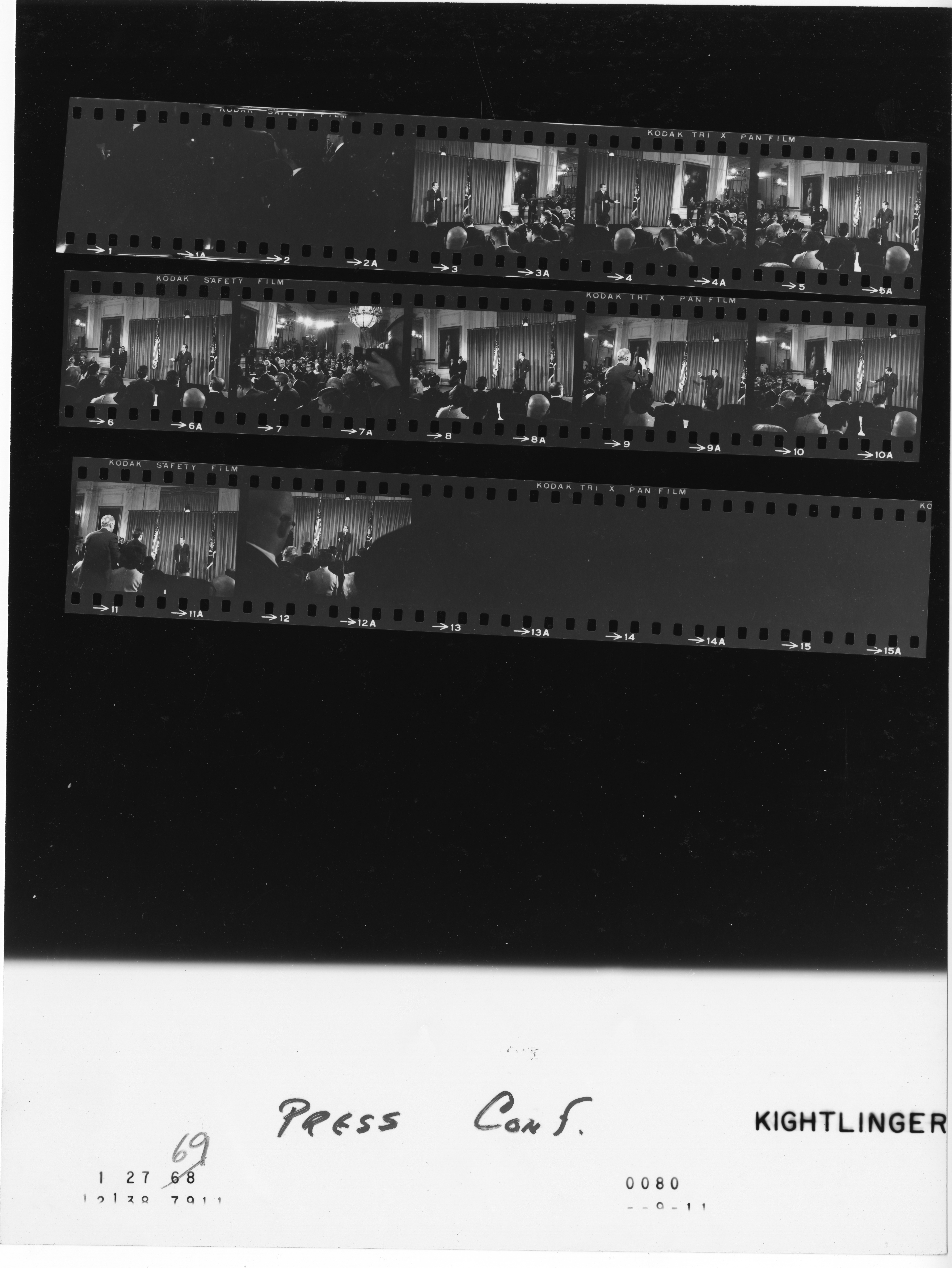
- Frame(s): WHPO-0080-03-12, President Nixon answers questions from reporters during his first televised Presidential Press Conference. 1/27/1969, Washington, D.C. White House, East Room. President Nixon, unidentified White House Press Corps reporters.
Roll WHPO-0081 Photographer: Kightlinger, Jack | Color or B&W: B&W
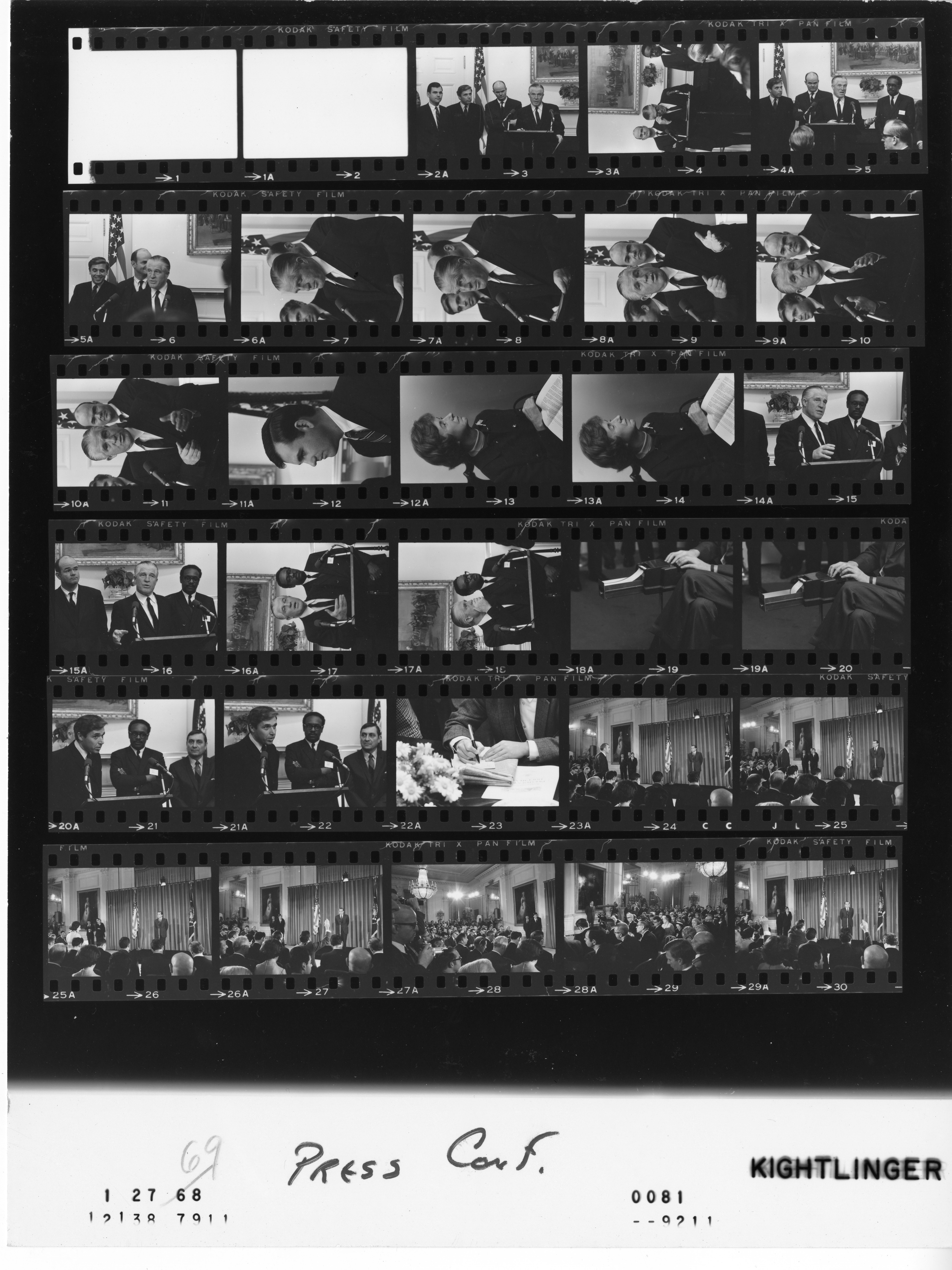
- Frame(s): WHPO-0081-03-11, 15-18, HUD Secretary George Romney at a press conference with Ron Ziegler and unidentified officials. 1/27/1969, Washington, D.C. White House, Roosevelt Room. George Romney, Ron Ziegler, unidentified officials.
- Frame(s): WHPO-0081-03-11, 15-18, HUD Secretary George Romney at a press conference with Ron Ziegler and unidentified officials. 1/27/1969, Washington, D.C. White House, Roosevelt Room. George Romney, Ron Ziegler, unidentified officials.
- Frame(s): WHPO-0081-12, Profile of White House Press Secretary Ron Ziegler listening to HUD Secretary George Romney at a press conference. 1/27/1969, Washington, D.C. White House, Roosevelt Room. Ron Ziegler.
- Frame(s): WHPO-0081-12, Profile of White House Press Secretary Ron Ziegler listening to HUD Secretary George Romney at a press conference. 1/27/1969, Washington, D.C. White House, Roosevelt Room. Ron Ziegler.
- Frame(s): WHPO-0081-13-14, Profile portrait of Mrs. Lenore Romney listening to her husband HUD Secretary George Romney, during a press conference. 1/27/1969, Washington, D.C. White House, Roosevelt Room. Lenore Romney.
- Frame(s): WHPO-0081-13-14, Profile portrait of Mrs. Lenore Romney listening to her husband HUD Secretary George Romney, during a press conference. 1/27/1969, Washington, D.C. White House, Roosevelt Room. Lenore Romney.
- Frame(s): WHPO-0081-19-20, Unidentified stenographer using the stenograph machine recording HUD Secretary George Romney's press conference. 1/27/1969, Washington, D.C. White House, Roosevelt Room. unidentified stenographer.
- Frame(s): WHPO-0081-19-20, Unidentified stenographer using the stenograph machine recording HUD Secretary George Romney's press conference. 1/27/1969, Washington, D.C. White House, Roosevelt Room. unidentified stenographer.
- Frame(s): WHPO-0081-21-22, Unidentied official speaking at microphone during HUD Secretary George Romney's press conference. 1/27/1969, Washington, D.C. White House, East Room. unidentified official.
- Frame(s): WHPO-0081-21-22, Unidentied official speaking at microphone during HUD Secretary George Romney's press conference. 1/27/1969, Washington, D.C. White House, East Room. unidentified official.
- Frame(s): WHPO-0081-23, Unidentied hand writing with a pen a paper. 1/27/1969, Washington, D.C. White House, East Room. unidentified official.
- Frame(s): WHPO-0081-23, Unidentied hand writing with a pen a paper. 1/27/1969, Washington, D.C. White House, East Room. unidentified official.
- Frame(s): WHPO-0081-24-37, President Nixon answers questions from reporters during his first televised Presidential Press conference. 1/27/1969, Washington, D.C. White House, East Room. President Nixon, unidentified White House Press Corps reporters.
- Frame(s): WHPO-0081-24-37, President Nixon answers questions from reporters during his first televised Presidential Press conference. 1/27/1969, Washington, D.C. White House, East Room. President Nixon, unidentified White House Press Corps reporters.
Roll WHPO-0082 Photographer: Kightlinger, Jack | Color or B&W: B&W
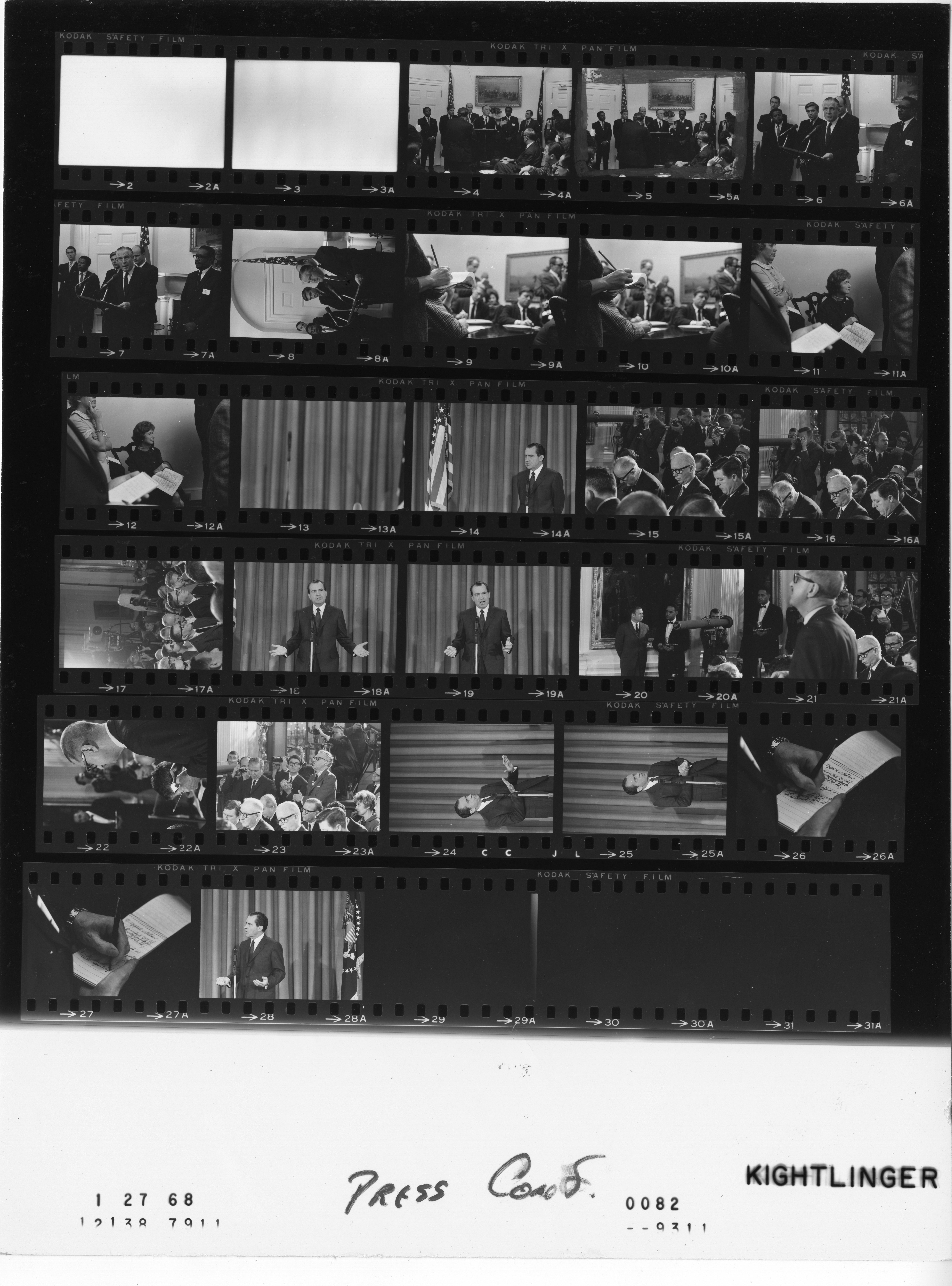
- Frame(s): WHPO-0082-04-12, HUD Secretary George Romney's press conference. 1/27/1969, Washington, D.C. White House, Roosevelt Room. George Romney, Ron Ziegler, unidentified officials, White House Press reporters.
- Frame(s): WHPO-0082-11, Profile portrait of Mrs. Lenore Romney listening to her husband HUD Secretary George Romney, (unseen) during a press conference. 1/27/1969, Washington, D.C. White House, Roosevelt Room. Mrs. Lenore Romney.
- Frame(s): WHPO-0082-14-28, President Nixon's first televised Presidential Press Conference. 1/27/1969, Washington, D.C. White House, East Room. President Nixon, unidentified White House Press reporters and photographers.
Roll WHPO-0083 Photographer: Kightlinger, Jack | Color or B&W: B&W
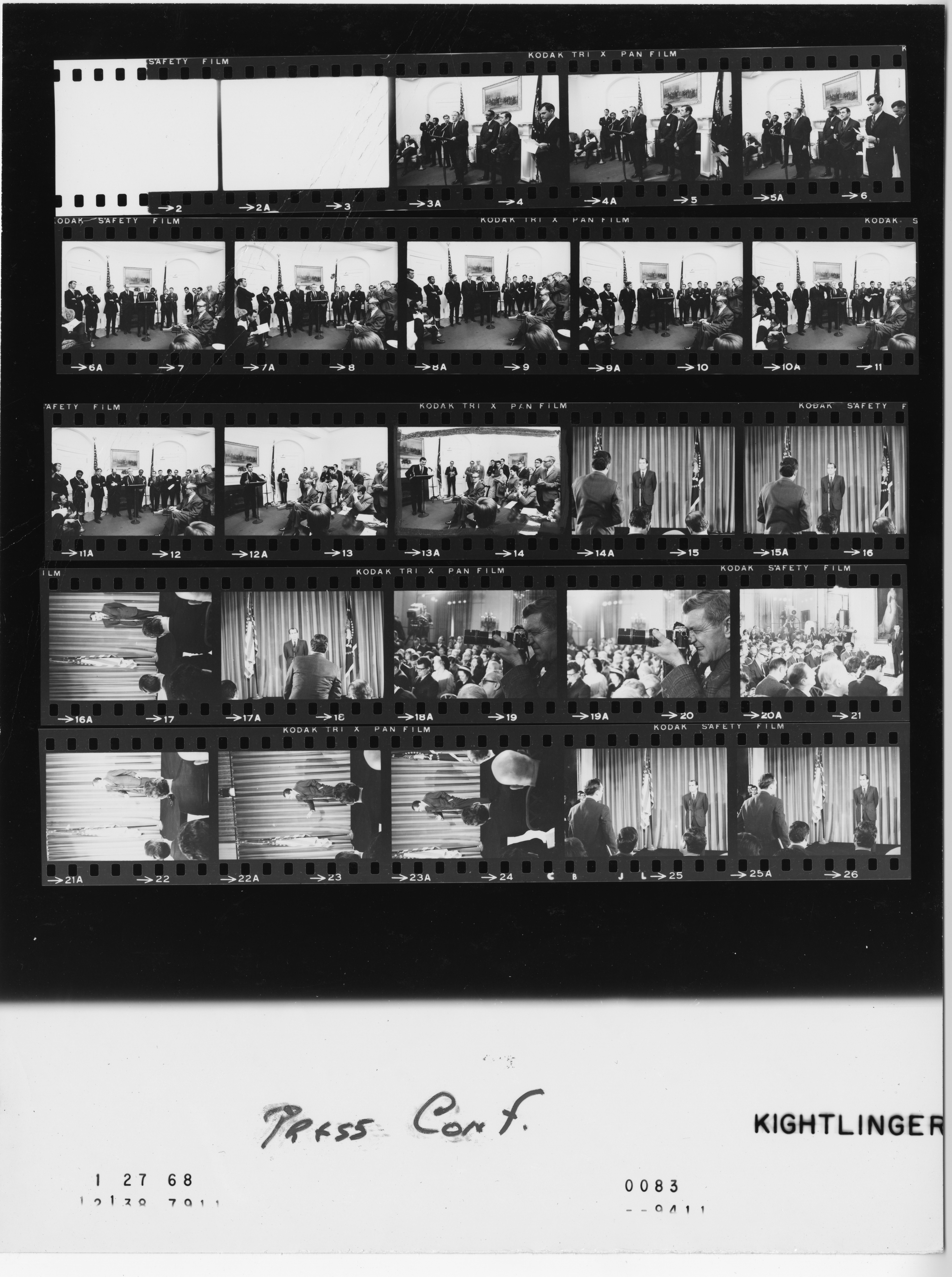
- Frame(s): WHPO-0083-03A-11A, HUD Secretary George Romney's press conference. 1/27/1969, Washington, D.C. White House, Roosevelt Room. George Romney, Ron Ziegler, unidentified White House Press reporters and stenographer, unidentified officials.
- Frame(s): WHPO-0083-12A-13A, Press Secretary Ron Ziegler speaking to White House Press Reporters during HUD Secretary George Romney's press conference. Unidentified Stenographer in foreground. 1/27/1969, Washington, D.C. White House, Roosevelt Room. Ron Ziegler, unidentified White House Press reporters and stenographer.
- Frame(s): WHPO-0083-14A-25A, President Nixon's answers reporter's questions, during the first televised Presidential Press Conference. 1/27/1969, Washington, D.C. White House, East Room. President Nixon unidentified White House Press reporters and photographers.
Roll WHPO-0097 Photographer: Fabian Bachrach | Color or B&W: B&W
- Frame(s): WHPO-0097-[DASH], Closeup formal portrait of President Nixon. 1/27/1969, unknown studio unknown studio. President Nixon.
- Frame(s): WHPO-0097-01, Formal Closeup head and shoulders portrait of President Nixon. (copy). 1/27/1969, unknown studio unknown studio. President Nixon.
Roll WHPO-0102 Photographer: Atkins, Oliver | Color or B&W: B&W
- Frame(s): WHPO-0102-00A-07A, President Nixon at luncheon with Henry Kissinger, Secretary of Defense Melvin Laird and Gen. Earle Wheeler, while receiving a briefing on the S.I.O.P., Single Integrated Operational Plan. 1/27/1969, Washington, D.C. Pentagon, lunchroom. Frame 1A, L-R: President Nixon, Henry Kissinger, Melvin Laird, General Earle Wheeler.
- Frame(s): WHPO-0102-01A, President Nixon at luncheon with Henry Kissinger, Secretary of Defense Melvin Laird and Gen. Earle Wheeler, while receiving a briefing on the S.I.O.P., Single Integrated Operational Plan. 1/27/1969, Washington, D.C. Pentagon, lunchroom. Clockwise: President Nixon, Melvin laird, Henry Kissinger, General Earle Wheeler.
- Frame(s): WHPO-0102-08A-12A, A group portrait of President Nixon, Henry Kissinger, Melvin Laird and Gen. Earle Wheeler, standing in the Pentagon hallway after a luncheon briefing on the Single Integrated Operational Plan. (SIOP). 1/27/1969, Washington, D.C. Pentagon, hallway. L-R: Henry Kissinger, Melvin Laird, President Nixon, General Earle Wheeler.
Roll WHPO-0103 Photographer: Atkins, Oliver | Color or B&W: B&W
- Frame(s): WHPO-0103-00-08, President Nixon receiving a photograph gift album from Nicaraguan Ambassador Guillermo Sevilla-Sacasa, during an Oval Office meeting with Henry Kissinger and Emil Mosbacher. 1/27/1969, Washington, D.C. White House, Oval Office. L-R: Emil "Bus" Mosbacher, President Nixon, Dr. Guillermo Sevilla-Sacasa, Henry Kissinger.
- Frame(s): WHPO-0103-08, President Nixon receiving a photograph gift album from Nicaraguan Ambassador Guillermo Sevilla-Sacasa, during an Oval Office meeting with Henry Kissinger and Emil Mosbacher. 1/27/1969, Washington, D.C. White House, Oval Office. L-R: Emil "Bus" Mosbacher, President Nixon, Dr. Guillermo Sevilla-Sacasa, Henry Kissinger.
Roll WHPO-0118 Photographer: Atkins, Oliver | Color or B&W: B&W
- Frame(s): WHPO-0118-01A-04A, President Nixon walks to his limo in the Pentagon parking garage area, after a luncheon briefing with General Wheeler and Melvin Laird and Henry Kissinger, on the S.I.O.P., Single Integrated Operational Plan. 1/27/1969, Washington, D.C. Pentagon. Frame 3A: President Nixon, Gen. Earle Wheeler, Melvin Laird. Unidentified security guards and military guards.
Roll WHPO-0172 Photographer: Knudsen, Robert L. | Color or B&W: Color
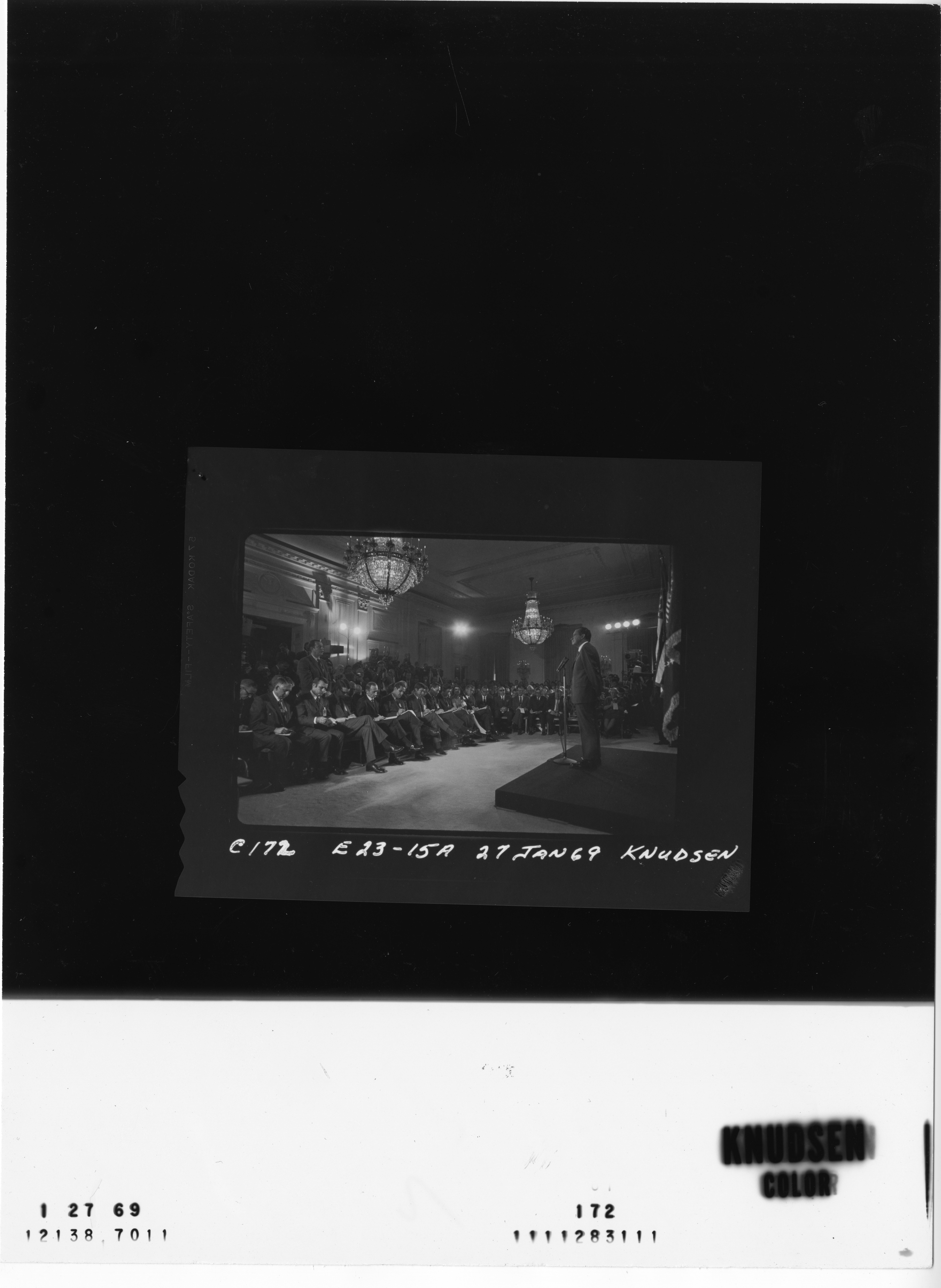
- Frame(s): WHPO-0172-01, President Nixon holding his first nationally televised press conference. 1/27/1969, Washington, D.C. White House, East Room. President Nixon, mostly all male reporters taking notes in the front row, members of the White House Press Corps.
Roll WHPO-0173 Photographer: Atkins, Oliver | Color or B&W: Color
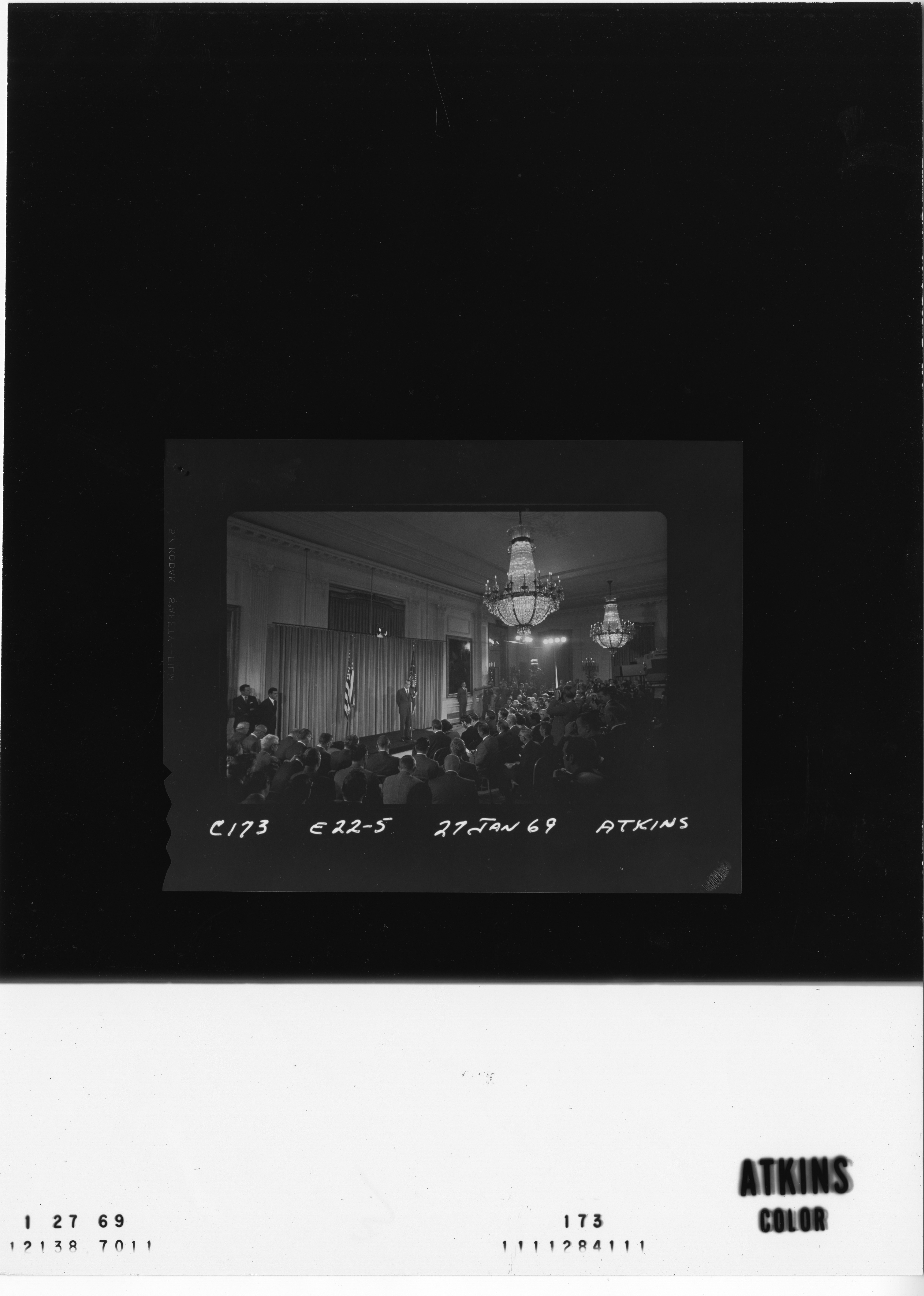
- Frame(s): WHPO-0173-01, President Nixon holding his first nationally televised press conference in the East Room. 1/27/1969, Washington, D.C. White House, East Room. President Nixon, mostly all male audience of reporters taking notes, members of the White House Press Corps.
Roll WHPO-0180 Photographer: Atkins, Oliver | Color or B&W: Color
- Frame(s): WHPO-0180-01, Formal standing portrait of Mrs. Judy Agnew dressed in her inaugural ball evening gown and gloves. 1/27/1969, Washington, D.C. Judy Agnew.
Roll WHPO-0752 Photographer: Knudsen, Robert L. | Color or B&W: Color
- Frame(s): WHPO-0752-, President Nixon standing in front of a microphone. 1/27/1969, Washington, D.C. President Nixon.
Roll WHPO-0761 Photographer: Knudsen, Robert L. | Color or B&W: Color
- Frame(s): WHPO-0761-, President Nixon talking while standing at a microphone. 1/27/1969, Washington, D.C. President Nixon.
Roll WHPO-0764 Photographer: Knudsen, Robert L. | Color or B&W: Color
- Frame(s): WHPO-0764-, President Nixon talking at a microphone. 1/27/1969, Washington, D.C. President Nixon.
Roll WHPO-0907 Photographer: Atkins, Oliver | Color or B&W: Color
- Frame(s): WHPO-0907-17A-22A, President Nixon at a microphone (Head and shoulders). 1/27/1969, Washington, D.C. President Nixon.
The White House Communications Agency Sound Recordings Collection contains public statements that took place between 1969 and 1974. Visit the finding aid to learn more.
B - Vice-Presidential (Agnew and Ford)
- WHCA-SR-B-005
Press briefing-Press lobby entrance, White House. (1/27/1969)
Runtime: 10:00
Original Format: 1/4-inch reel-to-reel audiotape. Original source type: Original. - WHCA-SR-B-006
Press conference-Washington Hilton Hotel, Wash. DC. (1/27/1969)
Runtime: 8:31
Original Format: 1/4-inch reel-to-reel audiotape. Original source type: Original.
P - Formal Presidential Remarks
- WHCA-SR-P-690114
Remarks by President Nixon in a press conference. (1/27/1969, East Room, White House)
Runtime: 0:29:18
Keywords: Presidential press conferences, presidential news conferences, interviews, media
Production credits: Audio feed supplied by WHCA/ABC
Original Format: 1/4-inch reel-to-reel audiotape. Original source type: Original.
The White House Communications Agency Videotape Collection contains “off-the-air” recordings of televised programs produced between 1968 and 1974. Visit the finding aid to learn more.
- WHCA-3206
The President's [First] Press Conference. NBC and CBS commentary. Partial episode of Gunsmoke at the end. President Richard Nixon.
CBS, NBC
Runtime: 00:34:50
Context (External Sources)
The Vanderbilt Television News Archive is the world's most extensive and complete archive of television news. They have been recording, preserving and providing access to television news broadcasts of the national networks since August 5, 1968.
Wikipedia is a free encyclopedia that anyone can edit.