
Introduction
This almanac page for Thursday, February 8, 1973, pulls together various records created by the federal government and links to additional resources which can provide context about the events of the day.
Previous Date: Wednesday, February 7, 1973
Next Date: Friday, February 9, 1973
Schedule and Public Documents
The Daily Diary files represent a consolidated record of the President's activities. Visit the finding aid to learn more.
The President's day began at The White House - Washington, D. C.
The Weekly Compilation of Presidential Documents made available transcripts of the President's news conferences; messages to Congress; public speeches, remarks, and statements; and other Presidential materials released by the White House.
Digitized versions can be found at HathiTrust.
Each Public Papers of the Presidents volume contains the papers and speeches of the President of the United States that were issued by the White House Office of the Press Secretary during the time period specified by the volume. The material is presented in chronological order, and the dates shown in the headings are the dates of the documents or events. In instances when the release date differs from the date of the document itself, that fact is shown in the text note.
To ensure accuracy, remarks have been checked against audio recordings (when available) and signed documents have been checked against the original, unless otherwise noted. Editors have provided text notes and cross references for purposes of identification or clarity.
The Federal Register is the official daily publication for rules, proposed rules, and notices of federal agencies and organizations, as well as executive orders and other Presidential documents.
The Congressional Record is the official daily record of the debates and proceedings of the U.S. Congress.
Archival Holdings
Any selection of archival documents will necessarily be partial. You should use the documents and folders identified below as a starting place, but consult the linked collection finding aids and folder title lists and the collections themselves for context. Many documents to be found this way do not lend themselves to association with specific dates, but are essential to a complete understanding of the material.
Selective document listing
President's Office Files
The President's Office Files consists of materials drawn together by the Special Files Unit from several administrative subdivisions within the White House Office. It is the handwriting and sensitive papers sent to the Staff Secretary that now comprise much of the President's Office Files. Visit the finding aid to learn more.
- News Summaries, Annotated News Summaries, Box 42, Feb. 8-17, 1973 [1 of 7] [Note: Due to the way News Summary products were compiled, you should also consult nearby days for potentially relevant materials.]
- News Summary, February 8, 1973, (Wednesday nets, wires)
The H. R. Haldeman Diaries consists of seven handwritten diaries, 36 dictated diaries recorded as sound recordings, and two handwritten audio cassette tape subject logs. The diaries and logs reflect H. R. Haldeman’s candid personal record and reflections on events, issues, and people encountered during his service in the Nixon White House. As administrative assistant to the President and Chief of Staff, Haldeman attended and participated in public events and private meetings covering the entire scope of issues in which the Nixon White House engaged in during the years 1969-1973. Visit the finding aid to learn more.
- Transcript of diary entry (PDF)
Thursday, February 8th. The day started with the Cabinet breakfast. The President opened another point of importance of other subjects than the Congress and the problems that they're raising. He then turned to me and said we should be sure to get the polls circulated regarding public opinion on the budget and so forth, to our Cabinet members and to our friends in Congress, making the point that the public generally is with us on this subject.
Ehrlichman then gave his pitch on the, no, Ash then gave his pitch on the budget and did a good job. He has some good facts, but he doesn't make good points with them, and the fact sheets don't do what the President suggests in making clear arguing points, they don't have a few meaningful stories that people can use in talking to others. Ash made a very good pitch, but gave them nothing to take away and use. The President interjected from time to time, made the point that by doing this right, this budget thing on these programs, we can do more for those who really need help, because we divert the money to where it is effective. Ehrlichman then made three points on how to use some of this effectively, making the point that we've got to keep looking at the forest instead of the trees; the big question rather than any individual program cut. First, on impounding, we should talk about savings, not reserves; we should call them tax savings, and make the point that we're reserving or saving less in '73 than we have in previous years. The President then said that Congress always overspends. The President's the one that has to hold the line regarding taxes. We have to say no to a tax increase or a price increase. The President says: don't argue the constitutionality, keep the issue on the tax increase. Hit the special interests. The issue is not the authority of the President, but the responsibility of the President. Ehrlichman's second point was that the Congress wants to add $200 to your $1,000 tax bill; the President has saved $22 billion or withheld $22 billion. The total tax revenue is about $100 billion, so if we spent all they want to spend in addition, it would raise your tax bill by over 20 percent. The President made the point that it's clear-cut; when the question is spending, it's not whether the Congress or the President wins. If the Congress wins, then they increase your tax by 20 percent, if the President wins, then there's no tax increase. Ehrlichman's third point was on plugging loopholes in making the point that there are no loopholes in reality, and that they wouldn't accomplish anything in terms of added revenue anyway. The President made the point that this is a maximum growth budget and has to be based on that. The President then summed it up saying that the name of the game in your speeches is jobs, taxes, and prices. At stake are the taxes you pay, the prices you pay, and your jobs, because if the government, when the economy is running at full-bore, spends more than it takes in in revenues. Then you lead to inflation, from there to recession, and from there to unemployment. For example, in '68, LBJ overspent $28 billion. Our '69 action, in reaction to that, caused the unemployment in 1970 of 6 percent. So what is involved is your prosperity. Congress would force on the President higher spending, which hurts you, hurts your prices, taxes and jobs. In the last four years, we've increased spending for the poor, education, housing and health by 300 to 400 percent, so we're not wiping out these programs, but we're now trying to pare out the programs that don't work. The average person is interested in his own problems; talk to that in general, not the specific programs. This is a tax increase Congress, and it imperils the prosperity we now have by forcing the President, who represents all the people, by representing the special interests, they force the President to spend more to help the special interests.
The President gave this in a very powerful way and said well that takes care of a little demagoguery. Now I want to make several other points. One, on the super-Cabinet; that's a lot of baloney, however you slice it, what we have is a way to coordinate those things that cut across Departments—not a super-Cabinet in any sense. The purpose is to see that the President's able to bring together all the agencies, not to downgrade any member of the Cabinet. All are equal, there's no super-Cabinet, they're just Cabinet committees. In the future, we may use other members for special assignments. Regarding the press and how to handle them, don't be afraid; talk to the press, especially out in the country. The press out there, you'll find their questions relate to the real issues instead of the phony issues ginned-up by the Washington press. For coordination, your press officer on all major things should coordinate very closely with Ziegler's office. Also regarding social events, if you have a choice, favor those that are for us; anything you say is all on the record at a social event. The point a reporter makes regarding off-the-record stuff with the press is baloney. Their first allegiance is to a story. Regarding the Congress, don't limit your contacts to Republicans or only to the Democratic Chairman. Avoid those who are totally against us, but remember that a lot of Democrats are consistently for us; be open, invite them down, flatter them, not doing just social deals, but those are good; have the wives, but talk substance at them rather than just socially; work with the Timmons office on this. There are a lot of dedicated people in the Congress who are strong with us. Congressional partisan people, Congressional people are partisan because of their own frustration. They take it as a part of the game, and you should take it as part of the game. You'll be backed 100 percent on what you do, if you get out and talk; the worst thing that you can do is to be timid.
He then referred to the King of Jordan and the point that he was shot when he was young, and his grandfather was shot, and he rode around in tanks ever since. But he made the point to the President that the moment a leader shows timidity it only encourages the attackers to go at you. Don't be arrogant or rash, but stand up for what you believe. If the opponent doesn't want to be conciliatory, fight, and fight hard.
Regarding foreign policy, he says our opponents have become strangely silent about the war. When we have a success they want to forget it, same as, but look at the example of Eisenhower in Korea. After he ended that in the first six months, we talked about it for four years. This cease-fire, of course, is not certain, nor is the Middle East, nor are all our problems solved. But if ever an Administration could point with pride regarding foreign policy successes on the broadest possible canvas, and we're painting on the whole canvas, this is that, this Administration has that right. So stand up there and cram it down their throats when you're on TV, and so forth. When you're asked a question, be responsive, but turn the answer to our issue. If the story doesn't come out with your facts, you haven't succeeded. Our story is what we want, not theirs, and you've got to see that you turn it.
He then called on Rogers who made the point that we should use our foreign policy successes. All Americans know about and that can be used to our advantage in all fields. Government is too complex for the average person to understand, so people judge an Administration first, on do you have a policy, second, do you have the courage to carry it out, and third, does it work? If they come to that conclusion, you're in good shape. The people, the criticism that we're dull, efficient, and orderly is not bad; people want orderly government. Use foreign policy successes to prove the point; don't say too much, but say it with conviction. First, the President is the world leader in the cause of peace; no one else even compares to him. Americans are proud of their country and their President; they like to see the US succeed. Second, they know the President has carried out his programs against tremendous odds. And third, it's worked, not just on Vietnam, but at the start of this Administration we announced a broad foreign policy, and the President has carried it out against the opposition of Congress, against the consistent opposition of the influential media, and it's worked. Get the facts to support these generalizations in the way you want to. He said the most dramatic illustration of this was a conversation he had with Pompidou, when he was in Paris for the Vietnam signing, and Pompidou requested a meeting with him. Even though he'd been critical of the President regarding the bombing, he asked to see Rogers and was quite apologetic. Rogers said that the people in the US supported the President and the people in the world, and Pompidou said...
-------------------------------------------------------------------------------------------------------------------
DECLASSIFIED - E.O. 13526, Sect. 3.4: by MS, NARA, June 12, 2013
Audio Cassette 30, Side B, Withdrawn Item Number 9 [AC-30(B) Sel 7]
Duration: 21 seconds
…yes, I think that's right. Pompidou then referred to his trip to Moscow and said that he had been a little concerned that we were too friendly with the Russians. But, he had told Brezhnev that was something he wanted to discuss with him, something Pompidou wanted to do, and Brezhnev said I'll have to talk to President Nixon about that.
-------------------------------------------------------------------------------------------------------------------
The media and the others had a vested interest in our failure; they're sorry that we succeeded. You look at what they said; you'll be embarrassed for them if you review it; and then we should make no apology--, they've made no apologies or retractions.
The President then said that we'll have a Cabinet meeting on energy within four weeks and one on trade soon, in two weeks or so. And generally, Cabinet meetings will be on such a particular subject of general interest. Meantime the Cabinet committees ought to keep working. You should participate as principals in those. Don’t send your deputies, but bring them along to sit in on the meetings.
He referred to the barrage that they've all been under, in the Hill hearings and so forth, and said that the President and Rogers had some rough moments, and went back to the November '69 demonstrators and all that made things look bad until Pete Brennan and his hardhats marched in our favor. Also we shouldn't blanket the media; we should separate reporters from columnists.
That we've had moments of discouragement and so on in the foreign field, as we're working on the China thing, Soviet, Middle East, Jordan, Vietnam. The Senate pulled the rug out from under us on Vietnam time after time. Those most for peace are the ones who prolonged the war. But looking at Mrs. Nolde, the wife of the Colonel who was the last man to die in Vietnam, she came to Washington for the funeral with her five children, some brothers and sisters, and so on, the whole family. And after the funeral service, the President had them come in, and Mrs. Nolde told him that in Nolde's last letter to the family before he was killed, he said that he'd like to take the family to Washington and take them on a tour of the Congress and the White House, so they have set that up. He said they were a typical American family, and that she had conducted herself and walked in like a First Lady. And he referred to Mrs. Johnson's being dignified at Johnson's funeral, which she should be, she's had five years as a First Lady, but Mrs. Nolde, who hadn't been in the glare still performed like a First Lady, too. Then on the kids, the 17-year-old boy who had a ragged beard and mustache, and long hair, the type that CBS would pick out, and they did, in the hopes that he'd make a negative statement, prepared a statement on why his father died, which was superb, and he had a big American flag in his lapel. He said he was proud of his dad; he fought for peace. Then the 16-year-old daughter, blonde, blue-eyed, looked up at the President and said just, Could I kiss you? At this point, there was a long silence, and I had been making notes, looked up and the President was just standing there. He started to say something and couldn't say it, paused for quite a bit longer, more silence, and then sort of said under his voice, I guess that's what it's all about, then he paused a minute, turned around and walked out of the State Dining Room, while everybody sat in silence for a moment, and then rose and applauded for quite a long time. It was a highly emotional and highly dramatic moment, one of the more unforgettable ones of the time we've been here, and everybody was very much overwhelmed emotionally by it.
I had no further contact with the Cabinet until we got on, or with the President until we got on the plane to California. He got into the Labor Department personnel question, said that Shultz had raised the point with him that Brennan hasn't appointed anyone because Colson, according, well, and then Colson, he said Colson had told him Malek won't approve Brennan's slate. And he feels that Ehrlichman should not get into a fight with Brennan on appointments, because he's got to maintain his relationship with him, and that we've got to get Brennan's people in there.
He went through a lot of miscellaneous items on the plane, the question of Webster at the Treasury Department, which Shultz also raised with him. He wants to make sure Colson talks to Ehrlichman's IRS recommendation and checks him out. He had a lot of miscellaneous schedule items on things he might do in California and on Evenings at the White House, otherwise you're getting Congressmen in, mobilizing PR forces on various things.
Then he got into the Nobel Prize. He said, don't discuss this with anyone else, but we've got to cover the question of how to handle the Nobel Peace Prize. It's a bad situation to be nominated and not get it. Maybe there should be a letter to Miller, who is nominating him, saying that the President feels he should not be honored for doing his duty, and that we can separate from Teddy Roosevelt, because he was involved in two other countries, it was something outside his normal duty as President. He wants a report on the Nobel Prize. Who's on the committee; what's the process; can the President withdraw his name and so on?
He also wanted a review of the Gallup figures. Wants Kendall to call DeLoach in on the FBI '68 bugging thing and tell him that if the FBI finds anything that you didn't tell us about, you're going to be fired. He feels we need to develop our press strategy toward Time and Newsweek that we haven't got that worked out yet. Wants Buchanan to prepare for the President a sh--, the sharpest, briefest thing he can regarding the most vicious thing said by the media in the last month. He’d like a copy of that out tomorrow.
He makes the point that we haven't received a letter yet from any Ivy League president or the Council of Churches. No retractions from Reston or any of the others. He wants the attack group to look for other things to do on media attack regarding Vietnam; that we have to keep that going.
He explored some questions on Watergate and the Ervin hearing, and we arrived in San Clemente to stay here for about 10 days.
End of February 8th. - Original audio recording (MP3)
The National Archives Catalog is the online portal to the records held at the National Archives, and information about those records. It is the main way of describing our holdings and also provides access to electronic records and digitized versions of our holdings.
The Catalog searches across multiple National Archives resources at once, including archival descriptions, digitized and electronic records, authority records, and web pages from Archives.gov and the Presidential Libraries. The Catalog also allows users to contribute to digitized historical records through tagging and transcription.
Nixon Library Holdings
All National Archives Units
National Security Documents
The President's Daily Brief is the primary vehicle for summarizing the day-to-day sensitive intelligence and analysis, as well as late-breaking reports, for the White House on current and future national security issues. Read "The President's Daily Brief: Delivering Intelligence to Nixon and Ford" to learn more.
The Foreign Relations of the United States series presents the official documentary historical record of major U.S. foreign policy decisions and significant diplomatic activity. Visit the State Department website for more information.
Vol. XXXI, Foreign Economic Policy, 1973-1976
The End of Fixed Exchange Rates, January-March 1973
5. Memorandum of Conversation, Tokyo, February 8, 1973, 9:30 p.m.
Source: National Archives, RG 56, Office of the Under Secretary of the Treasury, Files of Under Secretary Volcker, 1969–1974, Accession 56–79–15, Box 5, Japan (General). Secret; Nodis. Drafted on March 15 by Wickel. A notation at the top of the first page reads: “Uncleared by Undersecretary Volcker.” A handwritten notation below this reads: “No.” The meeting took place at the Finance Minister’s residence.
Vol. XXXVI, Energy Crisis, 1969-1974
March 16, 1972-March 6, 1973
163. Memorandum of Conversation, Washington, February 8, 1973, 1:15 p.m.
Source: National Archives, Nixon Presidential Materials, NSC Files, Box 1026, Presidential/HAK Memcons, Memcons, Jan–Mar 1973. Confidential. The meeting took place in the White House Cabinet Room. Initially this meeting on energy issues was scheduled to take place in Ehrlichman’s office. Backup material for the meeting includes Document 156 and a February 5 memorandum from DiBona to Ehrlichman commenting on an attached Energy Options Paper. (Ibid., Box 250, Agency Files, National Energy Office, Vol. I, March 1972–February 1973)
Vol. XXXVIII, Part 2, Organization and Management of Foreign Policy; Public Diplomacy, 1973-1976
Managing the Department of State
114. Memorandum From the President’s Assistant for National Security Affairs (Kissinger) to President Nixon, Washington, February 8, 1973
Source: National Archives, Nixon Presidential Materials, NSC Files, Box 286, Agency Files, State—Jan. 73–May 73, Vol. XVIII [2 of 2]. Secret. Sent for information. Scowcroft initialed for Kissinger. A stamped notation on the memorandum indicates that the President saw it, and in the margin, he wrote, “good.”
Vol. E-8, Documents on South Asia, 1973-1976
India-Pakistan 1
106. Conversation Between President Nixon and Ambassador Moynihan, Washington, February 8, 1973, 2:34-3:07 p.m.
Ambassador Moynihan spoke to President Nixon on the day the U.S. Senate confirmed his appointment as Ambassador to India.
Source: National Archives, Nixon Presidential Materials, White House Tapes, Oval Office, Conversation No. 853–16. No classification marking. The meeting took place in the Oval Office of the White House.
Vol. E-11, Part 2, Documents on South America, 1973-1976
Peru
281. Memorandum From William J. Jorden of the National Security Council Staff to the President’s Deputy Assistant for National Security Affairs (Scowcroft), Washington, February 8, 1973
Summary: Jorden informed Scowcoft of the state of play involving the IPC investment dispute.
Source: National Archives, Nixon Presidential Materials, NSC Files, Country Files, Box 793, Latin America, Peru, Vol. 3, January 1972–December 31, 1973. Secret; Sensitive; Eyes Only. Outside the System. Sent for action. Attached but not published were undated draft letters from Flanigan to the President and from the President to Velasco. Although there is no indication that Scowcroft informed Hinton of NSC approval, Nixon decided in late February to send Greene as an intermediary to Peru. (Paper prepared by the Department of State, April 21; ibid. RG 59, National Security Study Memoranda, 1969–1977: Lot 80D212, NSSM 158)
Vol. E-16, Documents on Chile, 1969-1973
"That Chilean Guy May Have Some Problems": The Downfall of Salvador Allende, January-September 1973
130. Memorandum for the 40 Committee, Washington, February 8, 1973
Summary: This memorandum, titled “Chile: Request for Additional Funds for 4 March 1973 Congressional Elections, proposed additional covert financial support to continue funding political opposition in Chile in hopes of gaining crucial senatorial seats.
Source: National Security Council, Nixon Intelligence Files, Subject Files, Chile 1973–. Secret; Sensitive; Eyes Only. At the top of the first page there is a notation in an unknown hand that reads, “approved orally by Haig minute 2/16/73.” At the bottom there is a notation in another unknown hand that reads, “approved by the 40 Committee on 12 February 1973.” A memorandum for the record by Ratliff dated February 12 states that the 40 Committee telephonically approved the request for additional funds. (Department of State, Bureau of Intelligence and Research, INR/IL Historical Files, Box 1, Chile, 40 Committee Action After September 1970)
The Kissinger telephone conversation transcripts consist of approximately 20,000 pages of transcripts of Kissinger’s telephone conversations during his tenure as Assistant to the President for National Security Affairs (1969-1974) and Secretary of State (1973-1974) during the administration of President Richard Nixon. Visit the finding aid for more information.
Digitized versions can be found in the National Archives Catalog.
Audiovisual Holdings
Visit the White House Tapes finding aid to learn about the taping system's operation and archival processing.
Old Executive Office Building
- 409-18; Unknown between 1:28 p.m. & 1:49 p.m.; Nixon, Richard M. (President); Monson, Zosimo
- 409-19; 1:49 p.m. - 1:49 p.m.; Nixon, Richard M. (President); White House operator
- 409-20; 1:50 p.m. - 2:15 p.m.; Nixon, Richard M. (President); Colson, Charles W.; [Unknown person(s)]; Howard, W. Rick
- 409-21; Unknown between 1:28 p.m. & 1:49 p.m.; Nixon, Richard M. (President); [Unknown person(s)]
Oval Office
- 853-1; Unknown between 9:51 a.m. & 9:52 a.m.; Nixon, Richard M. (President); White House operator
- 853-2; 9:51 a.m. - 9:52 a.m.; Nixon, Richard M. (President); Bull, Stephen B.
- 853-3; 9:52 a.m. - 9:54 a.m.; Nixon, Richard M. (President); Allin, Lyndon K.
- 853-4; Unknown between 9:54 a.m. & 10:31 a.m.; Nixon, Richard M. (President); Bull, Stephen B.
- 853-5; Unknown between 9:54 a.m. & 10:31 a.m.; Nixon, Richard M. (President); Sanchez, Manolo
- 853-6; Unknown between 9:54 a.m. & 10:31 a.m.; Nixon, Richard M. (President); Bull, Stephen B.
- 853-7; Unknown between 9:54 a.m. & 10:31 a.m.; Nixon, Richard M. (President); Sanchez, Manolo
- 853-8; Unknown between 9:54 a.m. & 10:31 a.m.; Nixon, Richard M. (President)
- 853-9; Unknown between 9:54 a.m. & 10:31 a.m.; Nixon, Richard M. (President); Bull, Stephen B.
- 853-10; 10:31 a.m. - 12:24 p.m.; Nixon, Richard M. (President); Long, Russell B.; Ehrlichman, John D.; White House photographer; Sanchez, Manolo; Shultz, George P.; Bull, Stephen B.
- 853-11; Unknown between 12:24 p.m. & 12:28 p.m.; Nixon, Richard M. (President); Bull, Stephen B.
- 853-12; 12:28 p.m. - 1:19 p.m.; Nixon, Richard M. (President); Howard, W. Rick; White House photographer; Hardy, Eugene J.; Kenna, E. D.; Bull, Stephen B.; Shultz, George P.
- 853-13; Unknown between 1:19 p.m. & 1:21 p.m.; Nixon, Richard M. (President); Bull, Stephen B.
- 853-14; 1:21 p.m. - 2:33 p.m.; Nixon, Richard M. (President); Bull, Stephen B.; Campbell, John L.; Ehrlichman, John D.; Cole, Kenneth R., Jr.; White House photographer; Campbell, Jane; DiBona, Charles J.; Shultz, George P.; Scowcroft, Brent G. (Gen.)
- 853-15; Unknown between 2:33 p.m. & 2:34 p.m.; Nixon, Richard M. (President); Bull, Stephen B.
- 853-16; 2:34 p.m. - 3:07 p.m.; Nixon, Richard M. (President); Moynihan, Daniel P.; White House photographer; Bull, Stephen B.; Morton, Rogers C. B.
- 853-17; Unknown between 3:07 p.m. & 11:59 p.m.; Nixon, Richard M. (President); Morton, Rogers C. B.
- 853-18; Unknown between 3:07 p.m. & 11:59 p.m.; Nixon, Richard M. (President); Sanchez, Manolo
White House Telephone
- 43-52; 9:52 p.m. - 9:52 p.m.; Nixon, Richard M. (President); Allin, Lyndon K.
- 43-53; 1:49 p.m. - 1:49 p.m.; Nixon, Richard M. (President); White House operator
- 43-54; Unknown between 1:50 p.m. & 2:15 p.m.; Colson, Charles W.; White House operator
- 43-55; Unknown between 1:50 p.m. & 2:15 p.m.; Colson, Charles W.; Howard, W. Rick
The White House Photo Office collection consists of photographic coverage of President Richard Nixon meeting with prominent social, political, and cultural personalities; speaking engagements and news conferences of the President and various high-ranking members of the White House staff and Cabinet; Presidential domestic and foreign travel, including Presidential vacations; social events and entertainment involving the First Family, including entertainers present; official portraits of the President, First Family, and high-ranking members of the Nixon administration; the 1969 and 1973 Inaugurals; the President’s 1972 Presidential election campaign appearances (including speeches) and other official activities of the White House staff and the President’s Cabinet from January 20, 1969 until August 9, 1974 at the White House and the Old Executive Office Building; other locations in Washington, DC, such as The Mall; and the Presidential retreats in Camp David, Maryland, Key Biscayne, Florida, and San Clemente, California. Visit the finding aid to learn more.
Roll WHPO-E0192 Photographer: Atkins, Oliver | Color or B&W: Color
- Frame(s): WHPO-E0192-, President Nixon hosting a breakfast meeting with members of the Cabinet. 2/8/1973, Washington, D.C. White House, State Dining Room. President Nixon, Cabinet members.
Roll WHPO-E0193 Photographer: Atkins, Oliver | Color or B&W: B&W
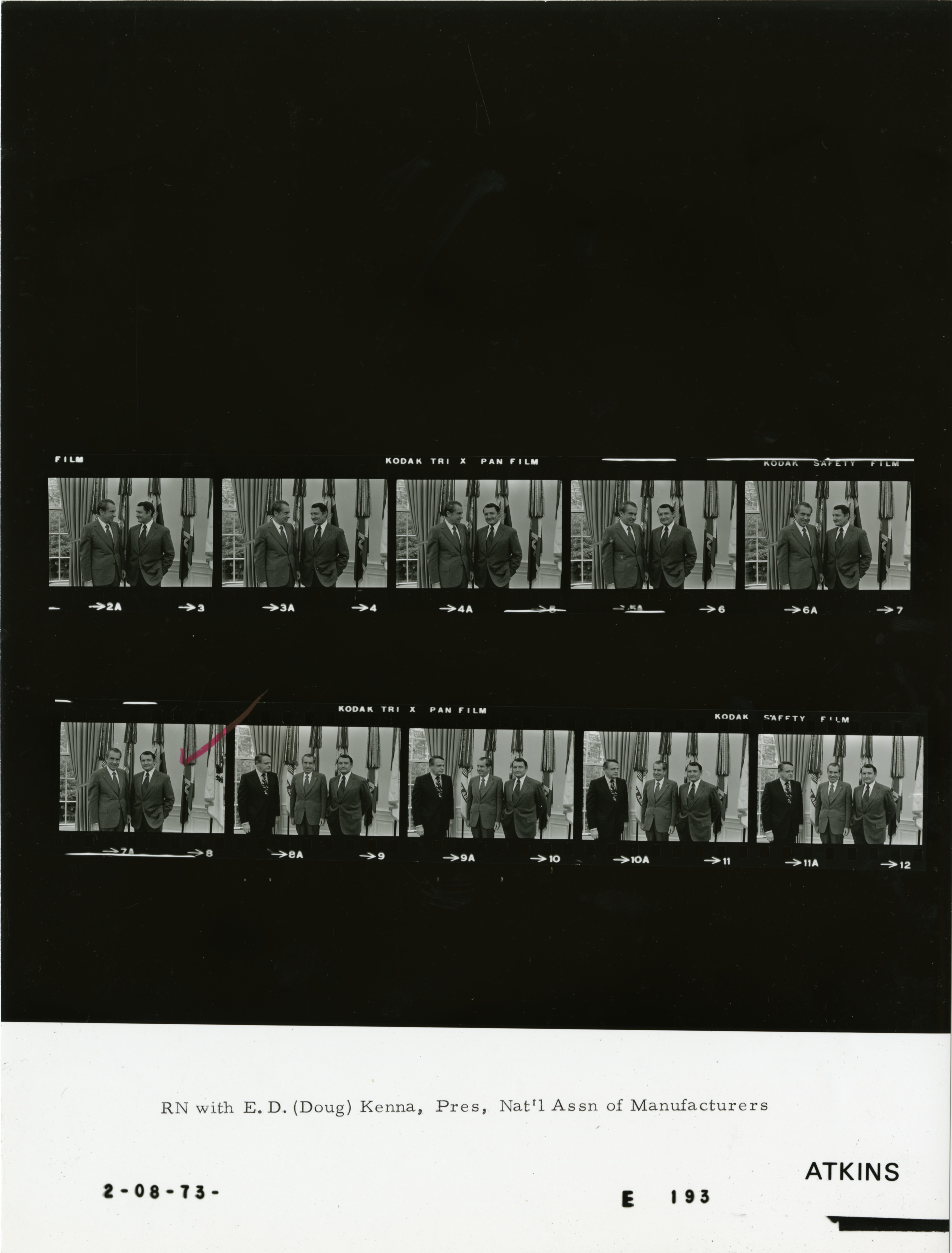
- Frame(s): WHPO-E0193-, President Nixon standing with Doug Kenna and Eugene Hardy of the National Association of Manufacturers. 2/8/1973, Washington, D.C. White House, Oval Office. President Nixon, Doug Kenna, Eugene Hardy.
Roll WHPO-E0194 Photographer: Schumacher, Karl | Color or B&W: B&W
- Frame(s): WHPO-E0194-, Mrs. Anne Armstrong. 2/8/1973, Washington, D.C. unknown. Anne Armstrong.
Roll WHPO-E0195 Photographer: Parish, William | Color or B&W: B&W
- Frame(s): WHPO-E0195-, Mike Farrell receiving a gift presentation from Parkman High School students and teachers. 2/8/1973, Washington, D.C. North Portico steps, White House. Michael Farrell, Parkman High School students and adults.
Roll WHPO-E0196 Photographer: Atkins, Oliver | Color or B&W: B&W
- Frame(s): WHPO-E0196-, President Nixon greeting and seated in the Oval Office with Senator Russell Long. 2/8/1973, Washington, D.C. White House, Oval Office. President Nixon, Russell Long.
- Frame(s): WHPO-E0196-12, President Nixon seated informally in the Oval Office during a meeting with Senator Russell Long. 2/8/1973, Washington, D.C. White House, Oval Office. President Nixon, Russell Long.
Roll WHPO-E0197 Photographer: Schumacher, Karl | Color or B&W: B&W
- Frame(s): WHPO-E0197-, Construction workers at work on a building. 2/8/1973, West Virginia unknown. construction workers.
Roll WHPO-E0198 Photographer: Schumacher, Karl | Color or B&W: B&W

- Frame(s): WHPO-E0198-06A-09A, President Nixon standing standing in the Oval office with John Campbell and Mrs. Campbell. 2/8/1973, Washington, D.C. White House, Oval Office. President Nixon, Mr. & Mrs. John Campbell.
- Frame(s): WHPO-E0198-10A-14A, President Nixon seated at his Oval office desk with Charles DiBona. 2/8/1973, Washington, D.C. White House, Oval Office. President Nixon, Charles DiBona.
- Frame(s): WHPO-E0198-16A-20A, President Nixon standing and seated standing standing in the Oval office with Daniel Patrick Moynihan. 2/8/1973, Washington, D.C. White House, Oval Office. President Nixon, Mr. & Daniel Moynihan.
- Frame(s): WHPO-E0198-19A, President Nixon seated at his Oval office desk with Daniel Patrick Moynihan during a meeting. 2/8/1973, Washington, D.C. White House, Oval Office. President Nixon, Daniel Patrick Moynihan.
Roll WHPO-E0199 Photographer: Schumacher, Karl | Color or B&W: Color
- Frame(s): WHPO-E0199-, President Nixon standing in the Oval office with John Campbell and Mrs. Campbell. 2/8/1973, Washington, D.C. White House, Oval Office. President Nixon, Mr. & Mrs. John Campbell.
Roll WHPO-E0221 Photographer: Knudsen, Robert L. | Color or B&W: B&W
- Frame(s): WHPO-E0221-03-21, Far East Tour. Henry Kissinger on a plane en route to Bangkok. 2/8/1973, enroute plane, interior. Henry Kissinger, unidentified Americans, Thai officials.
- Frame(s): WHPO-E0221-22-26, Far East Tour. Henry Kissinger and being greeted upon arrival in Bangkok. 2/8/1973, Bangkok, Thailand airport, tarmac. Henry Kissinger, unidentified Americans, Thai officials.
- Frame(s): WHPO-E0221-27-32, Far East Tour. Henry Kissinger and seated at a table. 2/8/1973, Bangkok, Thailand unidentified room. Henry Kissinger, unidentified Americans, Thai officials.
Roll WHPO-E0224 Photographer: Knudsen, Robert L. | Color or B&W: Color
- Frame(s): WHPO-E0224-02A-06A, Far East Tour. Personnel en route to Bangkok. 2/8/1973, air; Bangkok, Thailand plane, unidentified room. Kissinger, unidentified Americans.
- Frame(s): WHPO-E0224-07A-16A, Far East Tour. Kissinger standing with unidentified persons and seated at a table. 2/8/1973, air; Bangkok, Thailand plane, unidentified room. Kissinger, unidentified Americans.
The White House Communications Agency Sound Recordings Collection contains public statements that took place between 1969 and 1974. Visit the finding aid to learn more.
H - White House Staff Member Recordings
- WHCA-SR-H-683
Press briefing by Ronald Ziegler and John D. Ehrlichman. (2/8/1973, Press Lobby, White House)
Runtime: 46:00:00
Keywords: Press conferences, news conferences, interviews, media, press secretary
Production credits: Audio feed supplied by WHCA; Recorded by CRB (initials of WHCA engineer)
Original Format: 1/4-inch reel-to-reel audiotape. Original source type: Original.
L - White House Press Office Briefings
- WHCA-SR-L-128
Press briefing by Ronald Ziegler. (2/8/1973, Press Center, Laguna Beach, California)
Keywords: Press conferences, news conferences, interviews, media, press secretary
Original Format: 1/4-inch reel-to-reel audiotape. Original source type: Original.
The White House Communications Agency Videotape Collection contains “off-the-air” recordings of televised programs produced between 1968 and 1974. Visit the finding aid to learn more.
- WHCA-6099
Weekly News Summary, Tape III.
ALL NETWORKS
Runtime: 01:04:17
17. Smith/Kincaid: Former POW tells about adjusting to civilian life. Time Code Start: 40:09. Keywords: Vietnam War, Vietnam Prisoner of War, releases, psychology. Network: ABC.
18. Smith/Donaldson: Secretary of State Rogers comments on ceasefire. Time Code Start: 44:15. Keywords: cabinet, advisors, Vietnam War, ceasefires. Network: ABC.
19. Smith/Bell: Laos is already getting aid from U.S.. Time Code Start: 46:40. Keywords: Laos, Vietnam War. Network: ABC.
20. Smith/Jarriel: Ehrlichman comments on relations between Congress and President Nixon. Time Code Start: 49:41. Keywords: Presidents, House of Representatives, advisors, counsels, attorneys, lawyers, media, press conferences, news conferences, interviews. Network: ABC.
21. Smith: Commentary on fuel crisis. Time Code Start: 51:34. Keywords: energy crisis, oil crisis, petroleum, oil supply, gasoline, fuel, shortages, rationing, allocations. Network: ABC.
22. Chancellor/Levine: Pennsylvania Central strike. Time Code Start: 53:10. Keywords: railroads, trains, railroad industry, rail cars, mass transit, transportation, strikes, economy, recession, inflation, money, wages, costs, unemployment. Network: NBC.
23. Chancellor/Rosenfeld: POW releases; South Vietnam's President Thieu and Secretary of State Rogers disagree on ceasefire working. Time Code Start: 55:52. Keywords: South Vietnam, Presidents, speeches, statements, Vietnam War, ceasefires, Vietnam Prisoner of War. Network: NBC.
24. Chancellor: Draft dodger K. Rutledge returns home from Sweden. Time Code Start: 58:58. Keywords: military, conscription, evasion, selective service, lottery, laws, Vietnam War, conscientious objectors, political offenses, pardons, draft reform, draft evasion. Network: NBC.
25. Chancellor: Roy Ash at Senate hearing with Senator Proxmire. Time Code Start: 60:24. Keywords: cabinet, advisors, Senators, hearings, investigations, Watergate, Senate committee hearings, investigations, testimony, testify, cover-ups, break-in, burglary, theft, plumbers, scandals. Network: NBC.
26. Chancellor: Chapin and Watergate; Senate confirmations of President Nixon appointees. Time Code Start: 62:27. Keywords: Dirty Tricks, political sabotage, trials, Watergate, Senate committee hearings, investigations, testimony, testify, cover-ups, Presidential elections, campaigns. Network: NBC. - WHCA-6100
Weekly News Summary, Tape IV.
ALL NETWORKS
Runtime: 0:15
1. Cronkite/Kalb/Webster: Secretary of State Rogers before Congress; South Vietnam's President Thieu says there is no ceasefire; a Viet Cong visit. Time Code Start: 00:00. Keywords: South Vietnam, Presidents, speeches, statements, Vietnam War, ceasefires, People's Liberation Armed Forces (PLAF), National Liberation Front (NLF), VC,. Network: CBS.
2. Cronkite/Herman: The American dollar. Time Code Start: 06:24. Keywords: economy, economics, budgets, finances, recession, inflation, money, currency, monetary values, exchange rates, decreases, wages, costs, increases. Network: CBS.
3. Cronkite: Colson to travel to Moscow, Russia; Ehrlichman attacks Congress. Time Code Start: 08:22. Keywords: advisors, counsels, attorneys, lawyers, statements, travel, trips, Soviet Union, USSR, House of Representatives. Network: CBS.
4. Cronkite/Sevareid: Commentary on the President Nixon and Congress battle. Time Code Start: 09:47. Keywords: Presidents, House of Representatives. Network: CBS.
Context (External Sources)
The Vanderbilt Television News Archive is the world's most extensive and complete archive of television news. They have been recording, preserving and providing access to television news broadcasts of the national networks since August 5, 1968.
Wikipedia is a free encyclopedia that anyone can edit.