
Introduction
This almanac page for Tuesday, February 6, 1973, pulls together various records created by the federal government and links to additional resources which can provide context about the events of the day.
Previous Date: Monday, February 5, 1973
Next Date: Wednesday, February 7, 1973
Schedule and Public Documents
The Daily Diary files represent a consolidated record of the President's activities. Visit the finding aid to learn more.
The President's day began at The White House - Washington, D. C.
The Weekly Compilation of Presidential Documents made available transcripts of the President's news conferences; messages to Congress; public speeches, remarks, and statements; and other Presidential materials released by the White House.
Digitized versions can be found at HathiTrust.
Each Public Papers of the Presidents volume contains the papers and speeches of the President of the United States that were issued by the White House Office of the Press Secretary during the time period specified by the volume. The material is presented in chronological order, and the dates shown in the headings are the dates of the documents or events. In instances when the release date differs from the date of the document itself, that fact is shown in the text note.
To ensure accuracy, remarks have been checked against audio recordings (when available) and signed documents have been checked against the original, unless otherwise noted. Editors have provided text notes and cross references for purposes of identification or clarity.
The Federal Register is the official daily publication for rules, proposed rules, and notices of federal agencies and organizations, as well as executive orders and other Presidential documents.
The Congressional Record is the official daily record of the debates and proceedings of the U.S. Congress.
Archival Holdings
Any selection of archival documents will necessarily be partial. You should use the documents and folders identified below as a starting place, but consult the linked collection finding aids and folder title lists and the collections themselves for context. Many documents to be found this way do not lend themselves to association with specific dates, but are essential to a complete understanding of the material.
Selective document listing
President's Office Files
The President's Office Files consists of materials drawn together by the Special Files Unit from several administrative subdivisions within the White House Office. It is the handwriting and sensitive papers sent to the Staff Secretary that now comprise much of the President's Office Files. Visit the finding aid to learn more.
- Annotated and Unmarked News Summaries [Note: Although there was no News Summary on this date, due to the way News Summary products were compiled, you should also consult nearby days for potentially relevant materials.]
President's Personal File
The President's Personal File is essentially a President's secretary's file, kept by Rose Mary Woods, personal secretary to the President, for two purposes: (1) preserving for posterity a collection of documents particularly close to the President, whether because he dictated or annotated them, or because of the importance of the correspondent or the event concerned and (2) giving appropriate attention–letters of gratitude, invitations to White House social events, and the like–to members and important friends and supporters of the Nixon administration. This generalization does not describe all the varied materials of a file group which is essentially a miscellany, but it does identify the reason for the existence of the file group's core. Visit the finding aid to learn more.
- President's Speech File
The H. R. Haldeman Diaries consists of seven handwritten diaries, 36 dictated diaries recorded as sound recordings, and two handwritten audio cassette tape subject logs. The diaries and logs reflect H. R. Haldeman’s candid personal record and reflections on events, issues, and people encountered during his service in the Nixon White House. As administrative assistant to the President and Chief of Staff, Haldeman attended and participated in public events and private meetings covering the entire scope of issues in which the Nixon White House engaged in during the years 1969-1973. Visit the finding aid to learn more.
- Transcript of diary entry (PDF)
Tuesday, February 6.
Got into David's problem again this morning. The President says that-- he called me in, and was quite upset. He says that David's captain had called him and treated him very rough, urged him to stay. That the Secretary of Navy had said it would look political if he got out, and that it's now gotten as high as Warner and something's got to be done about it. I then checked with Scowcroft who says that the captain rolled him last summer when he first applied, but his application went in anyway. It was verbally okayed by his detailer but not acted on, so he missed the December list. The question then was whether he should be added to it. That was raised with the Secretary of Navy, who said it would be best to put him on the next routine list, so that he wouldn't be getting special treatment. Thus, he's up for March 31 retirement. There has been no further pressure on it, but now he wants to serve until the ship goes into the yard. I then called David at Camp David, and he said that's true, that he has the 31 March release date, but he doesn't think it's a good time, and he's asked Campbell to check into postponing it until July. The President doesn't seem to be satisfied with this. I think the real problem is Julie pressuring him to get something done to get David out. The President said he talked with Julie and she and David have decided that they want to go to California, so he is now going to leave on Thursday at 3:00 and will stay out there until the 19th. Wants a light schedule. Wants to add a Cabinet meeting Thursday morning for breakfast, before he goes.
Then got into the question of our need to have a better feel as to how to present things, such as at the leadership meeting this morning. Scott requested that we have some of these key points written down on a piece of paper, and Ehrlichman told him it was all covered in the budget book, which misses the point. We've got to spell out the key points, the grabbers and so on. Ash was excellent and articulate, much better than Shultz, but he doesn't give them simple, grabby terms. You've got to give a guy a few lines that he can memorize.
He got into that again this evening, saying that we've got to prepare leadership meetings and that sort of thing better ahead. That Timmons is not a good emcee, because you can't tell him to hit this or that. There should be a meeting ahead to figure out the three or four lines that the leaders should have and then get those across.
We got into a flap on his radio speech for tomorrow, when Steve took it into him late this afternoon with no time for preparation, so he's not going to do it. He says he has to have a day to work on any speech, so he'll try to do that one on Thursday. He got into a lot of odds and ends on strategy. He wants Kissinger to keep Sonnenfeld in the NSC, because he's too good to lose. He says State Dinners are the worst thing of all to have to do. That he'll have no Mexican State Visits. That we still have a hole on the President's speeches, someone in charge of what he's going to say. Shultz and Burns, for example, are pushing for a talk on international monetary and trade and they'll want it on TV, which absolutely the President will not do. So it's got to be understood that all Presidential public presentations must come in through me. He says everybody's so busy on substance that the sparks don't come, which is why the Domestic Council is so dull. The charts don't get the message to the people. You have to just give them six or eight points. He made the point that he found the line for the prayer breakfast regarding the song from a letter that came to him and wonders why we can't get some more of this kind of thing out of the mail, which is a very good indication of what people are saying and in the way that they are saying it. He wants a poll on amnesty again. Be sure to word the question right to get a reading on where we stand there.
We then got into quite a long question and discussion of Henry's whole situation, making the point that he's made all the big plays now and is trying to look for ways to maintain the momentum, which is essentially impossible. There is no way to duplicate the year that has just been completed. That's what Henry is in effect trying to do, although he may not realize it. He feels he's running down and getting bored, and for that matter, so is the President. There's a real letdown and psychological depression after the type of accomplishments that they've had. Henry's obviously not interested in taking the time to work out the details of the agreement, etcetera, which must be done, but doesn't really interest him at this point. So we've got to watch this as he completes his trip and comes back. Especially he is reluctant to move into the Middle East, which the President feels has got to be settled now. Henry's pushing for a big European bang of some kind later in the year, with an all-European Summit of some sort, which the President's reluctant to move on, at least at this time.
End of February 6. - Original audio recording (MP3)
The National Archives Catalog is the online portal to the records held at the National Archives, and information about those records. It is the main way of describing our holdings and also provides access to electronic records and digitized versions of our holdings.
The Catalog searches across multiple National Archives resources at once, including archival descriptions, digitized and electronic records, authority records, and web pages from Archives.gov and the Presidential Libraries. The Catalog also allows users to contribute to digitized historical records through tagging and transcription.
Nixon Library Holdings
All National Archives Units
National Security Documents
The President's Daily Brief is the primary vehicle for summarizing the day-to-day sensitive intelligence and analysis, as well as late-breaking reports, for the White House on current and future national security issues. Read "The President's Daily Brief: Delivering Intelligence to Nixon and Ford" to learn more.
The Foreign Relations of the United States series presents the official documentary historical record of major U.S. foreign policy decisions and significant diplomatic activity. Visit the State Department website for more information.
Vol. X, Vietnam, January 1973-July 1975
Neither War nor Peace, January 27-June 15, 1973
9. Minutes of Washington Special Actions Group Meeting, Washington, February 6, 1973, 4:38-5:30 p.m.
Source: National Archives, Nixon Presidential Materials, NSC Files, NSC Institutional Files (H–Files), Box H–117, WSAG Meeting Minutes, Originals, 1973. Top Secret; Sensitive. The meeting was held in the White House Situation Room.
Vol. XVIII, China, 1973-1976
Kissinger's Visits to Beijing and the Establishment of the Liaison Offices, January 1973-May 1973
6. National Security Decision Memorandum 204, Washington, February 6, 1973
Source: National Archives, Nixon Presidential Materials, NSC Files, NSC Institutional Files (H–Files), Box H–238, National Security Decision Memoranda, NSDM 204. Secret. Robert Hormats, with the concurrence of Executive Director of the Council for International Economic Policy Peter Flanigan, sent a January 22 memorandum to Kissinger recommending approval of the sale and disapproval of the transfer of civil inertial navigational systems to the Commodity Control List. (Ibid.) On January 30, Hormats sent Kissinger a memorandum recommending the approval of the draft NSDM which Kissinger initialed and forwarded to the President, who also approved it. (Ibid.)
Vol. XXV, Arab-Israeli Crisis and War, 1973
Arab-Israeli Crisis and War, 1973
14. Memorandum for the President’s File by the President’s Assistant for National Security Affairs (Kissinger), Washington, February 6, 1973, 11:35 a.m.-12:45 p.m.
Source: National Archives, Nixon Presidential Materials, NSC Files, Kissinger Office Files, Box 137, Country Files, Middle East, Iran—Oil to JORDAN/RIFAI, January 3, 1973 [2 of 2]. Top Secret; Sensitive. A Presidential tape recording of the conversation is ibid., White House Tapes, Conversation No. 850–8.
Vol. XXXI, Foreign Economic Policy, 1973-1976
The End of Fixed Exchange Rates, January-March 1973
3. Conversation Among President Nixon, Secretary of the Treasury Shultz, and the Chairman of the Federal Reserve System Board of Governors (Burns), Washington, February 6, 1973
Source: National Archives, Nixon Presidential Materials, White House Tapes, Oval Office, Conversation 851–4. No classification marking. According to the President’s Daily Diary, Nixon met with Shultz and Burns in the Oval Office from 5:11 to 6:10 p.m. (Ibid., White House Central Files) The editor transcribed the portion of the conversation printed here specifically for this volume.
Vol. XXXV, National Security Policy, 1973-1976
National Security Policy
3. National Security Decision Memorandum 203, Washington, February 6, 1973
Source: National Archives, Nixon Presidential Materials, NSC Files, NSC Institutional Files (H-Files), Box H–238, NSDM 203. Confidential. A copy was sent to the Secretary of the Treasury.
Vol. XXXVI, Energy Crisis, 1969-1974
March 16, 1972-March 6, 1973
159. Memorandum From the President’s Deputy Assistant for National Security Affairs (Scowcroft) to the President’s Assistant for National Security Affairs (Kissinger), Washington, February 6, 1973
Source: National Archives, Nixon Presidential Materials, NSC Files, Box 250, Agency Files, National Energy Office, Vol. I, March 1972–February 1973. No classification marking.
Vol. E-11, Part 1, Documents on Mexico; Central America; and the Caribbean, 1973-1976
Guyana
361. Memorandum From the Deputy Director for Plans, Central Intelligence Agency (Karamessines), to the President’s Assistant for National Security Affairs (Kissinger), Washington, February 6, 1973
Summary: The CIA assessed the political situation in Guyana and concluded there was no need to reconsider the 40 Committee’s December 1972 decision to terminate covert electoral support for Burnham’s government.
Source: National Security Council, Nixon Intelligence Files, Subject Files A–I, Guyana, 23 May 1969–6 February 1973. Secret; Sensitive; Eyes Only. All brackets are in the original except those indicating text that remains classified. A copy was sent to Meyer. For background on the decision to terminate covert assistance to Burnham, see Documents 376 and 379 in Foreign Relations, 1969–1976, vol. E–10, Documents on American Republics, 1969–1972.
The Kissinger telephone conversation transcripts consist of approximately 20,000 pages of transcripts of Kissinger’s telephone conversations during his tenure as Assistant to the President for National Security Affairs (1969-1974) and Secretary of State (1973-1974) during the administration of President Richard Nixon. Visit the finding aid for more information.
Digitized versions can be found in the National Archives Catalog.
Audiovisual Holdings
Visit the White House Tapes finding aid to learn about the taping system's operation and archival processing.
Cabinet Room
- 112-3; Unknown between 9:35 a.m. & 11:16 a.m.; Nixon, Richard M. (President); Scott, Hugh; Griffin, Robert P.; Bennett, Wallace F.; Brock, William E., III; Tower, John G.; Ford, Gerald R.; Arends, Leslie C.; Anderson, John B.; Devine, Samuel L.; Conable, Barber B., Jr.; Wilson, Robert C. ("Bob"); Bush, George H. W.; Ash, Roy L.; Ehrlichman, John D.; Timmons, William E.; Cook, Richard K.; Korologos, Thomas C.; Ziegler, Ronald L.; Cole, Kenneth R., Jr.
- 112-5; Unknown between 11:16 a.m., 2/6 & 7:57 a.m., 8/5; Brown, L. Dean; Kissinger, Henry A.; [Unknown person(s)]
Old Executive Office Building
- 409-8; 1:54 p.m. - 1:54 p.m.; Nixon, Richard M. (President); White House operator
- 409-9; 1:54 p.m. - 1:55 p.m.; Nixon, Richard M. (President); Sanchez, Manolo
- 409-10; 1:55 p.m. - 1:56 p.m.; Nixon, Richard M. (President); Bull, Stephen B.
- 409-11; Unknown between 1:57 p.m. & 2:47 p.m.; Nixon, Richard M. (President); Sanchez, Manolo
- 409-12; Unknown between 1:57 p.m. & 2:47 p.m.; Nixon, Richard M. (President); White House operator
- 409-13; Unknown between 1:57 p.m. & 2:47 p.m.; Nixon, Richard M. (President); Rogers, William P.
- 409-14; Unknown between 2:47 p.m. & 2:57 p.m.; Nixon, Richard M. (President); Eisenhower, Julie Nixon
- 409-15; Unknown between 2:47 p.m. & 2:57 p.m.; Nixon, Richard M. (President); White House operator
- 409-16; Unknown between 2:47 p.m. & 2:57 p.m.; Nixon, Richard M. (President); [Unknown person(s)]
- 409-17; 2:52 p.m. - 4:26 p.m.; Nixon, Richard M. (President); Colson, Charles W.; Bull, Stephen B.; Kissinger, Henry A.; Woods, Rose Mary; [Unknown person(s)]
Oval Office
- 850-1; Unknown between 8:32 a.m. & 9:08 a.m.; Nixon, Richard M. (President); Bull, Stephen B.
- 850-2; Unknown between 8:32 a.m. & 9:08 a.m.; Nixon, Richard M. (President); [Unknown person(s)]; Bull, Stephen B.
- 850-3; Unknown between 8:32 a.m. & 9:08 a.m.; Nixon, Richard M. (President); Bull, Stephen B.
- 850-4; 9:08 a.m. - 9:16 a.m.; Nixon, Richard M. (President); Woods, Rose Mary
- 850-5; 9:19 a.m. - 9:35 a.m.; Nixon, Richard M. (President); Haldeman, H. R. ("Bob"); Ehrlichman, John D.; Bull, Stephen B.
- 850-6; 11:16 a.m. - 11:17 a.m.; Nixon, Richard M. (President); Ziegler, Ronald L.
- 850-7; Unknown between 11:17 a.m. & 11:34 a.m.; Nixon, Richard M. (President); Bull, Stephen B.; Ziegler, Ronald L.
- 850-8; 11:34 a.m. - 12:38 p.m.; Nixon, Richard M. (President); ibn Talal, Hussein (King); White House operator; Ziegler, Ronald L.; Kissinger, Henry A.; Rifai, Zaid al-
- 850-9; 12:42 p.m. - 12:48 p.m.; Nixon, Richard M. (President); Bull, Stephen B.
- 850-10; Unknown between 12:48 p.m. & 12:51 p.m.; Nixon, Richard M. (President); Bull, Stephen B.
- 850-11; 12:51 p.m. - 1:23 p.m.; Nixon, Richard M. (President); Haldeman, H. R. ("Bob"); Bull, Stephen B.
- 850-12; Unknown between 9:35 a.m. & 11:16 a.m.; Haldeman, H. R. ("Bob"); [Unknown person(s)]
- 850-13; Unknown between 12:38 p.m. & 12:42 p.m.; [Unknown person(s)]
- 851-1; 4:32 p.m. - 4:49 p.m.; Nixon, Richard M. (President); Bull, Stephen B.
- 851-2; Unknown between 4:49 p.m. & 4:59 p.m.; Nixon, Richard M. (President)
- 851-3; Unknown between 4:49 p.m. & 5:11 p.m.; Nixon, Richard M. (President); [Unknown person(s)]; Woods, Rose Mary; Haldeman, H. R. ("Bob"); Bull, Stephen B.
- 851-4; 5:11 p.m. - 6:10 p.m.; Nixon, Richard M. (President); Burns, Arthur F.; Shultz, George P.; Bull, Stephen B.
- 851-5; Unknown between 6:12 p.m. & 7:19 p.m.; Nixon, Richard M. (President); Haldeman, H. R. ("Bob"); Sanchez, Manolo
White House Telephone
- 43-31; Unknown between 1:54 p.m. & 2:47 p.m.; Nixon, Richard M. (President); White House operator
- 43-32; 2:47 p.m. - 2:50 p.m.; Nixon, Richard M. (President); White House operator; Eisenhower, Julie Nixon
- 43-33; Unknown between 2:50 p.m. & 11:50 p.m.; Nixon, Richard M. (President); White House operator
- 43-34; Unknown between 2:50 p.m. & 11:50 p.m.; Nixon, Richard M. (President); White House operator
- 43-35; 11:50 p.m. - 11:51 p.m.; Nixon, Richard M. (President); Tkach, Walter R.
- 43-36; 11:57 p.m. - 11:58 p.m.; Nixon, Richard M. (President); Tkach, Walter R.
The White House Photo Office collection consists of photographic coverage of President Richard Nixon meeting with prominent social, political, and cultural personalities; speaking engagements and news conferences of the President and various high-ranking members of the White House staff and Cabinet; Presidential domestic and foreign travel, including Presidential vacations; social events and entertainment involving the First Family, including entertainers present; official portraits of the President, First Family, and high-ranking members of the Nixon administration; the 1969 and 1973 Inaugurals; the President’s 1972 Presidential election campaign appearances (including speeches) and other official activities of the White House staff and the President’s Cabinet from January 20, 1969 until August 9, 1974 at the White House and the Old Executive Office Building; other locations in Washington, DC, such as The Mall; and the Presidential retreats in Camp David, Maryland, Key Biscayne, Florida, and San Clemente, California. Visit the finding aid to learn more.
Roll WHPO-E0178 Photographer: Schumacher, Karl | Color or B&W: B&W
- Frame(s): WHPO-E0178-, Deputy Special Assistant John E. Nidecker receiving a gift presentation. 2/6/1973, Washington, D.C. unknown. Nidecker, unidentified man.
Roll WHPO-E0179 Photographer: Schumacher, Karl | Color or B&W: B&W
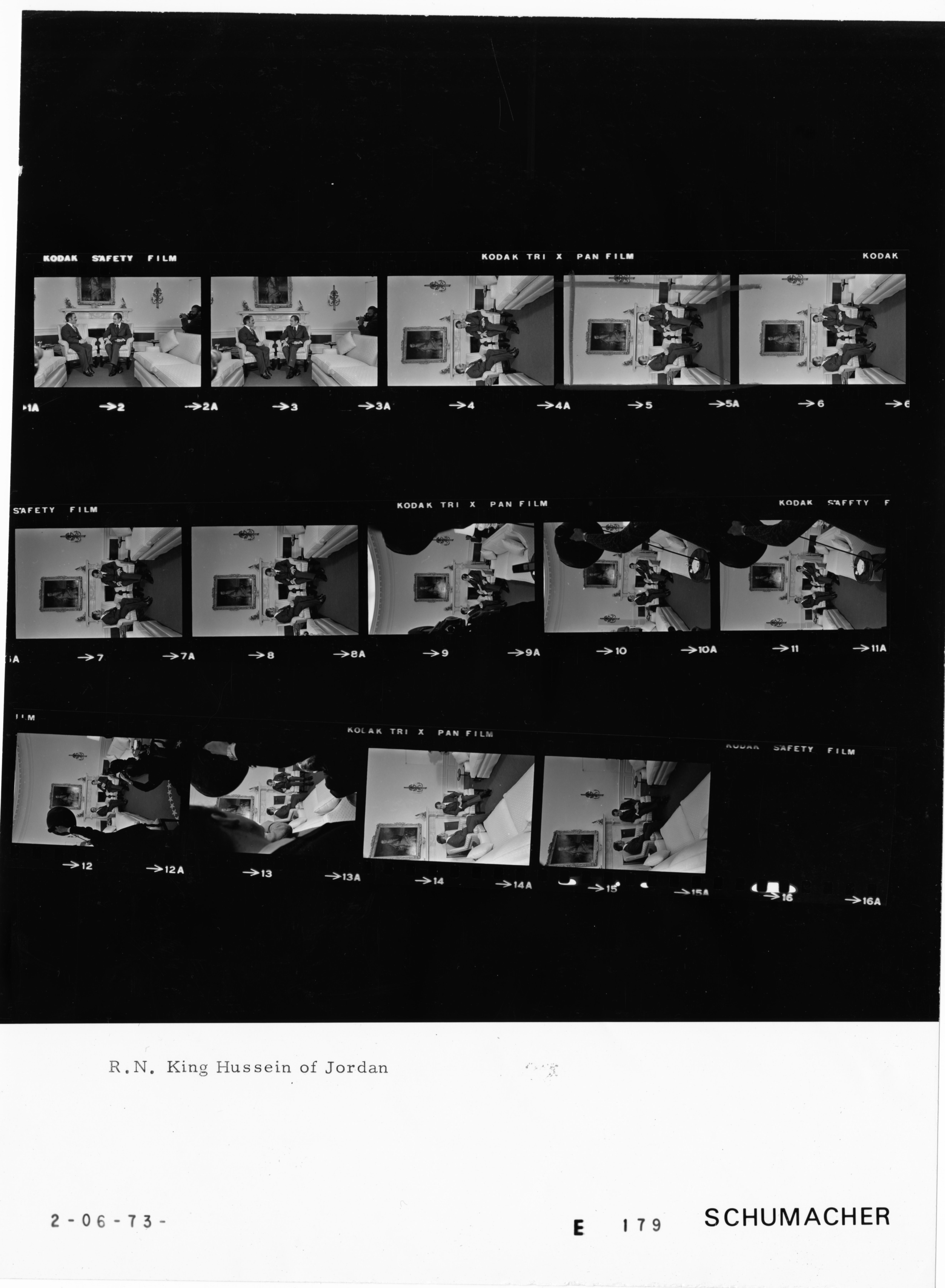
- Frame(s): WHPO-E0179-, President Nixon seated informally in the Oval office during a meeting with King Hussein of Jordan. 2/6/1973, Washington, D.C. White House, Oval Office. President Nixon, King Hussein.
- Frame(s): WHPO-E0179-13, President Nixon seated informally in the Oval office during a meeting with King Hussein of Jordan. Viewed from a space in between people in the room. 2/6/1973, Washington, D.C. White House, Oval Office. President Nixon, King Hussein.
Roll WHPO-E0180 Photographer: Schumacher, Karl | Color or B&W: B&W
- Frame(s): WHPO-E0180-, Peter Flanigan seated. 2/6/1973, Washington, D.C. unknown. Peter Flanigan, unidentified man.
Roll WHPO-E0181 Photographer: Atkins, Oliver | Color or B&W: Color
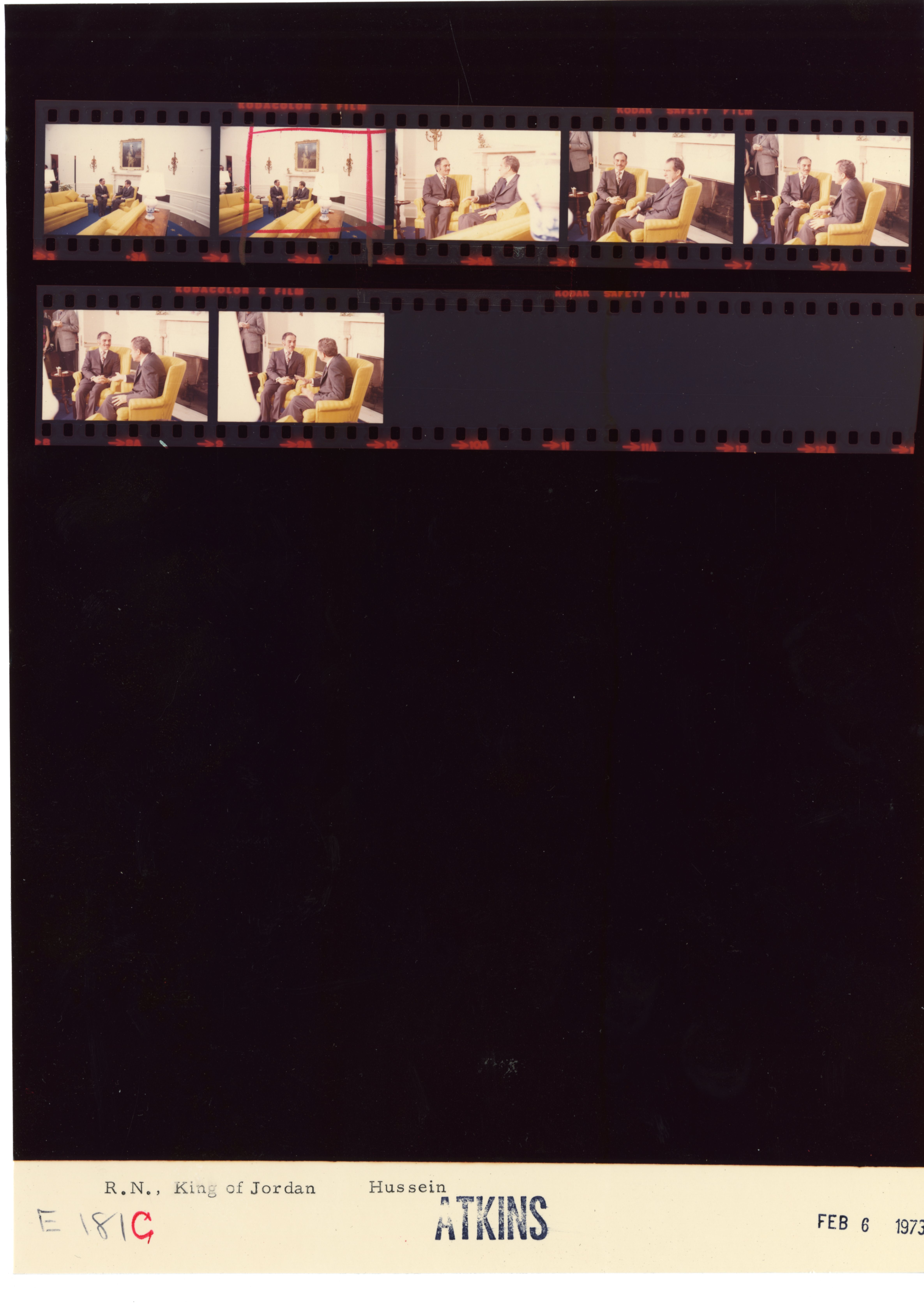
- Frame(s): WHPO-E0181-, President Nixon seated in the Oval office with King Hussein of Jordan. 2/6/1973, Washington, D.C. White House, Oval Office. President Nixon, King Hussein.
Roll WHPO-E0182 Photographer: Schumacher, Karl | Color or B&W: Color
- Frame(s): WHPO-E0182-, Pat Nixon accepting an award from the Greater Washington Area Chapter of Hadassah and in a receiving line alnogside National Hadassah President Rose Matzkin, Washington Area President Helene Karpa, and event chair Barbara Topol. 2/6/1973, Washington, D.C. Mayflower Hotel. Pat Nixon, Barbara Topol, Helene Karpa, Lester Tepper, Rose Matzkin, Hadassah members.
Roll WHPO-E0183 Photographer: Kightlinger, Jack | Color or B&W: Color
- Frame(s): WHPO-E0183-03A-07A, President Nixon greeting King Hussein and Queen Alia of Jordan upon their arrival for a state dinner at the White House. 2/6/1973, Washington, D.C. North Portico Entrance. President Nixon, Pat Nixon, King Hussein, Queen Alia.
- Frame(s): WHPO-E0183-05A, President Nixon greeting King Hussein and Queen Alia of Jordan upon their arrival for a state dinner at the White House. 2/6/1973, Washington, D.C. North Portico Entrance, Grand Hall, White House, East Room. President Nixon, Pat Nixon, King Hussein, Queen Alia al-Hussein.
- Frame(s): WHPO-E0183-08A-16A, President Nixon, Pat Nixon, King Hussein and Queen Alia pose for a group portrait at the Grand Staircase before proceeding to a White House state dinner. 2/6/1973, Washington, D.C. Grand Staircase. President Nixon, Pat Nixon, King Hussein, Queen Alia.
- Frame(s): WHPO-E0183-11, President Nixon, Pat Nixon, King Hussein, and Queen Alia pose for a group portrait at the Grand Staircase before proceeding to a White House state dinner. 2/6/1973, Washington, D.C. White House, Grand Staircase. President Nixon, Pat Nixon, King Hussein, Queen Alia.
- Frame(s): WHPO-E0183-18A-24A, President Nixon, Pat Nxon, King Hussein and Queen Alia of Jordan greet state dinner guests in a receiving line at the White House. 2/6/1973, Washington, D.C. North Portico Entrance, Grand Hall, White House, East Room. President Nixon, Pat Nixon, King Hussein, Queen Alia, guests, Ethel Ennis, Mike Curb, Mike Curb Congregation members.
- Frame(s): WHPO-E0183-25A-26A, President Nixon, Pat Nixon, King Hussein and Queen Alia walk down the White House Grand Hall to a state dinner. 2/6/1973, Washington, D.C. Grand Hall. President Nixon, Pat Nixon, King Hussein, Queen Alia.
- Frame(s): WHPO-E0183-27A-29A, Ethel Ennis, Mike Curb and the Mike Curb Congregation members singers performing on stage in the East Room. 2/6/1973, Washington, D.C. East Room. Ethel Ennis, Mike Curb, Mike Curb Congregation members.
- Frame(s): WHPO-E0183-29A-32A, President Nixon, Pat Nixon, King Hussein and Queen Alia pose for a group portrait with the Mike Curb Congregation singers on stage in the East Room. 2/6/1973, Washington, D.C. East Room. President Nixon, Pat Nixon, King Hussein, Queen Alia, guests, Ethel Ennis, Mike Curb, Mike Curb Congregation members.
- Frame(s): WHPO-E0183-30A, Mike Curb Congregation entertains at the White House during King Jussein's visit. 2/6/1973, Washington, D.C. North Portico Entrance, Grand Hall, White House, East Room. President Nixon, Pat Nixon, King Hussein, Mike Curb Congregation members.
Roll WHPO-E0255 Photographer: Kightlinger, Jack | Color or B&W: Color
- Frame(s): WHPO-E0255-06A, The Mike Curb Congregation. Entertainers at the state dinner in honor of King Hussein of Jordan. 2/6/1973, Washington, D.C. White House, East Room. Mike Curb Congregation.
The White House Communications Agency Sound Recordings Collection contains public statements that took place between 1969 and 1974. Visit the finding aid to learn more.
I - Various Administration Events
- WHCA-SR-I-128
Remarks of WHCA staff at farewell party for General Redman at Tayloe House, with Ronald Ziegler, Lt. Colonel Priddle, Mike Duval, and Chief Warrant Officer Stevens. (2/6/1973)
Runtime: 30:00:00
Original Format: 1/4-inch reel-to-reel audiotape. Original source type: Original.
L - White House Press Office Briefings
- WHCA-SR-L-123
Press briefing by Gerald Warren. (2/6/1973, White House Press Lobby)
Runtime: 0:03
Keywords: Press conferences, news conferences, interviews, media
Original Format: 1/4-inch reel-to-reel audiotape. Original source type: Original. - WHCA-SR-L-124
Press briefing by Ronald Ziegler, with Senate Minority Leader Hugh Scott (R-PA) and House Minority Leader Gerald Ford (R-MI). (2/6/1973, White House Press Lobby)
Runtime: 43:25:00
Keywords: Press conferences, news conferences, interviews, media, press secretary
Original Format: 1/4-inch reel-to-reel audiotape. Original source type: Original. - WHCA-SR-L-125
Press briefing by Gerald Warren. (2/6/1973, White House Press Lobby)
Runtime: 6:52
Keywords: Press conferences, news conferences, interviews, media
Original Format: 1/4-inch reel-to-reel audiotape. Original source type: Original.
P - Formal Presidential Remarks
- WHCA-SR-P-730206
Remarks by President Nixon in toast to King Hussein, with King Hussein. (2/6/1973)
Runtime: 6:44
Original Format: 1/4-inch reel-to-reel audiotape. Original source type: Original. - WHCA-SR-P-730207
Remarks by President Nixon at entertainment in honor of King Hussein. (2/6/1973)
Runtime: 2:19
Keywords: Musician, musicians, music, celebrities, performance, American popular music
Original Format: 1/4-inch reel-to-reel audiotape. Original source type: Original.
The White House Communications Agency Videotape Collection contains “off-the-air” recordings of televised programs produced between 1968 and 1974. Visit the finding aid to learn more.
- WHCA-6096
"Today" Show excerpt.
ALL NETWORKS
Runtime: 00:31:50 - WHCA-6098
Weekly News Summary, Tape II.
ALL NETWORKS
Runtime: 1:00
9. Smith/Bennett: POWs release, international conference, Kissinger, truce supervision. Time Code Start: 16:11. Keywords: Vietnam War, Vietnam Prisoner of War, releases, truces. Network: ABC.
10. Smith/Bell/Peterson: Joint Military Commission, mine sweeping. Time Code Start: 19:05. Keywords: Armed Forces, Air Force, Army, Navy, Marines, Coast Guard, National Guard, organizations, oceans, explosives, bombs, detection. Network: ABC.
11. Smith/Jarriel/Tomlinson: President Nixon vs Congress. Time Code Start: 22:22. Keywords: Presidents, House of Representatives. Network: ABC.
12. Smith/Donaldson: Watergate. Time Code Start: 26:04. Keywords: Watergate, Senate committee hearings, investigations, testimony, testify, cover-ups, break-in, burglary, theft, plumbers, scandals. Network: ABC.
13. Smith/Jennings: U.S. and Jordan. Time Code Start: 28:17. Keywords: Middle East, Mideast, war, Jordanian. Network: ABC.
14. Smith: Commentary on real peace. Time Code Start: 31:06. Keywords: Paris Peace Talks, Vietnam War, treaty, treaties, negotiations. Network: ABC.
15. Chancellor/Jones/Nessen: POWs to be released sometime this weekend, International Commission of Control and Supervision (ICCS) in the field. Time Code Start: 32:58. Keywords: Vietnam War, Vietnam Prisoner of War, releases, exchanges, ceasefires, management organizations. Network: NBC.
16. Chanceller/Nessen: American troops leaving Vietnam. Time Code Start: 36:14. Keywords: Vietnam War, military, troops, withdrawals. Network: NBC.
17. Chancellor/Duke: Separation of powers (Senators Muskie and Scott). Time Code Start: 38:38. Keywords: legislative, judiciary, executive, checks and balances, branches of government. Network: NBC.
18. Chancellor/Valeriani: King Hussein visits President Nixon (film). Time Code Start: 40:55. Keywords: Presidents, royalty, Kings, Middle East, Mideast, Jordanian, meetings. Network: NBC.
19. Cronkite/Wagner/Webster: POWs release, International Commission of Control and Supervision (ICCS). Time Code Start: 42:06. Keywords: Vietnam War, Vietnam Prisoner of War, releases, exchanges, ceasefires, management organizations. Network: CBS.
20. Cronkite/Davis: Report on Viet Cong. Time Code Start: 46:10. Keywords: Vietnam War, People's Liberation Armed Forces (PLAF), National Liberation Front (NLF), VC. Network: CBS.
21. Cronkite/Herman: President Nixon to veto any bill considered budget escalating (Senator Proxmire, Representatives Mahon, Stein, Patman, Byrd, Senator Ted Kennedy, and Erwin). Time Code Start: 49:04. Keywords: Presidents, bills, laws, vetoes, economy, economics, budgets, finances, recession, inflation, money, wages, costs, unemployment, prices. Network: CBS.
22. Cronkite/Schorr: Watergate, Mitchell to be questioned. Time Code Start: 51:40. Keywords: Watergate, Senate committee hearings, investigations, testimony, testify, cover-ups, break-in, burglary, theft, plumbers, scandals. Network: CBS.
23. Cronkite/Morton: Press struggle for freedom. Time Code Start: 52:34. Keywords: media, newspapers, magazines, publications, civil rights, constitutional rights, First Amendment. Network: CBS.
24. Cronkite/McLaughlin: Clark Air Force Base (AFB) prepares for POW arrivals. Time Code Start: 56:33. Keywords: Vietnam War, Vietnam Prisoner of War, releases, arrivals, Armed Forces, military, air bases, airfields, airports, hospitals. Network: CBS.
25. Cronkite/Sevareid: POWs. Time Code Start: 58:16. Keywords: Vietnam War, Vietnam Prisoner of War. Network: CBS.
Context (External Sources)
The Vanderbilt Television News Archive is the world's most extensive and complete archive of television news. They have been recording, preserving and providing access to television news broadcasts of the national networks since August 5, 1968.
Wikipedia is a free encyclopedia that anyone can edit.