

Introduction
This almanac page for Thursday, February 6, 1969, pulls together various records created by the federal government and links to additional resources which can provide context about the events of the day.
Previous Date: Wednesday, February 5, 1969
Next Date: Friday, February 7, 1969
Schedule and Public Documents
The Daily Diary files represent a consolidated record of the President's activities. Visit the finding aid to learn more.
The President's day began at The White House - Washington, D. C.
The Weekly Compilation of Presidential Documents made available transcripts of the President's news conferences; messages to Congress; public speeches, remarks, and statements; and other Presidential materials released by the White House.
Addresses and Remarks
- Post Office Department (5 Weekly Comp. Pres. Doc. 231, February 6, 1969)
The President's Remarks to Employees at the Department.
News Conferences
- The President's News Conference of February 6, 1969 (5 Weekly Comp. Pres. Doc. 225, February 6, 1969)
No. 2.
Statements by the President
- The President's European Visit (5 Weekly Comp. Pres. Doc. 231, February 6, 1969)
Statement by the President on His Forthcoming Visit to Western Europe.
Checklist of White House Press Releases
The releases listed below, made public by the Office of the White House Press Secretary during the period covered by this issue, are not included in the issue.
- Itinerary for the President's trip to Europe.
- Press conference of Dr. John A. Hannah.
- Biography of John Alfred Hannah.
Digest of Other White House Announcements
Following is a listing of items of general interest which were announced in the press but not made public as formal White House press releases during the period covered by this issue. Appointments requiring Senate approval are not included since they appear in the list of nominations submitted to the Senate, below.
- Representative Charles M. Teague of California met with the President to discuss the oil leakage disaster caused by off-shore drilling in the Santa Barbara Channel.
- The President has named Dr. John A. Hannah to be Administrator of the Agency for International Development.
Each Public Papers of the Presidents volume contains the papers and speeches of the President of the United States that were issued by the White House Office of the Press Secretary during the time period specified by the volume. The material is presented in chronological order, and the dates shown in the headings are the dates of the documents or events. In instances when the release date differs from the date of the document itself, that fact is shown in the text note.
To ensure accuracy, remarks have been checked against audio recordings (when available) and signed documents have been checked against the original, unless otherwise noted. Editors have provided text notes and cross references for purposes of identification or clarity.
The Federal Register is the official daily publication for rules, proposed rules, and notices of federal agencies and organizations, as well as executive orders and other Presidential documents.
The Congressional Record is the official daily record of the debates and proceedings of the U.S. Congress.
Archival Holdings
Any selection of archival documents will necessarily be partial. You should use the documents and folders identified below as a starting place, but consult the linked collection finding aids and folder title lists and the collections themselves for context. Many documents to be found this way do not lend themselves to association with specific dates, but are essential to a complete understanding of the material.
Selective document listing
President's Office Files
The President's Office Files consists of materials drawn together by the Special Files Unit from several administrative subdivisions within the White House Office. It is the handwriting and sensitive papers sent to the Staff Secretary that now comprise much of the President's Office Files. Visit the finding aid to learn more.
- President's Handwriting, Box 1, President's Handwriting, February 1969 [1 of 3]
- Memo; Henry Kissinger to The President re: Your Memorandum of February 1, 1969 on Peru. February 6, 1969. 1 pg.
- Memo; Robert Ellsworth to The President re: Federal Communications Commission. February 6, 1969. 1 pg.
- Memo; H. R. Haldeman to The President; Attorney General Mitchell; Mr. Ehrlichman re: Attached Confidential memorandum discussing selecting a new FBI director, incl. attachment. February 6, 1969. 3 pgs.
- Annotated News Summaries, Box 28, News Summaries - February 1969 [During this period, the Staff Secretary only removed pages from the News Summaries which contained President Nixon's handwriting, often leaving the document with no date. Although there are no specific documents with this date, you should also consult the full folder for the month.]
- President's Meetings File, Box 73, Memoranda for the President--Beginning February 2, 1969
- H. R. Haldeman to The President's File, Meeting with Governor Rhodes of Ohio. 2/6/1969, 11:46 a.m. [per President's Daily Diary]. 2 pgs.
- H. R. Haldeman to The President's File, Meeting with Governor Shafer of Pennsylvania. 2/6/1969, 12:31 p.m. [per President's Daily Diary]. 1 pg.
- Alexander P. Butterfield to The President's File, Mid-afternoon meeting in the President's office with Mr. Roy Ash. 2/6/1969, 3:43 p.m. [per President's Daily Diary]. 2 pgs.
- Alexander P. Butterfield to The President's File, Meeting in the President's Office with Congressman Charles M. Teague (R-Calif.). 2/6/1969, 4:22 p.m. [per President's Daily Diary]. 1 pg.
President's Personal File
The President's Personal File is essentially a President's secretary's file, kept by Rose Mary Woods, personal secretary to the President, for two purposes: (1) preserving for posterity a collection of documents particularly close to the President, whether because he dictated or annotated them, or because of the importance of the correspondent or the event concerned and (2) giving appropriate attention–letters of gratitude, invitations to White House social events, and the like–to members and important friends and supporters of the Nixon administration. This generalization does not describe all the varied materials of a file group which is essentially a miscellany, but it does identify the reason for the existence of the file group's core. Visit the finding aid to learn more.
- President's Speech File
Selective document listing
The White House Press Office during the Presidency of Richard Nixon was responsible for daily communication with the White House press corps. Ronald L. Ziegler was the Press Secretary to the President for Nixon's entire term in office from January 1969 to August 1974 and Gerald Warren served as the Deputy Press Secretary. The office held daily briefings for the press and produced the White House’s press releases. Visit the finding aid to learn more.
- White House Press Conferences, Box 55
- News Conference #35 at the White House with Ron Ziegler, Press Secretary to the President; and Congressman Charles M. Teague, February 6, 1969, 4:18 P.M. EST. 8 pgs.
The H. R. Haldeman Diaries consists of seven handwritten diaries, 36 dictated diaries recorded as sound recordings, and two handwritten audio cassette tape subject logs. The diaries and logs reflect H. R. Haldeman’s candid personal record and reflections on events, issues, and people encountered during his service in the Nixon White House. As administrative assistant to the President and Chief of Staff, Haldeman attended and participated in public events and private meetings covering the entire scope of issues in which the Nixon White House engaged in during the years 1969-1973. Visit the finding aid to learn more.
- Transcript of diary entry (PDF)
Thursday, February 6.
Morning preparation for 11:00 press conference. Another coup. Big concern regarding ABM. Laird had halted program, announcement in press (leak), but had not discussed with President or NSC, and had not included this fact in his departmental Q&A material. President got a question on it and had to toe-dance it, which he did very well - but not very happy about it afterward.
Met with Shafer, who came in loaded with two huge color pictures for President to sign. Had a bundle of things he wanted - and got most. President very inclined to agree with whatever these guys propose - may become an enormous problem. Someone's got to be in all meetings, if only to short stop Presidential commitments. President put lot of pressure on Shafer (and Rhodes, who was also in) to back up Agnew.
Meeting with Arthur Burns - wants faster follow-up on DC Crime program. President determined to get action - very impatient with tendency of Departments to study everything. Told me to order whole series of actions from Mitchell by Monday,
Also wants Civil Service ordered to remove clause from job rating forms about how many people you supervise (found it was removed in 1963). Plans to push hard on reducing size of Department staffs.
Met with Congressman Teague regarding Santa Barbara oil in the ocean. Overreacted again, ordered troops, stop drilling, pull out all stops. Called John Mitchell and asked him to "bend the law" to permit Hickel to order halt (done).
Hour with Ash, agree to go ahead with his committee plan. President really wants to accomplish something on reorganization and has great faith in Ash-types' ability to do so - but doesn't exactly know how.
Visited Post Office - people said they'd been there 32 years and this was first time the President had come. - Handwritten diary entry (JPG)
The National Archives Catalog is the online portal to the records held at the National Archives, and information about those records. It is the main way of describing our holdings and also provides access to electronic records and digitized versions of our holdings.
The Catalog searches across multiple National Archives resources at once, including archival descriptions, digitized and electronic records, authority records, and web pages from Archives.gov and the Presidential Libraries. The Catalog also allows users to contribute to digitized historical records through tagging and transcription.
Nixon Library Holdings
All National Archives Units
National Security Documents
The President's Daily Brief is the primary vehicle for summarizing the day-to-day sensitive intelligence and analysis, as well as late-breaking reports, for the White House on current and future national security issues. Read "The President's Daily Brief: Delivering Intelligence to Nixon and Ford" to learn more.
- President's Daily Brief of 06 February 1969 [consult link for visuals and extent of redactions]
The President's Daily Brief
6 February 1969
22
Top Secret
LATE NOTES FOR THE PRESIDENT'S DAILY BRIEF OF
6 FEBRUARY 1969
[redacted]
7February 1969
LATE NOTES FOR THE PRESIDENT'S DAILY BRIEF OF
6 FEBRUARY 1969
I. MAJOR PROBLEMS
MIDDLE EAST
[redacted]
* * *
General Bull, the chief of the UN observer force, has gone to Cairo with an Israeli complaint about Egyptian sniper fire across the Suez Canal. The Israelis also asked him to inform the Egyptian Government that their boats will be patrolling the eastern half of the Gulf of Suez from now on. Cairo is sure to consider this an encroachment on its domain. [redacted]
SOVIET AFFAIRS
[redacted]
* * *
TASS last night reported President Nixon's news conference, highlighting the announcement of the trip to Europe. It made no editorial comment. (FBIS 5 7, 6 Feb 69)
* * *
EUROPE
VIETNAM
There is nothing significant to report.
II. OTHER IMPORTANT DEVELOPMENTS
PERU
Velasco yesterday told the Peruvians at large what his government had told the International Petroleum Company a few hours earlier--that Peru is claiming over $690 million from the company for "unjust enrichment." This is more than five times what Peruvian officials were earlier claiming the company owes on this score. Velasco once again affirmed Peru's friendship toward the US, but he did take a swipe at the Hickenlooper amendment, asserting that it must be abolished "and never again mentioned." (FBIS 46-48, [redacted]
The Peruvian press has noted that the deadline for the payment of another bill--the $15 million the Peruvians are claiming for the products processed by the company since 9 October--has passed, and that the petroleum agency in Lima has initiated proceedings to sell the company properties involved. The head of the agency has said, however, that it will take a week or more to arrange the sale and the company can pay the bill at any time until the sale is actually consummated. [redacted]
MIDDLE EAST
[redacted]
* * *
[redacted]
* * *
The Egyptians were premature in their claim in the Cairo press about two weeks ago that the Soviets had agreed to include 500,000 tons of wheat in the annual trade agreement. The press leaks may in fact have been a tactic to force the Soviets' hand. [redacted]
Before the break in relations, the US under PL-480 supplied about one half of Egypt's annual import needs of two million tons. [redacted] Cairo would expect Moscow to pick up this burden. The Soviets have been extremely reluctant to do so. In 1967 they finally agreed to send 1.1 million tons but only after much stalling. Last year no new contracts were signed, although some of the 1967 wheat was not actually shipped until then.
EUROPE
There is nothing of significance to report.
SOVIET AFFAIRS
Kosygin apparently was back on the job today. He and Brezhnev were among those at the railroad station greeting Hungarian party boss Kadar today, according to a TASS dispatch. The Soviet news agency, however, has recently issued conflicting reports concerning Kosygin's s whereabouts, so we are trying to confirm this one.
* * *
[redacted]
* * *
Czechoslovak party leader Dubcek has bounded back from a brief illness [redacted] In a fighting speech yesterday, he took on both extreme hardliners and ultraliberals in and out of the party, and struck hard at Slovak party boss Husak, who is attempting to negotiate a takeover of the party central committee.
Dubcek's forceful appearance may give heart to progressives and moderates who were beginning to waver in their loyalty, and may encourage them to go ahead with plans to force an early party congress while they still have control of the leadership.
For this reason, the Soviets are opposed to a party congress in the near future. They want to finish undermining Dubcek and his colleagues first.
VIETNAM
In their private meeting on 5 February, Ha Van Lau strongly rejected Ambassador Vance's protest about Communist shelling of Hue and firing from the DMZ. The line he took was familiar and is likely to be heard many times in future sessions with Communist negotiators in Paris. There is virtually no chance of any early change in Hanoi's fundamental position that matters south of the 17th Parallel must be discussed with the National Liberation Front.
Ha Van Lau's pointed reminder at the outset of the meeting that the talks are a "four-way conference" could
be taken as an. invitation to private discussions in which both Saigon and the Front take part. We suspect, however, that the Communists would consider the idea of four-way private meetings of dubious value until after Ambassador Lodge has had a few private sessions with Le Duc Tho. The North Vietnamese doubtless would beg off commenting on South Vietnamese matters at such sessions by claiming that only the Front is competent to discuss them. This would not stop them from probing seriously for indications of the new US administration's intentions, however.
It remains to be seen what effect, if any, the US protest will have on Communist military activity in South
Vietnam. We doubt that it will deter them from any plans already in train for selective attacks on urban centers.
* * *
While much of the evidence we have received on Communist plans point to renewed attacks in the III Corps - Saigon area, there are signs of battle preparations in other parts of the country as well. These peparations apparently are proceeding at a slower pace, and evidence on timing is not as explicit. In I Corps, captured documents reflect enemy intentions to attack Da Nang this month, as well as plans for a "general attack" against a provincial capital south of that city. The central highlands have also seen an
enemy buildup, probably to counter increased pacification efforts there.
[redacted]
* * *
Military action remained light. Communist sappers struck another Civil Self-Defense office in downtown Saigon today, wounding several guards and damaging the building. At least seven other attacks have been staged in recent days against Civil Self-Defense offices in Saigon. The Civilian Self-Defense forces are groups of citizens who have been partially armed and trained to bolster local security. The Communists hope through these attacks to disrupt government defense of Saigon and to intimidate the civilians involved.
* * *
Thieu's government is worried that the US may use the An Quang Buddhist peace campaign to pressure the government into moving more rapidly in Paris. Minister of State Thuc sought out a US Embassy officer in Saigon on 5 February and said that President Thieu has been "very worried" that the US may be exhibiting "tolerance" of the Buddhists' activities.
Thuc said that Thieu and other high officials think the US has already determined its peace policy and that if Saigon does not go along, the US will seek major changes in the government leadership. Thuc's comments probably represent widespread fears among many Vietnamese in and out of government that the US will eventually support a "peace government" in South Vietnam in order to end the war. The Thuc approach represents an effort to gain reassurance that the US supports the Thieu government.
[redacted]
II. OTHER IMPORTANT DEVELOPMENTS
PHILIPPINES-MALAYSIA
[redacted]
ANNEX
THE SOVIET MEDITERRANEAN SQUADRON
SIGNIFICANCE: The Soviet Mediterranean squadron, a few surface ships and submarines in 1964, has grown to become the largest naval force which the Soviets have regularly deployed outside their own fleet operating areas. The squadron swelled to more than forty ships during the Arab-Israeli war in 1967 and has since leveled off at about thirty ships. The effectiveness of the squadron as an instrument of policy has grown as its combat capabilities have increased. The image of the USSR as defender of Arab interests is being conveyed more convincingly now than when the squadron was first established, and the increased capabilities of the squadron are intended to serve as a reminder to the US and others that Soviet interests must be reckoned with in any military moves in the Middle East.
* * *
Currently the Mediterranean squadron consists of 9 surface combat ships, five submarines, and 11 auxiliaries. The surface force normally includes a cruiser, two missile equipped destroyers, several conventional destroyers and minesweepers, and two amphibious landing ships. The surface ships spend most of their time at anchorages or in port.
The squadron serves Soviet political as well as military interests in the Mediterranean basin. It has extended Soviet influence in the area, strengthened the image of the USSR as defender of Arab interests, and helped convey the impression that the Mediterranean is not an "American lake."
The effectiveness of the squadron as an instrument of policy has risen as its combat capabilities have improved. In this connection, the increased capabilities of the squadron against aircraft carriers are particularly relevant. The carriers of the US Sixth Fleet have in the past provided the defensive sh1eld for US military moves in the Middle East, and the Soviets probably have come to regard us attack carriers more as an instrument of local or limited warfare than as a strategic threat. They may believe that the presence of an anticarrier force in the Mediterranean would cause the US to pause before intervening militarily in future crises in the area, and might, in turn, enable the Soviets to intervene in some fashion themselves should the need arise.
Prior to the June War the threat to US carriers was not impressive. There were few cruise missile launchers in the force, and the squadron as a whole was too small to pose a convincing threat to the US Sixth Fleet. Although intelligence collection ships were available, air reconnaissance was not. Many of the ships in the squadron were older vessels suitable for operating under cover of land-based fighter aircraft but ill equipped for long-range, long-duration operations.
Since the June War, however, the capability of the squadron against carriers has increased substantially. Most of the time at least two cruise missile ships and a nuclear-powered cruise missile submarine--mounting among them at least 12 cruise missile launchers--operate with the squadron. Reconnaissance aircraft are available, and the squadron's air defenses have been improved by the deployment of more SAM-equipped ships. The new types of ships now being assigned to the squadron are better equipped for long-range operations, and the size and posture of the force have been increased to the point that it has become a credible threat to the Sixth Fleet.
In addition, frequent and extended calls in Arab ports-most notably in Egypt--serve as a reminder of Soviet willingness to back Arab interests. The assignment of a few amphibious ships to the squadron adds to the impression that the Soviets might be willing to intervene in behalf of Arab interests. Actually, however, an amphibious force of some 400 troops has only symbolic military value.
[redacted]
The Soviets normally operate six to ten diesel submarines and at least one nuclear unit in the Mediterranean. The diesel submarines are now staying for about six months before returning to Soviet waters and spend some of this time in port. The nuclear units usually require no special support and are generally not observed during their stay in the Mediterranean. One of these units spent several days in Alexandria last month--the first visit to a nonbloc port by a Soviet nuclear submarine. The submarines appear to be in the Mediterranean to act as a counter to the more powerful Sixth Fleet [redacted] and to gain realistic
training in an area of potential conflict.
The squadron probably will not be enlarged much beyond its present size. Its capabilities will continue to be improved, however, by the regular deployment of newer and more effective ships and submarines. The logistics burden of the squadron may be reduced by the expanded use of Mediterranean ports and by increasing the proportion of nuclear-powered units in the squadron's submarine force.
The USSR has been granted the use of a naval oil storage facility in Port Said, has assigned a repair ship to Alexandria on a continuing basis, and may have assumed managerial control of a ship construction and repair facility at Alexandria. We do not believe that the Soviets intend to establish military bases--in the sense of areas over which they exercise sovereignty--in the Middle East, however. They probably do not wish to risk involving themselves in this way in future crises of peripheral consequence to Soviet interests and beyond the ability of Moscow to control. Moreover, they would not wish to tarnish their image by seeking for themselves the military bases which they have encouraged the Arabs to deny to the "imperialists."
The Foreign Relations of the United States series presents the official documentary historical record of major U.S. foreign policy decisions and significant diplomatic activity. Visit the State Department website for more information.
Vol. III, Foreign Economic Policy; International Monetary Policy, 1969-1972
Foreign Economic Policy
6. Volcker Group Paper , Washington, February 6, 1969
Source: Washington National Records Center, Department of the Treasury, Volcker Group Masters: FRC 56 86 30, VG/LIM/31-VG/LIM/50. Confidential; Limited Distribution. Circulated to members of the Volcker Group on March 18 under cover of a routing memorandum from Willis that indicated the paper was discussed at a February 28 meeting.
International Monetary Policy, 1969-1972
113. Memorandum From the Deputy to the Assistant Secretary of the Treasury for International Affairs (Willis) to the Under Secretary of the Treasury for Monetary Affairs (Volcker) , Washington, February 6, 1969
Source: Washington National Records Center, Department of the Treasury, Deputy to the Assistant Secretary for International Affairs: FRC 56 83 26, Contingency Planning 1965-1973, Sensitive Documents 1-4/69. Confidential; Limdis. Sent through Assistant Secretary Petty. Copies were sent to Daane at the Federal Reserve, Dale at the IMF, and a number of others in Treasury. The memorandum is marked “For information.”
Vol. XVII, China, 1969-1972
China, 1969
5. Memorandum From Richard L. Sneider of the National Security Council Staff to the President’s Assistant for National Security Affairs (Kissinger) , Washington, February 6, 1969
Source: National Archives, Nixon Presidential Materials, NSC Files, Box 518, Country Files, Far East, China, Vol. I. Secret. Kissinger’s handwritten comment at the top of this memorandum reads: “Where is memo?”
Vol. XXIII, Arab-Israeli Dispute, 1969-1972
The Rogers Plan
6. National Security Study Memorandum 17 , Washington, February 6, 1969
Source: National Archives, Nixon Presidential Materials, NSC Files, NSC Institutional Files (H-Files), Box H–135, National Security Study Memoranda. Secret; Exdis. A copy was sent to the Chairman, Joint Chiefs of Staff and the Director, Office of Emergency Preparedness.
7. Telegram From the Department of State to Certain Diplomatic Posts , Washington, February 6, 1969, 0214Z
Source: National Archives, Nixon Presidential Materials, NSC Files, Box 1187, Saunders Files, Middle East Negotiations Files, Middle East Settlement—Jarring Cables, 1969. Confidential; Priority; Exdis. Drafted by Betty J. Jones (IO/UNP); cleared in NEA/IAI, NEA/UAR, and EUR; and approved by Sisco. Sent to Amman, Beirut, Jidda, London, Moscow, Paris, Rome, Tel Aviv, Cairo, and USUN.
Vol. XXXIV, National Security Policy, 1969-1972
Parity, Safeguard, and the SS-9 Controversy
4. Notes of Review Group Meeting , Washington, February 6, 1969
Source: National Archives, Nixon Presidential Materials, NSC Files, NSC Institutional Files (H-Files), Box H–111, SRG Meetings Minutes, Originals, 1969. No classification marking. The original is a transcription of handwritten notes in an unknown hand, the only record of the meeting found. The notes do not indicate when the meeting began, but give an ending time of 4:20 p.m. The following attended: Henry A. Kissinger, James Schlesinger, Philip J. Farley, Counselor of the Department of State Richard F. Pedersen, Deputy Director of ACDA Adrian S. Fisher, R. Jack Smith representing the Central Intelligence Agency, Director of USIA Frank Shakespeare, Haakon Lindjord of OEP, Lieutenant General William B. Rosson of the Joint Staff, JCS, Defense Adviser to the U.S. Mission to NATO Ralph Earle II, and Alexander M. Haig, Laurence E. Lynn, Spurgeon Keeny, Helmut Sonnenfeldt, and Morton Halperin of the NSC Staff.
Vol. E-5, Part 1, Documents on Sub-Saharan Africa, 1969-1972
Nigerian Civil War
32. Memorandum From Roger Morris of the National Security Council Staff to the Presidentʼs Assistant for National Security Affairs (Kissinger) , Washington, February 6, 1969
Morris indicated that the NSC papers on Biafran relief basically told the President that the United States could not expect to expand relief under the present low-involvement policy, and if relief were expanded it would mean becoming more involved in supporting Federal Nigeria. Attached at Tab A are Talking Points in anticipation of an NSC Review Group discussion of Nigeria that afternoon.
Source: Library of Congress, Manuscript Division, Kissinger Papers, Box TS 68, NSC Committees & Panels Review Group, Feb–April 1969. Secret.
Vol. E-7, Documents on South Asia, 1969-1972
India and Pakistan: Pre-Crisis, January 1969-February 1971
4. Intelligence Memorandum No. 612/69 Prepared in the Office of Current Intelligence, Directorate of Intelligence, Central Intelligence Agency , Washington, February 6, 1969
The memorandum assessed the politically volatile situation in Pakistan.
Source: National Archives, Nixon Presidential Materials, NSC Files, Box 623, Country Files, Middle East, Pakistan, Vol. I, 1 Jan 69–30 Nov 69. Secret; No Foreign Dissem
Vol. E-10, Documents on American Republics, 1969-1972
Peru
577. Memorandum From the President’s Assistant for National Security Affairs (Kissinger) to President Nixon, Washington, February 6, 1969. , Washington, February 6, 1969
President’s Assistant for National Security Affairs Kissinger wrote President Nixon about a possible meeting with Ambassador Jones.
Source: National Archives, Nixon Presidential Materials, NSC Files, Box 794, Country Files, Latin America, Peru, 21 January–31 March 1969, Vol. 1, IPC Hickenlooper Amendment. Confidential. Nixon checked the option “Prefer you [Kissinger] see him,” and wrote, “and bring him in to say hello at end of conversation.” In a February 5 memorandum to Kissinger, Haig wrote, “I have little doubt that this is going to be one of President Nixon’s first major crises.” (Ibid.)
The Kissinger telephone conversation transcripts consist of approximately 20,000 pages of transcripts of Kissinger’s telephone conversations during his tenure as Assistant to the President for National Security Affairs (1969-1974) and Secretary of State (1973-1974) during the administration of President Richard Nixon. Visit the finding aid for more information.
Chronological File, Box 1, Folder February 1-11, 1969
- 8:40, Bob Ellsworth
Bob Ellsworth
8:40 2/6/69
E called to say that he was ready to discuss the NATO thing whenever K was.
K said he would call him in about an hour. - 8:55 AM, Amb Lucet; Mr. Kissinger
Arnb Lucet
Mr. Kissinger
2-6-69 8:55 AM
K. said the problems they discussed last night had been settled. K said this is the type of thing they can handle informally between the two of them - hoped nothing would be said in Paris. L said absolutely not.
They changed their appt today to 5:00 PM
jm - 9:40 AM, Prof E. van der Beugel (Hague); Mr. Kissinger
Prof E. van der Beugel (Hague)
Mr. Kissinger
2-6-69 9:40 AM
K said he had diplomatic problem on which he wished VDB's advice. K said VDB's friend, the Foreign Minister is very agitated that we are going to Brussels and not to the Hague. K. said reason we are going to Brussels is because of international organizations. VDB said he fully understands and think it is the right decision. HAK said we would be happy to invite the FM and PM to call on the President in Brussels but we do not want to do it if this creates bad feelings - beneath their dignity, etc. VDB said he thought Bill Tyler's view would be important. VDB suggested that HAK could come to the Hague but HAK said he would have to stay with the President. VDB reiterated that he thought it was the right decision to visit the four major countries and Brussels because of the international organizations. VDB said if FM and PM go to Brussels it should be made clear that the meeting will take place in Brussels because of above reason but will not be distinct from other meeting. HAK asked whether Luxembourg should be included - VDB said it was probably not necessary but K's man in Luxembourg
would know.
jm - 10:40 AM, The President; Mr. Kissinger
The President
Mr. Kissinger
2-6-69 10:40 AM
K said he wanted to bring up minor point: If President questioned at press conference about people he is going to see on the trip not to mention President of European Community. Pres said he would say he is seeing NATO officials.
jm - 12:45, Dwight Chapin
Dwight Chapin
12:45 2/6/69
Bryce Harlow has had alot of pressure for them (?) to see the President. K said they should be treated just as the others have been. K said he would see them for 20 minutes and then take them up to see the President for 5. If Ccan get him out of it that would be better but they just have a speech to make and want someone to listen. They won't be satisfied just seeing K. They feel since Javits got to see the President, they should to. Chapin will set it up.
s
( came in too late on call to determine who "they" are) - 2:20 PM, Secy Kennedy; Mr. Kissinger
Secy Kennedy
Mr. Kissinger
2/6/69 2:20 pm
Secy Kennedy and Mr. Kissinger agreed to meet at the Treasury at 8:00 a. m. 1 Friday, Feb. 7.
HAK mentioned his standing meeting at 7:30--said he would start it and then get his assistant to carry thru on it.
(HAK told Kennedy that Arthur Burns said he would make himself free at any time.) - 2:45 PM, Nancy Dickerson; Mr. Kissinger
Nancy Dickerson
Mr. Kissinger
2-6-69 2:45 PM
D said she is writing a pice and would it be stupid for her to speculate that President Nixon and de Gaulle will talk about war in Vietnam. K said we have not discussed yet subjects we are going to talk about, but if she wrote this it would be hard to call her stupid. D said it was good to have someone else in HAK's office right now - she had a terrible time with his predecessors, particulary the most recent one. D and K discussed reassurance of Germans. ND said she would send him a copy of what she writes. HAK asked D to come and see him sometime.
jm
Audiovisual Holdings
The White House Photo Office collection consists of photographic coverage of President Richard Nixon meeting with prominent social, political, and cultural personalities; speaking engagements and news conferences of the President and various high-ranking members of the White House staff and Cabinet; Presidential domestic and foreign travel, including Presidential vacations; social events and entertainment involving the First Family, including entertainers present; official portraits of the President, First Family, and high-ranking members of the Nixon administration; the 1969 and 1973 Inaugurals; the President’s 1972 Presidential election campaign appearances (including speeches) and other official activities of the White House staff and the President’s Cabinet from January 20, 1969 until August 9, 1974 at the White House and the Old Executive Office Building; other locations in Washington, DC, such as The Mall; and the Presidential retreats in Camp David, Maryland, Key Biscayne, Florida, and San Clemente, California. Visit the finding aid to learn more.
Roll WHPO-0209 Photographer: Atkins, Oliver | Color or B&W: B&W
- Frame(s): WHPO-0209-01A-24A, President Nixon standing and gesturing while speaking at a press conference. 2/6/1969, Washington, D.C. White House, East Room. President Nixon.
Roll WHPO-0210 Photographer: Atkins, Oliver | Color or B&W: B&W
- Frame(s): WHPO-0210-00A, An open briefcase with a contact sheet in it, next to camera tripod leg, and camera flash light. Possibly in the WHPO office area. 2/6/1969, Washington, D.C.
- Frame(s): WHPO-0210-01A-17A, Formal standing portrait of Vice President Agnew and wife Judy Agnew. 2/6/1969, Washington, D.C. Spiro Agnew, Judy Agnew.
- Frame(s): WHPO-0210-02A, Formal standing portrait of Vice President Agnew and wife Judy Agnew. 2/6/1969, Washington, D.C. Spiro Agnew, Judy Agnew.
- Frame(s): WHPO-0210-18A-20A, Formal seated head and shoulder portrait of Vice President Agnew. 2/6/1969, Washington, D.C. Spiro Agnew.
Roll WHPO-0211 Photographer: Atkins, Oliver | Color or B&W: B&W
- Frame(s): WHPO-0211-01-06, Formal seated portrait of Vice President Agnew, Mrs. Judy Agnew and their children with one grandchild, Judy Agnew, Pamela Agnew, James Agnew, Susan Agnew, Kimberly Agnew. 2/6/1969, Washington, D.C. Spiro T. Agnew, Judy Agnew, Pamela Agnew, James Agnew, Susan Agnew, Kimberly Agnew.
Roll WHPO-0212 Photographer: Atkins, Oliver | Color or B&W: B&W
- Frame(s): WHPO-0212-01-07, President Nixon seated in an Oval Office meeting with Ohio Governor Rhodes and H.R. Haldeman. 2/6/1969, Washington, D.C. White House, Oval Office. President Nixon, James A. Rhodes, H.R. Haldeman.
- Frame(s): WHPO-0212-07, President Nixon seated in an Oval Office meeting with Ohio Governor Rhodes and H.R. Haldeman. 2/6/1969, Washington, D.C. White House, Oval Office. President Nixon, James A. Rhodes, H.R. Haldeman.
- Frame(s): WHPO-0212-08-10, President Nixon seated in an Oval Office meeting with Ohio Governor Rhodes. 2/6/1969, Washington, D.C. White House, Oval Office. President Nixon, James A. Rhodes, H.R. Haldeman.
Roll WHPO-0213 Photographer: Knudsen, Robert L. | Color or B&W: B&W
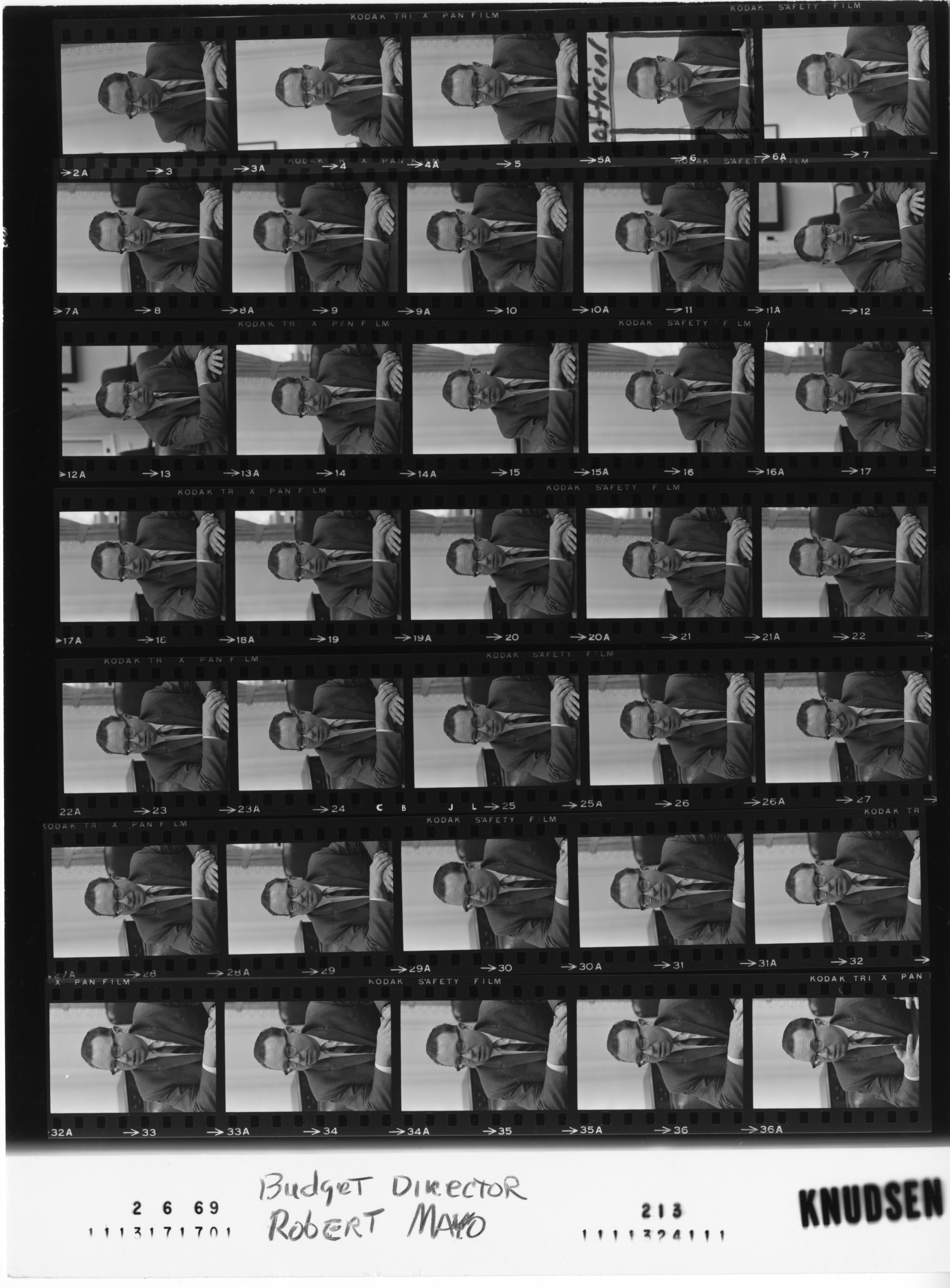
- Frame(s): WHPO-0213-03-37, Seated head and shoulder portrait of Budget Director Robert Mayo at a desk. 2/6/1969, Washington, D.C. unspecified office. Robert Mayo.
- Frame(s): WHPO-0213-27, Seated head and shoulder portrait of Budget Director Robert Mayo at a desk. 2/6/1969, Washington, D.C. unspecified office. Robert Mayo.
Roll WHPO-0214 Photographer: Knudsen, Robert L. | Color or B&W: B&W
- Frame(s): WHPO-0214-03-08, Unidentified White House staff members setting up the East Room for a press conference. 2/6/1969, Washington, D.C. White House, East Room. Unidentified White House staff, photographers, reporters, White House Press Corps.
- Frame(s): WHPO-0214-09, While unidentified White House staff members set up the East Room for a press conference, White House reporter Faye Gillis Wells looks at the chair seating. 2/6/1969, Washington, D.C. White House, East Room. Unidentified White House staff, Faye Gillis Wells, photographers, reporters, White House Press Corps.
- Frame(s): WHPO-0214-10-37, President Nixon speaking and answering questions from a large group of news reporters and White House correspondents, during his second press conference. 2/6/1969, Washington, D.C. White House, East Room. President Nixon, photographers, reporters, White House Press Corps.
- Frame(s): WHPO-0214-25, President Nixon speaking and answering questions from a large group of news reporters and White House correspondents, during his second press conference. 2/6/1969, Washington, D.C. White House, East Room.
Roll WHPO-0215 Photographer: Knudsen, Robert L. | Color or B&W: B&W
- Frame(s): WHPO-0215-02A-15A, President Nixon gestures while speaking during his second press conference. 2/6/1969, Washington, D.C. White House, East Room. President Nixon.
Roll WHPO-0216 Photographer: Knudsen, Robert L. | Color or B&W: B&W
- Frame(s): WHPO-0216-02-06, Televison news cameramen standing behind video cameras, on a podium in the back of the White House East Room set up for a press conference. 2/6/1969, Washington, D.C. White House, East Room. photographers, White House Press Corps.
- Frame(s): WHPO-0216-07-31, President Nixon answers a standing reporter's question during his second press conference. 2/6/1969, Washington, D.C. White House, East Room. President Nixon, reporters, White House Press Corps, Ron Ziegler.
- Frame(s): WHPO-0216-32-33, President Nixon speaking to a female reporter (possibly Helen Thomas seen from behind) as he leaves with Ron Ziegler, after the close of his second press conference. 2/6/1969, Washington, D.C. White House, East Room. President Nixon, photographers, reporters, Helen Thomas (possibly), White House Press Corps, Ron Ziegler.
Roll WHPO-0217 Photographer: Knudsen, Robert L. | Color or B&W: B&W
- Frame(s): WHPO-0217-03, Ron Ziegler and WHPO Director Oliver ("Ollie") Atkins, stand near the microphone on stage, before the beginning of President Nixon's second press conference. 2/6/1969, Washington, D.C. White House, East Room. Oliver ("Ollie") Atkins, Ronald Ziegler.
- Frame(s): WHPO-0217-04-05, An unidentified man wearing a PRT I.D. holds a banner near his head that reads "Washington Post," while standing near the microphone on stage, before the beginning of President Nixon's second press conference. 2/6/1969, Washington, D.C. White House, East Room. Unidentified man.
- Frame(s): WHPO-0217-06, Ronald Ziegler at the microphone, before the start of President Nixon's second press conference. 2/6/1969, Washington, D.C. White House, East Room.
- Frame(s): WHPO-0217-07-37, President Nixon speaking during his second press conference. 2/6/1969, Washington, D.C. White House, East Room. President Nixon, reporters, White House Press Corps.
- Frame(s): WHPO-0217-14A, President Nixon speaking at the microphone during his second press conference. 2/6/1969, Washington, D.C. White House, East Room. President Nixon.
- Frame(s): WHPO-0217-36A, President Nixon speaking at the microphone during his second press conference. 2/6/1969, Washington, D.C. White House, East Room. President Nixon.
Roll WHPO-0218 Photographer: Atkins, Oliver | Color or B&W: B&W
- Frame(s): WHPO-0218-02A-03A, During his visit to the Post Office Department President Nixon signs his autograph on a woman's leg cast, while she sits in her wheelchair. Postmaster General Winton M. Blount standing nearby. 2/6/1969, Washington, D.C. Post Office Department. President Nixon, Winton M. Blount.
- Frame(s): WHPO-0218-04A-10A, President Nixon meeting with Postmaster General Winton M. Blount, Holman Head, James Backhous, Elmer T. Klassen, James Hargrove, John L. O'Marra, Kenneth A. Housman, and David A. Nelson at the Post Office Department Office. 2/6/1969, Washington, D.C. Post Office Department. President Nixon, Winton M. Blount, Holman Head, James Backhous, Elmer T. Klassen, James Hargrove, John L. O'Marra, Kenneth A. Housman, and David A. Nelson, Military aide Jack Brennan.
- Frame(s): WHPO-0218-11A-14A, President Nixon speaking alone with Postmaster General Winton M. Blount. 2/6/1969, Washington, D.C. Post Office Department. President Nixon, Winton M. Blount.
- Frame(s): WHPO-0218-15A-19A, President Nixon addressing employees and officials at a gathering in the Post Office Department. 2/6/1969, Washington, D.C. Post Office Department. President Nixon, Winton M. Blount, Post Office Dept. employees and well-wishers.
Roll WHPO-0219 Photographer: Atkins, Oliver | Color or B&W: B&W
- Frame(s): WHPO-0219-00A-07A, Profile portraits of President Nixon speaking to Post Office Department employees and officials. 2/6/1969, Washington, D.C. Post Office Department. President Nixon, Winton M. Blount.
- Frame(s): WHPO-0219-01A, Profile portrait of President Nixon speaking to Post Office Department employees and officials. 2/6/1969, Washington, D.C. Post Office Department. President Nixon.
- Frame(s): WHPO-0219-08A, President Nixon leaving the Post Office Department. 2/6/1969, Washington, D.C. Post Office Department. President Nixon, Winton M. Blount, unidentified officials.
Roll WHPO-0220 Photographer: Atkins, Oliver | Color or B&W: B&W
- Frame(s): WHPO-0220-01-06, President Nixon during a seated Oval office meeting with AID Administrator John A. Hannah and Secretary of State William P. Rogers. 2/6/1969, Washington, D.C. White House, Oval Office. President Nixon, John A. Hannah, William P. Rogers.
Roll WHPO-0221 Photographer: Atkins, Oliver | Color or B&W: B&W
- Frame(s): WHPO-0221-01-02, H.R. Haldeman talking with members of the White House Staff in the Oval Office, while President Nixon meets with Rep. Olin E. Teague, in the background. 2/6/1969, Washington, D.C. White House, Oval Office. President Nixon, H.R. Haldeman, Olin E. Teague, White House Staff.
- Frame(s): WHPO-0221-03-08, President Nixon meeting with Texas Congressman Olin Earl Teague in the Oval Office, concerning the oil problem. 2/6/1969, Washington, D.C. White House, Oval Office. President Nixon, Olin E. Teague.
- Frame(s): WHPO-0221-06, President Nixon meeting with Texas Congressman Olin Earl Teague in the Oval Office, concerning the oil problem. 2/6/1969, Washington, D.C. White House, Oval Office. President Nixon, Olin E. Teague.
- Frame(s): WHPO-0221-09-12, Surrounded by White House Press Corps reporters and photographers in the Oval Office, President Nixon speaks with Texas Congressman Olin Earl Teague, concerning the oil problem. 2/6/1969, Washington, D.C. White House, Oval Office. President Nixon, Olin E. Teague, reporters, White House and WH Press Corps photographers.
- Frame(s): WHPO-0221-13, Dwight Chapin and an unidentified official standing in the Oval Office. 2/6/1969, Washington, D.C. White House, Oval Office. President Nixon, Dwight Chapin, unidentified man.
Roll WHPO-0222 Photographer: Atkins, Oliver | Color or B&W: B&W
- Frame(s): WHPO-0222-01A-03A, 28A-32A, President Nixon speaking to the gathered group of attendees, at a White House Reception for Republican Senators and Congressmen. 2/6/1969, Washington, D.C. White House, Yellow Oval Room. President Nixon, Howard Baker, John Williams, Brock, Lesllie C. Arends, Carl T. Curtis, J. Caleb Boggs, Karl E. Mundt, Roman L. Hruska, Louis C. Wyman, Clifford P. Hansen, Robert J. BOB Dole, Frank T. Bow, Norris Cotton, Glenard P. Lipscomb, Henry Bellmon, James G. Fulton, Strom Thurmond, John G. Tower, Clark MacGregor, Paul J. Fannin.
- Frame(s): WHPO-0222-04A-05A, 07A, President Nixon personally shaking hands and greeting a Republican leader Howard Baker, an attendee at a White House Reception for Republican Senators and Congressmen. 2/6/1969, Washington, D.C. White House, Yellow Oval Room. President Nixon, Howard Baker.
- Frame(s): WHPO-0222-06A, 08A-15A, 17A, 18A, 20-22A, 26A-27A, President Nixon personally shaking hands and greeting an unidentified Republican leaders attendee at a White House Reception for Republican Senators and Congressmen. 2/6/1969, Washington, D.C. White House, Yellow Oval Room. President Nixon, Howard Baker, John Williams, Brock, Lesllie C. Arends, Carl T. Curtis, J. Caleb Boggs, Karl E. Mundt, Roman L. Hruska, Louis C. Wyman, Clifford P. Hansen, Robert J. BOB Dole, Frank T. Bow, Norris Cotton, Glenard P. Lipscomb, Henry Bellmon, James G. Fulton, Strom Thurmond, John G. Tower, Clark MacGregor, Paul J. Fannin.
- Frame(s): WHPO-0222-16A, President Nixon personally shaking hands and greeting a Republican leader Robert J. BOB Dole, an attendee at a White House Reception for Republican Senators and Congressmen. 2/6/1969, Washington, D.C. White House, Yellow Oval Room. President Nixon, Robert J. BOB Dole.
- Frame(s): WHPO-0222-19A, President Nixon personally shaking hands and greeting a Republican leader Senator John J. Williams, an attendee at a White House Reception for Republican Senators and Congressmen. 2/6/1969, Washington, D.C. White House, Yellow Oval Room. President Nixon, John James "Whispering Willie" Williams.
- Frame(s): WHPO-0222-23A, President Nixon personally shaking hands and greeting a Republican leader Strom Thurmond, an attendee at a White House Reception for Republican Senators and Congressmen. 2/6/1969, Washington, D.C. White House, Yellow Oval Room. President Nixon, Strom Thurmond.
- Frame(s): WHPO-0222-24A, President Nixon personally shaking hands and greeting a Republican leader John Tower, an attendee at a White House Reception for Republican Senators and Congressmen. 2/6/1969, Washington, D.C. White House, Yellow Oval Room. President Nixon, John G. Tower.
- Frame(s): WHPO-0222-25A, President Nixon personally shaking hands and greeting a Republican leader Clark MacGregor, an attendee at a White House Reception for Republican Senators and Congressmen. 2/6/1969, Washington, D.C. White House, Yellow Oval Room. President Nixon, Clark MacGregor.
Roll WHPO-0753 Photographer: Atkins, Oliver | Color or B&W: Color
- Frame(s): WHPO-0753-, President Nixon gesturing while standing at a microphone. 2/6/1969, Washington, D.C. President Nixon.
Roll WHPO-0756 Photographer: Atkins, Oliver | Color or B&W: Color
- Frame(s): WHPO-0756-, Close-up of President Nixon gesturing while standing at a microphone. 2/6/1969, Washington, D.C. President Nixon.
Roll WHPO-0757 Photographer: Atkins, Oliver | Color or B&W: Color
- Frame(s): WHPO-0757-, Close-up of President Nixon gesturing while standing at a microphone. 2/6/1969, Washington, D.C. President Nixon.
Roll WHPO-0759 Photographer: Atkins, Oliver | Color or B&W: Color
- Frame(s): WHPO-0759-, President Nixon gesturing while standing at a microphone. 2/6/1969, Washington, D.C. President Nixon.
- Frame(s): WHPO-0759-[DASH], President Nixon gesturing while standing at a microphone. 2/6/1969, Washington, D.C.
Roll WHPO-0760 Photographer: Atkins, Oliver | Color or B&W: Color
- Frame(s): WHPO-0760-, President Nixon gesturing while standing at a microphone. 2/6/1969, Washington, D.C. President Nixon.
Roll WHPO-0762 Photographer: Atkins, Oliver | Color or B&W: Color
- Frame(s): WHPO-0762-, President Nixon talking while standing at a microphone. 2/6/1969, Washington, D.C. President Nixon.
Roll WHPO-0763 Photographer: Atkins, Oliver | Color or B&W: Color
- Frame(s): WHPO-0763-, President Nixon talking while standing at a microphone. 2/6/1969, Washington, D.C. President Nixon.
Roll WHPO-0765 Photographer: Atkins, Oliver | Color or B&W: Color
- Frame(s): WHPO-0765-, President Nixon pointing straight ahead while standing at a microphone. 2/6/1969, Washington, D.C. President Nixon.
Roll WHPO-0766 Photographer: Atkins, Oliver | Color or B&W: Color
- Frame(s): WHPO-0766-, President Nixon talking at a microphone. 2/6/1969, Washington, D.C. President Nixon.
Roll WHPO-0908 Photographer: Atkins, Oliver | Color or B&W: Color
- Frame(s): WHPO-0908-05-15, President Nixon at a microphone (Head and shoulders). 2/6/1969, Washington, D.C. President Nixon.
The White House Communications Agency Sound Recordings Collection contains public statements that took place between 1969 and 1974. Visit the finding aid to learn more.
H - White House Staff Member Recordings
- WHCA-SR-H-002
Remarks of John Hannah to press. (2/6/1969, Press Lobby Entrance, White House)
Runtime: [N/A]
Keywords: Press conferences, news conferences, interviews, media
Production credits: Audio feed supplied by WHCA; Recorded by ADS (initials of WHCA engineer)
Original Format: 1/4-inch reel-to-reel audiotape. Original source type: Original. - WHCA-SR-H-003
Remarks of Henry Kissinger to press. (2/6/1969, Fish Room, White House)
Runtime: 70:00:00
Keywords: Press conferences, news conferences, interviews, media
Production credits: Audio feed supplied by WHCA; Recorded by ADS (initials of WHCA engineer)
Original Format: 1/4-inch reel-to-reel audiotape. Original source type: Original.
P - Formal Presidential Remarks
- WHCA-SR-P-690208
Remarks by President Nixon in a press conference. (2/6/1969)
Runtime: 30:26:00
Keywords: Presidential press conferences, presidential news conferences, interviews, media
Original Format: 1/4-inch reel-to-reel audiotape. Original source type: Original. - WHCA-SR-P-690209
Remarks by President Nixon to Post Office officials. (2/6/1969, Auditorium, Post Office Department)
Runtime: 0:11:26
Production credits: Mult feed supplied by ABC; Recorded by WHCA
Original Format: 1/4-inch reel-to-reel audiotape. Original source type: Original.
The White House Communications Agency Videotape Collection contains “off-the-air” recordings of televised programs produced between 1968 and 1974. Visit the finding aid to learn more.
- WHCA-3211
The President's [Second] Press Conference.
NET (National Educational Television, PBS)
Runtime: 01:04:57
Context (External Sources)
The Vanderbilt Television News Archive is the world's most extensive and complete archive of television news. They have been recording, preserving and providing access to television news broadcasts of the national networks since August 5, 1968.
Wikipedia is a free encyclopedia that anyone can edit.