
Introduction
This almanac page for Friday, February 7, 1969, pulls together various records created by the federal government and links to additional resources which can provide context about the events of the day.
Previous Date: Thursday, February 6, 1969
Next Date: Saturday, February 8, 1969
Schedule and Public Documents
The Daily Diary files represent a consolidated record of the President's activities. Visit the finding aid to learn more.
The President's day began at The White House - Washington, D. C.
The Weekly Compilation of Presidential Documents made available transcripts of the President's news conferences; messages to Congress; public speeches, remarks, and statements; and other Presidential materials released by the White House.
Addresses and Remarks
- 1969 Senate Youth Program (5 Weekly Comp. Pres. Doc. 234, February 7, 1969)
The President's Remarks to Student Delegates Attending the Program Sponsored by the William Randolph Hearst Foundation. - Department of Transportation (5 Weekly Comp. Pres. Doc. 236, February 7, 1969)
The President's Remarks to Reporters on the Announcement of Major Appointments in the Department. - Department of Commerce (5 Weekly Comp. Pres. Doc. 237, February 7, 1969)
The President's Remarks to Employees at the Department. - Meeting With Roy Wilkins (5 Weekly Comp. Pres. Doc. 248, February 7, 1969)
The President's Remarks to Reporters Introducing the Head of the National Association for the Advancement of Colored People.
Announcements
- National Security Council (5 Weekly Comp. Pres. Doc. 232, February 7, 1969)
Announcement of the Structure, Role, and Staff of the Council. - Inspection of Tax Returns (5 Weekly Comp. Pres. Doc. 234, February 7, 1969)
Announcing of Granting of Authority to the Senate Committee on Government Operations During the 91st Congress.
Executive Orders
- Inspection of Tax Returns (5 Weekly Comp. Pres. Doc. 234, February 7, 1969)
Executive Order 11454 Providing for Inspection of Certain Tax Returns by the Senate Committee on Government Operations.
Statements by the President
- Under Secretary of Health, Education, and Welfare (5 Weekly Comp. Pres. Doc. 233, February 7, 1969)
Statement by the President Upon Announcing the Nomination of John G. Veneman.
Checklist of White House Press Releases
The releases listed below, made public by the Office of the White House Press Secretary during the period covered by this issue, are not included in the issue.
- Biographical data on members of the National Security Council staff.
- Biography of John G. Veneman.
- Announcement of intention to nominate four persons to positions in the Department of Transportation.
- Biography of James M. Beggs.
- Biography of Dr. Paul Cherington.
- Biography of James D'Orma Braman.
- Biography of Charles D. Baker.
- Press Conference of Secretary of Transportation John A. Volpe.
Digest of Other White House Announcements
Following is a listing of items of general interest which were announced in the press but not made public as formal White House press releases during the period covered by this issue. Appointments requiring Senate approval are not included since they appear in the list of nominations submitted to the Senate, below.
- The annual Boy Scout Week Report to the Nation was presented to the President by 15 Boy Scouts in a ceremony in the Fish Room at the White House.
- A group of Mardi Gras queens, representing each of the 50 States, met with the President in his office.
- The President has accepted the following resignation: RALPH M. PAIEWONSKY as Governor of the Virgin Islands, effective February 12, 1969.
- The President has accepted the following resignation: RIDGWAY B. KNIGHT as Ambassador to Belgium, effective at a date to be determined.
- The President has accepted the following resignation: GILBERT S. MERRITT, JR., as United States Attorney for the middle district of Tennessee, effective March 17, 1969.
- Roy Wilkins, of the National Association for the Advancement of Colored People, met with the President at the White House.
Each Public Papers of the Presidents volume contains the papers and speeches of the President of the United States that were issued by the White House Office of the Press Secretary during the time period specified by the volume. The material is presented in chronological order, and the dates shown in the headings are the dates of the documents or events. In instances when the release date differs from the date of the document itself, that fact is shown in the text note.
To ensure accuracy, remarks have been checked against audio recordings (when available) and signed documents have been checked against the original, unless otherwise noted. Editors have provided text notes and cross references for purposes of identification or clarity.
- Statement Announcing the Nomination of John G. Veneman as Under Secretary of Health, Education, and Welfare
- Remarks to Participants in the 1969 Senate Youth Program.
- Remarks to Employees at the Department of Commerce.
- Remarks Following a Meeting With the Director of the National Association for the Advancement of Colored People.
- Executive Order 11454—Inspection of Income, Excess-Profits, Estate, and Gift Tax Returns by the Senate Committee on Government Operations
- Remarks on Major Appointments in the Department of Transportation
The Federal Register is the official daily publication for rules, proposed rules, and notices of federal agencies and organizations, as well as executive orders and other Presidential documents.
The Congressional Record is the official daily record of the debates and proceedings of the U.S. Congress.
Archival Holdings
Any selection of archival documents will necessarily be partial. You should use the documents and folders identified below as a starting place, but consult the linked collection finding aids and folder title lists and the collections themselves for context. Many documents to be found this way do not lend themselves to association with specific dates, but are essential to a complete understanding of the material.
Selective document listing
President's Office Files
The President's Office Files consists of materials drawn together by the Special Files Unit from several administrative subdivisions within the White House Office. It is the handwriting and sensitive papers sent to the Staff Secretary that now comprise much of the President's Office Files. Visit the finding aid to learn more.
- President's Handwriting, Box 1, President's Handwriting, February 1969 [2 of 3]
- Memo; Frank Shakespeare to H. R. Haldeman re: Your Memo of February 5 to H. Klein on Use of Reaction to the President's Inaugural Address and First Press Conference. February 7, 1969. 1 pg.
- Memo; Dwight Chapin to The Record re: Note to Dr. Lee DuBridge, incl. attachment. February 7, 1969. 4 pgs.
- Schedule; to re: The President's Schedule, Friday, February 7, 1969. February 7, 1969. 1 pg.
- Annotated News Summaries, Box 28, News Summaries - February 1969 [During this period, the Staff Secretary only removed pages from the News Summaries which contained President Nixon's handwriting, often leaving the document with no date. In addition to the individual document listed below, you should also consult the full folder for the month.]
- Media Reaction to the President's Press Conference, February 7, 1969, Television Coverage
- President's Meetings File, Box 73, Memoranda for the President--Beginning February 2, 1969
President's Personal File
The President's Personal File is essentially a President's secretary's file, kept by Rose Mary Woods, personal secretary to the President, for two purposes: (1) preserving for posterity a collection of documents particularly close to the President, whether because he dictated or annotated them, or because of the importance of the correspondent or the event concerned and (2) giving appropriate attention–letters of gratitude, invitations to White House social events, and the like–to members and important friends and supporters of the Nixon administration. This generalization does not describe all the varied materials of a file group which is essentially a miscellany, but it does identify the reason for the existence of the file group's core. Visit the finding aid to learn more.
- President's Speech File
Selective document listing
The White House Press Office during the Presidency of Richard Nixon was responsible for daily communication with the White House press corps. Ronald L. Ziegler was the Press Secretary to the President for Nixon's entire term in office from January 1969 to August 1974 and Gerald Warren served as the Deputy Press Secretary. The office held daily briefings for the press and produced the White House’s press releases. Visit the finding aid to learn more.
- White House Press Conferences, Box 55
- News Conference #36 at the White House with Ron Ziegler, February 7, 1969, 10:07 A.M. EST. 3 pgs.
- News Conference #37 at the White House with Ron Ziegler, February 7, 1969, 1:25 P.M. EST. 3 pgs.
The H. R. Haldeman Diaries consists of seven handwritten diaries, 36 dictated diaries recorded as sound recordings, and two handwritten audio cassette tape subject logs. The diaries and logs reflect H. R. Haldeman’s candid personal record and reflections on events, issues, and people encountered during his service in the Nixon White House. As administrative assistant to the President and Chief of Staff, Haldeman attended and participated in public events and private meetings covering the entire scope of issues in which the Nixon White House engaged in during the years 1969-1973. Visit the finding aid to learn more.
- Transcript of diary entry (PDF)
Friday, February 7.
The busiest day yet for sheer volume of activity. Regular staff meeting, Kissinger briefing, Boy Scouts presentation, Mardi Gras queens, Cabinet meeting, session with Yost, Senate Youth Program group (President sensational according to all reports), Volpe's Department heads, the National Guard Chiefs, visit to Commerce Department, Roy Wilkins, Air Force commander in Vietnam, then signed huge batch of appointments and resignations and went through all of Rose's letters. All this before 5:00, when we took off for Key Biscayne. Left by helicopter from White House back lawn - pretty exciting. Poor Tim scared to death.
Called me in near end of plane trip to say he wanted no special cars flown to Europe, and the Secret Service detail cut way down. Doesn't want to look overprotected.
I spent the day getting decks cleared for Key Biscayne trip. Went out to order Jo's anniversary gifts and get my passport. Had long lunch meeting with Ken Cole and Larry regarding operation of our group. Problem is how to keep work and people and calls away from me and handled by others on the one side - and how to avoid the feeling or the fact that people can't get to me on the other. Also need to improve our internal communication. Ken and Larry to work up a plan.
Also long talk with Chapin regarding his attitude and operation. Concerned that he and Ziegler don't do adequate staffing job, but come to me for solutions instead of with solutions. Think it did some good. - Handwritten diary entry (JPG)
The National Archives Catalog is the online portal to the records held at the National Archives, and information about those records. It is the main way of describing our holdings and also provides access to electronic records and digitized versions of our holdings.
The Catalog searches across multiple National Archives resources at once, including archival descriptions, digitized and electronic records, authority records, and web pages from Archives.gov and the Presidential Libraries. The Catalog also allows users to contribute to digitized historical records through tagging and transcription.
Nixon Library Holdings
All National Archives Units
National Security Documents
The President's Daily Brief is the primary vehicle for summarizing the day-to-day sensitive intelligence and analysis, as well as late-breaking reports, for the White House on current and future national security issues. Read "The President's Daily Brief: Delivering Intelligence to Nixon and Ford" to learn more.
- President's Daily Brief of 07 February 1969 [consult link for visuals and extent of redactions]
The President's Daily Brief
7 February 1969
19
Top Secret
LATE NOTES FOR THE PRESIDENT'S DAILY BRIEF OF
7 FEBRUARY 1969
[redacted]
8 February 1969
LATE NOTES FOR THE PRESIDENT'S DAILY BRIEF OF
7 FEBRUARY 1969
I. MAJOR PROBLEMS
MIDDLE EAST
Soviet Ambassador Malik told Ambassador Yost yesterday that he thought the four powers should try to develop concrete suggestions on how the Middle Eastern problem could be resolved. He doubted that giving Jarring a new boost would add much to what had been done before. Malik, obviously not yet in receipt of Moscow's official reaction to the President's reply to the French note, spent most of his time with Yost probing for the US position. He did, however, agree that a major objective of the four-power talks should be agreement on the nature of a contractual arrangement assuring Israel it will have security but in a form acceptable to the Arabs. He said this coincides with the Soviet approach. [redacted]
EUROPE
[redacted]
A Belgian official has told our embassy in Brussels that the agreement on obligatory consultation reached by Britain and the five Community members is not open ended but is limited to specific issues. The list has not yet been agreed on, but he said it obviously will include Eastern Europe, the US, and the Third World. [redacted]
SOVIET AFFAIRS
There is nothing significant to report.
VIETNAM
The Soviet sounding of the US position on several key points during the conversation between Mr. Blake and Mr. Oberemko on 4 February doubtless reflects not only Moscow's interest but also Hanoi's, at least in general terms. Oberemko made it clear that the Soviet Union intends to stay right on top of the substantive talks and that we should regard the Soviets as a channel through which to pass Hanoi our views. In this meeting, however, there was nothing to suggest that this will be a two-way street, at least for the present.
Without knowing who initiated this particular conversation, it is difficult to judge whether Oberemko's pointed questions reflect a direct and fairly urgent request for Soviet action from Hanoi or whether it is simply the first in what could become a series of general efforts on the part of the Soviets to sound out our position. We tend to believe the latter is the more likely explanation. It does, however, open up the possibility of an indirect exchange of views between Hanoi and Washington without either having to back down from its initial position on how the talks should proceed.
Regardless of whether the Soviets were acting under a specific or a general request from Hanoi, the points raised by Oberemko probably were intended to be taken as an indication of the subjects of prime interest to Hanoi. Both the Soviets and the North Vietnamese have tried on various occasions to draw out the US position on a political settlement. This, however, is the most direct and pointed effort to date.
II. OTHER IMPORTANT DEVELOPMENTS
There is nothing significant to report.
I. MAJOR PROBLEMS
MIDDLE EAST
The Soviets have taken a significant step toward improving their credibility and leverage in Israel by allowing renewed emigration of Jews from the USSR to Israel. [redacted] Moscow reopened the gates to emigrants last September, at the same time it began its diplomatic campaign for an Arab-Israeli settlement. All such emigration had been halted after the Arab-Israeli war in June 1967. Up to mid-January, some 600 Soviet Jews with relatives in Israel had already departed. More than 200 of these left during the first two weeks of January. All ages apparently are represented, including at least 170 children.
The Israelis view Moscow's change in policy as another indication that the Kremlin desires to inch toward normalizing Soviet-Israeli relations and that it expects in return a certain amount of Israeli flexibility toward its proposals for a Middle East settlement. As a matter of fact, the Moscow move will probably achieve this goal, and in addition, because so much emotion is involved, will probably cause the Israelis to hesitate before they take any action which might jeopardize the flow of emigrants.
EUROPE
Somewhat to our surprise, the latest effort to forge closer political links in Western Europe has not produced an outright veto from De Gaulle. This initiative, an Italian plan for consultation among the members of the Western European Union (WEU) on important issues, was accepted for study by the WEU Council yesterday. In addition, Britain and the five Community members (France excepted) apparently have gone ahead and bound themselves to some kind of obligatory consultation.
The French reserved their position on this latter point, but they did not veto the idea outright. They also made clear their unhappiness with the proposal that the consultation notion itself be given further study, but in the end they went along with the rest of the members--perhaps because they thought it would be better to use delaying tactics later than to impose a flat negative now.
Rome's initiative, heavily backed by Foreign Minister Nenni, grew out of the attempts by the Five to outflank the French veto of Britain's application to join the European Communities. The idea was that political consultations would forge new links between Britain and the Six, and implicit in the proposal was the notion that if France refused to go along, the other five might start talks with the British. France's reluctance to veto the Italian proposal suggests that Paris may indeed have felt constrained to give a little ground.
We do not expect any short-term improvement in Britain's chances for Community membership as a result of this maneuvering, and we do not think any of the participants do either. Nevertheless, the British are trying to exploit the opening. Foreign Secretary Stewart has invited the Six--in the person of their ambassadors in London--to talks aiming toward a common position on the Middle East. If the French decline the British invitation, Paris risks imputing to Britain the role of spokesman for "Europe" in the four-power talks.
The recent spate of press stories [redacted] concerning a possible new effort to set up a supranational European political community may be related to the WEU efforts. The resurgence of talk along these lines bears some earmarks of a campaign by. Jean Monnet and other supporters of a federal Europe--apparently supported by Nenni. The federalists may be trying to give an institutional structure to the loose consultative framework now being pressed for in WEU.
SOVIET AFFAIRS
There is nothing of significance to report.
VIETNAM
The only noteworthy point we found in the Communist presentations at yesterday's Paris session was Tran Buu Kiem's continued emphasis on the "peace cabinet" theme. His prediction of no progress in the talks until the present Saigon government is overthrown may be only rhetoric, but it seems clear that the Communists have no intention of giving any ground in Paris until they have determined if this idea can be translated into political results in South Vietnam.
The "peace cabinet" idea has been the main Communist theme since the bombing halt. In our view, it is based on real conviction that widespread sentiment for peace in South Vietnam can be more effectively mobilized in support of Hanoi's objectives. [redacted]
The Communists regard the peace issue as one on which a wide spectrum of politically active elements in South Vietnam can be united. They know that most South Vietnamese would be reluctant to endorse a coalition government with the Communists. By putting their demands in the form of broad, nationalist generalities, however, the Communists hope to convince politically significant elements in South Vietnam that changes in the present regime would lead to fruitful discussions with the Communists and would eventually open the way to an acceptable political settlement and an end to the fighting.
In pursuing these objectives, the Communists are using both the carrot and the stick. Military pressure and hardline propaganda frequently are accompanied or followed up by displays of "flexibility" and "realism" both in public and in private. Tran Buu Kiem, the Front representative whose uncompromising stance at yesterday's Paris session made headlines, took an entirely different tack in an interview published in a French journal on Monday. There he went out of his way to give the impression of softening the Front's stand, especially toward the GVN, and to stress the Communists' willingness to bargain on such fundamental matters as a coalition government, elections, and even working with the present South Vietnamese leadership.
We are not able to measure adequately what inroads the Communists have made in this campaign to date. [redacted] the current concern in South Vietnam about peace sentiments and signs of intrigue about changes in the composition of the government are playing right into the hands of the Communists. They are trying hard to foster the theme of a "peace cabinet" in the Buddhist movement and to sell the same idea in labor, student, and intellectual circles in South Vietnam.
* * *
[redacted]
II. OTHER IMPORTANT DEVELOPMENTS
IRAN
An Iranian delegation will leave for Moscow tomorrow for the purpose, we believe, of negotiating a second arms purchase agreement. [redacted] purchases would _be financed from the more than $1 billion Iran hopes to earn from the delivery of natural gas to the USSR in the period from 1970 to 1987.
In January 1967, the Shah signed his first arms agreement with the Soviet Union for $110 million worth of vehicles, including armored personnel carriers and antiaircraft guns. The Shah was piqued at the time over what he thought to be the slowness of the US in meeting his arms needs. More important, he saw in Soviet equipment one way to spend the money Iran would earn from the gas pipeline to the Soviet Union now under construction.
VENEZUELA
In the wake of Wednesday's ambush of an army patrol, the Venezuelan armed forces have launched a major offensive against pro-Castro guerrillas in the eastern part of the country. Reports that a number of guerrillas have been killed and one guerrilla leader captured are still unconfirmed.
THAI LAND
Balloting for the lower house of the National Assembly--the first nationwide elections in more than ten years--will take place on 10 February. Under the new constitution, promulgated last year by the military leadership to legitimize its rule, the upper house is appointed and the power of the legislature is in addition carefully circumscribed. These elections therefore pose no threat to the establishment.
The government nevertheless fears embarrassment. A current reading suggests that the newly formed government party, still considerably disorganized, will fall short of a majority even though winning the largest bloc of seats.
[redacted] As an experiment in democratization, the elections have generated high public interest in most areas of the country, particularly in Bangkok. Although the Thai people have been reasonably happy under the military regime, there are a number of grievances which may now become more significant under the new political liberalization.
The Foreign Relations of the United States series presents the official documentary historical record of major U.S. foreign policy decisions and significant diplomatic activity. Visit the State Department website for more information.
Vol. II, Organization and Management of U.S. Foreign Policy, 1969-1972
The NSC System
22. Memorandum From the President’s Military Assistant (Haig) to the President’s Assistant for National Security Affairs (Kissinger) , Washington, February 7, 1969
Source: Ford Library, National Security Adviser, Kissinger–Scowcroft West Wing Office Files, 1969–77, Box 40, Administrative File, National Security Council Organization (2), 2/7/69–2/11/69. Eyes Only; Private.
23. Memorandum by the Chairman of the NSC Under Secretaries Committee (Richardson) , Washington, February 7, 1969
Source: National Archives, Nixon Presidential Materials, NSC Files, NSC Institutional Files (H-Files), Box H–270, Under Secretaries Decision Memoranda, U/DM 1. Information copies were sent to the Acting Director of AID, the Director of USIA, the Director of OEP, and the Under Secretary of the Treasury.
Vol. VI, Vietnam, January 1969-July 1970
Vietnam, January 1969-July 1970
19. Backchannel Message From the Ambassador to Vietnam (Bunker) to the Under Secretary of State for Political Affairs (Johnson) , Saigon, February 7, 1969
Source: Department of State, INR/IL Historical Files, 303/40 Committee Files, 303 Meetings, 2/16/68–1/20/70. Secret; Eyes Only. No time of transmission appears on the message.
Vol. XII, Soviet Union, January 1969-October 1970
Initial Contacts, January-April 22, 1969
11. Memorandum From the Ambassador to the Soviet Union (Thompson) to Secretary of State Rogers, Washington, February 7, 1969
Source: National Archives, RG 59, Office Files of William Rogers: Lot 73 D 443, Box 4, White House Correspondence, 1969. Secret.
Vol. XX, Southeast Asia, 1969-1972
Thailand
3. Memorandum Prepared for the 303 Committee , Washington, February 7, 1969
Source: National Security Council, Nixon Intelligence Files, Subject Files, Thailand. Secret; Eyes Only. A notation on the bottom left-hand corner of the first page reads, “303 Committee briefed on 11 February 1969.”
Vol. XLI, Western Europe; NATO, 1969-1972
Canada
89. Telegram From the Department of State to the Embassy in Canada , Washington, February 7, 1969, 0102Z
Source: National Archives, Nixon Presidential Materials, NSC Files, Box 670, Country Files—Europe, Canada, Vol. I. Secret; Immediate; Limdis. Drafted by J.L. Carson (EUR/CAN), cleared in S/S, and approved in EA. Also sent to Taipei and Tokyo and repeated to Bangkok, Canberra, Seoul, Wellington, Luxembourg, Stockholm, Paris, Rome, Hong Kong, the Mission to the EC, and USUN. A copy was included in the President’s daily briefing for February 8. (Ibid., White House Central Files, President’s Daily Briefing)
Vol. E-1, Documents on Global Issues, 1969-1972
U.S.-Cuba Hijacking Agreement, 1969-February 1973
122. Memorandum from the President’s Assistant For National Security Affairs (Kissinger) to President Nixon, Washington, February 7, 1969
Kissinger summarized and commented upon an attached memorandum from Secretary of State Rogers to the President that noted the potential dangers from the growing number of airline hijackings to Cuba. Rogers informed the President of U.S. diplomatic efforts to prevent hijacking to Cuba.
Source: National Archives, Nixon Presidential Materials, NSC Files, Box 780, Country Files, Latin America, Cuba, Vol. I. Confidential. Sent for information.
Vol. E-4, Documents on Iran and Iraq, 1969-1972
Iraq 1969-1971
250. Memorandum From John M. Leddy of the Bureau of European Affairs to Secretary of State Rogers, Washington, February 7, 1969
Leddy recommended that an expression of appreciation be sent to Belgian Foreign Minister Pierre Harmel for the work Belgium had done in representing U.S. interests in Iraq since 1967.
Source: National Archives, RG 59, Central Files 1967–69, POL 17 US-IRAQ. Confidential. Drafted by Baas. The attachment is not published. A message of thanks was sent on February 10.
Vol. E-5, Part 1, Documents on Sub-Saharan Africa, 1969-1972
Nigerian Civil War
33. Policy Options Paper , Washington, February 7, 1969
Prepared for the February 14 NSC meeting, this paper distilled Paper I and Paper II on Biafra into categories of relief, policy, basic choices, and options with the conclusion that there was little maneuverability in attempting to expand relief without antagonizing Federal Nigeria.
Source: National Archives, Nixon Presidential Materials, NSC Files, NSC Institutional Files (H-Files), Box H–20, NSC Meeting, Biafra, Strategic Policy Issues 2/14/69. Secret.
Vol. E-7, Documents on South Asia, 1969-1972
India and Pakistan: Pre-Crisis, January 1969-February 1971
5. Telegram 19762 From the Department of State to the Embassy in Pakistan, Washington, February 7, 1969, 0126Z
In a conversation with Secretary Rogers, Pakistani Ambassador Hilaly outlined Pakistan’s concerns about reduced economic assistance from the United States and the delay in promised military supplies.
Source: National Archives, RG 59, Central Files 1967–69, POL PAK–US. Confidential. Drafted on February 6 by James W. Spain (NEA/PAF), cleared by William J. Handley (NEA), and approved for transmission by Spain. The conversation took place on February 6. Rogers reported on the conversation in a memorandum that he sent to the President on February 6. (Ibid., Nixon Presidential Materials, NSC Files, Box 1, President’s Daily Briefs, Feb 1–8, 1969)
Vol. E-10, Documents on American Republics, 1969-1972
Cuba
196. Memorandum From the President’s Assistant for National Security Affairs (Kissinger) to President Nixon, Washington, February 7, 1969. , Washington, February 7, 1969
In reference to a February 6 memorandum from Secretary of State Rogers to President Nixon, President’s Assistant for National Security Affairs Kissinger noted that progress had been made with Cuba in dealing with the problem of aircraft hijacking. According to Kissinger, in 1961, Cuba had proposed an agreement to deal with hijacking that closely resembled the agreement that the U.S. had now proposed to Cuba. That proposal had been rejected by the United States.
Source: National Archives, Nixon Presidential Materials, NSC Files, Box 780, Country Files, Latin America, Cuba, Vol. I. Confidential. Sent for information. Attached but not published is a February 6 memorandum from Rogers to Nixon.
Paraguay
564. Country Analysis and Strategy Paper for Paraguay, February 7, 1969.
The Embassy stated that the main interest of the United States in Paraguay was to maintain a stable, pro-U.S. Government. A secondary interest was to promote the liberalization of the Paraguayan economy.
Source: National Archives, RG 59, Central Files 1967–69, POL 1 PAR–US. Secret. Transmitted to the Department of State as an attachment to Airgram A–14, February 7, 1969.
Peru
578. National Security Study Memorandum 18, Washington, February 7, 1969. , Washington, February 7, 1969
President Nixon requested a review of U.S. policy towards Peru, with emphasis given to the options available concerning the current situation and the IPC expropriation.
Source: National Archives, Nixon Presidential Materials, NSC Files, Box 365, NSSMs, NSSMs 1–42. Secret. A copy was sent to the Chairman of the JCS. The study of the NSC IG Study for Latin America, “U.S. Relations With Peru,” March 7, 1969, is printed as Document 581.
The Kissinger telephone conversation transcripts consist of approximately 20,000 pages of transcripts of Kissinger’s telephone conversations during his tenure as Assistant to the President for National Security Affairs (1969-1974) and Secretary of State (1973-1974) during the administration of President Richard Nixon. Visit the finding aid for more information.
Chronological File, Box 1, Folder February 1-11, 1969
- 10:45 AM, McGeorge Bundy
McGeorge Bundy
2/7/69 10:45 a. m.
McG. B. will send spec. delvy letter covering this matter.
McG. B. brought up the matter of the East-West Center (for the study of common problems of an advanced society). If the project is to stay alive, there needs to be some indication that the new Administration takes at least some interest in it. If the President doesn't mention it in Europe, it will probably die -- if he does, it will become part of his Administration.
The man who will know most about it in Europe is Harold Wilson -- and the man who needs to know that Washington has heard of it is Sir Solly Zuckerman. It's most important for the London visit (no need to present it to deGaulle, for instance.)
HAK said he'll make clear to Solly that he has heard of it -- that there's a favorable disposition to studying it further. HAK will have a chance to talk to the President in Key Biscayne this weekend; but he feels he's had enough conversation on the general problem that this sort of common effort is the kind of thing he is interested in.
McG. B. thought the President's press conference yesterday was excellent--but one word of warning. Re Pres' statement "he would move troops when commanders recommended it"----the Commander in Chief decides when to move troops. Our 'civilian' Presidents worry more about confidence of the military than they need. What military enjoy most is a firm hand; they like to feel it directly; all they want to know is that they have a commander and that they've had a hearing. HAK said he thought that was a strong point.
HAK hoped McG would get in touch with him, perhaps for lunch or dinner, next time he was down, and Mac said he would. - 12:10 PM, Secy Laird; Mr. Kissinger
Secy Laird
Mr. Kissinger
2-7-69 12:10 PM
L said Genl Abrams was trying to arrange best time for L to go to Saigon. K said Pres would be returning March 2 - L said he would then plan to leave on the 5th.
K said he had letter for L from the Pres re East-West Relations and he would seni it over in a double envelope.
L said there is some confusion over the Chicago Sun Story - there is no substance to the story. L said there is only one place ~ where there is any construction and that is in Boston and they are looking at another site 15 miles to the North. Nothing stopped on this System because of review except for Boston construction. L said site acquisitions were stopped by Clifford on Jan 15. L said procurement and research and development have not been stopped. K said he would explain this to the President
jm - 12:30 PM, Ben Read; Mr. Kissinger
Ben Read
Mr. Kissinger
2-7-69 12:30 PM
R asked whether K could possibly find time to talk with Harriman in the next few days. K said he did have him over for lunch a week or so ago, but he would be pleased to see him again and agreed to
set up appt for next week.
R and K agreed to lunch together on Tuesday. R said K should know how pleased George Ball was that K saw him at the White House.
K brought up subject of telegrams from conferences - when Vance calls in. R said he has been sending them over automatically on the LDX. K said the breakdown then is on his side.
jm - 12:45 PM, Michael Palliser; Mr. Kissinger
Michael Palliser
Mr. Kissinger
2-7-69 12:45 PM
P said he had talked to London about cars and the answer is a little different from what he had said last night. PM is very keen not to influence the President in any way about cars. If President wishes to ride in his own car, the PM would be pleased to ride with him - he is agreeable to anything the President would like. For the return, PM would be perfectly willing to ride with him but thinks President might prefer to go back alone or with one of his advisers. K said he thought that would be the right thing to do.
P said there is no problem about organizing fairly limited press facilities they had talked about - hopes President will agree to TV as well. K said yes.
jm - 3:10 PM, Michael Palliser; Mr. Kissinger
Michael Palliser
Mr. Kissinger
2/7/69 3:10pm
Palliser told HAK of a telegram he had from London suggesting that the Prime Minister might ask Pres. Nixon about his attitude toward "McGeorge Bundy's project. " The PM does not wish to raise this in any formal meeting with the President, but possibly in the course of an informal chat. And the PM does not wish to raise any subjects with the Pres. unless the Pres, has been previously briefed. Palliser said Gvishiari (Kosygin's son-in-law) is connected with the East-West Center project and he wondered whether it might help marginally as an informal link with the Russians.
The whole matter was actually suggested to the PM by Burke Trend (but most likely the channel was Bundy-to Zuckerman-to Trend.)
HAK said he will make sure that the President will be briefed on the matter; he can't tell Palliser what his views will be, but he has no reason to suppose that the President will not be sympathetic to it. HAK said he should have a reading on this for Palliser by the end of next week.
HAK told Palliser he passed message about the British car to Ehrlichman, who will take up the matter with Palliser in London. Our disposition is to have the two ride together in the British car and we can get one of our security people into it. - 3:45 PM, The Vice President; Mr. Kissinger
The Vice President
Mr. Kissinger
2-7-69 3:45 PM
VP calling about NPT and how to avoid getting drawn into some disarmament discussion. VP told HAK some thoughts he had on this which I did not hear because of confusion in office. HAK said he was going to have this looked into and would let the VP know what the thinking is.
HAK told VP about briefings being arranged for LBJ. President thought VP might agree to go down to the Ranch for a day and meet with Johnson. VP said he would be glad to do so. HAK said when we have a topic out of NSC he would take the liberty of suggesting to the VP that he go down.
jm - 3:45, Sec. Rogers
Sec. Rogers
3:45 2/7/69
R just heard that Frank Shakesphere was taking a trip to Beruit or someplace like that and has his doubts about whether this is a good move. They might think we have some sort of plan by sending Shakesphere.
HAK said he hadn't thought about that. What happened was someone asked at the Cabinet meeting (K thought Haldeman} wether Shakesphere could go somewhere to meet the public affairs officials.
R felt that Shakesphere was fairly inexperienced any maybe it might be a better idea to send him to Europe or Latin America K thought Europe would be a good idea and would give him a chance to meet the people there.
K said he would be seeing the P on a minor matter at 4:30 and would bring it up. It would give the P a positive reason rather than negative for not sending S to the Middle East.
Audiovisual Holdings
The White House Photo Office collection consists of photographic coverage of President Richard Nixon meeting with prominent social, political, and cultural personalities; speaking engagements and news conferences of the President and various high-ranking members of the White House staff and Cabinet; Presidential domestic and foreign travel, including Presidential vacations; social events and entertainment involving the First Family, including entertainers present; official portraits of the President, First Family, and high-ranking members of the Nixon administration; the 1969 and 1973 Inaugurals; the President’s 1972 Presidential election campaign appearances (including speeches) and other official activities of the White House staff and the President’s Cabinet from January 20, 1969 until August 9, 1974 at the White House and the Old Executive Office Building; other locations in Washington, DC, such as The Mall; and the Presidential retreats in Camp David, Maryland, Key Biscayne, Florida, and San Clemente, California. Visit the finding aid to learn more.
Roll WHPO-0223 Photographer: Atkins, Oliver | Color or B&W: B&W
- Frame(s): WHPO-0223-01A-06A, President Nixon greeting individually from a receiving line, a delegation of fifteen outstanding Boy Scouts of America, who are presenting him with the "Report to the Nation," BOYPOWER '76 deskset, fishing rod, tshirt and other gifts. 2/7/1969, Washington, D.C. White House, Fish Room. President Nixon, Paul Collins, Roberto J. Colon, B. Daniel Dillar, Bernard Esannason, Dear Curtis George, Mark Edwin Jolivette, Daniel McAuliffe, James Gerard Marley, Gary James Motsek, Rodney J. Reeves, Douglas Lynn Ross, Randolph Anthony roth, William C. Templeton III, randolph Winsler Rountree, John Thomas Wigington.
- Frame(s): WHPO-0223-07A-24A, 25A-32A, President Nixon personally greeting and shaking hands with each delegation member, from the Boy Scouts of America REPORT TO THE NATION DELEGATION. 2/7/1969, Washington, D.C. White House, Fish Room. President Nixon, Irving Feist, Alden G. Barber, Dwight W. Thomson, Charles W. Hunter, Ernest C. Hogan, William Schmitt, Rebel Robertson, Russell L. Bufkins, Dominick Spilatro, George Freeman, Donald M. Kendall, Arch Monson Jr., Paul Collins, Roberto J. Colon, B. Daniel Dillar, Bernard Esannason, Dear Curtis George, Mark Edwin Jolivette, Daniel McAuliffe, James Gerard Marley, Gary James Motsek, Rodney J. Reeves, Douglas Lynn Ross, Randolph Anthony roth, William C. Templeton III, Randolph Winsler Rountree, John Thomas Wigington.
- Frame(s): WHPO-0223-33A, President Nixon standing with the Boy Scouts of America REPORT TO THE NATION DELEGATION member, Chief Scout Executive Alden G. Barber and Scouts President Irving Feist. 2/7/1969, Washington, D.C. White House, Fish Room. President Nixon, Irving Feist, Alden G. Barber.
Roll WHPO-0224 Photographer: Atkins, Oliver | Color or B&W: B&W
- Frame(s): WHPO-0224-01A-11A, President Nixon greeting Louisiana Congressman Edwin Edwards with his daughter, 1969 New Orleans Mardi Gras Queen Victoria Edwards. 2/7/1969, Washington, D.C. White House, Fish Room. President Nixon, Edwin Edwards, Victoria Edwards.
- Frame(s): WHPO-0224-12A-27A, President Nixon greeting individual women selected as the 1969 New Orleans Mardi Gras Queens. 2/7/1969, Washington, D.C. White House, Fish Room. President Nixon, unidentified 1969 Mardi Gras Queens.
- Frame(s): WHPO-0224-28A, President Nixon laughing with Ron Ziegler and two other unidentified staff members. 2/7/1969, Washington, D.C. White House, Fish Room. President Nixon, Ron Ziegler, unidentified staff members.
Roll WHPO-0225 Photographer: Kightlinger, Jack | Color or B&W: Color
- Frame(s): WHPO-0225-03-10 No negatives - contact sheet only., Camp David various building exteriors in the compound. 2/7/1969, Thurmont, MD Camp David.
- Frame(s): WHPO-0225-11-13 No negatives - contact sheet only., Camp David guest cabin furnished interior, single bed bedroom. 2/7/1969, Thurmont, MD Camp David.
- Frame(s): WHPO-0225-14-18 No negatives - contact sheet only., Camp David main building and front garden area exterior view. 2/7/1969, Thurmont, MD Camp David.
- Frame(s): WHPO-0225-19-24 No negatives - contact sheet only., Camp David guest cabin furnished interior, dining room. 2/7/1969, Thurmont, MD Camp David.
- Frame(s): WHPO-0225-25-27 No negatives - contact sheet only., Camp David cabin furnished interior, sitting room with piano. 2/7/1969, Thurmont, MD Camp David.
- Frame(s): WHPO-0225-28-32 No negatives - contact sheet only., Camp David cabin furnished interior, guest house. 2/7/1969, Thurmont, MD Camp David.
- Frame(s): WHPO-0225-33-34 No negatives - contact sheet only., Camp David guest cabin building exterior. 2/7/1969, Thurmont, MD Camp David.
Roll WHPO-0226 Photographer: Kightlinger, Jack | Color or B&W: Color
- Frame(s): WHPO-0226-01A-05A, Camp David guest cabin exteriors. 2/7/1969, Thurmont, MD Camp David.
Roll WHPO-0227 Photographer: Kightlinger, Jack | Color or B&W: Color
- Frame(s): WHPO-0227-02A-06A, Camp David bedroom interior. 2/7/1969, Thurmont, MD Camp David.
- Frame(s): WHPO-0227-07A-10A, Camp David bowling alley area lane. Bowling balls are seen stacked in the wall rack. 2/7/1969, Thurmont, MD Camp David.
- Frame(s): WHPO-0227-11A-17A, Camp David cabin furnished interior, sitting room. 2/7/1969, Thurmont, MD Camp David.
- Frame(s): WHPO-0227-19A-26A, Camp David theater or auditorium room interior, furnished with rows of folding chairs. 2/7/1969, Thurmont, MD Camp David.
Roll WHPO-0228 Photographer: Kightlinger, Jack | Color or B&W: Color
- Frame(s): WHPO-0228-03-04, Camp David guest cabin exterior. 2/7/1969, Thurmont, MD Camp David.
- Frame(s): WHPO-0228-05-07, Camp David cabin furnished interior, living room with fireplace. 2/7/1969, Thurmont, MD Camp David.
- Frame(s): WHPO-0228-08-10,, Camp David guest cabin bedroom interiors. 2/7/1969, Thurmont, MD Camp David.
- Frame(s): WHPO-0228-11, 20, Camp David guest cabin building exteriors. 2/7/1969, Thurmont, MD Camp David.
- Frame(s): WHPO-0228-12-19, Camp David cabin furnished interior, bedroom. 2/7/1969, Thurmont, MD Camp David.
- Frame(s): WHPO-0228-20, Camp David exteriors. 2/7/1969, Thurmont, MD Camp David.
- Frame(s): WHPO-0228-21-37, Camp David cabin furnished interior, bedroom - sitting room. 2/7/1969, Thurmont, MD Camp David.
Roll WHPO-0229 Photographer: Kightlinger, Jack | Color or B&W: Color
- Frame(s): WHPO-0229-03, Camp David exteriors. 2/7/1969, Thurmont, MD Camp David.
- Frame(s): WHPO-0229-04-10, Camp David guest bedroom - sitting interiors. 2/7/1969, Thurmont, MD Camp David.
- Frame(s): WHPO-0229-11-12, Camp David guest cabin exteriors. 2/7/1969, Thurmont, MD Camp David.
- Frame(s): WHPO-0229-13-29, Camp David cabin furnished interior, guest bedroom - sitting area. 2/7/1969, Thurmont, MD Camp David.
Roll WHPO-0231 Photographer: Kightlinger, Jack | Color or B&W: Color
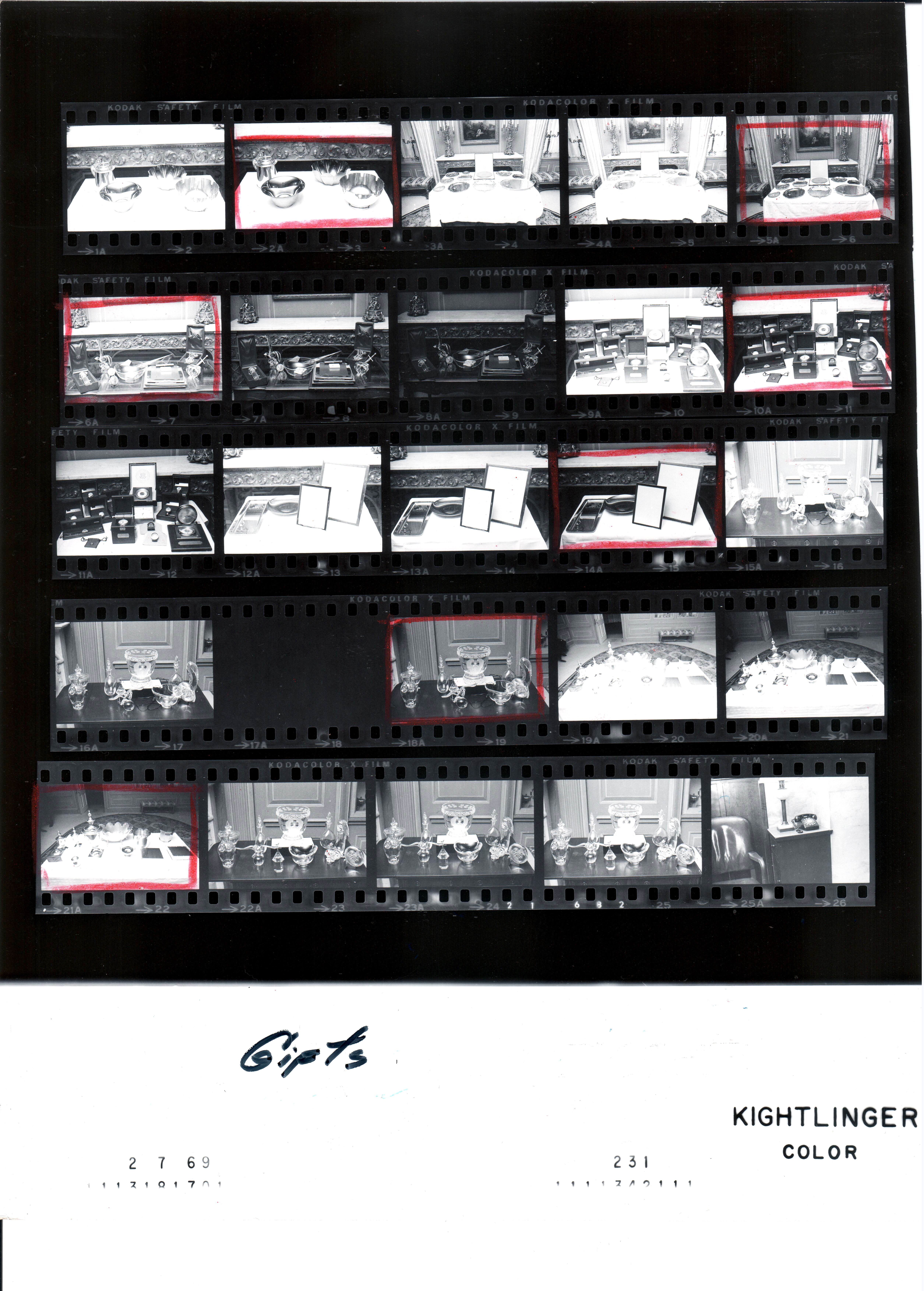
- Frame(s): WHPO-0231-01A-02A, Various silver bowl gifts given by President Nixon to his visitors. Grouping on display table. 2/7/1969, Washington, D.C. White House.
- Frame(s): WHPO-0231-03A-05A, Various silver serving platter and plate gifts given by President Nixon to his visitors. Grouping on display table. 2/7/1969, Washington, D.C. White House.
- Frame(s): WHPO-0231-06A-08A, Various types of crystal and metal gifts given by President Nixon to his visitors. Grouping on display table; Nixon's portrait medal, sword letter opener, crystal bowl, items in padded velvet boxes. 2/7/1969, Washington, D.C. White House.
- Frame(s): WHPO-0231-09A-11A, Various types of wrist watch and clock gifts given by President Nixon to his visitors. Grouping on display table;. 2/7/1969, Washington, D.C. White House.
- Frame(s): WHPO-0231-12A-14A, Various silver serving platter gifts, and framed certificates, given by President Nixon to his visitors. Grouping on display table. 2/7/1969, Washington, D.C. White House.
- Frame(s): WHPO-0231-15A-18A, 22A-24A, Various crystal gifts given by President Nixon to his visitors. Grouping on display table; vase, bowl, cruet, sculptural object, embossed large bowl with eagle. 2/7/1969, Washington, D.C. White House.
- Frame(s): WHPO-0231-19A-21A, Various silver serving platter gifts given by President Nixon to his visitors. Grouping on display table. 2/7/1969, Washington, D.C. White House.
- Frame(s): WHPO-0231-25A, A dark colored rotary dial telephone on side lamp table. 2/7/1969, Washington, D.C. White House.
Roll WHPO-0232 Photographer: Knudsen, Robert L. | Color or B&W: B&W
- Frame(s): WHPO-0232-02A, President Nixon at the Department of Commerce shaking hands with well wishers on stage in an auditorium. 2/7/1969, Washington, D.C. Department of Commerce. President Nixon, unidentified persons.
- Frame(s): WHPO-0232-03A-06A, President Nixon leaving the Department of Commerce, talking with Maurice Stans and a security officer by the Presidential limo. 2/7/1969, Washington, D.C. Department of Commerce. President Nixon, Maurice H. Stans.
Roll WHPO-0233 Photographer: Knudsen, Robert L. | Color or B&W: B&W
- Frame(s): WHPO-0233-02, Secretary of Commerce Maurice Stans greeting President Nixon upon his arrival at the Department of Commerce. 2/7/1969, Washington, D.C. Department of Commerce. President Nixon, Maurice H. Stans, unidentified guests.
- Frame(s): WHPO-0233-03, Unidentified well-wishers greeting President Nixon upon his arrival at the Department of Commerce. 2/7/1969, Washington, D.C. Department of Commerce. President Nixon, unidentified guests.
- Frame(s): WHPO-0233-04-25, Secretary of Commerce Maurice Stans introducing President Nixon to a Department of Commerce official. 2/7/1969, Washington, D.C. Department of Commerce. President Nixon, Maurice H. Stans, Rocco Siciliano, Ross D. Davis, William Chartener, John Kincaid, Fred Simpich, and unidentified guests.
- Frame(s): WHPO-0233-22, Secretary of Commerce Maurice Stans introducing President Nixon to a Department of Commerce official. 2/7/1969, Washington, D.C. Department of Commerce. President Nixon, Maurice H. Stans, unidentified official.
- Frame(s): WHPO-0233-26-32, President Nixon speaking at the Department of Commerce auditorium, Secretary of Commerce Maurice Stans sits nearby. 2/7/1969, Washington, D.C. Department of Commerce. President Nixon, Maurice H. Stans, Rocco Siciliano, Ross D. Davis, William Chartener, John Kincaid, Fred Simpich, and unidentified guests.
- Frame(s): WHPO-0233-33-37, President Nixon greeting unidentified Department of Commerce personnel on the auditorium stage area. 2/7/1969, Washington, D.C. Department of Commerce. President Nixon, Maurice H. Stans, Rocco Siciliano, Ross D. Davis, William Chartener, John Kincaid, Fred Simpich, and unidentified guests.
Roll WHPO-0234 Photographer: Knudsen, Robert L. | Color or B&W: B&W
- Frame(s): WHPO-0234-03-06, Bud Wilkinson speaking before the Senate Youth Program audience. 2/7/1969, Washington, D.C. White House, State Dining Room. President Nixon, Charles Burnham "Bud" Wilkinson.
- Frame(s): WHPO-0234-07, An unidentified official speaking before the Senate Youth Program audience. 2/7/1969, Washington, D.C. White House, State Dining Room. President Nixon, senate youth members, unidentified officials, unidentified persons.
- Frame(s): WHPO-0234-08-29, President Nixon addressing a large audience of the Senate Youth Program members. White House Staff, military officials stand nearby. 2/7/1969, Washington, D.C. White House, State Dining Room. President Nixon, senate youth members, unidentified officials, unidentified persons.
- Frame(s): WHPO-0234-15, President Nixon addressing a large audience of the Senate Youth Program members. White House Staff, military officials, and cameramen stand nearby. 2/7/1969, Washington, D.C. White House, State Dining Room. President Nixon, senate youth members, unidentified officials, unidentified persons, cameramen.
Roll WHPO-0235 Photographer: Knudsen, Robert L. | Color or B&W: B&W
- Frame(s): WHPO-0235-01A-25A, President Nixon addressing participants and personnel of the Senate Youth Program. 2/7/1969, Washington, D.C. White House, State Dining Room. President Nixon, Bud Wilkinson.
- Frame(s): WHPO-0235-26A-36A, President Nixon greeting the crowd after addressing participants and personnel of the Senate Youth Program. 2/7/1969, Washington, D.C. White House, State Dining Room. President Nixon, Bud Wilkinson.
Roll WHPO-0236 Photographer: Atkins, Oliver | Color or B&W: B&W
- Frame(s): WHPO-0236-01A-03A, President Nixon standing with Snowpine Liu, Nixon Library in Hong Kong Founder, and Rose Mary Woods. 2/7/1969, Washington, D.C. White House, Oval Office. President Nixon, Rose Mary Woods, Snowpine Liu.
- Frame(s): WHPO-0236-04A-05A, President Nixon standing with Snowpine Liu, Nixon Library in Hong Kong Founder. 2/7/1969, Washington, D.C. White House, Oval Office. President Nixon, Snowpine Liu.
Roll WHPO-0237 Photographer: Atkins, Oliver | Color or B&W: B&W
- Frame(s): WHPO-0237-01-05, President Nixon, escorted by a military aide, leaves his White House office and walks to a waiting limousine. 2/7/1969, Washington, D.C. White House, South Grounds. President Nixon unidentified aide.
- Frame(s): WHPO-0237-04, President Nixon, escorted by a military aide, leaves his White House office and walks to a waiting limousine. 2/7/1969, Washington, D.C. White House, South Grounds.
Roll WHPO-0238 Photographer: Knudsen, Robert L. | Color or B&W: B&W
- Frame(s): WHPO-0238-03-08, President Nixon holding a press conference with Roy Wilkins, the Executive Director of the National Association for the Advancement of Colored People (NAACP). 2/7/1969, Washington, D.C. White House, Fish Room. President Nixon, Roy Wilkins, unidentified press corps reporters.
Roll WHPO-0240 Photographer: Atkins, Oliver | Color or B&W: B&W
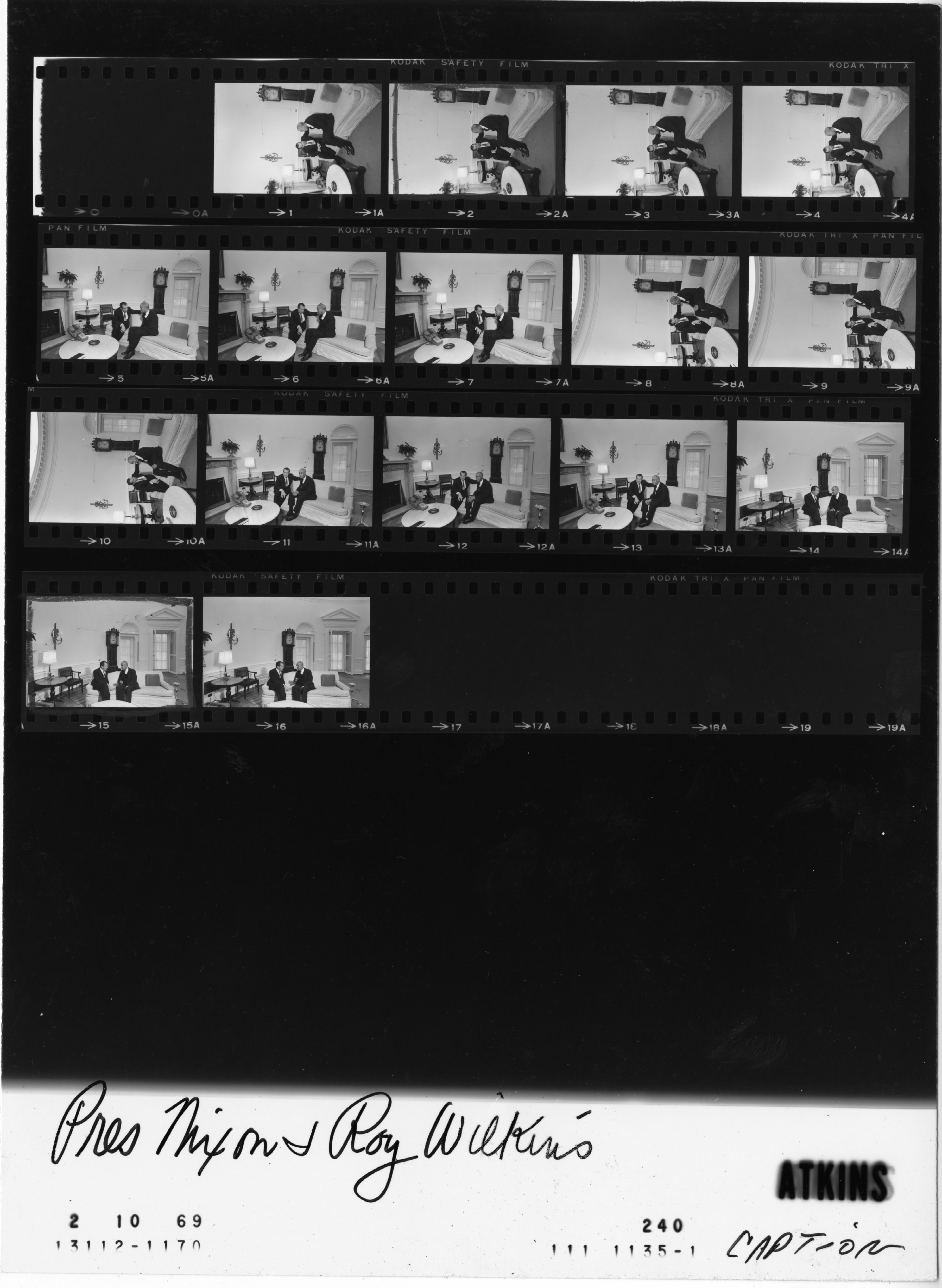
- Frame(s): WHPO-0240-01-16, President Nixon meeting in the Oval office with Roy Wilkins, the Executive Director of the National Association for the Advancement of Colored People (NAACP). 2/7/1969, Washington, D.C. White House, Oval Office. President Nixon, Roy Wilkins.
- Frame(s): WHPO-0240-02, President Nixon meeting in the Oval office with Roy Wilkins, the Executive Director of the National Association for the Advancement of Colored People (NAACP). 2/7/1969, Washington, D.C. White House, Oval Office. President Nixon, Roy Wilkins.
The White House Communications Agency Sound Recordings Collection contains public statements that took place between 1969 and 1974. Visit the finding aid to learn more.
P - Formal Presidential Remarks
- WHCA-SR-P-690210
Remarks by President Nixon to Boy Scouts. (2/7/1969)
Runtime: 5:46
Original Format: 1/4-inch reel-to-reel audiotape. Original source type: Original. - WHCA-SR-P-690211
Remarks by President Nixon to group from Senate youth program. (2/7/1969)
Runtime: 15:36
Original Format: 1/4-inch reel-to-reel audiotape. Original source type: Original. - WHCA-SR-P-690212
Remarks by President Nixon introducing Secretary of Transportation John Volpe to press,. (2/7/1969)
Runtime: 2:32
Original Format: 1/4-inch reel-to-reel audiotape. Original source type: Original.
Context (External Sources)
The Vanderbilt Television News Archive is the world's most extensive and complete archive of television news. They have been recording, preserving and providing access to television news broadcasts of the national networks since August 5, 1968.
Wikipedia is a free encyclopedia that anyone can edit.