
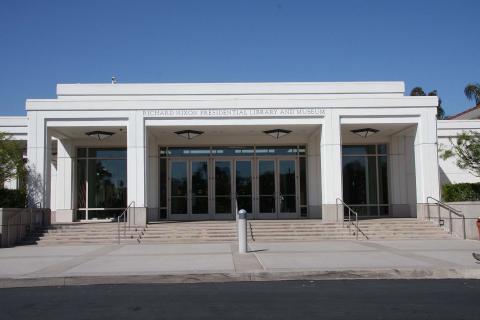
Introduction
This almanac page for Wednesday, February 5, 1969, pulls together various records created by the federal government and links to additional resources which can provide context about the events of the day.
Previous Date: Tuesday, February 4, 1969
Next Date: Thursday, February 6, 1969
Schedule and Public Documents
The Daily Diary files represent a consolidated record of the President's activities. Visit the finding aid to learn more.
The President's day began at The White House - Washington, D. C.
The Weekly Compilation of Presidential Documents made available transcripts of the President's news conferences; messages to Congress; public speeches, remarks, and statements; and other Presidential materials released by the White House.
Addresses and Remarks
- Postal Service (5 Weekly Comp. Pres. Doc. 223, February 5, 1969)
The President's Remarks Announcing New Policy on the Appointment of Postmasters. - Postal Service (5 Weekly Comp. Pres. Doc. 224, February 5, 1969)
Statement by Postmaster General Winston M. Blount on Decision to Fill Postmaster and Rural Carrier Appointments Through Civil Service Examination. - National Science Foundation (5 Weekly Comp. Pres. Doc. 224, February 5, 1969)
The President's Remarks Announcing an Increase in the Foundation's Expenditure Ceiling.
Congress, Communications to
- Nuclear Nonproliferation Treaty (5 Weekly Comp. Pres. Doc. 219, February 5, 1969)
The President's Message to the Senate Requesting Advise and Consent to Ratification.
News Conferences
- Meeting With the Minority Leadership (5 Weekly Comp. Pres. Doc. 219, February 5, 1969)
Press Briefing by Senator Everett M. Dirksen and Representative Gerald R. Ford Following a Meeting With the President.
Statements by the President
- Feed Grain Program (5 Weekly Comp. Pres. Doc. 223, February 5, 1969)
Statement by the President Announcing Continuation of Advanced Payment to Participants for 1969. - National Science Foundation (5 Weekly Comp. Pres. Doc. 225, February 5, 1969)
Statement by the President Upon Increasing the Expenditure Ceiling of the Foundation.
Checklist of White House Press Releases
The releases listed below, made public by the Office of the White House Press Secretary during the period covered by this issue, are not included in the issue.
- Press conference of Lee A. DuBridge, Director, Office of Science and Technology.
- Press conference of Postmaster General Winton M. Blount.
Digest of Other White House Announcements
Following is a listing of items of general interest which were announced in the press but not made public as formal White House press releases during the period covered by this issue. Appointments requiring Senate approval are not included since they appear in the list of nominations submitted to the Senate, below.
- Tracy Greenwood, 5, of Velma, Okla., this year's March of Dimes poster child, met with the President in his office.
Nominations Submitted to the Senate
Does not include promotions of members of the Uniformed Services, nominations to the Service Academies, or nominations of Foreign Service Officers.
- JOHN S. FOSTER, of Virginia, to be Director of Defense Research and Engineering.
- ROBERT C. MOOT, of Virginia, to be an Assistant Secretary of Defense.
- CHARLES A. BOWSHER, of Illinois, to be an Assistant Secretary of the Navy.
- ROERT ALAN FROSCH, of Maryland, to be an Assistant Secretary of the Navy.
- STANLEY R. RESOR, of Connecticut, to be Secretary of the Army.
- JOHN L. O'MARRA, of Oklahoma, to be an Assistant Postmaster General.
Each Public Papers of the Presidents volume contains the papers and speeches of the President of the United States that were issued by the White House Office of the Press Secretary during the time period specified by the volume. The material is presented in chronological order, and the dates shown in the headings are the dates of the documents or events. In instances when the release date differs from the date of the document itself, that fact is shown in the text note.
To ensure accuracy, remarks have been checked against audio recordings (when available) and signed documents have been checked against the original, unless otherwise noted. Editors have provided text notes and cross references for purposes of identification or clarity.
- Message to the Senate Requesting Advice and Consent to Ratification of the Treaty on Non-Proliferation of Nuclear Weapons.
- Statement Announcing Continuation of Advance Payments to Participants in the Feed Grain Program for 1969
- Remarks About a New Policy on Appointment of Postmasters.
- Remarks About an Increase in the Expenditure Ceiling of the National Science Foundation.
- Statement Announcing an Increase in the Expenditure Ceiling of the National Science Foundation
The Federal Register is the official daily publication for rules, proposed rules, and notices of federal agencies and organizations, as well as executive orders and other Presidential documents.
The Congressional Record is the official daily record of the debates and proceedings of the U.S. Congress.
Archival Holdings
Any selection of archival documents will necessarily be partial. You should use the documents and folders identified below as a starting place, but consult the linked collection finding aids and folder title lists and the collections themselves for context. Many documents to be found this way do not lend themselves to association with specific dates, but are essential to a complete understanding of the material.
Selective document listing
President's Office Files
The President's Office Files consists of materials drawn together by the Special Files Unit from several administrative subdivisions within the White House Office. It is the handwriting and sensitive papers sent to the Staff Secretary that now comprise much of the President's Office Files. Visit the finding aid to learn more.
- President's Handwriting, Box 1, President's Handwriting, February 1969 [2 of 3]
- Memo; Huston to Buchanan re: D.C. anti-crime effort. February 5, 1969. 1 pg.
- Memo; Huston to Buchanan re: Combatting crime in the District, incl. attachment. February 5, 1969. 3 pgs.
- Memo; John D. Ehrlichman to The President re: An interesting memorandum by Harry Dent (2/3/1969). February 5, 1969. 1 pg.
- Memo; John D. Ehrlichman to The President re: Attached note and letter from Strom Thurmond (2/3/1969). February 5, 1969. 1 pg.
- Memo; Rita E. Hauser to The President re: Appointment as U.S. Representative to the Human Rights Commission of the United Nations. February 5, 1969. 1 pg.
- Memo; H. R. Haldeman to Mr. Klein re: Reaction to the Inaugural Address. February 5, 1969. 1 pg.
- Annotated News Summaries, Box 28, News Summaries - February 1969 [During this period, the Staff Secretary only removed pages from the News Summaries which contained President Nixon's handwriting, often leaving the document with no date. Although there are no specific documents with this date, you should also consult the full folder for the month.]
- President's Meetings File, Box 73, Memoranda for the President--Beginning February 2, 1969
- Patrick J. Buchanan to The President, Re: One observer's view of the President's second meeting with his House and Senate Minority Leadership. 2/5/1969, 8:38 a.m. [per President's Daily Diary]. 10 pgs.
- Alexander P. Butterfield to The President's File, Mid-Morning Meeting in the President's Office with Dr. Lee DuBridge, Science Advisor to the President. 2/5/1969, 10:38 a.m. [per President's Daily Diary]. 1 pg.
President's Personal File
The President's Personal File is essentially a President's secretary's file, kept by Rose Mary Woods, personal secretary to the President, for two purposes: (1) preserving for posterity a collection of documents particularly close to the President, whether because he dictated or annotated them, or because of the importance of the correspondent or the event concerned and (2) giving appropriate attention–letters of gratitude, invitations to White House social events, and the like–to members and important friends and supporters of the Nixon administration. This generalization does not describe all the varied materials of a file group which is essentially a miscellany, but it does identify the reason for the existence of the file group's core. Visit the finding aid to learn more.
- President's Speech File
Selective document listing
The White House Press Office during the Presidency of Richard Nixon was responsible for daily communication with the White House press corps. Ronald L. Ziegler was the Press Secretary to the President for Nixon's entire term in office from January 1969 to August 1974 and Gerald Warren served as the Deputy Press Secretary. The office held daily briefings for the press and produced the White House’s press releases. Visit the finding aid to learn more.
- White House Press Conferences, Box 55
- News Conference #34 at the White House with Ron Ziegler, February 5, 1969, 4:15 P.M. EST. 5 pgs.
The H. R. Haldeman Diaries consists of seven handwritten diaries, 36 dictated diaries recorded as sound recordings, and two handwritten audio cassette tape subject logs. The diaries and logs reflect H. R. Haldeman’s candid personal record and reflections on events, issues, and people encountered during his service in the Nixon White House. As administrative assistant to the President and Chief of Staff, Haldeman attended and participated in public events and private meetings covering the entire scope of issues in which the Nixon White House engaged in during the years 1969-1973. Visit the finding aid to learn more.
- Transcript of diary entry (PDF)
Wednesday, February 5.
A big news day; the NPT, Congressional leaders meeting; Mideast announcement, removal of Post Office from politics, feed grain support raised, ceiling lifted on NSF funds, picture with March of Dimes kid. And all done in the morning. Afternoon free for preparation for press conference.
President couldn't get right to work on it though - came into my office - then to Rose's - to try on six pairs of new shoes. Got the briefing book at 2:00 and started to work about 3:00. Left for dinner at 6:30, back at 8:10, still there when I left at 10:45.
Still pushing regarding Departments trying to fill all jobs - wants them to leave some vacant. Still fussing about ambassadors. I took Peter O'Donnell (Texas State Chairman) in for a few minutes - after I had a session with him regarding his complaint of no Texas appointments.
Ehrlichman and I had knock-down with VP, regarding his staff and office facilities. Hard to get anywhere. Afraid we made things worse - and that it will have to go to President. VP has no concept of President's view of how he should handle the role, and I don't think he ever will. Real problem regarding his hiring LBJ advance man. He sees no reason not to - and apparently intends to buck us all the way.
President also upset because VP got into act at legislative leaders meeting and sided with Congressmen versus Postmaster Blount and the President. Just doesn't get it, yet.
Another go-round on ambassador resignations, but President didn't sign them.
Has feeling AP photo editors are jobbing us and wants Ziegler to check it out and if so give UPI some exclusive breaks. - Handwritten diary entry (JPG)
The National Archives Catalog is the online portal to the records held at the National Archives, and information about those records. It is the main way of describing our holdings and also provides access to electronic records and digitized versions of our holdings.
The Catalog searches across multiple National Archives resources at once, including archival descriptions, digitized and electronic records, authority records, and web pages from Archives.gov and the Presidential Libraries. The Catalog also allows users to contribute to digitized historical records through tagging and transcription.
Nixon Library Holdings
All National Archives Units
National Security Documents
The President's Daily Brief is the primary vehicle for summarizing the day-to-day sensitive intelligence and analysis, as well as late-breaking reports, for the White House on current and future national security issues. Read "The President's Daily Brief: Delivering Intelligence to Nixon and Ford" to learn more.
- President's Daily Brief of 05 February 1969 [consult link for visuals and extent of redactions]
The President's Daily Brief
5 February 1969
14
Top Secret
LATE NOTES FOR THE PRESIDENT'S DAILY BRIEF OF
5 FEBRUARY 1969
[redacted]
6 February 1969
LATE NOTES FOR THE PRESIDENT'S DAILY BRIEF OF
5 FEBRUARY 1969
I. MAJOR PROBLEMS
MIDDLE EAST
There is nothing significant to report.
EUROPE
The Soviets have taken a hard stand against any West German proposals for a deal under which Moscow would renounce "rights" it has already asserted to intervene in West German affairs under the Potsdam accords and the United Nations charter, in return for Bonn's signature of the nonproliferation treaty. [redacted] until a German peace treaty is concluded, the Soviets will continue
to regard both documents as the basis for their relations with Bonn. [redacted]
* * *
In West Germany, a parliamentary controversy has arisen over recent criticism of certain aspects of the nonproliferation treaty by two ranking diplomats, one the Foreign Office's commissioner for disarmament. The matter has taken a strong political coloration; the Socialists are critical and the Christian Democrats are defending the diplomats. The leader of the small Free Democratic Party also is critical. He told US Embassy officers on 5 February that his party is solidly in favor of West German signature of the treaty. [redacted]
* * *
The Socialists yesterday apparently reneged on an earlier promise to support Kai-Uwe von Hassel, a Christian Democrat, as the new president of the West German parliament. Von Hassel won anyway, by two votes, but he had to rely on votes from the Free Democrats, who are not in the grand coalition. This looks like yet another reason for a loosening--if not dismemberment--of the coalition prior to elections later this year. [redacted]
* * *
[redacted]
SOVIET AFFAIRS
There is nothing significant to report.
VIETNAM
The Viet Cong Radio announced today that another US prisoner would be released during the Tet holiday, which occurs from 17 to 19 February. The captive is said to be John A. Kuhman, a US soldier who was born in West Germany. The Viet Cong may be planning to make a propaganda issue out of his birthplace. (Reuters, Saigon, 6 Feb 69)
* * *
The press also reports that two terrorists bombed a local civil guard headquarters in Saigon today. We expect more of this type of attack as Tet approaches. (Reuters, Saigon, 6 Feb 69)
II. OTHER IMPORTANT DEVELOPMENTS
There is nothing of significance to report.
I, MAJOR PROBLEMS
MIDDLE EAST
There is nothing of significance to report.
EUROPE
As we had expected, the debate in West Germany over the nonproliferation treaty is heating up and is threatening to spill over into this year's election campaign. Brandt downgraded the arguments against the treaty last week in an article put out by his party's press service, and CDU and CSU leaders have been rebutting him ever since. The CSU, with Franz-Josef Strauss himself in the van, is particularly vehement and comprehensive in its objections. We assume that one motive behind Bonn's urgent requests for a US demarche to the Soviets is a desire to have the issue resolved as far as possible in advance of the elections next fall.
* * *
Moscow has made a bit more headway in its efforts to head off the meeting of the West German Federal Assembly in West Berlin. Soviet Ambassador Abrasimov has managed to dent Mayor Schuetz's belief that the meeting would not stimulate any major Communist countermeasures. [redacted] Ambassador Tsarapkin will doubtless be trying to drive the wedge in farther in his upcoming talk with Brandt at the latter's Black Forest retreat.
The Soviets may be having troubles of their own, however. Deputy Foreign Minister Semenov met yesterday in Berlin with high East German leaders, probably to go over several issues--including the Assembly meeting--on which Soviet and East German policies differ. We will probably hear more noise from the Soviets about the Assembly in the future, although not as much as Pankow would like. At the moment we still expect the meeting to be held in Berlin as planned.
SOVIET AFFAIRS
For the past three weeks there has been a sense of unease in Moscow concerning the situation in the Kremlim. The factor contributing most conspicuously to this unease has been Kosygin's long absence from his desk (he was last seen publicly on 20 December). [redacted]
Brezhnev has not been seen in public since 22 January, [redacted] Another member of the Politburo, Kirilenko, has been out of sight since 13 December. Other members of the Politburo have filled in for them, resulting in unusual public exposure for Shelepin, among others. As an ambitious "junior" who is believed to have made an unsuccessful attempt in 1965 to topple some of his elders, Shelepin's activities are always the subject of special interest.
The uncertainty has also been heightened by the regime's silence, since its initial terse announcement, concerning the attack on the cosmonaut motorcade on 22 January. Soviet citizens have been speculating wildly. Some fear the incident was a secret police provocation by which to justify a crackdown on political nonconformists, while others believe the attack was against the Soviet leadership rather than the cosmonauts.
The Soviet press has recently carried several articles expressing dissatisfaction, in veiled terms, with the way in which the leadership has been exercised. These articles are not unprecedented, but their appearance during this period of uncertainty has contributed to the over-all sense of unease.
We have no good information on the forces behind these articles or on their intended targets. We suspect, however, that individual members of the leadership may be jockeying for position, perhaps with an eye to the possibility that Kosygin may not return to duty.
The Annex today provides some background on the current relationship among the Soviet leaders.
* * *
The Soviets are concerned, as we are, that Ayub's position is shaky and that his fall could only mean confusion, instability, and an opening for the Chinese. They clearly want to preserve the status quo on the subcontinent and probably hope to maintain the advantage over the us and Communist China they feel they attained after the settlement of Tashkent in 1965. [redacted]
VIETNAM
Thieu is increasingly beset with demands that he reshuffle his cabinet. The list of those who have recently made clear their wish [redacted] for major changes in Saigon includes Vice President Ky, III Corps commander Do Cao Tri, General "Big" Minh and, of course, the militant Buddhists.
Thieu apparently is also receiving reports from various South Vietnamese quarters that the US might be sympathetic to the idea of major changes in the government, including perhaps even the replacement of Thieu with a "peace regime." Thieu seems to be taking such rumors in stride thus far, but he remains innately suspicious of the US. Moreover, he knows that any rumor
that the US might support a move to oust him is certain to encourage his enemies.
* * *
The Communists staged several rocket and mortar attacks on allied positions in the delta yesterday. The Communists also fired three mortar rounds out of the southern portion of the Demilitarized Zone yesterday. This is the third such incident in the last few days.
* * *
A recent spate of items in the North Vietnamese press reflects great dissatisfaction with the country's internal affairs and the performance of leadership cadre all down the line. For several weeks there have been signs of displeasure and strong suggestions that certain segments of the populace are flagging in their support of the war or at least not putting forth the kind of effort the regime demands. Groups, individuals, and even party leaders have been charged with a variety of sins, ranging from corruption to "individualism," but the main thrust is against anyone who is not fully concentrating on carrying out regime policy.
This campaign seems designed, to counter the widespread relaxation in North Vietnam which followed the US bombing halt on 1 November. Hanoi tolerated this for a short time, but in the last two months there has been growing emphasis on needs of the war in the South, improvement of conditions in the North, and preparation for future reconstruction. With the impetus of common danger removed, the regime seems to have more trouble obtaining maximum effort than before the bombing stopped. There is no persuasive evidence at this time, however, that these problems seriously weaken the Communist war effort. We regard the harsh language used recently as an attempt to head off trouble before it gets out of hand.
II. OTHER IMPORTANT DEVELOPMENTS
NIGERIA
The Biafrans, who recently were very short of ammunition, are again receiving nearly 100 tons of arms a week through the nightly airlift from Gabon and the Ivory Coast. A shipment of ammunition (about 1.2 million small arms rounds) is also en route by sea from France to Gabon for airlifting into Biafra.
In the war itself, there is some fighting on the south central edge of the Biafran perimeter. Biafran forces there are trying to retake an important crossroads at Owerri. To the North, federal forces are trying to link up east of Onitsha, mainly to simplify their supply problems. Casualties in all this skirmishing are thought to be light.
Frustrated Nigerian leaders are planning another major offensive, but we doubt that their troops can force an early break in the stalemate.
COMMUNIST CHINA
The Chinese Communists today poured some more cold water on the upcoming Warsaw talks. They informed the embassy in Warsaw that their charge--not their ambassador still in Peking--will participate at the session on 20 February. The Chinese also said that the meeting would take place at the usual location, and not in the Chinese or US embassy, as proposed by the US.
ANNEX
THE SOVIET COLLECTIVE LEADERSHIP
The group that ousted Khrushchev in October 1964 reinstated the system of collective leadership in which members of the Politburo share--although not equally--in formulating policy. Within the Politburo there have been adjustments in assignments and shifts in power relations, but the membership of this top policy-making body--especially its full or "voting" members--has changed very little in the past four years.
The 11-man Politburo is composed of overlapping and sometimes shifting cliques based on regional associations, age, and shared outlooks in the approach to key policy problems. One fairly central element has been the "Ukrainian group," headed by Brezhnev and including Podgorny, Kirilenko, Polyansky and Shelest. There are no such obvious alignments, based on geographic ties, in the careers of the other six.
Cutting across this grouping is an age gap between the "seniors"--allover 60--and the "juniors" in their early 50's, who on occasion have not been consulted and have voiced their resentment. Kosygin apart, most of the "seniors"--Brezhnev, Podgorny, Kirilenko, Suslov, Pelshe and Shelest--now present an image of thoroughly conventional Soviet Communist bureaucrats. Their view of the world and their political vocabulary--formed during the Stalin years--have preserved heavy traces of the "siege" mentality of those years. "Imperialist encirclement" and the contagion of foreign ideas are for them real dangers, only slightly mitigated by the fact that the Soviet Union has greatly reduced its international isolation.
Kosygin and the "juniors"--Mazurov, Polyansky, Shelepin and Voronov--appear to lean to a generally more pragmatic approach, perhaps because they hold or have held positions in the state apparatus responsible for the execution of policy. For them, probably, the danger of contamination by the West is weighed against what can be achieved by a degree of cooperation--both in terms of relaxed budgetary pressures and in access to technological know-how from abroad. They seem to believe that some modifications of the Soviet system, particularly in the economic sphere, are needed and that somewhat more scope must be given to the "experts" whose contribution lies in technical knowledge, not Marxist-Leninist fervor.
Contributing to these cross-currents is the fact that the composition of the Politburo now reflects the power relationships among the major interest groups in the country. The party apparatus, government bureaucracy, agricultural interests, and the military-defense industrial complex all seem to have men on the Politburo to whom they can look to represent their views! This balance has favored both stability and orthodoxy.
[redacted] the Politburo [redacted] meets regularly once a week, more often when the pressure of work demands. Its approval is required on all important matters, as well as on a large number of seemingly trivial questions. An effort is apparently made to reach unanimous agreement among all 11 members. If this is not possible, decision may be deferred or the minority view may be overridden. [redacted]
Brezhnev chairs Politburo meetings and presumably his opinion carries greater weight than any other. Despite the efforts to coordinate even small details of official policy positions--sometimes down to the texts of Pravda articles-and the careful observance of accepted codes of procedure, it is clear that differences of views, political rivalries and the considerable overlapping of responsibilities among members of the Politbμro all create strain within the leadership. [redacted] [redacted]
Collective leadership by its very nature has meant hesitation, procrastination, and on occasion an attempt to follow mutually contradictory policy lines simultaneously. It has also led to long periods when the entire energies of the Politburo were focused on one pressing problem to the exclusion of all others. [redacted]
The international situation has contributed to the growing orthodoxy in the Politburo. Increased international tensions--stemming from the war in Vietnam, the Middle East crisis and concern about developments in China--gave the spokesmen for the military and the defense industry more powerful voices, at least in budgetary matters, and proved a boon to conservatives who oppose accommodation with the West and favor greater discipline at home.
In an atmosphere inconducive to the cause of reform-minded moderates, their position in the leadership was weakened. Kosygin came to have less influence than Brezhnev, who showed himself ready to listen to the military. Brezhnev has been careful to stay close to the center of opinion in the Politburo, but that center is considerably more to the conservative side than it was at the time of Khrushchev's ouster.
The Czechoslovak problem probably presented the collective leadership with its most difficult hours, and may have placed some of the top leaders in a weaker position. Brezhnev may, for a variety of reasons, become the most obvious and convincing scapegoat for an unsatisfactory episode in the conduct of affairs abroad. Soviet politics has a way of searching out scapegoats, and the Czechoslovak affair may yet be used against him in the future.
In maintaining the delicate power balance at the top, Kosygin has a pivotal role, despite the fact that Brezhnev is clearly "chairman of the board." Kosygin's stature as an economic administrator is unchallenged; he is not associated with either regional rivalries or partisan pleading for special interest groups. There have been periodic flurries of rumors that he intends to step down, either because of dissatisfaction with the trend of conservatism in the Politburo or because of ill health. Should he do so, the strongest moderating influence in the group would be lost. Moreover, the difficult problem of choosing his replacement would bring to the fore all the accumulated frictions, rivalries and unsolved problems that have accumulated. It would certainly put a severe strain on the system of collectivity, and the outcome might change radically the face of the Soviet leadership.
The Foreign Relations of the United States series presents the official documentary historical record of major U.S. foreign policy decisions and significant diplomatic activity. Visit the State Department website for more information.
Vol. II, Organization and Management of U.S. Foreign Policy, 1969-1972
The Intelligence Community and the White House
185. Memorandum for the Record , Washington, February 5, 1969
Source: National Security Council, Nixon Intelligence Files, NSC Files, 303/40 Committee, Minutes, 1969. Secret; Eyes Only. Prepared by Chapin on February 6. Copies were sent to Johnson, Packard, Helms, and Mayo (item 1 only).
Vol. IV, Foreign Assistance, International Development, Trade Policies, 1969-1972
Trade and Commerce, 1969-1972
182. National Security Study Memorandum 16 , Washington, February 5, 1969
Source: National Archives, RG 59, S/S Files: Lot 80 D 212, NSSM 16. Limited Official Use.
Vol. V, United Nations, 1969-1972
Chinese Representation in the United Nations
273. National Security Study Memorandum 14 , Washington, February 5, 1969
Source: National Archives, Nixon Presidential Materials, NSC Files, Box 365, Subject Files, NSSMs 1–42. Secret.
Vol. VI, Vietnam, January 1969-July 1970
Vietnam, January 1969-July 1970
18. Memorandum From Secretary of State Rogers to President Nixon, Washington, February 5, 1969
Source: Library of Congress, Manuscript Division, Kissinger Papers, Box TS 64, Memoranda to the President, 1969, February to April. Top Secret. Kissinger’s staff prepared a summary of Rogers’ recommendations and arguments which Kissinger sent to Nixon on February 12. Kissinger advised that the President approve Rogers’ recommendations.
Vol. XVII, China, 1969-1972
China, 1969
4. National Security Study Memorandum 14 , Washington, February 5, 1969
Source: National Archives, Nixon Presidential Materials, NSC Files, NSC Institutional Files (H-Files), Box H–134, NSSM Files, NSSM 14. Secret.
Vol. XXIV, Middle East Region and Arabian Peninsula, 1969-1972; Jordan, September 1970
Saudi Arabia
127. Telegram From the Consulate General in Dhahran to the Department of State, Dhahran, February 5, 1969, 0625Z
Source: National Archives, Nixon Presidential Materials, NSC Files, Box 629, Country Files, Middle East, Saudi Arabia, Vol. I. Secret; Exdis. It was repeated to Jidda.
Vol. XXIX, Eastern Europe, 1969-1972
Radio Free Europe and Radio Liberty
30. Memorandum for the Record , Washington, February 5, 1969
Source: Department of State, INR/IL Historical Files, 40 Committee Minutes. Secret; Eyes Only. Drafted on February 6 by Trueheart.
Vol. E-2, Documents on Arms Control and Nonproliferation, 1969-1972
Nuclear Non-Proliferation Treaty; Implementation of Safeguard System
8. National Security Decision Memorandum 6 , Washington, February 5, 1969
This memorandum announced President Nixon’s decision to go forward with ratification of the NPT. Although the U.S. would ratify the agreement, Nixon directed that no efforts be made to pressure other nations, specifically the FRG, to follow suit. Instead the U.S. Government “should reflect a tone of optimism that other countries will sign or ratify,” and emphasize that the Treaty would not “broaden or modify U.S. commitments abroad.”
Source: National Archives, Nixon Presidential Materials, NSC Files, Box 363, Subject Files, NSDM’s (1–50). Secret. The President submitted the treaty to the Senate for ratification the same day. For text of his message to the Senate, see Public Papers: Nixon, 1969, p. 62. The Senate gave its consent on March 13 by a vote of 83–15. For text of the Senate Foreign Relations Committee report, see Documents on Disarmament, 1969, pp. 78–97.9. National Security Study Memorandum 13 , Washington, February 5, 1969
The President directed that a study be made reviewing the positions of key countries on the treaty and the alternative courses of action available to the U.S. to influence their signature or ratification of the treaty.
Source: National Archives, Nixon Presidential Materials, NSC Files, NSC Institutional Files (H-Files), Box H–34, Senior Review Group Meeting, 3/6/69. Secret
Eighteen-Nation Disarmament Committee; Seabed Arms Control Treaty
63. Memorandum From the President’s Assistant for National Security Affairs (Kissinger) to President Nixon, Washington, February 5, 1969
Kissinger recommended holding an NSC meeting to discuss the issues on the agenda for the upcoming Eighteen-Nation Disarmament Conference (ENDC) meeting in Geneva. In addition to this conference, he also recommended that an ad hoc study group be established to prepare a paper on the issues likely to be discussed, including the comprehensive test ban, ending production of fissionable material, and seabed arms control.
Source: National Archives, Nixon Presidential Materials, NSC Files, NSC Institutional Files (H-Files), Box H–136, NSSM 20. Secret. Nixon initialed his approval of both of Kissinger’s recommendations.
Nuclear Test Ban Issues; Peaceful Nuclear Explosions
280. Letter From the Chairman of the Atomic Energy Commission (Seaborg) to President Nixon, Washington, February 5, 1969
Seaborg addressed the various Plowshare projects and the treaty banning nuclear weapon tests in the atmosphere. He recommended allocating funding for AEC’s excavation and explosive development program, but noted that doing so potentially violated the LTBT.
Source: National Archives, Nixon Presidential Materials, NSC Files, Box 200, Agency Files, Nuclear Testing, Joint Nuclear Tests. Secret.
Vol. E-7, Documents on South Asia, 1969-1972
India and Pakistan: Pre-Crisis, January 1969-February 1971
3. Telegram 1238 From the Embassy in Pakistan to the Department of State, Rawalpindi, February 5, 1969, 1100Z
The Embassy reviewed mounting political unrest in Pakistan and concluded that Pakistani President Ayub Khan’s “eventual withdrawal from the political scene must be considered likely.”
Source: National Archives, RG 59, Central Files 1967–69, POL 23–8 PAK. Confidential; Priority. Repeated to Ankara, Jidda, Kabul, Karachi, London, Moscow, New Delhi, Tehran, Dacca, Lahore, Peshawar, DIA, and CINCSTRIKE.
Vol. E-10, Documents on American Republics, 1969-1972
Venezuela
654. Memorandum of Conversation, Washington, February 5, 1969, 11:30 a.m. , Washington, February 5, 1969, 11:30 a.m.
Special emissaries of President-elect Caldera met with Secretary of State Rogers to explore issues that would arise between the two nations, especially concerning petroleum.
Source: National Archives, Nixon Presidential Materials, NSC Files, Box 796, Country Files, Latin America, Venezuela, Vol. 1, 1969–1971. Confidential. Drafted by Hill. Attached was a note that read, “Not reviewed and cleared.” The meeting took place in the Secretary’s Office. According to Roger’s appointment book, the meeting took place between 11:35 a.m. and 12:10 p.m. (Personal Papers of William P. Rogers, Appointment Books)
The Kissinger telephone conversation transcripts consist of approximately 20,000 pages of transcripts of Kissinger’s telephone conversations during his tenure as Assistant to the President for National Security Affairs (1969-1974) and Secretary of State (1973-1974) during the administration of President Richard Nixon. Visit the finding aid for more information.
Chronological File, Box 1, Folder February 1-11, 1969
- 8:40 AM, Minister Tomkins (British Emb); Mr. Kissinger
Minister Tomkins (British Emb)
Mr. Kissinger
2-5-69 8:40 AM
Min T said that Michael Palliser could arrive in Washington at 3:45 PM tomorrow - asked whether HAK could plan to dine with him at Min Tomkins. HAK said he would be pleased to do so and asked if he could bring along John Ehrlichman - Min Tomkins agreed to this. Twill call HAK upon Palliser's arrival tomorrow. - 8:55 AM, Ben Read; Mr. Kissinger
Ben Read
Mr. Kissinger
2-5-69 8:55 AM
R said the French and Italian Ambs were coming in to see the Secretary this morning and asked whether HAK had notified them of forthcoming trip. HAK said they have not been notified of form
of announcement. He has seen both Ambs however and memcons have been sent to State on his conversations. R asked if they had been given precise dates - HAK then gave him schedule.
jm - 9:00 AM, Richard Pedersen; Mr. Kissinger
Richard Pedersen
Mr. Kissinger
2-5-69 9:00 AM
K said they were going to force him to give news interviews if stories like the one in the Times keep up. K said he was calling about questions and answers for President's press conference. P said material was not satifactory which they received and that they are going over it and will get it to K as soon as possible, perhaps about ll:30. K asked about Sihanouk letter. P said Secy did not have a chance to see it last night (had to have dinner with VP) , P has it on his desk and will get it over about 10:00.
K and P discussed NSDM 3. K said he had frankly reached point where he felt anything he sent over leads to a fight. P discussed practice to be followed on appeals in operational matters. K said he had no problem with this, obviously the appeal channel should be up to SecState. K said he would have Larry LDX over the text he planned to take into the President and asked P to LDX his acceptance - he would take them both into the President at tomorrow's meeting and get out another NSDM. Discussed IG material. P said Secretary will exercise policy authority over what State Dept puts into IG. Once report is finished, the report will be sent to the NSC, the Secretary and other Secretaries involved. - 9:10 AM, Richard Pedersen; Mr. Kissinger
2-5-69 9:10 AM
P called back to say Secy is concerned about Times story and wants to get NSDM thing out today. HAK said that is really blackmail. HAK said it would have been done a week ago except for their
objections.
jm - 9:20 AM, David Rockefeller; Mr. Kissinger
David Rockefeller
Mr. Kissinger
2-5-69 9:20 AM
Discussed NPT. R told K of his conversation with Schroeder - said he had told him that he would be in Munich on the 22nd and there was bare possibility that HAK might be there too. HAK said he probably would not be able to go for reasons that will become apparent in next two or three days. R said he was leaving for Europe tonight, would be back next Thursday and then going to England. R said he would call HAK on Thursday.
jm - 9:30 AM, Prof. E. H. van der Beugel; Mr. Kissinger
Prof E. H. van der Beugel
Mr. Kissinger
2-5-69 9:30 AM
HAK explained to van der Beugel that he has to leave for Florida with the President on Friday and will not return to Washington until Sunday night or Monday afternoon and would therefore not be able to see him here on Sunday. HAK said if there is a courier plane going to Key Biscayne, perhaps VDB could come down to Fla on that on Sunday. VDB explained that he has to be in NY Sunday night and is leaving for Holland Monday night, but would be glad to go to Florida so long as he gets to NYC
Sunday night.
HAK agreed to leave message at Regency Hotel in NYC where VDB will be ~ staying on Friday night or at the Mayflower in Washington on Saturday. If Florida deal cannot be worked out they agreed to have a long chat by phone on Sunday.
jm - 9:50, Mr. Ehrlichman; Mr. Kissinger
Mr. Ehrlichman
Mr. Kissinger
9:50 2-5-69
K told E of above conversation - E cannot make dinner but it was agreed he would join them for drinks. - 9:52, Minister Tomkins; Mr. Kissinger
Minister Tomkins
Mr. Kissinger
9:52 2-5-69
K explained that Ehrlichman could not be present for dinner but suggested that he might come by for a drink. T said they could come any time after 7:00 - address: 2406 Kalorama Road.
jm - 10:10 AM, Joseph Alsop; Mr. Kissinger
Joseph Alsop
Mr. Kissinger
2-5-69 10:10 AM
K apologized for problems they have been having with dinners lately. Agreed to come for dinner on Feb 14. A said he is also giving dinner for Lord Harlech on the 20th and HAK said he would love to come to that.
A said he wanted to talk with one or two of K's staff, especially Sonnenfeldt who he understands in one of top experts in the Government on Soviet matters. K said he wanted to think about it - that he had told his staff they were not to be in contact with the press. A said he thought he was making a mistake - if you don't trust the people you trust, there is no one who can defend you. HAK said that was a good point. He said there is something he would like to discuss with A but not on telephone and they agreed to try to have a meeting in the office next weak.
jm - 2:10 PM, Secretary Laird; Mr. Kissinger
Secretary Laird
Mr. Kissinger
2/5/69 2:10 pm
Secy Laird called to say he hoped HAK would let him make any contacts with military for a while. HAK said only times he will call military is when he gets a note from the Pres saying "call Gen Wheeler." (as apparently happened over the weekend) HAK agreed that when he gets such an instruction he will let Laird know, and then they will discuss how to proceed.
Laird is going to move on the ISA slot soon: Gus Hart , Exec VP of Quaker Oats wouldn't work hard enough to handle the job. Paul will stay until March 1st. Laird is looking over Richardson and Warren Nutter. HAK said they sound good to him. (Laird mentioned others: a law partner of Jack Irwin, one Robt M Pennoyer; Bob Amory; George Lindsay; Tim Stanley, but drawbacks to each.) - 2:30 PM, Mr. Kissinger; Ambassador Lucet
K said we have one problem that he would like to discuss with the Amb and it is raised by the fact that the Pope will be in retreat during the week of Pres visit to Rome because of Lent. K said now they will go to Rome for visit to Italian Govt, then to Paris as planned, but on way back they will stop in Rome for one hour visit to the Pope - wanted to know whether this would be agreeable. K said Paris will still be the last capital visited and that we are counting in any event on final meeting between the two Presidents on Sunday. K said they could probably leave Paris as late as 3:30 so the two Presidents could meet as late as 2:00 and then ride to airport together. L thought all of this would be agreeable.
K said our people are flying over two cars for the President, and wondered what pleasure of de Gaulle and French Govt would be to our using own automobiles. K said our security people would feel happier with this arrangement. It was agreed that two presidents would go in same car from airport but question is whether it should be Nixon or de Gaulle's car. L thought they would want to use de Gaulle's car whenever the two presidents were traveling the the same car.
K said Ehrlichman will be leaving on Saturday for Europe and would like him to meet the Ambassador before that. A meeting was arranged,
L asked about the ceremony at the Arc de Triumph - K said the President has agreed to do this. No speech involved.
K said President would announce his plans at tomorrow's press conf and agreed to get copy of text of his statement to L later in the day - said we would appreciate it if nothing were said in Paris before the press conf.
L said he had gotten note from SecState this morning re bilateral talks.
jm - 3:25 PM, Mrs. Clare Booth Luce; Mr. Kissinger
Mrs. Clare Booth Luce
Mr. Kissinger
2-5-69 3:25 PM
Mrs. L congratulated HAK on his appt and said how lucky the President is to have him. Mrs. L said she is coming to see Secretary of State on Tuesday, Feb 11 re the UNESCO job and would like to see HAK while she is here. Meeting with HAK set for 12:30. Mrs. L asked KAK's advice re sending memo to SecState beforehand re UNESCO job and he advised her that it would be a good idea.
jm - 3:35 PM, Italian Ambassador Ortona; Mr. Kissinger
Italian Ambassador Ortona
Mr. Kissinger
2-5-69 3:35 PM
Amb said he was leaving for Rome tomorrow and would be back on Tuesday afternoon. Said he would be able to tell K more after that but as for the subjects, he had indication of following: East-West Relation;, NATO, UN, European integration. They would like more restricted meeting on China and Disarmament with particular emphasis on SALT. If there is time, might touch on South America and monetary relations.
K said that Ehrlichman is leaving on Saturday and asked for name of person he should deal with on the other side. Amb said he would cable right away and let K know on Friday.
Amb said he will be calling K's secy for appt on Wednesday.
jm - 6:05 PM, Attorney General Mitchell; Mr. Kissinger
Attorney General Mitchell
Mr. Kissinger
Feb 5, 1969 6 05 pm
SENSITIVE MATERIAL
HAK had two items for the Attorney General.
1. Gen. Eisenhower thinks one way of relieving the police situation here in the District would be to get Federal troops to guard Federal Buildings. AG said they'd already thought of that, but no one bothers Federal Buildings. But HAK asked him to drop the President a note, which he could perhaps forward to DDE, about this.
2. President and HAK wondered whether the AG might be willing to serve on the 303 Committee, which is in charge of covert activities of the USG overseas. It would be a way to keep him connected with our foreign policy operations. HAK told him it meets once a week, Tuesdays at 10:00, and its function is to approve new operations which CIA is to undertake, and to review old ones. He said the President wouldn't insist on it if the AG's schedule is too full. Attorney General said he would certainly like to attempt to do it. HAK said he would make sure AG got briefing book the day before and, if he agrees, he would send Frank Chapin by to bring the AG up to date. If AG could spare a half hour, Chapin could tell him what it is all about.
Mitchell agreed to try it, and HAK said the President would be very pleased if he would find it possible to do so.
HAK said, "We'll see you next Tuesday at 10:00. We meet in the Situation Room." He pointed out that the AG would be the senior member of a group which is at the deputy level, but that didn't bother the AG.
z - 6:05 PM, Richard Pedersen; Mr. Kissinger
Richard Pedersen
Mr. Kissinger
2-5-6 9 6:05 PM
Discussed NSDM - P said he had sent something over to Larry which he thought was o. k. K said he may raise it again with the President tomorrow but he doesn't think he wants to hear about it again.
K asked about Vaky - said he thought he had been fairly patient and wondered if he should call the Secretary. P said no he would raise it with him.
jm - AM, Ron Ziegler; Mr. Kissinger
Ron Ziegler
Mr. Kissinger
Wednesday, Feb. 5, 1969 a.m.
Ziegler said the President was signing "this thing." He referred then to the New York Times story this morning. In view of this, HAK said shouldn't we have the background earlier? (he had thought it was next Tuesday). Ziegler said backgrounder would be tomorrow night about 6, after the press conference -- there would be 25-30 guys. HAK said he had a 7:30 dinner, and Ziegler said the backgrounder should last until about 7:15.
z
Audiovisual Holdings
The White House Photo Office collection consists of photographic coverage of President Richard Nixon meeting with prominent social, political, and cultural personalities; speaking engagements and news conferences of the President and various high-ranking members of the White House staff and Cabinet; Presidential domestic and foreign travel, including Presidential vacations; social events and entertainment involving the First Family, including entertainers present; official portraits of the President, First Family, and high-ranking members of the Nixon administration; the 1969 and 1973 Inaugurals; the President’s 1972 Presidential election campaign appearances (including speeches) and other official activities of the White House staff and the President’s Cabinet from January 20, 1969 until August 9, 1974 at the White House and the Old Executive Office Building; other locations in Washington, DC, such as The Mall; and the Presidential retreats in Camp David, Maryland, Key Biscayne, Florida, and San Clemente, California. Visit the finding aid to learn more.
Roll WHPO-0206 Photographer: Atkins, Oliver | Color or B&W: B&W
- Frame(s): WHPO-0206-01-07, President Nixon meeting with March of Dimes Poster Child Tracy Greenwood, his family, Oklahoma Sen. Henry Bellmon, Oklahoma Rep. Carl Albert. 2/5/1969, Washington, D.C. White House, Oval Office. President Nixon, Tracy Greenwood, Mr. & Mrs. Keith Greenwood, Jamie Greenwood, Carl Albert, Henry Bellmon, Ron Ziegler, Dwight Chapin, Manolo Sanchez, members of the press.
- Frame(s): WHPO-0206-08-11, Press reporters and photographers standing nearby as President Nixon meets with March of Dimes Poster Child Tracy Greenwood, his family, Oklahoma Sen. Henry Bellmon, Oklahoma Representative Carl Albert. 2/5/1969, Washington, D.C. White House, Oval Office. President Nixon, Tracy Greenwood, Mr. & Mrs. Keith Greenwood, Jamie Greenwood, Carl Albert, Henry Bellmon, Ron Ziegler, Dwight Chapin, Manolo Sanchez, members of the press.
- Frame(s): WHPO-0206-12-16, President Nixon meeting with March of Dimes Poster Child Tracy Greenwood, seen without family. 2/5/1969, Washington, D.C. White House, Oval Office. President Nixon, Tracy Greenwood.
- Frame(s): WHPO-0206-13, President Nixon sitting and meeting with March of Dimes Poster Child Tracy Greenwood, seen without family in the Oval Office. 2/5/1969, Washington, D.C. White House, Oval Office. President Nixon, Tracy Greenwood.
- Frame(s): WHPO-0206-17-26, Press reporters and photographers standing nearby as the family dogs, King Timahoe, Pasha the Yorkshire Terrier, and Vicki the Poodle interact with the children, during President Nixon's meeting with March of Dimes Poster Child Tracy Greenwood, his parents and brother, Oklahoma Sen. Henry Bellmon, Oklahoma Representative Carl Albert. 2/5/1969, Washington, D.C. White House, Oval Office. President Nixon, Tracy Greenwood, Mr. & Mrs. Keith Greenwood, Jamie Greenwood, Carl Albert, Henry Bellmon, Ron Ziegler, Dwight Chapin, Manolo Sanchez, members of the press.
Roll WHPO-0207 Photographer: Kightlinger, Jack | Color or B&W: B&W
- Frame(s): WHPO-0207-02A-05A, President Nixon introducing Postmaster General Winton M. Blount, at a Press conference. 2/5/1969, Washington, D.C. White House, Fish Room. President Nixon, Winton M. Blount, White House Press Corps reporters and photographers.
- Frame(s): WHPO-0207-06A, 08-10A, White House press conference with Postmaster General Winton M. Blount. 2/5/1969, Washington, D.C. White House, Fish Room. President Nixon, Winton M. Blount, White House Press Corps reporters and photographers.
- Frame(s): WHPO-0207-07A, White House reporters and photographers standing behind group, at a Press conference for President Nixon, Postmaster General Winton M. Blount and Dr. Lee A. Dubridge. 2/5/1969, Washington, D.C. White House, Fish Room. President Nixon, Winton M. Blount, White House Press Corps reporters and photographers.
- Frame(s): WHPO-0207-11A-12A, President Nixon speaking at Press conference introducing Office of Science and Technology Director Dr. Lee A. DuBridge. 2/5/1969, Washington, D.C. White House, Fish Room. President Nixon, Dr. Lee A. DuBridge, White House Press Corps reporters and photographers.
- Frame(s): WHPO-0207-13A-15A, Press conference with Office of Science and Technology Director Dr. Lee A. DuBridge. 2/5/1969, Washington, D.C. White House, Fish Room. President Nixon, Dr. Lee A. DuBridge, White House Press Corps reporters and photographers.
Roll WHPO-0208 Photographer: Kightlinger, Jack | Color or B&W: B&W
- Frame(s): WHPO-0208-06A-11A, President Nixon introducing Postmaster General Winton M. Blount, at a White House press conference. 2/5/1969, Washington, D.C. White House, Fish Room. President Nixon, Winton M. Blount, Ron Ziegler, White House Press Corps reporters and photographers.
- Frame(s): WHPO-0208-08A, President Nixon introducing Postmaster General Winton M. Blount, at a White House press conference. 2/5/1969, Washington, D.C. White House, Fish Room. President Nixon, Winton M. Blount, unidentified official.
- Frame(s): WHPO-0208-12A-13A, Postmaster General Winton M. Blount, speaking at a White House press conference. 2/5/1969, Washington, D.C. White House, Fish Room. Winton M. Blount, Ron Ziegler.
- Frame(s): WHPO-0208-14A, President Nixon introducing Dr. Lee A. DuBridge, Director, Office of Science and Technology, at a White House press conference. 2/5/1969, Washington, D.C. White House, East Room. President Nixon, Dr. Lee A. DuBridge (Director, Office of Science and Technology).
- Frame(s): WHPO-0208-14A-15A, 16A, President Nixon introducing Dr. Lee A. DuBridge, Director, Office of Science and Technology, at a White House press conference. 2/5/1969, Washington, D.C. White House, East Room. President Nixon, Dr. Lee A. DuBridge, Ron Ziegler, White House Press Corps reporters and photographers.
- Frame(s): WHPO-0208-17A-18A, 21A, Press conference with President Nixon and Dr. Lee A. DuBridge, Director, Office of Science and Technology. 2/5/1969, Washington, D.C. White House, East Room. Dr. Lee A. DuBridge.
- Frame(s): WHPO-0208-19A, Press conference reporters seated during a Press conference with President Nixon and Dr. Lee A. DuBridge, Director, Office of Science and Technology. 2/5/1969, Washington, D.C. White House, East Room. White House Press Corps reporters.
- Frame(s): WHPO-0208-20A, Ron Ziegler and an unidentified official listening during a Press conference with President Nixon and Dr. Lee A. DuBridge, Director, Office of Science and Technology. 2/5/1969, Washington, D.C. White House, East Room. President Nixon, Dr. Lee A DuBridge, Ron Ziegler, White House Press Corps reporters and photographers.
The White House Communications Agency Sound Recordings Collection contains public statements that took place between 1969 and 1974. Visit the finding aid to learn more.
H - White House Staff Member Recordings
- WHCA-SR-H-001
Remarks by Reverend William Sloane Coffin to the press regarding Vietnam and draft resisters. (2/5/1969, Press Lobby Entrance, White House)
Runtime: 0:06:34
Keywords: Press conferences, news conferences, interviews, media, military, conscription, selective service, lottery, laws, Vietnam War, military, conscription, selective service, lottery, laws, Vietnam War, Draft evasion
Production credits: Audio feed supplied by WHCA; Recorded by AAC (initials of WHCA engineer)
Original Format: 1/4-inch reel-to-reel audiotape. Original source type: Original.
P - Formal Presidential Remarks
- WHCA-SR-P-690207
Remarks by President Nixon presenting Postmaster Blount and Dr. Dubridge to the press. (2/5/1969)
Runtime: 12:11
Original Format: 1/4-inch reel-to-reel audiotape. Original source type: Original.
Context (External Sources)
The Vanderbilt Television News Archive is the world's most extensive and complete archive of television news. They have been recording, preserving and providing access to television news broadcasts of the national networks since August 5, 1968.
Wikipedia is a free encyclopedia that anyone can edit.