
Introduction
This almanac page for Friday, February 26, 1971, pulls together various records created by the federal government and links to additional resources which can provide context about the events of the day.
Previous Date: Thursday, February 25, 1971
Next Date: Saturday, February 27, 1971
Schedule and Public Documents
The Daily Diary files represent a consolidated record of the President's activities. Visit the finding aid to learn more.
The President's day began at The White House - Washington, D. C.
The Weekly Compilation of Presidential Documents made available transcripts of the President's news conferences; messages to Congress; public speeches, remarks, and statements; and other Presidential materials released by the White House.
Digitized versions can be found at HathiTrust.
Each Public Papers of the Presidents volume contains the papers and speeches of the President of the United States that were issued by the White House Office of the Press Secretary during the time period specified by the volume. The material is presented in chronological order, and the dates shown in the headings are the dates of the documents or events. In instances when the release date differs from the date of the document itself, that fact is shown in the text note.
To ensure accuracy, remarks have been checked against audio recordings (when available) and signed documents have been checked against the original, unless otherwise noted. Editors have provided text notes and cross references for purposes of identification or clarity.
The Federal Register is the official daily publication for rules, proposed rules, and notices of federal agencies and organizations, as well as executive orders and other Presidential documents.
The Congressional Record is the official daily record of the debates and proceedings of the U.S. Congress.
Archival Holdings
Any selection of archival documents will necessarily be partial. You should use the documents and folders identified below as a starting place, but consult the linked collection finding aids and folder title lists and the collections themselves for context. Many documents to be found this way do not lend themselves to association with specific dates, but are essential to a complete understanding of the material.
Selective document listing
President's Office Files
The President's Office Files consists of materials drawn together by the Special Files Unit from several administrative subdivisions within the White House Office. It is the handwriting and sensitive papers sent to the Staff Secretary that now comprise much of the President's Office Files. Visit the finding aid to learn more.
- Annotated News Summaries, Box 30, News Summaries - February 1971 [1 of 2]
- Annotated News Summaries, Box 30, News Summaries - February 1971 [2 of 2] [During this period, the Staff Secretary only removed pages from the News Summaries which contained President Nixon's handwriting, often leaving the document with no date. In addition to the individual document(s) listed below, you should also consult the full folder for the month.]
- [2/26/71]
- Digest of Recent News Comment, February 26, 1971
- [2/26/71]
- President's Daily Schedule, Box 101, [President's Daily Schedule, Jan.-Feb. 1971] [3 of 3]
- The President's Schedule, Friday - February 26, 1971
President's Personal File
The President's Personal File is essentially a President's secretary's file, kept by Rose Mary Woods, personal secretary to the President, for two purposes: (1) preserving for posterity a collection of documents particularly close to the President, whether because he dictated or annotated them, or because of the importance of the correspondent or the event concerned and (2) giving appropriate attention–letters of gratitude, invitations to White House social events, and the like–to members and important friends and supporters of the Nixon administration. This generalization does not describe all the varied materials of a file group which is essentially a miscellany, but it does identify the reason for the existence of the file group's core. Visit the finding aid to learn more.
- President's Speech File
The H. R. Haldeman Diaries consists of seven handwritten diaries, 36 dictated diaries recorded as sound recordings, and two handwritten audio cassette tape subject logs. The diaries and logs reflect H. R. Haldeman’s candid personal record and reflections on events, issues, and people encountered during his service in the Nixon White House. As administrative assistant to the President and Chief of Staff, Haldeman attended and participated in public events and private meetings covering the entire scope of issues in which the Nixon White House engaged in during the years 1969-1973. Visit the finding aid to learn more.
- Transcript of diary entry (PDF)
Friday, February 26.
The Kissinger-Rogers thing goes on today, even though the State of the World is over with, now because of the Mid-East. Henry persists in rushing in to the President and telling him we're about to get into a war in the Mid-East. The President asks him what he wants to do about it. He doesn't have any ideas, except that he wants to take over. Says we need a scenario, etcetera. This stirred up quite a bit today. Henry had several sessions with the President between his various public events, and then the President saw Rogers later in the day, and then Rogers called to say he'd received the message from the Israelis that he had been expecting. The President told him to send it over and then told me to have it routed through Henry, and to tell Henry that's what we were doing. So I did.
The real problem is that Henry becomes extremely emotional about the whole thing. Haig came in and talked to me about it. He said that Henry had not conducted himself well in the meeting with the President, and that the President had been very tough on Henry also. On the grounds that he didn't have any solutions, he just wanted to talk about what the problems were. The President's becoming impatient with the whole situation, and he's getting close to being ready to force the issue. He told Henry, before Rogers came over, to prepare a set of questions that they wanted the President to ask Rogers, in order to pin down what Rogers' position actually was. They did so, the President asked the questions, and Henry concluded afterwards that the answers were all unsatisfactory but was unable to tell the President what he considered satisfactory answers to be. So, we're back in the stew on that one.
We got the Gallup poll today, and that's 52/35, which is a drop from the 56 they got in January but didn't release. It's the same as their last released poll in December, which was 52/34. The President didn't seem unduly disturbed by it. John Davies at Gallup feels the reason for the drop is Laos. The President doesn't buy that, but feels we're okay at 52. He did, however, decide to run one of our own polls this week and then another one after the press conference next week. Although, he's now saying he may not be able to do the press conference because of the Mid-East situation, which apparently really is tightening up pretty badly. But Henry, while he's right on that, doesn't seem to be able to come up with his approach to a solution.
Had two public events over at the Residence today, George Bush's swearing in this morning, which went rather routinely; and the Adams portrait presentation this afternoon, in which the President did a superlative job of reciting some obscure John Quincy Adams history and reading a poem written by Adams while he was in the Congress. All this came out of Carl Sandburg's Abraham Lincoln, which the President had been reading and found a couple of pages on Adams, which gave him some material that none of the writers had come up with and that none of the other speakers on the program offered; so he did very well on that one.
He was pretty well tied up today, so didn't spend a lot of time in general chitchat. He decided not to go to Camp David tonight, even though he had sent the Connallys up there as weekend guests, because Pat's going to New York for shopping tomorrow.
Later tonight he called Alex and said he would go to Camp Hoover tomorrow afternoon taking two or three staff members. It’ll be interesting to see how that works out.
End of February 26. - Original audio recording (MP3)
The National Archives Catalog is the online portal to the records held at the National Archives, and information about those records. It is the main way of describing our holdings and also provides access to electronic records and digitized versions of our holdings.
The Catalog searches across multiple National Archives resources at once, including archival descriptions, digitized and electronic records, authority records, and web pages from Archives.gov and the Presidential Libraries. The Catalog also allows users to contribute to digitized historical records through tagging and transcription.
Nixon Library Holdings
All National Archives Units
National Security Documents
The President's Daily Brief is the primary vehicle for summarizing the day-to-day sensitive intelligence and analysis, as well as late-breaking reports, for the White House on current and future national security issues. Read "The President's Daily Brief: Delivering Intelligence to Nixon and Ford" to learn more.
The Foreign Relations of the United States series presents the official documentary historical record of major U.S. foreign policy decisions and significant diplomatic activity. Visit the State Department website for more information.
Vol. I, Foundations of Foreign Policy, 1969-1972
Foundations of Foreign Policy, 1969-1972
86. Interview With the President’s Assistant for National Security Affairs (Kissinger)
Source: Library of Congress, Manuscript Division, Kissinger Papers, Box CL 426, Subject File, Background Briefings, December 1970-December 1971. No classification marking. The interview took place on CBS Morning News. Interviewers included John Hart, Marvin Kalb, and Bernard Kalb.
Vol. II, Organization and Management of U.S. Foreign Policy, 1969-1972
The NSC System
143. Memorandum From Secretary of State Rogers to the President’s Assistant for National Security Affairs (Kissinger), Washington, February 26, 1971
Source: National Archives, Nixon Presidential Materials, NSC Files, Agency Files, Box 283, Dept of State, Vol. X, 1 Dec 70–15 Apr 71. Confidential. Haig initialed the memorandum. Kennedy wrote at the top: “Rogers gangs up with Laird.”
Vol. IV, Foreign Assistance, International Development, Trade Policies, 1969-1972
East-West Trade, 1969-1972
323. Action Memorandum From C. Fred Bergsten of the National Security Council Staff to the President’s Assistant for National Security Affairs (Kissinger), Washington, February 26, 1971
Source: National Archives, Nixon Presidential Materials, NSC Files, Agency Files, Box 213, Commerce, Volume II 1971. No classification marking. Concurred in by Sonnenfeldt and Saunders.
324. Memorandum From Curtis W. Kamman of the Planning and Coordination Staff to the Under Secretary of State (Irwin), Washington, February 26, 1971
Source: National Archives, RG 59, S/S Files: Lot 73 D 288, NSC Under Secretaries Miscellaneous Memoranda 1971-1972. Secret; Sensitive. Drafted by Kamman on February 26. At the top of the first page is a handwritten note: “Laird lunch 3/1/71.” On March 1 Kissinger attended “Laird’s lunch on FY 73 fiscal guidance.” (Library of Congress, Manuscript Division, Kissinger Papers, Box 438, Miscellany, 1968-76, Record of Schedule) No other record of the lunch has been found.
Vol. V, United Nations, 1969-1972
Chinese Representation in the United Nations
331. Memorandum From the Country Director for the Republic of China (Shoesmith) to the Assistant Secretary of State for East Asian and Pacific Affairs (Green), Washington, February 26, 1971
Source: National Archives, RG 59, Central Files 1970–73, UN 6 CHINAT. Secret. Drafted by Charles T. Sylvester and Shoesmith and cleared by William T. Breer and William A. Brown.
Vol. VII, Vietnam, July 1970-January 1972
Operational Lam Son 719, February 8-April 7, 1971
138. Memorandum of Conversation, Washington, February 26, 1971, 10:40-11:45 a.m.
Source: National Archives, Nixon Presidential Materials, NSC Files, NSC Institutional Files (H-Files), Box H–110, Minutes of Meetings, NSC Minutes, Originals 1971. Secret. The meeting took place in the Cabinet Room of the White House. All brackets are in the original. A handwritten notation at the top of the first page reads, “NSC Meeting: Laos.”
139. Summary of Conclusions of a Meeting of the Washington Special Actions Group, Washington, February 26, 1971, 3:49-4:32 p.m.
Source: National Archives, Nixon Presidential Materials, NSC Files, NSC Institutional Files (H-Files), Box H–115, WSAG Meetings Minutes, Originals, 1971. Top Secret; Nodis. The meeting took place in the Situation Room of the White House.
Vol. XIII, Soviet Union, October 1970-October 1971
"A Key Point in Our Relationship": Backchannel Talks on SALT, Berlin, and the Summit
127. Conversation Between President Nixon and the President’s Assistant for National Security Affairs (Kissinger), Washington, February 26, 1971
Source: National Archives, Nixon Presidential Materials, White House Tapes, Conversation 460–27. No classification marking. The editors transcribed the portions of the tape recording printed here specifically for this volume. According to the President’s Daily Diary, Nixon met with Kissinger in the Oval Office on February 26 from 5:47 to 6:08 p.m. (Ibid., White House Central Files)
Vol. XIX, Part 2, Japan, 1969-1972
December 1969-March 1971: Relations After the First Nixon-Sato Summit
68. Memorandum From Secretary of State Rogers to President Nixon, Washington, February 26, 1971
Source: National Archives, Nixon Presidential Materials, NSC Files, Box 554, Country Files, Far East, Okinawa, Vol. II, 1971 and 1972. On March 6, Kissinger forwarded this memorandum to the President under a covering memorandum for action prepared by Herbert Levin and John Lehman of the NSC staff. (Ibid.)
Vol. XXIII, Arab-Israeli Dispute, 1969-1972
209. Memorandum of Conversation of a National Security Council Meeting, Washington, February 26, 1971, 11:45 a.m.
Source: National Archives, Nixon Presidential Materials, NSC Files, NSC Institutional Files (H-Files), Box H–110, NSC Meeting Minutes, NSC Meetings Minutes Originals 1971 thru 6–20–74. Secret. The meeting was held in the Cabinet Room of the White House. According to the President’s Daily Diary, the meeting lasted from 10:40 a.m. until 12:35 p.m. (Ibid., White House Central Files) A tape recording of this meeting is ibid., White House Tapes, Cabinet Room, Conversation No. 48–4. All brackets are in the original.
Vol. XXIX, Eastern Europe, 1969-1972
General Policy
22. Memorandum From C. Fred Bergsten of the National Security Council Staff to the Presidentʼs Assistant for National Security Affairs (Kissinger), Washington, February 26, 1971
Source: National Archives, Nixon Presidential Materials, NSC Files, Box 213, Agency Files, Commerce, (1971)–Vol. II. No classification marking. Sent for action. Concurred in by Sonnenfeldt and Saunders.
Vol. XXXII, SALT I, 1969-1972
From Stalemate to Breakthrough, August 24, 1970-May 20, 1971
135. Conversation Between Secretary of State Rogers and President Nixon, Washington, February 26, 1971
Source: National Archives, Nixon Presidential Materials, White House Tapes, Oval Office, Conversation No. 460–25. No classification marking. According to the President’s Daily Diary, Nixon met with Rogers from 5:15 to 5:45 p.m. (Ibid., White House Central Files) The editor transcribed the portion of the conversation printed here specifically for this volume.
Vol. XL, Germany and Berlin, 1969-1972
Germany and Berlin, 1969-1972
188. Memorandum From Helmut Sonnenfeldt of the National Security Council Staff to the President’s Assistant for National Security Affairs (Kissinger), Washington, February 26, 1971
Source: National Archives, Nixon Presidential Materials, NSC Files, Box 691, Country Files, Europe, Germany (Berlin), Vol. III. Secret. Urgent; sent for information. Kissinger initialed the memorandum; an attached form indicates that it was “noted by HAK” on March 4. The memorandum is based on an unsigned status report, attached but not printed, on the negotiations as of February 26.
189. Note From Helmut Sonnenfeldt of the National Security Council Staff to the President’s Assistant for National Security Affairs (Kissinger), Washington, February 26, 1971, 12:20 p.m.
Source: National Archives, Nixon Presidential Materials, NSC Files, Kissinger Office Files, Box 60, Country Files, Europe, Bahr/Rush–Backup. No classification marking. Sonnenfeldt wrote “Urgent” at the top of the page.
The Kissinger telephone conversation transcripts consist of approximately 20,000 pages of transcripts of Kissinger’s telephone conversations during his tenure as Assistant to the President for National Security Affairs (1969-1974) and Secretary of State (1973-1974) during the administration of President Richard Nixon. Visit the finding aid for more information.
Digitized versions can be found in the National Archives Catalog.
Audiovisual Holdings
The White House Tapes are sound recordings of President Richard Nixon's telephone conversations and of meetings held in the Oval Office and the Cabinet Room in the White House, the President's office in the Old Executive Office Building (OEOB), the Lincoln Sitting Room in the residence section of the White House, and several locations at the Presidential retreat at Camp David, Maryland. These recordings document many of the major events and decisions of the Nixon Administration from February 16, 1971 to July 18, 1973. Visit the White House Tapes finding aid to learn about the taping system's operation and archival processing.
Oval Office
- 459-1; Unknown between 9:18 a.m. & 9:35 a.m.; Nixon, Richard M. (President); Kissinger, Henry A.
- 460-1; 10:26 a.m. - 10:27 a.m.; Nixon, Richard M. (President); Butterfield, Alexander P.
- 460-2; 10:29 a.m. - 10:36 a.m.; Nixon, Richard M. (President); Ziegler, Ronald L.; Bull, Stephen B.
- 460-3; Unknown between 10:36 a.m. & 10:40 a.m.; Nixon, Richard M. (President); Bull, Stephen B.
- 460-4; Unknown between 10:40 a.m. & 12:35 p.m.; United States Secret Service agents
- 460-5; 12:35 p.m. - 12:48 p.m.; Nixon, Richard M. (President); Laird, Melvin R.; Moorer, Thomas H. (Adm.); Kissinger, Henry A.; Henderson, Nigel
- 460-6; 12:48 p.m. - 12:54 p.m.; Nixon, Richard M. (President); Hitt, Patricia R.; Hampton, Robert E.; Gunderson, Barbara B.; Davis, Jeanne Wilson; Hicks, Florence Johnson; Moody, Juanita Morris; Morgan, Essie Davis; Rapp, Rita M.; Rosenblatt, Joan Raup; Bell, George T.
- 460-7; 12:54 p.m. - 12:54 p.m.; Nixon, Richard M. (President); Bull, Stephen B.
- 460-8; 12:54 p.m. - 1:00 p.m.; Nixon, Richard M. (President); Bull, Stephen B.; White, Francis E.; Wieting, Frederick C.; Cook, Bonnie; Conley, Dennis; Conley, Dennis (Mrs.); Johnson, Eva M.; Bell, George T.
- 460-9; 1:00 p.m. - 1:00 p.m.; Nixon, Richard M. (President); Bull, Stephen B.
- 460-10; 1:00 p.m. - 1:08 p.m.; Nixon, Richard M. (President); Jones, T. Harding; Radd, Anthony; Kolb, Charles; Magruder, Jeb Stuart; White House photographer
- 460-11; 1:08 p.m. - 1:08 p.m.; Nixon, Richard M. (President); Bull, Stephen B.
- 460-12; 1:08 p.m. - 1:12 p.m.; Nixon, Richard M. (President); Stevenson, Cecil W.; Wood, Frank G.; Bell, George T.; White House photographer
- 460-13; 1:12 p.m. - 1:14 p.m.; Nixon, Richard M. (President); Lias, Thomas L.; Dent, Harry S.; White House photographer
- 460-14; 1:14 p.m. - 1:18 p.m.; Nixon, Richard M. (President); Dudley, Guilford, Jr.; Dent, Harry S.; White House photographer
- 460-15; 1:18 p.m. - 1:18 p.m.; Nixon, Richard M. (President); Bull, Stephen B.
- 460-16; 1:18 p.m. - 1:23 p.m.; Nixon, Richard M. (President); Ziegler, Ronald L.; Bull, Stephen B.
- 460-17; 1:26 p.m. - 2:20 p.m.; Nixon, Richard M. (President); Butterfield, Alexander P.; Haldeman, H. R. ("Bob"); Bull, Stephen B.; [Unknown person(s)]; Chapin, Dwight L.
- 460-18; Unknown between 2:20 p.m. & 2:44 p.m.; Nixon, Richard M. (President); Bull, Stephen B.
- 460-19; 2:44 p.m. - 2:55 p.m.; Nixon, Richard M. (President); Kissinger, Henry A.; Haig, Alexander M., Jr.; Bull, Stephen B.
- 460-20; Unknown between 2:55 p.m. & 3:52 p.m.; United States Secret Service agents
- 460-21; Unknown between 3:52 p.m. & 3:54 p.m.; Nixon, Richard M. (President); Bull, Stephen B.
- 460-22; 3:54 p.m. - 4:01 p.m.; Nixon, Richard M. (President); Haldeman, H. R. ("Bob")
- 460-23; 4:01 p.m. - 5:08 p.m.; Nixon, Richard M. (President); Brandon, Henry; [Unknown person(s)]; Atkins, Oliver F. ("Ollie"); Sanchez, Manolo; Bull, Stephen B.; Kissinger, Henry A.
- 460-24; Unknown between 5:08 p.m. & 5:15 p.m.; Nixon, Richard M. (President); Bull, Stephen B.
- 460-25; 5:15 p.m. - 5:45 p.m.; Nixon, Richard M. (President); Rogers, William P.
- 460-26; Unknown between 5:45 p.m. & 5:47 p.m.; Nixon, Richard M. (President); Bull, Stephen B.
- 460-27; 5:47 p.m. - 6:08 p.m.; Nixon, Richard M. (President); Kissinger, Henry A.
- 460-28; 6:09 p.m. - 6:45 p.m.; Nixon, Richard M. (President); Haldeman, H. R. ("Bob"); Bull, Stephen B.; Malek, Frederic V.; Ferry, Richard; White House operator; Rogers, William P.
- 460-29; Unknown between 6:45 p.m. & 11:59 p.m.; United States Secret Service agents
The White House Photo Office collection consists of photographic coverage of President Richard Nixon meeting with prominent social, political, and cultural personalities; speaking engagements and news conferences of the President and various high-ranking members of the White House staff and Cabinet; Presidential domestic and foreign travel, including Presidential vacations; social events and entertainment involving the First Family, including entertainers present; official portraits of the President, First Family, and high-ranking members of the Nixon administration; the 1969 and 1973 Inaugurals; the President’s 1972 Presidential election campaign appearances (including speeches) and other official activities of the White House staff and the President’s Cabinet from January 20, 1969 until August 9, 1974 at the White House and the Old Executive Office Building; other locations in Washington, DC, such as The Mall; and the Presidential retreats in Camp David, Maryland, Key Biscayne, Florida, and San Clemente, California. Visit the finding aid to learn more.
Roll WHPO-5755 Photographer: Atkins, Oliver | Color or B&W: B&W
- Frame(s): WHPO-5755-, Swearing-in ceremony of George H. W. Bush as the U.N. Ambassador by Justice Potter Stewart. 2/26/1971, Washington, D.C. White House, State Dining Room. President Nixon, Wilbur Mills, Laird, David Kennedy, William Rogers, George Bush, Barbara Bush, Potter Stewart, Pat Nixon, Agnew.
- Frame(s): WHPO-5755-06, Swearing-in ceremony of George H. W. Bush as the U.N. Ambassador by Justice Potter Stewart. 2/26/1971, Washington, D.C. White House, State Dining Room. President Nixon, Justice Potter Stewart, George H.W. Bush, Barbara Bush.
- Frame(s): WHPO-5755-12, Swearing-in ceremony of George H. W. Bush as the U.N. Ambassador by Justice Potter Stewart. 2/26/1971, Washington, D.C. White House, State Dining Room. President Nixon, Justice Potter Stewart, George H.W. Bush, Barbara Bush.
Roll WHPO-5756 Photographer: Atkins, Oliver | Color or B&W: B&W
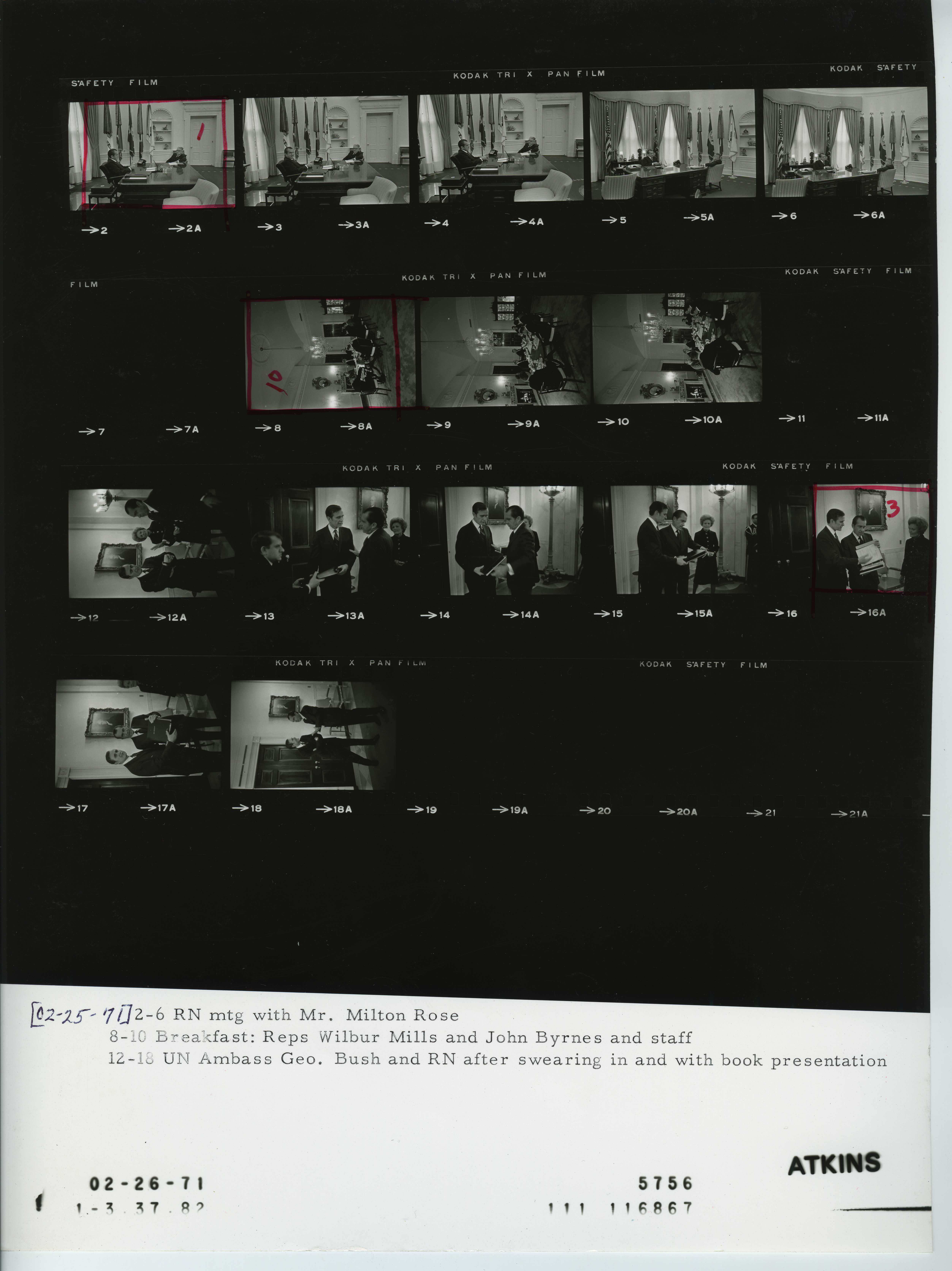
- Frame(s): WHPO-5756-08-10, President Nixon having breakfast with congressmen, officials, and staff. 2/26/1971, Washington, D.C. Family Dining Room, hallway, White House. President Nixon, Wilbur Mills, John Byrnes, James Hodgson, Elliot Richardson, George Shultz, Clark MacGregor, Ehrlichman, George Bush, Pat Nixon.
- Frame(s): WHPO-5756-12-18, President Nixon and Pat Nixon with George H. W. Bush. 2/26/1971, Washington, D.C. Family Dining Room, hallway, White House. President Nixon, George Bush, Pat Nixon.
Roll WHPO-5757 Photographer: Knudsen, Robert L. | Color or B&W: Color
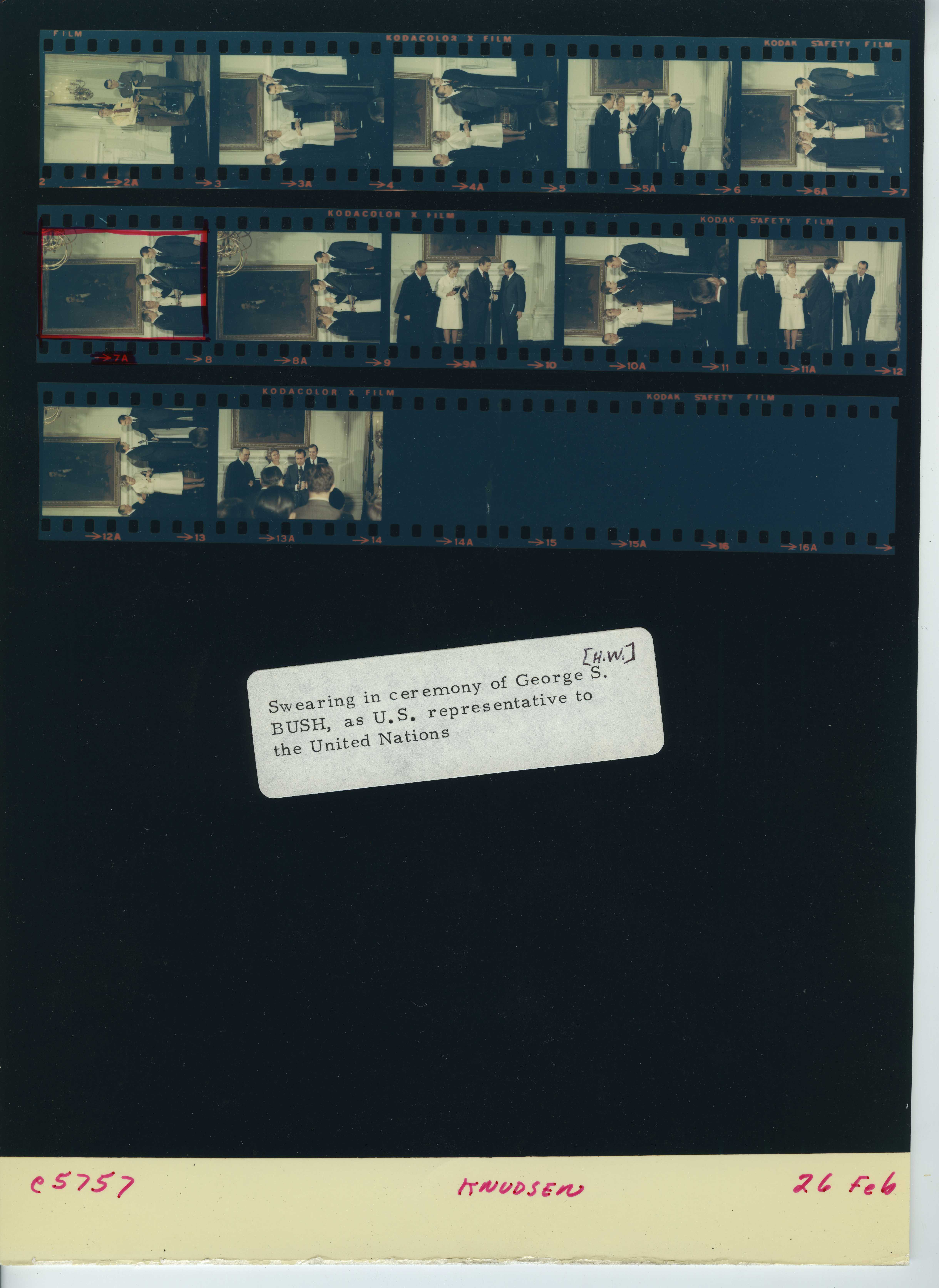
- Frame(s): WHPO-5757-, Swearing-in ceremony, conducted by Justice Potter Stewart, of George H. W. Bush as U.S. Ambassador (representative) to the United Nations, President Nixon and Barbara Bush stand nearby. 2/26/1971, Washington, D.C. White House, State Dining Room. President Nixon, George Bush, Barbara Bush, Justice Potter Stewart.
- Frame(s): WHPO-5757-07A, Swearing-in ceremony, conducted by Justice Potter Stewart, of George H. W. Bush as U.S. Ambassador (representative) to the United Nations, President Nixon and Barbara Bush stand nearby. 2/26/1971, Washington, D.C. White House, State Dining Room. President Nixon, George Bush, Barbara Bush, Justice Potter Stewart.
Roll WHPO-5758 Photographer: Knudsen, Robert L. | Color or B&W: Color
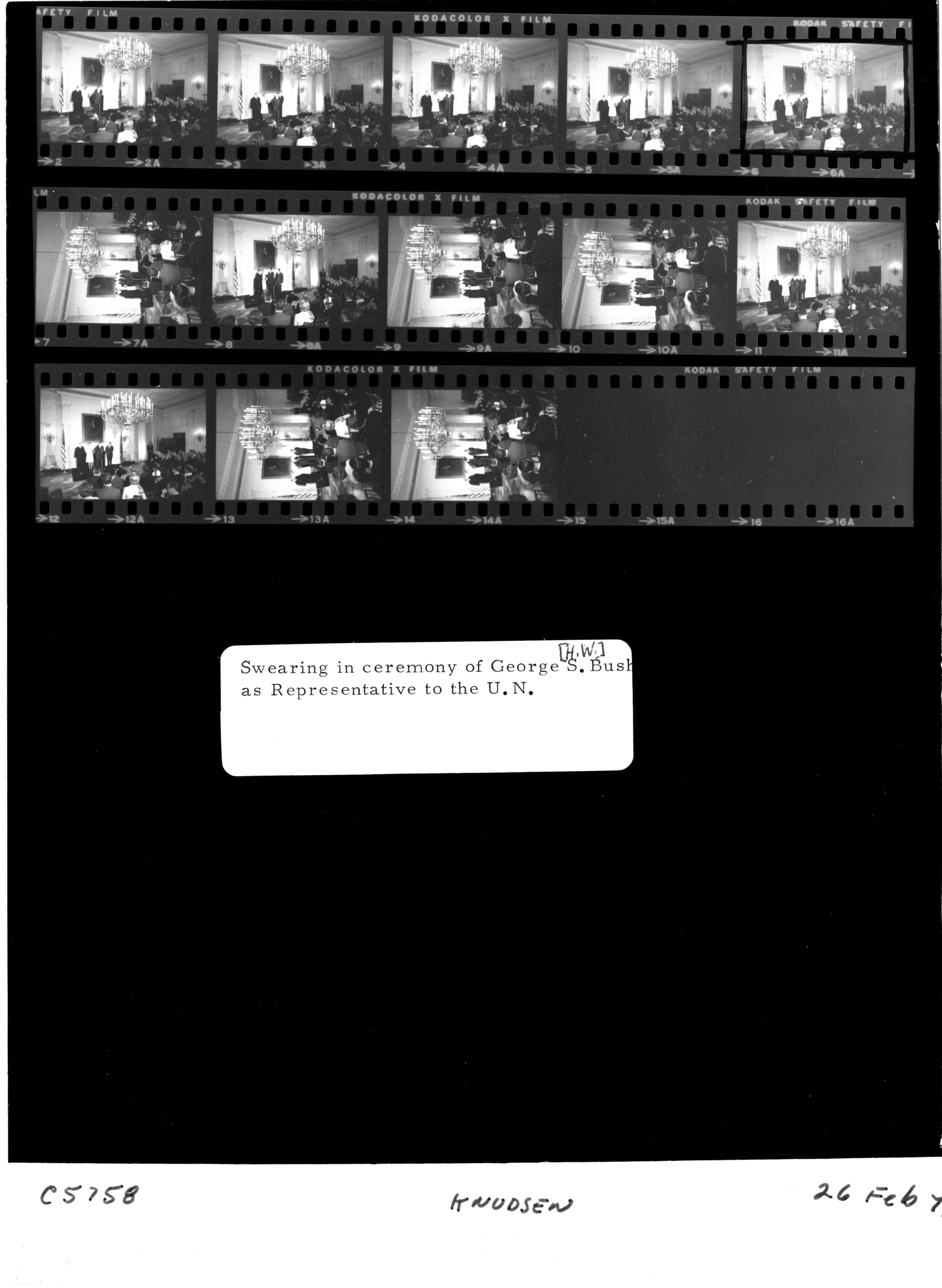
- Frame(s): WHPO-5758-02A-14A, Swearing-in ceremony of George H. W. Bush as the representative to the United Nations. President Nixon stands nearby. 2/26/1971, Washington, D.C. White House, State Dining Room. President Nixon, George H.W. Bush, Barbara Bush, Justice Potter Stewart, guests.
Roll WHPO-5759 Photographer: Atkins, Oliver | Color or B&W: B&W
- Frame(s): WHPO-5759-04A-09A, President Nixon standing with students representing Undergraduates for a Stable America. 2/26/1971, Washington, D.C. White House, Oval Office. President Nixon, T. Harding Jones, Anthony Radd, Charles Kolb, Cecil Stevenson, Frank Wood, Guilford Dudley, Jr.
- Frame(s): WHPO-5759-11A-15A, President Nixon standing with Disabled American Veterans officials. 2/26/1971, Washington, D.C. White House, Oval Office. President Nixon, T. Harding Jones, Anthony Radd, Charles Kolb, Cecil Stevenson, Frank Wood, Guilford Dudley, Jr.
- Frame(s): WHPO-5759-17A-20A, President Nixon standing with U.S. Ambassador to Denmark Guilford Dudley, Jr. 2/26/1971, Washington, D.C. White House, Oval Office. President Nixon, T. Harding Jones, Anthony Radd, Charles Kolb, Cecil Stevenson, Frank Wood, Guilford Dudley, Jr.
Roll WHPO-5760 Photographer: Atkins, Oliver | Color or B&W: B&W
- Frame(s): WHPO-5760-, President Nixon shaking hands with Admiral Sir Nigel Henderson, UK Royal Navy, Chairman of the NATO Military Committee. 2/26/1971, Washington, D.C. White House, Oval Office. President Nixon, Admiral Sir Nigel Henderson.
Roll WHPO-5761 Photographer: Atkins, Oliver | Color or B&W: B&W
- Frame(s): WHPO-5761-01A, President Nixon seated with Henry Kissinger, Melvin Laird, and Admiral Thomas Moorer. 2/26/1971, Washington, D.C. White House, Oval Office. President Nixon, Kissinger, Laird, Thomas Moorer, Jeanne Wilson Davis, Florence Johnson Hicks, Juanita Morris Moody, Essie Davis Morgan, Rita Rapp, Joan Raup Rosenblatt, Patricia Reilly Hitt.
- Frame(s): WHPO-5761-03A-08A, President Nixon standing with Federal Woman's Award Winners for 1971 and Patricia Reilly Hitt from HEW. 2/26/1971, Washington, D.C. White House, Oval Office. President Nixon, Kissinger, Laird, Thomas Moorer, Jeanne Wilson Davis, Florence Johnson Hicks, Juanita Morris Moody, Essie Davis Morgan, Rita Rapp, Joan Raup Rosenblatt, Patricia Reilly Hitt.
Roll WHPO-5762 Photographer: Knudsen, Robert L. | Color or B&W: B&W
- Frame(s): WHPO-5762-, President Nixon visiting in the Oval Office with Bonnie Cook, 1971 Poster Child of the National Association for Retarded Children, her parents, and officials. 2/26/1971, Washington, D.C. White House, Oval Office. President Nixon, Bonnie Cook, Mr. & Mrs. Dennis Conley, Dr. Eva Johnson, Frederick Wieting, Francis White.
- Frame(s): WHPO-5762-04, President Nixon visiting and shaking hands in the Oval Office with Bonnie Cook, 1971 Poster Child of the National Association for Retarded Children, while her parents and officials stand nearby. 2/26/1971, Washington, D.C. White House, Oval Office. President Nixon, Bonnie Cook, Mr. & Mrs. Dennis Conley, Dr. Eva Johnson, Frederick Wieting, Francis White.
- Frame(s): WHPO-5762-05, President Nixon receives a hug in the Oval Office from Bonnie Cook, 1971 Poster Child of the National Association for Retarded Children, while her parents and officials stand smiling nearby. 2/26/1971, Washington, D.C. White House, Oval Office. President Nixon, Bonnie Cook, Mr. & Mrs. Dennis Conley, Dr. Eva Johnson, Frederick Wieting, Francis White.
Roll WHPO-5763 Photographer: Knudsen, Robert L. | Color or B&W: B&W
- Frame(s): WHPO-5763-, President Nixon standing with Thomas Lias. 2/26/1971, Washington, D.C. White House, Oval Office. President Nixon, Thomas Lias, Harry Dent.
Roll WHPO-5764 Photographer: Knudsen, Robert L. | Color or B&W: Color
- Frame(s): WHPO-5764-, President Nixon and Pat Nixon at the ceremony presenting portraits of John Quincy Adams and his wife, Louisa Catherine Johnson Adams, to White House collection. 2/26/1971, Washington, D.C. White House, East Room. President Nixon, Pat Nixon, John Quincy Adams, Andrew Oliver, guests.
Roll WHPO-5765 Photographer: Knudsen, Robert L. | Color or B&W: Color
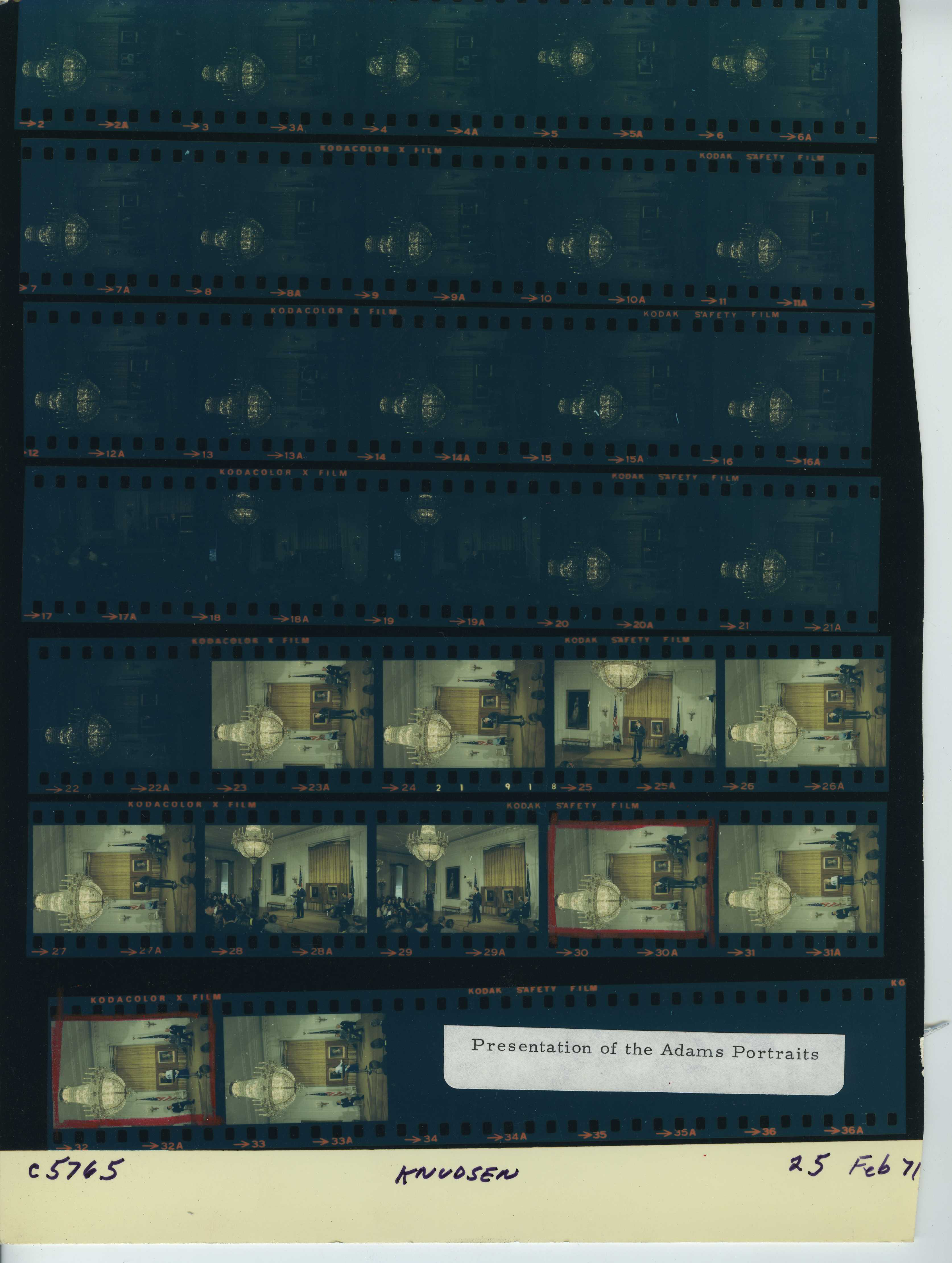
- Frame(s): WHPO-5765-, President Nixon and Pat Nixon with a members of the Adams family, at the ceremony presenting portraits of John Quincy Adams and his wife, Louisa Catherine Johnson Adams, to the White House collection. 2/26/1971, Washington, D.C. White House, East Room. President Nixon, Pat Nixon, John Quincy Adams, Andrew Oliver, guests.
Roll WHPO-5767 Photographer: Kightlinger, Jack | Color or B&W: B&W
- Frame(s): WHPO-5767-, President Nixon standing with Richard Ferry and Fred Malek. 2/26/1971, Washington, D.C. White House, Oval Office. President Nixon, Richard Ferry, Fred Malek.
Roll WHPO-5768 Photographer: Kightlinger, Jack | Color or B&W: B&W
- Frame(s): WHPO-5768-03-21, Pat Nixon, John Quincy Adams, and President Nixon speaking at the ceremony presenting the Adams portraits. 2/26/1971, Washington, D.C. White House, East Room. President Nixon, Pat Nixon, John Quincy Adams, Andrew Oliver, guests.
- Frame(s): WHPO-5768-22-23, President Nixon seated with author Henry Brandon. 2/26/1971, Washington, D.C. White House, Oval Office. President Nixon, Henry Brandon.
- Frame(s): WHPO-5768-24-27, Unidentified persons viewing the portraits. 2/26/1971, Washington, D.C. White House, East Room. unidentified women and man.
Roll WHPO-5769 Photographer: Kightlinger, Jack | Color or B&W: B&W
- Frame(s): WHPO-5769-03-22, President Nixon and Pat Nixon at the presentation Ceremony presenting portraits of John Quincy Adams and his wife, Louisa Catherine Johnson Adams, to White House collection. 2/26/1971, Washington, D.C. White House, East Room. President Nixon, Pat Nixon, John Quincy Adams, Andrew Oliver, guests.
- Frame(s): WHPO-5769-22-23, President Nixon seated informally with author Henry Brandon. 2/26/1971, Washington, D.C. White House, Oval Office. President Nixon, Henry Brandon.
Roll WHPO-5790 Photographer: Atkins, Oliver | Color or B&W: B&W
- Frame(s): WHPO-5790-, Photos of briefing charts on Revenue Sharing. 2/26/1971, Washington, D.C. unknown.
The White House Communications Agency Sound Recordings Collection contains public statements that took place between 1969 and 1974. Visit the finding aid to learn more.
G - Cabinet Officer Briefings
- WHCA-SR-G-082
Secretary of the Interior Rogers Morton addresses members of Congress on pollution, with John Nidecker. (2/26/1971, Family Theater)
Runtime: 17:54
Production credits: Audio feed supplied by WHCA; Recorded by JAD (initials of WHCA engineer)
Original Format: 1/4-inch reel-to-reel audiotape. Original source type: Original.
H - White House Staff Member Recordings
- WHCA-SR-H-349
Press briefing by John D. Ehrlichman on revenue-sharing. (2/26/1971, Press Center, White House)
Runtime: 1:07:00
Keywords: Press conferences, news conferences, interviews, media
Production credits: Audio feed supplied by WHCA; Recorded by SRJ (initials of WHCA engineer)
Original Format: 1/4-inch reel-to-reel audiotape. Original source type: Original.
P - Formal Presidential Remarks
- WHCA-SR-P-710234
Swearing-in of George Bush as Ambassador to UN with Bush. (2/26/1971)
Runtime: 4:41
Original Format: 1/4-inch reel-to-reel audiotape. Original source type: Original. - WHCA-SR-P-710235
Remarks by President Nixon at Adams portraits ceremony with PN, John Q. Adams, Andrew Oliver. (2/26/1971)
Runtime: 9:06
Original Format: 1/4-inch reel-to-reel audiotape. Original source type: Original.
The White House Communications Agency Videotape Collection contains “off-the-air” recordings of televised programs produced between 1968 and 1974. Visit the finding aid to learn more.
- WHCA-4194
"CBS Morning News".
Undetermined
Runtime: 00:26:13 - WHCA-4196
Weekly News Summary, Tape II.
ALL NETWORKS
Runtime: 1:00
17. Smith/Jarriel: U.S. troops into Laos?. Time Code Start: 47:16. Keywords: Laos, Vietnam War, Armed Forces, military, troops. Network: ABC.
18. Reasoner: Laos. Time Code Start: 49:11. Keywords: Laos, Vietnam War. Network: ABC.
19. Smith: Commentary on the New York Times. Time Code Start: 49:52. Keywords: media, newspapers, magazines, publications. Network: ABC.
20. Chancellor: Laos. Time Code Start: 51:43. Keywords: Laos, Vietnam War. Network: NBC.
21. Chancellor: Harriman on President Nixon's stand on the Vietnam War. Time Code Start: 57:10. Keywords: Vietnam War, statements. Network: NBC. - WHCA-4197
Weekly News Summary, Tape III.
ALL NETWORKS
Runtime: 00:24:30
1. Chancellor/Perkins: Representative Wilbur Mills and welfare. Time Code Start: 00:00. Keywords: Family Assistance Programs, government aid, financial aid, health and welfare assistance, financial aid. Network: NBC.
2. Chancellor: McGovern. Time Code Start: 07:26. Keywords: Presidential elections, campaigns, campaigning, candidates. Network: NBC.
3. Cronkite/Kalb/Scheiffer: Laos. Time Code Start: 09:02. Keywords: Laos, Vietnam War. Network: CBS.
4. Cronkite: Kissinger on the War in Vietnam. Time Code Start: 12:15. Keywords: governmnent, officials, Vietnam War. Network: CBS.
5. Cronkite/Schoumacher: McGovern in New Hampshire. Time Code Start: 17:17. Keywords: Presidential elections, campaigns, campaigning, candidates. Network: CBS.
6. Cronkite: Harriman on President Nixon's war posture; Sevaried analysis on same; the "flood of words". Time Code Start: 21:15. Keywords: Presidents, Vietnam War. Network: CBS. - WHCA-4211
Excerpts From the "NBC Nightly News" Indochina War Coverage, Tape I (Weekly News Summary).
NBC
63. Chancellor: Enemy takes Hill 31, invasion in trouble. Time Code Start: 73:36. Keywords: Vietnam War. Network: NBC.
64. Streithorst: U.S. support base attacked at Quang Tri, South Vietnam. Time Code Start: 74:34. Keywords: Vietnam War, Armed Forces, military, air bases, airfields, airports, fire support base, firebases, temporary military encampments, artillery air strike coordination center. Network: NBC.
65. Chancellor: Possible entry of U.S. troops into Laos; Averell Harriman opposes President Nixon's war policy. Time Code Start: 78:18. Keywords: Laos, Vietnam War, criticisms. Network: NBC.
Context (External Sources)
The Vanderbilt Television News Archive is the world's most extensive and complete archive of television news. They have been recording, preserving and providing access to television news broadcasts of the national networks since August 5, 1968.
Wikipedia is a free encyclopedia that anyone can edit.