
Introduction
This almanac page for Thursday, February 25, 1971, pulls together various records created by the federal government and links to additional resources which can provide context about the events of the day.
Previous Date: Wednesday, February 24, 1971
Next Date: Friday, February 26, 1971
Schedule and Public Documents
The Daily Diary files represent a consolidated record of the President's activities. Visit the finding aid to learn more.
The President's day began at The White House - Washington, D. C.
The Weekly Compilation of Presidential Documents made available transcripts of the President's news conferences; messages to Congress; public speeches, remarks, and statements; and other Presidential materials released by the White House.
Digitized versions can be found at HathiTrust.
Each Public Papers of the Presidents volume contains the papers and speeches of the President of the United States that were issued by the White House Office of the Press Secretary during the time period specified by the volume. The material is presented in chronological order, and the dates shown in the headings are the dates of the documents or events. In instances when the release date differs from the date of the document itself, that fact is shown in the text note.
To ensure accuracy, remarks have been checked against audio recordings (when available) and signed documents have been checked against the original, unless otherwise noted. Editors have provided text notes and cross references for purposes of identification or clarity.
The Federal Register is the official daily publication for rules, proposed rules, and notices of federal agencies and organizations, as well as executive orders and other Presidential documents.
The Congressional Record is the official daily record of the debates and proceedings of the U.S. Congress.
Archival Holdings
Any selection of archival documents will necessarily be partial. You should use the documents and folders identified below as a starting place, but consult the linked collection finding aids and folder title lists and the collections themselves for context. Many documents to be found this way do not lend themselves to association with specific dates, but are essential to a complete understanding of the material.
Selective document listing
President's Office Files
The President's Office Files consists of materials drawn together by the Special Files Unit from several administrative subdivisions within the White House Office. It is the handwriting and sensitive papers sent to the Staff Secretary that now comprise much of the President's Office Files. Visit the finding aid to learn more.
- Annotated News Summaries, Box 30, News Summaries - February 1971 [1 of 2] [During this period, the Staff Secretary only removed pages from the News Summaries which contained President Nixon's handwriting, often leaving the document with no date. In addition to the individual document(s) listed below, you should also consult the full folder for the month.]
- [2/25/71]
- Annotated News Summaries, Box 30, News Summaries - February 1971 [2 of 2] [During this period, the Staff Secretary only removed pages from the News Summaries which contained President Nixon's handwriting, often leaving the document with no date. In addition to the individual document(s) listed below, you should also consult the full folder for the month.]
- [2/25/71]
- Digest of Recent News Comment, Feb. 25, 1971
- [2/25/71]
- [2/25/71]
- State of the World, Network Radio Reaction Immediately Following the President's Speech, February 25, 1971
- Thursday, February 25, 1971
- President's Daily Schedule, Box 101, [President's Daily Schedule, Jan.-Feb. 1971] [3 of 3]
- The President's Schedule, Thursday - February 25, 1971
President's Personal File
The President's Personal File is essentially a President's secretary's file, kept by Rose Mary Woods, personal secretary to the President, for two purposes: (1) preserving for posterity a collection of documents particularly close to the President, whether because he dictated or annotated them, or because of the importance of the correspondent or the event concerned and (2) giving appropriate attention–letters of gratitude, invitations to White House social events, and the like–to members and important friends and supporters of the Nixon administration. This generalization does not describe all the varied materials of a file group which is essentially a miscellany, but it does identify the reason for the existence of the file group's core. Visit the finding aid to learn more.
- President's Speech File
The H. R. Haldeman Diaries consists of seven handwritten diaries, 36 dictated diaries recorded as sound recordings, and two handwritten audio cassette tape subject logs. The diaries and logs reflect H. R. Haldeman’s candid personal record and reflections on events, issues, and people encountered during his service in the Nixon White House. As administrative assistant to the President and Chief of Staff, Haldeman attended and participated in public events and private meetings covering the entire scope of issues in which the Nixon White House engaged in during the years 1969-1973. Visit the finding aid to learn more.
- Transcript of diary entry (PDF)
Thursday, February 25.
State of the World message day. The President holed up in the EOB first part of the morning, and then came over to the private office and delivered the address on nationwide radio at 11:00. It came out very well. Ran about 25 minutes, which was a little longer than he wanted, but he had cut it quite a bit to get it down to that. He then did a five minute TV clip of an excerpt for the news tonight, and then had Henry's crew, who had worked on the report, in for the signing. He then went back over to the EOB, and had about an hour and a half briefing from Admiral Moorer following up on Henry's concern expressed yesterday regarding the Laos military situation. It apparently went pretty well, because he seemed in good spirits afterwards and seemed well satisfied that they had the thing planned properly and under control.
He called Colson, Ziegler, Rumsfeld, and me over at 1:00 for a meeting, saying that he wanted to talk to us about the follow-up on the construction decision yesterday or Tuesday. He thought that we had made a real mistake in our failure to follow-up on it; that it was a very tough action, and the President had made the decision alone despite the urging of many of his advisors. Both Shultz and Hodgson came to him individually afterwards and said they admired his making the decision, how tough it was and all that. But they never told anyone else, which gets back to our basic problem. He then made the point that he felt we need a PR guy who sits in the White House who looks for these opportunities, who is attuned to what is the PR reaction to every tough decision. We need some way to get a few of the people in the media to know about these and to write it.
He feels Colson can't do the briefing on the construction thing; for example, that it should be Shultz or Hodgson, or one of the people who was actually in on the deal. And it must be done right at the time, and a PR game plan should have been put into effect immediately. He feels that somebody's got to be sitting there thinking of the PR effect on everything. What do we want to have come out of this, and how will we get it across? Interestingly enough, all this was an interruption of a meeting I'd been having with Rumsfeld on exactly the same subject, trying to persuade him to take the initiative in this area, which he has in essence now agreed to do, without any fanfare or announcement. If he actually takes hold of it, we'll be a giant step forward, especially since I worked out the final steps yesterday on getting Colson into running the operational side of this, as he wants to do. I had a long talk with Klein, and spelled it out to him reasonably clearly, and hopefully he understood what I was saying and will act accordingly. But I don't have too much confidence that that's the case. In any event, Colson's going to move in on it. I covered Magruder, Malek, Chapin, Ziegler, Ehrlichman, and others to try to make sure it all works out.
The President had sort of a rinky-dink schedule of odds and ends through the afternoon. Called me in the late afternoon just to chat for a while, didn't seem to have anything on his mind. We covered some schedule items, and reviewed the morning discussion. I told him how I felt the Rumsfeld thing could work out, and he's willing to try it.
End of February 25. - Original audio recording (MP3)
The National Archives Catalog is the online portal to the records held at the National Archives, and information about those records. It is the main way of describing our holdings and also provides access to electronic records and digitized versions of our holdings.
The Catalog searches across multiple National Archives resources at once, including archival descriptions, digitized and electronic records, authority records, and web pages from Archives.gov and the Presidential Libraries. The Catalog also allows users to contribute to digitized historical records through tagging and transcription.
Nixon Library Holdings
All National Archives Units
National Security Documents
The President's Daily Brief is the primary vehicle for summarizing the day-to-day sensitive intelligence and analysis, as well as late-breaking reports, for the White House on current and future national security issues. Read "The President's Daily Brief: Delivering Intelligence to Nixon and Ford" to learn more.
The Foreign Relations of the United States series presents the official documentary historical record of major U.S. foreign policy decisions and significant diplomatic activity. Visit the State Department website for more information.
Vol. I, Foundations of Foreign Policy, 1969-1972
Foundations of Foreign Policy, 1969-1972
85. Radio Address by President Nixon, Washington, February 25, 1971
Source: Public Papers of the Presidents of the United States: Richard Nixon, 1971, pp. 213-214. The address coincided with the submission to Congress of the Nixon administration’s second annual comprehensive report on the conduct of U.S. foreign policy. The President spoke at 11 a.m. from the White House. The text of the report is ibid., pp. 219-345.
Vol. IV, Foreign Assistance, International Development, Trade Policies, 1969-1972
Coordinating Committee on Export Controls, 1969-1972
371. Action Memorandum From the President’s Assistant for National Security Affairs (Kissinger) to President Nixon, Washington, February 25, 1971
Source: National Archives, Nixon Presidential Materials, NSC Files, Country Files-Europe, Box 677, France, Volume VII 10/70-3/71. Secret. Attached to a March 4 memorandum from Davis to Eliot confirming that the President had decided to continue to oppose the French proposal to manufacture integrated circuits in Poland. A stamped notation indicates the President saw this memorandum, which was proposed to Kissinger by Bergsten and Sonnenfeldt; see Document 370 and footnote 1 thereto.
Vol. VII, Vietnam, July 1970-January 1972
Operational Lam Son 719, February 8-April 7, 1971
137. Diary Entry by the Chairman of the Joint Chiefs of Staff (Moorer), Washington, February 25, 1971
Source: National Archives, RG 218, Records of the Chairman, Moorer Diary, July 1970–July 1974. Top Secret.
Vol. XIII, Soviet Union, October 1970-October 1971
"A Key Point in Our Relationship": Backchannel Talks on SALT, Berlin, and the Summit
125. Telegram From the Department of State to the Embassy in the Soviet Union, Washington, February 25, 1971, 0050Z
Source: National Archives, RG 59, Central Files 1970–73, POL 23–10 USSR. Confidential. Drafted by Semler and Mainland on February 24, cleared by Okun, and approved by Dubs. Repeated to USUN, Brussels, Tel Aviv, and Warsaw for Deputy Assistant Secretary Davies.
Vol. XXI, Chile, 1969-1973
Cool and Correct: The U.S. Response to the Allende Administration, November 5, 1970-December 31, 1972
210. Minutes of a Meeting of the Senior Review Group, Washington, February 25, 1971, 2:36-3:50 p.m.
Source: National Archives, Nixon Presidential Materials, NSC Files, NSC Institutional Files (H-Files), Box H–52, SRG Meeting, Chile. Secret; Nodis. The meeting took place in the White House Situation Room.
Vol. XXIII, Arab-Israeli Dispute, 1969-1972
208. Minutes of a Senior Review Group Meeting, Washington, February 25, 1971, 2:36-3:50 p.m.
Source: National Archives, Nixon Presidential Materials, NSC Files, NSC Institutional Files (H-Files), Box H–112, Senior Review Group, SRG Minutes (Originals) 1971. Secret; Nodis. The meeting was held in the White House Situation Room. All brackets are in the original except those indicating text omitted by the editors.
Vol. XXXIV, National Security Policy, 1969-1972
The Defense Budget and U.S. National Security Policy
178. National Intelligence Estimate, Washington, February 25, 1971
Source: Central Intelligence Agency, NIC Files, Job 79–R01012A. Top Secret. The CIA and the intelligence organizations of the Department of State, the Department of Defense, the AEC, and the NSA participated in the preparation of this estimate. The Director of Central Intelligence submitted this estimate with the concurrence of all members of the USIB with the exception of the representative of the FBI, who abstained on the grounds that it was outside his jurisdiction. The table of contents, a glossary, and an annex with tables of the estimated characteristics and performance of weapon systems are not printed. The full text of this NIE, excluding the glossary and annex, is in the CIA FOIA Electronic Reading Room (www.foia.cia.gov).
Vol. E-5, Part 1, Documents on Sub-Saharan Africa, 1969-1972
U.S.-African Policy
14. U.S. Foreign Policy for the 1970ʼs: Building for Peace: A Report to the Congress by Richard Nixon, President of the United States, Washington, February 25, 1971
President Nixonʼs second foreign policy report to Congress acknowledged Rogersʼ lengthy policy statement of March 26, 1970, (attachment to Document 11) and then elaborated on his specific goals for Africa: peace, economic development, and justice.
Source: Washington, D.C.: Government Printing Office. No classification marking.
Vol. E-7, Documents on South Asia, 1969-1972
India and Pakistan: Pre-Crisis, January 1969-February 1971
119. Telegram 1660 From the Embassy in Pakistan to the Department of State, Islamabad, February 25, 1971, 1200Z
Ambassador Farland reported on Pakistani President Yahya’s concern and pessimism over the political crisis developing in the country. Farland repeated that the U.S. felt it was important to maintain the unity of Pakistan, and Yahya encouraged Farland to go to Dacca and make the same point to Awami leader Mujibur Rahman.
Source: National Archives, RG 59, Central Files 1970–73, POL 15–1 PAK. Secret; Priority; Exdis. Repeated priority to the Consulate at Dacca.120. Telegram 1664 From the Embassy in Pakistan to the Department of State, Islamabad, February 25, 1971, 1226Z
Ambassador Farland explained to Pakistani President Yahya that the one-time-exception arms package could not be financed on a credit basis, and he reported that Yahya was “saddened and depressed.” Yahya noted that his Government was without the necessary funds to take full advantage of the offer, but he said that he would find the money to buy the armored personnel carriers.
Source: National Archives, RG 59, Central Files 1970–73, DEF 12–5 PAK. Secret; Priority; Exdis.
The Kissinger telephone conversation transcripts consist of approximately 20,000 pages of transcripts of Kissinger’s telephone conversations during his tenure as Assistant to the President for National Security Affairs (1969-1974) and Secretary of State (1973-1974) during the administration of President Richard Nixon. Visit the finding aid for more information.
Digitized versions can be found in the National Archives Catalog.
Audiovisual Holdings
The White House Tapes are sound recordings of President Richard Nixon's telephone conversations and of meetings held in the Oval Office and the Cabinet Room in the White House, the President's office in the Old Executive Office Building (OEOB), the Lincoln Sitting Room in the residence section of the White House, and several locations at the Presidential retreat at Camp David, Maryland. These recordings document many of the major events and decisions of the Nixon Administration from February 16, 1971 to July 18, 1973. Visit the White House Tapes finding aid to learn about the taping system's operation and archival processing.
Cabinet Room
Oval Office
- 458-1; Unknown between 9:11 a.m. & 11:00 a.m.; Nixon, Richard M. (President); Haldeman, H. R. ("Bob")
- 458-2; Unknown between 9:11 a.m. & 3:20 p.m.; Nixon, Richard M. (President); [Unknown person(s)]
- 458-3; 3:28 p.m. - 3:35 p.m.; Nixon, Richard M. (President); Butterfield, Alexander P.
- 458-4; 3:35 p.m. - 3:46 p.m.; Nixon, Richard M. (President); Renercomb, George; Kleppe, Thomas S.; Kleppe, Glenda L. (Gompf); Kleppe, Jill; Kleppe, Jane; Anderson, Gladys; Edick, Ruth; Chase, Anthony G.; Singer, Arthur H.; Parker, Marshall J.; Eachon, Jack, Jr.; McZier, Arthur; Russell, Howard; Johnson, Einar; Gavin, Wilfred J.; Knebel, John A.; Rivard, Loren J.; Stull, Raymond E.; Young, Milton R.; Young, Patricia M. (Burne); Dole, Robert J.; Conte, Silvio O.; Evins, Joseph L. ("Joe"); Gallagher, Christine; Sharp, Lucey; Kabis, Dorothy A.; Lutnass, Magnus; Morton, Rogers C. B.; MacGregor, Clark; Stans, Maurice H.
- 458-5; Unknown between 3:46 p.m. & 4:05 p.m.; Nixon, Richard M. (President); Bull, Stephen B.; Herrera, Felipe; Walker, Charls E.; Costanzo, Henry J.; Hewitt, Ashley
- 458-6; Unknown between 4:05 p.m. & 4:07 p.m.; Nixon, Richard M. (President); Butterfield, Alexander P.
- 458-7; 4:07 p.m. - 4:34 p.m.; Nixon, Richard M. (President); Waggonner, Joe D., Jr.; Moody, Juanita Morris; Whitaker, John C.; Cook, Richard K.; White House photographer; Sanchez, Manolo
- 458-8; Unknown between 4:34 p.m. & 4:42 p.m.; Nixon, Richard M. (President); Chapin, Dwight L.
- 458-9; 4:42 p.m. - 5:05 p.m.; Nixon, Richard M. (President); Rose, Milton C.; Sanchez, Manolo; Bull, Stephen B.
- 458-10; 5:05 p.m. - 5:43 p.m.; Nixon, Richard M. (President); Kennedy, David M.; Haig, Alexander M., Jr.; White House photographer; Yates, Nellie L.; Acker, Marjorie P.; Woods, Rose Mary
- 458-11; 5:44 p.m. - 6:30 p.m.; Nixon, Richard M. (President); Haldeman, H. R. ("Bob"); Butterfield, Alexander P.; White House operator
The White House Photo Office collection consists of photographic coverage of President Richard Nixon meeting with prominent social, political, and cultural personalities; speaking engagements and news conferences of the President and various high-ranking members of the White House staff and Cabinet; Presidential domestic and foreign travel, including Presidential vacations; social events and entertainment involving the First Family, including entertainers present; official portraits of the President, First Family, and high-ranking members of the Nixon administration; the 1969 and 1973 Inaugurals; the President’s 1972 Presidential election campaign appearances (including speeches) and other official activities of the White House staff and the President’s Cabinet from January 20, 1969 until August 9, 1974 at the White House and the Old Executive Office Building; other locations in Washington, DC, such as The Mall; and the Presidential retreats in Camp David, Maryland, Key Biscayne, Florida, and San Clemente, California. Visit the finding aid to learn more.
Roll WHPO-5743 Photographer: Atkins, Oliver | Color or B&W: B&W
- Frame(s): WHPO-5743-, President Nixon signing his Foreign Policy Message while Henry Kissinger and NSC staff members look on. 2/25/1971, Washington, D.C. White House, Cabinet Room. Henry Kissinger, Kissinger, NSC staff members.
Roll WHPO-5744 Photographer: Atkins, Oliver | Color or B&W: B&W
- Frame(s): WHPO-5744-, President Nixon during his Foreign Policy Review speech on live radio. 2/25/1971, Washington, D.C. White House, Oval Office. President Nixon.
Roll WHPO-5745 Photographer: Knudsen, Robert L. | Color or B&W: B&W
- Frame(s): WHPO-5745-, President Nixon seated at his desk reading his Foreign Policy Review message to a radio audience. 2/25/1971, Washington, D.C. White House, Oval Office. President Nixon.
- Frame(s): WHPO-5745-19A, President Nixon seated at his desk reading his Foreign Policy Review message to a radio audience. 2/25/1971, Washington, D.C. White House, Oval Office. President Nixon.
Roll WHPO-5746 Photographer: Schumacher, Karl | Color or B&W: B&W
- Frame(s): WHPO-5746-, John Davies receiving a presentation. 2/25/1971, Washington, D.C. White House grounds. John Davies, unidentified persons.
Roll WHPO-5747 Photographer: Knudsen, Robert L. | Color or B&W: B&W
- Frame(s): WHPO-5747-, Peter Flanigan accepts a gift presentation from the Austrian Ambassador on behalf of President Nixon. 2/25/1971, Washington, D.C. unknown. Peter Flanigan, Austrian Ambassador, unidentified men.
Roll WHPO-5748 Photographer: Schumacher, Karl | Color or B&W: B&W
- Frame(s): WHPO-5748-, Vice President Agnew, Secretary of State William Rogers, and others in a receiving line at Agnew's lunch for governors. 2/25/1971, Washington, D.C. State Department. Spiro Agnew, William Rogers, Elliot Richardson, Hugh Scott, Marvin Mandel, Ronald Reagan, Clifford Hardin, Clark MacGregor, officials, governors.
Roll WHPO-5749 Photographer: Schumacher, Karl | Color or B&W: B&W
- Frame(s): WHPO-5749-, John Davies accepting a gift presentation on behalf of the president. 2/25/1971, Washington, D.C. White House grounds. John Davies, unidentified young men and women.
Roll WHPO-5750 Photographer: Atkins, Oliver | Color or B&W: B&W
- Frame(s): WHPO-5750-02A-09A, Swearing-in ceremony of Thomas Kleppe as Administrator of the Small Business Administration. 2/25/1971, Washington, D.C. White House, Oval Office. President Nixon, Thomas Kleppe, Mrs. Thomas Kleppe, Judge George Revercomb, Jill Kleppe, Jane Kleppe, Gladys Anderson, SBA staff members, officials, guests.
- Frame(s): WHPO-5750-10A-13A, President Nixon seated at his Oval office desk speaking to Senator Bob Dole and Clark MacGregor (standing). 2/25/1971, Washington, D.C. White House, Oval Office. President Nixon, Bob Dole, Clark MacGregor.
- Frame(s): WHPO-5750-13A, President Nixon seated at his Oval office desk speaking to Senator Bob Dole and Clark MacGregor (standing). 2/25/1971, Washington, D.C. White House, Oval Office. President Nixon, Bob Dole, Clark MacGregor.
Roll WHPO-5751 Photographer: Atkins, Oliver | Color or B&W: B&W
- Frame(s): WHPO-5751-01A-04A, President Nixon with Felipe Herrera, President of the Inter-American Development Bank. 2/25/1971, Washington, D.C. White House, Oval Office. President Nixon, Felipe Herrera, J.M. Menefee, Joe Waggonner.
- Frame(s): WHPO-5751-08A-09A, President Nixon with J.M. Menefee and Representative Joe Waggonner. 2/25/1971, Washington, D.C. White House, Oval Office. President Nixon, Felipe Herrera, J.M. Menefee, Joe Waggonner.
Roll WHPO-5752 Photographer: Schumacher, Karl | Color or B&W: B&W
- Frame(s): WHPO-5752-, Medal presentations to unidentified military officials. 2/25/1971, Washington, D.C. unknown. unidentified military man, unidentified man and woman.
Roll WHPO-5753 Photographer: Kightlinger, Jack | Color or B&W: B&W
- Frame(s): WHPO-5753-, President Nixon seated at his desk during a meeting with Ambassador-at-Large David Kennedy. 2/25/1971, Washington, D.C. White House, Oval Office. President Nixon, David Kennedy.
- Frame(s): WHPO-5753-03A, President Nixon seated at his Oval Office desk reading a paper during a meeting with Ambassador-at-Large David Kennedy. 2/25/1971, Washington, D.C. White House, Oval Office. President Nixon, David Kennedy.
Roll WHPO-5754 Photographer: Kightlinger, Jack | Color or B&W: Color
- Frame(s): WHPO-5754-03A-12A, Pat Nixon greeting Postal Academy young men. 2/25/1971, Washington, D.C. White House, Red Room. Pat Nixon, Postal Academy young men, officials, guests.
- Frame(s): WHPO-5754-14A-19A, Ceremony for Postal Academy young men. 2/25/1971, Washington, D.C. White House, Blue Room. Pat Nixon, Postal Academy young men, officials, guests.
Roll WHPO-5756 Photographer: Atkins, Oliver | Color or B&W: B&W
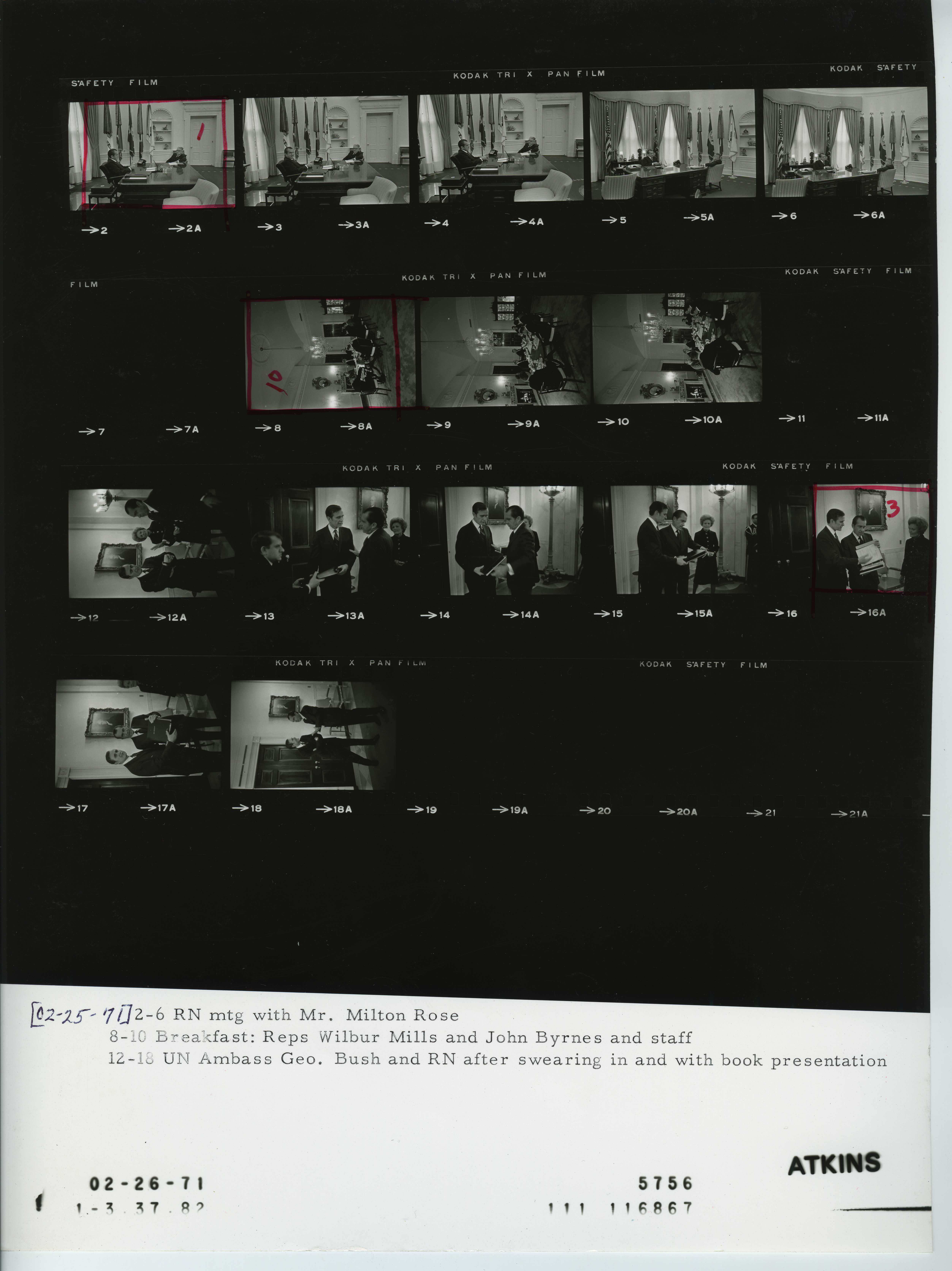
- Frame(s): WHPO-5756-02-06, President Nixon seated at his desk during a meeting with Milton Rose. 2/25/1971, Washington, D.C. White House, Oval Office. President Nixon, Milton Rose.
The White House Communications Agency Sound Recordings Collection contains public statements that took place between 1969 and 1974. Visit the finding aid to learn more.
C - First Lady
- WHCA-SR-C-061
Remarks by Pat Nixon to the Postal Academy, with Willoughby Walling and Bill Howard. (2/25/1971, Blue Room, The White House)
Runtime: 1:45
Production credits: Audio feed supplied by WHCA; Recorded by JAD (initials of WHCA engineer)
Original Format: 1/4-inch reel-to-reel audiotape. Original source type: Original.
P - Formal Presidential Remarks
- WHCA-SR-P-710232
President Nixon State of the World Address. (2/25/1971, White House Retiring Room)
Runtime: 0:29:34
Production credits: Mult feed supplied by ABC; Recorded by RHD (initials of WHCA engineer)
Original Format: 1/4-inch reel-to-reel audiotape. Original source type: Original. - WHCA-SR-P-710233
Remarks by President Nixon in a filmed statement on foreign policy. (2/25/1971, Oval Office, the White House)
Runtime: A:00:10:32 B: 00:05:48
Production credits: Mult feed supplied by ABC; Recorded by KAP (initials of WHCA engineer)
Original Format: 1/4-inch reel-to-reel audiotape. Original source type: Original.
The White House Communications Agency Videotape Collection contains “off-the-air” recordings of televised programs produced between 1968 and 1974. Visit the finding aid to learn more.
- WHCA-4196
Weekly News Summary, Tape II.
ALL NETWORKS
Runtime: 1:00
6. Smith/Jarriel: President Nixon's State of the World Message. Time Code Start: 15:15. Keywords: Presidents, speeches, foreign policy, foreign relations. Network: ABC.
7. Reasoner/Giggins: Laos. Time Code Start: 18:27. Keywords: Laos, Vietnam War. Network: ABC.
8. Smith: Possible invasion of North Vietnam. Time Code Start: 20:48. Keywords: Vietnam War. Network: ABC.
9. Reasoner: Commentary on the "big picture in Vietnam". Time Code Start: 22:38. Keywords: Vietnam War. Network: ABC.
10. Chancellor/Kaplow: President Nixon's State of the World Message. Time Code Start: 24:54. Keywords: Presidents, speeches, foreign policy, foreign relations. Network: NBC.
11. Chancellor: Vietnam War. Time Code Start: 27:44. Keywords: Vietnam War. Network: NBC.
12. Chancellor/Perkins: Representative Mills for Revenue Sharing, welfare. Time Code Start: 29:15. Keywords: bills, laws, State and Local Fiscal Assistance Act of 1972, financial aid, Family Assistance Programs, government aid, financial aid, health and welfare assistance. Network: NBC.
13. Cronkite: Vietnam War. Time Code Start: 33:20. Keywords: Vietnam War. Network: CBS.
14. Dean: Forbes, ABC hero. Time Code Start: 34:18. Keywords: media, radio, television, TV, the press, network broadcasting corporations. Network: CBS.
15. Cronkite/Mudd: Russian and Chinese reaction to Laos Capitol Hill fears invation of North Vietnam. Time Code Start: 41:21. Keywords: Soviet Union, Russia, USSR, Laos, Vietnam War, People's Republic of China. Network: CBS.
16. Cronkite/Rather: President Nixon's State of the World Message. Time Code Start: 44:20. Keywords: Presidents, speeches, foreign policy, foreign relations. Network: CBS. - WHCA-4211
Excerpts From the "NBC Nightly News" Indochina War Coverage, Tape I (Weekly News Summary).
NBC
62. Chancellor: Russia denounces invasion; peace talks; South Vietnam's President Thieu talks of invasion of North Vietnam; Senate doves proposed to outlaw U.S. Troops in North Vietnam. Time Code Start: 72:11. Keywords: Soviet Union, Russia, USSR, South Vietnam, Presidents, speeches, statements, Vietnam War. Network: NBC.
Context (External Sources)
The Vanderbilt Television News Archive is the world's most extensive and complete archive of television news. They have been recording, preserving and providing access to television news broadcasts of the national networks since August 5, 1968.
Wikipedia is a free encyclopedia that anyone can edit.