
Introduction
This almanac page for Saturday, February 27, 1971, pulls together various records created by the federal government and links to additional resources which can provide context about the events of the day.
Previous Date: Friday, February 26, 1971
Next Date: Sunday, February 28, 1971
Schedule and Public Documents
The Daily Diary files represent a consolidated record of the President's activities. Visit the finding aid to learn more.
The President's day began at The White House - Washington, D. C.
The Weekly Compilation of Presidential Documents made available transcripts of the President's news conferences; messages to Congress; public speeches, remarks, and statements; and other Presidential materials released by the White House.
Digitized versions can be found at HathiTrust.
The Federal Register is the official daily publication for rules, proposed rules, and notices of federal agencies and organizations, as well as executive orders and other Presidential documents.
Archival Holdings
Any selection of archival documents will necessarily be partial. You should use the documents and folders identified below as a starting place, but consult the linked collection finding aids and folder title lists and the collections themselves for context. Many documents to be found this way do not lend themselves to association with specific dates, but are essential to a complete understanding of the material.
Selective document listing
President's Office Files
The President's Office Files consists of materials drawn together by the Special Files Unit from several administrative subdivisions within the White House Office. It is the handwriting and sensitive papers sent to the Staff Secretary that now comprise much of the President's Office Files. Visit the finding aid to learn more.
- Annotated News Summaries, Box 30, News Summaries - February 1971 [1 of 2]
- Annotated News Summaries, Box 30, News Summaries - February 1971 [2 of 2] [During this period, the Staff Secretary only removed pages from the News Summaries which contained President Nixon's handwriting, often leaving the document with no date. In addition to the individual document(s) listed below, you should also consult the full folder for the month.]
- [2/27/71]
- News Summary, February 27, 1971, Television Report (Friday newscasts)
- President's Daily Schedule, Box 101, [President's Daily Schedule, Jan.-Feb. 1971] [3 of 3]
- The President's Schedule, Saturday - February 27, 1971
The H. R. Haldeman Diaries consists of seven handwritten diaries, 36 dictated diaries recorded as sound recordings, and two handwritten audio cassette tape subject logs. The diaries and logs reflect H. R. Haldeman’s candid personal record and reflections on events, issues, and people encountered during his service in the Nixon White House. As administrative assistant to the President and Chief of Staff, Haldeman attended and participated in public events and private meetings covering the entire scope of issues in which the Nixon White House engaged in during the years 1969-1973. Visit the finding aid to learn more.
- Transcript of diary entry (PDF)
Saturday, February 27th. Having cancelled his plan to go to Camp David last night, the President ended up with a basically free Saturday. A good chunk of the morning was filled with a two and a half hour meeting with Rogers, Laird, Kissinger, and Helms, to which Moorer and Sisco were added. This was on the Mideast situation as Henry had made the point that things were getting again to another crisis level. They apparently had a pretty good session. And the President seemed relaxed and unconcerned afterwards. He was then at loose ends and sort of bouncing around trying to figure what to do.
He called Garment in just to have a general chat with him and asked Finch to come in at the same time, but he was tied with a meeting and so came in a little later. He didn't have anything in particular to cover with Garment. Ran through sort of a general review of what was going on and then got into his Carl Sandburg book on Lincoln, in which he was particularly impressed with a section on General Maurer in the Civil War-- a man of whom no one has ever heard, and that was precisely the point. He was apparently one of the greatest generals of the war, but Sandburg's big point was that he never spoke of himself and he was a man they could always count on to get his job done with no fuss and no discussion. The President found this very impressive and was making the point that a great many of our staff are of the same caliber. He was, of course, implying that he was referring to Len. He also made the point that he wanted to put, get Len onto television talking about the President in the anecdotal area and the personal background, etcetera which, of course, Len could do very effectively. In that general discussion, and as Finch joined us, we concluded that White House staff, in general, cannot go on television regarding substance, and only those who know how to avoid getting into substance should go on at all.
He then got into considerable discussion on the general PR situation, questioning whether any of what we've done in the domestic area has really done any good. Also, he's starting to take the line again that maybe we should just forget all of our efforts, that things are pretty well set and there's nothing we can do about it in any event; so we might as well quit trying.
He then gets immediately back to trying to figure how to handle the Laos ground action in Vietnam; taking on the networks; how to get more going on the Hill regarding Vietnam; and a long discussion of timing of TV press conferences as to whether they should be every two weeks, every week, or what—Ziegler was in for part of this discussion.
He also made the point that when Eisenhower left office there were no American ground forces or advisors in Vietnam, and no Americans had been killed in Vietnam. Eight years later, when Nixon came in, he found there had been two hundred thousand American casualties, for over forty thousand American dead, and that's the light in which the records should be looked at. The Democratic administrations of the sixties got us into the war. The Nixon Administration is getting us out. If the Democrats want to fight the war issue on a partisan basis, this is the way they are going to have to take it. He wants Dole to take this on and for others to follow up, softening it, of course, by saying that we've had the approval of a strong loyal minorities of Democrats who support the President and his efforts, and that they deserve great credit, and then cites them.
He feels that in the general PR area, we've got to spend more time on communication, getting our line out, and less on the little odds and ends type items. He got intrigued with the idea of doing more radio talks as a result of the State of the World thing on Thursday. He thinks he can do specific radio speeches to the old people, young people, Indians, Mexicans, rural types, etcetera, and then do a very brief TV excerpt out of this.
He had asked Harlow to get into the VP problem the other day, and Harlow called me today to say that he did talk to Sohmer about the Gridiron, and he thinks maybe he's made some progress there. But he was not able to get the VP alone last night to talk about his staff problem and the whole intergovernmental relations operation, but he'll try to do that over the weekend.
The Mideast thing kept popping up today as we went along, because Henry is still concerned. The President asked me to get to AI Haig and ask him what he thinks we should be doing: What would he and Henry change? Or what would they do that we aren't doing now?
-------------------------------------------------------------------------------------------------------------
DECLASSIFIED - E.O. 13526, Sect. 3.4: by MS, NARA, June 12, 2013
Audio Cassette 5, Side A, Withdrawn Item Number 7 [AC-5(A) Sel 6]
Duration: 12 seconds
Recognizing that we, the President, will not accept the proposition that we will base our planning on the approach of satisfying the Israelis.
------------------------------------------------------------------------------------------------------------
In order to pacify Rogers, he wanted me to be sure and call Bill and tell him that we had not been responsible for Henry going on CBS news the other morning, and that this had been something worked on by Herb Klein in violation of instructions. I had the talk with Haig, but it was interrupted because the President, at 3:00, all of sudden ordered up a helicopter for Camp David said he wanted me to go along, so I had to rush out and take off with him. Haig reported our conversation to Henry, and as soon I got to Camp David, I had a call from Henry...
-------------------------------------------------------------------------------------------------------------------
DECLASSIFIED - E.O. 13526, Sect. 3.4: by MS, NARA, June 12, 2013
Audio Cassette 5, Side A, Withdrawn Item Number 8 [AC-5(A) Sel 7]
Duration: 3 minutes 48 seconds
...who started in on his same thing of saying everything is a terrible disaster and that even though they got some things worked out this morning in the meeting, that, that State now wants to send a cable endorsing the Arab position and he feels this would give the Soviets a signal that they now have a clear shot at the Israelis. He feels he's been in the horrible position of seeing a collision coming and not being allowed to say anything. He says there's a total lack of confidence on the part of the Israelis in both Rogers and Sisco. He says, further, that we've lied to Israel, and that State, include, meaning Rogers and Kissinger have lied to the President. For example, they've lied to the President in saying that Rabin is embarrassed by this situation, and he urges that the President ask Rabin himself and let him tell them how he feels. He says if we're willing to see Israel destroyed, then, okay, but if we're not, then all this is a lot of bologna. And that as a result of our present process, the Soviet will become a permanent Mediterranean power.
Through all this, as he kept talking about the problems, I kept pushing him on, paragraph-by-paragraph, on what would he do about it, which is what the President wanted to get smoked out, because, Henry keeps coming into him with the dire predictions, but never with any solutions. I finally got him to say that first of all they should stop running the same play. That they now want to send this cable and they shouldn't do it. They should slow down and think about it for a week.
His main point is that we should figure out what it is we want all the way; exactly where we want to come out. Then, we should talk to the Israelis, and work out a position, rather than euchring them step-by-step, which he claims is what Rogers is doing now. Secondly, he thinks we should get Soviets involved. Third, we should get a package together of what we want. And, fourth, the President should check the veracity of what he's being told. He feels that Rogers and Sisco keep asking the President for one decision at a time, and that instead we should tell the Israelis what we're willing to do, and lay out what we expect them to do.
He says the problem really was clarified at the meeting today and that State had been saying that all they want is to get Israel to put down just any proposal. But then the President flushed them out by saying, well, what if they propose to stand firm on the ‘67 borders. They then said that wouldn't be satisfactory. His point is that Israel will fight over the ‘67 borders, and that that's the problem we've got to figure out. But that we have to talk to the Israelis and the Arabs to decide it.
His point really is that we've got to determine what exactly is our peace settlement, and go with it. He made the point also that his feeling is that not only is the President perhaps right in feeling that Henry is emotionally involved here and therefore not the right person to be dealing with it, but that the President himself has a hang up regarding the whole Jewish matter. He refuses to be squeezed and he has to decide if he wants to let the Soviets have the Mediterranean and bring an Israeli war which they'll probably lose. He makes the point that the President is so sensitive to being squeezed by the American Jewish community that he overreacts the other way.
He feels that once the President gets a course, we can design the policies and move ahead, but that now, under the way were working, we're just feeding Rogers' and Sisco's egos rather than getting what we want done. He urged that I set up a meeting between the President and Rabin so the President would hear the Israeli side.
-------------------------------------------------------------------------------------------------------------------
After going through all that, we went over to Aspen to dinner. The Connallys are up here for the weekend, so the President had them plus John Ehrlichman, who came up for the dinner. It was Connally's birthday and we had a birthday cake. Very pleasant, light-hearted dinner chat. The President selected Around the World in 80 Days as the movie because the Connallys hadn't seen it and he was sure they would be delighted with it, which they basically were. He was hysterical through it; as each scene was coming up, he'd say “You're going to love this particular part,” or “the scenery is just great, now watch this closely,” and so on. He obviously has seen it time after time and knows the whole thing practically by heart. He also got a big kick, as did Connally, out of identifying the old stars as they appear in their bit parts.
End of February 27th. - Original audio recording (MP3)
The National Archives Catalog is the online portal to the records held at the National Archives, and information about those records. It is the main way of describing our holdings and also provides access to electronic records and digitized versions of our holdings.
The Catalog searches across multiple National Archives resources at once, including archival descriptions, digitized and electronic records, authority records, and web pages from Archives.gov and the Presidential Libraries. The Catalog also allows users to contribute to digitized historical records through tagging and transcription.
Nixon Library Holdings
All National Archives Units
National Security Documents
The President's Daily Brief is the primary vehicle for summarizing the day-to-day sensitive intelligence and analysis, as well as late-breaking reports, for the White House on current and future national security issues. Read "The President's Daily Brief: Delivering Intelligence to Nixon and Ford" to learn more.
The Foreign Relations of the United States series presents the official documentary historical record of major U.S. foreign policy decisions and significant diplomatic activity. Visit the State Department website for more information.
Vol. VII, Vietnam, July 1970-January 1972
Operational Lam Son 719, February 8-April 7, 1971
140. Conversation Among President Nixon, Secretary of State Rogers, Secretary of Defense Laird, the President’s Assistant for National Security Affairs (Kissinger), and the Chairman of the Joint Chiefs of Staff (Moorer), Washington, February 27, 1971
Source: National Archives, Nixon Presidential Materials, White House Tapes, Oval Office, Conversation 459–2. No classification marking. The editors transcribed the portions of the tape recording printed here specifically for this volume. The transcript is part of a larger conversation, 9:18–11:57 a.m.
Vol. XXIII, Arab-Israeli Dispute, 1969-1972
211. Telegram From the Department of State to the Embassy in Israel, Washington, February 27, 1971, 0304Z
Source: National Archives, Nixon Presidential Materials, NSC Files, Box 609, Country Files, Middle East, Israel, Vol. IX. Secret; Priority; Nodis; Cedar. Drafted by Theodore A. Wahl (NEA/IAI) and approved by Sisco. In a February 26 telegram, Rogers explained that the “Nodis/Cedar” and “Nodis/Cedar Plus” classifications were created to protect the “most sensitive traffic on the current peace negotiations on the Middle East” and that they would “receive extremely limited distribution in Washington within the Department and the White House and to principal officers of other agencies involved in NSC discussions of subject matter.” Nodis/Cedar Plus messages would “be distributed only to White House and within Department on strict need-to-know basis” and that officials in Tel Aviv, Cairo, and New York should give such telegrams “similarly restricted distribution.” (Telegram 32414 to USUN, Tel Aviv, and Cairo; ibid., RG 59, Central Files 1970–73, POL 27–14 ARAB–ISR)
Vol. E-5, Part 1, Documents on Sub-Saharan Africa, 1969-1972
Uganda
246. Telegram 33749 From the Department of State to the Embassy in Uganda, Washington, February 27, 1971, 2007Z
Responding to several requests from Ugandan President Amin, the Department instructed the Embassy to tell Amin that the U.S. Government desired to be responsive to overtures of friendship, but wanted to avoid direct involvement in primarily African issues. Therefore, it was not possible to provide military training or equipment. However, the U.S. Government appreciated the orientation of Aminʼs government, and therefore was prepared to provide technical assistance and approve commercial purchase of dual-purpose military equipment.
Source: National Archives, Nixon Presidential Materials, NSC Files, Box 746, Country Files, Africa, Uganda, Vol. I. Secret; Exdis; Immediate. Drafted by Beyer (AF/E) and Newsom, approved by Johnson, Eliot and Wright.
The Kissinger telephone conversation transcripts consist of approximately 20,000 pages of transcripts of Kissinger’s telephone conversations during his tenure as Assistant to the President for National Security Affairs (1969-1974) and Secretary of State (1973-1974) during the administration of President Richard Nixon. Visit the finding aid for more information.
Digitized versions can be found in the National Archives Catalog.
Audiovisual Holdings
The White House Tapes are sound recordings of President Richard Nixon's telephone conversations and of meetings held in the Oval Office and the Cabinet Room in the White House, the President's office in the Old Executive Office Building (OEOB), the Lincoln Sitting Room in the residence section of the White House, and several locations at the Presidential retreat at Camp David, Maryland. These recordings document many of the major events and decisions of the Nixon Administration from February 16, 1971 to July 18, 1973. Visit the White House Tapes finding aid to learn about the taping system's operation and archival processing.
Oval Office
- 459-2; 9:35 a.m. - 11:57 a.m.; Nixon, Richard M. (President); Butterfield, Alexander P.; Haldeman, H. R. ("Bob"); Kissinger, Henry A.; [Unknown person(s)]; Bull, Stephen B.; Laird, Melvin R.; Helms, Richard M.; Sisco, Joseph J.; Rogers, William P.; Haig, Alexander M., Jr.; Moorer, Thomas H. (Adm.); Ratliffe, Walter B. (Lt. Col.)
- 459-3; Unknown between 11:57 a.m. & 11:58 a.m.; Nixon, Richard M. (President); Bull, Stephen B.
- 459-4; 11:58 a.m. - 2:58 p.m.; Nixon, Richard M. (President); Haldeman, H. R. ("Bob"); Bull, Stephen B.; Butterfield, Alexander P.; Garment, Leonard; Finch, Robert H.; Sanchez, Manolo; Ziegler, Ronald L.; [Unknown person(s)]; Hughes, James D. ("Don")
- 459-5; Unknown between 2:58 p.m. & 3:11 p.m.; Finch, Robert H.; Schreiber, Taft; Schreiber, Taft (Mrs.); Butterfield, Charles W.
The White House Photo Office collection consists of photographic coverage of President Richard Nixon meeting with prominent social, political, and cultural personalities; speaking engagements and news conferences of the President and various high-ranking members of the White House staff and Cabinet; Presidential domestic and foreign travel, including Presidential vacations; social events and entertainment involving the First Family, including entertainers present; official portraits of the President, First Family, and high-ranking members of the Nixon administration; the 1969 and 1973 Inaugurals; the President’s 1972 Presidential election campaign appearances (including speeches) and other official activities of the White House staff and the President’s Cabinet from January 20, 1969 until August 9, 1974 at the White House and the Old Executive Office Building; other locations in Washington, DC, such as The Mall; and the Presidential retreats in Camp David, Maryland, Key Biscayne, Florida, and San Clemente, California. Visit the finding aid to learn more.
Roll WHPO-5770 Photographer: Atkins, Oliver | Color or B&W: Color
- Frame(s): WHPO-5770-, Birthday dinner for John Connally. 2/27/1971, Camp David, Maryland dining room. President Nixon, Haldeman, Ehrlichman, John Connally, Mrs. John Connally, waiter.
Roll WHPO-5771 Photographer: Atkins, Oliver | Color or B&W: B&W
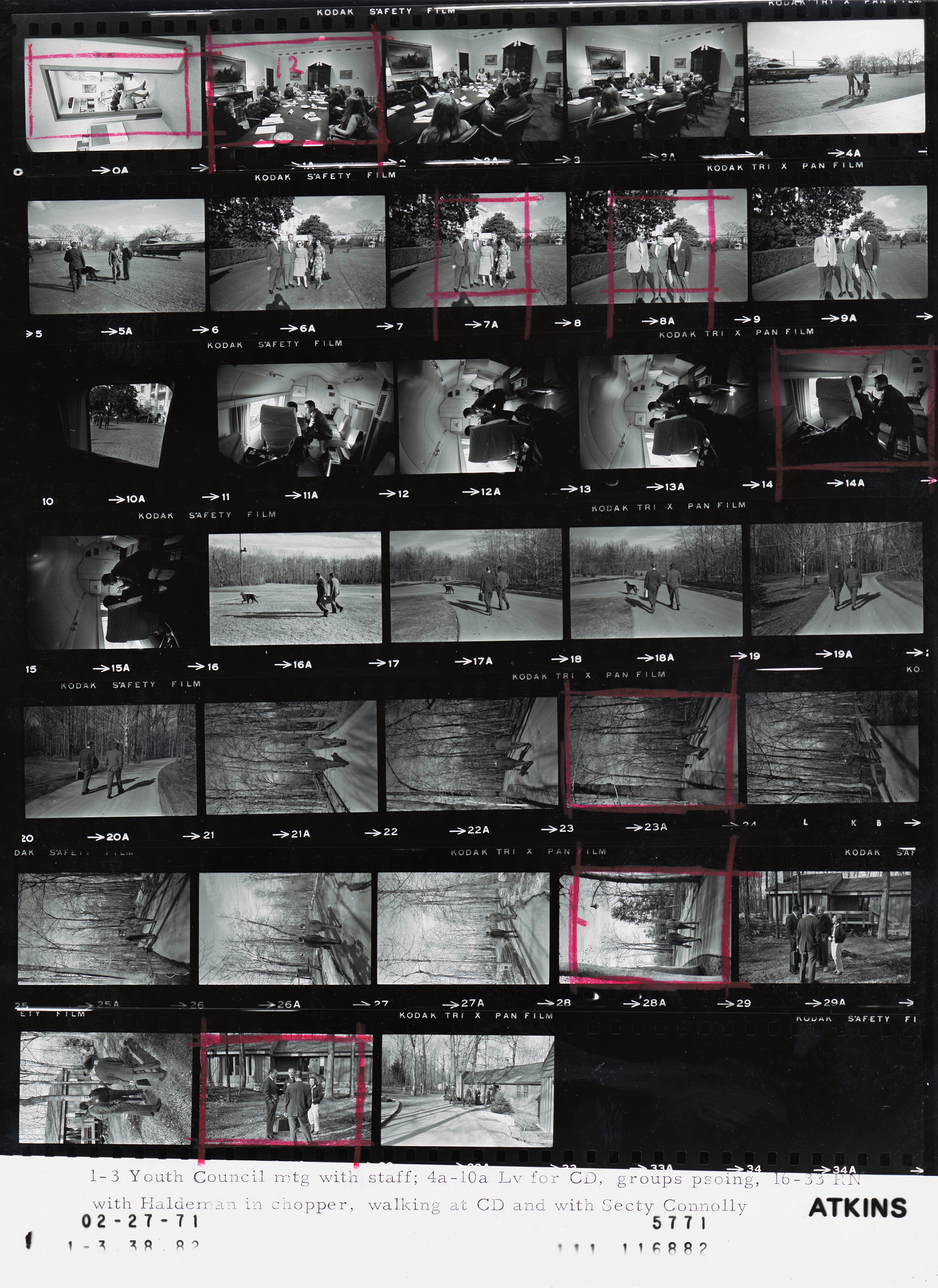
- Frame(s): WHPO-5771-00A, Unidentified staff member. 2/27/1971, Washington, D.C. unidentified room, White House, Roosevelt Room, South Lawn. President Nixon, Alexander Butterfield, Charles Butterfield, Youth Council members, staff, unidentified persons.
- Frame(s): WHPO-5771-01A-03A, President Nixon at Youth Council meeting. 2/27/1971, Washington, D.C. unidentified room, White House, Roosevelt Room, South Lawn. President Nixon, Alexander Butterfield, Charles Butterfield, Youth Council members, staff, unidentified persons.
- Frame(s): WHPO-5771-04A-09A, Before boarding a helicopter President Nixon with unidentified persons and with Alexander Butterfield and his brother, Charles Butterfield. 2/27/1971, Washington, D.C. unidentified room, White House, Roosevelt Room, South Lawn. President Nixon, Alexander Butterfield, Charles Butterfield, Youth Council members, staff, unidentified persons.
- Frame(s): WHPO-5771-10A-13A, 15A-32A, President Nixon and H.R. Haldeman on board the AF1 helicopter en route to Camp David, and then walking on the grounds, and standing with John Connally and his wife. 2/27/1971, air, Camp David, Maryland helicopter, Camp David grounds. President Nixon, Haldeman, John Connally, Mrs. John Connally.
- Frame(s): WHPO-5771-14A, President Nixon and H.R. Haldeman talking together while seated on board the AF1 helicopter en route to Camp David while King Timahoe the Irish Setter dog sits on a seat nearby. 2/27/1971, enroute, Camp David, Maryland Air Force One helicopter. President Nixon, H.R. Haldeman, King Timahoe Irish setter dog.
- Frame(s): WHPO-5771-23A, President Nixon and H.R. Haldeman walking together on a forest path on the Camp David grounds. Both are pictured from behind. 2/27/1971, Camp David, Maryland Camp David grounds. President Nixon, H.R. Haldeman.
The White House Communications Agency Videotape Collection contains “off-the-air” recordings of televised programs produced between 1968 and 1974. Visit the finding aid to learn more.
- WHCA-4198
"The Dick Cavett Show":Jack Klugman, Tony Randall, Clarence Brown, Proxmire. Includes a discussion of the proposed Supersonic Transport (SST) with Senator Clarence Brown (SST debate) and Senator William Proxmire Spiro T. Agnew, Vice President of the United States.
NBC
Runtime: 01:05:04 - WHCA-4209
Weekly News Summary, Tape I.
ALL NETWORKS
Runtime: 1:30
1. Newman/Lewis: including the Laos situation. Time Code Start: 00:00. Keywords: Laos, Vietnam War. Network: NBC.
2. Newman/Stern: Supreme Court decisions. Time Code Start: 02:34. Keywords: law officials, judges, justices, courts, trials, investigations, rulings. Network: NBC.
3. Newman/Quinn: Senator McGovern in New Hampshire. Time Code Start: 04:20. Keywords: Presidential elections, campaigns, campaigning, candidates. Network: NBC.
4. Mudd/Duvall: including the Laos situation. Time Code Start: 07:26. Keywords: Laos, Vietnam War. Network: CBS. - WHCA-4211
Excerpts From the "NBC Nightly News" Indochina War Coverage, Tape I (Weekly News Summary).
NBC
66. Newman: War action in Laos. Time Code Start: 80:29. Keywords: Laos, Vietnam War. Network: NBC.
67. Lewis: War action at South Vietnamese fire base at Dong Da. Time Code Start: 81:15. Keywords: fire support base, firebases, temporary military encampments, artillery air strike coordination center. Network: NBC.
Context (External Sources)
The Vanderbilt Television News Archive is the world's most extensive and complete archive of television news. They have been recording, preserving and providing access to television news broadcasts of the national networks since August 5, 1968.
Wikipedia is a free encyclopedia that anyone can edit.