
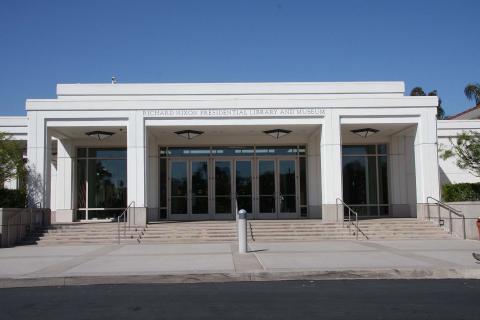
Introduction
This almanac page for Friday, December 8, 1972, pulls together various records created by the federal government and links to additional resources which can provide context about the events of the day.
Previous Date: Thursday, December 7, 1972
Next Date: Saturday, December 9, 1972
Schedule and Public Documents
The Daily Diary files represent a consolidated record of the President's activities. Visit the finding aid to learn more.
The President's day began at Camp David, Maryland
The Weekly Compilation of Presidential Documents made available transcripts of the President's news conferences; messages to Congress; public speeches, remarks, and statements; and other Presidential materials released by the White House.
Digitized versions can be found at HathiTrust.
The Federal Register is the official daily publication for rules, proposed rules, and notices of federal agencies and organizations, as well as executive orders and other Presidential documents.
Archival Holdings
Any selection of archival documents will necessarily be partial. You should use the documents and folders identified below as a starting place, but consult the linked collection finding aids and folder title lists and the collections themselves for context. Many documents to be found this way do not lend themselves to association with specific dates, but are essential to a complete understanding of the material.
Selective document listing
President's Office Files
The President's Office Files consists of materials drawn together by the Special Files Unit from several administrative subdivisions within the White House Office. It is the handwriting and sensitive papers sent to the Staff Secretary that now comprise much of the President's Office Files. Visit the finding aid to learn more.
- News Summaries, Annotated News Summaries, Box 41, Dec. 1972 [1 of 5] [Note: Due to the way News Summary products were compiled, you should also consult nearby days for potentially relevant materials.]
- A Regrettably Delayed Review of Press Comment on the Election and the Prospects for the Next 4 Years, December 8, 1972
- News Summaries, Unmarked News Summaries, Box 52, News Summaries - December 1972 [3 of 6]
- News Summary, December 8, 1972, (Thurs. nets, wires, columns)
The H. R. Haldeman Diaries consists of seven handwritten diaries, 36 dictated diaries recorded as sound recordings, and two handwritten audio cassette tape subject logs. The diaries and logs reflect H. R. Haldeman’s candid personal record and reflections on events, issues, and people encountered during his service in the Nixon White House. As administrative assistant to the President and Chief of Staff, Haldeman attended and participated in public events and private meetings covering the entire scope of issues in which the Nixon White House engaged in during the years 1969-1973. Visit the finding aid to learn more.
- Transcript of diary entry (PDF)
[Friday, December 8.]
Miscellaneous items today, no heavy schedule. He wanted to be sure I read Hutchnicker’s book on The Will to Live, because he thinks the thesis that Hutchnicker lays out is clearly related to Kissinger’s suicidal complex. He also wants to be sure I make extensive memoranda regarding Kissinger’s mental processes and so on, for his file.
Got into the Dole thing, and I explained to him what the problem was with Dole's blast at me in his conversation with Colson. And we moved to get Harlow and Mitchell to work it out, which they succeeded in doing by midday, but by then we had a sleet storm up at Camp David, and there was no point in trying to get Dole up. So we didn't. He was concerned about the public highway assault on Brinegar, who was supposed to be on the right side on that.
Got back into the Watergate/Segretti thing, wanted to be sure that he gets his Dean report. He thinks Dean ought to talk to the press, rather than Ziegler, to give the summary on it. Wants to have a meeting on that subject the first of the week.
-------------------------------------------------------------------------------------------------------------------
PRIVACY- Reviewed and released under Deed of Gift, DR, NARA, September 11, 2014
Audio Cassette 28, Side B.
Duration: 14 seconds
Then he said Boggs won’t do for the Secret Service, he tips too heavily, drinks too much, and chases girls too much around San Clemente so gotta get someone else.
-------------------------------------------------------------------------------------------------------------------
The Kissinger thing turned out to be a four and a half-hour meeting today and a plan for another meeting tomorrow, with the possibility of sending Haig back tomorrow night after the meeting's over. The President had me in again on getting Rogers sold on Scali, that he wants to get him to announce that. I finally told the President that Brinegar was not a Catholic, which came as something of a blow and disturbed him considerably. He feels we're wasting Krogh at the Transportation job and ought to move him up to something else. Got into his White House health unit again. He wants the thing set up for the family. The bowling alley, sauna, tub, dressing room, and Ryland table.
Then he had Julie come in, and we talked about her plans, first with the family's Christmas plans and then the idea of her taking an East Wing staff job, which would be superb. The key to that is getting David out of the Navy now, and setting it up so that he can run for the Goodling seat in Pennsylvania. So I'm going to try to work that out, so we can get Julie in.
Eliot Richardson called me this morning, wants to get together in the next week or so, because he wants a feel from me about his process of communications with the President. Will be in town all week. Also wants to talk about people, such as Bob Moody, he'd like to stay on. He then got to the Evans and Novak column this morning which told about the fight between the White House and Richardson, particularly me. Said he had never heard of one guy they said he was moving in, and the other guy, Moore, he has been using to handle the transition on both ends. And he remembered that I told him Moore could not go over to Defense, but he obviously is going to try and push that through. Says he wants to talk with the President, not under time pressure, to get a full sense of his thinking on what needs to be done in Defense. Says he's been talking with all of Laird's top staff, and he’ll have the background against which to understand all the President’s views, which he'd like to get in the near future.
I came down in the late afternoon, and we went to the theater with the Ehrlichmans tonight. The President is staying at Camp David over the weekend, pending Henry's return…
-------------------------------------------------------------------------------------------------------------------
PRIVACY- Reviewed and released under Deed of Gift, DR, NARA, September 11, 2014
Audio Cassette 28, Side B.
Duration: 4 seconds
…and the possibility of Helene arriving up there with Pat at some point.
-------------------------------------------------------------------------------------------------------------------
End of December 8. - Original audio recording (MP3)
The National Archives Catalog is the online portal to the records held at the National Archives, and information about those records. It is the main way of describing our holdings and also provides access to electronic records and digitized versions of our holdings.
The Catalog searches across multiple National Archives resources at once, including archival descriptions, digitized and electronic records, authority records, and web pages from Archives.gov and the Presidential Libraries. The Catalog also allows users to contribute to digitized historical records through tagging and transcription.
Nixon Library Holdings
All National Archives Units
National Security Documents
The President's Daily Brief is the primary vehicle for summarizing the day-to-day sensitive intelligence and analysis, as well as late-breaking reports, for the White House on current and future national security issues. Read "The President's Daily Brief: Delivering Intelligence to Nixon and Ford" to learn more.
The Foreign Relations of the United States series presents the official documentary historical record of major U.S. foreign policy decisions and significant diplomatic activity. Visit the State Department website for more information.
Vol. IX, Vietnam, October 1972-January 1973
Paris Negotiations Collapse, October 24-December 13, 1972
148. Defense Intelligence Estimates Memorandum Prepared in the Defense Intelligence Agency, Washington, December 8, 1972
Source: Washington National Records Center, OSD Files: FRC 330–75–0125, 381, Vietnam. Secret. The memorandum was not coordinated with other intelligence agencies and was approved by Brigadier General Daniel O. Graham, USA, Deputy Director for Estimates, DIA. A copy was sent to the National Security Council. (National Archives, Nixon Presidential Materials, NSC Files, Box 113, Vietnam Subject Files, Vietnam—Ceasefire 1972)
149. Message From Richard T. Kennedy of the National Security Council Staff to the President’s Deputy Assistant for National Security Affairs (Haig) in Paris, Washington, December 8, 1972
Source: National Archives, Nixon Presidential Materials, NSC Files, Kissinger Office Files, Box 27, HAK Trip Files, HAK Paris Trip Tohak 1–100, December 3–13, 1972. Top Secret; Sensitive; Exclusively Eyes Only. Written on December 7.
150. Message From President Nixon to the President’s Assistant for National Security Affairs (Kissinger) in Paris, Washington, December 8, 1972
Source: National Archives, Nixon Presidential Materials, NSC Files, Kissinger Office Files, Box 27, HAK Trip Files, HAK Paris Trip Tohak 1–100, December 3–13, 1972. Top Secret; Sensitive; Exclusively Eyes Only. Sent via Kennedy, Guay, and Haig. Written on December 7. This is a corrected copy of Tohak 90.
151. Message From the President’s Assistant for National Security Affairs (Kissinger) to President Nixon, Paris, December 8, 1972, 2135Z
Source: National Archives, Nixon Presidential Materials, NSC Files, Kissinger Office Files, Box 27, HAK Trip Files, HAK Paris Trip Hakto and Memos to Pres., etc., December 3–13, 1972. Top Secret; Flash; Sensitive; Exclusively Eyes Only. Sent via Haig, Guay, and Kennedy. Another copy of this message, typed for President Nixon’s reading, bears the stamped notation: “The President has seen.” (Ibid.)
Vol. XLII, Vietnam: The Kissinger-Le Duc Tho Negotiations
Breakdown of Negotiations, November 1972-December 1972
36. Memorandum of Conversation, Paris, December 8, 1972, 3:05-7:20 p.m.
Source: National Archives, Nixon Presidential Materials, NSC Files, Box 859, For the President’s Files (Winston Lord) China Trip/Vietnam Negotiations, Sensitive, Camp David, Vol. XXII, Minutes of Meetings, Paris, December 4–13, 1972. Top Secret; Sensitive; Exclusively Eyes Only. The meeting took place at 31 Boulevard de la Saussaye, Neuilly-sur-Seine. All brackets are in the original.
According to Kissinger’s report to the President, this meeting was “a brutal four-and-a-half hour session.” (Foreign Relations, 1969–1976, vol. IX, Vietnam, October 1972–January 1973, Document 151) Tentatively, however, the outcome was positive. In his memoir, Kissinger wrote that after the meeting, “we were now down essentially to two issues: the DMZ and American civilian personnel. Compared with what had already been settled, these could be dealt with in one session provided the desire was there. On this assumption I asked Haig to return to Washington. If we settled on December 9, I wanted him ready to leave for Saigon the next morning with the Vice President to obtain Thieu’s concurrence.” (Kissinger, White House Years, p. 1436)
The Politburo, however, remained unwilling to reach a settlement on those terms. A Politburo message to Le Duc Tho the next day commenting on the meeting and giving him guidance stated:
“The 8 December meeting reveals that even though the U.S. is being forced to withdraw from the war in Vietnam, they still want to achieve the best possible settlement for the U.S. and their puppets.
“We will not agree to any settlement that includes anything that might be interpreted as stating that South Vietnam is a separate country. This includes such wording as, ʻ. . . the four countries of Indochina,’ ʻ. . . within the territories of North and South Vietnam,’ etc. We must continue to demand the withdrawal of U.S. civilian personnel because this is an important aspect of ending U.S. involvement in South Vietnam.” (Message from the Politburo to Le Duc Tho and Xuan Thuy, 9 December 1972, in Doan Duc, et al., compilers, Major Events: The Diplomatic Struggle and International Activities during the Resistance War Against the Americans to Save the Nation, 1954–1975, volume 4, pp. 357–358)
Vol. E-7, Documents on South Asia, 1969-1972
U.S. Relations with India and Pakistan, 1972
320. Memorandum From Douglas M. Cochran of the Office of Pakistan, Afghanistan, and Bangladesh Affairs to the Assistant Secretary of State for Near Eastern and South Asian Affairs (Sisco), Washington, December 8, 1972
Cochran’s memorandum detailed what he described as Pakistan’s “growing nervousness” over the state of its relations with the United States.
Source: Department of State, NEA/PAB Files: Lot 76 D 52, PAK/Indian Negotiations July–Dec 1972. Confidential. Cleared by Meyer and sent through Laingen. The December 4 meeting between Rogers and Tridev Roy, head of Pakistan’s delegation to the UN General Assembly, was reported to Islamabad on December 5 in telegram 220229. (National Archives, RG 59, Central Files 1970–73, POL 7 PAK)
The Kissinger telephone conversation transcripts consist of approximately 20,000 pages of transcripts of Kissinger’s telephone conversations during his tenure as Assistant to the President for National Security Affairs (1969-1974) and Secretary of State (1973-1974) during the administration of President Richard Nixon. Visit the finding aid for more information.
Digitized versions can be found in the National Archives Catalog.
Audiovisual Holdings
Visit the White House Tapes finding aid to learn about the taping system's operation and archival processing.
Camp David Hard Wire
- 234-16; Unknown between 12:05 p.m. & 1:12 p.m.; Shultz, George P.; Camp David Operator
- 234-17; Unknown between 12:05 p.m. & 1:12 p.m.; Ehrlichman, John D.; Shultz, George P.
- 234-18; Unknown between 1:12 p.m. & 4:00 p.m.; Sanchez, Manolo; [Unknown person(s)]
- 234-19; Unknown between 1:12 p.m. & 4:00 p.m.; Nixon, Richard M. (President); Eisenhower, Julie Nixon
Camp David Study Table
The White House Photo Office collection consists of photographic coverage of President Richard Nixon meeting with prominent social, political, and cultural personalities; speaking engagements and news conferences of the President and various high-ranking members of the White House staff and Cabinet; Presidential domestic and foreign travel, including Presidential vacations; social events and entertainment involving the First Family, including entertainers present; official portraits of the President, First Family, and high-ranking members of the Nixon administration; the 1969 and 1973 Inaugurals; the President’s 1972 Presidential election campaign appearances (including speeches) and other official activities of the White House staff and the President’s Cabinet from January 20, 1969 until August 9, 1974 at the White House and the Old Executive Office Building; other locations in Washington, DC, such as The Mall; and the Presidential retreats in Camp David, Maryland, Key Biscayne, Florida, and San Clemente, California. Visit the finding aid to learn more.
Roll WHPO-D1072 Photographer: Kightlinger, Jack | Color or B&W: B&W
- Frame(s): WHPO-D1072-05-10, President Nixon seated informally in the Aspen Lodge at Camp David during a meeting Duke Law Dean Joseph Tyree Sneed, III. 12/8/1972, Camp David, Maryland Aspen Lodge, Sun Porch. President Nixon, Joseph Tyree Sneed, III, Robert Bork, George Shultz, Burns, Herb Stein.
- Frame(s): WHPO-D1072-11-14, President Nixon seated informally in the Aspen Lodge at Camp David during a meeting with Robert Bork. 12/8/1972, Camp David, Maryland Aspen Lodge, Sun Porch. President Nixon, Joseph Tyree Sneed, III, Robert Bork, George Shultz, Burns, Herb Stein.
- Frame(s): WHPO-D1072-15-19, President Nixon seated informally in the Aspen Lodge at Camp David during a meeting with George Shultz, Burns, and Stein. 12/8/1972, Camp David, Maryland Aspen Lodge, Sun Porch. President Nixon, Joseph Tyree Sneed, III, Robert Bork, George Shultz, Burns, Herb Stein.
Roll WHPO-D1073 Photographer: Kightlinger, Jack | Color or B&W: B&W
- Frame(s): WHPO-D1073-03-19, President Nixon alone. President Nixon with Ehrlichman. President Nixon with John Ehrlichman and Ron Ziegler. 12/8/1972, Camp David, Maryland Aspen Lodge, Sun Porch. President Nixon, John Ehrlichman, Ron Ziegler.
- Frame(s): WHPO-D1073-03A, President Nixon seated informally during a meeting with John Ehrlichman at Aspen Lodge in Camp David. 12/8/1972, Camp David, Maryland Aspen Lodge, Sun Porch. President Nixon, John Ehrlichman.
- Frame(s): WHPO-D1073-12, Ron Ziegler standing while speaking to President Nixon seated informally at Aspen Lodge Camp David. 12/8/1972, Camp David, Maryland Aspen Lodge, Sun Porch. President Nixon, Ron Ziegler.
- Frame(s): WHPO-D1073-20-21, President Nixon with Burns, Herb Stein, and Caspar Weinberger at Camp David. 12/8/1972, Camp David, Maryland Aspen Lodge, Sun Porch. President Nixon, Burns, Stein, Weinberger.
Roll WHPO-D1074 Photographer: Knudsen, Robert L. | Color or B&W: B&W
- Frame(s): WHPO-D1074-02-08, Workmen decorating chandeliers for Christmas. 12/8/1972, Washington, D.C. Grand Hallway, room. White House. workmen, unidentified woman.
- Frame(s): WHPO-D1074-09, Unidentified woman in an office. 12/8/1972, Washington, D.C. Grand Hallway, room. White House. workmen, unidentified woman.
The White House Communications Agency Sound Recordings Collection contains public statements that took place between 1969 and 1974. Visit the finding aid to learn more.
L - White House Press Office Briefings
- WHCA-SR-L-082
Press briefing by Ronald Ziegler. (12/8/1972, Camp David)
Runtime: 30:00:00
Keywords: Press conferences, news conferences, interviews, media, press secretary
Original Format: 1/4-inch reel-to-reel audiotape. Original source type: Original.
The White House Communications Agency Videotape Collection contains “off-the-air” recordings of televised programs produced between 1968 and 1974. Visit the finding aid to learn more.
- WHCA-5947
Weekly News Summary, Tape I.
ALL NETWORKS
Runtime: 1:30
1. Smith/Kaplow: President Nixon's cabinet complete, Revenue Sharing. Time Code Start: 00:00. Keywords: bills, laws, State and Local Fiscal Assistance Act of 1972, financial aid. Network: ABC.
2. Smith/Rolfson/Gill: Paris peace talks, Vietnam war, United Mine Workers report. Time Code Start: 02:06. Keywords: Paris Peace Talks, Vietnam War, treaty, treaties, negotiations, unions, mining, natural resources, reports. Network: ABC.
3. Smith/Comment: President Nixon and Franklin D. Roosevelt (FDR). Time Code Start: 05:31. Keywords: Presidents, history, comparisons, politics. Network: ABC.
4. Chancellor/Dobyns: Paris peace talks. Time Code Start: 07:20. Keywords: Paris Peace Talks, Vietnam War, treaty, treaties, negotiations. Network: NBC.
5. Chancellor/Levine: Revenue sharing monies (Walker). Time Code Start: 09:50. Keywords: bills, laws, State and Local Fiscal Assistance Act of 1972, financial aid. Network: NBC.
6. Chancellor/Kiker: Democratic National Committee to meet to select new Chairman. Time Code Start: 12:51. Keywords: political parties, Democrats, Democratic Party. Network: NBC.
7. Cronkite/Schorr: Unemployment down to 5.2%; President Nixon may drop wage price controls. Time Code Start: 14:44. Keywords: jobs, unemployment, statistics. Network: CBS.
8. Cronkite/Serafin: New cabinet changes; Democratic struggle for new Chairman. Time Code Start: 16:20. Keywords: political parties, Democrats, Democratic Party. Network: CBS.
9. Cronkite: Teamsters to change law firms. Time Code Start: 18:40. Keywords: labor, unions, regulations, voting. Network: CBS.
10. Cronkite/Collingwood: Paris peace talks. Time Code Start: 19:24. Keywords: Paris Peace Talks, Vietnam War, treaty, treaties, negotiations. Network: CBS.
11. Cronkite/Stawser/Drinkwater: Revenue sharing checks sent out; Revenue sharing affects Pomona, California. Time Code Start: 23:23. Keywords: bills, laws, State and Local Fiscal Assistance Act of 1972, financial aid. Network: CBS.
Context (External Sources)
The Vanderbilt Television News Archive is the world's most extensive and complete archive of television news. They have been recording, preserving and providing access to television news broadcasts of the national networks since August 5, 1968.
Wikipedia is a free encyclopedia that anyone can edit.