
Introduction
This almanac page for Tuesday, December 12, 1972, pulls together various records created by the federal government and links to additional resources which can provide context about the events of the day.
Previous Date: Monday, December 11, 1972
Next Date: Wednesday, December 13, 1972
Schedule and Public Documents
The Daily Diary files represent a consolidated record of the President's activities. Visit the finding aid to learn more.
The President's day began at The White House - Washington, D. C.
The Weekly Compilation of Presidential Documents made available transcripts of the President's news conferences; messages to Congress; public speeches, remarks, and statements; and other Presidential materials released by the White House.
Digitized versions can be found at HathiTrust.
The Federal Register is the official daily publication for rules, proposed rules, and notices of federal agencies and organizations, as well as executive orders and other Presidential documents.
Archival Holdings
Any selection of archival documents will necessarily be partial. You should use the documents and folders identified below as a starting place, but consult the linked collection finding aids and folder title lists and the collections themselves for context. Many documents to be found this way do not lend themselves to association with specific dates, but are essential to a complete understanding of the material.
Selective document listing
President's Office Files
The President's Office Files consists of materials drawn together by the Special Files Unit from several administrative subdivisions within the White House Office. It is the handwriting and sensitive papers sent to the Staff Secretary that now comprise much of the President's Office Files. Visit the finding aid to learn more.
- News Summaries, Annotated News Summaries, Box 41, Dec. 1972 [2 of 5] [Note: Due to the way News Summary products were compiled, you should also consult nearby days for potentially relevant materials.]
- News Summary, December 12, 1972, (Monday nets, wires, mags, columns)
- President's Daily Schedule, Box 102, [President's Daily Schedule, Oct.-Dec. 1972] [2 of 2]
- The President's Schedule, Tuesday - December 12, 1972
The H. R. Haldeman Diaries consists of seven handwritten diaries, 36 dictated diaries recorded as sound recordings, and two handwritten audio cassette tape subject logs. The diaries and logs reflect H. R. Haldeman’s candid personal record and reflections on events, issues, and people encountered during his service in the Nixon White House. As administrative assistant to the President and Chief of Staff, Haldeman attended and participated in public events and private meetings covering the entire scope of issues in which the Nixon White House engaged in during the years 1969-1973. Visit the finding aid to learn more.
- Transcript of diary entry (PDF)
Tuesday, December 12th. The President had me over to talk about the Julie job thing. Apparently, Julie had talked with him last night, and based on Pat's talk with Ziegler on Connie Stuart, Ron convinced her that she should keep Connie, which is too bad. So the President feels that Julie feels that she can't now take that job, so he wanted me to consider what she could do over here, on the basis that she's good for the President, well organized, thinks up things, and handles a lot of little things. It’s good to have her around, good for the President, so he wants to see what she can do at the White House. She could schedule events, getting people to cooperate, and all that.
He went through quite an agony on why he didn't do the Whittier group when they were in yesterday. Apparently they flew back to present a petition or something, and Pat Nixon received them. He feels we really blew it, that it was a highly personal thing, and we should be more aware of those and not drop that sort of thing. That if we were using Julie in the White House, she could do that kind of keeping an eye on things, as well as, the buffering with the East Wing, see important people, review the schedule, and that sort of stuff. She should do something where she handles people, especially her mother, Connie Stuart, and so on; something in an overall scheduling, planning, and so forth, but something specific. I talked to Julie later, and she agreed that the real place for her is in the East Wing job. She talked to Ron and he agreed, too, so we're going to try to get that back on the track.
The President got into the inaugural thing and the American Music concert. He wants to be sure that the program and artists are not picked by Garment and Hanks, and that they get into modern stuff. He wants to be sure it's all his kind of American music; same with Ormandy's program.
On the personnel side, got concerned that Helms needs to say something about Schlesinger being a good man, and Haig needs to talk to Stennis and get Schlesinger sold unless he's against Schlesinger himself. We need a stronger man to handle Stennis. Also, we need strong man in the Timmons role to back things up. The President met with Strachan in this little farewell meeting there, and talked with him about the bad guys in the various USIA jobs, and then latter with Keogh and Shakespeare, reviewed the USIA situation, spent an hour with them and gave Frank a pretty good buildup. He wants to use Shakespeare on special missions or on a commission; wants to be sure Casey follows Shakespeare's advice that he get out in the field and travel fast to get readings out in the embassies and all, but he should have a talk with Shakespeare first, especially on how to look for the problems. He should concentrate on the major posts, do a few things well, talk to the business community, explore the attitude toward people and all. Shakespeare got into quite a bit on his concern about the danger of euphoria building in the world, vis-à-vis the Soviet Union and China, because of the formalization of relations that we're moving towards. The President got into the point that conviction is believing in something and knowing why you believe. And there was a long discussion and of his whole philosophy of the elite, Life magazine, and all that sort of stuff—pretty much the usual material.
I had a call from Billy Graham today, to say he's back from his trip. He wanted to report that everyone in all the countries he visited were elated at the President's election, and the Shah of Iran said that we've saved civilization for at least four more years. He's concerned about the worship idea at the inaugural Sunday service, of having three ministers. He said first, he'd really would prefer a black man instead of himself and suggested Dr. Hill from Los Angeles. Secondly, he's concerned if he gives his convictions on Christ, it might embarrass the Rabbi and the Jews that symbolism is very important to the blacks, and it would be good to have them in there. Then he said on the next thing, if it's part of the inaugural, there's no problem. But if it's separate as a service, he will get criticism, because a worship service is not acceptable to the Evangelicals with three ministers of different faiths, because all three would be compromising. However it's printed, if it's printed as part of the inauguration program with the inauguration materials, then it's logical and he can do it. He thinks the Moynihan appointment is the best the President could have made, and that he can save Indian democracy. Graham would like to talk with Pat and give him the background...
-------------------------------------------------------------------------------------------------------------------
DECLASSIFIED - E.O. 13526, Sect. 3.4: by MS, NARA, June 12, 2013
Audio Cassette 28, Side B, Withdrawn Item Number 14 [AC-28(B) Sel 6]
Duration: 13 seconds
…and share what he was told by the three Christians in Gandhi’s cabinet. He thinks there's a good chance India will split apart and the Shah thinks they will.
-------------------------------------------------------------------------------------------------------------------
That Moynihan going there was an absolute master stroke.
End of December 12th. - Original audio recording (MP3)
The National Archives Catalog is the online portal to the records held at the National Archives, and information about those records. It is the main way of describing our holdings and also provides access to electronic records and digitized versions of our holdings.
The Catalog searches across multiple National Archives resources at once, including archival descriptions, digitized and electronic records, authority records, and web pages from Archives.gov and the Presidential Libraries. The Catalog also allows users to contribute to digitized historical records through tagging and transcription.
Nixon Library Holdings
All National Archives Units
National Security Documents
The President's Daily Brief is the primary vehicle for summarizing the day-to-day sensitive intelligence and analysis, as well as late-breaking reports, for the White House on current and future national security issues. Read "The President's Daily Brief: Delivering Intelligence to Nixon and Ford" to learn more.
The Foreign Relations of the United States series presents the official documentary historical record of major U.S. foreign policy decisions and significant diplomatic activity. Visit the State Department website for more information.
Vol. IV, Foreign Assistance, International Development, Trade Policies, 1969-1972
Coordinating Committee on Export Controls, 1969-1972
384. Memorandum From the Deputy Secretary of Defense (Rush) to the Chairman of the National Security Council Under Secretaries Committee (Irwin), Washington, December 12, 1972
Source: National Archives, RG 59, S/S Files: Lot 83 D 305, NSDM 159. Confidential. The memorandum is Tab B to a December 30 memorandum from Armstrong to Irwin; see footnote 1, Document 387.
Vol. IX, Vietnam, October 1972-January 1973
Paris Negotiations Collapse, October 24-December 13, 1972
158. Message From the President’s Deputy Assistant for National Security Affairs (Haig) to the President’s Assistant for National Security Affairs (Kissinger) in Paris, Washington, December 12, 1972, 0245Z
Source: National Archives, Nixon Presidential Materials, NSC Files, Kissinger Office Files, Box 27, HAK Trip Files, HAK Paris Trip Tohak 100–192, December 3–13, 1972. Top Secret; Sensitive; Exclusively Eyes Only. Sent via Lord. Written on December 11.
159. Conversation Between President Nixon and the President’s Deputy Assistant for National Security Affairs (Haig), Washington, December 12, 1972
Source: National Archives, Nixon Presidential Materials, White House Tapes, Conversation 820–5. No classification marking. According to the President’s Daily Diary, Haig met with Nixon in the Oval Office from 9:57 to 10:21 a.m. (Ibid., White House Central Files) The editors transcribed the portions of the conversation printed here specifically for this volume.
160. Memorandum From the President’s Deputy Assistant for National Security Affairs (Haig) to President Nixon, Washington, December 12, 1972
Source: National Archives, Nixon Presidential Materials, NSC Files, Kissinger Office Files, Box 27, HAK Trip Files, HAK Paris Trip Hakto and Memos to Pres., etc., December 3–13, 1972. Top Secret; Sensitive; Exclusively Eyes Only. A stamped notation on the first page reads: “The President has seen.”
161. Conversation Between President Nixon and the President’s Deputy Assistant for National Security Affairs (Haig), Washington, December 12, 1972
Source: National Archives, Nixon Presidential Materials, White House Tapes, Oval Office, Conversation 820–16. No classification marking. According to the President’s Daily Diary, Haig met with the President in the Oval Office from 1:34 to 1:55 p.m. (Ibid, White House Central Files) The editors transcribed the portions of the conversation printed here specifically for this volume.
162. Message From the President’s Deputy Assistant for National Security Affairs (Haig) to the President’s Assistant for National Security Affairs (Kissinger) in Paris, Washington, December 12, 1972, 1905Z
Source: National Archives, Nixon Presidential Materials, NSC Files, Kissinger Office Files, Box 27, HAK Trip Files, HAK Paris Trip Tohak 100–192, December 3–13, 1972. Top Secret; Flash; Sensitive; Exclusively Eyes Only. Sent via Guay.
163. Message From the President’s Assistant for National Security Affairs (Kissinger) to the President’s Deputy Assistant for National Security Affairs (Haig), Paris, December 12, 1972, 2241Z
Source: National Archives, Nixon Presidential Materials, NSC Files, Kissinger Office Files, Box 27, HAK Trip Files, HAK Paris Trip Hakto and Memos to Pres., etc., December 3–13, 1972. Top Secret; Flash; Sensitive; Exclusively Eyes Only.
164. Conversation Between President Nixon and the President’s Deputy Assistant for National Security Affairs (Haig), Washington, December 12, 1972
Source: National Archives, Nixon Presidential Materials, White House Tapes, Oval Office, Conversation 821–1. No classification marking. According to the President’s Daily Diary, Haig met with Nixon in the Oval Office from 5:50 to 6:10 p.m. (Ibid., White House Central Files) The editors transcribed the portions of the conversation printed here specifically for this volume.
165. Backchannel Message From the Special Assistant for Vietnamese Affairs, Central Intelligence Agency (Carver) to the President’s Assistant for National Security Affairs (Kissinger) in Paris, Washington, December 12, 1972, 2354Z
Source: National Archives, Nixon Presidential Materials, NSC Files, Kissinger Office Files, Box 27, HAK Trip Files, HAK Paris Trip Tohak 100–192, December 3–13, 1972. Secret; Sensitive; Exclusively Eyes Only. Sent via Haig.
166. Memorandum From Secretary of Defense Laird to President Nixon, Washington, December 12, 1972
Source: Washington National Records Center, OSD Files: FRC 330–77–0095, 385.1, Viet, December 1972. Top Secret; Sensitive.
Vol. XXIV, Middle East Region and Arabian Peninsula, 1969-1972; Jordan, September 1970
Persian Gulf States
125. Memorandum From the Director, Arabian Peninsula Affairs (Dickman) to the Assistant Secretary of State for Near Eastern and South Asian Affairs (Sisco), Washington, December 12, 1972
Source: National Archives, RG 59, Central Files 1970–73, POL 32–1 SAUD–UAE. Confidential. Sent through Atherton. A handwritten note by Sisco reads: “I remain unconvinced. I’ll sit tight a little while longer and then we’ll see.” Attached but not printed is a map of the Abu Dhabi–Saudi Arabia boundary.
Vol. XXXIV, National Security Policy, 1969-1972
Taking Stock
229. Memorandum From the Chairman of the Joint Chiefs of Staff (Moorer) to Secretary of Defense Laird, Washington, December 12, 1972
Source: Ford Library, Laird Papers, Box 28, Taking Stock. Top Secret; Restricted Data.
Vol. XLII, Vietnam: The Kissinger-Le Duc Tho Negotiations
Breakdown of Negotiations, November 1972-December 1972
39. Memorandum of Conversation of a Ministers Meeting, Paris, December 12, 1972, 10:30 a.m.-1:30 p.m.
Source: National Archives, Nixon Presidential Materials, NSC Files, Box 859, For the President’s Files (Winston Lord)—China Trip/Vietnam Negotiations, Sensitive, Camp David, Vol. XXII, Minutes of Meetings, Paris, December 4–13, 1972. Top Secret; Sensitive; Exclusively Eyes Only. The meeting took place at 31 Boulevard de la Saussaye, Neuilly-sur-Seine. All brackets are in the original. The tabs are attached but not printed.
40. Memorandum of Conversation, Paris, December 12, 1972, 3:07-7:35 p.m.
Source: National Archives, Nixon Presidential Materials, NSC Files, Box 865, For the President’s Files (Winston Lord)—China Trip/Vietnam Negotiations, Camp David Memcons, December 1972 [1 of 3]. Top Secret; Sensitive; Exclusively Eyes Only. The meeting took place at 108 Avenue du Général Leclerc in Gif-sur-Yvette. All brackets are in the original. The tabs are attached but not printed.
It is clear from message traffic before the meeting that the North Vietnamese negotiators in Paris and the Politburo in Hanoi differed over how to proceed. A day or two before this meeting, Tho and Thuy informed Hanoi that if they presented Hanoi’s rigid approach to a draft on the demilitarized zone (DMZ) as instructed, the U.S. negotiators would reject it. In consequence, they continued, “it is possible that the talks may be suspended for a period of time and the war will continue. Even though they are not capable of protracting the war for an extended period, they will make massive concentrated attacks for a time and then request resumption of the talks. If we refuse to meet with them the war will continue and the U.S. will place the blame on us. If we announce the suspension of talks and the only remaining issue is the question of the demilitarized zone, it will be hard for us to explain our position. The public may mistakenly think that we do not want to respect the demilitarized zone and that we want to continue sending troops down into the South. If we agree to meet with them, we will be under pressure and if we simply deal with the issue of the demilitarized zone using the Politburo’s formula it will be very difficult for us to achieve acceptance of this formula, and we will also suffer additional losses in North Vietnam, losses that will have at least some effect on the situation in South Vietnam.”
Tho and Thuy therefore recommended that Hanoi consider settling on the agreement as then negotiated: “We are not under any time pressure, but we need to recognize our opportunity. Right now the U.S. needs a settlement, but if we leave things too long we will miss this opportunity and then our pressure on them will have little effect, because everything has limits.”
Hanoi refused to allow a more flexible response and directed Tho and Thuy to maintain the previous hard-line offer which Kissinger, as the negotiators expected, quickly rejected. (Luu and Nguyen, Le Duc Tho-Kissinger Negotiations in Paris [Cac Cuoc Thuong Luong Le Duc Tho-Kissinger Tai Paris], pp. 581–582; Vietnamese edition)
Kissinger provided a narrative of the meeting for Haig and Nixon in Washington and then an interpretation of the events vis-à-vis the future. In a message to Haig, he wrote:
“Hanoi has decided to play for time, either because of the public split between us and Saigon; or because they have a pipeline into the South Vietnamese and know about our exchanges; or because their leadership is divided and they are still making up their minds on whether to conclude the agreement. Their consistent pattern is to give us just enough each day to keep us going but nothing decisive which could conclude an agreement. On the other hand, they wish to insure that we have no solid pretext for taking tough actions. They keep matters low key to prevent a resumption of bombing. They could have settled in three hours any time these past few days if they wanted to, but they have deliberately avoided this. For every one of their semi-concessions they introduce a counter-demand. Thus their sentence on the DMZ, which in itself is unacceptable, was counterbalanced today by the withdrawal of their proposal for the signing procedure made yesterday. Moreover, the DMZ sentence, as you recognize, takes away the significance of the respect for the DMZ. I tried in innumerable ways to get the word ʻcivil’ included but they totally refused this. Thus what they offered after supposedly more than two days of communication with Hanoi was to move a still objectionable sentence further down in the text, and even here they link all the sentences by semicolons in the same paragraph.”
Thus, he concluded: “We now find ourselves in an increasingly uncomfortable position. We have no leverage on Hanoi or Saigon, and we are becoming prisoners of both sides’ internecine conflicts. Our task clearly is to get some leverage on both of them.” To that end, he made the following recommendations:
“—As soon as Tho has left Paris we should reseed the mines, as heavily as possible including of course north of the 20th parallel. This is desirable in any event because the longer the mines are in DRV ports the less likely they are to violate the agreement if it is finally concluded.
“—We should take off all restrictions on bombing south of the 20th parallel and step up our attacks, particularly by B–52s.
“—We should resume reconnaissance activities north of the 20th parallel immediately which would serve as a warning to Hanoi.
“—We should plan a two or three day strike including B–52’s north of the 20th parallel for early next week. Please get plans. The power plants seem attractive.
“—I would like you [Haig] to look at the bombing situation in southern Laos. Yesterday’s noon report mentioned the fact that infiltration was much heavier because the bombing in that area had fallen off.
“It is essential that the military perform effectively for once in the above tasks. I would not resume daily bombing north of the 20th parallel at this point until we can discuss it.”
Giving vent to his frustration with the North and South Vietnamese, Kissinger concluded his analysis with these words:
“The North Vietnamese strategy seems to me to be as follows: they have reduced the issues to a point where a settlement can be reached with one exchange of telegrams. I do not think they will send this telegram, however, in the absence of strong pressures. These pressures in turn cannot really be applied now because of Thieu. If Thieu had adopted a common position with us we would have an excellent ground on which to stand now with North Vietnam’s insistence on maintaining troops in the South and total refusal to recognize any aspect of sovereignty for South Vietnam. What makes it intolerable is the inability to defend an agreement that Thieu attacks. Moreover his short-sighted device for preventing a settlement has deprived us of the pressure which could bring us a settlement. His offer of prolonged Christmas truce almost guarantees that Hanoi will wait on sending the telegram until the truce breaks down or Congress is heard from. This is why the visit with Thieu is now essential and I know no one else than Agnew who can possibly do it. The present course will guarantee that Congress will cut off the funds and that everything we have striven four years to avoid will be imposed on us. If this is to happen we are better off knowing it early on than to die the death of a thousand cuts.” (Foreign Relations, 1969–1976, vol. IX, Vietnam, October 1972–January 1973, Document 163)
Vol. E-1, Documents on Global Issues, 1969-1972
U.S.-Cuba Hijacking Agreement, 1969-February 1973
139. Memorandum from Deputy Assistant Secretary of State for Inter-American Affairs (Hurwitch) to Secretary of State Rogers, Washington, December 12, 1972
Hurwitch sent Rogers the preliminary reaction of the Cubans to the possibility of returning hijackers as part of the proposed U.S.-Cuban hijacking agreement.
Source: National Archives, RG 59, Central Files 1970-73, AV 12. Secret; Nodis. Drafted by Hurwitch. Rogers approved the recommendation but changed the language to read: “That Ambassador Masnata be instructed to suggest that one procedure that might be considered would be extradition under the 1904 treaty.” The memorandum of the meeting with the Canadians was attached but not published.
Vol. E-7, Documents on South Asia, 1969-1972
U.S. Relations with India and Pakistan, 1972
321. Telegram 9952 From the Embassy in Pakistan to the Department of State, Islamabad, December 12, 1972, 0600Z
Chargé Sober reported that Pakistan and India had reached agreement on delineation of the line of control in Jammu and Kashmir. He speculated that further progress on implementing the Simla accord could be anticipated and he recommended a congratulatory letter from President Nixon to Pakistani President Bhutto and Indian Prime Minister Gandhi.
Source: National Archives, RG 59, Central Files 1970–73, POL 27 INDIA–PAK. Confidential; Priority; Exdis. Repeated to New Delhi. Agreement on delineation of the line of control in Jammu and Kashmir was announced in Pakistan on December 11. Mutual troop withdrawals to the border between the two countries were scheduled to begin the following day. (Telegram 9965 from Islamabad, December 12; ibid., POL 31–1 INDIA–PAK) The troop withdrawals were completed by December 20. (Telegram 10226 from Islamabad, December 21; ibid.)
Afghanistan, 1969-1972
371. Information Memorandum From the Assistant Secretary of State for Near Eastern and South Asian Affairs (Sisco) to Secretary of State Rogers, Washington, December 12, 1972
Sisco informed Rogers that King Zahir had accepted the resignation of Prime Minister Zahir and had asked Foreign Minister Shafiq to form a new government. Sisco concluded that Shafiq “seems an outstanding choice for Prime Minister.”
Source: National Archives, RG 59, NEA/PAB Files: Lot 76 D 319, 1972 POL-15.1 Prime Minister. Limited Official Use. Drafted by Flaten (NEA/PAB) and cleared by Laingen and Davies.
The Kissinger telephone conversation transcripts consist of approximately 20,000 pages of transcripts of Kissinger’s telephone conversations during his tenure as Assistant to the President for National Security Affairs (1969-1974) and Secretary of State (1973-1974) during the administration of President Richard Nixon. Visit the finding aid for more information.
Digitized versions can be found in the National Archives Catalog.
Audiovisual Holdings
Visit the White House Tapes finding aid to learn about the taping system's operation and archival processing.
Oval Office
- 820-1; Unknown between 9:50 a.m. & 9:57 a.m.; Nixon, Richard M. (President); Sanchez, Manolo
- 820-2; Unknown between 9:50 a.m. & 9:57 a.m.; Nixon, Richard M. (President); Sanchez, Manolo
- 820-3; Unknown between 9:50 a.m. & 9:57 a.m.; Nixon, Richard M. (President); [Unknown person(s)]
- 820-4; 9:57 a.m. - 9:57 a.m.; Nixon, Richard M. (President); White House operator
- 820-5; 9:57 a.m. - 10:21 a.m.; Nixon, Richard M. (President); Haig, Alexander M., Jr.; Ziegler, Ronald L.
- 820-6; Unknown between 10:21 a.m. & 10:39 a.m.; Nixon, Richard M. (President)
- 820-7; 10:39 a.m. - 10:49 a.m.; Nixon, Richard M. (President); Ziegler, Ronald L.
- 820-8; 10:50 a.m. - 10:53 a.m.; Nixon, Richard M. (President); Woods, Rose Mary; Bull, Stephen B.
- 820-9; 10:53 a.m. - 11:13 a.m.; Nixon, Richard M. (President); Haldeman, H. R. ("Bob")
- 820-10; Unknown between 11:13 a.m. & 11:17 a.m.; Nixon, Richard M. (President); Bull, Stephen B.
- 820-11; 11:17 a.m. - 11:53 a.m.; Nixon, Richard M. (President); Stone, W. Clement; Kinsey, Douglas K.; Garment, Leonard; [Unknown person(s)]; Bull, Stephen B.
- 820-12; 11:54 a.m. - 11:54 a.m.; Nixon, Richard M. (President); Bull, Stephen B.
- 820-13; 11:55 a.m. - 12:02 p.m.; Nixon, Richard M. (President); Marriott, J. Willard; Magruder, Jeb Stuart; Chapin, Dwight L.; White House photographer; Bull, Stephen B.
- 820-14; 12:05 p.m. - 12:25 p.m.; Nixon, Richard M. (President); Haldeman, H. R. ("Bob"); Bull, Stephen B.
- 820-15; 12:25 p.m. - 1:30 p.m.; Nixon, Richard M. (President); Lewis, Hobart D.; Kauffmann, John H.; O'Neill, Michael J.; Haig, Alexander M., Jr.; Klein, Herbert G.; White House photographer
- 820-16; 1:30 p.m. - 1:55 p.m.; Nixon, Richard M. (President); Butterfield, Alexander P.; White House operator; Bull, Stephen B.; Haig, Alexander M., Jr.
- 820-17; Unknown between 1:55 p.m. & 1:58 p.m.; Nixon, Richard M. (President); Sanchez, Manolo
- 820-18; 1:58 p.m. - 2:20 p.m.; Nixon, Richard M. (President); Haldeman, H. R. ("Bob"); [Unknown person(s)]
- 820-19; Unknown between 2:20 p.m. & 3:17 p.m.; Eisenhower, Julie Nixon; Sanchez, Manolo
- 820-20; Unknown between 2:20 p.m. & 3:17 p.m.; Nixon, Richard M. (President); Haldeman, H. R. ("Bob")
- 820-21; Unknown between 2:20 p.m. & 3:17 p.m.; Nixon, Richard M. (President); Haig, Alexander M., Jr.
- 820-22; 3:17 p.m. - 3:36 p.m.; Nixon, Richard M. (President); LaFontant, Jewell R.; Ehrlichman, John D.; Bull, Stephen B.; White House photographer; Monzon, Zosimo T.
- 820-23; Unknown between 3:36 p.m. & 3:38 p.m.; Nixon, Richard M. (President); Bull, Stephen B.
- 820-24; 3:38 p.m. - 6:10 p.m.; Nixon, Richard M. (President); Smith, Gerard C.; Haldeman, H. R. ("Bob"); Monzon, Zosimo T.
- 820-25; Unknown between 9:50 a.m. & 9:57 a.m.; Nixon, Richard M. (President); [Unknown person(s)]
- 820-26; Unknown between 9:50 a.m. & 9:57 a.m.; Nixon, Richard M. (President); [Unknown person(s)]
- 821-1; Unknown between 3:38 p.m. & 6:10 p.m.; Nixon, Richard M. (President); Haldeman, H. R. ("Bob"); Strachan, Gordon C.; Shakespeare, Frank J.; Keogh, James; White House photographer; Bull, Stephen B.; Sanchez, Manolo; Butterfield, Alexander P.; Haig, Alexander M., Jr.; [Unknown person(s)]
- 821-2; Unknown between 6:10 p.m. & 6:12 p.m.; Haldeman, H. R. ("Bob"); [Unknown person(s)]
White House Telephone
- 34-51; 9:57 a.m. - 9:57 a.m.; Nixon, Richard M. (President); White House operator
- 34-52; 1:35 p.m. - 1:35 p.m.; Nixon, Richard M. (President); White House operator
- 34-53; Unknown between 2:20 p.m. & 8:31 p.m.; Nixon, Richard M. (President); White House operator
- 34-54; 8:31 p.m. - 8:38 p.m.; Nixon, Richard M. (President); Haig, Alexander M., Jr.
- 34-55; 8:40 p.m. - 8:40 p.m.; Nixon, Richard M. (President); White House operator
- 34-56; Unknown between 8:40 p.m. & 11:04 p.m.; Nixon, Richard M. (President); White House operator
- 34-57; 11:04 p.m. - 11:05 p.m.; Nixon, Richard M. (President); Sanchez, Manolo
- 34-150; Unknown between 8:40 p.m. & 11:04 p.m.; White House operator; Nixon, Richard M. (President)
The White House Photo Office collection consists of photographic coverage of President Richard Nixon meeting with prominent social, political, and cultural personalities; speaking engagements and news conferences of the President and various high-ranking members of the White House staff and Cabinet; Presidential domestic and foreign travel, including Presidential vacations; social events and entertainment involving the First Family, including entertainers present; official portraits of the President, First Family, and high-ranking members of the Nixon administration; the 1969 and 1973 Inaugurals; the President’s 1972 Presidential election campaign appearances (including speeches) and other official activities of the White House staff and the President’s Cabinet from January 20, 1969 until August 9, 1974 at the White House and the Old Executive Office Building; other locations in Washington, DC, such as The Mall; and the Presidential retreats in Camp David, Maryland, Key Biscayne, Florida, and San Clemente, California. Visit the finding aid to learn more.
Roll WHPO-D1087 Photographer: Atkins, Oliver | Color or B&W: Color
- Frame(s): WHPO-D1087-, President Nixon seated informally with Hobart Lewis, John Kauffmann, Michael O'Neill, and others. 12/12/1972, Washington, D.C. White House, Oval Office. President Nixon, Hobart Lewis, John Kauffmann, Michael O'Neill, Herb Klein, Haig.
Roll WHPO-D1088 Photographer: Atkins, Oliver | Color or B&W: Color
- Frame(s): WHPO-D1088-, President Nixon receiving a gift of the first Inauguration automobile License Plate from J. Willard Marriott, Chairman of the Inaugural Committee, as Jebb Magruder, Dwight Chapin, and Steve Bull look on. 12/12/1972, Washington, D.C. White House, Oval Office. President Nixon, J. Willard Marriott, Magruder, Chapin, Bull.
- Frame(s): WHPO-D1088-, President Nixon meeting with J. Willard Marriott, Chairman of the Inaugural Committee, Jebb Magruder, Dwight Chapin, and Steve Bull. 12/12/1972, Washington, D.C. White House, Oval Office. President Nixon, J. Willard Marriott, Magruder, Chapin, Bull.
Roll WHPO-D1089 Photographer: Knudsen, Robert L. | Color or B&W: B&W
- Frame(s): WHPO-D1089-, President Nixon receiving gifts from Inaugural Committee Chairman J. Willard Marriott as aides Jebb Magruder, Dwight Chapin, and Steve Bull look on. 12/12/1972, Washington, D.C. White House, Oval Office. President Nixon, J. Willard Marriott, Jebb Magruder, Dwight Chapin, Bull.
Roll WHPO-D1090 Photographer: Atkins, Oliver | Color or B&W: B&W
- Frame(s): WHPO-D1090-, President Nixon seated at his desk during a meeting with W. Clement Stone, Douglas Kinsey, and Leonard Garment. 12/12/1972, Washington, D.C. White House, Oval Office. President Nixon, W. Clement Stone, Douglas Kinsey, Leonard Garment.
- Frame(s): WHPO-D1090-05, President Nixon seated at his desk during a meeting with W. Clement Stone, Douglas Kinsey, and Leonard Garment. 12/12/1972, Washington, D.C. White House, Oval Office. President Nixon, W. Clement Stone, Douglas Kinsey, Leonard Garment.
Roll WHPO-D1091 Photographer: Royer | Color or B&W: B&W
- Frame(s): WHPO-D1091-, Deputy Special Assistant John Nidecker receiving an Afghan rug from Mayor Sobin. 12/12/1972, Washington, D.C. unknown. John E. Nidecker, Mayor Sobin.
Roll WHPO-D1092 Photographer: Atkins, Oliver | Color or B&W: B&W
- Frame(s): WHPO-D1092-, Fred Malek sitting at his desk. 12/12/1972, Washington, D.C. unknown. Fred Malek.
- Frame(s): WHPO-D1092-09, Portrait of Fred Malek sitting at his desk. 12/12/1972, Washington, D.C. unknown. Fred Malek.
Roll WHPO-D1093 Photographer: Atkins, Oliver | Color or B&W: B&W
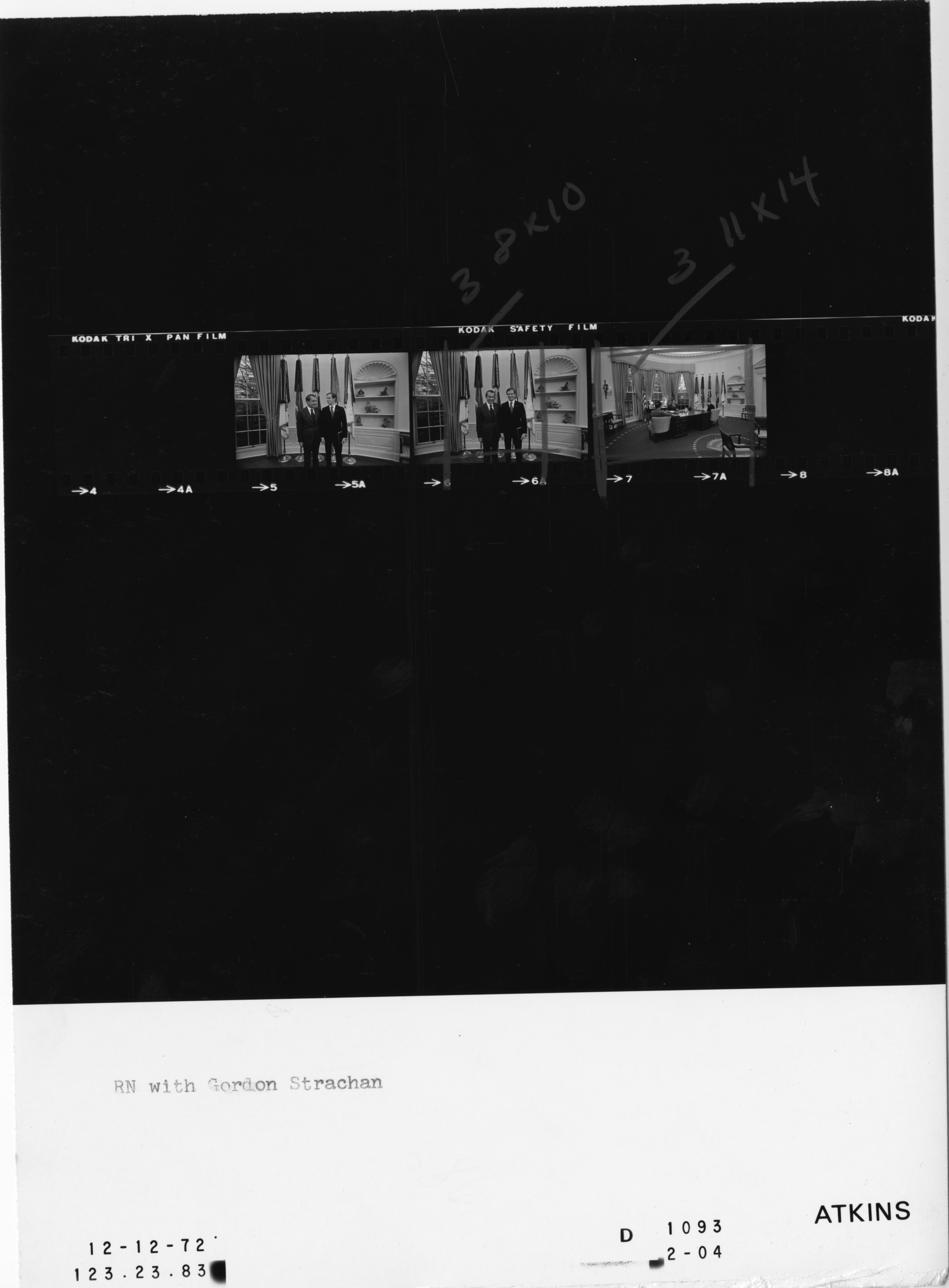
- Frame(s): WHPO-D1093-, President Nixon in the Oval Office with Gordon Strachan and H.R. Haldeman. 12/12/1972, Washington, D.C. White House, Oval Office. President Nixon, Gordon Strachan, H.R. Haldeman.
- Frame(s): WHPO-D1093-, President Nixon in the Oval Office with Gordon Strachan. 12/12/1972, Washington, D.C. White House, Oval Office. President Nixon, Gordon Strachan.
Roll WHPO-D1094 Photographer: Knudsen, Robert L. | Color or B&W: B&W
- Frame(s): WHPO-D1094-, President Nixon seated informally with U.S. Representative to the United Nations Jewel Lafontant. 12/12/1972, Washington, D.C. White House, Oval Office. President Nixon, Jewel Lafontant.
Roll WHPO-D1095 Photographer: Kightlinger, Jack | Color or B&W: B&W
- Frame(s): WHPO-D1095-, President Nixon seated informally with Frank Shakespeare, USIA Director, and James Keogh, USIA Director-designate. 12/12/1972, Washington, D.C. White House, Oval Office. President Nixon, Frank Shakespeare, James Keogh.
Roll WHPO-D1096 Photographer: Kightlinger, Jack | Color or B&W: B&W
- Frame(s): WHPO-D1096-, President Nixon standing with Lois Ross. 12/12/1972, Washington, D.C. White House, State Dining Room. President Nixon, Lois Ross.
Roll WHPO-D1097 Photographer: Kightlinger, Jack | Color or B&W: Color
- Frame(s): WHPO-D1097-03-09, Julie Eisenhower standing with Rep. William Steiger. 12/12/1972, Washington, D.C. East Wing Reception Room, White House. Julie Eisenhower, William Steiger, unidentified man.
- Frame(s): WHPO-D1097-10, Julie Eisenhower standing with an unidentified man. 12/12/1972, Washington, D.C. East Wing Reception Room, White House. Julie Eisenhower, William Steiger, unidentified man.
The White House Communications Agency Sound Recordings Collection contains public statements that took place between 1969 and 1974. Visit the finding aid to learn more.
L - White House Press Office Briefings
- WHCA-SR-L-084
Briefing by Martha Doss to Foreign Exchange wives. (12/12/1972, Family Theater)
Runtime: 35:00:00
Keywords: Briefings, private briefings
Original Format: 1/4-inch reel-to-reel audiotape. Original source type: Original. - WHCA-SR-L-085
Press briefing by Ronald Ziegler. (12/12/1972, White House Press Lobby)
Runtime: 0:43:43
Keywords: Press conferences, news conferences, interviews, media, press secretary, briefings, Paris Peace Talks, Vietnam War, Indochina War, negotiations, treaties, treaty
Production credits: Audio feed supplied by WHCA; Recorded by RWF (initials of WHCA engineer)
Original Format: 1/4-inch reel-to-reel audiotape. Original source type: Original. Technical notes: 54minutes and 4 seconds of silence at end of recording removed from access copies.
P - Formal Presidential Remarks
- WHCA-SR-P-721201
Audio taping for Nat'l Armed Forces Prayer Breakfast. (12/12/1972)
Runtime: 0:42
Keywords: Church service, worship service, prayer service, religion
Original Format: 1/4-inch reel-to-reel audiotape. Original source type: Original.
The White House Communications Agency Videotape Collection contains “off-the-air” recordings of televised programs produced between 1968 and 1974. Visit the finding aid to learn more.
- WHCA-5947
Weekly News Summary, Tape I.
ALL NETWORKS
Runtime: 1:30
31. Smith/Burke/Koppel: Paris peace talks; South Vietnam's President Thieu proposes ceasefire. Time Code Start: 72:43. Keywords: South Vietnam, Presidents, speeches, statements, Vietnam War, ceasefires. Network: ABC.
32. Smith/Kaplow: Revenue sharing in Syracuse, New York. Time Code Start: 75:48. Keywords: bills, laws, State and Local Fiscal Assistance Act of 1972, financial aid. Network: ABC.
33. Smith/Sherwood: Former President Johnson (LBJ) papers to be available to historians. Time Code Start: 78:46. Keywords: Presidents, libraries, writing, collections, archives. Network: ABC.
34. Smith: Commentary on the national budget. Time Code Start: 80:53. Keywords: reports, economy, economics, budgets, finances, recession, inflation, money, wages, costs, unemployment, prices, payments. Network: ABC.
35. Chancellor/Dobyns: Paris peace talks. Time Code Start: 82:31. Keywords: Paris Peace Talks, Vietnam War, treaty, treaties, negotiations. Network: NBC.
36. Chancellor/Jones: South Vietnam's President Thieu will not sign peace agreement. Time Code Start: 85:00. Keywords: South Vietnam, Presidents, speeches, statements, Vietnam War. Network: NBC.
37. Brinkley's Journal: Informal survey summary. Time Code Start: 87:18. Keywords: public opinions, polls, approval ratings, Gallup poll, Harris poll. Network: NBC. - WHCA-5948
Weekly News Summary, Tape II.
ALL NETWORKS
Runtime: 1:30
1. Cronkite/Davis/Kalisher/Kalb: South Vietnam's President Thieu proposes ceasefire. Time Code Start: 00:00. Keywords: South Vietnam, Presidents, speeches, statements, Vietnam War, ceasefires. Network: CBS.
2. Cronkite/Walker: Johnson Presidential Library opens Civil Rights exhibit (Former President Johnson (LBJ)). Time Code Start: 06:23. Keywords: Presidents, libraries, shows, exhibits, collections, archives, racial discrimination, African Americans, leaders, desegregation, racism, history. Network: CBS.
3. Schorr: United Mine Workers (UMW) elections. Time Code Start: 09:29. Keywords: labor, unions, elections, candidates, voting. Network: CBS.
4. Sevareid: Commentary on the Mafia returning to the good old days. Time Code Start: 10:43. Keywords: organized crime syndicates, assassinations, killings, shootings, gangs. Network: CBS.
Context (External Sources)
The Vanderbilt Television News Archive is the world's most extensive and complete archive of television news. They have been recording, preserving and providing access to television news broadcasts of the national networks since August 5, 1968.
Wikipedia is a free encyclopedia that anyone can edit.