
Introduction
This almanac page for Monday, December 11, 1972, pulls together various records created by the federal government and links to additional resources which can provide context about the events of the day.
Previous Date: Sunday, December 10, 1972
Next Date: Tuesday, December 12, 1972
Schedule and Public Documents
The Daily Diary files represent a consolidated record of the President's activities. Visit the finding aid to learn more.
The President's day began at The White House - Washington, D. C.
The Weekly Compilation of Presidential Documents made available transcripts of the President's news conferences; messages to Congress; public speeches, remarks, and statements; and other Presidential materials released by the White House.
Digitized versions can be found at HathiTrust.
Each Public Papers of the Presidents volume contains the papers and speeches of the President of the United States that were issued by the White House Office of the Press Secretary during the time period specified by the volume. The material is presented in chronological order, and the dates shown in the headings are the dates of the documents or events. In instances when the release date differs from the date of the document itself, that fact is shown in the text note.
To ensure accuracy, remarks have been checked against audio recordings (when available) and signed documents have been checked against the original, unless otherwise noted. Editors have provided text notes and cross references for purposes of identification or clarity.
The Federal Register is the official daily publication for rules, proposed rules, and notices of federal agencies and organizations, as well as executive orders and other Presidential documents.
No Federal Register published on this date
Archival Holdings
Any selection of archival documents will necessarily be partial. You should use the documents and folders identified below as a starting place, but consult the linked collection finding aids and folder title lists and the collections themselves for context. Many documents to be found this way do not lend themselves to association with specific dates, but are essential to a complete understanding of the material.
Selective document listing
President's Office Files
The President's Office Files consists of materials drawn together by the Special Files Unit from several administrative subdivisions within the White House Office. It is the handwriting and sensitive papers sent to the Staff Secretary that now comprise much of the President's Office Files. Visit the finding aid to learn more.
- News Summaries, Unmarked News Summaries, Box 52, News Summaries - December 1972 [4 of 6] [Note: Due to the way News Summary products were compiled, you should also consult nearby days for potentially relevant materials.]
- Weekend News Review, December 11, 1972
- President's Daily Schedule, Box 102, [President's Daily Schedule, Oct.-Dec. 1972] [2 of 2]
- The President's Schedule, Monday - December 11, 1972
The H. R. Haldeman Diaries consists of seven handwritten diaries, 36 dictated diaries recorded as sound recordings, and two handwritten audio cassette tape subject logs. The diaries and logs reflect H. R. Haldeman’s candid personal record and reflections on events, issues, and people encountered during his service in the Nixon White House. As administrative assistant to the President and Chief of Staff, Haldeman attended and participated in public events and private meetings covering the entire scope of issues in which the Nixon White House engaged in during the years 1969-1973. Visit the finding aid to learn more.
- Transcript of diary entry (PDF)
Monday, December 11.
The President had Dole in first thing this morning. I had talked to Bush ahead of time and worked out the arrangement with him as to how we would handle the announcement. He agreed that Dole should go out after the meeting and cover the whole thing, but say that Bush still has important work at the UN and that we'd have to do the shift after the General Assembly.
The Dole meeting went reasonably well. Bob came in and sort of wandered through a lot of chitchat for a while, and then the President finally eased into the deal by talking about Dole's trips, saying he ought to probably go to Japan, which would keep it open. Leave the option for a spring or fall trip, look for a really good event for maximum attention, but his best advice would be to go to Russia in the summertime. And that was left that way. Then Dole raised his handicap question. The President told him to sit down with our experts and develop a good bill, as the Dole Bill, on his information center for the handicapped idea. Providing them with a single source on benefits, and so on, like a veteran can do. Some discussion of Anne Armstrong, and John Rollins for National Finance and so on. Then the President called Bush --with Dole on the other phone-- and also had Ziegler in the office at the same time to develop the line. They agreed that Bush would stay on through the session, and Dole would stay at the RNC until the January 19 meeting. And Ziegler should shoot down the nonsense that Dole was pushed out. That basically covered the Dole meeting.
The President covered a lot of other odds and ends. Said he didn't want to meet with Colton alone on the Republican governor deal, or with the full group, but would meet with the Executive Committee. Wanted me to call Connally and tell him about Bush and get his reaction on Strauss. Wanted to be sure Colson gives Bush, Brock and Brown the book, chapter and verse on the President's activities for candidates. Wants Ehrlichman to get going on the Yorba Linda house, put someone in charge of it to keep the lawn mowed, and so on:
Had Ehrlichman in for a couple of hours. Went through his usual dreary review of the fact that we have a dull Cabinet in the public mind, and went on and on about that stuff. Made the point that we have to get some very young people at the second level and ethnics and thinks that we're wasting Krogh, who's too good, and Whitaker, who adds nothing.
Wanted me to get Mack Farrell locked-- keep him in the Visitor's Office, because the image does matter, plus doing a good job. And that Shultz is not impressive in selling the program as he's got to do today. That we've got no one to move around and articulate the Administration. That the Labor Under Secretary has to be a White House man. We can't handle that one solely on the Labor basis. Wants to get LaFontante and Anne Armstrong in to see him. Then gave us a long, long lecture on leadership and rambled on and on about the Georgetown set and all the problems there and then read a lot from Disraeli on the elite in London and so forth. Got into the election analysis and the fact that our margin in the suburbia was less than it was in '68 but we did better in the central cities, which is why we put together the landslide.
Got into the Watergate thing. Feels he doesn't want to leave an aura around the White House that there are a lot of bad guys there and the President doesn't care. Says the theory of, "Just be quiet and it'll all go away" won't work. That we need something to be said. Otherwise, how can the President handle it at his first press conference? We should try just a very brief statement, but we must get something to get it out of the way. At least something that Segretti had nothing to do with Watergate. And he feels a good offense is the best defense in this kind of thing. He went through it all with Ehrlichman and said that the view now is that the President is trying to hide something or protect someone, and that we've got to go for the smallest statement we can make, but we do have to make some statement.
I called Connally to get his reaction. He said he was mad as hell at Strauss regarding his TV thing yesterday. That he had called him and told him his remarks were ill-advised -- that he had gone out of his way to take a cut at Connally and said he had read him out of the Party and made the point, apparently, that it was a sin to have voted against McGovern, and that if that's so, they ought to set up new moral standards. He said he was pretty rough and that Strauss was quite disturbed. Connally said he may publicly ask that they censure all Democrats who voted against McGovern. He says Strauss' election won't change a thing, that he doesn't know what his deals are that he made to get the post, but that in any event, the Liberals will try to crucify him, that he brings no strength to the Party, he's just a manager. He can't bring the South in. Wallace is the leader of the Democratic South. The Southern Governors will try to keep the Party together, so will the Congressmen and Senators. For that reason, we should move in, somewhat, to let them have a place to go, but they'll need a compelling motivation. They can't go to a void or a nebulous third party. Theoretically, they'd do it in a minute, but they don't know how to do it practically. It'll take a move -- either a positive move by the Republicans or a negative move by the Democrats. We'll have to wait and see. He doesn't think Connally going Republican would do it. It wouldn't be enough, and anyway, the timing isn't now. He then mentioned that he's going to Saudi Arabia on the 15th and would like a letter to the King from the President.
When I was in the office late this afternoon, the President was going over general political stuff with Colson, then got a phone call apparently from Haig on the Vietnam problem. Talked about considering recess for a week and that Kissinger was backed into a corner again and that there was a question about the VP option of going to Saigon, that maybe that was a bad deal.
End of December 11. - Original audio recording (MP3)
The National Archives Catalog is the online portal to the records held at the National Archives, and information about those records. It is the main way of describing our holdings and also provides access to electronic records and digitized versions of our holdings.
The Catalog searches across multiple National Archives resources at once, including archival descriptions, digitized and electronic records, authority records, and web pages from Archives.gov and the Presidential Libraries. The Catalog also allows users to contribute to digitized historical records through tagging and transcription.
Nixon Library Holdings
All National Archives Units
National Security Documents
The President's Daily Brief is the primary vehicle for summarizing the day-to-day sensitive intelligence and analysis, as well as late-breaking reports, for the White House on current and future national security issues. Read "The President's Daily Brief: Delivering Intelligence to Nixon and Ford" to learn more.
The Foreign Relations of the United States series presents the official documentary historical record of major U.S. foreign policy decisions and significant diplomatic activity. Visit the State Department website for more information.
Vol. IX, Vietnam, October 1972-January 1973
Paris Negotiations Collapse, October 24-December 13, 1972
156. Message From the President’s Assistant for National Security Affairs (Kissinger) to the President’s Deputy Assistant for National Security Affairs (Haig), Paris, December 11, 1972, 2040Z
Source: National Archives, Nixon Presidential Materials, NSC Files, Box 858, For the President’s Files (Winston Lord)—China Trip/Vietnam, Sensitive Camp David, Vol. XXII (2). Top Secret; Flash; Sensitive; Exclusively Eyes Only.
157. Telephone Conversation Between President Nixon and the President’s Deputy Assistant for National Security Affairs (Haig), Washington, December 11, 1972
Source: National Archives, Nixon Presidential Materials, White House Tapes, Conversation 34–45. No classification marking. According to the President’s Daily Diary, Nixon spoke with Haig by telephone from 5:21 to 5:29 p.m. (Ibid., White House Central Files) The editors transcribed the portions of the conversation printed here specifically for this volume.
Vol. XXVIII, Southern Africa
Portuguese Africa
97. Intelligence Note Prepared in the Bureau of Intelligence and Research, Washington, December 11, 1972
Source: National Archives, RG 59, Central Files 1970–73, POL AFR–PORT. Confidential; No Foreign Dissem. Drafted by James Connell on December 8, cleared by Martin Packman, and released by David Mark (INR/Europe and USSR).
Vol. XLII, Vietnam: The Kissinger-Le Duc Tho Negotiations
Breakdown of Negotiations, November 1972-December 1972
38. Memorandum of Conversation, Paris, December 11, 1972, 3:10-7:15 p.m.
Source: National Archives, Nixon Presidential Materials, NSC Files, Box 865, For the President’s Files (Winston Lord)—China Trip/Vietnam Negotiations, Camp David Memcons, December 1972 [2 of 3]. Top Secret; Sensitive; Exclusively Eyes Only. The meeting took place at 31 Boulevard de la Saussaye, Neuilly-sur-Seine. All brackets are in the original.
Kissinger, reporting to the President via a message to Haig, who was in Washington, characterized the day’s proceedings as being “composed of equal parts of insolence, guile, and stalling by the North Vietnamese.” His appraisal of what might happen next and his recommendation of what he should do was as follows:
“It is not impossible that we could conclude the agreement tomorrow, but nothing in their behavior suggests any urgency and much in their manner suggests cock-sure insolence. They could, of course, be without instructions, and may in any event want to play with us until the last minute. The amount of work left for tomorrow is staggering and could make for a sloppy conclusion, which is precisely one of their favorite tactics. I believe in any event that I should return home tomorrow night.”
He added:
“All of this may prove academic, however, since we must face other facts. It is obvious that an agreement was easily achievable on any day since last Thursday. Hanoi may well have concluded that we have been outmaneuvered and dare not continue the war because of domestic and international expectations. They may believe that Saigon and we have hopelessly split and that the imminence of Christmas makes it impossible for us to renew bombing the North. If this is the case we will face a decision of major magnitude. I believe a total collapse by us now would make an agreement unenforceable. The President must also understand that an agreement at this point and under conditions that led to the collapse of South Vietnam would have grave consequences for his historic position later.”
Kissinger concluded: “No matter what happens tomorrow I will not repeat not break off the negotiations but rather we could take the line that the two sides are close enough to continue work through diplomatic channels.” (Foreign Relations, 1969–1976, vol. IX, Vietnam, October 1972–January 1973, Document 156)
Later that evening, Haig replied for the President:
“The President considers that if Hanoi remains unmanageably intransigent that in any event we should not break off the talks in a formal sense. Rather, we should recess, informing them that we believe that this past week’s discussions suggest that both sides should take some time for consultations and to reconsider the gravity of the situation.
You are returning to Washington and will be prepared to meet with them again after Christmas or before if they believe it would be constructive. We would then reseed the mines and resume military activity at an intensified pre-October pace. (You should decide whether to tell this to Tho or not.)”
Haig then summed up:
“I believe the President is perfectly amenable to your returning home on Tuesday [December 12] if in your judgment there is no hope of a settlement or if we would risk fundamentally our ability to ultimately achieve a workable settlement as a result of your staying longer. On the other hand, he is very clear that if you obtain sufficient movement tomorrow to indicate that a day or two more labor will resolve the matter, you should extend your stay.”
At the same time, Haig observed: “I am absolutely convinced that the President is fully aware of the seriousness of the situation and, especially, the difficulties which we have faced at the negotiating table. He is fully prepared to react strongly and to weather through a continuing intransigent position by Hanoi.” To drive home this point, Haig told Kissinger that the President had “just called again and urged that we reseed the mines tomorrow and be prepared to move immediately with around-the-clock bombing of the Hanoi area. I told him we should definitely hold on this until after tomorrow’s session and until you return. Based on the foregoing, I am convinced that there is absolutely no problem here with respect to our strategy and what must be done if it is forced upon us.” (Ibid., Document 158)
Vol. E-1, Documents on Global Issues, 1969-1972
U.S. Policy Towards Terrorism, Hijacking of Aircraft, and Attacks on Civil Aviation: The Olympic Attack and the Anti-Terrorism Initiatives, September−December 1972
118. Memorandum From Secretary of State Rogers to President Nixon, Washington, December 11, 1972
Rogers reported that the UN’s Legal Committee had voted to support a “disappointingly weak” resolution on terrorism.
Source: National Archives, RG 59, President’s Evening Reading: Lot 74 D 164.
Vol. E-5, Part 1, Documents on Sub-Saharan Africa, 1969-1972
Nigerian Civil War
217. Telegram 9519 From the Embassy in Nigeria to the Department of State, Lagos, December 11, 1972, 0918Z
Assistant Secretary of State Newsom reported on his 5-day visit to Nigeria, remarking on Nigeriaʼs independence and sensitivity. He noted that the United States remained popular but suffered from its civil war policy, its stand on South Africa, and the belief that the United States was unwilling to respond to Nigerian priorities on aid.
Source: National Archives, RG 59, Central Files 1970–73, AID (US) Nigeria. Confidential. Repeated to London.
Vol. E-5, Part 2, Documents on North Africa, 1969-1972
Tunisia
163. Memorandum From the President’s Assistant for National Security Affairs (Kissinger) to President Nixon, Washington, December 11, 1972
Kissinger recommended that Nixon respond to President Bourguiba’s recent letter by reassuring him of U.S. interest in Tunisia.
Source: National Archives, Nixon Presidential Materials, NSC Files, Box 762, Presidential Correspondence, President Bourguiba. Confidential. Sent for action. In his October 25 letter, not printed, Bourguiba renewed his request for a bilateral review of U.S.-Tunisian relations and the international scene. In Nixon’s December 12 reply, not printed, he agreed that a dialogue on bilateral matters was important, and that, while much could be communicated at the ambassadorial level, he welcomed Bourguiba’s views at any time.
The Kissinger telephone conversation transcripts consist of approximately 20,000 pages of transcripts of Kissinger’s telephone conversations during his tenure as Assistant to the President for National Security Affairs (1969-1974) and Secretary of State (1973-1974) during the administration of President Richard Nixon. Visit the finding aid for more information.
Digitized versions can be found in the National Archives Catalog.
Audiovisual Holdings
Visit the White House Tapes finding aid to learn about the taping system's operation and archival processing.
Old Executive Office Building
- 385-1; 2:30 p.m. - 2:35 p.m.; Nixon, Richard M. (President); Butterfield, Alexander P.
- 385-2; Unknown between 2:35 p.m. & 4:05 p.m.; Nixon, Richard M. (President); Sanchez, Manolo
- 385-3; Unknown between 2:35 p.m. & 4:05 p.m.; Nixon, Richard M. (President); Haig, Alexander M., Jr.
- 385-4; Unknown between 2:35 p.m. & 4:05 p.m.; Nixon, Richard M. (President); Sanchez, Manolo
- 385-5; Unknown between 2:35 p.m. & 4:05 p.m.; Nixon, Richard M. (President); Sanchez, Manolo
- 385-6; Unknown between 2:35 p.m. & 4:05 p.m.; [Unknown person(s)]; Nixon, Richard M. (President)
- 385-7; Unknown between 2:35 p.m. & 4:05 p.m.; Nixon, Richard M. (President); Sanchez, Manolo
- 385-8; 4:05 p.m. - 4:55 p.m.; Nixon, Richard M. (President); Butterfield, Alexander P.; Haig, Alexander M., Jr.; [Unknown person(s)]
- 385-9; Unknown between 4:55 p.m. & 4:59 p.m.; Nixon, Richard M. (President); White House operator
- 385-10; 4:59 p.m. - 5:01 p.m.; Nixon, Richard M. (President); Ziegler, Ronald L.
- 385-11; Unknown between 5:01 p.m. & 5:09 p.m.; Nixon, Richard M. (President); [Unknown person(s)]
- 385-12; Unknown between 5:01 p.m. & 5:14 p.m.; Nixon, Richard M. (President); Sanchez, Manolo; Eisenhower, Julie Nixon
- 385-13; Unknown between 5:10 p.m. & 5:14 p.m.; Nixon, Richard M. (President); [Unknown person(s)]
- 385-14; 5:14 p.m. - 5:37 p.m.; Nixon, Richard M. (President); Colson, Charles W.; Haldeman, H. R. ("Bob"); Haig, Alexander M., Jr.; Eisenhower, Julie Nixon
- 385-15; Unknown between 5:35 p.m. & 5:37 p.m.; Nixon, Richard M. (President); White House operator
- 385-16; 5:37 p.m. - 5:42 p.m.; Nixon, Richard M. (President); Haig, Alexander M., Jr.
- 385-17; Unknown between 5:42 p.m. & 7:10 p.m.; Nixon, Richard M. (President); Eisenhower, Julie Nixon; [Unknown person(s)]
- 385-18; Unknown between 5:42 p.m. & 7:10 p.m.; Nixon, Richard M. (President); Haig, Alexander M., Jr.
- 385-19; Unknown between 5:42 p.m. & 7:10 p.m.; Nixon, Richard M. (President); Eisenhower, Julie Nixon
- 385-20; Unknown between 5:42 p.m. & 7:10 p.m.; Nixon, Richard M. (President); Eisenhower, Julie Nixon; [Unknown person(s)]
- 385-21; Unknown between 5:42 p.m. & 7:10 p.m.; Nixon, Richard M. (President); Haig, Alexander M., Jr.
- 385-22; Unknown between 5:42 p.m. & 7:10 p.m.; Nixon, Richard M. (President); Eisenhower, Julie Nixon; Sanchez, Manolo
- 385-23; Unknown between 5:42 p.m. & 7:10 p.m.; Nixon, Richard M. (President); Sanchez, Manolo; Eisenhower, Julie Nixon
Oval Office
- 819-2; Unknown between 10:18 a.m. & 2:25 p.m.; Nixon, Richard M. (President); Haldeman, H. R. ("Bob"); Dole, Robert J.; White House operator; Ziegler, Ronald L.; Bush, George H. W.; Butterfield, Alexander P.; Boyd, McDill ("Huck"); Connally, John B.; Ehrlichman, John D.; Bull, Stephen B.
- 819-3; Unknown between 2:25 p.m., 12/11 & 9:57 a.m., 10/16; United States Secret Service agents
White House Telephone
- 34-34; Unknown between 10:18 a.m. & 11:07 a.m.; Nixon, Richard M. (President); White House operator
- 34-35; Unknown between 11:08 a.m. & 11:15 a.m.; Haldeman, H. R. ("Bob"); Bush, George H. W.; Nixon, Richard M. (President)
- 34-36; 11:25 a.m. - 11:25 a.m.; Nixon, Richard M. (President); White House operator
- 34-37; Unknown between 11:25 a.m. & 11:42 a.m.; Nixon, Richard M. (President); White House operator
- 34-38; 11:42 a.m. - 11:48 a.m.; Nixon, Richard M. (President); Boyd, McDill ("Huck")
- 34-39; Unknown between 11:55 a.m. & 12:14 p.m.; Haldeman, H. R. ("Bob"); White House operator
- 34-40; Unknown between 11:55 a.m. & 12:14 p.m.; Haldeman, H. R. ("Bob"); Connally, John B.
- 34-41; Unknown between 4:55 p.m. & 4:59 p.m.; Nixon, Richard M. (President); White House operator
- 34-42; 4:59 p.m. - 5:01 p.m.; Nixon, Richard M. (President); Ziegler, Ronald L.
- 34-43; Unknown between 5:01 p.m. & 5:09 p.m.; Nixon, Richard M. (President); White House operator
- 34-44; 5:09 p.m. - 5:10 p.m.; Nixon, Richard M. (President); Eisenhower, Julie Nixon
- 34-45; 5:21 p.m. - 5:29 p.m.; Nixon, Richard M. (President); Haig, Alexander M., Jr.
- 34-46; Unknown between 5:35 p.m. & 5:37 p.m.; Nixon, Richard M. (President); White House operator
- 34-47; 5:37 p.m. - 5:42 p.m.; Nixon, Richard M. (President); Haig, Alexander M., Jr.
- 34-48; Unknown between 5:42 p.m. & 7:49 p.m.; Nixon, Richard M. (President); White House operator
- 34-49; 7:49 p.m. - 7:50 p.m.; Nixon, Richard M. (President); Ziegler, Ronald L.
- 34-50; 7:54 p.m. - 7:55 p.m.; Nixon, Richard M. (President); Ziegler, Ronald L.
The White House Photo Office collection consists of photographic coverage of President Richard Nixon meeting with prominent social, political, and cultural personalities; speaking engagements and news conferences of the President and various high-ranking members of the White House staff and Cabinet; Presidential domestic and foreign travel, including Presidential vacations; social events and entertainment involving the First Family, including entertainers present; official portraits of the President, First Family, and high-ranking members of the Nixon administration; the 1969 and 1973 Inaugurals; the President’s 1972 Presidential election campaign appearances (including speeches) and other official activities of the White House staff and the President’s Cabinet from January 20, 1969 until August 9, 1974 at the White House and the Old Executive Office Building; other locations in Washington, DC, such as The Mall; and the Presidential retreats in Camp David, Maryland, Key Biscayne, Florida, and San Clemente, California. Visit the finding aid to learn more.
Roll WHPO-D1075 Photographer: unknown | Color or B&W: B&W
- Frame(s): WHPO-D1075-, Black and white photos of color White House Christmas card. 12/11/1972, Washington, D.C. unknown.
Roll WHPO-D1076 Photographer: unknown | Color or B&W: Color
- Frame(s): WHPO-D1076-, Photo of White House Christmas card. 12/11/1972, Washington, D.C. unknown.
Roll WHPO-D1077 Photographer: Kightlinger, Jack | Color or B&W: Color
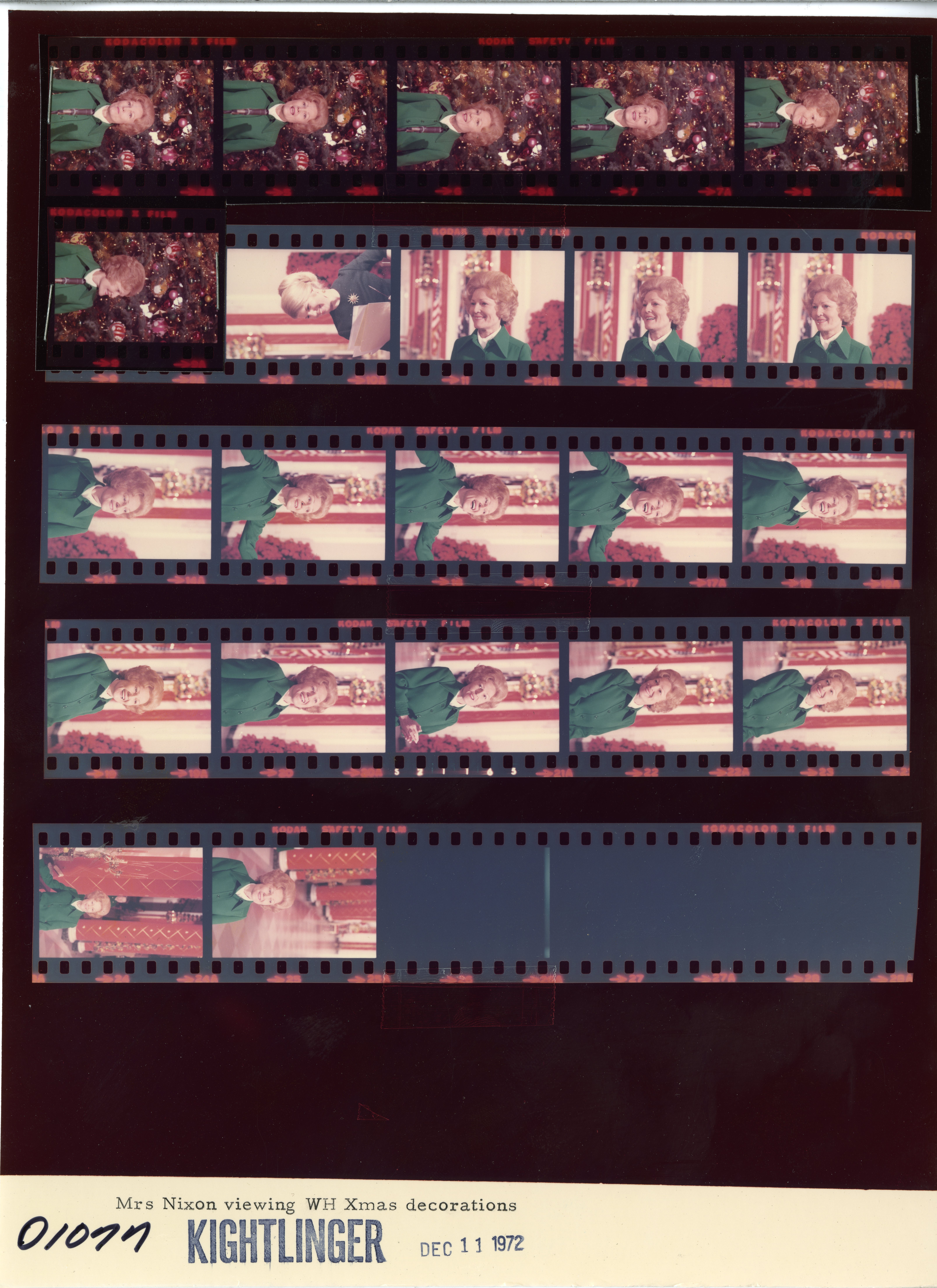
- Frame(s): WHPO-D1077-, Pat Nixon speaking into a microphone in front of a Christmas tree and standing by decorations in the Grand Hall. 12/11/1972, Washington, D.C. Blue Room, Grand Hallway, White House. Pat Nixon, Connie Stuart.
- Frame(s): WHPO-D1077-16, Close up of Pat Nixon, wearing a green coat dress, standing in the Grand Hall, which is decorated for Christmas with red material-covered pillars and large Poinsettia trees. 12/11/1972, Washington, D.C. White House, Grand Hallway. Pat Nixon.
Roll WHPO-D1078 Photographer: Kightlinger, Jack | Color or B&W: Color
- Frame(s): WHPO-D1078-, Pat Nixon standing in front of a Christmas tree, a Nativity creche scene, a gingerbread house, and hall decorations. 12/11/1972, Washington, D.C. Blue Room, East Room, State Dining Room, Grand Hallway. Pat Nixon.
Roll WHPO-D1079 Photographer: Royer | Color or B&W: Color
- Frame(s): WHPO-D1079-, Pat Nixon speaking to the press while standing in front of a Christmas tree and viewing a Nativity creche scene, a gingerbread house, and hall decorations. 12/11/1972, Washington, D.C. Blue Room, East Room, State Dining Room, Grand Hallway. Pat Nixon, press corps members.
- Frame(s): WHPO-D1079-33, Pat Nixon standing in the Grand hallway during the Christmas White House tour for members of the press. Grand Hall pillars are covered in red with gold braid dotted with gold stars. Fruit and floral decorations are hung on the chandeliers. 12/11/1972, Washington, D.C. White House, Grand Hallway. Pat Nixon.
Roll WHPO-D1080 Photographer: Schumacher, Karl | Color or B&W: Color
- Frame(s): WHPO-D1080-, The White House East Room Christmas tree seen through an open doorway flanked by red material decorations, covered pillars green pin bough swags and tall Christmas trees on torchiers. 12/11/1972, Washington, D.C. Blue Room, East Room, State Dining Room, Grand Hallway.
- Frame(s): WHPO-D1080-, Pat Nixon standing in front of the East Room Christmas tree. 12/11/1972, Washington, D.C. Blue Room, East Room, State Dining Room, Grand Hallway. Pat Nixon.
- Frame(s): WHPO-D1080-, Pat Nixon standing near the East Room Christmas Nativity creche scene. 12/11/1972, Washington, D.C. Blue Room, East Room, State Dining Room, Grand Hallway. Pat Nixon.
- Frame(s): WHPO-D1080-, Pat Nixon standing near a White House Christmas gingerbread house on display. 12/11/1972, Washington, D.C. Blue Room, East Room, State Dining Room, Grand Hallway. Pat Nixon.
Roll WHPO-D1081 Photographer: Schumacher, Karl | Color or B&W: Color
- Frame(s): WHPO-D1081-, White House Christmas decorations. 12/11/1972, Washington, D.C. Grand Hallway, Blue Room, State Dining Room.
- Frame(s): WHPO-D1081-09, A White House Christmas tree. 12/11/1972, Washington, D.C. Grand Hallway, Blue Room, State Dining Room.
Roll WHPO-D1082 Photographer: Schumacher, Karl | Color or B&W: Color
- Frame(s): WHPO-D1082-, White House interior Christmas decorations featuring red poinsettia and red cloth on pillars, floral décor on walls and in room, stairway. 12/11/1972, Washington, D.C. Grand Stairway, Grand Hallway, White House, East Room.
Roll WHPO-D1083 Photographer: Kightlinger, Jack | Color or B&W: B&W
- Frame(s): WHPO-D1083-, Farrell and an unidentified group standing in front of a Christmas tree. 12/11/1972, Washington, D.C. Blue Room, White House. Farrell, unidentified group.
Roll WHPO-D1084 Photographer: Kightlinger, Jack | Color or B&W: Color
- Frame(s): WHPO-D1084-03-07, Pat Nixon with Dr. & Mrs. Arthur Hughes. 12/11/1972, Washington, D.C. White House, Library, Map Room. Pat Nixon, Mr. & Mrs. Arthur Hughes, Blake Sanborn, Donald Kemp.
- Frame(s): WHPO-D1084-08-12, Pat Nixon receiving a telegram from two officials from Whittier, California. 12/11/1972, Washington, D.C. White House, Library, Map Room. Pat Nixon, Mr. & Mrs. Arthur Hughes, Blake Sanborn, Donald Kemp.
Roll WHPO-D1085 Photographer: Kightlinger, Jack | Color or B&W: Color
- Frame(s): WHPO-D1085-, Pat Nixon taking group photos with members of the Candle Lighters. 12/11/1972, Washington, D.C. North Portico steps, Grand Hall, White House. Pat Nixon, Candlelighters.
Roll WHPO-D1086 Photographer: Kightlinger, Jack | Color or B&W: B&W
- Frame(s): WHPO-D1086-, Pat Nixon exiting White House to greet and pose with members of the Candle Lighters. 12/11/1972, Washington, D.C. North Portico steps, White House. Pat Nixon, Candlelighters.
The White House Communications Agency Sound Recordings Collection contains public statements that took place between 1969 and 1974. Visit the finding aid to learn more.
C - First Lady
- WHCA-SR-C-138
Remarks by Pat Nixon to press at thepresentation of the White House Christmas decorations. (12/11/1972, The White House)
Runtime: 3:14
Production credits: Audio feed supplied by WHCA; Recorded by ACH (initials of WHCA engineer)
Original Format: 1/4-inch reel-to-reel audiotape. Original source type: Original.
G - Cabinet Officer Briefings
- WHCA-SR-G-195
Press briefing by Director George Shultz of the Office of Management and Budget, with Ronald Ziegler and Caspar Weinberger. (12/11/1972, [none listed])
Production credits: Audio feed supplied by WHCA; Recorded by JBA (initials of WHCA engineer)
Original Format: 1/4-inch reel-to-reel audiotape. Original source type: Original.
H - White House Staff Member Recordings
- WHCA-SR-H-673
Press briefing by Ronald Ziegler and Senator Robert Dole. (12/11/1972, Press Lobby, White House)
Runtime: 19:30
Keywords: Press conferences, news conferences, interviews, media, press secretary
Production credits: Audio feed supplied by WHCA; Recorded by JBA (initials of WHCA engineer)
Original Format: 1/4-inch reel-to-reel audiotape. Original source type: Original.
The White House Communications Agency Videotape Collection contains “off-the-air” recordings of televised programs produced between 1968 and 1974. Visit the finding aid to learn more.
- WHCA-5946
"Today" Show excerpt.
Committee to Re-Elect the President
Runtime: 00:10:18 - WHCA-5947
Weekly News Summary, Tape I.
ALL NETWORKS
Runtime: 1:30
18. Smith/Jarriel: Wage-Price controls continue. Time Code Start: 40:20. Keywords: wage and price controls, freezes, prices, costs, increases, decreases, economy, economics, budgets, finances, recession, inflation, money. Network: ABC.
19. Smith/Cioffi: Paris peace talks; Vietnam. Time Code Start: 42:27. Keywords: Paris Peace Talks, Vietnam War, treaty, treaties, negotiations. Network: ABC.
20. Smith: Senator Dole resigns as Republican National Chairman, (RNC) and Bush selected, Moynihan. Time Code Start: 45:34. Keywords: cabinet, advisors, political parties, Republicans, GOP, leaders, resignations. Network: ABC.
21. Reasoner: Commentary on Blivenisms. Time Code Start: 46:04. Keywords: media, newspapers, journalists, political reporters, quotes, quotations. Network: ABC.
22. Utley/Valeriani: Peace may be close, Kissinger, Vietnam. Time Code Start: 48:00. Keywords: Paris Peace Talks, Vietnam War, treaty, treaties, negotiations. Network: NBC.
23. Utley/Kiker: Wage-price controls will continue, Shultz; Dole loses job as Republican Chairman, Bush replaces. Time Code Start: 52:16. Keywords: political parties, Republicans, GOP, leaders, economy, economics, budgets, finances, recession, inflation, money, wages, costs, unemployment, prices, wage freezes. Network: NBC.
24. Utley/Jones: First refugee flight from Cuba since May has arrived in Miami, Florida. Time Code Start: 56:10. Keywords: refugees, immigration, Cuban, flights. Network: NBC.
25. Quinn: USSR Jews in Israel. Time Code Start: 59:10. Keywords: Soviet Union, Russia, USSR, Jews, Jewish, Hebrews, Judaism, Middle East, Mideast, Israeli. Network: NBC.
26. Cronkite/Schorr: Shultz says wage-price controls to continue. Time Code Start: 62:37. Keywords: wage and price controls, freezes, prices, costs, increases, decreases, economy, economics, budgets, finances, recession, inflation, money, cabinet, advisors, speeches. Network: CBS.
27. Cronkite/Serafin: Dole loses job as Chairman of the Republican party, Bush gets job, Moynihan back in the administration. Time Code Start: 64:00. Keywords: cabinet, advisors, political parties, Republicans, GOP, leaders, resignations. Network: CBS.
28. Cronkite/Collingwood: Peace now looks promising. Time Code Start: 67:20. Keywords: Paris Peace Talks, Vietnam War, treaty, treaties, negotiations. Network: CBS.
29. Cronkite/Sevareid: Commentary on wage-price controls and Congress. Time Code Start: 69:45. Keywords: House of Representatives, wage freezes. Network: CBS.
30. Cronkite: First Lady Pat Nixon gives tour of Christmas decorations at White House. Time Code Start: 70:47. Keywords: Presidents, families, wife, holidays, décor, buildings, tours, Christmas, government buildings, Presidential residence, Washington, D.C.. Network: CBS.
Context (External Sources)
The Vanderbilt Television News Archive is the world's most extensive and complete archive of television news. They have been recording, preserving and providing access to television news broadcasts of the national networks since August 5, 1968.
Wikipedia is a free encyclopedia that anyone can edit.