
Introduction
This almanac page for Thursday, August 3, 1972, pulls together various records created by the federal government and links to additional resources which can provide context about the events of the day.
Previous Date: Wednesday, August 2, 1972
Next Date: Friday, August 4, 1972
Schedule and Public Documents
The Daily Diary files represent a consolidated record of the President's activities. Visit the finding aid to learn more.
The President's day began at The White House - Washington, D. C.
The Weekly Compilation of Presidential Documents made available transcripts of the President's news conferences; messages to Congress; public speeches, remarks, and statements; and other Presidential materials released by the White House.
Digitized versions can be found at HathiTrust.
Each Public Papers of the Presidents volume contains the papers and speeches of the President of the United States that were issued by the White House Office of the Press Secretary during the time period specified by the volume. The material is presented in chronological order, and the dates shown in the headings are the dates of the documents or events. In instances when the release date differs from the date of the document itself, that fact is shown in the text note.
To ensure accuracy, remarks have been checked against audio recordings (when available) and signed documents have been checked against the original, unless otherwise noted. Editors have provided text notes and cross references for purposes of identification or clarity.
The Federal Register is the official daily publication for rules, proposed rules, and notices of federal agencies and organizations, as well as executive orders and other Presidential documents.
The Congressional Record is the official daily record of the debates and proceedings of the U.S. Congress.
Archival Holdings
Any selection of archival documents will necessarily be partial. You should use the documents and folders identified below as a starting place, but consult the linked collection finding aids and folder title lists and the collections themselves for context. Many documents to be found this way do not lend themselves to association with specific dates, but are essential to a complete understanding of the material.
Selective document listing
President's Office Files
The President's Office Files consists of materials drawn together by the Special Files Unit from several administrative subdivisions within the White House Office. It is the handwriting and sensitive papers sent to the Staff Secretary that now comprise much of the President's Office Files. Visit the finding aid to learn more.
- News Summaries, Annotated News Summaries, Box 37, August 1-4, 1972 [3 of 4] [Note: Due to the way News Summary products were compiled, you should also consult nearby days for potentially relevant materials.]
- News Summary, August 3, 1972, (Wed. nets, wires, mags, columns)
The H. R. Haldeman Diaries consists of seven handwritten diaries, 36 dictated diaries recorded as sound recordings, and two handwritten audio cassette tape subject logs. The diaries and logs reflect H. R. Haldeman’s candid personal record and reflections on events, issues, and people encountered during his service in the Nixon White House. As administrative assistant to the President and Chief of Staff, Haldeman attended and participated in public events and private meetings covering the entire scope of issues in which the Nixon White House engaged in during the years 1969-1973. Visit the finding aid to learn more.
- Transcript of diary entry (PDF)
Thursday, August 3.
The President got into quite a thing this morning on plans for this evening and the weekend. He is going to have Bebe and Abplanalp all come up, go out to McCabe's place in Ocean City, MD, which Bebe is very reluctant to do, but the President is determined. He wants to take Mitchell along, too, which works out well, since Martha's going to be gone for the weekend. Tonight, he's going to take him, Finch, Klein, Ziegler, Colson, Timmons, Malek, and Chapin out on the Sequoia for a general discussion type dinner. He had Ehrlichman in this morning to discuss the basic problem of domestic intelligence, the need for our moving on IRS and Justice to get some action on tax and other matters involving people supporting the opposition. Apparently, Agnew called him last night regarding the Senate vote, which led him to think about this. Also, he has some concerns about some appointments in the education area, and made the comment to Ehrlichman that he's 1000 percent against the educational establishment, then said "If I may quote someone else", referring to McGovern who said he was 1000 percent for-- behind Eagleton, just before he fired him.
On political strategy, he makes the point now, that he thinks the martyrdom theory is now reversed. That is, we were concerned originally that we not hit McGovern too hard, so as not to martyr him. Now, he thinks that theory is reversed, that McGovern is under attack, he's shown he's mortal, that he has feet of clay, that he's a non-sympathetic character at the moment. And when a man has fallen in battle, the thing to do is hit him again while he's down to keep him down.
Monumental problem with Laird who was babbling around his opposition to the spending ceiling that we've proposed. The President ordered Ehrlichman to get a Laird statement saying he misunderstood this that it doesn't affect Defense and therefore he's for it. That won't solve it, because Laird will muddy it up somehow, but at least we'll take a stab at it. Went through a number of just general campaign needs. He wants to get Perle Mesta on the Democrats. He wants to get Yorty announced, get Harlow to travel with the Vice President, use Chotiner for enemy intelligence, take Mrs. Nixon to Hawaii and do a Clair Luce bipartisan reception, which she suggested to Henry.
He talked to Colson about the voter block groups. He doesn't think they're worth a damn in our general organization, but a front organization like the Democrats is indispensable. That we should have Democratic lawyers, Democratic doctors, Democratic Italians, and so forth, and that we need these in order to space them out and use it for purpose of mailings and to get publicity stories for the Democrats after their original announcement. He's pushing for an immediate effort in Missouri, because of the Eagleton question, getting bumper stickers and registration, capitalize on the reaction there as quickly as we can.
End of August 3. - Original audio recording (MP3)
The National Archives Catalog is the online portal to the records held at the National Archives, and information about those records. It is the main way of describing our holdings and also provides access to electronic records and digitized versions of our holdings.
The Catalog searches across multiple National Archives resources at once, including archival descriptions, digitized and electronic records, authority records, and web pages from Archives.gov and the Presidential Libraries. The Catalog also allows users to contribute to digitized historical records through tagging and transcription.
Nixon Library Holdings
All National Archives Units
National Security Documents
The President's Daily Brief is the primary vehicle for summarizing the day-to-day sensitive intelligence and analysis, as well as late-breaking reports, for the White House on current and future national security issues. Read "The President's Daily Brief: Delivering Intelligence to Nixon and Ford" to learn more.
The Foreign Relations of the United States series presents the official documentary historical record of major U.S. foreign policy decisions and significant diplomatic activity. Visit the State Department website for more information.
Vol. V, United Nations, 1969-1972
UN Finances and Reduction of the U.S. Assessment
183. Telegram From the Mission to the United Nations to the Department of State, New York, August 3, 1972, 0102Z
Source: National Archives, RG 59, Central Files 1970–73, UN 10–4. Confidential; Exdis.
Vol. VIII, Vietnam, January-October 1972
The Parties Move Toward Agreement, July 19-October 7, 1972
225. Memorandum From the President’s Assistant for National Security Affairs (Kissinger) to President Nixon, Washington, August 3, 1972
Source: National Archives, Nixon Presidential Materials, NSC Files, Box 864, For the President’s Files (Winston Lord)—China Trip/Vietnam, Sensitive, Camp David Memcons, May–October 1972 [4 of 5]. Top Secret; Sensitive; Exclusively Eyes Only. At the top of the first page, President Nixon wrote: “K—Splendid job on what must be a very tedious exercise.” Tabs A–C are attached but not printed.
226. Backchannel Message From the President’s Assistant for National Security Affairs (Kissinger) to the Ambassador to South Vietnam (Bunker), Washington, August 3, 1972, 1543Z
Source: National Archives, Nixon Presidential Materials, NSC Files, Box 869, For the President’s Files (Winston Lord)—China Trip/Vietnam, Camp David Cables, August–September 1972. Top Secret; Sensitive; Eyes Only.
Vol. XXXVI, Energy Crisis, 1969-1974
March 16, 1972-March 6, 1973
136. Memorandum From Harold H. Saunders of the National Security Council Staff to the President’s Assistant for National Security Affairs (Kissinger), Washington, August 3, 1972
Source: National Archives, Nixon Presidential Materials, NSC Files, Box 630, Country Files, Middle East, Saudi Arabia, Vol. III, Sep 1971–Apr 1973. Confidential; Sensitive. Sent for action. Kissinger and Haig initialed the memorandum, which has the notation “OBE.”
Vol. XXXIX, European Security
Prelude to Negotiations, June 1972-November 1972
104. Minutes of a Joint Verification Panel and Senior Review Group Meeting, Washington, August 3, 1972, 3:14-4 p.m.
Source: National Archives, Nixon Presidential Materials, NSC Institutional Files (H-Files), Box H–113, SRG Minutes, Originals, 1972–73. Secret. The meeting took place in the White House Situation Room.
Vol. E-4, Documents on Iran and Iraq, 1969-1972
Iraq 1972
323. Telegram 2879 From the Embassy in Belgium to the Department of State, Brussels, August 3, 1972, 1624Z
The Iraqi Foreign Ministry reacted to the announcement by the Department of State that two diplomats would be appointed to the U.S. Interests Section in the Belgian Embassy in Baghdad.
Source: National Archives, RG 59, Central Files 1970–73, POL 17 US-IRAQ. Unclassified. The U.S. Interests Section was opened on October 1, 1972.
Vol. E-7, Documents on South Asia, 1969-1972
U.S. Relations with India and Pakistan, 1972
298. Special National Intelligence Estimate 31–72, Washington, August 3, 1972
SNIE 31–72 analyzed Indian nuclear developments and their likely implications.
Source: Central Intelligence Agency, Job 79-R01012A, NIC Files. Secret; Sensitive; Controlled Dissem. According to a note on the cover sheet, the estimate was prepared by the CIA, and the intelligence organizations of the Departments of State and Defense, the AEC, and the NSA. All members of the U.S. Intelligence Board concurred in the estimate except the representatives of the Federal Bureau of Investigation and the Treasury, who abstained because the subject was outside of their jurisdiction.
Bangladesh, December 1971-December 1972
428. Information Memorandum From the Country Director for Pakistan and Afghanistan (Laingen) to the Assistant Secretary of State for Near Eastern and South Asian Affairs (Sisco), Washington, August 3, 1972
Laingen summarized the international response to the appeal by the UN Secretary-General for foodgrains for Bangladesh.
Source: National Archives, RG 59, NEA/PAB Files: Lot 77 D 16, AID 1, AID to Bangladesh 1972. Limited Official Use. Drafted in NEA/PAB by W. Scott Butcher. The attachment cited in the memorandum is not published.
The Kissinger telephone conversation transcripts consist of approximately 20,000 pages of transcripts of Kissinger’s telephone conversations during his tenure as Assistant to the President for National Security Affairs (1969-1974) and Secretary of State (1973-1974) during the administration of President Richard Nixon. Visit the finding aid for more information.
Digitized versions can be found in the National Archives Catalog.
Audiovisual Holdings
Visit the White House Tapes finding aid to learn about the taping system's operation and archival processing.
Old Executive Office Building
- 353-1; Unknown between 11:43 a.m. & 11:49 a.m.; Nixon, Richard M. (President); Eisenhower, Julie Nixon
- 353-2; Unknown between 11:49 a.m. & 12:10 p.m.; Nixon, Richard M. (President); Sanchez, Manolo
- 353-3; Unknown between 11:49 a.m. & 12:10 p.m.; Nixon, Richard M. (President); [Unknown person(s)]
- 353-4; Unknown between 11:49 a.m. & 12:10 p.m.; Nixon, Richard M. (President); White House operator
- 353-5; 12:10 p.m. - 12:11 p.m.; Nixon, Richard M. (President); Bull, Stephen B.
- 353-6; 12:11 p.m. - 12:12 p.m.; Nixon, Richard M. (President); White House operator
- 353-7; Unknown between 12:12 p.m. & 12:37 p.m.; Nixon, Richard M. (President); Colson, Charles W.; Woods, Rose Mary; Sanchez, Manolo
- 353-8; Unknown between 12:20 p.m. & 12:37 p.m.; Nixon, Richard M. (President); Sanchez, Manolo
- 353-9; 12:37 p.m. - 12:37 p.m.; Nixon, Richard M. (President); White House operator
- 353-10; 12:40 p.m. - 1:10 p.m.; Nixon, Richard M. (President); Colson, Charles W.
- 353-11; Unknown between 1:10 p.m. & 1:15 p.m.; Nixon, Richard M. (President); Connally, John B.
- 353-12; Unknown between 1:15 p.m. & 2:24 p.m.; Nixon, Richard M. (President); Sanchez, Manolo
- 353-13; 2:24 p.m. - 2:27 p.m.; Nixon, Richard M. (President); Connally, John B.
- 353-14; Unknown between 2:27 p.m. & 2:30 p.m.; Nixon, Richard M. (President); White House operator
- 353-15; Unknown between 2:27 p.m. & 2:30 p.m.; Nixon, Richard M. (President); Haldeman, H. R. ("Bob")
- 353-16; Unknown between 2:27 p.m. & 2:30 p.m.; Nixon, Richard M. (President); Sanchez, Manolo
- 353-17; Unknown between 2:27 p.m. & 2:30 p.m.; Nixon, Richard M. (President); [Unknown person(s)]
- 353-18; 2:30 p.m. - 4:15 p.m.; Nixon, Richard M. (President); Andreas, Dwayne O.; Haldeman, H. R. ("Bob"); [Unknown person(s)]; Kissinger, Henry A.; White House operator; Colson, Charles W.
- 353-19; Unknown between 4:15 p.m. & 4:30 p.m.; Nixon, Richard M. (President); Sanchez, Manolo
- 353-20; Unknown between 4:15 p.m. & 4:30 p.m.; Nixon, Richard M. (President); White House operator
- 353-21; Unknown between 4:15 p.m. & 4:45 p.m.; Nixon, Richard M. (President); Nixon, Thelma C. ("Pat") (Ryan); Ehrlichman, John D.
- 353-22; Unknown between 4:45 p.m. & 4:47 p.m.; Nixon, Richard M. (President); White House operator
- 353-23; 4:57 p.m. - 4:59 p.m.; Nixon, Richard M. (President); Stennis, John C.
- 353-24; 5:00 p.m. - 5:57 p.m.; Nixon, Richard M. (President); Ehrlichman, John D.; Haldeman, H. R. ("Bob"); Butterfield, Alexander P.; Monzon, Zosimo T.
Oval Office
- 760-1; Unknown between 8:08 a.m. & 8:10 a.m.; Nixon, Richard M. (President); [Unknown person(s)]
- 760-2; 8:10 a.m. - 8:10 a.m.; Nixon, Richard M. (President); White House operator
- 760-3; Unknown between 8:10 a.m. & 8:28 a.m.; Nixon, Richard M. (President); Bull, Stephen B.
- 760-4; Unknown between 8:10 a.m. & 8:28 a.m.; Nixon, Richard M. (President); Sanchez, Manolo
- 760-5; Unknown between 8:10 a.m. & 8:28 a.m.; Nixon, Richard M. (President); White House operator
- 760-6; 8:28 a.m. - 8:57 a.m.; Nixon, Richard M. (President); Kissinger, Henry A.; Bull, Stephen B.; White House operator; Marsh, John O., Jr.
- 760-7; 9:09 a.m. - 9:10 a.m.; Nixon, Richard M. (President); [Unknown person(s)]
- 760-8; Unknown between 9:10 a.m. & 9:12 a.m.; Nixon, Richard M. (President); Sanchez, Manolo
- 760-9; 9:12 a.m. - 10:41 a.m.; Nixon, Richard M. (President); Haldeman, H. R. ("Bob"); Woods, Rose Mary; Ehrlichman, John D.; [Unknown person(s)]; Bull, Stephen B.; Matson, Ollie; Matson, Ollie (Mrs.); Matson, Barbara; Matson, Bruce; Chang, Marguerite S.; Cashen, Henry C., II; White House photographer
- 760-10; 10:42 a.m. - 11:10 a.m.; Nixon, Richard M. (President); Eisenhower, John S. D.; Young, David R., Jr.; White House photographer
- 760-11; Unknown between 11:10 a.m. & 11:12 a.m.; Nixon, Richard M. (President); Bull, Stephen B.
- 760-12; Unknown between 11:10 a.m. & 11:12 a.m.; Nixon, Richard M. (President); Butterfield, Alexander P.
- 760-13; Unknown between 11:10 a.m. & 11:12 a.m.; Nixon, Richard M. (President); Bull, Stephen B.
- 760-14; 11:12 a.m. - 11:37 a.m.; Nixon, Richard M. (President); Butterfield, Alexander P.; Kissinger, Henry A.; Bull, Stephen B.; White House operator
- 760-15; Unknown between 11:38 a.m. & 11:41 a.m.; United States Secret Service agents; [Unknown person(s)]
White House Telephone
- 28-47; 8:10 a.m. - 8:10 a.m.; Nixon, Richard M. (President); White House operator
- 28-48; Unknown between 8:10 a.m. & 8:28 a.m.; Nixon, Richard M. (President); White House operator
- 28-49; 8:48 a.m. - 8:54 a.m.; Nixon, Richard M. (President); Marsh, John O., Jr.
- 28-50; 11:33 a.m. - 11:33 a.m.; Nixon, Richard M. (President); White House operator
- 28-51; Unknown between 11:33 a.m. & 11:37 a.m.; Nixon, Richard M. (President); White House operator
- 28-52; Unknown between 11:33 a.m. & 11:37 a.m.; Nixon, Richard M. (President); White House operator
- 28-53; 11:43 a.m. - 11:49 a.m.; Nixon, Richard M. (President); Eisenhower, Julie Nixon
- 28-54; Unknown between 11:49 a.m. & 12:10 p.m.; Nixon, Richard M. (President); White House operator
- 28-55; 12:10 p.m. - 12:11 p.m.; Nixon, Richard M. (President); Bull, Stephen B.
- 28-56; Unknown between 12:11 p.m. & 12:12 p.m.; Nixon, Richard M. (President); White House operator
- 28-57; 12:12 p.m. - 12:20 p.m.; Nixon, Richard M. (President); Colson, Charles W.
- 29-1; 1:10 p.m. - 1:15 p.m.; Nixon, Richard M. (President); Connally, John B.
- 29-2; 2:24 p.m. - 2:27 p.m.; Nixon, Richard M. (President); Connally, John B.
- 29-3; Unknown between 2:27 p.m. & 2:30 p.m.; Nixon, Richard M. (President); White House operator
- 29-4; 2:30 p.m. - 2:36 p.m.; Nixon, Richard M. (President); Andreas, Dwayne O.
- 29-5; 3:19 p.m. - 3:22 p.m.; Nixon, Richard M. (President); Andreas, Dwayne O.
- 29-6; Unknown between 4:15 p.m. & 4:30 p.m.; Nixon, Richard M. (President); White House operator
- 29-7; 4:30 p.m. - 4:33 p.m.; Nixon, Richard M. (President); Nixon, Thelma C. ("Pat") (Ryan)
- 29-8; 4:44 p.m. - 4:45 p.m.; Nixon, Richard M. (President); Ehrlichman, John D.
- 29-9; Unknown between 4:45 p.m. & 4:57 p.m.; Nixon, Richard M. (President); White House operator
- 29-10; 4:57 p.m. - 4:59 p.m.; Nixon, Richard M. (President); Stennis, John C.
- 29-69; Unknown between 12:20 p.m. & 1:10 p.m.;
- 29-70; Unknown between 3:22 p.m. & 4:15 p.m.; Nixon, Richard M. (President); [Unknown person(s)]
The White House Photo Office collection consists of photographic coverage of President Richard Nixon meeting with prominent social, political, and cultural personalities; speaking engagements and news conferences of the President and various high-ranking members of the White House staff and Cabinet; Presidential domestic and foreign travel, including Presidential vacations; social events and entertainment involving the First Family, including entertainers present; official portraits of the President, First Family, and high-ranking members of the Nixon administration; the 1969 and 1973 Inaugurals; the President’s 1972 Presidential election campaign appearances (including speeches) and other official activities of the White House staff and the President’s Cabinet from January 20, 1969 until August 9, 1974 at the White House and the Old Executive Office Building; other locations in Washington, DC, such as The Mall; and the Presidential retreats in Camp David, Maryland, Key Biscayne, Florida, and San Clemente, California. Visit the finding aid to learn more.
Roll WHPO-9720 Photographer: Grove, Andrew | Color or B&W: B&W
- Frame(s): WHPO-9720-, Republican lawyers group of Ed Nixon standing on the steps. 8/3/1972, Washington, D.C. Diplomatic Entrance steps, White House. Republican lawyers.
Roll WHPO-9721 Photographer: Atkins, Oliver | Color or B&W: B&W
- Frame(s): WHPO-9721-, President Nixon seated informally with John Eisenhower and David Young. 8/3/1972, Washington, D.C. White House, Oval Office. President Nixon, John Eisenhower, David Young.
- Frame(s): WHPO-9721-10A, President Nixon seated informally with John Eisenhower and David Young. 8/3/1972, Washington, D.C. White House, Oval Office. President Nixon, John Eisenhower, David Young.
Roll WHPO-9722 Photographer: Atkins, Oliver | Color or B&W: B&W
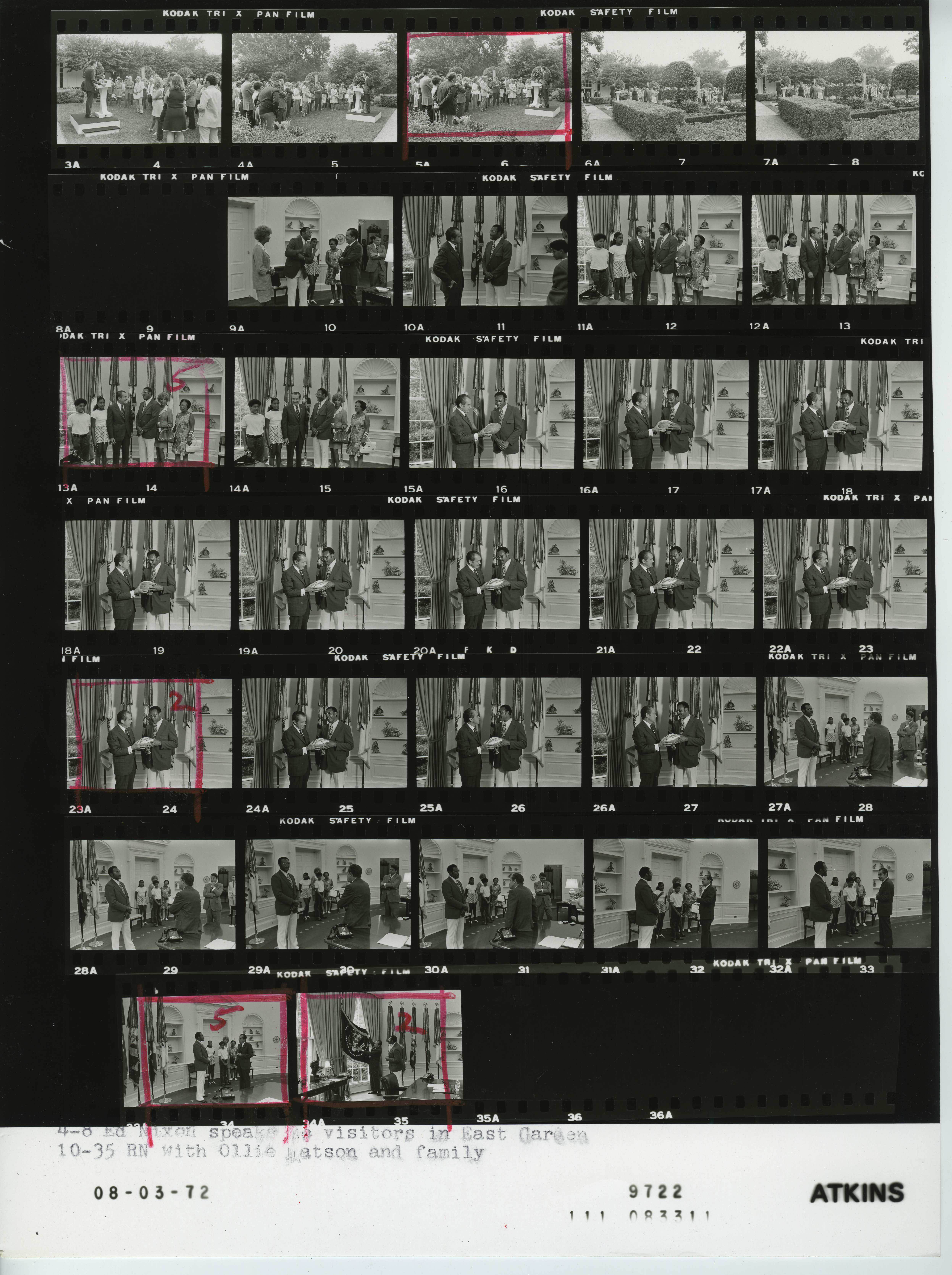
- Frame(s): WHPO-9722-04-08, Ed Nixon speaking to a group of Republican lawyers. 8/3/1972, Washington, D.C. Jacqueline Kennedy Garden, White House. Ed Nixon, Republican lawyers.
- Frame(s): WHPO-9722-10-35, President Nixon with former football player Ollie Matson and his family. 8/3/1972, Washington, D.C. White House, Oval Office. President Nixon, Ollie Matson, Mary Matson, Bruce Matson, Barbara Matson, Mamie Greene, staff members.
- Frame(s): WHPO-9722-25, President Nixon holding a "Pro-Bowl" football with former football player Ollie Matson. 8/3/1972, Washington, D.C. White House, Oval Office. President Nixon, Ollie Matson.
- Frame(s): WHPO-9722-35, President Nixon holding up an Oval Office flag to show former football player Ollie Matson. 8/3/1972, Washington, D.C. White House, Oval Office. President Nixon, Ollie Matson.
Roll WHPO-9723 Photographer: Schumaker, Byron | Color or B&W: B&W
- Frame(s): WHPO-9723-, Kris Kristofferson standing with Press Office secretaries. 8/3/1972, Washington, D.C. White House, Rose Garden. Kris Kristofferson, secretaries.
The White House Communications Agency Sound Recordings Collection contains public statements that took place between 1969 and 1974. Visit the finding aid to learn more.
H - White House Staff Member Recordings
- WHCA-SR-H-634
Remarks by Ed Nixon. (8/3/1972, East Garden, White House)
Runtime: 4:00
Production credits: Audio feed supplied by WHCA; Recorded by GET (initials of WHCA engineer)
Original Format: 1/4-inch reel-to-reel audiotape. Original source type: Original. - WHCA-SR-H-635
Remarks by Donald Rumsfeld. (8/3/1972, Family Theater)
Runtime: 60:00:00
Production credits: Audio feed supplied by WHCA; Recorded by GLG (initials of WHCA engineer)
Original Format: 1/4-inch reel-to-reel audiotape. Original source type: Original.
The White House Communications Agency Videotape Collection contains “off-the-air” recordings of televised programs produced between 1968 and 1974. Visit the finding aid to learn more.
- WHCA-5625
Nancy Dickerson and The New Woman.
CBS, NBC, ABC
Runtime: 00:31:01 - WHCA-5626
Dick Cavett Show.
N/A
Runtime: 00:51:28 - WHCA-5629
Weekly News Summary, Tape III.
ALL NETWORKS
Runtime: 1:00
1. Smith/Geer: McGovern on VP choices. Time Code Start: 00:00. Keywords: Vice Presidents, Presidential elections, campaigns, campaigning, candidates. Network: ABC.
2. Reasoner/Drury: Senator Eagleton on method of selecting Vice President (VP); report from Ayrshire, Iowa. Time Code Start: 02:01. Keywords: Vice Presidents, Presidential elections, campaigns, campaigning, candidates. Network: ABC.
3. Reasoner: Commentary on what women should be called. Time Code Start: 05:27. Keywords: titles, Feminism, Feminist movement, women's rights, Womens Liberation, equality, equal rights, gender, civil rights, activists, women, activists, special interest groups. Network: ABC.
4. Utley/Dancy: McGovern looking for VP. Time Code Start: 07:28. Keywords: Vice Presidents, Presidential elections, campaigns, campaigning, candidates. Network: NBC.
5. Utley/Alborne: Senator Eagleton in New York. Time Code Start: 09:57. Keywords: Presidents, Presidential elections, campaigns, candidates. Network: NBC.
6. Utley/Dobyns: Paris Peace Talks, Ambassador William J. Porter. Time Code Start: 11:56. Keywords: Paris Peace Talks, Vietnam War, treaty, treaties, negotiations, government, officials. Network: NBC.
7. Mudd/Morton: McGovern on selection of VP; Muskie, Humphrey. Time Code Start: 13:46. Keywords: Vice Presidents, Presidential elections, campaigns, campaigning, candidates. Network: CBS.
8. Mudd: Senator Eagleton's voice on telephone conversation tape recording made by reporter Hardy asking him to be Vice President. Time Code Start: 17:30. Keywords: Presidents, Presidential elections, campaigns, candidates, telephones, recordings. Network: CBS.
9. Mudd/Rather: Investigation of Republican committee to elect President Nixon, on bugging, MacGregor [Watergate]. Time Code Start: 19:51. Keywords: bugging, bugs, wiretapping, wire taps, surveillance, spying, recordings, Watergate, Senate committee hearings, investigations, testimony, testify, cover-ups, break-in, burglary, theft, plumbers, scandals. Network: CBS.
10. Mudd: President Nixon and football. Time Code Start: 22:11. Keywords: Presidents, sports, football, games. Network: CBS.
11. Sevareid: Commentary on issues of this campaign. Time Code Start: 23:00. Keywords: Presidential elections, campaigns, campaigning, candidates. Network: CBS.
12. Mudd/Chase: The American Party. Time Code Start: 25:33. Keywords: political parties. Network: CBS.
Context (External Sources)
The Vanderbilt Television News Archive is the world's most extensive and complete archive of television news. They have been recording, preserving and providing access to television news broadcasts of the national networks since August 5, 1968.
Wikipedia is a free encyclopedia that anyone can edit.