
Introduction
This almanac page for Monday, April 30, 1973, pulls together various records created by the federal government and links to additional resources which can provide context about the events of the day.
Previous Date: Sunday, April 29, 1973
Next Date: Tuesday, May 1, 1973
Schedule and Public Documents
The Daily Diary files represent a consolidated record of the President's activities. Visit the finding aid to learn more.
The President's day began at Camp David, Maryland
The Weekly Compilation of Presidential Documents made available transcripts of the President's news conferences; messages to Congress; public speeches, remarks, and statements; and other Presidential materials released by the White House.
Digitized versions can be found at HathiTrust.
Each Public Papers of the Presidents volume contains the papers and speeches of the President of the United States that were issued by the White House Office of the Press Secretary during the time period specified by the volume. The material is presented in chronological order, and the dates shown in the headings are the dates of the documents or events. In instances when the release date differs from the date of the document itself, that fact is shown in the text note.
To ensure accuracy, remarks have been checked against audio recordings (when available) and signed documents have been checked against the original, unless otherwise noted. Editors have provided text notes and cross references for purposes of identification or clarity.
The Federal Register is the official daily publication for rules, proposed rules, and notices of federal agencies and organizations, as well as executive orders and other Presidential documents.
The Congressional Record is the official daily record of the debates and proceedings of the U.S. Congress.
Archival Holdings
Any selection of archival documents will necessarily be partial. You should use the documents and folders identified below as a starting place, but consult the linked collection finding aids and folder title lists and the collections themselves for context. Many documents to be found this way do not lend themselves to association with specific dates, but are essential to a complete understanding of the material.
Selective document listing
President's Office Files
The President's Office Files consists of materials drawn together by the Special Files Unit from several administrative subdivisions within the White House Office. It is the handwriting and sensitive papers sent to the Staff Secretary that now comprise much of the President's Office Files. Visit the finding aid to learn more.
- News Summaries, Unmarked News Summaries, Box 55, News Summaries - Apr. 16-30, 1973 [7 of 7] [Note: Due to the way News Summary products were compiled, you should also consult nearby days for potentially relevant materials.]
- Weekend News Review, April 30, 1973
- Digest of Weekend News Comment, April 30, 1973
- News Summaries, Unmarked News Summaries, Box 55, News Summaries - May 1-16, 1973 [1 of 8]
- The President's April 30, 1973 Speech
President's Personal File
The President's Personal File is essentially a President's secretary's file, kept by Rose Mary Woods, personal secretary to the President, for two purposes: (1) preserving for posterity a collection of documents particularly close to the President, whether because he dictated or annotated them, or because of the importance of the correspondent or the event concerned and (2) giving appropriate attention–letters of gratitude, invitations to White House social events, and the like–to members and important friends and supporters of the Nixon administration. This generalization does not describe all the varied materials of a file group which is essentially a miscellany, but it does identify the reason for the existence of the file group's core. Visit the finding aid to learn more.
- President's Speech File
The H. R. Haldeman Diaries consists of seven handwritten diaries, 36 dictated diaries recorded as sound recordings, and two handwritten audio cassette tape subject logs. The diaries and logs reflect H. R. Haldeman’s candid personal record and reflections on events, issues, and people encountered during his service in the Nixon White House. As administrative assistant to the President and Chief of Staff, Haldeman attended and participated in public events and private meetings covering the entire scope of issues in which the Nixon White House engaged in during the years 1969-1973. Visit the finding aid to learn more.
- Transcript of diary entry (PDF)
Monday, April 30.
Resignation day. We finished up our resignation statements this morning. And I had a meeting with Bull, Parker, Larry, and Kehrli to impress on them the need to carry on the ongoing system just as it is until a new system was worked out and ready to put into place, and urged that they not fall into the trap of any sort of internal struggle for position. And explained the importance of their holding everything tightly together during the interim period while the President would be in a very tough emotional and physical shape, and so on.
Ehrlichman and I then met with the senior staff. Shultz couldn't be there because he was testifying on the Hill, but we had Ash, and Kissinger, Timmons, and Ken Cole and told them what our decision was and made something of the same points. John was quite emotional in that session, broke down or was on the verge of it at least, several times. Everybody, I think, was genuinely shocked, and I think we successfully impressed on them also the need to deal very carefully with this interim period.
I made a number of phone calls, talked to Billy Graham. He seemed to feel it was the right thing to do, said that he didn't believe that in government he had met two finer men than Ehrlichman and me, that we have his full support, he feels we've been caught in a web of evil that will ultimately be defeated. He has great affection and love for me as a man, that I should count him as a friend, and that what I'm doing is going to help the President.
I called the Vice President, he said he had almost called me yesterday, wanted to let me know about the charges that came out then, that they were tremendously unfair, and that they were nothing but smoke. Said he'd like to see me before I actually left, that he would like to be as helpful as he can, and that he thinks this is probably the right move.
Talked to Connally, he says I think this is the right thing to do at this time, although I'm awfully sorry it came out that way. Then emphasized the great opportunity I would have to influence the President on who follows in my footsteps and in the staff restructuring. He emphasized the need to implore the President to get top people and go at the restructuring right.
The announcement plan hit a snag when Ehrlichman and Jerry Jones were unable to reach John Dean to inform him that the President was requesting his resignation, so there was a little flap at 11:00 about that, but Ron went ahead with the announcement anyway. The first lead out of it was rather unfortunate, because it implied that Dean, Ehrlichman, and I had all resigned. But Ron worked all afternoon and got that corrected, so by the time of the evening news, it came out that Ehrlichman and I had resigned, as had Kleindienst, and that Dean had been fired. There was no reaction from Dean all day.
President called in the afternoon from Camp David, where he was working on his speech for tonight. Sounded terrible, said, well, I just wanted you to know I still love you. Commented on the problem of reaching Dean, and said so be it. And said basically I have all resignations in hand anyway, don't I? And I said that he did. Told me to tell Ehrlichman that he was in the middle of the speech draft, but to tell him the same as he had told me, and also to tell him and he said you won't understand this, but John will, that I think he's a great man, and his wife is a great lady, and I won't let her down tonight. This was because Jeanne had written the President a letter which John left with him yesterday when we were up at Camp David.
John and I then spent the afternoon with our lawyers, going through the whole process of how to approach our appearances. President's TV speech tonight was, to say the least, not one of his finer efforts, but it probably was effective, because he was obviously shaken, and as the commentator said, didn't exhibit the normal confidence we associate with him. He's obviously in heavy weather, and so on. He sure showed that. It was interesting that he called-- I called him, and they said he wasn't taking calls, but he called back a little after 10:00. I said well, you've got it behind you now, and you should approach it that way. He said it was a very tough thing, and I'll never mention it again. Then he got to feeling sorry for himself. He said Cap is the only Cabinet officer who's called. I told him that the operators were telling people that you weren't taking calls. Said to me you're a strong man, you've got to keep the faith, you're going to win this, God bless you.
Then he asked me if I thought I could do some checking around on reaction to the speech as I had done in the past, and I said no, I didn't think I could. He realized that was the case. He called again about midnight, rather bitter. Said Kissinger's reaction is typical, he's waiting to see how it comes out. He said again, keep the faith, and that was that.
Earlier this evening, we'd gotten into something of a flap because Garment had met with Richardson and Ruckelshaus, and they had all decided that it was imperative that they put FBI guards on all of our files, so there couldn't be any charge that we had destroyed anything, destroyed any evidence and so on. Ehrlichman didn't like that, but we went round and round and it was agreed that they were just there as guards, not as custodians, and so they said they would do it on that basis.
End of April 30, and the end of my official career in the White House. Although technically I'll remain on the payroll for a while, I don't know exactly how long. The termination plans haven't been worked out, and we've got to get at that pretty soon, too. We'll stay on in some sort of fashion for a while, at least, to help in the transition, but obviously we're going to have to concentrate on the case from here on out, and the President's going to have to move on to new ways of doing business.
[End of April 30.] - Original audio recording (MP3)
The National Archives Catalog is the online portal to the records held at the National Archives, and information about those records. It is the main way of describing our holdings and also provides access to electronic records and digitized versions of our holdings.
The Catalog searches across multiple National Archives resources at once, including archival descriptions, digitized and electronic records, authority records, and web pages from Archives.gov and the Presidential Libraries. The Catalog also allows users to contribute to digitized historical records through tagging and transcription.
Nixon Library Holdings
All National Archives Units
National Security Documents
The President's Daily Brief is the primary vehicle for summarizing the day-to-day sensitive intelligence and analysis, as well as late-breaking reports, for the White House on current and future national security issues. Read "The President's Daily Brief: Delivering Intelligence to Nixon and Ford" to learn more.
The Foreign Relations of the United States series presents the official documentary historical record of major U.S. foreign policy decisions and significant diplomatic activity. Visit the State Department website for more information.
Vol. XXVII, Iran; Iraq, 1973-1976
Iraq, January 1973-December 1974
214. Letter From the Chief of the Interests Section in Baghdad (Lowrie) to the Director of the Office of Lebanon, Jordan, Syrian Arab Republic, and Iraq Affairs, Bureau of Near Eastern and South Asian Affairs (Korn), Baghdad, April 30, 1973
Source: National Archives, RG 59, Central Files 1970–73, POL IRAQ–US. Secret; Official–Informal.
Vol. E-8, Documents on South Asia, 1973-1976
Nepal, Sikkim, and Bhutan
243. Telegram 1829 From the Embassy in Nepal to the Department of State, April 30, 1973, 1155Z
The Embassy reported on the visit of Assistant Secretary for Near Eastern and South Asian Affairs Joseph Sisco and Deputy Secretary of State Kenneth Rush to Katmandu. Rush met with King Birendra, among others, and discussed Nepalese foreign relations and U.S. interests in Nepal.
Source: National Archives, RG 59, Central Files 1970–73, POL 2–3 Nepal. Confidential. It was repeated to Calcutta, Colombo, Dhaka, Islamabad, Kabul, New Delhi, and Tehran.
Vol. E-11, Part 1, Documents on Mexico; Central America; and the Caribbean, 1973-1976
Dominican Republic
330. Letter From the Acting Assistant Secretary of State for Inter-American Affairs (Crimmins) to Frank J. Devine, Minister-Counselor at the Embassy in Venezuela, Washington, April 30, 1973
Summary: After Devine received an inquiry from the Dominican Ambassador to Venezuela regarding U.S. policy with respect to the upcoming Dominican Presidential elections, Crimmins wrote that the United States had no preferred candidate and would refrain from involvement in the electoral process.
Source: National Archives, RG 59, ARA/CAR/DR Files: Lot 75D392, POL 14 Elections. Confidential. Official-Informal. Drafted and cleared by Burke. A copy was sent to Ambassador Meloy. In an April 16 letter to Crimmins, Devine reported on a conversation in which Dominican Ambassador Rafael Bonilla Aybar alleged that a rumor was circulating in Santo Domingo that the Department was opposed to a Balaguer candidacy for reelection. In the margins of that letter, Crimmins wrote, “I think CAR should do a note to FJD [Devine] saying that we are taking no position, etc., and he can at his discretion pass to B–A [Bonilla Aybar].” (Ibid.)
The Kissinger telephone conversation transcripts consist of approximately 20,000 pages of transcripts of Kissinger’s telephone conversations during his tenure as Assistant to the President for National Security Affairs (1969-1974) and Secretary of State (1973-1974) during the administration of President Richard Nixon. Visit the finding aid for more information.
Digitized versions can be found in the National Archives Catalog.
Audiovisual Holdings
Visit the White House Tapes finding aid to learn about the taping system's operation and archival processing.
Camp David Study Table
- 164-40; 9:15 a.m. - 9:17 a.m.; Nixon, Richard M. (President); Rebozo, Charles G. ("Bebe")
- 164-41; Unknown between 9:17 a.m. & 10:20 a.m.; Nixon, Richard M. (President); Camp David operator
- 164-42; 10:20 a.m. - 10:21 a.m.; Nixon, Richard M. (President); Woods, Rose Mary
- 164-43; Unknown between 10:21 a.m. & 10:22 a.m.; Nixon, Richard M. (President); Camp David operator
- 164-44; Unknown between 10:22 a.m. & 10:36 a.m.; Nixon, Richard M. (President); Ziegler, Ronald L.
- 164-45; Unknown between 10:36 a.m. & 10:37 a.m.; Nixon, Richard M. (President); Camp David operator
- 164-46; 10:37 a.m. - 10:39 a.m.; Nixon, Richard M. (President); Bull, Stephen B.
- 164-47; Unknown between 10:39 a.m. & 10:42 a.m.; Nixon, Richard M. (President); Camp David operator
- 164-48; Unknown between 10:42 a.m. & 10:52 a.m.; Nixon, Richard M. (President); Price, Raymond K., Jr.
- 164-49; Unknown between 10:52 a.m. & 11:02 a.m.; Nixon, Richard M. (President); Camp David operator
- 164-50; Unknown between 10:52 a.m. & 11:02 a.m.; Nixon, Richard M. (President); Camp David operator
- 164-51; 11:02 a.m. - 11:03 a.m.; Nixon, Richard M. (President); Bull, Stephen B.
- 164-52; 4:20 p.m. - 4:20 p.m.; Nixon, Richard M. (President); Camp David operator
- 164-53; Unknown between 4:20 p.m. & 5:49 p.m.; Nixon, Richard M. (President); Camp David operator
- 164-54; 5:49 p.m. - 5:49 p.m.; Camp David operator; Nixon, Richard M. (President)
- 164-55; 5:50 p.m. - 5:51 p.m.; Nixon, Richard M. (President); Ziegler, Ronald L.
- 164-56; 5:52 p.m. - 5:53 p.m.; Nixon, Richard M. (President); Woods, Rose Mary
- 164-57; 5:54 p.m. - 5:55 p.m.; Ziegler, Ronald L.; Nixon, Richard M. (President)
- 164-58; 6:04 p.m. - 6:05 p.m.; Woods, Rose Mary; Nixon, Richard M. (President)
- 164-59; 6:11 p.m. - 6:11 p.m.; Nixon, Richard M. (President); Camp David operator
- 164-60; Unknown between 6:11 p.m. & 6:50 p.m.; Nixon, Richard M. (President); Camp David operator
- 164-61; 6:50 p.m. - 6:51 p.m.; Nixon, Richard M. (President); Bull, Stephen B.
Old Executive Office Building
- 432-5; Unknown between 8:25 p.m. & 8:58 p.m.; Nixon, Richard M. (President); [Unknown person(s)]
- 432-6; Unknown between 8:25 p.m. & 8:58 p.m.; Nixon, Richard M. (President)
- 432-7; Unknown between 8:25 p.m. & 8:58 p.m.; Nixon, Richard M. (President); [Unknown person(s)]
- 432-8; Unknown between 8:25 p.m. & 8:58 p.m.; Nixon, Richard M. (President); [Unknown person(s)]
- 432-44; Unknown between 8:25 p.m. & 8:58 p.m.; Nixon, Richard M. (President)
Oval Office
White House Telephone
- 45-39; Unknown between 10:09 p.m. & 10:16 p.m.; Woods, Rose Mary; White House operator; Nixon, Richard M. (President); Keyes, Paul W.; Volpe, John A.
- 45-40; Unknown between 10:12 p.m. & 10:16 p.m.; Nixon, Richard M. (President); White House operator
- 45-41; 10:16 p.m. - 10:20 p.m.; Nixon, Richard M. (President); Haldeman, H. R. ("Bob")
- 45-42; Unknown between 10:20 p.m. & 10:32 p.m.; White House operator; Nixon, Richard M. (President); Graham, William F. ("Billy")
- 45-43; Unknown between 10:20 p.m. & 10:32 p.m.; Woods, Rose Mary; White House operator
- 45-44; Unknown between 10:20 p.m. & 10:32 p.m.; Rogers, William P.; Nixon, Richard M. (President); Cox, Tricia Nixon
- 45-45; Unknown between 10:20 p.m. & 10:32 p.m.; Graham, William F. ("Billy"); Nixon, Richard M. (President)
- 45-46; Unknown between 10:20 p.m. & 10:32 p.m.; White House operator; Cox, Tricia Nixon
- 45-47; Unknown between 10:20 p.m. & 10:33 p.m.; Nixon, Richard M. (President); White House operator; Cox, Tricia Nixon; Bull, Stephen B.
- 45-48; 10:34 p.m. - 10:36 p.m.; White House operator; Cox, Tricia Nixon; Kleindienst, Richard G.
- 45-49; 10:39 p.m. - 10:40 p.m.; White House operator; Cox, Tricia Nixon; Nixon, Richard M. (President); Woods, Rose Mary; Dent, Harry S.; Eisenhower, [Dwight] David, II
- 45-50; 10:41 p.m. - 10:42 p.m.; White House operator; Cox, Tricia Nixon; Moorer, Thomas H. (Adm.)
- 45-51; 10:43 p.m. - 10:45 p.m.; White House operator; Cox, Tricia Nixon; Woods, Rose Mary; Kissinger, Henry A.
- 45-52; Unknown between 10:45 p.m. & 10:48 p.m.; Cox, Tricia Nixon; White House operator; Nixon, Richard M. (President)
- 45-53; 10:48 p.m. - 10:50 p.m.; White House operator; Cox, Tricia Nixon; Nixon, Richard M. (President); Reagan, Ronald W.
- 45-54; 10:51 p.m. - 10:54 p.m.; Shultz, George P.; Nixon, Richard M. (President)
- 45-55; Unknown between 10:54 p.m. & 11:04 p.m.; White House operator; Nixon, Richard M. (President); Cox, Tricia Nixon; Cox, Edward R. F.
- 45-56; Unknown between 10:54 p.m. & 11:04 p.m.; Nixon, Richard M. (President); White House operator; Nixon, Thelma C. ("Pat") (Ryan); Eisenhower, Julie Nixon; Cox, Tricia Nixon; Ziegler, Ronald L.
- 45-57; 11:04 p.m. - 11:06 p.m.; White House operator; Cox, Tricia Nixon; Nixon, Richard M. (President); Lewis, Hobart D.
- 45-58; Unknown between 11:07 p.m. & 11:08 p.m.; White House operator; Nixon, Richard M. (President); Eisenhower, [Dwight] David, II; Haig, Alexander M., Jr.
- 45-59; 11:09 p.m. - 11:13 p.m.; Lynn, James T.; Nixon, Richard M. (President)
- 45-60; Unknown between 11:13 p.m. & 11:14 p.m.; Cox, Tricia Nixon; Nixon, Richard M. (President); White House operator; Eisenhower, [Dwight] David, II; Woods, Rose Mary
- 45-61; 11:14 p.m. - 11:15 p.m.; White House operator; Cox, Tricia Nixon; Nixon, Richard M. (President); Armstrong, Anne L.
- 45-62; 11:15 p.m. - 11:18 p.m.; White House operator; Cox, Tricia Nixon; Nixon, Richard M. (President); Bush, George H. W.
- 45-63; 11:21 p.m. - 11:23 p.m.; White House operator; Cox, Tricia Nixon; Brinegar, Claude S.
- 45-64; Unknown between 11:23 p.m. & 11:24 p.m.; Nixon, Richard M. (President); White House operator
- 45-65; 11:24 p.m. - 11:28 p.m.; Nixon, Richard M. (President); [Unknown person(s)]; Colson, Charles W.
- 45-66; Unknown between 11:28 p.m. & 11:30 p.m.; Nixon, Richard M. (President); White House operator
- 45-67; 11:30 p.m. - 11:30 p.m.; White House operator; Nixon, Richard M. (President)
- 45-68; 11:36 p.m. - 11:37 p.m.; Cox, Tricia Nixon; White House operator; Nixon, Richard M. (President); Bull, Stephen B.
- 45-69; 11:41 p.m. - 11:42 p.m.; White House operator; Cox, Tricia Nixon; Nixon, Richard M. (President); Hughes, James D. ("Don")
- 45-70; Unknown between 11:47 p.m. & 11:49 p.m.; Cox, Tricia Nixon; White House operator; Nixon, Richard M. (President); Abplanalp, Robert H.; Rebozo, Charles G. ("Bebe")
- 45-71; Unknown between 11:49 p.m. & 11:50 p.m.; Nixon, Richard M. (President); White House operator
- 45-72; Unknown between 11:50 p.m. & 11:53 p.m.; Nixon, Richard M. (President); Haldeman, H. R. ("Bob")
The White House Photo Office collection consists of photographic coverage of President Richard Nixon meeting with prominent social, political, and cultural personalities; speaking engagements and news conferences of the President and various high-ranking members of the White House staff and Cabinet; Presidential domestic and foreign travel, including Presidential vacations; social events and entertainment involving the First Family, including entertainers present; official portraits of the President, First Family, and high-ranking members of the Nixon administration; the 1969 and 1973 Inaugurals; the President’s 1972 Presidential election campaign appearances (including speeches) and other official activities of the White House staff and the President’s Cabinet from January 20, 1969 until August 9, 1974 at the White House and the Old Executive Office Building; other locations in Washington, DC, such as The Mall; and the Presidential retreats in Camp David, Maryland, Key Biscayne, Florida, and San Clemente, California. Visit the finding aid to learn more.
Roll WHPO-E0716 Photographer: Knudsen, Robert L. | Color or B&W: B&W
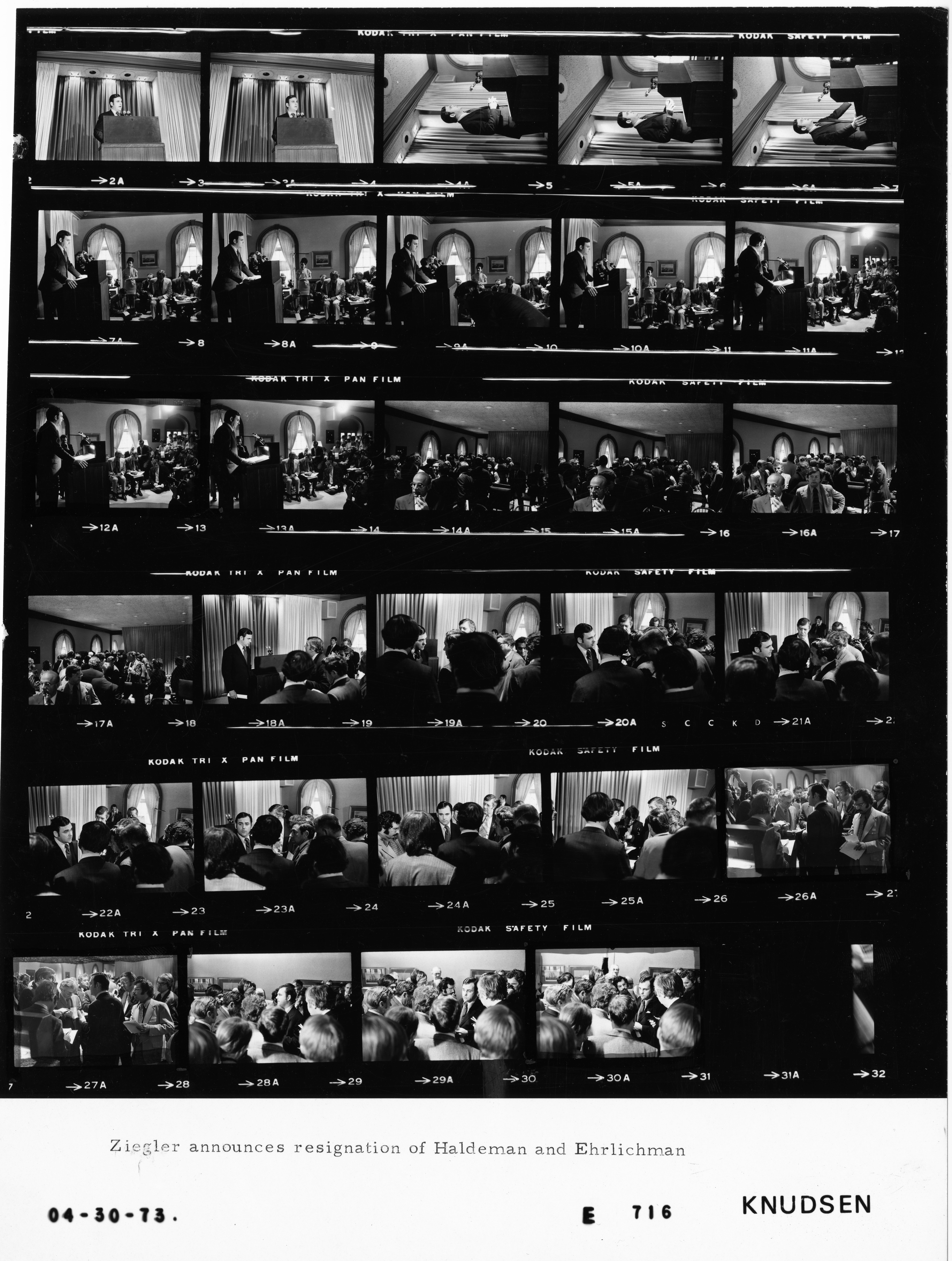
- Frame(s): WHPO-E0716-, Press Secretary Ron Ziegler announcing the resignations of H. R. Haldeman and John D. Ehrilchman at a press conference. 4/30/1973, Washington, D.C. White House, Press Room. Ronald Ziegler, members of the press.
- Frame(s): WHPO-E0716-26A, Press Secretary Ron Ziegler announcing the resignations of H. R. Haldeman and John D. Ehrilchman at a press conference. 4/30/1973, Washington, D.C. White House, Press Room. Ronald Ziegler, members of the press.
Roll WHPO-E0717 Photographer: Atkins, Oliver | Color or B&W: B&W
- Frame(s): WHPO-E0717-, Leonard Garment portraits. 4/30/1973, unknown unknown. Leonard Garment.
- Frame(s): WHPO-E0717-12A, Close-up portrait study of Leonard Garment. 4/30/1973, unknown unknown. Leonard Garment.
Roll WHPO-E0718 Photographer: COPY | Color or B&W: B&W
- Frame(s): WHPO-E0718-, Framed portraits of Richard Cook. 4/30/1973, unknown unknown. Richard Cook.
Roll WHPO-E0719 Photographer: COPY | Color or B&W: B&W
- Frame(s): WHPO-E0719-, Framed portraits of Taft Schreiber. 4/30/1973, unknown unknown. Taft Schreiber.
Roll WHPO-E0720 Photographer: COPY | Color or B&W: B&W
- Frame(s): WHPO-E0720-, Framed side portraits of Taft Schreiber. 4/30/1973, unknown unknown. Taft Schreiber.
Roll WHPO-E0721 Photographer: Kightlinger, Jack | Color or B&W: B&W
- Frame(s): WHPO-E0721-, President Nixon addressing members of the press following nationwide Watergate address. 4/30/1973, Washington, D.C. White House, Press Room. President Nixon. Press conference attendees.
Roll WHPO-E0722 Photographer: Atkins, Oliver | Color or B&W: Color

- Frame(s): WHPO-E0722-, Television photo of President Nixon addressing a nationwide audience on the Watergate investigation. 4/30/1973, Washington, D.C. White House, Oval Office. President Nixon.
- Frame(s): WHPO-E0722-02-03, Technical crew Setting up the Oval Office for televised broadcast. 4/30/1973, Washington, D.C. White House, Oval Office. unidentified Staff and TV crew.
The White House Communications Agency Sound Recordings Collection contains public statements that took place between 1969 and 1974. Visit the finding aid to learn more.
P - Formal Presidential Remarks
- WHCA-SR-P-730422
Televised remarks on Watergate. (4/30/1973)
Runtime: 24:07:00
Keywords: Watergate
Original Format: 1/4-inch reel-to-reel audiotape. Original source type: Original.
S - White House Press Office Briefings (continuation of the L-series)
- WHCA-SR-S-088
Press briefing by Ronald Ziegler and Gerald Warren. (4/30/1973, White House Press Lobby)
Runtime: 0:15:10
Keywords: Press conference, news conference, interviews, media, press secretary, briefings, Watergate, Senate committee hearings, investigations, testimony, testify, cover-ups, break-in, burglars, theft, plumbers, resignations, USSR, Soviet Union, Russia, cabinet,
Production credits: Audio feed supplied by WHCA; Recorded by MJP (initials of WHCA engineer)
Original Format: 1/4-inch reel-to-reel audiotape. Original source type: Original. Technical notes: 1 hour, 21 minutes and 49 seconds at end of recording removed from access copies. - WHCA-SR-S-089
Press briefing by Ronald Ziegler. (4/30/1973, White House Press Lobby)
Runtime: 0:06:31
Keywords: Press conference, news conference, interviews, media, press secretary, briefings, Watergate, Senate committee hearings, investigations, testimony, testify, cover-ups, break-in, burglars, theft, plumbers, resignations
Production credits: Audio feed supplied by WHCA; Recorded by MJP (initials of WHCA engineer)
Original Format: 1/4-inch reel-to-reel audiotape. Original source type: Original. Technical notes: 58 minutes and 39 seconds of two-track music recording at end of recording and 43 seconds at beginning removed from access copies.
The White House Communications Agency Videotape Collection contains “off-the-air” recordings of televised programs produced between 1968 and 1974. Visit the finding aid to learn more.
- WHCA-6257
Nixon Speech. Resignation of H.R. Haldeman and John Ehrlichman speech/appointment of Elliot Richardson. Includes commentary and analysis by Howard K. Smith, Tom Jarrell, Sam Donaldson, Bill Gill
Undetermined
Runtime: 00:37:00 - WHCA-6258
President Nixon's Address to the Nation About the Watergate Investigations with CBS Commentary by Roger Mudd. Resignation of H.R. Haldeman and John Ehrlichman speech/appointment of Elliot Richardson.
Post-Newsweek Stations, Inc.
Runtime: 01:04:20 - WHCA-6259
President Nixon's remarks on the resignation of H.R. Haldeman and John Ehrlichman, and the appointment of Elliot Richardson.. Secretary of Agriculture Earl Butz.
CBS
Runtime: 01:00:14 - WHCA-6260
"Martin Agronsky: Evening Edition". FTN: President Nguyen Van Thieu of the Republic of South Vietnam; "I&A": General Flynn.
ABC, CBS
Runtime: 00:29:18 - WHCA-6264
Weekly News Summary, Tape II.
ALL NETWORKS
Runtime: 1:30
8. Watergate scandal: Bob Haldeman, John Ehrlichman & Attorney General Kleindienst resignations; John Dean firing; on camera comments by Ron Ziegler regarding announcement of resignations and firings; film of Haldeman, Ehrlichman and John Dean. Time Code Start: 08:21. Keywords: advisors, counsels, attorneys, lawyers, Watergate, Senate committee hearings, investigations, testimony, testify, cover-ups, break-in, burglary, theft, plumbers, scandal, resignations, firings. Network: ABC.
9. Report on Attorney General Kleindienst resignation; on camera comments by Kleindienst. Time Code Start: 11:14. Keywords: Watergate, Senate committee hearings, investigations, testimony, testify, cover-ups, break-in, burglary, theft, plumbers, scandals, cabinet, advisors, firings. Network: ABC.
10. Report on Secretary of Defense Richardson as designate Attorney General. Time Code Start: 12:52. Keywords: cabinet, advisors, nominations, law officials. Network: ABC.
11. On camera comments by Senators Bob Dole, William Saxbe, Senator Barry Goldwater and Senator Hugh Scott; opinions regarding resignations. Time Code Start: 14:24. Keywords: cabinet, advisors, resignations, Senators, media, press conferences, news conferences, interviews. Network: ABC.
12. Democrat and stock market reaction to Watergate; Environmental Protection Agency (EPA) Administrator Ruckelshaus becomes acting FBI director. Time Code Start: 16:39. Keywords: Watergate, Senate Committee hearings, investigations, testimony, testify, cover-ups, public opinions, reactions, stock markets, investments, securities, Wall Street, Dow Jones, New York Stock Exchange, NASDAQ. Network: ABC.
13. Report on Judge Matthew Byrne possibly becoming permanent FBI director; Leonard Weinglass interview on Judge Byrne as possible FBI director. Time Code Start: 17:51. Keywords: Federal Bureau of Investigations, organizations, leaders, nominees. Network: ABC.
14. Report on President Nixon's tax reform proposal; film of secretary George Shultz. Time Code Start: 19:41. Keywords: Presidents, bills, laws, taxes, taxation, revenue, reforms. Network: ABC.
15. Report on Congress' extension of President Nixon's wage and price controls Report on Congress' extension of Nixon's wage and price controls. Time Code Start: 21:28. Keywords: Presidents, House of Representatives, recession, inflation, money, wages, wage freezes, prices. Network: ABC.
16. Report on Cambodia (driving back Communist troops and support for American role); film of Secretary of State Rogers testifying before Congress. Time Code Start: 21:42. Keywords: Cambodia, Vietnam War, cabinet, advisors, Congressional hearings, testimony. Network: ABC.
17. Howard K. Smith: commentary on forgiveness of President Nixon as compared to Harding (Teapot Dome Scandal) and Eisenhower; Sherman Adams scandal. Time Code Start: 23:40. Keywords: Presidents, pardons, Presidential staff, scandals, history, gifts, bribery, disclosures, petroleum, oil. Network: ABC.
18. Watergate scandal: Bob Haldeman, John Ehrlichman and Richard Kleindienst resignations; John Dean firing; on camera announcements by Ron Ziegler; Richardson as designate Attorney General; Ehrlichman and Haldeman announce they will voluntarily resign. Time Code Start: 25:26. Keywords: cabinet, advisors, counsels, attorneys, lawyers, Watergate, firings, resignations, investigations, Presidents, media, press conferences, news conferences, interviews. Network: NBC.
19. Cooperate with Grand Jury. Time Code Start: 25:26. Keywords: Watergate, Senate committee hearings, investigations, testimony, testify, cover-ups, break-in, burglary, theft, plumbers, scandals. Network: NBC.
20. Report on Elliot Richardson and his orders by President Nixon to coordinate the effort to find the whole truth about Watergate. Time Code Start: 29:38. Keywords: Watergate, Senate committee hearings, investigations, testimony, testify, cover-ups, break-in, burglary, theft, plumbers, scandals. Network: NBC.
21. Attorney General Kleindienst explains his resignation on camera; film of Henry Paterson refusing comment. Time Code Start: 30:12. Keywords: Watergate, Federal Bureau of Investigations, organizations, crime, espionage, spying, appointments, Senate, committees, investigations, testimony, testify, cover-ups, break-in, burglary, theft, plumbers, scandals. Network: NBC.
22. Report on Environmental Protection Agency (EPA) Administrator Ruckelshaus and (the former Assistant Attorney General Civil Division) becomes acting FBI director. Time Code Start: 32:15. Keywords: cabinet, advisors, appointments, Federal Bureau of Investigations, organizations, crime, espionage, spying. Network: NBC.
23. Report on how the Watergate scandal broke wide open. Time Code Start: 32:47. Keywords: Watergate, Senate committee hearings, investigations, officials, testimony, testify, cover-ups, break-in, burglary, theft, plumbers, scandals, newspapers, stories. Network: NBC.
24. President Nixon cleans house; Senators Robert Dole, William Saxbe, Charles Percy on camera applaud the resignations of Ehrlichman and Haldeman describing them as arrogant and contemptuous of Congress. Time Code Start: 35:15. Keywords: cabinet, advisors, counsels, attorneys, lawyers, Watergate, firings, resignations, investigations, Presidents, media, press conferences, news conferences, interviews. Network: NBC.
25. Man in the street response to Watergate resignations. Time Code Start: 38:10. Keywords: Watergate, Senate committee hearings, investigations, testimony, testify, cover-ups, break-in, burglary, theft, plumbers, scandals. Network: NBC.
26. Public opinion and David Brinkley commentary on President Nixon's knowledge of Watergate. Time Code Start: 39:52. Keywords: Watergate, Senate committee hearings, investigations, testimony, testify, cover-ups, break-in, burglary, theft, plumbers, scandals. Network: NBC.
27. Report on Pentagon Papers linked to Watergate. Time Code Start: 41:58. Keywords: Armed Forces, military, classified documents, secrets, Watergate, Senate committee hearings, investigations, testimony, testify, cover-ups, break-in, burglary, theft, plumbers, scandals. Network: NBC.
28. Kissinger's plans to go to Moscow. Time Code Start: 44:00. Keywords: cabinet, advisors, travel, trips, Russia, Soviet Union, USSR. Network: NBC.
29. Report on President Nixon's plan to aid South Vietnam's President Thieu of no Vietnam breaks ceasefire. Time Code Start: 44:20. Keywords: Vietnam War, ceasefires. Network: NBC.
30. Report on Congress' extension of President Nixon's wage and price controls. Time Code Start: 44:32. Keywords: Presidents, House of Representatives, recession, inflation, money, wages, wage freezes, prices. Network: NBC.
31. Report on American troops in Thailand. Time Code Start: 44:44. Keywords: Vietnam War, military, troops. Network: NBC.
32. Report on President Nixon and high meat prices. Time Code Start: 45:07. Keywords: food, meats, animal products, markets, retail stores, prices, costs, increases, shortages. Network: NBC.
33. West German Chancellor Willy Brandt in Washington, D.C.. Time Code Start: 45:23. Keywords: President Nixon, West Germany, Chancellors, leaders, meetings. Network: NBC.
34. John Chancellor's commentary on Watergate and the presidency. Time Code Start: 45:43. Keywords: Supreme Court, Justices, reports, Armed Forces, Vietnam War, Laos, Cambodia, Vietnam, bombings, Presidents, secrets, Ellsberg, Russo, Watergate. Network: NBC.
35. President Nixon and Watergate scandal: Bob Haldeman, John Ehrlichman and Attorney General Kleindienst resignations; John Dean firing; Ron Ziegler news conference. Time Code Start: 46:57. Keywords: advisors, counsels, attorneys, lawyers, Watergate, firings, resignations, investigations, media, press conferences, news conferences, interviews. Network: CBS.
36. Elliot Richardson as designate Attorney General. Time Code Start: 50:30. Keywords: cabinet, advisors, nominations, law officials, nominees. Network: CBS.
37. Report on how Watergate broke wide open. Time Code Start: 51:49. Keywords: Watergate, Senate committee hearings, investigations, testimony, testify, cover-ups, break-in, burglary, theft, plumbers, scandals. Network: CBS.
38. Congressmen Bob Dole, William Saxbe, Senators Barry Goldwater and Hugh Scott opinion's on President Nixon and resignations of H.R. Haldeman and John Ehrlichman. Time Code Start: 53:05. Keywords: Senators, advisors, counsels, attorneys, lawyers, Watergate, firings, resignations, investigations, media, press conferences, news conferences, interviews. Network: CBS.
39. Public reaction to Watergate (three reports from middle America). Time Code Start: 55:57. Keywords: Watergate, Senate committee hearings, investigations, officials, testimony, testify, cover-ups, break-in, burglary, theft, plumbers, scandals, reactions, public opinions, polls, approval ratings, Gallup poll, Harris poll. Network: CBS.
40. Watergate compared to Harding's (Teapot Dome Scandal); Former President Truman; Harry Vaughn and former President Eisenhower; Sherman Adams scandal. Time Code Start: 59:46. Keywords: Watergate, Presidents, death, memorials, ceremony, ceremonies, history, scandals, history, gifts, bribery, disclosures, petroleum, oil. Network: CBS.
41. Opinion on Watergate scandal compared to other White House scandals. Time Code Start: 62:37. Keywords: Watergate, Senate committee hearings, investigations, officials, testimony, testify, cover-ups, break-in, burglary, theft, plumbers, scandals, reactions, public opinions, polls, approval ratings, Gallup poll, Harris poll. Network: CBS.
42. Cronkite: Pentagon Papers trial, Ellsberg and Anthony Russo, Judge Matthew Byrne wants sworn affidavits from key figures in Watergate scandal before subpoenas, admits meetings with President Nixon, says Ehrlichman offered him federal job. Time Code Start: 63:34. Keywords: Armed Forces, military, classified documents, secrets, Watergate, courts, trials, Vietnam War, Indochina War, bombings, judges, bribery, Presidents, meetings. Network: CBS.
43. Henry Kissinger's trip to Moscow, Russia. Time Code Start: 64:13. Keywords: cabinet, advisors, travel, trips, Soviet Union, USSR. Network: CBS.
44. Secretary of State William Rogers defends bombing of Cambodia. Time Code Start: 64:30. Keywords: Cambodia, Vietnam War, bombings, statements, speeches, cabinet, advisors. Network: CBS.
45. Eric Sevaraid commentary on President Nixon's house cleaning. Time Code Start: 66:19. Keywords: Presidents, resignations, advisors, firings. Network: CBS.
Context (External Sources)
The Vanderbilt Television News Archive is the world's most extensive and complete archive of television news. They have been recording, preserving and providing access to television news broadcasts of the national networks since August 5, 1968.
Wikipedia is a free encyclopedia that anyone can edit.