
Introduction
This almanac page for Thursday, April 15, 1971, pulls together various records created by the federal government and links to additional resources which can provide context about the events of the day.
Previous Date: Wednesday, April 14, 1971
Next Date: Friday, April 16, 1971
Schedule and Public Documents
The Daily Diary files represent a consolidated record of the President's activities. Visit the finding aid to learn more.
The President's day began at The White House - Washington, D. C.
The Weekly Compilation of Presidential Documents made available transcripts of the President's news conferences; messages to Congress; public speeches, remarks, and statements; and other Presidential materials released by the White House.
Digitized versions can be found at HathiTrust.
Each Public Papers of the Presidents volume contains the papers and speeches of the President of the United States that were issued by the White House Office of the Press Secretary during the time period specified by the volume. The material is presented in chronological order, and the dates shown in the headings are the dates of the documents or events. In instances when the release date differs from the date of the document itself, that fact is shown in the text note.
To ensure accuracy, remarks have been checked against audio recordings (when available) and signed documents have been checked against the original, unless otherwise noted. Editors have provided text notes and cross references for purposes of identification or clarity.
The Federal Register is the official daily publication for rules, proposed rules, and notices of federal agencies and organizations, as well as executive orders and other Presidential documents.
The Congressional Record is the official daily record of the debates and proceedings of the U.S. Congress.
Archival Holdings
Any selection of archival documents will necessarily be partial. You should use the documents and folders identified below as a starting place, but consult the linked collection finding aids and folder title lists and the collections themselves for context. Many documents to be found this way do not lend themselves to association with specific dates, but are essential to a complete understanding of the material.
Selective document listing
President's Office Files
The President's Office Files consists of materials drawn together by the Special Files Unit from several administrative subdivisions within the White House Office. It is the handwriting and sensitive papers sent to the Staff Secretary that now comprise much of the President's Office Files. Visit the finding aid to learn more.
- Annotated News Summaries, Box 30, News Summaries - April 1971 [During this period, the Staff Secretary only removed pages from the News Summaries which contained President Nixon's handwriting, often leaving the document with no date. In addition to the individual document(s) listed below, you should also consult the full folder for the month.]
- Wire Reports, April 15, 1971
The H. R. Haldeman Diaries consists of seven handwritten diaries, 36 dictated diaries recorded as sound recordings, and two handwritten audio cassette tape subject logs. The diaries and logs reflect H. R. Haldeman’s candid personal record and reflections on events, issues, and people encountered during his service in the Nixon White House. As administrative assistant to the President and Chief of Staff, Haldeman attended and participated in public events and private meetings covering the entire scope of issues in which the Nixon White House engaged in during the years 1969-1973. Visit the finding aid to learn more.
- Transcript of diary entry (PDF)
Thursday, April 15th. Still bouncing on the stock market rise yesterday and the continuing rise today. The President felt that we ought to work out some kind of a gimmick, such as having the Wall Street crowd come down to Washington and give the President a bronze bull to symbolize the greatest bull market in history. The plan now is to go ahead and do something like this tomorrow to build the interest in the market rise while it's still going up.
He got back on the general PR question again, the point that we've not created a mythology; that the courage, boldness, and guts hasn't come across; that we haven't made the point that it's not true that everything is political. He feels that the most important factor in the first two years is guts, and that we've got to get that across. He also got into the POW wives question while Henry was there, because of Dole's report yesterday that they're pretty shaky, and that we've got to do something dramatic to keep them on track. The President told Henry to see the wives this week and to work out something with them that will buy us three months’ time, because we can't afford to let them come unglued at this point, while everything else is going so well.
The President met with the Prime Minister of Morocco today, who came all the way over just to tell him that the King couldn't come next week; so we're postponing the visit until August. As a result of this, the President's thinking about state visits and come up with the decision that there will be no State visits in 1972.
-------------------------------------------------------------------------------------------------------------------
DECLASSIFIED - E.O. 13526, Sect. 3.4: by MS, NARA, June 12, 2013
Audio Cassette 6, Side B, Withdrawn Item Number 10 [AC-6(B) Sel 6]
Duration: 6 seconds
He wants to turn them all off on the basis that they do nothing for us and just waste a lot of time.
-------------------------------------------------------------------------------------------------------------------
Basically, he's right.
He got to pondering the question of Cabinet changes again; has the feeling that we probably should give some real thought to the point Connally raised of making some changes now and getting some real gung ho salesmen into the Cabinet. He particularly thinks that we ought to consider moving Hardin and Stans. The general feeling, based on reaction coming in from all sources, is that the whole China business is having a major effect, especially on the left-wing intellectuals, which means it's an effect that will ripple out and be felt generally, as they talk about it. It seems to have the Left really shook and off balance.
In thinking about other events for this year, the President was looking at the poll history and noting the effect of Glassboro and LBJ's approval rating. Before the Glassboro Summit, he was 44-40. Right afterwards, he was 52-35, a fairly good gain. But two months later, he was 39-47, so it all wore off pretty fast.
The President spent all day at the EOB, except for the meeting with the Prime Minister and a quick open hour event at noontime. He's working on the briefing material for the ASNE tomorrow night. He'll spend tomorrow on that also.
End of April 15th. - Original audio recording (MP3)
The National Archives Catalog is the online portal to the records held at the National Archives, and information about those records. It is the main way of describing our holdings and also provides access to electronic records and digitized versions of our holdings.
The Catalog searches across multiple National Archives resources at once, including archival descriptions, digitized and electronic records, authority records, and web pages from Archives.gov and the Presidential Libraries. The Catalog also allows users to contribute to digitized historical records through tagging and transcription.
Nixon Library Holdings
All National Archives Units
National Security Documents
The President's Daily Brief is the primary vehicle for summarizing the day-to-day sensitive intelligence and analysis, as well as late-breaking reports, for the White House on current and future national security issues. Read "The President's Daily Brief: Delivering Intelligence to Nixon and Ford" to learn more.
The Foreign Relations of the United States series presents the official documentary historical record of major U.S. foreign policy decisions and significant diplomatic activity. Visit the State Department website for more information.
Vol. XIII, Soviet Union, October 1970-October 1971
"A Key Point in Our Relationship": Backchannel Talks on SALT, Berlin, and the Summit
180. Transcript of a Telephone Conversation Between the President’s Assistant for National Security Affairs (Kissinger) and the Soviet Minister (Vorontsov), Washington, April 15, 1971, 8:57 a.m.
Source: National Archives, Nixon Presidential Materials, Henry Kissinger Telephone Transcripts, Box 9, Chronological File. No classification marking.
181. Conversation Between President Nixon and the President’s Assistant for National Security Affairs (Kissinger), Washington, April 15, 1971
Source: National Archives, Nixon Presidential Materials, White House Tapes, Conversation 1–101. No classification marking. The editors transcribed the portion of the tape recording printed here specifically for this volume. According to the President’s Daily Diary, Nixon called Kissinger at 7:33 p.m.; the two men then talked for 10 minutes. (Ibid., White House Central Files) A transcript of the conversation is ibid., Henry Kissinger Telephone Conversation Transcripts, Box 9, Chronological File.
182. National Intelligence Estimate, Washington, April 15, 1971
Source: Central Intelligence Agency, NIC Files, Job 79–R01012A. Secret. According to a note on the cover sheet, the Central Intelligence Agency and the intelligence organizations of the Departments of State and Defense, and the National Security Agency participated in the preparation of this estimate. The Director of Central Intelligence submitted this estimate with the concurrence of all members of the United States Intelligence Board, except the representatives of the Atomic Energy Commission and the Federal Bureau of Investigation, who abstained on the grounds that it was outside their jurisdiction. This estimate supersedes NIE 11/13–69, “The USSR and China,” August 12, 1969; see Foreign Relations, 1969–1976, volume XVII, China, 1969–1972, Document 24.
Vol. XIX, Part 2, Japan, 1969-1972
April-October 1971: Change and Reassessment
72. National Security Study Memorandum 122, Washington, April 15, 1971
Source: National Archives, Nixon Presidential Materials, NSC Files, Box 365, Subject Files, National Security Study Memoranda, Nos. 104–206. Secret. Copies were sent to the Secretary of Commerce, the Secretary of Agriculture, the Special Representative for Trade Negotiations, the Director of the U.S. Information Agency, the Chairman of the Joint Chiefs of Staff, and the Assistant to the President for International Economic Affairs. Kissinger rejected earlier drafts of this NSSM, arguing that economic issues should be placed at the end of the NSSM rather than near the front. (Kissinger marginalia on memorandum from Richard T. Kennedy to Kissinger, April 2; ibid., NSC Institutional Files (H-Files), Box H–182, National Security Study Memoranda, NSSM 122 [3 of 3]) The NSSM was also changed to include a member of Peterson’s staff on the Interdepartmental Group that prepared the requested study. (Memorandum from Richard Kennedy to Kissinger, April 12; ibid.) The Senior Review Group examined the issues raised by this memorandum on August 7, August 26, and September 7, while the CIEP Review Group considered economic aspects of these issues on August 10. The result of these meetings was the issuance of National Security Decision Memorandum 130, September 7, Document 94, which prepared the U.S. delegation before the eighth U.S.-Japan Joint Economic Committee Meeting, on September 9 and 10.
Vol. XXXVI, Energy Crisis, 1969-1974
April 15, 1971-March 11, 1972
89. Telegram From the Embassy in Iran to the Department of State, Tehran, April 15, 1971, 0817Z
Source: National Archives, RG 59, Central Files 1970–73, PET 3 OPEC. Confidential. Repeated to Dhahran, Jidda, Kuwait, London, and Tripoli.
Vol. XL, Germany and Berlin, 1969-1972
Germany and Berlin, 1969-1972
219. Memorandum for the Record, Washington, April 15, 1971
Source: National Archives, Nixon Presidential Materials, NSC Files, Box 685, Country Files, Europe, Germany (Bonn), Vol. IX. Confidential. Sent for information. Drafted by Sonnenfeldt. The original was sent to Kissinger. An attached form indicates that the memorandum was “noted by HAK.”
Vol. E-4, Documents on Iran and Iraq, 1969-1972
Iran 1971
125. Telegram 1935 From the Embassy in Iran to the Department of State, Tehran, April 15, 1971, 0817Z
Ambassador MacArthur alerted the Department that the Shah hoped to bridge the gap between the recent Persian Gulf oil settlement and the more favorable terms that Libya had just secured.
Source: National Archives, RG 59, Central Files 1970–73, PET 3 OPEC. Confidential. Repeated to Dhahran, Jidda, Kuwait, London, and Tripoli.
Vol. E-5, Part 2, Documents on North Africa, 1969-1972
Morocco
113. Memorandum of Conversation, Washington, April 15, 1971, 11 a.m.
Prime Minister Laraki explained that King Hassan wished to postpone his visit to the United States in order to attend the upcoming Arab Summit.
Source: National Archives, Nixon Presidential Materials, NSC Files, Box 1025, Presidential/HAK Memcons, Mem Con-The President, Prime Minister Laraki, April 15, 1971. Top Secret; Sensitive; Eyes Only. The meeting took place in the Oval Office. The Department’s draft memorandum of the conversation is located in Ibid., RG 59, Central Files 1970–73, POL 7 MOR.
The Kissinger telephone conversation transcripts consist of approximately 20,000 pages of transcripts of Kissinger’s telephone conversations during his tenure as Assistant to the President for National Security Affairs (1969-1974) and Secretary of State (1973-1974) during the administration of President Richard Nixon. Visit the finding aid for more information.
Digitized versions can be found in the National Archives Catalog.
Audiovisual Holdings
The White House Tapes are sound recordings of President Richard Nixon's telephone conversations and of meetings held in the Oval Office and the Cabinet Room in the White House, the President's office in the Old Executive Office Building (OEOB), the Lincoln Sitting Room in the residence section of the White House, and several locations at the Presidential retreat at Camp David, Maryland. These recordings document many of the major events and decisions of the Nixon Administration from February 16, 1971 to July 18, 1973. Visit the White House Tapes finding aid to learn about the taping system's operation and archival processing.
Old Executive Office Building
- 249-1; Unknown between 8:32 a.m. & 8:36 a.m.; Nixon, Richard M. (President); Sanchez, Manolo
- 249-2; Unknown between 8:32 a.m. & 8:36 a.m.; Nixon, Richard M. (President); Bull, Stephen B.
- 249-3; 8:36 a.m. - 8:42 a.m.; Nixon, Richard M. (President); Woods, Rose Mary
- 249-4; Unknown between 8:42 a.m. & 8:59 a.m.; Nixon, Richard M. (President); [Unknown person(s)]
- 249-5; Unknown between 8:42 a.m. & 8:59 a.m.; Nixon, Richard M. (President); [Unknown person(s)]
- 249-6; 8:59 a.m. - 10:45 a.m.; Nixon, Richard M. (President); Haldeman, H. R. ("Bob"); [Unknown person(s)]; Bull, Stephen B.; Kissinger, Henry A.; Sanchez, Manolo
- 249-7; Unknown between 2:30 p.m. & 3:15 p.m.; Nixon, Richard M. (President); Sanchez, Manolo
- 249-8; Unknown between 2:30 p.m. & 3:15 p.m.; Nixon, Richard M. (President); Sanchez, Manolo
- 249-9; Unknown between 2:30 p.m. & 3:15 p.m.; Nixon, Richard M. (President); [Unknown person(s)]
- 249-10; 3:15 p.m. - 3:16 p.m.; Nixon, Richard M. (President); Haldeman, H. R. ("Bob")
- 249-11; Unknown between 3:16 p.m. & 3:44 p.m.; Nixon, Richard M. (President); White House operator
- 249-12; 3:44 p.m. - 3:44 p.m.; Nixon, Richard M. (President); White House operator
- 249-13; 3:45 p.m. - 3:48 p.m.; Nixon, Richard M. (President); Rumsfeld, Donald H.
- 249-14; Unknown between 3:48 p.m. & 4:05 p.m.; Nixon, Richard M. (President); Ziegler, Ronald L.
- 249-15; Unknown between 3:48 p.m. & 4:05 p.m.; Nixon, Richard M. (President); Ehrlichman, John D.
- 249-16; 4:05 p.m. - 4:32 p.m.; Nixon, Richard M. (President); Kissinger, Henry A.
- 249-17; Unknown between 4:05 p.m. & 4:31 p.m.; Nixon, Richard M. (President); White House operator
- 249-18; 4:31 p.m. - 4:34 p.m.; Nixon, Richard M. (President); Buchanan, Patrick J.
- 249-19; Unknown between 4:34 p.m. & 4:35 p.m.; Nixon, Richard M. (President); White House operator
- 249-20; 4:35 p.m. - 4:36 p.m.; Nixon, Richard M. (President); Bull, Stephen B.
- 249-21; 4:42 p.m. - 4:52 p.m.; Nixon, Richard M. (President); Buchanan, Patrick J.
- 249-22; 5:05 p.m. - 5:07 p.m.; Nixon, Richard M. (President); Butterfield, Alexander P.
- 249-23; Unknown between 5:07 p.m. & 5:25 p.m.; Nixon, Richard M. (President); [Unknown person(s)]
- 249-24; Unknown between 5:07 p.m. & 5:25 p.m.; Nixon, Richard M. (President); Sanchez, Manolo
- 249-25; Unknown between 5:07 p.m. & 5:25 p.m.; Nixon, Richard M. (President); Sutton, Faith
- 249-26; 5:25 p.m. - 6:20 p.m.; Nixon, Richard M. (President); Haldeman, H. R. ("Bob"); Bull, Stephen B.; Murphy, Robert D.; Kissinger, Henry A.; White House photographer
- 249-27; Unknown between 6:20 p.m. & 6:21 p.m.; Nixon, Richard M. (President); White House operator
- 249-28; 6:21 p.m. - 6:22 p.m.; Nixon, Richard M. (President); Nixon, Thelma C. ("Pat") (Ryan)
- 249-29; 6:30 p.m. - 6:50 p.m.; Nixon, Richard M. (President); Haldeman, H. R. ("Bob")
- 249-30; Unknown between 6:50 p.m. & 7:00 p.m.; Haldeman, H. R. ("Bob"); [Unknown person(s)]
Oval Office
- 480-1; Unknown between 10:59 a.m. & 11:02 a.m.; Nixon, Richard M. (President); Ahlgram, Henry
- 480-2; Unknown between 10:59 a.m. & 11:02 a.m.; Nixon, Richard M. (President); [Unknown person(s)]
- 480-3; 11:02 a.m. - 12:00 p.m.; Nixon, Richard M. (President); Kissinger, Henry A.; Toumayan, Alex G.; Mosbacher, Emil ("Bus"), Jr.; Laraki, Moulay Ahmed; Haldeman, H. R. ("Bob")
- 480-4; 12:01 p.m. - 12:02 p.m.; Nixon, Richard M. (President); Bull, Stephen B.
- 480-5; 12:15 p.m. - 12:15 p.m.; Nixon, Richard M. (President); Bull, Stephen B.
- 480-6; 12:15 p.m. - 12:40 p.m.; Nixon, Richard M. (President); Finch, Robert H.; Rumsfeld, Donald H.
- 480-7; 12:40 p.m. - 12:41 p.m.; Nixon, Thelma C. ("Pat") (Ryan); Nixon, Richard M. (President)
- 480-8; Unknown between 12:41 p.m. & 12:50 p.m.; Nixon, Richard M. (President); [Unknown person(s)]
- 480-9; Unknown between 12:41 p.m. & 12:50 p.m.; Nixon, Richard M. (President); Bull, Stephen B.
- 480-10; Unknown between 12:41 p.m. & 1:18 p.m.; Nixon, Richard M. (President); Haldeman, H. R. ("Bob"); Bull, Stephen B.; Ziegler, Ronald L.; Sutherland, John P. ("Jack"); Ehrlichman, John D.
- 480-11; Unknown between 12:02 p.m. & 12:15 p.m.; United States Secret Service agents
- 480-12; Unknown between 1:18 p.m. & 1:40 p.m.; United States Secret Service agents
White House Telephone
- 1-96; 12:40 p.m. - 12:41 p.m.; Nixon, Richard M. (President); Nixon, Thelma C. ("Pat") (Ryan)
- 1-97; 8:17 p.m. - 8:18 p.m.; Nixon, Richard M. (President); White House operator
- 1-98; 7:26 p.m. - 7:29 p.m.; Nixon, Richard M. (President); Haldeman, H. R. ("Bob")
- 1-99; 7:30 p.m. - 7:30 p.m.; Nixon, Richard M. (President); White House operator
- 1-100; 7:31 p.m. - 7:31 p.m.; Nixon, Richard M. (President); White House operator
- 1-101; Unknown between 7:31 p.m. & 7:33 p.m.; Nixon, Richard M. (President); White House operator; Kissinger, Henry A.
- 1-102; Unknown between 7:42 p.m. & 7:47 p.m.; Nixon, Richard M. (President); White House operator
- 1-103; Unknown between 7:42 p.m. & 7:47 p.m.; Nixon, Richard M. (President); White House operator
- 1-104; 7:47 p.m. - 7:48 p.m.; Nixon, Richard M. (President); Connally, John B.
- 1-105; 7:49 p.m. - 7:53 p.m.; Nixon, Richard M. (President); Shultz, George P.
- 42-41; 8:36 a.m. - 8:42 a.m.; Nixon, Richard M. (President); Woods, Rose Mary
- 42-42; Unknown between 8:42 a.m. & 3:15 p.m.; [Unknown person(s)]; White House operator; Shields, Ralph
- 42-43; 3:15 p.m. - 3:16 p.m.; Haldeman, H. R. ("Bob"); Nixon, Richard M. (President)
- 42-44; Unknown between 3:16 p.m. & 3:44 p.m.; Nixon, Richard M. (President); White House operator
- 42-45; 3:44 p.m. - 3:44 p.m.; Nixon, Richard M. (President); White House operator
- 42-46; 3:45 p.m. - 3:48 p.m.; Nixon, Richard M. (President); Rumsfeld, Donald H.
- 42-47; Unknown between 3:48 p.m. & 4:31 p.m.; Nixon, Richard M. (President); White House operator
- 42-48; 4:31 p.m. - 4:34 p.m.; Nixon, Richard M. (President); Buchanan, Patrick J.
- 42-49; Unknown between 4:34 p.m. & 4:35 p.m.; Nixon, Richard M. (President); White House operator
- 42-50; 4:35 p.m. - 4:36 p.m.; Nixon, Richard M. (President); Bull, Stephen B.
- 42-51; Unknown between 6:20 p.m. & 6:21 p.m.; Nixon, Richard M. (President); White House operator
- 42-52; 6:21 p.m. - 6:22 p.m.; Nixon, Richard M. (President); Nixon, Thelma C. ("Pat") (Ryan)
The White House Photo Office collection consists of photographic coverage of President Richard Nixon meeting with prominent social, political, and cultural personalities; speaking engagements and news conferences of the President and various high-ranking members of the White House staff and Cabinet; Presidential domestic and foreign travel, including Presidential vacations; social events and entertainment involving the First Family, including entertainers present; official portraits of the President, First Family, and high-ranking members of the Nixon administration; the 1969 and 1973 Inaugurals; the President’s 1972 Presidential election campaign appearances (including speeches) and other official activities of the White House staff and the President’s Cabinet from January 20, 1969 until August 9, 1974 at the White House and the Old Executive Office Building; other locations in Washington, DC, such as The Mall; and the Presidential retreats in Camp David, Maryland, Key Biscayne, Florida, and San Clemente, California. Visit the finding aid to learn more.
Roll WHPO-6048 Photographer: Atkins, Oliver | Color or B&W: B&W
- Frame(s): WHPO-6048-02-04, President Nixon standing with Shultz and OMB staff member Roger Jones. 4/15/1971, Washington, D.C. White House, State Dining Room. President Nixon, Roger Shultz, Roger Jones.
Roll WHPO-6049 Photographer: Atkins, Oliver | Color or B&W: B&W
- Frame(s): WHPO-6049-01A-03A, President Nixon sitting with Moroccan Prime Minister Ahmed Laraki and others. 4/15/1971, Washington, D.C. White House, State Dining Room. President Nixon, Henry Kissinger, Ahmed Laraki, unidentified men.
Roll WHPO-6050 Photographer: Kightlinger, Jack | Color or B&W: B&W
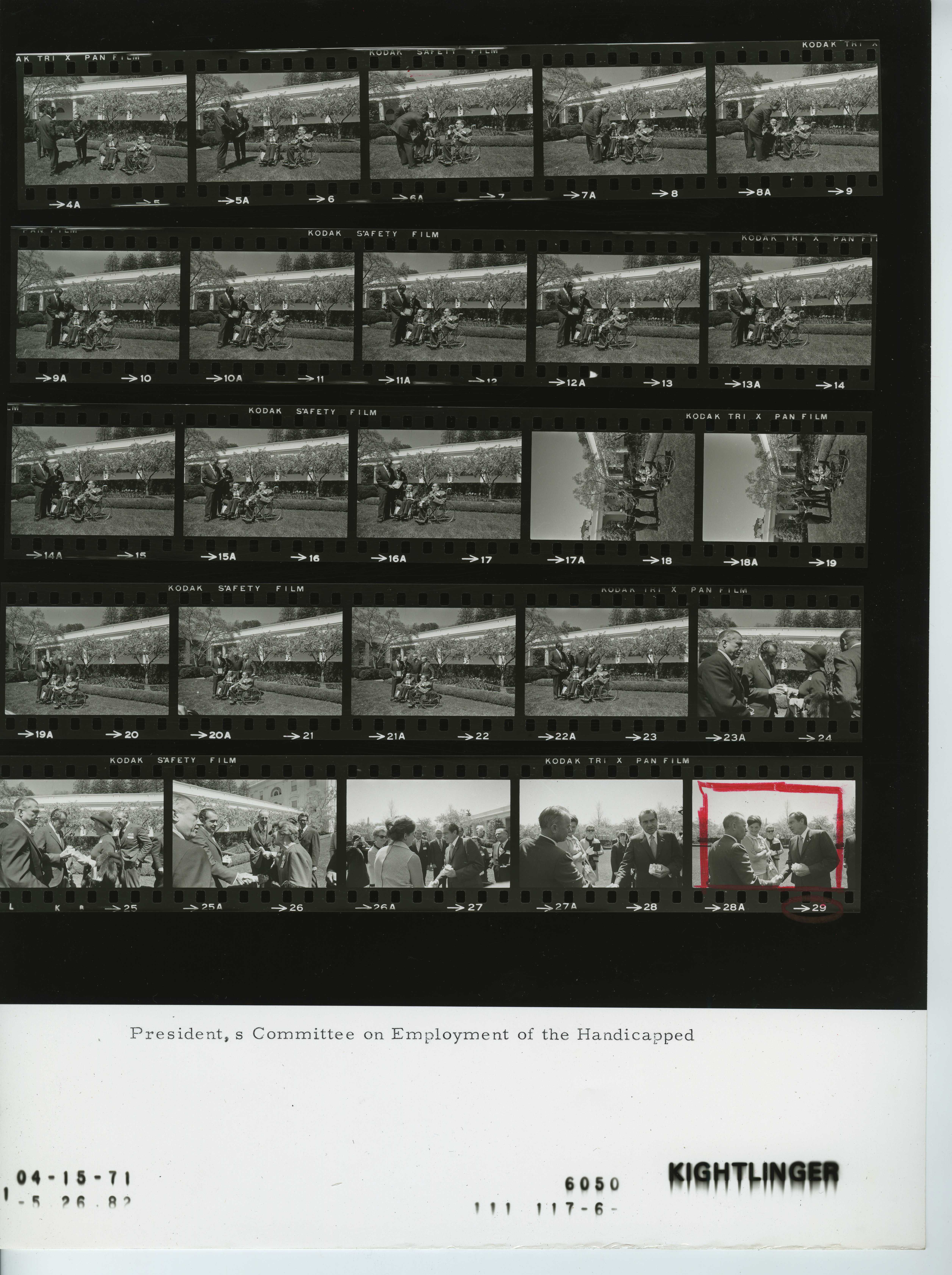
- Frame(s): WHPO-6050-04A-22A, President Nixon meeting with Richard Santin and Robert Santin, who received the President's Trophy Award from the President's Committee on Employment of the Handicapped. 4/15/1971, Washington, D.C. White House, Rose Garden. President Nixon, Richard Santin, Robert Santin, Harold Russell, guests.
- Frame(s): WHPO-6050-23A-28A, President Nixon shaking hands with Henry Watts, Jr., President Muscular Dystrophy Association of America, Mrs. Henry Watts, and others. 4/15/1971, Washington, D.C. White House, Rose Garden. President Nixon, Richard Santin, Robert Santin, Harold Russell, guests.
Roll WHPO-6051 Photographer: unknown | Color or B&W: B&W
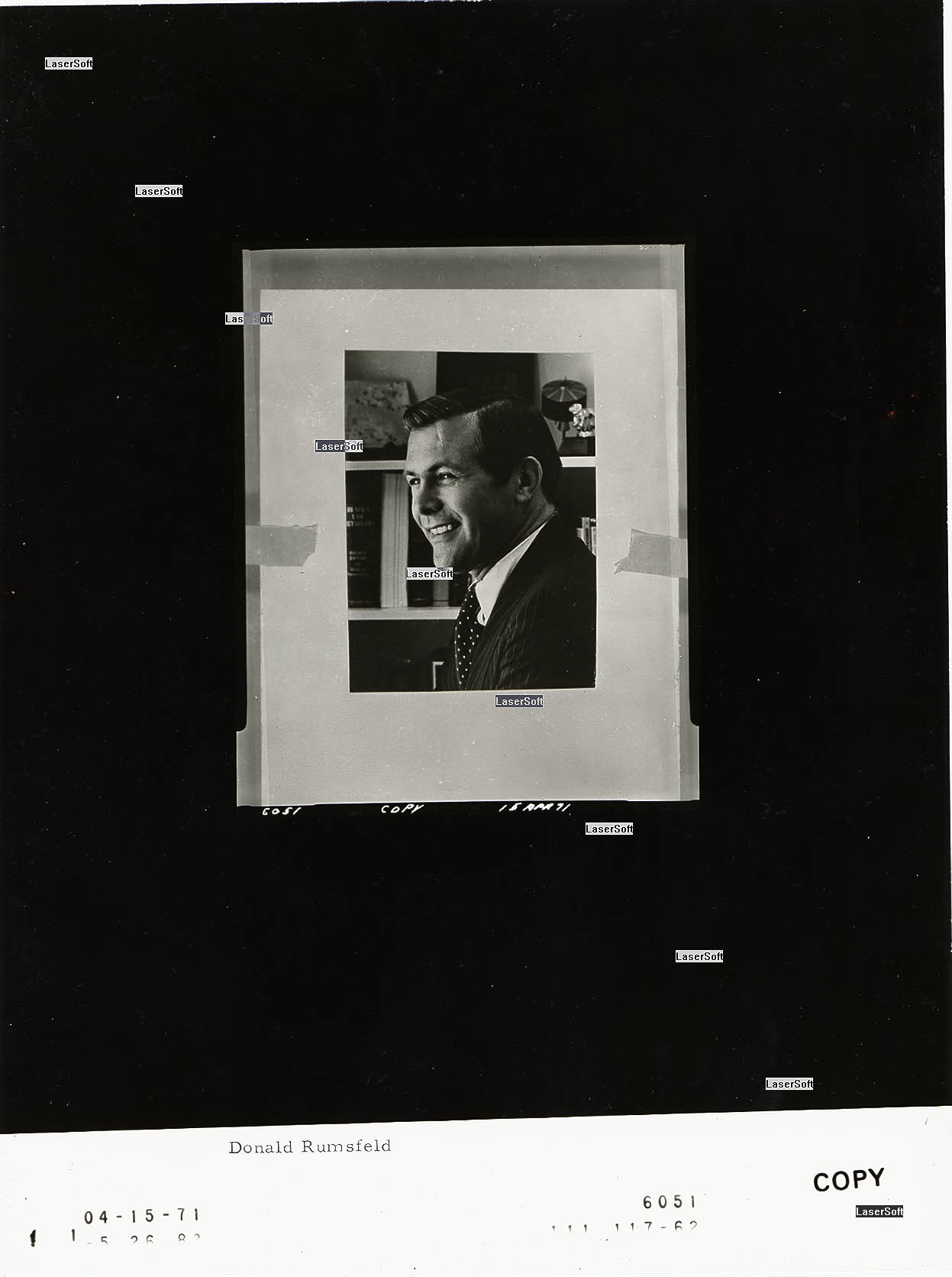
- Frame(s): WHPO-6051-, Copy of a portrait of Donald Rumsfeld. 4/15/1971, Washington, D.C. unknown. Donald Rumsfeld.
- Frame(s): WHPO-6051-[none], Head and shoulders 3/4 portrait study of Donald Rumsfeld smiling. 4/15/1971, Washington, D.C. unknown. Donald Rumsfeld.
Roll WHPO-6052 Photographer: Kightlinger, Jack | Color or B&W: B&W
- Frame(s): WHPO-6052-03-09, John Ehrlichman and Robert Brown meeting with black leaders. 4/15/1971, Washington, D.C. unknown. Ehrlichman, Robert Brown, unidentified black leaders.
Roll WHPO-6053 Photographer: Kightlinger, Jack | Color or B&W: B&W
- Frame(s): WHPO-6053-03-06, President Nixon sitting with Robert Murphy. 4/15/1971, Washington, D.C. Executive Office Building, Presidential Office. President Nixon, Robert Murphy.
- Frame(s): WHPO-6053-06, President Nixon sitting with Robert Murphy. 4/15/1971, Washington, D.C. Executive Office Building, Presidential Office.
Roll WHPO-6054 Photographer: Kightlinger, Jack | Color or B&W: B&W
- Frame(s): WHPO-6054-02A-03A, President Nixon standing with Jack Sutherland, a reporter with "U.S. News & World Report". 4/15/1971, Washington, D.C. White House, Oval Office. President Nixon, Jack Sutherland.
- Frame(s): WHPO-6054-04A-11A, Donald Rumsfeld standing with the Mayor of Oklahoma City. 4/15/1971, Washington, D.C. unknown. Donald Rumsfeld, Mayor of Oklahoma City.
Roll WHPO-6062 Photographer: Kightlinger, Jack | Color or B&W: B&W
- Frame(s): WHPO-6062-03, President Nixon examining an award given by the President's Committee on Employment of the Handicapped. 4/15/1971, Washington, D.C. White House, Rose Garden. President Nixon, Harold Russell, R. Santin.
The White House Communications Agency Sound Recordings Collection contains public statements that took place between 1969 and 1974. Visit the finding aid to learn more.
H - White House Staff Member Recordings
- WHCA-SR-H-373
Press briefing by George Shultz. (4/15/1971, Press Center, White House)
Runtime: 25:00:00
Keywords: Press conferences, news conferences, interviews, media
Production credits: Audio feed supplied by WHCA; Recorded by JMC (initials of WHCA engineer)
Original Format: 1/4-inch reel-to-reel audiotape. Original source type: Original.
The White House Communications Agency Videotape Collection contains “off-the-air” recordings of televised programs produced between 1968 and 1974. Visit the finding aid to learn more.
- WHCA-4283
Weekly News Summary, Tape II.
ALL NETWORKS
Runtime: 01:05:18
1. Smith/Miles: U.S. Ping Pong team in People's Republic of China (table tennis). Time Code Start: 00:00. Keywords: People's Republic of China, sports, ping pong, table tennis, games, organizations, groups, travel, trips. Network: ABC.
2. Smith/Samde: Trade with People's Republic of China. Time Code Start: 01:48. Keywords: People's Republic of China, business, exchanges, agreements, contracts, profits, finance, sales, buying, selling. Network: ABC.
3. Smith/Clark: Democratic Presidential hopefuls attack the White House. Time Code Start: 03:45. Keywords: political parties, Democrats, Democratic Party. Network: ABC.
4. Reasoner: Commentary on the Central Intelligence Agency (CIA) role. Time Code Start: 07:34. Keywords: national security, intelligence gathering, covert activities, spying, espionage. Network: ABC.
5. McGee/Levine: Economy report with Secretary Shultz. Time Code Start: 09:30. Keywords: cabinet, advisors, economy, economics, budgets, finances, recession, inflation, money, wages, costs, unemployment, prices. Network: NBC.
6. McGee: Indochina report. Time Code Start: 12:23. Keywords: Laos, Cambodia, Vietnam War. Network: NBC.
7. McGee/Rich: U.S. Ping Pong players in People's Republic of China (table tennis). Time Code Start: 13:12. Keywords: People's Republic of China, sports, ping pong, table tennis, games, organizations, groups, travel, trips. Network: NBC.
8. Cronkite/Rather: Economy report with Secretary Shultz. Time Code Start: 14:24. Keywords: cabinet, advisors, economy, economics, budgets, finances, recession, inflation, money, wages, costs, unemployment, prices. Network: CBS.
9. Cronkite: Indochina and Paris peace talks. Time Code Start: 16:38. Keywords: Laos, Cambodia, Vietnam, Paris Peace Talks, Vietnam War, treaty, treaties, negotiations. Network: CBS.
10. Cronkite/Mudd: Democratic Presidential Hopefuls test desserts on White House lawn. Time Code Start: 17:58. Keywords: political parties, Democrats, Democratic Party. Network: CBS.
11. Sevareid: Commentary on press relations with the Federal Government. Time Code Start: 19:32. Keywords: media, newspapers, magazines, the press, publications, television, radio. Network: CBS.
Context (External Sources)
The Vanderbilt Television News Archive is the world's most extensive and complete archive of television news. They have been recording, preserving and providing access to television news broadcasts of the national networks since August 5, 1968.
Wikipedia is a free encyclopedia that anyone can edit.