
Introduction
This almanac page for Tuesday, April 11, 1972, pulls together various records created by the federal government and links to additional resources which can provide context about the events of the day.
Previous Date: Monday, April 10, 1972
Next Date: Wednesday, April 12, 1972
Schedule and Public Documents
The Daily Diary files represent a consolidated record of the President's activities. Visit the finding aid to learn more.
The President's day began at The White House - Washington, D. C.
The Weekly Compilation of Presidential Documents made available transcripts of the President's news conferences; messages to Congress; public speeches, remarks, and statements; and other Presidential materials released by the White House.
Digitized versions can be found at HathiTrust.
Each Public Papers of the Presidents volume contains the papers and speeches of the President of the United States that were issued by the White House Office of the Press Secretary during the time period specified by the volume. The material is presented in chronological order, and the dates shown in the headings are the dates of the documents or events. In instances when the release date differs from the date of the document itself, that fact is shown in the text note.
To ensure accuracy, remarks have been checked against audio recordings (when available) and signed documents have been checked against the original, unless otherwise noted. Editors have provided text notes and cross references for purposes of identification or clarity.
The Federal Register is the official daily publication for rules, proposed rules, and notices of federal agencies and organizations, as well as executive orders and other Presidential documents.
The Congressional Record is the official daily record of the debates and proceedings of the U.S. Congress.
Archival Holdings
Any selection of archival documents will necessarily be partial. You should use the documents and folders identified below as a starting place, but consult the linked collection finding aids and folder title lists and the collections themselves for context. Many documents to be found this way do not lend themselves to association with specific dates, but are essential to a complete understanding of the material.
Selective document listing
President's Office Files
The President's Office Files consists of materials drawn together by the Special Files Unit from several administrative subdivisions within the White House Office. It is the handwriting and sensitive papers sent to the Staff Secretary that now comprise much of the President's Office Files. Visit the finding aid to learn more.
- News Summaries, Annotated News Summaries, Box 35, April 1-11, 1972 [4 of 4] [Note: Due to the way News Summary products were compiled, you should also consult nearby days for potentially relevant materials.]
- News Summary, April 11, 1972, (Monday nets, wires, mags)
The H. R. Haldeman Diaries consists of seven handwritten diaries, 36 dictated diaries recorded as sound recordings, and two handwritten audio cassette tape subject logs. The diaries and logs reflect H. R. Haldeman’s candid personal record and reflections on events, issues, and people encountered during his service in the Nixon White House. As administrative assistant to the President and Chief of Staff, Haldeman attended and participated in public events and private meetings covering the entire scope of issues in which the Nixon White House engaged in during the years 1969-1973. Visit the finding aid to learn more.
- Transcript of diary entry (PDF)
Tuesday, April 11.
President got into some discussion this morning, after his Vietnam meeting with Henry on the Russian trip plans. I raised the point of where he'll stop on the way over. And he doesn't like the idea of the Azores any better than anyone else and suggested we try in Majorca which didn't work out and had me call Dick Walter's who suggested some of the bases in Spain but that won't work. President then wanted to try Lucerne but then got back to Austria which was his original suggestion, and we've now agreed to go for Salzburg and to spend two nights. He also wanted me to talk to Billy Graham about whether he should go to the Baptist church while he's in Moscow.
Says he's going to do a press conference with whole press corps in Moscow, wants to shoot for a three-on-one interview in the networks on Wednesday, the 7th after we get back. He had Ziegler in for some discussion of Russian press-- the press corps on the Russian trip. Ron made his pitch about having to have an open listing on it if we can get the Russians to agree to that. The President finally gave into Ron's view on it.
He then got into some ideas on follow-up on the Ehrlichman plan, he wants to have John hold meetings with the surrogate speakers maybe once a week to get them charged up, give them the line, get them to concentrate on the key issues. Also he called later this afternoon and wants Ehrlichman to take over half of the leaders meeting tomorrow and get into to the domestic programs on drugs, busing, and food prices, after Henry does the half-hour on the general war situation.
No new developments today. President had a fairly full afternoon because we moved up some of the schedule from Thursday so he’ll be clear then before he goes to Canada. He's now planning to go to Camp David at noon tomorrow and stay until noon on Thursday.
End of April 11. - Original audio recording (MP3)
The National Archives Catalog is the online portal to the records held at the National Archives, and information about those records. It is the main way of describing our holdings and also provides access to electronic records and digitized versions of our holdings.
The Catalog searches across multiple National Archives resources at once, including archival descriptions, digitized and electronic records, authority records, and web pages from Archives.gov and the Presidential Libraries. The Catalog also allows users to contribute to digitized historical records through tagging and transcription.
Nixon Library Holdings
All National Archives Units
National Security Documents
The President's Daily Brief is the primary vehicle for summarizing the day-to-day sensitive intelligence and analysis, as well as late-breaking reports, for the White House on current and future national security issues. Read "The President's Daily Brief: Delivering Intelligence to Nixon and Ford" to learn more.
The Foreign Relations of the United States series presents the official documentary historical record of major U.S. foreign policy decisions and significant diplomatic activity. Visit the State Department website for more information.
Vol. VIII, Vietnam, January-October 1972
The Easter Offensive, March 30-May 7, 1972
73. Memorandum From Philip A. Odeen of the National Security Council Staff to the President’s Assistant for National Security Affairs (Kissinger), Washington, April 11, 1972
Source: National Archives, Nixon Presidential Materials, NSC Files, NSC Institutional Files (H-Files), Box H–085, Washington Special Actions Group Meetings, WSAG Meeting Vietnam 4/13/72. Secret. Urgent; sent for information.
Vol. XIV, Soviet Union, October 1971-May 1972
U.S.-Soviet Relations and the Spring Offensive in Vietnam, March 30-April 18, 1972
92. Minutes of Washington Special Actions Group Meeting, Washington, April 11, 1972, 10:11-11:42 a.m.
Source: National Archives, Nixon Presidential Materials, NSC Files, NSC Institutional Files (H–Files), Box H–115, WSAG Minutes, Originals. Top Secret; Sensitive. No drafting information appears on the minutes. The meeting was held in the White House Situation Room. According to Kissinger’s Record of Schedule, the meeting lasted from 10:12 to 10:41 a.m. (Library of Congress, Manuscript Division, Kissinger Papers, Box 438, Miscellany, 1968–1976)
Vol. XXI, Chile, 1969-1973
Cool and Correct: The U.S. Response to the Allende Administration, November 5, 1970-December 31, 1972
298. Minutes of a Meeting of the Senior Review Group, Washington, April 11, 1972, 4:08-5:15 p.m.
Source: National Archives, Nixon Presidential Materials, NSC Files, NSC Institutional Files (H-Files), Box H–64, SRG Meeting, Chile, 4/11/72. Secret. The meeting took place in the White House Situation Room. Davis sent the minutes to Kissinger under an April 13 covering memorandum. A copy of the memorandum was sent to Kennedy, Jorden, and Hormats. (Ibid.)
Vol. XXIX, Eastern Europe, 1969-1972
Austria
67. Transcript of Telephone Conversation Among the Presidentʼs Assistant (Haldeman), the Presidentʼs Assistant for National Security Affairs (Kissinger), and President Nixon, Washington, April 11, 1972, 10:50 a.m.
Source: Library of Congress, Manuscript Division, Kissinger Papers, Box 21, Telephone Conversations, Chronological File. No classification marking.
Vol. XXXII, SALT I, 1969-1972
Narrowing the Issues, October 19, 1971-April 18, 1972
257. Backchannel Message From the Chief of the Delegation to the Strategic Arms Limitation Talks (Smith) to the President’s Assistant for National Security Affairs (Kissinger), Helsinki, April 11, 1972, 1600Z
Source: National Archives, Nixon Presidential Materials, NSC Files, Box 427, Backchannel Files, Backchannel Messages, 1972 SALT. Top Secret; Sensitive; Exclusive. Copies were sent to Haig and Sonnenfeldt.
Vol. E-4, Documents on Iran and Iraq, 1969-1972
Iran 1972
177. Telegram 2080 From the Embassy in Iran to the Department of State, Tehran, April 11, 1972, 0645Z
The Embassy conveyed the request of the Shah’s sister, Princess Ashraf, for U.S. Government assistance in refuting the charge that the U.S. Federal Narcotics Bureau had once recommended that she be denied entry to the United States due to a heroin trafficking incident in 1961.
Source: National Archives, RG 59, Central Files 1970–73, POL 15–1 IRAN. Confidential; Exdis. In Telegram 35450 to Tehran, March 1, the Department inquired about a press story regarding a member of the Shah’s entourage, Amir Hushang Davallou, who had been charged in Switzerland with narcotics trafficking. Invoking diplomatic immunity, DAVALLOU had departed the country on the private plane of the Shah, who allegedly cut short his vacation to get DAVALLOU out of the country. The scandal rekindled charges of narcotics trafficking within the Shah’s inner circle. (Ibid, SOC 11–5 SWITZ)
Vol. E-5, Part 1, Documents on Sub-Saharan Africa, 1969-1972
Nigerian Civil War
214. Memorandum From Fred Rondon of the National Security Council Staff to the Presidentʼs Assistant for National Security Affairs (Kissinger), Washington, April 11, 1972
Rondon forwarded Secretary of State Rogersʼ memorandum recommending that Ambassador Iyalla pay a farewell call on the President. National Security Council Staff Secretary Jeanne Davis called the idea a “non-starter” and Deputy Assistant to the President for National Security Affairs Haig disapproved it.
Source: National Archives, Nixon Presidential Materials, NSC Files, Box 742, Country Files, Africa, Nigeria, Vol. I. Confidential. Sent for action. The suggested schedule attached at Tab II is not published, nor is the biographical sketch attached to Rogersʼ memorandum. A handwritten notation on Rondonʼs memorandum states, “disapproved by Genʼl Haig 4–14.” In an April 11 memorandum to John Howe, Jeanne Davis wrote: “I think this is a non-starter. The Presidentʼs office (Parker) has made it plain that the President does not want to see any more departing Ambassadors unless there are overriding reasons why he should. If HAK really wants to support this, we will have to be prepared to have one or two turn-downs before it actually goes through.” Haig wrote on the memorandum, “AgreeDrop it.” Both Haig and John Howe initialed Haigʼs comment. (Ibid.)
Vol. E-10, Documents on American Republics, 1969-1972
Mexico
475. Memorandum From William J. Jorden of the National Security Council Staff to the President’s Assistant for National Security Affairs (Kissinger), Washington, April 11, 1972., Washington, April 11, 1972
In preparation for an April 12 meeting with Foreign Secretary Rabasa, National Security Council staff member Jorden provided President’s Assistant for National Security Affairs Kissinger with an update on the status of salinity negotiations.
Source: National Archives, Nixon Presidential Materials, NSC Files, Box 788, Country Files, Latin America, Mexico, Vol. III, 1972. Secret; Eyes Only. Sent for action; Outside system. Attached but not published are Tabs A, B, and D. Tab A is an April 7, 1971 memorandum from McBride to Kissinger, Tab B is a chart identifying 4 options for resolving the salinity issue, Tab D has 3 letters from Echeverría to Nixon, one dated April 6, the other two undated, and biographical information on Rabasa. Attached at Tab C is a memorandum from Jorden to Kissinger, March 25. It is published as Document 474. Kissinger and Jorden met with Rabasa on April 12, 11:51 a.m.–12:32 p.m. No further record of a conversation has been found. (Library of Congress, Manuscript Division, Papers of Henry A. Kissinger, Box 438, Miscellany, 1968–76, Record of Schedule)
The Kissinger telephone conversation transcripts consist of approximately 20,000 pages of transcripts of Kissinger’s telephone conversations during his tenure as Assistant to the President for National Security Affairs (1969-1974) and Secretary of State (1973-1974) during the administration of President Richard Nixon. Visit the finding aid for more information.
Digitized versions can be found in the National Archives Catalog.
Audiovisual Holdings
Visit the White House Tapes finding aid to learn about the taping system's operation and archival processing.
Old Executive Office Building
- 329-14; 10:31 a.m. - 10:34 a.m.; Nixon, Richard M. (President); Butterfield, Alexander P.; Bull, Stephen B.
- 329-15; Unknown between 12:35 p.m. & 12:37 p.m.; Nixon, Richard M. (President); Sanchez, Manolo
- 329-16; 12:37 p.m. - 12:40 p.m.; Nixon, Richard M. (President); Butterfield, Alexander P.; Bull, Stephen B.
- 329-17; Unknown between 12:40 p.m. & 1:12 p.m.; Nixon, Richard M. (President); Sanchez, Manolo
- 329-18; Unknown between 12:40 p.m. & 1:12 p.m.; Nixon, Richard M. (President); Sanchez, Manolo; White House operator
- 329-19; 1:12 p.m. - 1:14 p.m.; Nixon, Richard M. (President); Butterfield, Alexander P.
- 329-20; Unknown between 1:14 p.m. & 2:06 p.m.; Nixon, Richard M. (President); White House operator
- 329-21; 2:06 p.m. - 2:08 p.m.; Nixon, Richard M. (President); Helms, Richard M.
- 329-22; Unknown between 2:08 p.m. & 2:45 p.m.; Nixon, Richard M. (President); [Unknown person(s)]
- 329-23; Unknown between 2:08 p.m. & 2:45 p.m.; Nixon, Richard M. (President)
- 329-24; Unknown between 2:08 p.m. & 2:45 p.m.; Nixon, Richard M. (President); Sanchez, Manolo
- 329-25; Unknown between 2:08 p.m. & 2:45 p.m.; Nixon, Richard M. (President); Kissinger, Henry A.
- 329-26; 2:45 p.m. - 2:55 p.m.; Nixon, Richard M. (President); Ziegler, Ronald L.
Oval Office
- 706-1; 9:41 a.m. - 10:09 a.m.; Nixon, Richard M. (President); Kissinger, Henry A.
- 706-2; 10:10 a.m. - 12:35 p.m.; Nixon, Richard M. (President); Haldeman, H. R. ("Bob"); [Unknown person(s)]; White House operator; Walters, Vernon A.; Kissinger, Henry A.; Ziegler, Ronald L.; Sanchez, Manolo
- 706-3; Unknown between 12:35 p.m. & 2:56 p.m.; United States Secret Service agents; Bull, Stephen B.
- 706-4; 2:57 p.m. - 3:03 p.m.; Nixon, Richard M. (President); Butterfield, Alexander P.; Ehrlichman, John D.
- 706-5; 3:06 p.m. - 5:05 p.m.; Nixon, Richard M. (President); Peterson, Peter G.; Ehrlichman, John D.; Flanigan, Peter M.; Cole, Kenneth R., Jr.; Bull, Stephen B.; Sanchez, Manolo; Burns, Arthur F.; Shultz, George P.; Connally, John B.; Malek, Frederic V.
- 706-6; Unknown between 5:05 p.m. & 11:59 p.m.; United States Secret Service agents; Sanchez, Manolo
White House Telephone
- 22-102; Unknown between 10:10 a.m. & 10:49 a.m.; Haldeman, H. R. ("Bob"); White House operator
- 22-103; Unknown between 10:10 a.m. & 10:49 a.m.; Haldeman, H. R. ("Bob"); Walters, Vernon A.
- 22-104; Unknown between 10:10 a.m. & 10:49 a.m.; Nixon, Richard M. (President); Haldeman, H. R. ("Bob"); White House operator
- 22-105; Unknown between 10:49 a.m. & 10:54 a.m.; Haldeman, H. R. ("Bob"); Kissinger, Henry A.; Nixon, Richard M. (President)
- 22-106; Unknown between 12:40 p.m. & 1:12 p.m.; Nixon, Richard M. (President); White House operator
- 22-107; 1:12 p.m. - 1:14 p.m.; Nixon, Richard M. (President); Butterfield, Alexander P.
- 22-108; Unknown between 1:14 p.m. & 2:06 p.m.; Nixon, Richard M. (President); White House operator
- 22-109; 2:06 p.m. - 2:08 p.m.; Nixon, Richard M. (President); Helms, Richard M.
- 22-110; Unknown between 6:21 p.m. & 7:41 p.m.; Nixon, Richard M. (President); White House operator
- 22-111; 7:41 p.m. - 7:54 p.m.; Nixon, Richard M. (President); Kissinger, Henry A.
- 22-112; Unknown between 7:54 p.m. & 8:00 p.m.; Nixon, Richard M. (President); White House operator
- 22-113; 8:00 p.m. - 8:01 p.m.; Nixon, Richard M. (President); Hoover, J. Edgar
The White House Photo Office collection consists of photographic coverage of President Richard Nixon meeting with prominent social, political, and cultural personalities; speaking engagements and news conferences of the President and various high-ranking members of the White House staff and Cabinet; Presidential domestic and foreign travel, including Presidential vacations; social events and entertainment involving the First Family, including entertainers present; official portraits of the President, First Family, and high-ranking members of the Nixon administration; the 1969 and 1973 Inaugurals; the President’s 1972 Presidential election campaign appearances (including speeches) and other official activities of the White House staff and the President’s Cabinet from January 20, 1969 until August 9, 1974 at the White House and the Old Executive Office Building; other locations in Washington, DC, such as The Mall; and the Presidential retreats in Camp David, Maryland, Key Biscayne, Florida, and San Clemente, California. Visit the finding aid to learn more.
Roll WHPO-8865 Photographer: Schumaker, Byron | Color or B&W: Color
- Frame(s): WHPO-8865-, Pat Nixon standing outside with Judy Agnew and two other women in Red Cross uniforms and attending the Red Cross Luncheon. 4/11/1972, Washington, D.C. Capitol Hill. Pat Nixon, Judy Agnew, unidentified women, musician.
Roll WHPO-8866 Photographer: Kightlinger, Jack | Color or B&W: B&W
- Frame(s): WHPO-8866-, Members of the Arkansas State Legislature in group shots. 4/11/1972, Washington, D.C. White House, South Lawn. Arkansas state legislators.
Roll WHPO-8867 Photographer: Knudsen, Robert L. | Color or B&W: B&W
- Frame(s): WHPO-8867-, President Nixon, Hugh Scott, Mike Mansfield, and Henry Kissinger standing by a large map of China on an easel. 4/11/1972, Washington, D.C. White House, Map Room. President Nixon, Hugh Scott, Mike Mansfield, Henry Kissinger.
Roll WHPO-8868 Photographer: Kightlinger, Jack | Color or B&W: B&W
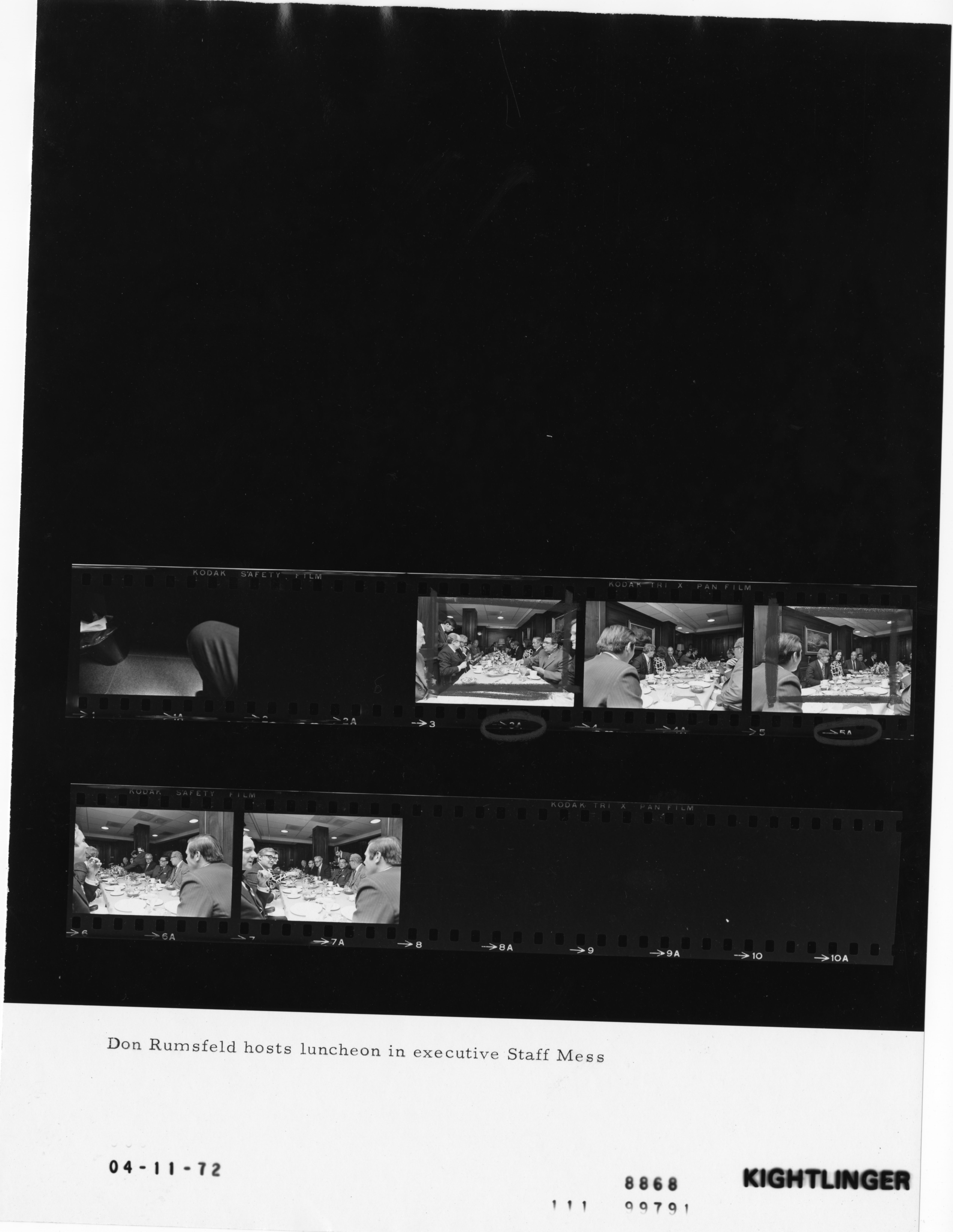
- Frame(s): WHPO-8868-, Rumsfeld hosting a luncheon. 4/11/1972, Washington, D.C. Executive Staff Mess. Rumsfeld, staffers.
Roll WHPO-8869 Photographer: Kightlinger, Jack | Color or B&W: Color
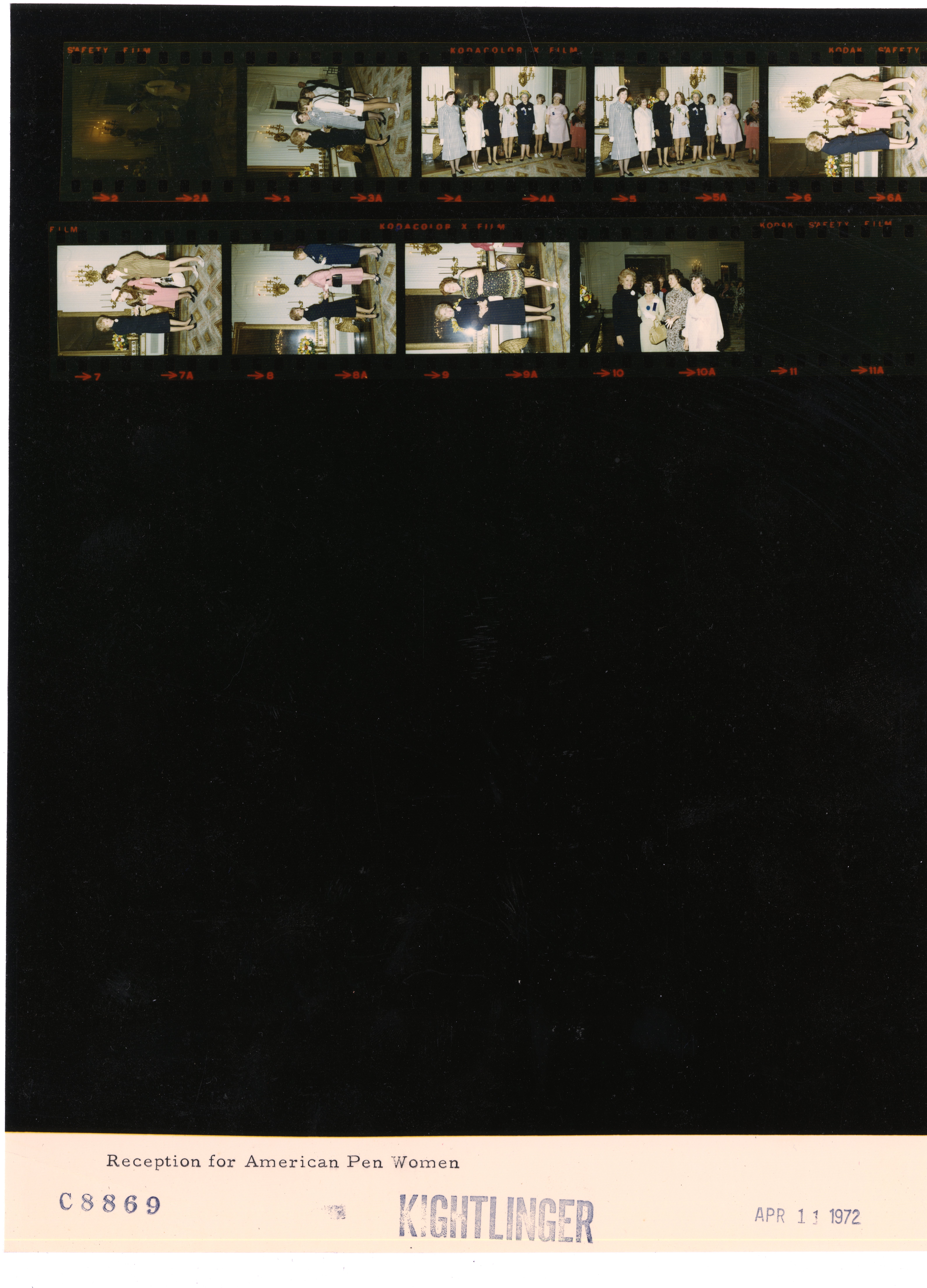
- Frame(s): WHPO-8869-, Pat Nixon greeting women during a reception for American Pen Women. 4/11/1972, Washington, D.C. White House, State Dining Room. Pat Nixon, American Pen Women.
The White House Communications Agency Videotape Collection contains “off-the-air” recordings of televised programs produced between 1968 and 1974. Visit the finding aid to learn more.
- WHCA-5273
Weekly News Summary, Tape II.
ALL NETWORKS
Runtime: 1:30
16. The situation in South Vietnam: comments from State Department and Pentagon; increase in U.S. troops; film report of the fighting in South Vietnam. Time Code Start: 33:48. Keywords: United States Department of Defense headquarters, Armed Forces, Vietnam War, military, troops, increases, reports. Network: ABC.
17. Report on proposed Senate bill limiting Presidential war powers. Time Code Start: 36:49. Keywords: Presidents,. Network: ABC.
18. Film report of Vice President Agnew speech on leftist leaning of school teachers. Time Code Start: 37:26. Keywords: Vice Presidents, speeches, schools, faculty, politics. Network: ABC.
19. Reasoner: Commentary on New York Mafia killings and the gangland mystique. Time Code Start: 39:12. Keywords: organized crime syndicates, assassinations, killings, shootings, gangs. Network: ABC.
20. Situation in South Vietnam. Film report from Chon Thang, Republic of South Vietnam on drive to support beleaguered South Vietnamese army, with comments from Major General James Hollingsworth (U.S. Military Advisor). Time Code Start: 40:55. Keywords: Vietnam War, Armed Forces, Air Force, Army, Navy, Marines, Coast Guard, National Guard, officials. Network: NBC.
21. Report on President Nixon's "Special Action Group" and reports to the President on the communist offensive. Time Code Start: 43:43. Keywords: Presidents,. Network: NBC.
22. U.S. aircraft carriers dispatched to Vietnam; film report of U.S.S. Saratoga on route to South Vietnam from Jacksonville, Florida. Time Code Start: 45:07. Keywords: Vietnam War, Navy, ships, aircraft. Network: NBC.
23. Report on the busing situation and the Nashville, Tennessee, busing case; film report on court proceedings in Cincinnati, Ohio. Time Code Start: 47:28. Keywords: bills, laws, legislation, desegregation, racism, racial discrimination, African Americans, schools, students, transportation, reports. Network: NBC.
24. Report on President Nixon's Phase II economic plan. Time Code Start: 49:58. Keywords: wage and price controls, freezes, prices, costs, increases, decreases, economy, economics, budgets, finances, recession, inflation, money. Network: NBC.
25. Report on the number of hours Americans work to pay taxes. Time Code Start: 50:19. Keywords: taxes, taxation, revenue, employment. Network: NBC.
26. Brinkley: Commentary on federal taxes. Time Code Start: 50:55. Keywords: taxes, taxation, revenue. Network: NBC.
27. Kleindienst's nomination for Attorney General and alleged involvement in obstruction of justice. Film report from Senate Judiciary committee with comments by Senator Ervin re: the Kleindienst nomination. Time Code Start: 53:22. Keywords: law officials, nominations, Watergate, Senate committee hearings, investigations, testimony, testify, cover-ups, break-in, burglary, theft, plumbers, scandals. Network: NBC.
28. Report on the International Telephone & Telegraph (ITT Corporation) case; Bob Wilson calls for perjury charges. Time Code Start: 55:18. Keywords: International Telephone & Telegraph, communications, world, corporations, conglomerates, campaign funding, investigations, hearings. Network: NBC.
29. American ground troops move to close support for Army of the Republic of Viet Nam (ARVN) troops in combat. Film reports from Phu Bai and Da Nang. Time Code Start: 55:45. Keywords: Vietnam War, South Vietnamese Army (SVA), mlitary, troops, decreases, withdrawals. Network: NBC.
30. Pentagon comments on the use of American ground troops and on withholding information about air strikes from American media. Time Code Start: 57:34. Keywords: United States Department of Defense headquarters, Armed Forces, Vietnam War, aircraft, bombings. Network: NBC.
31. Reports on shore bombardment of Vietnamese targets by U.S. warships, B-52 strikes around the Demilitarized Zone (DMZ) , fighting throughout Vietnam. Time Code Start: 58:24. Keywords: Vietnam War, military, aircraft, ships, bombings. Network: NBC.
32. Adm. Moorer confident that tide of battle turning in favor of Army of the Republic of Viet Nam (ARVN). Film from Quang Tri and An Loc re. increased morale of Vietnamese and aftermath of battles. Time Code Start: 59:36. Keywords: Vietnam War, South Vietnamese Army (SVA), military, troops. Network: NBC.
33. President Nixon administration statistics on the amount of Soviet aid to North Vietnam. Time Code Start: 65:26. Keywords: Soviet Union, Russia, USSR, Vietnam War, foreign aid, funding, finances. Network: NBC.
34. Report on Justice Department action on the International Telephone & Telegraph (ITT Corporation) case. Time Code Start: 67:05. Keywords: International Telephone & Telegraph, communications, world, corporations, conglomerates, campaign funding, investigations, hearings. Network: NBC.
35. Excess profits by large corporations. Donald Rumsfeld comments. Time Code Start: 67:32. Keywords: cabinet, advisors, interviews, businesses, investments, money. Network: NBC.
36. Film report of Vice President Agnew attack on the leftist bias of intellectuals at a luncheon in Washington, D.C.. Time Code Start: 67:50. Keywords: Vice Presidents, speeches, politics. Network: NBC.
37. "Jesus Freaks" registering as Republican voters. Time Code Start: 70:19. Keywords: Vote, voters, voting, Presidential elections, voting, registrations, political parties, Republicans, GOP, Christians, counterculture, religion. Network: NBC.
38. United Mine Workers President (UMW) W.A. Tony Boyle on trial for murder for hire of Miners Union leader Joseph Yablonski. Time Code Start: 71:01. Keywords: trials, killings, deaths, crimes, violence, homicides, murders, shootings, assassinations, labor, unions, leaders. Network: NBC.
39. Film report on segregated school buses in Bradley, Arizona (no city in AZ named Bradley - possibly Buckeye or Bisbee) and upcoming Justice Department suit. Time Code Start: 71:33. Keywords: desegregation, racism, racial profiling, racial discrimination, civil rights, African Americans, schools, students. Network: NBC.
40. Doctor Tkach (President Nixon's doctor) comments on acupuncture. Time Code Start: 74:43. Keywords: Presidents, health, medical, doctors, physicians, tests, examinations, interviews. Network: NBC.
Context (External Sources)
The Vanderbilt Television News Archive is the world's most extensive and complete archive of television news. They have been recording, preserving and providing access to television news broadcasts of the national networks since August 5, 1968.
Wikipedia is a free encyclopedia that anyone can edit.