
Introduction
This almanac page for Thursday, March 6, 1969, pulls together various records created by the federal government and links to additional resources which can provide context about the events of the day.
Previous Date: Wednesday, March 5, 1969
Next Date: Friday, March 7, 1969
Schedule and Public Documents
-
The Daily Diary files represent a consolidated record of the President's activities. Visit the finding aid to learn more.
The President's day began at The White House - Washington, D. C.
-
The Weekly Compilation of Presidential Documents made available transcripts of the President's news conferences; messages to Congress; public speeches, remarks, and statements; and other Presidential materials released by the White House.
Appointments and Nominations
- Central Intelligence Agency (5 Weekly Comp. Pres. Doc. 374, March 6, 1969)
Announcement of Intention To Nominate Lt. Gen. Robert E. Cushman, Jr., as Deputy Director.
Awards and Citations
- Federal Woman's Award Winners (5 Weekly Comp. Pres. Doc. 373, March 6, 1969)
List of Winners Meeting With the President at the White House.
Checklist of White House Press Releases
The releases listed below, made public by the Office of the White House Press Secretary during the period covered by this issue, are not included in the issue.
- Biography of Nathaniel Samuels.
- Press conference of Secretary of State Rogers and Nathaniel Samuels.
Digest of Other White House Announcements
Following is a listing of items of general interest which were announced in the press but not made public as formal White House press releases during the period covered by this issue. Appointments requiring Senate approval are not included since they appear in the list of nominations submitted to the Senate, below.
- Former Governor William Scranton of Pennsylvania met with the President at the White House.
- The President attended the funeral of his uncle, Dr. Ernest Nixon, at State College, Pa.
Nominations Submitted to the Senate
Does not include promotions of members of the Uniformed Services, nominations to the Service Academies, or nominations of Foreign Service Officers.
- BENJAMIN F. HOLMAN, of the District of Columbia, to be Director, Community Relations Service for the term of 4 years, vice Roger W. Wilkins.
- THOMAS O. PAINE, of California, to be Administrator of the National Aeronautics and Space Administration.
- ROBERT D. MORAN, of Massachusetts, to be Administrator of the Wage and Hour Division, Department of Labor.
- JOHN H. SHAFFER, of Maryland, to be Administrator of the Federal Aviation Administration.
- REGINALD NORMAN WHITMAN, of Minnesota, to be Administrator of the Federal Railroad Administration.
- CARLOS C. VILLARREAL, of California, to be Urban Mass Transportation Administrator.
- LT. GEN. ROBERT E. CUSHMAN, JR., U.S. Marine Corps, to be Deputy Director, Central Intelligence Agency, with his current rank of lieutenant general while so serving.
- NATHANIEL SAMUELS, of New York, to be a Deputy Under Secretary of State.
- HOLLIS M. DOLE, of Oregon, to be an Assistant Secretary of the Interior.
- LESLIE LLOYD GLASGOW, of Louisiana, to be Assistant Secretary for Fish and Wildlife, Department of the Interior.
- CHARLES H. MEACHAM, of Alaska, to be Commissioner of Fish and Wildlife, Department of the Interior.
- NILS A. BOE, of South Dakota, to be an Assistant Director of the Office of Emergency Preparedness.
- Central Intelligence Agency (5 Weekly Comp. Pres. Doc. 374, March 6, 1969)
-
The Federal Register is the official daily publication for rules, proposed rules, and notices of federal agencies and organizations, as well as executive orders and other Presidential documents.
-
The Congressional Record is the official daily record of the debates and proceedings of the U.S. Congress.
Archival Holdings
Any selection of archival documents will necessarily be partial. You should use the documents and folders identified below as a starting place, but consult the linked collection finding aids and folder title lists and the collections themselves for context. Many documents to be found this way do not lend themselves to association with specific dates, but are essential to a complete understanding of the material.
-
Selective document listing
President's Office Files
The President's Office Files consists of materials drawn together by the Special Files Unit from several administrative subdivisions within the White House Office. It is the handwriting and sensitive papers sent to the Staff Secretary that now comprise much of the President's Office Files. Visit the finding aid to learn more.
- Annotated News Summaries, Box 28, News Summaries - March 1969 [During this period, the Staff Secretary only removed pages from the News Summaries which contained President Nixon's handwriting, often leaving the document with no date. Although there are no specific documents dated March 6, 1969, you should also consult the full folder for the month.]
President's Personal File
The President's Personal File is essentially a President's secretary's file, kept by Rose Mary Woods, personal secretary to the President, for two purposes: (1) preserving for posterity a collection of documents particularly close to the President, whether because he dictated or annotated them, or because of the importance of the correspondent or the event concerned and (2) giving appropriate attention–letters of gratitude, invitations to White House social events, and the like–to members and important friends and supporters of the Nixon administration. This generalization does not describe all the varied materials of a file group which is essentially a miscellany, but it does identify the reason for the existence of the file group's core. Visit the finding aid to learn more.
- President's Speech File
- Box 46, March 6, 1969, Visit to CIA
-
The H. R. Haldeman Diaries consists of seven handwritten diaries, 36 dictated diaries recorded as sound recordings, and two handwritten audio cassette tape subject logs. The diaries and logs reflect H. R. Haldeman’s candid personal record and reflections on events, issues, and people encountered during his service in the Nixon White House. As administrative assistant to the President and Chief of Staff, Haldeman attended and participated in public events and private meetings covering the entire scope of issues in which the Nixon White House engaged in during the years 1969-1973. Visit the finding aid to learn more.
- Transcript of diary entry (PDF)
Thursday, March 6.
Day started with a schedule snafu - and stayed pretty well screwed up. Problem was President beat Chapin and his crew in, and the schedule they had left on his desk was wrong. He started out with Kissinger - then added Rogers - about ABM, and used up all the time until start of UAC. It was screwed up because Moynihan had not properly staffed the agenda, and had sneaked in a four page release and a new volunteer plan. President pretty upset. Hope our plan for Ehrlichman to oversee domestic matters will overcome this.
President met with Scranton to try to persuade him to take over OEO. According to Ehrlichman, President gave him complete control of everything - until John snatched it back.
President gone most of the afternoon for Uncle Ernest's funeral in Pennsylvania.
I had a couple of sessions in between. He's trying to figure a way to get over our activities and accomplishments in the domestic area. Also going back and forth on whether to go to California for the weekend, to see the property. Some further talk regarding office decor. I met again with Williamsburg guy, they'll take on the project. President ordered name change from the Mansion to the Residence.
Stans worried about details of his European mission - President wants him to work it out with Kissinger and State. President decided to drop idea of Vatican representative.
GOP leadership meeting for cocktails in the library - fire warming, very homey. General discussion of campus disorders, Finch HEW school problem, special election in Tennessee, ABM, NPT and electoral reform. Not much progress.
I had dinner date with Finch in the Mess - halfway through phone rang - President asked us to join him for dinner - told him we'd come for dessert. Went to Residence, President alone in Lincoln Sitting Room eating dinner on TV table, by the fire. Sad – trying to escape Helene Drown. Was in great spirits. Talked for couple of hours - mainly about HEW problems, and some politics. Decided not to go to California. Pushing hard to do something regarding campus disorders. Doesn't want to let Reagan get the whole ride on this issue. Leaders urged this too. Probably will make radio address. - Handwritten diary entry (JPG)
- Transcript of diary entry (PDF)
-
The National Archives Catalog is the online portal to the records held at the National Archives, and information about those records. It is the main way of describing our holdings and also provides access to electronic records and digitized versions of our holdings.
The Catalog searches across multiple National Archives resources at once, including archival descriptions, digitized and electronic records, authority records, and web pages from Archives.gov and the Presidential Libraries. The Catalog also allows users to contribute to digitized historical records through tagging and transcription.
Nixon Library Holdings
All National Archives Units
National Security Documents
-
The President's Daily Brief is the primary vehicle for summarizing the day-to-day sensitive intelligence and analysis, as well as late-breaking reports, for the White House on current and future national security issues. Read "The President's Daily Brief: Delivering Intelligence to Nixon and Ford" to learn more.
- President's Daily Brief of 06 March 1969 [consult link for visuals and extent of redactions]
The President's Daily Brief
6 March 1969
19
Top Secret
LATE NOTES FOR THE PRESIDENT'S DAILY BRIEF OF
6 MARCH 1969
[redacted]
7 March 1969
LATE NOTES FOR THE PRESIDENT'S DAILY BRIEF OF
6 MARCH 1969
I. MAJOR PROBLEMS
MIDDLE EAST
There is nothing significant to report.
EUROPE
There is nothing significant to report.
SOVIET AFFAIRS
The major Soviet newspapers carried a TASS item on Thursday summarizing President Nixon's press conference of 4 March. The article quotes the President on "new confidence and faith" between the US and its European allies, appending the President's disclaimer about expecting major results from exchanges of diplomatic niceties at the highest level. President Nixon's stress on US support for NATO was also brought out.
On US-Soviet relations, TASS paraphrases the President's statement that possibilities exist for bilateral negotiations limiting strategic weapons as well as on other problems. The article also notes the President's comment that the European trip was in preparation for an East-West summit meeting.
Embassy Moscow comments that while Soviet coverage of the press conference is highly selective, treatment of those portions presented is factual, continuing the neutral trend of Soviet reporting of the President's foreign policy pronouncements. Moscow is undoubtedly pleased to be able to show that, although the President reaffirmed US support for NATO, another reason for his trip was to prepare the groundwork for a top-level meeting with the
Soviets. [redacted]
* * *
The Helmstedt-Berlin autobahn has been open since 1200 EST yesterday. [redacted]
VIETNAM
[redacted]
* * *
Reports overnight say that enemy military action continues at a relatively low level. [redacted]
II. OTHER IMPORTANT DEVELOPMENTS
There is nothing significant to report.
I. MAJOR PROBLEMS
MIDDLE EAST
We understand that the student body at the Hebrew University in Jerusalem has a very high percentage of army veterans. This is yet another reason why the government will feel obliged to take some kind of retaliatory action for today's bombing in the university cafeteria. Israeli tempers are al9o getting short once again because of persistent Egyptian sniping along the Suez Canal. For a variety of reasons--including Eban's visit to the US--the Israeli Government, however, may find it politic to postpone any retaliatory measures a bit longer.
* * *
[redacted]
* * *
[redacted]
* * *
[redacted]
EUROPE
The French trade union representatives walked out of the talks with management today. The fear of a period of labor unrest will distress already worried
French speculators, and more pressure on the franc is certain to result.
Gold prices had already risen to record levels in London and Paris because of fears that the talks would produce inflationary settlement. The London closing price today was $43.25 an ounce; in Paris, gold reached $47.74 an ounce. Despite the existence of extensive exchange controls, money has been finding its way out of France, with one report stating that as much as 75 percent of the demand for gold in London comes from France.
Before the walkout, labor leaders had already called a general strike for next Tuesday. They learned the lesson of too much caution last May and are consulting with the rank and file about the extent and duration of the strike. Some wildcat walkouts have already begun.
* * *
Our embassy in Bonn feels that the election yesterday of Gustav Heinemann as West Germany's next president will have a beneficial effect on its relations and reputation abroad. Heinemann's anti-Nazi reputation and his election over the opposition of the rightist National Democratic Party are plusses. The victory actually is a gain in prestige for the entire SPD and should mean votes in the Bundestag elections in September. Finally, Heinemann was supported throughout the three ballots by the bulk of the Free Democratic Party electors, which makes a coalition between the SPD and FDP following the fall election more of a possibility.
SOVIET AFFAIRS
The excitement in Berlin is probably about over. The military "exercises" that served as a pretext for autobahn closures seem to be coming to an end. Some Soviet units which have operated along and across the autobahns west of Berlin since the first of the week are returning to their garrisons. Their movements were used again today to justify intermittent autobahn closures.
Soviet air activity was also considerably reduced. [redacted] In their propaganda output this morning, neither the East Germans nor the Soviets hinted at any further countermeasures in the Berlin area.
In a post-mortem on the activities of the last week, our mission in Berlin concluded that the East Germans obviously favored taking stronger action but that Moscow apparently decided its interest in talks with the US took precedence over pleasing Ulbricht.
VIETNAM
The Communists' speeches in Paris today continued the theme that their military action in South Vietnam is a response to allied military pressure and justified on the basis of "self-defense." The Communists do not say so explicitly, but they obviously are trying to leave an impression [redacted] that they are ready to bargain on the issue of mutual de-escalation. The Front's Madame Binh is quoted by the Western press as saying that the Front has sought to "de-escalate" the war but that the US was only intensifying it. This may be a distorted version of her remarks, but the idea is implicit in many other recent Communist statements.
Whether this talk of de-escalation becomes a full-blown campaign depends in part on how the US moves next and, more importantly, on what results the Communists can produce through their military offensive over the next several weeks. The current drive could culminate in a "peace campaign" emphasizing political action against the Saigon government and diplomatic pressure on the US to curb allied military operations.
The Communists will probably stop short of calling for a cease-fire, but they may well become bolder in suggesting a readiness to scale down their military activity in return for similar action by the US.
* * *
Communist mortar crews in the southern half of the Demilitarized Zone lightly shelled South Vietnamese positions in northeastern Quang Tri Province for the fifth straight day on 5 March. No allied casualties were reported. In the area just below the central DMZ, captured enemy documents tend to confirm that elements of the 246th NVA Regiment are operating south of the zone. It is not clear when or how the 246th returned to South Vietnam after pulling back into North Vietnam last summer, although we presume it crossed over the DMZ. The documents show that the 246th took part in the heavy attacks on two US Marine bases in north-central Quang Tri Province on 25 February. Other North Vietnamese units noted south of the DMZ recently are the 27th and 138th regiments.
With the exception of the early morning rocket attack on Saigon, enemy initiated activity on 6 March continued at the same reduced level as the past few days.
II. OTHER MAJOR DEVELOPMENTS
PERU
[redacted]
CAMBODIA
Sihanouk made his first public references today to President Nixon's letter and the possibility of a rapprochement with the US. Although he did not go into details on the recent exchange at his press conference in Phnom Penh, it is clear from his remarks that Sihanouk has not yet received the President's follow-up to the letter. He offered, however, to release four recently captured US military officers if asked to do so by the President.
Otherwise the tone of Sihanouk's remarks were clearly defensive and suspicious. He once again accused the US of mounting daily attacks across the Cambodian border. In doing so, Sihanouk made his most explicit public admission that North Vietnamese units are based in northeast Cambodia. He denied, however, as he has in the past, that the Duck Bill region in the southeast and other areas, which he said were regularly bombed by US planes, were sanctuaries of the Viet Cong.
- President's Daily Brief of 06 March 1969 [consult link for visuals and extent of redactions]
-
The Foreign Relations of the United States series presents the official documentary historical record of major U.S. foreign policy decisions and significant diplomatic activity. Visit the State Department website for more information.
Vol. VI, Vietnam, January 1969-July 1970
Vietnam, January 1969-July 1970
29. Memorandum From the President’s Assistant for National Security Affairs (Kissinger) to President Nixon, Washington, March 6, 1969
Source: National Archives, Nixon Presidential Materials, NSC Files, Box 3, President’s Daily Briefs. Top Secret; Sensitive.
Vol. XII, Soviet Union, January 1969-October 1970
Initial Contacts, January-April 22, 1969
23. Memorandum From the President’s Assistant for National Security Affairs (Kissinger) to President Nixon, Washington, March 6, 1969
Source: National Archives, Nixon Presidential Materials, NSC Files, Box 489, President’s Trip File, Dobrynin/Kissinger, 1969, Part 2. Secret; Nodis. The memorandum indicates the President saw it. This conversation, like most meetings between Kissinger and Dobrynin, was private and occurred without interpreters or secretaries.
Vol. XVII, China, 1969-1972
China, 1969
9. Special National Intelligence Estimate , Washington, March 6, 1969
Source: National Archives, Nixon Presidential Materials, NSC Files, NSC Institutional Files (H-Files), Box H–037, SRG Meeting, China NPG [Part 1], 5/15/69. Secret; Controlled Dissem. According to a note on the covering sheet, the CIA and intelligence organizations of the Departments of State and Defense, and the NSA participated in the preparation of this estimate. All members of the USIB concurred with the estimate on March 6 except for the representatives from the AEC and FBI, who abstained on the grounds that the subject was outside their jurisdiction. For the full text of this SNIE, see Tracking the Dragon, pp. 527–539. This estimate was included with the materials for the May 15 SRG meeting. According to a March 5 memorandum from Holdridge (then with INR/REA) to George C. Denney, Jr. (INR/OD), this SNIE was discussed by the USIB on February 26 and 28. Holdridge mentioned that the INR/REA staff felt that the original version had “overemphasized the failure of Peking’s foreign policy in Asia and overlooked the major role assured for China by her location, population, and traditional fears of her neighbors.” He also emphasized that “the Chinese may hope that possession of a strategic [nuclear] capability will limit the possibility of a nuclear attack by the U.S. and the USSR and thus give China a freer hand to support people’s war, or more remotely, engage in conventional war in Asia.” (Ibid., RG 59, INR/EAP Files: Lot 90 D 110, SNIE 13–69)
Vol. XXXIV, National Security Policy, 1969-1972
Parity, Safeguard, and the SS-9 Controversy
19. Memorandum From the Under Secretary of State (Richardson) and the Director of the Arms Control and Disarmament Agency (Smith) to Secretary of State Rogers, Washington, March 6, 1969
Source: National Archives, RG 59, Entry No. 5000, S/S–NSC Meeting Files, 1969–70: Lot 71 D 175, Box 3, NSC Meeting, March 5, 1969. Secret. Apparently drafted on March 5. Cleared by Johnson.
Vol. E-4, Documents on Iran and Iraq, 1969-1972
Iran 1969
4. Memorandum From the Country Director for Iran (Eliot) to the Assistant Secretary of State for Near Eastern and South Asian Affairs (Sisco) , Washington, March 6, 1969
Eliot recommended that Sisco inform Iranian Ambassador Ansary in their upcoming meeting that the United States could not intervene with the oil companies over the dispute with Iran.
Source: National Archives, RG 59, Central Files 1967–69, POL 17 IRAN-US. Secret. Drafted by Eliot; cleared by James E. Akins (E/ORF/FSE). In Telegram 35431, March 7, the Department advised the Embassy that Sisco had followed Eliot’s suggestions in his meeting with Ansary. (Ibid., PET 6 IRAN)
Vol. E-4, Documents on Iran and Iraq, 1969-1972
Iraq 1969-1971
253. Telegram 1474 From the Embassy in Belgium to the Department of State, Brussels, March 6, 1969, 1742Z
The Embassy alerted the Department that Baghdad might demand that the United States sell its Embassy property in Baghdad in exchange for the exit visas of the recently-released American hostages.
Source: National Archives, RG 59, Central Files 1967–69, POL 17 US-IRAQ. Confidential. Repeated to Beirut, London, and Tehran. In telegram 33546 to Brussels, March 7, the Department rejected the notion of paying the Iraqis ransom for the former U.S. hostages. (Ibid.)
Vol. E-5, Part 1, Documents on Sub-Saharan Africa, 1969-1972
Nigerian Civil War
49. Telegram 2010 from the Embassy in Nigeria to the Department of State, Lagos, March 6, 1969, 1500Z
Mathews reported that he told Commissioner for External Affairs Arikpo he had been instructed to discuss Nigerian Air Force bombing of civilians in rebel territory. Arikpo said it was not policy or intent of the federal military government to harm civilians and that the government was tightening controls over the Nigerian Air Force to minimize casualties.
Source: National Archives, RG 59, Central Files 1967–69, POL 27 Biafra-Nigeria. Secret; Priority. Repeated to Addis Ababa, Cotonou, London, Ottawa, Paris, Yaounde, USUN, and Geneva.
Vol. E-10, Documents on American Republics, 1969-1972
Dominican Republic
267. Memorandum From the Deputy Director for Plans (Karamessines) to the Director of Central Intelligence (Helms), Washington, March 6, 1969. , Washington, March 6, 1969
Deputy Director Karamessines reported that the Dominican Popular Movement (MPD) planned for an anti-government uprising which ultimately failed. CIA informed the Dominican Government, which responded by guarding the anticipated targets of the MPD and forestalling the uprising before it could get underway.
Source: Central Intelligence Agency, ODDP Registry, Job Number 80–B01086A. Secret. The memorandum bears Karamessines’ typed signature with an indication that he signed the original.
Peru
580. Special National Intelligence Estimate 97–69, Washington, March 6, 1969. , Washington, March 6, 1969
This report, titled “Peru and the U.S.: The Implications of the IPC Controversy,” predicted that the Velasco regime will almost certainly not meet the requirements of U.S. law or compensation of the IPC. Therefore, the crisis with Peru over the IPC will probably be significant, and the U.S.-Latin American relations could deteriorate.
Source: National Archives, Nixon Presidential Materials, NSC Files, NSC Institutional Files (H-Files), Box H–34, Review Group Peru, 3/13/69. Secret; Controlled Dissem. Evidence that the Review Group meeting was held has not been found.
-
The Kissinger telephone conversation transcripts consist of approximately 20,000 pages of transcripts of Kissinger’s telephone conversations during his tenure as Assistant to the President for National Security Affairs (1969-1974) and Secretary of State (1973-1974) during the administration of President Richard Nixon. Visit the finding aid for more information.
Digitized versions can be found in the National Archives Catalog.
Audiovisual Holdings
-
The White House Photo Office collection consists of photographic coverage of President Richard Nixon meeting with prominent social, political, and cultural personalities; speaking engagements and news conferences of the President and various high-ranking members of the White House staff and Cabinet; Presidential domestic and foreign travel, including Presidential vacations; social events and entertainment involving the First Family, including entertainers present; official portraits of the President, First Family, and high-ranking members of the Nixon administration; the 1969 and 1973 Inaugurals; the President’s 1972 Presidential election campaign appearances (including speeches) and other official activities of the White House staff and the President’s Cabinet from January 20, 1969 until August 9, 1974 at the White House and the Old Executive Office Building; other locations in Washington, DC, such as The Mall; and the Presidential retreats in Camp David, Maryland, Key Biscayne, Florida, and San Clemente, California. Visit the finding aid to learn more.
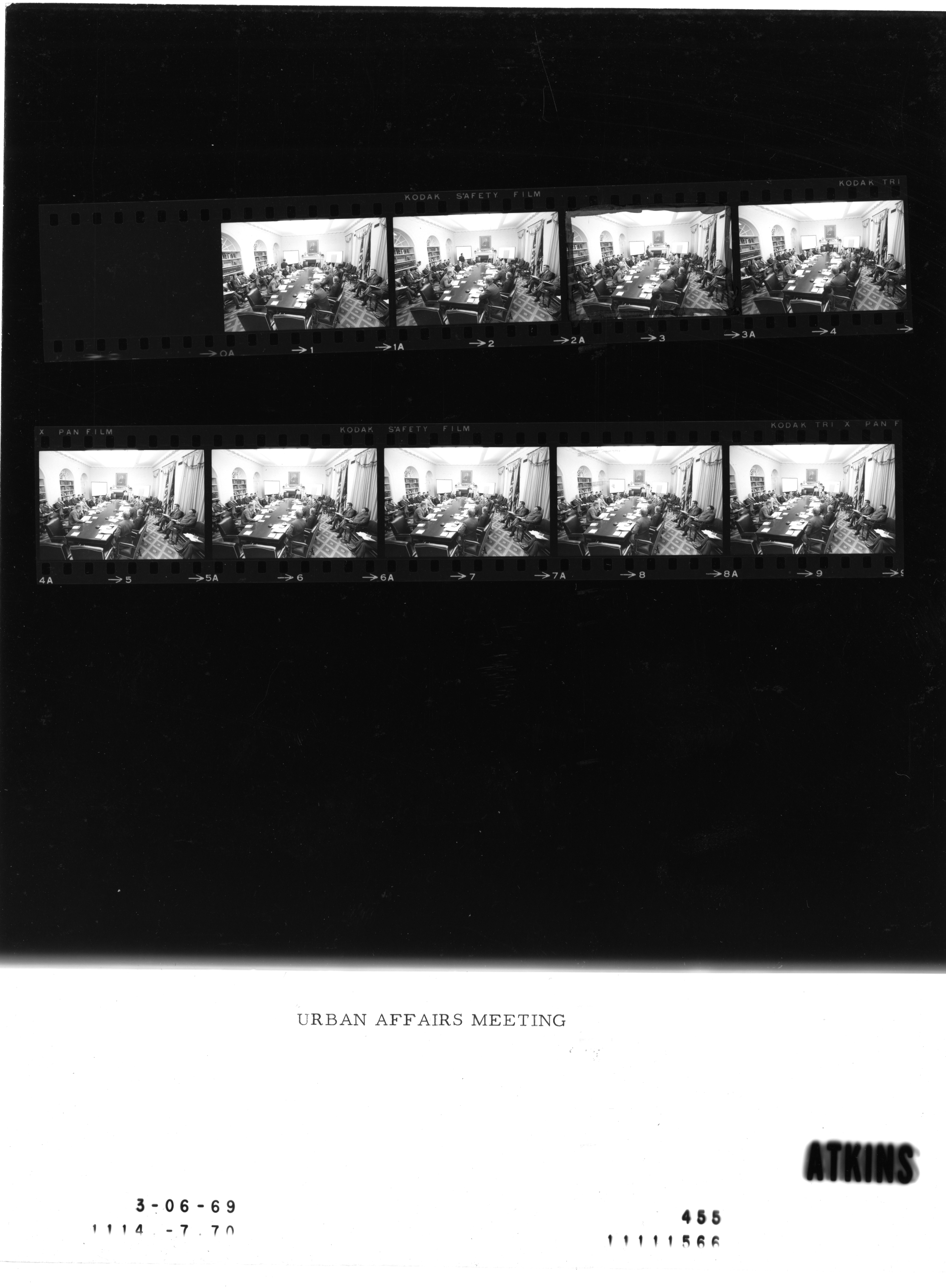
Roll WHPO-0455 Photographer: Atkins, Oliver | Color or B&W: B&W
- Frame(s): WHPO-0455-, President Nixon meeting with the Urban Affairs Council. 3/6/1969, Washington, D.C. White House, Cabinet Room. President Nixon, unidentified Urban Affairs Council members.
Roll WHPO-0456 Photographer: Atkins, Oliver | Color or B&W: B&W
- Frame(s): WHPO-0456-, President Nixon at his desk with Henry Kissinger and William Rogers, Secretary of State. 3/6/1969, Washington, D.C. White House, Oval Office. President Nixon, Henry Kissinger, William Rogers.
- Frame(s): WHPO-0456-03A, President Nixon at his desk with Henry Kissinger and William Rogers, Secretary of State. 3/6/1969, Washington, D.C. White House, Oval Office. President Nixon, Henry Kissinger, William Rogers.
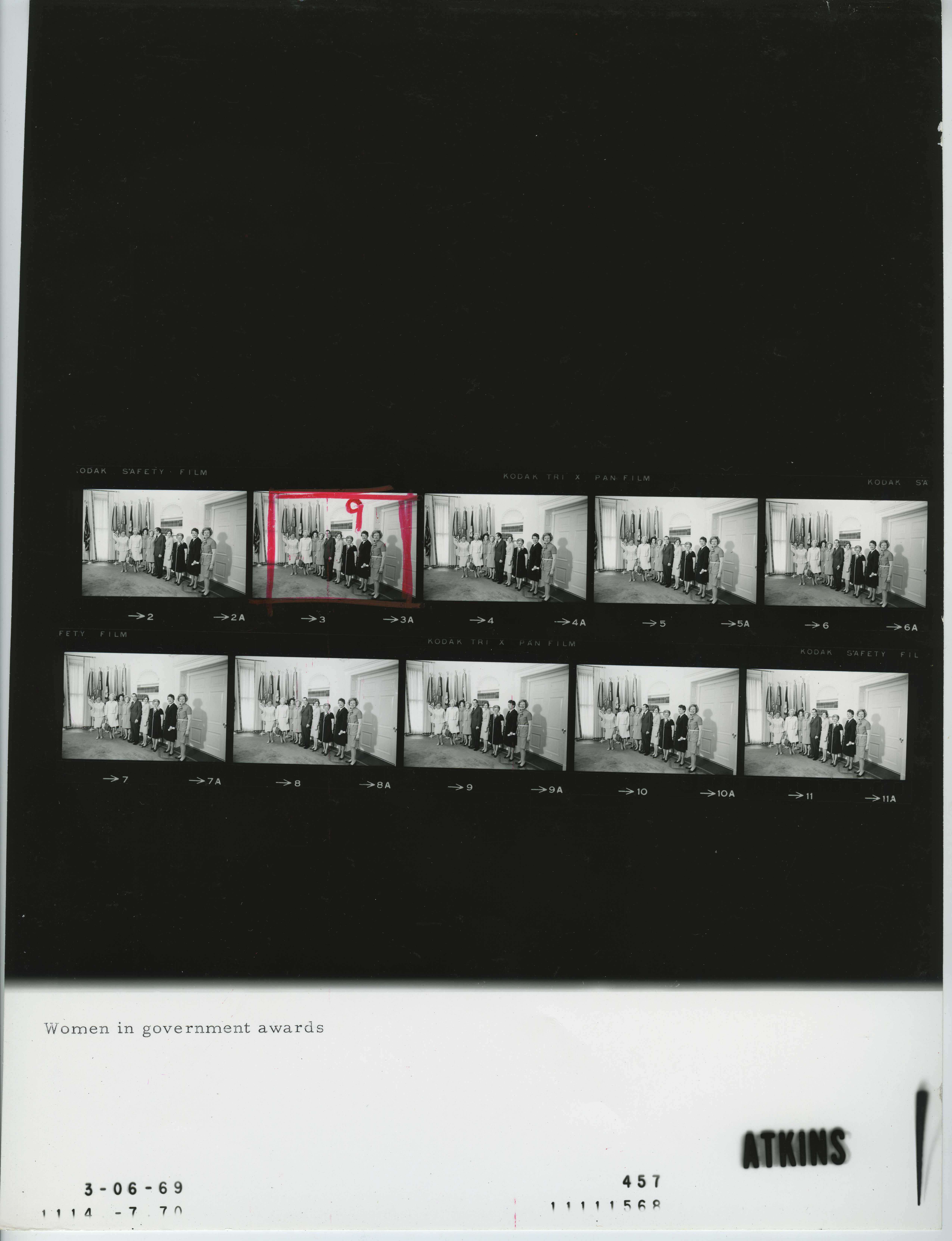
Roll WHPO-0457 Photographer: Atkins, Oliver | Color or B&W: B&W
- Frame(s): WHPO-0457-, President Nixon and Pat Nixon with the winners of the Federal Woman's Award. 3/6/1969, Washington, D.C. White House, Oval Office. Eileen R. Donovan, Mary Hughes Budenbach, Edith N. Cook, Mrs. Nixon, Nixon, Jo Ann Smith Kinney, Esther Christian Lawton, Dorothy L. Starbuck.
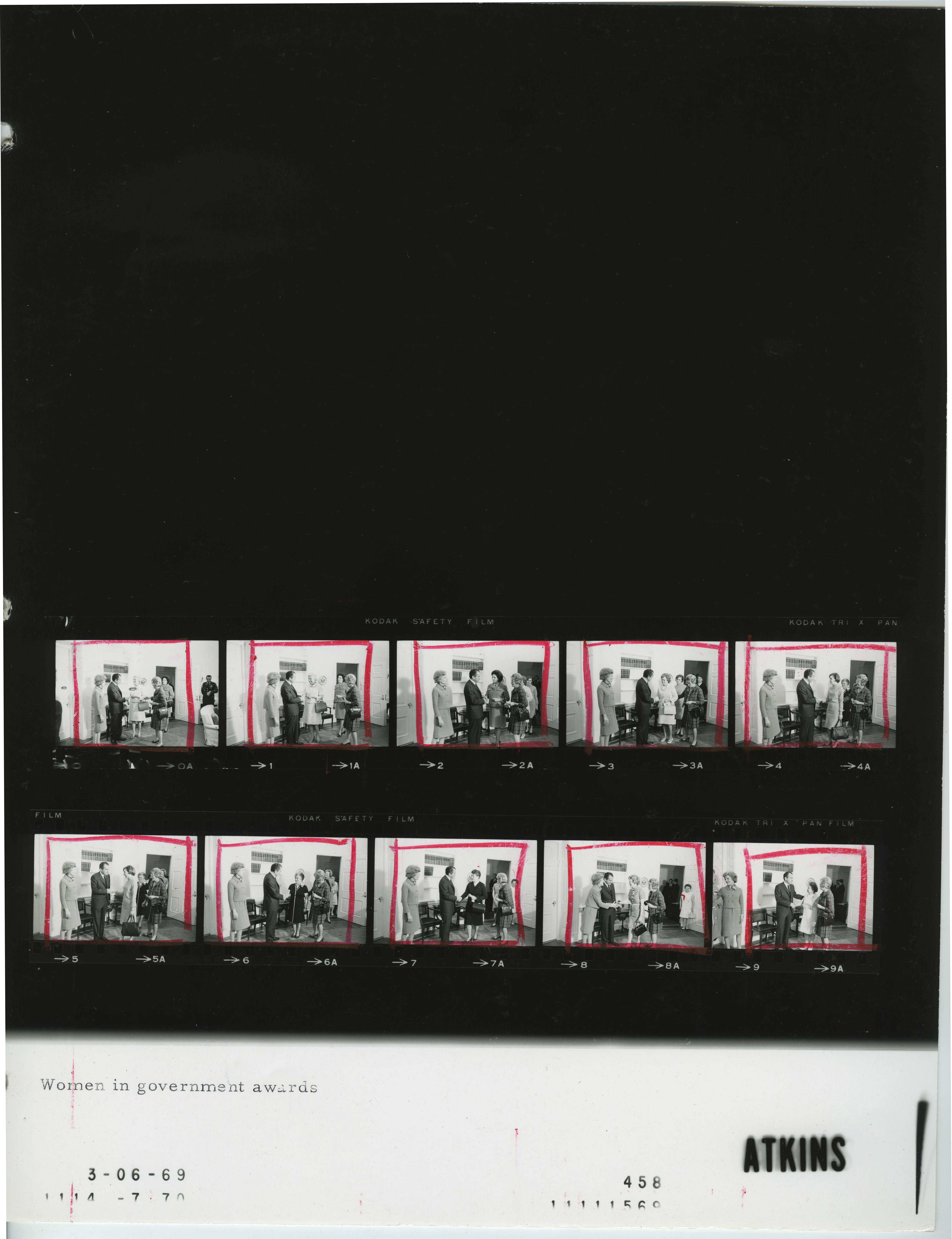
Roll WHPO-0458 Photographer: Atkins, Oliver | Color or B&W: B&W
- Frame(s): WHPO-0458-, President Nixon with Pat Nixon and Federal Woman's Award winners. 3/6/1969, Washington, D.C. White House, Oval Office. President Nixon, Pat Nixon, Mary Hughes Budenbach, Edith N. Cook, Eileen Roberta Donovan, Dr. Jo Ann Smith Kinney, Esther C. Lawton, Dorothy L. Starbuck, unidentified women.
Roll WHPO-0460 Photographer: Kightlinger, Jack | Color or B&W: B&W
- Frame(s): WHPO-0460-, Vice President Agnew and Liberian Vice President William Tolbert. 3/6/1969, Washington, D.C. Spiro Agnew, William Tolbert.
Roll WHPO-0461 Photographer: Kightlinger, Jack | Color or B&W: B&W
- Frame(s): WHPO-0461-, Vice President Agnew with Liberian Vice President William Tolbert. 3/6/1969, Washington, D.C. Agnew's office. Spiro Agnew, William Tolbert, unidentified man.
-
The White House Communications Agency Sound Recordings Collection contains public statements that took place between 1969 and 1974. Visit the finding aid to learn more.
F - Secretary of State Briefings
- WHCA-SR-F-001
Remarks by Secretary of State Rogers announcing appointment of Nathaniel Samual as Deputy Undersecretary for Economic Affairs, with Mrs. Samual and Ronald Ziegler. (3/6/1969, Roosevelt Room, The White House)
Runtime: 8:02
Production credits: Audio feed supplied by CBS; Recorded by WFM (initials of WHCA engineer)
Original Format: 1/4-inch reel-to-reel audiotape. Original source type: Original.
- WHCA-SR-F-001
Context (External Sources)
-
The Vanderbilt Television News Archive is the world's most extensive and complete archive of television news. They have been recording, preserving and providing access to television news broadcasts of the national networks since August 5, 1968.
-
Wikipedia is a free encyclopedia that anyone can edit.