
Introduction
This almanac page for Friday, March 7, 1969, pulls together various records created by the federal government and links to additional resources which can provide context about the events of the day.
Previous Date: Thursday, March 6, 1969
Next Date: Saturday, March 8, 1969
Schedule and Public Documents
The Daily Diary files represent a consolidated record of the President's activities. Visit the finding aid to learn more.
The President's day began at The White House - Washington, D. C.
The Weekly Compilation of Presidential Documents made available transcripts of the President's news conferences; messages to Congress; public speeches, remarks, and statements; and other Presidential materials released by the White House.
Addresses and Remarks
- Medal of Honor (5 Weekly Comp. Pres. Doc. 375, March 7, 1969)
The President's Remarks Upon Presenting the Award to Staff Sergeant Joe R. Hooper, Sergeant First Class Fred W. Zabitosky, and Specialist Five Clarence E. Sasser, United States Army. - Central Intelligence Agency (5 Weekly Comp. Pres. Doc. 377, March 7, 1969)
The President's Remarks to Agency Employees.
Appointments and Nominations
- Governor of the Virgin Islands (5 Weekly Comp. Pres. Doc. 377, March 7, 1969)
Announcement of Intention To Nominate Peter A. Bove. - Export-Import Bank of the United States (5 Weekly Comp. Pres. Doc. 377, March 7, 1969)
Announcement of Intention To Nominate Henry Kearns To Be President of the Bank.
Executive Orders
- International Transport of Goods Under Customs Seal (5 Weekly Comp. Pres. Doc. 379, March 7, 1969)
Executive Order 11459.
Reports to the President
- Railway Labor Dispute (5 Weekly Comp. Pres. Doc. 377, March 7, 1969)
Announcement of Report of Emergency Board No. 175 Investigating the Dispute Between Certain Railroads and Signalmen.
Digest of Other White House Announcements
Following is a listing of items of general interest which were announced in the press but not made public as formal White House press releases during the period covered by this issue. Appointments requiring Senate approval are not included since they appear in the list of nominations submitted to the Senate, below.
- Vice President Richard Tolbert of Liberia paid a courtesy call on the President at the White House.
- The President has accepted the recommendation of the Cabinet Committee on Economic Policy to establish a task force to study lumber and plywood prices.
Nominations Submitted to the Senate
Does not include promotions of members of the Uniformed Services, nominations to the Service Academies, or nominations of Foreign Service Officers.
- PETER A. BOVE, of Vermont, to be Governor of the Virgin Islands.
- HENRY KEARNS, of California, to be President of the Export-Import Bank of the United States.
Each Public Papers of the Presidents volume contains the papers and speeches of the President of the United States that were issued by the White House Office of the Press Secretary during the time period specified by the volume. The material is presented in chronological order, and the dates shown in the headings are the dates of the documents or events. In instances when the release date differs from the date of the document itself, that fact is shown in the text note.
To ensure accuracy, remarks have been checked against audio recordings (when available) and signed documents have been checked against the original, unless otherwise noted. Editors have provided text notes and cross references for purposes of identification or clarity.
The Federal Register is the official daily publication for rules, proposed rules, and notices of federal agencies and organizations, as well as executive orders and other Presidential documents.
The Congressional Record is the official daily record of the debates and proceedings of the U.S. Congress.
Archival Holdings
Any selection of archival documents will necessarily be partial. You should use the documents and folders identified below as a starting place, but consult the linked collection finding aids and folder title lists and the collections themselves for context. Many documents to be found this way do not lend themselves to association with specific dates, but are essential to a complete understanding of the material.
Selective document listing
President's Office Files
The President's Office Files consists of materials drawn together by the Special Files Unit from several administrative subdivisions within the White House Office. It is the handwriting and sensitive papers sent to the Staff Secretary that now comprise much of the President's Office Files. Visit the finding aid to learn more.
- President's Handwriting, Box 1, President's Handwriting, March 1 thru 15, 1969 [2 of 2]
- Memo; Patrick J. Buchanan to The President re: "Right intelligentsia". March 7, 1969. 5 pgs.
- Memo; Staff Secretary to H. Klein re: President would like to review distribution of Favorable Editorials on the March 4th News Conference prior to its release. March 7, 1969. 1 pg.
- Annotated News Summaries, Box 28, News Summaries - March 1969 [During this period, the Staff Secretary only removed pages from the News Summaries which contained President Nixon's handwriting, often leaving the document with no date. Although there are no specific documents with this date, you should also consult the full folder for the month.]
- President's Meetings File, Box 73, Memoranda for the President--Beginning March 2, 1969 [2 of 2]
- Safire to Haldeman, Report on Meeting of Cabinet Committee on Economic Policy, March 7, 1969, 10:45 a.m. to 12 noon.. 3/7/1969, 10:43 a.m. [per President's Daily Diary]. 19 pgs.
- Alexander P. Butterfield to The President's File, Late Afternoon Meeting in the President's Office with Budget Director Mayo (4:45-5:20 p.m.). 3/7/1969, 4:46 p.m. [per President's Daily Diary]. 2 pgs.
The H. R. Haldeman Diaries consists of seven handwritten diaries, 36 dictated diaries recorded as sound recordings, and two handwritten audio cassette tape subject logs. The diaries and logs reflect H. R. Haldeman’s candid personal record and reflections on events, issues, and people encountered during his service in the Nixon White House. As administrative assistant to the President and Chief of Staff, Haldeman attended and participated in public events and private meetings covering the entire scope of issues in which the Nixon White House engaged in during the years 1969-1973. Visit the finding aid to learn more.
- Transcript of diary entry (PDF)
Friday, March 7.
President presented his first Congressional Medals of Honor today. Ceremony in the East Room, with the Marine Band, families, etc. He did a marvelous job of personalizing the presentations and broke from the script to have the families each come up for a picture afterwards, while he chatted informally with them. Very well done - and a departure from the past when LBJ used these occasions to defend his war policy.
Rest of the day was clean-up appointments, and a visit to the CIA. Decided this morning to go to Florida for the weekend, had planned on Camp David. Problem is Helene Drown. All the troops really had to hop, but we made it. Ehrlichman and I spent most of the flight down in the cabin with President. General discussion with no particular results. He had a few drinks and was thoroughly relaxed. - Handwritten diary entry (JPG)
The National Archives Catalog is the online portal to the records held at the National Archives, and information about those records. It is the main way of describing our holdings and also provides access to electronic records and digitized versions of our holdings.
The Catalog searches across multiple National Archives resources at once, including archival descriptions, digitized and electronic records, authority records, and web pages from Archives.gov and the Presidential Libraries. The Catalog also allows users to contribute to digitized historical records through tagging and transcription.
Nixon Library Holdings
All National Archives Units
National Security Documents
The President's Daily Brief is the primary vehicle for summarizing the day-to-day sensitive intelligence and analysis, as well as late-breaking reports, for the White House on current and future national security issues. Read "The President's Daily Brief: Delivering Intelligence to Nixon and Ford" to learn more.
- President's Daily Brief of 07 March 1969 [consult link for visuals and extent of redactions]
The President's Daily Brief
7 March 1969
14
Top Secret
LATE NOTES FOR THE PRESIDENT'S DAILY BRIEF OF
7 MARCH 1969
[redacted]
8 March 1969
LATE NOTES FOR THE PRESIDENT'S DAILY BRIEF OF
7 MARCH 1969
I. MAJOR PROBLEMS
MIDDLE EAST
[redacted]
* * *
Tel Aviv announced today that four Egyptian MIGs overflew the Sinai Peninsula this morning and that one of them had been shot down. [redacted]
EUROPE
[redacted]
SOVIET AFFAIRS
There is nothing significant to report.
VIETNAM
Communist forces attacked US positions in Tay Ninh and Binh Long provinces north and northwest of Saigon during the night of 7-8 March. [redacted] Indications of impending Communist action in other areas continue to accumulate. [redacted]
II. OTHER IMPORTANT DEVELOPMENTS
SOVIET UNION - COMMUNIST CHINA
[redacted]
I. MAJOR PROBLEMS
MIDDLE EAST
[redacted]
* * *
The police chief in Jerusalem told the press Wednesday that the Israelis have rounded up about 80 suspected terrorists. All of them, he said, are residents of Israeli-occupied territory, including Gaza and Jerusalem. He also showed the reporters enough munitions "to blow up half of Jerusalem."
When the Israelis uncover a ring such as this, the main sufferers usually are the relatives of those arrested. The press indicates that Israeli authorities have in fact begun the destruction of the suspects' houses. [redacted]
EUROPE
Kurt Birrenbach, the highly respected leader of West German public opinion, sought out Charge Fessenden Thursday to reiterate his belief that there is no alternative for Europe other than integration and that President de Gaulle's views are anathema to European unity. He fears that even French policy toward the Middle East is really designed to further the general's European theories by building up France as the spokesman for continental Europe
among "the big four."
SOVIET AFFAIRS
Most of the Soviet troops deployed west of Berlin have returned to their garrisons. These moves caused a further closing of the Berlin-Helmstedt autobahn for three hours today. When an American officer protested to the Soviet checkpoint commander, the latter commented that the autobahn "will not be closed long. Over-all it won't be going on much longer."
VIETNAM
President Thieu's reflections on Communist intentions in his conversation with Ambassador Bunker on 6 March seem both realistic and persuasive. In particular, we agree with his suggestion that the Communists may be trying to erode the basis of the "understanding" on the bombing halt in the hope of some further horse-trading which might curb US military operations in South Vietnam.
It would be a crude maneuver for the Communists to attempt to trade off a cessation of attacks on cities for a halt to some specific US military actions, such as B-52 raids. Nonetheless, this may well be the direction in which they are heading. The Front's press spokesman in Paris came close to making this point yesterday when he said, in response to questions about Communist shellings and terrorist attacks, that "no agreement was reached with the US to end the war."
* * *
A North Vietnamese spokesman in Paris addressed himself today to the possibility of retaliatory air strikes against North Vietnam. He told the press that the Communists will continue their attacks in South Vietnam and asserted defiantly that North Vietnam was not intimidated by the threat of US bombings.
The Communists probably calculated before they started the current offensive round that any losses they might suffer as a result of US retaliatory strikes would be more than offset by the additional pressures this course would put on the over-all US position. In fact, given their public position the Communists would be hard put not to continue the shellings of major cities in South Vietnam in the face of US retaliatory action. Furthermore, the Communists may want to confront the us with the dilemma of retaliating in a major way and taking the adverse political pressures engendered by a "US escalation," or of not retaliating and thus exacerbating tensions between Saigon and Washington.
* *
Numerous indicators point to a substantial rise in Communist military activity possibly beginning this weekend, particularly in III Corps and IV Corps. During the past 24 hours, however, action in South Vietnam was at about the same level as the last few days.
[redacted]
II. OTHER IMPORTANT DEVELOPMENTS
PERU
[redacted]
JAPAN
Over the past year, pressure has been building for sterner government action-against leftist disorders at the universities. Many government leaders apparently are now convinced of the need for this. There has been a recent upsurge in student violence in Kyoto, and Liberal Democratic Party members have taken political soundings which indicate widespread popular discontent with student excesses. Prime Minister Sato himsel£ has probably concluded that if he does not soon respond, intraparty rivals may use the issue to attack his leadership.
The introduction of legislation to curb student violence probably would meet with bitter opposition from ultraleftist Socialists and Communists and might even lead to an impasse in Diet proceedings. Under these circumstances, Sato might consider it politically opportune to dissolve the Diet within the next few months and call for general elections. Such a decision would be based on his assessment that the opposition Japan Socialist Party is generally unprepared for early elections, and that the government's sponsorship of an emergency bill to restore order in the schools would be an effective campaign issue having wide popular appeal.
SOVIET UNION - COMMUNIST CHINA
However the Soviet-Chinese border incident began, both sides are now committed to treating it as a deliberate provocation by the other. Although Chinese harassment of the Soviets in Peking has eased, massive anti-Soviet patriotic rallies are continuing throughout the country. The Chinese are not likely to give the Russians the last word. Peking apparently hopes to capitalize heavily on the incident to reinforce recent propaganda appeals for a renewed display of national unity on the eve of the crucial Ninth Party Congress, now expected this month.
There have, however, been no indications that either side has significantly altered its military posture in the area. [redacted]
COMMUNIST CHINA
The Annex today discusses Communist China's strategic weapons program.
[redacted]
ANNEX
COMM~NIST CHINA'S STRATEGIC WEAPONS PROGRAM
A National Intelligence Estimate has just been completed on Communist China's strategic weapons program. It concludes that the program continues to be given a high priority despite recent economic and political difficulties. The Chinese may now have a limited regional nuclear strike capability consisting of a few thermonuclear weapons for delivery by their two operational jet medium bombers. They may also have some fission weapons in stock.
Medium-range ballistic missile deployment could begin this year or more likely in 1970, reaching a force of some 80-100 launchers in the mid-1970s. If the Chinese achieve an operational ICBM by the earliest possible date--late 1972--they might have something on the order of 10 to 25 deployed ICBMs by 1975. However, it is more likely that initial operational capability will be reached later than 1972, perhaps by as much as two or three years. If so, the deployment of a force of this size would slip accordingly.
Many uncertainties leave in doubt the future pace, size, and scope of the Chinese program. China lacks the broad technical and economic resources to forge ahead as rapidly as did the US or the USSR, and this situation has been aggravated by the domestic dislocations caused by the Cultural Revolution. In general the Chinese programs have not advanced as fast as we once thought likely. However, if Peking allocates its resources and chooses priorities carefully, it can continue to make gradual progress in developing strategic missiles and nuclear weapons.
Background
The Chinese effort to develop strategic weapons goes back to at least 1957-58. The original program was started with Soviet assistance and appeared to be extremely ambitious. The cessation of Soviet aid in 1960 and the confusion and depression of the early 1960s resulting from the "Great Leap Forward" had a severe impact on the advanced weapons program. Nevertheless, Peking persisted in giving high priority to the development of advanced weapons and gradual progress was made. The program continued to receive a high priority throughout the Cultural Revolution. By 1966 the Chinese already had many of the facilities necessary to support an ongoing advanced weapons program.
The political disorder of the Cultural Revolution has been disruptive, however. Its ultimate cost will depend, of course, on the time it takes to re-establish political and administrative order. Even with a restoration of order, the Chinese economy can support a large-scale production and deployment of strategic weapons only by neglecting the investment requirements for healthy growth in agriculture and in the general industrial sector. This and other uncertainties suggest caution in estimating the probable rate of progress of China's advanced weapons development over the next few years.
Medium-range Missiles
[redacted] it appeared that MRBM deployment might be imminent. Though detailed information was lacking, it was known that the Chin~se had been working on an MRBMI [redacted]
It is not possible to explain the apparent delay in deployment with much confidence. Technical problems with the missile and disruptions of the Cultural Revolution may have. slowed progress. It could be that priorities assigned to the development of nuclear weapons are influencing the deployment schedule or that the immediate purpose of the MRBM program was to develop technology for an ICBM.
It remains possible that the MRBM system is now ready to deploy. If so, the Chinese probably could soon do so, putting MRBMs in rudimentary field launch positions at the cost of reduced reliability and accuracy. More likely Peking will take time to prepare permanent sites with adequate support facilities. It would probably take the Chinese a year or more to prepare their first permanent launch facilities. If preparation should begin soon, it would still be sometime in 1970 before the Chinese had an operational MRBM capability.
We have no good basis for estimating the size of the MRBM force that might be deployed, but the Chinese probably would want to cover important military bases and population centers in the arc stretching from Japan through Southeast Asia and northern India. They would probably also target some MRBMs against the USSR. For these purposes the Chinese might require a force of 80-100 MRBMs. If begun in 1970, such a program could extend into the mid-1970s.
[redacted]
Intercontinental Missiles
[redacted]
Assuming that test vehicles were available, ICBM flight testing might begin this year. It should be pointed out, however, that in Chinese programs there have been long lapses between the completion of a facility and its effective use.
From whatever time the Chinese begin testing an ICBM, it is likely to require at least three years to achieve an initial operational capability. Thus if flight testing were to begin later this year, the earliest possible date would probably be late 1972. However, this allows the Chinese only a bit more time than required by the Soviets or the US with first generation ICBMs and assumes fairly smooth progress. In the light of China's inexperience and limited technical and scientific base, and considering general political and economic conditions in China, more time will probably be required. Thus, the initial operational capability is more likely to be later than 1972, perhaps by as much as two or three years.
Bomber Aircraft
[redacted]
As with MRBMs, there is no good basis for estimating the number of TU-16s the Chinese will deploy, we estimate that production could reach a rate of four or five aircraft a month in about two years. Because of testing requirements and initial production problems, however, only a few of these aircraft are likely to be deployed in the next year or two. As the program proceeds, we should be able to determine production and deployment rates with fairly
good confidence.
Space Program
We believe that for reasons of national prestige the Chinese will try to orbit a satellite as soon as possible. They probably will use a modified MRBM for a space booster if they attempt to launch a satellite this year.
[redacted]
Development of Nuclear Weapons
Peking's greatest achievements have probably been in the field of nuclear weapon design, where it has rapidly succeeded in developing a high-yield thermonuclear device [redacted]
The Foreign Relations of the United States series presents the official documentary historical record of major U.S. foreign policy decisions and significant diplomatic activity. Visit the State Department website for more information.
Vol. V, United Nations, 1969-1972
Chinese Representation in the United Nations
274. Telegram From the Mission to the United Nations to the Department of State, New York, March 7, 1969, 2219Z
Source: National Archives, Nixon Presidential Materials, NSC Files, Box 295, Agency Files, USUN, Vol. I. Secret; Exdis.
Vol. VI, Vietnam, January 1969-July 1970
Vietnam, January 1969-July 1970
30. Telegram From the Department of State to the Embassy in Vietnam, Washington, March 7, 1969
Source: National Archives, RG 59, East Asia Bureau, Office of Asian Communist Affairs Files: Lot 70 D 47. Secret; Immediate; Nodis; Paris Meetings; Plus. Also sent to Paris. Drafted by Bundy on March 6, cleared by Kissinger and Walsh, and approved by Rogers.
Vol. E-2, Documents on Arms Control and Nonproliferation, 1969-1972
Eighteen-Nation Disarmament Committee; Seabed Arms Control Treaty
68. Memorandum for the Record , Washington, March 7, 1969
The memorandum summarized the discussion at the March 6 NSC Review Group Meeting. The Review Group conducted a brief discussion of the accuracy of the paper “Positions of Key Countries on the Non Proliferation Treaty” and a more complete analysis of the preparations made for the upcoming ENDC.
Source: Central Intelligence Agency, Job 80–B01086A, Director of Central Intelligence, ER Subject File, Box 7, NSC Review Group. Secret. Prepared by R.J. Smith.
Vol. E-10, Documents on American Republics, 1969-1972
Ecuador
National Security Council staff member Nachmanoff reported that because Ecuador and Peru seized U.S. fishing vessels, they could not receive U.S. military aid. He noted that the Department of State was considering lifting the suspension of military sales if Ecuador participated in a four-power conference on the fisheries problem.
Source: National Archives, Nixon Presidential Materials, NSC Files, Box 784, Country Files, Latin America, Ecuador, Vol. 1, 1969–1970. Confidential. Haig wrote on the memorandum, “Arnie HAK[Kissinger] has seen—he doesn’t feel this should be used to pressure Peruvians. Al”
Panama
520. Information Memorandum From the Acting Assistant Secretary of Inter-American Affairs (Vaky) to Secretary of State Rogers, Washington, March 7, 1969. , Washington, March 7, 1969
Acting Assistant Secretary Vaky noted that a power struggle in the Panamanian National Guard had resulted in the exile of four officers to the United States. He concluded that opportunistic Panamanian politicians might attempt to take advantage of the instability in the nation by stirring up future dissension in the Guard.
Source: National Archives, RG 59, Central Files 1967–69, POL 15 PAN. Secret. Drafted on March 6 by Guthrie.
Peru
581. Study Memorandum Prepared by the National Security Council Interdepartmental Group for Inter-American Affairs, Washington, March 7, 1969. , Washington, March 7, 1969
In this 20-page memorandum, the National Security Council Interdepartmental Group for Inter-American Affairs (NSC–IG/ARA) summarized U.S.–Peruvian relations, outlined U.S. objectives over the next 6 months and potential policy options that would become available in the following month, and examined possible case scenarios in which those options might be employed.
Source: National Archives, Nixon Presidential Materials, NSC Files, NSC Institutional Files (H-Files), Box H–135, NSSM Files, NSSM 18. Secret.
The Kissinger telephone conversation transcripts consist of approximately 20,000 pages of transcripts of Kissinger’s telephone conversations during his tenure as Assistant to the President for National Security Affairs (1969-1974) and Secretary of State (1973-1974) during the administration of President Richard Nixon. Visit the finding aid for more information.
Chronological File, Box 1, Folder March 3-13, 1969 [1 of 2]
- 9:40 AM, Gerard Smith; Mr. Kissinger
Gerard Smith
Mr. Kissinger
3-7-69 9:40 AM
K said President wanted him to tell S that he was good soldier in his testimony today and the President appreciates it very much.
jm - 9:50 AM, Secretary Rogers; Mr. Kissinger
Secretary Rogers
Mr. Kissinger
3/7/69 9:50 a.m.
HAK said the President wanted him to bring two things to Rogers' attention: (1) The President is getting quite attracted to the idea of Lodge as Ambassador to the OAS -- Pres didn't say it with any
impatience, but he just wanted to be sure the Secy understood that Pres. was thinking about it -- HAK will take soundings and be back in touch. (2) President raised question of Ambassador to Italy- -
Tasca (Morocco) looks good to him.
Rogers noted that things in VNam have quieted down. HAK's assessment is that it is a prelude to private talks on their part. - 10:05 AM, Mr. Kissinger; Secy Packard
Mr. Kissinger
Secy Packard
3-7-69 10:05 AM
K said President is going to Key Biscayne this evening and wondered if K and P could come down on Monday morning. P said he would be pleased to. K said President would like K and P to talk about VN strategy from here on in.
K said unless something else happens today we are turning that thing off.
K said he would be over at 2:00 today
jm - 11:00 AM, Mr. Kissinger; Scotty Reston
Mr. Kissinger
Scotty Re ston
3-7-69 11:00 AM
Discussed trip - R complimented Kon it.
K said he was calling re suggestion R had made the last time they saw one another to effect that R might be willing to permit K to comment on editorials on major foreign policy issues. K has talked to the President about this and he would be delighted to let K do this. K said he did not want to get involved in little issues but if something important comes up, if we could have a hearing it would be in both our interests. R said that is right K should not hesitate if he sees something wrong or if he sees something that is subject to correction. K asked how this would work. R said if K is saying he is available whenever they are trying to make up their minds about something and are puzzled, if K is available on phone they will call and take advantage of it. Also, there is no reason why K should not initiate call to them whenever he wishes. K said with respect to the former, he is available and the President has authorized it. K said he will not fool them - he may not always tell them everything but he will do nothing to mislead them. K said if he does feel the Times is going off base on something, he will be in touch. K said he personally has a preference for dealing with R but, of course, could not prescribe with whom he should deal. R agreed that K should not be talking to ten different people and said he thought it best if they start off dealing personally.
K said East/West relations is one subject which he would like to discuss and does not want to do over the telephone. R and K agreed to lunch in K's office at 12:30 on Thursday, March 12.
jm - 12:30 PM, Secy Rogers; Mr. Kissinger
Secy Rogers
Mr. Kissinger
3-7-69 12:30 PM
K said he had three things - first he had meeting with Joe Sisco and thought what State has is really first-rate. K said he really thinks this is the way to proceed. Secondly, bilateral talks should be here rather than New York. K also mentioned that the President was very please with Gerard Smith's testimony yesterday.
The third thing K wanted to bring up is Glen Olds, who he understands is being considered for a UN post. K said the man is a fool - a nice fool. K. said this is his view and not a White House view. R said the White House is the one pushing on this. K said Olds has a fifth-class mind; no judgment. K said he could give R ten names of others who feel the same way if R needs help on this. K reiterated that this is not the President's view and he is doing this on a personal basis.
jm - 4:35 PM, Secy Rogers; Mr. Kissinger
Secy Rogers
Mr. Kissinger
3-7-69 4:35 PM
R asked if we are still on the track for Tuesday. K said not 100 per cent - it may now be Wednesday. K said we are working on paper now which is still in typewriter - he will send it over when finished. R said Harlan Cleveland will be notified by telegram, which he will clear with K.
R said he had had nice talk with Linowitz and R thinks maybe John Lodge would be desirable for the OAS job. L held two jobs and R thinks they can be split up.
K said he thought R should just announce Myers thing from State. K said he would let President get out of city first and then he will call him and tell him R is going to do this. K said in general Asst Secretaries should think of themselves as Secretary's men and President should not start announcing these appointments. R agreed - same some of the press had mentioned this to him in connection with Samuels I announcement. K asked when he was going to get Vaky - R said it should not be very
long now
jm - 5:15 PM, Mr. Kissinger; Joe Sisco
Mr. Kissinger
Joe Sisco
3-7-69 5:15 PM
K asked whether Pakistan was in S's area - that is just what he told the President. President wants to get Ayub Khan over here and wondered if it would create problems now that he has indicated that he is going to step down. S said this would be interpreted as an American step to bolster Ayub Khan and be regarded as intervention in Pakistani affairs. K asked whether S could drop him a personal note on this and not send it through the whole Department. S said he would do so.
jm - 5:30 PM, Admiral Moorer; Mr. Kissinger
Admiral Moorer
Mr. Kissinger
3-7-69 5:30 PM
K said he had talked with the President and North of the 20th but outside territorial waters is o. k.
M asked on the other thing we have outstanding when does K think we should make a decision on that - K said how about 9:00 tonight. K said he has talked to President about that and he would like it
kept on a very short fuse.
K asked if M would look at the situation and see what we can do, with minimum loss of lives in shortest period - M said they can give estimate. K asked whether it was possible to sink a ship in the harbor - M said they have looked at several possibilities - even submarines - and it turns out to be difficult because they lighten load and then go on in. M said it could be done with mines. K said right but they would have to keep it going then. M said no problem - we would do it with aircraft.
K asked whether M had opposition arguments in his shop - M said he could give him a brief on what can be done in this area. K asked for it fairly soon.
jm - 7:40 PM, Secy Rogers; Mr. Kissinger
Secy Rogers
Mr. Kissinger
3-7-69 7:40 PM
K said he was just looking over message that Bundy drafted to Paris. K said he could go along with R's reasoning this afternoon but he has serious questions about what Lodge is supposed to say to the guy whose name he can never pronounce. K said the message in fact says we are agreeing to private talks and read message to R. R said he reads it the other way - that shellings have caused us to have second thoughts. K said to him it means if if we stop the shellings we will have private talks. R said he reads it other way.
R said he did not mind if K wanted to change the message.
jm
Audiovisual Holdings
The White House Photo Office collection consists of photographic coverage of President Richard Nixon meeting with prominent social, political, and cultural personalities; speaking engagements and news conferences of the President and various high-ranking members of the White House staff and Cabinet; Presidential domestic and foreign travel, including Presidential vacations; social events and entertainment involving the First Family, including entertainers present; official portraits of the President, First Family, and high-ranking members of the Nixon administration; the 1969 and 1973 Inaugurals; the President’s 1972 Presidential election campaign appearances (including speeches) and other official activities of the White House staff and the President’s Cabinet from January 20, 1969 until August 9, 1974 at the White House and the Old Executive Office Building; other locations in Washington, DC, such as The Mall; and the Presidential retreats in Camp David, Maryland, Key Biscayne, Florida, and San Clemente, California. Visit the finding aid to learn more.
Roll WHPO-0459 Photographer: Kightlinger, Jack | Color or B&W: B&W
- Frame(s): WHPO-0459-01-04, Workstation. 3/7/1969, Washington, D.C. White House.
- Frame(s): WHPO-0459-05-15, President Nixon with Walter Chilsen, Congressional candidate from Wisconsin. 3/7/1969, Washington, D.C. White House. President Nixon, Walter Chilsen, unidentified man, three dogs, military guard.
- Frame(s): WHPO-0459-08, President Nixon with Walter Chilsen, Congressional candidate from Wisconsin. 3/7/1969, Washington, D.C. White House. President Nixon, Walter Chilsen.
- Frame(s): WHPO-0459-16-22, President Nixon boards the Marine One helicopter. 3/7/1969, Washington, D.C. White House. President Nixon.
- Frame(s): WHPO-0459-23-26, Marine One helicopter departs from the South Lawn. 3/7/1969, Washington, D.C. White House.
Roll WHPO-0462 Photographer: Knudsen, Robert L. | Color or B&W: B&W
- Frame(s): WHPO-0462-, President Nixon with Liberian Vice President William Tolbert and Liberian Ambassador S. Edward Peal. 3/7/1969, Washington, D.C. White House, Oval Office. President Nixon, William Tolbert, S. Edward Peal, White House Press Corps.
Roll WHPO-0463 Photographer: Knudsen, Robert L. | Color or B&W: B&W
- Frame(s): WHPO-0463-, President Nixon with Liberian Vice President William Tolbert in front of carved ivory tusks. 3/7/1969, Washington, D.C. White House, Oval Office. President Nixon, William Tolbert, S. Edward Peal.
Roll WHPO-0464 Photographer: Knudsen, Robert L. | Color or B&W: B&W
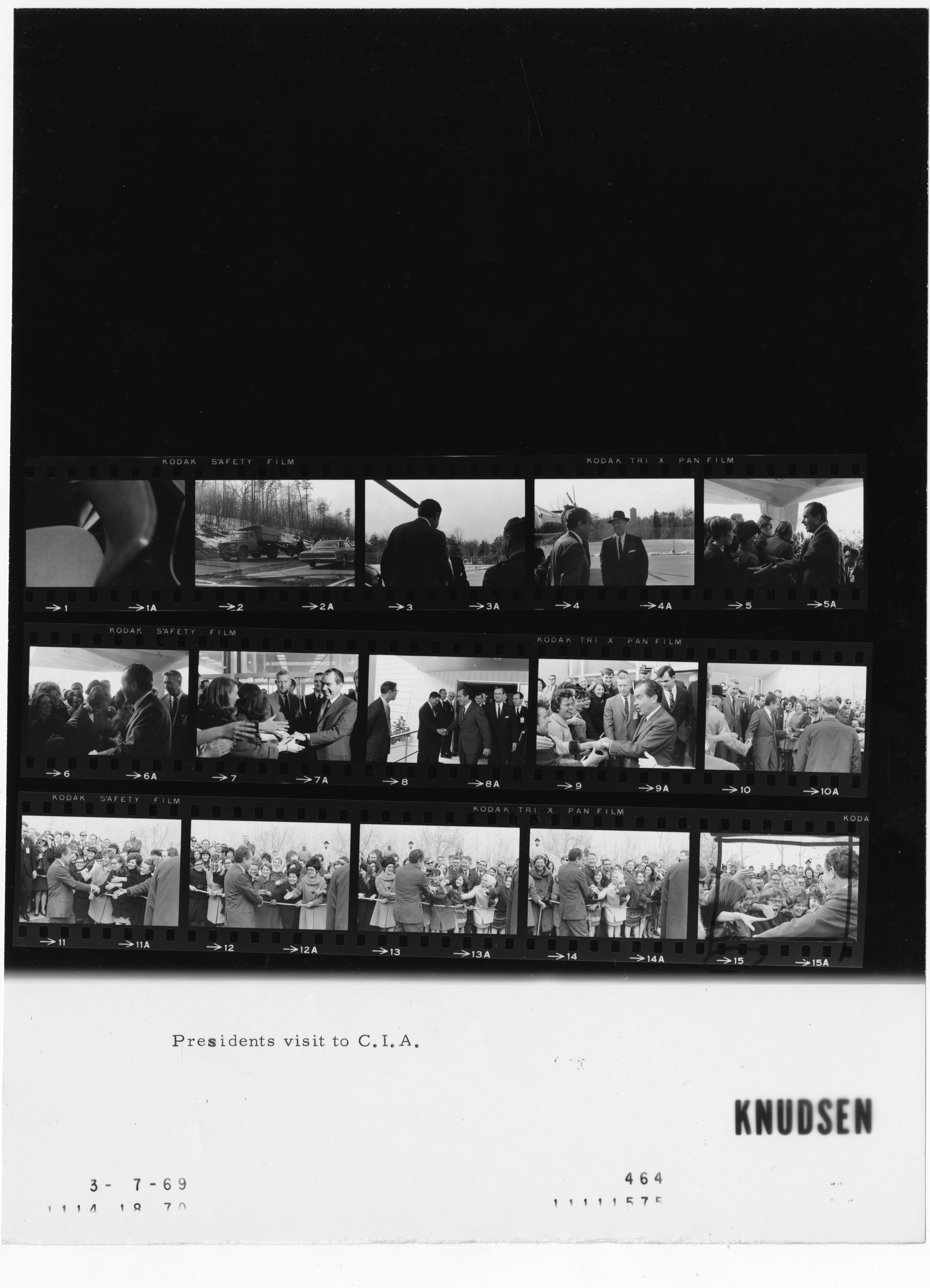
- Frame(s): WHPO-0464-, President Nixon arriving at the CIA headquarters. 3/7/1969, McLean, Virginia CIA Headquarters. President Nixon, unidentified CIA employees.
Roll WHPO-0465 Photographer: Knudsen, Robert L. | Color or B&W: B&W
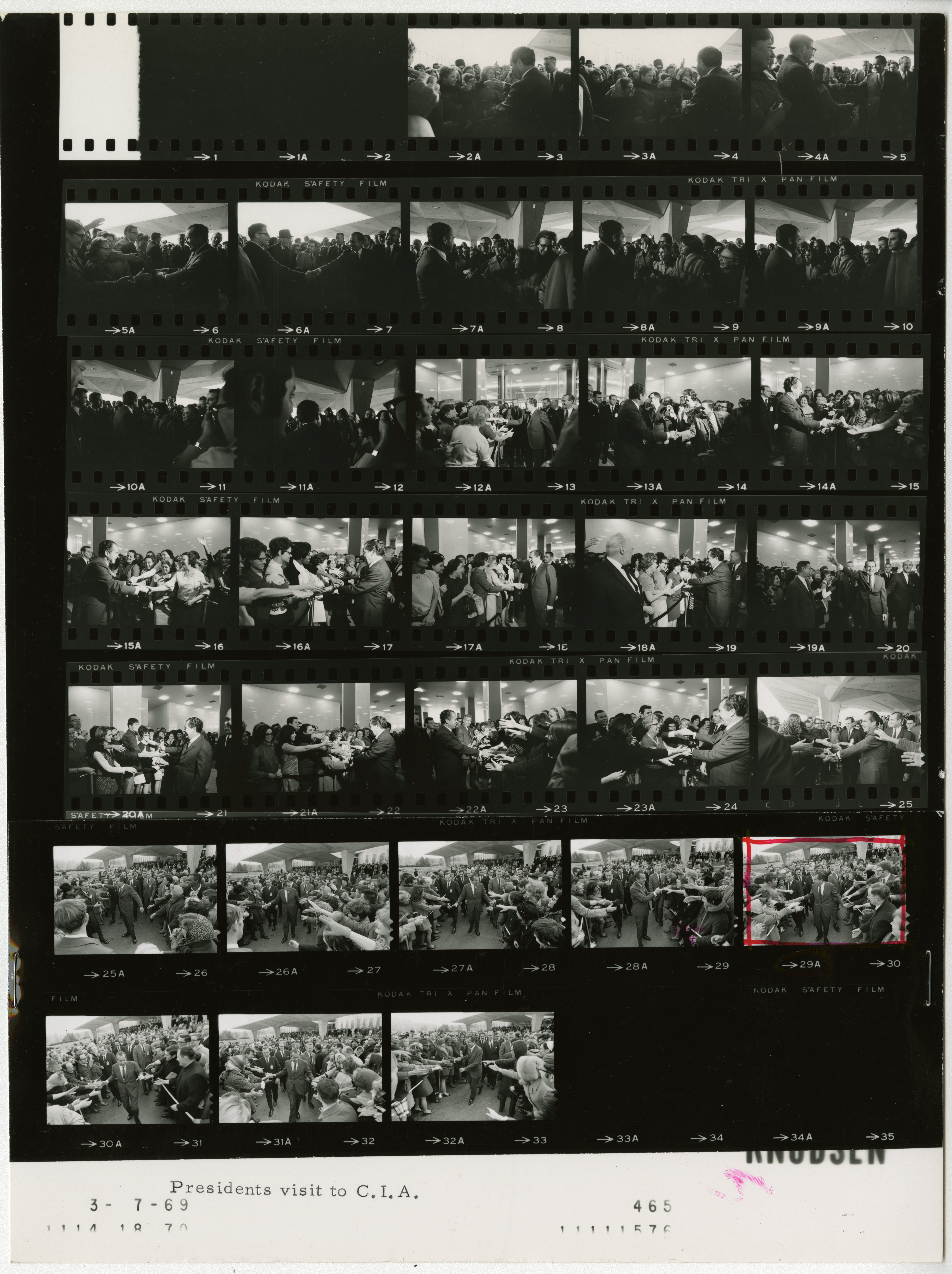
- Frame(s): WHPO-0465-, President Nixon arriving at the Central Intelligence Agency (CIA) headquarters. 3/7/1969, McLean, Virginia CIA Headquarters. President Nixon, unidentified CIA employees.
- Frame(s): WHPO-0465-29A, President Nixon greeting the crowd outside of the Central Intelligence Agency (CIA) headquarters. 3/7/1969, McLean, Virginia CIA Headquarters. President Nixon, unidentified CIA employees, crowd.
Roll WHPO-0466 Photographer: Knudsen, Robert L. | Color or B&W: B&W
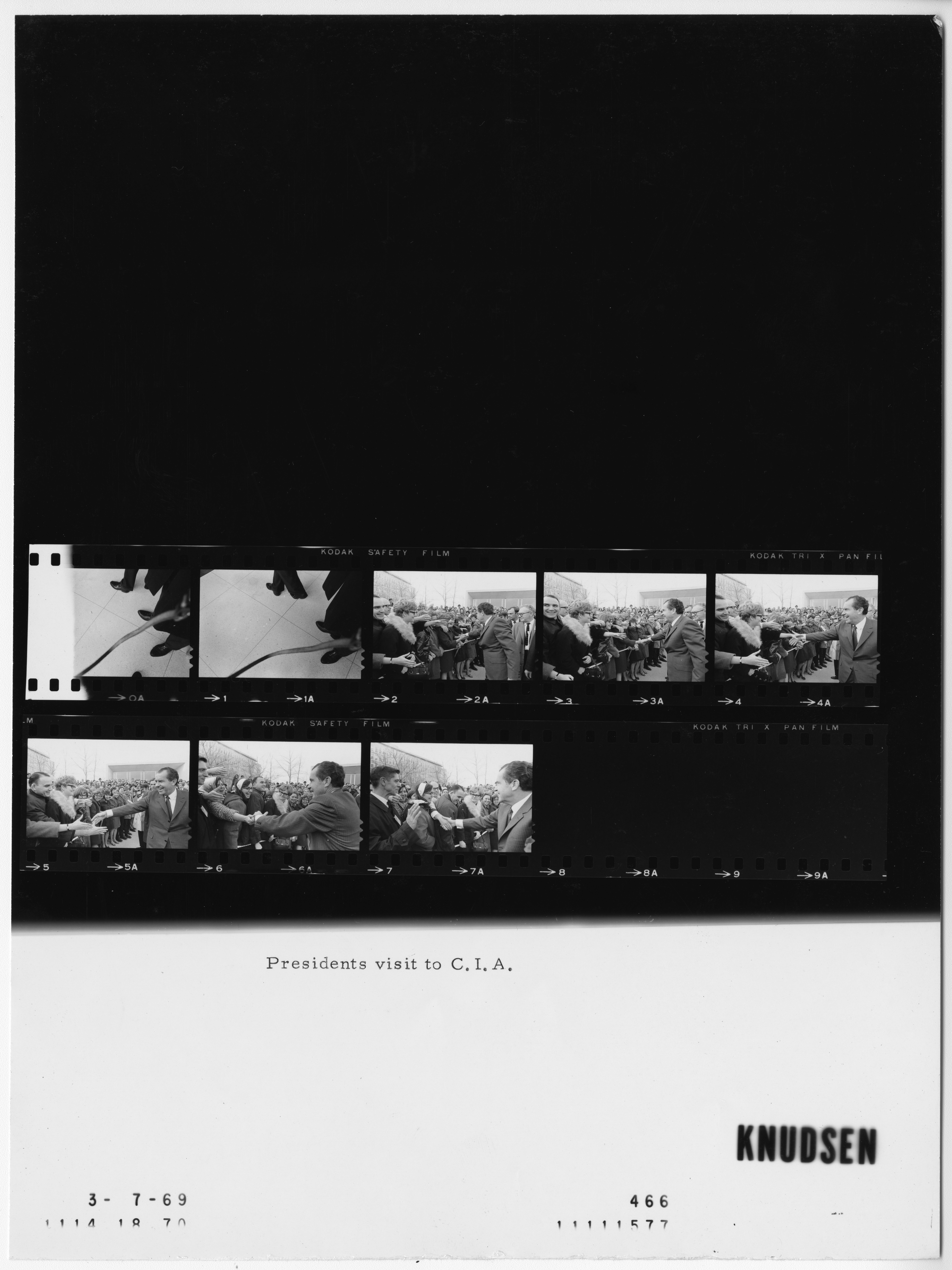
- Frame(s): WHPO-0466-, President Nixon with Central Intelligence Agency (CIA) employees. 3/7/1969, McLean, Virginia CIA Headquarters. President Nixon, unidentified CIA employees.
Roll WHPO-0467 Photographer: Knudsen, Robert L. | Color or B&W: B&W
- Frame(s): WHPO-0467-, President Nixon presenting the Medal of Honor to: Sergeant First Class Fred Zabitosky; Staff Sergeant Joe Hooper; and Specialist Clarence Sasser. Group picture of President Nixon with the medalists. 3/7/1969, Washington, D.C. White House, East Room. President Nixon, Fred Zabitosky, Joe Hooper, Clarence Sasser, and their respective families.
- Frame(s): WHPO-0467-30A, Group portrait of President Nixon standing with three Medal of Honor recipients: Sergeant First Class Fred Zabitosky; Staff Sergeant Joe Hooper; and Specialist Clarence Sasser. 3/7/1969, Washington, D.C. White House, East Room. President Nixon, Fred Zabitosky, Joe Hooper, Clarence Sasser.
- Frame(s): WHPO-0467-33-37, President Nixon standing with Medal of Honor recipients Sergeant First Class Fred Zabitosky and Specialist Clarence Sasser. 3/7/1969, Washington, D.C. White House, East Room. President Nixon, Fred Zabitosky, Clarence Sasser.
- Frame(s): WHPO-0467-36, President Nixon standing with Medal of Honor recipient Specialist Clarence Sasser and his mother, Mrs. Sasser. 3/7/1969, Washington, D.C. White House, East Room. President Nixon, Clarence Sasser, Mrs. Sasser (mother).
Roll WHPO-0468 Photographer: Knudsen, Robert L. | Color or B&W: B&W
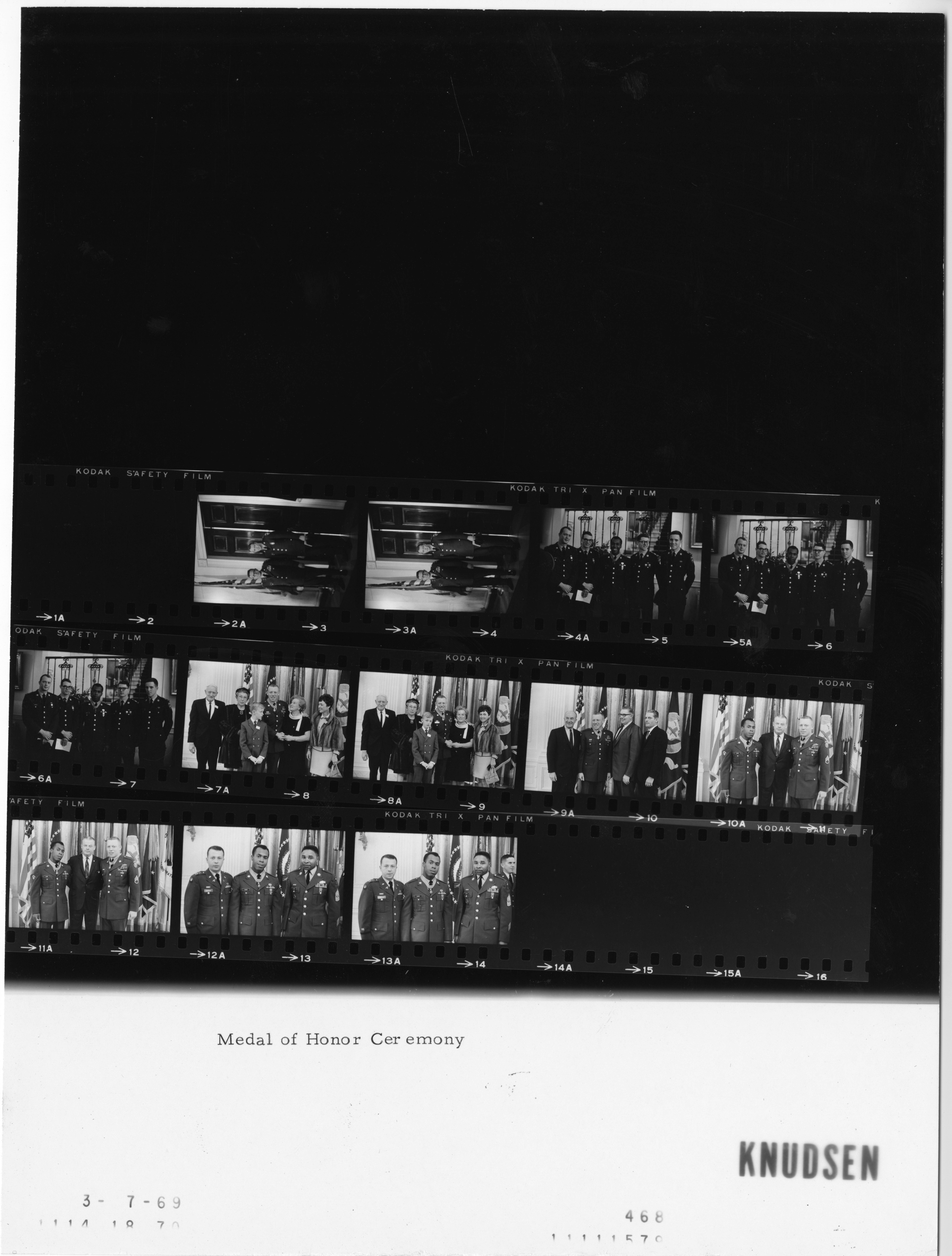
- Frame(s): WHPO-0468-02A-03A, Two unidentified soldiers at a Medal of Honor ceremony. 3/7/1969, Washington, D.C. White House, East Room. Clarence Sasser, Joe Hooper, unidentified civilians and Army personnel.
- Frame(s): WHPO-0468-04A-06A, Specialist Clarence Sasser posses with other soldiers at his Medal of Honor ceremony. 3/7/1969, Washington, D.C. White House, East Room. Clarence Sasser, Joe Hooper, unidentified civilians and Army personnel.
- Frame(s): WHPO-0468-07A-09A, Staff Sergeant Joe Hooper with family at his Medal of Honor ceremony. 3/7/1969, Washington, D.C. White House, East Room. Clarence Sasser, Joe Hooper, unidentified civilians and Army personnel.
- Frame(s): WHPO-0468-10A-11A, Specialist Clarence Sasser and Staff Sergeant Joe Hooper standing with an unidentified man at Medal of Honor ceremony. 3/7/1969, Washington, D.C. White House, East Room. Clarence Sasser, Joe Hooper, unidentified civilians and Army personnel.
- Frame(s): WHPO-0468-12A-13A, Specialist Clarence Sasser with two soldiers at Medal of Honor ceremony. 3/7/1969, Washington, D.C. White House, East Room. Clarence Sasser, Joe Hooper, unidentified civilians and Army personnel.
Roll WHPO-0469 Photographer: Knudsen, Robert L. | Color or B&W: B&W
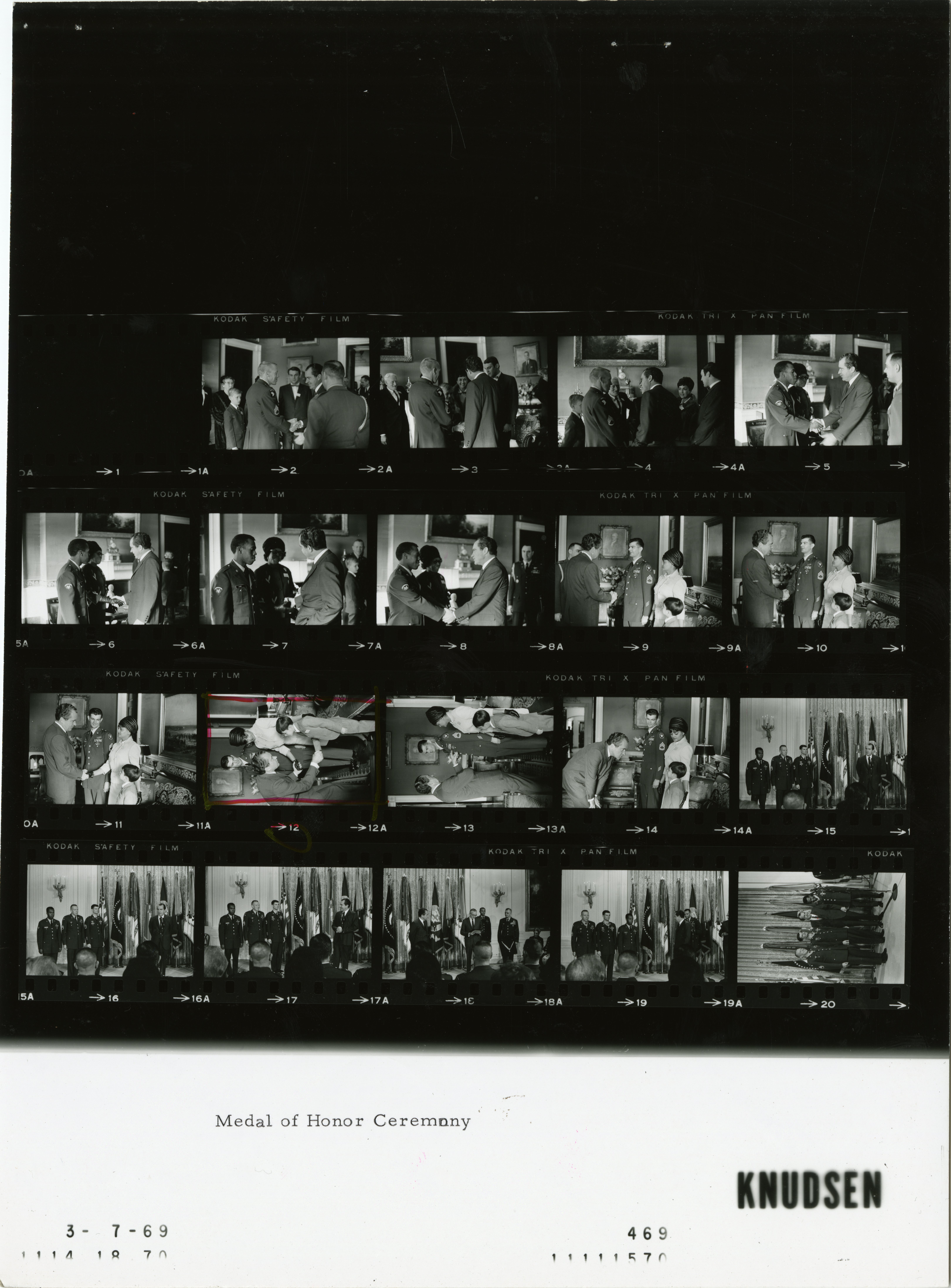
- Frame(s): WHPO-0469-02-20, President Nixon with Medal of Honor recipients Fred Zabitosky, Joe Hooper, and Clarence Sasser at presentation ceremony. 3/7/1969, Washington, D.C. White House. President Nixon, Fred Zabitosky, Joe Hooper, Clarence Sasser, their respective families, William Westmoreland, unidentified Army personnel.
- Frame(s): WHPO-0469-02-20, President Nixon with Medal of Honor recipients Fred Zabitosky, Joe Hooper, and Clarence Sasser at presentation ceremony. 3/7/1969, Washington, D.C. White House. President Nixon, Fred Zabitosky, Joe Hooper, Clarence Sasser, their respective families, William Westmoreland, unidentified Army personnel.
- Frame(s): WHPO-0469-21-23, President Nixon with Medal of Honor recipients Fred Zabitosky, Joe Hooper, and Clarence Sasser. 3/7/1969, Washington, D.C. White House. President Nixon, Fred Zabitosky, Joe Hooper, Clarence Sasser, their respective families, William Westmoreland, unidentified Army personnel.
- Frame(s): WHPO-0469-21-23, President Nixon with Medal of Honor recipients Fred Zabitosky, Joe Hooper, and Clarence Sasser. 3/7/1969, Washington, D.C. White House. President Nixon, Fred Zabitosky, Joe Hooper, Clarence Sasser, their respective families, William Westmoreland, unidentified Army personnel.
- Frame(s): WHPO-0469-24-27, President Nixon with Joe Hooper and his family at Medal of Honor ceremony. 3/7/1969, Washington, D.C. White House. President Nixon, Fred Zabitosky, Joe Hooper, Clarence Sasser, their respective families, William Westmoreland, unidentified Army personnel.
- Frame(s): WHPO-0469-24-27, President Nixon with Joe Hooper and his family at Medal of Honor ceremony. 3/7/1969, Washington, D.C. White House. President Nixon, Fred Zabitosky, Joe Hooper, Clarence Sasser, their respective families, William Westmoreland, unidentified Army personnel.
- Frame(s): WHPO-0469-28-31, President Nixon with Fred Zabitosky and his family at Medal of Honor ceremony. 3/7/1969, Washington, D.C. White House. President Nixon, Fred Zabitosky, Joe Hooper, Clarence Sasser, their respective families, William Westmoreland, unidentified Army personnel.
- Frame(s): WHPO-0469-28-31, President Nixon with Fred Zabitosky and his family at Medal of Honor ceremony. 3/7/1969, Washington, D.C. White House. President Nixon, Fred Zabitosky, Joe Hooper, Clarence Sasser, their respective families, William Westmoreland, unidentified Army personnel.
- Frame(s): WHPO-0469-32-34, President Nixon with Clarence Sasser and his family at Medal of Honor Ceremony. 3/7/1969, Washington, D.C. White House. President Nixon, Fred Zabitosky, Joe Hooper, Clarence Sasser, their respective families, William Westmoreland, unidentified Army personnel.
- Frame(s): WHPO-0469-32-34, President Nixon with Clarence Sasser and his family at Medal of Honor Ceremony. 3/7/1969, Washington, D.C. White House. President Nixon, Fred Zabitosky, Joe Hooper, Clarence Sasser, their respective families, William Westmoreland, unidentified Army personnel.
- Frame(s): WHPO-0469-35-37, Gen. William Westmoreland standing with unidentified Army personnel. 3/7/1969, Washington, D.C. White House. President Nixon, Fred Zabitosky, Joe Hooper, Clarence Sasser, their respective families, William Westmoreland, unidentified Army personnel.
- Frame(s): WHPO-0469-35-37, Gen. William Westmoreland standing with unidentified Army personnel. 3/7/1969, Washington, D.C. White House. President Nixon, Fred Zabitosky, Joe Hooper, Clarence Sasser, their respective families, William Westmoreland, unidentified Army personnel.
Roll WHPO-0470 Photographer: Knudsen, Robert L. | Color or B&W: B&W
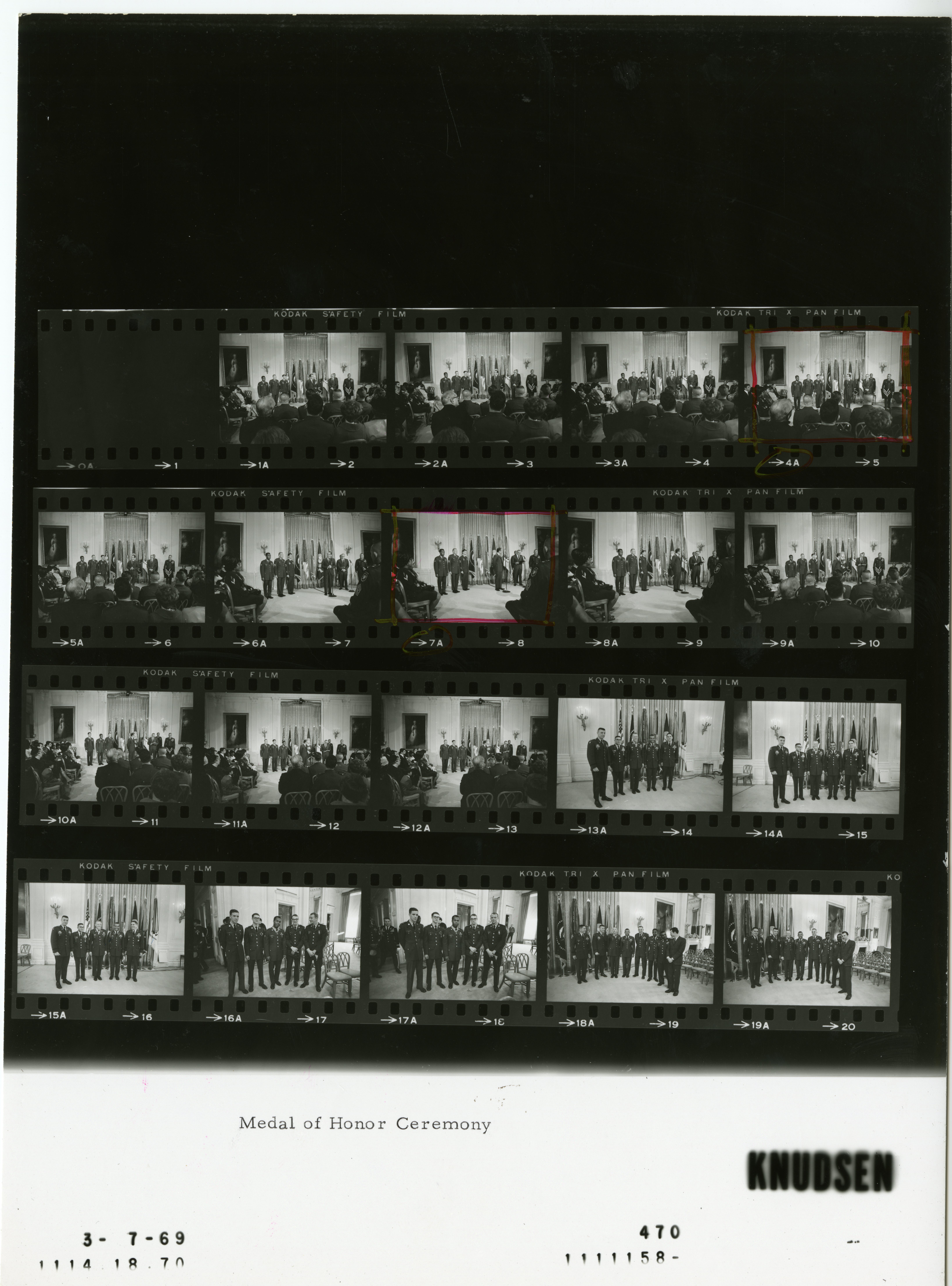
- Frame(s): WHPO-0470-, President Nixon with Medal of Honor recipients Fred Zabitosky, Joe Hooper, and Clarence Sasser. 3/7/1969, Washington, D.C. White House, East Room. President Nixon, Fred Zabitosky, Joe Hooper, Clarence Sasser, unidentified audience members and Army personnel.
Roll WHPO-0474 Photographer: Kightlinger, Jack | Color or B&W: B&W
- Frame(s): WHPO-0474-, President Nixon's presidential helicopter arrives followed by departure on AF1 at Homestead Air Force Base (possibly) on March 10th. 3/7/1969, Florida Homestead Air Force Base. President Nixon, unidentified men.
Roll WHPO-0475 Photographer: Kightlinger, Jack | Color or B&W: B&W
- Frame(s): WHPO-0475-, President Nixon greets crowd upon arrival. 3/7/1969, Florida Homestead Air Force Base. President Nixon, crowd.
The White House Communications Agency Sound Recordings Collection contains public statements that took place between 1969 and 1974. Visit the finding aid to learn more.
P - Formal Presidential Remarks
- WHCA-SR-P-690309
Medal of Honor presentation ceremony with remarks by President Nixon. (3/7/1969, East Room, the White House)
Runtime: 0:15:46
Production credits: Audio feed probably supplied by WHCA; Mult Feed provided by ABC; Recorded by WHCA
Original Format: 1/4-inch reel-to-reel audiotape. Original source type: Original. - WHCA-SR-P-690310
Remarks by President Nixon to personnel at the Central Intelligence Agency, with remarks by Director Richard Helms. (3/7/1969, Central Intelligence Agency, McLean, Virginia)
Runtime: 0:12:41
Production credits: Audio feed supplied by "WHCA Only"; No WHCA engineer initials listed
Original Format: 1/4-inch reel-to-reel audiotape. Original source type: Original.
Context (External Sources)
The Vanderbilt Television News Archive is the world's most extensive and complete archive of television news. They have been recording, preserving and providing access to television news broadcasts of the national networks since August 5, 1968.
Wikipedia is a free encyclopedia that anyone can edit.