
Introduction
This almanac page for Saturday, September 16, 1972, pulls together various records created by the federal government and links to additional resources which can provide context about the events of the day.
Previous Date: Friday, September 15, 1972
Next Date: Sunday, September 17, 1972
Schedule and Public Documents
The Daily Diary files represent a consolidated record of the President's activities. Visit the finding aid to learn more.
The President's day began at The White House - Washington, D. C.
The Weekly Compilation of Presidential Documents made available transcripts of the President's news conferences; messages to Congress; public speeches, remarks, and statements; and other Presidential materials released by the White House.
Digitized versions can be found at HathiTrust.
The Federal Register is the official daily publication for rules, proposed rules, and notices of federal agencies and organizations, as well as executive orders and other Presidential documents.
Archival Holdings
Any selection of archival documents will necessarily be partial. You should use the documents and folders identified below as a starting place, but consult the linked collection finding aids and folder title lists and the collections themselves for context. Many documents to be found this way do not lend themselves to association with specific dates, but are essential to a complete understanding of the material.
Selective document listing
President's Office Files
The President's Office Files consists of materials drawn together by the Special Files Unit from several administrative subdivisions within the White House Office. It is the handwriting and sensitive papers sent to the Staff Secretary that now comprise much of the President's Office Files. Visit the finding aid to learn more.
- News Summaries, Annotated News Summaries, Box 38, Sept. 1-18, 1972 [6 of 7] [Note: Due to the way News Summary products were compiled, you should also consult nearby days for potentially relevant materials.]
- News Summary, September 16, 1972, (Fri nets, wires)
- President's Daily Schedule, Box 102, [President's Daily Schedule, Aug.-Sept. 1972] [2 of 2]
- The President's Schedule, Saturday - September 16, 1972
The H. R. Haldeman Diaries consists of seven handwritten diaries, 36 dictated diaries recorded as sound recordings, and two handwritten audio cassette tape subject logs. The diaries and logs reflect H. R. Haldeman’s candid personal record and reflections on events, issues, and people encountered during his service in the Nixon White House. As administrative assistant to the President and Chief of Staff, Haldeman attended and participated in public events and private meetings covering the entire scope of issues in which the Nixon White House engaged in during the years 1969-1973. Visit the finding aid to learn more.
- Transcript of diary entry (PDF)
Saturday, September 16.
President was very concerned this morning about a Rather story on CBS that was based on two leaked CIA documents, and wanted me to check that out; I had Dave Young run a complete check. President is going to hang on to the list, so that we can move on those people at the appropriate time. He doesn't want any FBI check or anything made on it, just a list of those who had access to the CIA documents, so we have a basis on which to move.
Henry was in to report further. He had covered his whole trip results with the President last night, but went into some details today, particularly on timing of announcements. We agreed we'd deposit the SALT agreements on October 3, announce the trade agreements on the 10th, timing of SALT II on the 16th, and the European Security Conference and MBFR on October 23, or 24th, or 25th. Henry feels that he's got things well in hand with the Soviets, he also thinks there may be a possibility as he always does on Vietnam. Apparently Le Duc Tho was pretty outgoing in their Paris meeting and said "Do you really want to bring this to an end now?" Henry said, "Yes," and he said, "Okay, should we do it by October 15?" and Henry said, "That'd be fine." Le Duc Tho came across the table, shook hands with him, and said, "We have finally agreed on one thing, we will end the war on October 15."
I had a phone call session with Connally on planning for his television commercials. He wants to hold up on the credibility commercial, because he thinks it hits McGovern too hard, at least now, and that we should wait till he bottoms out before we hit him that hard. He's going to start week after next with the defense commercial, and then welfare, and then go to the credibility one. He thinks that he's in good shape, he's not going to move committees into the non-key states, but figures Democrats there should move in to our organizations. He did agree to create a National Committee kind of thing to bring in people who want to tie up with Democrats in the non-key states.
Had a long talk yesterday with Billy Graham. He feels things are very good, that he felt a couple weeks ago that we were behind in California, but he now feels we're pulling ahead there. Thinks we're going to have to give up almost totally on the black vote, we only have a few friends in that area. That Kennedy coming into the campaign and Shriver on the ticket make the difference. He also is concerned that the radical youth are really working for McGovern; for example, they were doing a very heavy registration effort in San Francisco. He doesn't think we'll win as big as it looks now, but thinks we're in good shape. Says the bugging isn't hurting us at all, it's too clouded; people think the Democrats placed it themselves and that they've overplayed it. He thinks that the President is finally succeeding in creating an Eisenhower father image for himself, there's no one else, and he should stay above partisanship. He thinks Wilkes-Barre was tremendous, especially the wedding. President should try to do this kind of thing every three or four days on an unexpected basis to show he's interested in people.
He heard a black two-star general on television who defended Nixon on Vietnam, and did a superb job, said it was the greatest defense of Nixon he's ever heard, and the greatest exponent of Nixon he's ever heard. He was really enthusiastic about it. Thinks that the President needs three or four motorcades in friendly situations but not too much other exposure. He should avoid all chances of negatives, let McGovern go on making more mistakes. Thinks we're still all on the positive side on the Jewish question. No problems regarding the Soviet Jews, expects to win Florida 70 percent, and then told me about Johnny Carson, trying to figure out how he can help the President, and Graham telling him the way to do it is be a little biased in his favor from now on, like he has been biased against him.
President hit me on the drug speech draft. It's twice too long, and he wants it cut down, come out hard and crisp, get a good memorable phrase, determine what the headline is and get all that worked out. The speech crew has been given that to try to develop. He's agreed to do the Italian picnic tomorrow.
Got into a talk about Disraeli and the analysis that Gladstone ended up as an exhausted volcano after his enormous reform programs, and that the British people come to times when they don't want to be improved, and that we in this country may be at that stage. He's doing a lot of talking about the approach to policy for the second term in that context. That not only do we clear out our enemies and build our own establishment, that we clear out the bad programs and so on too. I reviewed our latest wave-- three poll results in the key states with him, and they're overwhelmingly favorable, and it makes the point that we probably should make a quiet decision now to move money out of some of the key states and into West Virginia, Minnesota, Massachusetts, and Rhode Island, which are the only doubtful ones, and see if we can't pick up all 50. So we are going to work on that. President left mid-afternoon for Camp David.
End of September 16. - Original audio recording (MP3)
The National Archives Catalog is the online portal to the records held at the National Archives, and information about those records. It is the main way of describing our holdings and also provides access to electronic records and digitized versions of our holdings.
The Catalog searches across multiple National Archives resources at once, including archival descriptions, digitized and electronic records, authority records, and web pages from Archives.gov and the Presidential Libraries. The Catalog also allows users to contribute to digitized historical records through tagging and transcription.
Nixon Library Holdings
All National Archives Units
National Security Documents
The President's Daily Brief is the primary vehicle for summarizing the day-to-day sensitive intelligence and analysis, as well as late-breaking reports, for the White House on current and future national security issues. Read "The President's Daily Brief: Delivering Intelligence to Nixon and Ford" to learn more.
The Foreign Relations of the United States series presents the official documentary historical record of major U.S. foreign policy decisions and significant diplomatic activity. Visit the State Department website for more information.
Vol. XX, Southeast Asia, 1969-1972
Thailand
175. Memorandum From Secretary of Defense Laird to President Nixon, Washington, September 16, 1972
Source: National Archives, Nixon Presidential Materials, NSC Files, Box 565, Country Files, Far East, Thailand, Vol. IX. Secret; Sensitive.
Vol. XXIX, Eastern Mediterranean, 1969-1972
Cyprus
417. Telegram From the Embassy in Cyprus to the Department of State, Nicosia, September 16, 1972, 1040Z
Source: National Archives, RG 59, Central Files 1970–73, POL 27 CYP. Secret; Priority;Limdis. Repeated to Ankara, Athens, London, USNATO, USDOCOSOUTH, EUCOM, and USUN.
Vol. E-7, Documents on South Asia, 1969-1972
Afghanistan, 1969-1972
367. Telegram 5368 From the Embassy in Afghanistan to the Department of State, Kabul, September 16, 1972
Ambassador Neumann discussed with King Zahir the measures being taken by the Afghan Government to deal with the food crisis.
Source: National Archives, RG 59, Central Files 1970–73, SOC 10 AFG. Confidential. Repeated to Ankara, Islamabad, Moscow, New Delhi, and Tehran.
The Kissinger telephone conversation transcripts consist of approximately 20,000 pages of transcripts of Kissinger’s telephone conversations during his tenure as Assistant to the President for National Security Affairs (1969-1974) and Secretary of State (1973-1974) during the administration of President Richard Nixon. Visit the finding aid for more information.
Digitized versions can be found in the National Archives Catalog.
Audiovisual Holdings
Visit the White House Tapes finding aid to learn about the taping system's operation and archival processing.
Camp David Hard Wire
- 211-1; Unknown between 2:31 p.m. & 6:36 p.m.; Nixon, Richard M. (President); Nixon, Thelma C. ("Pat") (Ryan)
- 211-2; Unknown between 2:31 p.m. & 6:36 p.m.; Nixon, Thelma C. ("Pat") (Ryan); Eisenhower, Julie Nixon
- 211-3; Unknown between 2:31 p.m. & 6:36 p.m.; Nixon, Richard M. (President); Sanchez, Manolo
- 211-4; Unknown between 2:31 p.m. & 6:36 p.m.; Nixon, Richard M. (President)
- 211-5; Unknown between 2:31 p.m. & 6:36 p.m.; Nixon, Richard M. (President); Sanchez, Manolo
- 211-6; Unknown between 2:31 p.m. & 6:36 p.m.; Nixon, Richard M. (President); Camp David Operator
- 211-7; 6:36 p.m. - 6:37 p.m.; Nixon, Richard M. (President); Sanchez, Manolo
- 211-8; Unknown between 6:37 p.m. & 7:00 p.m.; Nixon, Richard M. (President); Eisenhower, Julie Nixon
- 211-9; Unknown between 6:37 p.m. & 7:00 p.m.; Nixon, Richard M. (President); Eisenhower, Julie Nixon
- 211-10; Unknown between 6:37 p.m. & 7:00 p.m.; Nixon, Thelma C. ("Pat") (Ryan); Eisenhower, Julie Nixon
- 211-11; Unknown between 7:00 p.m., 9/16 & 10:25 a.m., 7/22; Eisenhower, Julie Nixon; Nixon, Thelma C. ("Pat") (Ryan)
Camp David Study Table
- 143-1; Unknown between 6:30 p.m. & 6:36 p.m.; Nixon, Richard M. (President); Camp David Operator
- 143-2; 6:36 p.m. - 6:37 p.m.; Nixon, Richard M. (President); Sanchez, Manolo
Old Executive Office Building
- 359-16; Unknown between 1:15 p.m. & 1:32 p.m.; Nixon, Richard M. (President); Kissinger, Henry A.; Bull, Stephen B.
- 359-17; Unknown between 1:15 p.m. & 1:32 p.m.; Nixon, Richard M. (President); White House operator
- 359-18; Unknown between 1:15 p.m. & 1:32 p.m.; Nixon, Richard M. (President); Colson, Charles W.; Eisenhower, Julie Nixon
Oval Office
- 780-2; Unknown between 9:13 a.m. & 9:24 a.m.; Nixon, Richard M. (President); Bull, Stephen B.
- 780-3; Unknown between 9:13 a.m. & 9:24 a.m.; Nixon, Richard M. (President); Bull, Stephen B.
- 780-4; Unknown between 9:13 a.m. & 9:24 a.m.; Nixon, Richard M. (President); White House operator
- 780-5; Unknown between 9:13 a.m. & 9:24 a.m.; Nixon, Richard M. (President); Haldeman, H. R. ("Bob")
- 780-6; 9:24 a.m. - 9:26 a.m.; Nixon, Richard M. (President); Haldeman, H. R. ("Bob"); Ziegler, Ronald L.
- 780-7; 9:26 a.m. - 10:20 a.m.; Nixon, Richard M. (President); Haldeman, H. R. ("Bob"); Colson, Charles W.; Bull, Stephen B.; Kissinger, Henry A.; [Unknown person(s)]; Butterfield, Alexander P.; Ziegler, Ronald L.
- 780-8; Unknown between 10:20 a.m. & 10:41 a.m.; Ziegler, Ronald L.; [Unknown person(s)]
- 780-9; Unknown between 10:20 a.m. & 10:41 a.m.; Butterfield, Alexander P.; [Unknown person(s)]
- 780-10; Unknown between 10:20 a.m. & 10:41 a.m.; United States Secret Service agents
- 780-11; Unknown between 10:41 a.m. & 10:44 a.m.; Nixon, Richard M. (President); Bull, Stephen B.
- 780-12; Unknown between 10:41 a.m. & 10:44 a.m.; Nixon, Richard M. (President); White House operator
- 780-13; 10:44 a.m. - 10:45 a.m.; Nixon, Richard M. (President); Rigley, Harold T.
- 780-14; Unknown between 10:45 a.m. & 10:55 a.m.; Nixon, Richard M. (President); Butterfield, Alexander P.
- 780-15; 10:55 a.m. - 12:50 p.m.; Nixon, Richard M. (President); Haldeman, H. R. ("Bob"); Bull, Stephen B.; Sanchez, Manolo; Cox, Tricia Nixon; Kissinger, Henry A.; Ziegler, Ronald L.
- 780-16; Unknown between 12:50 p.m. & 12:58 p.m.; Nixon, Richard M. (President); Sanchez, Manolo
- 780-17; Unknown between 12:50 p.m. & 12:58 p.m.; Nixon, Richard M. (President); Bull, Stephen B.; Sanchez, Manolo
- 780-18; Unknown between 12:50 p.m. & 12:58 p.m.; Nixon, Richard M. (President); Bull, Stephen B.
- 780-19; Unknown between 12:58 p.m. & 12:59 p.m.; United States Secret Service agents; [Unknown person(s)]
The White House Photo Office collection consists of photographic coverage of President Richard Nixon meeting with prominent social, political, and cultural personalities; speaking engagements and news conferences of the President and various high-ranking members of the White House staff and Cabinet; Presidential domestic and foreign travel, including Presidential vacations; social events and entertainment involving the First Family, including entertainers present; official portraits of the President, First Family, and high-ranking members of the Nixon administration; the 1969 and 1973 Inaugurals; the President’s 1972 Presidential election campaign appearances (including speeches) and other official activities of the White House staff and the President’s Cabinet from January 20, 1969 until August 9, 1974 at the White House and the Old Executive Office Building; other locations in Washington, DC, such as The Mall; and the Presidential retreats in Camp David, Maryland, Key Biscayne, Florida, and San Clemente, California. Visit the finding aid to learn more.
Roll WHPO-D0390 Photographer: Atkins, Oliver | Color or B&W: B&W
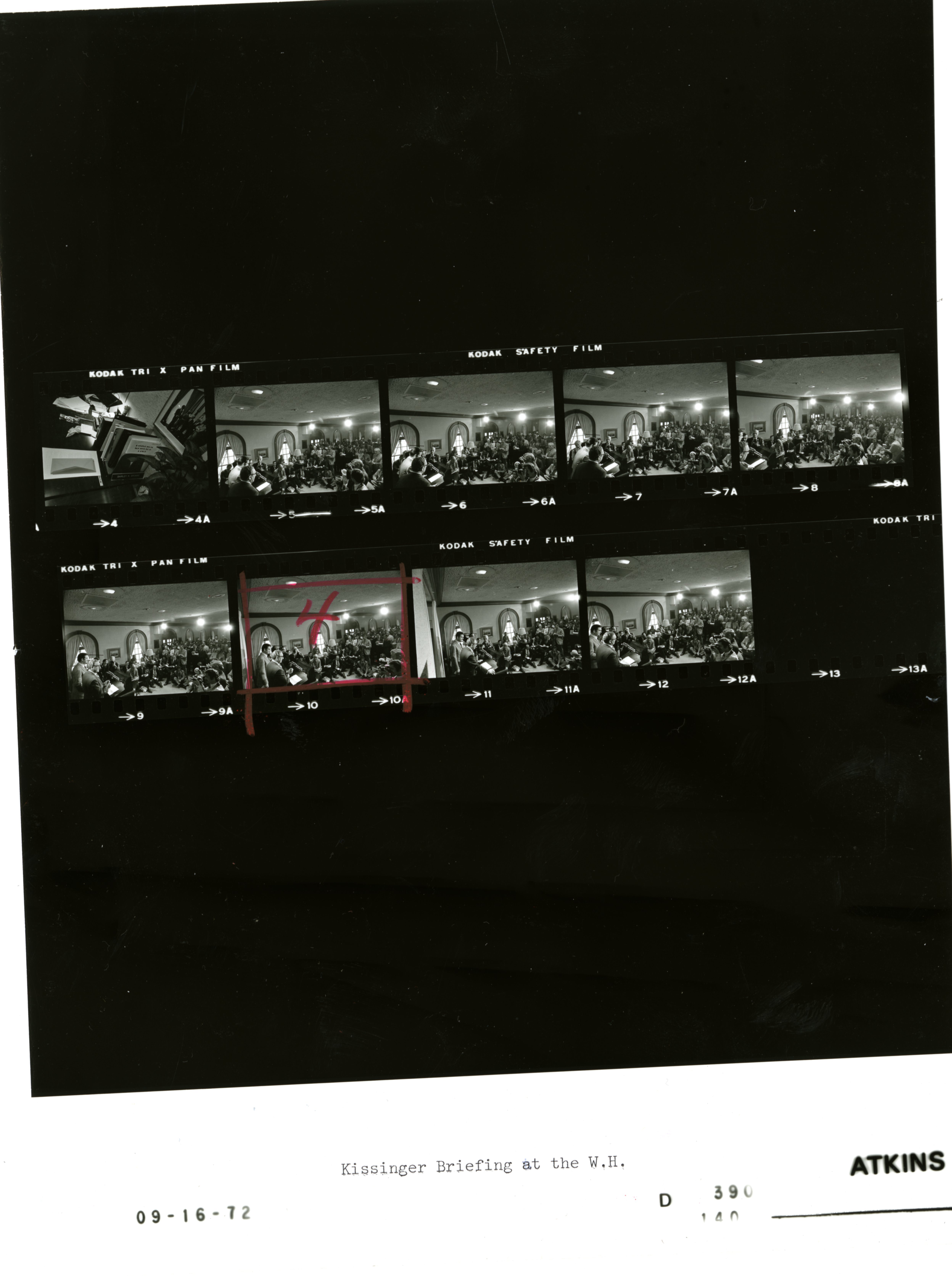
- Frame(s): WHPO-D0390-04, Photo of books and nameplate at an office desk space against a wall. 9/16/1972, Washington, D.C. unidentified room, White House. Henry Kissinger, Ron Ziegler, press corps members.
- Frame(s): WHPO-D0390-05-12, Henry Kissinger conducting a press briefing with Ron Ziegler standing nearby. 9/16/1972, Washington, D.C. White House. Henry Kissinger, Ron Ziegler, press corps members.
- Frame(s): WHPO-D0390-09, Henry Kissinger conducting a press briefing with Ron Ziegler standing nearby. 9/16/1972, Washington, D.C. White House.
Roll WHPO-D0391 Photographer: Atkins, Oliver | Color or B&W: B&W
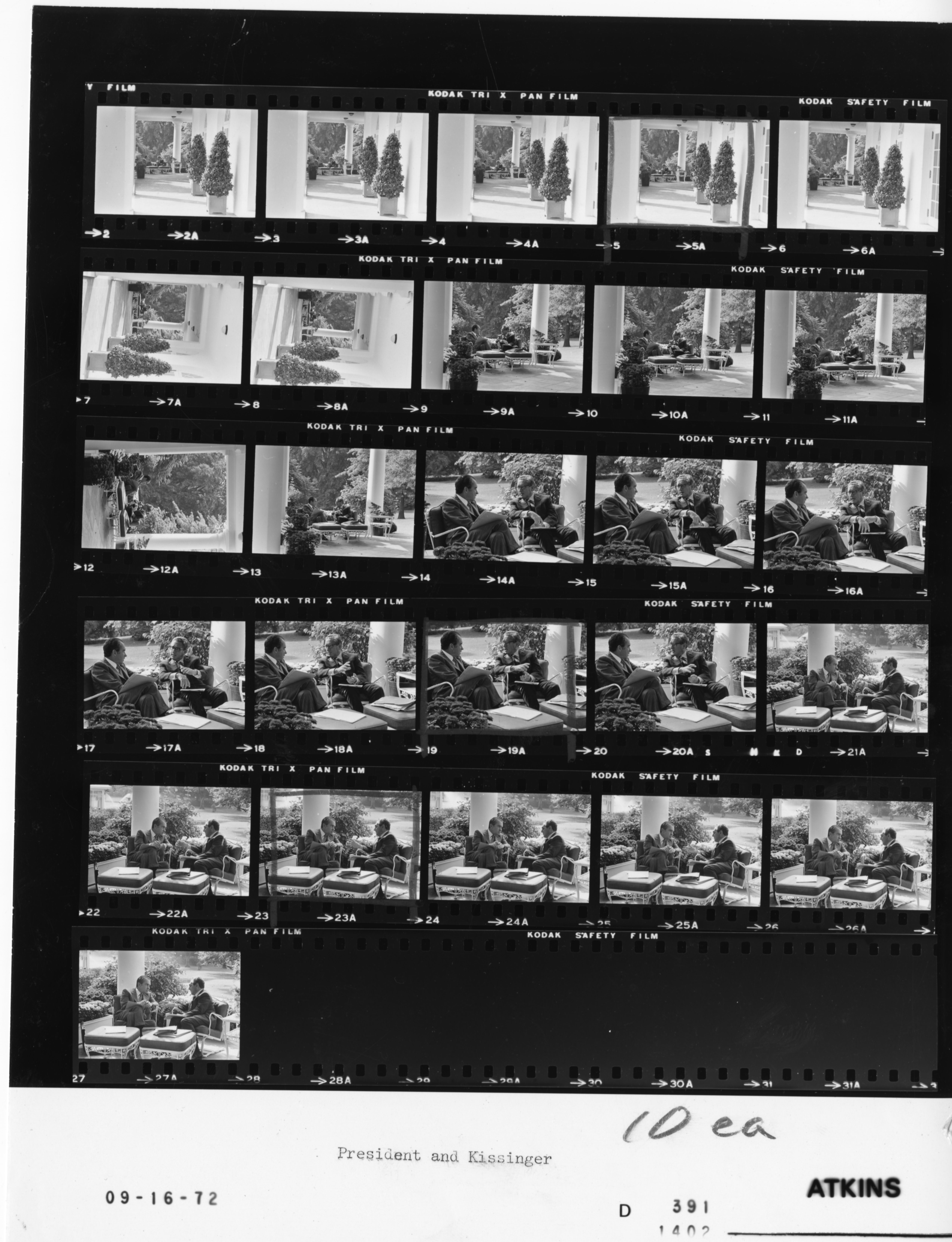
- Frame(s): WHPO-D0391-02A-27A, President Nixon and Henry Kissinger seated outside during a meeting on the White House rose garden porch area. 9/16/1972, Washington, D.C. Rose Garden Patio, White House. President Nixon, Henry Kissinger.
- Frame(s): WHPO-D0391-19A, President Nixon and Henry Kissinger seated outside during a meeting on the White House Rose Garden Patio. 9/16/1972, Washington, D.C. Rose Garden Patio, White House. President Nixon, Henry Kissinger.
- Frame(s): WHPO-D0391-23A, President Nixon and Henry Kissinger seated outside during a meeting on the White House Rose Garden Patio. 9/16/1972, Washington, D.C. Rose Garden Patio, White House. President Nixon, Henry Kissinger.
Roll WHPO-D0392 Photographer: Atkins, Oliver | Color or B&W: B&W
- Frame(s): WHPO-D0392-02A-10A, President Nixon and Henry Kissinger seated outside during a meeting on the White House Rose Garden Patio. 9/16/1972, Washington, D.C. Rose Garden Patio, White House. President Nixon, Henry Kissinger.
- Frame(s): WHPO-D0392-02A-10A, President Nixon and Henry Kissinger seated outside during a meeting on the White House Rose Garden Patio. 9/16/1972, Washington, D.C. Rose Garden Patio, White House. President Nixon, Henry Kissinger.
- Frame(s): WHPO-D0392-10A, President Nixon and Henry Kissinger seated outside during a meeting on the White House Rose Garden Patio. 9/16/1972, Washington, D.C. Rose Garden Patio, White House. President Nixon, Henry Kissinger.
- Frame(s): WHPO-D0392-10A, President Nixon and Henry Kissinger seated outside during a meeting on the White House Rose Garden Patio. 9/16/1972, Washington, D.C. Rose Garden Patio, White House. President Nixon, Henry Kissinger.
Roll WHPO-D0400 Photographer: Kightlinger, Jack | Color or B&W: Color
- Frame(s): WHPO-D0400-05-35, Pat Nixon outside and inside a campaign headquarters, with Gov. Rockefeller, Sen. Jacob Javits, and Sen. Buckley at her side. 9/16/1972, Flushing, New York street, campaign headquarters. Pat Nixon, Nelson Rockefeller, Jacob Javits, James Buckley, campaign workers.
- Frame(s): WHPO-D0400-12, Pat Nixon standing outside the Main Street Nixon Presidential campaign headquarters with Governor Nelson Rockefeller, Senator Jacob Javits and Sen. Buckley. A guitar player performs nearby. 9/16/1972, Flushing, New York street, campaign headquarters. Pat Nixon, Nelson Rockefeller, Jacob Javits, James Buckley, campaign workers.
- Frame(s): WHPO-D0400-35, Pat Nixon speaking on the phone at the Nixon Presidential campaign headquarters while sitting near Governor Nelson Rockefeller and Senator Jacob Javits, who are also making campaign calls. 9/16/1972, Flushing, New York street, campaign headquarters. Pat Nixon, Nelson Rockefeller, Jacob Javits, campaign workers.
Roll WHPO-D0401 Photographer: Kightlinger, Jack | Color or B&W: Color
- Frame(s): WHPO-D0401-, Pat Nixon's visits with staff at a Nixon Presidential campaign headquarters along with Governor Nelson Rockefeller, Senator Jacob Javits and Sen. Buckley. Pat Nixon and officials speaking on the phone making campaign calls. 9/16/1972, Flushing, New York campaign headquarters. Pat Nixon, Nelson Rockefeller, Jacob Javits, campaign workers.
Roll WHPO-D0402 Photographer: Knudsen, Robert L. | Color or B&W: B&W
- Frame(s): WHPO-D0402-, Julie Eisenhower on a Presidential campaign stop, speaking to a crowd and going door to door. 9/16/1972, Philadelphia, Pennsylvania unidentified neighborhood street. Julie Eisenhower, crowd, unidentified persons.
- Frame(s): WHPO-D0402-02, Julie Eisenhower speaking from a stage set outdoors near neighborhood businesses during a Presidential campaign stop. Signs carried in the crowd are: "PENNA. SPORTSMEN FOR NIXON" and a "Nixon Now." sign with portrait. 9/16/1972, Philadelphia, Pennsylvania unidentified neighborhood street. Julie Eisenhower, crowd, unidentified persons.
Roll WHPO-D0403 Photographer: Knudsen, Robert L. | Color or B&W: B&W
- Frame(s): WHPO-D0403-, Julie Eisenhower on a Presidential campaign stop, speaking to a crowd and going door to door. 9/16/1972, Philadelphia, Pennsylvania unidentified neighborhood street. Julie Eisenhower, unidentified persons.
Roll WHPO-D0404 Photographer: Knudsen, Robert L. | Color or B&W: B&W
- Frame(s): WHPO-D0404-, Julie Eisenhower on a Presidential campaign stop, speaking to a crowd and going door to door. 9/16/1972, Philadelphia, Pennsylvania unidentified neighborhood street. Julie Eisenhower, unidentified persons, crowd.
Roll WHPO-D0405 Photographer: Knudsen, Robert L. | Color or B&W: Color
- Frame(s): WHPO-D0405-, Julie Eisenhower campaigning, speaking to a crowd and going door to door. 9/16/1972, Philadelphia, Pennsylvania street. Julie Eisenhower, unidentified persons, crowd.
The White House Communications Agency Sound Recordings Collection contains public statements that took place between 1969 and 1974. Visit the finding aid to learn more.
H - White House Staff Member Recordings
- WHCA-SR-H-654
Press briefing by Henry Kissinger and Ronald Ziegler. (9/16/1972, Press Lobby, White House)
Runtime: 0:55:08
Keywords: Press conferences, news conferences, interviews, media, press secretary
Production credits: Audio feed supplied by WHCA; Recorded by JAD (initials of WHCA engineer)
Original Format: 1/4-inch reel-to-reel audiotape. Original source type: Original. Technical notes: 41 minutes and 35 seconds of silence at end of recording removed from access copies.
L - White House Press Office Briefings
- WHCA-SR-L-023
Press briefing by Ronald Ziegler. (9/16/1972, White House Press Lobby)
Runtime: 0:08:03
Keywords: Press conferences, news conferences, interviews, media, press secretary, briefings, public statements to the press, cabinet, advisors
Production credits: Audio feed supplied by WHCA; Recorded by JAD (initials of WHCA engineer)
Original Format: 1/4-inch reel-to-reel audiotape. Original source type: Original. Technical notes: 1 hour, 28 minutes and 39 seconds of silence at end of recording removed from access copies.
The White House Communications Agency Videotape Collection contains “off-the-air” recordings of televised programs produced between 1968 and 1974. Visit the finding aid to learn more.
- WHCA-5775
"Agronsky & Company".
NPACT
Runtime: 00:30:01 - WHCA-5782
Weekly News Summary, Tape I.
ALL NETWORKS
Runtime: 01:32:52
16. Utley: Watergate indictment and (McGovern) statement. Time Code Start: 47:49. Keywords: Watergate, Senate committee hearings, investigations, testimony, testify, cover-ups, break-in, burglary, theft, plumbers, scandals. Network: NBC.
17. Utley/Valeriani: (President Nixon and Kissinger) outside Oval Office talking about negotiations. Time Code Start: 49:29. Keywords: Presidents, cabinet, advisors, meetings. Network: NBC.
18. Utley/Bell: President Nixon campaigning with Mrs. Judy Agnew and First Lady Pat Nixon. Time Code Start: 51:30. Keywords: Vice Presidents, families, wife, travel, Mrs. Agnew trips, First Lady trips, domestic, Presidential elections, campaigns, candidates. Network: NBC.
19. Utley: Announcement on President Nixon's net worth - $765,118; Vice President Agnew - $198,258; McGovern - $271,600. Time Code Start: 53:20. Keywords: Presidents, Vice Presidents, Internal Revenue Service, taxes, audits, investigations. Network: NBC.
20. Pierpoint: (Kissinger) confers with (President Nixon) about trips. Time Code Start: 53:53. Keywords: Presidents, cabinet, advisors, travel, trips. Network: CBS.
21. Mudd: McGovern comments on results of Grand Jury indictments for Watergate caper. Time Code Start: 59:24. Keywords: Watergate, Senate committee hearings, investigations, testimony, testify, cover-ups, break-in, burglary, theft, plumbers, scandals. Network: CBS.
22. Mudd/Schakne/Shepard/Sarafin/Shaw: First Lady Pat Nixon on the road campaigning; Julie Nixon Eisenhower in Pennsylvania, Mrs. Judy Agnew. Time Code Start: 60:45. Keywords: Presidents, families, wife, travel, Mrs. Agnew trips, First Lady trips, Julie Nixon Eisenhower trips, domestic, Presidential elections, campaigns. Network: CBS.
Context (External Sources)
The Vanderbilt Television News Archive is the world's most extensive and complete archive of television news. They have been recording, preserving and providing access to television news broadcasts of the national networks since August 5, 1968.
Wikipedia is a free encyclopedia that anyone can edit.