

Introduction
This almanac page for Friday, September 15, 1972, pulls together various records created by the federal government and links to additional resources which can provide context about the events of the day.
Previous Date: Thursday, September 14, 1972
Next Date: Saturday, September 16, 1972
Schedule and Public Documents
The Daily Diary files represent a consolidated record of the President's activities. Visit the finding aid to learn more.
The President's day began at The White House - Washington, D. C.
The Weekly Compilation of Presidential Documents made available transcripts of the President's news conferences; messages to Congress; public speeches, remarks, and statements; and other Presidential materials released by the White House.
Digitized versions can be found at HathiTrust.
Each Public Papers of the Presidents volume contains the papers and speeches of the President of the United States that were issued by the White House Office of the Press Secretary during the time period specified by the volume. The material is presented in chronological order, and the dates shown in the headings are the dates of the documents or events. In instances when the release date differs from the date of the document itself, that fact is shown in the text note.
To ensure accuracy, remarks have been checked against audio recordings (when available) and signed documents have been checked against the original, unless otherwise noted. Editors have provided text notes and cross references for purposes of identification or clarity.
The Federal Register is the official daily publication for rules, proposed rules, and notices of federal agencies and organizations, as well as executive orders and other Presidential documents.
The Congressional Record is the official daily record of the debates and proceedings of the U.S. Congress.
Archival Holdings
Any selection of archival documents will necessarily be partial. You should use the documents and folders identified below as a starting place, but consult the linked collection finding aids and folder title lists and the collections themselves for context. Many documents to be found this way do not lend themselves to association with specific dates, but are essential to a complete understanding of the material.
Selective document listing
President's Office Files
The President's Office Files consists of materials drawn together by the Special Files Unit from several administrative subdivisions within the White House Office. It is the handwriting and sensitive papers sent to the Staff Secretary that now comprise much of the President's Office Files. Visit the finding aid to learn more.
- News Summaries, Annotated News Summaries, Box 38, Sept. 1-18, 1972 [5 of 7] [Note: Due to the way News Summary products were compiled, you should also consult nearby days for potentially relevant materials.]
- Media Political Analysis, September 15
- News Summary, September 15, 1972, (Thurs. nets, wires and columns)
- President's Daily Schedule, Box 102, [President's Daily Schedule, Aug.-Sept. 1972] [2 of 2]
- The President's Schedule, Friday - September 15, 1972
The H. R. Haldeman Diaries consists of seven handwritten diaries, 36 dictated diaries recorded as sound recordings, and two handwritten audio cassette tape subject logs. The diaries and logs reflect H. R. Haldeman’s candid personal record and reflections on events, issues, and people encountered during his service in the Nixon White House. As administrative assistant to the President and Chief of Staff, Haldeman attended and participated in public events and private meetings covering the entire scope of issues in which the Nixon White House engaged in during the years 1969-1973. Visit the finding aid to learn more.
- Transcript of diary entry (PDF)
Friday, September 15.
The President had me read a speech Connally's planning to give on Mutual Radio that he felt was extremely good. He wants to have our speech writers review it, to see how a good political speech is put together with all the grabbers and quotable lines, no wasted words or high blown rhetoric, just exactly the right tone. High level, hard hitting, and simple.
We reviewed some minor schedule things. He then ended up in the afternoon with not much to do, sat around and talked about the campaign in general, had Pete Daily in for about 45 minutes going over the advertising plans and Daily's analysis of the current situation. Then called John Dean in for a report on the Watergate indictments, which came out today. Wondered if we should put out the fact that Johnson bugged us in '68, told me to ask Connally about that, then withdrew the idea. Wants to be sure we put the screws on Congress to turn off the Patman hearings, where they're trying to get Stans up to testify, and then got into quite a long talk with Dean about the need to get control of such things as the IRS and to be sure that we force all resignations, right after the election, a general area that we've got to start planning on. Since he feels strongly about it, it will be our one opportunity in our last month or so of this year.
End of September 15. - Original audio recording (MP3)
The National Archives Catalog is the online portal to the records held at the National Archives, and information about those records. It is the main way of describing our holdings and also provides access to electronic records and digitized versions of our holdings.
The Catalog searches across multiple National Archives resources at once, including archival descriptions, digitized and electronic records, authority records, and web pages from Archives.gov and the Presidential Libraries. The Catalog also allows users to contribute to digitized historical records through tagging and transcription.
Nixon Library Holdings
All National Archives Units
National Security Documents
The President's Daily Brief is the primary vehicle for summarizing the day-to-day sensitive intelligence and analysis, as well as late-breaking reports, for the White House on current and future national security issues. Read "The President's Daily Brief: Delivering Intelligence to Nixon and Ford" to learn more.
The Foreign Relations of the United States series presents the official documentary historical record of major U.S. foreign policy decisions and significant diplomatic activity. Visit the State Department website for more information.
Vol. V, United Nations, 1969-1972
UN Finances and Reduction of the U.S. Assessment
188. Telegram From the Mission to the United Nations to the Department of State, New York, September 15, 1972, 0116Z
Source: National Archives, RG 59, Central Files 1970–73, UN 10–4. Confidential. Repeated to Moscow.
Vol. VIII, Vietnam, January-October 1972
The Parties Move Toward Agreement, July 19-October 7, 1972
261. Memorandum From the Deputy Special Assistant for Vietnamese Affairs, Central Intelligence Agency (Horgan) to the Executive Director–Comptroller of the Agency (Colby), Washington, September 15, 1972
Source: Central Intelligence Agency, Executive Registry, DCI Files, Job 80–R01284A, Box 6, 1 August–30 September 1972. Secret; Sensitive. In his September 15 transmittal memorandum to Colby, Carver wrote: “When the first ‘blue ribbon’ panel was convened [the first meeting of PPOG] under Sullivan’s aegis at 1000 on the morning of 20 May, I quickly grabbed for the Agency bureaucratic control of the Washington effort and nominated my deputy as its day-to-day director. The move was made before anybody else could come up with alternatives and, in the rush of trying to be seen to be responsive to the President’s ‘get cracking’ order, nobody made any serious objections.”
262. Conversation Among President Nixon, the President’s Assistant for National Security Affairs (Kissinger), and the President’s Deputy Assistant for National Security Affairs (Haig), Washington, September 15, 1972
Source: National Archives, Nixon Presidential Materials, White House Tapes, Oval Office, Conversation 780–1. No classification marking. The editors transcribed the portions of the tape recording printed here specifically for this volume. The transcript is part of a larger conversation, 11:43 p.m.–1:01 a.m. In this conversation, Kissinger reported the high points of his September 15 meeting with Le Duc Tho in Paris.
Vol. XX, Southeast Asia, 1969-1972
Philippines
256. Telegram From the Embassy in the Philippines to the Department of State, Manila, September 15, 1972, 0942Z
Source: National Archives, Nixon Presidential Materials, NSC Files, Box 557, Country Files, Far East, Philippines, Vol. IV. Top Secret; Priority; Nodis.
Vol. XLII, Vietnam: The Kissinger-Le Duc Tho Negotiations
Serious Negotiations and the October Settlement, July 1972-October 1972
18. Memorandum of Conversation, Paris, September 15, 1972, 9:55 a.m.-3:55 p.m.
Source: National Archives, Nixon Presidential Materials, NSC Files, Box 864, For the President’s Files (Winston Lord)—China/Vietnam Negotiations, Sensitive, Camp David Memcons, May–October 1972 [3 of 5]. Top Secret; Sensitive; Exclusively Eyes Only. The meeting took place at 11 Rue Darthé, Choisy-le-Roi. All brackets, except those indicating illegible or missing text, are in the original. The tabs are attached but not printed.
In a September 19 memorandum to the President reporting on the meeting, Kissinger wrote:
“It was in many respects the most interesting we have ever had. They were defensive; they professed eagerness to set the earliest possible deadline for an overall settlement; and they have never been so eager to have early and frequent meetings. They repeatedly, and almost plaintively, asked how quickly we wished to settle and there was none of their usual bravado about how U.S. and world opinion were stacked against them. For the first time in the history of these talks I sensed that they were groping for their next move and their tack was devoid of any apparent, clear-cut strategy. Indeed the tone of our exchanges may prove more significant for the future than actual content of their remarks at this meeting.
“On the purely substantive side, we tabled our new proposal building on our August 14 offer but adding the political element which we had withheld at the last meeting pending consultations with Saigon. With your prior concurrence, one element of our political proposal, namely the tripartite nature of the committee to supervise the Presidential elections, was tabled without complete Saigon agreement. This was because of the inordinate delay in receiving Saigon’s comments on our proposals and the fact that without this element our proposal would have had practically nothing new as compared to our January offer.”
He continued: “My surmise is that they are deeply concerned about your reelection and its implications for them but, with their collective leadership, they may be having deep difficulties coming to grips with the very political concessions they will have to make to move the talks off dead center. They continue to pose unacceptable demands, perhaps because they lack imagination, perhaps because they wish to defer the necessary concessions to the last possible moment.
“Whatever the case, we are in an unassailable position. By tabling our new proposal we have built an excellent negotiating record. This will be enhanced by the next meeting and their eagerness to talk will carry us into October. At that point Hanoi will face the choice of moving off its political position in order to reach early agreement or having to deal with you after the election.” ( Foreign Relations, 1969–1976, vol. VIII, Vietnam, January–October 1972, Document 263; a stamped notation on the memorandum indicates the President saw it.)
Vol. E-1, Documents on Global Issues, 1969-1972
U.S. Policy Towards Terrorism, Hijacking of Aircraft, and Attacks on Civil Aviation: The Olympic Attack and the Anti-Terrorism Initiatives, September−December 1972
101. Telegram 169556 From the Department of State to the Mission at the United Nations, Washington, September 15, 1972, 2354Z
The Department discussed its strategy on handling terrorism issues at the UN General Assembly.
Source: National Archives, RG 59, Central Files 1970-73, POL 23-8. Confidential; Routine. Repeated to 21 additional posts. Drafted by Armitage, and cleared by De Palma, Stevenson, Atherton, and Sisco.
Vol. E-1, Documents on Global Issues, 1969-1972
Oceans Policy
437. Memorandum From Secretary of Defense Laird to President Nixon, Washington, September 15, 1972
Laird registered Department of Defense concerns about the scenario for resolving the Ecuadorian fisheries dispute proposed by the Department of State.
Source: National Archives, Nixon Presidential Materials, NSC Files, NSC Institutional Files (H-Files), Box H-237, NSDM Files, NSDM 194 [2 of 2]. Confidential.
Vol. E-7, Documents on South Asia, 1969-1972
Afghanistan, 1969-1972
366. Telegram 169365 From the Department of State to the Embassy in Afghanistan, Kabul, September 15, 1972, 2237Z
The Department concurred in the need for urgent action to try to prevent starvation in the western mountains of Afghanistan.
Source: National Archives, RG 59, Central Files 1970–73, SOC 10 AFG. Limited Official Use. Drafted by Flaten (NEA/PAB), cleared in draft with AID/ASIA/NE, AID/PRI/DRD, and DOD/ISA and by Laingen. Repeated to Islamabad, Tehran, and Moscow.
The Kissinger telephone conversation transcripts consist of approximately 20,000 pages of transcripts of Kissinger’s telephone conversations during his tenure as Assistant to the President for National Security Affairs (1969-1974) and Secretary of State (1973-1974) during the administration of President Richard Nixon. Visit the finding aid for more information.
Digitized versions can be found in the National Archives Catalog.
Audiovisual Holdings
Visit the White House Tapes finding aid to learn about the taping system's operation and archival processing.
Old Executive Office Building
- 358-2; Unknown between 12:39 p.m. & 3:08 p.m.; Nixon, Richard M. (President); Woods, Rose Mary
- 358-3; Unknown between 12:39 p.m. & 3:08 p.m.; Nixon, Richard M. (President); Sanchez, Manolo
- 358-4; Unknown between 12:39 p.m. & 3:08 p.m.; Nixon, Richard M. (President); Bull, Stephen B.
- 358-5; Unknown between 12:39 p.m. & 3:08 p.m.; Nixon, Richard M. (President); Sanchez, Manolo
- 358-6; Unknown between 12:39 p.m. & 3:08 p.m.; Nixon, Richard M. (President); Sanchez, Manolo
- 358-7; Unknown between 12:39 p.m. & 3:08 p.m.; Nixon, Richard M. (President)
- 358-8; Unknown between 12:39 p.m. & 3:08 p.m.; Nixon, Richard M. (President); Woods, Rose Mary
- 358-9; Unknown between 12:39 p.m. & 3:08 p.m.; Nixon, Richard M. (President); Sanchez, Manolo
Oval Office
- 778-1; Unknown between 8:36 a.m. & 9:02 a.m.; Nixon, Richard M. (President); Bull, Stephen B.
- 778-2; Unknown between 8:36 a.m. & 9:02 a.m.; Nixon, Richard M. (President); Bull, Stephen B.
- 778-3; Unknown between 8:36 a.m. & 9:02 a.m.; Nixon, Richard M. (President); White House operator
- 778-4; Unknown between 8:36 a.m. & 9:02 a.m.; Nixon, Richard M. (President); Sanchez, Manolo
- 778-5; Unknown between 8:36 a.m. & 9:58 a.m.; Nixon, Richard M. (President); Haldeman, H. R. ("Bob"); Connally, John B.; Haig, Alexander M., Jr.
- 778-6; 10:01 a.m. - 10:30 a.m.; Nixon, Richard M. (President); McConaughy, Walter P.; Haig, Alexander M., Jr.; White House photographer
- 778-7; Unknown between 10:30 a.m. & 10:39 a.m.; Nixon, Richard M. (President); Bull, Stephen B.
- 778-8; Unknown between 10:30 a.m. & 10:39 a.m.; Nixon, Richard M. (President); [Unknown person(s)]
- 778-9; 10:39 a.m. - 10:40 a.m.; Nixon, Richard M. (President); Butterfield, Alexander P.
- 778-10; Unknown between 10:40 a.m. & 10:41 a.m.; Nixon, Richard M. (President); White House operator
- 778-11; 10:40 a.m. - 10:42 a.m.; Nixon, Richard M. (President); Connally, John B.
- 778-12; Unknown between 10:42 a.m. & 10:49 a.m.; Nixon, Richard M. (President); White House operator
- 778-13; 10:49 a.m. - 10:50 a.m.; Nixon, Richard M. (President); Eisenhower, Julie Nixon
- 778-14; Unknown between 10:50 a.m. & 11:05 a.m.; Nixon, Richard M. (President); Sanchez, Manolo
- 778-15; Unknown between 10:50 a.m. & 11:05 a.m.; Nixon, Richard M. (President); Bull, Stephen B.
- 778-16; Unknown between 10:50 a.m. & 11:05 a.m.; Nixon, Richard M. (President); Bull, Stephen B.
- 778-17; 11:05 a.m. - 11:22 a.m.; Nixon, Richard M. (President); Carlson, Randy (Mrs.); Elman, Bruce; Taylor, Robert; Travis, Alice; Cashen, Henry C., II; Bull, Stephen B.; White House photographer
- 778-18; Unknown between 11:22 a.m. & 11:26 a.m.; Nixon, Richard M. (President); Bull, Stephen B.
- 778-19; Unknown between 11:22 a.m. & 11:26 a.m.; Nixon, Richard M. (President); Bull, Stephen B.
- 778-20; 11:26 a.m. - 11:48 a.m.; Nixon, Richard M. (President); Finch, Robert H.; Butterfield, Alexander P.; Bull, Stephen B.
- 778-21; 11:50 a.m. - 12:13 p.m.; Nixon, Richard M. (President); Carr, Patrick E.; Holt, Cooper T.; Rhatican, William F.; White House photographer
- 778-22; 12:13 p.m. - 12:13 p.m.; Nixon, Richard M. (President); Bull, Stephen B.
- 778-23; 12:13 p.m. - 12:13 p.m.; Nixon, Richard M. (President); Bull, Stephen B.
- 778-24; 12:13 p.m. - 12:14 p.m.; Nixon, Richard M. (President); Eisenhower, Julie Nixon
- 778-25; Unknown between 12:14 p.m. & 12:17 p.m.; Nixon, Richard M. (President); Bull, Stephen B.
- 778-26; Unknown between 12:17 p.m. & 3:08 p.m.; Sanchez, Manolo; United States Secret Service agents
- 778-27; Unknown between 3:08 p.m. & 3:15 p.m.; Nixon, Richard M. (President); Bull, Stephen B.
- 778-28; Unknown between 3:08 p.m. & 3:15 p.m.; Nixon, Richard M. (President); Bull, Stephen B.
- 778-29; Unknown between 3:15 p.m. & 5:27 p.m.; Nixon, Richard M. (President); Haldeman, H. R. ("Bob"); White House operator; Buchanan, Patrick J.; Bull, Stephen B.; Dailey, Peter H.; White House photographer; Sanchez, Manolo; Ziegler, Ronald L.
- 779-1; Unknown between 3:15 p.m. & 5:27 p.m.; Nixon, Richard M. (President); Haldeman, H. R. ("Bob")
- 779-2; Unknown between 4:49 p.m. & 6:17 p.m.; Nixon, Richard M. (President); Haldeman, H. R. ("Bob"); Dean, John W., III; Bull, Stephen B.; MacGregor, Clark
- 779-3; Unknown between 11:43 p.m., 9/15 & 1:01 a.m., 8/4; Nixon, Richard M. (President); Kissinger, Henry A.; Haig, Alexander M., Jr.
- 780-1; Unknown between 11:43 p.m., 9/15 & 1:01 a.m., 8/7; Nixon, Richard M. (President); Kissinger, Henry A.; Haig, Alexander M., Jr.
The White House Photo Office collection consists of photographic coverage of President Richard Nixon meeting with prominent social, political, and cultural personalities; speaking engagements and news conferences of the President and various high-ranking members of the White House staff and Cabinet; Presidential domestic and foreign travel, including Presidential vacations; social events and entertainment involving the First Family, including entertainers present; official portraits of the President, First Family, and high-ranking members of the Nixon administration; the 1969 and 1973 Inaugurals; the President’s 1972 Presidential election campaign appearances (including speeches) and other official activities of the White House staff and the President’s Cabinet from January 20, 1969 until August 9, 1974 at the White House and the Old Executive Office Building; other locations in Washington, DC, such as The Mall; and the Presidential retreats in Camp David, Maryland, Key Biscayne, Florida, and San Clemente, California. Visit the finding aid to learn more.
Roll WHPO-D0374 Photographer: unknown | Color or B&W: Color
- Frame(s): WHPO-D0374-, Posed head and shoulders professional portrait of Edward Cox. 9/15/1972, unknown unknown. Edward Cox.
- Frame(s): WHPO-D0374-00, Head and shoulders professional portrait of Edward Cox. 9/15/1972, unknown unknown. Edward Cox.
Roll WHPO-D0375 Photographer: unknown | Color or B&W: Color
- Frame(s): WHPO-D0375-00, Head and shoulders professional portrait of Edward Cox. 9/15/1972, unknown unknown. Edward Cox.
Roll WHPO-D0376 Photographer: unknown | Color or B&W: Color
- Frame(s): WHPO-D0376-00, Posed head and shoulders professional portrait of Tricia Nixon Cox. 9/15/1972, unknown unknown. Tricia Nixon Cox.
Roll WHPO-D0377 Photographer: Schumacher, Karl | Color or B&W: B&W
- Frame(s): WHPO-D0377-, Vice President Agnew greeting guests at a reception. 9/15/1972, Washington, D.C. rooms, Taylor House. Agnew, guests.
Roll WHPO-D0378 Photographer: Grove, Andrew | Color or B&W: B&W
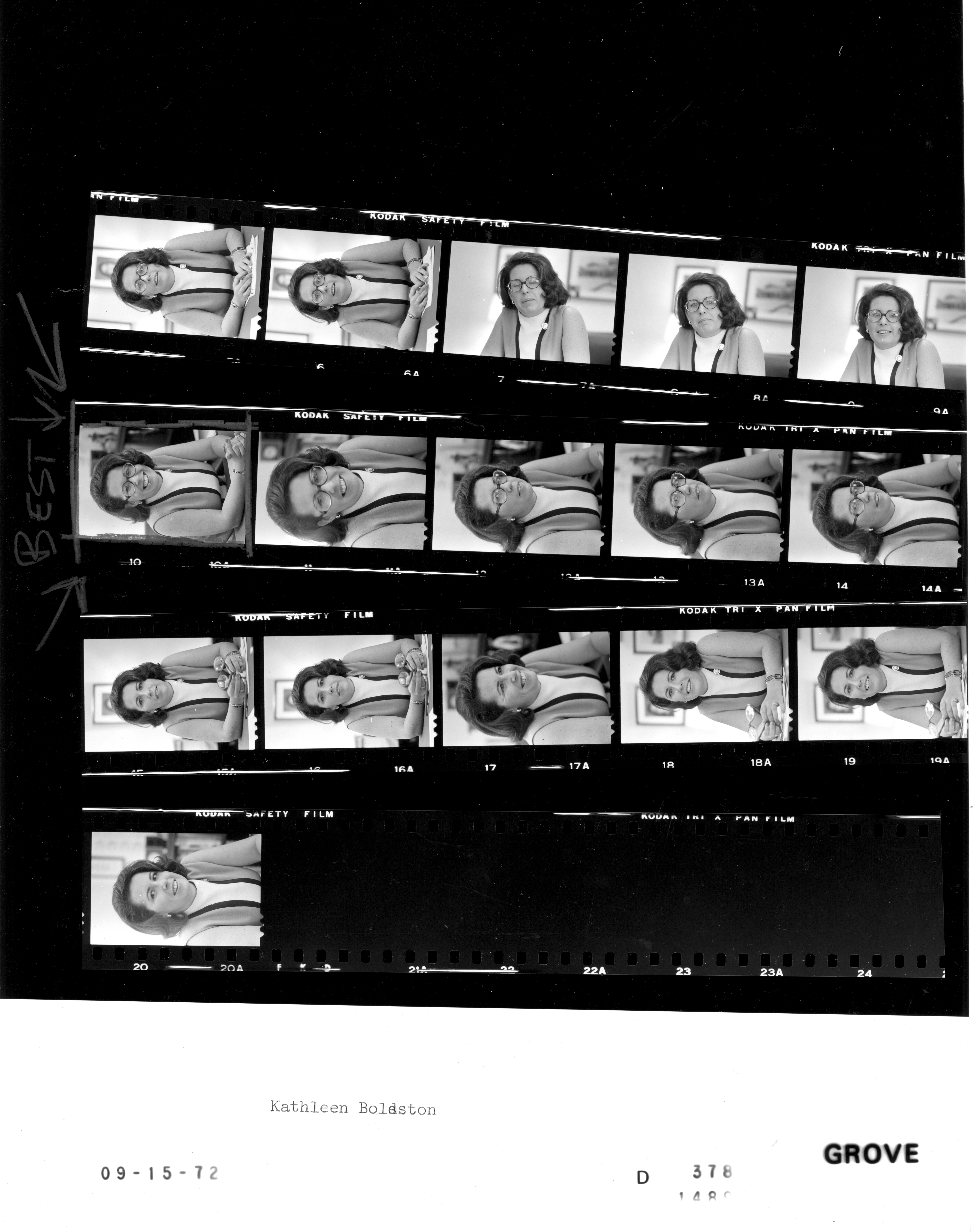
- Frame(s): WHPO-D0378-, Head and shoulders shots of Kathleen Boldston. 9/15/1972, Washington, D.C. unknown. Kathleen Boldston.
Roll WHPO-D0379 Photographer: Atkins, Oliver | Color or B&W: B&W
- Frame(s): WHPO-D0379-03-04, President Nixon seated at his desk during a meeting with Ambassador to China Walter P. McConaughy and Alexander Haig. 9/15/1972, Washington, D.C. White House, Oval Office. President Nixon, Haig, Walter P. McConaughy, Patrick Carr.
- Frame(s): WHPO-D0379-07-15, President Nixon standing with VFW National Commander Carr. 9/15/1972, Washington, D.C. White House, Oval Office. President Nixon, Haig, Walter P. McConaughy, Patrick Carr.
Roll WHPO-D0380 Photographer: Atkins, Oliver | Color or B&W: B&W
- Frame(s): WHPO-D0380-, President Nixon standing and seated in the Oval Office during a meeting with Blues singer Ray Charles and others. 9/15/1972, Washington, D.C. White House, Oval Office. President Nixon, Ray Charles, Bruce Elman, Robert Taylor, Alice Travis, Henry Cashen.
- Frame(s): WHPO-D0380-16, President Nixon seated at his Oval Office during a meeting with singer Ray Charles. 9/15/1972, Washington, D.C. White House, Oval Office. President Nixon, Ray Charles.
Roll WHPO-D0381 Photographer: Schumacher, Karl | Color or B&W: B&W
- Frame(s): WHPO-D0381-, Vice President Agnew meeting with the Commission on Intergovernmental Relations. 9/15/1972, Washington, D.C. unknown. Spiro Agnew, commission members.
Roll WHPO-D0382 Photographer: Atkins, Oliver | Color or B&W: B&W
- Frame(s): WHPO-D0382-, John Ehrlichman with members of his staff. 9/15/1972, Washington, D.C. unknown. Ehrlichman, staff members.
Roll WHPO-D0383 Photographer: Atkins, Oliver | Color or B&W: B&W
- Frame(s): WHPO-D0383-, John Ehrlichman with members of his staff. 9/15/1972, Washington, D.C. unknown. Ehrlichman, staff members.
Roll WHPO-D0384 Photographer: unknown | Color or B&W: B&W
- Frame(s): WHPO-D0384-, Posed head and shoulders photos of Edward Cox. 9/15/1972, unknown unknown. Edward Cox.
Roll WHPO-D0385 Photographer: Atkins, Oliver | Color or B&W: B&W
- Frame(s): WHPO-D0385-, Informal shots of Ken Cole. 9/15/1972, Washington, D.C. unknown. Kenneth Cole.
- Frame(s): WHPO-D0385-22A, Head and shoulders portrait of Ken Cole smiling. 9/15/1972, Washington, D.C. unknown. Kenneth Cole.
Roll WHPO-D0386 Photographer: Atkins, Oliver | Color or B&W: B&W
- Frame(s): WHPO-D0386-, Julie Eisenhower standing with Mr. & Mrs. Don Cornish and Barbara Pathe of ARC. 9/15/1972, Washington, D.C. White House, Library. Julie Eisenhower, Mr. & Mrs. Don Cornish, Barbara Pathe.
- Frame(s): WHPO-D0386-02A, Julie Eisenhower holding a copy of her new book EYE ON NIXON, while standing with Don Cornish. 9/15/1972, Washington, D.C. White House, Library. Julie Eisenhower, Don Cornish.
Roll WHPO-D0387 Photographer: Atkins, Oliver | Color or B&W: B&W
- Frame(s): WHPO-D0387-, Julie Eisenhower seated at the presidential desk, holding a crystal elephant. 9/15/1972, Washington, D.C. White House, Oval Office. Julie Eisenhower.
Roll WHPO-D0388 Photographer: Knudsen, Robert L. | Color or B&W: B&W

- Frame(s): WHPO-D0388-, President Nixon seated at his desk during a meeting with H.R. Haldeman and Peter Daily. 9/15/1972, Washington, D.C. White House, Oval Office. President Nixon, H.R. Haldeman, Peter Daily.
Roll WHPO-D0389 Photographer: Knudsen, Robert L. | Color or B&W: B&W
- Frame(s): WHPO-D0389-, Egil Krogh seated with members of his staff. 9/15/1972, Washington, D.C. unknown. Egil Krogh, staff members.
Roll WHPO-D0396 Photographer: Knudsen, Robert L. | Color or B&W: B&W
- Frame(s): WHPO-D0396-, President Nixon standing with VFW National Commander Carr. 9/15/1972, Washington, D.C. White House, Oval Office. President Nixon, Patrick Carr.
Roll WHPO-D0398 Photographer: Kightlinger, Jack | Color or B&W: Color
- Frame(s): WHPO-D0398-, Pat Nixon visits a kennel housing service dogs, including seeing eye guide dogs for the blind. 9/15/1972, Morristown, New Jersey unknown. Pat Nixon, unidentified persons.
- Frame(s): WHPO-D0398-31, Pat Nixon wearing a blindfold while walking with the aid of a seeing eye guide dog for the blind at the Morristown, New Jersey park where the dogs are trained. 9/15/1972, Morristown, New Jersey unknown. Pat Nixon, unidentified persons.
Roll WHPO-D0399 Photographer: Kightlinger, Jack | Color or B&W: Color
- Frame(s): WHPO-D0399-, Pat Nixon at a senior citizens facility and a campaign headquarters. 9/15/1972, Morristown, New Jersey senior citizens facility, campaign headquarters. Pat Nixon, senior citizens, campaign workers, unidentified persons.
Roll WHPO-D0400 Photographer: Kightlinger, Jack | Color or B&W: Color
- Frame(s): WHPO-D0400-03-04, Pat Nixon and a campaign worker. 9/15/1972, Morristown, New Jersey campaign headquarters. Pat Nixon, unidentified woman.
The White House Communications Agency Sound Recordings Collection contains public statements that took place between 1969 and 1974. Visit the finding aid to learn more.
H - White House Staff Member Recordings
- WHCA-SR-H-653
Press briefing by Frank Carlucci and Ronald Ziegler. (9/15/1972, Press Lobby, White House)
Runtime: 0:50:53
Keywords: Press conferences, news conferences, interviews, media, press secretary
Production credits: Audio feed supplied by WHCA; Recorded by GET (initials of WHCA engineer)
Original Format: 1/4-inch reel-to-reel audiotape. Original source type: Original. Technical notes: 45 mintes and 39 seconds of silence at end of recording removed from access copies.
The White House Communications Agency Videotape Collection contains “off-the-air” recordings of televised programs produced between 1968 and 1974. Visit the finding aid to learn more.
- WHCA-5774
"Everywoman". Nella Manes, Irma Diamond, Kerry Treasure, and Marge Gland
CBS
Runtime: 00:33:02 - WHCA-5782
Weekly News Summary, Tape I.
ALL NETWORKS
Runtime: 01:32:52
1. Smith/Shoumacher/Geer: Seven indicted on Watergate caper with statement by Kleindienst. Federal grand jury indicts 7 on charges of conspiracy, breaking and entering, theft, and installing eavesdropping devices at Democratic national headquarters. (Justice. Time Code Start: 00:00. Keywords: Watergate, Senate committee hearings, investigations, testimony, testify, cover-ups, break-in, burglary, theft, plumbers, scandals. Network: ABC.
2. Reasoner/Donaldson: More on Watergate. Time Code Start: 00:19. Keywords: Watergate, Senate committee hearings, investigations, testimony, testify, cover-ups, break-in, burglary, theft, plumbers, scandals. Network: ABC.
3. Reasoner: Wholesale wheat exporters get advance notice of upcoming wheat programs. Time Code Start: 05:46. Keywords: American, Soviet Union, USSR, Russia, agriculture, food, crops, products, sales, agreements, business, imports, exports, trade. Network: ABC.
4. Reasoner/Mariano: Quang Tri in South Vietnamese control, General Lavelle's hearings. Time Code Start: 06:20. Keywords: Vietnam War, Air Force, military officials, bombings, Sentate, hearings, investigations, retirement, hearings, investigations. Network: ABC.
5. Reasoner/Kincaid: McGovern to disband wage and price controls; Youth vote in Columbus, Ohio with (Julie Nixon Eisenhower and Mark Harroff). Time Code Start: 08:50. Keywords: Vote, voters, voting, Presidents, Presidential elections, campaigns, campaigning, candidates, voting, registrations, employment, wages, prices, freezes,. Network: ABC.
6. Smith: Commentary on General Lavelle. Time Code Start: 13:04. Keywords: Vietnam War, Air Force, military officials, bombings, Sentate, hearings, investigations, retirement, hearings, investigations. Network: ABC.
7. Chancellor/Stern: Watergate bugging, seven indicted with statements by Kleindienst, L. Patrick Gray. 7 federal indictments returned in Watergate bugging affair, a case which began last June when 5 men apprehended in Watergate building headquarters of Demo. Time Code Start: 14:50. Keywords: bugging, bugs, wiretapping, wire taps, surveillance, spying, recordings, Watergate, Senate committee hearings, investigations, testimony, testify, cover-ups, break-in, burglary, theft, plumbers, scandals. Network: NBC.
8. Chancellor: More on men involved in bugging. Time Code Start: 17:45. Keywords: bugging, bugs, wiretapping, wire taps, surveillance, spying, investigations, recordings. Network: NBC.
9. Chancellor/Jones: Kissinger in Paris, Vietnam war, film on Quang Tri and Danang. Time Code Start: 21:50. Keywords: Paris Peace Talks, Vietnam War, treaty, treaties, negotiations, officials, travel, trips. Network: NBC.
10. Chancellor/Graham: (McGovern) policy on economy and in Maine. Time Code Start: 26:33. Keywords: economy, economics, budgets, finances, recession, inflation, money, wages, costs, unemployment, prices. Network: NBC.
11. Cronkite/Mudd: Watergate indictment film in Miami, Florida, film on Liddy Blocker. Time Code Start: 29:11. Keywords: Watergate, Senate committee hearings, investigations, testimony, testify, cover-ups, break-in, burglary, theft, plumbers, scandals. Network: CBS.
12. Cronkite/Webster: Vietnam, Quang Tri, film. Time Code Start: 36:10. Keywords: Vietnam War. Network: CBS.
13. Cronkite/Brady: (Kissinger) in Paris, weapons bill approved. Time Code Start: 39:33. Keywords: Paris Peace Talks, Vietnam War, treaty, treaties, negotiations, government, officials, travel, trips, bills, military, defense, defence, budgets, funding,. Network: CBS.
14. Cronkite/Chung: (McGovern) in Portland, Maine. Time Code Start: 43:03. Keywords: Presidential elections, campaigns, campaigning, candidates. Network: CBS.
15. Cronkite/Kelly: First Lady Pat Nixon visits New Jersey. Time Code Start: 46:30. Keywords: Presidents, families, wife, travel, First Lady trips, domestic, Presidential elections, campaigns. Network: CBS.
Context (External Sources)
The Vanderbilt Television News Archive is the world's most extensive and complete archive of television news. They have been recording, preserving and providing access to television news broadcasts of the national networks since August 5, 1968.
Wikipedia is a free encyclopedia that anyone can edit.