
Introduction
This almanac page for Thursday, September 16, 1971, pulls together various records created by the federal government and links to additional resources which can provide context about the events of the day.
Previous Date: Wednesday, September 15, 1971
Next Date: Friday, September 17, 1971
Schedule and Public Documents
The Daily Diary files represent a consolidated record of the President's activities. Visit the finding aid to learn more.
The President's day began at The White House - Washington, D. C.
The Weekly Compilation of Presidential Documents made available transcripts of the President's news conferences; messages to Congress; public speeches, remarks, and statements; and other Presidential materials released by the White House.
Digitized versions can be found at HathiTrust.
Each Public Papers of the Presidents volume contains the papers and speeches of the President of the United States that were issued by the White House Office of the Press Secretary during the time period specified by the volume. The material is presented in chronological order, and the dates shown in the headings are the dates of the documents or events. In instances when the release date differs from the date of the document itself, that fact is shown in the text note.
To ensure accuracy, remarks have been checked against audio recordings (when available) and signed documents have been checked against the original, unless otherwise noted. Editors have provided text notes and cross references for purposes of identification or clarity.
The Federal Register is the official daily publication for rules, proposed rules, and notices of federal agencies and organizations, as well as executive orders and other Presidential documents.
The Congressional Record is the official daily record of the debates and proceedings of the U.S. Congress.
Archival Holdings
Any selection of archival documents will necessarily be partial. You should use the documents and folders identified below as a starting place, but consult the linked collection finding aids and folder title lists and the collections themselves for context. Many documents to be found this way do not lend themselves to association with specific dates, but are essential to a complete understanding of the material.
Selective document listing
President's Office Files
The President's Office Files consists of materials drawn together by the Special Files Unit from several administrative subdivisions within the White House Office. It is the handwriting and sensitive papers sent to the Staff Secretary that now comprise much of the President's Office Files. Visit the finding aid to learn more.
- News Summaries, Annotated News Summaries, Box 30, News Summaries - September 1971 [1 of 2]
- [9/16/71]
- News Summaries, Unmarked News Summaries, Box 46, News Summaries - September 1971 [5 of 9] [Note: Due to the way News Summary products were compiled, you should also consult nearby days for potentially relevant materials.]
- News Summary, September 16, 1971, (Wednesday newscasts, wires, magazines)
- Digest of Recent News Comment, September 16, 1971
President's Personal File
The President's Personal File is essentially a President's secretary's file, kept by Rose Mary Woods, personal secretary to the President, for two purposes: (1) preserving for posterity a collection of documents particularly close to the President, whether because he dictated or annotated them, or because of the importance of the correspondent or the event concerned and (2) giving appropriate attention–letters of gratitude, invitations to White House social events, and the like–to members and important friends and supporters of the Nixon administration. This generalization does not describe all the varied materials of a file group which is essentially a miscellany, but it does identify the reason for the existence of the file group's core. Visit the finding aid to learn more.
- President's Speech File
Among Pat Buchanan’s duties was the compilation and coordination of background briefing materials for Presidential and a few Vice Presidential press conferences. The briefings—for both the larger, announced press conferences and the smaller, informal ones held in the Oval Office—related to a widespread number of topics and were in the form of probable questions which the White House staff members anticipated news reporters would address to the President. Along with the questions, were answers recommended by Buchanan, other members of the White House staff, and the heads of major departments of the government.
The briefing books are primarily in the form of potential questions and suggested answers (often with heavy annotation by President Nixon), along with associated memos. A listing of briefing books is below, with indication of whether President Nixon annotated the book or not. Each book has an index to the potential questions with direct links to the National Archives Catalog. You should consult the full digital folder for suggested responses, President Nixon's annotations, and other documents and topics not covered by the index.
PRESS CONFERENCE September 16, 1971 (Annotated)
Citation: PRESS CONFERENCE September 16, 1971; box 4; White House Central Files: Staff Member and Office Files: Patrick J. Buchanan; Richard Nixon Presidential Library and Museum, Yorba Linda, CA
Consult the full digital folder for other briefing materials not in the form of prepared questions and answers.
- DRAFT
- ATTICA
- MACK TRUCK DEAL
- ECONOMY
- NEW AMERICAN REVOLUTION
- VIETNAM
- ATTICA STATE PRISON
- BUSSING
- Can you tell us your opinion of the proposed constitutional amendment that would outlaw bussing to achieve racial balance?
- Can you tell us briefly, just what is your position on bussing, and whether your position really makes any difference given the Court decision?
- Some districts which have complied in good faith with Supreme Court rulings are now in need of funds to provide the busses to carry out those rulings. Is It not unfair to these good-faith districts to rule out funds for busses from your $1.5 billion Emergency School assistance legislation?
- PRESS CONFERENCE
- VICE PRESIDENT
- Can you tell us your view on the regular rumors that Secretary Connally, or Governor Rockefeller, will replace Vice President Agnew on the ticket in 1972?
- Would you agree with Senator Muskie's statement that a black Vice Presidential candidate would mean defeat for a national ticket in 1972?
- Is there any truth to the report that your top aides have been taking polls on the political strength of the Vice President, or that top staffers have been told to defend the Vice President?
- CONSERVATIVE REVOLT
- CHINA AT THE UN
- CHINA TRIP
- Any further details on your trip to China? In view of the recent hard line taken by Chou (in the Reston interview), are you still hopeful for a successful meeting in Peking?
- Has the seeming intransigence in Peking, and the tough propaganda line taken in recent months, dimmed at all your hopes for those talks with Chou En-Lai?
- ROLE OF U.S. FORCES IN CURRENT ARVN OPERATION
- U.S. TROOP WITHDRAWALS
- POLITICAL SITUATION IN SOUTH VIETNAM
- SOUTH VIETNAMESE POLITICAL SITUATION
- POLITICAL SITUATION IN SVN -- AID AND TROOP WITHDRAWALS
- BUNKER'S ROLE
- PARIS PEACE NEGOTIATIONS
- SALT
- SOVIET-AMERICAN STRATEGIC RELATIONSHIP
- U.S. RELATIONS WITH JAPAN - POST ECONCOM
- MIDDLE EAST Peace Prospects
- EUROPEAN TROOP LEVELS - MUTUAL FORCE REDUCTIONS
- BERLIN
- AMCHITKA NUCLEAR TEST (CANNIKAN)
- SOVIET GLOBE-TROTTING
- SOVIET PROPAGANDA
- SOVIET FLEET
- PAKISTAN
- LAOS
- GREECE
- JAPAN
- NUCLEAR WEAPONS
- CHILE
- CUBA
- INTERNATIONAL LABOR ORGANIZATION
- REALIGNMENT OF EXCHANGE RATES
- REVEAL OF IMPORT SURCHARGE
- PRICE OF SURCHARGE REMOVAL
- CONTROLS - PERMANENT OR TEMPORARY
- PROFIT LIMITATIONS
- WHY PUSH AUTOS?
- OLD 'GAME PLAN' VERSUS NEW
- RESEARCH TAX CREDIT
- MUSKIE'S PROGRAM
- WHY NOT CONSULT WITH TOKYO?
- NEW ISOLATIONISM VERSUS AMERICA FIRST
The H. R. Haldeman Diaries consists of seven handwritten diaries, 36 dictated diaries recorded as sound recordings, and two handwritten audio cassette tape subject logs. The diaries and logs reflect H. R. Haldeman’s candid personal record and reflections on events, issues, and people encountered during his service in the Nixon White House. As administrative assistant to the President and Chief of Staff, Haldeman attended and participated in public events and private meetings covering the entire scope of issues in which the Nixon White House engaged in during the years 1969-1973. Visit the finding aid to learn more.
- Transcript of diary entry (PDF)
Thursday, September 16.
MacGregor reported at the staff meeting this morning that he had heard from Mel Laird, that Senator Hollings had told Tom Moorer that, at a meeting of Democratic Senators, Mansfield made the point that the Draft Bill was a straight line, 1972 political issue, that any Senators up for reelection who failed to support the Mansfield position would not receive funds in '72. Also that the question involved here was who brought the war to an end, and that it must-- they must fight to make sure it's the Democrats in Congress, rather than the Republican President. This, needless to say, stirred us up a bit, and we got some things cranking during the day to get that story out. As a result of it, the thing backfired. And late tonight, MacGregor called me to say that UPI was running a story attributing the whole report to Safire. We had used Satire to leak it, and one of his sources had pulled the pin on him; so the word was out. I told him not to worry about it. Actually I think it works out pretty well. We got the story on the wire instead of just leaked into one paper.
This was a day of lots of Congressional wheeling and dealing and maneuvers, as the situation shifted and ebbed on the Draft Bill vote, with Mansfield determined to kill it by tabling it. MacGregor came up with the proposal that we could split Allott off from Mansfield and get him back supporting us, if we would promise Presidential support for a separate bill that would provide a military pay raise, which Defense and Shultz thought we should do. We ran it by the President, and he agreed; so we gave that to MacGregor to go ahead and try to work on. It was the only way he could split Allott off. There were a lot of false starts, as they shifted the timing back and forth, etcetera, and Allott playing it right to the hilt and drawing out the last drop of blood before he finally agreed to shift his forces over to us. In the process of that, Mansfield put the vote off until tomorrow, when he knows Allott isn't going to be here. So we have to sweat it out another day. The President was concerned that we were using him too much in this kind of thing, and wanted to be sure that we recognize the danger of the use of the President when the President fails. And that we can't strike out too many times.
As he was preparing for his press conference, the President called, asking for a question answer for him and commenting on it. He wanted Laird to talk to Hebert and see what we could do to hold on to the draft, and he wanted an answer by 2:00. He felt we should put the heat-- or that we had put the heat to the Senate by saying Hebert would not agree to a new conference, but now if we lose the Senate vote, what is our plan for following up? Obviously we've got to get a new conference. He then apparently called Hebert himself and later called me to say he had a special deal worked out with Hebert, that he wouldn't tell me about it, and not to ask him, but that to schedule him August 12 to go to the Armed Services Committee in the afternoon. As far as his answer in the press conference, he decided he would simply say we have a very serious problem, and this would be a disastrous blow to our ability to protect the United States.
He was very discouraged that his long meeting with Mansfield had apparently accomplished nothing in the way of getting any cooperation from him, which of course, is the usual situation when Mansfield's playing the partisan role. He made the point that he wanted Colson and me to get together this afternoon and develop a plan for an offensive against the partisan obstructionists, putting that label on the Senate Democrats. He feels we need an assault on the floor of the Senate and the House, and that we need the VP, Cabinet officers, etcetera, to really go on this, building on the quote from Mansfield from the leadership meeting, but we have to play the game this way, very hard. Kissinger apparently urged the President to take them on himself regarding the draft in Vietnam, but of course, he feels he has to stay above the battle, which he should. But we do need the partisan obstructionist label pinned on them, so he wanted me to get the group together and start figuring it out, try to get someone to stand up on the floor of the Senate, challenge Mansfield, and so on.
The press conference went very well. He had a chance to answer most of the questions he wanted to cover. He did a great job on the Draft Bill, which was the first question, saying that if they defeated it-- or tabled it, it would be one of the most irresponsible acts on the part of the Senate that he could think of, that it would jeopardize our peace initiatives, that a vote against the draft seriously jeopardizes US interests around the world and would make the US the second strongest nation in the world. He got several on the economy and a chance to predict things will be good. In Vietnam, he hit very hard on the question of cutting off aid to Thieu and pointed out that of the 91 na-- nations that we provide aid to, only 32 have elected leaders in the sense that we would call a democratic election; so we would have to cut off aid to two-thirds of the countries, if we followed that theory. He also made the point that in the Jefferson-Adams election in 19--1800, only 150,000 people voted, out of a total population of 4 million; whereas in the Vietnam Congressional elections, 80 percent voted versus only 60 percent in our last elections.
He had a good chance to lay out his plans for Phase II on the economic policy. Some good questions on China, and he zapped Reston pretty hard by saying nothing in the Reston piece in The Times. It appeared that Chou En-lai hadn't told Kissinger in much greater detail already. And then he just laid Muskie low on the black VP question, saying first, he wouldn't use the press conference to discuss politics, and then said regarding the proposition of prejudice involved in politics, he would reiterate his previous position, saying it was a libel on the American people to suggest they would vote against someone because of race, religion, or color, and cited the Ed Brooke example. As we talked about the press conference afterward, he was obviously very pleased and thought it had gone well, which it did. I had a staff dinner on the Sequoia for all our key staff and their wives, which came off very well. After I got back, we got into all the phone call flaps on the Safire problem.
End of September 16. - Original audio recording (MP3)
The National Archives Catalog is the online portal to the records held at the National Archives, and information about those records. It is the main way of describing our holdings and also provides access to electronic records and digitized versions of our holdings.
The Catalog searches across multiple National Archives resources at once, including archival descriptions, digitized and electronic records, authority records, and web pages from Archives.gov and the Presidential Libraries. The Catalog also allows users to contribute to digitized historical records through tagging and transcription.
Nixon Library Holdings
All National Archives Units
National Security Documents
The President's Daily Brief is the primary vehicle for summarizing the day-to-day sensitive intelligence and analysis, as well as late-breaking reports, for the White House on current and future national security issues. Read "The President's Daily Brief: Delivering Intelligence to Nixon and Ford" to learn more.
The Foreign Relations of the United States series presents the official documentary historical record of major U.S. foreign policy decisions and significant diplomatic activity. Visit the State Department website for more information.
Vol. II, Organization and Management of U.S. Foreign Policy, 1969-1972
The Intelligence Community and the White House
237. Memorandum For the Record, Washington, September 16, 1971
Source: Central Intelligence Agency, Executive Registry Files, Job 80–M01048A, Box 15, Folder 5, ExDir/Comptroller (Colby) Files, Intelligence Community. Secret; Sensitive.
Vol. IV, Foreign Assistance, International Development, Trade Policies, 1969-1972
Expropriation Policy, 1969-1972
164. Memorandum From the President’s Assistant for International Economic Policy (Peterson) to the President’s Assistant for National Security Affairs (Kissinger), Washington, September 16, 1971
Source: National Archives, Nixon Presidential Materials, NSC Files, Agency Files, Box 218, CIEP. Confidential.
Vol. V, United Nations, 1969-1972
UN Finances and Reduction of the U.S. Assessment
167. Telegram From the Mission to the United Nations to the Department of State, New York, September 16, 1971, 1957Z
Source: National Archives, RG 59, Central Files 1970–73, UN 10. Limited Official Use.
Chinese Representation in the United Nations
407. Telegram From the Department of State to Certain Posts, Washington, September 16, 1971
Source: National Archives, RG 59, Central Files 1970–73, POL 7 CHINAT. Secret; Priority. Drafted by Herz, cleared by Moser and Pedersen, and approved by Herz. Sent to 34 posts in Central America, South America, and Africa, as well as to Taipei, Tokyo, and USUN.
Vol. XI, South Asia Crisis, 1971
South Asia Crisis, 1971
148. Memorandum From Harold Saunders and Samuel Hoskinson of the National Security Council Staff to the Presidentʼs Assistant for National Security Affairs (Kissinger), Washington, September 16, 1971
Source: National Archives, Nixon Presidential Materials, NSC Files, Box 641, Country Files, Middle East, South Asia, Vol. II, Jan–Oct 1971. Secret; Exdis. Sent for information. Kissinger initialed the memorandum indicating he read it.
Vol. XX, Southeast Asia, 1969-1972
Thailand
136. Memorandum From the Chief of the Far East Division of the Directorate of Plans of the Central Intelligence Agency (Nelson) to the Under Secretary of State for Political Affairs (Johnson) and the Assistant Secretary of State for East Asian and Pacific Affairs (Green), Washington, September 16, 1971
Source: Department of State, INR Historical Files, Country Files, Thailand, 1970–71. Secret; Sensitive.
Vol. E-2, Documents on Arms Control and Nonproliferation, 1969-1972
Chemical and Biological Warfare; Geneva Protocol; Biological Weapons Convention
238. Memorandum From the President’s Science Adviser (David) to the President’s Assistant for National Security Affairs (Kissinger), Washington, September 16, 1971
Responding to the IPMG’s report on the General Protocol and the question of riot control agents and chemical herbicides, David recommended implementing Alternative 1 of Option B. This alternative affirmed that the Protocol did not cover riot control agents and herbicides, but maintained that, in future conflicts, the U.S. would not initiate their first use.
Source: National Archives, Nixon Presidential Materials, NSC Files, NSC Institutional Files (H-Files), Box H–179, NSSM 112. Secret.
Vol. E-10, Documents on American Republics, 1969-1972
Guatemala
358. Memorandum for the Record, Washington, September 16, 1971., Washington, September 16, 1971
The issue of the extra-legal activities of the Guatemalan Government Security Service was raised in a 40 Committee meeting, but the Chairman and some of the other principals felt that this subject did not come under covert action and should be discussed between the State Department and Defense Department in another forum.
Source: National Security Council Files, NSC Intelligence Files, Minutes of 40 Committee, 1971, Box 7. Secret; Eyes Only. The memorandum was drafted on September 24 by Jessup and a copy was sent to Mitchell, Packard, Johnson, Moorer, and Helms.
The Kissinger telephone conversation transcripts consist of approximately 20,000 pages of transcripts of Kissinger’s telephone conversations during his tenure as Assistant to the President for National Security Affairs (1969-1974) and Secretary of State (1973-1974) during the administration of President Richard Nixon. Visit the finding aid for more information.
Digitized versions can be found in the National Archives Catalog.
Audiovisual Holdings
The White House Tapes are sound recordings of President Richard Nixon's telephone conversations and of meetings held in the Oval Office and the Cabinet Room in the White House, the President's office in the Old Executive Office Building (OEOB), the Lincoln Sitting Room in the residence section of the White House, and several locations at the Presidential retreat at Camp David, Maryland. These recordings document many of the major events and decisions of the Nixon Administration from February 16, 1971 to July 18, 1973. Visit the White House Tapes finding aid to learn about the taping system's operation and archival processing.
Cabinet Room
Old Executive Office Building
- 278-39; 9:17 p.m. - 9:20 p.m.; Nixon, Richard M. (President); Butterfield, Alexander P.
- 278-40; Unknown between 9:20 a.m. & 10:33 a.m.; Nixon, Richard M. (President); Sanchez, Manolo
- 278-41; Unknown between 9:20 a.m. & 10:33 a.m.; Nixon, Richard M. (President); Sanchez, Manolo
- 278-42; Unknown between 9:20 a.m. & 10:33 a.m.; Nixon, Richard M. (President); Bull, Stephen B.
- 278-43; Unknown between 9:20 a.m. & 10:33 a.m.; Nixon, Richard M. (President); Bull, Stephen B.
- 278-44; Unknown between 9:20 a.m. & 10:33 a.m.; Nixon, Richard M. (President); [Unknown person(s)]
- 278-45; Unknown between 9:20 a.m. & 10:33 a.m.; Nixon, Richard M. (President); [Unknown person(s)]
- 278-46; Unknown between 9:20 a.m. & 10:33 a.m.; Nixon, Richard M. (President); White House operator
- 278-47; 10:33 a.m. - 10:34 a.m.; Nixon, Richard M. (President); Butterfield, Alexander P.
- 278-48; Unknown between 10:34 a.m. & 10:48 a.m.; Nixon, Richard M. (President); Kissinger, Henry A.
- 278-49; Unknown between 10:34 a.m. & 10:48 a.m.; Nixon, Richard M. (President); White House operator
- 278-50; Unknown between 10:34 a.m. & 10:48 a.m.; Nixon, Richard M. (President); Kissinger, Henry A.
- 278-51; 10:48 a.m. - 10:57 a.m.; Nixon, Richard M. (President); Hébert, F. Edward; Kissinger, Henry A.
- 278-52; Unknown between 11:15 a.m. & 11:48 a.m.; Nixon, Richard M. (President); Haldeman, H. R. ("Bob")
- 278-53; Unknown between 11:15 a.m. & 11:48 a.m.; Nixon, Richard M. (President); Haldeman, H. R. ("Bob")
- 278-54; Unknown between 11:15 a.m. & 11:48 a.m.; Nixon, Richard M. (President); [Unknown person(s)]
- 278-55; Unknown between 11:15 a.m. & 11:48 a.m.; Nixon, Richard M. (President); Kissinger, Henry A.
- 278-56; Unknown between 11:15 a.m. & 11:48 a.m.; Nixon, Richard M. (President); White House operator
- 278-57; 11:48 a.m. - 11:50 a.m.; Nixon, Richard M. (President); Shultz, George P.
- 278-58; Unknown between 11:50 a.m. & 1:45 p.m.; Nixon, Richard M. (President); Kissinger, Henry A.
- 278-59; Unknown between 11:50 a.m. & 1:45 p.m.; Nixon, Richard M. (President); Haldeman, H. R. ("Bob")
- 278-60; Unknown between 11:50 a.m. & 1:45 p.m.; Nixon, Richard M. (President); Sanchez, Manolo
- 278-61; Unknown between 11:50 a.m. & 1:45 p.m.; Nixon, Richard M. (President); White House operator
- 278-62; Unknown between 11:50 a.m. & 1:45 p.m.; Nixon, Richard M. (President); [Unknown person(s)]
- 278-63; Unknown between 11:50 a.m. & 1:45 p.m.; Nixon, Richard M. (President); Sanchez, Manolo
- 278-64; Unknown between 11:50 a.m. & 1:45 p.m.; Nixon, Richard M. (President); Haldeman, H. R. ("Bob")
- 278-65; Unknown between 11:50 a.m. & 1:45 p.m.; Nixon, Richard M. (President); [Unknown person(s)]
- 278-66; 1:45 p.m. - 2:10 p.m.; Nixon, Richard M. (President); Haldeman, H. R. ("Bob")
- 278-67; Unknown between 9:20 a.m. & 10:33 a.m.; Nixon, Richard M. (President); [Unknown person(s)]; Haldeman, H. R. ("Bob"); White House operator; MacGregor, Clark
- 278-68; Unknown between 2:10 p.m. & 2:47 p.m.; Nixon, Richard M. (President); Bull, Stephen B.
- 278-69; 2:47 p.m. - 2:49 p.m.; Nixon, Richard M. (President); Haldeman, H. R. ("Bob")
- 278-70; 3:00 p.m. - 3:00 p.m.; Nixon, Richard M. (President); Haldeman, H. R. ("Bob")
- 278-71; Unknown between 3:00 p.m. & 3:41 p.m.; Nixon, Richard M. (President); Sanchez, Manolo
- 278-72; 3:41 p.m. - 3:43 p.m.; Nixon, Richard M. (President); Haldeman, H. R. ("Bob")
- 278-73; Unknown between 3:43 p.m. & 4:00 p.m.; Nixon, Richard M. (President); Sanchez, Manolo
Oval Office
- 573-1; 4:00 p.m. - 4:58 p.m.; Nixon, Richard M. (President); Ziegler, Ronald L.; Butterfield, Alexander P.; Haldeman, H. R. ("Bob"); Kissinger, Henry A.; Safire, William L.; MacGregor, Clark; Klein, Herbert G.; Bull, Stephen B.; Buchanan, Patrick J.; [Unknown person(s)]
- 573-2; 6:21 p.m. - 6:29 p.m.; Nixon, Richard M. (President); Haldeman, H. R. ("Bob"); Cox, Tricia Nixon
- 573-3; Unknown between 6:29 p.m. & 6:31 p.m.; United States Secret Service agents
White House Telephone
- 9-34; Unknown between 9:20 a.m. & 10:33 a.m.; Bull, Stephen B.; White House operator; [Unknown person(s)]
- 9-35; Unknown between 9:20 a.m. & 10:33 a.m.; Nixon, Richard M. (President); White House operator
- 9-36; 10:33 a.m. - 10:34 a.m.; Nixon, Richard M. (President); Butterfield, Alexander P.
- 9-37; Unknown between 10:34 a.m. & 10:48 a.m.; Nixon, Richard M. (President); White House operator
- 9-38; 10:48 a.m. - 10:57 a.m.; Nixon, Richard M. (President); Hébert, F. Edward
- 9-39; Unknown between 11:15 a.m. & 11:48 a.m.; Nixon, Richard M. (President); White House operator
- 9-40; 11:48 a.m. - 11:50 a.m.; Nixon, Richard M. (President); Shultz, George P.
- 9-41; Unknown between 11:50 a.m. & 1:45 p.m.; Nixon, Richard M. (President); White House operator
- 9-42; Unknown between 1:45 p.m. & 2:10 p.m.; Haldeman, H. R. ("Bob"); White House operator
- 9-43; Unknown between 2:10 p.m. & 6:21 p.m.; Nixon, Richard M. (President); MacGregor, Clark
- 9-44; Unknown between 2:10 p.m. & 6:21 p.m.; Nixon, Richard M. (President); Haldeman, H. R. ("Bob")
- 9-45; 6:21 p.m. - 6:22 p.m.; Nixon, Richard M. (President); Cox, Tricia Nixon
- 9-46; Unknown between 6:22 p.m. & 9:03 p.m.; Nixon, Richard M. (President); White House operator
- 9-47; 9:03 p.m. - 9:03 p.m.; Nixon, Richard M. (President); White House operator
- 9-48; 9:06 p.m. - 9:12 p.m.; Nixon, Richard M. (President); Buchanan, Patrick J.
- 9-49; 9:12 p.m. - 9:12 p.m.; Nixon, Richard M. (President); White House operator
- 9-50; 9:13 p.m. - 9:13 p.m.; Nixon, Richard M. (President); White House operator
- 9-51; Unknown between 9:13 p.m. & 9:17 p.m.; Nixon, Richard M. (President); White House operator
- 9-52; 9:17 p.m. - 9:19 p.m.; Nixon, Richard M. (President); White House operator; Haig, Alexander M., Jr.
- 9-53; Unknown between 9:19 p.m. & 9:22 p.m.; Nixon, Richard M. (President); White House operator
- 9-54; 9:22 p.m. - 9:23 p.m.; Nixon, Richard M. (President); Robinson, George K. (Maj.)
- 9-55; 9:24 p.m. - 9:31 p.m.; Nixon, Richard M. (President); Colson, Charles W.
- 9-56; 9:34 p.m. - 9:37 p.m.; Nixon, Richard M. (President); Haldeman, H. R. ("Bob")
The White House Photo Office collection consists of photographic coverage of President Richard Nixon meeting with prominent social, political, and cultural personalities; speaking engagements and news conferences of the President and various high-ranking members of the White House staff and Cabinet; Presidential domestic and foreign travel, including Presidential vacations; social events and entertainment involving the First Family, including entertainers present; official portraits of the President, First Family, and high-ranking members of the Nixon administration; the 1969 and 1973 Inaugurals; the President’s 1972 Presidential election campaign appearances (including speeches) and other official activities of the White House staff and the President’s Cabinet from January 20, 1969 until August 9, 1974 at the White House and the Old Executive Office Building; other locations in Washington, DC, such as The Mall; and the Presidential retreats in Camp David, Maryland, Key Biscayne, Florida, and San Clemente, California. Visit the finding aid to learn more.
Roll WHPO-7276 Photographer: Schumaker, Byron | Color or B&W: B&W
- Frame(s): WHPO-7276-02-16, John Andrews seated. 9/16/1971, Washington, D.C. Executive Office Building. John Andrews.
Roll WHPO-7277 Photographer: Schumaker, Byron | Color or B&W: B&W
- Frame(s): WHPO-7277-01A-11A, Close-up portrait study of John Andrews. 9/16/1971, Washington, D.C. Executive Office Building. John Andrews.
Roll WHPO-7278 Photographer: Schumacher, Karl | Color or B&W: B&W
- Frame(s): WHPO-7278-05-26, Vice President Agnew with the Executive Committee of NACo, Mexican Ambassador Olloqui and representatives of the Mexican-American community, and the Executive Committee of the U.S. Conf. of Mayors. 9/16/1971, Washington, D.C. Executive Office Building, Vice Presidential Office. Spiro Agnew, Jose Juan de Olloqui, unidentified officials of organizations.
Roll WHPO-7279 Photographer: Schumacher, Karl | Color or B&W: B&W
- Frame(s): WHPO-7279-02-06, Vice President Agnew at a podium in the EOB. 9/16/1971, Washington, D.C. Executive Office Building, (EOB), Conference Room. Spiro Agnew.
- Frame(s): WHPO-7279-07-08, Portrait of Vice President Agnew seated informally in his office. 9/16/1971, Washington, D.C. Executive Office Building, (EOB), Vice Presidential Office. Spiro Agnew.
- Frame(s): WHPO-7279-07A, Portrait of Vice President Agnew seated informally in his office. 9/16/1971, Washington, D.C. Executive Office Building, (EOB), Vice Presidential Office. Spiro Agnew.
Roll WHPO-7280 Photographer: Knudsen, Robert L. | Color or B&W: B&W
- Frame(s): WHPO-7280-03A-17A, President Nixon meeting with elected state and local officials to discuss post 90-day wage-price freeze policy. 9/16/1971, Washington, D.C. White House, Cabinet Room. President Nixon, elected officials, White House officials.
Roll WHPO-7281 Photographer: Schumacher, Karl | Color or B&W: B&W
- Frame(s): WHPO-7281-03-22, Judy Agnew with the wives of the Executive Committee of the National Governors Conference. 9/16/1971, Washington, D.C. Vice Presidential apartment. Judy Agnew, governors' wives.
Roll WHPO-7282 Photographer: Kightlinger, Jack | Color or B&W: Color
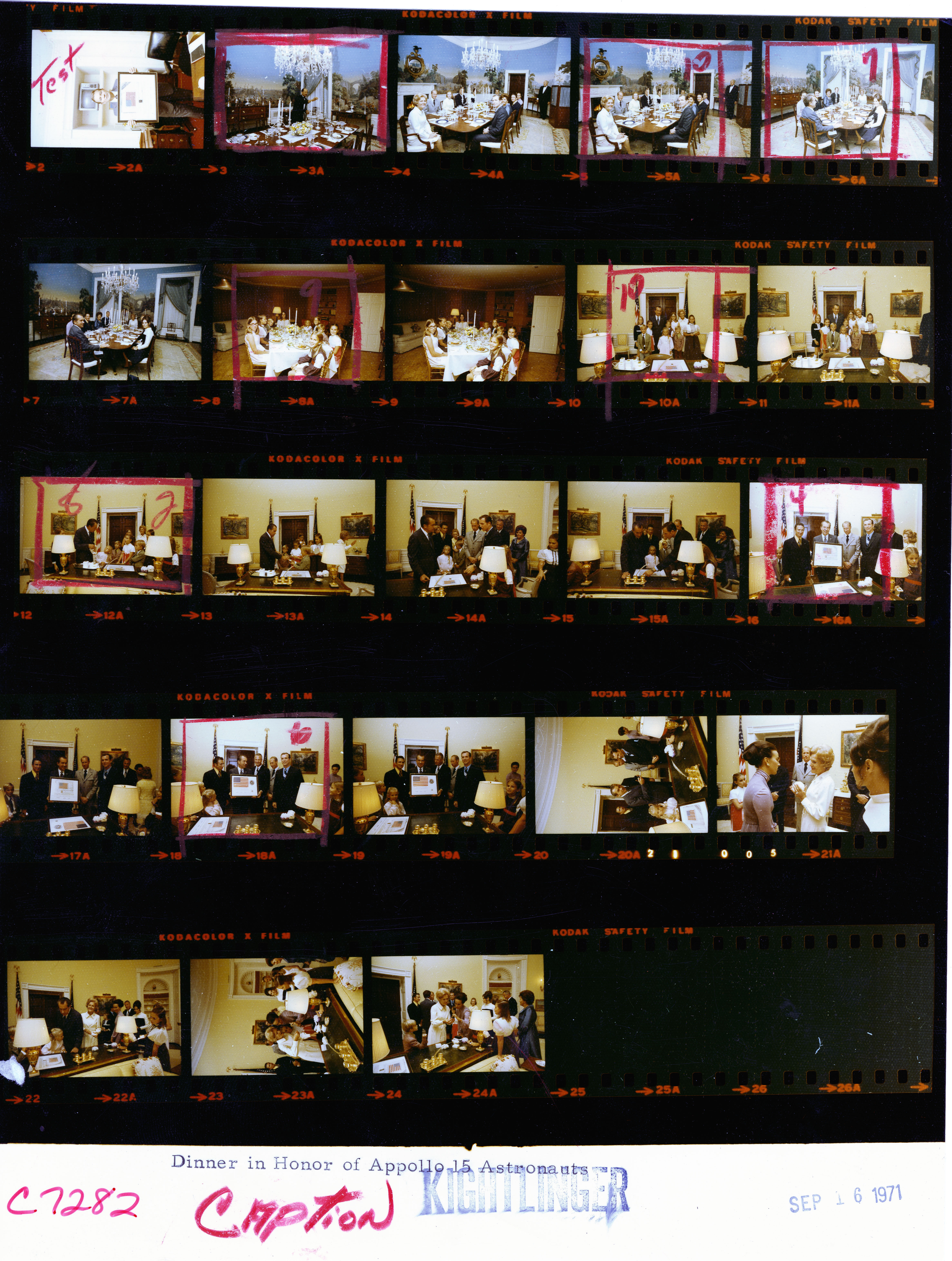
- Frame(s): WHPO-7282-03-09, President Nixon and Pat Nixon with Vice President Agnew and Judy Agnew seated at the table while hosting a dinner for Apollo 15 astronauts Col. David Scott, Lt. Col. Alfred Worden, Col. James Irwin, their wives and children. 9/16/1971, Washington, D.C. White House, Family Dining Room. President Nixon, Pat Nixon, Spiro Agnew, Judy Agnew, Kim Agnew, Col. & Mrs. David Scott, Tracy Scott, Douglas Scott, Lt. Col. Alfred Worden, Merrill Worden, Alison Worden, Col. & Mrs. James Irwin, Joy Irwin, Jill Irwin, James Irwin, Jan Irwin, Lucy Winchester.
- Frame(s): WHPO-7282-05A, President Nixon and Pat Nixon seated at the table while hosting a dinner for Apollo 15 astronauts Col. David Scott, Lt. Col. Alfred Worden, Col. James Irwin,and their wives in the formal family dining room at the White House. 9/16/1971, Washington, D.C. White House, Family Dining Room. President Nixon, Pat Nixon, Col. & Mrs. David Scott, Lt. Col. Alfred Worden, Col. & Mrs. James Irwin, Lucy Winchester.
- Frame(s): WHPO-7282-10-24, President Nixon and Pat Nixon with Vice President Agnew and Judy Agnew seated at the table while hosting a dinner for Apollo 15 astronauts Col. David Scott, Lt. Col. Alfred Worden, Col. James Irwin, their wives and children. 9/16/1971, Washington, D.C. White House, Family Dining Room. President Nixon, Pat Nixon, Spiro Agnew, Judy Agnew, Kim Agnew, Col. & Mrs. David Scott, Tracy Scott, Douglas Scott, Lt. Col. Alfred Worden, Merrill Worden, Alison Worden, Col. & Mrs. James Irwin, Joy Irwin, Jill Irwin, James Irwin, Jan Irwin, Lucy Winchester.
- Frame(s): WHPO-7282-12A, President Nixon and Pat Nixon speaking with a group of young children, possibly of Astronauts Col. David Scott, Lt. Col. Alfred Worden, and Col. James Irwin. 9/16/1971, Washington, D.C. White House, Yellow Oval Room. President Nixon, Pat Nixon, unidentified children.
- Frame(s): WHPO-7282-18A, President Nixon and Vice President Agnew holding a framed plaque containing a framed flag and medal while standing with Apollo 15 astronauts Col. David Scott, Lt. Col. Alfred Worden, Col. James Irwin. The astronauts' wives and young children look on nearby. 9/16/1971, Washington, D.C. White House, Solarium, Yellow Oval Room. President Nixon, Col. David Scott, Lt. Col. Alfred Worden, Col. James Irwin, Mrs. Irwin, unidentified children.
The White House Communications Agency Sound Recordings Collection contains public statements that took place between 1969 and 1974. Visit the finding aid to learn more.
B - Vice-Presidential (Agnew and Ford)
- WHCA-SR-B-191
Remarks in honor of Mexico's independence-Rm. 272 1/2, E.O.B. (9/16/1971)
Runtime: 5:20
Original Format: 1/4-inch reel-to-reel audiotape. Original source type: Original.
H - White House Staff Member Recordings
- WHCA-SR-H-438
Address by Darrel Trent to Wichita Chamber of Commerce with John Nidecker, Garner Schiver. (9/16/1971, East Garden, White House)
Runtime: 9:00
Keywords: Briefings, private briefings
Production credits: Audio feed supplied by WHCA; Recorded by DAS (initials of WHCA engineer)
Original Format: 1/4-inch reel-to-reel audiotape. Original source type: Original. - WHCA-SR-H-439
Remarks by governor Arch Moore of the Governor's Council regarding Nixon's new economic policy. (9/16/1971, Northwest entrance of the White House)
Runtime: 12:30
Production credits: Audio feed supplied by WHCA; Recorded by JAD (initials of WHCA engineer)
Original Format: 1/4-inch reel-to-reel audiotape. Original source type: Original.
P - Formal Presidential Remarks
- WHCA-SR-P-710907
Remarks by President Nixon in an improptu press conference. (9/16/1971)
Runtime: 37:26:00
Keywords: Presidential press conferences, presidential news conferences, interviews, media
Original Format: 1/4-inch reel-to-reel audiotape. Original source type: Original.
The White House Communications Agency Videotape Collection contains “off-the-air” recordings of televised programs produced between 1968 and 1974. Visit the finding aid to learn more.
- WHCA-4658
"Washington Week in Review". Richard Nixon.
WGN
Runtime: 00:10:41 - WHCA-4659
"The David Frost Show" Rosemary Brown, Jim McKay, David Brenner, with U.S. Air Force Brig. Gen. Jeanne Holm. .
WRC
Runtime: 01:30:03 - WHCA-4662
Weekly News Summary, Tape III.
ALL NETWORKS
Runtime: 1:30
11. Smith/Jackson: Inmates' family on Attica Prison riot. Time Code Start: 29:38. Keywords: prisons, riots, rebellions, uprisings, jails, penal institutions, incarceration, penitentiary, inmates, violence, murders, deaths, hostages, New York, families, crime, crimes, offences, infractions, criminals, criminality, law breaking, law and order. Network: ABC.
12. Smith/Jarriel: President Nixon Press Conference at White House. Time Code Start: 31:52. Keywords: Presidents, speeches, statements, media, press conferences, news conferences, interviews. Network: ABC.
13. Reasoner: Commentary on LOOK magazine to stop publishing. Time Code Start: 33:56. Keywords: media, newspapers, magazines, publications. Network: ABC.
14. Chancellor/Delaney/Mackin: Governor Rockfeller and President Nixon on the Attica Prison riot. Time Code Start: 35:42. Keywords: Governors, Presidents,prisons, riots, rebellions, uprisings, jails, penal institutions, incarceration, penitentiary, inmates, violence, murders, deaths, hostages, New York. Network: NBC.
15. Chancellor/Kaplow: President Nixon Press Conference. Time Code Start: 41:23. Keywords: Presidents, speeches, statements, media, press conferences, news conferences, interviews. Network: NBC.
16. Chancellor/Scherer: Connally stands firm on the dollar in talks with world leaders. Time Code Start: 42:26. Keywords: economy, economics, budgets, finances, recession, inflation, money, currency, monetary values, exchange rates, decreases, wages, costs, increases. Network: NBC.
17. Brinkley: Taxation and ecology. Time Code Start: 44:37. Keywords: bills, laws, taxes, taxation, revenue, ecosystems, habitats, physical environments, life cycles, nature, sciences. Network: NBC.
18. Chancellor: Vietnam politics, President Nixon comments; Paris Peace Talks. Time Code Start: 47:33. Keywords: Paris Peace Talks, Vietnam War, treaty, treaties, negotiations. Network: NBC.
19. Chancellor/Valeriani: Ambassador Bush comments on two Chinas; President Nixon comments on same (People's Republic of China). Time Code Start: 48:28. Keywords: organization of nations, intergovernmental alliance, Ambassadors, Presidents, statements, People's Republic of China. Network: NBC.
20. Pappas: Attica Prison riot. Time Code Start: 51:08. Keywords: prisons, riots, rebellions, uprisings, jails, penal institutions, incarceration, penitentiary, inmates, violence, murders, deaths, hostages, New York, crime, crimes, offences, infractions, criminals, criminality, law breaking, law and order. Network: CBS.
21. Cronkite/Rather: President Nixon asks for Draft extension; comments on economy and on People's Republic of China. Time Code Start: 58:10. Keywords: military, conscription, selective service, lottery, laws, Vietnam War, People's Republic of China, economy, economics, debt, budgets, finances, recession, inflation, money, draft reform, draft evasion. Network: CBS.
22. Sevareid: LOOK Magazine capitulates. Time Code Start: 60:00. Keywords: media, newspapers, magazines, publications. Network: CBS.
Context (External Sources)
The Vanderbilt Television News Archive is the world's most extensive and complete archive of television news. They have been recording, preserving and providing access to television news broadcasts of the national networks since August 5, 1968.
Wikipedia is a free encyclopedia that anyone can edit.