
Introduction
This almanac page for Tuesday, September 14, 1971, pulls together various records created by the federal government and links to additional resources which can provide context about the events of the day.
Previous Date: Monday, September 13, 1971
Next Date: Wednesday, September 15, 1971
Schedule and Public Documents
The Daily Diary files represent a consolidated record of the President's activities. Visit the finding aid to learn more.
The President's day began at The White House - Washington, D. C.
The Weekly Compilation of Presidential Documents made available transcripts of the President's news conferences; messages to Congress; public speeches, remarks, and statements; and other Presidential materials released by the White House.
Digitized versions can be found at HathiTrust.
The Federal Register is the official daily publication for rules, proposed rules, and notices of federal agencies and organizations, as well as executive orders and other Presidential documents.
The Congressional Record is the official daily record of the debates and proceedings of the U.S. Congress.
Archival Holdings
Any selection of archival documents will necessarily be partial. You should use the documents and folders identified below as a starting place, but consult the linked collection finding aids and folder title lists and the collections themselves for context. Many documents to be found this way do not lend themselves to association with specific dates, but are essential to a complete understanding of the material.
Selective document listing
President's Office Files
The President's Office Files consists of materials drawn together by the Special Files Unit from several administrative subdivisions within the White House Office. It is the handwriting and sensitive papers sent to the Staff Secretary that now comprise much of the President's Office Files. Visit the finding aid to learn more.
- News Summaries, Unmarked News Summaries, Box 46, News Summaries - September 1971 [6 of 9] [Note: Due to the way News Summary products were compiled, you should also consult nearby days for potentially relevant materials.]
- News Summary, September 14, 1971, (TV, wires, magazines)
- President's Daily Schedule, Box 102, [President's Daily Schedule, Sept.-Dec. 1971] [1 of 3]
- The President's Schedule, Tuesday - September 14, 1971
The H. R. Haldeman Diaries consists of seven handwritten diaries, 36 dictated diaries recorded as sound recordings, and two handwritten audio cassette tape subject logs. The diaries and logs reflect H. R. Haldeman’s candid personal record and reflections on events, issues, and people encountered during his service in the Nixon White House. As administrative assistant to the President and Chief of Staff, Haldeman attended and participated in public events and private meetings covering the entire scope of issues in which the Nixon White House engaged in during the years 1969-1973. Visit the finding aid to learn more.
- Transcript of diary entry (PDF)
Tuesday, September 14.
President started the day with a Republican leadership meeting to which he had added ranking members of the committees concerned with the economic program, thinking that would add a little more enthusiasm and pep things up. Apparently it didn't, because after the meeting, he hit again the fact that he'd never seen anyone in the leadership meeting, including our own staff people, who will lead any cheers, who will take the initiative, or anything else, and that he's sick of them. This seems to be the attitude after virtually every such meeting. The problem being that they just don't have any fire and don't respond. He also met with the farmers group to get their views on the economic program. Apparently that went reasonably well, at least he didn't have any particular comments on it.
Henry got back from Paris last night and reported to the President. Came in, saw me this morning, to run over the plans. The North Vietnamese have closed off the negotiations in effect, because of the screw-up on Thieu's election. At least that's Henry's view, and he in turn has basically turned off the talks. He now wants to go to Moscow and work the same kind of a deal there, or at least make the record for it, so that when we do the pull out in January, we'll have that as a final wrap-up attempt to settle by negotiation. His logic is that if we're going to pull out anyway, we might as well try to get all the mileage out of it that we can.
Apparently his meeting with the Chinese went pretty well. They were horrified, however, at his information that the press corps traveling with us would be a minimum of 150 people. He didn't even raise the question of the ground station, which would take another 100 people. I'm convinced, incidentally, from a memo I got from Scali, that we should try to press for the ground station if we can possibly get it, so that we can have live coverage of our morning activities in Peking. The Chinese did not go along with Henry's plan to announce his trip and the date of the President's trip on September 21. Instead, they want to wait until October to announce Henry's trip, and they want to wait until after Henry's trip to announce the date of the President's trip, so they'll have some substantive reason for Henry making the trip. I don't see any problem with this, and I don't think Henry does either, so we'll probably go ahead on that basis.
The President called me at home tonight and said that in his long talk with Henry this afternoon, Henry had brought up the fact that Reston was in to see him, or that Henry had talked to Reston, and that Reston had asked for an interview with the President. Henry was actually raising this with the President. It's completely incredible, because several weeks ago, in the President's office, Reston's stories came out and the President then made the point loud, clear, and solidly to Henry that under no circumstances would he see Reston at any time, ever, and that Henry was not to see him at all, that we knew he would be coming around trying to get an interview when he got back to Washington, but that he was to be flatly turned down. And then next thing we know, Henry's back and is talking with him. So I've got to hit him on that tomorrow. He also raised with me again the need to get going on finding a new Secretary of Agriculture to replace Hardin, who leaves November 1.
End of September 14. - Original audio recording (MP3)
The National Archives Catalog is the online portal to the records held at the National Archives, and information about those records. It is the main way of describing our holdings and also provides access to electronic records and digitized versions of our holdings.
The Catalog searches across multiple National Archives resources at once, including archival descriptions, digitized and electronic records, authority records, and web pages from Archives.gov and the Presidential Libraries. The Catalog also allows users to contribute to digitized historical records through tagging and transcription.
Nixon Library Holdings
All National Archives Units
National Security Documents
The President's Daily Brief is the primary vehicle for summarizing the day-to-day sensitive intelligence and analysis, as well as late-breaking reports, for the White House on current and future national security issues. Read "The President's Daily Brief: Delivering Intelligence to Nixon and Ford" to learn more.
The Foreign Relations of the United States series presents the official documentary historical record of major U.S. foreign policy decisions and significant diplomatic activity. Visit the State Department website for more information.
Vol. XX, Southeast Asia, 1969-1972
Indonesia
321. Memorandum for the President’s File, Washington, September 14, 1971, 10:45-11:45 a.m.
Source: National Archives, Nixon Presidential Materials, NSC Files, Box 532, Country Files, Far East, Indonesia, Vol. III. Secret; Sensitive. Drafted and initialed by Haig.
The Kissinger telephone conversation transcripts consist of approximately 20,000 pages of transcripts of Kissinger’s telephone conversations during his tenure as Assistant to the President for National Security Affairs (1969-1974) and Secretary of State (1973-1974) during the administration of President Richard Nixon. Visit the finding aid for more information.
Digitized versions can be found in the National Archives Catalog.
Audiovisual Holdings
The White House Tapes are sound recordings of President Richard Nixon's telephone conversations and of meetings held in the Oval Office and the Cabinet Room in the White House, the President's office in the Old Executive Office Building (OEOB), the Lincoln Sitting Room in the residence section of the White House, and several locations at the Presidential retreat at Camp David, Maryland. These recordings document many of the major events and decisions of the Nixon Administration from February 16, 1971 to July 18, 1973. Visit the White House Tapes finding aid to learn about the taping system's operation and archival processing.
Cabinet Room
- 74-2; Unknown between 8:09 a.m. & 10:21 a.m.; Nixon, Richard M. (President); Shultz, George P.; McCracken, Paul W.; Stein, Herbert; Walker, Charls E.; Weber, Arnold R.; Scott, Hugh; Griffin, Robert P.; Allott, Gordon L.; Dominick, Peter H.; Bennett, Wallace F.; Young, Milton R.; Javits, Jacob K.; Ford, Gerald R.; Arends, Leslie C.; Anderson, John B.; Rhodes, John J.; Wilson, Robert C. ("Bob"); Smith, H. Allen; Stafford, Robert T.; Poff, Richard H.; Conable, Barber B., Jr.; Bow, Frank T.; Byrnes, John W.; Springer, William L.; Ehrlichman, John D.; MacGregor, Clark; Timmons, William E.; BeLieu, Kenneth E.; Buchanan, Patrick J.; Warren, Gerald L.
- 74-3; Unknown between 10:07 a.m. & 10:21 a.m.; Bull, Stephen B.; [Unknown person(s)]
- 74-4; Unknown between 10:07 a.m. & 10:51 a.m.; Nixon, Richard M. (President); Committee to Form a National Health Education Foundation; Wilson, Joseph; Beirne, Joseph A.; Haynes, M. Alfred (Dr.); McGall, Richard; McMahon, J. Alexander; McNerney, Walter; Nielson, A. C.; Painter, Joseph T.; Petersmeyer, Wrede; Siegfried, Charles A.; Seymour, David; Shapiro, Irving (Dr.); Simonds, Scott; Smith, J. Henry; Duval, Merlin K. ("Morty") (Dr.); Laur, Robert (Dr.); Weingarten, VIctor; Laventhal, Josee; Brannick, Linda; Urrows, Grace; Ennes, Howard; Warter, Peter (Dr.); Meek, Peter; Mendel, Levitt; Pearson, Clarence; Wheatley, George (Dr.); Brancini, Caesar; Scott, Stanley S.; White House photographer
- 75-1; Unknown between 11:07 a.m. & 9:50 p.m.; Nixon, Richard M. (President); Kuhfuss, William J.; Scott, John W.; McInturf, Robert C.; DeChant, Tony C.; Staley, Oren Lee; Hardin, Clifford M.; Palmby, Clarence D.
- 75-2; Unknown between 12:37 p.m. & 4:58 p.m.; [Unknown person(s)]
- 75-3; Unknown between 12:37 p.m. & 4:58 p.m.; [Unknown person(s)]
Old Executive Office Building
- 277-1; Unknown between 8:56 p.m. & 8:59 p.m.; Nixon, Richard M. (President); Keyes, Paul W.
- 277-2; 9:16 p.m. - 9:18 p.m.; Nixon, Richard M. (President); Keyes, Paul W.
- 278-34; Unknown between 5:35 p.m. & 5:39 p.m.; Nixon, Richard M. (President); White House operator
- 278-35; Unknown between 5:35 p.m. & 5:39 p.m.; Nixon, Richard M. (President); Bull, Stephen B.
- 278-36; 5:39 p.m. - 6:35 p.m.; Nixon, Richard M. (President); Haldeman, H. R. ("Bob"); Rogers, William P.; Kissinger, Henry A.; White House operator; Rockefeller, Nelson A.; Haldeman, H. R. ("Bob")
- 278-37; Unknown between 6:35 p.m. & 6:40 p.m.; Nixon, Richard M. (President); Sanchez, Manolo
- 278-38; Unknown between 6:35 p.m. & 6:40 p.m.; Nixon, Richard M. (President); Sanchez, Manolo; Buchanan, Patrick J.
Oval Office
- 451-12; 1:20 p.m. - 2:32 p.m.; Nixon, Richard M. (President); Haldeman, H. R. ("Bob"); White House operator; Price, Raymond K., Jr.; Ziegler, Ronald L.; Buchanan, Patrick J.
- 572-1; 7:57 p.m. - 8:09 p.m.; Nixon, Richard M. (President); Haldeman, H. R. ("Bob"); Bull, Stephen B.; Ford, Gerald R.; White House photographer
- 572-2; Unknown between 8:09 a.m. & 10:07 a.m.; United States Secret Service agents
- 572-3; 10:07 a.m. - 10:21 a.m.; Nixon, Richard M. (President); Allott, Gordon L.; Arends, Leslie C.; MacGregor, Clark; BeLieu, Kenneth E.; [Unknown person(s)]
- 572-4; Unknown between 10:21 a.m. & 10:51 a.m.; United States Secret Service agents
- 572-5; 10:51 a.m. - 11:07 a.m.; Nixon, Richard M. (President); Galbraith, Francis J.; Haig, Alexander M., Jr.
- 572-6; Unknown between 11:07 a.m. & 12:37 p.m.; United States Secret Service agents
- 572-7; Unknown between 11:07 a.m. & 12:37 p.m.; United States Secret Service agents
- 572-8; 12:37 p.m. - 1:45 p.m.; Nixon, Richard M. (President); Haldeman, H. R. ("Bob"); [Unknown person(s)]; Colson, Charles W.; Bull, Stephen B.
- 572-9; 2:57 p.m. - 3:01 p.m.; Nixon, Richard M. (President); Butterfield, Alexander P.
- 572-10; Unknown between 3:01 p.m. & 3:03 p.m.; Nixon, Richard M. (President); Bull, Stephen B.
- 572-11; 3:03 p.m. - 3:30 p.m.; Nixon, Richard M. (President); Hitachi, Prince; Ushiba, Nobuhiko; Ushiba, Nobuhiko (Mrs.); Wickel, James J.; Mosbacher, Emil, Jr. (Bus); Haig, Alexander M., Jr.; Bull, Stephen B.; White House photographer
- 572-12; 3:37 p.m. - 4:40 p.m.; Nixon, Richard M. (President); Mansfield, Michael J. ("Mike"); Scott, Hugh; MacGregor, Clark
- 572-13; Unknown between 4:40 p.m. & 4:42 p.m.; Nixon, Richard M. (President); Bull, Stephen B.
- 572-14; Unknown between 4:40 p.m. & 4:42 p.m.; Nixon, Richard M. (President); Butterfield, Alexander P.; Bull, Stephen B.
- 572-15; 4:45 p.m. - 5:06 p.m.; Nixon, Richard M. (President); Shultz, George P.
White House Telephone
- 9-1; Unknown between 12:37 p.m. & 1:48 p.m.; Nixon, Richard M. (President); White House operator
- 9-2; 1:48 p.m. - 1:49 p.m.; Nixon, Richard M. (President); Nixon, Thelma C. ("Pat") (Ryan)
- 9-3; Unknown between 5:35 p.m. & 5:39 p.m.; Nixon, Richard M. (President); White House operator
- 9-4; 5:39 p.m. - 5:42 p.m.; Nixon, Richard M. (President); Rogers, William P.
- 9-5; Unknown between 6:07 p.m. & 6:13 p.m.; Nixon, Richard M. (President); White House operator
- 9-6; 6:13 p.m. - 6:18 p.m.; Nixon, Richard M. (President); Rockefeller, Nelson A.
- 9-7; Unknown between 6:18 p.m. & 6:35 p.m.; Kissinger, Henry A.; White House operator
- 9-8; Unknown between 6:18 p.m. & 6:35 p.m.; Kissinger, Henry A.; Rogers, William P.
- 9-9; Unknown between 8:16 p.m. & 8:20 p.m.; Nixon, Richard M. (President); White House operator
- 9-10; 8:20 p.m. - 8:27 p.m.; Nixon, Richard M. (President); Haldeman, H. R. ("Bob")
- 9-11; Unknown between 8:27 p.m. & 8:56 p.m.; Nixon, Richard M. (President); White House operator
- 9-12; 8:56 p.m. - 8:59 p.m.; Nixon, Richard M. (President); Keyes, Paul W.
- 9-13; 9:16 p.m. - 9:18 p.m.; Nixon, Richard M. (President); Keyes, Paul W.
The White House Photo Office collection consists of photographic coverage of President Richard Nixon meeting with prominent social, political, and cultural personalities; speaking engagements and news conferences of the President and various high-ranking members of the White House staff and Cabinet; Presidential domestic and foreign travel, including Presidential vacations; social events and entertainment involving the First Family, including entertainers present; official portraits of the President, First Family, and high-ranking members of the Nixon administration; the 1969 and 1973 Inaugurals; the President’s 1972 Presidential election campaign appearances (including speeches) and other official activities of the White House staff and the President’s Cabinet from January 20, 1969 until August 9, 1974 at the White House and the Old Executive Office Building; other locations in Washington, DC, such as The Mall; and the Presidential retreats in Camp David, Maryland, Key Biscayne, Florida, and San Clemente, California. Visit the finding aid to learn more.
Roll WHPO-7262 Photographer: Schumaker, Byron | Color or B&W: B&W
- Frame(s): WHPO-7262-04-06, President Nixon receiving a plaque from Rep. Gerald Ford. 9/14/1971, Washington, D.C. White House, Oval Office. President Nixon, Gerald Ford.
Roll WHPO-7263 Photographer: Knudsen, Robert L. | Color or B&W: B&W
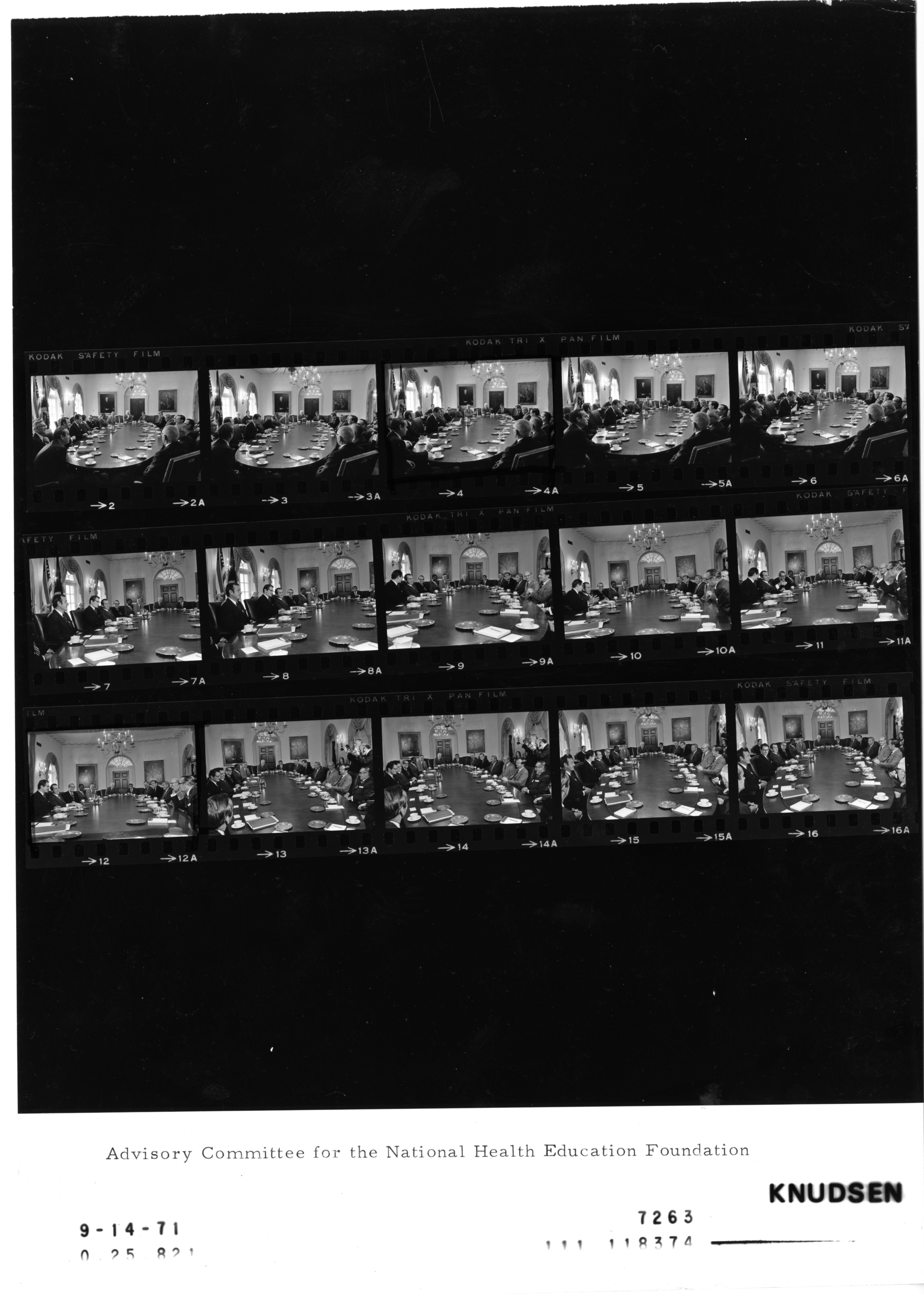
- Frame(s): WHPO-7263-02-16, President Nixon meeting with the Committee to Form a National Health Education Foundation. 9/14/1971, Washington, D.C. White House, Cabinet Room. President Nixon, Eliot Richardson, Joseph Wilson, Joseph Beirne, M. Alfred Haynes MD, Richard McGrail, J. Alexander McMahon, Walter J. McNerney, A.C. Nielsen Jr., Joseph Painter, Wrede Petersmeyer, Charles Seigfried, Dan Seymour, Dr. Irving Shapiro, Scott Simonds, J. Henry Smith, Dr. Merlin DeVal, Robert Laur, others listed in Presidential Daily Diary.
- Frame(s): WHPO-7263-12, President Nixon meeting with the Committee to Form a National Health Education Foundation. 9/14/1971, Washington, D.C. White House, Cabinet Room. President Nixon, Eliot Richardson, Joseph Wilson, Joseph Beirne, M. Alfred Haynes MD, Richard McGrail, J. Alexander McMahon, Walter J. McNerney, A.C. Nielsen Jr., Joseph Painter, Wrede Petersmeyer, Charles Seigfried, Dan Seymour, Dr. Irving Shapiro, Scott Simonds, J. Henry Smith, Dr. Merlin DeVal, Robert Laur, others listed in Presidential Daily Diary.
Roll WHPO-7264 Photographer: Schumaker, Byron | Color or B&W: B&W
- Frame(s): WHPO-7264-01-06, President Nixon meeting with agricultural leaders. 9/14/1971, Washington, D.C. White House, Cabinet Room. President Nixon, Hardin, George Shultz, agricultural leaders.
Roll WHPO-7265 Photographer: Schumaker, Byron | Color or B&W: B&W
- Frame(s): WHPO-7265-03-15, Portrait of Jeni Brown. 9/14/1971, Washington, D.C. White House, South Lawn. Jeni Brown.
Roll WHPO-7266 Photographer: Schumaker, Byron | Color or B&W: B&W
- Frame(s): WHPO-7266-02-04, President Nixon seated at his desk with General Alexander Haig and Francis Galbraith, Ambassador to Indonesia. 9/14/1971, Washington, D.C. White House, Oval Office. President Nixon, Alexander Haig, Francis Galbraith.
Roll WHPO-7267 Photographer: Knudsen, Robert L. | Color or B&W: B&W
- Frame(s): WHPO-7267-02A-20A, President Nixon sitting with Masahito, Prince Hitachi, and Hanako, Princess Hitachi, of Japan, Nobuhiko Ushiba, Japanese Ambassador to the U.S. and Mrs. Fujiko Kobayashi Ushiba, and General Alexander Haig. 9/14/1971, Washington, D.C. White House, Oval Office. President Nixon; Masahito, Prince Hitachi; Hanako, Princess Hitachi; Nobuhiko Ushiba, Mrs. Fujiko Kobayashi Ushiba, Alexander Haig.
- Frame(s): WHPO-7267-13A, President Nixon sitting with Masahito, Prince Hitachi, and Hanako, Princess Hitachi, of Japan, Nobuhiko Ushiba, Japanese Ambassador to the U.S., Mrs. Fujiko Kobayashi Ushiba, and General Alexander Haig. 9/14/1971, Washington, D.C. White House, Oval Office. President Nixon; Masahito, Prince Hitachi; Hanako, Princess Hitachi; Nobuhiko Ushiba, Mrs. Fujiko Kobayashi Ushiba, Alexander Haig.
Roll WHPO-7268 Photographer: Knudsen, Robert L. | Color or B&W: B&W
- Frame(s): WHPO-7268-02A-10A, Portrait of President Nixon with Prince Hitachi and Princess Hitachi of Japan, Nobuhiko Ushiba, Japanese Ambassador to the U.S. and Mrs. Fujiko Kobayashi Ushiba. 9/14/1971, Washington, D.C. White House, Yellow Oval Room. President Nixon; Masahito, Prince Hitachi; Hanako, Princess Hitachi; Nobuhiko Ushiba, Mrs. Fujiko Kobayashi Ushiba.
Roll WHPO-7269 Photographer: Kightlinger, Jack | Color or B&W: B&W
- Frame(s): WHPO-7269-02A-08A, President Nixon seated in the Oval office during a meeting with Masahito, Prince Hitachi of Japan. 9/14/1971, Washington, D.C. White House, Oval Office. President Nixon; Masahito, Prince Hitachi.
Roll WHPO-7270 Photographer: Kightlinger, Jack | Color or B&W: Color
- Frame(s): WHPO-7270-02A-10A, President Nixon sitting in the Oval office with Masahito, Prince Hitachi; Hanako, Princess Hitachi; Nobuhiko Ushiba, the Japanese Ambassador to the US; and Mrs. Fujiko Kobayashi Ushiba. 9/14/1971, Washington, D.C. White House, Oval Office. President Nixon; Masahito, Prince Hitachi; Hanako, Princess Hitachi; Nobuhiko Ushiba, Mrs. Fujiko Kobayashi Ushiba.
- Frame(s): WHPO-7270-04, President Nixon sitting in the Oval office with Masahito, Prince Hitachi; Hanako, Princess Hitachi; Nobuhiko Ushiba, the Japanese Ambassador to the US; and Mrs. Fujiko Kobayashi Ushiba. 9/14/1971, Washington, D.C. White House, Oval Office. President Nixon; Masahito, Prince Hitachi; Hanako, Princess Hitachi; Nobuhiko Ushiba, Mrs. Fujiko Kobayashi Ushiba.
- Frame(s): WHPO-7270-11, President Nixon sitting in the Oval office with Masahito, Prince Hitachi. Unseen are: Hanako, Princess Hitachi; Nobuhiko Ushiba, the Japanese Ambassador to the US; and Mrs. Fujiko Kobayashi Ushiba. 9/14/1971, Washington, D.C. White House, Yellow Oval Room. President Nixon; Masahito, Prince Hitachi.
- Frame(s): WHPO-7270-12-16, Pat Nixon standing with Masahito, Prince Hitachi; Hanako, Princess Hitachi; Nobuhiko Ushiba, the Japanese Ambassador to the US; and Mrs. Fujiko Kobayashi Ushiba. 9/14/1971, Washington, D.C. White House, Yellow Oval Room. President Nixon; Masahito, Prince Hitachi; Hanako, Princess Hitachi; Nobuhiko Ushiba, Mrs. Fujiko Kobayashi Ushiba.
Roll WHPO-7271 Photographer: Schumaker, Byron | Color or B&W: B&W
- Frame(s): WHPO-7271-03A-05A, Portrait of President Nixon standing at the Rose Garden steps with Masahito, Prince Hitachi; Hanako, Princess Hitachi; Nobuhiko Ushiba, the Japanese Ambassador to the US; and Mrs. Fujiko Kobayashi Ushiba. 9/14/1971, Washington, D.C. White House, Rose Garden steps. President Nixon; Masahito, Prince Hitachi; Hanako, Princess Hitachi; Nobuhiko Ushiba, Mrs. Fujiko Kobayashi Ushiba.
Roll WHPO-7272 Photographer: Schumaker, Byron | Color or B&W: Color
- Frame(s): WHPO-7272-01A-08A, President Nixon walking with Masahito, Prince Hitachi; Hanako, Princess Hitachi; Nobuhiko Ushiba, the Japanese Ambassador to the US; and Mrs. Fujiko Kobayashi Ushiba. 9/14/1971, Washington, D.C. Rose Garden , White House. President Nixon; Masahito, Prince Hitachi; Hanako, Princess Hitachi; Nobuhiko Ushiba, Mrs. Fujiko Kobayashi Ushiba, unidentified man.
Roll WHPO-7644 Photographer: Schumaker, Byron | Color or B&W: Color
- Frame(s): WHPO-7644-01A-08A, President Nixon walking with Japanese Prince Hitachi, Princess Hitachi, Japanese Ambassador Nobuhiko Ushiba, and Mrs. Nobuhiko Ushiba. 9/14/1971, Washington, D.C. White House, Rose Garden. Presudebt Nixon, Prince and Princess Hitachi, Nobuhiko Ushiba, Mrs. Nobuhiko Ushiba, unidentified man.
The White House Communications Agency Sound Recordings Collection contains public statements that took place between 1969 and 1974. Visit the finding aid to learn more.
G - Cabinet Officer Briefings
- WHCA-SR-G-138
Press briefing by Secretary of Health, Education and Welfare Elliot Richardson and Joe Wilson (Chairman of the President's Committee on Health and Education), with Neill Ball. (9/14/1971, Press Center)
Runtime: 14:00
Production credits: Audio feed supplied by WHCA; Recorded by DAS (initials of WHCA engineer)
Original Format: 1/4-inch reel-to-reel audiotape. Original source type: Original. - WHCA-SR-G-139
Press briefing by Secretary of Labor James D. Hodgson, with Gerald Warren. (9/14/1971, Press Center)
Runtime: 25:00:00
Production credits: Audio feed supplied by WHCA; Recorded by RES (initials of WHCA engineer)
Original Format: 1/4-inch reel-to-reel audiotape. Original source type: Original.
The White House Communications Agency Videotape Collection contains “off-the-air” recordings of televised programs produced between 1968 and 1974. Visit the finding aid to learn more.
- WHCA-4654
"Dinah's Place". Dinah Shore's talk show with guest star Martha Mitchell
NBC
Runtime: 00:29:02 - WHCA-4655
"The David Frost Show" with Mike Grey, Jesse Jackson, John Newcombe, Eubie Blake.
NBC
Runtime: 01:30:46 - WHCA-4656
"Caution".
CBS
Runtime: 00:29:00 - WHCA-4661
Weekly News Summary, Tape II.
ALL NETWORKS
Runtime: 01:36:00
9. Clark: Gun control bill (John Lindsay). Time Code Start: 28:30. Keywords: bills, laws, weapons, sales, controls, registrations, licenses. Network: ABC.
10. Reasoner/Kincade: Resistance against busing. Time Code Start: 30:39. Keywords: bills, laws, legislation, desegregation, racism, racial discrimination, African Americans, schools, students, transportation, reports. Network: ABC.
11. Smith/Gill: Draft bill and Vietnam elections. Time Code Start: 32:41. Keywords: Vietnam War, military, conscription, selective service, lottery, laws, Congress, elections, candidates, campaigns, campaigning, voting, results, draft reform, draft evasion. Network: ABC.
12. Reynolds: Governor Conference. Time Code Start: 34:22. Keywords: Governors, conferences, meetings. Network: ABC.
13. Reasoner: Commentary on Attica Prison riot. Time Code Start: 36:13. Keywords: prisons, riots, rebellions, uprisings, jails, penal institutions, incarceration, penitentiary, inmates, violence, murders, deaths, hostages, New York, crime, crimes, offences, infractions, criminals, criminality, law breaking, law and order. Network: ABC.
14. Chancellor/Lord: War strife in Cambodia. Time Code Start: 38:23. Keywords: Cambodia, Vietnam War. Network: NBC.
15. Chancellor/Lewis: Saigon, Vietnam elections. Time Code Start: 40:58. Keywords: Vietnam War, Congress, elections, candidates, campaigns, campaigning, voting, results. Network: NBC.
16. Chancellor/Brinkley: Commentary on General Abrams' war notes. Time Code Start: 42:50. Keywords: Armed Forces, military, leaders, officials, writings, documents, wars. Network: NBC.
17. Chancellor/Ruddles: Busing in Detroit, Michigan and San Francisco, California. Time Code Start: 45:08. Keywords: bills, laws, legislation, desegregation, racism, racial discrimination, African Americans, schools, students, transportation, reports. Network: NBC.
18. Chancellor/Nessin: Supreme Court Chief Justice Burger's opinion on busing. Time Code Start: 48:30. Keywords: courts, officials, bills, laws, legislation, desegregation, racism, racial discrimination, African Americans, schools, students, transportation, reports. Network: NBC.
19. Chancellor: Eisenhower commission on violence (Attica Prison riot). Time Code Start: 50:27. Keywords: prisons, riots, rebellions, uprisings, jails, penal institutions, incarceration, penitentiary, inmates, violence, murders, deaths, hostages, New York, crime, crimes, offences, infractions, criminals, criminality, law breaking, law and order. Network: NBC.
20. Hart/Schatney/Pappas: Attica Prison riot. Time Code Start: 51:22. Keywords: prisons, riots, rebellions, uprisings, jails, penal institutions, incarceration, penitentiary, inmates, violence, murders, deaths, hostages, New York, crime, crimes, offences, infractions, criminals, criminality, law breaking, law and order. Network: CBS.
21. Hart/Serafin: John Lindsay on gun control. Time Code Start: 60:03. Keywords: bills, laws, weapons, sales, controls, registrations, licenses. Network: CBS.
22. Hart/Fromson: Busing in Detroit, Michigan. Time Code Start: 63:08. Keywords: bills, laws, legislation, desegregation, racism, racial discrimination, African Americans, schools, students, transportation, reports. Network: CBS.
23. Hart/Williams: Massacre in Cambodia. Time Code Start: 66:04. Keywords: Cambodia, Vietnam War, massacres, war crimes, atrocities, mass murders, civilians deaths, shootings. Network: CBS.
24. Sevareid: Commentary on force used at Attica (Attica Prison riot). Time Code Start: 67:30. Keywords: prisons, riots, rebellions, uprisings, jails, penal institutions, incarceration, penitentiary, inmates, violence, murders, deaths, hostages, New York weapons, police, military, crime, crimes, offences, infractions, criminals, criminality, law breaking, la. Network: CBS.
Context (External Sources)
The Vanderbilt Television News Archive is the world's most extensive and complete archive of television news. They have been recording, preserving and providing access to television news broadcasts of the national networks since August 5, 1968.
Wikipedia is a free encyclopedia that anyone can edit.