
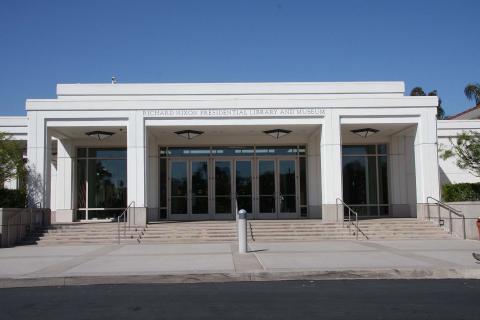
Introduction
This almanac page for Friday, October 6, 1972, pulls together various records created by the federal government and links to additional resources which can provide context about the events of the day.
Previous Date: Thursday, October 5, 1972
Next Date: Saturday, October 7, 1972
Schedule and Public Documents
The Daily Diary files represent a consolidated record of the President's activities. Visit the finding aid to learn more.
The President's day began at The White House - Washington, D. C.
The Weekly Compilation of Presidential Documents made available transcripts of the President's news conferences; messages to Congress; public speeches, remarks, and statements; and other Presidential materials released by the White House.
Digitized versions can be found at HathiTrust.
Each Public Papers of the Presidents volume contains the papers and speeches of the President of the United States that were issued by the White House Office of the Press Secretary during the time period specified by the volume. The material is presented in chronological order, and the dates shown in the headings are the dates of the documents or events. In instances when the release date differs from the date of the document itself, that fact is shown in the text note.
To ensure accuracy, remarks have been checked against audio recordings (when available) and signed documents have been checked against the original, unless otherwise noted. Editors have provided text notes and cross references for purposes of identification or clarity.
The Federal Register is the official daily publication for rules, proposed rules, and notices of federal agencies and organizations, as well as executive orders and other Presidential documents.
The Congressional Record is the official daily record of the debates and proceedings of the U.S. Congress.
Archival Holdings
Any selection of archival documents will necessarily be partial. You should use the documents and folders identified below as a starting place, but consult the linked collection finding aids and folder title lists and the collections themselves for context. Many documents to be found this way do not lend themselves to association with specific dates, but are essential to a complete understanding of the material.
Selective document listing
President's Office Files
The President's Office Files consists of materials drawn together by the Special Files Unit from several administrative subdivisions within the White House Office. It is the handwriting and sensitive papers sent to the Staff Secretary that now comprise much of the President's Office Files. Visit the finding aid to learn more.
- News Summaries, Annotated News Summaries, Box 39, October 1-13, 1972 [2 of 5] [Note: Due to the way News Summary products were compiled, you should also consult nearby days for potentially relevant materials.]
- Political Media Analysis, October 6, 1972, 32 to Go
- News Summary, October 6, 1972, (Thurs. nets, wires, columns)
- President's Daily Schedule, Box 102, [President's Daily Schedule, Oct.-Dec. 1972] [1 of 2]
- The President's Schedule, Friday - October 6, 1972
The H. R. Haldeman Diaries consists of seven handwritten diaries, 36 dictated diaries recorded as sound recordings, and two handwritten audio cassette tape subject logs. The diaries and logs reflect H. R. Haldeman’s candid personal record and reflections on events, issues, and people encountered during his service in the Nixon White House. As administrative assistant to the President and Chief of Staff, Haldeman attended and participated in public events and private meetings covering the entire scope of issues in which the Nixon White House engaged in during the years 1969-1973. Visit the finding aid to learn more.
- Transcript of diary entry (PDF)
Friday, October 6.
The President started in this morning on the radio speech for tomorrow. He was very concerned about the draft that he got last night, because he feels it's just a civics lecture and that's not enough on the spending ceiling, so he wanted Buchanan to get some other things going on it, covering the vetoes that he is going to make. Put him in the position of standing like Horatio at the bridge and that in the next few weeks there will be a number of good bills coming in that were for good purposes but he'll veto them, not because of what they stand for, but in order to veto a tax increase. I've covered all this in a memo, today's date, to Buchanan. He feels that there was no meat in it, that they need something with crisp, newsy, portable language, that Price again hasn't come up with anything that has any leads. They don't recognize this as a campaign. That they need some paragraphs with some sharpness and some bite so that people will say that he said something. Then he went into quite a bit of dictation on stuff he wanted included, and which I covered in the Buchanan memo.
Ziegler was in talking about the press conference and the fact that it wasn't well played on television last night and that got the President into a pretty bad mood overall today, and he was charging around on most everything that came along as a result. He had Colson and me in later, analyzing the press conference thing. We convinced him, I think, that it really wasn't as bad as he made it seem on the basis of Ziegler's report, that the point really was that he got the newspaper and radio coverage, that it just wasn't much on TV but it never will be, and that he's got to approach it with that basis in mind.
He also got into some poll history analysis. He was going through the month-by-month poll ratings in some of the other campaigns, making the point about what good shape we're really in. Colson gave him the Harris poll data, which shows us no worse off, or only one point worse off than we were before, two weeks ago, so there's no decline and that's a disaster for McGovern at this point. Talked a little about schedule. He agreed to our plan for the Ohio motorcade. Still wants to go to Buffalo for some kind of a Polish event, the same day we do the rest of New York, but he wants to move New York to the 22nd rather than the 23rd, which poses a problem that we've got to work out. He's agreed to the idea of the five minute statement on election eve and also will do a five minute statement from his office on election night, a victory statement before he goes before any public groups, he'll have one quite thoughtful kind of thing first.
End of October 6.
He went on up to Camp David this afternoon and spent the night and for the weekend. - Original audio recording (MP3)
The National Archives Catalog is the online portal to the records held at the National Archives, and information about those records. It is the main way of describing our holdings and also provides access to electronic records and digitized versions of our holdings.
The Catalog searches across multiple National Archives resources at once, including archival descriptions, digitized and electronic records, authority records, and web pages from Archives.gov and the Presidential Libraries. The Catalog also allows users to contribute to digitized historical records through tagging and transcription.
Nixon Library Holdings
All National Archives Units
National Security Documents
The President's Daily Brief is the primary vehicle for summarizing the day-to-day sensitive intelligence and analysis, as well as late-breaking reports, for the White House on current and future national security issues. Read "The President's Daily Brief: Delivering Intelligence to Nixon and Ford" to learn more.
The Foreign Relations of the United States series presents the official documentary historical record of major U.S. foreign policy decisions and significant diplomatic activity. Visit the State Department website for more information.
Vol. V, United Nations, 1969-1972
Special Meetings of the Security Council
135. Telegram From the Mission to the United Nations to the Department of State, New York, October 6, 1972, 2200Z
Source: National Archives, RG 59, Central Files 1970–73, UN 3 SC. Confidential. Repeated to Panama, Canberra, London, and Tokyo.
Vol. VIII, Vietnam, January-October 1972
The Parties Move Toward Agreement, July 19-October 7, 1972
282. Backchannel Message From the President’s Assistant for National Security Affairs (Kissinger) to the Ambassador to South Vietnam (Bunker), Washington, October 6, 1972, 0155Z
Source: National Archives, Nixon Presidential Materials, NSC Files, Box 869, For the President’s Files (Winston Lord)—China Trip/Vietnam, Camp David Cables, October 1972. Top Secret; Sensitive; Exclusively Eyes Only.
283. Backchannel Message From the President’s Assistant for National Security Affairs (Kissinger) to the Ambassador to South Vietnam (Bunker), Washington, October 6, 1972, 1725Z
Source: National Archives, Nixon Presidential Materials, NSC Files, Box 869, For the President’s Files (Winston Lord)—China Trip/Vietnam, Camp David Cables, October 1972. Top Secret; Sensitive; Exclusively Eyes Only.
Vol. XVII, China, 1969-1972
China, March-December 1972
255. Memorandum From John H. Holdridge of the National Security Council Staff to the President’s Assistant for National Security Affairs (Kissinger), Washington, October 6, 1972
Source: National Archives, Nixon Presidential Materials, NSC Files, Box 523, Country Files, Far East, China, Vol. XI. Secret; Sensitive. Sent for action. Concurred in by Pinckney. Written by hand above Kissinger’s name are the words “Haig for.”
Vol. XIX, Part 1, Korea, 1969-1972
Republic of Korea Troops in Vietnam and Force Modernization, April 1971-December 1972
158. Information Memorandum From the Assistant Secretary of State for East Asian and Pacific Affairs (Green) to Secretary of State Rogers, Washington, October 6, 1972
Source: National Archives, RG 59, Central Files 1970–73, POL KOR N–KOR S. Secret; Nodis. Drafted by Picard and concurred in by Kriebel.
Vol. XX, Southeast Asia, 1969-1972
Thailand
182. Memorandum for the President’s File, Washington, October 6, 1972, 10:30 a.m.
Source: National Archives, Nixon Presidential Materials, White House Special Files, President’s Office Files, Box 3, Memoranda for the President, Beginning October 1, 1972. Secret; Sensitive. Drafted by Holdridge.
Vol. XXIX, Eastern Europe, 1969-1972
Czechoslovakia
90. Memorandum From Secretary of State Rogers to President Nixon, Washington, October 6, 1972
Source: National Archives, RG 59, Central Files 1970–73, POL CZECH–US. Confidential.
Poland
173. Memorandum From Helmut Sonnenfeldt of the National Security Council Staff to the Presidentʼs Assistant for National Security Affairs (Kissinger), Washington, October 6, 1972
Source: National Archives, Nixon Presidential Materials, NSC Files, Box 699, Country Files—Europe, Poland, Vol. II 1972. Confidential. Sent for urgent action.
Vol. XXIX, Eastern Mediterranean, 1969-1972
Turkey
457. Telegram From Secretary of State Rogers to the Department of State, New York, October 6, 1972, 1841Z
Source: National Archives, RG 59, Central Files 1970–73, POL TUR–US. Confidential; Priority. Repeated to Ankara. Secretary Rogers was in New York attending the UN General Assembly session.
Vol. XXXVI, Energy Crisis, 1969-1974
March 16, 1972-March 6, 1973
141. Memorandum From Acting Secretary of State Irwin to President Nixon, Washington, October 6, 1972
Source: National Archives, Nixon Presidential Materials, NSC Files, Box 250, Agency Files, National Energy Office, Vol. I, March 1972–Feb 1973. Confidential. According to an attached note, this memorandum was incorporated into the President’s October 11 daily briefing.
Vol. XLI, Western Europe; NATO, 1969-1972
Ireland
177. Memorandum of Conversation, Washington, October 6, 1972
Source: National Archives, Nixon Presidential Materials, NSC Files, Box 1026, Presidential/ HAK MemCons. Limited Official Use. Drafted by R.W. DuBose (EUR/NE). An attached November 19 note indicates that Sean O’Heiderian, Counselor the Irish Embassy, was also present at the meeting. In a September 21 briefing memorandum for Kissinger, Sonnenfeldt reviewed both the foreign policy and domestic political considerations that a meeting with Hillery entailed for the President. He noted that the Department of State had advised against such a meeting but that the President’s political advisers favored it. (Ibid.) A tape recording of the meeting is ibid., White House Tapes, Conversation 793–12.
Vol. E-7, Documents on South Asia, 1969-1972
U.S. Relations with India and Pakistan, 1972
304. Telegram 3739 From Secretary of State Rogers to the Department of State, New York, October 6, 1972, 2300Z
In a meeting with Indian Foreign Minister Singh at the UN, Secretary Rogers took sharp exception to allegations reportedly made by Prime Minister Gandhi that the CIA was interfering in India’s internal affairs.
Source: National Archives, RG 59, Central Files 1970–73, POL 7 INDIA. Secret; Exdis. Also designated as Secto 70. Repeated to New Delhi, Islamabad, and Dacca. The allegations made by Indian Prime Minister Gandhi to which Rogers referred were reported on October 3 in telegram 1577 from Calcutta. In a speech before Congress Party workers, Gandhi stated that she had information that the CIA had become active in India and she asked party workers to be vigilant and counteract its activities. (Ibid., POL INDIA–US)
Vol. E-10, Documents on American Republics, 1969-1972
Haiti
409. Telegram 3700 From the Mission to the United Nations to the Department of State, October 6, 1972, 0147Z., October 6, 1972, 0147Z
Secretary of State Rogers met with Foreign Minister Raymond to discuss U.S.-Haiti relations and the forthcoming provision of U.S. assistance.
Source: National Archives, RG 59, Central Files 1970–73, POL 7 HAI. Confidential. Repeated to Port-au-Prince.
Vol. E-13, Documents on China, 1969-1972
160. Telegram 3725/SECTO 65 From the United States Mission to the United Nations to the Department of State, New York, October 6, 1972, 2222Z, New York, October 6, 1972, 2222Z
Secretary of State Rogers, Ambassador to the United Nations Bush, and Chinese Vice Minister of Foreign Minister Ch’iao Kuan-hua discussed the continued thawing of relations between the United States and China.
Source: National Archives, RG 59, Central Files 1970-73, POL CHICOM-US. Secret; Immediate; Nodis; Homer. The meeting was held at Ch’iao’s apartment in New York on October 5.
The Kissinger telephone conversation transcripts consist of approximately 20,000 pages of transcripts of Kissinger’s telephone conversations during his tenure as Assistant to the President for National Security Affairs (1969-1974) and Secretary of State (1973-1974) during the administration of President Richard Nixon. Visit the finding aid for more information.
Digitized versions can be found in the National Archives Catalog.
Audiovisual Holdings
Visit the White House Tapes finding aid to learn about the taping system's operation and archival processing.
Cabinet Room
Camp David Hard Wire
- 217-1; Unknown between 4:34 p.m. & 8:32 p.m.; Nixon, Richard M. (President); Sanchez, Manolo
- 217-2; Unknown between 4:34 p.m. & 8:32 p.m.; Nixon, Richard M. (President); Sanchez, Manolo
- 217-3; Unknown between 4:34 p.m. & 8:32 p.m.; Nixon, Richard M. (President); Camp David Operator
- 217-4; 8:32 p.m. - 8:35 p.m.; Nixon, Richard M. (President); Butterfield, Alexander P.
- 217-5; Unknown between 8:35 p.m. & 8:40 p.m.; Nixon, Richard M. (President); Camp David Operator
- 217-6; 8:40 p.m. - 9:00 p.m.; Nixon, Richard M. (President); Colson, Charles W.
- 217-7; Unknown between 9:00 p.m., 10/6 & 10:16 a.m., 8/16; Nixon, Richard M. (President); [Unknown person(s)]
- 217-8; Unknown between 9:00 p.m., 10/6 & 10:16 a.m., 8/16; Nixon, Richard M. (President); Nixon, Thelma C. ("Pat") (Ryan)
Camp David Study Table
- 147-1; Unknown between 8:30 p.m. & 8:32 p.m.; Nixon, Richard M. (President); Camp David Operator
- 147-2; 8:32 p.m. - 8:35 p.m.; Nixon, Richard M. (President); Butterfield, Alexander P.
- 147-3; Unknown between 8:35 p.m. & 8:40 p.m.; Nixon, Richard M. (President); Camp David Operator
- 147-4; 8:40 p.m. - 9:00 p.m.; Nixon, Richard M. (President); Colson, Charles W.
Old Executive Office Building
- 354-11; Unknown between 12:29 p.m. & 12:31 p.m.; Nixon, Richard M. (President); White House operator
- 354-12; Unknown between 12:29 p.m. & 12:31 p.m.; Nixon, Richard M. (President); Sanchez, Manolo
- 354-13; Unknown between 12:29 p.m. & 12:30 p.m.; Nixon, Richard M. (President); Bull, Stephen B.
- 354-14; 12:30 p.m. - 12:30 p.m.; Nixon, Richard M. (President); White House operator
- 354-15; Unknown between 12:30 p.m. & 12:31 p.m.; Nixon, Richard M. (President); [Unknown person(s)]
- 354-16; 12:31 p.m. - 12:34 p.m.; Nixon, Richard M. (President); Cox, Tricia Nixon
- 354-17; 12:35 p.m. - 1:55 p.m.; Nixon, Richard M. (President); Colson, Charles W.; Haldeman, H. R. ("Bob")
- 354-18; Unknown between 1:55 p.m. & 2:05 p.m.; Nixon, Richard M. (President); Sanchez, Manolo
- 354-19; 2:05 p.m. - 2:05 p.m.; Nixon, Richard M. (President); White House operator
- 354-20; 2:06 p.m. - 2:06 p.m.; Nixon, Richard M. (President); White House operator
- 354-21; 2:06 p.m. - 2:06 p.m.; Nixon, Richard M. (President); Woods, Rose Mary
- 354-22; Unknown between 2:06 p.m. & 2:07 p.m.; Nixon, Richard M. (President); White House operator
- 354-23; 2:07 p.m. - 2:07 p.m.; Nixon, Richard M. (President); White House operator
- 354-24; Unknown between 2:07 p.m. & 2:09 p.m.; Nixon, Richard M. (President); White House operator
- 354-25; 2:09 p.m. - 2:24 p.m.; Nixon, Richard M. (President); Rogers, William P.
- 354-26; 2:26 p.m. - 2:27 p.m.; Nixon, Richard M. (President); Nixon, Thelma C. ("Pat") (Ryan)
- 354-27; Unknown between 2:27 p.m. & 2:28 p.m.; Nixon, Richard M. (President); White House operator
- 354-28; Unknown between 2:27 p.m. & 2:28 p.m.; Nixon, Richard M. (President); Sanchez, Manolo
- 354-29; 2:28 p.m. - 2:32 p.m.; Nixon, Richard M. (President); Laird, Melvin R.
- 354-30; Unknown between 2:32 p.m. & 2:35 p.m.; Nixon, Richard M. (President); Bull, Stephen B.
- 354-31; 2:35 p.m. - 3:22 p.m.; Nixon, Richard M. (President); Haig, Alexander M., Jr.; Kissinger, Henry A.; [Unknown person(s)]
- 354-32; 3:22 p.m. - 3:22 p.m.; Nixon, Richard M. (President); White House operator
- 354-33; Unknown between 3:22 p.m. & 3:24 p.m.; Nixon, Richard M. (President); [Unknown person(s)]; Sanchez, Manolo
- 354-34; 3:24 p.m. - 3:55 p.m.; Nixon, Richard M. (President); Kissinger, Henry A.; Colson, Charles W.; Butterfield, Alexander P.; Bull, Stephen B.
- 365-1; Unknown between 12:29 p.m., 10/6 & 1:38 p.m., 8/3; Nixon, Richard M. (President); Ziegler, Ronald L.; Butterfield, Alexander P.
- 365-2; Unknown between 12:29 p.m., 10/6 & 1:38 p.m., 8/3; Nixon, Richard M. (President); [Unknown person(s)]
- 365-3; Unknown between 12:29 p.m., 10/6 & 1:38 p.m., 8/3; Nixon, Richard M. (President); Sanchez, Manolo
Oval Office
- 793-1; Unknown between 7:55 a.m. & 8:55 a.m.; Nixon, Richard M. (President); Butterfield, Alexander P.
- 793-2; Unknown between 7:55 a.m. & 8:55 a.m.; Nixon, Richard M. (President); Bull, Stephen B.
- 793-3; Unknown between 7:55 a.m. & 8:55 a.m.; Nixon, Richard M. (President); Bull, Stephen B.
- 793-4; Unknown between 7:55 a.m. & 8:55 a.m.; Nixon, Richard M. (President); Bull, Stephen B.
- 793-5; 8:55 a.m. - 9:06 a.m.; Nixon, Richard M. (President); Haldeman, H. R. ("Bob"); Butterfield, Alexander P.
- 793-6; 9:06 a.m. - 9:28 a.m.; Nixon, Richard M. (President); Kissinger, Henry A.; Bull, Stephen B.; [Unknown person(s)]
- 793-7; 9:30 a.m. - 10:03 a.m.; Nixon, Richard M. (President); Bull, Stephen B.
- 793-8; 10:03 a.m. - 10:03 a.m.; Nixon, Richard M. (President); Bull, Stephen B.
- 793-9; Unknown between 10:03 a.m. & 10:06 a.m.; Nixon, Richard M. (President); Ziegler, Ronald L.; White House operator; Colson, Charles W.; Shivers, Allan; Haldeman, H. R. ("Bob"); [Unknown person(s)]
- 793-10; 10:06 a.m. - 10:36 a.m.; Nixon, Richard M. (President); Sarasin, Pote; Panyarachun, Anand; Holdridge, John H.; White House photographer; Sanchez, Manolo
- 793-11; 10:37 a.m. - 11:20 a.m.; Nixon, Richard M. (President); Haldeman, H. R. ("Bob")
- 793-12; 11:23 a.m. - 11:34 a.m.; Nixon, Richard M. (President); Hillery, Patrick; O'Heideian, Sean; Kennedy, Richard T. (Col.); Smoak, Marion H.; Moore, John D.; Ziegler, Ronald L.; White House photographer; Bull, Stephen B.; Moore, Richard A.
- 793-13; 11:34 a.m. - 12:15 p.m.; Nixon, Richard M. (President); Bull, Stephen B.
- 793-14; Unknown between 12:15 p.m. & 12:17 p.m.; Nixon, Richard M. (President); Booth, L. Venchael; Jones, Paul R.; Brown, Robert J.; White House photographer
- 793-15; 12:17 p.m. - 12:27 p.m.; Nixon, Richard M. (President); Bull, Stephen B.; Sanchez, Manolo
- 793-16; Unknown between 12:27 p.m. & 12:29 p.m.; United States Secret Service agents; [Unknown person(s)]
- 793-17; Unknown between 12:29 p.m. & 4:01 p.m.; United States Secret Service agents; [Unknown person(s)]
White House Telephone
- 31-8; Unknown between 10:06 a.m. & 10:10 a.m.; Nixon, Richard M. (President); White House operator
- 31-9; 10:14 a.m. - 10:16 a.m.; Nixon, Richard M. (President); Shivers, Allan
- 31-10; Unknown between 12:29 p.m. & 12:30 p.m.; Nixon, Richard M. (President); [Unknown person(s)]; White House operator
- 31-11; 12:31 p.m. - 12:34 p.m.; Nixon, Richard M. (President); Cox, Tricia Nixon
- 31-12; Unknown between 12:37 p.m. & 1:40 p.m.; Colson, Charles W.; White House operator; Nixon, Richard M. (President); Haldeman, H. R. ("Bob"); Hall, Joan; Lallathin, Susan
- 31-13; 2:05 p.m. - 2:05 p.m.; Nixon, Richard M. (President); White House operator
- 31-14; 2:06 p.m. - 2:06 p.m.; Nixon, Richard M. (President); White House operator
- 31-15; Unknown between 2:06 p.m. & 2:07 p.m.; Nixon, Richard M. (President); White House operator
- 31-16; 2:07 p.m. - 2:07 p.m.; Nixon, Richard M. (President); White House operator
- 31-17; Unknown between 2:07 p.m. & 2:09 p.m.; Nixon, Richard M. (President); White House operator
- 31-18; 2:09 p.m. - 2:26 p.m.; Nixon, Richard M. (President); Rogers, William P.
- 31-19; 2:26 p.m. - 2:27 p.m.; Nixon, Richard M. (President); Nixon, Thelma C. ("Pat") (Ryan)
- 31-20; Unknown between 2:27 p.m. & 2:28 p.m.; Nixon, Richard M. (President); White House operator
- 31-21; 2:28 p.m. - 2:32 p.m.; Nixon, Richard M. (President); Laird, Melvin R.
- 31-22; 3:22 p.m. - 3:22 p.m.; Nixon, Richard M. (President); White House operator
- 31-152; 12:14 p.m. - 12:14 p.m.; Nixon, Richard M. (President); Cox, Tricia Nixon
The White House Photo Office collection consists of photographic coverage of President Richard Nixon meeting with prominent social, political, and cultural personalities; speaking engagements and news conferences of the President and various high-ranking members of the White House staff and Cabinet; Presidential domestic and foreign travel, including Presidential vacations; social events and entertainment involving the First Family, including entertainers present; official portraits of the President, First Family, and high-ranking members of the Nixon administration; the 1969 and 1973 Inaugurals; the President’s 1972 Presidential election campaign appearances (including speeches) and other official activities of the White House staff and the President’s Cabinet from January 20, 1969 until August 9, 1974 at the White House and the Old Executive Office Building; other locations in Washington, DC, such as The Mall; and the Presidential retreats in Camp David, Maryland, Key Biscayne, Florida, and San Clemente, California. Visit the finding aid to learn more.
Roll WHPO-D0625 Photographer: Schumacher, Karl | Color or B&W: B&W
- Frame(s): WHPO-D0625-, Vice President Agnew greeting newspaper boys. 10/6/1972, Washington, D.C. unknown. Spiro Agnew, newspaper boys, adults.
Roll WHPO-D0626 Photographer: Atkins, Oliver | Color or B&W: Color
- Frame(s): WHPO-D0626-, Photos of Ron Walker in various positions. 10/6/1972, Washington, D.C. unknown. Ronald Walker.
- Frame(s): WHPO-D0626-12, Portrait study of Ron Walker smiling. 10/6/1972, Washington, D.C. unknown. Ronald Walker.
Roll WHPO-D0629 Photographer: Royer | Color or B&W: B&W
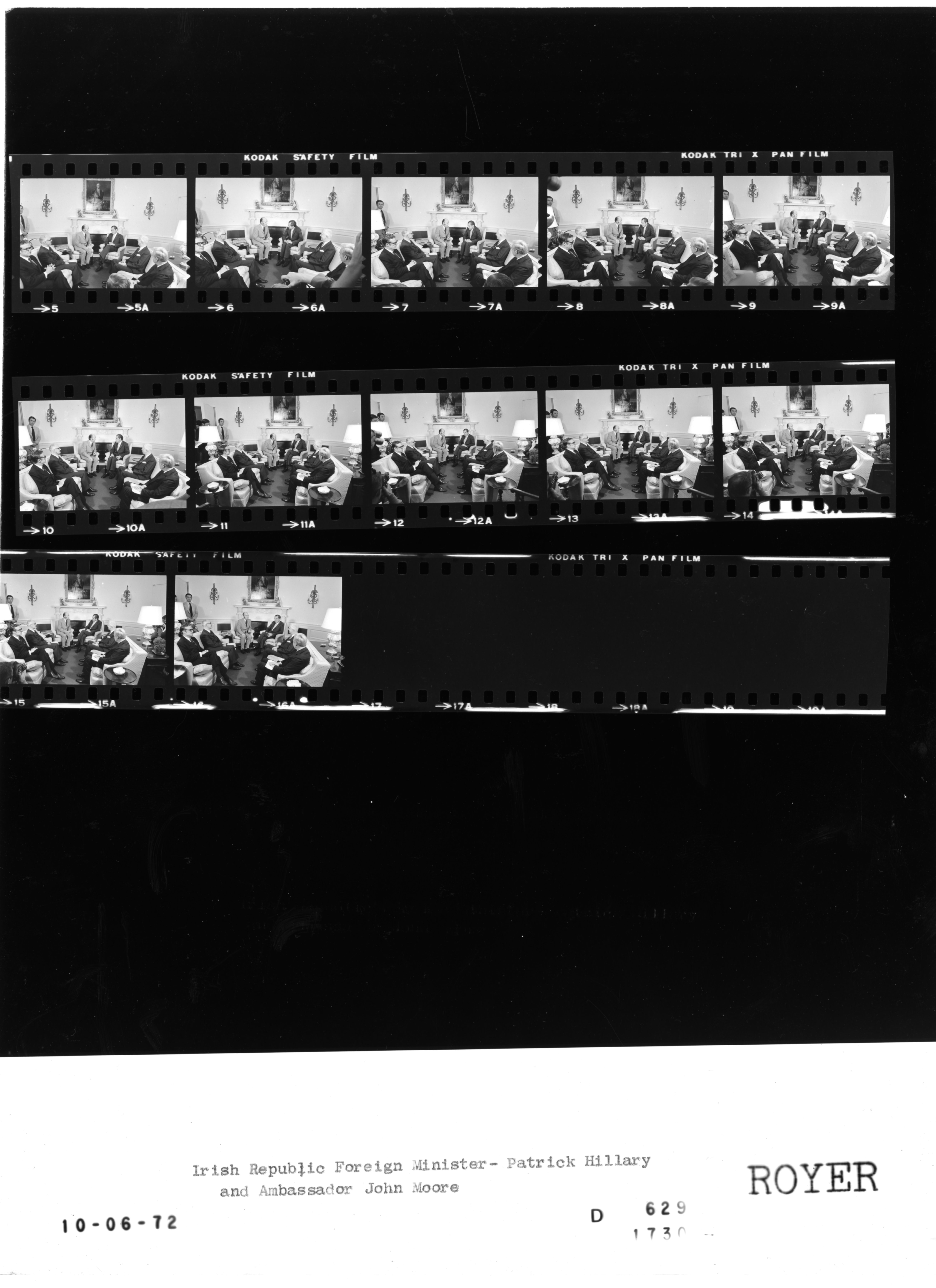
- Frame(s): WHPO-D0629-, President Nixon seated informally with Republic of Ireland high officials and others. 10/6/1972, Washington, D.C. White House, Oval Office. President Nixon, Sean O'Heideian, Patrick Hillery, Richard Kennedy, Marion Smoak, John Moore.
Roll WHPO-D0630 Photographer: Schumacher, Karl | Color or B&W: B&W
- Frame(s): WHPO-D0630-, Vice President Agnew greeting and seated around a conference table with members of the foreign advisory intelligence board. 10/6/1972, Washington, D.C. unknown. Spiro Agnew, board members.
Roll WHPO-D0631 Photographer: Atkins, Oliver | Color or B&W: B&W
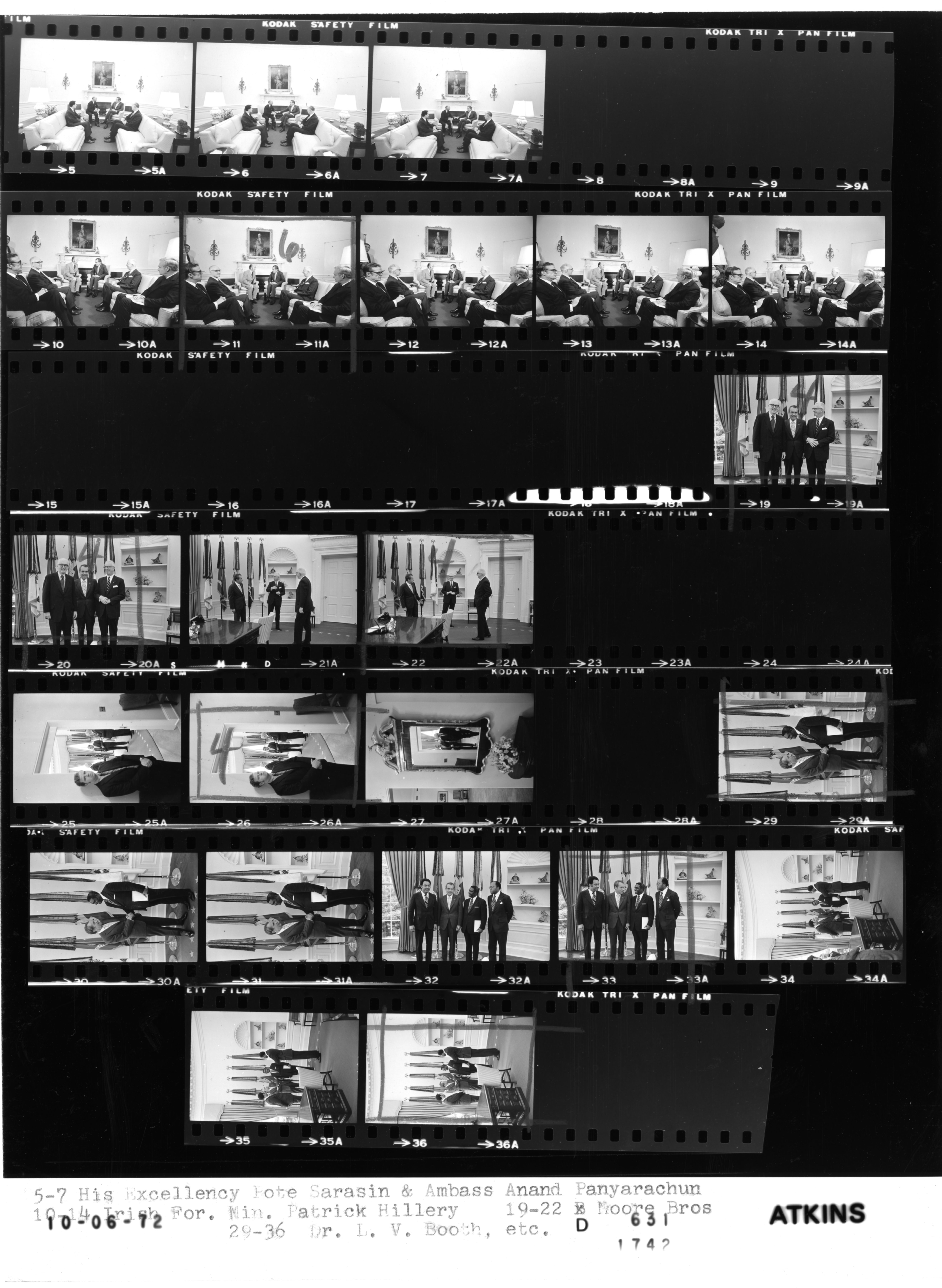
- Frame(s): WHPO-D0631-, President Nixon seated informally with officials from Thailand (5-7) and the Republic of Ireland (10-14). President Nixon standing with the Moore brothers (19-27), L. Venchael Booth (29-31), and Mr. Booth and others (32-36). 10/6/1972, Washington, D.C. White House, Oval Office. President Nixon, Anand Panyarachun, Pote Sarasin, John Holdridge, Marion Smoak, Sean O'Heideian, Patrick Hillery, Richard Kennedy, John Moore, Richard Moore, L. Venchael Booth, Paul Jones, Robert Brown.
Roll WHPO-D0633 Photographer: Kightlinger, Jack | Color or B&W: Color
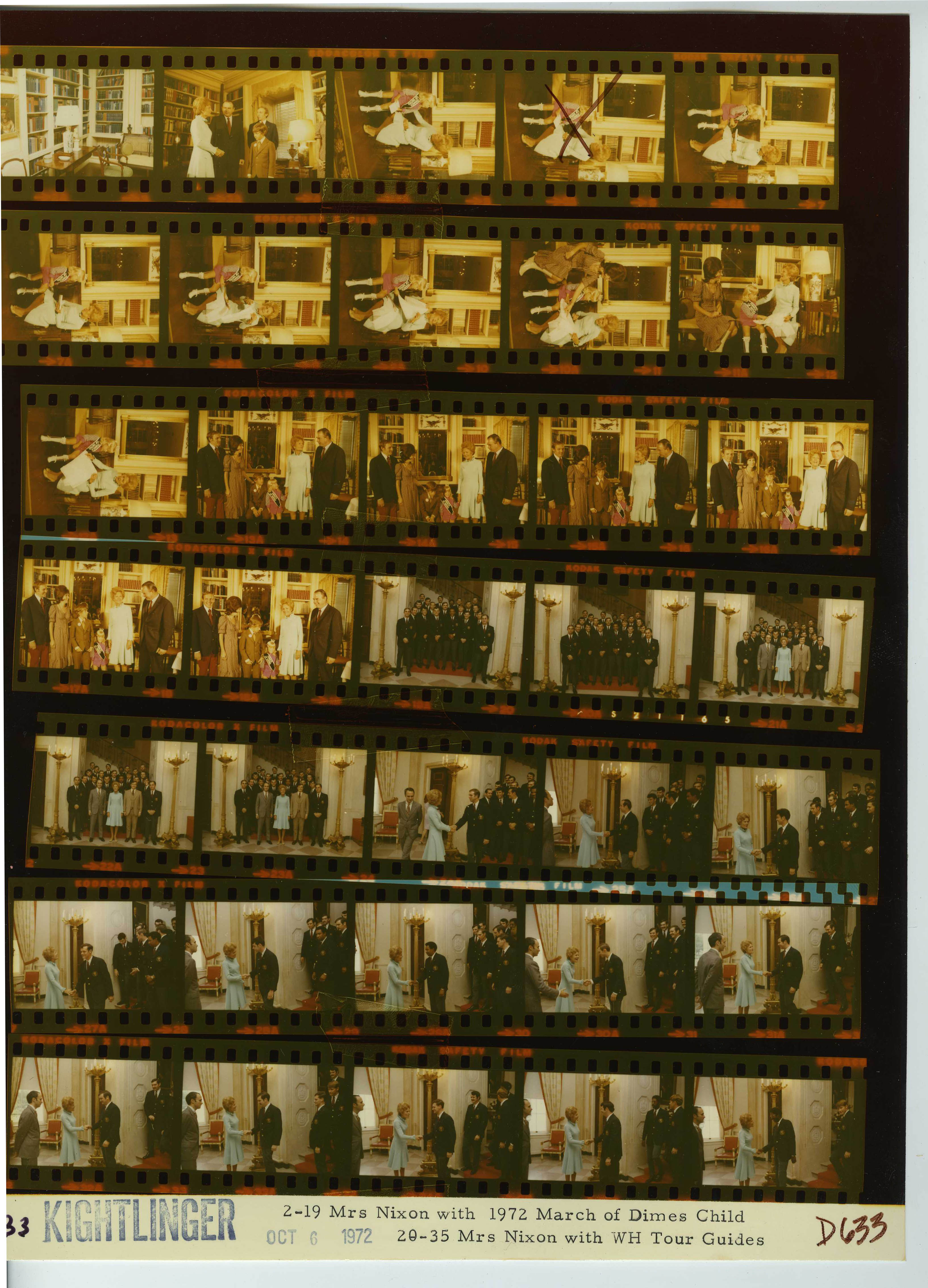
- Frame(s): WHPO-D0633-03-19, Pat Nixon visiting with the 1973 March of Dimes Poster Child Paula Pfiefer, her family, and Senator Henry Bellmon. 10/6/1972, Washington, D.C. White House, Library. Pat Nixon, Henry Bellmon, Paula Pfiefer, Roger Pfiefer, Georgia Pfiefer, Patrick Pfiefer.
- Frame(s): WHPO-D0633-07A, Pat Nixon sitting down and visiting the 1973 March of Dimes Poster Child Paula Pfiefer. 10/6/1972, Washington, D.C. White House, Library. Pat Nixon, Paula Pfiefer.
- Frame(s): WHPO-D0633-20-37, Pat Nixon standing with the White House Tour Officers, and greeting them individually. 10/6/1972, Washington, D.C. Grand Staircase, Grand Hall. Pat Nixon, White House Tour Officers.
Roll WHPO-D0634 Photographer: Kightlinger, Jack | Color or B&W: Color
- Frame(s): WHPO-D0634-, Pat Nixon seated with 1973 March of Dimes Poster Child Paula Pfiefer. 10/6/1972, Washington, D.C. White House, Library. Pat Nixon, Paula Pfiefer.
The White House Communications Agency Sound Recordings Collection contains public statements that took place between 1969 and 1974. Visit the finding aid to learn more.
L - White House Press Office Briefings
- WHCA-SR-L-033
Press briefing by Ronald Ziegler. (10/6/1972, White House Press Lobby)
Runtime: 0:24:44
Keywords: Press conferences, news conferences, interviews, media, press secretary, briefings, public statements to the press, Vietnam War, Indochina War, military, Armed Forces, African Americans, Presidential elections, campaigns, candidates, organizations, Waterg
Production credits: Audio feed supplied by WHCA; Recorded by LSB (initials of WHCA engineer)
Original Format: 1/4-inch reel-to-reel audiotape. Original source type: Original. Technical notes: 1 hour, 11 minutes and 35 seconds of silence at end of recording removed from access copies.
The White House Communications Agency Videotape Collection contains “off-the-air” recordings of televised programs produced between 1968 and 1974. Visit the finding aid to learn more.
- WHCA-5809
"Panorama". FTN: U.S. Representative John Schmitz; "MTP": U.S. Representative Pete Domenici (D-NM); "I&A": U.S. Senators Henry Jackson (D-WA) and William Proxmire.
ABC
Runtime: 01:34:53 - WHCA-5819
Weekly News Summary, Tape I.
ALL NETWORKS
Runtime: 1:30
1. Reasoner/Collins: London Times says peace in Vietnam near; Vietnam war; Highway 13. Time Code Start: 00:00. Keywords: Paris Peace Talks, Vietnam War, roads, treaty, treaties, negotiations, newspapers, reports,. Network: ABC.
2. Reasoner/Matney: McGovern in Chicago, Illinois. Time Code Start: 03:03. Keywords: Presidential elections, campaigns, campaigning, primaries, candidates, speeches. Network: ABC.
3. Smith/Shoumacher: MacGregor speaks against McGovern. Time Code Start: 05:30. Keywords: Presidential elections, campaigns, campaigning, candidates. Network: ABC.
4. Reasoner/Kincaid: Youth vote in Columbus, Ohio, with Shriver. Time Code Start: 07:24. Keywords: Vote, voters, voting, Presidential elections, campaigns, campaigning, candidates, young people, issues, voting age, registrations. Network: ABC.
5. Smith: Commentary on voter's choice. Time Code Start: 10:24. Keywords: Vote, voters, voting, Presidential elections, campaigns, campaigning, candidates, primaries, voting, registrations, public opinions, polls, approval ratings, Gallup poll, Harris poll. Network: ABC.
6. Chancellor/Shearer/Dobyns/Maus: Peace hopes. Time Code Start: 12:05. Keywords: Vietnam War, treaty, treaties, negotiations. Network: NBC.
7. Chancellor: Vietnam. Time Code Start: 15:58. Keywords: Vietnam War. Network: NBC.
8. Chancellor/Nessen: McGovern on peace news. Time Code Start: 16:40. Keywords: Presidential elections, campaigns, campaigning, candidates. Network: NBC.
9. Brinkley's Journal: Defense budget. Time Code Start: 19:55. Keywords: military, reports, economy, economics, budgets, finances, recession, inflation, money, wages, costs, unemployment, prices, payments,. Network: NBC.
10. Perkins: Vice President Agnew visits Great Falls, Montana. Time Code Start: 22:08. Keywords: Vice Presidents, travel, trips. Network: NBC.
11. Cronkite/Kalb: Peace in Vietnam?. Time Code Start: 25:59. Keywords: Paris Peace Talks, Vietnam War, treaty, treaties, negotiations. Network: CBS.
12. Cronkite/Jones: Vietnam war. Time Code Start: 28:23. Keywords: Vietnam War. Network: CBS.
13. Cronkite/Schorr: Watergate affair (O'Brien). Time Code Start: 32:11. Keywords: Presidential elections, campaigns, campaigning, candidates, managers, bugging, bugs, wiretapping, wire taps, surveillance, spying, recordings, Senate committee hearings, investigations, testimony, testify, cover-ups, break-in, scandals, Watergate. Network: CBS.
14. Cronkite/Schieffer: McGovern in Chicago, Illinois. Time Code Start: 34:50. Keywords: Presidential elections, campaigns, campaigning, primaries, candidates, speeches. Network: CBS.
15. Cronkite: Part 3 of wheat scandal special. Time Code Start: 37:18. Keywords: U.S., American, Soviet Union, USSR, Russia, agriculture, food, crops, products, sales, agreements, business, imports, exports, trade, Federal Bureau of Investigations, government, organizations, crime. Network: CBS.
16. Cronkite/Sevareid: Politics. Time Code Start: 42:46. Keywords: political activities. Network: CBS.
Context (External Sources)
The Vanderbilt Television News Archive is the world's most extensive and complete archive of television news. They have been recording, preserving and providing access to television news broadcasts of the national networks since August 5, 1968.
Wikipedia is a free encyclopedia that anyone can edit.