
Introduction
This almanac page for Monday, October 30, 1972, pulls together various records created by the federal government and links to additional resources which can provide context about the events of the day.
Previous Date: Sunday, October 29, 1972
Next Date: Tuesday, October 31, 1972
Schedule and Public Documents
The Daily Diary files represent a consolidated record of the President's activities. Visit the finding aid to learn more.
The President's day began at Camp David, Maryland
The Weekly Compilation of Presidential Documents made available transcripts of the President's news conferences; messages to Congress; public speeches, remarks, and statements; and other Presidential materials released by the White House.
Digitized versions can be found at HathiTrust.
Each Public Papers of the Presidents volume contains the papers and speeches of the President of the United States that were issued by the White House Office of the Press Secretary during the time period specified by the volume. The material is presented in chronological order, and the dates shown in the headings are the dates of the documents or events. In instances when the release date differs from the date of the document itself, that fact is shown in the text note.
To ensure accuracy, remarks have been checked against audio recordings (when available) and signed documents have been checked against the original, unless otherwise noted. Editors have provided text notes and cross references for purposes of identification or clarity.
The Federal Register is the official daily publication for rules, proposed rules, and notices of federal agencies and organizations, as well as executive orders and other Presidential documents.
No Federal Register published on this date
Archival Holdings
Any selection of archival documents will necessarily be partial. You should use the documents and folders identified below as a starting place, but consult the linked collection finding aids and folder title lists and the collections themselves for context. Many documents to be found this way do not lend themselves to association with specific dates, but are essential to a complete understanding of the material.
Selective document listing
President's Office Files
The President's Office Files consists of materials drawn together by the Special Files Unit from several administrative subdivisions within the White House Office. It is the handwriting and sensitive papers sent to the Staff Secretary that now comprise much of the President's Office Files. Visit the finding aid to learn more.
- News Summaries, Unmarked News Summaries, Box 51, News Summaries - October 1972 [7 of 7] [Note: Due to the way News Summary products were compiled, you should also consult nearby days for potentially relevant materials.]
- Political Media Analysis, October 30, 1972, 8 Days To Go
- Weekend Review, Oct. 30, 1972
- President's Daily Schedule, Box 102, [President's Daily Schedule, Oct.-Dec. 1972] [1 of 2]
- The President's Schedule, Monday - October 30, 1972
President's Personal File
The President's Personal File is essentially a President's secretary's file, kept by Rose Mary Woods, personal secretary to the President, for two purposes: (1) preserving for posterity a collection of documents particularly close to the President, whether because he dictated or annotated them, or because of the importance of the correspondent or the event concerned and (2) giving appropriate attention–letters of gratitude, invitations to White House social events, and the like–to members and important friends and supporters of the Nixon administration. This generalization does not describe all the varied materials of a file group which is essentially a miscellany, but it does identify the reason for the existence of the file group's core. Visit the finding aid to learn more.
- President's Speech File
The H. R. Haldeman Diaries consists of seven handwritten diaries, 36 dictated diaries recorded as sound recordings, and two handwritten audio cassette tape subject logs. The diaries and logs reflect H. R. Haldeman’s candid personal record and reflections on events, issues, and people encountered during his service in the Nixon White House. As administrative assistant to the President and Chief of Staff, Haldeman attended and participated in public events and private meetings covering the entire scope of issues in which the Nixon White House engaged in during the years 1969-1973. Visit the finding aid to learn more.
- Transcript of diary entry (PDF)
Monday, October 30th. One major item today was the continuing debate on how to counterattack on the whole espionage business. The President still thinks we should consider a libel suit, using the Colson route of suing the Post and Edward Bennett Williams on malicious lies involving the White House tied to the Watergate. Also, Ehrlichman feels we should exploit the Post's admission of guilt, but is concerned about the Colson libel suit, because it will inevitably lead to his having to leave the White House after the election. He feels that the President will be forced to clean up. The President thinks that we should go ahead on a white paper to the editors, give them the specific answers on all the Watergate items, and that maybe Ehrlichman should use U.S. News in next week's issue to get a, the whole story on record, get it established somewhere. He's afraid that it will leave a blotch on us, after the election, if we don't get the word out and all the questions answered now.
Later today, Ehrlichman called and said that he, Stans, Dean, and Moore had worked out a possible settlement of the Common Cause case, which is to go to trial tomorrow. So, that we would disclose $5 million of our pre-April 7th gifts under court order, and this would avoid them going to trial until after the first of the year and would keep Sloan off the stand. They feel it's a good way to cut our losses, so they're going ahead to try to work that out.
The other big item today was the whole Vietnam question, and how we deal with the attack on McGovern, and the threat of the North Vietnamese blow-up. The original plan was for Rogers to hit McGovern today at a press conference re: his point that he would reserve the right to renegotiate any deal that we make. That he should, that that would crack McGovern and hypo what he said, and set the stage to blame McGovern if North Vietnam hits us on breaking off talks tomorrow.
Ehrlichman feels that the key to Rogers doing this is that the President be precisely positioned tomorrow in Chicago, because he'd have to say some things at the regional meeting, and that Kissinger’s doing a talking paper that he will discuss with the President on this. John feels that Kissinger talks as if it's a virtual certainty that this will blow-up tomorrow. I raised that with the President, at 10:00 over at Aspen, and he said to have Ziegler not announce on TV, because we may have to put Agnew on instead. He can't go on if Vietnam is blown up, as Kissinger apparently thinks will happen. Then he got back to considerable discussion of what a blow-up would do; makes the point that Rogers should go ahead today, but the problem is we had no choice once North Vietnam was on track. We couldn't turn it off, or slow it down. He called me a little later on the phone, said he had talked to Kissinger and that they expect a message at 2:00 or 3:00; that, the, Ehrlichman was overreacting. That Kissinger says, that first, they may agree to talk; second, they may just postpone the talks; third, they may possibly blow up, but Kissinger thinks that the third is not likely. But, if it does happen, that we should just take the offensive. He now feels Rogers should not go out today, until we get the message from North Vietnam that it's okay for Agnew to take on McGovern now, as hard as hell, but we have to wait until we get the message before Rogers can go out. He then cautions that we must not get jittery and hysterical. That we've got to handle this with poise; that we're going through the birth pains of an agreement.
Then, we told them to go ahead on the Vice President. The Vice President called me and was concerned about the statement, and is working that out with Haig, but feels that it would be a bad mistake for him to go forward with the plan that they've proposed to him of going to the White House press room, making a statement, and refusing to answer questions. I agreed with him. He suggested that he either do this as part of a speech he's giving tomorrow, or that he do it on a paid television five minutes tonight, and say that we purchased the time in order to get the full statement over to the people. So, we worked on that basis for a while. A little later, I talked to Kissinger, and he says that North Vietnam is preparing a blow for us this week: first, that they might not show up on Thursday, because the negotiations are completed; second, they might agree to meet; third, they'd say we cheated them, so they're breaking the whole thing off. If the latter happens, he thinks we should just brazen it through. He later told the President he was concerned that we'd take a murderous beating, because he did get the message from North Vietnam, and they simply said that they were taking the whole thing under serious consideration and, and would get back to us later. The President still wants the VP to go on, emphasizing that McGovern is sabotaging the peace efforts. He feels that we should ge--, develop our plan, that we should take a hawkish view. And then he had me talk to Kissinger a little later, and Henry, then, had calmed down.
-------------------------------------------------------------------------------------------------------------------
DECLASSIFIED - E.O. 13526, Sect. 3.4: by MS, NARA, June 12, 2013
Audio Cassette 26, Side A, Withdrawn Item Number 14 [AC-26(A) Sel 12]
Duration: 11 seconds
Said that he talked to Dobrynin who doesn't think that the North Vietnamese will blow; that they'll yell and scream, but then they'll talk.
-------------------------------------------------------------------------------------------------------------------
Henry feels we must go on the offensive if they do blow; publish all that we've offered. Make the point that we didn't meet with them to sign, because: first, Saigon reports they're seizing territory and the threat of a bloodbath; second, Pham Van Dong claimed this was a coalition government, which we agreed it was not; third, we never agreed to leave all their troops in the South, and we've been watching for a unilateral withdrawal, which they were supposed to do as evidence of good faith. Then we should make the point that if in good faith we can settle, we will, but that we will not let us, ourselves be stampeded into doing this just for the election. He also says that the liberal press is very vulnerable in any effort to attack us, because now they've moved to the right of us, and they're complaining that we're letting good old Thieu down. Henry feels he should step out again and brief the press. That it should not be elevated to the Presidential level. We should just say that the first item was to end the war that we've made major progress—this is if the President goes on TV Thursday night. He should open by saying, the first thing in looking at the future is to end the war; that we've made major progress, and then describe the situation as it stands on Thursday night. Say we're committed to the generation of peace, and we pledge that we will get peace with honor in Vietnam. He feels that the first five minutes of the talk should be on Vietnam in any event, in a strong manly way. And the President later agreed, and said that we should go to the full half hour, if we need extra time. He had, he old me to have Kissinger get this offer to Price to write up a couple of pages for inclusion in the speech.
We then went over, I went over the poll that we'd done over the weekend, with the President, which shows a drop in the trial heat, and evidence that it's not because of Vietnam, but because the corruption thing is starting to get through some. He feels that Henry has got to get out through either Ziegler, or Rogers, the point that the President is causing a delay in these, because the deal isn't made properly, because that's the one thing that doesn't look so good in the poll.
The Vice President is going ahead with his blast at McGovern, so we'll get some action on that anyway.
The President also got into some schedule things today; there was a great train wreck in Chicago, as a result of which we decided to cancel our Chicago visit. The President called Mayor Daley to tell him, and it worked out pretty well, because Daley said he was canceling the McGovern parade for Wednesday night also. The President decided to go ahead with the radio speech today at the last minute on the old folks, so that was tossed in. He's approved the Urban Affairs speech and the TV speech. He's just going to read them as written, and wants to keep the week basically pretty free. He got back to the idea of the big press pool on the plane coming back on Monday, as well as going out on Saturday. He decided to go to church in San Clemente, instead of Whittier.
-------------------------------------------------------------------------------------------------------------------
Deed of Gift - Privacy withdrawal reviewed and released by MS, NARA, October 21, 2013
Audio Cassette 26, Side A, Withdrawn Item Number 15
Duration: 6 seconds
And, got back to the Drown problem on election night because they are coming back. He doesn't want them at the house; they're to stay at the Shoreham.
------------------------------------------------------------------------------------------------------------------
He wants a phone list for election night, people he should call. He wants to send wires to all our chairmen in each state, as the state goes over the top on election night. He refused to call Cahill to apologize for not mentioning him at the Northeast regional meeting. He decided to hold up on Oklahoma, New Mexico, and will not do those if we don't reschedule Chicago, and then later decided that we definitely should not reschedule Chicago, so we've dropped those on the schedule now.
And that’s the end of October 30th. - Original audio recording (MP3)
The National Archives Catalog is the online portal to the records held at the National Archives, and information about those records. It is the main way of describing our holdings and also provides access to electronic records and digitized versions of our holdings.
The Catalog searches across multiple National Archives resources at once, including archival descriptions, digitized and electronic records, authority records, and web pages from Archives.gov and the Presidential Libraries. The Catalog also allows users to contribute to digitized historical records through tagging and transcription.
Nixon Library Holdings
All National Archives Units
National Security Documents
The President's Daily Brief is the primary vehicle for summarizing the day-to-day sensitive intelligence and analysis, as well as late-breaking reports, for the White House on current and future national security issues. Read "The President's Daily Brief: Delivering Intelligence to Nixon and Ford" to learn more.
The Foreign Relations of the United States series presents the official documentary historical record of major U.S. foreign policy decisions and significant diplomatic activity. Visit the State Department website for more information.
Vol. IV, Foreign Assistance, International Development, Trade Policies, 1969-1972
East-West Trade, 1969-1972
359. National Security Decision Memorandum 195, Washington, October 30, 1972
Source: National Archives, RG 59, S/S Files, Lot 83 D 305, NSDM 195. Secret. Copies were sent to the Secretary of Defense, the Director of Central Intelligence, and the President’s Assistant for International Economic Affairs.
Vol. V, United Nations, 1969-1972
UN Finances and Reduction of the U.S. Assessment
193. Telegram From the Mission to the United Nations to the Department of State, New York, October 30, 1972, 1622Z
Source: National Archives, RG 59, Central Files 1970–73, UN 10–4. Confidential.
Vol. IX, Vietnam, October 1972-January 1973
Paris Negotiations Collapse, October 24-December 13, 1972
80. Minutes of a Washington Special Actions Group Meeting, Washington, October 30, 1972, 11:13-11:42 a.m.
Source: National Archives, Nixon Presidential Materials, NSC Files, NSC Institutional Files (H-Files), Box H–117, Washington Special Actions Group, WSAG Minutes (Originals) 7–27–72 to 9–20–73. Top Secret; Sensitive. The meeting took place in the White House Situation Room.
81. Backchannel Message From the President’s Assistant for National Security Affairs (Kissinger) to the Ambassador to Vietnam (Bunker), Washington, October 30, 1972, 1746Z
Source: National Archives, Nixon Presidential Materials, NSC Files, Box 857, For the President’s Files (Winston Lord)—China Trip/Vietnam, Sensitive Camp David, Vol. XXI (1). Top Secret; Sensitive; Exclusively Eyes Only.
82. Transcript of a Telephone Conversation Between the President’s Assistant for National Security Affairs (Kissinger) and the Assistant to the President (Haldeman), Washington, October 30, 1972, 3:20 p.m.
Source: National Archives, Nixon Presidential Materials, Kissinger Telephone Conversations, Box 16, Chronological File. No classification marking.
83. Backchannel Message From the President’s Assistant for National Security Affairs (Kissinger) to the Ambassador to Vietnam (Bunker), Washington, October 30, 1972, 2200Z
Source: National Archives, Nixon Presidential Materials, NSC Files, Box 857, For the President’s Files (Winston Lord)—China Trip/Vietnam, Sensitive Camp David, Vol. XXI (1). Top Secret; Sensitive; Exclusively Eyes Only.
84. Memorandum From the Special Assistant for Vietnamese Affairs, Central Intelligence Agency (Carver) to the President’s Assistant for National Security Affairs (Kissinger), Washington, October 30, 1972
Source: National Archives, Nixon Presidential Materials, NSC Files, Box 113, Vietnam Subject Files, Vietnam—Ceasefire 1972. Top Secret; Sensitive.
Vol. XL, Germany and Berlin, 1969-1972
Germany and Berlin, 1969-1972
380. Memorandum From Helmut Sonnenfeldt of the National Security Council Staff to the President’s Assistant for National Security Affairs (Kissinger), Washington, October 30, 1972
Source: National Archives, Nixon Presidential Materials, NSC Files, Box 721, Country Files, Europe, USSR, Vol. XXVI. Secret; Background Use Only. Sent for information. Kissinger initialed the memorandum indicating that he had seen it.
381. Memorandum From Helmut Sonnenfeldt of the National Security Council Staff to the President’s Assistant for National Security Affairs (Kissinger), Washington, October 30, 1972
Source: National Archives, Nixon Presidential Materials, NSC Files, Box 692, Country Files, Europe, Germany (Berlin), Vol. V. Secret; Exclusively Eyes Only. Urgent; sent for information. Kissinger and Haig both initialed the memorandum indicating that they had seen it. The memorandum is largely based on the reporting in telegrams 14751 and 14756 from Bonn, October 28 and 30, respectively. (Both National Archives, RG 59, Central Files 1970–73, POL 38–6)
Vol. XLI, Western Europe; NATO, 1969-1972
France
162. Memorandum From the President’s Assistant for National Security Affairs (Kissinger) to President Nixon, Washington, October 30, 1972
Source: National Archives, Nixon Presidential Materials, NSC Files, Box 679, Country Files—Europe, France, Vol. X. Top Secret; Sensitive. Sent for information. A stamped notation on the first page reads: “The President has seen.”
Vol. E-4, Documents on Iran and Iraq, 1969-1972
Iran 1972
229. Telegram 196855 From the Department of State to the Embassy in Iran, Washington, October 30, 1972, 2115Z
The Department urgently requested an additional 16 F–5A aircraft from Iran, offering concessions on other equipment in return.
Source: National Archives, RG 59, Central Files 1970–73, DEF 19–8 US-IRAN. Top Secret; Nodis; Cherokee. Drafted by Thomas R. Pickering (PM) and approved by Johnson, Defense, and Harry G. Barnes, Jr (S/S). Repeated to the Ambassador in Saigon.230. Letter From the Embassy in Iran to the Country Director for Iran (Miklos), Tehran, October 30, 1972
Political officer Andrew Killgore discussed the likely future of Iranian politics, including the possibility that the Shah might introduce a one-party system.
Source: National Archives, RG 59, NEA/IRN, Office of Iran Affairs, Lot File 75D365, Box 7, POL 14, Elections. Confidential; Official—Informal. The referenced A-166 was not found. Adl was Yahya Adl, the leader of the opposition Mardom party. In a handwritten postscript, Killgore added, “Jack, your letter was particularly welcome because of the strong criticism of the Iranian regime implied in it. The Shah is a great man whose accomplishments are also great. But this gives no occasion for a worshipful attitude on our part. The Shah’s interests and ours will be better served in the long run by our looking dispassionately at the failures as well as the success of the regime. That’s what we are going to be doing. Cheers! Andy K.” Miklos’s letter was also not found. On October 13, as expected, the ruling Iran Novin party had won a sweeping victory over the Mardom party in local elections, taking 80% of the vote. In Telegram 6210, October 14, the Embassy had written that the importance of the election “lies not so much in Iran Novin victory, which observers already knew would be the result, but in their significance as a training vehicle in democratic forms.” (Ibid., Central Files, POL 18–1 IRAN.)
Vol. E-5, Part 1, Documents on Sub-Saharan Africa, 1969-1972
Burundi
229. Memorandum From Secretary of State Rogers to President Nixon, Washington, October 30, 1972
Rogers reported that Burundi Ambassador Terence was called to the Department October 18 and informed of the new policy. Terence was defensive and said that national reconciliation was underway.
Source: National Archives, Nixon Presidential Materials, NSC Files, Box 735, Country Files, Africa, Burundi, Vol. I. Confidential. Kissinger forwarded Rogersʼ memorandum to the President under cover of a November 8 memorandum in which he summarized its contents and assured Nixon that Ambassador Yost was fully aware of his instructions and could be expected to carry them out. (Ibid.)
Vol. E-5, Part 2, Documents on North Africa, 1969-1972
Libya
94. Telegram 1699 From the Embassy in Libya to the Department of State, Tripoli, October 30, 1972, 1600Z
The Ambassador and Qadhafi had a tour d’horizon conversation in which the Libyan leader sent a message to the President.
Source: National Archives, RG 59, Central Files 1970–73, POL 15–1 LIBYA. Secret; Priority.
Vol. E-7, Documents on South Asia, 1969-1972
U.S. Relations with India and Pakistan, 1972
308. Memorandum From the Country Director for India, Ceylon, and Nepal (Schneider) to the Assistant Secretary of State for Near Eastern and South Asian Affairs (Sisco), Washington, October 30, 1972
At Sisco’s request, Schneider listed U.S. programs in India that had been curtailed by the Indian Government since December 1971.
Source: National Archives, RG 59, Central Files 1970–73, POL INDIA–US. Confidential. Drafted in NEA/INC by Donald W. Born. Sent through Armin H. Meyer, who was assigned to NEA as a special consultant after returning to the Department following 3 years as U.S. Ambassador to Japan. He had previously been Ambassador to Lebanon and Iran.
Vol. E-16, Documents on Chile, 1969-1973
Cool and Correct: The U.S. Response to the Allende Administration, November 5, 1970-December 31, 1972
123. Paper Prepared for the Ad Hoc Interagency Working Group on Chile, Washington, October 30, 1972
Summary: This contingency paper, titled “Possible Military Intervention,” examined the effects of the mid-1972 strikes in Chile and those “contingency situations” that the United States would confront if the Chilean military intervened in Chilean politics.
Source: National Archives, RG 59, Central Files 1970–73, POL CHILE–US. Secret. Drafted by J.E. Karkashian, D. Erbe, and L. Girdler. An October 30 covering memorandum from Meyer to the Senior Review Group states the paper was for the Group’s information.
The Kissinger telephone conversation transcripts consist of approximately 20,000 pages of transcripts of Kissinger’s telephone conversations during his tenure as Assistant to the President for National Security Affairs (1969-1974) and Secretary of State (1973-1974) during the administration of President Richard Nixon. Visit the finding aid for more information.
Digitized versions can be found in the National Archives Catalog.
Audiovisual Holdings
Visit the White House Tapes finding aid to learn about the taping system's operation and archival processing.
Camp David Hard Wire
- 222-5; Unknown between 9:30 a.m. & 9:50 a.m.; Nixon, Richard M. (President); [Unknown person(s)]
- 222-6; Unknown between 9:30 a.m. & 9:50 a.m.; Nixon, Richard M. (President); Nixon, Thelma C. ("Pat") (Ryan)
- 222-7; 9:50 a.m. - 10:25 a.m.; Nixon, Richard M. (President); Haldeman, H. R. ("Bob")
- 222-8; Unknown between 10:25 a.m. & 10:33 a.m.; Nixon, Richard M. (President); Camp David Operator
- 222-9; 10:33 a.m. - 10:43 a.m.; Nixon, Richard M. (President); Kissinger, Henry A.
- 222-10; Unknown between 10:43 a.m. & 10:44 a.m.; Nixon, Richard M. (President); Camp David Operator
- 222-11; 10:44 a.m. - 10:48 a.m.; Nixon, Richard M. (President); Haldeman, H. R. ("Bob")
- 222-12; Unknown between 4:40 p.m. & 4:58 p.m.; Nixon, Thelma C. ("Pat") (Ryan); [Unknown person(s)]
- 222-13; 5:00 p.m. - 5:40 p.m.; Nixon, Richard M. (President); Haldeman, H. R. ("Bob"); Nixon, Thelma C. ("Pat") (Ryan); White House operator; Daley, Richard J.; [Unknown person(s)]; Camp David Operator; Ehrlichman, John D.
Camp David Study Desk
Camp David Study Table
- 152-4; Unknown between 9:33 a.m. & 10:33 a.m.; Nixon, Richard M. (President); Camp David Operator
- 152-5; 10:33 a.m. - 10:43 a.m.; Nixon, Richard M. (President); Kissinger, Henry A.
- 152-6; Unknown between 10:43 a.m. & 10:44 a.m.; Nixon, Richard M. (President); Camp David Operator
- 152-7; 10:44 a.m. - 10:48 a.m.; Nixon, Richard M. (President); Haldeman, H. R. ("Bob")
- 152-8; Unknown between 5:00 p.m. & 5:22 p.m.; Nixon, Richard M. (President); Camp David Operator
- 152-9; 5:22 p.m. - 5:23 p.m.; Nixon, Richard M. (President); Daley, Richard J.
White House Telephone
The White House Photo Office collection consists of photographic coverage of President Richard Nixon meeting with prominent social, political, and cultural personalities; speaking engagements and news conferences of the President and various high-ranking members of the White House staff and Cabinet; Presidential domestic and foreign travel, including Presidential vacations; social events and entertainment involving the First Family, including entertainers present; official portraits of the President, First Family, and high-ranking members of the Nixon administration; the 1969 and 1973 Inaugurals; the President’s 1972 Presidential election campaign appearances (including speeches) and other official activities of the White House staff and the President’s Cabinet from January 20, 1969 until August 9, 1974 at the White House and the Old Executive Office Building; other locations in Washington, DC, such as The Mall; and the Presidential retreats in Camp David, Maryland, Key Biscayne, Florida, and San Clemente, California. Visit the finding aid to learn more.
Roll WHPO-D0860 Photographer: Royer | Color or B&W: B&W
- Frame(s): WHPO-D0860-, Vice President Agnew shaking hands and seated informally with the Tunisian Ambassador. 10/30/1972, Washington, D.C. Vice Presidential Office, Executive Office Building. Spiro Agnew, Tunisian Ambassador, unidentified men.
Roll WHPO-D0861 Photographer: Royer | Color or B&W: B&W
- Frame(s): WHPO-D0861-, Janet McNamee accepting a gift presentation from Rabbi Baal. 10/30/1972, Washington, D.C. White House, South Grounds. Janet McNamee, Rabbi Baal, unidentified man.
Roll WHPO-D0863 Photographer: Royer | Color or B&W: B&W
- Frame(s): WHPO-D0863-, Pumpkin carving Halloween contest entrants during the judging of the Jack O Lanterns. 10/30/1972, Washington, D.C. East Lobby, White House. unidentified persons.
Roll WHPO-D0864 Photographer: Royer | Color or B&W: B&W
- Frame(s): WHPO-D0864-, Pumpkin carving Halloween contest entrants during the judging of the Jack O Lanterns. 10/30/1972, Washington, D.C. East Lobby, White House. unidentified persons.
Roll WHPO-D0865 Photographer: Royer | Color or B&W: B&W
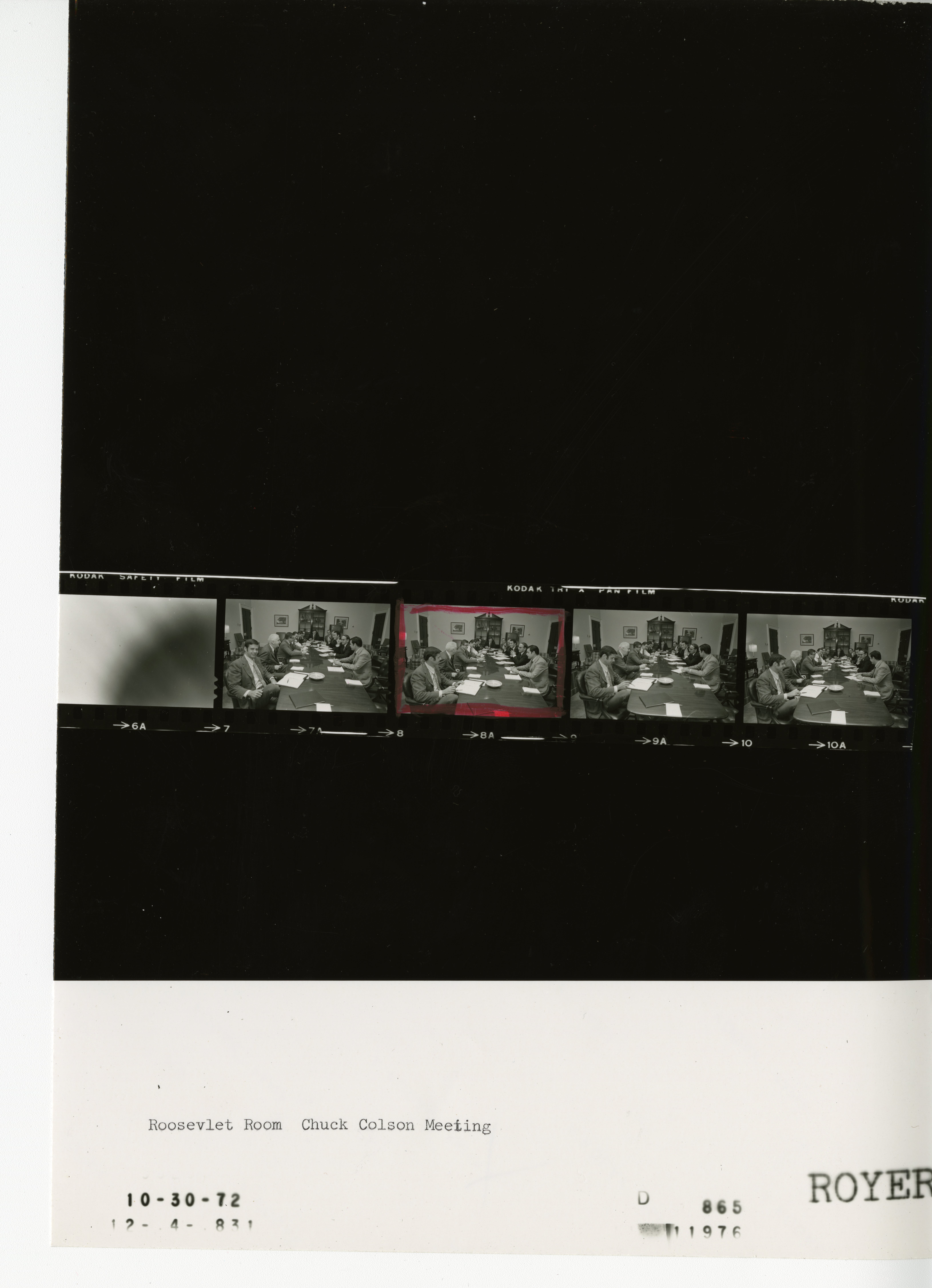
- Frame(s): WHPO-D0865-, Chuck Colson and others seated around a conference table during a meeting. 10/30/1972, Washington, D.C. White House, Roosevelt Room. Charles W. Colson, unidentified men.
Roll WHPO-D0866 Photographer: Kightlinger, Jack | Color or B&W: B&W
- Frame(s): WHPO-D0866-, Bill Timmons talking with a group of Italian men. 10/30/1972, Washington, D.C. unknown. Bill Timmons, Italian men.
The White House Communications Agency Sound Recordings Collection contains public statements that took place between 1969 and 1974. Visit the finding aid to learn more.
B - Vice-Presidential (Agnew and Ford)
- WHCA-SR-B-235
Television taping-Family Theater. (10/30/1972)
Runtime: 4:00
Original Format: 1/4-inch reel-to-reel audiotape. Original source type: Original.
G - Cabinet Officer Briefings
- WHCA-SR-G-196
Press briefing by Secretary of Health, Education and Welfare Elliot Richardson, John D. Ehrlichman, Ronald Ziegler, and Dr. Fleming. (10/30/1972, White House Press Lobby)
Runtime: 1:15:36
Keywords: health care, kidney disease
Production credits: Audio feed supplied by WHCA; Recorded by JBA (initials of WHCA engineer)
Original Format: 1/4-inch reel-to-reel audiotape. Original source type: Original.
L - White House Press Office Briefings
- WHCA-SR-L-046
Press briefing by Ronald Ziegler. (10/30/1972, [location not specified])
Runtime: 0:15:37
Keywords: press conferences, news conferences, interviews, media, press secretary, briefings, public statements to the press, statements, Presidential statements
Production credits: Audio feed supplied by WHCA; Recorded by CBW (initials of WHCA engineer)
Original Format: 1/4-inch reel-to-reel audiotape. Original source type: Original. Technical notes: 1 hour, 21 minutes and 39 seconds of silence at end of recording removed from access copies.
P - Formal Presidential Remarks
- WHCA-SR-P-721035
Radio broadcast from Camp David re signing HR 1 - To amend the Social Security Act. (10/30/1972, Camp David)
Runtime: 0:12:49
Keywords: health care, kidney disease
Production credits: Audio feed supplied by WHCA; Recorded by MJP (initials of WHCA engineer)
Original Format: 1/4-inch reel-to-reel audiotape. Original source type: Original.
The White House Communications Agency Videotape Collection contains “off-the-air” recordings of televised programs produced between 1968 and 1974. Visit the finding aid to learn more.
- WHCA-5862
"CBS Morning News" excerpt.
PBS
Runtime: 00:19:55 - WHCA-5870
Weekly News Summary, Tape II.
ALL NETWORKS
Runtime: NA
1. Smith/Rolfson: Vietnam peace; Viet Cong negotiator Madame Nguyen Thi Binh; American patrols. Time Code Start: 00:00. Keywords: Paris Peace Talks, Vietnam War, treaty, treaties, negotiations, women, officials, People's Liberation Armed Forces (PLAF), National Liberation Front (NLF), VC. Network: ABC.
2. Smith/Sherwood: (Julie Nixon Eisenhower) (Tricia Nixon Cox) in Minnesota. Time Code Start: 05:02. Keywords: Presidents, families, women, Presidential elections, campaigns, candidates. Network: ABC.
3. Shoumacher: John Schmitz, American Independent Party (AIP) candidate for President. Time Code Start: 05:02. Keywords: Presidential elections, campaigns, campaigning, candidates. Network: ABC.
4. Jackson: Dr. Spock. Time Code Start: 11:00. Keywords: elections, campaigns, campaigning, candidates, child psychology, psychologist, authors. Network: ABC.
5. Smith: Commentary on the Middle East. Time Code Start: 13:54. Keywords: Middle East, Mideast, war. Network: ABC.
6. Chancellor/Dobyns/Valeriani/Streithorst: Vietnam peace settlement; film on North Vietnamese press conference; South Vietnam's President Thieu; Vietnam war. Time Code Start: 15:24. Keywords: South Vietnam, Presidents, speeches, statements, Vietnam War, Presidents, speeches, statements, media, press conferences, news conferences, interviews. Network: NBC.
7. Chancellor: President Nixon signs Social Security Bill. Time Code Start: 22:21. Keywords: bills, laws, Presidents, signings, signing ceremony, Family Assistance Programs, financial aid, health assistance, retirees, retirement, senior citizens, elderly, pensions, money, wages, increases. Network: NBC.
8. Chancellor/Dancy: (McGovern) in Connecticut. Time Code Start: 23:52. Keywords: Presidential elections, campaigns, campaigning, candidates. Network: NBC.
9. Chancellor: Chapin admits hiring Donald Segretti. Time Code Start: 24:43. Keywords: Dirty Tricks, political sabotage, trials, Watergate, Senate committee hearings, investigations, testimony, testify, cover-ups, Presidential elections, campaigns. Network: NBC.
10. Chancellor/Davis: Election campaign in Ohio; films of President Nixon and McGovern. Time Code Start: 25:20. Keywords: Presidents, Presidential elections, campaigns, campaigning, candidates. Network: NBC.
11. Cronkite/Kalisher/Sevareid: Vietnamese peace signing; film of North Vietnamese press conference. Time Code Start: 27:30. Keywords: Vietnam War, ending, peace, signings, treaty, treaties, signing ceremony, Presidents, Vice Presidents, speeches, statements, Presidents, Vice Presidents, speeches, statements, press conferences, news conferences, interviews, news. Network: CBS.
12. Cronkite/Schieffer: (McGovern) in Connecticut. Time Code Start: 33:05. Keywords: Presidential elections, campaigns, campaigning, candidates. Network: CBS.
13. Cronkite: Yankelovich poll. Time Code Start: 34:52. Keywords: public opinions, polls, approval ratings, Gallup poll, Harris poll. Network: CBS.
14. Cronkite: Campaign '72, an election analysis. Time Code Start: 35:48. Keywords: Presidential elections, campaigns, campaigning, candidates. Network: CBS.
Context (External Sources)
The Vanderbilt Television News Archive is the world's most extensive and complete archive of television news. They have been recording, preserving and providing access to television news broadcasts of the national networks since August 5, 1968.
Wikipedia is a free encyclopedia that anyone can edit.