
Introduction
This almanac page for Tuesday, October 17, 1972, pulls together various records created by the federal government and links to additional resources which can provide context about the events of the day.
Previous Date: Monday, October 16, 1972
Next Date: Wednesday, October 18, 1972
Schedule and Public Documents
The Daily Diary files represent a consolidated record of the President's activities. Visit the finding aid to learn more.
The President's day began at The White House - Washington, D. C.
The Weekly Compilation of Presidential Documents made available transcripts of the President's news conferences; messages to Congress; public speeches, remarks, and statements; and other Presidential materials released by the White House.
Digitized versions can be found at HathiTrust.
Each Public Papers of the Presidents volume contains the papers and speeches of the President of the United States that were issued by the White House Office of the Press Secretary during the time period specified by the volume. The material is presented in chronological order, and the dates shown in the headings are the dates of the documents or events. In instances when the release date differs from the date of the document itself, that fact is shown in the text note.
To ensure accuracy, remarks have been checked against audio recordings (when available) and signed documents have been checked against the original, unless otherwise noted. Editors have provided text notes and cross references for purposes of identification or clarity.
The Federal Register is the official daily publication for rules, proposed rules, and notices of federal agencies and organizations, as well as executive orders and other Presidential documents.
The Congressional Record is the official daily record of the debates and proceedings of the U.S. Congress.
Archival Holdings
Any selection of archival documents will necessarily be partial. You should use the documents and folders identified below as a starting place, but consult the linked collection finding aids and folder title lists and the collections themselves for context. Many documents to be found this way do not lend themselves to association with specific dates, but are essential to a complete understanding of the material.
Selective document listing
President's Office Files
The President's Office Files consists of materials drawn together by the Special Files Unit from several administrative subdivisions within the White House Office. It is the handwriting and sensitive papers sent to the Staff Secretary that now comprise much of the President's Office Files. Visit the finding aid to learn more.
- News Summaries, Annotated News Summaries, Box 39, [Oct. 16-17, 1972] [2 of 2] [Note: Due to the way News Summary products were compiled, you should also consult nearby days for potentially relevant materials.]
- Political Media Analysis, October 17, 1972, Three Weeks
- News Summary, October 17, 1972, (Monday nets, wires, mags)
- President's Daily Schedule, Box 102, [President's Daily Schedule, Oct.-Dec. 1972] [1 of 2]
- The President's Schedule, Tuesday - October 17, 1972
The H. R. Haldeman Diaries consists of seven handwritten diaries, 36 dictated diaries recorded as sound recordings, and two handwritten audio cassette tape subject logs. The diaries and logs reflect H. R. Haldeman’s candid personal record and reflections on events, issues, and people encountered during his service in the Nixon White House. As administrative assistant to the President and Chief of Staff, Haldeman attended and participated in public events and private meetings covering the entire scope of issues in which the Nixon White House engaged in during the years 1969-1973. Visit the finding aid to learn more.
- Transcript of diary entry (PDF)
Tuesday, October 17.
Haig was in first thing this morning with a report from Henry who says the talks are going well and he feels that he should go on to Saigon, so he will tonight. We got into some discussions about Henry's attitude, along the same lines that Haig had expressed to me yesterday. He shares the President's view that Henry is strongly motivated in all this by a desire for personally being the one to bring about the final peace settlement. Al feels this poses a major problem in that it will cause Henry to push harder for a settlement and to accept a less favorable thing than he might if he didn't have this push. He thinks that my talk with him about a successor for Haig in the second term was very helpful, in that it gave him some reassurance that he would be around in the second term, and, therefore, the pressure for him to get this settled before the election was lightened and his willingness to talk it over with Haig was greatly increased. Al urges that while Henry is gone we give every possible evidence to him that we can, of total support so that he won't feel that he has to prove anything. He agrees that under no circumstances can he go to the third stop unless the whole thing is fully settled, but he's not at all convinced that Henry fully shares this view.
The President spoke this morning to a group of foreign labor leaders. Felt afterwards that he'd given a very thoughtful analysis of the relationship of labor and government and the history of free labor in the United States but that probably no one would notice it, that we wouldn't get any mileage out of it.
We had a one hour Connally meeting today, a lot of talk about how great his television show was, some discussion of funds to run it, a little discussion of Connally's schedule, some of Connally's ideas on the problem of the espionage/sabotage case and some speech ideas. Then Mitchell, MacGregor and Ehrlichman joined us for the regular Tuesday political meeting.
The President got into an analysis that as of now the polls are the same as they've been. In the next week to ten days the opposition has to break through but there's no way they can, especially if we keep on the offensive and keep them on the defensive. Some discussion on the radio speeches, Connally told him he feels that he's the most effective radio speaker in his lifetime. He then got into a question of the President's schedule. MacGregor raised it, feeling that we need some additional schedule activity in order to maintain the morale of our troops and to avoid the charge that we're taking the election for granted. Connally agreed, said the President ought to hit about eight cities in two days on ten minute airport stops in each, or consider traveling around the country the week after the election thanking people. The President basically didn't buy that argument because he feels that a stop in a state doesn't help the vote there and some of the states that Clark had suggested, he totally disagreed with. He feels he should not go back to Michigan because it'll only stir up the Ruther machine, Missouri's bad because of Eagleton, and that our problem is to avoid stirring up the opposition. Even going to Chicago is bad because of stirring Daley up.
The key here is to show emotion and Ehrlichman suggested a national get out the vote drive. The President would go to eight states with predicted low votes to make the case that they should get a better turnout. Actually, we'd select states where we're in good shape. Connally argued that the President should only do this if he really wants to but we do need to appear that we're not taking it for granted and he also argues that going out more would help with Congress after the election which is not a valid point. The President said we'll see Operation Rescue in the next three weeks as the Democrats try to save local candidates. His going out to campaign might aggravate this because any appearance he makes has to be political. It's a tough judgment call and questioned whether with television it's a good idea.
The basic problem is the dead spot next week between Monday and Saturday. The President talked about popping out and back from here, one stop each day on Wednesday and Thursday, but the problem then would be to have a major speech. So it got back to the airport prop stops. Then I suggested helicopter stops in tri-state areas, going to one tri-state airport and chopper to three states from there and then back to Washington. The President liked that and so did the others, and we ended up talking about Wednesday and Thursday of next week, and Monday and Tuesday of the following week for this kind of activity.
Connally made a pitch that there was no question that he could win the election as a celluloid candidate but you get a very fragile strength through television, that you really have to be out where they can touch you. That he should go out not as a challenger, a campaigner, but as President, and not campaign against McGovern.
After the meeting, President made the point to me that he was very much concerned about their sensitivity on his time at Camp David. He said on the travel thing he tends to agree-- not on a rational basis-- but for the compelling reason that all of them seem so strongly for it. He thinks going out to the country is not bad if he can go in a dignified, non-combative way, as my helicopter plan would provide. He thinks we don't need it, that it won't affect the election. But hat we have to live with the morale of our own forces, and that it does remove the Congressional arguments, so he suggested several combination states to work out of. To look for nonpolitical events that we could do if possible, preempting the VP or the family if we need to. He told me to go ahead and work some ideas out on this, which we'll get into I'm sure tomorrow.
End of October 17. - Original audio recording (MP3)
The National Archives Catalog is the online portal to the records held at the National Archives, and information about those records. It is the main way of describing our holdings and also provides access to electronic records and digitized versions of our holdings.
The Catalog searches across multiple National Archives resources at once, including archival descriptions, digitized and electronic records, authority records, and web pages from Archives.gov and the Presidential Libraries. The Catalog also allows users to contribute to digitized historical records through tagging and transcription.
Nixon Library Holdings
All National Archives Units
National Security Documents
The President's Daily Brief is the primary vehicle for summarizing the day-to-day sensitive intelligence and analysis, as well as late-breaking reports, for the White House on current and future national security issues. Read "The President's Daily Brief: Delivering Intelligence to Nixon and Ford" to learn more.
The Foreign Relations of the United States series presents the official documentary historical record of major U.S. foreign policy decisions and significant diplomatic activity. Visit the State Department website for more information.
Vol. V, United Nations, 1969-1972
Special Meetings of the Security Council
138. Telegram From the Embassy in Panama to the Department of State, Panama City, October 17, 1972, 1645Z
Source: National Archives, RG 59, Central Files 1970–73, UN 3 SC. Confidential; Immediate.
UN Finances and Reduction of the U.S. Assessment
191. Telegram From the Mission to the United Nations to the Department of State, New York, October 17, 1972, 2311Z
Source: National Archives, RG 59, Central Files 1970–73, UN 10–4. Confidential.
Vol. IX, Vietnam, October 1972-January 1973
Breakthrough in Paris Blocked in Saigon, October 8-23, 1972
22. Memorandum From the President’s Deputy Assistant for National Security Affairs (Haig) to President Nixon, Washington, October 17, 1972
Source: National Archives, Nixon Presidential Materials, NSC Files, Box 857, For the President’s Files (Winston Lord)—China Trip/Vietnam, Sensitive Camp David, Vol. XX [1 of 2]. Top Secret; Sensitive; Eyes Only. A stamped notation on the first page reads: “The President has seen.”
Vol. XIX, Part 1, Korea, 1969-1972
Republic of Korea Troops in Vietnam and Force Modernization, April 1971-December 1972
161. Telegram From the Department of State to the Embassy in Korea, Washington, October 17, 1972, 0026Z
Source: National Archives, Nixon Presidential Materials, NSC Files, Box 543, Country Files, Far East, Korea, Vol. V, 1 Jan–31 Dec 1972. Secret; Flash;Nodis. Drafted by Kriebel and cleared by Ranard, Green, and in S/S.
162. Memorandum From the President’s Assistant for National Security Affairs (Kissinger) to President Nixon, Washington, October 17, 1972
Source: National Archives, Nixon Presidential Materials, NSC Files, Box 543, Country Files, Far East, Korea, Vol. V, 1 Jan–31 Dec 1972, Part 2. Secret; Sensitive. Sent for information. Haig initialed for Kissinger. A notation on the memorandum indicates Nixon saw it.
Vol. XXI, Chile, 1969-1973
Cool and Correct: The U.S. Response to the Allende Administration, November 5, 1970-December 31, 1972
312. Memorandum for the Record, Washington, October 17, 1972
Source: Central Intelligence Agency, Executive Registry, Job 80B01086A, Box 12, Subject File, Chile. Secret; Sensitive. Drafted on October 18.
313. Memorandum From William J. Jorden of the National Security Council Staff to the President’s Deputy Assistant for National Security Affairs (Haig), Washington, October 17, 1972
Source: National Archives, Nixon Presidential Materials, NSC Files, Box 776, Country Files, Latin America, Chile, Vol. VII. Secret; Sensitive; Outside System. Sent for information. A copy was sent to Kennedy. Across the first page of the memorandum, Haig wrote, “Bill shouldn’t we consider WSAG now to be sure we’re on top of this—what does Kennedy think?”
Vol. XXIV, Middle East Region and Arabian Peninsula, 1969-1972; Jordan, September 1970
Saudi Arabia
166. Telegram From the Embassy in Saudi Arabia to the Department of State, Jidda, October 17, 1972, 1433Z
Source: National Archives, RG 59, Central Files 1970–73, PET 1 SAUD–US. Confidential; Limdis. It was repeated to Abu Dhabi, Algiers, Amman, Beirut, Brussels, Caracas, CINCEUR for POLAD, Dhahran, Djakarta, Kuwait, Lagos, London, Manama, Rome, Tehran, Tripoli, Tunis, Vienna, and the Mission to OECD in Paris.
Vol. XLII, Vietnam: The Kissinger-Le Duc Tho Negotiations
Serious Negotiations and the October Settlement, July 1972-October 1972
25. Memorandum of Conversation, Paris, October 17, 1972, 10:37 a.m.-10:10 p.m.
Source: National Archives, Nixon Presidential Materials, NSC Files, Box 856, For the President’s Files (Winston Lord)—China Trip/Vietnam Negotiations, Sensitive, Camp David, Vol. XX [3 of 3]. Top Secret; Sensitive; Exclusively Eyes Only. The meeting took place at 108 Avenue du Général Leclerc in Gif-sur-Yvette. All brackets except where noted are in the original. The tabs are attached but not printed.
For the draft agreement that resulted from this meeting, see Appendix 2. Two days after this meeting, North Vietnam agreed to the U.S. positions on the two remaining major issues: the replacement of armaments and the release of imprisoned members and supporters of the Communist shadow government in the South, Articles 7 and 8. In the first instance, the North Vietnamese agreed to replacements on a piece-for-piece basis for those items worn out, damaged, or destroyed; in the second, North Vietnam agreed that the issue would be settled by the South Vietnamese parties after the cease-fire began. These two issues settled, the United States informed North Vietnam that “the text of the agreement can now be considered complete.” ( Foreign Relations, 1969–1976, vol. IX, Vietnam, October 1972–January 1973, Document 30 and footnote 2 thereto).
Kissinger’s next task was to present the draft agreement to President Thieu in Saigon and obtain his approval. He flew directly to Saigon from Paris and began a series of meetings with Thieu on October 19.
Vol. E-5, Part 2, Documents on North Africa, 1969-1972
Libya
93. Telegram 189100 From the Department of State to the Embassy in Libya, Washington, October 17, 1972, 2114Z
The Department conveyed a memorandum of conversation between the Secretary and the Libyan Foreign Minister, in which the former fended off demands for the contracted F–5s by inquiring about Libyan plans for the aircraft.
Source: National Archives, RG 59, Central Files 1970–73, POL LIBYA–US. Secret;Exdis. It was repeated to Cairo, Tel Aviv, and USUN. Drafted by Connor (USUN); cleared by AF; and approved by Michael Habib (S/S).
The Kissinger telephone conversation transcripts consist of approximately 20,000 pages of transcripts of Kissinger’s telephone conversations during his tenure as Assistant to the President for National Security Affairs (1969-1974) and Secretary of State (1973-1974) during the administration of President Richard Nixon. Visit the finding aid for more information.
Digitized versions can be found in the National Archives Catalog.
Audiovisual Holdings
Visit the White House Tapes finding aid to learn about the taping system's operation and archival processing.
Cabinet Room
Old Executive Office Building
- 368-1; Unknown between 12:52 p.m. & 2:10 p.m.; Nixon, Richard M. (President); Sanchez, Manolo
- 368-2; Unknown between 12:52 p.m. & 2:10 p.m.; Nixon, Richard M. (President); Sanchez, Manolo
- 368-3; Unknown between 12:52 p.m. & 2:10 p.m.; Nixon, Richard M. (President); Sanchez, Manolo
- 368-4; Unknown between 12:52 p.m. & 2:10 p.m.; Nixon, Richard M. (President); Sanchez, Manolo
- 368-5; 2:10 p.m. - 3:00 p.m.; Nixon, Richard M. (President); Colson, Charles W.; Sanchez, Manolo
- 368-6; Unknown between 7:18 p.m. & 8:08 p.m.; Nixon, Richard M. (President); Haldeman, H. R. ("Bob")
- 368-7; Unknown between 7:18 p.m. & 8:08 p.m.; Nixon, Richard M. (President); Haldeman, H. R. ("Bob")
- 368-8; Unknown between 7:18 p.m. & 8:08 p.m.; Nixon, Richard M. (President); Sanchez, Manolo
- 368-9; Unknown between 7:18 p.m. & 8:08 p.m.; Nixon, Richard M. (President); Sanchez, Manolo
- 368-10; Unknown between 7:18 p.m. & 8:08 p.m.; Nixon, Richard M. (President); Sanchez, Manolo
- 368-11; Unknown between 7:18 p.m. & 8:08 p.m.; Nixon, Richard M. (President); White House operator
- 368-12; 8:08 p.m. - 8:09 p.m.; Nixon, Richard M. (President); Haldeman, H. R. ("Bob")
- 368-13; Unknown between 8:09 p.m. & 8:37 p.m.; Nixon, Richard M. (President); Sanchez, Manolo
- 368-14; 8:19 p.m. - 8:20 p.m.; Nixon, Richard M. (President); Bull, Stephen B.
- 368-15; Unknown between 8:20 p.m. & 8:37 p.m.; Nixon, Richard M. (President); Sanchez, Manolo
- 368-16; 8:37 p.m. - 8:40 p.m.; Nixon, Richard M. (President); Haig, Alexander M., Jr.
- 369-1; Unknown between 8:40 p.m. & 9:01 p.m.; Nixon, Richard M. (President); Sanchez, Manolo
- 369-2; Unknown between 8:40 p.m. & 9:01 p.m.; Nixon, Richard M. (President); Sanchez, Manolo
Oval Office
- 801-1; Unknown between 7:54 a.m. & 8:17 a.m.; Nixon, Richard M. (President); White House operator
- 801-2; Unknown between 7:54 a.m. & 8:17 a.m.; Nixon, Richard M. (President); [Unknown person(s)]
- 801-3; 8:17 a.m. - 8:34 a.m.; Nixon, Richard M. (President); Ziegler, Ronald L.
- 801-4; Unknown between 8:36 a.m. & 9:59 a.m.; Nixon, Richard M. (President); Haig, Alexander M., Jr.; Haldeman, H. R. ("Bob"); Bull, Stephen B.; White House operator; Gibson, Andrew E.
- 801-5; 9:59 a.m. - 10:21 a.m.; Nixon, Richard M. (President); Ziegler, Ronald L.; Haldeman, H. R. ("Bob"); Bull, Stephen B.; Hoopes, David C.; Haig, Alexander M., Jr.
- 801-7; Unknown between 10:33 a.m. & 11:06 a.m.; Nixon, Richard M. (President); Bull, Stephen B.; Haldeman, H. R. ("Bob"); Ziegler, Ronald L.; Haig, Alexander M., Jr.
- 801-8; Unknown between 11:06 a.m. & 11:21 a.m.; United States Secret Service agents; Sanchez, Manolo
- 801-9; 11:22 a.m. - 11:22 a.m.; Nixon, Richard M. (President); White House operator
- 801-10; Unknown between 11:22 a.m. & 11:24 a.m.; Nixon, Richard M. (President); Bull, Stephen B.
- 801-11; 11:24 a.m. - 11:24 a.m.; Nixon, Richard M. (President); White House operator
- 801-12; Unknown between 11:24 a.m. & 11:26 a.m.; Nixon, Richard M. (President); Bull, Stephen B.
- 801-13; Unknown between 11:24 a.m. & 11:26 a.m.; Nixon, Richard M. (President); Sanchez, Manolo
- 801-14; Unknown between 11:24 a.m. & 11:26 a.m.; Nixon, Richard M. (President); Haig, Alexander M., Jr.
- 801-15; Unknown between 11:24 a.m. & 11:26 a.m.; Nixon, Richard M. (President); Sanchez, Manolo; Ehrlichman, John D.
- 801-16; 11:26 a.m. - 12:10 p.m.; Nixon, Richard M. (President); Ehrlichman, John D.; Eisenhower, Julie Nixon; White House operator; Boggs, Corrine (Clairborne) (Lindy); Bull, Stephen B.; Brown, Robert J.; Sayers, Gale E.; Jones, Paul R.; White House photographer
- 801-17; Unknown between 12:10 p.m. & 12:22 p.m.; Nixon, Richard M. (President); Bull, Stephen B.; Woods, Rose Mary; Squire, Jeanne; Shriver, Lucille; Franklin, Barbara H.; Cashen, Henry C., II; White House photographer
- 801-18; Unknown between 12:22 p.m. & 12:24 p.m.; Nixon, Richard M. (President); Bull, Stephen B.
- 801-19; 12:24 p.m. - 12:50 p.m.; Nixon, Richard M. (President); Laughlin, Carl (Dr.); Chase, William O. (Dr.); Christensen, Hal M.; Cole, Kenneth R., Jr.; White House photographer; [Unknown person(s)]
- 801-20; Unknown between 12:50 p.m. & 12:52 p.m.; Nixon, Richard M. (President); Bull, Stephen B.; Sanchez, Manolo
- 801-21; Unknown between 12:52 p.m. & 3:00 p.m.; United States Secret Service agents
- 801-22; Unknown between 3:00 p.m. & 3:02 p.m.; Nixon, Richard M. (President); Haig, Alexander M., Jr.
- 801-23; Unknown between 3:00 p.m. & 3:02 p.m.; Nixon, Richard M. (President); Bull, Stephen B.
- 801-24; Unknown between 3:02 p.m. & 4:07 p.m.; Nixon, Richard M. (President); Haldeman, H. R. ("Bob"); Connally, John B.; Bull, Stephen B.
- 802-1; Unknown between 3:02 p.m. & 6:24 p.m.; Nixon, Richard M. (President); Haldeman, H. R. ("Bob"); Connally, John B.; Mitchell, John N.; MacGregor, Clark; Ehrlichman, John D.
- 802-2; Unknown between 6:24 p.m. & 6:28 p.m.; Nixon, Richard M. (President); White House operator
- 802-3; Unknown between 6:24 p.m. & 6:28 p.m.; Nixon, Richard M. (President); Butterfield, Alexander P.
- 802-4; Unknown between 6:24 p.m. & 6:28 p.m.; Nixon, Richard M. (President); Bull, Stephen B.; Nixon, Thelma C. ("Pat") (Ryan)
- 802-5; Unknown between 6:24 p.m. & 6:28 p.m.; Nixon, Richard M. (President); White House operator
- 802-6; 6:28 p.m. - 6:29 p.m.; Nixon, Richard M. (President); Begich, Pegge (Jendro)
- 802-7; Unknown between 6:29 p.m. & 6:30 p.m.; Nixon, Richard M. (President); Haldeman, H. R. ("Bob")
- 802-8; Unknown between 6:29 p.m. & 6:30 p.m.; Nixon, Richard M. (President); Sanchez, Manolo
- 802-9; 6:30 p.m. - 7:17 p.m.; Nixon, Richard M. (President); Bull, Stephen B.; Butterfield, Alexander P.; Haldeman, H. R. ("Bob"); Ziegler, Ronald L.; Haig, Alexander M., Jr.
- 802-10; Unknown between 7:17 p.m. & 11:59 p.m.; United States Secret Service agents
White House Telephone
- 31-98; Unknown between 7:54 a.m. & 9:12 a.m.; Nixon, Richard M. (President); White House operator
- 31-99; 9:12 a.m. - 9:13 a.m.; Nixon, Richard M. (President); Marrinsen, Ralph
- 31-100; 11:22 a.m. - 11:22 a.m.; Nixon, Richard M. (President); White House operator
- 31-101; 11:24 a.m. - 11:24 a.m.; Nixon, Richard M. (President); White House operator
- 31-102; 11:30 a.m. - 11:32 a.m.; Nixon, Richard M. (President); Eisenhower, Julie Nixon
- 31-103; Unknown between 11:32 a.m. & 11:33 a.m.; Nixon, Richard M. (President); White House operator
- 31-104; 11:33 a.m. - 11:34 a.m.; Nixon, Richard M. (President); Boggs, Corrine (Clairborne) (Lindy)
- 31-105; Unknown between 6:24 p.m. & 6:26 p.m.; Nixon, Richard M. (President); White House operator
- 31-106; 6:26 p.m. - 6:27 p.m.; Nixon, Richard M. (President); Nixon, Thelma C. ("Pat") (Ryan)
- 31-107; Unknown between 6:27 p.m. & 6:28 p.m.; Nixon, Richard M. (President); White House operator
- 31-108; 6:28 p.m. - 6:29 p.m.; Nixon, Richard M. (President); Begich, Pegge (Jendro)
- 31-109; Unknown between 7:18 p.m. & 8:08 p.m.; Nixon, Richard M. (President); White House operator
- 31-110; 8:08 p.m. - 8:09 p.m.; Nixon, Richard M. (President); Haldeman, H. R. ("Bob")
- 31-111; 8:19 p.m. - 8:20 p.m.; Nixon, Richard M. (President); Bull, Stephen B.
- 31-112; 8:37 p.m. - 8:40 p.m.; Nixon, Richard M. (President); Haig, Alexander M., Jr.
The White House Photo Office collection consists of photographic coverage of President Richard Nixon meeting with prominent social, political, and cultural personalities; speaking engagements and news conferences of the President and various high-ranking members of the White House staff and Cabinet; Presidential domestic and foreign travel, including Presidential vacations; social events and entertainment involving the First Family, including entertainers present; official portraits of the President, First Family, and high-ranking members of the Nixon administration; the 1969 and 1973 Inaugurals; the President’s 1972 Presidential election campaign appearances (including speeches) and other official activities of the White House staff and the President’s Cabinet from January 20, 1969 until August 9, 1974 at the White House and the Old Executive Office Building; other locations in Washington, DC, such as The Mall; and the Presidential retreats in Camp David, Maryland, Key Biscayne, Florida, and San Clemente, California. Visit the finding aid to learn more.
Roll WHPO-D0722 Photographer: Knudsen, Robert L. | Color or B&W: B&W
- Frame(s): WHPO-D0722-, President Nixon addressing 41 representatives from foreign labor unions (the Labor Leader National Elections Procedures Team). An untouched buffet table sits behind them in the foreground, set with desserts on trays. Table is decorated with silver figurine candelabras, and sliver coffee servers. 10/17/1972, Washington, D.C. White House, State Dining Room. President Nixon, foreign labor union representatives.
- Frame(s): WHPO-D0722-21, President Nixon addressing 41 representatives from foreign labor unions (the Labor Leader National Elections Procedures Team). An untouched buffet table sits behind them in the foreground, set with desserts on trays. Table is decorated with silver figurine candelabras, and sliver coffee servers. 10/17/1972, Washington, D.C. White House, State Dining Room. President Nixon, foreign labor union representatives.
Roll WHPO-D0723 Photographer: Atkins, Oliver | Color or B&W: B&W
- Frame(s): WHPO-D0723-, President Nixon meeting with the National Advisory Council for Drug Abuse Prevention. 10/17/1972, Washington, D.C. White House, Cabinet Room. President Nixon, Advisory Council members.
Roll WHPO-D0724 Photographer: Atkins, Oliver | Color or B&W: B&W
- Frame(s): WHPO-D0724-, President Nixon seated informally with Jeanne Squire, President of the National Federation of Business & Professional Women's Clubs, Fed. Director Lucille Shriver, Rose Mary Woods, and Barbara Franklin. Reporters and photographers stand nearby. 10/17/1972, Washington, D.C. White House, Oval Office. President Nixon, Jeanne Squire, Lucille Shriver, Rose Mary Woods, Barbara Franklin, reporters, photographers.
- Frame(s): WHPO-D0724-07, President Nixon seated informally with Jeanne Squire, President of the National Federation of Business & Professional Women's Clubs, Fed. Director Lucille Shriver, Rose Mary Woods, and Barbara Franklin. Reporters and photographers stand nearby. 10/17/1972, Washington, D.C. White House, Oval Office. President Nixon, Jeanne Squire, Lucille Shriver, Rose Mary Woods, Barbara Franklin, reporters, photographers.
Roll WHPO-D0725 Photographer: Atkins, Oliver | Color or B&W: B&W
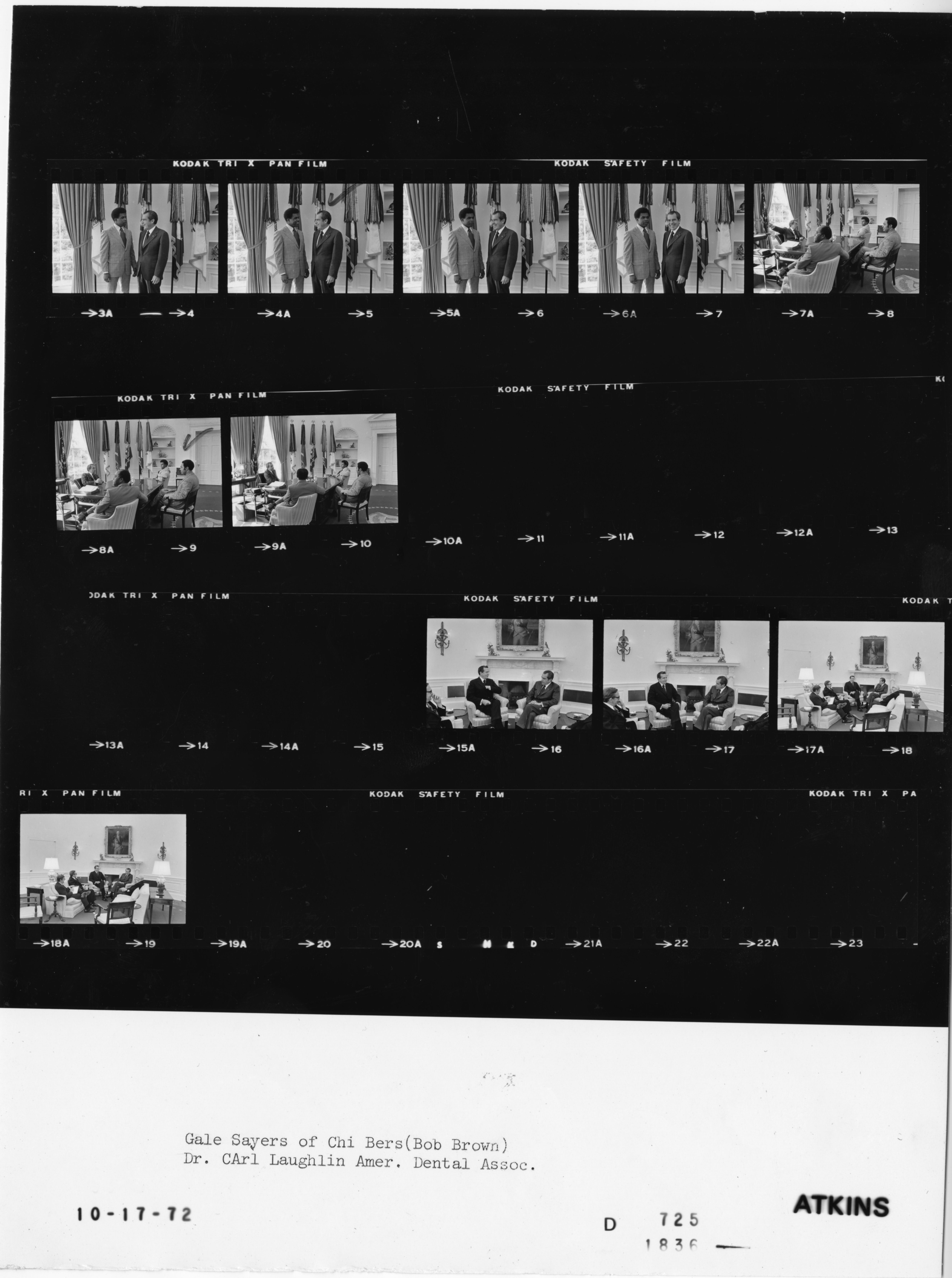
- Frame(s): WHPO-D0725-03A-09A, President Nixon at his desk during a meeting with football player Gale Sayers, (former Chicago Bears) member of the National Advisory Council for Drug Abuse Prevention and Paul Jones Director of the Black Vote Division of the Committee for the Re-election of the President (CRP or CREP) and Special Assistant Robert J. Brown. 10/17/1972, Washington, D.C. White House, Oval Office. President Nixon, Gale Sayers, Robert J. Brown, Paul Jones.
- Frame(s): WHPO-D0725-04A, President Nixon standing in the Oval Office with football player Gale Sayers, (former Chicago Bears). 10/17/1972, Washington, D.C. White House, Oval Office. President Nixon, Gale Sayers.
- Frame(s): WHPO-D0725-15A-18A, President Nixon seated informally with American Dental Association President Dr. Carl Laughlin, President of the American Dental Association (ADA) and the President's personal dentist Dr. William Chase and Hal Christensen, Assistant Executive Director of the ADA, Washington, D.C. 10/17/1972, Washington, D.C. White House, Oval Office. President Nixon, Hal M. Christensen, Dr. Carl Laughlin, Dr. William O. Chase.
Roll WHPO-D0726 Photographer: Royer | Color or B&W: B&W

- Frame(s): WHPO-D0726-, Vice President Agnew with the members of Young Labor for Richard Nixon. 10/17/1972, Washington, D.C. unknown. Spiro Agnew, Nixon supporters.
Roll WHPO-D0727 Photographer: Royer | Color or B&W: B&W
- Frame(s): WHPO-D0727-, Vice President Agnew shaking hands with a Young Labor for Richard Nixon member. 10/17/1972, Washington, D.C. unknown. Spiro Agnew, Nixon supporter.
Roll WHPO-D0728 Photographer: Royer | Color or B&W: B&W
- Frame(s): WHPO-D0728-, Pat Nixon at the ceremony honoring the 1972 "National Retired Teacher of the Year," Miss Kate Frank. 10/17/1972, Washington, D.C. Diplomatic Reception Room, White House. Pat Nixon, Kate Frank, NRTA officials.
Roll WHPO-D0729 Photographer: Kightlinger, Jack | Color or B&W: Color
- Frame(s): WHPO-D0729-, Pat Nixon at the ceremony honoring the 1972 "National Retired Teacher of the Year," Miss Kate Frank. 10/17/1972, Washington, D.C. Diplomatic Reception Room, White House. Pat Nixon, Kate Frank, NRTA officials.
The White House Communications Agency Sound Recordings Collection contains public statements that took place between 1969 and 1974. Visit the finding aid to learn more.
H - White House Staff Member Recordings
- WHCA-SR-H-662
Press briefing by Caspar Weinberger, John D. Ehrlichman, and Ronald Ziegler on the Water Pollution Bill. (10/17/1972, Press Lobby, White House)
Runtime: 0:23:49
Keywords: Environment, clean air, clean water, Press conferences, news conferences, interviews, media, press secretary
Production credits: Audio feed supplied by WHCA; Recorded by CBW (initials of WHCA engineer)
Original Format: 1/4-inch reel-to-reel audiotape. Original source type: Original.
L - White House Press Office Briefings
- WHCA-SR-L-040
Press briefing by Ronald Ziegler. (10/17/1972, White House Press LWhite House Press Lobbyobby)
Runtime: 0:45:02
Keywords: press conferences, news conferences, interviews, media, press secretary, briefings, public statements to the press, Paris Peach Talks, Vietnam War, Indochina War, treaties, negotiations, bills, laws, State and Local Fiscal Assistance Act of 1972, financia
Production credits: Audio feed supplied by WHCA; Recorded by JMM (initials of WHCA engineer)
Original Format: 1/4-inch reel-to-reel audiotape. Original source type: Original. Technical notes: 51 minutes and 42 seconds of silence at end of recording removed from access copies.
P - Formal Presidential Remarks
- WHCA-SR-P-721010
Remarks by President Nixon to visiting labor leaders from 24 foreign nations. (10/17/1972)
Runtime: 10:36
Original Format: 1/4-inch reel-to-reel audiotape. Original source type: Original. - WHCA-SR-P-721011
Veterans Day message. (10/17/1972)
Runtime: 1:50
Original Format: 1/4-inch reel-to-reel audiotape. Original source type: Original.
The White House Communications Agency Videotape Collection contains “off-the-air” recordings of televised programs produced between 1968 and 1974. Visit the finding aid to learn more.
- WHCA-5832
Weekly News Summary, Tape II.
ALL NETWORKS
Runtime: 1:30
1. Reasoner/Giggins: Henry Kissinger in Paris, France and Saigon, Vietnam. Time Code Start: 00:00. Keywords: Paris Peace Talks, Vietnam War, treaty, treaties, negotiations, government, officials, travel, trips. Network: ABC.
2. Smith/Koppel: Paris Peace Talks; Vietnam. Time Code Start: 03:07. Keywords: Paris Peace Talks, Vietnam War, treaty, treaties, negotiations. Network: ABC.
3. Smith/Jarriel: President Nixon campaign tactics. Time Code Start: 05:44. Keywords: Presidents, Presidential elections, campaigns, campaigning. Network: ABC.
4. Reasoner/Reynolds: McGovern campaigning. Time Code Start: 07:42. Keywords: Presidential elections, campaigns, campaigning, candidates. Network: ABC.
5. Smith/Donaldson: Watergate case; Laurence Young talks about Segretti. Time Code Start: 11:36. Keywords: Dirty Tricks, political sabotage, trials, Watergate, Senate committee hearings, investigations, testimony, testify, cover-ups, Presidential elections, campaigns. Network: ABC.
6. Reasoner/Gill: Connally talks about Watergate case. Time Code Start: 15:20. Keywords: Watergate, Senate committee hearings, investigations, testimony, testify, cover-ups, break-in, burglary, theft, plumbers, scandals. Network: ABC.
7. Reasoner: Commentary on Congress abdicating its constitutional power. Time Code Start: 16:55. Keywords: House of Representatives, legislation. Network: ABC.
8. Chancellor/Valeriani: Henry Kissinger leaves Paris, France for Saigon, Vietnam. Time Code Start: 18:46. Keywords: Paris Peace Talks, Vietnam War, treaty, treaties, negotiations, government, officials, travel, trips, departures. Network: NBC.
9. Chancellor/Kiker: Connally comments on Watergate case; McGovern in Texas. Time Code Start: 20:30. Keywords: Watergate, Senate committee hearings, investigations, testimony, testify, cover-ups, break-in, burglary, theft, plumbers, scandals. Network: NBC.
10. Brinkley: Commentary on the Presidential campaign. Time Code Start: 23:50. Keywords: Presidential elections, campaigns, campaigning, candidates. Network: NBC.
11. Cronkite/Wagner: Henry Kissinger leaves Paris, France for Saigon, Vietnam; Vietnam War. Time Code Start: 25:35. Keywords: Paris Peace Talks, Vietnam War, treaty, treaties, negotiations, officials, travel, trips, departures. Network: CBS.
12. Cronkite/Herman: Special report - What happened to welfare reform. Time Code Start: 29:25. Keywords: bills, laws, Family Assistance Programs, government aid, financial aid, health and welfare assistance, financial aid, investigations, reports. Network: CBS.
13. Cronkite/Sevareid: Commentary on the campaign and the poll. Time Code Start: 42:36. Keywords: public opinions, polls, approval ratings, Gallup poll, Harris poll, Presidential elections, campaigns, primaries, candidates, voting. Network: CBS.
Context (External Sources)
The Vanderbilt Television News Archive is the world's most extensive and complete archive of television news. They have been recording, preserving and providing access to television news broadcasts of the national networks since August 5, 1968.
Wikipedia is a free encyclopedia that anyone can edit.